Prologue
I am teaching the Child to speak.
It is a difficult process. I have long since discovered on our expeditions together that he can imitate any of the birds or animals we come across, and he delights in showing off to me how he can whistle like the big hawks we see occasionally floating high up under the clouds or throw his voice, pic pic, against the bole of a tree, like the woodpeckers of my childhood, the sacred spirits of our Sulmo countryside. He stands with his feet apart, hands on hips, head held back to the light, and his lips contort, his features strain to become those of the bird he is mimicking, to become beak, crest, wattles, as out of his body he produces the absolute voice of the creature, and surely, in entering into the mysterious life of its language, becomes, for a moment, the creature itself, so that to my eyes he seems miraculously transformed.
Sometimes he uses his hands like an instrument to trill and flute, blowing across his fist and fluttering his fingers. At other times the cry simply floats out of him, high and clear, or the warbling comes from deep in his throat, a guttural murmuring, or his body suddenly gives forth a metallic creaking so that I am startled by its closeness. It is as if each of the various bird species—ground pigeons, crows, waders, high-flying migratory birds that have been who knows where over the horizon—had their life in him and could be drawn out on the breath between his lips; as if he had some entrance to their mysterious comings and goings among the grasses, or had been with them to the bottom of the river where the water birds dive after their prey, or in the high places of the air where imagination fails to follow them or to catch with the ear how their cries are translated at the margin of the stars.Footnote 1
The narrator is Ovid, or rather novelist David Malouf's imagining of the Roman poet in his Scythian exile, telling of the feral child he has taken in. To be sure, Malouf's Ovid is a modern mind, concerned here with language and reason as markers, simultaneously, of humanness and human alienation from Nature.Footnote 2 But there is more. Malouf's Ovid here begins to recognize that the Child's vocal behavior is ecological. That is, he is not merely imitating the hawk or the woodpecker, he in his full humanness speaks hawk or speaks woodpecker, announcing his presence in the soundscape in the languages of his fellow creatures. And it dawns on the poet that, paradoxically, the Child is in some way more fully human than Ovid and his former fellow citizens, that their modernity has separated them from the world.Footnote 3
The separation involves a suppression of the ecological impulse in language and culture; or, more benignly, it involves uncritical acceptance of a “misleading distinction” between immaterial and material aspects of culture according to which “language, tradition, art, music, law, and religion are immaterial, insubstantial, or intangible, whereas tools, shelters, clothing, vehicles, and books are not.”Footnote 4 We may casually accept the notion of music as acoustic expression in a soundscape, but recognizing music's ecological impulse challenges the place of natural sounds in Western musicology.Footnote 5 Having separated pitched sound from nature as much as possible—disciplined it into scales, temperaments, etc.—Western music culture has for centuries made extraordinary efforts to imitate natural sounds and processes, whether through madrigalisms and word-painting, or more recently, recorded or synthesized sound and so-called extended performance techniques. Traditional musicological discourse rarely takes these timbral practices into account. If it does, then they are considered secondary to form, motivic development, and pitch structure, or understood to represent abstract cultural categories—“high” or “low” social status, the sacred or the profane, the pastoral, etc. A musical sound's maker is not considered an agent, and the sound's timbre is not recognized as directly transmitting crucial information of the maker's identity, position, emotional attitude, or conditions in which maker and hearer encounter one another.
One consequence of this situation is the uncertain value of sound source and timbre for understanding a composition's structure. This is especially true for non-tonal music of recent decades, such as the work of George Crumb. Performers and audiences are familiar with Crumb's use of idiosyncratic performance directions, non-canonical instrumentation, vocalizations, and quotation. Critics have called these practices “novelties,” “spooky effects,” and “childlike,” even in laudatory reviews.Footnote 6 Scholars are not sure how these features should be interpreted in the context of Crumb's evident and delightfully elaborate and symmetrical motivic designs. In this article, I claim that the questions posed by Crumb's characteristic use of sound are answered by renewing an understanding of music as ecological utterance, as expressive engagement in the natural soundscape. I offer as a case study “El niño busca su voz,” the first song of Crumb's cycle Ancient Voices of Children (1970) on texts by Federico García Lorca. I argue that the song enacts the vocal ecology of natural soundscapes in which humans and fellow organisms—crickets, in this case—interact and make claims of place and self. I begin with a brief account of the form and then explain my ecological approach to vocal expression before turning to analysis of the text and music themselves. More broadly, this study demonstrates the value of recognizing music as a member of a family of acoustic behaviors human beings share with other organisms to which both makers and hearers attribute meaning and purpose in the soundscape.
Music, Song, and Ecology
Ancient Voices of Children is scored for soprano and boy soprano, and a chamber ensemble of oboe, mandolin, harp, “electric piano” (that is, a standard concert grand fitted with contact microphones and connected to an amplifier and speakers), and a percussion suite needing three players. The oboe and mandolin are not used in “El niño.”
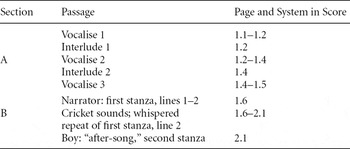
Table 1 outlines the form of “El niño” according to its layout in the 1970 edition of the score.Footnote 7 In the table and throughout this article, locations of passages in the score are given in the form x.y, where x is the page number and y is the system. For example, the soprano sings the first line of the text at 1.6, or the sixth system on page 1.Footnote 8
Form of George Crumb, Ancient Voices of Children, I. “El niño busca su voz,” according to the published score (1970).

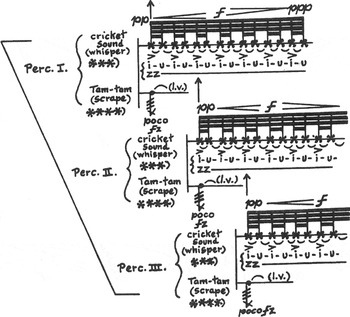
The A section (1.1–1.5) begins with a vocalise in which the soprano soloist sings cycles of vowels, along with other figures, into the open, amplified piano. Two more vocalises follow, alternating with instrumental interludes. The B section (1.6–2.1) begins with the first sung text of the song, after which the score calls for the three percussionists to whisper “cricket sounds.” We know how to speak about the pitches of the soprano's vocalise, and we are likely to say that the striking timbre and texture change when the cricket sounds begin help to articulate the division between A and B sections, but we are not sure how to analyze these sounds. We might label the cricket sounds in the song as Nachtmusik, but this suggests an affective signal at best. We might say the vocal techniques called for by Crumb are “effect” or “color.” Yet in so doing we implicitly exempt them from any evaluation of pitch-class relations and motivic development, subtly but unmistakably distinguishing them from “the music.”Footnote 9 It cannot be otherwise, because if these sounds specify something or someone, then they must be extra-musical.
The sounds do indeed specify: the vowel cycles specify a voice—and thus one who would speak—making the sounds of which language is made; and the sounds made by the percussionists specify crickets and all that the sounds of crickets entail—to humans and to other crickets. The song engages with the world through a negotiation of identity, agency, territory, and survival; that is to say, the song enacts an acoustic, and specifically vocal, ecology.
By no means have Western musicians assumed, at least not for a long time, that music is ecological in this way. Gary Tomlinson has ascribed a suppression, or purification, of the category music to the eighteenth century disciplining of song. From ancient times through the Renaissance, song had power. Tomlinson writes,
[T]he ability of song to affect listeners was conceived as an alteration worked on body, soul, and the faculties that mediated between them. This view took for granted the impact of song on the immaterial aspect of the human organism, soul. In doing so it recognized the power of song to set in motion complex psychophysiological relations between the human organism and the surrounding cosmos.Footnote 10
After the eighteenth century “emancipation” of instrumental music from vocal, “Nothing could seem more self-evident to us, after all, than that song is a kind of music, that a song is ‘a piece of music’. . . or that singing is a musical activity.” Tomlinson calls for a reconfiguration of musicology as “cantology,” the first aim of which “would be to break out of this naturalized hierarchy, to grasp and live with an arrangement in which music is a subcategory of song and music-making a songish thing.”Footnote 11 And music making, as a songish thing, is efficacious: through it the singer makes things happen in the world, or means to do so. In short, song is ecological. The suppression of its efficacy is, at least in part, a suppression of music's ecological agency, just as Roman language and culture in Malouf's Ovid's account suppresses the ecological agency he witnesses in the Child's birdish vocalizing. Musical sounds, divorced from ecological context and potential efficacy, become, in Marion Guck's term, music-literal.Footnote 12 That is, just as metaphorical terms such as those for pitch “height” have come to be understood as literal and therefore naturally true of the musical phenomena they describe, so to have the sounds themselves: the timbre of a horn or of a singing voice has only aesthetic value; any echo of a bellowing aurochs or a weeping mother is extra-musical.Footnote 13 The metaphors, like the music they conceptualize, have become transparent.Footnote 14
From the ecological perspective I adopt here, Crumb's song re-inverts the song-music relation and enacts a familiar nocturnal soundscape and its vocal ecology: when crickets have voice, humans are mute, and vice versa.
My claims for a vocal ecology in general, and for specification of ecological agency in particular, are consonant with Eric Clarke's work on the ecology of listening, and extend it to account for composition and performance.Footnote 15 Drawing on James J. Gibson's ecological psychology, Clarke argues that musical sound, like all other objects and events in our environment, afford the listener opportunities and meaning, especially opportunities for action, that arise both from the properties of the objects and events and our capacities and needs. Clarke writes,
When humans and other animals perceive the world, they do so actively. Perception is essentially exploratory, seeking out sources of stimulation in order to discover more about the environment. This operates in so many ways and so continuously that it is easy to overlook: we detect a sound and turn to it; we catch sight of an object, turn our eyes to it, lean forward and reach out to touch it; we get a whiff of something and deliberately breathe in through the nose to get a better sense of its smell. These and countless other examples illustrate the constant orienting of the organism to its environment, the constant search to optimize and explore the source of stimulation. Actions lead to, enhance, and direct perception, and are in turn the result of, and response to, perception. Resonance is not passive: it is a perceiving organism's active exploratory engagement with its environment.Footnote 16
Clarke is interested in the experience of the enculturated listener to Western music, for whom functions or actions tend towards, as Clarke puts it, “different varieties of more or less concealed or sublimated active engagement” during apparently passive attention.Footnote 17 But the “general ecological principle of reciprocity of perception and action,” the idea that organism and environment resonate with each other, still stands.Footnote 18
Thus the active responses of an organism to the objects and events in its environment are themselves objects and events in the environment, reciprocally affording meaning and opportunities for action to other organisms, and crucially, simultaneously affording the acting organism agency in its environment.Footnote 19 It is from this perspective that I shall interpret the voices in Crumb's song to be enacting claims of presence and agency in the nocturnal soundscape.
My ecological approach necessarily entails attention to the relationship between human expression and the natural environment, and in this way I share principles and perspectives with the work gathered recently under the heading “ecomusicology,” but with some important differences. Introducing a recent colloquy in the Journal of the American Musicological Society, Aaron Allen asks six fundamental questions that ecomusicology, or ecocritical musicology, must answer.Footnote 20 Five of these have to do with the role the discipline can or should play in thinking about human impact on the environment. These are important questions, but not ones to which I address this article. A sixth question is, “how does nature inform music, and what can the study of music tell us about humans, other species, the built environment, the natural world, constructed ‘nature,’ and their connections?” I would begin the question differently: “How is music natural, or ‘of nature’?” The difference between Allen's formulation and mine lies in the relationship between music as part of cultural discourse that may contemplate Nature and music as natural, as part of a suite of human acoustic behaviors—and I include listening as well as making in these behaviors.Footnote 21 Papers by Denise Von Glahn and Daniel Grimley in the same colloquy illustrate my point.
Von Glahn asks, “[W]hose place has been described in the nature-conquering narratives [expressive of Americanness]; how has the nation been characterized and by what authority; whose identity has been foregrounded?”Footnote 22 In answer she outlines a project that studies works composed by women that reflect a “time- and place-specific understanding of nature” and “express societal values regarding relationships between humans and nonhuman others.”Footnote 23 Here and elsewhere, Von Glahn's project explores the place of Nature in American cultural discourse, rather than music as natural.Footnote 24
Grimley considers the effects of Sibelius's Tapiola as a land/soundscape in which the listener is situated and to which the listener is attuned, as one is, to some degree, always situated in and attuned to one's surroundings.Footnote 25 Although Grimley notes how Tapiola “belongs within an established cultural tradition . . . of the forest as a mysterious twilight domain of primitive folk custom and ritual sacrifice,”Footnote 26 that is, a well-established theme in cultural discourse, he is more concerned with the ways the piece creates a soundscape in which the listener is immersed in the same way a perceiving organism is immersed in the light, sound, wind, and ground of a natural landscape.
My concerns here are more like Grimley's than Von Glahn's, but that does not mean I value one strain of ecologically aware musicology more than the other. Both are necessary modes of inquiry. Rather, a number of Crumb's compositions, “El niño” being a brief and particularly manageable one among them, raise for me not only questions about Nature represented in music, but specifically what it means to have a voice, to use it, and to be heard in the world. Put another way, how are human behaviors that Western scholars recognize as musical akin to acoustic behaviors of other organisms?
Other works by Crumb, in one way or another, are ecological in the sense I mean. I have elsewhere traced in Apparition (1979), a song cycle on texts by Walt Whitman, the way the voice of the hermit thrush, as Whitman writes of it in “When Lilacs Last in the Dooryard Bloom'd,” is heard first as itself—an elusive nocturnal bird—and then gradually as a voice that sings to and with the poet in mourning for the death of Abraham Lincoln.Footnote 27An Idyll for the Misbegotten (1985), for flute and percussion, is explicitly about environmental degradation and is meant to evoke the “voice of nature.”Footnote 28 For much of the piece, this voice (in the flute) is birdsong-like, and will have the effect Crumb intends if played “from afar, over a lake, on a moonlight evening in August.”Footnote 29 The flute-bird would be mostly audible in such a setting, depending on wind, tree cover, and distance, but the percussion parts would only occasionally be prominent enough to identify their sources. The tam-tam would be heard as no more than an ominous rumble, too distant to identify but too present to completely dismiss as “background,” indistinguishable from the omnipresent rumble of noise generated by the mechanisms of human culture that are the instruments of what Crumb calls our illegitimacy as “monarchs of a dying world.”Footnote 30Vox Balanae was inspired, according to Crumb, by recordings of humpback whales first made available in in the early 1970s. Rather than directly represent the sounds of whale song, the piece evokes the vast time and distances across which whales sing and alter their songs. Crumb says, “The range was the first thing that impressed me . . . from the pedal tones of the organ to sounds that go way beyond the limit of human hearing. A sense of musical phrase, an incredible composition that was going on, majestic, huge phrases.”Footnote 31 The scale on which humpbacks sing and compose is indeed vast: the whales change their songs slowly, singing variations on phrases over the course of years until songs are almost completely new.Footnote 32 All of these works are considerably more complex than “El niño.” Because of its brevity, however, “El niño” is an ideal ecosystem in which to begin to understand song as acoustic agency in a soundscape.
Lorca's poem
Crumb's text for “El niño” is drawn from Lorca's poem, “El niño mudo” (“The Voiceless Child”), published in the Canciones of 1927. The two stanzas used by Crumb are in boldface.
The front matter of the score provides a translation by W. S. Merwin of the two stanzas set in the song:
The text tells of ownership of the voice, of possessing vocal agency. The cricket king has the boy's voice; the boy asks for it back, but only so that he can fashion it into a ring—an emblem of ownership—for the cricket king to wear.
Lorca's poem has more to say about possession of the voice. Here is a more recent translation by Alan S. Trueblood, given complete:
The first of the additional couplets repeats the second couplet of the first stanza; the last couplet of the poem portrays the voice, captive though it is, as an agent. The cricket does not wear the voice; rather, the voice puts on cricket clothes, becomes cricket-like.
Merwin's and Trueblood's translations of the second stanza differ on the identity of he who will wear the ring. Merwin's “so that he may wear my silence / on his little finger” refers to the cricket king. Trueblood's “for my silence to wear / on its little finger” personifies the boy's silence and gives it the ring. We can reconcile the difference through an appeal to the vocal ecology of the soundscape we share with crickets. They chirp only when we are silent and still. A chirping cricket is, in this sense, a human being's silence. We shall return to this matter below.
Crumb's voz
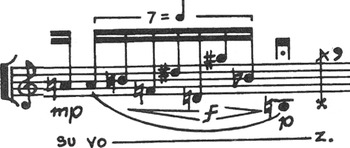
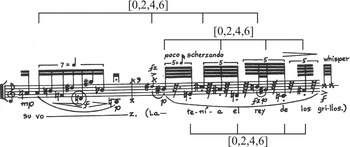
Lorca's poem tells of the voice; likewise, Crumb's song centers on a voice, or more precisely, voz, the figure shown in Example 1a. In a song replete with displays of the vocal tract's abilities to make not just pitches but sounds that specify a vocalizing organism, voz is remarkable for its presentation of the voice as more of a musical instrument than a quivering of a singer's throat and for registering conventions of compound melody and motivic development. Nevertheless, voz is a voice; it opens its mouth and speaks, expands, from a registrally neutral A4.Footnote 34 We will explore this opening and its sequel note by note as a first step toward understanding how the song portrays sounds becoming meaningful utterances of a voice. In the analysis below, I model this process as a pitch- and pitch-class-motivic one, first deriving voz from smaller motives in the opening vocalise (1.1–1.2), and then showing how the rest of the song plays with and elaborates what has come before. I write “plays with” intentionally, because the remainder of the A section manipulates the original motives and their combinations in ways that are less developmental (in the traditional musicological sense of teleological and implicitly hierarchical alteration and recombination) than they are casual and exploratory. The curious, playful character that emerges in the analysis is consonant with the interpretation of Lorca's text, in which the cricket king tries out the boy's voice, beginning with a few trial sounds, and eventually learning how to speak fluently. Analyses of music and text together thus support the claim that, in portraying the problem of interspecies vocal agency in the soundscape, “El niño” enacts the ecology of the nocturnal soundscape humans and crickets—and indeed many other organisms—share.
“El niño,” © 1970 by C. F. Peters Corporation. Used by permission. a. 1.6, voz figure.

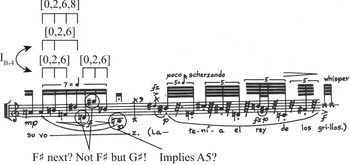
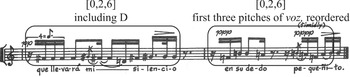
Example 1b, from the B section narration (1.6), shows how the first three pitches of voz begin to open registral space and form a trichord of class [0, 2, 6]. The fourth pitch, D♯5, makes a second [0, 2, 6], {A, B, D♯}, the inversion about B♭4 of the first, and in so doing, suggests that voz articulates a counterpoint about that axis. Together, the trichords make a tetrachord of class [0, 2, 6, 8]. The fifth pitch, D4, does not make an [0, 2, 6], but seems to continue the inversional counterpoint of the compound melody, and would do so, were it followed by F♯5. But voz is a voice, and it now “speaks out,” as it were, with G♯5, exceeding the boundaries of the apparent motivic-transformational path.Footnote 35 The seventh pitch, B♭4, reengages voz with the motivic process, both making the earlier axis of inversion explicit and fixing D and G♯ in a third [0, 2, 6]. The eighth pitch of voz, B3, neither adds a new pitch class nor makes a new [0, 2, 6]. Perhaps it leaves open the possibility of A5, its inversional sibling about B♭4, but A5 is never sung or played in the song.
“El niño,” 1.6, motivic process in voz.

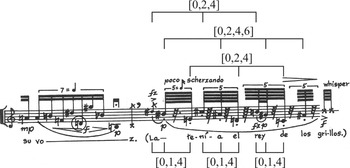
By contrast, the parenthetical explanation for the boy's search—that the cricket king has the voice—closes voz’s mouth, contracts its registral space, and abandons—or at least changes—the motivic process. This passage appears on the right side of Example 1c, following voz. Crumb's metrical notation and the sequential descent in register suggest trichords of class [0, 1, 4], a sonority otherwise not salient in the song. Coming immediately after voz with its contrapuntal, register-opening effect, however, the rests and staccato articulation encourage a hearing in which three voices, outlined by arpeggiated [0, 1, 4] chords, converge on F♯4. These three descending lines are as follows: the top line, (D♯, C♯, B), and bottom line, (E, D, C) descend through trichords of class [0, 2, 4]; the middle line, (B♯, A♯, G♯, F♯), descends through a tetrachord of class [0, 2, 4, 6].
“El niño,” 1.6, narration, first stanza, second line.

We can connect this part of the passage—the closing of voz’s mouth—to voz itself if we hear F♯4 completing both the bottom line as well as middle, the last sound before the mouth closes. Example 1d shows how. With F♯, the bottom line is also an [0, 2, 4, 6]. With A4 the pitch on which the lost voz begins, the top line is also a descending [0, 2, 4, 6].Footnote 36
“El niño,” 1.6, narration, first stanza, second line, alternative interpretation.

We hear voz two other times in the song. One of these is in the boy soprano's “after-song,” as Crumb labels the closing passage of the B section. Example 2 shows the final measures of the passage (2.1). Abbreviated and reordered, voz in the last measure of “El niño” is little more than a whimper; it has become a ring for the cricket king, the boy's silence personified, to wear “en su dedo pequeñito,” on his little finger. On the hand of the cricket, though, in the penultimate measure, the D4 of voz finds a new and clearly articulated [0, 2, 6]: {D, F♯, G♯}, a setting it was missing in the earlier statement. In the boy's silence—“mi silencio,” he sings—what is left of his voz speaks of that silence, while the cricket gives voz new voice.
“El niño,” 2.1, “after-song,” closing measures. © 1970 by C. F. Peters Corporation. Used by permission.

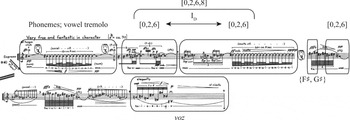
The other time we hear voz is at the close of Vocalise 1 (1.1–1.2), shown in Example 3. We do not yet recognize it as voz, though we might recognize it as voice, as sound uttered by someone. We might so recognize it because of the way it emerges out of the soprano's vocal calisthenics, marked “free and fantastic” by Crumb.
“El niño,” 1.1–1.2, Vocalise 1. © 1970 by C. F. Peters Corporation. Used by permission.

The vocalise—and the song—begins with three kinds of phoneme, the fundamental sound of which human utterances are formed: a tongue click, reminiscent of the clicks that are present in few languages now outside of southern Africa, “mm,” and vowels.Footnote 37 The soprano sings the vowels in a steadily accelerating and decelerating tremolo. There is no reason, yet, to hear the figure as the sound of something other than a C♯ articulated simultaneously accelerando-ritardando and crescendo-descrescendo. But the rapid vowel oscillation of this figure and others like it resemble, in notation and aural effect, the “cricket sound” performed later by the percussionists.
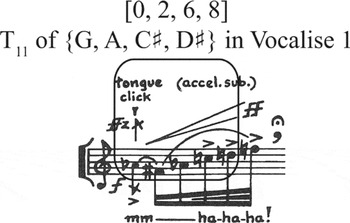
From these beginnings, sung entirely on C♯5, emerge the first syllables and the first pitch motives of the piece. An [0, 2, 6] figure settles again on C♯5, and then a second [0, 2, 6] figure, an inversion of the first about D, settles on D♯5, from which the soprano once again sings the cricket-like vowel tremolo. Together, the figures make an [0, 2, 6, 8] tetrachord, {G, A, C♯, D♯}. After a three-second pause, the soprano sings a new figure that includes one of the previous [0, 2, 6] trichords, and adds two new pitches, F♯5 and G♯5. These new notes make no [0, 2, 6] with any others yet sung. Perhaps they open the way to new versions of the trichord; if so, we should expect C, D, or both.
The soprano sings this new figure twice. In the first version of the figure, she sings only the syllable “ka-” followed by “mm.” In the second version, she sings a vowel cycle like those of the earlier cricket-like tremolos.Footnote 38 Then, “elegantly,” as Crumb's marking reads, the soprano sings the figure we will come to recognize as voz.
The emergence of voz in the first vocalise is both a motivic process and a narrative one. As the preceding analysis shows, voz emerges motivically from the first gestures of the song to which Crumb sets the vowel-cycle tremolos. But for the initial “k-” the soprano also sings vowels to voz. But these are not the vowel cycles of before; just as the voz figure expands the motivic process begun earlier in the vocalise, the vowel series set to the voz figure breaks out of the cycles sung earlier. All of this vocalizing has become a voice.
Voz emerges narratively as the cricket tries out its new voice. At first, it can manage only a few phonemes, and these in the cricket's native pulsing thrum. Shortly, though, the cricket manages syllables and melodic figures, and soon after, notes that foretell new figures. It is then that we hear voz.
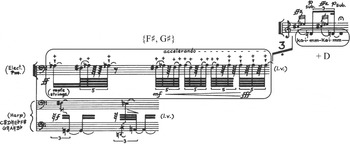
The cricket, or the voice in cricket guise, can now speak; it can create new utterances, and it takes pleasure in the new skill. Recall that the {F♯, G♯} dyad in Vocalise 1 called for D, C, or both, to make [0, 2, 6] trichords or an [0, 2, 6, 8] tetrachord. The dyad returns in the following Interlude 1 (1.2), played on the amplified piano. Example 4a shows Interlude 1 and the beginning of Vocalise 2, which the soprano begins with a figure emphasizing D4. After pausing there, she sings a rising figure, shown in Example 4b, that makes good on the promise of the {F♯, G♯} dyad and joins it with D. As the figure rises, it passes through C5 and D5, making an [0, 2, 6, 8] tetrachord related by T11 to the tetrachord in the first vocalise. And just as the first vocalise then moved beyond its initial tetrachord, so this figure moves beyond its tetrachord, adding F5. I claimed that the cricket—or the voice—is pleased by its newfound capability for speech. I say so because, here, it laughs, “ha-ha-ha!” Or better, it giggles with delight, as a child might when discovering a new skill. This is truly a child's voice.
“El niño,” © 1970 by C. F. Peters Corporation. Used by permission. a. 1.2, Interlude 1 and beginning of Vocalise 1.

“El niño,” 1.3, Vocalise 2, laughing figure.

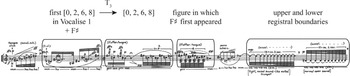
After this realization, motivic development and use of register are more confident, as Example 5 shows. The next figure rehearses the first [0, 2, 6, 8] tetrachord from Vocalise 1 and its first extension to F♯, then from this F♯ makes a new tetrachord related to the original by T3. Then the soprano sings the very figure in which F♯ first appeared. The cricket—or the voice—can not only create new utterances, it can tell a story about how what now is came to be out of what was.
“El niño,” 1.3, Vocalise 2. © 1970 by C. F. Peters Corporation. Used by permission.

Vocalise 2 closes with a thrumming “wa-wa” tremolo, different from the earlier vowel cycle tremolos but nevertheless similar enough to recall the cricket's earlier efforts with its new voice. But now, the tremolo marks the upper and lower registers of the captured and acclimated voice. E♭5 is enharmonically equivalent to the D♯5 on which the voice last sang the tremolo—the pitch, that is, on which the voice last sang in a cricket's manner—and D4 is the pitch after which voz began to open up and the capacity for speech emerged.
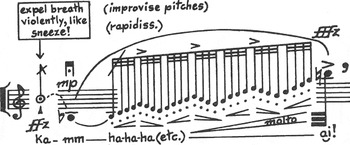
A detailed account of Vocalise 3 is unnecessary here. It continues development of figures that emerge in Vocalises 1 and 2, as if the cricket is in full human voice and relishing it. However, near the end of Vocalise 3 (1.5), and therefore of the song's A section, the cricket laughs again, this time in a great two-octave-plus-a-semitone sweep across and exceeding the range of voz; indeed, exceeding the range of any passage in the song. The figure appears in Example 6. From self-conscious giggle to hearty cackle, the A section depicts the cricket's possession of voice and agency in the song's soundscape.
“El niño,” 1.5, Vocalise 3, laughing figure. © 1970 by C. F. Peters Corporation. Used by permission.

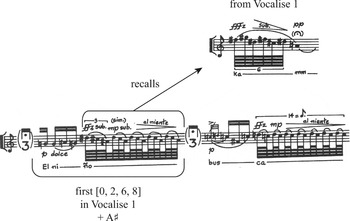
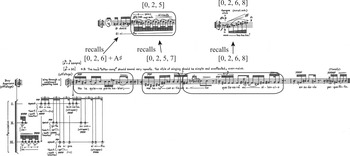
The B section of “El niño” opens with the first use of Lorca's text (1.6). The speaker is a third voice, neither the cricket nor the boy, but a narrator. We studied the end of this passage in Examples 1a–c above, and the beginning, shown in Example 7, now looks familiar. The setting of “El niño” (the first phrase of text, not the song's title) is the [0, 2, 6, 8] tetrachord from Vocalise 1, this time with an added A♯. We have heard enough by now to connect A♯, and the repeated [0, 2, 5] trichord it makes with D♯ and C♯, to another figure with which we are familiar: the figure in which the soprano first sang F♯ and G♯ (1.1). Were the present figure to include G♯, it would be a transposition of the earlier one without its A.
“El niño,” 1.6, narration, first stanza, first line. © 1970 by C. F. Peters Corporation. Used by permission.

The soprano's narration fades into a whisper, and it is safe for the cricket king and his subjects to sing again, this time in their own voices (1.6–2.1). The first part of the passage (1.6) appears in Example 8a. But they, too, must break off into a whisper and then silence, because the boy himself speaks (2.1), as shown in Example 8b. This is hardly his own voice. The boy sings, “No la quiero para hablar,” (I don't want it to speak with), but he uses the narrator's voice: the pitch classes are those to which the soprano sang “El niño busca su voz,” but without G. He then sings “me hare con ella un anillo,” beginning with the very collection alluded to by the soprano when she sang “niño” in the narration that began the B section (see the left side of Example 6). When the boy names the ring, “anillo,” into which he would make his stolen voice, he speaks for the first time in something like his voice—something like voz—continuing into the next phrase to make a familiar [0, 2, 6, 8] tetrachord. This is not the original {G, A, C♯, D♯} tetrachord, however. Rather, it is {F♯, G♯, C, D}, the one in which the cricket giggled upon realizing the agency of voz.
“El niño,” © 1970 by C. F. Peters Corporation. Used by permission. a. 1.6, cricket sounds.

“El niño,” 2.1, end of cricket sounds and “after-song.”

After this, as we saw in Example 2, the boy can just barely speak.
Vocal ecology
The boy has thus yielded the voice and agency in the soundscape to the cricket. If the boy speaks at the end of “El niño,” it is in the voice that for now belongs more to the cricket king. It is a curious thing to attribute vocal agency, or agency of any sort, to a cricket. We push cricket sounds into the background of our soundscape such that they can represent silence and emptiness—witness the playback of recorded cricket sounds to underscore lack of audience response to a comedian's joke. But the cricket sound then really represents the absence of human sound: the crickets’ “silence” becomes an overwhelming chorus—the voiceless taking voice, background noise becoming song. (Of course, only humans invest our interaction with crickets with meaning; for the crickets, as far as we know, both singing and being silent are simply matters of survival.)
Imagine wandering into a yard or field well after dark on a warm night. When you move or call, crickets in the area cease chirping, the response being more pronounced the nearer you are to the insects and the lower the vibrations you transmit through the ground.Footnote 39 So long as you are silent and motionless, however, crickets will chirp, sometimes so loudly and in such great numbers that not only can you hear little else clearly, you could not discern the location of a single cricket. Thus, crickets may interfere with our ability to assess the soundscape and thus our ability to exercise acoustic agency, such as our own social vocalizations that have intimate evolutionary ties to our responses to music.Footnote 40 Likewise, exercise of ecological agency, acoustic or physical, by human beings interferes with cricket communication. Male crickets—females do not chirp—produce sound by rubbing files on the undersurface of one wing with a plectrum on the top of the other, the vibrations of which excite resonators in the wings. The dominant, or carrier, frequency of the resonators and the frequency of the wingbeat pulses differ by species, and female crickets display phonotaxis, or motion toward a sound source. The female cricket's job is complicated by two factors. First, she must use the males’ calls alone to locate a suitable mate. Evidence suggests that she moves toward calls that feature a dominant frequency and pulse typical for her species. The problem is that species of other crickets may be present and chirping, and the cost of choosing the wrong mate is high. The second complication is the acoustic presence of yet other species—insects whose calls occupy similar regions of the frequency spectrum, bats whose echolocation signals can evidently be discerned by crickets if they are not acoustically masked, birds, and humans—and other sound sources, especially mechanical anthropogenic sounds.Footnote 41 Crickets must be still and silent to avoid predators; but they must chirp and move, and just as importantly, hear clearly to survive. The less we exercise agency in the soundscape, the more the crickets can do so.
Ecology and song
The problem of vocal agency is not only ecological, it is also cultural, as Tomlinson's account of song suggests. As pitched vocal behavior—song—was disciplined into music, it was stripped—at least outwardly—of its efficaciousness. First, efficacy was linked to pitch collections, pitch patterns, and rhythmic figures and then classified by mode (themselves a disciplining of melodic practice). Later, musical effects were ordered and explained according to categories received from classical rhetoric. Along the way these classifications became perfunctory, and music's power to summon spirits, influence natural phenomena, and so on was demonized or dismissed. Likewise, the vocal behavior we call song was divorced from some of its ecological and biological purposes: to announce territory, to warn off competing creatures and predators, to express to other organisms the singer's physical self-awareness.
Crumb's song challenges us to recognize these properties in music anew. Of course, from a performer's practical point of view, Crumb's use of timbre is simply imitative: the soprano soloist and percussionists performing Ancient Voices must think about how to make their voices sound “like crickets.” In the foregoing interpretation, however, Crumb's “El niño busca su voz” is not merely a song that imitates cricket sounds for effect. Like the Child in Malouf's tale, musicians performing Ancient Voices make concerted human and cricket sound, an enacting of the vocal ecology in which we and other creatures share.
In an attempt to show that poetry is best understood ecologically (in precisely the way I am using the term) Canadian poet and typographer Robert Bringhurst quotes Simone Weil on language and art as, ultimately, acts of compassionate subjectivity. Weil wrote, “Their function is to testify, after the fashion of apple trees in bloom, of stars.”Footnote 42 Bringhurst goes on:
Aristotle called this process μíμησις [mímēsis]. This has been translated as “imitation,” but participation would be closer. It is imitation in the culturally significant sense of the word: the sense in which children imitate their elders and apprentices their masters. Μíμησις means learning by doing. And words, Weil reminds us, are not just poker chips that are used for passing judgements or passing exams. Words are the tracks left by the breath of the mind as it intersects with the breath of the lungs.Footnote 43
That is, utterances are not merely tokens; they are physical and efficacious. They are the sounds of someone, or something. Likewise, the distinctive timbral characters in Crumb's music are neither music-literal acoustic tokens nor tone-painterly effects nor mere imitation, but notices of self and agency: a cricket speaks, a boy whimpers. Crumb's music implicitly asks, how and what does song express for the individual who sings—regardless of species? In what way may we once again acknowledge that human musics are songish?