Introduction
A Eurasian woodwasp, Sirex noctilio (Hymenoptera: Siricidae), was first discovered in North America in 2005 (Hoebeke et al. Reference Jacobs, Bergdahl, Wingfield, Halik, Seifert, Bright and Wingfield2005; de Groot et al. Reference Fong and Crowden2006). This woodwasp has an important symbiotic relationship with a basidiomycete fungus, Amylostereum areolatum (Fries) Boidin (Stereaceae), (Talbot Reference Talbot1977), which may influence whether or not it becomes a significant pest in North America. Although it is a secondary pest in its native Eurasian range, where it has been introduced in the Southern Hemisphere, this woodwasp is of considerable economic concern (e.g., Bedding Reference Bedding, Bedding, Akhurst and Kaya1993).
Sirex noctilio favours suppressed, physiologically stressed, or damaged pine trees, Pinus L. (Pinaceae) (Spradbery and Kirk Reference Spradbery and Kirk1978; Neumann and Minko Reference Neumann and Minko1981). During oviposition, a female woodwasp inoculates a tree with the fungus and a phytotoxic mucus that together impair the physiological and defensive responses of the tree and eventually cause its death (Coutts and Dolezal Reference de Groot, Nystrom and Scarr1969; Fong and Crowden Reference Hanson1973). The fungal symbiont is also integral to the woodwasp's development. Egg eclosion is delayed when conditions in the tree impede fungal growth (Madden Reference Madden, Coutts and Batra1981), and the fungus provides an essential nutritional resource for at least the early larval instars (Madden and Coutts 1979). Larvae may starve if A. areolatum growth is inhibited (Coutts Reference Coutts and Dolezal1965; Coutts and Dolezal Reference Coutts and Dolezal1965; King Reference Kirisits, Lieutier, Day, Battisti, Grégoire and Evans1966), but when conditions for fungal growth are optimal, larger adults are produced and their reproductive potential is greater (Madden Reference Madden, Coutts and Batra1981). Because the reproduction and development of S. noctilio are highly dependant upon its fungal associate, inhibition of the symbiont's growth could have considerable consequences for the population dynamics of this woodwasp.
In North America, potentially significant interactions may occur between S. noctilio and a large guild of bark and wood-boring beetles and their fungal associates. In Canada, the known distribution of S. noctilio in 2010 included all of southern Ontario and a few scattered locations in Quebec close to the border between Ontario and the United States of America (Canadian Food Inspection Agency Reference Coutts2010). There, it is reproductively active from early July to mid-September (Long et al. Reference Madden2009) and may deposit eggs throughout the tree stem (Morgan and Stewart Reference Morgan and Stewart1966; Neumann et al. Reference Neumann, Harris, Kassaby and Minko1982). An introduced bark beetle, Tomicus piniperda (L.) (Coleoptera: Curculionidae), is a common insect that uses similar host trees and may be associated with S. noctilio in this range in Canada (Morgan et al. Reference Morgan, de Groot and Smith2004). Tomicus piniperda is reproductively active primarily in the early spring, although a second brood can be produced during the summer (Ryall and Smith Reference Ryall and Smith2000). Leptographium wingfieldii Morelet and Ophiostoma minus (Hedgcock) H. and P. Sydow (Ophiostomataceae) are common “blue-stain” fungal associates of T. piniperda in its native and Canadian ranges (Jacobs et al. Reference Jamieson2004; Kirisits Reference Klepzig2004; Hausner et al. Reference Hironori, Toshiyuki, Hayato and Shuichi2005; Ben Jamaa et al. Reference Ben, Lieutier, Yart, Jerraya and Khouja2007). These fungal species are relatively virulent pathogens that can grow quickly in pine wood (Uzunović and Webber Reference Uzunović and Webber1998; Solheim et al. Reference Solheim, Krokene and Långström2001). They do not have an exclusive association with T. piniperda and are vectored by a number of other beetle species (e.g., Jacobs et al. Reference Jamieson2004; Kirisits Reference Klepzig2004) that may also co-occur with S. noctilio in trees.
Based on field observations, it has been postulated that A. areolatum may be a weak competitor against blue-stain fungi and that this will subsequently impede the development and survival of S. noctilio larvae (Hanson Reference Hausner, Iranpour, Kim, Breuil, Davis and Gibb1939; Morgan and Stewart Reference Morgan and Stewart1966; Titze and Stahl Reference Titze and Stahl1970). Most of these suggestions, however, are anecdotal although King Reference Kirisits, Lieutier, Day, Battisti, Grégoire and Evans(1966) noted that some common nonophiostomatoid fungi are strongly antagonistic to A. areolatum. The success of a fungus in colonizing a substrate depends on its competitive ability to capture the substrate either primarily, when the fungus rapidly exploits and gains control over the uncolonized resource, or secondarily, when one fungal species is able to gain access to or colonize an area already occupied by another (Rayner and Webber Reference Rayner, Webber, Jennings and Rayner1984).
The purpose of our study was to assess the outcome of in vitro competition between the woodwasp fungal symbiont A. areolatum and selected bark beetle-vectored ophiostomatoid fungi. Our objectives were to evaluate (i) the outcomes of primary capture of uncolonized substrate between A. areolatum and L. wingfieldii and O. minus; (ii) how temperature modifies the outcomes of these interactions; (iii) the ability of A. areolatum to establish in already occupied substrates (secondary resource capture); and (iv) the effect of substrate on the outcomes of competition experiments.
Materials and methods
Fungal isolates
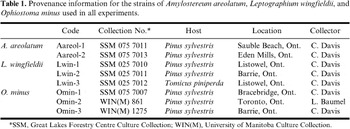
Both strains of A. areolatum known to occur in Canada were used in these experiments. Three strains each of the T. piniperda fungal associates L. wingfieldii and O. minus were used as potential competitors. Multiple strains were used because they may have different growth rates (e.g., Lieutier et al. Reference Long, Williams and Hajek2004), which will modify the results of competition. All strains were obtained from existing culture collections (Table 1), inoculated onto sterile Pinus sylvestris L. woodchips, and then re-isolated to mitigate the effects of storage in culture. The strains were then grown on potato dextrose agar (PDA) for use in the following experiments.

* SSM, Great Lakes Forestry Centre Culture Collection; WIN(M), University of Manitoba Culture Collection.
Interactions between A. areolatum and ophiostomatoid species on artificial media
In paired comparisons, each strain of A. areolatum was tested against each strain of the ophiostomatoid species. For each of the pairs, a 5 mm diameter PDA plug colonized by each fungus was inoculated onto 2.4% PDA on opposite sides of a 9 cm diameter Petri plate. The A. areolatum plug was inoculated 4 days prior to the contender to address the growth lag of this species (A. areolatum growth did not begin until 4 days after inoculation).
Five replicates of each pair combination were inoculated, and each strain was also inoculated on its own as a control. All plates were sealed with Parafilm and stored in the dark at 25°C (±1°C) in a growth chamber. The outer extent of each of the resultant fungal colonies was traced on the bottom of the plate every second day for 2 weeks, starting from day 2 after ophiostomatoid species inoculation. Fungal hyphae of each species are morphologically distinct, so, colony boundaries could be determined visually (Klepzig Reference Lieutier, Yart, Ye, Sauvard and Gallois1998) and confirmed under a dissecting scope. The sequential and final boundaries of the colony for each species were traced onto paper and then scanned and measured with Scion Image software (Scion Corporation, Frederick, Maryland).
Interactions on wood substrate and effect of temperature
The interaction experiment was repeated on autoclaved (121°C × 45 min submerged in distilled water) P. sylvestris wood chips (approximate dimensions 3 cm × 4 cm × 2 mm) over a range of temperatures. This was done because substrate type and temperature can affect fungal growth rate, and can do so differently for each species (e.g., Uzunović and Webber Reference Uzunović and Webber1998; Rice et al. Reference Rice, Thormann and Langor2007). In addition, the results of outcomes have rarely been compared between substrates.
Ten replicates of each of treatment combination and corresponding control chips were inoculated in a similar manner to the previous experiment: fungal strains were inoculated at opposite edges of the upper flat surface of each wood chip. Wood chips were suspended on glass stir rods bent into triangles, which were set in Petri plates on filter paper moistened with sterile water. Plates were stored in the dark in growth chambers at 10, 15, 20, 25, and 30°C (±1°C).
In a preliminary trial, the colony boundaries of each of the solo-growing strains seen under magnification were tested by taking wood samples from immediately outside of the outer colony limit but no fungi grew from these test isolations, thus confirming the boundary. Hyphae of each contending species were distinctive in appearance, so colony boundaries were determined visually for this experiment. At 7 days, half of the replicates of each pair of strains were measured, colony boundary edges were marked, and each chip was photographed. The surface area colonized by each strain was measured from the photograph with Scion Image software. At 14 days, fungal colony boundaries on each of the remaining chips were similarly marked and measured. The set of interactions tests conducted at 25°C were compared with those conducted on PDA to determine substrate-related differences in interaction outcomes.
Ability to grow on precolonized resource
This experiment used the same species–strain combinations as in the previous experiments. Surface-sterilized P. sylvestris wood chips were inoculated with each of the strains and stored, as previously described, until approximately 75% of each woodchip was colonized. Half of the chips of each strain were then autoclaved. Competing strains were inoculated on top of colonized areas of autoclaved and live fungal colonies. There were five replicates of each pair of strains on each of the two substrate treatments (autoclaved and nonautoclaved) and five control replicates of a single strain growing on uncolonized wood chips. At 2 weeks post-inoculation, the growth, or lack of growth, of the added second strain was recorded.
Data analysis
To test for evidence of A. areolatum growth inhibition in the presence of contender fungi, the sequential area of growth on PDA of each A. areolatum strain in the presence of each ophiostomatoid species (three strains and control) was analyzed by fixed-factor repeated-measures ANOVA. Colony area of each strain at 25°C at 7 days on wood chips was compared using ANOVA. To test differences in primary resource capture between strains, the colony area of each contending species at 14 days was compared using pooled variance t tests. The effect of temperature, ophiostomatoid species, and the interaction of the two on resource capture at 14 days was analyzed by ANOVA for each A. areolatum strain. Data were tested for normality and variance by inspecting graphs of the residuals from regression. The surface area of the woodchip colonized by each fungus was logn-transformed, met test assumptions after transformation, and analyzed in this form. For all analyses, the ∞ value was set at 0.05. Analyses were conducted with SYSTAT (Systat Software Inc. 2007) (ANOVA) or calculated in Microsoft Excel Reference Boros(2003) (t test).
Results
Interactions on artificial media
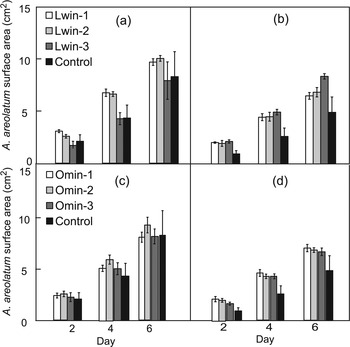
Some strains of the ophiostomatoid fungi grew quickly, resulting in fully occupied Petri plates within 6–8 days, so the repeated-measures analysis was restricted to the first three measurements (days 2, 4, and 6) to allow comparisons between all species and strains of fungi. There was a significant effect of the L. wingfieldii strains on the growth of both A. areolatum strains (Aareol-1: F 3,16 = 4.78, P = 0.02; Aareol-2: F 3,16 = 7.91, P = 0.002) over the first 6 days of growth; A. areolatum colonized more surface area in the presence of some L. wingfieldii strains than when growing alone (Figs. 1a, 1b). There was a similar effect of O. minus on the growth of one of the A. areolatum strains but not the other (Aareol-1: F 3,16 = 1.97, P = 0.16; Aareol-2: F 3,16 = 5.59, P = 0.008) (Figs. 1c, 1d).

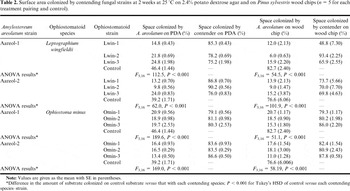
When the plates were entirely colonized, each strain of O. minus and L. wingfieldii captured substantially more space than did each A. areolatum strain (compare columns 4 and 5 in Table 2). At 2 weeks, A. areolatum strains growing without competitors colonized significantly more area than the same strains growing with L. wingfieldii or O. minus (Table 2).

Note: Values are given as the mean with SE in parentheses.
* Difference in the amount of substrate colonized on control substrate versus that with each contending species; P < 0.001 for Tukey's HSD of control versus each contending species–strain.
Interactions on wood substrate at 25°C
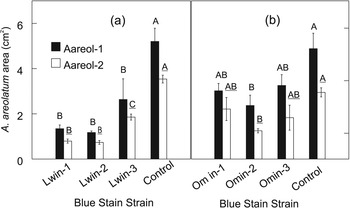
At 25°C the colonized area of both A. areolatum strains at 7 days was significantly affected by the presence of L. wingfieldii (Aareol-1: F 3,16 = 17.3, P < 0.001; Aareol-2: F 3,16 = 85.5, P < 0.001). Both strains of A. areolatum colonized significantly less area in the presence of each of the L. wingfieldii strains than they did growing alone (Figs. 2a, 2b). Amylostereum areolatum area at 7 days was also significantly affected by the presence of O. minus (Aareol-1: F 3,16 = 5.2, P = 0.01; Aareol-2: F 3,16 = 3.44, P = 0.04); however, results varied between O. minus strains (Figs. 2a, 2b).

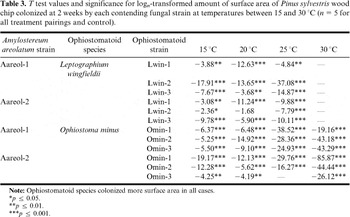
At 2 weeks, all strains of both ophiostomatoid species colonized substantially more space than did the A. areolatum strains, and the solo-growing A. areolatum colonized substantially more space than did colonies growing in the presence of competing species (Tables 2, 3). Inhibition zones were frequently present on chips inoculated with A. areolatum and L. wingfieldii, resulting in less than 100% colonization of the chip; a subset of these left to grow beyond 2 weeks showed no further colonization of this zone. At 2 weeks, A. areolatum strains growing without competitors colonized significantly more area than did the same strains growing with L. wingfieldii or O. minus (Table 2).

Note: Ophiostomatoid species colonized more surface area in all cases.
* p ≤ 0.05.
** p ≤ 0.01.
*** p ≤ 0.001.
Neither L. wingfieldii nor A. areolatum was isolated from the territory of the other in subcultures taken at 4 weeks. Ophiostoma minus was isolated from A. areolatum space but A. areolatum was not found in space colonized by O. minus.
Effect of temperature on interactions on wood substrate
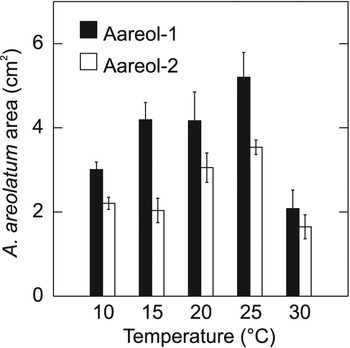
At 1 week, A. areolatum strains colonized the greatest amount of substrate when growing at 25°C, and Aareol-1 typically colonized more substrate than did Aareol-2 at each temperature (Fig. 3). All three fungal species grew slowly at 10°C, the chips incubated at this temperature were never fully colonized, and the contenders did not compete for substrate. Allowing a further week of growth did not result in competition for substrate. Two L. wingfieldii strains (Lwin-2 and Lwin-3) grew very poorly at 30°C and many replicates of these strains failed to grow. Several replicates of the A. areolatum strain Aareol-2 failed to grow in the presence of O. minus strain Omin-3 at 15°C. These poorly growing treatment combinations were excluded from analyses.

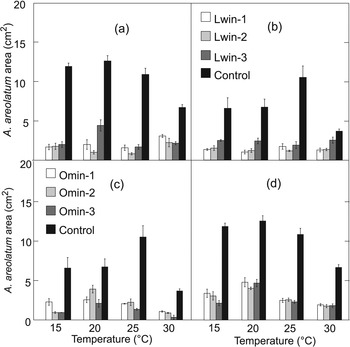
With the exception of one strain combination (A. areolatum Aareol-2 and L. wingfieldii Lwin-2), in each of the tested and analyzed strain combinations the ophiostomatoid strain colonized significantly more of the chip than the A. areolatum strain did at temperatures between 15 and 25°C (Table 3). There was a significant effect of temperature, L. wingfieldii strain, and the interaction of the two on the amount of substrate colonized by A. areolatum strain Aareol-1 at temperatures between 15 and 25°C (temperature: F 2,36 = 3.4, P = 0.04; strain: F 2,36 = 11.83, P < 0.001; interaction: F 4,36 = 3.48, P = 0.02). Amylostereum areolatum was able to colonize more substrate at 20°C when competing with L. wingfieldii strain Lwin-3 than it could with the other temperature and strain combinations (Fig. 4a). There was a significant effect of L. wingfieldii strain (but not of temperature or interaction) on A. areolatum strain Aareol-2 (temperature: F 2,36 = 1.61, P = 0.23; strain F 2,36 = 13.77, P < 0.001; interaction: F 4,36 = 2.09, P = 0.10) (Fig. 4b). At temperatures between 15 and 30°C, there was a significant effect of temperature (but not of O. minus strain or the interaction of the two) on the amount of substrate colonized by A. areolatum strain Aareol-1 (temperature: F 3,48 = 40.19, P < 0.001; strain F 2,48 = 2.19, P = 0.12; interaction: F 6,48 = 1.50, P = 0.21). This strain was able to capture more substrate at 20°C than at other temperatures (Fig. 4c). There was a significant effect of temperature, O. minus strain, and the interaction of the two on area colonized by A. areolatum Aareol-2 at temperatures between 20 and 30°C (temperature: F 2,36 = 54.09, P < 0.001; strain F 2,36 = 7.59, P = 0.002; interaction: F 4,36 = 2.97, P = 0.03) and results were similar for the 15–30°C temperature range when the incomplete data set was included in the analysis (Fig. 4d).

Growth on precolonized substrate
Neither A. areolatum strain grew on any of the live (nonautoclaved) strains of either L. wingfieldii or O. minus, but both strains grew on all of the autoclaved ophiostomatoid colonized substrate. One strain of L. wingfieldii (Lwin-1) did not grow on either strain of live A. areolatum or on one of the autoclaved A. areolatum strains (Aareol-1). Two strains of O. minus (Omin-3 and Omin-2) did not grow on live A. areolatum strain Aareol-1.
Discussion
The outcomes of experimental interactions on artificial and wood substrates and at all temperatures were generally similar: L. wingfieldii and O. minus each colonized more substrate than did A. areolatum and both prevented A. areolatum from colonizing this space. Assuming that these laboratory results can be extrapolated to natural environments, this suggests that where T. piniperda, S. noctilio, and their associated fungal symbionts are found in close proximity, the growth of nutritional resources for larvae of the woodwasp may be limited. The limitation of A. areolatum growth through these fungal interactions could reduce the size and fecundity of adult S. noctilio (Madden Reference Madden1974). This could be especially deleterious at early instars, when woodwasp larvae are believed to depend on A. areolatum as their sole food source (e.g., Madden and Coutts 1979). Therefore, fungal interactions have the potential to exert a degree of biological control in this system.
Although the ophiostomatoid competitors typically occupied more substrate than did A. areolatum at temperatures between 15 and 25–30°C, the relative amount of substrate that A. areolatum colonized was influenced by temperature in interactions with some ophiostomatoid strains. Under natural conditions, sapwood temperatures of around 20°C (Fig. 4) may provide relatively more favorable interaction conditions for the woodwasp fungal symbiont. Sapwood temperatures can range up to 30°C (Stockfors Reference Stockfors2000); at this temperature A. areolatum strains would likely have difficulty competing with O. minus strains (Figs. 4c, 4d). Trees infested by S. noctilio appear to have higher sapwood temperatures than uninfested trees (Jamieson Reference King1957), and this may add competition pressure on the woodwasp symbiont after its initial establishment in a tree.
Amylostereum areolatum could not establish on substrate already occupied by active colonies of either of the ophiostomatoid species. However, it could establish on autoclaved colonies of the same competitors, suggesting that this pattern was a result of antibiosis rather than competition for nutrients (exploitation). Given this outcome, we expect that oviposition by S. noctilio would not result in successful brood development in sapwood already colonized by one of these ophiostomatoid fungi. The observed interstrain variability in the ability of each ophiostomatoid species to establish on A. areolatum-colonized substrate suggests that only some strains would have the potential to capture substrate already colonized by A. areolatum and influence woodwasp larval development. That half of the ophiostomatoid strains were unable to establish in one of the two A. areolatum strains is surprising in light of King's Reference Kirisits, Lieutier, Day, Battisti, Grégoire and Evans(1966) comment that the woodwasp symbiont was always overtaken by competitors. This illustrates the importance of examining interstrain differences when evaluating fungal interactions.
The degree to which these ophiostomatoid species may affect development of S. noctilio larvae will depend on factors such as the timing and frequency of entry of woodwasps and bark beetles (and therefore the fungal associates) into trees, and the role that A. areolatum plays in nutrition during later larval instars of S. noctilio. Adult T. piniperda appear most likely to enter a tree in late winter or early spring, after initial colonization by, and early development of, larval S. noctilio (personal observation). Oviposition by S. noctilio in the late summer may result in greater effects of fungal competition on larval development than oviposition in the early summer. However, phloem- and wood-boring insects other than T. piniperda may enter the tree shortly after oviposition by S. noctilio (personal observation), and could introduce ophiostomatoid fungi at early stages in woodwasp development. Not all beetles carry fungi, so the frequency with which fungal competitive interactions could occur is unknown (Solheim and Långström Reference Solheim and Långström1991; Jacobs et al. Reference Jamieson2004). The role of A. areolatum in nutrition of later larval instars of S. noctilio is not well described, so the entry of ophiostomatoid fungi during those stages may have a limited effect on woodwasp development.
The interactions we observed followed general patterns; however, there were differences between strains. In particular, A. areolatum strain Aareol-1 tended to colonize more space than the other strain (Table 2, Fig. 3), showed different responses to temperature and contending strain (Fig. 4), and was more resistant to secondary-resource capture. Therefore, woodwasp larvae developing in the presence of Aareol-1 may benefit from the greater ability of that symbiont to procure and maintain nutritional resources.
Other factors may affect the outcome of interactions between A. areolatum and other fungi. The phytotoxic mucus deposited by S. noctilio during oviposition is thought to stimulate fungal growth (Boros 1968; Titze and Turnbull Reference Titze and Turnbull1970) and may influence the outcomes of interactions between competing fungi under natural conditions. The effect of wood moisture may be another key factor. Amylostereum areolatum grows best in wood having less than 70% moisture content (Coutts and Dolezal Reference Coutts and Dolezal1965), whereas L. wingfieldii grows more quickly in wood between 120% and 150% moisture (Hironori et al. Reference Hoebeke, Haugen and Haack2003). At lower wood moisture content, the S. noctilio symbiont may fare better in competition against ophiostomatoid fungi.
Our work is the first to show quantitative evidence of the outcomes of interactions between the S. noctilio symbiont A. areolatum and species of beetle-vectored fungi. Amylostereum areolatum was clearly a poor competitor against L. wingfieldii and O. minus and, although it fared better at certain temperatures, it was consistently outcompeted by those fungi and excluded from substrate already colonized by them, regardless of substrate or temperature conditions. This will have reproductive consequences for S. noctilio if its larvae are vying for space in trees with phloem- and wood-boring beetles and could ultimately affect its population dynamics as it establishes in North American forests.
Acknowledgements
We thank Sheung Au for providing invaluable assistance in the laboratory. Chuck Davis and James Reid supplied fungal isolates. Simona Margaritescu, Chuck Davis, Martin Hubbes, and James Reid provided essential advice at various stages of this project. Funding was provided by Natural Resources Canada's Alien Invasive Species Program, the Natural Sciences and Engineering Research Council of Canada, and the Ontario Ministry of Natural Resources.