The color revolutions and the Arab Spring resulted in the optimistic belief that social media might substitute for traditional media as a watchdog monitoring government wrongdoing (Diamond Reference Diamond2010; Howard and Hussain Reference Howard and Hussain2013). Citizens might hope to replace corrupt governments that are exposed as crooked, and the prospect of exposure would discourage misconduct (Bennett and Segerberg Reference Bennett and Segerberg2012; Shirky Reference Shirky2009). In some contexts, this assertion prevailed: greater internet access is indeed associated with better government accountability (Andersen et al. Reference Andersen2011; Lio, Liu, and Ou Reference Lio, Liu and Ou2011; Petrova Reference Petrova2008). However, in others, the internet has been no panacea. Whatever gains the internet helped achieve have been short-lived or far more limited than what earlier accounts suggested. Over the last decade, the hope that the internet would incite a sweeping wave that will overthrow corrupt, repressive regimes across the world has dwindled (Aday et al. Reference Aday2013). Many countries instead experienced a deterioration of basic freedoms, such as freedom of the press.
In this article, we study an incumbent's strategic response to new information technologies that can be used to amplify small voices. Without such technologies, communication between citizens is minimal and an incumbent can confine information to a few independent media outlets and their consumers. The advent of information technologies, in particular, social media, enables opponents of the incumbent to spread damaging information to a broad audience. Containment thus becomes futile. An incumbent must then either release control completely or suppress all criticism. Our model suggests that increased internet access leads to either higher or lower press freedom under different conditions. This is because the internet makes it impossible for incumbents to ignore smaller media outlets.
The core of the argument made in this article is as follows. Social media catalyzes the transmission of information by acting as a conduit between citizens. This amplifies their voices, allowing them to reach much larger audiences at a fraction of the time and cost. The diffusion of the ability to distribute information makes control harder. This poses a threat to incumbents who rely on their control of the flow of information for their survival. In the context of government control of the media, or media capture, social media makes capture harder in two ways. First, it increases the price of capture by increasing the opportunity costs outlets face of suppressing news. The incumbent must then provide stronger incentives to capture media outlets, whether in the form of sticks or carrots. As such incentives are costly, both financially and reputationally, an increase in access to information technologies pushes the incumbent toward releasing some pressure from media. Secondly, social media makes containment harder: it increases the risk that damaging information will leak and reach a critical mass of citizens who may then overturn the incumbent. This pushes the incumbent toward intensifying pressure, suppressing smaller outlets they previously ignored so that there is no damaging information to spread on social media. Depending on which of these forces dominate, greater internet access may lead to more or less media capture.
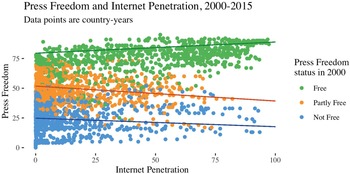
This logic explains the pattern that high internet penetration is linked with more extreme press freedom outcomes. Data from 160 countries from 2000 to 2015 show that there are few observations of countries with high internet penetration and intermediate levels of press freedom (see Figure 1). This is in line with our argument that greater internet access makes partial capture, where the government accommodates some independent media, an untenable strategy. Instead, as internet penetration rapidly rose across the world between 2000 and 2015, countries moved toward either extreme: some experienced an improvement in press freedom outcomes as the costs of pressuring media outlets went up; while in others, press freedom deteriorated further as incumbents shut down independent outlets, fearing their news would spread on social media. Controlling for a host of variables and country and year fixed effects, we see that in countries that had a “Free” press at the start of this period, higher internet penetration is associated with more press freedom.Footnote 1 In contrast, among the countries that were “Partly Free” in 2000, internet penetration is associated with less press freedom.Footnote 2 This is consistent with the intuition that when incentives to stay in office are strong enough relative to the costs of capture, the risk of being overturned eclipses higher costs and greater internet access leads to more capture.
A scatterplot of internet penetration rates and press freedom scores in 160 countries over 16 years.
Notes: Countries in green had a “Free” press in 2000, yellow countries were “Partly Free,” and blue countries were “Not Free.” Lines correspond to linear fits from regressions with controls and country and year fixed effects. The full set of regression results and details about datasets and empirical specifications can be found in the Online Appendix.

What explains this observed heterogeneity in the effects of the internet in different contexts? While we agree with the optimists' premise that the internet is a medium through which information can diffuse, we argue that it can also set off a cascade of counterbalancing forces. First, incumbents proved to be better able to respond to the new reality of the internet than anticipated. Much scholarly attention has focused on internet censorship (King, Pan, and Roberts Reference King, Pan and Roberts2013; Tufekci Reference Tufekci2017). From blocking websites to deleting critical posts, incumbents devised a plethora of methods to subdue the revolutionary potential of social media (Morozov Reference Morozov2012; Zhuravskaya, Petrova, and Enikolopov Reference Zhuravskaya, Petrova and Enikolopov2020). Secondly, the prevalence of misinformation resulted in an unprecedented lack of trust online (Invernizzi and Mohamed Reference Invernizzi and Mohamed2019). Although less control over content did make it easier for news critical of governments to spread, so did it for poorly researched or fabricated news. With low entry costs and little reputation concerns, many on the internet produced and propagated misinformation. This led to more skepticism, making it easier for incumbents to dismiss damaging information as fake news.
In this article, we start from these observations and present a model that investigates how the advent of the internet influences the interaction between the incumbent and the media. Our model follows the political agency literature (Barro Reference Barro1973; Besley and Prat Reference Besley and Prat2006; Ferejohn Reference Ferejohn1986). There is an incumbent whose type is observed by the media outlets but not the voters. Voters want to overturn a bad incumbent who wishes to remain in office. A bad incumbent may offer transfers to media outlets to suppress information about his type. Media outlets may accept or reject these offers. Their decisions determine what information their followers receive.
The novel contribution of our article is to model how information can disperse among groups of voters with different signals. This allows us to offer a mechanism that explains the observed heterogeneity in press freedom outcomes. Our main focus is on the case where a minority of voters observe the incumbent's type. Here, the informed minority may choose to spread on social media the signal they received from an informative traditional media outlet. This mechanism is motivated by recent empirical work that shows social media is more effective at political persuasion when used to complement traditional media as a signal booster. For example, Reuter and Szakonyi (Reference Reuter and Szakonyi2015) find that the effect of social media on public awareness of electoral fraud in the 2011 Russian parliamentary election was larger in regions with more press freedom. State-run media—from which a majority of Russians got their news—avoided the issue entirely. Thus, coverage was exclusive to local news outlets with limited reach. Where they could, opposition activists fed more reliable information from these outlets into social media, magnifying their influence. Similarly, Aday et al. (Reference Aday2013) find that content generated by traditional news organizations dominated the online discourse during the Egyptian Uprising. More broadly, Druckman, Levendusky, and McLain (Reference Druckman, Levendusky and McLain2017) find that “almost half the information that originates from the media passes to the masses indirectly via a diffuse intermediate layer of opinion leaders,” consistent with the “two-step flow of communication” hypothesis, which posits that media affects behavior mostly via personal influences of the intermediaries (Katz Reference Katz1957). We study the interaction of such activists or opinion leaders in a formal theoretical framework.
We show that an important parameter in determining the outcome of social media interaction is the level of “connectedness” (Jackson and Yariv Reference Jackson and Yariv2007). We take connectedness to be a measure of technological variables, such as internet penetration, social media use, and the prevalence of mobile devices or other telecommunication technologies, and of sociological ones, such as social capital or political trust (Haciyakupoglu and Zhang Reference Haciyakupoglu and Zhang2015). We find that an increase in the connectedness of a country serves to bring in line the information revealed by media outlets in equilibrium.
The level of connectedness determines in equilibrium two important parameters. The first is the costs of capture, defined as the expected loss in audience share of a media outlet from suppressing news. Our case studies of Turkey and Tunisia present real-life examples of how consumers left uninformative media outlets for those with information, inflicting on them both monetary and reputational costs. The second important parameter is the probability that a bad incumbent will be overturned. Both Turkey and Tunisia experienced antigovernment protests fueled by social media in the early 2010s, and while Erdoğan managed to survive this episode, Ben Ali's 23-year reign of Tunisia came to end. To capture this range of possibilities, we model overturn as a stochastic event.
Another important parameter in our model is the incumbent's rents from office. This parameter covers a variety of benefits the incumbent can extract from holding office, such as monetary transfers in the form of wages for politicians or transfers to political parties (Persson and Tabellini Reference Persson and Tabellini2002, 8). In more corrupt regimes, political rents may also include such benefits as bribes or the embezzlement of funds for public programs (Svensson Reference Svensson2005). When more rents are available for extraction relative to costs of capture, the incumbent has stronger incentives to withstand the novel pressures stemming from the internet and keep the media captured.
As detailed later in Lemma 2 and the following discussion, a comparison of the incumbent's rents from office to the costs of capture and the probability of overturn determines their optimal strategy. For sufficiently high rents, the incumbent prefers complete capture. At the other extreme, no capture is optimal. When this is the case, all media outlets can publish critical news about the government. For intermediate values of rents, the incumbent prefers partial capture. Here, as connectedness increases, the chances that followers of a captured outlet learn that another outlet is more informative increases, as voters who follow the informative outlet share its reports on social media. This has two effects. First, higher connectedness increases the costs of suppressing for media outlets, which, in turn, increases the costs of capture for the incumbent. This may free media by making capture too costly relative to rents. Secondly, higher connectedness also results in a higher probability the incumbent will be overturned under partial capture. If the value of staying in office is sufficiently high, higher connectedness may instead lead the incumbent to also capture smaller media outlets to preclude any reports that could be shared on social media. This hinders the dissemination of information in the country completely. Thus, our model provides a novel explanation as to why censorship intensified in many regimes as internet use spread over the last few decades.
The rest of the article is organized as follows. The next section reviews the related literature. This is followed by the presentation and analysis of our model. Finally, we relate our model to the cases of the Gezi Park protests in Turkey and post-Arab Spring Tunisia, and then conclude.
Related Literature
The present article contributes to the literatures on the political economy of media capture and authoritarianism. In a highly influential article on the first topic, Besley and Prat (Reference Besley and Prat2006) assume that the incumbent can make transfers to media outlets to suppress a bad signal they may have about them. They find that plurality in the media can act as a safeguard against media capture. Egorov, Guriev, and Sonin (Reference Egorov, Guriev and Sonin2009) investigate the relationship between press freedom and resource endowment. They argue that dictators in resource-poor countries rely on an efficient bureaucracy to generate revenue and that free media—while potentially hurting the incumbent—can help the incumbent provide stronger incentives to the bureaucracy. They find robust empirical support for their theory that oil reserves are associated with lower press freedom in nondemocracies, whereas this relationship is flat for democracies. Trombetta and Rossignoli (Reference Trombetta and Rossignoli2020) study a model with rationally ignorant voters and show theoretically and empirically that greater competition in the media industry may make capture easier. Gehlbach and Sonin (Reference Gehlbach and Sonin2014) examine a setting in which capture can occur in two ways. In their model, the government can pay transfers to independent media or seize control. The authors find that controlling for media ownership, higher commercial revenues lead to greater press freedom; however, they may also induce the government to nationalize media outlets to save on costs of capture, which may cause a decline in press freedom. Our model contributes to this literature on the determinants of media capture by considering the role of the internet and social media.
There are few articles on the question of the internet's effect on press freedom, and they provide conflicting findings. Petrova (Reference Petrova2008) studies a model which suggests that higher internet penetration leads to greater media freedom, and more so in democracies. Using panel data up to 2004, she finds support for her claims in democracies but not in autocracies. Our results corroborate her findings for democracies but suggest that social media may have an opposite, detrimental effect in other contexts. Also related is Lorentzen (Reference Lorentzen2014), who studies press freedom in an autocratic context. He provides qualitative evidence that the central government in China allows investigative journalism, in part, to keep tabs on local politicians and replace those who are corrupt. The government weighs this benefit of press freedom against the risks it poses. Lorentzen also studies an extension on the effects of online media, assuming it acts as a substitute for traditional media. As the government needs to keep constant the total amount of information citizens receive, it tightens control of traditional media as internet access increases. Thus, Lorentzen argues that higher internet penetration induces the government to restrict press freedom and finds that citizens are equally informed before and after the advent of the internet in his particular setting. In comparison, the present manuscript investigates how greater connectedness may lead to higher press freedom or result in more capture across contexts. This allows us to recover the results of both Petrova (Reference Petrova2008) for countries with low rents relative to costs of capture, and Lorentzen (Reference Lorentzen2014) for others, though our mechanism is distinct from both. We show that when fewer rents are available for extraction, press freedom may improve because capture becomes prohibitively expensive. In contrast, with higher rents, press freedom may fall because the government can extend censorship to media outlets whose influence grows as internet penetration goes up. Thus, our model finds that the advent of the internet leads to citizens who are politically more or less informed, depending on the incumbent's incentives to remain in office relative to the increased costs of capture.
Also related to our article is the literature on authoritarianism and authoritarianization. Frantz (Reference Frantz2018, 87) defines authoritarianization as when leaders who came to power via democratic elections abuse their power to “disadvantage and sideline opponents and consolidate control.” She notes that in the post-Cold War era, authoritarianizations have made up 38 percent of all democratic collapses, second only to coups. In other words, democracies are increasingly falling apart through incumbent takeovers (Levitsky and Ziblatt Reference Levitsky and Ziblatt2018). The mechanisms that lead to a decline in press freedom in our model are closely related to many such authoritarianization processes. Thus, our model provides a microfoundation for media capture in autocracies.
In our model, an incumbent wishes to keep uninformed a portion of the citizenry to remain in power. Implicit in this setup is the assumption that public opinion is of importance even in autocracies. Indeed, an important finding from the literature on authoritarianism is that many autocratic regimes today also integrate features of democratic governance in their system of rule (Gandhi and Lust-Okar Reference Gandhi and Lust-Okar2009). In modern dictatorships, it is increasingly common to see multiparty elections that occur on a regular basis (Bratton and Van de Walle Reference Bratton and Van de Walle1997). While only 59 percent of all dictatorships held regular elections with multiple political parties in 1970, the rate increased to 83 percent in 2008 (Kendall-Taylor and Frantz Reference Kendall-Taylor and Frantz2014). That such regimes are considered authoritarian despite holding elections is in no small part due to media capture, whereby incumbents preclude an informed electorate and hence tilt the playing field in their favor. Magee and Doces (Reference Magee and Doces2015) document the serious obstacles the media typically faces in authoritarian regimes. The information they do release is often biased and intentionally inaccurate, even about basic information, such as economic growth rates. In a time-series, cross-country empirical analysis, Stier (Reference Stier2015) finds that autocracies have lower press freedom scores than democracies, and that within autocracies, electoral autocracies tend to allow for more press freedom while communist regimes tend to have the least free press. Our contribution to this literature is to show how—despite early optimism—the effect of the internet on press freedom depends on the amount of rents available for the incumbent to extract.
Model
In this section, we introduce a two-period Bayesian game. Our model involves: (1) an incumbent politician, I, whose type is private information; (2) mainstream and the alternative media outlets M and A; and (3) a unit mass of voters, V, divided into two groups as followers of the mainstream media (mainstream voters, V M) and as followers of the alternative media (alternative voters, V A).
In the first period, the incumbent is exogenously in power, facing a challenger. The incumbent needs the support of at least ζ fraction of citizens to retain office. For concreteness, we interpret citizens' support as voting and take ζ = 1/2 as a simple majority; however, our model encompasses other types of political action and different values of ζ.Footnote 3 Both the incumbent and the challenger can be one of two types, “good” or “bad.” A good politician produces a payoff of 1 to voters and a bad politician produces a payoff of 0. The incumbent and the challenger are drawn independently from a common pool, and we denote by γ ∈ (0, 1) the prior probability that a politician is good. At the start of the game, the incumbent and media outlets observe the type of the incumbent. The voters can only learn about the incumbent's type before their decision through the news reports of the media outlets.
For ease of exposure, we assume that there are two media outlets, one mainstream and one alternative. The media outlets are identical in their strategy sets and preferences. They only differ in their audience size, denoted by σ k for k ∈ {M, A}. At the start of the game, the mainstream outlet reaches a group of voters large enough for the incumbent to retain office, but the alternative outlet does not, σ M ≥ ζ > σ A, and each voter follows exactly one outlet, σ M + σ A = 1. If the incumbent is good, the outlets have no verifiable news and publish the null signal,  $s_k = \emptyset $ for k ∈ {M, A}. If the incumbent is bad, media outlets have a verifiable signal (s k = b) that they can publish and inform their audience of the incumbent's type.Footnote 4 Before they make their editorial decisions, however, the incumbent can try to influence them.
Real-world incumbents have a broad set of tools to influence the editorial decisions of media outlets. These tools may be in the form of carrots to outlets who adopt editorial strategies in line with the incumbent's objectives (e.g., access, cash transfers, and business contracts) and sticks against those who do not (e.g., fines and closures). To capture this wide range of possible strategies in a simple way, we model this interaction between the incumbent and the outlets as a bargaining game. After the outlets observe their type, the incumbent can make an offer of a transfer t k to outlet k ∈ {M, A} in exchange for them suppressing the verifiable signal. Here, a high t k may correspond to larger monetary transfers paid out to outlets in the case of carrots or to sparing them from shutting down in the case of sticks. For the sake of generality, we impose no structure on the form of these transfers except to require that stronger incentives to suppress are more costly for the incumbent to provide. This means that, for example, bigger bribes are more expensive to pay out and shutting down a defiant outlet is more costly than fining it. The outlets observe the offers made to each. They then simultaneously decide whether to publish the news or to suppress it in exchange for transfers from the incumbent. The incumbent and the outlets observe what both outlets publish. If one outlet publishes the news about the incumbent's type while the other one suppresses it, the informed voters may share the news on social media, causing some fraction of the uninformative outlet's audience to switch to the informative outlet. This switch decreases the audience share of the uninformative outlet while increasing that of the informative outlet.Footnote 5
Thus, an outlet facing an uninformative competitor chooses between the opportunity to steal some market share versus transfers from the incumbent, whereas an outlet facing an informative competitor chooses between holding on to their market share versus receiving transfers but losing some audience to their competitor. The offers to the two outlets are unobserved by the voters, as are whether the outlets accept the incumbent's offers. When indifferent, outlets accept the incumbent's offer. For ease of notation, we normalize the audience-related profits of both outlets at the start of the game to 0.
If both outlets accept the offer, or if both reject it, the game moves to the election stage. If one of the media outlets accepts the offer and the other does not, the followers of the informative outlet (informed voters) decide whether to share their signal via social media. In this decision, the benefits of sharing information about a bad incumbent are weighed against the potential costs of expressing political, antigovernment opinions online. Depending on the fraction of informed voters who share the signal, ν ∈ [0, 1], and a variable we call connectedness, θ ∈ ℝ, some uninformed voters switch to the informative outlet, observe the verifiable signal about the incumbent's type, and become informed. Specifically, the number of informed voters grows by f(ν, θ) > 0, where f is continuous and increasing in both arguments. The rest of the uninformed voters stay uninformed.
We use the term “connectedness” to refer to factors that influence the likelihood with which messages reach voters. These are both technological factors, such as internet penetration, and social factors, such as political trust and the prevalence of fake news. We take connectedness to be a random variable of the form θ = μ + ψ.Footnote 6 Since technological variables are measured relatively precisely, we interpret the expected level of connectedness, μ ∈ [0, 1], to be equal to the level of internet penetration. The error term, drawn from a normal distribution with zero mean and finite variance, can be interpreted as the uncertainty regarding other factors that influence information flows through the social network, and is unobserved.
The fraction of informed voters who share the news is determined in equilibrium. The benefits of sharing may be in the form of material gain, where more clicks correspond to larger advertisement revenue. They may also be in the form of expressive or glow utility derived from sharing one's political opinion with an audience, where a larger audience leads to more engagement, such as “likes” and “comments.” Regardless, when connectedness increases, an informed voter can reach a larger audience and therefore derives a larger utility from sharing. As connectedness is positively correlated with internet access, in our model, this means that, all else equal, higher internet penetration implies larger expected benefits from sharing. For ease of notation, we further assume that this relationship is linear, that is, the expected benefit informed voters derive from sharing information via social media linearly increases with internet penetration, μ.
There are also expected costs associated with sharing the bad signal about the incumbent, given by the expression c. This captures the severity of the punishment and might range from zero (e.g., no punishment), to relatively low (e.g., getting fired from public service) to extremely high (e.g., death). The expected utility of sharing is thus μ − c and the expected utility of refraining is normalized to 0. When indifferent, informed voters choose to refrain. In the Online Appendix, we explicitly model coordination between informed voters within a global games framework. The equilibrium behavior of that model is qualitatively similar to the simple decision problem that we present in this paragraph. In the main text, we stick with this simpler setup for ease of presentation.
At the final stage of the game, voters choose between the incumbent and a challenger of unknown type. The incumbent retains office if and only if they receive the support of at least ζ fraction of citizens and receive office rents denoted by r > 0, regardless of their type. Thus, the payoff of the incumbent is  $r-\sum\nolimits_{k\in K}^{} {t_k} $ if they stay in office and
 $-\mathop {\sum\nolimits_{k\in K}^{} {t_k} }\limits_{} $ if they do not, where K is the set of media outlets who accept the incumbent's offer. The payoff of an outlet k who publishes the signal about the incumbent is σ kf(ν, θ) if its opponent suppresses the news because of the growth in k's market share, and k's payoff is normalized to 0 if its opponent also publishes. The payoff of an outlet k who chooses to suppress the news is equal to t k if its opponent also suppresses, and it is equal to t k − σ −kf(ν, θ) when the opponent publishes because of the lost market share.
Discussion
Before proceeding to the analysis of the model, we discuss our modeling assumptions to clarify the scope conditions and limitations of our model. Most of our assumptions are made for purposes of clarity and convenience, and can be generalized to different settings. For those that cannot, we discuss why we believe the assumptions we make are justified and what would change in our results if they did not hold.
Importantly, although throughout the article we refer to voting and elections for the sake of concreteness, our model's scope expands beyond democracies and electoral autocracies. Our terminology should hence be interpreted more broadly. For example, in the context of autocracies, citizens may revolt to overthrow an autocrat they know to be corrupt. Our analysis would then follow through, with the only major difference being that media capture would serve the purpose of preventing a large enough protest to set off a revolutionary cascade, instead of a majority voting to replace the incumbent. The critical assumption we make is that the incumbent fears losing power if information about their type reaches a large enough subset of the population. Thus, they would prefer to keep the fraction of informed voters well below that threshold, subject to the constraints they face. This preference may be driven by a desire to elude electoral defeat or widespread protests; our model accommodates either interpretation. However, even a literal interpretation of the elections in our model applies to a wide range of contemporary regimes. This is because most contemporary authoritarian regimes integrate features of democratic governance, particularly elections, in their system of rule, and 39 percent of all authoritarian regime failures occur via electoral processes (Frantz Reference Frantz2018).
In modeling how voters learn about politicians' types, we make four main assumptions. First, social media is not sufficient for voters to modify their beliefs about the incumbent because, unlike news reports published by media outlets, we assume that social media posts are not verifiable. Voters can thus only learn from social media that they are not getting all the news and must change their media consumption if they wish to be better informed. In other words, social media can only direct voters to media outlets that may have verifiable information. In reality, some voters may be convinced by social media alone, but without the reputation of traditional media outlets to back them up, a group of voters large enough to overturn the incumbent is unlikely to be persuaded.Footnote 7
Relatedly, we follow Besley and Prat (Reference Besley and Prat2006) in assuming that outlets can only publish verifiable news. If we allowed traditional media outlets to publish “fake news,” we would have to analyze a more complex signaling game where voters have to take into account the possibility that the incumbent is good despite a bad signal, a game with potentially multiple equilibria. Even in such a model, however, all of our substantive takeaways would remain unchanged in any equilibrium where bad signals are at least partly informative.
Thirdly, we assume for simplicity that there are only two media outlets and that voters initially follow exactly one of them. One may easily extend this assumption to any number of media outlets from which the incumbent determines M and A endogenously, as in Trombetta and Rossignoli (Reference Trombetta and Rossignoli2020). We could also allow for voters who follow multiple outlets or no outlets at all. Our substantive results would remain unchanged. We stick with this simpler setup for tractability.
Finally, voters in our model initially only observe the news reported by the media outlets they follow. As in Prat (Reference Prat2018), we assume that there is some rigidity in the media market and voters do not change the outlet they follow unless they have sufficient reason to believe the other is more informative. This may be because of habit formation or because voters consume media mainly for reasons other than informativeness, such as entertainment. Either way, we assume that voters do not seek out another media outlet just because they observed the null signal. However, they may do so if they see the news shared on social media. If we instead allowed voters to switch media outlets until finding one that is informative even absent nudges from social media, the incumbent would always capture either both outlets or none. Both the existing empirical research on this topic and the media capture strategies of incumbents from Turkey to Russia, however, imply that there is substantial persistence in media consumption (Gehlbach Reference Gehlbach2010).
To model the spread of information on social media in a clean way, we abstract away from the possibility that the incumbent may shut down the internet or social media, which would refer to μ = 0 in our model. Such cases are beyond the scope of our model, but we note that even in the case of the Arab Spring, where access to technology was quite restricted at times, shutting down the internet did not turn out to be a very viable strategy and may actually have backfired (Hassanpour Reference Hassanpour2014).
Relatedly, our specification of θ = μ + ψ implies that technological and nontechnological factors that make up connectedness are additively separable. While this simplifies the exposition of the model considerably, in principle, it is possible to imagine alternatives. If the nontechnological factors in a country, such as political polarization or government manipulation of the internet, are such that more internet penetration does not lead to an increase in connectedness, then our model no longer applies. For example, the online commentators recruited by the Chinese government since at least 2013, such as the so-called 50 Cent Army, may invert the relationship between internet penetration and connectedness, in which case, post-2013 China would fall beyond the scope of our model (King, Pan, and Roberts Reference King, Pan and Roberts2017). That said, we believe that it is more likely the case that such actions by the regime may only attenuate the positive relationship between penetration and connectedness but cannot invert it.
Another simplifying assumption we make in our model is that the expected benefits of sharing are equal to the level of internet penetration. We can easily generalize this functional form; our qualitative results still hold as long as the expected utility of sharing increases with internet penetration. While we believe that this assumption is reasonable—social media users typically enjoy having larger audiences—it is possible that this may not be universally true. In contexts where social media use is saturated and the limiting factor is attention rather than reach, further increases to connectedness may lead to a lower expected utility of sharing. Nonetheless, while this may be true for some users, especially in the political domain, where there is “strength in numbers” and repeated exposure may prove more persuasive, we maintain that greater reach always leads to a larger expected payoff to most social media users.
Finally, we assume that the informed voters who share the signal on social media incur the costs of sharing before the election. Assuming that costs are incurred after the election and only if the incumbent stays in power would not qualitatively change any of our results.
Analysis
In this section, we solve the game step by step. We consider perfect Bayesian equilibria in undominated strategies. We start by solving for optimal voting behavior as a function of beliefs, followed by optimal sharing on social media and the interaction between the incumbent and the media outlets, respectively. Then, we summarize the unique equilibrium of the game and present comparative statics.
Equilibrium Voting Behavior
For a voter who observes that the incumbent is bad (that is, s i = b), the expected utility of reelecting the incumbent is 0; bad signals are verifiable and all voters who observe them believe that the incumbent is bad with probability 1. The expected utility of electing a challenger of unknown type is equal to the probability that the challenger is good, γ. As we are looking at equilibria in undominated strategies, any voter who receives the signal that the incumbent is bad votes against the incumbent. On the other hand, if a voter observes no signal (that is,  $s_i = \emptyset $), they believe that the incumbent is good with probability weakly greater than γ. This is because observing the null signal is never more likely when the incumbent is bad. Thus, a voter who receives the null signal votes for the incumbent.Footnote 8
Therefore, any voter who observes the signal that the incumbent is bad votes for the challenger and any voter who does not observe any signal votes for the incumbent. The only means by which the voters can observe the incumbent's type is through the media outlets. As σ M ≥ ζ > σ A, when they vote together, the votes of V M are decisive in an election. Hence, the outcome of the elections ultimately boils down to whether V M receive any signal about the type of the incumbent.
If the mainstream outlet publishes the news that the incumbent is bad, the incumbent loses the election with certainty. If neither M nor A publishes, then all voters vote for the incumbent and they win the election. If only the alternative outlet publishes and the mainstream outlet suppresses, then the outcome of the elections depends on the outcome of the social media game. This is summarized in Table 1.
Media outlets' strategies result in different electoral outcomes

Equilibrium Information Sharing on Social Media
If only the voters who follow the mainstream outlet are informed, then whether news spreads through social media does not affect the outcome of the elections. This is because the challenger always wins when at least ζ voters know the incumbent is bad. Thus, it is never optimal for the bad incumbent to only capture the alternative outlet, as this would mean paying transfers to the alternative outlet and losing the election. It follows that in equilibrium, it cannot be the case that V M are informed and V A are not. Therefore, we restrict attention to the inverse case where V A are informed and V M are not.
Informed voters prefer sharing the news that the incumbent is bad on social media if and only if the expected benefits from doing so exceed its costs. The benefit of sharing is equal to the level of connectedness, θ, whose expectation is equal to the level of internet penetration, μ. Thus, informed voters share on social media whenever μ is greater than c, the cost of sharing. In this case, we have ν = 1. In contrast, when internet penetration is less than c all informed voters refrain from sharing and ν = 0.
Given the level of internet penetration, μ, we denote by  $p( \mu ) = \Pr ( {\sigma_A( {1 + f( {\nu , \;\theta } ) } ) > \zeta \vert \mu } ) $ the probability that a subset of V M large enough to overturn the bad incumbent is convinced to switch to the informative outlet and become informed themselves. In other words, p(μ) is the probability of being overturned if the game reaches the social media stage given that ν(μ) = 1 if and only if μ > c. In the next subsection, we study the implications of this finding for press freedom.
In the Online Appendix, we present an extension where we explicitly model the coordination problem informed voters face as a global game. There, we assume that the costs of sharing decrease in the fraction of informed voters who also share, as this makes it harder for the government to punish each individual citizen. This setup leads to essentially the same results as the simple model presented here. One important difference in this extension is that the equilibrium fraction of informed voters who share the news, ν(μ), is an interior solution instead of equal to either 0 or 1. The most important additional insight from the extension is that higher connectedness has a positive second-order effect on sharing due to strategic complementarity besides the first-order effect of increasing the benefit of sharing. The interested reader can find the details in the Online Appendix.
Equilibrium Media Capture
The payoff of a media outlet depends not only on its action, but also on whether the other outlet publishes or not. When both outlets publish, or neither do, they receive a normalized payoff of 0. When one publishes and the other suppresses, the former's audience share grows by fraction f(ν, θ) as a subset of the latter switch to it after being convinced on social media. The payoff of an outlet k that publishes is thus:
 $$EU_k( {{\rm publish}} ) = \left\{{\matrix{ {0, \;} & {{\rm if\;}-k{\rm \;publishes}} \hfill\cr {\sigma_kq( \mu ) , \;} & {{\rm if\;}-k{\rm \;suppresses}} \cr } } \right., \;$$
where we let q(μ) ≡ E[f(ν, θ)].
When an outlet instead suppresses, its payoff is the transfer offered by the incumbent minus some audience share lost if the other outlet publishes the news:
 $$EU_k( {{\rm suppress}} ) = \left\{{\matrix{ {t_k-\sigma_{{-}k}q( \mu ) , \;} & {{\rm if\;}-k{\rm \;publishes}} \hfill\cr {t_k, \;} & {{\rm if\;}-k{\rm \;suppresses}} \cr } } \right..$$
In equilibrium, when a media outlet is indifferent between accepting or rejecting an offer by the incumbent, it accepts. Thus, making an offer to an outlet that is strictly greater than its opportunity cost is strictly dominated for the incumbent. Moreover, capturing A only is a dominated strategy because it would lead to the incumbent paying transfers and still losing the election. Thus, the incumbent never makes such an offer in equilibrium. Finally, making an offer that an outlet would reject in equilibrium is equivalent to offering 0. These are summarized in the following lemma:

When both media outlets are captured, the bad incumbent is reelected for certain, but they have to pay transfers to both outlets. When only M is captured, the transfers are lower and the incumbent is reelected with probability 1 − p(μ). When neither outlet is captured, the bad incumbent does not pay any transfers but is certainly overturned. These are summarized in the following lemma:

Equilibrium
The equilibrium of the game is summarized here. We state it formally in the Online Appendix. Any voter who observes the signal that the incumbent is bad believes it and votes for the challenger. Any voter who does not observe a signal about the incumbent's type believes that the incumbent is at least as likely to be good as a challenger and votes for the incumbent. Voters who observe that the incumbent is bad may share their signal on social media. The informed voters share the news on social media whenever the expected level of connectedness is higher than the cost of sharing, and refrain otherwise. The expected level of connectedness thus determines the costs of capture and the expected probability of being overturned. Given these, the incumbent chooses which outlets to capture, if any, maximizing their expected utility as described in Lemma 2. The media outlets accept any offer from the incumbent that is at least as high as the expected change in commercial revenues.
Comparative Statics
The equilibrium level of press freedom depends on the incumbent's payoffs, as summarized in Lemma 2. When the probability p(μ) that the signal about the incumbent's type spreads to a critical mass of voters is 0, complete capture is never optimal. Substantively, if the incumbent has little reason to fear their supporters switching to an antagonistic outlet, our model suggests that they prefer to confine pressure to the mainstream outlet only. This would be true when there are few means of communication between citizens or when such communications are often dismissed due to a lack of trust. Here, partial capture allows the incumbent to keep a greater share of extracted rents for themselves. In contrast, when p(μ) ≥ σ M, partial capture is never optimal because the risk of being overturned is too high. When this is the case, the incumbent effectively chooses between no capture and complete capture.
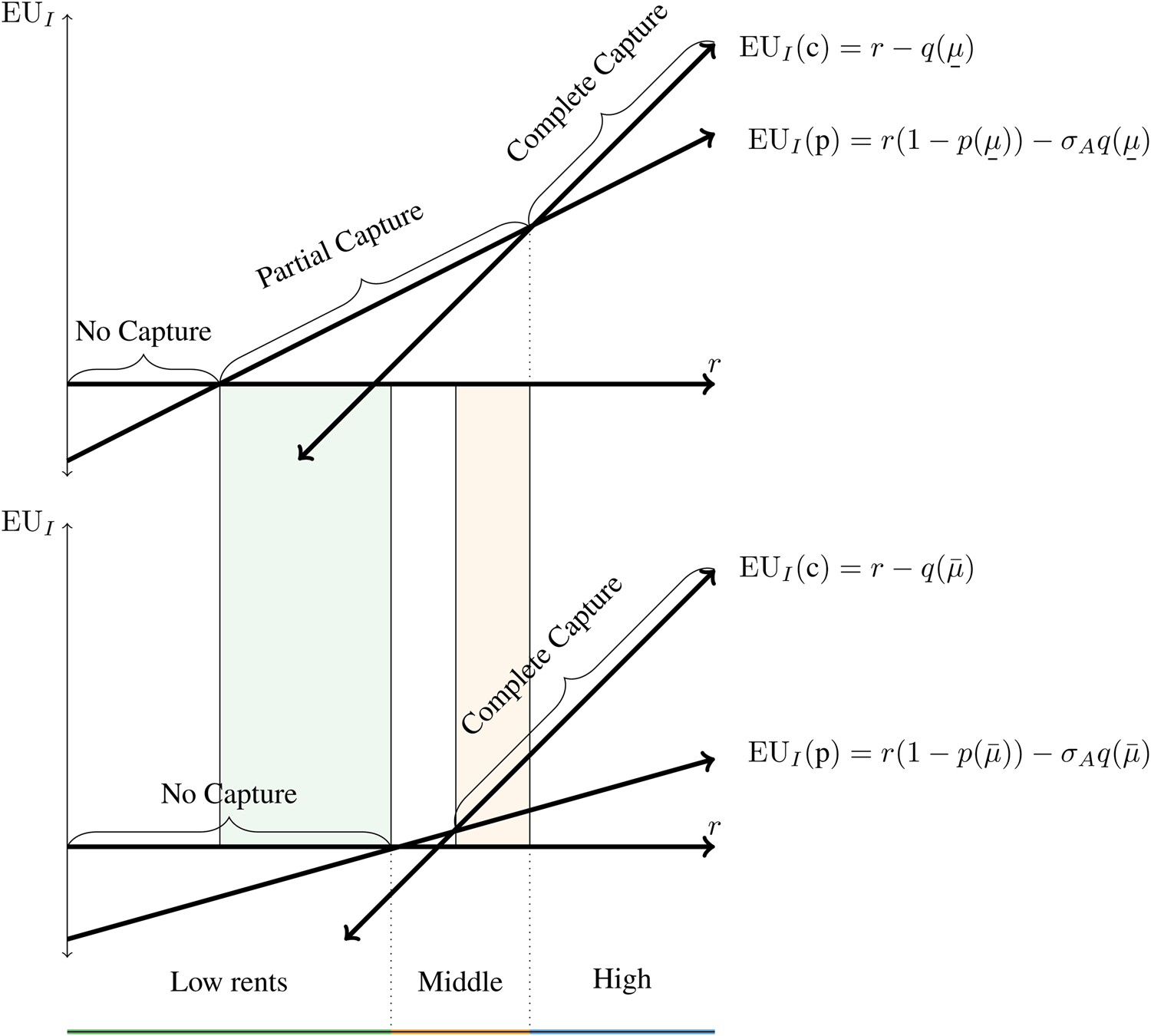
In between these two extremes, when 0 < p(μ) < σ M, all three strategies are viable. The incumbent's optimal strategy then depends on: the relative costs of capture, q(μ); the probability of being overturned under partial capture, p(μ); and office rents, r. Specifically, for sufficiently low rents from office, r < σ Aq(μ)/(1 − p(μ)), no capture is optimal for the incumbent because the payoff of holding office does not cover the costs of capture. For sufficiently high rents, r > σ Mq(μ)/p(μ), the incumbent prefers complete capture because the payoff of holding office is too high to risk being overturned. For intermediate values of rent, the incumbent prefers partial capture. Figure 2 shows these different regions of the incumbent's optimal strategies as a function of office rent.
Higher connectedness shrinks the set of parameter values leading to partial capture.
For two different levels of expected connectedness μ̄ > μ, the expected utilities of the incumbent from their three equilibrium strategies are plotted against low, middle, and high office rents, when Condition 1 holds and 0 < p(μ) < σ M. The best response of the incumbent is the upper envelope in each plot. The green (yellow) shaded region indicates levels of office rents such that the incumbent switches from partial capture to no (complete) capture when connectedness goes up.

Given the incumbent's equilibrium strategies, we can derive the primary comparative statics of our model: the effect of internet penetration on press freedom. It can be seen from Lemma 2 that the incumbent's payoffs from both complete and partial capture decrease with internet penetration. Intuitively, this is because the probability of news spreading via social media goes up when internet penetration rises, which increases both the risk of being overturned and the costs of capture. This means that when rents from staying in office are low, an increase in internet penetration may free the media by making capture too costly for the incumbent.
The effect of a rise in internet penetration on the relative payoffs of complete capture versus partial capture is less obvious. On the one hand, greater internet penetration pushes the incumbent toward complete capture because it increases the risk of being overturned if the social media game is played. However, it also makes complete capture less attractive because outlets' opportunity cost of suppressing increases as their potential market gain grows. Thus, it becomes more costly for the incumbent to capture both outlets. Whether the risk effect or the cost effect dominates depends on the following condition:

Condition 1 implies that the risk of being overturned increases faster than the costs of capture as connectedness goes up. When this is the case, an incumbent who prefers partial capture may switch to complete capture as internet penetration increases. Thus, the set of rents for which the incumbent chooses partial capture shrinks as μ goes up, forcing an incumbent who previously preferred partial capture to either switch to complete or no capture. Figure 2 provides a visual representation of these forces at work.
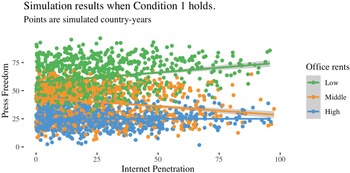
When Condition 1 holds, the effect of social media on press freedom is ambiguous. Increased internet penetration may improve press freedom, as the risk of being overturned becomes too high and capture too expensive for the incumbent to continue pressuring the mainstream outlet. However, it may also have the opposite effect: it may induce incumbents to increase their hold on media by also capturing alternative outlets to ensure news cannot spread via social media. Figure 3 presents a simulation that captures the relationship between internet penetration and press freedom when Condition 1 holds. The details of our simulations can be found in the Online Appendix.
When Condition 1 holds, higher internet penetration may hurt or improve press freedom.
When Condition 1 holds, higher internet penetration may improve press freedom by making partial capture too costly and inducing incumbents to release mainstream outlets in low-rent countries (green), or may hurt it by making partial capture too risky and inducing incumbents to capture alternative outlets in medium-rent countries (yellow). High-rent countries (blue) remain in complete capture.

In Figure 3, press freedom scores (25 for complete capture, 50 for partial capture, and 75 for no capture, with random noise added to enhance readability) on the vertical axis are plotted against internet penetration levels, μ, on the horizontal axis. Colors capture the terciles of uniformly distributed office rents, r, for 160 simulated countries: blue refers to countries with high office rents, yellow to intermediate office rents, and green to low office rents. For each simulated country, we draw 16 values of internet penetration from a beta distribution. The simulations show that under Condition 1, as internet penetration increases, most low-rent countries switch from partial capture to no capture. In contrast, most countries with intermediate levels of rent switch from partial capture to complete capture. Countries with high office rents remain in complete capture.
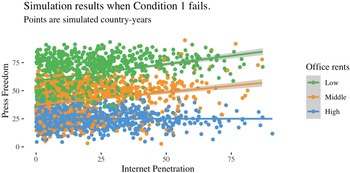
In contrast, when Condition 1 fails, the cost of capturing both outlets grows faster than the risk of being overturned. Then, internet penetration has the unambiguous effect of improving press freedom. This is because the transfers required to capture media outlets grow faster than the risk that a sufficiently high fraction of uninformed voters become informed and overturn the incumbent. Here, greater internet penetration cannot induce an incumbent to switch from partial to complete capture. The only possible change is that countries move toward more press freedom. Figure 4 presents a simulation of the relationship between internet penetration and press freedom when Condition 1 fails.
When Condition 1 fails higher internet penetration improves press freedom.
When Condition 1 fails, higher internet penetration improves press freedom by making both partial and complete capture too costly, inducing incumbents to move from partial to no capture (green) or move from complete to partial or no capture (yellow). High-rent countries (blue) remain in complete capture.

A comparison of our simulations with actual data can inform us about whether Condition 1 is justified for our model. By studying empirically whether increased internet penetration is universally associated with improved press freedom outcomes or not, we can get a sense of how the risk of overturn increases in μ relative to costs of capture. Our empirical analysis in the Online Appendix finds that internet penetration has a robust negative relationship with press freedom in countries that were “Partly Free” in 2000 according to Freedom House's Freedom of the Press report (see Tables 2–5 in the Online Appendix). These suggest that, at least in countries where there were serious concerns about press freedom prior to the advent of the internet, incumbents' fear of information spillovers may have risen faster than the costs they faced in capturing the media.
As discussed earlier, office rents relative to costs of capture determine the incumbent's strategy in equilibrium. This, in turn, decides the country's level of press freedom. Thus, when comparing our simulations to data, we split our simulation by terciles of r to match countries' press freedom status in 2000.Footnote 9 This classification is supported by cross-country studies which find that press freedom is inversely related to office rents (Brunetti and Weder Reference Brunetti and Weder2003). This is because in countries with high levels of press freedom, it is harder for incumbents to extract rents relative to the costs of capturing media outlets. Similarly, Stier (Reference Stier2015) finds that democracies tend to have higher press freedom scores than autocracies, and among the latter group, electoral autocracies tend to have more free press than others.Footnote 10
Overall, Condition 1 is consistent with the observed data because higher internet penetration is associated with better or worse press freedom depending on their status in 2000, rather than an unambiguous improvement as a failure of Condition 1 would suggest. Thus, we expect media in countries with high penetration to be generally either very free or not free at all. In contrast, media in countries with low penetration should have smaller cross-country variance. As internet penetration increases, countries that have intermediate levels of press freedom should move toward either extreme.
Greater press freedom leads to bad incumbents being identified and overturned more often. Therefore, voter welfare increases as press freedom goes up. These points are summarized in the following proposition:

The Cases of Turkey and Tunisia
Throughout the text, we have presented examples from around the world, including Turkey, Tunisia, Peru, Russia, China, and Mexico. In this section, we will discuss the first two countries in more detail and in relation to the assumptions and findings of our model. As will be detailed in the following, both Turkey and Tunisia experienced a change in media freedom in the early 2010s as a result of a series of events in which a minority successfully used social media to amplify the voices of media outlets with otherwise limited reach. There are many similarities between Turkey and Tunisia. Despite these similarities, in the years following the aforementioned events, media freedom decreased in Turkey while it increased in Tunisia. Hence, these two countries present a comprehensive pair of examples for the two opposite directions in which media freedom can move in our model after an increase in internet penetration.
When applicable, we detail later the specific form the components of our model take for Turkey and Tunisia, such as: mainstream and alternative media outlets; tools incumbents use to influence the editorial decisions of media outlets; ways in which media outlets suppress information and how their audience shares respond to this; how voters use social media to share information provided by informative media outlets; and costs associated with sharing information on social media. Additionally, we discuss how these cases relate to our assumptions.
We start with the Turkish case. Before June 2013, when most citizens still did not have access to the internet, press freedom in Turkey resembled a partial capture equilibrium. Then, incumbent Prime Minister Erdoğan focused his efforts on capturing mainstream media, overlooking smaller media outlets. As a result, a series of events damaging to the incumbent were covered solely by alternative media outlets with limited reach. Their market share surged after social media users started discussing and referring others to them. Erdoğan's government survived this tumultuous episode and subsequently extended capture to alternative media outlets, thus switching from partial to complete capture in response to rising connectedness. In their 2014 report, Freedom House moved Turkey from the “Partly Free” to “Not Free.”
June 2013 was marked by violent clashes between the police and protesters trying to prevent the demolition of a park in the heart of Istanbul. Propelled by widespread anger toward Erdoğan's authoritarian style, the so-called “Gezi Park” protests multiplied across the country. The number and the broad scope of protesters, the government's response, and the use of extreme force by the riot police were unprecedented during Erdoğan's tenure. The protests made headlines all around the world. However, in Turkey, the way mainstream media ignored the events took center stage instead. For example, while CNN International was livestreaming the hundreds of thousands of protesters in a mist of teargas, CNN's Turkish version, CNN Türk, was broadcasting a documentary about penguins. One channel was showing a beauty pageant; another, a show about food. The mainstream media—TV stations, newspapers, and their websites—was remiss throughout the first few days of the protests.
In line with the predictions of the partial capture equilibrium of our model, the most accurate and extensive coverage of the events took place in a few alternative media outlets and social media (Chrona and Bee Reference Chrona and Bee2017). People used social media to alert fellow citizens about a few TV stations and newspapers that reported on the events, channeling people to these sources for reliable information. An example of this is Halk TV, an obscure TV station that streamed the protests live with commentary in Turkish. Twitter users in Turkey soon started referring to the channel and Halk TV became a “trending topic.” Soon, others flocked to the news channel to find out about the protests, rapidly tripling its audience size (Bonini Reference Bonini2017; Farro and Demirhisar Reference Farro and Demirhisar2014). Similarly, the antigovernment daily Sözcü saw a 21 percent increase in sales during the week following the start of the protests. In terms of our model, these constituted lost audience shares for the competing, “mainstream” media outlets.
A probe into Turkish media yields why some outlets chose to cover these protests, whereas most others did not. Both Halk TV and Sözcü were universally acknowledged to be antigovernment. Many of Sözcü's editors moved there when fired from their previous outlets, allegedly due to government pressure.Footnote 11 Most of Sözcü's readers also switched to the antigovernment daily after their previous newspapers changed their stances to accommodate the government.Footnote 12 Eventually, Sözcü became a haven for the disillusioned secularists in an increasingly polarized society. Its staunch adherence to old Kemalist principles made it unlikely to appeal to anybody else. As such, it was not a government target for capture. Instead, the government focused its attention and pressure on mainstream media outlets that can reach people whose votes can be influenced by the news they consume (Corke et al. Reference Corke2014). Throughout his tenure, Erdoğan used a variety of sticks and carrots to capture these mainstream outlets.Footnote 13
One carrot is preferential treatment in public procurement in Turkey's centralized economy. Most media outlets in Turkey are owned by large holding companies. Often, these companies earn the bulk of their profits from other interests, such as energy or construction. They buy media outlets not for commercial revenues—which are limited in Turkey—but for a means to show their loyalty to the incumbent. Erdoğan was in charge of both the Privatization High Council (ÖİB), which gives privatization approvals, and the Housing Development Administration (TOKİ), which distributes billions of dollars each year through construction contracts, as well as several other institutions that tender public sector contracts. Staying on good terms with the government was key to getting lucrative business contracts, and owning a sycophantic media outlet helped.
In contrast, critical mainstream media outlets were disproportionately subject to tax inspections. In one case, the government fined a media company a record USD2.5 billion over tax irregularities. This equaled about 80 percent of the valuation of the entire parent holding company. To settle its bill, its owner sold two of the highest-circulating newspapers in Turkey to another holding company with strong ties to the government. Tax authorities promptly agreed to restructure the fine (Esen and Gumuscu Reference Esen and Gumuscu2016).
In the backdrop of these developments, and concurrently with the rest of the developing world, internet penetration was rising in Turkey. Household surveys show that internet access went from about 30 percent in 2009 to about 50 percent in 2013 to just under 90 percent in 2019 (TurkStat 2019). In terms of our model, the prior expectation of connectedness in Turkey was not high enough to induce complete capture before 2013. Under partial capture, people who consumed alternative media had a chance to take the news of widespread Gezi protests—and the ensuing violent police crackdown—to social media and try to convince those who followed mainstream media to switch. Citizens flocked to social media to draw attention to what was happening in Taksim and elsewhere (Chrona and Bee Reference Chrona and Bee2017). During the first three days of the protests, Twitter saw 10 million tweets that included such protest hashtags as #occupygezi and #direngeziparki (Barbera, Metzger, and Tucker Reference Barbera, Metzger and Tucker2013). Most of these tweets came from inside the country, with about half from Istanbul.
From hiring online commentators to spread progovernment messages to blocking access to social media platforms, the government took many steps to stem citizens' ability to inform one another via social media (Esen and Gumuscu Reference Esen and Gumuscu2016). Soon after Erdoğan called Twitter a “menace to society,” progovernment media outlets started targeting public figures for tweeting in support of the protests. More directly related to our model was the government's escalation of media capture. Halk TV was fined for “harming the physical, moral and mental development of children and young people” by broadcasting coverage of the Gezi Park protests (Hürriyet Daily News 2013). Journalists were assaulted, jailed, and fired from their outlets after government henchmen—and sometimes Erdoğan himself—called their owners to complain about a piece they wrote (Hürriyet Daily News 2014). A total of 143 journalists lost their jobs in 2013 alone, followed by 339 more in 2014.
For a brief period in 2013, social media provided voters in Turkey with an opportunity to share the verifiable signal of Erdoğan's intolerance of opposition behind the veneer of democracy he presented until then. Many shared the news and were punished for it, implying that the expectation of connectedness was greater than the cost of sharing. However, Erdoğan managed to cling on to his job; he defied the protesters' wishes for his resignation and managed to win 2014's presidential election. In terms of our model, this means that although the informed voters persuaded some uninformed voters, they failed to persuade a sufficiently large group to switch to an informative outlet. Having survived this period, Erdoğan subsequently switched from a partial capture to a complete capture strategy by extending his reach to these previously informative outlets.
Similarly, the Tunisian media was under partial capture until the Arab Spring by the then incumbent President Ben Ali. In line with our model, during the Arab Spring, social media users in Tunisia helped share news from outlets with comparatively smaller reach, resulting in Ben Ali's ouster. Afterwards, Tunisia gradually improved the state of its democracy as well as its press freedom scores, moving from the partial capture equilibrium of our model to no capture. Over the years, this improvement was reflected in a series of important landmarks including: (1) a Nobel peace prize awarded to the Tunisian National Dialogue Quartet in 2015; (2) Tunisia's support for the Information and Democracy Initiative in 2018; and (3) the creation of the Press Council of Tunisia in 2020. We next discuss these developments in greater detail.
On December 18, 2010, the Arab Spring was sparked in Tunisia by the first protests that occurred in response to Mohamed Bouazizi's self-immolation in protest of police corruption and ill-treatment. The demonstrations quickly spread to other Arab countries and soon ended the 23-year reign of President Ben Ali. It has been widely argued that social media had a significant effect on the Arab Spring, enabling the public to circumvent state-controlled media channels and facilitating the swift spread of information to raise awareness about alleged crimes against humanity (Mellen Reference Mellen2012). The Ben Ali government tried a range of strategies to suppress the spread of information on social media: they hired censors to block or filter social media sites, and tried to hack into Facebook and steal user passwords. Such efforts, however, had little success. Web-savvy Tunisians employed a range of strategies to bypass government restrictions, and the sheer volume of sharing by protesters on the internet made it virtually impossible for the Ben Ali regime to suppress information short of shutting down the internet (Schraeder and Redissi Reference Schraeder and Redissi2011).Footnote 14 Activists also interacted with international media and news organizations, such as Al Jazeera or BBC News Arabic (Bossio Reference Bossio2014). Since the domestic media was regarded as biased, such international broadcasters that are harder for the incumbent to capture became the trusted sources of news (Hänska-Ahy and Shapour Reference Hänska-Ahy and Shapour2013). Howard et al. (Reference Howard2011) emphasize the importance of satellite TV coverage during the Arab Spring and note that Al Jazeera TV enjoyed the highest profile and the most influence regionally as a key information broker, partially due to its innovative new-media team that converted its traditional news product for use on social media sites. Schraeder and Redissi (Reference Schraeder and Redissi2011) note that Al Jazeera was the first international news outlet to run the story of the initial protests in Sidi Bouzid. Hence, in relation to our model, the Tunisian experience shows that international media can sometimes also take the role of the “alternative outlet.”
Since the Arab Spring, political life in Tunisia has been transitioning, though slowly, toward constitutional democratic governance, marking Tunisia as the success story of the Arab Spring.Footnote 15 A 2011 decree by the Ministry of the Interior banned the “political police.” In the same year, the Ennahda Movement, formerly banned under the Ben Ali regime, came out of the election as the largest party and former dissident and veteran human rights activist Moncef Marzouki was elected president. The postrevolution government in Tunisia institutionalized several changes that enabled the emergence of a pluralism of opinion in the media. A number of new newspapers and reviews published since the beginning of the revolution were granted authorization in 2011. Since then, foundations have been laid for the Tunisian media's transformation into professional, free, autonomous, and impartial entities. In 2018, Tunisia, along with 11 other states at the Paris Peace Forum, undertook the Information and Democracy Initiative, promoting democratic principles and freedom of information in the online public arena. Most recently, September 2020 marked the creation of the Press Council of Tunisia, the first independent press council in Middle East and North Africa (MENA).
The effect of such developments is also visible in the significant increase in Tunisia's international press freedom scores. According to Reporters Without Borders, Tunisia's press freedom ranking improved dramatically between 2011 and 2020, from 164 to 72, making it the country with the most free press in the MENA region. Similarly, in Freedom House's press freedom ranking, Tunisia went from 185 to 115 between 2011 and 2017.
When comparing the Turkish and the Tunisian experiences, our model points to two important parameters. The first is connectedness. Although internet penetration was higher in Turkey in 2013 than in 2011's Tunisia, we argue that connectedness was lower in Turkey because social trust was lower and political polarization was higher. Thus, despite both countries being under a partial capture regime and informed voters in both countries choosing to share news on social media, the opposition in Tunisia had much better success in persuading others and eventually replacing the incumbent. In support of this claim, Angrist (Reference Angrist2013) notes that in Tunisia's case, masses of citizens from diverse socioeconomic classes and political divisions were able to cooperate in sustaining physical protests across most of the state's territory for a significant period of time.Footnote 16 Perhaps more importantly, the secularists, the Islamists, and the widely respected Tunisian labor federation worked in collaboration to support the opposition. Even the Tunisian army and members of Tunisia's long-ruling hegemonic political party refused to stand with Ben Ali. In contrast, many Turks continued believing that the Gezi protests were a foreign conspiracy intended to weaken Turkey, a propaganda message that was widely circulated in mainstream media (Yilmaz and Shipoli Reference Yilmaz and Shipoli2021). As a result, voters in Turkey remained bitterly divided: a survey of Turkish citizens in the spring of 2014, only a few months after the Gezi protests, found that Erdoğan had a job approval of 59 percent; and he won 2014's presidential election with 52 percent of the vote.
The second important dimension of comparison that helps explain the divergent paths of the two countries is rents from office relative to the costs of capture. In 2013, Turkish gross domestic product (GDP) was around 21 times that of Tunisia (USD957.8 billion to USD46.25 billion) and Turkish government spending was around 16 times that of Tunisia (USD134.27 billion to USD8.63 billion), implying that rents from office were likely higher in Turkey. Furthermore, the prevalence of international media outlets in Tunisia that broadcast in Arabic, such as Al Jazeera and BBC News Arabic, likely made complete capture prohibitively expensive in Tunisia. In contrast, there were no international traditional media outlets that broadcasted or printed in Turkish, and most Turkish voters did not consume news media in other languages, making complete capture easier in comparison. Overall, with increased internet penetration, the incumbent's equilibrium strategy switched to complete capture in Turkey and to no capture in Tunisia.
Conclusion
The recent proliferation of social media has altered the way people across the world receive and share news. People increasingly go online to follow news and organize. Governments have caught up with this trend and are trying to find ways of discouraging the public from sharing news on social media. Autocrats censor websites, arrest social media users for critical posts, imprison bloggers, spread fake news, and hire progovernment commentators to manipulate online discussions. As such, while information technologies continue to spread across the globe, the rise in connectedness lags behind.
Previous research has focused on these trends to explain the internet's failure to bring about a new wave of democratization. In this article, we focus on incumbents' efforts to expand control over traditional media as a direct result of the internet. Our model reiterates that press freedom is a significant tool for political accountability and suggests that social media may serve as a complement to traditional media. However, contrary to earlier accounts, we find that press freedom and political accountability do not necessarily improve as a result of increased access to the internet. Governments whose survival depends on their control of information find means to counteract its potential. Indeed, despite initial optimism about the wave of democratization social media might bring, many autocratic regimes thrived after the advent of the internet.
In this article, we propose a model of political agency where a subset of voters who follow independent media outlets can spread verifiable information via social media to others. Some consumers who learn their outlet is captured switch to an independent media outlet and become informed. This results in revenue loss for captured media and revenue gain for independent media. Thus, the prevalence of social media increases both the compensation the incumbent must provide for capture and the risk independent media pose to the incumbent. If the costs of capture are high relative to office rents, the cost effect dominates, and greater internet access leads to more press freedom. Otherwise, the increased risk induces the incumbent to extend capture to outlets they previously ignored, and greater internet access leads to less press freedom. Our model thus provides a mechanism that explains the divergence in press freedom outcomes over the last two decades as internet penetration rose rapidly across the world.
Our goal with this model is to present this divergence in a simple way. There are a number of directions in which our model could be extended. For example, one could consider a fully dynamic model where voters receive signals from social media on how informative their outlet is in every period and decide whether to switch accordingly. In such a model, both the incumbent and the media outlets can update their beliefs about connectedness over time, which may give rise to interesting dynamics. Another possible extension regards the complementarity between social media and traditional media. This currently appears in a stylized fashion: a news story that originates with traditional media is then spread on social media to a broader audience. In real life, there is a richer complementarity: content that is generated in social media is frequently picked up by traditional media, whose reputation allows it to spread further. This could be captured in an extension as follows. Instead of media outlets observing the type of the incumbent with certainty, as they do in the baseline model, this could be modeled as a stochastic process: as more citizens are connected, the probability that a citizen produces evidence of the incumbent's type is higher. We conjecture that this would reinforce the mechanisms that are at play in the current model.
Two simplifying assumptions we make in our model are that the media environment and connectedness are both exogenous. Of course, more realistic would be to allow the incumbent to choose what measure of the media market to capture. Further research may focus on endogenizing the media environment and the ownership structures within. Another possible future extension is allowing the incumbent to manipulate θ by taking a costly action to interfere with connectedness by blocking or censoring websites, or hiring progovernment commentators that spread misinformation and fake news online. In our model, we take such actions by the incumbent as exogenous and subsumed under the error term, ψ. Explicitly modeling the incumbent's manipulation of connectedness is a promising avenue for future research.
Supplementary Material
Online appendices are available at: https://doi.org/10.1017/S0007123421000594
Data Availability Statement
Replication data for this article can be found in Harvard Dataverse at: https://doi.org/10.7910/DVN/UI1DBG
Acknowledgments
We wish to thank Scott Abramson, Mehmet Barlo, Tim Besley, Cristina Bodea, Killian Clarke, Brendan Cooley, Hulya Eraslan, Berk Esen, Matias Iaryczower, Giovanna Invernizzi, Federica Izzo, Ayse Kadioglu, Ersin Kalaycioglu, Arzu Kibris, John Londregan, Yusufcan Masatlioglu, Kris Ramsay, Marc Ratkovic, Tom Romer, Keith Schnakenberg, Greg Sheen, Federico Trombetta, three anonymous referees, and seminar participants at Princeton University, the Bosporus Workshop on Economic Design, and the Midwest Political Science Association Conference for valuable comments and discussions.
Financial Support
None.
Competing Interests
None.