Introduction
Mountains comprise ecosystems that show rapid spatial changes in abiotic conditions (e.g., temperature, rainfall, and humidity) across their extension (Lara et al. Reference Lara, Fernandes and Gonçalves-Alvim2002; Rahbek et al. Reference Rahbek, Borregaard, Colwell, Dalsgaard, Holt and Morueta-Holme2019; Alvarado et al. Reference Alvarado, Salomão, Hernández-Rivera and Lira2020). A general climatic trend occurs in tropical mountains, in which the increase in elevation is followed by a reduction of air temperature and an increase in solar radiation (Körner Reference Körner2007; Rahbek et al. Reference Rahbek, Borregaard, Colwell, Dalsgaard, Holt and Morueta-Holme2019). Following such climatic shifts, marked changes in vegetation physiognomies are observed throughout elevation in mountainous landscapes (Mark et al. Reference Mark, Dickinson and Hofstede2000; Pôrto et al. Reference Pôrto, Cabral and Tabarelli2004; Nogué et al. Reference Nogué, Rull and Vegas-Vilarrúbia2013). Consequently, relationships between species diversity and elevation have been broadly studied, drawing different patterns depending on the evolutionary processes and biogeographic context of the mountain (e.g., Lomolino Reference Lomolino2001; Rahbek et al. Reference Rahbek, Borregaard, Colwell, Dalsgaard, Holt and Morueta-Holme2019; Kohlmann et al. Reference Kohlmann, Arriaga-Jiménez and Salomão2021). Diversity peaks often are observed at intermediate elevational intervals or show a marked decrease in diversity with increasing elevation (Escobar et al. Reference Escobar, Lobo and Halffter2005; MacCain and Grythes Reference MacCain and Grythes2010; Alvarado et al. Reference Alvarado, Salomão, Hernández-Rivera and Lira2020). Understanding how biodiversity responds to different elevations in mountains enables better understanding of the connection between community dynamics and the biogeographical context in the different ecosystems.
The “Pantepui” biogeographic province (Rull et al. Reference Rull, Huber, Vegas-Vilarrúbia, Señaris, Rull, Huber, Vegas-Vilarrúbia and Señaris2019) of northern South America is formed by an archipelago of about 50 sandstone plateaus (Désamoré et al. Reference Désamoré, Vanderpoorten, Laenen, Gradstein and Kok2010). The tepuis, as these plateaus called, are flat-topped, nearly vertical escarpments varying between 1200 and 3000 m in elevation and between 0.2 and 1096.3 km2 in area (McDiarmid and Donnelly Reference McDiarmid, Donnelly, Donnelly, Crother, Guyer, Wake and White2005). They rise from the surrounding tropical rainforest and are covered at the top by savannas, thus representing remote sky islands with unique flora and fauna. Geologically, the tepuis are part of Precambrian Guiana Shield, representing the remains of the erosion of the Roraima Formation. Tepuis are resistant, quartzite mesas with summit temperatures ranging from 8 to 20 °C on average over the year, depending on elevation, and precipitation ranging from 2000 and 4000 mm per year with a subtle dry season (Olson et al. Reference Olson, Dinerstein, Wikramanayake, Burgess, Powell and Underwood2001). As in other mountainous ecosystems, a marked change in vegetation occurs across the elevational bands of tepuis (Prance Reference Prance1996; Nogué et al. Reference Nogué, Rull and Vegas-Vilarrúbia2013; Oliveira-Filho et al. Reference Oliveira-Filho, Dexter, Pennington, Simon, Bueno and Neves2021). High endemism has been reported for the flora (25% in vascular plants) and fauna (68.5% in amphibians and reptiles) of single tepui (Berry and Riina Reference Berry and Riina2005; McDiarmid and Donnelly Reference McDiarmid, Donnelly, Donnelly, Crother, Guyer, Wake and White2005). For this reason, tepuis are important biodiversity reservoirs in the Neotropics, harbouring many rare and poorly known species (Barbosa-Silva et al. Reference Barbosa-Silva, Bueno, Labiak, Nadruz, Martinelli and Forzza2020).
Among the different animal groups used to assess species distribution through elevational effects on biological communities, dung beetles (Coleoptera: Scarabaeidae: Scarabaeinae) are an excellent model for ecological studies (Spector Reference Spector2006). Dung beetles are copro–necrophagous insects, with more than 6800 species described worldwide (Schoolmeesters Reference Schoolmeesters2023), most of which inhabit tropical ecosystems (Hanski and Cambefort Reference Hanski and Cambefort1991; Scholtz et al. Reference Scholtz, Davis and Kryger2009). Reflecting such high diversity, species within this family often have disparate habitat distributions and finely grained environmental requirements (Hanski and Cambefort Reference Hanski and Cambefort1991; Larsen et al. Reference Larsen, Lopera and Forsyth2006; Scholtz et al. Reference Scholtz, Davis and Kryger2009; Macedo et al. Reference Macedo, Audino, Korasaki and Louzada2020). A standardised sampling approach has made dung beetles a successful focal taxon used as bioindicators (Halffter and Favila Reference Halffter and Favila1993; Spector Reference Spector2006; Nichols et al. Reference Nichols, Larsen, Spector, Davis, Escobar, Favila and Vulinec2007; Otavo et al. Reference Otavo, Parrado-Rosselli and Noriega2013). The environmental requirements of dung beetle species are reflected in their distribution in mountainous landscapes, with species presenting contrasting patterns of elevational distribution depending on the species’ life histories (Noriega et al. Reference Noriega, March-Salas, Castillo, García-Q, Hortal and Santos2021a). Confirming what is known for other groups, dung beetle diversity tends to present a hump-shaped pattern, with high species richness at intermediate elevations (Escobar et al. Reference Escobar, Lobo and Halffter2005; da Silva et al. Reference da Silva, Lobo, Hensen, Vaz-de-Mello and Hernández2018; Noriega and Realpe Reference Noriega and Realpe2018; Alvarado et al. Reference Alvarado, Salomão, Hernández-Rivera and Lira2020) or decreasing species richness as elevation increases (Noriega et al. Reference Noriega, Solis, Escobar and Realpe2007; Alvarado et al. Reference Alvarado, Escobar and Montero-Muñoz2014; Espinoza and Noriega Reference Espinoza and Noriega2018; Salomão et al. Reference Salomão, Arriaga-Jiménez and Kohlmann2021a).
Few studies on dung beetles have been undertaken in the northernmost Amazonian region of Brazil (e.g., Andrade et al. Reference Andrade, Barlow, Louzada, Vaz-de-Mello, Silveira and Cochrane2014; Pacheco and Vaz-de-Mello Reference Pacheco and Vaz-de-Mello2015; França et al. Reference França, Korasaki, Louzada and Vaz-de-Mello2016; Génier and Cupello Reference Génier and Cupello2018; Noriega et al. Reference Noriega, Santos, Calatayud, Chozas and Hortal2021b), and none have focussed on studying the fauna of tepuis. The present study aimed to assess the elevational distribution of dung beetles from a tepui located in the Brazilian Amazon. To attain this objective, we compared dung beetle assemblage structure (i.e., species richness, abundance, and biomass) across different elevational bands in the Tepequém tepui. We hypothesised that assemblage structure changes through the tepui’s different elevation strata. The highlands of these mountains comprise dry and open-canopy vegetation, which contrasts with the dominant closed-canopy ombrophilous forest of the lowlands (Prance Reference Prance1996; Nogué et al. Reference Nogué, Rull and Vegas-Vilarrúbia2013). Given that open-canopy environments are more restrictive for tropical dung beetles than closed-canopy environments are (Nichols et al. Reference Nichols, Larsen, Spector, Davis, Escobar, Favila and Vulinec2007), we expected that elevational increases would entail an impoverished assemblage with lower species richness, abundance, and biomass.
Material and methods
Study area
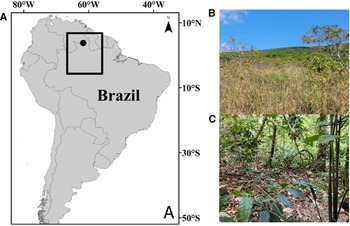
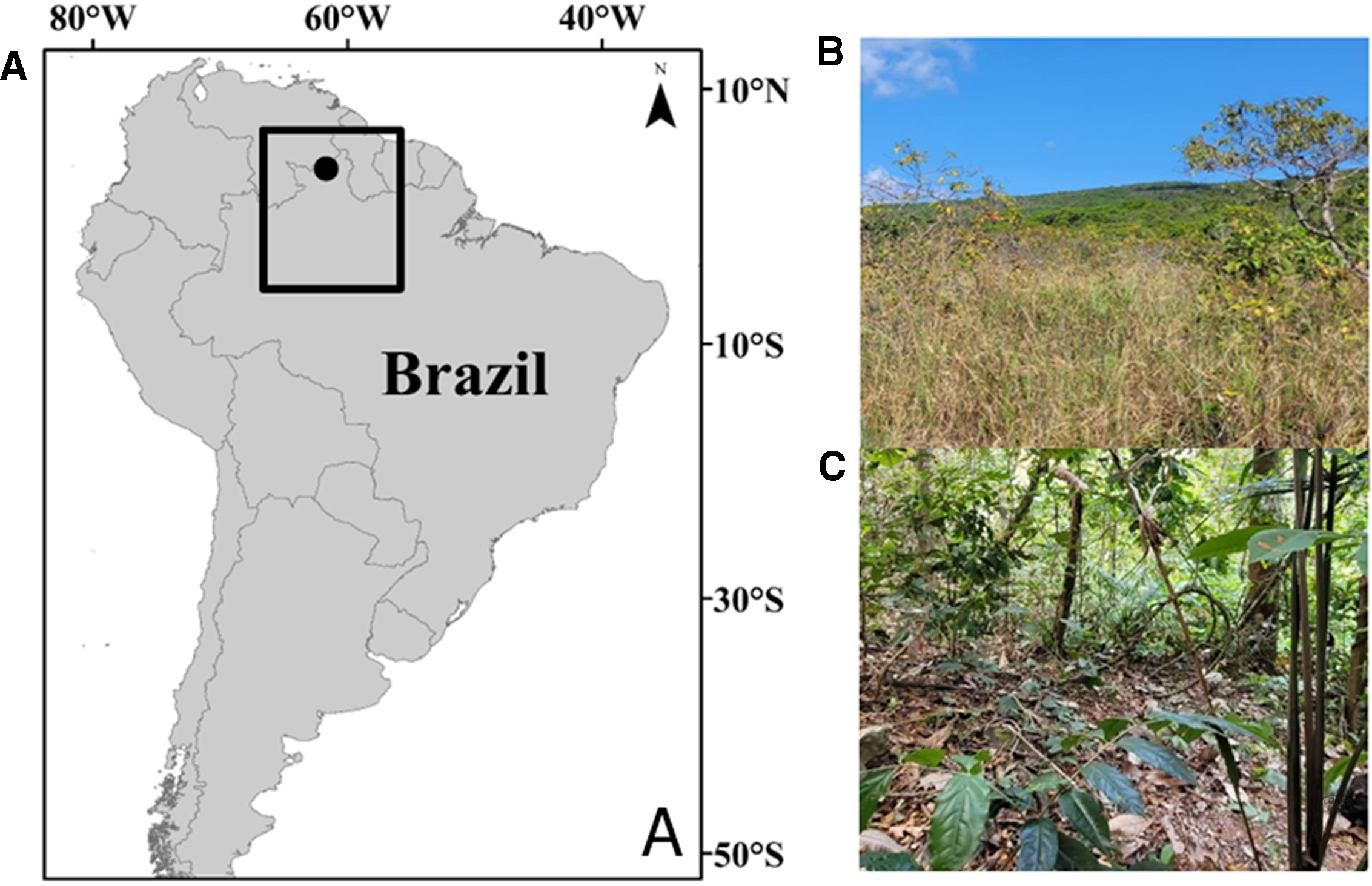
The study was performed in Tepequém, a tepui located in northern Roraima (3° 45' N, 61° 41' W), the northernmost state of Brazil (Fig. 1A). Tepequém has approximately 5500 ha in its table-top mountain area and is geomorphologically comprised of erosive scarps, steep slopes, and valleys (Rodríguez-Zorro et al. Reference Rodríguez-Zorro, Costa and Behling2017). The base of the mountain ranges across approximately 200 m of elevation, and its summit reaches approximately 1100 m. At the mountain’s base and lower elevations between 250 and 700 m, the vegetation consists of a mosaic of ombrophilous tropical forest (Fig. 1B) and anthropogenic habitats (e.g., pasturelands). Towards the summit (above 700 m), the ombrophilous tropical forest is replaced by savannah vegetation (Prance Reference Prance1996), with rupestrian grassland and shrublands (Fig. 1C). The region’s climate is tropical humid (Am), according to Köppen’s classification, with a mean annual temperature of 28 °C and a mean annual rainfall of 1600 mm (Barbosa and Miranda Reference Barbosa, Miranda, Barbosa, Xand and Costa e Souza2004). The rainy season of Tepequém occurs from March to September (mean monthly precipitation: 254 mm; Climate Data 2023).
A, Tepequém tepui in Roraima state, Brazil. Physiognomies found at: B, higher elevation (above 700 m): savannah vegetation; and C, lower elevation (250–700 m): ombrophilous tropical forest.
Dung beetle trapping
We collected dung beetles in October 2021, which represents the beginning of the region’s dry season (October–February; Climate Data 2023). Sampling was performed every 100 m from 250 to 850 m at seven sites (i.e., elevational bands). To collect dung beetles, four pitfall traps baited with human excrement were installed within each elevational band, and each trap was spaced 5 m from one another. The number and spacing of traps were selected to maximise the number of beetles that could be sampled in each sampling site – an approach commonly used in ecological studies with dung beetles (e.g., Lobo et al. Reference Lobo, Hortal and Cabrero-Sañudo2006; Fletchmann et al. Reference Fletchmann, Tabet and Quintero2009; Filgueiras et al. Reference Filgueiras, Iannuzzi and Leal2011; Salomão et al. Reference Salomão, Cerqueira, Gomes, González-Tokman, Maia and Iannuzzi2021b). Pitfall traps consisted of cylindrical plastic receptacles (20 cm diameter × 15 cm height) buried at the ground surface. Inside the traps, a 250-mL solution of water, salt, and detergent was used to kill and preserve collected specimens. Above each plastic receptacle, a small plastic cup, in which approximately 50 g of human excrement was placed, was set to attract the beetles. Each trap was covered with a plastic lid to prevent rainwater and leaf litter from entering.
Beetles were collected over 24 hours after the traps were set. Specimens were identified to the lowest level possible according to taxonomic keys (e.g., Génier Reference Génier2009; Edmonds and Zídek Reference Edmonds and Zidek2010; Vaz-de-Mello et al. Reference Vaz-de-Mello, Edmonds, Ocampo and Schoolmeesters2011; González-Alvarado and Vaz-de-Mello Reference González-Alvarado and Vaz-de-Mello2014, Reference González-Alvarado and Vaz-de-Mello2021; Pacheco and Vaz-de-Mello Reference Pacheco and Vaz-de-Mello2015) and using the reference materials of the entomological collection of Instituto Nacional de Pesquisas da Amazônia (Manaus, Brazil) and the Universidade Federal de Mato Grosso (Cuiabá, Brazil). Species not identified to species level were morphotyped. Voucher specimens were deposited in the entomological collection of Universidade Federal de Mato Grosso (Mato Grosso, Brazil).
Following the approaches of previous ecological studies, beetle body size was used as a proxy for biomass (see Hunt and Simmons Reference Hunt and Simmons2000; Graf et al. Reference Graf, Reid, Aukema and Lindgren2012). We measured pronotum width, which recently has been used as an indicator of body size (Salomão et al. Reference Salomão, González-Tokman, Dáttilo, López-Acosta and Favila2018; Servín-Pastor et al. Reference Servín-Pastor, Salomão, Caselín-Cuevas, Córdoba-Aguilar, Favila and Jacome-Hernández2020). Pronotum width was estimated from digital photographs taken at Google Pixel 2m using the Leica Application Suite software, version 3.4.0 (https://www.leica-microsystems.com/products/microscope-software/p/leica-las-x-ls/). All individuals collected in this study were measured.
Data analysis
To help ensure that our sampling collected a representative diversity of dung beetles at the Tepequém tepui, we calculated sampling coverage. We followed the methodology proposed by Chao and Jost (Reference Chao and Jost2012), which is based on the number of individuals collected of each species in the assemblage. We performed sampling coverage for each elevational band and for all elevational bands combined. To calculate sampling coverage, we used the software iNEXT (Hsieh et al. Reference Hsieh, Ma and Chao2016).
We used generalised linear models and linear models to analyse how beetle species richness, abundance, and body size (total and mean body size) changed across the elevational bands. Elevation was the independent variable, and dung beetle species richness, species abundance, and total and mean body size (i.e., the sum of the body size of all the specimens of each species and the mean body size of all beetles collected in each elevational band) were the dependent variables. The mean body size variable allows us to understand the effect of elevation on body size only, and total body size measures elevational effect on body size and on the complete biomass of each species – that is, on the balance between their body size and abundance. This interaction is important because sometimes a species may change its mean body size across an ecological spectrum but may retain a stable population biomass by increasing its abundance and vice versa. We used generalised linear models with negative binomial distribution in the species richness, species abundance, and mean biomass models, given the overdispersion found in the model (residual deviance/residual df > 2), and we used linear models in the total biomass model. Data distribution was observed by using quantile–quantile plots. The presence of outliers was observed with Cook’s distance. Statistical analyses were conducted following Zuur et al. (Reference Zuur, Ieno, Walker, Saveliev and Smith2009) and Crawley (Reference Crawley2013) and were done in R, version 4.1.3 (R Development Core Team 2022).
We used a Bray–Curtis similarity index to explore the similarities of dung beetle assemblage structure among elevational bands. Subsequently, we analysed the significance of elevation groupings based on resemblance indices through a similarity profile permutation test performed in Primer, version 6.0 (Clarke and Gorley Reference Clarke and Gorley2006). For the similarity profile permutation test, each elevational band (i.e., set of four pitfall traps) was used as a sampling unit.
Results
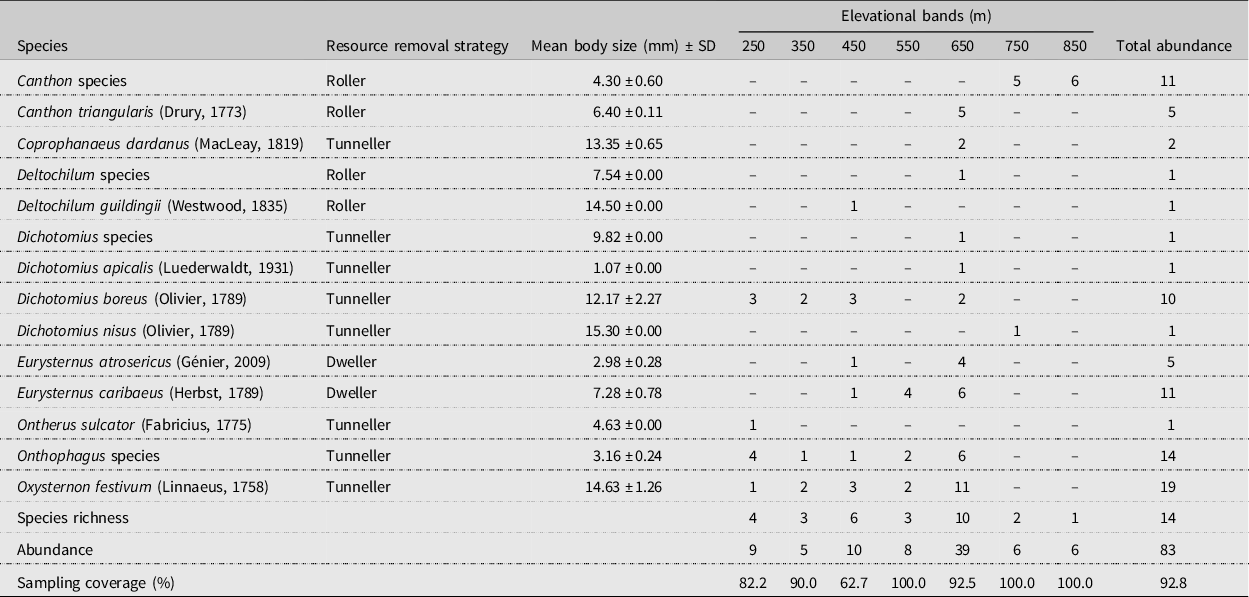
We collected 83 beetles belonging to 14 species and seven genera (Table 1). Oxysternon festivum (Linnaeus, 1758) and an unidentified Onthophagus species were the most abundant species, representing 23 and 17% of the total beetles sampled, respectively. Deltochilum guildingii (Westwood, 1835) and an unidentified Deltochilum species each were singletons, and Coprophanaeus dardanus (MacLeay, 1819), an unidentified Dichotomius species, and Dichotomius apicalis (Luederwaldt, 1931) each were represented by two specimens. When considering each elevational band separately, sampling coverage ranged from 62.7 (450 m) to 100% (550, 750, and 850 m); when considering all elevational bands together, we obtained 92.8% sampling coverage of dung beetle species from the Tepequém tepui (Table 1).
Dung beetles collected and species sampling coverage at different elevational bands in the Tepequém tepui, Roraima, Brazil.
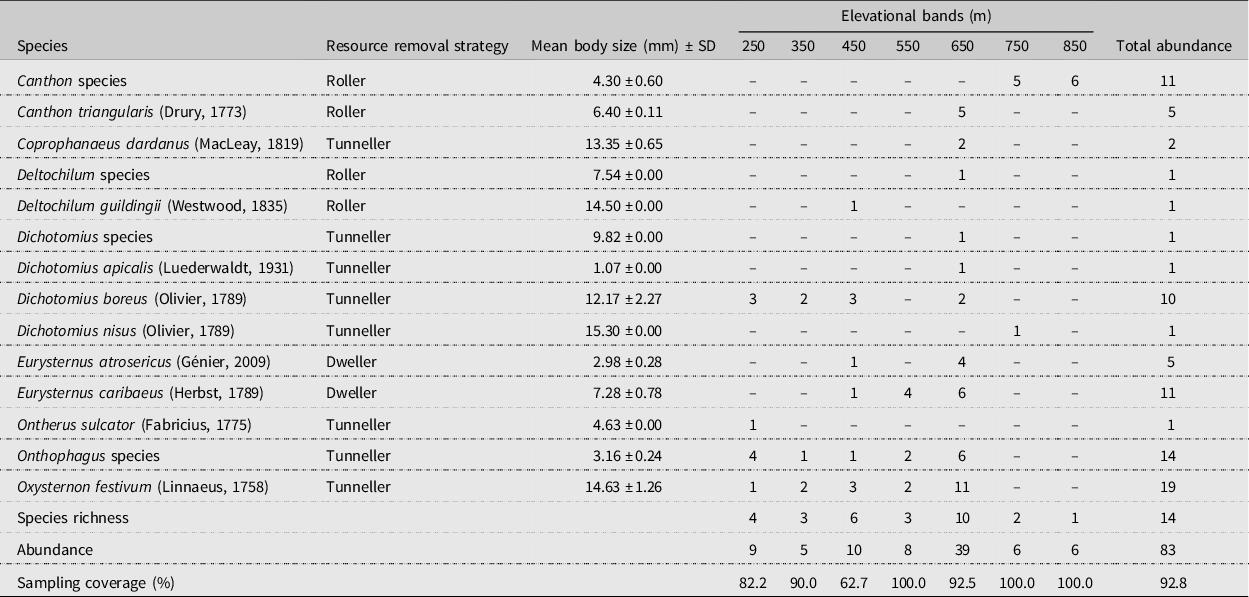
Mean body size = pronotum width × 10.
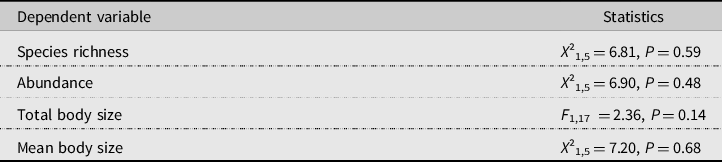
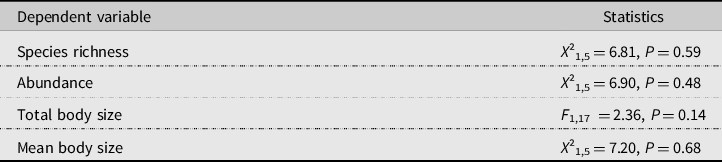
The body size of species ranged from 2.98 mm (Eurysternus atrosericus Génier, 2009) to 14.63 mm (Oxysternon festivum (Linnaeus, 1758)). Species richness per elevational band ranged between one (850 m) and 11 species (650 m), whereas abundance ranged from five (350 m) to 39 beetles (650 m). Species richness, species abundance, and total and mean body size were unaffected by elevation (Table 2).
Generalised linear models and linear models for the effects of elevation on dung beetle species richness and abundance and total and mean body size in seven elevational bands located in the Tepequém tepui, Roraima, Brazil.
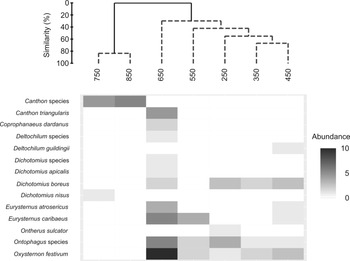
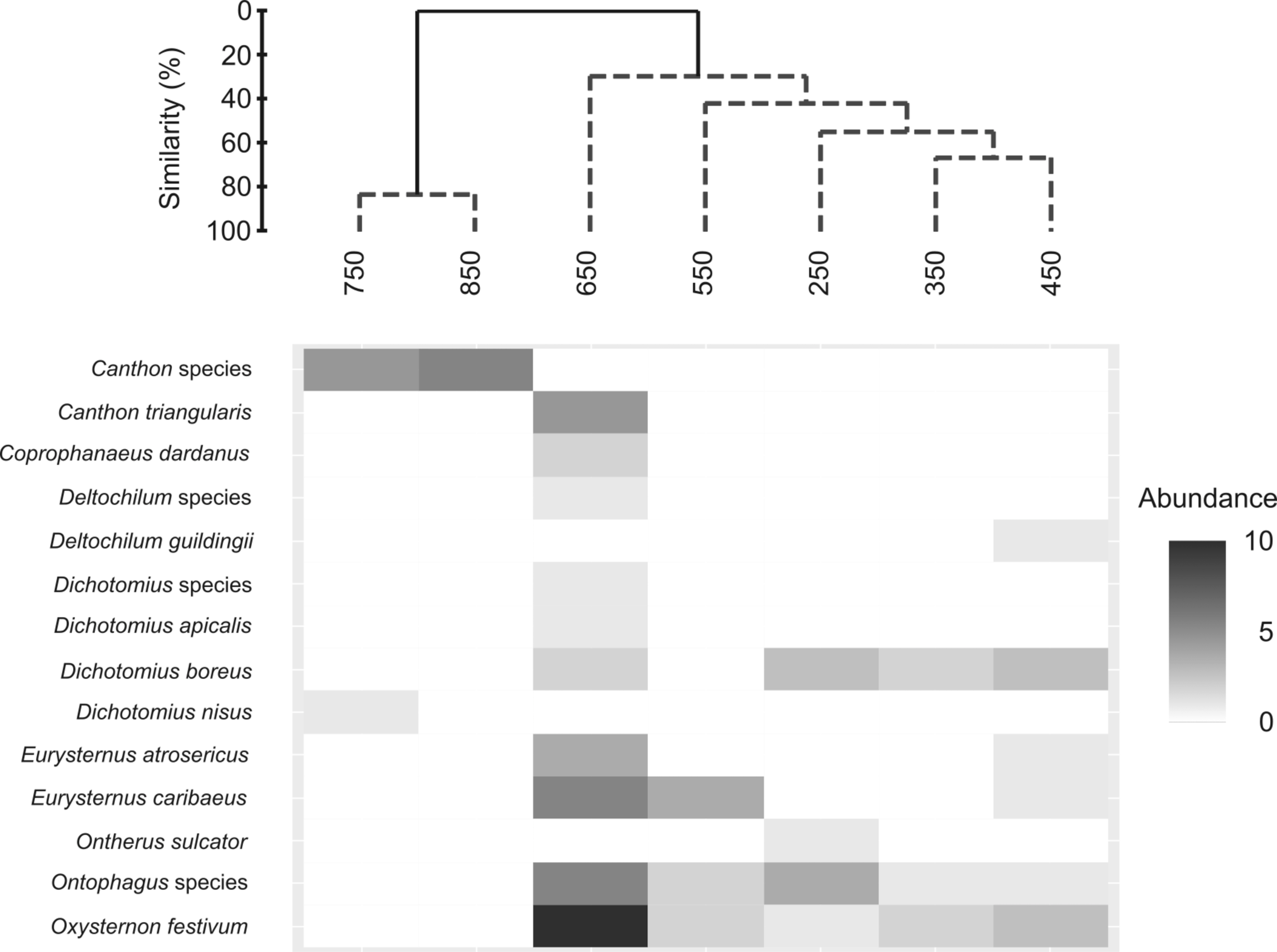
Three species were widely recorded (Dichotomius boreus (Olivier, 1789), an unidentified Onthophagus species, and O. festivum) and collected in more than half of the sampling sites. In contrast, seven species were recorded from only one elevational band (five at 650 m). Regarding vegetation physiognomies, only two species were captured in the savannah vegetation (an unidentified Canthon species and Dichotomius nisus (Olivier, 1789)), corresponding to 750 and 850 m (Table 1). Except for those two species, all the others were recorded in humid tropical forests, which occurred between 250 and 650 m elevation (Table 1). The 750 and 850 m elevation bands were grouped according to the dung beetle assemblage structure, and all the other elevations were clustered in another statistically distinct group (Fig. 2).
Heatmap of the distribution of dung beetle species throughout the elevational bands of the Tepequém tepui, Roraima, Brazil. The dendrogram shows the grouping of elevational bands according to the Bray–Curtis similarity index, and dashed lines represent statistical groupings according to the similarity profile permutation test (P < 0.05).
Discussion
Mountain ecosystems are critical models for understanding how biodiversity changes according to climatic gradients (Rahbek et al. Reference Rahbek, Borregaard, Colwell, Dalsgaard, Holt and Morueta-Holme2019; Salomão et al. Reference Salomão, Arriaga-Jiménez and Kohlmann2021a). Contrary to previous studies in Amazonian mountainous ecosystems (e.g., Celi et al. Reference Celi, Terneus, Torres and Ortega2004; Espinoza and Noriega Reference Espinoza and Noriega2018), we did not find elevational effects on dung beetle species richness, abundance, or biomass in the present study. Nevertheless, our findings may be analysed to consider the current landscape scenario in the studied tepui. Gold mining activities and livestock expansion in the Tepequém region have led to deforestation in recent years (Almeida-Filho and Shimabukuro Reference Almeida-Filho and Shimabukuro2010; Barros et al. Reference Barros, Melo, Senwo, Evald, Siqueira, Bardales and Nunes2018). Among our study sites, lower tropical rainforest elevation (i.e., below 700 m) had heterogeneous conservation levels: our sampling areas comprised secondary forests or small primary forest fragments. Because the elevational effects on dung beetle diversity are still not clearly understood in tepui landscapes, the results presented herein should be analysed carefully and consider that anthropogenic effects may have decreased the diversity at the lower elevation and that forest disturbance is one of the most important forces driving dung beetle ecological dynamics (e.g., Filgueiras et al. Reference Filgueiras, Iannuzzi and Leal2011; Braga et al. Reference Braga, Korasaki, Andresen and Louzada2013; Alvarado et al. Reference Alvarado, Salomão, Hernández-Rivera and Lira2020).
Our study showed a marked difference between the dung beetle assemblage sampled from the highlands (> 700 m) and those sampled from the lowlands and intermediate elevations. Of the 14 species we sampled, only two (D. nisus and an unidentified Canthon species) were found in the highlands, and both were recorded exclusively at those elevations. The Tepequém tepui comprises two marked vegetation structures, one from the lowlands and intermediate elevation (tropical rainforest) and one from the highlands (savannah, rupestrian grassland; Prance Reference Prance1996; Campos et al. Reference Campos, Schaefer, Pontara, Xavier, Júnior, Corrêa and Villa2022), and according to our samples, dung beetle species composition appears to respond to this bimodal vegetational pattern. Interestingly, D. nisus, a broadly distributed species in Brazilian open vegetation (e.g., the Cerrado savanna and Caatinga dry forest, Brazil; Cassenote et al. Reference Cassenote, Valois, Maldaner and Vaz-de-Mello2020), was recorded in the highlands. Conversely, the species from the lower elevation are all commonly found in Amazon rainforests (Quintero and Halffter Reference Quintero and Halffter2009; Cupello and Vaz-de-Mello Reference Cupello and Vaz-de-Mello2013; Ratcliffe Reference Ratcliffe2013; Harada et al. Reference Harada, Araújo, Overal and Silva2020). The contrasting highland–lowland tepuis vegetation structure resembles those observed in other similar tropical elevational gradients, such as the brejos de altitude – the elevational enclaves of rainforest inserted in Caatinga dry forests in Brazil (e.g., Pôrto et al. Reference Pôrto, Cabral and Tabarelli2004; Silva Reference Silva2011; Salomão et al. Reference Salomão, Lira, Foerster and Vaz-de-Mello2022). Wherever abrupt habitat shifts occur along elevational gradients, the species located in the highlands will likely differ from those inhabiting the lowlands.
Some important caveats need to be considered when interpreting the patterns observed in our study: these include our limited sampling effort and the relatively small elevational range comprised in the Tepequém tepui. Although we used four pitfall traps per elevational band to improve our sampling efficiency, we had a limited period during which traps were kept active in the field (24 hours). Pitfall traps are usually left to remain active during 48 hours in the field (e.g., Liberal et al. Reference Liberal, Farias, Meiado, Filgueiras and Iannuzzi2011; Medina and Lopes Reference Medina and Lopes2014), but studies that use pitfall traps for only 24-hour periods also present solid results encompassing dung beetle diversity dynamics (e.g., Lobo et al. Reference Lobo, Lumarett and Jay-Robert2001; Barraza et al. Reference Barraza, Montes, Martínez and Deloya2010; Braga et al. Reference Braga, Korasaki, Andresen and Louzada2013). Even with an acceptable 24-hour period of pitfall traps, we collected only a relatively low number of beetles (mean of approximately three beetles per pitfall trap) and a relatively low sampling coverage in the elevational bands of 250 m and 450 m. Any analysis of our data must consider that some tropical ecosystems may present a marked dung beetle seasonal activity (e.g., Hanski and Cambefort Reference Hanski and Cambefort1991; Scholtz et al. Reference Scholtz, Davis and Kryger2009; Liberal et al. Reference Liberal, Farias, Meiado, Filgueiras and Iannuzzi2011). In this sense, one hypothesis for the present study is that sampling during the beginning of the dry season in this region may have biased our results, especially for the highlands (above 700 m), which have a drier vegetation physiognomy. Dry tropical ecosystems (e.g., Caatinga dry forest) are more prone to seasonal fluctuations in beetle activity compared to more humid ecosystems (e.g., Atlantic rainforest; see Liberal et al. Reference Liberal, Farias, Meiado, Filgueiras and Iannuzzi2011; Iannuzzi et al. Reference Iannuzzi, Salomão, Costa and Liberal2016). Although it has been argued that Neotropical studies on dung beetles as currently carried out apply an excessive sampling effort (Rivera and Favila Reference Rivera and Favila2022), we believe that installing more traps and presenting a broader spatial and temporal distribution in the tepui mountains could present clearer trends regarding beetle elevational distribution.
Regarding the limited vertical range of the Tepequém tepui, it is important to understand this spatial limitation as a consequence of the close elevation between our sampling units (i.e., 100 m among each sampling site). Studies encompassing elevational dynamics on dung beetle diversity in the Neotropics often consider elevational intervals ranging from 200 to 400 m (e.g., Escobar et al. Reference Escobar, Lobo and Halffter2005, Reference Escobar, Halffter and Arellano2007; Alvarado et al. Reference Alvarado, Salomão, Hernández-Rivera and Lira2020; Kohlmann et al. Reference Kohlmann, Arriaga-Jiménez and Salomão2021). Our sampling design considered an elevational gradient, but seven elevational bands spaced 100 m apart may be excessive for the limited vertical space of Tepequém tepui. We believe our reduced spacing among the elevational bands may have led to a spatial overlap and, in consequence, a sub-estimation of the elevation effects on dung beetle species richness, abundance, and biomass.
To our knowledge, this is the first study to focus on dung beetle diversity in a tepui. Previous dung beetle studies in the region focused on lowland fauna (França et al. Reference França, Korasaki, Louzada and Vaz-de-Mello2016; Choo et al. Reference Choo, Gill, Zuur, Zent and Economo2019) or gathered nonstandardised information encompassing larger areas in the region (Pacheco and Vaz-de-Mello Reference Pacheco and Vaz-de-Mello2015; Génier and Cupello Reference Génier and Cupello2018). Considering such data scarcity and the biological relevance of the tepuis, we recommend that future studies perform intense biodiversity inventories at the different elevations of these mountains, focusing efforts on the tepuis’ summits. Although the Tepequém tepui did not present a clear relationship between elevation, diversity, and biomass, we observed a marked difference in dung beetle assemblages related to vegetation physiognomy, which is itself related to elevation. These table-top mountains may serve as good models for studying ecological dynamics (e.g., the effect of the area of the tepuis on diversity) and biogeographical hypotheses (e.g., the “Lost World” hypothesis; Rull Reference Rull2004). We therefore believe that this study should be considered a starting point in improving our understanding of the dung beetle diversity of the tepuis.
Acknowledgements
The authors thank Estância Ecológica Sesc Tepequém for providing logistic support. R.P.S. was supported by a Dirección General de Asuntos del Personal Académico (DGAPA) postdoctoral fellowship from the Universidad Nacional Autónoma de México. A.F.A.L. was funded by the Fundação de Apoio a Pesquisa do Estado da Paraíba (FAPESQ) and by the Conselho Nacional de Desenvolvimento Científico e Tecnológico (CNPq) through a postdoctoral scholarship (PDCTR-300104/2022-7).
Competing interests
The authors declare they have no competing interests.