The collecting and arranging of British folk-song in the early twentieth century has often been associated with a combination of earnest antiquarian and nationalist impulses tinged with romanticism,Footnote 1 yet Percy Grainger’s extraordinary attraction to British folk-song as a collector and arranger appears to have stemmed from complicated personal and aesthetic motives. Between 1905 and 1908 Grainger devoted himself to collecting English folk-songs with a passion that would appear to have been fired not by a narrow nationalism, but rather by more universalist ideals about folk-song. His interests were catholic, and over his career he collected folk-song in England, Denmark and New Zealand, making arrangements of tunes he collected and setting many folk melodies collected by others. While the pursuit of melodies had its own attractions, Grainger was drawn equally to the ‘folk’ dimension of folk-song.
Grainger’s fascination with the rhythmic freedom and expressivity of folk performance, and his genuine interest in the lives of the singers, bears testimony to a wider agenda than just the race against time to preserve melodies as the urban increasingly encroached upon the rural. Romanticization of the rural was nothing new, but Grainger seems to have glimpsed from his earliest collecting forays not only the symbiotic relationship between song and singer, but a way of life in which song and singer were both integrated. The songs they sang to the young Grainger were ancient and untamed, with recurrent themes and imagery that transcended national borders. David Pear and Malcolm Gillies have noted that Grainger’s claim of a theme of ‘spiritual wildness and even cruelty’ in his compositions and particularly his folk-song settings, along with the spiritual dimension of his creativity, warrant further investigation.Footnote 2 More recently, Peter Tregear has noted that themes of ‘betrayal, deception and doomed youth’ figure prominently in the texts of some of Grainger’s well-known folk-song settings.Footnote 3 This article seeks to throw light on the development and formative influences in Grainger’s lifelong attraction to folk-song, concentrating primarily on his early settings of British folk-song; I will take a more comprehensive view of the themes and recurrent images in the texts associated with his British folk-song settingsFootnote 4 and consider the spiritual dimension of these works. Teresa Balough’s exposition of Grainger’s philosophy of music has emphasized the critical importance of the over-200 folk-song settings in his output (including subsequent arrangements) as a deliberate strategy of ‘taking the local, to the national, to the universal’.Footnote 5 This article expands on this concept of universality, along with ideas of purity and freedom that Grainger associated with folk-song in his writings, in discussion of notions of the spiritual in his British folk-song settings.
While Grainger rejected Christianity and other orthodox spiritualities outright, he nevertheless referred to music in simultaneously religious and universal terms: ‘I look on music as a religious art, a form of devotion, and essentially an art in which many different personalities blend into one harmonious whole’.Footnote 6 The sense of reverence and the integration Grainger describes confer recognizably spiritual attributes on music and his musical experience. In the absence of a religious framework, studying spirituality poses difficulties of definition, aptly described by Courtney Bender as being ‘akin to shovelling fog’.Footnote 7 Grainger’s voluminous writings outline a construction of personal meaning through his music and a philosophical view of music as a means to promote personal and universal connectedness. When seen in conjunction with the subsequent transformation of his creativity and focus on self-expression, there is alignment with general principles of progressive spirituality that is traceable to Ralph Waldo Emerson and the American Transcendentalists.Footnote 8 Grainger’s exposure to these principles was likely mediated through the poetry of Walt Whitman, who drew on the Transcendentalist ideas and added his own personalist philosophy.Footnote 9 In 1897 Grainger received a volume of Whitman’s poetry as a gift from Cyril Scott;Footnote 10 the volume was a formative influence. At one point Grainger even declared that his religion was ‘Walt Whitmanism’, inspired by Leaves of Grass,Footnote 11 and consequently this article provides some discussion of influences of Whitman on Grainger’s response to folk-song, nature and the development of his notions of the spiritual and universal.
Publications of collections of traditional and popular melodies, including a frequently undifferentiated mix of British folk-song, dance melodies, broadside ballads and well-known airs from ballad operas, appeared in increasing numbers during the nineteenth century, reflecting a mix of antiquarian and commercial interests.Footnote 12 Such volumes supplemented royalty ballads to provide the core repertory of domestic vocal music making in Australian homes in the late nineteenth century and continued to do so up until World War Two. Grainger would have been familiar with some of these songs from his childhood, and as will be demonstrated in this article, would appear to have had access to some of the key publications, such as Chappell’s Popular Music of the Olden Time. Footnote 13 Grainger began his own folk-song collecting in 1905, directly inspired by a lecture to the Musical Association from a stalwart of the Folk Song Society, Lucy Broadwood,Footnote 14 and became aware of her work and that of other members of the Society such as Cecil Sharp, Frank Kidson and the inimitable Reverend Sabine Baring-Gould.Footnote 15
The possibilities of traditional material to Grainger’s fertile musical imagination appear to have been prompted by the wealthy patron of music, Karl Klimsch, who provided him with some composition tuition in Frankfurt.Footnote 16 Klimsch had some sympathy for his pupil’s more modernist impulses and was the only composition teacher Grainger acknowledged in later life. Grainger revered Klimsch for his ‘pure goodness, pure generosity, pure rightness and pure wisdom’ as a friend and guide.Footnote 17 Nevertheless Klimsch was highly critical of Grainger’s early ‘florid’ style to which he proposed the following compositional antidote:
If you have no theme or melody in your head, don’t compose at all. If you have a theme or melody, start off with it right away and the moment your melodic inspiration runs out stop your piece. No prelude, no interlude, no postlude: just the pith of the music all the time.Footnote 18
Corresponding with the period when he was in close contact with Klimsch, Grainger began arranging traditional melodies, which would have provided the aforementioned themes to focus his compositional imagination and hone his technique. These were all selected from published collections, although it is unclear whether Grainger had a free hand in selection. Klimsch certainly introduced Grainger to the possibilities of Scottish traditional song by lending him publications,Footnote 19 as will be discussed later in this article, but there is no evidence that he singled out specific songs to Grainger for this purpose. Grainger’s musical independence even at this early stage of his compositional career suggests that he would have exercised some choice over musical material (even for compositional exercises); on this assumption the selection warrants further investigation to reveal the impulses at work.
In late October 1898 Grainger began working on an original setting of three poems of Robert Burns,Footnote 20 and while this was in progress he also completed an arrangement of the ‘Old English Song’ O willow, willow.Footnote 21 The manuscript of this arrangement does not give Grainger’s source for the melody, but apart from two minor alterations of rhythm it is the same as that printed in William Chappell’s Popular Music of the Olden Time. Grainger in fact uses the same key of E minor, and his rolled chord accompaniment echoes the simple accompaniment provided by G.A. Macfarren in that collection, although Grainger’s is even more sparse, and relies on pedal harmonies using tenths emphasizing parallel fifths in the voicing of the chords. This old ballad text, which had been quoted by Shakespeare in Othello, poignantly laments lost love. It must have resonated with the 16-year-old Grainger, as he recalled it many years later as an example of the ‘tragic’ folk-songs that ‘appealed to me most’.Footnote 22
Just a few months later, from 15 to 29 January, 1899, Grainger made arrangements of 25 traditional melodies, which he completed over several days of concentrated effort and enthusiasm for his task.Footnote 23 In the manuscript, Grainger gave 17 January 1899 as the completion date for no less than seven of the arrangements, and indicated that another five were completed on 20 January 1899.Footnote 24 Each arrangement is laid out on three staves as a vocal line with piano accompaniment, but in every case the vocal line is untexted. Either Grainger had intended to write the words in later or this was a compositional exercise for Klimsch in providing new accompaniments to the selected tunes, testing out a range of harmonic, textural and rhythmic ideas with varying degrees of independence from the melody.
These 25 popular old English songs then provided the aforementioned melody for Grainger’s flights of inspiration and concentrated his musical ideas. The songs he selected include a mix of vigorous jocularity (A hunting we will go, There was a jolly miller, Come lasses and lads), songs of lost love (Early one morning), death from love (Near Woodstock Town) and ballads embracing the macabre and cruel (The Three Ravens, Barbara Allen). Grainger’s approach was relatively conventional but the parallel tenths of the earlier O Willow, willow setting were employed again in Barbara Allen and the sustained chords and parallel fifths, trialled in that arrangement in 1898, are used as the underpinning device for his arrangement of A poor beggar’s daughter and are also the dominant feature of his accompaniment for Early one morning.Footnote 25 Grainger’s source for these melodies would also have included the text, even if he did not write it into his manuscript, and he later recalled The Three Ravens as an example of his attraction to tragedy.Footnote 26 Even in these very early compositions, Grainger’s ability to capture the essence and mood with limited figural devices and restrained, even sparse, textures is apparent, reflecting Klimsch’s influence on his muse.
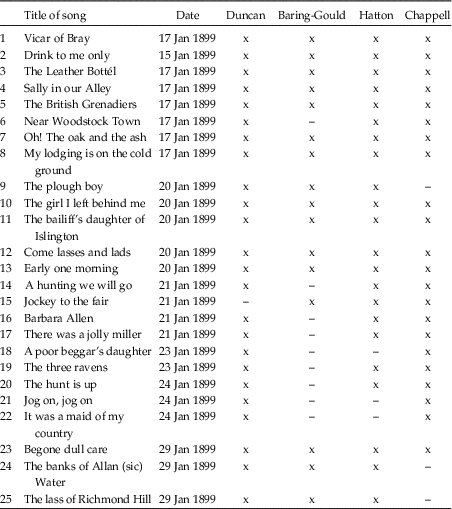
In trying to come to an understanding of Grainger’s early exposure to folk melody and the accompaniment models that he may have been using, it would be helpful to be able to identify the collection or collections of British folk-songs to which he had access in this period. The manuscript of this set of arrangements is in a folio marked ‘English Folksongs’, and on this was made the following annotation at a later date: ‘26 settings of popular old English songs (late Jan 1899) seemingly from Augener’s Minstrelsy of England’. This attribution unfortunately presents a number of problems. Minstrelsy of England was indeed an Augener publication, edited by Edmounstone Duncan; but this two-volume collection seems not to have been published until around 1905, six years after Grainger made his arrangements.Footnote 27 Nevertheless, Duncan’s edition contains 24 of the 25 melodies that were arranged by Grainger and appear in this 1899 manuscript.Footnote 28 The suggestion made by Dorothy De Val that Baring-Gould’s English Minstrelsie (1895–96) may have been Grainger’s source seemed possible, but unfortunately is not borne out by the evidence (see Table 1).Footnote 29 There are two other major collections, readily available in the 1890s, each of which contain 22 of the melodies that Grainger selected for his 1899 arrangements. One was Hatton’s The Songs of England and the other collection was Chappell’s Popular Music of the Olden Time.Footnote 30
Melodic concordances for Grainger’s ‘Popular Old English Song’ arrangements (1899) with key published collections of the period

While Table 1 gives an indication of the amount of common material between key published collections of this period, the only publication that approaches Duncan’s Minstrelsy of England in its concordance to Grainger’s arrangements is Chappell’s Popular Music, and this would be consistent if it was also his source for O Willow, willow. In conclusion, it appears that the attribution ascribing the songs to Augener’s Minstrelsy of England was mistaken, and Grainger had instead used Chappell as either the primary or a supplementary source. Alternatively, the absence of a specific date in the first edition of Duncan’s Minstrelsy of England provides a modicum of doubt and perhaps the publication of this collection was earlier and available to Grainger at the beginning of 1899. In any case it seems likely that more than one printed source was used in order to compile all the melodies. Chappell’s collection combined with any one of the other three sources given in Table 1 would account for all of the tunes.
Later in 1899, following the first of a series of breakdowns in Rose Grainger’s health, Karl Klimsch financed a holiday for Grainger and his mother, apparently on the condition that he did not want the money to be repaid.Footnote 31 They travelled through northern Italy and France, and eventually made their way to London and then Glasgow, where Grainger took a three-day hike through the spectacular landscape of mountains and lochs in nearby West Argyllshire, which was to have a profound and lasting effect on his creativity.Footnote 32
Around the time of Grainger’s other early experiments with folk-song arranging, Klimsch introduced him to another popular collection of folk-songs, Songs of the North edited by Harold Boulton and Anne Campbell MacLeod. Malcolm Lawson provided the serviceable, but not particularly inspiring, piano accompaniments and a few choral arrangements. Songs of the North was a collection of Scottish songs first published in 1884 in a handsome leather-bound edition, with gilt-edged pages and beautiful lithograph plates throughout, illustrating the songs with reproductions of drawings of such esteemed artists as Edward Burne-Jones, Frederick Sandys and James McNeil Whistler.Footnote 33 Much cheaper cloth-bound editions followed, with additional songs, expanding the collection into two volumes and omitting most of the illustrations. Songs of the North proved to be extremely popular, with over 30 editions published by 1925. Klimsch lent Grainger his clothbound volumes of Songs of the North, and Grainger would seem to have taken these with him when he went on the holiday to Scotland.Footnote 34 Spurred on by his experience of the beauty and isolation of the Scottish landscape he set about arranging some of the melodies in the collection. The settings were made in June and July 1900, while Grainger was visiting Argyllshire, and were subsequently completed in London.Footnote 35 Grainger gave the manuscript, which also included at the end an arrangement of The Rag-Time Girl (Hello my honey, hello my baby) to his mother as a birthday present, inscribed ‘For dear Mother’s birthday July 3, 1900 remembering a great kindness in permittance of a Highland Tripp [sic]’.Footnote 36
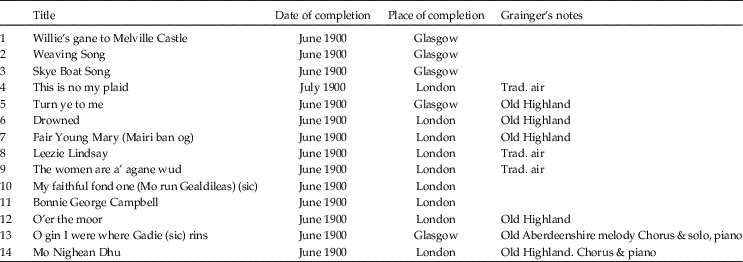
Grainger selected 14 songs for his arrangements, all drawn from the 56 songs contained in the first volume of Songs of the North, so it is possible that he only took this one volume with him when he travelled to Scotland. The most well-known of the songs in the collection, Bonnie Banks of Loch Lomond, Grainger did not arrange. He instead selected 14 others from throughout the volume, but the criteria for this selection are difficult to determine. Certainly, all the melodies that Grainger chose were designated in Songs of the North as being ‘traditional’ or were classified as ‘Old Highland’ and similar. There are some songs in Songs of the North that had newly composed melodies to traditional poetry. Grainger eschewed these. As with many of these popular collections a lot of the folk melodies were provided with new poetry, either because only the melody was collected, or because the original words were in Gaelic, or the English words deemed of lesser quality. Given the quality of some the poetry provided, it is hard to believe the original could have been worse. Nevertheless, volume 1 of Songs of the North was Grainger’s source and he would at least have read the words, if not sung them, as part of the process of composing his arrangements. Over half a century later Grainger made another arrangement of three of these songs for piano solo and his note on the manuscript says ‘Three Scotch Folksongs from “Songs of the North” … remembered (no doubt inaccurately) Oct 21, 1954’.Footnote 37 Although Grainger made errors in spelling and minor errors in the text the words had imprinted themselves sufficiently in his memory in association with the melodies that he was able to give the first verse of each – O gin I were where Gowrie (sic) rins, Leezie Lindsay and Mo nighean dhu – on the manuscript. Although Grainger may have made untexted arrangements of folk melodies or arrangements for purely instrumental resources, this indicates that if a text was in his original source, then he likely carried an integrated memory of melody and words.Footnote 38
Twelve of the arrangements from the Songs of the North that Grainger made in 1900 take the form of a melody with piano accompaniment and two are choral arrangements. As with the ‘Popular Old English Song’ arrangements of January 1899, Grainger did not copy in the texts. Grainger’s interest seems to have been focussed on re-harmonization of the melodies and creation of mood; thus his Songs of the North arrangements, like the aforementioned set, were probably a compositional exercise instigated by Klimsch. In Songs of the North Malcolm Lawson’s arrangement of O gin I were where Gowdie rins was SATB chorus for the refrain and solo voice for the verses. Grainger’s arrangement follows the same format of solo and chorus. Similarly, the arrangement of Mo nighean dhu (My dark-haired maid) in Songs of the North was a setting for homorhythmic four-part chorus with piano accompaniment ad lib and Grainger’s arrangement is also for four-part chorus. Grainger was clearly influenced not just by the melodies but also by the textures in his source, although preserving these may have been an imposed compositional constraint (Table 2).
Grainger’s Scottish Folksongs from ‘Songs of the North’

At the end of each song Grainger gave only the month and place of completion so it is not possible to put the songs in strict chronological order; however, the songs written in Glasgow were the first of the arrangements and the compositions were reordered at some point. The texts of these first songs, Willie’s gane to Melville Castle and Weaving song are stereotypically Scottish in their language and quite light-hearted. In the first, young Willie, who has won the hearts of three sisters at Melville Castle, pledges to marry all three on his return, and in the second, a young lassie about to be married believes that love will suffice against all: ‘I love the laddie weel who wears the tartan plaidie’. The Skye Boat Song was the ‘hit song’ of Songs of the North and had been first published in that collection and then subsequently included in many other folk-song collections, becoming one of the best known Scottish songs by the early twentieth century. The tune drew on a rowing melody collected in the Highlands by MacLeod, and Boulton had provided the familiar words that referred to the escape of Bonnie Prince Charlie to exile assisted by Flora Macdonald. The words of the verse contain some vivid poetic images of bravery under persecution (‘burned are our homes, exile and death scatter the royal men’) and of winds howling and stormy seas. Such words of valour and reference to the elemental powers must have been attractive to Grainger and this arrangement is his longest in this set of songs. Turn ye to me is similarly full of powerful, evocative and fundamentally unsettling images, overtly referencing death. The sorrow of the lover is echoed in nature in the moans of the sea-mew, but even the sea-bird can find repose on the rocks while for the bereft lover the only rest is eternal: ‘thy home is the angry wave, mine but the lonely grave’.
The final arrangement Grainger made while still in Scotland was O gin I were where the Gadie rins, an Aberdeenshire melody that had been collected and provided with nostalgic words by Dr John Park. Footnote 39 Such images of untamed nature – wild birds, waves and storms – seem to be a common denominator in these first songs, but there are also images of death in battle and a strong strain of melancholy in the selection of songs where lovers are parted by death.
When Grainger and his mother arrived in London later in June 1900 he continued with the Songs of the North arrangements, and his choice of songs largely aligns with the dominant thematic tone of these first few settings. Leezie Lindsay is a companion to the humorous courtship song, Willie’s gane to Melville Castle discussed previously. In Leezie Lindsay the lad presses his suit to no avail until he reveals himself as Lord Ronald Macdonald, and only then does proud Lizzie accept him. The anti-Jacobite song, The women are a’ agane wud seems to be the one that does not conform, but this again takes independent women as its subject. There is danger inherent in the text that is framed from a male standpoint; the women have gone wild and aligned themselves with Bonnie Prince Charlie because of his beauty, and the ‘wildness’ of these Scottish women might put the whole community in danger. This is no my plaid possibly also originated in the Jacobite era, as the tartan was banned after the Jacobite uprising as a symbol of Scottish independence and by association, Bonnie Prince Charlie. This song of coded rebellion is from a woman’s perspective. The notion of independent ‘wild’ women who knew their own mind certainly appealed to Grainger in his later life, and these texts, drawing on the popular ballad trope of warrior women,Footnote 40 may have had a maternal resonance for him. This ‘wildness’ also echoes ideas of personal freedom and self-determination that emerged as key factors in his evolving philosophy.
The English text by Dr John Park reproduced in Songs of the North for Mo nighean dhu is a nostalgic, bittersweet poem. The remaining songs Grainger selected from the collection are unified by themes common to folk poetry, of undying love (Fair young Mary) that transcends separation (My faithful fond one), and even the final separation of death (O’er the moor and Drowned). Although there were other ballads included in the volume from which he was sourcing his melodies, Grainger selected Bonnie George Campbell (Child ballad 210) for arrangement. In this archetypal tragic tale of death, and by implication, violent murder, George Campbell goes out riding, but his horse returns alone, with the saddle covered in blood, and George’s bride laments his death, tearing out her hair. That Grainger might have found this dramatic ballad particularly enticing is not surprising: blood, violence and the powerful emotions of grief all combine.Footnote 41
Returning to Frankfurt Grainger began work on his Hill-songs, which were inspired directly by his trip to Scotland. As he recounted later:
My Hill-Songs arose out of thoughts about, and longings for, the wildness, the freshness, the purity of hill-countries, hill peoples and hill-musics – the Scottish Highlands and their clansmen, the Himalayas and their hill-men, the Scottish and Asiatic bagpipes, etc. These compositions were part of a back to nature urge, and were written as a protest against the tame-ness of plain-countries and plain-dwellers and the dullness, samishness and thwartingness of life in towns. Musically speaking, my Hill-Songs sought to weave the bagpipe tone-type (the skirling drasticness of the ‘chaunter’, the nasal fierceness of the drones) into many-voiced (polyphonic) textures.Footnote 42
Grainger’s choice of wording here is important, in his characterization of his ‘back to nature urge’ with adjectives such as purity and freshness, and terms such as wildness, fierceness and drasticness. These signify a deeper, personal emotional response, and parallel the textual themes that dominated in the songs that he selected for his arrangements from Songs of the North. The Scotland of his experience and his imagining was not only an antidote to urbanity, but a direct encounter with emotionality to ‘scenes where man’s hand has played no part’.Footnote 43 Drawing artistic inspiration from nature and untouched landscape, and the expression of the soul’s response to nature, were characteristics that lay at the heart of Grainger’s personal construct of Nordic music.Footnote 44 These inklings of a spirituality linked to nature bear strong parallels with ideas in Walt Whitman’s Leaves of Grass. Whitman wrote of the interconnectedness of nature and man, of his artistic inspiration drawn from nature and those moments of revelation of spiritual truth when the earth ‘spoke’ to him.Footnote 45 In his poem ‘A Song of the Rolling Earth’ for example, Whitman wrote:
I begin to see little or nothing in audible words,
All merges towards the presentation of the unspoken meanings of the earthFootnote 46
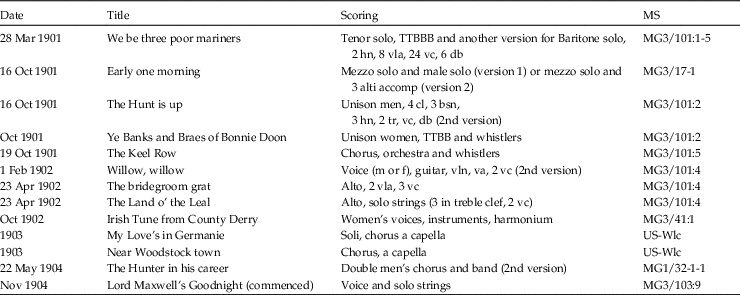
In 1901 Grainger moved to London, where his work as a society pianist was a key step towards attracting both pupils and the professional engagements necessary for a concert career.Footnote 47 Even so, he did not abandon his compositional activities, and between 1901 and 1904 he composed a number of arrangements of melodies that he had first arranged in 1898 in the ‘Popular Old English Song’ settings (e.g. Early One Morning; The Hunt is Up; Willow, willow; Near Woodstock Town). He also made new settings of a number of other folk-songs from published collections such as Chappell,Footnote 48 including We be three poor mariners, Ye banks and braes of bonnie Doon and The Keel Row; and he may have returned to Songs of the North for material to make an arrangement for soloists and chorus of My Love’s in Germanie. In April 1902 Grainger made settings for alto and strings of two other Scottish traditional songs, The Bridegroom grat and The Land o’ the Leal and in that same year he completed his first arrangement of the instrumental melody, Irish Tune from County Derry. (Table 3)
Grainger’s British folk-song and traditional song arrangements 1901–1904

In February 1903 Grainger composed a setting of the folk-poem The twa corbies which he ascribed to Sir Walter Scott’s The Minstrelsy of the Scottish Border. Footnote 49 The poem was a Scottish variant of The Three Ravens (Child Ballad 26), which Grainger had first arranged in 1899, but this version of the tale had a cynical twist and he provided fully original music for The twa corbies. The poem that he selected was a particularly gruesome one: a tale of two ravens who find a slain knight and feast upon his body, certain that they will be uninterrupted because the knight lay abandoned by his horse and hawk, and even his lady does not know where he fell. There are also echoes of Bonnie George Campbell in this poem, and perhaps that was what drew Grainger to the song, but The twa corbies had also been included in the first volume of Songs of the North that Grainger had used for his other Scottish song settings in 1900. Common to these is the imagery of violent death, decay and abandonment or ‘knights mouldering in ditches’ as Grainger himself described it.Footnote 50
Six of Grainger’s British folk-song arrangements appeared in print in 1904 and these included the Irish tune from County Derry, arrangements of two Welsh traditional songs, Men of Harlech and The Camp (Y Gadlys), and two English songs, Sir Eglamore and The hunter in his career.Footnote 51 In the published score Grainger indicated the source of the melody for Sir Eglamore as being from Stafford Smith’s Musica Antiqua. This was the first publication of the melody, as acknowledged with its reprinting in Chappell’s Popular Music of the Olden Time. As Chappell’s collection would appear to have been Grainger’s source for some earlier folk-songs, this may have been the case here also. The two Welsh tunes were stirring songs for battle, and there is a similar tone to The hunter in his career and Sir Eglamore, the valiant knight. These are songs of valour and bravery, employing martial motifs both musical and textual.
In November of 1904 Grainger commenced his first setting for voice and solo strings of Lord Maxwell’s Goodnight, drawing both melody and words from Sir Walter Scott’s The Minstrelsy of the Scottish Border. Having killed another man in a family feud, Lord Maxwell is farewelling his lady, his family and Scotland as he sails away to France to escape. While the backdrop is one of violence, the overriding themes are of exile, and the laird’s sorrow as he bids farewell to his beloved Scotland. The theme of exile featured in Skye Boat Song and Lord Maxwell’s Goodnight may have had a particular resonance for Grainger. Although he spent almost all his life away from Australia, studying in Germany and then building his career in England and, later, the United States, it was in Australia that he created the repository for his life’s work – a symbolic and physical return from exile in the bricks and mortar of the Grainger Museum. Also in 1904, Grainger commenced an original setting for men’s chorus and orchestra of the words of Sir Walter Scott’s version of the Border ballad, The Lads of Wamphray (Child ballad 184). Its images of blood revenge over the hanging of a horse thief are highly evocative and obviously appealed to Grainger who later reflected on his ‘doom-mooded’ compositions of hangings and murders.Footnote 52
During 1905 Grainger’s career and reputation as a pianist were becoming well-established,Footnote 53 but the watershed experience of 1905 was Grainger’s encounter, at the North Lincolnshire Musical Competitions in Brigg, with the living tradition and nuanced performance practice of British folk-song. Grainger may have felt that he was already acquainted with English folk-song, but all the settings he had made to this point were of melodies and texts drawn from pre-existing publications. Intended for the middle-class market, these volumes presented folk melodies in regular rhythms and consistent mode, provided simple tonal and supportive accompaniments, and often sanitized the words for more genteel sensibilities. This was a ‘Road to Damascus’ transformative experience for Grainger: the startling recognition that what he had thought was English folk-song, was but a pale imitation. Grainger then turned his characteristic energy to the collection of English folk-song, and between April 1905 and August 1909, over 52 days of collecting, he amassed 435 English folk-songs.Footnote 54
Grainger’s folk-song collecting in England made a significant contribution to the united scholarly efforts of Lucy Broadwood, Sabine Baring-Gould, Cecil Sharp, Anne Gilchrist, Frank Kidson, Ralph Vaughan Williams and other members of the Folk Song Society, founded just a few years earlier.Footnote 55 Grainger’s approach to folk-song collecting broke new ground, however, as he began to record the folk singers on the Edison-Bell phonograph from 1906, allowing him to capture a multiplicity of nuances of performance practice including rhythmic freedom, variation techniques, shifting stresses reflecting the narrative and other details of expression including ornamentation and microtonal inflections.Footnote 56 He presented a lecture defending his methods to the Folk Song Society in 1907, and then expanded this lecture into an extensive article for the Journal of the Folk Song Society in 1908, promoting the advantages of collecting with the phonograph and reflecting on ‘The Impress of the Personality in Traditional Singing’. Grainger included with the article 27 carefully annotated transcriptions from the phonograph recordings, detailing features such as rhythmic and melodic variants, ornamentation and dialect.Footnote 57 Such a methodology, however, was criticized by some in the Folk Song Society, particularly Cecil Sharp, for the restrictions the technology presented for impromptu collection, and the vocal and physical adaptations singers needed to make for the recording process.Footnote 58 Other members of the Society were less interested in the nuances of performance detail that Grainger pursued relentlessly through his methodology.Footnote 59 The rhythmic freedom and other performed inflections in these recordings appear to have influenced some of the experimentation in his own composition but Graham Freeman has made a convincing argument that Grainger’s modernist aesthetic actually shaped the methodologies of his collecting.Footnote 60
Certainly, there were both cultural and generational factors at play in the support of the ‘traditional’ mode of collection with a manuscript book and pencil over Grainger’s technological solution, but it subtly shifts the emphasis from saving a cultural heritage of melodies and words, of inherent worth, to viewing the phenomenon holistically and preserving the actual performance in cultural context. Grainger seemed to perceive from the outset the influence of the individual singer’s personality and creative expression in moulding a performance – that singer and song were inevitably intertwined and that the heritage could only be brought to life in sound when the melodies were heard. A pursuit that may have seemed a distraction to others at the time provided Grainger with the basic material for a career’s worth of strikingly original arrangements of British folk-songs.Footnote 61
In a letter in July 1906 he described that he had collected ‘Twice as many and as good as last year. I have got 8 songs which I would give almost anything for in order to save them from getting lost, and forgotten’.Footnote 62 The drive to save melodies from ‘forgottenness’ was not unique to Grainger, but the care he took with his transcriptions from recordings and the detailed performance instructions that he provided in many of his arrangements for subsequent performers looked to immortalize not just melodies, but a way of life that was far removed from sophisticated urban existence in London. The wildness of Scotland that had inspired his Songs of the North arrangements and the Hill-Songs, was reconfigured anew in the English countryside by the folk-singers he encountered. The rhythmic freedom and variation inherent in their delivery, even their approach to mode, was far from his expectations. There was a level of ambivalence, too, in his encounters with his singers – he intellectually enjoyed the earthiness but simultaneously felt it to be overwhelming:
I was altogether with farming folk nearly all the time; nice people, big-hearted and amusing, but (naturally) dirty-handed and filthy, and sometimes I did not feel strong enough to find pleasure in an otherwise happy so-called ‘nature life’ like that.Footnote 63
In spite of the abundance of his talent, Grainger was still an outsider in London, due to his birth in colonial Australia as well as by dint of his social status. The folk-singers, as rural dwellers, were also outsiders to the English establishment; and while Grainger may have romanticized them as cultural custodians,Footnote 64 it was their isolation from urban culture that enabled them to maintain the old traditions. The ordinariness of his singers was democratic, and in that sense it conveyed a universality to his mission. The songs he was collecting belonged not to a composer but to the people, and were truly democratic (that is, of the people) and while each singer might put their individuality into an interpretation, the core material was essentially treated as something sacred to be remembered and sung as an integral part of community life:
You see the folksong-singer sticks to tales; he sings of plots; & as these tales are mostly of long ago the spirit of today finds small room in that art, & instead of fresh everyday realistic introductions into folksong words, little except forgettings & corruptions have been its source of alteration.Footnote 65
The continuity of tradition, and the spirit of the past had distinct appeal for Grainger. The arrangements inspired by the songs he collected covered the gamut of vocal and instrumental combinations, but of the hundreds of songs that he collected there were some that he returned to on numerous occasions, signaling a particular attraction. It is the nature of that attraction that is of interest, and while in some cases it may have been purely musical (such as in the many versions of Shepherd’s Hey), there is evidence that when Grainger had encountered a text in association with a melody he seemed to retain an integrated memory of both, as discussed earlier in relation to the Three Scotch Folksongs. In many cases he made texted vocal arrangements of the folk-songs, clinching his emotional or even spiritual connection with the text and spiritual resonance with the community life and cultural democracy they represented.
From lamenting inconstancy in love in Early one morning and Brigg Fair, to the heartrending Died for love, sung by a pregnant girl lamenting her lost love, or the young man dying from love rejected by hard-hearted Barbara Allen, Grainger was drawn to the universal themes of ‘death-for-love’s sake’.Footnote 66 Songs about deceit also seem to have struck a chord, perhaps resonating with childhood experiences. The false lover also appears in The Sprig of Thyme and in Robert Burns’ Ye Banks and Braes, to which Grainger returned on a number of occasions, where a deceitful lover has stolen the young girl’s rose and left her with a thorn (heart-sore, if not pregnant). Cruelty and violence are also in abundance: the ghoulish delight of the ravens over the corpse of the ‘mouldering knight’, the violent revenge (and a bit of cross-dressing) in Bold William Taylor Footnote 67 and the stabbings of pregnant Mary Thomson and the washed-up corpse in Six Dukes went a-fishin’. While such tropes are common in ballad literature the preponderance in Grainger’s choices points to a degree of self-revelation that Grainger himself acknowledged: ‘For I am as cruel as I am kind, as merciless as I am sorrow-sharing’.Footnote 68 Folk-song texts featuring the trope of heroic women also held an attraction for Grainger as discussed previously in this article. On some occasions, however, these women are not just bold in their actions (Bold William Taylor), but are also sexually bold and uninhibited by convention (I’m seventeen come Sunday, The Gypsy’s Wedding Day, British Waterside (The Jolly Sailor) or The Knight and the Shepherd’s Daughter, even though Grainger made purely instrumental arrangements of the latter). The heroic and unconstrained woman aligned with Grainger’s personal philosophy of freedom in his music and his professional and personal life.
Grainger acknowledged his attraction to tragic themes in poetry, and in later years he believed that his best music was evoked by poetry depicting the sorrows of life, a universal human experience; but, being Grainger, he then interprets ‘the willingness to face the greatest possible sadness’ as an attribute of the racial superiority of Scandinavians.Footnote 69 Such poetry yielded results because it struck at the heart of his being: the pent-up violence, emotional turmoil and an inner sadness. As he recalled in later years ‘the sad & tragic poems … I worship really affect me personally … Everything in my art is based on violently sentimental emotionalism’.Footnote 70
While there are certainly textual themes that attracted Grainger as a result of complex emotional and psychological factors in his own upbringing, it is clear that he was also drawn to folk-song as a source of inspiration even from his student years, as mentored by Klimsch and galvanized by Broadwood. Through his encounter with the living folk tradition in England, Grainger glimpsed a world of music making and a spiritual relationship with song that challenged and enticed him as he sought to find the meaning of his own life through music in a more personal spiritual and philosophical quest.
Grainger’s description of the ‘satisfying completeness’ of the ‘pure line … that may often be noticed in the humblest folk-song’ reveals a level of reverence for these melodies in their original unaccompanied state, yet the reference to purity is significant.Footnote 71 Grainger also wrote about ‘individualistic melody’ by which he referred to:
an unaccompanied single stream of vocal or instrumental sound in which the emotional message of the composer is conveyed chiefly by means of the expressiveness of linear curves of sound … and in a lesser degree by rhythmic and dynamic contrasts and impressions.Footnote 72
Grainger went on to link the idea of individualistic melody with lonely and rurally based occupations such as shepherds and ploughmen, and he likewise wrote of the spirituality and deep emotion that characterized ‘the music of the Nordic (Scandinavian, British, Irish, American) races’.Footnote 73 Grainger’s personal construct of spirituality in music and its manifestation in performance appear to have been rooted in folk-song and shaped in his youth by aspects of his personality, his life experience and, significantly, the ideas of Walt Whitman.Footnote 74 The idealistic claims Grainger made for the universality of art and musical utterance and the potential of music to unify humanity, that ‘art should be one of the meeting places of all races’,Footnote 75 owe much to Whitman’s idea of the web of universal relationships:
that all the men ever born are also my brothers,
And the women my sisters and lovers.Footnote 76
Similarly, the strain that goes through Grainger’s writings of individualism and self-referential philosophy also have resonances with Whitman’s Personalism that identifies ‘a single solitary soul’ as the base unit of democracy, and that ‘intelligence and consciousness are derived from the individual self’.Footnote 77 Grainger’s independence of thought and action parallel Whitman’s advice, ‘You shall listen to all sides and filter them from your self’.Footnote 78
The connections Grainger made between nature and purity and individuality of musical expression are part of a constructed spirituality that was both humanistic and centred in an emotional response to the wildness of landscapes, such as he experienced on his early trip to Scotland, and the power and unpredictability of the elements. Similar themes of nature and the out-of-doors dominate Whitman’s Leaves of Grass. ‘Song of the Open Road’ could well depict Grainger:
Afoot and light-hearted I take to the open road,
Healthy, free, the world before me,
The long brown path before me leading where I choose.Footnote 79
Grainger’s spirituality entwined with his creativity, where the wildness of nature and the tragedy and sadness in poetry plumbed his emotional depths and tapped his emotional and psychological centre. Folk-song was an integral part of that construct and Grainger’s folk-song settings track the development of his distinctive and original compositional style and reflect the influence of his pianism and modernist experimentation with harmony, colour, rhythm and scoring. His lifelong fascination with the musical possibilities of folk melodies, wherever in the world he travelled, underscores that his relationship with folk-song extended far beyond a ready source of melodic material and struck a proverbial chord that resonated with the heart of his creative impulse.
Grainger’s mature folk-song arranging strove to bring this ‘pure’ music to international notice and foster a Whitmanesque universality of musical understanding based on commonalities of musical expression and human experience. The democratic principles of Grainger’s composition were given full voice in his folk-song arrangements, which he regarded as a way of bringing the music of the people, back to the people and as an introductory pathway to develop ‘understanding and enjoyment’ of the canon.Footnote 80 He claimed that ‘spiritual music (religious, philosophical, rapturously emotional music) is clearly one of the influences that will enable us to shed that film of soul-blindness that still separates us’.Footnote 81
While much of this creative philosophy was articulated and possibly only devised many years later, there was a universalism to Grainger’s vision of what music could achieve that was inherently spiritual, and that music could capture and convey ideas and images common to the human condition. For Grainger, arranging British folk-songs was one of his formative compositional activities and one that continued to engage and inspire him throughout his career, in the quest to convey in his works the depth of emotional expression of poetry and the freedom of performance of the folk singers he recorded. The window into a nation’s soul that Klimsch unlocked and Broadwood propped open for Grainger, allows an intimate view into Grainger’s own soul and creative spirit, and his folk-song settings open, for listeners and performers, a door into the musical souls of all humanity.