Introduction
Fossiliferous sedimentary deposits in the Fayum Depression, Western Desert, Egypt (Fig. 1) have produced a remarkable assemblage of late Eocene and early Oligocene animals, representing a wide variety of fish, amphibians, reptiles, birds, and mammals (e.g., Andrews, Reference Andrews1906; Rasmussen and Simons, Reference Rasmussen and Simons1988; Gingerich et al., Reference Gingerich, Smith and Simons1990; Simons and Rasmussen, Reference Simons and Rasmussen1990; Domning and Gingerich, Reference Domning and Gingerich1994; Domning et al., Reference Domning, Gingerich, Simons and Ankel-Simons1994; Seiffert et al., Reference Seiffert, Simons and Attia2003, Reference Seiffert, Perry, Simons and Boyer2009; Seiffert, Reference Seiffert2006, Reference Seiffert2007, Reference Seiffert2010, Reference Seiffert2012; Simons et al., Reference Simons, Seiffert, Ryan and Attia2007; Sallam et al., Reference Sallam, Seiffert, Steiper and Simons2009, Reference Sallam, Seiffert and Simons2011; Murray et al., Reference Murray, Cook, Attia, Chatrath and Simons2010). Despite the fact that anthracotheres (Mammalia, Artiodactyla) are represented throughout most of the sequence (Fig. 2) and are among the most common faunal elements preserved in Fayum localities, very little has been published about the group since the early part of the twentieth century (Andrews, Reference Andrews1906; Schmidt, Reference Schmidt1913; Ducrocq, Reference Ducrocq1997; Holroyd et al., Reference Holroyd, Lihoreau, Gunnell and Miller2010). At present, two anthracothere genera are known from the early Oligocene of the Fayum–Bothriogenys Schmidt, Reference Schmidt1913 (four species) and Qatraniodon Ducrocq, Reference Ducrocq1997 (one species). Here we describe and discuss an additional new genus that replaces and enhances material previously included in the genus Rhagatherium Pictet, Reference Pictet1857. Among other distinguishing features, members of the new taxon are characterized by having a shorter snout, large caniniform canines, and more bunodont cheek teeth, suggesting a more frugivorous and varied diet than for the other, more bunoseledont, Fayum anthracotheres.
Location of the Fayum Depression in the Western Desert, northern Egypt.

Stratigraphic ranges of Fayum anthracotheres recognized in this paper and unstudied specimens (Anthracotheriidae) from older quarries. Age estimates for major mammal-bearing fossil localities and approximate position of Eocene-Oligocene boundary follow Seiffert (Reference Seiffert2006).
Materials and methods
Repositories and institutional abbreviations
CGM=Cairo Geological Museum; DPC=Duke University Lemur Center, Division of Fossil Primates; NHM=The Natural History Museum, London.
Terminology
Dental terminology follows that of Lihoreau and Ducrocq (Reference Lihoreau and Ducrocq2007). I, C, P, and M (for incisors, canines, premolars, and molars, respectively) are followed by superscript and subscript numbers, referring to upper and lower teeth, respectively. M2–3 and M3 of Nabotherium new genus with dental features labeled are illustrated in Figure 3.
Nomenclature used to describe morphological features of the teeth of Nabotherium, following Lihoreau and Ducrocq (Reference Lihoreau and Ducrocq2007). Bold face indicates the main cusps of the tooth.
Methods
Ammonium chloride (NH4Cl) was used to whiten some of the specimens for the photographs presented here. An AF-S micro Nikkor 60-mm f/2.8G ED lens was used to photograph specimens. Stereophotographic figures are presented for some dentitions.
Systematic paleontology
Class Mammalia Linnaeus, Reference Linnaeus1758
Order Artiodactyla Owen, Reference Owen1848
Family Anthracotheriidae Leidy, Reference Leidy1869
Subfamily Anthracotheriinae Leidy, Reference Leidy1869
Genus Nabotherium new genus
Upper dentitions of Nabotherium and Bothriogenys. (1) Occlusal view of DPC 13442, N. aegypticum, left maxilla with P4–M2 from Fayum Quarry R. (2) Occlusal view of NHM M8449, holotype of N. aegypticum (NHM M8449), left M3 from an unknown horizon in the Jebel Qatrani Formation. (3) Occlusal view of DPC 6473, N. aegyptiacum, left maxilla with P3–M3 from Fayum Quarry V. (4) Occlusal view of DPC 4234, Bothriogenys sp., left maxilla with P3–M2 from Fayum Quarry V. Arrows indicate robust labial ribs (‘barrels’) of the labial surfaces of the paracone and metacone in Nabotherium.
Stereophotographs of a left lateral view of the cranium of Nabotherium aegyptiacum (CGM 67200) from Fayum Quarry V, Jebel Qatrani Formation.
Stereophotographs of the ventral view of the cranium of Nabotherium aegyptiacum (CGM 67200), showing the occlusal surface of the dentition.
Lower dentition of Nabotherium aegyptiacum, CGM 67201. (1–4) Stereophotographs of an occlusal surface; (1) right C and P1; (2) left P2–3; (3) right P4 (broken) and M1; (4) right M3. (5) General labial view. (6) General occlusal view.
Mandibular dentition of Nabotherium aegyptiacum in occlusal view. (1) DPC 9048, mandible with left C, P2–M2, and right C, P2–M3 from Fayum Quarry V. (2) CGM 67202, left M3 from Fayum Quarry V.
Type species
Rhagatherium aegyptiacum Andrews, Reference Andrews1906, by monotypy.
Diagnosis
As for the type species.
Etymology
Combination of Nab, Arabic word for canine, in reference to its large upper and lower canines, and therium, Greek for wild beast.
Occurrence
Early Oligocene, Jebel Qatrani Formation, Fayum, Egypt. The holotype of the type species is from an unknown locality in the Jebel Qatrani Formation (Fluvio-Marine Sequence north of Birket Qarun). The referred specimens are from Fayum Quarries A (65-m level), R (210 ml), and V (166 ml) (Fig. 2).
Remarks
Nabotherium aegyptiacum is a new combination. Andrews (Reference Andrews1906) proposed the name Rhagatherium aegyptiacum for an isolated M3 (Fig. 4.2) recovered from an unknown locality in the Jebel Qatrani Formation. Andrews (Reference Andrews1906) noted that the Fayum specimen was much larger than the two species of Rhagatherium known at that time, R. valdense Pictet, 1855 and R. fronstettense Kowalevsky, Reference Kowalevsky1874, and that when better specimens of the Fayum taxon were found it might be necessary to establish a new genus for them. Other than the material described here, no specimens attributable to ‘Rhagatherium’ from the Fayum have come to light in the 100+ years since Andrews (Reference Andrews1906).
Hooker and Thomas (Reference Hooker and Thomas2001) provided a thorough review of Rhagatherium and associated taxa. Rhagatherium was originally described as an anthracothere (Pictet, Reference Pictet1857), and continued to be discussed as one (Stehlin, Reference Stehlin1908) for more than 80 years, until Pilgrim (Reference Pilgrim1941) moved it and two other taxa to a new family, Haplobunodontidae. McKenna and Bell (Reference McKenna and Bell1997) considered the haplobunodontids to be a family within Anthracotherioidea, although the analysis of Hooker and Thomas (Reference Hooker and Thomas2001) placed Rhagatherium as the sister taxon to Hallebune Erfurt and Sudre, Reference Erfurt and Sudre1995 within Haplobunodontidae.
DPC 13442 is a left maxilla with P4–M2 from Fayum Quarry R (Fig. 4.1) that is very similar to the holotype of Rhagatherium aegyptiacum (Fig. 4.2) as described by Andrews (Reference Andrews1906). Comparisons between the holotype of R. aegypticum, DPC 13442, and Pictet’s (Reference Pictet1857, pl. 3) illustrations reveal a number of substantial differences between the Fayum specimens and the type material of R. valdense, which make clear that the Fayum material does not belong in Rhagatherium. For example, R. valdense has a P4 with paired labial cusps (paracone and metacone) that are of the same size and height. These two cusps are connected to a weakly differentiated protocone by a continuous U-shaped crest that incorporates the protocone within it. In contrast, the Fayum taxon has only a single labial cusp, a more distinct protocone, and lacks a postprotocrista.
In the molar series, both the Fayum specimens and Rhagatherium valdense have upper molars with mesostyles, but in R. valdense, the mesostyle is formed as a rounded crest connecting the postparacrista and premetacrista, after each turns labially to form parallel crests that extend nearly to the labial margin of the teeth. Also, the rounded crest forming the mesostylar connection bulges labially so that the labial extent reaches far beyond either the para- or metastylar shelves. In contrast, the Fayum specimens have small, cuspate mesostyles formed by weakly conjoined postpara- and premetacristae that do not run parallel to one another. In addition, the mesostyle does not extend labially beyond the parastyle, and extends only very weakly beyond the metastyle, especially on M2–3.
The lower dentition of Nabotherium aegyptiacum differs even more substantially from that of Rhagatherium valdense. True Rhagatherium has marked diastemata between the lower canine and P2, and between P2 and P3. Also, P1 is absent in Rhagatherium but present in Nabotherium. All three lower premolars of Rhagatherium are elongate and laterally compressed, whereas those of Nabotherium are relatively shorter and broader. The molars of Rhagatherium are also narrower, and M1 and M2 are subequal, unlike in Nabotherium and in anthracotheres in general, in which there is normally a size increase in molars from M1/1 to M3/3.
These comparisons make it clear that the Fayum taxon ‘Rhagatherium’ aegyptiacum does not belong in the genus Rhagatherium as originally defined by Pictet (Reference Pictet1857). To remedy this taxonomic situation, the new generic name Nabotherium is here proposed for the species.
Nabotherium aegyptiacum (Andrews, Reference Andrews1906) new combination
1906Rhagatherium aegyptiacum Andrews, p. 192.
Holotype
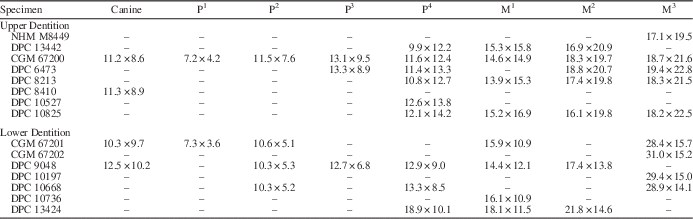
NHM M8449, left M3 (Table 1, Fig. 4.2).
Tooth measurements of the hypodigm of Nabotherium aegypticum n. gen. (length x width, in mm).
Diagnosis
Medium-sized anthracothere with dental formula 3.1.4.3.
Differs from contemporaneous Bothriogenys in having I3 caniniform, enlarged caniniform upper and lower canines, very short canine-P1/P1 diastema, no diastema between lower canine and I3, apex of P1–3 crowns situated almost midway between the roots, P1 peg-like and lacking triangular occlusal outline of P2 and P3, P2–3 mesial and distal crista oriented more mesiodistally rather than obliquely, upper molars with distinctive labial ribs (‘barrels’) on the labial slopes of the paracone and metacone (see Fig. 4.1–4.3), weakly-developed parastyle and metastyle, mesostyle bulbous and cuspate and not invaded by postparacrista and premetacrista, preparacrista weak and mesially oriented, labial cingula well-developed, strong lingual metacristule connected with lingual cingula, and very weak preprotocristae that never reach the paraconule, and leave a small valley between protocone and paraconule.
Differs from Qatraniodon (Andrews, Reference Andrews1906; Ducrocq, Reference Ducrocq1997) in having much larger tooth dimensions, more bunodont molars that are relatively shorter and broader. Differs from the younger African taxon, Epirigenys Lihoreau, Boisserie, Manthi, and Ducrocq, Reference Lihoreau, Boisserie, Manthi and Ducrocq2015 (see Lihoreau et al., Reference Lihoreau, Boisserie, Manthi and Ducrocq2015), in lacking a distinct metaconid on P4, in having a more distinct protocone and shorter pre- and postprotocristae on P4, and in lacking an enlarged and mesially extended parastylar shelf on upper molars.
Differs from Anthracothema Pilgrim, Reference Pilgrim1928 (see Pilgrim, Reference Pilgrim1928; Colbert, Reference Colbert1938) in having smaller tooth dimensions; M2 only slightly smaller than M3 (M2 much smaller than M3 in Anthracothema); upper molars with relatively larger and more robust mesostyles; upper molars with complete lingual cingula; M2–3 with much smaller anterior cingular cuspule; M3 with less basally inflated cusps; a more labiolingually constricted trigonid fovea, talonid basin, and hypoconulid fovea; and in possessing a well-developed premetacristid that connects to the preprotocristid, resulting in a closed trigonid basin.
Differs from Myaingtherium Tsubamoto, Zin-Maung-Maung-Thein, Egi, Nishimura, Thaung-Htike, and Takai, Reference Tsubamoto, Zin-Maung-Maung-Thein, Egi, Nishimura, Thaung-Htike and Takai2011 (see Tsubamoto et al., Reference Tsubamoto, Zin-Maung-Maung-Thein, Egi, Nishimura, Thaung-Htike and Takai2011) in having a better developed protocone on P4, P4 and upper molars with lingual cingula, upper molars with mesostyles, shelf-like parastyles (both absent in Myaingtherium), much larger and crestiform paraconules, distinct pre- and postmetacristule (the latter closing off the talon basin distally), and in having distinct and lingually curving paracristids on P2–4.
Differs from Anthracotherium magnum Cuvier, Reference Cuvier1822 (NHM M28770, early Oligocene, Flonheim, Germany) in having less robust and more laterally compressed I2–3, a much less robust and more labiolingually compressed upper canine, P2 with a small protocone shelf, P3 with a relatively smaller protocone shelf and without a protocone cuspule, M2 only slightly smaller than M3, upper molars with complete lingual cingulum, and smaller mesostyles that do not project labially beyond the para- and metastyles, especially on M2–3.
Description
Skull: Due to postmortem damage, the cranium of Nabotherium aegyptiacum (CGM 67200; Figs. 5–6) is mediolaterally compressed with some morphological features obscured. Also, some of the cranial elements are shifted or appear to be fused together, which makes it difficult to describe some of the bones with confidence. Nonetheless, the specimen reveals many important details about the cranial morphology of Nabotherium, and the tooth rows are well preserved, although there are cracks in some places.
The nasal bones are preserved although their relationship with the premaxillae and frontals is obscured. The premaxillae form most of the rostrum (Fig. 5) and preserve alveoli for moderate to large upper incisors. The most rostral part of the premaxillae is damaged but the second and third upper incisors are well preserved, although both are slightly displaced. There are small diastemata separating each incisor. The suture between the premaxilla and the maxilla on the lateral surface of the rostrum is poorly preserved, but it arcs posteriorly above the canines.
The maxillae are severely crushed and the jugal is not preserved. The frontal bones are present and roughly flat. The postorbital process is well developed, short, triangular, and points ventrolaterally from the middle part of the frontal, forming the dorsal arch of the orbit. The length of the postorbital process suggests that the rim of the orbit was open distally. The anterior rim of the orbit is placed above the level between M2 and M3. The temporal lines extend posteromedially from the postorbital process to meet at the midline to form the anterior aspect of the sagittal crest.
Upper dentition: The upper dentition is preserved, except for the first upper incisors and left canine (Fig. 6). The left tooth row is also slightly displaced anteriorly when compared with the right tooth row. The occlusal morphology of the teeth is clear even though minor cracks are visible on the posterior molars. The upper cheek teeth have bunodont crowns, with rounded cusps. The size of the teeth increases from P1 to M3.
Upper incisors: I2 is relatively short and shows a crown that is labiolingually compressed, with a convex labial surface and concave lingual surface. The I2 mesial and distal crests are sharp and meet at the midpoint of the crown, forming the tip of the tooth. Wear is present on the mesial crest only. The I3 is narrow and caniniform compared with I2. The mesial and distal crests are less sharp than on I2, and an appreciable wear facet is visible on the distal crista. The diastema between I2 and I3 is slightly longer than the one between I1 and I2.
Upper canines: The upper canine is very large, oval in cross section, being the tallest tooth in the upper dentition, and it has a sharp and pointed tip. The tooth is slightly labiolingually compressed with a deep root that is ~2.5 times bigger than the size of the crown. The mesial part of the tooth is not preserved but the distal edge is well developed. There is a very short diastema between the C and I3.
Upper premolars: The upper first premolar is relatively small and has two roots. The tooth is peg-like, labiolingually compressed, and triangular in lateral view, being longer than wide and broader distally than mesially. The mesial crest is weakly developed and the distal crest is highly abraded. The occlusal surface bears one main cusp, from which a well-developed distal crest runs labiodistally to terminate at the distolabial base of the crown. There is a very weakly developed cingulum around the base of the crown except along the distal margin. Wear is developed along the tip of the main cusp and the distal crest.
P2 has a triangular outline, longer than wide, broader distally, and narrower mesially. There are two small inflations along the distal crest course. The mesial crest is very weakly developed when compared with the distal crest. There is a very weakly developed cingulum course around the base of the crown aside from the distal margin. Wear is only found on the tip of the main cusp and along the distal crest. P3 is essentially identical in morphology to P2, but differs in being larger and having a relatively large distolingual corner and relatively more robust crests. Distal inflation on the distal crest is also more developed as a minute cusp. There is no parastyle.
P4 has a roughly ovoid occlusal outline, being broader than long. The tooth has two lobes, with the labial one longer than the lingual one, and two main cusps, paracone and protocone. The protocone is placed slightly mesial to the paracone, and a relatively deep, narrow sinus separates the two cusps. The preparacrista extends mesiolabially from the mesial side of the paracone and fuses with a small accessory cusp on the mesiolabial corner of the crown, from which a short cingulum extends. The postparacrista is shorter than the preparacrista; it runs distolabially from the paracone, and ends as a minor accessory cusp on the distolabial corner of the tooth. On the distal margin of the crown, there is an additional small cusp.
Upper molars: M1 is the smallest molar with M2 being either smaller than or nearly equal in size to M3. M1 (Fig. 6) is the most worn tooth in the upper dentition, although it is clear that the tooth has a semiquadrate occlusal outline, with a relatively short lingual margin and a broader mesial margin. The four main cusps of the crown (paracone, protocone, metacone, and metaconule) are all approximately equal in size. There is a distinct paraconule situated lingual to the paracone. A well-developed cuspate mesostyle is present and is centered on the labial wall of the tooth. On the labial wall of M1, a low and well-developed labial cingulum runs mesially from the base of the mesostyle to merge with the mesial cingulum, forming a shelf around the mesiolabial corner of the crown. There is also a more weakly developed cingulum originating at the base of the mesostyle and tapering around the distolabial corner of the tooth. In the mesiolabial corner of the crown, there is a minute parastyle visible as a small inflation, which is connected distally to the paracone via a very weakly developed preparacrista. The postparacrista and premetacrista run distolabially and mesiolabially, respectively, and meet each other at the lingual base of the mesostyle. The mesial cingulum is well developed, and runs lingually from the parastyle to terminate at the mesiolingual base of the protocone.
M2 is similar to M1 in its occlusal morphology, but differs in being larger and having relatively more robust cusps and cristae, and in having a relatively narrower distal portion. The right M2 is affected by minor cracking. The paraconule is well developed, slightly mesially placed between the paracone and protocone, tapers distally, and ends at the midline of the crown. It is separated from the paracone and protocone by narrow and shallow grooves, the labial of which is wider than the lingual. Mesially, there is a short preparacristule that extends from the mesiolabial part of the paraconule to merge with the lingual base of the parastyle. There is an accessory cusp on the mesial cingulum situated mesiolabially to the protocone.
The metaconule bears three cristae. The premetacristule runs mesiolabially to merge with the postprotocrista, forming an inverted V-shape in the middle of the transverse valley of the crown. The postmetacristule runs distolabially and fuses with the distal cingulum; and the lingual metacristule runs mesiolingually to merge with the lingual cingulum.
The occlusal pattern on M3 is similar to those observed on M1 and M2. M3 is larger although with a relatively shorter distal margin, giving the tooth a somewhat trapezoidal occlusal outline. Also, the parastyle is less developed on M3 than on M2. A weakly developed preparacrista is present. The cingulum is continuous around the crown. The labial cingulum is well developed with respect to that of M2, in particular the portion labial to the paracone.
Mandible: Nabotherium aegyptiacum has a robust mandible with a relatively shallow horizontal ramus. Although CGM 67201 (Fig. 7) shows numerous fractures due to postmortem damage, three mental foramina are visible. The mesial mental foramen has a roughly oval outline and is situated below the mesial root of P2. The distal mental foramen is roughly the same size as the mesial one and is positioned between P3 and P4. The third mental foramen is situated below the mesial root of P3. The mandibular symphysis is fused in adults, U-shaped, and extends posteriorly back to the level of P2.
Lower dentition: The anterior portion of the mandible in CGM 67201 is distorted and the lower incisors are not preserved. However, DPC 9048 (Fig. 8) preserves this region (although not the incisors themselves) and makes clear that Nabotherium had three lower incisors on each side arranged in a shallow arc across the front of the mandible, and that I3 was not separated from the canine by a diastema. The canines are large, projecting, and oval in cross section.
In CGM 67201, the alveolus of the left lower canine is exposed, which reveals that the tooth root is very deep and curves dorsally to terminate beneath P1. DPC 9048 has both canines in place and shows that the mesial edge of the canine is sharply defined, and that a wear facet is present on the distal canine surface.
Lower premolars: P1 is a small peg-shaped tooth with a labiolingually compressed crown and an oval base, and is separated by a very short diastema from the lower canine. In CGM 67201(Fig. 7), the right P1 is well preserved and consists of one main cusp, from which run mesial and distal cristids, the distal one being longer than the mesial one. The tooth is single-rooted, convex laterally, concave medially, and curves distally. There is a short diastema between the P1 and P2, slightly larger than that between the P1 and the canine.
The left P2 is well preserved in both CGM 67201 and DPC 9048 (Figs. 7.2, 8.1). The tooth is larger than P1, triangular in shape when viewed lingually, and double-rooted. The main cusp is tall and acutely pointed. A cristid runs mesially from the main cusp to terminate at the base of the crown. The distal cristid runs distally from the distal portion of the main cusp and bifurcates into two cristids, one of which runs lingually and the other continues distally to end at the base of the crown, meeting the small and shallow distal cingulid. The latter cristid courses around the distal margin of the tooth. There is no diastema between the P2 and P3.
P3 is well-preserved on DPC 9408. It has a morphology similar to that of P2, but it is larger with a more distinct and relatively longer mesial crest and a more distally extended posterior portion.
P4, best observed on DPC 9048, is relatively more robust and broader than the other premolars. The P4 protoconid is as high as those of P2–3 and is more robust. The mesial crest is slightly more curved than that of P3 and the lingual distal crest is stronger. The distal portion of the crown is relatively broader than in the other premolars and a low shelf is formed by an expanded distal cingulid.
Lower molars: M1 is relatively long and broad when compared with P4 and shows appreciable wear compared to other cheek teeth. The second lower molar is well preserved in DPC 9048 and is a slightly longer and broader version of M1 but with a broader (mesiodistally) hypoconulid shelf.
M3 is the longest lower molar because it has an extended hypoconulid lobe (Figs. 7.4, 8.1–8.2). The M3 trigonid and talonid are equally wide and have crenulations covering the occlusal surface. The mesial cingulid is moderately developed, runs around the mesial margin of the crown, and merges with the labial cingulid. There is a small spur on the mesial cingulid at the base of metaconid. The metaconid and protoconid are transversely placed and separated by a deep and narrow valley. The premetacristid slopes down from the mesial side of the metaconid and joins the preprotocristid near the middle of the mesial margin of the tooth, forming a U-shaped crest.
The hypoconid is placed slightly mesial to the entoconid. The prehypocristid (cristid obliqua) is acute and curves mesiolingually to merge with the distal junction between the postmetacristid and postprotocristid. There is no postentocristid and the posthypocristid run distolingually from the hypoconid to merge with the prehypocristulid that slopes down from the hypoconulid, leaving the longitudinal valley open. The hypoconulid is a distinct cusp, occupies the central part of the distal margin of the crown, and forms a very distinct third lobe. The posthypocristulid runs from the hypoconulid summit to end at the base of the entoconid. In labial view, a hypocristulid slopes mesiolabially toward the base of the hypoconid to merge with the labial cingulid. Occasionally there is a small knob developed on the posthypocristulid at the base of the hypoconid.
Materials
From Quarry A: 13424, mandible with symphysis, left M1–2 and right broken P3–M1 and M2–3. From Quarry R: DPC 13442 (Fig. 4.1), left maxilla with P4–M2. From Quarry V: CGM 67200, a laterally crushed skull that preserves the upper dentition (right and left I2–3, C, P1–4, M1–3), except right and left I1 and left C (Table 1, Figs. 5–6); CGM 67201 (Fig. 7), right dentary with C, P1, P4 (broken), M1, M3, and left dentary with P2–P3; CGM 67202 (Fig. 8.2), left dentary fragment preserving M3 and part of the distal root of M2; DPC numbers: 6473 (Fig. 4.3), left maxilla with P3–M3; 8213, left maxilla P4–M3; 8410, left upper C; 9048 (Fig. 8.1), mandible with left and right C, P2–M3; 10197, left dentary with M3; 10527, left P4; 10668, right dentary with M2 (broken), M3; 10736, mandible with left dI1–3, dC, dP1–4, M1 and right dP3–4, M1; 10825, palate with left P4–M3, right P4–M2.
Comparison
Members of Nabotherium exhibit a suite of distinctive features not seen among the other Fayum anthracotheres. Nabotherium differs from Bothriogenys in ways that suggest utilization of differing diets. Nabotherium has more bunodont and generally broader cheek teeth. The front of the skull is shortened and it lacks a canine-premolar diastema. Nabotherium possesses large, projecting, and relatively laterally compressed canines that are oval in cross section. In the upper molar row, Nabotherium differs from other Fayum anthracotheres in a large number of occlusal details, including the presence of cuspate mesostyles, well-developed labial and lingual cingula, distinctive labial surfaces of the para- and metacones (compare Fig. 4.1, 4.3 with 4.4) that have very strong barrels, and a well-developed lingual metacristule that joins with the lingual cingulum. This is combined with only weakly developed parastyles, metastyles, preparacristae, and postmetacristae.
One specimen assigned to Nabotherium aegyptiacum from Fayum Quarry A (DPC 13424) differs from other known specimens of this taxon in having more robust and larger premolars, and somewhat larger molars (Table 1). It is not clear whether these features might be taxonomically meaningful or whether they are better interpreted as representing idiosyncratic variation, but the specimen is assigned to N. aegyptiacum because, other than relatively larger tooth size, it is morphologically comparable to other members of the species.
Relatively little can be said about the differences between Nabotherium and Qatraniodon, due to the fact that Qatraniodon is not very well known, and the type preserves only M1–2. However, Nabotherium is clearly distinct from Qatraniodon in being larger and in having much more bunodont and relatively wider molars. Qatraniodon has a small and low, but distinct, cingular spur on M1 that is lacking in Nabotherium, and the posterior shelves of M1–2 in Nabotherium are relatively broader than in Qatraniodon.
Nabotherium further differs from the Asian Paleogene anthracotheres including: Siamotherium Suteethorn, Buffetaut, Helmcke-Ingavat, Jaeger, and Jongkanjanasoontorn, Reference Suteethorn, Buffetaut, Helmcke-Ingavat, Jaeger and Jongkanjanasoontorn1988, Anthracokeryx Pilgrim and Cotter, Reference Pilgrim and Cotter1916, and Anthracohyus Pilgrim and Cotter, Reference Pilgrim and Cotter1916. Specifically, Nabotherium differs from Siamotherium in having a double rooted P1, and in having a well-developed lingual metacristule continuous with the lingual cingulum, a distolabially oriented paraconule, and more distinct mesostyles on the upper molars.
The Egyptian taxon differs from Anthracokeryx (Colbert, Reference Colbert1938) in lacking diastemata between the lower canine–P1, P1–P2, and P2–P3, in having relatively shorter and broader cheek teeth, and in having a (albeit small) P2 protocone shelf.
Nabotherium is distinct from Anthracohyus (known only from a single upper molar; Colbert, Reference Colbert1938) in having a bulbous, cuspate mesostyle (Anthracohyus has only a tiny crest in the position of the mesostyle), a better developed parastylar area, distinct labial barrels on the labial surfaces of the paracone and metacone, and a distinct lingual cingulum.
Discussion
Anthracotheres have long been recognized as a family of artiodactyls that likely originated in North America or Eurasia, at least by the late middle Eocene, and subsequently spread and diversified throughout Laurasia and Africa (Lihoreau and Ducrocq, Reference Lihoreau and Ducrocq2007). The oldest known definitive anthracotheres have been identified from deposits in North America (ca. 42 Ma) and Myanmar (Burma) (ca. 40 Ma) (Khin Zaw et al., Reference Khin, Meffre, Takai, Suzuki, Burrett, Thaung, Zin, Maung, Tsubamoto, Egi and Maung2014), and although the origin of African anthracotheres is uncertain, their ancestry can probably be traced to a Eurasian form that reached Africa during or before the late Eocene.
Three anthracothere lineages are known from the early Oligocene deposits of the Fayum: a bunodont form (Nabotherium), and two bunoselenodont ones (Bothriogenys, Qatraniodon). This same pattern, of coexisting bunodont and bunoselenodont lineages, seems to be fairly common; it has been noted previously among Eurasian and North American faunas (Macdonald, Reference Macdonald1956; Lihoreau and Ducrocq, Reference Lihoreau and Ducrocq2007) and is now documented in Africa as well.
Of the bunoselenodont forms, Qatraniodon is known from only a single specimen, which is a lower jaw with two molars. However, Bothriogenys is well represented in the Fayum faunal assemblage and exhibits features that include relatively longer and narrower cheek teeth, more complex premolars often with accessory crest development, occasional supernumerary teeth (GFG, ERM, personal observations), more complex molar teeth, with high crowns that sometimes show development of neomorphic crests and cuspules, and small, more incisiform canines, combined with a long anterior canine-premolar diastema, and a mandibular symphysis that is canted anteriorly, resulting in an elongated, scoop-like anterior dental arcade. Dental adaptations such as these are typically seen in browsing and grazing herbivores and it is likely that Bothriogenys focused on foliage. In particular, given the apparent hydrophyllic nature of some anthracotheres (Pickford, Reference Pickford2008), Bothriogenys might have relied on aquatic plants as dietary staples. Nabotherium, in contrast, with its relatively shorter rostrum, enlarged projecting canines, short to absent anterior diastemata, low-crowned and simple premolars, and low, broad, bunodont molars, was likely to have been a more eclectic frugivore/herbivore.
Acknowledgments
We thank O. Teamaa, chairman of Egyptian Mineral Resources Authority, S. Mansour, director of the Central Administration at the Egyptian Geological Survey, R. Hraoun, general director of Egyptian Geological Museum, and M. Abdel Ghani, curator of invertebrate Paleontology Collections in the Egyptian Geological Museum, for facilitating this work. We would like to thank S. El-Sayed and I. El Dawoudi from Mansoura University Vertebrate Paleontology Center (MUVP) for assistance with preparation and other aspects of the research. Two anonymous reviewers helped to improve a previous version of this paper.