Implications
Some agro-industrial by-products are available for an acceptable length of time over the year, easy to store, inexpensive and nutritious. They can be used in livestock diets to limit environmental pollution and to reduce production costs without compromising dietary nutritional value. Among the various agricultural by-products, artichoke bracts are considered as a waste product, which is often underutilized and its potential value is lost. In the hope to evaluate this nutrient source in rabbit, the current paper focused on the effect of artichoke bracts-based diets on the qualitative and sensorial characteristics of rabbit meat.
Introduction
In the recent years, an increase in rabbit meat production has been noticed worldwide, and in 2011 the amount produced in the entire world was estimated about 1.7 million tonnes (Food and Agriculture Organization, 2011). An important aspect supporting this trend could be the recognized high nutritive and pro-health values of this meat. On the basis of these evidences, a lot of research is currently oriented towards the development of feeding strategies aimed to capitalize the potential of rabbit meat as a ‘functional food’ (Dalle Zotte and Szendrő, Reference Dalle Zotte and Szendrő2011). With regard to this, it is well known that the nutritional value of rabbit meat, as is the case for the meat from other monogastrics, can be improved by dietary inclusion of n-3 polyunsaturated fatty acids (PUFA), vitamins and antioxidants (Hernández and Gondret, Reference Hernández and Gondret2006).
The search for natural antioxidants, especially of plant origin, has notably increased in recent years to obtain functional foods. Their effects on the meat are easy to assess and reproduce and therefore beneficial for both the consumer and food industry (Sarraga et al., Reference Sarraga, Carreras, Garcia Regueiro, Guardia and Guerrero2006). The residual by-products, remaining after the industrial processing of fruits and vegetables, represent a good source of natural antioxidants, such as phenolic compounds, with high added value. The processing of artichoke (Cynara scolymus L.) for canning generate high quantity of by-products that could be very important for animal feeding (Bonanno et al., Reference Bonanno, Alicata, Alabiso and Leto1994; Marsico et al., Reference Marsico, Ragni, Vicenti, Caputi Jambrenghi, Tateo, Giannico and Vonghia2005).
Among artichoke by-products, artichoke bracts (AB) are the richest source of dietary phenolic antioxidants. Its antioxidant activity varies in relation to biological, technical and environmental factors (Lombardo et al., Reference Lombardo, Pandino, Mauro and Mauromicale2009). Moreover, Llorach et al. (Reference Llorach, Espín, Tomás-Barberán and Ferreres2002) reported that the extracts from artichoke by-products showed a high capacity to inhibit linoleic acid (LA) peroxidation and showed different activities for preventing lipid peroxidation.
The effects of AB supplementation in the diets of growing rabbits on their performance and apparent digestibility have been studied by Dabbou et al. (Reference Dabbou, Peiretti, Gai, Dabbou Fekih, Rotolo, Helal, Zoccarato and Gasco2014), which found that AB is a valid feed ingredient because of its good chemical composition, and has potential as an effective supplement for rabbits at levels of up to 100 g/kg in the diet, even though the best digestibility coefficients were found in rabbits fed a 50 g/kg diet. The effects of artichoke residues in animal feeding on quality and composition of meat have been investigated in a non-depth way (Marsico et al., Reference Marsico, Ragni, Vicenti, Caputi Jambrenghi, Tateo, Giannico and Vonghia2005). Moreover, scientific information about the effect of including non-traditional feedstuffs in rabbit nutrition is scarce. Therefore, the aim of the present study is to evaluate the effect of AB supplementation in rabbit diets on carcass characteristics, meat quality traits, oxidative stability, fatty-acid (FA) profile in the longissimus dorsi (LD) muscle and perirenal fat. Finally, a preference ranking test was used to determine if a significant difference exists in preference among meat samples from AB-supplemented and unsupplemented animals.
Material and methods
Animals and diets
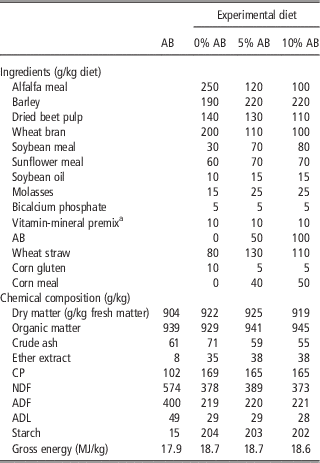
The trial was carried out at the experimental rabbitry of the Department of Agricultural, Forest and Food Sciences (University of Turin), located in Carmagnola, Italy. A total of 120 weaned crossbred (Hycole×Grimaud) rabbits aged 38 days with an average initial weight of 1041±107 g were randomly divided into three groups of 40 animals with equal initial weight variability. The animals were single housed in wire cages (0.41 m long×0.30 m wide×0.28 m high) at a temperature of 22±2°C and had free access to clean drinking water. Diets were prepared using AB (Violet d’Hyères variety) obtained from the Technical Centre of Potato and Artichoke, in Mannouba (Northern Tunisia). ABs were dried in an oven at 60°C until constant weight is reached and then finely ground. Three diets, supplemented with different levels of AB (0%, 5% and 10%), were formulated to be isonitrogenous and isocaloric and to meet all the essential nutrient requirements of growing rabbits. The ingredients and chemical composition of AB and the experimental diets are shown in Table 1. All diets were pelleted fresh and stored in darkness to prevent auto-oxidation of the lipid sources.
Ingredients and chemical composition of the artichoke bracts (AB) and experimental diets

a Vitamin A 200 U, α-tocopherylacetate 16 mg, Niacine 72 mg, Vitamin B6 16 mg, Choline 0.48 mg, dl-methionine 600 mg, Ca 500 mg, P 920 mg, K 500 mg, Na 1 g, Mg 60 mg, Mn 1.7 mg, Cu 0.6 mg per kg of diet.
AB and diet samples were analysed in duplicate for dry matter (AOAC 925.40), ash by ignition to 550°C (AOAC 923.03) and ether extract (AOAC 945.16) according to the methods of the Association of Official Analytical Chemists (AOAC, 2000). Gross energy was measured using an adiabatic bomb calorimeter (IKA C7000, Staufen, Germany). Starch content was determined using the Ewer’s polarimetric method (European Economic Community, 1972). NDF, ADF and ADL were determined according to Van Soest et al. (Reference Van Soest, Robertson and Lewis1991).
Slaughter procedures and sample collection
At 96 days of age, 12 rabbits/group (mean weight 3167±328 g) were slaughtered in an experimental slaughterhouse without fasting. The slaughtered rabbits were bled, and the skin, genitals, urinary bladder, gastrointestinal tract and the distal part of the legs were removed, as recommended by Blasco et al. (Reference Blasco, Ouhayoun and Masoero1993). The carcass was weighed and the weights of the skin and full gastrointestinal tract were recorded and expressed as a percentage of slaughter weight (SW). Carcasses (with the head, thoracic cage organs, liver, kidneys) were chilled at 4°C for 24 h in a refrigerated room. The chilled carcass weight (CCW) was recorded, then the dressing out percentage was calculated as the ratio between CCW and SW, whereas the head and liver weight were expressed as a percentage of CCW. The head, thymus, trachea, oesophagus, heart, lungs, liver and kidney weights were removed from the CCW to obtain the reference carcass weight (RCW). The perirenal fat was recorded and expressed as a percentage of RCW.
Sample preparation
After 24 h of chilling, the carcasses were halved and the two LD muscles were excised. The left LD muscle was divided into two parts. The fore part was used to measure pH, colour and cooking losses. The hind part of the left LD was vacuum-packed, frozen at –20°C, weighted before and after the freeze-dried process to determine its moisture. Proximate composition, FA profile and thiobarbituric acid-reactive substances (TBARS) values were determined on freeze-dried samples. The whole right LD was vacuum-packed, frozen at –20°C and stored until sensory analysis. The perirenal fat was vacuum-packed, frozen and stored at –20°C for a week until gas chromatographic analysis.
Meat chemical composition
The proximate chemical composition in terms of moisture (AOAC 950.46), ash (AOAC 923.03), CP (AOAC 981.10) and ether extract (AOAC 960.39) content of lyophilized samples of the right LD muscle was determined according to AOAC (2000) methods and values were expressed on a wet weight basis.
pH measurement
Meat pH of the LD at the level of seventh lumbar was measured at 24 h postmortem (pH24) in duplicate using a Crison portable pH meter (Crison Instruments, S.A., Alella, Spain) fitted with a spear-type electrode and an automatic temperature compensation probe.
Colour measurements
Meat colour was measured on a freshly cut surface of the loin at the level of the seventh lumbar vertebra at room temperature (20°C) using a Minolta CR-331C Minolta Colorimeter (25 mm measuring area, 45° circumferential illumination/0° viewing angle geometry) with the D65 illuminant and a 2° standard observed angle was used. Colour measurements were reported in terms of lightness (L*), redness (a*) and yellowness (b*) in the CIELAB colour space model (Commission Internationale de l’Eclairage, 1976). Chroma (C*), which is a measure of the colour intensity, and hue angle (H*), which describes the fundamental colour of a substance, were calculated as: (a*2+b*2)0.5 and tan−1 (b*/a*), respectively. The hue angle was converted from radians to degrees for data analysis. The colour values were obtained considering the average of three readings per meat sample.
Cooking losses
Samples of the left LD muscle of each rabbit were weighed, vacuum-packed in plastic bags and cooked at 80°C for 1 h by immersion in a water bath (Ramírez et al., Reference Ramírez, Oliver, Pla, Guerrero, Ariňo and Blasco2004). Cooked samples were cooled under running water for 30 min. The samples were then removed from the bags, blotted and weighed. Cooking losses were determined by calculating the weight difference in samples before and after cooking, expressed as percentage of initial weight.
TBARS assay
Lipid oxidation was determined using the modified thiobarbituric acid (TBA) method according to procedure described by Witte et al. (Reference Witte, Krause and Bailey1970). Freeze-dried meat of 3 g was mixed and homogenized during 30 s with 10% trichloroacetic acid (TCA) using a Polytron tissue homogenizer (Type PT 10–35; Kinematica GmbH, Luzern, Switzerland). The supernatant was filtered through Whatman #1 filter paper. One millilitre of filtrate was combined with 1 ml of a 0.02 M aqueous 2-TBA solution, heated in a boiling water bath for 20 min together with a blank containing 1 ml of a TCA/water mix (1/1) and 1 ml of a TBA reagent and subsequently cooled under running tap water. The samples were analysed in duplicate and the absorbance was read at 532 nm with a Helios spectrophotometer (Unicam Limited, Cambridge, UK) against a blank that contained all the reagents, but no meat. Results were expressed as µg malonaldehyde/g of meat.
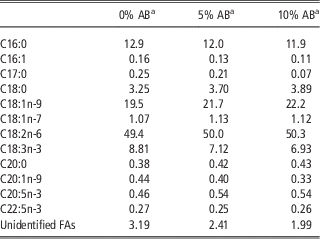
FA composition of diets, LD muscle and perirenal fat
The FA profile was carried out on diets, perirenal fat and LD muscle samples according to Peiretti and Meineri (Reference Peiretti and Meineri2008). The FA percentage for the experimental diets was the average of two replicates. The average FA composition, expressed as g/100 g of total FA of the three experimental diets was reported in Table 2. The FA was analysed as the methyl esters. The analysis was carried out by gas chromatography, using a Dani GC 1000 DPC (Dani Instruments S.P.A., Cologno Monzese, Italy), equipped with a fused silica capillary column - Supelcowax-10 (60 m×0.32 mm (i.d.), 0.25 μm). The injection and flame ionization detector (FID) ports were set at 245°C and 270°C, respectively. The oven temperature programme was set at 50°C for the first minute, increased at a rate of 5°C/min to 230°C, where it remained for 24 min. Hydrogen was used as carrier gas at a flow rate of 5 ml/min. Gases used in FID were hydrogen and purified air produced by zero air generator (UHP-10ZA; Domnick Hunter Scientific, Tyne and Wear, England), combined with nitrogen as make-up gas. One microlitre was injected using a Dani ALS 1000 auto sampler with a 1 : 50 split ratio. The peak area was measured using a Dani Data Station DDS 1000, and each peak was identified and quantified according to pure methyl ester standards (Restek Corporation, Bellefonte, PA, USA).
Fatty-acid (FA) composition (g/100 g of total FA) of the experimental diets (% of artichoke bracts (AB))
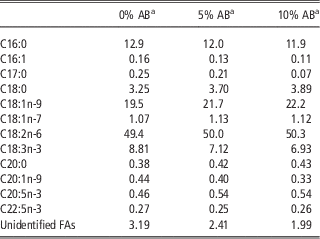
a Means of two replicates.
Sensory analysis
Sensory analysis was performed by 58 panelists, 34 male and 24 female, ranging in age from 21 to 55 years. Panelists were untrained students and staff members recruited from the campus of the Department of Agricultural, Forest and Food Sciences of the University of Turin (Italy), and of the Italian National Research Council of Turin (Italy). All were already involved in surveys on rabbit preference/acceptance tests and were regular consumers of rabbit meat. The entire LD muscles from rabbits of the three groups were simultaneously cooked without salt or spice on a double plate grill, preheated at 250°C, to a final internal temperature of 70°C. Cooking temperature was monitored by an iron/constantan thermocouple placed in the geometric centre of each loin. After grilling, the loins were immediately cut into equal sizes and coded with a three-digit random number. Meat samples arising from the three rabbit groups fed with 0%, 5% and 10% AB were given to the panelists in a predetermined balanced order and were evaluated in a preference ranking test. Panelists were asked to rank the samples using a rank scale with 1=preferred most and 3=preferred least; ties were not allowed. Evaluation took place in individual booths in a sensory testing laboratory under controlled conditions. Between each sample, panelists were instructed to rinse their mouths with water served at room temperature.
Statistical analyses
The statistical analyses were performed using the SPSS software package (version 11.5.1 for Windows, SPSS Inc., Chicago, IL, USA). ANOVA was used to evaluate the effects of different concentrations of AB on the performance, carcass characteristics, meat composition, and FA profile of the meat and perirenal fat of the rabbits. The differences were tested using Duncan’s New Multiple Range Test. Significance was accepted for P<0.05.
With regard to the sensory analysis, the rank orders for each consumer were summed to produce the rank sums for each meat sample. The preference ranking data were analysed by using Friedman’s test (Meilgaard et al., Reference Meilgaard, Civille and Carr1991). The significant level of the test was P<0.05.
Results and discussion
Carcass characteristics
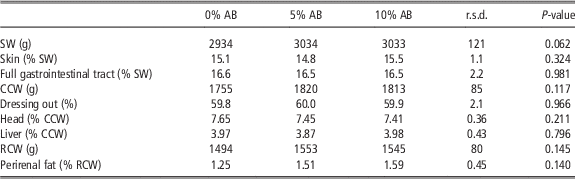
Carcass characteristics are reported in Table 3. There were no significant differences among experimental groups for all parameters, even if a statistical trend could be observed on SW (P=0.062), that could be positive for commercial purposes. These results are in line with those found by Bonanno et al. (Reference Bonanno, Alicata, Alabiso and Leto1994), who did not find any significant differences in the percentages on warm carcass weight, weight percentages of the liver, internal organs, perirenal and retroscapular fat. However, with respect to the same authors, data concerning dressing out and perirenal fat were higher than those reported in our trial. This difference may be because of the age, amount of fat and the number of internal organs left with the carcass of the rabbit at slaughter. On the contrary, Bonomi (Reference Bonomi1999) found that dehydrated artichoke leaves used at 5% and 10% in rabbit feed had a positive influence in carcass weight, and the percentage of the hindquarters, loin and meat.
Effect of artichoke bract (AB) supplementation on the carcass characteristics of rabbits (n=12)
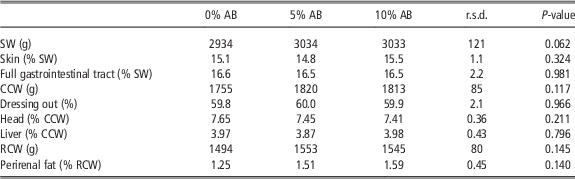
SW=slaughter weight; CCW=chilled carcass weight; RCW=reference carcass weight.
Meat quality traits
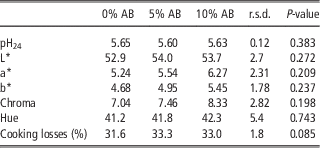
Results of pH24, colour measurements, calculated colour characteristics and cooking losses are summarized in Table 4. The LD muscle was not affected by AB supplementation for any of these parameters. The pH value depends on the balance of muscle energy metabolism and represents an important role in the maintenance of meat quality during storage (Dalle Zotte, Reference Dalle Zotte2002). The ultimate pH in our study was in the normal range for rabbit meat (Blasco and Piles, Reference Blasco and Piles1990). These results are in agreement with those reported by Benatmane et al. (Reference Benatmane, Kouba, Youyou and Mourot2011), Dal Bosco et al. (Reference Dal Bosco, Mourvaki, Cardinali, Servili, Sebastiani, Ruggeri, Mattioli, Taticchi, Esposto and Castellini2012) and Peiretti et al. (Reference Peiretti, Gasco, Brugiapaglia and Gai2011a and Reference Peiretti, Gai, Rotolo, Brugiapaglia and Gasco2013) with different raw material supplementation in rabbit feed.
Effect of artichoke bract (AB) supplementation on the longissimus dorsi muscle traits of rabbits (n=12)

L*=lightness; a*=redness; b*=yellowness.
In our study, meat colour parameters were not affected significantly by AB supplementation. Dalle Zotte and Ouhayoun (Reference Dalle Zotte and Ouhayoun1998) demonstrated that meat lightness increases with muscle myofibrillar protein shrinkage, which is negatively correlated to pH value, for example, the lower the pH, the higher the lightness.
No significant differences were found in cooking losses (Table 4) among the three groups, even if a statistical trend could be observed (P=0.085). These results are in agreement with other studies that use various agricultural by-products, such as the study by Dal Bosco et al. (Reference Dal Bosco, Mourvaki, Cardinali, Servili, Sebastiani, Ruggeri, Mattioli, Taticchi, Esposto and Castellini2012) using olive pomace from different varieties and Peiretti et al. (Reference Peiretti, Gai, Rotolo, Brugiapaglia and Gasco2013) using different levels of tomato pomace in rabbits’ diet.
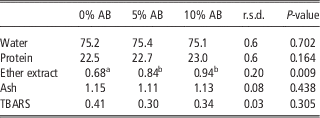
The chemical composition of the LD muscle was not significantly affected by AB supplementation; with the exception of the ether extract that increases with the increasing AB inclusion level (Table 5), this can be related to the increased ether extract content of the corresponding diets. Using different levels of artichoke leaves in rabbits’ diet, Bonomi (Reference Bonomi1999) did not find significant differences in the chemical composition of the muscle.
Effect of artichoke bracts (AB) supplementation on the chemical composition on fresh matter basis (%) and oxidative status (TBARS, µg malonaldehyde/g meat) of the longissimus dorsi muscle of rabbits (n=12)

TBARS=thiobarbituric acid-reactive substances.
a,bMeans in the same row with unlike superscripts differ (P<0.05).
TBARS assay
Lipid oxidation is the major problem in rabbit meat owing to its high content of PUFA, which can lead to oxidation reducing its shelf life. Susceptibility of muscle tissue to lipid oxidation can be reduced by antioxidants, even if it depends on several factors. The most important is the level of PUFA present in the meat (Gray et al., Reference Gray, Gomaa and Buckley1996). The effects of the AB supplementation on the oxidative stability of the LD muscle are shown in Table 5. Dietary treatment did not affect TBARS values significantly, even if our results were lower than those reported by Corino et al. (Reference Corino, Pastorelli, Pantaleo, Oriani and Salvatori1999) in the meat of rabbit treated with a vitamin E supplementation. According to these authors, the relatively high TBARS values observed in rabbit meat can be probably attributed to the naturally high levels of unsaturated FA residues in the glycolytic muscle of this species.
FA profile of the meat
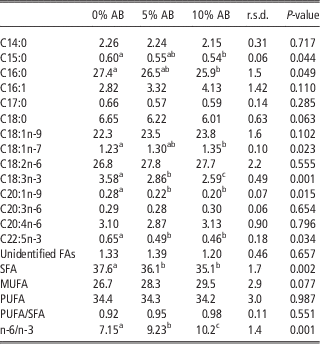
The FA composition of the LD muscle was shown in Table 6. Regarding the LD muscle PUFA percentage, significant differences among treatments was found for α-linolenic acid (C18:3n-3, ALA). ALA percentage decreased (P<0.05) from 3.58% in rabbits fed AB 0% diet to 2.86% and 2.59% in the meat of the rabbits fed with AB 5% and AB 10% diets, respectively. A significant decrease with increasing AB supplementation level was also found for C15:0, C16:0, C20:1n-9 and C22:5n-3 percentage, while C18:1n-7 increased. No significant differences were detected among the treatments for LA (C18:2n-6) and other FAs. Undoubtedly, the decrease in ALA and C22:5n-3 percentage from the nutritional point of view is negative; however, the level of saturated fatty acid (SFA) was significantly lower in the meat of rabbit fed AB-supplemented diets than that of the meat of rabbit fed unsupplemented diet. In the present study, the n-6/n-3 ratio increased with increasing level of AB supplementation. The n-6/n-3 ratio is generally very high in rabbit meat because of the high LA percentage, which was very high in our study. However, our results are intermediate when compared with other rabbit feeding trials. In fact, Dalle Zotte (Reference Dalle Zotte2002) reported an n-6/n-3 ratio of 11.6 for the rabbit hind leg, and Liu et al. (Reference Liu, Gai, Gasco, Brugiapaglia, Lussiana, Guo, Tong and Zoccarato2009) reported even higher values (around 14.6) for this ratio. Peiretti et al. (Reference Peiretti, Masoero and Meineri2011b) found an n-6/n-3 ratio of 13.1 for the LD muscle of rabbits fed maize oil supplement diet, although values ranging from 1.1 to 1.9 for this ratio were found in the LD muscle of rabbits fed golden flaxseed-supplemented diets (Peiretti and Meineri, Reference Peiretti and Meineri2010). Moreover, in a trial using tomato by-products, Peiretti et al. (Reference Peiretti, Gai, Rotolo, Brugiapaglia and Gasco2013) found similar values to those of the present study. In our trial, and in the view of potential nutritive value for the consumers, the increased n-6/n-3 ratio was balanced by low saturation in the rabbit meat.
Effect of artichoke bracts (AB) supplementation on the fatty-acid (FA) composition (g/100 g of total FA) in the longissimus dorsi muscle of rabbits (n=12)

SFA=saturated fatty acid; MUFA=monounsaturated fatty acid; PUFA=polyunsaturated fatty acid; PUFA/SFA=polyunsaturated fatty acid/saturated fatty-acid ratio; n-6/n-3=PUFA n-6/PUFA n-3 ratio.
a,b,cMeans in the same row with unlike superscripts differ (P<0.05).
FA profile of the perirenal fat
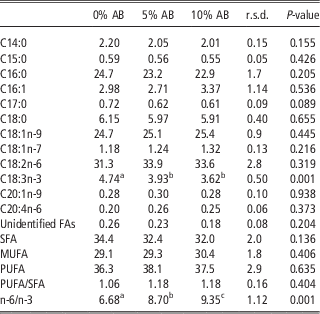
FA composition of perirenal fat was reported in Table 7. Perirenal FA profile mirrored the dietary FA composition. Indeed, main FAs of the perirenal fat were: C16:0, C18:0, oleic acid (C18:1n-9), LA and ALA, respectively. Regarding experimental hypothesis, no effect of dietary treatment was reported for SFA and monounsaturated fatty acid. On the contrary, a significant difference was only reported for ALA and n-6/n-3 ratio.
Effect of artichoke bracts (AB) supplementation on the fatty-acid (FA) composition (g/100 g of total FA) in the perirenal fat of rabbits (n=12)

SFA=saturated fatty acid; MUFA=monounsaturated fatty acid; PUFA=polyunsaturated fatty acid; PUFA/SFA=polyunsaturated fatty acid/saturated fatty-acid ratio; n-6/n-3=PUFA n-6/PUFA n-3 ratio.
a,b,cMeans in the same row with unlike superscripts differ (P<0.05).
Sensory analysis
The sensory analysis was performed to determine whether a significant difference exits in preference between the three meat samples arising from the three groups. The results of the ranking test indicated that there was no significant preference for any of the three types of meat presented to panelists: the meat samples from rabbits fed with 5% AB showed a rank sum of 119, followed by meat from the 10% AB group (rank sum=117) and from the 0% AB group (rank sum=112). Peiretti et al. (Reference Peiretti, Gai, Rotolo, Brugiapaglia and Gasco2013) found a significant difference in rabbit meat preference between animal fed a diet supplemented with 6% of tomato pomace in comparison with control group.
Conclusion
The results presented in this study showed that dietary AB significantly increased energy expenditure in the LD muscle. Rabbit meat FA composition was slightly affected by the diet. There were no significant differences among diets in PUFA percentage; however, significant differences in SFA percentage between the unsupplemented AB and the AB supplemented groups were found. The ALA and the SFA percentage in the LD muscle and perirenal fat decreased, whereas the n-6/n-3 ratio increased significantly with increasing AB inclusion. To sum up, the enrichment of the rabbit diet with AB allows the production of rabbit meat with an increased total lipid content and a low degree of saturation, even if the n-6/n-3 ratio was slightly worse.
Acknowledgements
This research was supported by ‘Università di Torino (ex 60%)’ grant (Es. Fin. 2012–2013). Many thanks are due to Dr Weslati T. and Mr Krimi K. (Technical Center of Potato and Artichoke, Mannouba, Tunisia) for providing the artichoke bracts, Dr Montersino P., Mr Sola D. and Colombano M. for the care of the rabbits, Dr Palumbo A. for the technical support and Dr Dell’Armelina Rocha P.R. for reviewing the language of the manuscript.