


%20--%3e%3c!DOCTYPE%20svg%20PUBLIC%20'-//W3C//DTD%20SVG%201.0//EN'%20'http://www.w3.org/TR/2001/REC-SVG-20010904/DTD/svg10.dtd'%3e%3csvg%20version='1.0'%20id='Layer_1'%20xmlns='http://www.w3.org/2000/svg'%20xmlns:xlink='http://www.w3.org/1999/xlink'%20x='0px'%20y='0px'%20width='64px'%20height='64px'%20viewBox='5.5%20-3.5%2064%2064'%20enable-background='new%205.5%20-3.5%2064%2064'%20xml:space='preserve'%3e%3cg%3e%3ccircle%20fill='%23FFFFFF'%20fill-opacity='0'%20cx='37.785'%20cy='28.501'%20r='28.836'/%3e%3cpath%20fill='%23595959'%20d='M37.441-3.5c8.951,0,16.572,3.125,22.857,9.372c3.008,3.009,5.295,6.448,6.857,10.314%20c1.561,3.867,2.344,7.971,2.344,12.314c0,4.381-0.773,8.486-2.314,12.313c-1.543,3.828-3.82,7.21-6.828,10.143%20c-3.123,3.085-6.666,5.448-10.629,7.086c-3.961,1.638-8.057,2.457-12.285,2.457s-8.276-0.808-12.143-2.429%20c-3.866-1.618-7.333-3.961-10.4-7.027c-3.067-3.066-5.4-6.524-7-10.372S5.5,32.767,5.5,28.5c0-4.229,0.809-8.295,2.428-12.2%20c1.619-3.905,3.972-7.4,7.057-10.486C21.08-0.394,28.565-3.5,37.441-3.5z%20M37.557,2.272c-7.314,0-13.467,2.553-18.458,7.657%20c-2.515,2.553-4.448,5.419-5.8,8.6c-1.354,3.181-2.029,6.505-2.029,9.972c0,3.429,0.675,6.734,2.029,9.913%20c1.353,3.183,3.285,6.021,5.8,8.516c2.514,2.496,5.351,4.399,8.515,5.715c3.161,1.314,6.476,1.971,9.943,1.971%20c3.428,0,6.75-0.665,9.973-1.999c3.219-1.335,6.121-3.257,8.713-5.771c4.99-4.876,7.484-10.99,7.484-18.344%20c0-3.543-0.648-6.895-1.943-10.057c-1.293-3.162-3.18-5.98-5.654-8.458C50.984,4.844,44.795,2.272,37.557,2.272z%20M37.156,23.187%20l-4.287,2.229c-0.458-0.951-1.019-1.619-1.685-2c-0.667-0.38-1.286-0.571-1.858-0.571c-2.856,0-4.286,1.885-4.286,5.657%20c0,1.714,0.362,3.084,1.085,4.113c0.724,1.029,1.791,1.544,3.201,1.544c1.867,0,3.181-0.915,3.944-2.743l3.942,2%20c-0.838,1.563-2,2.791-3.486,3.686c-1.484,0.896-3.123,1.343-4.914,1.343c-2.857,0-5.163-0.875-6.915-2.629%20c-1.752-1.752-2.628-4.19-2.628-7.313c0-3.048,0.886-5.466,2.657-7.257c1.771-1.79,4.009-2.686,6.715-2.686%20C32.604,18.558,35.441,20.101,37.156,23.187z%20M55.613,23.187l-4.229,2.229c-0.457-0.951-1.02-1.619-1.686-2%20c-0.668-0.38-1.307-0.571-1.914-0.571c-2.857,0-4.287,1.885-4.287,5.657c0,1.714,0.363,3.084,1.086,4.113%20c0.723,1.029,1.789,1.544,3.201,1.544c1.865,0,3.18-0.915,3.941-2.743l4,2c-0.875,1.563-2.057,2.791-3.541,3.686%20c-1.486,0.896-3.105,1.343-4.857,1.343c-2.896,0-5.209-0.875-6.941-2.629c-1.736-1.752-2.602-4.19-2.602-7.313%20c0-3.048,0.885-5.466,2.658-7.257c1.77-1.79,4.008-2.686,6.713-2.686C51.117,18.558,53.938,20.101,55.613,23.187z'/%3e%3c/g%3e%3c/svg%3e)
%20--%3e%3c!DOCTYPE%20svg%20PUBLIC%20'-//W3C//DTD%20SVG%201.0//EN'%20'http://www.w3.org/TR/2001/REC-SVG-20010904/DTD/svg10.dtd'%3e%3csvg%20version='1.0'%20id='Layer_1'%20xmlns='http://www.w3.org/2000/svg'%20xmlns:xlink='http://www.w3.org/1999/xlink'%20x='0px'%20y='0px'%20width='64px'%20height='64px'%20viewBox='5.5%20-3.5%2064%2064'%20enable-background='new%205.5%20-3.5%2064%2064'%20xml:space='preserve'%3e%3cg%3e%3ccircle%20fill='%23FFFFFF'%20fill-opacity='0'%20cx='37.637'%20cy='28.806'%20r='28.276'/%3e%3cg%3e%3cpath%20fill='%23595959'%20d='M37.443-3.5c8.988,0,16.57,3.085,22.742,9.257C66.393,11.967,69.5,19.548,69.5,28.5c0,8.991-3.049,16.476-9.145,22.456%20C53.879,57.319,46.242,60.5,37.443,60.5c-8.649,0-16.153-3.144-22.514-9.43C8.644,44.784,5.5,37.262,5.5,28.5%20c0-8.761,3.144-16.342,9.429-22.742C21.101-0.415,28.604-3.5,37.443-3.5z%20M37.557,2.272c-7.276,0-13.428,2.553-18.457,7.657%20c-5.22,5.334-7.829,11.525-7.829,18.572c0,7.086,2.59,13.22,7.77,18.398c5.181,5.182,11.352,7.771,18.514,7.771%20c7.123,0,13.334-2.607,18.629-7.828c5.029-4.838,7.543-10.952,7.543-18.343c0-7.276-2.553-13.465-7.656-18.571%20C50.967,4.824,44.795,2.272,37.557,2.272z%20M46.129,20.557v13.085h-3.656v15.542h-9.944V33.643h-3.656V20.557%20c0-0.572,0.2-1.057,0.599-1.457c0.401-0.399,0.887-0.6,1.457-0.6h13.144c0.533,0,1.01,0.2,1.428,0.6%20C45.918,19.5,46.129,19.986,46.129,20.557z%20M33.042,12.329c0-3.008,1.485-4.514,4.458-4.514s4.457,1.504,4.457,4.514%20c0,2.971-1.486,4.457-4.457,4.457S33.042,15.3,33.042,12.329z'/%3e%3c/g%3e%3c/g%3e%3c/svg%3e)
%20--%3e%3c!DOCTYPE%20svg%20PUBLIC%20'-//W3C//DTD%20SVG%201.0//EN'%20'http://www.w3.org/TR/2001/REC-SVG-20010904/DTD/svg10.dtd'%3e%3csvg%20version='1.0'%20id='Layer_1'%20xmlns='http://www.w3.org/2000/svg'%20xmlns:xlink='http://www.w3.org/1999/xlink'%20x='0px'%20y='0px'%20width='64px'%20height='64px'%20viewBox='5.5%20-3.5%2064%2064'%20enable-background='new%205.5%20-3.5%2064%2064'%20xml:space='preserve'%3e%3cg%3e%3ccircle%20fill='%23FFFFFF'%20fill-opacity='0'%20cx='36.924'%20cy='28.403'%20r='28.895'/%3e%3cpath%20fill='%23595959'%20d='M37.442-3.5c8.99,0,16.571,3.085,22.743,9.256C66.393,11.928,69.5,19.509,69.5,28.5c0,8.992-3.048,16.476-9.145,22.458%20C53.88,57.32,46.241,60.5,37.442,60.5c-8.686,0-16.19-3.162-22.513-9.485C8.644,44.728,5.5,37.225,5.5,28.5%20c0-8.762,3.144-16.343,9.429-22.743C21.1-0.414,28.604-3.5,37.442-3.5z%20M12.7,19.872c-0.952,2.628-1.429,5.505-1.429,8.629%20c0,7.086,2.59,13.22,7.77,18.4c5.219,5.144,11.391,7.715,18.514,7.715c7.201,0,13.409-2.608,18.63-7.829%20c1.867-1.79,3.332-3.657,4.398-5.602l-12.056-5.371c-0.421,2.02-1.439,3.667-3.057,4.942c-1.622,1.276-3.535,2.011-5.744,2.2%20v4.915h-3.714v-4.915c-3.543-0.036-6.782-1.312-9.714-3.827l4.4-4.457c2.094,1.942,4.476,2.913,7.143,2.913%20c1.104,0,2.048-0.246,2.83-0.743c0.78-0.494,1.172-1.312,1.172-2.457c0-0.801-0.287-1.448-0.858-1.943l-3.085-1.315l-3.771-1.715%20l-5.086-2.229L12.7,19.872z%20M37.557,2.214c-7.276,0-13.428,2.571-18.457,7.714c-1.258,1.258-2.439,2.686-3.543,4.287L27.786,19.7%20c0.533-1.676,1.542-3.019,3.029-4.028c1.484-1.009,3.218-1.571,5.2-1.686V9.071h3.715v4.915c2.934,0.153,5.6,1.143,8,2.971%20l-4.172,4.286c-1.793-1.257-3.619-1.885-5.486-1.885c-0.991,0-1.876,0.191-2.656,0.571c-0.781,0.381-1.172,1.029-1.172,1.943%20c0,0.267,0.095,0.533,0.285,0.8l4.057,1.83l2.8,1.257l5.144,2.285l16.397,7.314c0.535-2.248,0.801-4.533,0.801-6.857%20c0-7.353-2.552-13.543-7.656-18.573C51.005,4.785,44.831,2.214,37.557,2.214z'/%3e%3c/g%3e%3c/svg%3e)
%20--%3e%3c!DOCTYPE%20svg%20PUBLIC%20'-//W3C//DTD%20SVG%201.1//EN'%20'http://www.w3.org/Graphics/SVG/1.1/DTD/svg11.dtd'%3e%3csvg%20version='1.1'%20id='Layer_1'%20xmlns='http://www.w3.org/2000/svg'%20xmlns:xlink='http://www.w3.org/1999/xlink'%20x='0px'%20y='0px'%20width='64.000977px'%20height='64px'%20viewBox='0%200%2064.000977%2064'%20enable-background='new%200%200%2064.000977%2064'%20xml:space='preserve'%3e%3cg%3e%3ccircle%20fill='%23FFFFFF'%20fill-opacity='0'%20cx='32.064453'%20cy='31.788086'%20r='29.012695'/%3e%3cg%3e%3cpath%20fill='%23595959'%20d='M31.943848,0C40.896484,0,48.476562,3.105469,54.6875,9.314453C60.894531,15.486328,64.000977,23.045898,64.000977,32%20s-3.048828,16.457031-9.145508,22.513672C48.417969,60.837891,40.779297,64,31.942871,64%20c-8.648926,0-16.152832-3.142578-22.513672-9.429688C3.144043,48.286133,0,40.761719,0,32.000977%20c0-8.723633,3.144043-16.285156,9.429199-22.68457C15.640137,3.105469,23.14502,0,31.943848,0z%20M32.060547,5.771484%20c-7.275391,0-13.429688,2.570312-18.458496,7.714844C8.381836,18.783203,5.772949,24.954102,5.772949,32%20c0,7.125,2.589844,13.256836,7.77002,18.400391c5.181152,5.181641,11.352051,7.770508,18.515625,7.770508%20c7.123047,0,13.332031-2.608398,18.626953-7.828125C55.713867,45.466797,58.228516,39.353516,58.228516,32%20c0-7.3125-2.553711-13.484375-7.65625-18.513672C45.504883,8.341797,39.333984,5.771484,32.060547,5.771484z%20M44.117188,24.456055%20v5.485352H20.859863v-5.485352H44.117188z%20M44.117188,34.743164v5.481445H20.859863v-5.481445H44.117188z'/%3e%3c/g%3e%3c/g%3e%3c/svg%3e)
1 Introduction
1.1 Rationale for Focusing on Human Capital Development in PK-12
The effectiveness and long-term sustainability of PK–12 education systems depend on the quality of their human capital. Within schools, educators constitute the primary professional resource through which educational intentions are translated into instructional practice, allowing students to encounter learning in its enacted form (Belay et al., Reference Belay, Melese and Seifu2021; Bruce, Reference Bruce2023). Educators’ knowledge, pedagogical expertise, professionalism, and commitment shape not only student outcomes but also the school climate and the broader instructional environment. From this perspective, attention to human capital development is not incidental to educational improvement; it is constitutive of it.
The urgency of focusing on human capital development has intensified under contemporary system pressures. Many education systems are grappling with persistent teacher shortages, attrition, fragmented employment patterns, and declining enrollment in teacher education programs (Brandenburg et al., Reference Brandenburg, Larsen, Simpson, Sallis and Tran2024; Donitsa-Schmidt, Reference Donitsa-Schmidt2025). These trends challenge schools’ capacity to sustain instructional quality and effectiveness. At the same time, the scope and complexity of educators’ work have expanded considerably. Educators are expected to address increasingly diverse student populations, socio-emotional needs, rapid technological change, and heightened accountability demands. Such conditions require professionals who are adaptable, reflective, and supported through continuous professional learning. Without systematic investment in educators’ development and well-being, efforts to provide high-quality education aligned with twenty-first-century competencies risk resting on an increasingly fragile professional foundation.
Educational discourse and policy have, nonetheless, often prioritized structural reforms, accountability regimes, and student performance measures over the sustained development of the professionals responsible for enacting educational change (Mohammad Nezhad & Stolz, Reference Mohammad Nezhad and Stolz2025; Sachs, Reference Sachs2016). Such orientations have tended to position educators as implementers of externally generated initiatives rather than as evolving professionals whose expertise requires deliberate cultivation across their career span. Unlike material or procedural resources, professional capacity is continuously shaped by workplace conditions, learning opportunities, and the quality of professional relationships. It may be strengthened through investment and support or eroded by overload, limited autonomy, and insufficient recognition (Perryman & Calvert, Reference Perryman and Calvert2020).
A human capital perspective reorients the analytical lens from personnel management to the cultivation of professional capacity. This orientation encompasses both individual and organizational dimensions: the development of educators’ knowledge, skills, motivation, and professional identities alongside the creation of school environments that enable collaboration, trust, agency, and ongoing learning (Shell, Reference Shell2023). Within this framework, leadership plays a central role, not only in structuring tasks or implementing policy but also in shaping the conditions that determine whether human capital can flourish (Gumede & Govender, Reference Gumede and Govender2022).
Placing human capital development at the center of inquiry also addresses a conceptual gap. Although leadership, professional learning, and school effectiveness have generated substantial bodies of scholarship, fewer works have explicitly integrated these strands through a coherent human capital lens, particularly with regard to how school principals understand and enact responsibility for staff development. Advancing such an integrative perspective is essential for linking leadership theory, practice, and system-level policy. In particular, while research has emphasized the role of principals in improving school outcomes, principals appear, primarily, to influence student learning indirectly by creating structures that enable educators to learn individually and collectively on an ongoing basis (e.g., Qadach et al., Reference Qadach, Schechter and Da’as2020). Moreover, principals have largely been conceptualized as instructional leaders focused on teaching and learning processes rather than as human capital managers concerned with strategies to develop, strengthen, and sustain school human resources (Tuytens et al., Reference Tuytens, Vekeman and Devos2023; Vogel, Reference Vogel2018). The significance of principals’ role as human capital developers within school communities therefore remains underexamined (Shell, Reference Shell2023). Research on principals’ specific contributions as human capital managers is particularly limited, given the multifaceted nature of their roles (Mulvaney, Reference Mulvaney2018).
The Element presented here therefore positions human capital development as a central organizing principle for examining educational leadership and school improvement in PK–12 contexts. By conceptualizing educators as the core asset of education systems, it underscores that investing in their growth is not a supplementary endeavor but a strategic imperative for instructional quality, organizational resilience, and schools’ capacity to respond to the complex demands of contemporary education.
1.2 Overview of Challenges in Contemporary Schools
The global teacher shortage remains an acute and pressing concern, with documented repercussions across Europe (OECD, 2021) and other regions (McPherson et al., Reference Ho, Bryant and Walker2024). According to the most recent report by UNESCO and the International Task Force on Teachers for Education 2030 (2024), the global demand for educators is projected to reach critical levels by 2030, with estimates indicating a need for approximately 44 million additional teachers to ensure the equitable and high-quality provision of primary and secondary education.
Beyond issues of supply, education systems contend with significant structural constraints: teachers are frequently undercompensated, required to operate beyond their areas of expertise, and offered limited opportunities for professional development and career progression (Mashiach & Davidovitch, Reference Mashiach, Davidovitch, Zajda, Hallam and Whitehouse2023). Such conditions negatively impact teacher well-being (Hargreaves et al., Reference Hargreaves, Washington, O’Connor, Netolicky, Andrews and Paterson2018) and contribute to elevated rates of attrition (Carver-Thomas & Darling-Hammond, Reference Carver-Thomas and Darling-Hammond2017).
The COVID-19 pandemic further intensified these pressures, profoundly affecting labor markets and the teaching profession, including early childhood educators, teaching assistants, and educational support staff. The ensuing so-called Great Resignation reflected a widespread reassessment of work purpose, conditions, and personal fulfillment, resulting in increased voluntary departures and altered patterns of occupational commitment (Linzer et al., Reference 63Linzer, Griffiths and Feldman2022). Within education, these effects exacerbated preexisting shortages of qualified teachers and contributed to declining enrollment in teacher education programs (Are, Reference Are2024; Berkovich, Reference Berkovich2023). An increasing number of active teachers are now contemplating leaving the profession, raising concerns regarding the continuity of student learning and the long-term sustainability of instructional quality (Brandenburg et al., Reference Brandenburg, Larsen, Simpson, Sallis and Tran2024).
The literature has indicated that teacher shortages stem not from a singular cause but rather from a confluence of systemic recruitment and retention challenges. Recruitment is constrained by negative public perceptions of the teaching profession, high training costs, and inconsistencies in licensure regulations. Retention is compromised by insufficient institutional support, demanding working conditions, persistent work–life imbalance, engagement with diverse student populations, and remuneration that inadequately reflects the role’s complexity (GAO, Reference 63Linzer, Griffiths and Feldman2022). The COVID-19 pandemic has exacerbated these trends, intensifying teachers’ perceptions of inadequate support and diminishing the profession’s public stature (GAO, Reference 63Linzer, Griffiths and Feldman2022).
Teacher attrition rarely reflects a lack of intrinsic interest in teaching; rather, it emerges from an interplay of systemic, structural, and professional factors. Teachers frequently identify a gap between their professional expectations and actual working conditions, including extensive administrative responsibilities, multiple regulatory demands, rigid curricula, and limited pedagogical autonomy. Elevated workload and sustained pressure contribute to burnout, emotional exhaustion, and professional disengagement. Prolonged working hours, rigorous accountability requirements, and insufficient organizational support accelerate early-career burnout and increase the likelihood of premature exit from the profession (Donitsa-Schmidt, Reference Donitsa-Schmidt2025).
Addressing these challenges, particularly early-career attrition, requires concerted efforts to foster the retention of high-quality teaching personnel. It necessitates strategies to strengthen the development and retention of human capital in schools, including professional growth of teachers and school staff.
1.3 Purpose and Scope of the Element
The Element presented here seeks to foreground human capital development as a central organizing principle in PK–12 educational leadership, highlighting the important role of educators as the core drivers of instructional quality, school effectiveness, and systemic resilience. Its primary purpose is to synthesize contemporary research and empirical evidence on the strategies, practices, and conditions that enhance the recruitment, development, retention, and professional engagement of educators. By doing so, it illuminates the mechanisms through which leadership can foster environments that sustain educators’ capacity, well-being, and long-term commitment.
The scope of the Element encompasses both conceptual and applied dimensions. Conceptually, it situates human capital development within broader discussions of educational leadership, policy, and organizational effectiveness, integrating insights from studies of human resources management, professional learning, and leadership theory. It interrogates how the development of educators as professional resources mediates the relationship between leadership practices and student outcomes, offering a lens through which to understand the indirect but profound influence of principals on educational quality.
Practically, the Element synthesizes insights from recent empirical studies exploring principals’ perceptions, linking these findings with theoretical frameworks to demonstrate how conceptual understandings inform leadership strategies. By connecting evidence on perceptions with theory-driven interpretations, the Element highlights actionable pathways through which leadership shapes educators’ experiences, career trajectories, and well-being. In addressing these dimensions, this Element provides a coherent foundation for policymakers, principals, and educational leaders seeking to enhance the quality, stability, and sustainability of PK–12 education.
1.4 Overview of the Element
This Element is organized to move progressively from conceptual foundations to empirical evidence and practical implications for human capital development in PK–12 education. The Element begins by establishing the theoretical and conceptual foundations of human capital in education, including its definitions and dimensions. It then examines the processes through which human capital is developed and sustained in education systems, focusing on strategic perspectives of human resource management and the role of educational leaders. Following the theoretical discussion, the Element presents empirical insights into principals’ perceptions of human capital development based on research findings. The final sections integrate theoretical perspectives with empirical evidence of human capital development and its implications for educational practice, policy, and future research.
This Element contributes to the literature by bringing together conceptual, empirical, and applied perspectives on human capital development in education. First, it provides an integrated conceptual synthesis of human capital development in PK–12 education by bringing together fragmented strands of research from educational leadership, human resource management, organizational theory, and teacher professional learning into a coherent framework. Second, it advances the discussion beyond traditional perspectives on educational leadership by positioning human capital development as a strategic leadership responsibility encompassing teacher recruitment, development, retention, and career progression. Third, it bridges theory and practice by integrating contemporary empirical evidence – including findings from the authors’ research on school leadership and human capital management – with established theoretical perspectives to illustrate how leadership practices shape teachers’ professional growth and organizational capacity. Finally, it offers an applied framework for policymakers, principals, and educational leaders by identifying evidence-informed strategies that support human capital development.
2 Conceptual Foundations of Human Capital in Education
2.1 Historical Development of the Concept
The conceptual roots of what is today known as human capital can be traced back to classical political economy. Smith ([1776] Reference Smith and Bennett2017) was among the first to recognize that labor is not simply a homogeneous input in production but embodies skills and knowledge that directly influence productivity. He argued that investment in education, training, and physical well-being enhances workers’ productive capacities and contributes to national wealth beyond the accumulation of physical capital.
The modern formulation of human capital, however, emerged in the mid-twentieth century, when economists sought to explain persistent variations in productivity that could not be accounted for solely by physical resources or technological advancement. Schultz (Reference Schultz1961) challenged earlier perspectives that treated labor as a passive factor of production, proposing instead that education and training should be conceptualized as forms of capital formation. Such investments, he claimed, enhance individuals’ productive capacities in ways analogous to investment in machinery or infrastructure.
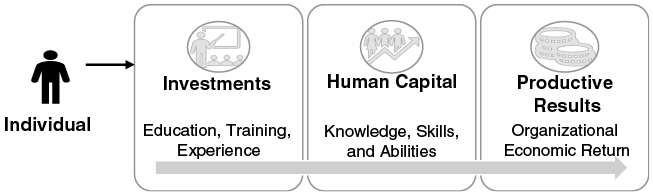
Building on Schultz’s insights, Becker (Reference Becker and Lazear2002) developed a systematic and formal theory of human capital, framing expenditures on education, training, and experience as investments that yield returns in the form of increased productivity and earnings over time. He emphasized that individuals should be understood not merely as labor inputs but as holders of capital capable of generating economic returns and that intentional investment in developing this capital is fundamental to both individual advancement and broader economic growth. According to this perspective, human capital is not a fixed attribute but an asset that can be accumulated, cultivated, and enhanced throughout a lifetime.
Figure 1 illustrates the core concept of human capital as an accumulable form of individual investment in education, training, and experience that generates future economic returns. By understanding its origins within this economic framework, it becomes possible to extend the concept toward a humanistic approach in the subsequent chapters.
Becker’s (Reference Becker and Lazear2002) conceptualization of human capital.
The economic conception of human capital gradually diffused into other disciplines, including human resource management, psychology, and education (Ployhart et al., Reference Ployhart, Nyberg, Reilly and Maltarich2014). The variation in definitions across disciplines reflects the emphasis placed on the factors most vital to each field.
2.2 Definitions and Dimensions of Human Capital in Educational Settings
The notion of teacher human capital was first articulated by Hargreaves and Fullan (Reference Hargreaves and Fullan2012) as a key component of professional capital, encompassing teachers’ advanced knowledge and the skills necessary for fulfilling their professional responsibilities. According to their model, professional capital comprises the integration of human, social, and decisional capital. Human capital refers to the individual talent, knowledge, and skills of each teacher or professional, reflecting the investment in the training and development of each practitioner. Social capital represents the collective strength of the group, encompassing the quality of collaboration, trust, and teamwork among staff members, with strong social capital being essential for improving the performance of the entire educational system rather than just individual outcomes. Decisional capital involves the ability to make informed, professional decisions in complex situations, acquired over years of experience, reflection, and collaboration with colleagues. In this framework, successful educational outcomes depend not only on the presence of talented teachers and well-developed human capital but also on cultivating a culture of collaborative learning that enhances social capital and enables informed and professional decision-making through decisional capital.
Within teaching, human capital represents the essential human resource input required to produce student learning outcomes (Carr, Reference Carr, Lovat, Toomey, Clement and Dally2023; Ginsburg, Reference Ginsburg2017). Typically, teacher human capital is conceptualized as the accumulation of personal and professional knowledge and competencies over time (Daly et al., Reference Daly, Liou and Der-Martirosian2021). These competencies develop primarily during in-service experience, supported by abundant opportunities for ongoing professional development both within and beyond the school setting (Belay et al., Reference Belay, Melese and Seifu2021). Scholars differ in their interpretations of teacher human capital. Some define it in terms of teachers’ knowledge, skills, and abilities related to the disciplines they teach and the pedagogical methods required for effective instruction (Yamak & Chaaban, Reference Yamak and Chaaban2022). Others stress the sufficiency of these resources, questioning whether teachers and principals possess adequate knowledge, capability, and willingness to act effectively (Hollweck & Doucet, Reference Hollweck and Doucet2020). Additional perspectives highlight the processes through which knowledge and skills are acquired, arguing that the essence of educational human capital lies in enhancing teachers’ productive capacity via formal study and practical experience (Buyruk, Reference Buyruk, Morales and Abegglen2020; Sirak et al., Reference Sirak, Ejakait and Musera2022). Human capital in education also encompasses knowledge of specific subject matter, understanding of students’ learning styles, and the emotional and social competencies required to support learners from diverse backgrounds (Belay et al., Reference Belay, Melese and Seifu2021; Yamak & Chaaban, Reference Yamak and Chaaban2022). Quantitative indicators of teacher human capital include educational attainment, expertise, skill level, and sufficient staffing within the system (Wang et al., Reference Wang, Huang and Wu2022). These indicators are positively correlated, as teachers with higher education, expertise, and skills are more likely to possess effective human capital and remain within the profession (Mason & Matas, Reference Mason and Matas2015).
This conceptualization is consistent with Bourdieu’s (Reference Bourdieu and Richardson1986) broader theory of capital, which distinguishes between different forms of capital, including economic capital, social capital, and cultural capital. Cultural capital, which includes knowledge, education, and skills, and social capital, which is reflected in networks and professional relationships, may eventually be transformed into symbolic capital, that is, the recognition and value attributed to these resources (Bourdieu, Reference Bourdieu and Richardson1986). Unlike Becker’s (Reference Becker and Lazear2002) more individual and economically oriented conception of human capital as an investment in skills and productivity, Bourdieu’s (Reference Bourdieu and Richardson1986) approach situates human capital within a broader social and relational framework of different forms of capital that gain value through social recognition and conversion processes. In the context of education, the development of teachers’ human capital can therefore be understood as a process in which the accumulation of knowledge, competencies, and professional relationships gradually acquires value and recognition within the school system. To better understand the positioning of human capital within the broader configurations of capital and the context in which it operates, Figure 2 presents Bourdieu’s (Reference Bourdieu and Richardson1986) conceptual framework.
The position of human capital within Bourdieu’s (Reference Bourdieu and Richardson1986) theory of capital.
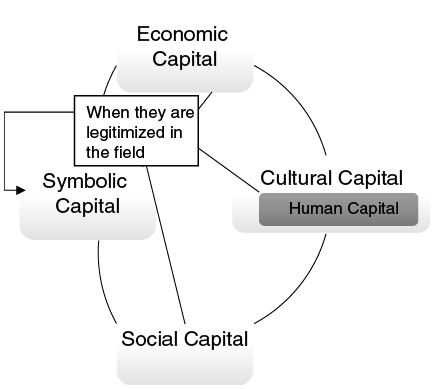
According to the figure, human capital is not positioned as an independent category within Bourdieu’s model but is, instead, embedded within the broader system of capital forms. It is most closely associated with embodied cultural capital, expressed through knowledge, skills, competencies, and dispositions acquired over time. However, its position within the model highlights that human capital is not inherently fixed or universally valuable; rather, its value is context-dependent and shaped by the specific social field in which it is enacted. In other words, human capital gains meaning and effectiveness only within existing power relations and social structures and in interaction with other forms of capital, such as social and economic capital, which together influence the ability to convert it into tangible advantages. Figure 2 illustrates that symbolic capital does not function as an independent form of capital; rather, it represents the recognized and legitimized form of other capitals – economic, cultural, and social – within a given field. This idea provides an important foundation for understanding how human capital is not only defined but also developed in educational systems, as discussed in the following section 3.
3 Human Capital Development in PK–12 Education
An important feature of human capital is its developable nature. It is not limited to what employees bring on their first day but encompasses their ongoing capacity to acquire new knowledge and skills. Human capital development relies on motivation and deliberate actions aimed at enhancing individuals’ knowledge, capabilities, and competencies while creating optimal conditions for realizing their potential (Kurowicka, Reference Kurowicka2019; Murphy & Douglas-McNab, Reference Murphy and Douglas-McNab2019). Consequently, human capital growth within educational organizations occurs not only through the recruitment of new school staff with relevant developed skills but also through strategic investment in the development and retention of existing personnel.
Such development may occur at any stage of an educator’s career, whether through the refinement of existing competencies or the acquisition of new capabilities through structured training and educational opportunities. Educators’ accumulation of the knowledge, skills, and abilities required for effective teaching is closely associated with their exposure to diverse learning opportunities over time (Daly et al., Reference Daly, Liou and Der-Martirosian2021). Within educational settings, human capital development therefore emphasizes the central role of learning opportunities, professional training, and continuous professional development in fostering the ongoing improvement of school staff (Belay et al., Reference Belay, Melese and Seifu2021; Wang et al., Reference Wang, Huang and Wu2022). The knowledge embedded within the school staff includes both explicit knowledge, acquired through formal professional development, and tacit knowledge, derived from personal experiences and everyday classroom practice (Daly et al., Reference Daly, Liou and Der-Martirosian2021; Darling-Hammond et al., Reference Darling-Hammond, Hyler and Gardner2017). Both formal training programs and informal mechanisms, such as peer learning, coaching, and collaborative training, have been shown to contribute significantly to educators’ development of extensive knowledge of teaching methods and to the establishment of professional norms that support effective instruction (Papay et al., Reference Papay, Bacher-Hicks, Page and Marinell2017). Consequently, education systems invest in the human capital of educators by providing opportunities for continuous professional development, thereby enriching educators’ professional experience and, ultimately, strengthening student achievement (Wang et al., Reference Wang, Huang and Wu2022). In this context, academic training departments and educational institutions also play a central role in overseeing and implementing policies related to teacher training and ongoing professional development.
Increasing human capital through professional development also requires the implementation of complementary measures. These measures, shaped by effective school leadership, include fostering a positive academic climate, promoting a sense of institutional security, and encouraging educators’ willingness to participate in professional development initiatives (Belay et al., Reference Belay, Melese and Seifu2021). In this regard, middle leaders, who function as intermediaries between principals and school staff, also contribute to this process by strengthening educators’ professional effectiveness. They do so by making decisions aimed at improving teaching practices and learning experiences while simultaneously fostering an environment of constructive professional influence (Benoliel, Reference Benoliel2021; Ho et al., Reference Ho, Bryant and Walker2024).
Some scholars have claimed that the development of human capital is also dependent on social capital, which is grounded in social interaction and relationship-building among educators (Liou & Canrinus, Reference Liou and Canrinus2020). Principals may influence school social capital by establishing various professional groups, encouraging frequent interactions among school stakeholders, and cultivating a school culture that reinforces these interactions (Berhanu, Reference Berhanu2024). Through social capital, educators are able to combine and expand their human capital, incorporating new knowledge in ways that enhance their teaching practices (Gumede & Govender, Reference Gumede and Govender2022).
Beyond the availability of learning opportunities, seniority and professional experience have also been identified as key factors in the development of school staff’s human capital. For example, Daly et al. (Reference Daly, Liou and Der-Martirosian2021) demonstrated a correlation between mathematics teachers’ human capital measured by formal education, years of subject-specific experience, perceived proficiency in teaching mathematics, and their students’ academic achievement. The significant role attributed to years of experience is consistent with the conceptualization of human capital as the accumulation of knowledge and skills over time (Yoon et al., Reference Yoon, Yom, Yang and Liu2017), indicating that teachers’ professional growth is substantially shaped by their experience (Graham et al., Reference Graham, White, Cologon and Pianta2020). Moreover, Podolsky et al.’s (Reference Podolsky, Kini and Darling-Hammond2019) critical review study demonstrates that experience plays a significant role in the development of human capital throughout the different stages of teachers’ career trajectories, contrary to the common assumption that its influence diminishes after the initial years. However, Yamak and Chaaban (Reference Yamak and Chaaban2022) found that teachers who left the profession prematurely demonstrated a higher level of personal teaching quality, thereby challenging the assumption that extended tenure leads to greater professional competence. These findings caution against simplistic assumptions regarding the relationship between professional experience and human capital development.
Overall, the literature on human capital development in PK–12 education emphasizes that human capital is not a fixed attribute acquired on entry into the profession but an evolving capacity shaped by ongoing learning, professional experience, and organizational conditions. Empirical evidence highlights the central role of structured professional development, informal learning processes, and collaborative mechanisms in fostering educators’ knowledge, skills, and instructional competencies. These processes are further supported by school-level conditions, including leadership practices, professional cultures, and the facilitation of social interaction among school staff members. In addition, social capital has been identified as an important complementary dimension, through which professional relationships enhance the utilization and expansion of individual human capital. Alongside these organizational and relational dimensions, educators’ professional experience has also been shown to play a significant role in shaping human capital development, although its impact is not linear and may vary across career stages and contexts.
4 Human Capital Development from a (Strategic) Human Resources Management Perspective
Building on the presentation of the human capital crisis in education and the growing professional emphasis on solutions related to human capital development at the level of the educational organization, this section focuses on human capital development from the perspective of human resources management. This perspective, which has only rarely been systematically integrated into educational theory in general and into educational leadership and organizational theory in particular, broadens the understanding of teacher development beyond initial teacher preparation or models that focus solely on professional development at different career stages. Instead, it proposes viewing human capital development as a systemic, organizational, holistic, purposeful, and continuous process that includes recruitment, induction, professional development, evaluation, promotion, and retention of school staff. Examining human capital development from a human resource management perspective makes it possible to highlight the managerial principles that underpin different models, the theoretical assumptions that guide them, and their potential contribution to understanding how educational systems and school organizations can build a structured and coherent foundation for the long-term development of human capital.
Human resource management is concerned with the strategic management and development of an organization’s workforce in order to advance institutional goals. At its core, human resource management addresses the relationship between employees and the organization, seeking to ensure that human resources are aligned with organizational objectives and can contribute effectively to overall performance (Stone et al., Reference Stone, Cox and Gavin2020; Vekeman et al., Reference Vekeman, Devos, Valcke and Rosseel2018). In its early conceptualizations, human resource management emphasized the improvement of organizational productivity and efficiency through the optimization of employee contributions (Chong et al., Reference Chong, Ngolob and Palaoang2020). Over time, however, the field evolved to incorporate more humanistic perspectives that view employees not merely as a means of production but as a central organizational asset that requires continuous investment, development, and support.
In the educational context, human resources include all members of the school community: principals, teachers, administrative personnel, and support staff, who collectively work toward the achievement of educational objectives. From this perspective, human resource management refers to the policies, strategies, and practices designed to guide, motivate, and support employees in ways that enhance both individual effectiveness and organizational performance (Pandey & Sharma, Reference 65Pandey and Sharma2021). Within schools, human resource management aims to both strengthen organizational functioning and improve the quality of teaching and student achievement by creating a supportive framework that enables teachers and school staff to realize their professional potential (Kurowicka, Reference Kurowicka2019). Because teachers and school staff constitute the primary drivers of educational success, human resource management must prioritize practices that promote professional growth, strengthen competencies, and enhance employees’ capacity to contribute meaningfully to overall school performance (Sukawati et al., Reference Sukawati, Gunawan, Ubaidillah, Maulina and Santoso2020).
Importantly, the effectiveness of these practices depends not only on the development of professional competencies but also on the promotion of teachers’ personal well-being. A growing body of research indicates that teachers’ well-being is a critical factor influencing both their motivation and their professional effectiveness (Zerrad & Schechter, Reference Zerrad and Schechter2025d). Accordingly, teacher well-being has become a central concern of human resource management in educational institutions (Pagan-Castano et al., Reference Pagan-Castano, Sánchez-García, Garrigos-Simon and Guijarro-García2021; Zhang et al., Reference Zhang, Goroshnikova, McGuire, Paunescu, Perusquía, Tang and Kwong2023). Teacher well-being encompasses both a sense of value and satisfaction and effective functioning at work, which includes subjective vitality, behavioral engagement, and professional growth (Collie, Reference Collie2023).
Teacher well-being is also shaped by human resource management practices such as participation in decision-making processes, access to continuous professional development, and positive perceptions of how human resources are managed within the school (Pagan-Castano et al., Reference Pagan-Castano, Sánchez-García, Garrigos-Simon and Guijarro-García2021; Veld & Alfes, Reference Veld and Alfes2017). When human resource management successfully balances the needs of the educational system with the personal and professional needs of teachers and the maintenance of their well-being, the motivation of school staff increases and their performance improves, thereby contributing directly to the achievement of the institution’s goals (Sukawati et al., Reference Sukawati, Gunawan, Ubaidillah, Maulina and Santoso2020; Tran & Buckman, Reference Tran and Buckman2021; Van Beurden et al., Reference Van Beurden, Van Veldhoven and Van de Voorde2021).
4.1 The Strategic Roots of the Human Capital Development Approach
Human resource management did not originally emerge as a strategic field but rather as an administrative function primarily concerned with bureaucratic procedures and professional control. Early approaches were grounded in the assumption that employees needed to be regulated and supervised in order to ensure appropriate behavior and organizational compliance (Nurata, Reference Nurata2022). Over the past five decades, however, human resource management has undergone a profound transformation, gradually shifting from a control-oriented model toward a strategic approach centered on human capital, long-term goal setting, and organizational alignment. In this strategic perspective, employees are no longer viewed merely as resources to be managed but as central contributors whose commitment, trust in the organization, and participation in decision-making processes are essential to institutional success (Runhaar, Reference Runhaar2017).
Recent scholarship has further highlighted the growing emphasis on recognizing employees’ needs and promoting their professional development as a core component of human resource management (Ozkeser, Reference Ozkeser2019). This shift reflects the convergence of two underlying theoretical orientations within the field: on the one hand, the instrumental approach emphasizes strategic alignment, measurable outcomes, and organizational performance; on the other hand, the humanistic approach underscores employees’ motivation, satisfaction, and commitment as critical factors in organizational effectiveness (Stone et al., Reference Stone, Cox and Gavin2020).
The historical development of human resource management can therefore be understood as a gradual evolution through several stages. In the earliest phase, often described as pre-manpower management, employees were treated primarily as factors of production, similar to human machines. This was followed by the stage of personnel management, in which employees were still regarded largely in mechanistic terms but with greater recognition of their emotional needs. During this period, the focus was placed on functions such as recruitment, job analysis, labor relations, evaluation, training, and compensation. A third stage marked the transition to human resource management as a distinct field, characterized by the recognition of employees as individuals whose motivation and workplace behavior required systematic attention. The most recent stage encompasses the strategic management of human resources, in which human resource practices are integrated into broader strategic frameworks. This stage combines a performance-oriented perspective with a more developmental approach that considers both organizational goals and the needs of employees and stakeholders (Nurata, Reference Nurata2022).
Within this historical development, human capital development should be understood not as a separate or parallel concept but as a direct outcome of the transition to strategic human resource management. Once human resource management shifted from a control-oriented administrative function to a strategic approach concerned with long-term organizational performance, the development of employees’ knowledge, skills, and capabilities became a central organizational priority rather than a peripheral activity. In this sense, human capital development reflects the strategic logic of human resource management: it assumes that organizational success depends on the continuous strengthening of employees’ professional capacity, their motivation, and their long-term commitment to the organization.
Accordingly, the concept of human capital development is rooted in the recognition that employees are not only a resource to be managed but a strategic asset that must be systematically developed over time. This perspective moves beyond traditional personnel practices that focused primarily on recruitment, supervision, and evaluation and instead emphasizes long-term investment in employees through structured professional development, career advancement opportunities, and supportive organizational conditions. It is precisely this shift, from administrative control to strategic development, that forms the foundation of the human capital development approach and explains its close alignment with strategic human resource management.
Understanding human capital development within educational organizations requires, as a first step, a broad examination of prevailing human resource management practices across organizational contexts. Such a perspective enables the identification of core principles, mechanisms, and practices that underpin the management and development of human capital in general. Building on this foundation, it becomes possible to more precisely examine those human resource management practices that are particularly relevant to the management and development of school staff. This distinction is essential as, while many human resource practices are transferable across sectors, their application within educational settings must be adapted to the unique characteristics, goals, and professional demands of teaching and learning environments.
Against this conceptual backdrop, human capital development is operationalized through a set of core human resource management practices that span the entire employee life cycle. These practices translate strategic orientations into concrete organizational actions (Boudreau et al., Reference Boudreau, Ulrich and Buhler2023), shaping how employees are recruited, developed, evaluated, and supported over time. Although they can be analytically distinguished, in effect they function as an interconnected and mutually reinforcing system, in which each practice both influences and is influenced by the others (Botelho et al., Reference Botelho, Kearns and Woollard2023).
Implementation varies across organizational contexts. Nevertheless, the literature identifies a set of core practices that are widely regarded as foundational to human resource management in general. These practices constitute the organizational infrastructure through which employees are managed, supported, and developed, forming the basis upon which more targeted approaches, such as human capital development, are later articulated. Among the most commonly recognized practices are: (1) recruitment and selection, (2) training and development, (3) performance management, and (4) the design of the work environment and workplace relationships (Ho & Kuvaas, Reference Ho and Kuvaas2020; Kurowicka, Reference Kurowicka2019).
First, recruitment and selection constitute the entry point to the organization, encompassing the policies and practices associated with attracting and identifying new employees. The emphasis is placed on selecting candidates who not only possess the required competencies but also demonstrate a strong fit with the specific role and organizational culture as well as a higher likelihood of future engagement. To this end, evidence-based selection methods are employed, often combining structured interviews with assessments of personal characteristics. Equally important is the effort to ensure alignment between candidates’ expectations regarding their future role and the actual characteristics of the work environment they will encounter.
Second, training and development represent a complementary dimension through which employees are provided not only with the resources necessary to perform their roles but also with opportunities to enhance and expand their personal and professional capacities. In addition, organizations are encouraged to create spaces that enable employees to express ideas, concerns, and suggestions, thereby fostering continuous improvement and innovation. Research indicates that such opportunities play a significant role in enabling employees to develop their personal resources within the workplace.
Third, performance management constitutes an ongoing organizational process aimed at identifying, evaluating, and enhancing both individual and collective performance in alignment with organizational goals. This process includes the establishment of performance and developmental goals, the provision of feedback and recognition, and the cultivation of an organizational climate characterized by trust, engagement, and empowerment, all of which contribute to improved performance outcomes.
Finally, the design of the work environment and the quality of workplace relationships play a role in shaping employees’ motivation. According to self-determination theory (Deci & Ryan, Reference Deci and Ryan1985), the fulfillment of three fundamental psychological needs – autonomy, competence, and relatedness – fosters intrinsic motivation. Work environments that support employees’ sense of choice and agency, perception of effectiveness, and sense of belonging are more likely to promote optimal motivational and emotional experiences, thereby enhancing performance.
From a theoretical and empirical standpoint, not all human resource management practices contribute equally to the development of human capital. Given that human capital is conceptualized as the accumulation of knowledge, skills, and competencies, practices that directly shape these dimensions assume a particularly central role. Accordingly, recruitment and selection, alongside training and development, emerge in the literature as the most salient practices for advancing human capital. While recruitment and selection determine the initial quality and potential of the workforce by identifying individuals who possess the relevant knowledge base and capacity for growth, training and development serve as the primary mechanisms through which these capabilities are further cultivated and expanded over time.
This emphasis is further supported by system-level conceptualizations of human resource management in schools. Runhaar (Reference Runhaar2017) proposes a framework for human resource management systems that includes three dimensions for teacher development: ability, motivation, and opportunity. The ability dimension, which encompasses staffing and professional development, aligns directly with the conceptualization of human capital adopted in this Element, as it focuses on ensuring and enhancing teachers’ knowledge, skills, and competencies. At the same time, the framework highlights that teacher development cannot be reduced to capability-building alone. While recruitment and selection along with training and development represent the primary mechanisms for building human capital, their effectiveness is strengthened when combined with additional practices in line with a broader systemic perspective.
It is important to note that over the past three decades, research has increasingly shifted its focus from isolated human resource practices to comprehensive human resource systems (Boon et al., Reference Boon, Eckardt, Lepak and Boselie2018). This shift reflects a growing consensus regarding the limited effectiveness of individual practices when implemented in isolation and their dependence on other practices within the system (Botelho et al., Reference Botelho, Kearns and Woollard2023). The integration of human resource management practices into a coherent system characterized by internal alignment strengthens each individual practice and generates synergistic effects (Sutton & Atkinson, Reference Sutton and Atkinson2023). This notion of synergy, which underpins the systemic perspective, serves as a foundational mechanism for enhancing organizational performance (Ho & Kuvaas, Reference Ho and Kuvaas2020).
The effectiveness of these core practices cannot be fully understood in isolation from broader organizational conditions. In particular, employee well-being has been identified as a significant factor influencing the outcomes of human resource management practices (Pagan-Castano et al., Reference Pagan-Castano, Sánchez-García, Garrigos-Simon and Guijarro-García2021; Zhang et al., Reference Zhang, Goroshnikova, McGuire, Paunescu, Perusquía, Tang and Kwong2023), suggesting that the development of human capital is not solely a function of formal skill acquisition but is also shaped by motivational and emotional dimensions (Zerrad & Schechter, Reference Zerrad and Schechter2025d). Consequently, practices related to the work environment – such as the cultivation of a positive learning climate, supportive interpersonal relationships, and fair compensation structures – play an important complementary role by enhancing employees’ satisfaction, engagement, and capacity to benefit from developmental opportunities. Elements related to well-being are embedded both within these core practices and within complementary practices associated with the motivation and opportunity dimensions, such as performance management, supportive work environments, and participation.
This understanding is further reinforced by findings from our own research (Zerrad & Schechter, Reference Zerrad and Schechter2025d), which proposes an expanded multidimensional model of human capital development based on principals’ perceptions. Our findings indicate that, alongside professional development, principals emphasize the centrality of teachers’ socio-emotional well-being as a core domain of development. Moreover, the results highlight the importance of integrating professional and socio-emotional dimensions, suggesting that effective human capital development in schools is achieved through the synergy between capability-building practices and practices that promote teachers’ sense of belonging, trust, and motivation. These findings further support the argument that while recruitment and development constitute the primary mechanisms of human capital formation, their effectiveness is contingent on the broader organizational conditions in which they are embedded.
While existing literature has identified a range of human resource management practices, these are typically discussed within the broader context of managing employees in general organizational settings rather than specifically in relation to the development of educators’ human capital. Moreover, such practices are often examined in isolation, without sufficient attention to the distinctions between those that directly contribute to the development of professional capabilities and those that function as enabling or supportive conditions. Figure 3 seeks to address this gap by offering an integrative model that differentiates between two areas: core practices that directly foster human capital development – namely, the development of teachers’ knowledge, skills, and professional capacities; and complementary practices, which, while not developmental in themselves, play a role in shaping the organizational conditions under which such development can occur. In doing so, the model brings into focus not only what schools do to develop their teachers but also how these efforts are supported, sustained, and experienced in everyday school life. Particular attention is given to the role of teachers’ well-being as a foundational dimension that underpins the effectiveness of these practices, highlighting the interdependence between professional growth and the broader human and relational context in which it unfolds.
A human resource management–based model of human capital development in schools.
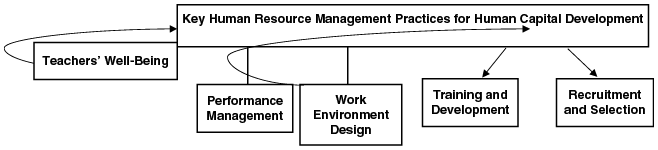
The model delineates a distinction between core practices of human capital development and complementary practices that support their effectiveness. At its core, the model identifies two primary practices: recruitment and selection and training and development. These constitute the direct mechanisms through which human capital is formed and enhanced through the careful selection of suitable educators and their ongoing professional development over time. Alongside these, work environment design and performance management are positioned as complementary practices. These do not directly generate human capital development; rather, they establish the organizational conditions that enable core practices to function effectively. Work environment design shapes educators’ sense of belonging and autonomy and the quality of professional relationships, while performance management provides direction, feedback, and a framework for professional growth. In this sense, these practices strengthen teachers’ capacity to benefit from development opportunities without constituting the source of development itself. An additional dimension that cuts across the entire model is teachers’ well-being, which is conceptualized not only as an outcome but as a foundational condition. Teachers’ well-being shapes how they experience and engage with both core and complementary practices, influencing their motivation, commitment, and persistence in professional development processes. As such, the effectiveness of core practices is highly contingent on the presence of supportive conditions that sustain well-being.
The model advances a hierarchical and integrated understanding of human capital development: core practices that directly drive development alongside complementary practices and organizational conditions that enable, reinforce, and sustain these processes over time.
5 Educational Leadership and Human Capital Development
5.1 Principals as Human Capital Developers
In light of the ongoing need for educational institutions to recruit new school staff, develop their professional capacities, and retain a high-quality teaching workforce over time, there is a growing recognition of the importance of human capital development in educational settings. This form of management is not limited to a single dimension; rather, it encompasses a broad range of professional domains and competencies, from planning and leading effective professional development (particularly considering findings indicating that existing programs do not always achieve their intended goals) through the development of career pathways and strengthening teamwork to the promotion of teachers’ well-being. Accordingly, it constitutes a complex and multilayered process that requires the support of central administrative personnel, who assist those responsible for achieving the full range of objectives related to human capital development, namely, principals. At the same time, these processes require active teacher involvement and careful adaptation to the specific context of each school.
As educational institutions face evolving challenges, there is an increasing need for a more strategic and systemic approach to staff development, one that not only enhances educators’ skills but also promotes job satisfaction and organizational commitment, thus contributing to school staff retention. Unlike traditional human resource management, human capital development requires a conceptual and systemic shift as well as alignment between school-level and district-level management approaches and the needs of the teaching workforce that drives the system (Murphy & Douglas-McNab, Reference Murphy and Douglas-McNab2019; Shell, Reference Shell2023). This shift entails a focus on capacity building and other factors that enhance educators’ job satisfaction and commitment and ultimately improve their performance in the educational process (Daly et al., Reference Daly, Liou and Der-Martirosian2021).
Principals play a central role in guiding these processes and in creating conditions that support professional growth, job satisfaction, and organizational commitment (Shell, Reference Shell2023; Zerrad & Schechter, Reference Zerrad and Schechter2025d). However, the practical implementation of this strategy is influenced by both the specific contextual characteristics of each school and broader conditions of policy, regulation, and resource constraints, which place continuous and complex demands on principals in managing human capital. The role of principals is increasingly understood as extending beyond traditional hiring and dismissal functions within human resource management and toward the adoption of strategic approaches that enhance the overall professionalism and value of the teaching workforce (Shell, Reference Shell2023). Assuming this responsibility is widely regarded as a core dimension of effective leadership (Gumede & Govender, Reference Gumede and Govender2022).
Within this framework, principals are expected not only to rely on teachers’ initiative in developing their human capital but also to actively enable and structure opportunities for professional growth (Zerrad & Schechter, Reference Zerrad and Schechter2025d). Such opportunities include workshops, collaborative meetings, conferences, and cooperative learning forums, which serve as key mechanisms for strengthening teachers’ pedagogical competencies (Belay et al., Reference Belay, Melese and Seifu2021; Wang et al., Reference Wang, Huang and Wu2022). By positioning themselves as “learning leaders,” principals can intentionally design and sustain continuous professional learning environments within schools (MacLeod, Reference MacLeod, White and McCallum2020). A strategic human capital leadership approach further emphasizes the importance of aligning professional development with educators’ knowledge and skill potentials through targeted and well-designed learning activities (Murphy & Douglas-McNab, Reference Murphy and Douglas-McNab2019). In this way, recognition of teachers’ professional growth becomes central to nurturing their capabilities and enhancing job satisfaction (Best, Reference Best2010; Gumede & Govender, Reference Gumede and Govender2022).
Another key dimension of principals’ role in human capital leadership relates to recruitment and retention (Best, Reference Best2010). Effective recruitment requires alignment between candidates’ competencies and motivations and the specific demands of the teaching role (Runhaar, Reference Runhaar2017). At the same time, sustaining a stable teaching workforce over time (Aulia & Haerani, Reference Aulia and Haerani2022) depends on fostering a strong sense of belonging and meaning (Shell, Reference Shell2023) alongside a positive school climate (Almager et al., Reference Almager, Cumby and Almekdash2021). These conditions reflect the development of social capital within schools, namely, the relational networks through which teachers interact, share knowledge, and collectively enhance practice. Through such social capital, individual human capital can be integrated into collective professional capacity, thereby strengthening instructional effectiveness (Daly et al., Reference Daly, Liou and Der-Martirosian2021; Liou & Canrinus, Reference Liou and Canrinus2020). In addition, collaborative leadership structures and participatory decision-making further enhance teacher satisfaction and retention by supporting ongoing learning and professional engagement (Belay et al., Reference Belay, Melese and Seifu2021). Attention to teachers’ emotional and social well-being further contributes to their professional development and fosters a sense of fulfillment in the school environment (Berkovich & Eyal, Reference Berkovich and Eyal2020).
Murphy and Douglas-McNab (Reference Murphy and Douglas-McNab2019) further conceptualize the principal’s role through their strategic guidelines for human capital leadership in schools. These guidelines integrate considerations of teachers’ well-being with broader processes of recruitment, development, and retention, emphasizing their interdependence with professional satisfaction. Key recommendations include developing transparent job descriptions to clarify expectations and enhance engagement, recruiting innovative and adaptable educators capable of responding to systemic change, and continuously revising human capital processes in collaboration with school staff to improve effectiveness. Additionally, they highlight the importance of redesigning reward and benefit systems to ensure fairness and attractiveness as well as fostering leadership development opportunities that enable educators to assume expanded professional roles.
5.2 Educational Leadership Theories Relevant to Human Capital Development
Educational leadership plays a central role in shaping the development of human capital within schools, as principals are key agents in designing, implementing, and sustaining the conditions that enable teachers to grow professionally and personally. While human capital development is often discussed within the framework of human resource management, its realization in educational settings is deeply embedded in leadership practices and approaches.
A range of educational leadership theories offers valuable insights into how principals influence the development of teachers’ knowledge, skills, motivation, and well-being. Understanding these theoretical perspectives provides a foundation for examining how leadership can effectively support and enhance human capital development in schools. Accordingly, this section examines key educational leadership theories and their relevance to human capital development in schools.
In the context of educational leadership theories, it is worth emphasizing that the roots of the human capital development approach can be traced to strategic leadership (Tuytens et al., Reference Tuytens, Vekeman and Devos2023), where investment in human capital development is conceptualized as a long-term strategy for enhancing school effectiveness (Belay et al., Reference Belay, Melese and Seifu2021; Gumede & Govender, Reference Gumede and Govender2022). Strategic educational leadership can be understood as a system-wide and context-sensitive mode of leadership that reflects a broader way of thinking, integrating vision, data-informed understanding of context, and long-term (typically three- to five-year) organizational development. In this sense, strategy functions as a guiding framework that shapes both leadership and management practices within the school, linking present actions with future-oriented goals (Carvalho et al., Reference Carvalho, Cabral, Verdasca and Alves2021). Through this framework, strategic leadership provides the mechanism through which human capital development becomes coherent, ensuring that teacher development initiatives are not fragmented but are instead aligned with a shared vision, distributed across organizational levels, and continuously adapted to contextual needs.
Instructional leadership refers to the set of actions and responsibilities undertaken by principals that directly influence teaching and learning within schools. Key responsibilities of instructional leaders include establishing clear goals and expectations for student performance, which provide measurable benchmarks that guide both teaching and learning processes (Alanoglu, Reference Alanoglu2022). Instructional leaders are expected to engage in data-driven decision-making by analyzing student performance data to identify areas for improvement and to inform instructional planning and curriculum development (Akomodi, Reference Akomodi2025). By closely monitoring the quality of teaching, providing feedback, and supporting professional learning, instructional leadership contributes to the development of teachers’ pedagogical knowledge and skills (He et al., Reference He, Guo and Abazie2024). However, while instructional leadership effectively supports specific aspects of professional expertise, its role in fostering broader human capital development may be more limited. This is because instructional leadership tends to prioritize technical and instructional dimensions of teaching, often placing less emphasis on the holistic development of teachers as professionals. In particular, dimensions such as teachers’ personal well-being, broader professional growth beyond immediate instructional needs, and the realization of individual potential may receive comparatively less attention within this leadership approach. Accordingly, instructional leadership can be viewed as a component within a wider human capital development framework, contributing to its instructional dimension but not encompassing its full scope.
Distributed leadership can be understood as a perspective that conceptualizes leadership not as the function of a single individual but as a collective, practice-based process emerging through interactions among multiple actors within an organization (Galdames-Calderón, Reference Galdames-Calderón2023). Rather than being confined to formal roles, leadership is distributed across leaders, educators, and contextual situations, with an emphasis on interdependent actions and shared responsibility (Adams et al., Reference Adams, Harris, Moosa, Jones and Khaleel2025b; Hickey et al., Reference Hickey, Flaherty and Mannix McNamara2022). This leadership approach is particularly relevant to human capital development, as it positions teachers not only as recipients of development but also as active agents in shaping their professional learning and organizational growth. Through participation in collaborative structures, shared decision-making, and peer learning processes, teachers contribute to the development of both individual and collective capacities (Zerrad & Schechter, Reference Zerrad and Schechter2025c), resulting in increased motivation, job satisfaction, and school staff retention (Katitas et al., Reference Katitas, Yildiz and Dogan2025). Within this framework, middle leadership plays a mediating role in advancing human capital development. Given the limited capacity of principals to be directly involved in all developmental processes, middle leaders serve as key intermediaries who translate strategic priorities into practice and adapt development initiatives to the specific needs of teachers (Benoliel, Reference Benoliel2021). Their proximity to day-to-day instructional work enables them to align organizational goals with teachers’ professional realities, thereby enhancing the relevance and effectiveness of human capital development efforts. However, distributed leadership may, in some cases, function as a mechanism for increasing teachers’ workload or reinforcing administrative control under the guise of collaboration (Harris et al., Reference Harris, Jones and Ismail2022). This “dark side” suggests that its contribution to human capital development depends on how it is enacted in practice, whether it genuinely promotes shared agency or merely redistributes responsibility without corresponding support.
Transformational leadership is among the most extensively studied approaches in educational contexts. It emphasizes leaders’ ability to inspire, motivate, and intellectually stimulate staff while attending to their individual needs (Al Hammadi et al., Reference Al Hammadi, Dayan, Bellibas, Tafesse and Sacilotto2025). Transformational leaders foster a shared vision, encourage innovation, and support teachers’ professional development. In this sense, transformational leadership contributes directly to the development of teachers’ human capital by enhancing not only their knowledge and instructional skills but also their motivation, engagement, and capacity for continuous learning (Alzoraiki et al., Reference Alzoraiki, Ahmad, Ateeq and Milhem2024). This perspective also aligns with the Ability, Motivation, Opportunity (AMO) framework (Boselie et al., Reference Boselie, Van Harten and Veld2021; Ho & Kuvaas, Reference Ho and Kuvaas2020), particularly with regard to the central role of motivation in enabling the development and utilization of teachers’ capabilities. Transformational leadership strengthens the motivational dimension by fostering commitment, inspiration, and a sense of purpose, thereby encouraging teachers to invest in their own professional growth. As such, it operates as a complementary practice that supports the development of abilities while activating the motivational processes necessary for human capital development. However, its contribution appears to be more pronounced at the individual and motivational levels than at the structural or organizational level. Hence, it may be less aligned with a strategic, system-wide perspective on human capital development, which emphasizes organizational coherence, alignment between goals and practices, and the coordinated development of human capital as an institutional capacity rather than just an individual attribute (Carvalho et al., Reference Carvalho, Cabral, Verdasca and Alves2021).
Servant leadership has gained increasing attention in educational research, particularly in light of the complex challenges faced by teachers in post-pandemic contexts. This leadership approach emphasizes the role of the leader as one who prioritizes the needs, well-being, and development of others, positioning service to followers as a central leadership function (Athanasios, Reference Athanasios2025). In educational settings, servant leadership is reflected in practices that support teachers’ emotional well-being, professional growth, and sense of purpose, especially in contexts characterized by uncertainty, shifting instructional modalities, and increased demands on teachers’ adaptability (Adams et al., Reference Adams, Feng and Omar2025a). Empirical studies indicate that servant leadership is associated with positive outcomes such as improved performance, stronger organizational commitment, and higher levels of engagement. These outcomes are closely aligned with the broader conception of human capital as encompassing not only knowledge and skills but also motivation, well-being, and the capacity for continuous professional growth (Athanasios, Reference Athanasios2025; Zhang et al., Reference Zhang, Liu, Aramburo and Jiang2025). At the same time, servant leadership sustains developmental domains that include integrating professional growth with social and emotional development (Zerrad & Schechter, Reference Zerrad and Schechter2025d). As a leadership approach that prioritizes the emotional dimension, it promotes a holistic understanding of teacher development, in which professional learning is closely intertwined with well-being, interpersonal relationships, and personal fulfillment. However, servant leadership is not inherently performance-oriented in a strategic or systemic sense. While it contributes to teachers’ well-being, engagement, and personal growth, it does not necessarily provide a structured or intentional strategy for the development of specific professional competencies. As such, it may lack a clear focus on aligning and systematically advancing the skills required for instructional improvement. Table 1 synthesizes the leadership approaches’ key contributions and limitations in an attempt to clarify their differences and offer a better understanding of their complementary roles in human capital development.
| Leadership approach | Key contribution to human capital development | Limitations |
|---|---|---|
| Strategic leadership | Provides long-term vision and alignment; integrates human capital development with school goals; ensures coherence across practices and organizational levels | May overlook day-to-day relational and emotional aspects of teacher development; risks being overly policy driven |
| Instructional leadership | Strengthens teachers’ pedagogical knowledge and instructional skills; promotes data-informed improvement and focused professional learning | Narrow focus on teaching and learning; limited attention to well-being, identity, and broader growth |
| Distributed leadership | Encourages shared responsibility, collaboration, and collective learning; enhances teacher agency, motivation, and retention | May increase workload or diffuse responsibility |
| Transformational leadership | Enhances motivation, commitment, and professional engagement; fosters vision, innovation, and continuous learning | Less focused on structural alignment and system-level coherence; may emphasize inspiration over concrete developmental strategies |
| Servant leadership | Promotes well-being, trust, and holistic development; integrates emotional and professional dimensions of growth | Lacks strong focus on performance, structure, and strategic skill development; may not sufficiently guide systematic improvement |
Human capital leadership does not align exclusively with a single theoretical model or leadership approach. Rather, it reflects. While recognizing that no single leadership model fully captures the complexity of educational settings, in practice human capital leadership also does not align exclusively with a single theoretical model or leadership approach. Rather, it reflects a combination of complementary perspectives. A range of educational leadership theories thus provides a conceptual foundation for understanding how principals can influence the development of human capital in schools. The present analysis strongly supports this integrative view, indicating that different leadership approaches contribute in distinct ways: strategic leadership provides direction and long-term orientation; distributed leadership builds collective capacity; transformational leadership enhances motivation and commitment; instructional leadership strengthens professional expertise; and servant leadership fosters well-being and supportive relationships. This differentiated contribution points to an important analytical insight: the question is not which leadership theory is most effective, but rather how these approaches can be combined in a complementary manner. Accordingly, future research should move beyond single-theory frameworks and examine how hybrid or integrated leadership models can more effectively support the complex and evolving nature of human capital development in educational contexts.
5.3 Challenges and Tensions in Human Capital Leadership in Schools
Alongside the growing recognition of the importance of human capital development in educational institutions and its contribution to improving teaching quality, organizational climate, and student outcomes, the implementation of these models within the educational-organizational context is far from straightforward. The transition from theoretical conceptions of human capital development to everyday managerial practices gives rise to a range of challenges and constraints, both structural-organizational and human, which affect principals’ ability to sustain ongoing developmental processes.
In this context, human capital leadership does not occur within a neutral environment but rather within a system characterized by regulatory constraints, limited resources, professional and emotional workload, and continuous changes in policies and expectations. Therefore, examining the challenges associated with human capital development not only identifies barriers but also provides a deeper understanding of the managerial complexity within which principals operate as well as the gap between the underlying logic of human capital development and its practical implementation in educational organizations.
Human capital leadership in schools entails challenges at both earlier conceptual stages and in its applied implementation. Conceptual challenges relate to the ways in which human capital leadership is understood, framed, and interpreted within the education system. These challenges operate “through” management itself and do not necessarily stem from organizational structures or managerial competencies; they emerge instead from underlying assumptions, conceptual language, and value orientations that shape human capital leadership as a strategic practice in educational organizations. This conceptual framework directly and indirectly influences how applied management challenges are identified, interpreted, and addressed in practice.
Applied challenges, in turn, refer to the concrete, context-dependent difficulties that emerge in the day-to-day enactment of human capital leadership within schools. These include the recruitment and retention of qualified school staff, the design and implementation of effective professional development processes, the construction of career pathways, the management of workload and well-being, and the need to operate within regulatory, resource-related, and policy constraints. The applied challenges reflect the practical tensions that principals face in translating human capital leadership principles into effective organizational practices within educational environments. The main challenges, both conceptual and applied, are discussed in detail below.
5.3.1 The Adoption of an Economic Perspective in the Educational Context (Conceptual)
Although the term “human capital” has become widely used in contemporary public discourse and is increasingly adopted by scholars in the field of education, particularly in relation to teachers’ professional development, it carries a historical legacy rooted in economic conceptions of education. This legacy does not always align with the humanistic values underpinning the idea of teacher development, which emphasize professionalism, autonomy, and ethical commitment (Zerrad & Schechter, Reference Zerrad and Schechter2025a). While the literature acknowledges the importance of human capital management, some scholars caution that the very use of the term “capital” may inadvertently reduce school staff to assets expected to generate returns, thereby obscuring the ethical, relational, and pedagogical dimensions of their work (Auerbach & Green, Reference Auerbach and Green2024; Edeji, Reference Edeji2024). In the context of teaching, these dimensions include educators’ professional autonomy, ethical responsibilities, and participation in collegial and professional communities (Mezza, Reference Mezza2022).
This framing gives rise to a central dilemma: should educators be managed primarily as resources to be optimized in pursuit of organizational outcomes, such as students’ academic achievement? Or should they be developed as professionals endowed with intrinsic motivation and a broader social and educational commitment? The tension between viewing teachers as instruments for achieving institutional goals and fostering their intrinsic motivation becomes particularly evident in human capital leadership strategies that adopt a humanistic orientation, emphasizing staff well-being as a means of enhancing job satisfaction and retention within the system (Pagan-Castano et al., Reference Pagan-Castano, Sánchez-García, Garrigos-Simon and Guijarro-García2021; Sutton & Atkinson, Reference Sutton and Atkinson2023; Zhang et al., Reference Zhang, Goroshnikova, McGuire, Paunescu, Perusquía, Tang and Kwong2023).
5.3.2 Low Public Prestige and Efforts to Address It (Conceptual)
A substantial body of international educational research underscores the extent to which the social status of the teaching profession constitutes a key determinant of educational system effectiveness. Large-scale reports, such as the “Global Status of Teachers” by Education International Research, indicate that in most countries teaching is perceived as a profession of high social value yet remains characterized by comparatively low public esteem, remuneration, and professional support relative to other prestigious occupations. These findings are not confined to local contexts; based on data from more than 120 countries, they point to a global rather than context-specific pattern of professional devaluation (Arnold & Rahimi, Reference Arnold and Rahimi2025).
The declining prestige of the teaching profession leads many prospective students to opt for alternative fields that offer stronger economic prospects and clearer career trajectories. Instead of enrolling in teacher education programs, many candidates pursue undergraduate studies in research universities or general academic institutions in fields such as law, psychology, engineering, computer science, and business administration – disciplines widely perceived as more attractive in terms of employment opportunities and professional advancement (Donitsa-Schmidt, Reference Donitsa-Schmidt2025).
The status of the teaching profession affects not only individual career choices but also organizational perceptions within educational systems. When teaching is perceived as relatively low in status compared to other professions, the conception of the school as a “knowledge organization” may be weakened. Such perceptions can lead to internal organizational practices that fail to recognize systematic investment in human capital development as a central value-generating mechanism.
Human resource management in education typically operates through a cyclical and interdependent set of five core practices: attraction, recruitment, and selection; teacher evaluation; compensation; professional development; and retention (Tuytens et al., Reference Zhang, Goroshnikova, McGuire, Paunescu, Perusquía, Tang and Kwong2023). When public status and professional esteem are low, each of these practices may be compromised. As a result, attracting high-quality candidates becomes more difficult, evaluation processes lose legitimacy, professional development opportunities become limited, and retention is undermined. Consequently, the low public image of the teaching profession is not merely a symbolic social marker; it directly shapes how educational systems manage professionalism, organizational learning, and human resource planning, thereby influencing their capacity to develop high-quality human capital and achieve effective educational outcomes.
5.3.3 Between School Staff Well-Being and School Strategy Implementation (Conceptual)
Strategic human resource management in education is increasingly characterized by a humanistic orientation that emphasizes teachers’ needs and well-being. Even elements traditionally perceived as instrumental, such as the formulation of measurable strategic goals, are often reframed within humanistic principles through participatory decision-making processes that involve teachers. However, this integration may generate ambiguity regarding the practical implementation of strategic leadership principles aimed at organizational productivity and efficiency. When decisions are made with a strong emphasis on individual teacher interests rather than broader school-level strategic needs, a fundamental question arises: whose priorities take precedence? Are teachers the end in themselves or a means to achieving institutional objectives? And how can teachers’ well-being be supported without compromising the school’s strategic goals? (Zerrad & Schechter, Reference Zerrad and Schechter2025a).
It is important to note that the development of school staff also involves complementary human resource management practices designed to enhance motivation and opportunity structures as a precondition for effective human capital development (Boudreau, Reference Boudreau, Ulrich and Buhler2023; Sharma, Reference Sharma2023). These practices, including performance appraisal, reward systems, recognition, and employee engagement, support efforts to strengthen staff capabilities. In this sense, they complement a humanistic orientation by reinforcing teachers’ well-being as a central organizational priority. At the same time, they also highlight an inherent tension within instrumental approaches, as effective human capital leadership cannot be achieved without integrating practices that explicitly prioritize school staff welfare (Zerrad & Schechter, Reference Zerrad and Schechter2025a).
5.3.4 The Need for a Holistic Approach (Conceptual)
Although human resource management in educational settings provides an essential framework for promoting the recruitment, development, and retention of educational personnel, its effective contribution to educational quality and workforce stability depends on its thoughtful design and implementation. Research findings indicate, for example, that professional development programs do not always realize their full potential and that teamwork may, under certain conditions, prove ineffective or even counterproductive due to intervening factors such as team composition or structural design (Pagan-Castano et al., Reference Pagan-Castano, Sánchez-García, Garrigos-Simon and Guijarro-García2021; Runhaar, Reference Runhaar2017). A key implication is that the implementation of isolated human resource management components is insufficient and that there is a need for a deep understanding of how the system functions as an integrated whole, adapted to the specific context of each school. This also implies a need for expert guidance or targeted training for those responsible for designing and managing such processes.
Existing research on human resource management in education remains largely conceptual and abstract, focusing on general approaches, attitudes, and policies while often lacking a clear implementation model (Tuytens et al., Reference Zhang, Goroshnikova, McGuire, Paunescu, Perusquía, Tang and Kwong2023). Focusing on individual human resource management practices is insufficient, as the effectiveness of each practice depends on the presence and functioning of the others within the system (Botelho et al., Reference Zhang, Goroshnikova, McGuire, Paunescu, Perusquía, Tang and Kwong2023). In the educational sector, most studies continue to examine isolated practices rather than an integrated system that encompasses all human resource management components and is adapted to the complex needs of schools (Boon et al., Reference Boon, Den Hartog and Lepak2019). This insight underscores the significant theoretical and practical complexity involved in managing human capital at the organizational level in education.
5.3.5 Recruitment and Induction of School Staff (Applied)
The fundamental assumption is that a high-quality educational workforce delivers high-quality instruction. Accordingly, improving teaching and learning requires the recruitment of candidates with strong preparation who meet personal, educational, and regulatory criteria (Madigan & Kim, Reference Madigan and Kim2021; Malkab et al., Reference Malkab, Nawawi, Mahmud and Sujiono2015). Effective teacher recruitment processes enhance the value of schools’ instructional efforts (Tran & Buckman, Reference Tran and Buckman2021). The use of human resource management functions focused on the recruitment, selection, and onboarding of high-quality teachers can support and strengthen principals’ expertise (Cameron, Reference 60Cameron2018). These functions include policies and procedures for attracting and selecting individuals who are both highly qualified and motivated to work in schools (Runhaar, Reference Runhaar2017).
More broadly, this process involves systematic and strategic planning aimed at improving educational quality through anticipation of the school’s future staffing needs (Klassen et al., Reference Pagan-Castano, Sánchez-García, Garrigos-Simon and Guijarro-García2021; Yulianti & Munir, Reference Yulianti and Munir2020). Recruitment is, accordingly, understood as a process in which candidates are provided with a realistic and transparent understanding of the nature of the role and its working conditions (Runhaar, Reference Runhaar2017). Within this framework, human resource management enhances recruitment by identifying the most suitable candidates in terms of both competence and contextual fit (Cameron, Reference 60Cameron2018).
In the context of the current crisis, which is reflected in, among other factors, an insufficient supply of qualified teachers to fill positions and constraints arising from union agreements, it is important to note that principals are often required to employ staff who do not fully meet the desired competency thresholds or who lack the background necessary for optimal integration into the school’s organizational culture (Castro, Reference Castro2022; Saks, Reference 66Saks, Evers, Anderson and Voskuijl2017).
5.3.6 Development of School Staff: Capacity Building (Applied)
Capacity building refers to strategies aimed at enhancing the effectiveness and functional capacity of school staff through support, mentoring, and ongoing professional development (Nurwakhidah & Suganda, Reference Nurwakhidah and Suganda2022; Oancea et al., Reference Pagan-Castano, Sánchez-García, Garrigos-Simon and Guijarro-García2021). Providing opportunities for professional development is widely regarded as a central mechanism for fostering the acquisition of the knowledge and skills necessary for staff growth and effectiveness (Mart & Campbell-Barr, Reference Mart and Campbell-Barr2021) and constitutes an integral component of human capital development processes that seek to promote both individual and organizational growth (Gumede & Govender, Reference Gumede and Govender2022). Such development encompasses a broad range of activities throughout the professional career of staff members, including workshops, conferences, courses, collaborative learning, and reflective practices (MacIsaac, Reference MacIsaac2023).
The enhancement of human capital through professional development requires the implementation of complementary measures. These measures, shaped by effective school leadership, include fostering a positive academic climate, promoting a sense of institutional safety, and encouraging staff willingness to engage in professional learning initiatives (Belay et al., Reference Pagan-Castano, Sánchez-García, Garrigos-Simon and Guijarro-García2021). It should be noted that capacity building also depends on staff cooperation, motivation, and willingness to engage in ongoing development. Resistance to professional development initiatives among staff members represents a significant challenge (Shell, Reference Shell2023). Such resistance may reflect burnout or broader organizational disengagement, with potential implications not only for the individuals concerned but also for colleagues and the wider organizational climate. In this context, many principals note that the term “experienced staff” is sometimes perceived as synonymous with “burned-out staff.” Over time, some experienced educators may become fatigued by the demands of the profession, leading to reduced motivation for continuous learning and improvement. In the absence of appropriate support mechanisms, this may hinder their own capacity building and, in turn, slow down or constrain the professional development processes of the entire staff.
It is also important to emphasize that even when staff members express motivation and willingness to engage in professional growth, such intentions cannot always be fully realized in practice. The shortage of educational personnel directly affects their availability to participate in professional development processes, as it leads to an expansion of their responsibilities and workload. In such conditions, staff members are required to take on additional tasks, increased teaching loads, and immediate school needs, often at the expense of time, attention, and resources allocated to learning and professional growth (Zerrad & Schechter, Reference Zerrad and Schechter2025b). As a result, professional development, conceived as a long-term and in-depth process, is frequently pushed to the margins in favor of urgent operational demands. This creates a gap between staff motivation for development and their actual capacity to participate in such processes, underscoring that challenges in human capital development stem not only from attitudes or perceptions but also from structural and systemic constraints.
Alongside the fundamental need for staff willingness and capacity to engage in development, principals also face difficulties in implementing effective professional development initiatives. District- or system-level programs are not always aligned with the specific needs of school staff and are sometimes perceived as top-down initiatives lacking sufficient flexibility (Poulou et al., Reference Zhang, Goroshnikova, McGuire, Paunescu, Perusquía, Tang and Kwong2023). At the same time, the need to address diverse professional and personal profiles within staff populations creates additional managerial complexity (Best, Reference Best2010). Resource limitations, managerial workload, and time constraints therefore constitute major barriers to sustained and high-quality professional development in educational settings (Asuquo et al., Reference Zhang, Goroshnikova, McGuire, Paunescu, Perusquía, Tang and Kwong2023).
Principals are required to navigate multiple areas of responsibility simultaneously – pedagogical, organizational, administrative, and regulatory – with human capital development added to an already extensive and pressing list of duties. In this reality, professional development initiatives often struggle to become systematic and continuous processes and are sometimes perceived as isolated activities rather than part of a broader organizational strategy.
The managerial workload requires principals to engage in constant prioritization between immediate operational needs and long-term investment in staff capacity building. Consequently, dedicated time for learning, professional support, and reflective practice may be significantly reduced for both principals and staff. Moreover, limited financial and human resources restrict the ability to offer diverse, tailored, and continuous development pathways, thereby constraining the implementation of differentiated learning approaches aligned with various career stages.
In addition, limited managerial training in the field further impedes the identification and design of appropriate development opportunities and weakens principals’ capacity to fulfill their role as human capital developers (Price, Reference Price2017). In practice, there is often a lack of structured and formal preparation for principals in human capital development across different stages of their career within both principal preparation programs and advanced professional studies.
This situation is further exacerbated by the absence of a dedicated role responsible for the systematic coordination, planning, and leadership of human capital development processes within schools. There is an inherent ambiguity in the definition of roles and in the delineation of authority among school-based positions. This issue is even more pronounced in primary schools where, in most cases, there are no grade-level or subject coordinators. As a result, within the existing structure, the principal becomes the direct manager of most teachers, even within a pyramidal hierarchy that may include a deputy principal and/or a pedagogical coordinator. In such configurations, the extent of each actor’s authority and responsibility for human capital leadership and development remains insufficiently defined, creating structural uncertainty regarding accountability for staff development.
5.3.7 School Staff Retention (Applied)
Retention represents a central challenge in human capital leadership in education. The very way in which educators are recruited may influence their likelihood of remaining in the system over time (Tuytens et al., Reference Zhang, Goroshnikova, McGuire, Paunescu, Perusquía, Tang and Kwong2023). High-quality teachers tend to leave the profession when a gap emerges between their expectations of the school environment and their actual day-to-day experience (Cheng et al., Reference Zhang, Goroshnikova, McGuire, Paunescu, Perusquía, Tang and Kwong2023; Van Beurden et al., Reference Pagan-Castano, Sánchez-García, Garrigos-Simon and Guijarro-García2021). In this sense, the absence of a realistic and transparent presentation of the nature of the role and employment conditions during the recruitment and onboarding stages may intensify such misalignment and increase the risk of early attrition (Runhaar, Reference Runhaar2017).
High turnover rates, particularly among early-career educators, point to a persistent difficulty in retaining high-quality personnel within the education system (Billingsley & Bettini, Reference 59Billingsley and Bettini2019). This challenge is further exacerbated by processes of burnout, reflected in sustained workload demands, professional stress, and perceived lack of adequate support, all of which undermine teachers’ long-term commitment to the profession (Ho et al., Reference Ho, Bryant and Walker2024). The perceived inadequacy of salary conditions also contributes to increased turnover and limits principals’ ability to invest in long-term human capital development within schools (Ekabu, Reference Ekabu2019).
5.3.8 Human Capital Development within Labor Agreements and Teachers’ Unions (Applied)
Finally, human capital development in education cannot be understood in isolation from collective bargaining frameworks and representative teachers’ unions. Particularly in countries with strong social-democratic traditions, the development of school staff must be considered alongside the institutional role of unions representing teachers. These organizations significantly influence principals’ capacity to advance professional development processes through, for example, agreements that regulate the allocation of professional development hours and collectively negotiated conditions related to evaluation, compensation, and dismissal procedures.
In this context, teachers’ unions constitute an important structural actor within the governance of human capital, shaping both the possibilities and the constraints within which principals operate. Consequently, key aspects of human capital leadership are not determined solely at the school level but are also embedded in broader institutional arrangements and negotiated labor frameworks.
From a holistic perspective on human capital development in education, effective implementation therefore depends on sustained collaboration between schools, which develop context-sensitive models of staff development, the Ministry of Education, and representatives of teachers’ organizations. Such collaboration is essential for aligning systemic policies with local needs and for enabling coherent approaches to human capital development across the education system.
6 Principals’ Perceptions of Human Capital Development
Despite the richness of the empirical foundation, much of the existing literature on human capital development in PK–12 education has tended to emphasize structures, mechanisms, and outcomes, while placing less attention on the interpretive dimensions of practice: namely, how these processes are experienced, understood, and made meaningful by those who enact them within schools. In particular, the perspectives of principals, who occupy a central position in shaping and sustaining human capital development, have remained relatively underexplored. To fill this gap, we conducted several qualitative empirical studies to examine principals’ perceptions of human capital development in schools. These studies present the perceptions of principals in Israel across different geographical regions and educational sectors.
A state school principal from the Southern District reflected on the centrality of teacher investment within the broader educational mission of the school system:
It is obvious that quality teachers are the ABCs of a functioning education system, and we want to provide our students with the best possible tools. This cannot be done without first investing in teachers. We are all familiar with the phenomenon of burnout and fatigue, and indeed the profession is difficult, and the conditions are sometimes challenging. If we do not invest in our teachers, I truly do not know where we will end up. People are leaving this profession.
It is evident that the recognition of teachers as the foundation of the educational system is deeply embedded in principals’ perspectives. This understanding positions teachers at the forefront of school functioning and reflects an assumption regarding their centrality to educational success; it demonstrates that principals perceive investment in teachers not as an optional enhancement, but as a fundamental prerequisite for sustaining meaningful teaching and learning processes within schools.
In addition to the recognition of teachers as a central resource, principals’ perspectives also reveal the practical ways in which human capital development is enacted within schools. Rather than relying solely on formal training structures, principals described an ongoing and situated process of identifying, nurturing, and expanding the capacities of their staff. This process involves attention to individual potential within the broader context of collective advancement, the gradual allocation of responsibilities, and the creation of opportunities through which teachers can explore and develop new roles within the organization. In this sense, human capital development is not framed as a one-time intervention, but as a practice embedded in the everyday work of school leadership:
First of all, it’s about identifying the potential of each person around me … identifying their ability to do additional things within the organization …. For example, if I see that one of the teachers could potentially serve in a certain role in the future … I might say, “Oh, she could be a social coordinator,” and start letting her try out small tasks … to see if she really can, if she has good interpersonal skills, good organizational abilities. And then when I suggest it to people … I’ll say, “Look, when you did this role … you succeeded very well, and it speaks volumes about you.”
Alongside their active role in fostering and supporting teachers’ human capital development, principals also articulate clear boundaries regarding their influence over this process. Their perspectives reflect an understanding that, while leadership can create conditions, provide resources, and offer guidance, the realization of professional growth ultimately depends on the individual teacher. In this sense, human capital development is constructed not only as an organizational endeavor but also as a personal commitment that requires initiative, engagement, and sustained effort by the teachers themselves.
This perspective is further explored through a metaphorical lens, which enables a deeper understanding of how principals conceptualize their role in human capital development (Zerrad & Schechter, Reference Zerrad and Schechter2025c). Metaphors play a key role in developing new approaches to theorizing and understanding educational leadership, serving as a fundamental component in the theory-building process (McKay et al., Reference Boon, Den Hartog and Lepak2019). Through this lens, principals articulate their role both in concrete terms and through figurative expressions that capture the balance between guidance and individual responsibility. The following account, for example, draws on the metaphor of a fitness coach to illustrate how principals perceive their role in supporting teachers’ development while recognizing the limits of their influence:
A fitness coach can provide knowledge, tools, and opportunities to get in shape … they can accompany them [their clients] on the journey, they can encourage them … but the physical work must be done by the individuals themselves. I think the idea in human capital development is similar. As a principal, I am required to give teachers all the opportunities and tools to develop … [but] their investment in acquiring the tools available to them, their use and exploitation of the knowledge and opportunities for development, are solely their responsibility. I cannot do it for them.
Beyond the structural and professional dimensions of human capital development, principals’ perspectives also highlight its deeply human and relational character. Their accounts suggest that fostering human capital extends beyond enhancing skills and competencies and involves a sustained attentiveness to teachers’ sense of belonging, well-being, and personal fulfillment within the school environment. Accordingly, understanding what motivates individuals, what supports their engagement, and how they experience their place within the organization becomes an integral part of leadership practice. Human capital development is thus closely intertwined with the creation of conditions in which teachers feel valued, recognized, and supported; these experiences are seen as central to their willingness to invest in their work and contribute to the broader goals of the school.
Human capital development or the development of people within any organization, certainly within the Ministry of Education and in schools, must be something very, very central with a very strong focus on understanding what is good for people, what gives them a sense of belonging to the place, when they feel better or less so, even with a forward-looking perspective on where they are headed and if they do not know where, then guiding them. Because where people feel good, where they feel happy, where they feel seen, where they feel appreciated, they will feel it and will want to give more.
This account underscores principals’ recognition that human capital development is inseparable from teachers’ emotional and relational experiences within the school. It reflects an understanding that professional growth is not driven solely by formal structures or skill acquisition but is deeply influenced by teachers’ sense of belonging, recognition, and personal well-being. The emphasis on feeling “seen,” valued, and supported highlights the extent to which motivation and commitment are cultivated through relational conditions that foster trust and engagement. Such perspectives point to a more holistic conception of human capital, in which emotional and social dimensions are integral to sustaining teachers’ investment and, ultimately, their contribution to the school community.
Building on principals’ understandings of human capital development as a central educational priority, their accounts also highlight the practical implications of this commitment in everyday leadership practice. In particular, they reflect the kinds of professional attitudes, motivations, and organizational conditions required to attract, sustain, and develop teachers within schools. These perspectives move beyond general statements of importance and engage with the question of how human capital development is enacted in practice through the cultivation of commitment, engagement, and professional meaning. In line with the challenges outlined above, these perceptions further reinforce the complexity of translating human capital development from a guiding principle into sustained everyday practice within schools.
I think that in the field of education we are facing a very, very significant challenge in terms of the branding of the profession, the issue of salaries, and the way parents relate to teachers. In other words, teachers are in a situation that is very, very difficult and also not very rewarding. Therefore, there is also an inherent difficulty in retaining people in this system. As time goes on, students also become more difficult and more challenging …. The challenge is to bring in high-quality personnel and retain them within the system, to continuously sustain their sense of mission so that it keeps bubbling within them, to maintain their sense of belonging to this specific place so that they feel it is their second home, and to bring them to a level of motivation where they do not only want to do the minimum required, but also want to be collegial, to act with mutual responsibility, to progress, and to say: “I want this role even though I am not highly rewarded for it. I still want it because I believe in this role as something that can advance both me and my environment.” That is our challenge.
Taken together, the empirical findings reveal a recurring thread concerning the ongoing endeavor to attract, sustain, and nurture teachers within schools. Human capital development is thus understood as extending far beyond recruitment or formal organizational mechanisms and being, instead, deeply rooted in the cultivation of meaning, belonging, professional purpose, and a sustained sense of mission. At the same time, the findings highlight the importance attributed to collegiality, shared responsibility, and intrinsic motivation as vital conditions for maintaining teachers’ engagement in the life of the school over time. In this sense, the broader empirical picture emerging from the study suggests that human capital development is shaped as much by socio-emotional and motivational dimensions as by structural or organizational strategies.
7 Integrating Theory and Practice
7.1 Leadership Models and Human Capital Development
The relationship between educational leadership theories and human capital development highlights the need to bridge conceptual frameworks with the realities of school practice. While leadership theories offer distinct lenses for understanding how principals influence teacher development, motivation, and organizational capacity, their translation into practice is neither linear nor uniform. Rather, schools operate as complex environments in which multiple leadership approaches coexist, overlap, and are continuously reshaped by contextual demands.
In this sense, examining leadership models through the prism of human capital development enables a more integrated understanding of how leadership functions as a mechanism for building, sustaining, and renewing professional capacity within schools. It also underscores that no single leadership theory is sufficient to capture the full scope of processes involved in developing human capital, as each approach emphasizes different dimensions of influence, structure, and interaction.
Accordingly, this section presents and examines five key models: the AMO model, the school-based human resource management model (Runhaar, Reference Runhaar2017), the updated four HR business partner roles model (Ulrich, Reference Ulrich1996), the school-based human capital management system model (Kraemer et al., Reference Malkab, Nawawi, Mahmud and Sujiono2015), and the expanded multidimensional model of human capital development in schools (Zerrad & Schechter, Reference Zerrad and Schechter2025d). Each of these contributes a distinct analytical lens for understanding how leadership and human resource practices jointly shape human capital development in educational contexts.
7.1.1 The AMO Model
The theoretical foundation underlying integrated human resource management systems is the well-established AMO (Ability, Motivation, and Opportunity) model (Boselie et al., Reference Pagan-Castano, Sánchez-García, Garrigos-Simon and Guijarro-García2021; Ho & Kuvaas, Reference Ho and Kuvaas2020). The AMO framework offers an influential lens for explaining the relationship between human resource practices and employee performance, positing that individual and organizational outcomes are shaped by the alignment between employees’ capabilities, motivational drivers, and the opportunities they are given to perform and contribute effectively (Cui & Yu, Reference Cui and Yu2021). Empirical research has consistently associated the AMO model with higher levels of productivity and organizational commitment, as well as reduced turnover and absenteeism (De la Rosa-Navarro et al., Reference 61De la Rosa-Navarro, Díaz-Fernández and Lopez-Cabrales2020).
Within this framework, human resource practices are typically grouped into three interrelated dimensions. The first dimension, ability, refers to employees’ cognitive and physiological capacities, including the knowledge, skills, and competencies required to perform their roles effectively. In this sense, ability is closely aligned with the concept of human capital as elaborated earlier in this section (Section 2.2). HR practices such as recruitment, selection, training, and professional development are therefore understood as mechanisms for building and enhancing employee ability. The second dimension, motivation, concerns employees’ willingness and commitment to invest effort in performing their tasks. Practices such as performance management, incentive systems, recognition, and reward structures are designed to strengthen this motivational component and encourage sustained engagement in organizational goals. The third dimension, opportunity, refers to the contextual conditions that enable or constrain performance. These include employee participation, job design, workplace relationships, and the broader organizational environment that either facilitates or limits employees’ ability to apply their skills and motivation effectively.
At the core of the AMO model lies the assumption that employee behavior and performance are contingent on the simultaneous presence of ability, motivation, and opportunity (Guerrero Alba et al., Reference Pagan-Castano, Sánchez-García, Garrigos-Simon and Guijarro-García2021). Positive attitudes and effective work behaviors emerge when all three conditions are met, but deficiencies in any single dimension can significantly limit organizational outcomes. For example, highly skilled and motivated employees may still underperform if they are not provided with adequate opportunities to apply their competencies, while capable employees lacking motivation are unlikely to fully utilize their potential for organizational benefit (Boselie et al., Reference Pagan-Castano, Sánchez-García, Garrigos-Simon and Guijarro-García2021; Boon et al., Reference Boon, Den Hartog and Lepak2019).
Viewed through the lens of the AMO model, a more nuanced understanding emerges regarding human capital development in schools. Specifically, the model underscores that human capital development cannot be reduced to practices that focus solely on enhancing employees’ abilities, such as training or professional learning. While such practices are essential, they are insufficient on their own to generate meaningful and sustained improvement in performance. Rather, the AMO perspective highlights the importance of synergy among all three components: ability, motivation, and opportunity as interdependent conditions that jointly shape the effectiveness of human capital development. In this sense, investments in skill development must be accompanied by strategies that foster motivation and create enabling organizational conditions, including supportive leadership, participatory structures, and conducive work environments. Without this integrated alignment, even well-designed capacity-building initiatives are unlikely to translate into improved practice or organizational outcomes. Thus, the AMO model reinforces the view that human capital development in educational settings is inherently systemic and multidimensional, requiring a coordinated approach rather than isolated interventions.
7.1.2 The School-Based Human Resource Management System Model
Runhaar (Reference Runhaar2017) proposed a conceptual framework for designing school-based human resource management systems, which encompasses a coherent set of managerial activities that shape practices within educational settings. The model draws on empirical findings, policy considerations, theoretical perspectives, and established practices in the field of educational human resource development to offer an integrated approach to understanding how human resource management systems operate in schools. The model is structured around the AMO model.
The ability dimension encompasses school policies and practices aimed at ensuring that school staff possess the knowledge, skills, and competencies required for effective instructional practice. This dimension is divided into two core domains: staffing and professional development. The first domain, staffing, refers to recruitment and selection processes designed to ensure optimal person–job and person–organization fit. Several key practices underpin these processes: (1) providing candidates with rich and realistic information about the nature of the role and working conditions in order to align expectations and reduce early attrition due to mismatch, (2) aligning candidates’ competencies with task requirements and motivational profiles while ensuring reciprocal information exchange between applicants and the school system, and (3) involving school staff in selection processes rather than relying exclusively on managerial decision-making. This approach is grounded in the assumption that teachers are best positioned to understand role demands, identify missing competencies within the existing team, and assess the professional and cultural fit of potential colleagues. The second domain, professional development, involves both content selection and pedagogical approaches to learning. Three guiding principles are emphasized: (1) providing both formal learning opportunities (e.g., training sessions, courses, workshops) and informal learning avenues (e.g., peer learning, collaborative practice, self-directed learning); (2) aligning professional development with school-level needs, including system-wide reforms that require new pedagogical knowledge and role-specific skill development; and (3) addressing individual teacher needs by recognizing differences across career stages, roles, and responsibilities. Professional learning is therefore conceptualized as a continuous, career-long process that requires differentiated pathways tailored to both collective and individual development trajectories.
The motivation dimension focuses on mechanisms that strengthen teachers’ willingness to invest effort and engage in their professional roles. It includes two main components: performance appraisal and reward systems. The second component, performance appraisal, involves the use of both formative and summative evaluation: the former to identify developmental goals and improve instructional practice, and the latter to inform decisions related to tenure, promotion, or compensation. Performance appraisal also employs evaluation based on clearly defined competency frameworks that articulate expected knowledge and skills, thereby increasing transparency in expectations and supporting coherent professional growth trajectories. The second component, reward systems, involves recognition of teachers’ intrinsic motivations, including professional commitment, a sense of mission, and the desire to support student growth. Awareness of these motivations enables principals to design reward mechanisms that reinforce intrinsic engagement, such as opportunities for professional growth, constructive feedback, and expanded responsibilities. Reward systems use both financial and non-financial incentives (e.g., recognition, professional development opportunities). Runhaar (Reference Runhaar2017) highlights potential tensions associated with individual incentive systems, particularly in relation to collaboration, as well as challenges in measuring teacher performance, especially when relying on student outcomes as proxy indicators.
The opportunity dimension refers to the extent to which organizational conditions enable teachers to perform their roles effectively. It is divided into two subcomponents: work environment design and participation. Work environment design assumes that a supportive work environment fosters teachers’ intrinsic motivation by fulfilling three basic psychological needs: (1) autonomy: the perception that actions are self-determined and aligned with personal values and professional judgment; (2) competence: a sense of effectiveness in managing professional challenges and social interactions; and (3) relatedness: a sense of belonging, connection, and care within the professional community. When these needs are met, collaborative practices are strengthened, provided that task allocation considers both autonomy levels and individual strengths within teams. Participation refers to the involvement of teachers in professional, technical, and administrative domains beyond classroom instruction. Such participation represents the “teacher voice” within the school and is essential for broadening perspectives, strengthening professional identity, and enhancing organizational commitment. Meaningful participation in school-level decision-making contributes to both professional growth and deeper engagement with institutional goals.
Importantly, recognition of teachers’ needs, both professional and individual, runs consistently across all three AMO dimensions. It is embedded in the enhancement of ability, the strengthening of motivation, and the expansion of opportunities, thereby reinforcing the integrative logic of the model.
7.1.3 Ulrich’s (1996) Updated Model: The Four HRBP Roles
Ulrich’s (Reference Ulrich1996) four-role model provides a foundational framework for understanding the multifaceted responsibilities of the human resource business partner (HRBP). The model conceptualizes human resource management roles along two intersecting axes, strategic versus operational orientation and process-focused versus people-focused activity, thereby capturing the dual imperative of organizational effectiveness and employee support. Within this model, four core roles are identified: the strategic partner, the change agent, the administrative expert, and the employee champion.
At the strategic level, the strategic partner and the change agent are primarily concerned with aligning human resource practices with organizational goals and facilitating processes of institutional adaptation and transformation. The strategic partner focuses on embedding human resource management within the broader strategic agenda of the organization, ensuring coherence between human capital development and long-term objectives. Complementing this role, the change agent supports the organization’s capacity to respond to evolving internal and external demands, guiding processes of change in ways that sustain organizational relevance and effectiveness.
At the operational level, the administrative expert and the employee champion address the day-to-day functioning of human resource management systems and the lived experiences of employees. The administrative expert ensures the efficient implementation of HR processes, maintaining organizational stability through effective systems and procedures. In parallel, the employee champion represents the human dimension of human resource management, providing direct support to employees and contributing to the reduction of workload pressures and the enhancement of well-being (Wach et al., Reference 63Linzer, Griffiths and Feldman2022).
Importantly, the enactment of these roles is not neutral; rather, it reflects the broader orientation adopted within strategic human resource management. The literature commonly distinguishes between instrumental and humanistic approaches (Nurata, Reference Nurata2022). While the instrumental perspective emphasizes efficiency, performance metrics, and alignment with organizational goals, the humanistic perspective foregrounds employee motivation, satisfaction, and commitment as central drivers of organizational success (Stone et al., Reference 61De la Rosa-Navarro, Díaz-Fernández and Lopez-Cabrales2020). Accordingly, the HRBP role may be enacted in ways that privilege either performance outcomes or employee well-being. A humanistic orientation tends to foster trust, engagement, and long-term commitment through supportive and developmental practices, whereas an instrumental orientation may prioritize measurable outcomes and cost-efficiency, sometimes at the expense of morale and professional growth (Qassoom, Reference Qassoom2023).
Recent developments in the human resource management literature further extend Ulrich’s model by highlighting the growing centrality of employee-focused roles. In particular, the traditional employee champion role has been refined into two complementary functions: the human capital developer, responsible for cultivating the organization’s future capabilities through sustained investment in staff development; and the employee advocate, who focuses on strengthening trust, voice, and reciprocity within the employment relationship (Cayrat & Boxall, Reference Cayrat and Boxall2023). This conceptual refinement underscores the increasing recognition of human capital development as a strategic priority and reinforces the relevance of Ulrich’s framework for understanding how HR roles can be adapted to support the complex demands of contemporary educational systems.
When considered within the context of educational organizations, Ulrich’s framework offers a valuable lens for understanding how human resource roles can actively support the development of teachers’ human capital. Principals, who often assume hybrid managerial and pedagogical responsibilities, are required to navigate between strategic alignment, organizational change, operational efficiency, and direct support for staff. In this sense, the different HRBP roles can be interpreted as complementary functions that collectively shape the conditions for teachers’ professional growth, motivation, and well-being. The strategic roles contribute to aligning human capital development with school goals and long-term improvement processes, while the operational roles ensure that teachers are supported through effective systems, responsive leadership, and attention to their professional and personal needs. Moreover, the growing emphasis on roles such as the human capital developer reinforces the centrality of sustained investment in teachers’ learning and development as a core component of school effectiveness. Thus, Ulrich’s model provides a structured framework for conceptualizing how leadership and human resource management practices intersect in fostering human capital development within schools.
7.1.4 The School-Based Human Capital Management System Model
This conceptual model proposed by Kraemer et al. (Reference Malkab, Nawawi, Mahmud and Sujiono2015) offers a structured and coherent approach to managing human capital in schools. It conceptualizes human capital management as a systemic and interconnected process that links external conditions, organizational goals, and human resource practices.
This model is based on a logic in which school goals, particularly those related to student learning, inform the development of instructional strategies which, in turn, shape teachers’ roles and required competencies. These competencies define the knowledge, skills, and dispositions that educators must possess, thereby guiding human resource practices such as recruitment, professional development, evaluation, and retention. Importantly, the model operates within a broader organizational and environmental context, including policy demands, labor market conditions, and collective agreements. These contextual factors influence how human capital practices are designed and implemented, reinforcing the need for adaptability and strategic alignment.
A key contribution of this framework lies in its emphasis on coherence. Human resource practices are not treated as isolated mechanisms but as part of an integrated system that must be aligned both vertically with organizational goals and horizontally across different practices. This dual alignment ensures that efforts to develop teachers’ ability, motivation, and opportunity are implemented in a coordinated and mutually reinforcing manner.
Finally, the model highlights the outcomes of effective human capital management, including teacher recruitment, development, motivation, and retention. These outcomes feed back into the system by strengthening the school’s capacity to achieve its strategic objectives, thereby creating a continuous cycle of organizational improvement.
7.1.5 An Expanded Multidimensional Model for Human Capital Development in Schools
Based on an analysis of principals’ perceptions, we proposed an expanded multidimensional model for human capital development in schools (Zerrad & Schechter, Reference Zerrad and Schechter2025d). The model draws on existing theories in the field and extends them according to empirical findings, thereby structuring the concept of human capital development within the school context. It includes three main dimensions: the essence of the principal’s role as a human capital developer of school staff, the domains of development, and the agents responsible for human capital development. These dimensions are interwoven and reflect an integrative understanding of human capital development. It should be noted that each dimension includes a range of perceptions that were identified in the study; however, the final model consolidates the central themes that emerged from the majority of participants.
The role of the principal as a human capital developer focuses on advancing the abilities, talents, and skills of school staff beyond the mere provision of development opportunities. This perspective emphasizes the importance of fostering staff motivation and guiding them toward continuous professional growth and progression. Within this framework, the principal’s role can be understood as comprising three interrelated components: (1) advancing the school staff through the creation of pathways and activities that support development at multiple levels, even if not all individuals fully realize their personal potential; (2) providing guidance and support in development through the intentional facilitation of learning and training processes, including the creation of opportunities, allocation of resources, and establishment of enabling conditions, while recognizing that responsibility for professional growth also rests with the teachers themselves; and (3) role modeling, whereby principals demonstrate ongoing professional and personal development, thereby encouraging staff to adopt similar practices and a sustained commitment to growth.
Similarly, the domains of human capital development in schools extend beyond a narrow focus on professional training and reflect a broader, integrative perspective on staff growth. This perspective emphasizes the importance of addressing multiple, interrelated dimensions of development rather than relying solely on specific tools or practices. Within this framework, three central domains can be identified: (1) social-emotional development, which focuses on strengthening teachers’ well-being, emotional resilience, and sense of social connectedness through the cultivation of belonging, trust, autonomy, a positive learning climate, and supportive interpersonal relationships; (2) professional development, which involves enhancing teachers’ knowledge, skills, and instructional competencies through structured learning processes aimed at improving teaching quality and professional capacity; and (3) the integration of social-emotional and professional development, which reflects a holistic approach that addresses both individual needs and collective organizational goals, creating a synergistic relationship between well-being and professional growth through practices that promote choice, participation, and meaning, such as involving teachers in decisions regarding their own professional development.
Another dimension concerns the question of who is responsible for fostering and sustaining the growth of school staff. Within this framework, responsibility for human capital development can be understood as comprising three interrelated patterns: (1) exclusive responsibility of the principal, in which principals perceive themselves as the primary agents responsible for staff development and directly link it to school effectiveness and success, thereby underscoring the centrality of leadership in advancing and supporting teachers; (2) shared responsibility between the principal and the management team, in which development processes are distributed among leadership roles within the school, allowing for more structured coordination and collective leadership; and (3) shared responsibility between the principal and the school staff, in which teachers themselves are actively involved in planning, decision-making, and shaping their own professional growth, thereby strengthening their sense of autonomy, enhancing motivation, and fostering organizational commitment. This perspective shifts the focus from a model in which the principal is viewed as the sole driver of teacher development toward a more distributed and collaborative understanding of leadership. In this view, human capital development is conceived as a shared organizational endeavor rather than a single-leader responsibility. Notably, the model identifies the most effective configuration as one grounded in shared responsibility between leadership and school staff, whereby principals retain a guiding and enabling role while teachers are actively engaged as co-owners of their professional development.
The model further expands the understanding of human capital development by broadening its core dimensions beyond a narrow focus on professional training. It emphasizes that effective development in schools encompasses not only professional growth but also social-emotional well-being and the integration between these domains. In addition, it extends the concept of responsibility from a single-leader approach to a shared and collaborative one and highlights the principal’s role as an active developer rather than merely a facilitator. Taken together, these expansions present human capital development as a multidimensional, integrated, and distributed process within the school system. It is noteworthy that the three expanded dimensions of the model are interwoven and collectively form an integrative framework for human capital development in the education system. This integration enables human capital development to be understood as a continuous process that balances individual growth with advancement, well-being with performance demands, and shared educational leadership.
Together, the models presented above offer an integrated understanding of human capital development in schools, and their core ideas and key contributions are summarized in Table 2.
| Model | Core idea | Key contribution to human capital development in schools |
|---|---|---|
| AMO Model | Employee performance is determined by the interaction between ability, motivation, and opportunity. | Provides a foundational human resource management framework emphasizing that human capital development depends on complementary HR practices: knowledge and skill-building (ability) alone are insufficient without motivation-enhancing and opportunity-enabling conditions. |
| School-based human resource management system model (Runhaar, Reference Runhaar2017) | Human resource management in schools is structured through coherent practices aligned with AMO (staffing, development, appraisal, rewards, participation, work design). | Translates AMO into school practice by detailing how recruitment, professional development, evaluation, and workplace design collectively shape teacher development and engagement, with the ability dimension directly linked to the development of teachers’ human capital. |
| Ulrich’s four HRBP roles (Reference Ulrich1996, updated) | A model that defines human resource manager roles through four core functions: strategic partner, change agent, administrative expert, and employee champion, integrating organizational goals with employee needs. | Expands understanding of leadership roles in human capital development, highlighting the dual strategic–human focus of principals in balancing organizational goals with teachers’ well-being and development. |
| School-based human capital management system model (Kraemer et al., Reference Malkab, Nawawi, Mahmud and Sujiono2015) | Human capital management is a coherent system linking school goals, competencies, HR practices, and context. | Emphasizes systemic alignment and coherence, showing how HR practices must be vertically aligned with school goals and horizontally integrated to ensure sustained teacher development and organizational improvement. |
| Expanded multidimensional model for human capital development in schools (Zerrad & Schechter, Reference Zerrad and Schechter2025d) | Defines the role of the human capital developer in schools as advancing staff through integrated professional and socio-emotional development, with shared responsibility between the principal and management team or school staff. | Expands the concept of human capital development beyond a narrow focus on knowledge and skills toward a holistic approach, shifts the emphasis from individual potential realization to collective advancement, and reframes responsibility from principal-centered to shared responsibility. |
7.2 Applying Practical Human Capital Leadership
While theoretical models provide a conceptual foundation for understanding human capital management, their value ultimately lies in their application within real educational settings. Translating these frameworks into practice requires principals to navigate complex organizational realities and adapt theoretical principles to context-specific conditions. In this regard, practical leadership in human capital leadership can be understood as the process through which principals integrate strategic thinking with day-to-day decision-making. This process involves aligning recruitment, professional development, motivation, and retention practices with broader school goals while, simultaneously, responding to immediate operational demands and contextual constraints.
Applying human capital frameworks in practice is not a linear or uniform process. Rather, it requires ongoing interpretation, prioritization, and adaptation. Principals need balance-competing demands, such as short-term functionality versus long-term development, individual needs versus organizational goals, and accountability requirements versus professional autonomy. These tensions highlight the importance of leadership as a mediating force between policy, theory, and practice. Moreover, effective application depends on the ability of principals to create coherence across different domains of human capital management. This includes fostering alignment between staff development initiatives, organizational culture, and structural conditions, as well as ensuring that practices related to ability, motivation, and opportunity are implemented in a coordinated and mutually reinforcing manner.
Building on the above, a practical framework for applying human capital leadership in schools can be conceptualized as an integrated cycle consisting of four interrelated dimensions: diagnosis, alignment, enactment, and evaluation. First, diagnosis involves identifying the existing human capital profile within the school, including teachers’ competencies, motivational levels, and overall well-being. This stage allows principals to map both professional capacities and well-being needs in relation to school goals and student outcomes. Second, alignment refers to the translation of strategic school goals into coherent human capital priorities. At this stage, principals connect recruitment, professional development, and resource allocation to long-term institutional objectives while explicitly integrating staff well-being as a parallel and interdependent goal alongside performance and achievement targets. This ensures that human capital decisions are both goal-oriented and human-centered rather than purely instrumental or task-driven. Third, enactment focuses on the implementation of leadership practices in daily school life. This includes targeted integration of social-emotional and professional development alongside practices that sustain and enhance teachers’ well-being, such as workload regulation, emotional support, and the creation of supportive working conditions that enable both professional and personal growth. Finally, evaluation emphasizes continuous monitoring and reflection on the effectiveness of human capital practices. Principals assess not only improvements in competence and performance but also changes in staff well-being and organizational climate, recognizing well-being as both an outcome in itself and a condition for sustained human capital development. Adjustments are then made to ensure ongoing balance between development and well-being.
For example, a principal seeking to improve teacher retention and instructional quality may apply this framework in a coordinated manner. In the diagnosis phase, the principal identifies that while teachers demonstrate strong professional competencies, levels of workload-related stress and declining well-being are affecting motivation. In the alignment phase, the school sets a strategic priority that integrates instructional improvement with staff well-being, ensuring that professional development plans and resource allocation address both dimensions simultaneously. During enactment, the principal introduces collaborative planning time, reduces unnecessary burden, and implements targeted professional learning communities that support both instructional growth and emotional support among staff. Finally, in the evaluation phase, the principal monitors not only student achievement indicators and instructional quality but also teachers’ well-being, turnover intentions, and organizational climate, using this data to refine strategies over time. Overall, this cyclical framework positions human capital leadership as an iterative and adaptive process in which well-being is embedded across all stages: beginning in goal alignment, operationalized in leadership practices, and reflected in both individual and organizational outcomes.
According to the expanded multidimensional model of human capital development in schools (Zerrad & Schechter, Reference Zerrad and Schechter2025d), human capital development is not a top-down process but an organizational capability that results from shared responsibility, mutual accountability, and ongoing professional interaction among all stakeholders. Therefore, it is important that at all stages of diagnosis, alignment, enactment, and evaluation, there is involvement of the educational team in the development process, including middle management who mediate between the school staff and the principal and the school staff who are being developed themselves. Human capital development emerges through interaction between these levels rather than being imposed externally. Without their involvement and willingness to engage in development, the depth and sustainability of human capital development processes may be limited.
In terms of implementation challenges, as discussed above, the effective application of the framework may require structural support beyond the principal’s role, including the allocation of a dedicated position responsible for coordinating human capital processes within the school. Similar to the HRBP model in business organizations, such a role can help bridge the gap between strategic leadership, middle management, and school staff, thereby supporting continuity, coherence, and sustained attention to both human capital development and well-being.
8 Conclusion
The growing recognition of the importance of human capital in education positions the development of educational and school staff as a central component in addressing the challenges of contemporary teaching. However, the manner in which this research-based approach is translated into policy and practice varies across different contexts (Boselie et al., Reference Pagan-Castano, Sánchez-García, Garrigos-Simon and Guijarro-García2021). Accordingly, there is a need for a comprehensive examination of existing models and frameworks alongside the challenges and strategies that enable the effective implementation of human capital development in education today.
It is important to note that the framework of human capital development has not occupied a central position in educational research or theory. The field of teacher development from initial preparation through entry into the profession and ongoing professional development has, for many years, not sufficiently engaged in the formulation and validation of a holistic conceptual framework. Over the past several decades, most efforts to address the human capital crisis in education have focused primarily on systemic solutions, such as improved salary agreements and similar initiatives characterized by top-down processes.
Although such measures, including reforms in compensation and employment conditions, are undoubtedly important, they cannot, on their own, bring about a substantial transformation in the development of human capital within the education system. The central argument advanced in this Element is that solutions related to the management and advancement of human capital in the face of current educational challenges must be integrated and implemented simultaneously, both at the level of the educational institution itself (bottom-up) and at the level of national, regional, and local policy. In this regard, the educational institution, in accordance with its diverse and context-specific needs, must function as a core unit of change for the advancement of organizational models of human capital development.
In contemporary PK–12 educational systems, human capital is no longer understood only in terms of productivity, skills, or measurable outcomes but in terms of educators’ professional identity, emotional well-being, sense of meaning, and sense of belonging within their work environment. What emerges is an evolutionary shift in the concept itself, from an economic and instrumental logic toward a humanistic orientation. Within this understanding, the strategy of human capital development does not reside solely in training programs or skill acquisition but in the continuous investment in educators as whole individuals. In this sense, human capital is not something that is “added to” educators but something that is developed through them, with them, and within them.
In terms of practical implementation, two core and interrelated practices of human capital development in schools are recruitment and ongoing professional development. High-quality human capital begins with careful selection processes that prioritize not only subject matter expertise but also interpersonal competencies, adaptability, and alignment with the school’s educational values. However, recruitment alone is insufficient. Human capital development depends on structured and continuous professional learning opportunities that support teachers’ growth across different stages of their careers. These include formal training programs, induction processes, mentoring systems, and collaborative professional learning communities that enable knowledge sharing and collective reflection on practice. It also involves cultivating a school environment in which teachers feel valued, trusted, and able to take initiative. These processes extend beyond formal training programs and are embedded in daily interactions, shared work, and the relationships that evolve within the school.
Alongside these core practices, the findings also emphasize the importance of complementary, system-wide conditions that support the effectiveness of human capital development efforts. These include fostering a positive organizational climate, strengthening collegial relationships, and ensuring that professional learning is embedded within a broader culture of well-being. Teacher well-being emerges not as an additional or secondary consideration but as a foundational condition for engagement, development, and retention. Within this framework, schools that successfully integrate professional development with attention to emotional, social, and relational dimensions are better positioned to sustain meaningful and long-term human capital growth.
Effective human capital leadership in schools draws simultaneously on multiple theoretical rationales, integrating structural, instructional, relational, and emotional dimensions of leadership practice. The educational leadership theories discussed earlier illustrate that human capital development in schools is not based on a single conceptual or practical framework but rather reflects a constellation of complementary leadership approaches. Each theory offers a lens for understanding how leadership practices shape teachers’ professional growth, motivation, and well-being. Strategic leadership emphasizes long-term coherence and organizational alignment; instructional leadership focuses on teaching and learning processes; distributed leadership highlights collective responsibility and shared professional agency; transformational leadership emphasizes motivation, vision, and professional engagement; and servant leadership foregrounds care, well-being, and support. Importantly, these perspectives should not be viewed as competing or mutually exclusive but as interrelated dimensions that together capture the complexity of human capital development in educational settings.
In this sense, human capital leadership is best understood as an integrative leadership effort that requires balancing system-level alignment, professional capacity building, and sustained attention to the human and relational aspects of educators’ work. Within this ongoing process, the role of principals emerges as a mediating force between system-level expectations and the lived realities of teachers, without which the process cannot meaningfully advance. Principals’ perspectives further reinforce the centrality of the human dimension in these processes, highlighting the importance of reciprocity in teachers’ engagement with development. While modeling, brokering development opportunities, and facilitating access to collective professional and social capital are important leadership domains, they are not sufficient in themselves. Human capital development depends not only on the availability of opportunities but also on educators’ active engagement, ownership, and willingness to invest in their own growth. In this sense, development is most effective when it becomes a shared and internally motivated process, grounded in both support and responsibility.
Given the growing complexity and importance of human capital development in education, there is an increasing need to consider more structured and systematic approaches to its management within school systems. One such direction is the development of conceptual frameworks for human capital leadership, which draw on a range of organizational models that address how human resources are recruited, developed, supported, and sustained over time. These models vary in their emphasis, from internally driven school-based approaches to more formalized system-level structures that aim to ensure coherence, continuity, and strategic alignment in human capital development processes.
In light of these challenges, policy frameworks may need to move beyond relying on principals to carry this responsibility in isolation. Instead, consideration should be given to the establishment of complementary roles and support structures that can strengthen and professionalize human capital processes within schools. These may include expanded leadership teams within schools or dedicated roles, such as HRBPs adapted to educational contexts, as well as external professionals who can provide targeted expertise and support. Such roles could assist in bridging policy and practice, supporting principals in managing complex human capital demands, and ensuring that development processes are both systematic and responsive to the needs of educators.
The accumulation of these insights indicates a need to reconsider how human capital development is conceptualized and operationalized within education systems. Rather than approaching human capital through an instrumental or system-driven lens, the findings point to the need to place educators themselves at the center of the developmental process, attending to their professional growth, emotional well-being, sense of purpose, and lived experience within schools. In this sense, human capital leadership extends beyond the management or optimization of human resources. It is concerned with cultivating the conditions in which educators can thrive as both professionals and individuals whose work carries meaning and significance. It is through this shift, from system-centered thinking toward a genuinely human-centered approach, that the potential for sustainable human capital development can be realized.
Ultimately, this is the essence of human capital leadership: putting educators first in school systems.
Chen Schechter
Dedicated to Ayelet, my soulmate in the way to Ithaca; to my twin daughters, Eileil and Daria, who are the pride of my life; and to my mother, Rina, who is a Holocaust survivor.
Hodaya Zerrad
Dedicated to my beloved husband, Moshe Haim, and our children, Ayala, Shalom, and Chaya, with deep gratitude for their unwavering love and support.
Series Editor
Jianping Shen
Western Michigan University
Jianping Shen is a professor of (a) Educational Leadership and (b) Evaluation, Measurement, and Research at Western Michigan University, where he holds the John E. Sandberg Professorship of Education and the Gwen Frostic Endowed Chair in Research and Innovation. He has published more than 120 journal articles and several books on school renewal, educational leadership, and policy analysis. Among his notable contributions, he and his colleagues developed and validated the School Renewal Model. In recognition of his scholarship, Dr. Shen received the 2025 American Educational Research Association Division A Excellence in Research Award. His most recent book is School Renewal in the Bifurcated Educational System (Cambridge University Press, 2026).
Advisory Board
Amanda Datnow, University of California at San Diego
Jason Grissom, Vanderbilt University
Qing Gu, University College London
David Gurr, University of Melbourne
Alma Harris, Cardiff Metropolitan University
Meredith I. Honig, University of Washington
Kenneth Leithwood, University of Toronto
Constance A. Lindsay, University of North Carolina at Chapel Hill
Gerardo R. López, Michigan State University
Yongmei Ni, University of Utah
April Peters-Hawkins, University of Houston
Donald J. Peurach, University of Michigan
Chen Schechter, Bar-Ilan University
Jingping Sun, University of Alabama
Jiangang Xia, University of Nebraska–Lincoln
About the Series
Cambridge Elements in Educational Leadership provides a timely synthesis and accessible dissemination of the field’s knowledge base. Each volume presents up-to-date empirical research on a crucial topic in PK–12 educational leadership, with significant implications for researchers, instructors, and practitioners.
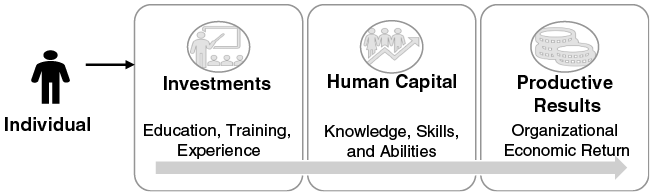
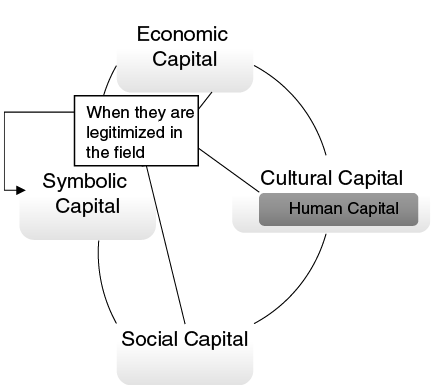
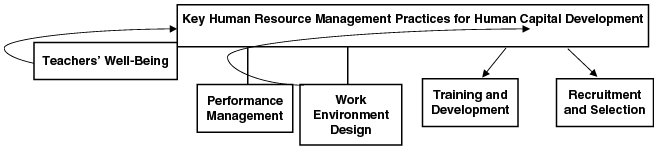

 Open access