If human subjects are used, include a statement to indicate institutional Internal [sic] Review Board (IRB) approval of the research.
Editor's statement
Call for Papers, Inaugural Edition, 2007
Caucasus Journal of Social Sciences
Political science as a discipline has largely ignored research regulatory policies associated with institutional review boards (IRBs). Many political scientists—especially those in the senior ranks—are either oblivious to the existence of IRBs or actively decide to sidestep them by not submitting their proposals for review.Footnote 1 Based on research conducted since 2004, we hold that APSA members at all ranks of the profession, along with political scientists worldwide, need to be concerned, not to say alarmed, about IRB policy. Why this sense of urgency, and why now?
Critics of the U.S. policy have been decrying its “mission creep” (Lederman Reference Lederman2006; Gunsalus et al. Reference Gunsalus, Bruner, Burbules, Dash, Finkin, Goldberg, Greenough, Miller, Pratt, Iriye and Aronson2007) for some time: its extension beyond federally funded research to encompass all research, beyond science to include the humanities (such as historians conducting oral histories; see Howard Reference Howard2006), beyond “knowledge-producing” research to involve classroom coursework (Shea Reference Shea2000). Many social scientists (e.g., Katz Reference Katz2004) have been alarmed that the policy's features are increasingly exerting a stranglehold on field research. We share in these concerns, but two other factors add to our sense of urgency.
First, as the epigraph suggests, the policing of IRB compliance may be extending to the realm of journal publication, such that no manuscript will be accepted for review (let alone published) without indication of IRB approval.Footnote 2 Second, EU member-states are under increasing pressure to develop IRB policies for their own universities, and at least some are turning to U.S. policy as their model—but absent an understanding of its historical origins and under the sway of their own privacy policies (stricter than any U.S. policy), they are misinterpreting that policy and developing even more stringent controls than those existing in the U.S.Footnote 3 In the context of an increasingly globalized, comparative political-social science, possibilities for cross-national collaborations become increasingly constricted as researchers need to satisfy policies that conflict with each other (e.g., one requiring data storage, another prohibiting it).
Along with other scholars (e.g., Feeley Reference Feeley2006; Gunsalus et al. Reference Gunsalus, Bruner, Burbules, Dash, Finkin, Goldberg, Greenough, Miller, Pratt, Iriye and Aronson2007; Katz Reference Katz2004; Lederman Reference Lederman2006; Shweder Reference Shweder2006), we are concerned about the problems IRB policies pose for social science research. Some of these problems—e.g., the lack of clearly and succinctly stated procedures, sometimes long delays between proposal submission and response, and patchwork implementation—are due to structural elements in the U.S. policy (as we discuss below). These problems have, in turn, led some to argue for particular policy reforms, suggesting that clarifying policy statements, giving time-strapped IRBs more resources, and improving training for board administrators, members, and faculty in general will make the policy more workable for social science research. Many critics point to the policy's bio-medical orientation as the source of difficulties in its application to social science research.
Our analysis shows that addressing the shortcomings of the policy with respect to its lack of clarity, shortage of resources, or complicated implementation structure will not remedy the difficulties faced by one class of social science research, ethnography and field research. It is not just its background in medical research that renders IRB policy problematic for non-medical research. Rather, it is the character of its implicit research design model, embedded in its historical development, that renders IRB policy problematic for ethnographic and other field researchers. The need for human subjects protection policy resulted from the perception that medical researchers conducting experimental research abused their subjects; as a consequence, the model of scientific practice implicit in the policy's construction is experimental research design. This is what renders the policy problematic for social science research that does not follow such a design. Medical anthropologists, for example, and other social scientists conducting health-focused research (see, e.g., Boulton and Parker Reference Boulton and Parker2007) are not immune from IRB policy problems. This article points to the character of these problems by providing a view from the field—from the lived experiences with IRBs of those political scientists conducting ethnographic and other forms of field research.
Understanding the Current State of IRB Policy
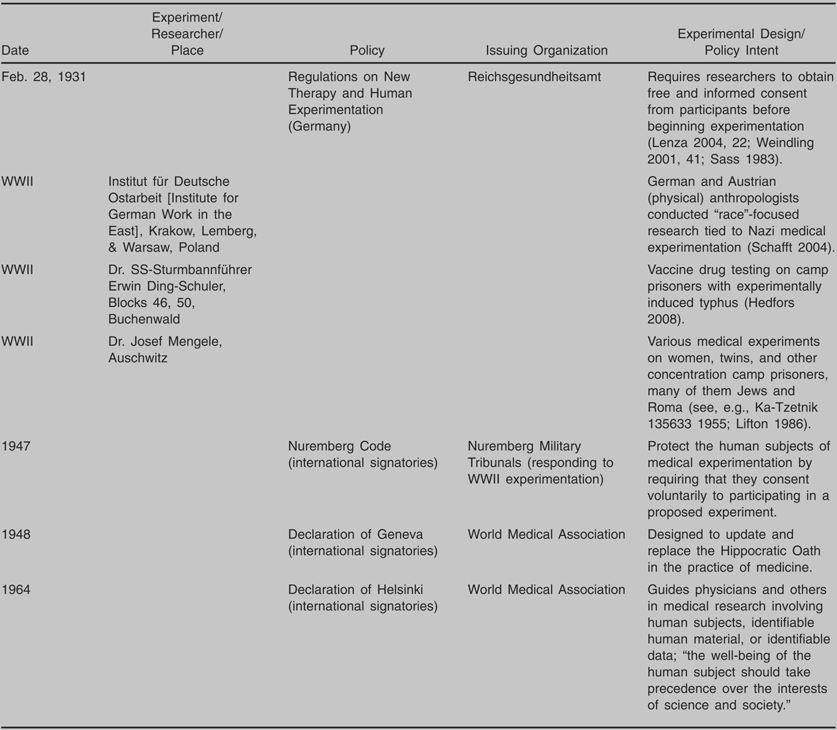
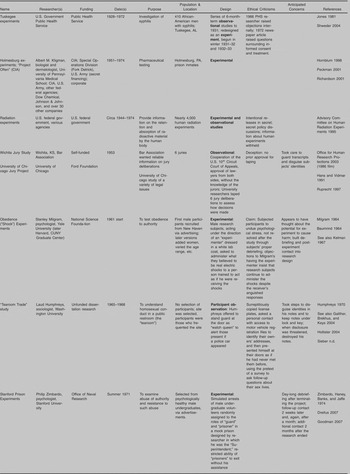
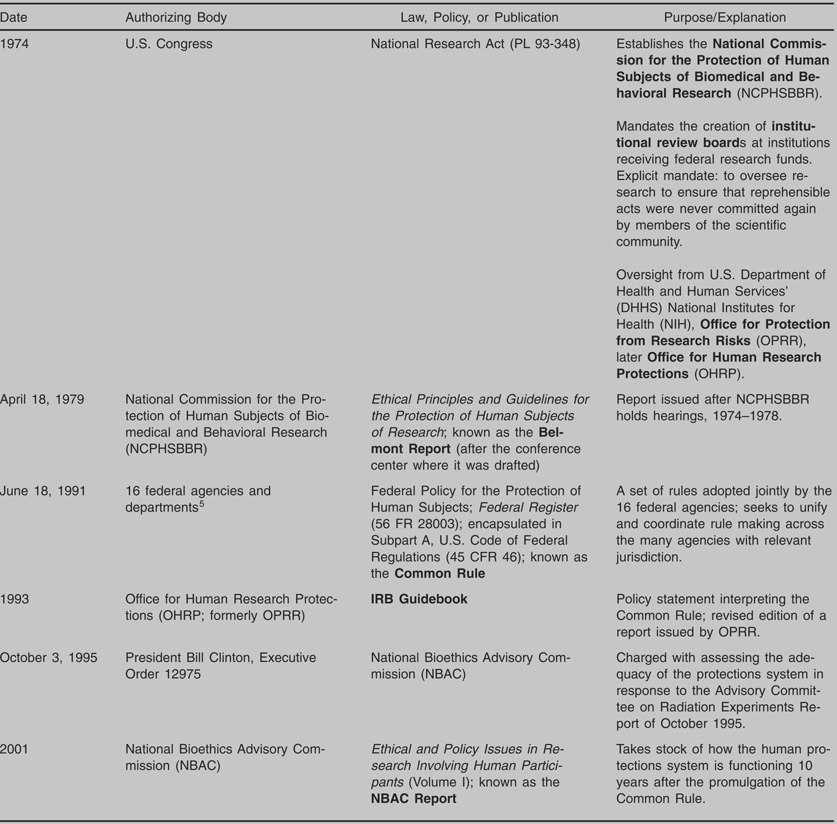
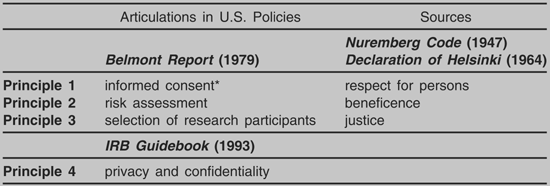
We do not have space here to describe in detail the historical events, documents, or ethical principles that have produced IRB policy. Yet some general awareness of these influences seems crucial to generating a historically informed discussion of policy and policy reforms. Understanding why the policy instantiates the model of experimental research design requires knowing something of its specific scientific history; understanding some of the difficulties of its implementation requires knowing something of its policy history. So we summarize these historical influences in four tables (to which we refer in the following analysis). Table 1a lists the international experiments and codes that preceded and shaped the development of U.S. policies and practices. Table 1b summarizes notable experiments in the U.S. that directed public and Congressional attention to the ethics of researcher conduct and shaped debate over research regulatory policy. Table 1c presents a timeline of U.S. policies. Table 2 links the U.S. principles and practices that are the backbone of contemporary policy to their international code sources.
Historical Background: Experimentation and Policies—International

Historical Background: Experimentation—U.S.

Historical Background: Policies—U.S.Footnote 5

U.S. Policy Principles and International Sources

* Ability to give consent, voluntarily, entails possessing
ʼn the legal capacity to give consent (leading to protections for minors);
ʼn the freedom of choice to do so without coercion of any sort (“force, fraud, deceit, duress, over-reaching, or other ulterior form of constraint or coercion”; Nuremberg Code 1947); and
ʼn the capacity to understand what the research project involved, in order to make an informed decision.
This policy history (see Tables 1a and 1b) has created a number of unanticipated consequences for policy implementation:
-
1. Lack of clarity. Policy principles are articulated across three major documents, the Belmont Report, the IRB Guidebook, and the NBAC Report (see Table 1c), each interpreting previous ones but none of them subsuming and replacing prior statements. This renders the policy rather convoluted: discussions of the issues are, in many cases, wordy enough as to obfuscate their programmatic aspects. All three are still operative, and trying to master their contents is not easy. The policy is in dire need of reform for purposes of clarification.
-
2. Uneven, patchwork implementation. The policy incorporates the principle of local implementation: each university or research institution creates its own review board, and each board makes its own rulings on research proposals (or protocols, in IRB parlance). This means that two different universities in the same region or campuses within the same university system—such as the University of Utah and Utah State University, or the various University of California campuses—may decide differently on identical proposals. This creates the classic implementation situation of a legislative patchwork of policy decisions, leaving researchers puzzling over inconsistencies in IRB judgments.
-
3. Kafkaesque “exemption” policies. U.S. code (45 CFR Subpart A §46.101) lists categories of research that are eligible for exemption from compliance with human subjects protections policy. However the federal code has been interpreted to mean that IRBs must assess research proposals to verify that they meet the criteria for such exemption, leading to considerable ambiguity about the meaning of exemption at the implementation stage. For instance over 500 campuses now require their researchers to complete online human subjects protections training (Collaborative Institutional Training Initiative 2008), one of whose modules states that “some research that involves interactions with people does not meet the regulatory definition of research with human subjects because the focus of the investigation is not the individual” (Hicks Reference Hicks2007, 6). In the example used there, if a researcher telephones the director of a shelter for battered women requesting data on clients' average length of stay in the facility, that would not constitute human subjects research; whereas if the researcher interviewed the director about her own “training, experience, and how she defines the problem of battering, then the inquiry becomes about her” and, therefore, does meet the regulatory definition (Hicks Reference Hicks2007, 7). Yet the federal code (45 CFR Subpart A §46.102 (f)) (Health and Human Services 1981) defines conducting research with human subjects as “obtain[ing] data through intervention or interaction with the individual,” where interaction is defined as including “communication or interpersonal contact between investigator and subject”—a broader definition than that used in the Collaborative Institutional Training Initiative (CITI) training module. Moreover, given the implementation structure, a local board can go beyond established federal policy and require researchers to meet its university's own “ethical standards” governing the conduct of research, and these standards can themselves require what IRB policy exempts.
-
4. No compilation of rulings. There is no publicly available compilation of rulings and precedents, either locally or federally, such that each newly populated IRB creates its decision-making rules de novo. From an organizational studies perspective, this raises the issue of institutional memory; at the local level, it must reside in IRB staff, since board membership changes as faculty rotate on and off. From a legal studies perspective it creates a system without a record of precedent decisions, making for a highly irregular regulatory policy (Robert Kagan, personal communication, September 10, 2007). That there is no formal appeals process only compounds this irregularity.
-
5. Erroneous faculty understandings. Whether because they are not aware either of the character of the policy's clarity or of its implementation structure, researchers often assume, wrongly, that decisions made by their colleagues serving on local IRBs apply federal policy rather than interpret it—a classic misunderstanding of what policy implementation entails (see, e.g., Lipsky Reference Lipsky, Burnham and Weinberg1978). Local IRBs have been delegated these interpretive powers by policy design, and these interpretations at times go beyond the federal policy's stated intent, sometimes even creating what appear to many to be absurd situations. The lack of a formal appeals process and of precedent rulings protects the power of local boards, leading to campus struggles with overly eager board administrators (some have been replaced), ongoing structural reorganizations (some boards have split between biomedical research and social science research over questions of research design appropriateness; in some cases, double boards have been re-reorganized into a single boardFootnote 4), and rising complaints from faculty (for a first-person account, see Johnson Reference Johnson2008).
-
6. Fear of lawsuits. Public, state-supported universities, especially those with large medical schools obtaining millions of federal grant dollars, are particularly sensitive to the potential loss of that funding. Proposals for non-medically related social science research are important less for their funding potential than for the threat they might pose to federal grant monies if their research compromises human protections policies, resulting in federal investigation and loss of funding. In light of the litigious culture in the U.S. today, it may be that universities' inclination to avoid lawsuits is the primary motivation for many of these strictures within IRB practices, more than the desire to protect the rights of human participants, leading IRBs to ever more micromanagement of research proposals and researcher actions.
-
7. Disproportionate impact on doctoral students and junior researchers. It seems that many senior faculty are ignorant of contemporary IRB requirements for the conduct of research. Developed through the 1990s, IRB policy has only in the last few years become mandatory on many campuses, some of which make releasing the Ph.D. degree dependent on the student's filing IRB forms along with the completed dissertation. In one case we know of, the student cannot proceed with research unless the dissertation supervisor completes the CITI training. Some senior faculty simply go about their research without paying attention to campus IRB requirements: there appear to be no enforcement or punitive mechanisms for those who fly under the radar. Those no longer actively conducting research involving human participants are likely to be unfamiliar with the present state of affairs—meaning (as we understand from conversations with various current and recent doctoral students) that they systematically underestimate its impacts on their students, sometimes even advising the latter to conduct their research without paying attention to the policy. In some cases universities have extended IRB requirements to undergraduate students—e.g., those writing honors theses. Tenured professors may have little to no understanding of the time requirements compliance with IRB policy imposes on junior faculty and students alike: aside from the time necessary for compiling the initial proposal (see below), applications are often returned requesting changes necessary to secure approval. At times it can take up to a full year to go through revisions and reapplications, given the time constraints on board members, who, after all, are fellow colleagues serving voluntarily as part of their university service. Attempts to challenge IRB rulings can add further delay such that doctoral students are often advised to just go along with procedures considered inappropriate or nonsensical.
The View from Field Research
It is the policy's scientific history that accounts for the particular problems it poses for social science research, especially for those conducting field research. To see how these policy principles play out in practice, here is a typical process that a researcher might need to follow to conduct any form of research. As you read this, however, we invite you to imagine that you are proposing to do ethnographic (or other) field research, say, a political ethnography of an organization. Let's say this one is in your own country, and so you are familiar not only with the language being spoken (although you will have to learn the terms and jargon particular to this organization), but also with the general norms, mores, and cultural practices of its broader environment. Doing research in a country not your own raises additional sorts of issues, discussed below. We present the default requirements, ignoring, for the moment, exceptions in the federal law and guidelines as well as variations due to local implementation.
Prior to commencing research, to comply with policies in effect at this point in time, you would have to submit your research proposal (or protocol, in medical research) and human subjects protections forms to your campus (or an independent) IRB, engaging the following issues (the bold phrases are the policy principles; see Table 2):
1 Estimate the number, describe, and justify the selection and exclusion of types of research participants (Principle 3).
2 Figure out how you will get informed consent from all the people you intend to talk to (Principle 1) and develop a form that you can hand each of them for their signature indicating such consent. In this form, you would:
ʼn describe your research objectives;
ʼn outline all risks to the individual, and probabilities of risk, that you anticipate might befall someone participating in the research project; and
ʼn emphasize the participant's ability to withdraw from the research at any time.
Depending on your particular university's IRB, you might be required to follow this information-and-signature process each and every time you speak to someone in the course of conducting your research—even when speaking with the same person for the tenth time.
3 Figure out how to disguise the identity of the organization (or other setting) of your research (Principle 4), along with all the persons you speak with. This commonly means disguising its location, which, in the event of research conducted outside your home country, may mean also disguising the country in which the organization's work takes place;
4 Justify the scientific value of the knowledge you expect your research project to generate—the benefits you anticipate will accrue from your research (Principle 2).
5 Detail how you will protect the data you generate (Principle 4): who will have access to them, and when will the data be destroyed?Footnote 6
We hope that you are already foreseeing some of the difficulties this policy regimen poses for conducting ethnographic or other field research. We speak here of field research, meaning ethnographic and participant observation research and other forms of qualitative or interpretive methods (Yanow and Schwartz-Shea Reference Yanow and Schwartz-Shea2006) that use ethnographic tools (observing, with whatever degree of participation; talking to participants; and close reading of topic-related documents and other material artifacts) that entail interacting with human beings in their “native” settings.Footnote 7 Although survey researchers also go to the field and talk to “informants,” the quasi-experimental design (Campbell and Stanley Reference Campbell and Stanley1966) of their surveys renders their research much closer to the experimental model of science onwhich IRB policy is built and is therefore less problematic for policy compliance.Footnote 8 Conducting field research in a country other than their own, researchers might be required to conform that research not only to their own university's IRB policy but also to that of their host country. This is similar to U.S. principal investigators from different campuses, even within the same university system, who, as collaborators on a research project, are required to secure IRB approval from each and every campus.
We don't have space here for a detailed analysis of the policy texts (see Schwartz-Shea and Yanow Reference Schwartz-Shea and Yanow2006) or for a detailed assessment of the policy from the perspective of participant-observation or ethnography (Yanow and Schwartz-Shea Reference Yanow and Schwartz-Shea2007). Instead we will focus on the experiential model informing the two research designs, experimental (and quasi-experimental) and field research: Where is the researcher's home base for the conduct of research? Who is more/less comfortable there? How do power and control differ in these two settings?
Who Goes Where, to Whom? Access, Not Recruitment
In experimental research designs, the researched enter into the researcher's space. A particular set of power dynamics comes into play when research subjects go to the researcher. Medical and other experimentalists are used to patients and research subjects coming into settings (e.g., offices, hospitals, or laboratories) familiar to researchers from their everyday work practices. They assume a research world in which the researcher is all powerful and in control, and research subjects entering that world are subject to that professional power: their subject position (in both senses of the word) in that situation makes them vulnerable. The psychologistsFootnote 9 and lawyers who participated in IRB policy deliberations and design are, like physicians, accustomed in their professional practices to people seeking them out in their own “natural” settings. It is normal to therapists, lawyers, and physicians to assume a research world peopled by powerful researchers and (relatively) powerless “subjects” who might need protection from abuses of that power—the characteristics of the research that gave rise to IRB policy.
Before research subjects arrive, experimental researchers have the opportunity to plan out the research. Based on existing knowledge of medical, psychological, or other practices, they design the treatment ahead of time for their imagined patient population, locking the procedural steps into place. Such researchers exercise considerable control over the research process, deciding who will be included in and excluded from the study—what as late as the 1993 IRB Guidebook was called “subject selection” (Penslar and Porter Reference Penslar and Porter1993). (By the time of the 2001 NBAC Report, the policy language had changed to “participants”; nonetheless, the framing of the policy issue—in ways that are sometimes subtle, but quite central to the differences between experimental and field research designs—has not shifted along with it.) It may require some thought and effort on the part of researchers to get subjects into research settings, especially in identifying those particularly suited to the research question, but advertising, physician referral, and record searching are all possible ways of recruiting volunteers.
Consider the relational expectations established in the contemporary model for medical experimentation, shared by behavioral—therapeutic or psychological—research, in which research subjects go to the setting chosen by the researcher.Footnote 10 It is the research participant in this experimental world who, once in that world, needs to be empowered to exit it. Inertia can make leaving—declining to participate—difficult, especially as it entails standing up to a person in power, as represented symbolically by the white coat of the experimenter and doctor. As anyone who has experienced a major medical incident requiring hospital care can attest, patients do feel vulnerable and in need of an advocate to help them make decisions. In this strange setting, research participants are more vulnerable than in their home settings. Addressing this power imbalance is what informed consent procedures were intended to facilitate (see Table 2).
Contrast that model of medical experimentation with the model of field research and its underlying assumptions and associated research practices. Here, the researcher goes to the researched! The researcher enters the participants' space(s)—a Congressional office (Dodson Reference Dodson2006), a slaughterhouse (Pachirat Reference Pachirat and Schatz2007), the union hall (Warren Reference Warren2005), a cocktail lounge in Las Vegas (Bayard de Volo Reference Bayard de Volo2003) or corporate headquarters (Morrill Reference Morrill1995)—rather than staying in a familiar setting. The researcher asks to enter the world of the research participant—a home (Soss Reference Soss2000) or the local coffee shop or neighborhood corner store (Prindeville Reference Prindeville2004; Walsh Reference Walsh2004) to talk, the reservation (McCool Reference McCool2002) or community center (Yanow Reference Yanow1996) to hang out, the shop floor (Shehata Reference Shehata2003) to work. The sheer variety of potential settings and their relative unfamiliarity to the field researcher just starting out—in contrast to the medical researcher's intimate knowledge of a very bounded workplace—mean that the research process must and should be conducted quite differently.
From the outset, field research design is concerned with access: to settings and persons and, at times, to research-relevant documents. This is a key distinguishing characteristic demarcating field research from experimental research design, even within the social sciences. Contrast Humphreys going to the “tea room” and interacting with the men there, with Milgram's and Zimbardo's subjects coming to each of them (see Table 1b). This sets up a radically different relational dynamic between researcher and researched, including in its power dimensions.
Field researchers must enter others' worlds, and are expected to do so with care and respect, and these worlds can be complex, unbounded, and in flux. Instead of rigidly delimited, pre-designed protocols laying out research steps that are invariable with respect to persons and time, which subjects can be handed as they step into the world of the medical researcher, field research often requires flexing the research design to accommodate unanticipated persons and personalities and unforeseen conditions.
Unlike the subjects volunteering for experiments, whom the researcher can choose not to select, participants in field research are there in the setting whether the researcher likes it or not: this is their home, their community, their place of work, and the researcher, unlike the regression analyst, cannot remove the “outliers” and recalibrate. Field researchers must accommodate themselves to research participants and their settings. This suggests a very different set of power dynamics from those characterizing the experimental researcher, with different possibilities for abuses of that power, concerns that have, on the whole, been absent from deliberations producing the U.S. policy documents we have examined.
When researchers enter others' worlds, their power position changes relative to that of the experimentalist. In some respects it is reduced accordingly, as they are not in control of those worlds or of what goes on within them. Researchers can be denied access: people can refuse to participate, even before the project is explained to them; organizational, polity, community, and other gatekeepers can deny entry into the site, depriving researchers of the opportunity even to ask people if they would agree to participate. An elaborate research methodology (and extensive literature) has evolved to reflect on the general sorts of problems that may be encountered in the field: Who will talk with me? Will they give me others' names? Will they let me come back? These questions reveal the uncertain, supplicant status of the field researchers and the lack of control over what and whom they might encounter and how they might (need to) respond to those encounters.
The difference in researcher power is especially the case for field researchers following an interpretive methodological paradigm who engage research participants as experts in their own local knowledge (which is what ethnographers want to learn) and as co-generators of research data. The challenges are different in kind, reflecting the relational character that lies at the heart of field research, especially when participants are seen, and treated, more as partners than as subjects. Depending on the research topic, between some and much of the local knowledge that the researcher seeks to learn cannot be known ahead of time, subjecting the researcher to greater uncertainties and lack of control than that possessed by an experimentalist colleague. This is not to say that ethnographic and other field researchers are powerless—they are not—but the power dynamics and potential for abuses are different.
This fundamental difference in research design has implications for the other three aspects of IRB policy: the meaning of informed consent (Principle 1) and its manifestations in the research setting, the understanding of potential harms and risks (Principle 2), and the needs for privacy and confidentiality (Principle 4; see Table 2). Asking people to sign forms not only presumes literacy of certain kinds and degrees (an understanding of the concepts of research, consent, and so forth; the ability to read, possibly in a language other than one's own; the ability to write one's name); it also assumes that doing so is itself not potentially harmful—including to the researcher who now possesses, in certain circumstances, potentially dangerous documents. Political scientists are likely to be interested in speaking with elected or appointed public officials, a category that receives explicit exemption from the federal protections regulations (NBAC Report 2001, 169). However, in assessing potential risks to these and other persons in the public eye, IRB policy has not entertained (in any of the policy documents we have examined) the possibility that they might be better protected by standard libel and privacy laws. Furthermore, government-sponsored field research (such as that conducted in Vietnam or Afghanistan; see Salemink Reference Salemink, van Ufford and Giri2003; Rohde Reference Rohde2007) that is knowingly intended to harm participants pits one federal policy against the other, something else not discussed. Giving federal officials “the right to inspect research records” (Penslar and Porter Reference Penslar and Porter1993, Chapter 3) potentially violates the IRB requirement to protect participants' privacy and confidentiality. The model of experimental research design that informs present IRB policy not only does not fit the realities of field research, it is biased toward research conducted in the U.S., and it assumes “Western” middle class values as universal to participants in all research settings (see Yanow and Schwartz-Shea Reference Yanow and Schwartz-Shea2007 for extended discussion of these points).
Moreover, it is not clear what the interface is between IRB policy and professional associations' codes of research ethics. In the absence of systematic research demonstrating patterns of abuses by social science researchers, the assumed superiority of federal regulatory policy over such associational codes and disciplining practices is worth questioning.
Issues in Policy Reform
We have no quarrel with the idea that research might need regulating. The Belmont principles (see Table 2) make eminent sense assuming an experimental research design:
-
ʼn Respect means asking the consent of each individual who enters a research world that is new and different.
-
ʼn Beneficence means assessing risks to each individual who agrees to endure an experimental procedure in order to produce research benefits that become available to many.
-
ʼn Justice means systematically assessing which subpopulations in a society are subjected to experimental research, compared with the ones that might benefit from it.
In addition, several colleagues report the usefulness of IRB policy in making them think through the implications of their proposed research in ways they might not otherwise have done. In our own classrooms we have experienced its utility as a teaching tool in research methods courses' ethics discussions. But extending these principles to other, non-experimental research settings without making the underlying mode of science and its methodology explicit and without exploring their suitability to non-experimental scientific modes and methodologies has resulted in a hodgepodge of ethical guidance that is confused and confusing. Those guidelines do not give the many serious ethical problems of field research design and methodologies the sustained attention they deserve.
Despite the evolution in terminology from research subject to research participant, the presuppositions underlying IRB policy still reflect its initial origins in experimental research design. Existing human participants protections policy is fundamentally experimental in its understanding of the relationships between researchers and participants in the research setting, and this—not resources, not policy or implementation complexity—is what accounts for its lack of fit with social science, and especially field, research. The lack of awareness at the local level of these profound differences raises another issue in policy implementation. Whether because of their personal academic and research backgrounds and institutional locations or due to the implied, yet unstated, definitions of science embedded in the experimental research design on which IRB policy is modeled, IRB members may be unfamiliar with the scientific standards, requirements, and particular character of ethnographic and other field research. This could lead them to apply regulatory provisions to such research that are inappropriate to its own methodological presuppositions. Furthermore, although IRB staff may seek to communicate that they are there to help, their help is more often about conforming to the existing system. Given the lack of appeal and transparency, a researcher may feel that any resistance could move what would otherwise be exempt research to full review.
The proposals that we have seen to date for reforming IRB policy (e.g., Carpenter Reference Carpenter2007) all tinker with the existing system. None of them, to the best of our knowledge, has yet identified and engaged the underlying methodological frame—experimental research design—shaping that policy and its implementation. Policy reforms that address resource, organizational, and other features of the existing policy leave that framing and its prosecution in place. The impact of these policies on field research is, however, serious, extending IRB policy to these other forms of research in the absence of systematic evidence of their having harmed research participants. If we are to have policies to ensure the protection of human participants in all areas of research, those policies need to be suited to other than just experimental research designs in ways that are commensurate with their own potential for harms. It is vital that recognition of the misfit between existing experimentally based policy and field research design and methodologies also be on the table in discussions of IRB policy reform.
A Call for Action
We call on APSA to take a proactive stance with respect to IRB policy reforms and the needs of its members, rather than waiting for the kind of exposé that shocked the American Anthropological Association (2002; 2005) into action (see also Gregor and Gross Reference Gregor and Gross2004). As one example, the Law & Society Association's (LSA) committee charged with reviewing IRB policy surveyed its members. On this basis, the committee, appointed by President Malcolm Feeley and chaired by Christine Harrington, developed a report in 2007 with policy recommendations. We suggest that APSA take the following actions:
-
ʼn Investigate the problems present IRB policy poses for APSA members, especially focusing on doctoral students who appear to bear the brunt of the implementation problems outlined above, and develop policy recommendations and recommendations for APSA action. Analysis should include reflection on the relationship between IRB policy and existing ethics statements, and the possible overhaul of the latter.
-
ʼn Advocate, actively, together with LSA and others within the Consortium of Social Science Organizations (COSSA), for the needs of APSA members in negotiations with the myriad associations and committees charged with IRB policy. We recognize that in dollar terms, social science is a small dog that is being wagged by a very large IRB tail; and within that, that ethnographic and other forms of field research are a tadpole, to mix a metaphor, at risk of being swallowed up by both of these larger fish. Still, those of us doing field research of some sort cross nearly all of APSA's organized sections. We call on our association to act on our behalf.
-
ʼn Provide an informational and educational service with respect both to those serving on IRBs and to those submitting proposals. All need to know, among other things, that the policy provides for expedited review of minimal-risk research, exemption for the same, and exemption for research on public officials. These and other points relevant to political science research might be included in a handbook, which APSA could take the lead in writing. We envision this educative function also being served through a survey of the membership that would explore, among other things, members' (including doctoral students') awareness of and experiences with IRBs (including—with proper guarantees of confidentiality—the extent to which faculty simply ignore IRB mandates). There is much that we do not know about the kind(s) of field research political scientists are doing today (although we have tried to imagine various scenarios, in light of conversations with colleagues, in thinking through our analysis). We need more systematic, policy-oriented research about members' field research practices, and we call on APSA to take the lead in conducting or facilitating it, perhaps through focus group discussions around such questions as: Considering your most recent field setting, what harms arose or might have arisen, to your hosts, yourself, others; could you have anticipated these; could you have “informed” your hosts and discussed the issues with them; could harms have been prevented; were there benefits from the research that justified these harms; were there social justice imbalances? Researchers need to educate themselves in the provisions of the national policy documents. But we have found these documents so convoluted that it seems reasonable to turn to our professional association for help, as this is a profession-wide problem. Doctoral students in particular need assistance in this regard.
-
ʼn Issue a statement calling for reform of IRB policy in a substantive way that protects the interests of APSA members. So much has been done within health-related social science research, where awareness of the issues seems high and well informed (see, e.g., Boulton and Parker Reference Boulton and Parker2007). Policy issues need wider discussion within the social sciences, including political science.
What the new journal's editorial statement in the opening epigraph suggests is that IRB policy may be increasingly joining with other governmental higher education funding schemes, such as the UK's Research Assessment Exercise (RAE), in controlling university researchers. We want to sound a strong note of concern with respect to the politics and power of IRB policy overall. It not only threatens to alter the face of ethnographic and other qualitative-interpretive research. In parallel with the UK and U.S. evidence-based movements, as well as those higher-education policies such as the RAE that seek to establish productivity measures for university-level researchers, it narrowly construes what counts as evidence. In so doing IRB policy insulates and protects policymakers, elected officials, and others in positions of power.
Perhaps we are being overly paranoid (though we, of course, don't think so), but we find here much to be discussed. As research regulation appears to be expanding beyond the U.S, while being based on its model, awareness of issues raised by that policy may enable researchers worldwide to anticipate developments in their own settings. It might be useful at this point in time to return to a consideration of the purposes of research, as recognized by the Nuremberg Code, to “develop knowledge that is beneficial to society” (NBAC Report 2001, 73). This would require a more complex understanding on the part of researchers, as well as policymakers, of the character of such research goals and the ethical issues they raise, in order to develop appropriate regulatory policies.