Speaking in St. Louis, Missouri, on 5 July 2008, Democratic presidential candidate Barack Obama outlined his approach toward the Iraq war: “The tactics of how we ensure our troops are safe as we pull out, how we execute the withdrawal, those are things that are all based on facts and conditions. I am not somebody—unlike George W. Bush—who is willing to ignore facts on the basis of my preconceived notions.”Footnote 1 Obama's statement, in effect, accused President Bush of willfully ignoring reality in Iraq. However, as we show below, it is by no means clear what role “reality” actually plays in shaping the assessments of elites and citizens concerning the status of a military conflict.
As of this writing (May 2010) the ultimate outcome of the prolonged war in Iraq remains the subject of contention. Nonetheless, it seems clear in retrospect that in 2007 an important shift took place in the situation on the ground in Iraq—a shift that checked and eventually reversed what appeared to be an implacable slide into chaos and defeat. At the time, however, recognizing this important turn of events proved exceptionally difficult, not only for the entrenched politicians on both sides of the dispute over whether (and when) the United States should withdraw, but also for journalists attempting to communicate the reality of the Iraq story to the public and for citizens seeking to understand the true status of the conflict.
Attempting to explain this dilemma, commentator Yon complained, “no thinking person would look at last year's weather reports to judge whether it will rain today, yet we do something similar with Iraq news. The situation in Iraq has drastically changed, but the inertia of bad news leaves many convinced that the mission has failed beyond recovery … whether it is good news or bad, whether it is true or untrue, once information is widely circulated, it has such formidable inertia that public opinion seems impervious to the corrective balm of simple and clear facts.”Footnote 2
Consistent with prior research,Footnote 3 we argue that media representations of elite debate in Washington concerning Iraq will tend to guide public opinion regarding the conflict. When citizens observe bipartisan elite support for a policy, they will tend to rally in support of it. If they observe partisan bickering, they will tend to fall in line behind their fellow partisan elites, resulting in a weaker rally. However, the original application of this approach to explaining public opinion regarding foreign policyFootnote 4 purports only to account for the immediate postconflict-initiation presence or absence of a rally-round-the-flag.Footnote 5
In this study, we extend this line of inquiry beyond the rally-round-the-flag period. In addition, we argue that because the public typically receives much of its information about actual “events on the ground”—which we define as the “reality” of a conflict—through the news media, the effects on public opinion of elite communication appearing in those media are likely to persist, even after accounting for the state of events (that is, net of reality) well beyond an initial rally period.Footnote 6
However, we further argue that as the public gathers more information over time, the potential gap between reality and its representation by elites through the media will likely recede, as will the public's responsiveness to additional information.Footnote 7 Following Baum and Potter,Footnote 8 we refer to this change in relative responsiveness as the “elasticity of reality.” As the elasticity of reality varies, so too, we anticipate, will the relative influence on public opinion of elite communication and objective indicators of reality.
In this regard, our theory bridges the divide between theories emphasizing rational public responses to empirical indicators of a war's success or failure,Footnote 9 such as U.S. casualtiesFootnote 10 and those emphasizing the centrality of elite rhetoric in mediating public support.Footnote 11 In the latter case, while prior researchFootnote 12 has shown that elite cues influence public opinion regarding war beyond rally periods, such studies do not directly measure or compare the evolving relative effects of rhetoric and reality over the course of an extended conflict. We show that both rhetoric and reality matter, albeit to varying degrees under differing circumstances and at different points in time.Footnote 13
The war in Iraq provides an ideal case for illustrating and testing our theory. Early in the conflict, opponents of the conflict were dismayed at the Bush administration's ability to rally war support based on arguments that—in retrospect—appear to have been based on faulty or incomplete information.Footnote 14 In contrast, the circumstances described in the Yon quotation above suggest that at the time of these observations, the elasticity of reality with respect to Iraq had effectively collapsed. As a result, public opinion was almost wholly unresponsive to incremental changes in events or to pro-war rhetoric from President Bush and others. Subsequently, as the level of violence in Iraq continued to recede, a gap reopened in the relative and absolute influences of rhetoric and reality, such that most segments of the public seemed more responsive to negative rhetoric from the president's critics than to the increasingly positive situation on the ground in Iraq.
In this study, we explain this perplexing shift in the relative influence of elite rhetoric and reality over the course of the conflict. We begin by presenting our theoretical argument and deriving a series of hypotheses concerning the effects of elite rhetoric and “events on the ground” (that is, “reality”) on public opinion regarding Iraq. We next undertake a series of empirical tests. Testing dynamic patterns in public opinion poses a variety of substantive and methodological challenges. Many factors vary over time, and it is difficult, if not impossible, to account for all potential causal variables. Consequently, rather than relying on any single test, we undertake three distinct empirical investigations, employing a variety of data sources and modeling techniques, in order to build as strong a suggestive case for our theory as possible, given the limitations of each individual data source. We believe the weight of the combined evidence makes a more persuasive case for the theory than would be possible based on any one, or even several, of our empirical investigations. The final section offers concluding observations.
Theory and Hypotheses
The public does not evaluate events or elite rhetoric in a vacuum. Rather, individuals assess new information in part based on the reliability of previous pertinent information they have consumed, as well as on their pre-existing beliefs about the event.Footnote 15 Early in a conflict, typical individuals have limited information upon which to base such retrospective assessments and relatively mutable beliefs. Consequently, new information should be relatively influential. Over time, as they acquire more information and their opinions solidify, the influence of additional new information is likely to recede. Consequently, the qualities that make a given story persuasive to the public do not remain constant over time.
Zaller and Feldman explain why new information tends to exert less influence as an individual collects more information.Footnote 16 They argue that typical individuals possess a range of considerations on any issue and when asked their opinion, they average across those considerations that are accessible at that moment. They then respond probabilistically, based on the mix of accessible considerations regarding the pertinent issue. For instance, the greater the proportion of accessible considerations that point toward supporting the conflict in Iraq, the greater the probability that they will express support for it. However, all else equal, as the number of accessible considerations about the conflict increases over time, the marginal effect of any additional piece of information on the individual's overall ratio of positive-to-negative considerations—and hence on his or her likely response—declines.Footnote 17
Presumably, as the U.S. engagement in Iraq has continued—exceeding seven years as of this writing—typical citizens have increased their store of information about the conflict. Consequently, attitudes regarding the war have likely solidified relative to early in the conflict, when elites and journalists enjoyed a substantial informational advantage over the public and consequently substantial leeway in the initial framing of events.Footnote 18
Journalists are not immune to such attitude solidification. Scholars have long recognized that journalists tend to cue off one another in their coverage, producing “pack journalism” and “metanarratives.”Footnote 19 For instance, once journalists settle on a particular narrative regarding a presidential candidate—such as “Al Gore is dishonest” or “George W. Bush is unintelligent”—they tend to continually reference and thereby reinforce it. Eventually, it becomes increasingly resistant to challenges, even if it is based on faulty assumptions. Regarding the Iraq War, retired U.S. Army Lieutenant General Ricardo S. Sanchez complained to military reporters and editors, “once reported, your assessments become conventional wisdom and nearly impossible to change.”Footnote 20
Because news is an experience good—whose value citizens cannot observe prior to consuming itFootnote 21—only over time can citizens retrospectively evaluate the reliability of previously consumed news. Such retrospective updating may lead to a shift in the balance of previously stored considerations, as individuals retag some negatively or positively tagged information, based on a retrospective revision in their reliability assessments. It may also lead to a coloring of assumptions regarding the reliability of new information. While inattentive individuals might have difficulty retrieving and retroactively updating the assessed valuation of information consumed in the murky past, and may be relatively unmotivated to do so, the prominence of the administration's initial efforts to gain publicity for its desired frame should help citizens recall it later.Footnote 22 For example, the Bush administration's rhetorical reliance on Saddam Hussein's alleged weapons of mass destruction (WMD) program to justify the war made it easier for critics to dredge up such claims later to undermine the administration's credibility on future claims.
As this process unfolds, and as elites' informational advantage recedes over time, the influence of new information inconsistent with the (updated) prevailing media representation of reality presumably diminishes. Consequently, the elasticity of reality—which we define as elites' capacity to successfully frame reality distinctly from the true state of events on the ground—declines over time. Only a fairly dramatic and sustained change in the valence of information would foster significant change in opinion once the prevailing narrative is firmly established, and even then only after some lag period during which citizens continue to discount the credibility of the new information.Footnote 23
Illustrating this process, Figure 1 traces the typical path of the foreign policy informational advantage leaders enjoy relative to the public, focusing on the effects of reality (that is, the true nature of events on the ground) relative to its representation by elites via the mass media. The “Communication/elite rhetoric effects” and “Reality effects” curves, respectively, represent the influence on public opinion of the framing of events (for example, positive, negative, or neutral valence, offensive versus defensive goals, and so on) embedded in media reporting of elite rhetoric and the influence of actual events. The gap between them (that is, the elasticity of reality) represents the range of frames, with varying distances from those events' true tenor that the public will accept as reliable.
Elasticity of reality for a given state of events

At the outset of the conflict (time t 0), the public has little or no independent information about events on the ground. It thus depends on a representation of events provided by elites, whose construction in turn depends on media framing. Absent any capacity of the public to retrospectively assess the reliability of this information, the elasticity of reality is extremely large (albeit presumably bounded in some manner by longer-term public attitudes, values, and perhaps experience in prior conflicts).Footnote 24 After a little time passes, but still relatively early in a conflict, say at time t 1, the true tenor of events should still matter relatively less than media presentation of elite rhetoric regarding those events. If media coverage diverges from reality, the former is likely to exert greater influence than the latter, as shown by the gap between C1 (communication/rhetoric effects at time t 1) and R1 (reality effects at time t 1), which represents the elasticity of reality at time t 1. The two are likely to converge over time, with rhetoric in the news increasingly reflecting actual events, as shown at time t 2, where R2 = C2.Footnote 25
Eventually, however, as the public increases its store of information and retrospectively updates its reliability assessments, the marginal influence of new information will, as noted above, recede. This decline is likely to be more rapid for communication effects, which exert a disproportionate influence early on and consequently have more room to fall. Typical individuals will tend to be skeptical of information that diverges from their updated assessments regarding reality. Consequently, as the elasticity of reality collapses, the capacity of elite rhetoric to influence opinion independent of actual events diminishes.Footnote 26 At the same time, actual conflict developments continue to contribute—albeit presumably at a reduced marginal rate—to net public assessments. The shaded area between times t2 and t3 represents this period, where reality influences public opinion more than does elite rhetoric in the news, at least for a time.
Of course, the precise rate of convergence shown in Figure 1 is arbitrary, solely intended to illustrate the theoretical point. Presumably the actual rates of convergence, as well as the slopes of and gaps between the two curves, will vary across events. For instance, all else equal, given journalists' preferences for covering conflict over covering harmony among elites,Footnote 27 the rates of convergence seem likely to be faster when elites are divided rather than when they are unified in support of the policy (which, consistent with Brody, Zaller, and others,Footnote 28 we believe will decrease the variability of public opinion). Nonetheless, regardless of the precise locations and slopes of the curves, eventually the public judgment becomes relatively fixed, by time t 3. At this point, absent a fairly dramatic and sustained change in the tenor of events, neither reality nor rhetoric will likely exert much influence. Several hypotheses follow:
H1: Longer-term communication effects: elite rhetoric regarding a war will continue to influence public attitudes independent of objective indicators of reality beyond the rally period, but, absent a substantial and sustained change in the tenor of events, the marginal effects of such rhetoric will recede over time.
H2: Longer-term reality effects: over time, absent a substantial and sustained change in the tenor of events, the marginal influence of objective indicators of a war's progress on public attitudes will first increase and then eventually recede.
H3: Rhetoric versus reality: over time, the marginal influence of elite rhetoric will decline more than the marginal influence of objective indicators of a war's progress.
Rather than occurring uniformly throughout the public, we anticipate that such declines should be more precipitous for the nonpresidential party (NPP), relative to the presidential party (PP). After all, due to their partisan affinity, statements by a president should, all else equal, be more credible to his fellow partisans than to opposition partisans or Independents and should remain so for a longer period of time.Footnote 29 This suggests a corollary to H1 (longer-term communication effects):
H4: Partisan long-term effects: after the initial rally period following initiation of a conflict, negative events or elite rhetoric will decrease the support of NPP partisans in the electorate more quickly and sharply than that of Independents, who, in turn, will be more affected than PP partisans. Conversely, positive events or elite rhetoric will increase the support of PP partisans more quickly and sharply than that of Independents, who will be more affected than NPP partisans.Footnote 30
The model depicted in Figure 1 rests on an important assumption: that the fundamental nature of reality remains relatively constant. In other words, it assumes that war-related events follow a consistent, reinforcing path, while the media—and hence the public—gradually recognize that path and converge toward an accurate understanding of it. Yet the tenor of events could potentially swing substantially in a different direction. If so, depending on where along the elasticity timeline the prior state of events lies, we anticipate a resurgence of the influence of rhetoric relative to reality. In other words, a major, sustained change in reality seems likely to reopen the elasticity of reality, at least to some extent. Following such a change, this reopening consists of journalists and much of the public initially discounting rhetoric or other information inconsistent with the state of affairs prior to the change as they seek to determine whether it is real or illusory. Figure 2 presents three curves separately tracking the effects of a fundamental shift in the tenor of events for PP and NPP partisans and Independents.
Persuasiveness of presidential rhetoric over time, by party

On the left side of the curve, events are uniformly negative for an extended period. As the true, bleak nature of events becomes clearer over time, all three groups grow less susceptible to positive pronouncements about the conflict. However, PP partisans are far slower than NPP partisans or Independents to lose faith in the president. NPP partisans are particularly quick to begin discounting presidential rhetoric.
If events begin improving substantially, PP partisans will relatively quickly regain confidence in the president's positive rhetoric, while NPP partisans will remain skeptical for a longer period of time before recognizing the change in reality and consequently reassessing. Independents will again fall in between. Eventually, all three groups will renew at least some of their initial confidence in the credibility of the administration's positive rhetoric. However, depending on how long the prior, negative tenor of events persisted—and hence how firmly public opinion is entrenched—such responsiveness may not return to levels comparable to the outset of the conflict.
With respect to Iraq, even after political elites did begin to reassess the state of events, the NPP predictably remained far more skeptical than the president's fellow partisans. For instance, Democratic Senator Hillary Clinton of New York offered a bluntly skeptical assessment of the Surge in her response to testimony from General David Petraeus, Commander of U.S. forces in Iraq: “I think that the reports that you provide to us really require the willing suspension of disbelief.”Footnote 31 Democratic Senate Majority Leader Harry Reid added: “I believe … this surge is not accomplishing anything.”Footnote 32
One can easily imagine the opposing case, in which events are proceeding well and public confidence in the administration is high, followed by a significant turn for the worse. The U.S. intervention in Somalia in 1992–93 was such a case.Footnote 33 Most observers regarded the initial U.S. humanitarian mission there as an overwhelming success, resulting in public euphoria and support. However, in the wake of a seemingly unsuccessful nation-building effort in spring and summer 1993, frustration and disappointment replaced this euphoria. Eventually, both partisans and Independents lost confidence in presidential claims contrary to the apparent declining state of affairs. However, consistent with Figure 2, the rate at which the loss of confidence occurred, and the lag between the change in events and the onset of declining confidence, varied with partisan affiliation. Most notably, in fall 1993, Republicans predictably (given a Democratic commander-in-chief) began advocating a U.S. withdrawal from Somalia well before Democrats.Footnote 34
This discussion suggests an additional corollary to the longer-term communication effects (H1) and reality effects (H2) hypotheses addressing how the public processes a change in reality that is not matched by a change in elite rhetoric (that is, rhetoric consistent with the prior state of the world but not with a recent shift in events, as well as the predicted variations in such processes across partisan subgroups). (See Baum and GroelingFootnote 35 for a discussion of how elite rhetoric appearing in the news can systematically diverge from actual events and even from a sample of elite rhetoric).
H5: Event-shift effects corollary: following a significant and sustained change of events, the public will initially be more susceptible to influence by elite rhetoric in the media consistent with prior events, relative to the “new” reality or rhetoric consistent with it. Only later will the public become more responsive to the current true tenor of events (as represented by media coverage) and to rhetoric consistent with it. Given a positive change of events, the president's fellow partisans will respond more quickly and positively to rhetoric and events consistent with the new positive situation relative to NPP partisans and Independents. Conversely, given a negative change of events, they will be less susceptible to such influence than NPP partisans and Independents.
Statistical Investigations
Trends in Effects of Elite Rhetoric and ‘Reality’ on Public Opinion
We first investigate whether and in what manner elite rhetoric influences public opinion over the longer term, independent of the true tenor of events in a conflict and the influence of events themselves. Recall that our longer-term communication effects hypothesis (H1) predicts that media representations of elite rhetoric regarding a war will continue to influence public attitudes beyond the rally period, but that, absent a substantial change in the tenor of events on the ground, the extent of that influence will recede over time. Our longer-term reality effects hypothesis (H2) then predicts that the marginal influence of reality on public attitudes will first increase and then eventually recede.
The event shift effects corollary (H5), in turn, predicts that a significant change in the tenor of events may first revive the influence of rhetoric, and then reality. The public should thus once again grant disproportionate credibility to elite rhetoric—particularly media representations of that rhetoric consistent with the prior state of reality—and then gradually shift to recognize the new state of events on the ground, with the president's fellow partisans doing the latter more rapidly than opposition partisans or Independents.
To test these predictions, we employ two key causal variables: (1) New York Times coverage of U.S. military and Iraqi civilian casualties in Iraq, and (2) actual trends in civilian and military casualties. In the former case, while media coverage often does not mirror the true underlying tenor of all elite rhetoric, it does represent that portion of elite rhetoric selected by the media that is thereby capable of influencing public opinion, as we have argued elsewhere.Footnote 36 Similarly, divergence between the Times coverage of casualties and actual casualty levels does not imply that the Times coverage is inaccurate or sloppy: rather, it might simply reflect the rhetorical choices of the various sources the newspaper has chosen to include in its coverage. Rather than assessing the accuracy of stories that make it into the Times, our goal is to determine the nature and extent of such coverage's impact on public opinion, as well as that of actual events.
In the latter case, we focus on civilian and military casualties as our key indicator of reality for two reasons. First, much of the literature on public opinion regarding war emphasizes casualties—either their number,Footnote 37 rate,Footnote 38 trend,Footnote 39 or framingFootnote 40—as a key factor determining public support for war. Because we measure reality via the cumulative effects of casualties (see the section on data and methods), one could reasonably interpret our model as an extension of Mueller's seminal propositionFootnote 41 concerning the sensitivity of public opinion in wartime to the accumulation of casualties. However, we differ from Mueller with respect to the assumed longer-term effects of casualties, which Mueller conceives of as accumulating via a logarithmic function.
Like Mueller, we assume that the effects of casualties accumulate over time and that their impact on public opinion reflects both current and prior casualties. However, Mueller's model implies that the marginal effects of each additional casualty, c, is necessarily smaller than that of a prior casualty, c-1, as the sum total number of casualties rises. Such marginal effects thus inexorably recede over time even as their cumulative effect necessarily mounts in a logarithmic pattern. Mueller thus argues that the public is most sensitive to casualties early in a conflict and grows less so as casualties mount over time.Footnote 42
In contrast, we model the marginal effect of each individual casualty as eroding over time subsequent to its occurrence, but not necessarily relative to prior casualties. Moreover, we model these marginal patterns within the broader context of a cumulative effect comprised of the sum of the many individual effects. In other words, at any point in time when a casualty occurs, it has a peak influence, which then declines over the course of several months. The cumulative effect also declines, unless new casualties refresh the relative peak level of influence. The total magnitude of the effects of casualties on opinion at that point depends on how many recent casualties have occurred. Thus we explicitly allow for the possibility that new casualties may yield large marginal effects, even late in a relatively long conflict where the cumulative total number of casualties is quite large. Consequently, consistent with our theory and distinct from Mueller's classic model, we allow for the possibility of surprises or other dramatic effects of casualties at any point in a conflict, depending on recent developments.
More fundamentally, our goal is to develop a unified model of the effects of information and rhetoric on war support, rather than strictly a theory of how casualties influence public opinion regarding wars. We are thus concerned not only with the direct effects of U.S. casualties, but also with the overall state of events in a conflict, with U.S. military and Iraqi civilian casualties serving as a benchmark indicator of that reality.
We view our measure of cumulative, discounted casualties—especially when we account for both U.S. military and Iraqi civilian casualties—as the best available indicator of the overall tenor of events in Iraq. To begin with, U.S. military and Iraqi civilian casualties have been by far the most frequently cited measures of U.S. progress in the conflict.Footnote 43 They are arguably also the most appropriate such indicator, as it is difficult to conceive of “stability” in Iraq without considering the level or trend in casualties.Footnote 44 Indeed, proponents of the success of the Surge in Iraq have pointed almost exclusively to declining casualty rates to support their argument. For instance, in an article entitled “Admit it: The Surge Worked,” Washington Post columnist Peter Beinart bases this assertion solely on declining casualties, observing in the lead paragraph: “the number of Iraqi war dead was 500 in November of 2008, compared with 3,475 in November of 2006. That same month, 69 Americans died in Iraq; in November 2008, 12 did.”Footnote 45 Consequently, while our predictions are in some respects consistent with Mueller's theory,Footnote 46 his focus is narrower than ours and his empirical indicator does not incorporate civilian casualties among indigenous populations. This makes sense given the differences in the domains of our theories and consequent construction of our empirical indicators.Footnote 47
Data and Methods
To measure trends in the effects of elite rhetoric via the media on public opinion regarding Iraq, we assembled a monthly time series data set, running from May 2003 through November 2007. This yields a total of fifty-five monthly observations. The dependent variable is the monthly percent change in the percentage of Americans indicating that they supported the war in Iraq in a series of surveys. Following Jacobson,Footnote 48 our Iraq war support series aggregates results from more than 200 different polling questions, from fifteen polling organizations, addressing whether removing Hussein or the result of the war were worth the loss of lives, whether the respondents approve of military action in Iraq, whether the United States did the right thing in going to war, whether they support or oppose the current U.S. military presence in Iraq, whether they favor or oppose having gone to war, whether it was the right decision despite the CIA report on WMD, whether the war was a mistake, and whether their view of the war was favorableFootnote 49 (see JacobsonFootnote 50 for details about the surveys included in this analysis, including question wording and sponsors). Also following Jacobson, we employ LOESS smoothing (that is, locally weighted polynomial regression) on the aggregate series to account for variation across survey wordings and organizations.Footnote 51
Our first key causal variable measures the valence of coverage of casualties (U.S. and Iraqi, civilian and military) in the New York Times, lagged one month. We coded the valence of all articles mentioning casualties during the time frame of our analysis, measuring whether each article's coverage of casualties was positive, negative, or neutral with respect to the state of the conflict, including U.S. involvement.
We counted a maximum of one positive and one negative code per article. However, an article coded as positive or negative could not also be coded as neutral. Two research assistants—working separately and independently—coded each article. Two other research assistants serving as arbitrators resolved disagreements between the first two coders. Inter-coder reliability on the initial coding was 76 percent, while that for our two arbitrators was 87 percent.Footnote 52 To create our final indicator, we employ positive coverage as a percentage of all casualty coverage (positive, negative, or neutral). We then averaged this “net positive” casualty coverage indicator for each month. This variable runs from 0 to 1, where 0 represents the least positive casualty coverage, and 1 represents the most positive coverage (μ = .1, σ = .18). To capture variance in the effects of media coverage over time—and thereby test our hypotheses—we interact the lagged New York Times casualty coverage valence indicator with a variable counting the number of months since the beginning of our series, as well as with its quadratic.Footnote 53
We elected to emphasize casualty coverage in the New York Times as our measure of elite rhetoric for two primary reasons. First, by comparing actual casualties (see below) with media coverage of casualties, we are able to hold the subject matter constant and only vary the quantity of casualties and valence of rhetoric. This allows us to isolate any “gap” between casualty levels or trends and their representation by elites in the news. This enhances the control of our comparisons. Second, given that we are focusing on news coverage of casualties, we consider the New York Times, which tends to set the national media agenda and whose stories are reprinted or otherwise covered in news media around the country (far more than any other outlet), to be the best single source.
Our second key causal variable measures actual levels of casualties in Iraq. We separately measured monthly total Iraqi civilian and U.S. military casualties. We normalized each total to a 0-1 interval and then added them together. We normalized the summary variable to a 0-1 interval to form our final casualty indicator (μ = .46, σ = .21). We thus take into account the substantially greater weight placed by typical Americans on U.S. casualties, relative to Iraqi casualties.Footnote 54 Our final indicator employs a one-month lag on the summary casualty variable. To account for the distinction between media coverage of casualties and the actual casualty trend, we interact the (lagged) summary casualty measure with our month counter and its quadratic (as we did with the New York Times casualty coverage valence indicator).Footnote 55
We also include seven control variables. To account for the intensity of media coverage of casualties in Iraq, our first two controls measure the percentage of the combined total number of stories about Iraq that mentioned casualties in television (ABC, CBS, NBC, and CNN) and print (New York Times, Washington Post, Los Angeles Times, USA Today, and Wall St. Journal). Third, to account for the president's political capital, we include presidential approval lagged one month (based on CBS News and Gallup polls).Footnote 56 Fourth, to account for the political effect of Hurricane Katrina, we include a dummy coded 1 during the month of the hurricane (September 2005) and the subsequent four months.Footnote 57 Fifth, we include a dummy for the 2004 presidential election (coded 1 for September through November 2004, including the immediate postelection period). Sixth, to account for the state of the economy, we include the national average price of gasoline, lagged one month.Footnote 58 Finally, to account for possible serial autocorrelation, our ordinary least squares (OLS) models include the dependent variable lagged one month, as a causal variable.
Results
Table 1 presents the results of our OLS analysis testing our longer-term communication (H1) and longer-term reality (H2) effects hypotheses, as well as the event-shift effects corollary (H5). Given the relatively small N and hence limited available statistical leverage in our model, we first present a basic model, excluding all but arguably the most important control, presidential approval. While the results predictably differ somewhat from the fully specified model, the key relationships are largely comparable—in terms of valence and relative magnitudes of causal variables—to the fully specified model. Consequently, we proceed more confidently in interpreting the latter, fully specified OLS model.
Effects of variations in valence of New York Times coverage of casualties and actual casualties on changes in public support for Iraq war

Notes: Standard errors are in parentheses. ∧p < .10;
* p < .05;
** p < .01;
*** p < .001.
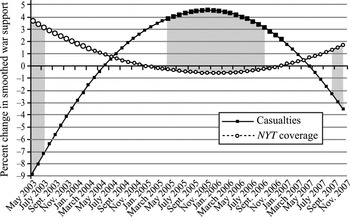
To ease interpretation we employ Clarify.Footnote 59 This allows us to estimate, via simulations, the expected change in the percentage of respondents supporting the war as New York Times casualty coverage varies from no positive coverage to one standard deviation above the mean level of positive coverage, with all control variables—including casualty levels—held constant at their mean values. We repeat this simulation for each month in our series. Figure 3 presents the trends in the magnitudes of the effects on public support for the war of variations in New York Times coverage of casualties, on the one hand, and actual casualties, on the other.
Percent change in public war support as casualties and New York Times casuality coverage vary, May 2003 through November 2007
Notes: For ease of visual interpretation, the valence of the “Casualties” curve is reversed so that we represent an increased direct relationship between declines in casualties and rising war support as a positive vertical movement along the y-axis. Large circles or squares indicate statistically significant (p < .10 or better) effects of news coverage or casualties; shaded regions represent statistically significant differences between effects of casualties and news coverage.

Looking at the origin of the curve in Figure 3, the New York Times coverage curve indicates that in the first month of our series (May 2003), an increase from no positive casualty coverage to one standard deviation above the mean level of positive casualty coverage is associated with about a 4 percent increase in smoothed public war support (p < .01).Footnote 60 The magnitude of the positive effect of favorable coverage on public war support recedes gradually, albeit remaining statistically significant and substantial in magnitude, through March 2004, eleven months into our series and thirteen months into the war. The implication is that variations in media coverage of casualties in Iraq continued to influence public opinion, independent from the effects of the actual level of casualties, over a year into the conflict. This is obviously far beyond the so-called “rally period” at the war's outset. In addition to offering support for longer-term communication effects (H1) with respect to media representations of elite rhetoric, these results also confirm a core assumption underlying our theory: that in foreign policy, communication matters over both the short- and longer-term.
After August 2005, the mean effects continue to decline through January 2006—with the direction of the relationship briefly turning negative (though the latter shift is statistically insignificant). This implies that as circumstances in the conflict steadily worsened, the actual state of events seems to have dominated public opinion, resulting in a greatly reduced independent influence of press coverage of casualties. Indeed, presumably due to the effects of reality, during this period positive coverage of casualties might have led to further decreases in public support (albeit insignificantly so). As conditions on the ground began to improve, however, the relationship for press coverage eventually becomes direct again (that is, positive coverage is associated with more positive public attitudes about the conflict, and vice versa). Given the apparent turnabout in events in Iraq in late 2007—that is, significantly reduced Iraqi civilian and U.S. military casualties arguably attributable to the Surge in the U.S. troop presence in Iraq—the return to a direct relationship between the valence of New York Times coverage and public war support appears consistent with H5. However, neither the post–July 2005 declines in the effects of increased positive coverage, nor the upward turn in such effects in late 2007 are statistically significant. Consequently, these latter results are more suggestive than definitive. Nonetheless, the direct relationship in late 2007 approaches significance (p < .20), and the upward trend in the positive effects from its low point in early 2006 is itself marginally statistically significant (p < .10). This suggests that these broad patterns most likely represent real rather than coincidental shifts.
It is, however, important to note that the most important rhetorical shift across these two periods was not a change in positive evaluations, which only increased by around 11 percent (from an average of 1.13 per month in the first eight months of 2007 to 1.25 during the September to November 2007 period). Rather, the late-2007 balance of rhetoric primarily reflected a massive 68 percent drop in negative evaluations (from 6.25 to only 2 per month). Thus, even as rhetoric began to regain traction and correlate more directly with public opinion, net changes in that rhetoric were mostly limited to fluctuations in negative evaluations. Negative evaluations continued to outpace positive ones throughout 2007, albeit at a reduced rate during the fall.
Turning to the actual casualties curve in Figure 3, we find a quite distinct pattern. (Note that to ease the visual interpretation of the data, we reversed the valence on the actual casualties curve, so that, like the news coverage valence curve, higher values represent improvements in the state of events—in this instance declines in casualties rather than increases.) In the initial months of our series, variations in the level of civilian and military casualties have no significant effect on public war support. The curve begins briefly in negative territory, suggesting, not entirely surprisingly, that the public greeted higher levels of casualties at the outset of the war with increased support.Footnote 61 The curve then gradually moves upward until, in February 2005—twenty-five months into our series and twenty-seven months into the war—the effects of declines in casualties (here and subsequently from one standard deviation above the mean to zero) become statistically significantly positive. That is, beginning in February 2005, declines in casualties are associated with significant increases in war support. This pattern persists—and remains statistically significant—until January 2007, peaking in December 2005, when a decline in casualties from one standard deviation above the mean to zero is associated with a nearly five percent increase in public war support (p < .05).
Beginning in February 2007, the curve moves into negative territory, indicating that falling casualty levels are associated with decreases in war support. This seemingly paradoxical reversal is not statistically significant, however, and so is of questionable substantive importance. Overall, these results clearly support longer-term reality effects (H2), as the effects of reality—in this case trends in civilian and military casualties—emerge gradually, and subsequently recede over time.
Also important for our theory, the two curves are themselves statistically distinct from one another during the first three months of our series, through July 2003 (p < .10 or better, indicated by the shaded region at the start of the curves in Figure 3). During this period, positive New York Times coverage produces a positive and significant effect on public opinion, while variations in casualties are associated with no statistically significant effect. Between August 2003 and April 2005, the two curves are statistically indistinguishable. From May 2005 through November 2006, declines in casualty levels exert a significantly more positive effect on public war support than positive news coverage, which exerts no significant effect (shown by the shaded region in the mid-section of the top graphic in Figure 3). After November 2006, the curves again become statistically indistinguishable until September 2007. Beginning in that month, positive New York Times casualty coverage again exerts a statistically distinguishable positive effect on public opinion (p < .10 or better, again indicated by the shaded region toward the ends of the curves in Figure 3) relative to declines in actual casualty levels, which do not significantly affect opinion.
Overall, the empirical patterns in Figure 3 are strikingly consistent with the theoretical model depicted in Figure 1. Initially, as predicted, rhetoric (measured by media coverage of casualties) exercises a greater influence than reality (measured by actual casualty levels). Subsequently, reality begins to exert itself, outpacing rhetoric during the “medium-term” (represented by the middle part of our time series). Eventually, both rhetoric and reality fade to insignificance. Though the influence of both recedes over time (albeit at different times), consistent with the rhetoric versus reality (H3) hypothesis, statistically significant effects persist far longer for reality than for rhetoric (nineteen months versus eleven).Footnote 62
Our theory also predicts that even after a long period of consistent rhetoric and events on the ground, a noteworthy change in the tenor of events—such as the substantial and sustained drop in Iraqi civilian and U.S. military casualties associated with the “Surge”—can eventually (after some lag period) lead the public to take a second look at a conflict and again become amenable to at least some influence by media—and by extension, elite—framing of events, as well as ultimately by the actual tenor of the events themselves.Footnote 63 In this instance, the return to a positive relationship between net positive New York Times coverage of casualties and public war support—as well as the re-emergence of a statistically significant difference between the effects on opinion of news reports about casualties and of actual casualties—takes place in fall 2007. Presumably it is not a coincidence that this is the period where journalists began to take notice, after several months of skepticism, of declining casualty trends in Iraq.Footnote 64 Finally, it is worth noting that the pattern in fall 2007 essentially mirrors that from the beginning of the war, with rhetoric again exerting a greater influence on opinion than reality (albeit at more attenuated levels). These latter results support our rhetoric versus reality (H3) and event-shift effects corollary (H5) hypotheses and are again strikingly consistent with the theoretical model depicted in Figure 1.
Presidential Rhetoric and the Elasticity of Reality
We next investigate trends in citizen responses to presidential rhetoric regarding Iraq. In doing so, we test the longer-term communication effects (H1) hypothesis, which predicts that, all else equal, the effects of elite rhetoric on public opinion regarding a conflict will tend to diminish over time. We also test the partisan long-term effects (H4) hypothesis, which predicts that after the initial rally period following initiation of a conflict, NPP partisans will decrease their war support in response to negative elite rhetoric more quickly and sharply than Independents, who will be more responsive than PP partisans (with the opposite pattern arising in the case of favorable rhetoric).
Data and Methods
We assembled a data set on all public presidential speeches, addresses, press conferences, and press statements pertaining in significant measure to the conflict in Iraq. Our universe of data consists of a series of 347 transcripts representing all public statements by President Bush that the White House defined on its website as significantly focused on Iraq.Footnote 65 We include all such statements by President Bush in which, in the judgments of our coders, Iraq constituted at least one third of the content of the statement. This yielded seventy-four cases, of which sixty-seven were primarily (that is, greater than 50 percent) focused on Iraq.Footnote 66
Our research assistants coded each transcript along a variety of dimensions, including the type of statement (for example, address to the nation, press conference, joint appearance, and so on) and frequency of references to Iraq. (See Appendix for a complete listing of variables and coding rules.) Pairs of coders independently dual-coded all transcripts, subsequently resolving any disputes by discussing the disagreement until they achieved consensus.Footnote 67 Intercoder reliability testing indicated that our coders agreed on 85 percent of all initial (that is, first-round) coding decisions on our primary variables of interest.
Our dependent variable measures variations in public opinion regarding Iraq in the periods prior to and immediately following presidential statements, based on the same smoothed war approval data as in the prior analysis. In this instance, however, we employ partially disaggregated data based on partisan affiliation. While the smoothing process reduces the random variance in the series, it also greatly reduces its systematic variance. Consequently, the remaining variability in the series is quite small (significantly smaller than in the aggregate series). In fact, the maximum change in smoothed war support from a month t to a month t + 1 is just 1.54 percentage points. Presumably due at least in part to the relatively small monthly variations in these partisan indicators, transforming them into percent changes results in several observations dropping from the model. Hence we employ as our dependent variable the simple difference between partisan war support at time t and at time t + 1.
To distinguish statements predominantly focused on Iraq from those in which most of the content focused on other issues, we include a dummy variable, coded 1 for the sixty-seven speeches in which more than half of the content focused on Iraq. Statistical testing indicated that these sixty-seven statements produced materially distinct effects from the remaining seven less-Iraq-centric statements. Consequently, to isolate the effects of the predominantly Iraq-oriented statements, we interact the Iraq focus dummy with a count variable measuring the date when a given statement occurred. Because any trends are unlikely to be linear—or at least nonmonotonic—we include the quadratic of the date counter and also interact the quadratic with the Iraq focus dummy.
For our control variables, in order to account for potential autocorrelation, we include the lagged value of our dependent variable.Footnote 68 We also include a dummy for statements to the press (including press conferences), which stood apart from other types of speeches as substantially less likely to enhance partisan support for Iraq.
To capture the state of events in Iraq, we include measures of the level and weekly changes in U.S. and Iraqi civilian casualties. To account for trends in the volume of media coverage of Iraq, we also control for the number of mentions of Iraq on the nightly newscasts of ABC, CBS, NBC, and Fox News's Special Report with Brit Hume.Footnote 69
We also control for the number of mentions of Saddam Hussein by President Bush in each statement. Perhaps due to the familiarity to Americans—and hence broad accessibility—of the Saddam-Hussein-as-villain narrative,Footnote 70 this variable proved a reasonably strong predictor of media attention, independent of variations in the overall intensity of the president's focus on Iraq. Finally, we include three indicators of the state of the U.S. economy—the monthly change in consumer sentiment, the rate of inflation, and average gas prices—as well as a variable measuring the number of days between presidential statements in the data set.Footnote 71
Results
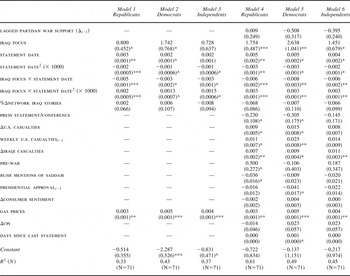
Models 1 to 6 in Table 2 present the results from our tests of our longer-term communication (H1) and partisan long-term (H4) effects hypotheses. As before, given the relatively small Ns and large numbers of controls in our fully specified models, we first present a set of basic models (Models 1 to 3), excluding all but two important control variables (gas prices and network news coverage of Iraq). The results for the key causal variables, though again predictably differing somewhat, are nonetheless broadly consistent (in valence as well as relative magnitudes) with the fully specified models (Models 4 to 6). Consequently, we again proceed more confidently to interpreting the latter, fully specified models. To do so, we again employ CLARIFY to transform the OLS coefficients into expected percentage point changes in war support in response to presidential statements on Iraq, over time. Figure 4 illustrates the results.
OLS analyses of effects of Bush Iraq statements on partisan war support

Notes: Standard errors are in parentheses; “× 1000” indicates that listed coefficients have been multiplied by 1,000. ∧p < .10;
* p < .05;
** p < .01;
*** p < .001.
Effect of a presidential statement on Iraq on news coverage of and partisan support for the Iraq War, 2002–2007

For all three partisan groups, a presidential statement is associated with an increase in approval of the war (either hypothetically, prior to its initiation, or retrospectively, during the conflict). Democrats display the strongest such relationship, with a presidential statement associated with about a 2.2 percentage point increase in support for going to war against Iraq in January 2002 (p < .01).Footnote 72 The corresponding increases for Republicans and Independents are 1.2 and 1.5 percentage points, respectively (p < .05 in both cases).
Lower baseline approval rates among Democrats at the time of the survey presumably explain the relatively higher effect on Democrats. They simply had more room to rise in response to a presidential statement. Moreover, in January 2002, President Bush was in the midst the largest and most sustained “rally-round-the-flag” approval spike ever recorded—a 35 percentage point rise almost overnight—in response to the terrorist attacks of 11 September 2001.Footnote 73 Hence, at this time, Democrats were more inclined to rally in response to appeals by President Bush than was the case later in his presidency.
All three partisan groups display diminishing responsiveness over time to presidential appeals, reaching the zero point at about the same time, albeit with the Democrats, as anticipated, falling farthest and fastest (though the differences between the partisan subgroups are not statistically significant). The effects of presidential statements turn negative beginning in early 2005—with statements by the president associated with subsequent declines in war support—and remain so across all three partisan groups for the remainder of the series. Among Democrats, a presidential statement on Iraq in the final month of our series is greeted with about a .77 percentage point decline in war support (p < .05). The corresponding declines among Independents and Republicans are approximately .51 percentage points in each case (p < .05).
These results offer clear support for our longer-term communication effects hypothesis (H1). Across all three groups the influence of presidential rhetoric on public support for Iraq clearly declines over time, approaching and then surpassing zero, and ultimately turning negative. Consistent with the partisan long-term effects (H4) hypothesis, in turn, we observe the largest and most rapid declines among NPP partisans (Democrats), and the shallowest decline among PP partisans (Republicans). However, because these latter differences are statistically insignificant, they must be interpreted as suggestive rather than definitive support for H4.
Individual Attitudes
We turn next to an individual-level analysis. Recall that H1 (longer-term communication effects) and H2 (long-term reality effects) predict that the effect(s) of rhetoric and reality, respectively, on public opinion will recede over time, while their corollary, the event-shift effects (H5) hypothesis, predicts that a substantial and sustained change in the tenor of events will eventually reinvigorate the effects of rhetoric and reality on public opinion, with PP partisans being quicker to reassess reality in response to events perceived as favorable to the president (and slower to reassess when events are perceived as unfavorable to him), relative to Independents or members of the NPP. It further predicts that the effects of the new “reality” will emerge gradually, while those of rhetoric consistent with the prior state of events will persist for some period of time while the public assesses the reliability of rhetoric consistent with the newly changed state of reality on the ground.
In order to test these predictions at the individual-level, we surveyed a national population sample (provided by Polimetrix) concerning attitudes regarding Iraq. (See Appendix for question wording and coding.) While one survey at a single point in time clearly cannot test the dynamic aspects of our theory, we nonetheless believe it is valuable for assessing the face validity of several of our assumptions and predictions. We asked respondents about the trend in casualties and the prospects for a U.S. victory in Iraq, as well as about the ability of the Bush Administration to influence public opinion on Iraq. Figure 5 presents four graphics, which together summarize the key results by party.
Evolution of public opinion regarding Iraq conflict
Notes: Required figures based on averages across respondents, coded: Increased = 1, About same = 0, Decreased = −1.

We begin with the top-left and top-right graphics in Figure 5. These graphics indicate that—as of December 2007 (when the survey was in the field)—Democrats and Independents believed that the U.S. prospect for victory in Iraq had remained largely unchanged over the preceding year (top-left graphic) and that the Surge had produced virtually no effect on the U.S. prospect for victory (top-right graphic), as both groups hover near the zero line (representing a response of “unchanged”). In sharp contrast, Republicans believed (perhaps correctly in retrospect) by large margins that the prospects for victory had improved (top-left graphic) and that the Surge had improved the U.S. chances of victory (top-right graphic). The differences between Democrats and Independents, on the one hand, and Republicans, on the other, are highly significant (p < .001 in both cases).
The bottom-left graphic presents the results from a question asking whether respondents believed the rate of U.S. military and Iraqi civilian casualties in Iraq had increased, decreased, or remained about the same since the start of the Surge in March 2007. The results are consistent with those discussed above; Democrats and Independents believed (incorrectly) that casualty rates had remained roughly constant between March and December 2007, while Republicans, again by large margins, believed (correctly) that average monthly casualty levels had declined over that same time period. Once again, the differences between Democrats and Independents, on the one hand, and Republicans, on the other, are highly significant (p < .001 in both cases).
These results support our predictions, particularly our event-shift effects corollary (H5). While opposition partisans and Independents are slow to even recognize changes in events favorable to the president, let alone acknowledge their significance, the president's fellow partisans are substantially quicker to positively reassess and more likely to do so in large numbers.
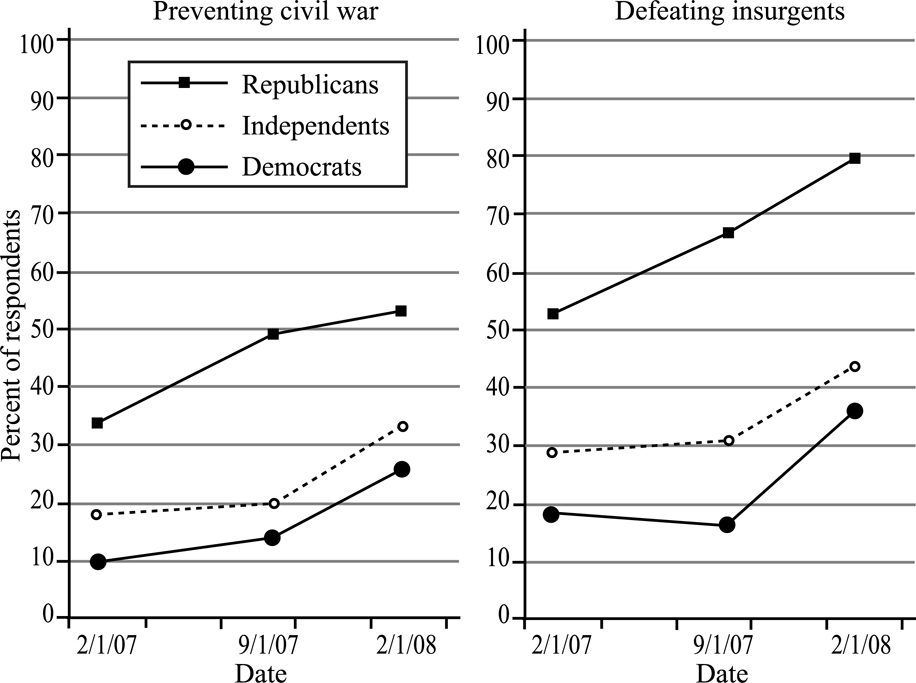
Additional national survey data provide more dynamic evidence of a partisan divide in perception following a shift in real-world events. According to a series of Pew Center surveys beginning in February 2007 (shortly after the announcement of the Surge strategy in Iraq), public perceptions of the conflict differed starkly, in precisely the manner predicted by H5. As shown in Figure 6, Republicans began to perceive progress in Iraq within months of the initiation of the Surge, increasingly believing the United States was making progress defeating Iraqi insurgents and preventing a civil war.
Perceived U.S. progress in Iraq since start of Surge, by party
Note: Data are from the following Pew survey question: “As I read a few specific things about Iraq, tell me if you think we are making progress or losing ground in each area. First, are we making progress or losing ground in [Preventing Civil War/Defeating Insurgents]?” Data available at ⟨http://people-press.org/reports/display.php3?PageID=1258⟩. Accessed 24 march 2010.
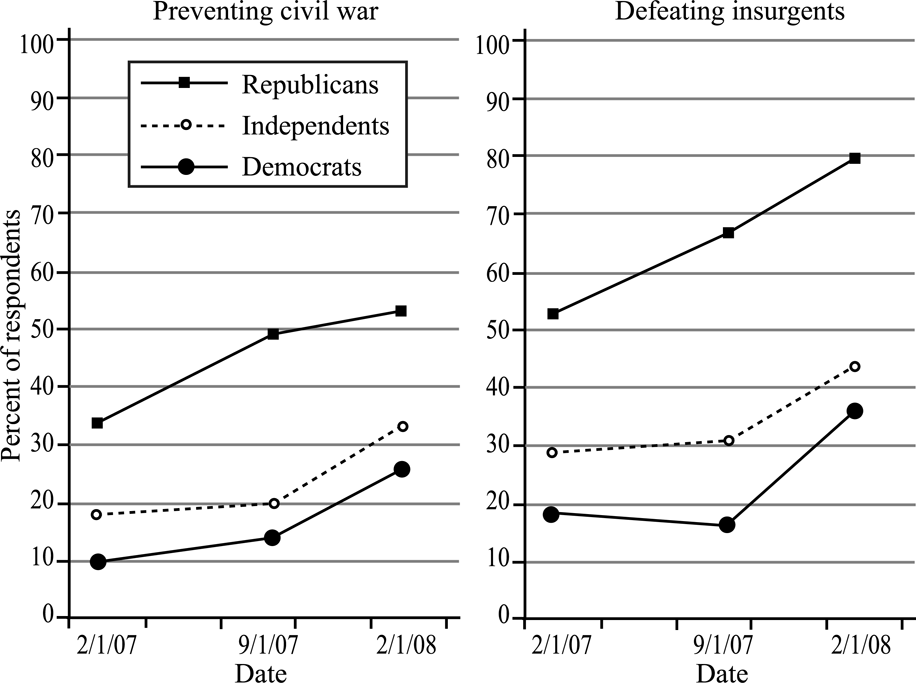
In contrast and also consistent with our event-shift effects corollary (H5) hypothesis, Independents and especially Democrats remained skeptical that any such progress was emerging, even as late as September 2007. Indeed, Democrats actually perceived a deteriorating situation with respect to the insurgency between February and September 2007. Only later did Democrats and Independents begin to join Republicans in believing that the United States was actually making progress in these areas.
These results address a possible counterhypothesis that by 2006, most people had concluded that the costs of war already exceeded whatever benefits might be obtained by stabilizing Iraq. At that point, there would be no reason to revise one's view that the war was a mistake, even if events on the ground took a turn for the better. Yet we do not observe persistent inertia in the face of changed events. Rather, we find evidence at both the individual level and in aggregate trends of a substantial change in public opinion regarding the war's likely outcome roughly six months following the initial “success” of the Surge. Indeed, after hitting a low of around 30 percent in Winter 2006–2007, the percentage of Americans reporting they believed the American military effort was doing fairly or very well nearly doubled two years later to just below 60 percent.Footnote 74 Consequently, we believe that the inertia hypothesis, though plausible, is not supported by the data.
Finally, returning to Figure 5, the bottom-right graphic presents the results from a question asking whether the Bush administration's capacity to influence public opinion on the war has increased, decreased, or remained relatively constant since the start of the war. This tests our longer-term communication (H1) and partisan long-term (H4) effects hypotheses, which predict that, absent a major shift in the tenor of events, the effects of elite rhetoric on public attitudes will recede over time (H1), but that this effect will be weakest among the president's fellow partisans (H4). The results indicate, consistent with H1, that, on average, all respondents—Democrats, Republicans, and Independents—agreed that the influence of the Bush administration on public support for the war had receded since the start of the conflict. Moreover, consistent with H4, Democrats and Independents were far more likely than Republicans to believe this. There are certainly multiple factors contributing to these assessments, and, as noted, self-reports at a single point in time concerning the influence of the Bush administration may be somewhat unreliable. Hence, these latter results represent only suggestive evidence. Nevertheless, they are precisely what H1 and H4 would predict.
Conclusion
In Common Sense, Thomas Paine observed that, “time makes more converts than reason.”Footnote 75 Interestingly, and consistent with the assumptions underlying the elasticity of reality framework, in the first half of our data series “reason” (that is, elite rhetoric) predicted changes in war support to a greater extent than our indicators of reality for two of three partisan subgroups (Republicans and Independents), while in the second half of our series the pattern reversed, with our reality indicators better predicting changes in war support for two of three partisan subgroups (again, Republicans and Independents). This suggests that as the elasticity of reality shrinks over time, so too does the capacity of political elites to frame events to their own advantage, at least to the extent that such frames contradict the tenor of actual events. As VandeHei and Harris observed in fall 2007 with respect to public opinion regarding Iraq, “it turns out that Washington matters less than many Democrats and even many journalists supposed in determining political momentum in the Iraq debate. Events on the ground—including … evidence that security is improving somewhat in the wake of the military's ‘Surge’ policy—matter more.”Footnote 76
The implications of these findings for American foreign policy are ambiguous. On the one hand, in an increasingly partisan and polarized media and public opinion environment, maintaining support for any foreign policy—much less a costly, protracted one—would seem more difficult for U.S. leaders than in the past. For instance, substantial researchFootnote 77 suggests that citizens can influence the outcomes of international bargaining processes by enhancing or inhibiting leaders' capacities to signal resolve during such negotiations. According to this view, democratic leaders can enhance their bargaining position by making public threats or promises. By doing so, and risking political punishment at home should they back down, leaders can effectively “tie their hands,” thereby enhancing their credibility to an adversary. This is because upon publicly issuing a threat, democratic leaders generate domestic audience costs, defined as the domestic political punishment leaders suffer if they issue public threats and subsequently retreat.Footnote 78
Domestic audience cost theory, as specified above, implicitly assumes that citizens—the “audience” in domestic audience costs—will respond whenever their leaders call.Footnote 79 Our evidence calls this into question. We find that over time, citizens become less responsive to a leader's appeals as the tenor of events increasingly narrows the range of elite frames that the public will accept. We further find that not all citizens are equally inclined to respond when their leader calls. Indeed, if expressions of antagonism toward a leader's foreign policy from the opposition party can undermine the credibility of her commitments abroad, as Schultz argues,Footnote 80 a similar logic seems likely to apply to the general public.Footnote 81 These factors may weaken leaders' hands in international bargaining situations by reducing their capacity to generate or sustain the domestic audience costs necessary for signaling resolve.
Conversely, one might take heart from the apparent limits we have documented on the capacity of elites to indefinitely manipulate public perceptions of reality. Sooner or later, it would seem, the public can discern the true merits of a conflict, to at least some degree, regardless of elite efforts to spin events to their partisan advantage. This suggests that the “audience” is not necessarily the passive rubber stamp frequently assumed by audience cost theories. Indeed, depending on the merits of a leader's preferred foreign policy actions, it is unclear that a given nation's interests are necessarily always best served by maximizing the credibility of its leader's threats.
Notwithstanding the potential dangers of rogue democratic leaders pursuing unwise foreign policies, sometimes a perceived record of distortion and manipulation on the part of an administration can prevent the public from accurately perceiving the reality of a conflict, even when that reality has actually shifted—as we saw in our examination of the Surge in late 2007. For instance, it seems clear in hindsight that President Bush's speech 2 May 2003 aboard the aircraft carrier U.S.S. Abraham Lincoln—in which he declared that “in the Battle of Iraq, the United States and our allies have prevailed”Footnote 82 before a large banner reading “Mission Accomplished”—later reduced the persuasiveness of his assertions that the U.S. military was making progress in Iraq.Footnote 83 Indeed, much like the boy who cried wolf, politicians who are too quick to claim victory or the accomplishment of a mission risk having no one believe them if or when their long-promised victory actually arrives.Footnote 84
Appendix
Survey Question Wording: Polimetrix
1. Do you believe the prospects for a U.S. victory in Iraq (as you define it) are better, worse, or about the same as they were a year ago?
2. In your opinion, has the Bush Administration's ability to influence public opinion regarding the Iraq War increased, decreased, or remained about the same since 2003?
3. Has the “Surge” (that is, the U.S. counterinsurgency campaign begun in 2007 that increased the U.S. troop presence in Iraq by over 30,000) increased or decreased the likelihood of a U.S. victory in Iraq, or has it had no significant effect on the likelihood of victory?
4. Have the average monthly U.S. military and Iraqi civilian casualties in Iraq increased, decreased, or stayed at about the same level since the start of the “Surge”?
Presidential Public Rhetoric Data Analysis: Variable Definitions and Sources
days since last statement: number of days since last presidential statement on Iraq.
prewar: dummy coded 1 prior to March 20, 2003.
press statement/conference: dummy variable, coded 1 for press statements or conferences.
bush mentions of saddam: number of times Saddam Hussein was mentioned in the speech.
iraq focus: coded 1 if Iraq was primary focus of presidential statement, .5 if Iraq was one of two major issues covered in statement, and 0 if Iraq was one of three or more issues covered.
%Δnetwork iraq stories: percent change in network news stories mentioning Iraq (weeks t to t+1).
presidential approvalt-1: most recent Gallup or CBS presidential approval poll rating prior to date of presidential statement on Iraq.
gas prices: average weekly gas prices, available at ⟨http://tonto.eia.doe.gov/dnav/pet/pet_pri_gnd_dcus_nus_w.htm⟩. Accessed 2 April 2010.
weekly u.s. casualties: weekly tally of hostile U.S. casualties, from U.S. Department of Defense.
Δu.s. casualties: weekly change in hostile U.S. casualties (same source as above).
Δiraqi casualties: weekly change in Iraqi civilian casualties, from ⟨www.IraqBodyCount.org⟩. Accessed 2 April 2010.
Δconsumer sentiment: monthly change in consumer sentiment from ⟨www.economagic.com⟩. Accessed 2 April 2010.
Δcpi: monthly net change in consumer price index, from ⟨http://inflationdata.com/inflation/Consumer_Price_Index/CPI.asp⟩. Accessed 2 April 2010.