Introduction
Population ageing due to low fertility rates and increasing life expectancy is a prevalent trend in ‘developed’ countries or regions, including Hong Kong. In 2011, there were 941,312 people aged 65 and over, representing 13.3 per cent of the total population in Hong Kong (Census and Statistics Department 2012a ). As baby-boomers born in the 1950s and 1960s will enter into old age over the next 20 years, by 2040, one out of every three persons in Hong Kong will be 65 or older (Census and Statistics Department 2012b ). With the rise of life expectancy, increasing attention has been paid to the importance of improving life satisfaction and the prospect of ageing well in the prolonged years, while enhancing wellbeing in later life has long been a policy and practice challenge (Meggiolaro and Ongaro Reference Meggiolaro and Ongaro2014).
The Government of the Hong Kong Special Administrative Region has implemented a wide range of policies, programmes and services to foster active ageing and to improve older adults' health and life satisfaction. For instance, the Social Welfare Department has provided various community support services through District Elderly Community Centers, Neighborhood Elderly Centers and Social Centers for the Elderly, with the aim of meeting the social and leisure needs of older adults and enabling them to lead a dignified and enjoyable life in the community. The Labour and Welfare Bureau and the Elderly Commission have further rolled out ‘Elder Academy’ to promote life-long learning among older adults with the active involvement of primary and secondary schools, and tertiary institutions, in the provision of formal and informal learning programmes. However, older adults in Hong Kong still experience relatively high rates of depression and suicide, and quite a number of them are unable to adapt well to retirement (Tam and Chiu Reference Tam and Chiu2011). It is reported that the suicide rate of older adults was 25.4 per 100,000 in 2012, twice the average for all age groups (Woodhouse, Abdullah and Goh Reference Woodhouse, Abdullah and Goh2014). It seems that there is still room for improvement of relevant policies and services for older adults given that the needs of younger baby-boomers are growing and changing (Hung, Bai and Lu Reference Hung, Bai and Lu2015). They are more independent and financially capable than prior generations, and are more eager to learn new skills and explore new interests. Senior consumers have also emerged as an affluent, fast-expanding group in Hong Kong, who are more willing to spend money on dining and entertainment, travel and other leisure activities (Wong Reference Wong2007). New and positive images of ageing and older adults should be shaped with joint efforts (Bai Reference Bai2014; Bai, Chan and Chow Reference Bai, Chan and Chow2012). It is of great importance for policy makers and service providers to explore new directions to cater for the expanding and diverse needs of older adults so as to improve their quality of life (Lai and Bai Reference Lai, Bai, Al-Krenawi, Graham and Habibov2016).
In addition to the most commonly identified predictors of greater life satisfaction, including socio-demographic characteristics such as younger age, higher socio-economic status, better physical, mental and functional health status, as well as stronger family and social network and support (Lou Reference Lou2010; Niedzwiedz et al. Reference Niedzwiedz, Katikireddi, Pell and Mitchell2014; Read, Grundy and Foverskov Reference Read, Grundy and Foverskov2016), active participation in social and leisure activities could also enhance older adults' life satisfaction (Chen and Petrick Reference Chen and Petrick2013; Chou, Chow and Chi Reference Chou, Chow and Chi2004). The importance of social and leisure participation has been highlighted by the World Health Organization's (2002) Active Ageing Policy Framework, which strongly recommends continued social and leisure participation for achieving successful ageing. Leisure activities broadly refer to those ‘to which the individual turns at will, for either relaxation, diversion, or broadening his knowledge and his spontaneous social participation, the free exercise of his creative capacity’, apart from obligations to family, work and society (Dumazedier Reference Dumazedier1967: 16–17). Although the benefits of leisure activities have been explored in previous studies, travel has only occasionally been considered to be part of the ‘leisure’ domain and very few studies have focused exclusively on its impacts on life satisfaction of older adults, let alone the theoretical underpinnings of such an impact (Chen and Petrick Reference Chen and Petrick2013; Neal, Uysal and Sirgy Reference Neal, Uysal and Sirgy2007; Sirgy et al. Reference Sirgy, Kruger, Lee and Grace2011). As a matter of fact, travel can provide older adults with recreational opportunities, maintain social and physical activities, and satisfy socio-psychological needs such as rest, relaxation, social interaction, learning and excitement (Horneman et al. Reference Horneman, Carter, Wei and Ruys2002). Older adults may also utilise travel to offset feelings of disillusionment and distress (Jang and Wu Reference Jang and Wu2006), which points to the role that travel can play in enhancing later life satisfaction (Dann Reference Dann, Uysal, Perdue and Sirgy2012; Dolnicar, Lazarevski and Yanamandram Reference Dolnicar, Lazarevski, Yanamandram, Uysal, Perdue and Sirgy2012).
The present study seeks to answer the following questions: (a) What are the motivating factors of travel for older adults in Hong Kong? (b) How do older adults' travel motivations influence their travel actions? (c) How do older adults' travels affect life satisfaction? (d) Do male and female older adults differ in aspects of travel motivations and life satisfaction? The study findings will support an improved awareness among professionals and service providers about the benefit of travelling in enhancing life satisfaction of older adults. The findings can also inform service and policy development for relevant stakeholders, with the aim of facilitating responses to the travel needs and motivations of older adults and optimising travel opportunities in order to promote active ageing in Hong Kong.
Literature review
Travel motivations and travel actions
Travel motivations can stimulate travel intentions, trigger travel decisions, maintain ongoing travel involvement and drive future travel actions (Dann Reference Dann, Uysal, Perdue and Sirgy2012; Dolnicar, Lazarevski and Yanamandram Reference Dolnicar, Lazarevski, Yanamandram, Uysal, Perdue and Sirgy2012; Hsu, Cai and Li Reference Hsu, Cai and Li2009; Jang and Wu Reference Jang and Wu2006; Jang et al. Reference Jang, Bai, Hu and Wu2009; Lee and Tideswell Reference Lee and Tideswell2005; Ritchie, Tkaczynski and Faulks Reference Ritchie, Tkaczynski and Faulks2010). A better understanding of older adults' travel motivations can facilitate effective responses to their unique travel needs and further contribute to positive travel experiences and life satisfaction (Hsu, Cai and Wong Reference Hsu, Cai and Wong2007; Ritchie, Tkaczynski and Faulks Reference Ritchie, Tkaczynski and Faulks2010; Sangpikul Reference Sangpikul2008; Smith and Costello Reference Smith and Costello2009).
Previous studies of diverse older populations, including Chinese, Taiwanese and Japanese older adults, have identified numerous ‘push’ and ‘pull’ factors shaping travel motivations. This research draws on Crompton's (Reference Crompton1979) ‘push–pull’ model. ‘Push’ factors refer to intangible and internal factors that drive a person to travel, such as novelty and knowledge seeking (e.g. experiencing new places and cultures, increasing knowledge, curiosity), escape, rest and relaxation (e.g. physical rest, escape from daily stress and routines), esteem and recognition (e.g. feeling proud when telling people about travel experiences) and socialisation (e.g. time with family and friends, meeting new people) (Huang and Tsai Reference Huang and Tsai2003; Hung and Petrick Reference Hung and Petrick2011; Jang et al. Reference Jang, Bai, Hu and Wu2009; Jang and Wu Reference Jang and Wu2006; Lee and Tideswell Reference Lee and Tideswell2005; Ritchie, Tkaczynski and Faulks Reference Ritchie, Tkaczynski and Faulks2010; Sangpikul Reference Sangpikul2008; Smith and Costello Reference Smith and Costello2009). ‘Pull’ factors are tangible and external attributes attracting potential visitors to a particular destination, such as cultural, historical and natural attractions, safety and accessibility, travel arrangements and facilities (e.g. tourist facilities and attractions, travel distance), and cost of goods and services (Huang and Tsai Reference Huang and Tsai2003; Jang and Wu Reference Jang and Wu2006; Lee and Tideswell Reference Lee and Tideswell2005; Sangpikul Reference Sangpikul2008). Travel motivations are multi-dimensional and differ across individuals (Dolnicar, Lazarevski and Yanamandram Reference Dolnicar, Lazarevski, Yanamandram, Uysal, Perdue and Sirgy2012; Ritchie, Tkaczynski and Faulks Reference Ritchie, Tkaczynski and Faulks2010; Smith and Costello Reference Smith and Costello2009). With reference to the ‘push–pull’ model, Hung and Petrick (Reference Hung and Petrick2011) have developed the Cruising Motivation Scale which contains four domains of motivation including self-esteem and social recognition, escape or relaxation, learning or discovery and thrill, and bonding.
Travel and life satisfaction
The concept of life satisfaction refers to good feelings about one's life, general happiness, and sense of meaning and fulfilment (Chen, Lehto and Cai Reference Chen, Lehto and Cai2013; Neal, Uysal and Sirgy Reference Neal, Uysal and Sirgy2007; Sangpikul Reference Sangpikul2008), which is often linked to quality of life and subjective wellbeing (Chen, Lehto and Cai Reference Chen, Lehto and Cai2013; Dann Reference Dann, Uysal, Perdue and Sirgy2012; Dolnicar, Lazarevski and Yanamandram Reference Dolnicar, Lazarevski, Yanamandram, Uysal, Perdue and Sirgy2012; Dolnicar, Yanamandram and Cliff Reference Dolnicar, Yanamandram and Cliff2012; Sangpikul Reference Sangpikul2008; Sirgy et al. Reference Sirgy, Kruger, Lee and Grace2011). Life satisfaction reflects the extent to which a person's needs, goals and wishes are fulfilled, and it generally includes satisfaction with different life domains such as education and learning, work and material wellbeing, health, family relationships, leisure and spiritual life, and social life (Chen, Lehto and Cai Reference Chen, Lehto and Cai2013; Dann Reference Dann, Uysal, Perdue and Sirgy2012; Dolnicar, Lazarevski and Yanamandram Reference Dolnicar, Lazarevski, Yanamandram, Uysal, Perdue and Sirgy2012; Sirgy et al. Reference Sirgy, Kruger, Lee and Grace2011).
Leisure activities, including travel, contribute to better life satisfaction (Chen and Petrick Reference Chen and Petrick2013; Dolnicar, Yanamandram and Cliff Reference Dolnicar, Yanamandram and Cliff2012; Lee and Tideswell Reference Lee and Tideswell2005; McCabe, Joldersma and Li Reference McCabe, Joldersma and Li2010; Neal, Uysal and Sirgy Reference Neal, Uysal and Sirgy2007; Sirgy et al. Reference Sirgy, Kruger, Lee and Grace2011), characterised by greater happiness, decreased stress, better cognition and a healthier lifestyle (Andel, Silverstein and Kåreholt Reference Andel, Silverstein and Kåreholt2014; Chen and Petrick Reference Chen and Petrick2013; McCabe, Joldersma and Li Reference McCabe, Joldersma and Li2010; Sörman et al. Reference Sörman, Sundström, Rönnlund, Adolfsson and Nilsson2014). It has been reported that compared to non-travellers, frequent travellers are more likely to feel happy and satisfied with their lives (Sangpikul Reference Sangpikul2008) and report greater subjective wellbeing (Chen, Lehto and Cai Reference Chen, Lehto and Cai2013).
Travel contributes to life satisfaction and psychological wellbeing by providing opportunities to pursue personal and social interests, engage in physical and mental activities, as well as rest, promote excitement and stimulation, and prevent boredom and depression (Dolnicar, Lazarevski and Yanamandram Reference Dolnicar, Lazarevski, Yanamandram, Uysal, Perdue and Sirgy2012; Lee and Tideswell Reference Lee and Tideswell2005; Ritchie, Tkaczynski and Faulks Reference Ritchie, Tkaczynski and Faulks2010; Wei and Milman Reference Wei and Milman2002). Travel also provides the chance to spend quality time with family and friends, meet new people, create happy memories, escape from stressful circumstances or routines, and learn about oneself (McCabe, Joldersma and Li Reference McCabe, Joldersma and Li2010; Ritchie, Tkaczynski and Faulks Reference Ritchie, Tkaczynski and Faulks2010; Sirgy et al. Reference Sirgy, Kruger, Lee and Grace2011). For disadvantaged groups such as older adults, travel can alleviate negative conditions and contribute to improved quality of life and successful ageing (Dann Reference Dann, Uysal, Perdue and Sirgy2012; Hsu, Cai and Wong Reference Hsu, Cai and Wong2007).
Gender differences in travel motivations, travel actions and benefits
‘Clusters’ of travellers can be identified based on their particular travel perceptions, motivations and involvement (Lee and Tideswell Reference Lee and Tideswell2005; Ritchie, Tkaczynski and Faulks Reference Ritchie, Tkaczynski and Faulks2010; Smith and Costello Reference Smith and Costello2009). There are a number of factors that can influence travel motivations and experiences, including age (Batra Reference Batra2009; Collins and Tisdell Reference Collins and Tisdell2002; Horneman et al. Reference Horneman, Carter, Wei and Ruys2002; Lee and Tideswell Reference Lee and Tideswell2005; Smith and Costello Reference Smith and Costello2009), gender (Collins and Tisdell Reference Collins and Tisdell2002; Huang and Tsai Reference Huang and Tsai2003; Jang and Wu Reference Jang and Wu2006; Lee and Tideswell Reference Lee and Tideswell2005; Sangpikul Reference Sangpikul2008; Smith and Costello Reference Smith and Costello2009), socio-economic status (Hsu, Cai and Wong Reference Hsu, Cai and Wong2007; Huang and Tsai Reference Huang and Tsai2003; Jang and Wu Reference Jang and Wu2006; McCabe, Joldersma and Li Reference McCabe, Joldersma and Li2010; Sangpikul Reference Sangpikul2008; Smith and Costello, Reference Smith and Costello2009) and health status (Huang and Tsai Reference Huang and Tsai2003; Jang and Wu Reference Jang and Wu2006).
It has been reported that, in general, women have a higher level of travel motivations (Andreu et al. Reference Andreu, Kozac, Avci and Cifter2005) and travel expectations (Huang and Tsai Reference Huang and Tsai2003) compared to men, and women are more likely than men to travel for holidays and to visit friends and relatives (Collins and Tisdell Reference Collins and Tisdell2002). Female travellers tend to be more attracted by relaxation activities, whereas male travellers are more attracted by recreational activities (Andreu et al. Reference Andreu, Kozac, Avci and Cifter2005). While Jang and Wu (Reference Jang and Wu2006) found that female travellers were more motivated by knowledge seeking than male travellers, Lee and Tideswell (Reference Lee and Tideswell2005) found that older men were more likely to travel for novelty-seeking.
Conceptual framework
Incentive theory of motivation
As an important behavioural theory, the incentive theory of motivation suggests that people are pulled towards certain behaviours that will be followed by tangible or intangible benefits or rewards, which results in a ‘positive reinforcement’. The sooner an individual is rewarded based on a certain behaviour, the more effective this is in reinforcing the behaviour (Bernstein Reference Bernstein2011). Therefore, in the context of current study, older adults who feel happiness and pleasure or satisfaction from travelling would be more motivated to travel.
Activity theory of ageing
Another theory related to travel in old age is activity theory of ageing developed by Lemon, Bengston and Peterson in 1972 (cited in Altchley and Barusch Reference Altchley and Barusch2004), which suggests that older adults benefit from active engagement in social life and personal interactions. Remaining active in later life can help older adults to maintain social roles and functioning, further contributing to better physical and mental health as well as life satisfaction. Previous studies drawing on activity theory have found that for older adults, participation in activities, including leisure and travel, is associated with greater mental health and life satisfaction (Carlson et al. Reference Carlson, Kuo, Chou and Clark2013; Everard Reference Everard1999; Everard et al. Reference Everard, Lach, Fisher and Baum2000), resulting from personal fulfillment and social connections or relationships (Carlson et al. Reference Carlson, Kuo, Chou and Clark2013; Everard Reference Everard1999; Litwin and Shiovitz-Ezra Reference Litwin and Shiovitz-Ezra2006). Therefore, according to this theory, older adults' participation in travel activities can support continued involvement in different domains of life and interactions with other people, which would further promote quality of life. It has also been noted that reasons for engaging in activities (e.g. social reasons, passing time) mediate the relationship between participation and wellbeing in older adults (Everard Reference Everard1999), illustrating the importance of examining travel motivations and their links to life satisfaction.
Travel motivation–action–life satisfaction model
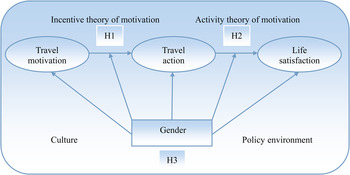
Drawing on previous literature and theoretical models, including the incentive theory of motivation and activity theory of ageing, the travel motivation–action–life satisfaction model was proposed as a conceptual framework to guide the present study, with hypothesised relationships shown in Figure 1. Three hypotheses were identified:
-
• Hypothesis 1: Greater travel motivations lead to higher travel frequency in older adults.
-
• Hypothesis 2: Higher travel frequency leads to older adults' greater life satisfaction.
-
• Hypothesis 3: Male and female older adults present different patterns of travel and life satisfaction.
Conceptual framework: the travel motivation–action–life satisfaction model.

Methods
Participants
Data was collected using a cross-sectional questionnaire survey approach. The target population of this study was adults of 60 years and older who were users or members of local senior centres. A purposive sampling strategy was used for recruiting participants. Service organisations for older adults were invited to help facilitate the identification of potential participants. Invitation letters describing the study were sent by letter mail or by e-mail to various District Elderly Community Centres (DECCs), Neighbourhood Elderly Centres (NECs) and the Institute of Active Ageing in Hong Kong. A total of two DECCs, two NECs and an Institute of Active Ageing in the three districts of Hong Kong (Hong Kong Island, Kowloon and New Territories) agreed to facilitate the implementation of the study. The person in charge of each participating centre assisted the researchers in the identification and recruitment of study participants by distributing recruitment leaflets. Participants were eligible for the study if they: (a) were Chinese and aged 60 or over, (b) physically living in Hong Kong, and (c) were cognitively fit for having normal conversations with interviewers. A total of 520 eligible participants were approached, and a total of 415 participants successfully completed the survey questionnaire.
Data collection
Data collection took place between December 2013 and April 2014, using a structured survey questionnaire in individual face-to-face interviews with the participants at the participating service organisations. Prior to the interviews, eligible participants were given an information sheet describing the purposes of the study, and verbal consent to participate in the study was obtained. Five undergraduate students from a health and social sciences faculty at a university in Hong Kong assisted with the collection of data. Prior to data collection, the five students attended three training sessions led by the first author. The first two sessions of training made them clearly informed of the objectives of the study and familiar with all the procedures to conduct the survey. The third session of training aimed to enhance inter-rater reliability by reaching consensus on the most appropriate sequence and ways of asking the questions so as not to bias the responses. Regular meetings and supervision sessions were held over the course of data collection. Fifteen pilot interviews were first conducted by the five trained students and some minor revisions were made to the questionnaire so as to ensure that the structure and wordings of the questionnaire were understandable to the target audience in the study.
Of the 415 participants who completed the survey questionnaire, fewer than 5 per cent of the participants reported a missing answer in the questionnaire.
Measurement
The study questionnaire included items assessing participants' socio-demographic characteristics, travel motivations, travel actions and life satisfaction.
Socio-demographic characteristics
Information was collected on a number of socio-demographic characteristics, including age, gender, employment status, educational level and health status. Age was reported as chronological age. Categories for measuring employment status included working full-time or part-time, students, retirees, homemakers and others. Educational attainment categories included no formal education at all, primary education only, secondary education Form 1–3, secondary education Form 4–7, and post-secondary or above. Health status was assessed based on self-reported medication status (need medications or not needed) and self-care capabilities (completely capable, need some assistance, fully dependent on others).
Travel motivations
Travel motivations were assessed using an adapted version of the Cruising Motivation Scale. The original 13-item, five-point scale developed and validated by Hung and Petrick (Reference Hung and Petrick2011) contains four domains including self-esteem and social recognition (e.g. I travel to increase my feelings of self-worth), escape or relaxation (I travel to give my mind a rest), learning or discovery and thrill (e.g. I travel to experience other cultures) and bonding (e.g. Because my friends/family members want to travel). For each item, participants were asked to indicate the extent to which they agreed (ranging from ‘strongly disagree’ to ‘strongly agree’) with the statements under each domain. The scale was translated from English to Chinese with the assistance of a bilingual scholar. As the original scale was used to measure the motivations for cruise travelling, some of the items were adapted for the purposes of the current study so as to facilitate more accurate assessment of participants' general travel motivations. The adapted nine-item version was validated using confirmatory factor analysis, and it has a satisfactory level of internal consistency, with the composite reliability of all domains above 0.70.
Travel actions
Different scales of measurement were used in assessing travel actions in previous studies, which included dichotomous (Baloglu and Shoemaker Reference Baloglu and Shoemaker2001), three-point categorical scale (Kelly Reference Kelly1980), five-point Likert scale (Inbakaran, Jackson and Zhang (Reference Inbakaran, Jackson, Zhang, McDonnell, Grabowski and March2007), six-point categorical scale (Ajzen and Driver Reference Ajzen and Driver1991), seven-point scale (Ryu and Han Reference Ryu and Han2010) and nine-point semantic differential scale (Pizam and Calantone Reference Pizam and Calantone1987). To avoid different interpretations of point scales in this study, travel actions were measured by asking participants to identify and report the actual total number of trips (both local and outbound trips) that they had taken in the past 12 months, and over the last three years.
Life satisfaction
Respondents' life satisfaction level was assessed by the Chinese version of the Satisfaction with Life Scale (SWLS) (Diener et al. Reference Diener, Emmons, Larsen and Griffin1985). This five-item seven-point scale (ranging from ‘strongly disagree’ to ‘strongly agree’) was developed to measure personal judgement of satisfaction with one's life. The total scores of the index range from 5 (lowest level of life satisfaction) to 35 (highest life satisfaction). The Cronbach's alpha of this Chinese version of SWLS in the present sample was 0.93, indicating a very satisfactory reliability level.
Data analysis
SPSS version 20 and AMOS version 20 were used for data analysis. First, descriptive analyses were conducted to describe participants' socio-demographic characteristics and information about their travel motivations, actions and life satisfaction. Structural equation modelling was performed to examine the reliability and validity of the measures used, and to test the goodness-of-fit of the proposed travel motivation–action–life satisfaction model. Invariance testing was conducted to compare male and female participants on the tested model.
Results
Respondents' profile
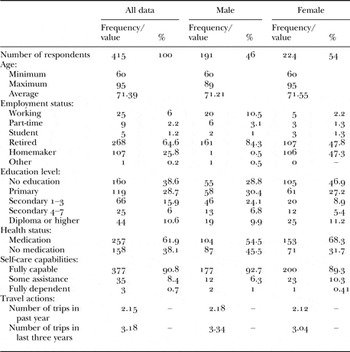
The average age of the 415 participants was 71.4, ranging from 60 to 95 years; 191 participants (46%) were male and 224 (54%) were female (Table 1). The majority of respondents were retired (64.6%) and a quarter of respondents were homemakers (25.8%), with only a small number working either full-time (6%) or part-time (2.2%). While most male participants had retired from work (84.3%), less than half of female participants were retirees (47.8%), while the other half were mainly homemakers (47.3%) who had never participated in the workforce. Participants had a generally low education level, with more than one-third having no formal education (38.6%) and over a quarter having only completed primary school (28.7%). A very small number completed secondary school education (6%) or obtained a diploma or higher education (10.6%). Male participants were generally more educated than female participants, with nearly half of the women having no formal education (46.9%) compared to less than one-third of men (28.8%). With respect to health status, most participants took medication on a regular basis (61.9%), and only about one-third did not need medication (38.1%). More female participants (68.3%) took medication on a daily basis than men (54.5%). However, most participants (90.8%) were fully capable of carrying out daily activities without help from others, with only a small number requiring support (9.1%).
Participants' socio-demographic profile

Measurement and model testing
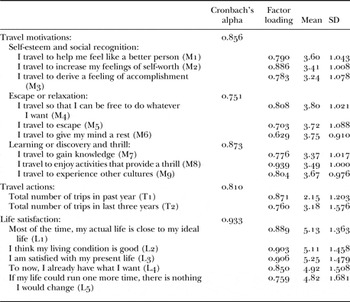
The measurement scales were first tested with pooled data for reliability and validity. The original travel motivation measurement scale developed by Hung and Petrick (Reference Hung and Petrick2011) contains four dimensions, namely self-esteem and social recognition, escape or relaxation, learning or discovery and thrills, and bonding. After the ‘bonding’ dimension and two self-esteem and social recognition items were removed due to low factor loadings, the reliability and factor loadings were generally satisfactory. Cronbach's alpha values were above 0.7 for all dimensions of the final travel motivation measure, implying acceptable reliability (Table 2). Factor loadings for all remaining motivation measurement items were above 0.6, and all items were found to contribute significantly to the underlying construct at a 0.001 level, which suggests satisfactory convergent validity of the travel motivation measurement scale (Bagozzi and Yi Reference Bagozzi and Yi1988; Netemeyer, Boles and McMurrian Reference Netemeyer, Boles and McMurrian1996).
Results of confirmatory factor analysis

Note: SD: standard deviation.
Travel actions were measured by the total number of trips that participants had taken in the past 12 months as well as over the last three years. The mean value for total number of trips in a year was 2.15, and the mean value for total number of trips in three years was 3.18. The Cronbach's alpha value for the travel actions measure was 0.810, demonstrating a satisfactory reliability level of the measure. The factor loadings of the two measurement items were above 0.7, and the two items contributed significantly to travel actions at the 0.001 level.
Five measurement items were used to measure participants' life satisfaction. Both reliability and factor loadings were satisfactory, with Cronbach's alpha values larger than 0.9 and factor loadings higher than 0.7. Factor loadings for all measurement items were significant at the 0.001 level, signifying a satisfactory level of convergent validity.
Inter-correlations among the variables (travel motivations, travel actions and life satisfaction) were assessed to test the discriminant validity of the study variables further. All correlation values were far below 0.85, which is the threshold value suggested by Kline (Reference Kline2005), thus establishing the discriminant validity of the three study measures.
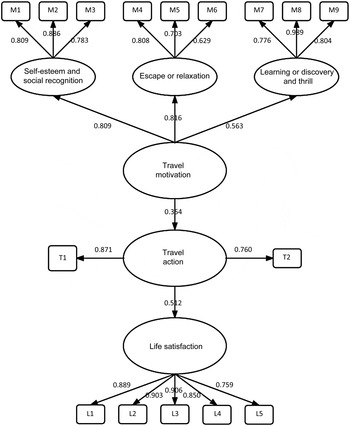
The model fit and hypotheses were further tested in AMOS (Figure 2). The model fit indices suggested that the proposed model had an acceptable fit with the data-set (Root Mean Square Error of Approximation (RMSEA) = 0.086; Comparative Fit Index (CFI) = 0.929; Normed Fit Index (NFI) = 0.906; Incremental Fit Index (IFI) = 0.927; Tucker–Lewis Index (TLI) = 0.912). Consistent with the first two hypotheses, results showed that greater travel motivations led to higher travel frequency in older adults (β = 0.354; standard error (SE) = 0.110; t = 5.335; p < 0.001), and that higher travel frequency further led to older adults' greater life satisfaction (β = 0.512; SE = 0.058; t = 9.621; p < 0.001). Further investigations suggested that 12.5 per cent of variance in travel actions were explained by travel motivations and that 26.3 per cent of variance in life satisfaction was explained by travel actions.
The tested travel motivation–action–life satisfaction model.

Model and means comparisons between male and female older adults
Model comparisons: invariance testing
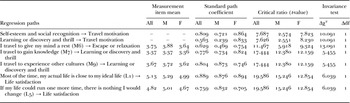
Invariance testing was conducted to compare findings for male and female participants on the tested model. Prior to invariance testing, a baseline model was formed for comparison. The hypothesised model was tested for each group after confirming its acceptable fit with pooled data. The model has acceptable fit for both male (CFI = 0.909; IFI = 0.910) and female groups (CFI = 0.914; IFI = 0.915), enabling the establishment of the baseline model for the invariance tests. In the invariance testing, all structural and measurement regression paths were forced to be invariant across the two groups, and changes in chi-square values were recorded (measurement weights: Δχ2 = 27.739, Δdf (degrees of freedom) = 10 (structural weights: Δχ2 = 16.626, Δdf = 4). As significant changes in chi-square values were found in both measurement and structural weights, invariance tests were further executed on each regression path across the two groups to identify the path causing the variance. The tested model was invariant in most aspects across two groups, with only seven out of 19 regression paths variant between male and female groups (Table 3).
Significant regression paths in invariance tests

Notes: M: male. F: female. df: degrees of freedom.
Variant regression paths include: (a) Self-esteem and social recognition → Travel motivation; (b) Learning or discovery and thrill → Travel motivation; (c) ‘I travel to give my mind a rest’ → Escape or relaxation; (d) ‘I travel to gain knowledge’ → Learning or discovery and thrill; (e) ‘I travel to experience other cultures’ → Learning or discovery and thrill; (f) ‘Most of the time, my actual life is close to my ideal life’ → Life satisfaction; and (g) ‘If my life could run one more time, there is nothing I would change’ → Life satisfaction. Further investigations suggested that while travel motivations explained a similar percentage of variance in travel actions across male (15.2%) and female groups (10.9%), travel actions explained greater variance in life satisfaction among men (33.4%) than women (19.1%).
Means comparisons: travel motivations, actions and life satisfaction
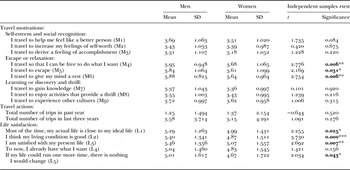
An independent samples t-test was conducted to assess differences in measurement items between male and female participants (Table 4). No significant differences were observed in travel actions between male and female groups in both one-year and three-year time periods. However, men and women differ significantly in both escape or relaxation motivations and life satisfaction. Men were more likely to travel in order to fulfil escape or relaxation needs and were more likely to report better life satisfaction than their female counterparts.
Comparison of means between males and females in travel motivations, actions and life satisfaction

Note: SD: standard deviation; *p < 0.05; **p < 0.01; ***p < 0.001.
Discussion
In this study, a structural equation model was used to test the fitness of the proposed travel motivation–action–life satisfaction model, focusing on the effects of travel motivations on older adults' travel actions, the effects of travel actions on older adults' life satisfaction, as well as differences in travel and life satisfaction among male and female older adults. The study findings suggested an adequate fit between the model and the actual data, and all three hypotheses embedded in the model were supported, with 12.5 per cent of variance in travel actions explained by travel motivations, 26.3 per cent of variance in life satisfaction explained by travel actions, and gender differences detected in travel motivations and life satisfaction.
Older adults' travel motivations were found to effectively stimulate travel actions. The commonly used taxonomy of travel motivations, including enhancing self-esteem and social recognition, seeking escape and relaxation, and promoting learning, discovery and thrills, were found to be relevant for older participants. The findings of the present study revealed that older adults were more attracted to escaping from daily routines and improving self-esteem and social recognition, rather than seeking opportunities for learning, discovery and thrills. These findings were consistent with previous studies that described age-related differences in travel motivations, with older adults being motivated more by opportunities for relaxation and change from normal routines (Batra Reference Batra2009; Jönsson and Devonish Reference Jönsson and Devonish2008), while younger adults were motivated more by new experiences and adventures, experiencing new cultures, and socialising with family and friends (Batra Reference Batra2009; Collins and Tisdell Reference Collins and Tisdell2002; Horneman et al. Reference Horneman, Carter, Wei and Ruys2002; Smith and Costello Reference Smith and Costello2009). Contrary to these findings, other studies have reported that older travellers are more likely than younger travellers to seek new knowledge, experiences or discoveries (Jönsson and Devonish Reference Jönsson and Devonish2008). The inclusive results illustrate the need for further research to examine specific travel motivations among different older adult age groups, and between older and young adults.
Findings of this study affirmed that travel as a form of leisure activity could increase older adults' life satisfaction. This was concordant with activity theory, which suggests that participation in travelling activities can help older adults maintain involvement in different domains of life and interactions with other people, which can further promote life satisfaction and quality of life. Previous studies with reference to activity theory found that for older adults, participation in activities, including leisure and travel, were associated with greater mental health and life satisfaction (Carlson et al. Reference Carlson, Kuo, Chou and Clark2013; Everard Reference Everard1999; Everard et al. Reference Everard, Lach, Fisher and Baum2000). Research which examined the relationships between participation in activities and wellbeing and life satisfaction emphasised opportunities for social connections and the importance of social relationships (Carlson et al. Reference Carlson, Kuo, Chou and Clark2013; Everard Reference Everard1999; Litwin and Shiovitz-Ezra Reference Litwin and Shiovitz-Ezra2006). In the context of travel by older adults, preparing travel information before departure, discussing with others about travel itineraries, arranging accommodation and meals with family members or friends during travel, and sharing with acquaintances the joy and excitement after travel could provide older adults with opportunities for social participation and interaction with others, as well as a sense of pleasure and satisfaction.
Previous studies described different patterns of travel motivations and travel actions between older men and women. In the present study, although no gender differences were observed in travel frequency, older men were more attracted by opportunities for escape and relaxation, and enjoyed better life satisfaction than older women, while older women were more motivated by improving self-esteem and social recognition, a desire to learn and discover new things, and thrills. The findings of the current study echoed some findings of previous research, including the greater motivating impact of knowledge seeking on female travellers compared to male travellers (Jang and Wu Reference Jang and Wu2006). However, the current study findings differed from other previous research findings, which reported that female travellers tended to be more attracted by relaxation activities (Andreu et al. Reference Andreu, Kozac, Avci and Cifter2005) and that novelty-seeking older travellers were more likely to be male (Lee and Tideswell Reference Lee and Tideswell2005). This reflects the huge diversity in older adult populations, among both male and female travellers.
Implications
The present study brought new knowledge for understanding older adults' diverse travel motivations and further confirmed the positive effect of travel on life satisfaction in an ageing population.
These findings have important implications for practitioners in the community services and tourism industry, and policy makers working on social policies to enhance the wellbeing of older adults. These findings made us understand that developing strategies for using travel as an intervention to promote life satisfaction of older adults and the optimisation of travel opportunities could be important to both the tourism industry and the social services sector. For instance, the findings of this study could help the travel business sector to be more aware of the characteristics and interests of older adults as a newly emerging market segment. As older travellers are often less concerned with time constraints than younger travellers (Sakai, Brown and Mak Reference Sakai, Brown and Mak2000), the travel industry could design travel activities that align better with the various travel motivations of the ageing cohorts among their customers. In addition to providing opportunities to escape from daily routines, travel programmes that serve to improve self-esteem and social recognition of older adults could be further developed to attract the involvement of this market segment. They should, however, be aware of the differences in travel motivations between male and female travellers, as well as between different age groups.
Policy makers and social service providers ought to acknowledge the importance of travel as a form of leisure activity that contributes to the life satisfaction and overall wellbeing of older adults. Retirement protection policy should consider the fact that older adults' financial status is also linked to travel opportunities, motivations and wellbeing (Bai, Lai and Guo Reference Bai, Lai and Guo2016; Chou and Chi Reference Chou and Chi2000; Hung, Bai and Lu Reference Hung, Bai and Lu2015; Read, Grundy and Foverskov Reference Read, Grundy and Foverskov2016; Scherger, Nazroo and Higgs Reference Scherger, Nazroo and Higgs2011). However, existing social security measures provide inadequate coverage and financial protection for older adults in Hong Kong. The lack of a comprehensive public pension system, insufficient coverage and low replacement rate of the existing Mandatory Provident Fund, and potentially stigmatising effects and low benefit levels of the social security programmes (e.g. Comprehensive Social Security Allowance, Old Age Allowance, Old Age Living Allowance) (Chow et al. Reference Chow, Wong, Chan, Ho and Bai2014), may add up to huge financial obstacles for older adults to travel. Policy efforts should focus on strengthening the multi-pillar retirement protection system for older adults.
For ageing service practitioners, organising structured programmes and providing resources to facilitate various travel opportunities for older adults (e.g. within their city, province or country of residence) could lead to a positive impact on their life satisfaction and wellbeing. Programmes supporting older adults to consider travel, even the form of local travel, as a leisure or lifestyle choice could be beneficial. Older adults should be better equipped with knowledge, skills and safety awareness related to travel. Service practitioners may also consider organising some post-travel sharing activities, interest groups and learning activities to better fulfil older adults' self-esteem and social recognition needs, learning needs, as well as social interaction needs. In addition, as previous research findings showed that leisure participation in middle age would predict the participation level in later life (Agahi, Ahacic and Parker Reference Agahi, Ahacic and Parker2006), middle-age adults should be encouraged to nurture travelling habits and related skills. Travel itself can also help to facilitate the process of maintaining one's preference, lifestyle and social participation level from mid-life to later life.
As longevity increases with health-care technology advances, life after age 65 accounts for an increasing part of the lifespan. Younger baby-boomers are portrayed as better educated and more independent than the earlier age cohorts. They are faced with more service choices and possibilities, and have a better spending power in later life than older people in the past (Daneshkhu Reference Daneshkhu2014). The needs of the increasingly diverse ageing populations should be better attended to, and older adults should be provided with more opportunities to reap the fruit of social development and enjoy later life (Bai Reference Bai2016). Results of this study showed that on average older people had travelled more than twice in the past 12 months prior to the study. Tourism for older people is a growing market potential for the business sector, meanwhile, travel programmes and related activities are meaningful strategies and tools for the social service sector to adopt to enhance the quality of life and sense of happiness and wellbeing of their ageing clients.
Limitations
Several limitations in the present study should be acknowledged. First, this study was conducted in Hong Kong, a cosmopolitan metropolis in China, and many people in Hong Kong have a keen interest in travel. A recent Visa Survey showed that Hong Kong people spend more than half of their holidays on travelling (Visa 2015). Thus, one should be cautious about generalising the findings to older populations in other places in China, especially those who live in small cities or rural areas. Second, although diversity and representativeness of older participants were maximised by recruiting participants with the assistance of various community centres and an institute of active ageing, we were unable to use random sampling due to budget constraints. Third, the results of the present study suggested a positive relationship between travel motivations and travel frequency, as well as between travel frequency and life satisfaction in older adults, but the existing data and analysis do not allow us to identify the tipping points for such positive relationships. This is worth further investigation in future research. Fourth, the present study has focused more on travel frequency; it would be worthwhile for future studies to shed light on other aspects of older adults' travel behaviours such as expenditure, travel companions, travel destinations and length of travel, as well as on how these aspects are influenced by their travel motivations and further affect their life satisfaction.
Acknowledgements
We would like to thank Mr Wing Hong Chau, Ms Yan Wah Choi, Ms Ching Nga Lam, Mr Yu Cheong Leung and Ms Man Yee Yau for their help and patience in data collection for this study. This work was supported by the Hong Kong Polytechnic University (grant numbers 1-ZVGD, A-PK55 and G-YM03).