

Research on autocracies in comparative politics and international relations has surged in the past decade. In an effort to understand not just how dictatorships differ from democracies but also to examine how dictatorships differ from one another, this research looks at variation in different forms of non-democratic rule. Studies of international conflict, civil war, international cooperation and commitments, nuclear proliferation, repression, international trade, terrorism, foreign investment, and autocratic survival demonstrate that variation within the group of countries categorized as non-democracies provides substantial leverage on explaining many important outcomes. This study introduces newly coded historical data to identify the latent dimensions of autocratic rule.
This paper makes two contributions. First, we establish that detailed historical data on the relationships between the leader, the party, and the military in autocratic contexts provides information that is largely orthogonal to commonly used measures of the level of “democraticness.” This suggests that dictatorships differ from each other on dimensions that cannot be measured using common democracy variables. While many scholars implicitly make this assumption when using autocratic regime types in applied research, this paper provides evidence to confirm this supposition.
Second, this paper introduces new, time-varying data and uses it to construct measures of latent dimensions of autocratic rule, an approach that differs from the existing practice of creating categorical typologies of autocratic regimes.Footnote 1 We use an exploratory factor analysis approach to structure time-varying information so that we can explore the extent to which different variables—which may measure distinct concepts—capture theoretically-relevant variation in autocracies. The Geddes (Reference Geddes1999) typology of autocracies, upon which we build, has existed since the late 1990s. Since, scholars have introduced new typologies for categorizing non-democratic rule (Hadenius and Teorell, Reference Hadenius and Teorell2007; Gandhi, Reference Gandhi2008; Goemans et al., Reference Goemans, Gleditsch and Chiozza2009; Cheibub et al., Reference Cheibub, Gandhi and Vreeland2010; Svolik, Reference Svolik2012). After comparing the new data with extant data on autocracies, we demonstrate the utility of the time-varying features of the data by re-analyzing a study of dictatorships and conflict initiation (Weeks, Reference Weeks2014, Chapter 2).
1. Varieties of autocratic rule
Scholars of dictatorships offer several categorizations of autocratic regimes (Huntington, Reference Huntington1968; Wintrobe, Reference Wintrobe1990; Huntington, Reference Huntington1991; Chehabi and Linz, Reference Chehabi and Linz1998; Geddes, Reference Geddes1999; Hadenius and Teorell, Reference Hadenius and Teorell2007; Cheibub et al., Reference Cheibub, Gandhi and Vreeland2010). During the height of the third wave of democratization in the 1990s, research turned to studying these transitions, which in turn spurred even more regime categorizations focusing on hybrid or transitional autocracies—countries that had the trappings of democracy, but where incumbent leaders and parties did not leave office in fair and free elections or where political participation was still severely restricted (Karl, Reference Karl1995; Diamond, Reference Diamond2002; Schedler, Reference Schedler, Landman and Robinson2009; Levitsky and Way, Reference Levitsky and Way2010). Our study builds on a categorization of dictatorships generated from the question: “who rules constrained by whom?” (Brooker, Reference Brooker2000). This approach draws basic insights from the sociological literature on military institutions and party organizations. It treats the interests and preferences of individuals and organized groups, such as the military or ruling party, that are able to influence autocratic decision-making as central to the task of distinguishing types (Janowitz, Reference Janowitz1960; Weber, Reference Weber1964; Huntington, Reference Huntington1968; Nordlinger, Reference Nordlinger1977; Linz, Reference Linz2000).
Our starting point for identifying the structure of autocratic rule is the Geddes' typology, which identifies individual autocratic regimes. A regime is a set of formal and informal rules for choosing leaders and policies (Geddes et al., Reference Geddes, Wright and Frantz2014). The rule central to distinguish one autocratic regime from another in the same country is the rule that identifies the group from which leaders can be chosen and determines who influences leadership choice and policy. To remain in power, leaders must retain the support of members of this group, but leaders also have substantial ability to influence the membership of the group, especially after initial leadership selection. Autocratic regimes differ from autocratic spells (periods of uninterrupted non-democratic rule) and the tenure of individual autocratic leaders. For example, the post-1979 clerical regime in Iran is distinct from the pre-revolutionary regime under the Shah. These two regime together constitute one autocratic spell because there was no democratic interlude between them. The clerical regime has had multiple leaders, Ruhollah Khomeini and his successor Ali Khamenei.
The original Geddes classification reflects three ideal types of autocracy: Military, Party, and Personalist. Conceptually, these ideal types focus on the organized groups that bring autocratic leaders to power, namely military juntas and political parties (Geddes, Reference Geddes1999, 122). These are the “launching organization” or “seizure groups” that overcome collective action problems to place autocratic leaders in power (e.g., Haber, 2002; Geddes, Wright, and Frantz, 2018). Personalist dictatorships are those where the leader wins internal struggles for power with these organized groups. These ideal types therefore reflect the relative power of organized groups and the leader they ostensibly support. In contrast, democratic-looking institutions of accountability and constraint, such as legislatures and courts, are potential venues of political contest and decision-making delineated by formal (often written) rules that may, in some contexts, structure political interaction.Footnote 2 For formal institutions to structure political interaction that further accountability or constraint, humans, often organized into groups such as parties or militaries, must act collectively to enforce them.Footnote 3 Formal political institutions (conceived of as “rules of the game”) and the (relative) power of organized groups are therefore conceptually distinct areas of study, need not be collinear in measurement, and may be fruitfully explored separately or in combination with each other to examine how they produce outcomes of interest.
The original typological classification used questions theoretically relevant to Military, Party, and Personalist ideal types, and placed regimes in one category or another based on whether there were a relatively high number of affirmative answers to questions within a particular category (Geddes, Reference Geddes2003, 225). For example, if a regime received a high number of “Yes” answers to questions pertaining to personalist dictatorships but a low number on questions addressing military and party rule, the regime was classified as a personalist dictatorship. Hybrid regimes were those that scored relatively highly in more than one category of questions.
This approach to classifying regimes, while useful for some purposes, faces three issues that stem from classification of regimes into exclusive categories (Hadenius and Teorell, Reference Hadenius and Teorell2007; Svolik, Reference Svolik2012; Weeks, Reference Weeks2014; Wilson, Reference Wilson2014). First, using a relative cut-point on an index to delineate whether an individual regime falls into a particular category means that some concepts, which vary in degree across all dictatorships, are reduced to a binary categorization. The original classification addressed this issue by allowing for hybrid categories. However, this approach still obscures potentially relevant information.
Second, this method of aggregating information does not allow researchers to pinpoint the particular questions (and thus the concepts) that are most important for classifying regimes in one category and not another. For example, if a dictatorship is coded as party-based we do not know whether that is due to factors related to the organizational structure of the support party, to rules governing leader succession, or to both equally. The inability to distinguish different concepts that are used in the original classification of exclusive categories may lead to concept stretching. For example, researchers have used the variations of the Geddes typology to measure constraints on the leader (Weeks, Reference Weeks2008), the breadth and depth of the support coalition (Wright, Reference Wright2009), and the range of available coercive and co-opting strategies (Wilson and Piazza, Reference Wilson and Piazza2013). These studies argue that the relevant concept is captured in some of the original questions, but the exclusive categories may be measuring other important concepts as well. Using the original classification of exclusive categories, we do not know the relative weight of particular concepts used to place a regime in one category or another.
Finally, the original autocracy typology places a specific regime in the same category throughout its entire duration. This is problematic in some research applications that employ time-invariant typologies as explanatory variables because the historical information used to place a regime in a particular category may not occur until after the outcome of interest has been observed. For example, Kim Il Sung invaded South Korea in June 1950, initiating an inter-state conflict; however he purged a rival military officer, Mu Chong, in December 1950 after the conflict had begun (Song and Wright, Reference Song and Wright2018, 14). This purge, as well as subsequent personalization of the Korean Worker's party in the 1950s, occurs after an outcome of interest, namely, conflict initiation. If dictators use conflict situations to personalize their rule, as the Kim example suggests, then a correlation between a time-invariant indicator of personalist regime and conflict initiation—which might be interpreted as personalist dictatorships being more conflict-prone than other autocracies—could get the purported explanatory relationship backwards.
New data, combined with our approach, address these issues by using the newly coded variables—some of which vary over time within regimes—to structure the information for exploration and comparison.Footnote 4 This approach does not use arbitrary cut-points in an index (except to assess the number of factors); it allows us to see which raw variables contribute the most information to each dimension; and it allows for information on multiple dimensions to vary over time within a particular regime.Footnote 5
2. Latent dimensions of autocratic rule
Our goal is to identify possible relationships between the measured variables that may correspond to latent features theorized in prior research by exploring the variation in the newly coded historical data and comparing it with existing data. We view exploration and comparison as an important first step before constructing measurement models for applied analysis.Footnote 6
We begin with information from time-varying, yearly coding of questions used to create the original Geddes' typology. The data consist of 80 variables that capture information about the relationships between the dictator, the political party that supports the regime (if there is one), and the military.Footnote 7 There are 280 distinct autocratic regimes in 118 countries for the year 1946 to 2010, constituting 4591 country-year observations. The variable names, their value definitions, and summary statistics are in the online Appendix.
We use an exploratory factor analysis to structure the information. Figure A-1 in the online Appendix shows the eigenvalues. Visually there are four factors that capture substantial variation in items. For the subsequent analysis, we only analyze the first three factors, though we believe the fourth may be an important dimension of the data for future research.Footnote 8 We allow the factors to be correlated with each other by using an oblique rotation rather than assuming orthogonality among factors: the first (party) component is negatively correlated with the second (military, −0.17) and the third (personal, −0.17) while second and third are positively correlated (0.15).
Figure 1 shows the extent to which individual items (variables) contribute information to each of the first three dimensions.Footnote 9 The variable names are listed along the horizontal axes while the component loadings are depicted on the vertical axis. Larger positive values indicate a strong positive correlation between the variable (item) and the latent dimension (factor). We label the first factor Party because the items that load most strongly on this factor are conceptually related to the institutional strength of the supporting political party, for example: supportparty (whether the regime has a support party), localorgzs (whether the party has extensive local party organizations), partymins (the extent to which the party—as opposed to just the regime leader—controls appointment of cabinet ministers), and excomcivn (whether most of the party executive committee is civilian).
Dimensions of autocratic rule.
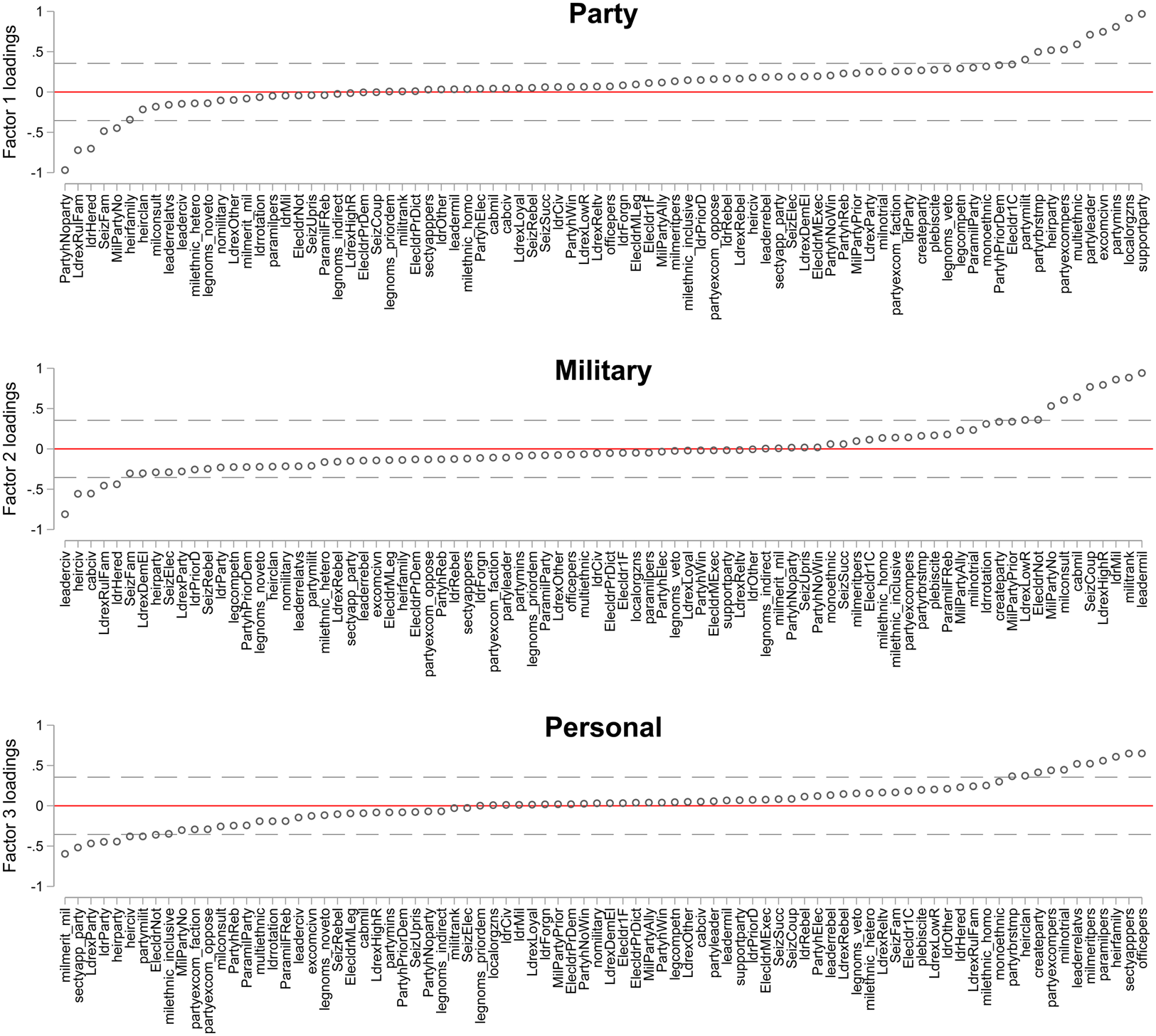
The items with high loading values on the second factor, correspond conceptually to military regimes: leadermil, which measures whether the regime leader was a member of the military prior to taking office, and leadermil, which indicates the military rank (e.g., general or colonel) if he was a member of the military prior to assuming power, load the most strongly. Regimes based on the military as an institution are more often than not led by highly ranked officers, not sergeants or majors.
Finally, variables that contribute information to a third dimension, such as sectapp_pers—which measures whether the regime leader personally controls key organizations in the security apparatus—and officepers—which measures whether the leader has discretion over appointments to high office—reflect the personal power of the leader. The regime leader, in this conceptualization, has more power when he controls appointments to high office and creates a separate security or paramilitary organization to counter the power of the existing military institution, especially the latter's capacity to credibly threaten a successful coup.
3. Case-based data validation: China
We use the case of Communist Party (CCP) rule in China to conduct case-based data validation. The CCP is coded as a dominant or one-party civilian regime during its entire time in power by standard autocratic typologies such as Geddes (Reference Geddes1999), Hadenius and Teorell (Reference Hadenius and Teorell2007), and Cheibub et al. (Reference Cheibub, Gandhi and Vreeland2010). Figure 2 shows the changes in the three dimensions in China over six decades, including the rise and fall of Mao's personal power as an increase in personalism in the late 1960s and subsequent decline in the 1970s.Footnote 10
Three dimensions of autocratic rule in China.

After the civil war, the CCP elite ruled China; and although Mao's power was rising relative to others in the party's inner circle, “decisions were usually made by a small group whose composition for over thirty years (until mid-1966) was amazingly stable” (Robinson, Reference Robinson and Scalapino1972, 157). Between 1959 and 1961, moderates led by Liu Shaoqi and Deng Xiaoping, whose support came especially from the party machine, gained sway while Mao lost influence (Shinn and Worden, Reference Shinn, Worden, Worden, Savada and Dolan1987). In mid-1966, however, Mao launched the Cultural Revolution to attack the party bureaucracy and undermine moderate members of the top leadership like Liu and Deng (Israel, Reference Israel, Cohen and Shapiro1974, 405). Mao used mass rallies at which crowds responded “ecstatically” to mobilize popular support for the campaign and to “intimidate opponents” within party (Israel, Reference Israel, Cohen and Shapiro1974, 412, 423). The military, commanded by a Mao protégé, provided transport to rallies and support for Red Guard volunteers as they fanned out around the country (Israel, Reference Israel, Cohen and Shapiro1974, 414). The leaders who had been most involved in building the party were attacked by Red Guards and purged during the Cultural Revolution (Klein and Hager, Reference Klein, Hager, Cohen and Shapiro1974, 225), as were state and party bureaucracies, which weakened the party's hold on the state apparatus. The Central Committee Secretariat, the party's administrative apparatus, was abolished (Brooker, Reference Brooker1995, 93–4). At the 1969 CCP Congress, purged party stalwarts were replaced on the Central Committee and Politburo by military officers and other Mao loyalists, including his wife—the peak of Mao's personal dominance over the party (Scalapino, Reference Scalapino and Scalapino1972, 96–8; Klein and Hager, Reference Klein, Hager, Cohen and Shapiro1974, 224–6, 239).
By the early 1970s, the party had begun to reassert itself. After Mao died in 1976, members of the Politburo quickly arrested Mao's wife and the rest of the “Gang of Four” leaders of the anti-party faction to prevent a power struggle. In 1977, the Central Committee exonerated Deng Xiaoping, and he resumed all posts. Factional struggles continued during the late 1970s as Deng gradually reasserted his and the party pragmatists' dominance (Shinn and Worden, Reference Shinn, Worden, Worden, Savada and Dolan1987). In 1980 the Party Secretariat was reconstituted (Ristaino, Reference Ristaino1987). The post of party chair was abolished in 1981 in favor of a more collegial senior leadership (Brooker, Reference Brooker1997, 25). From Deng's death until Xi's consolidation of power in the mid-2010s, the party enforced term limits and mandatory retirement for top leaders.
This example illustrates that, with appropriate data, it is possible not only to measure the level of personalism as it varies over time within a particular regime but that we can measure features of authoritarianism as they vary over time within the rule of an individual leader, such as the rise and fall of Mao's personal power. This feature of the data improves on extant typologies, such as Cheibub et al. (Reference Cheibub, Gandhi and Vreeland2010) and Weeks (Reference Weeks2012), that capture some of the variation between leaders within a particular regime, but change little over time within the tenure of leaders.
4. Latent dimensions of autocratic rule and measures of democracy
This section demonstrates that the dimensions of autocratic rule are not correlated with the commonly-used measures of democracy. Figure 3 shows a correlation matrix between dimensions of autocratic rule and extant democracy variables (Unified Democracy Score, or UDS; composite Polity2; V Dem polyarchy; and Freedom House). We also compare these variables to a variable measuring Leader duration to provide context for the correlations. Darker cells denote greater (absolute value) correlations. The democracy scores highly correlate with each other, forming a distinct dark block in the matrix. None of the autocratic dimensions correlate with cross-national measures of democracy. The strongest correlation for the autocracy dimensions is the correlation between the Personal dimension and Leader duration.
A correlation matrix of our three latent dimensions of autocratic structure, and several measures of democracy. Visually, darker cells show higher correlation. Democracy scores largely group together as a high correlation block, while our latent dimensions are not in that block.

Figure A-3 extends this analysis to sub-components of democracy from the Varieties of Democracy project and Polity. The autocratic dimensions are not highly correlated with any of the conceptual democracy variables (liberal, participatory, deliberative, egalitarian) or with accountability. Sub-components of Polity related to executive recruitment are correlated at roughly 0.5 with the Party dimension (openness of executive recruitment) and the Military dimension (negatively correlated with competitiveness and regulation of executive recruitment). These correlations indicate that some autocracies with high party autonomy have elected leaders (e.g., PRI in Mexico); and many autocracies with an autonomous military have leaders who come to power in coups, which reflects low competitiveness and regulation of leadership selection. Notably, however, the third dimension, Personal, is not highly correlated with any of the democracy sub-components.
5. Latent dimensions of autocratic rule and extant measures of autocracy
5.1. Extant typologies
To assess convergent and divergent validity, we compare the latent autocratic space to two related autocratic typologies, from Weeks (Reference Weeks2012) and Geddes et al. (Reference Geddes, Wright and Frantz2014). The latter is an update of prior versions of the Geddes' typology. The former builds on information from the original questions used to code the Geddes' typology.
To measure personal and military traits, Weeks (Reference Weeks2012, 356) uses eight variables for personalism and five for military rule. From this she: (a) “create[s] indices representing the proportion of ‘yes’ answers on the two dimensions”; and (b) “create[s] dummy variables for each of the four regime types, using a cutoff of 0.5 to classify countries as either personalist or nonpersonalist, or military or civilian.” Combining information from these dummy variables creates four “types” of autocratic regimes: strongman, which is military and personalist; junta which is military but not personalist; boss which is not military but personalist; and machine which is neither. Adding two more types completes the universe of autocracies: monarchy and other.
Table 1 shows the bivariate correlations between the three dimensions and these extant types, ordered by how well they correlate with the third, personalist, dimension. The first factor is most strongly correlated with Party regime (0.61), indicating convergent validity, and negatively correlated with Monarchy and Weeks' Military index. The second dimension is most strongly correlated with Weeks' Military index (0.82), Military regime (0.61), Strongman (0.48), and Junta (0.45), again indicating convergent validity for this factor. Finally, the third factor is most strongly correlated with Weeks' Personalist index and Personalist regime, indicating convergent validity for this factor. These correlations confirm that the first factor captures party strength, while second measures military strength, and the third personalism. Further, Monarchy is (weakly) negatively correlated with the first two factors, suggesting that it might be described as a regime type with both weak parties and weak military autonomy.
Correlations of extant typologies with three dimensions of autocratic structure.

Figure 4 plots the three latent dimensions for each of the regime categories in Geddes et al. (Reference Geddes, Wright and Frantz2014). The blue points in each plot represent one regime-year observation for those in each category. The vertical gray lines show the distance (height) from the point to the (x,y) plane. The top left plot for Dominant party regimes show that almost all observations fall on the high half of the Party dimension, indicating stronger support parties. The top right plot for Military regimes shows that nearly all observations fall in the top half of the Military dimension. We can also visually distinguish between two clusters along the Party dimension, which shows that some military regimes (with high Military scores) have no (or a weak) supporting party, while others lie in the high half of the Party dimension. Further, there is substantial variation in both Dominant party regimes and Military regimes along the Personalism axis. In short, the top two plots show, first, that the vast majority of dominant party and military regimes fall in the expected space on their respective latent dimensions; and second, there is variation in the other dimension for each regime type.
Latent dimensions of autocratic rule, by Geddes, Wright, and Frantz (2014) typology.

Turning to the lower left plot in Figure 4, the points for the Personalist regime observations fall all along the Personalism axis. Further, there is substantial variation in the along the non-personalism dimensions. Finally, the lower right plot shows that Monarchies—with a few exceptions—tend to score low on the Military and Party dimensions.
These figures illustrate, first that though Military and Party are observed where we would expect them, there is substantial variation on other dimensions not used to categorized a particular regime. For example, though all Military regimes have high scores on the military dimension, there is variation in both party strength and personalism among this group of observations. A similar point holds for Dominant party regimes. Thus, the latent dimension approach allows us to measure variation in the world of autocracies that cannot be captured in exclusive regime categories. Second, observations coded as Personalist regimes by Geddes et al. (Reference Geddes, Wright and Frantz2014) do not all have high scores on the personalism dimension—an anomaly we explain below.
5.2. Variance decomposition
Next we examine variation across time in the latent dimensions and compare this variation with that contained in the Weeks' ordinal ratings of military and personalist features of autocracies. This exercise shows us whether the data can be used to examine questions that pertain to changes over time in autocratic features. In some applications we want to know, for example, not just whether Saddam Hussein's regime in Iraq is more personalist than the theocracy in Iran but also what factors explain why Hussein was able to consolidate personal power during his reign and why the Ayatollahs who have ruled Iran's regime have not. To examine the rise of personalist power for an individual leader, we need a measure of personalism that has substantial variation over time within a leader's tenure.Footnote 11
We decompose total variation in each variable into two components: “between” variation—or the difference between cross-sectional units—and “within” variation—or the variation over time within these cross-section units. We employ two types of cross-sectional units: autocratic regimes and individual leaders. Recall that a regime, as defined by Geddes et al. (Reference Geddes, Wright and Frantz2014), is a group of elite who rule, making policy and personnel choices, including the choice of regime leader. Importantly, many regimes have multiple leaders, as has been the case for CCP rule in China. As we consider the variance in the latent dimensions, it is important to understand that variance in the Geddes' autocratic regime typology is time-invariant during a particular regime; there is zero “within” variation.
Figure 5 plots the ratio of “within” variation to total variation for each variable along the vertical axis. This measure tells us the extent to which the variation occurs over time within cross-section units. The horizontal axis represents the total variation in each variable. The left plot employs regimes as the cross-section unit, while the right plot uses leaders. We examine five variables in each plot: party, military, and personalist latent dimensions from an oblique rotation (discussed above) and Week's ordinal measures of military and personal features of autocracy. Among the latent dimensions, the variables for personalism show the highest “within” variance. Second, the personalist latent dimensions have more “within” variation than the Weeks' measure of this concept. For regimes, personalist variance is 33 percent “within”; for the Weeks' measure it is 19 percent. For leaders, variance for the latent measure of personalism is 26 percent “within” and for the Weeks' measure 11 percent.
Variance decomposition of autocratic regime variables.

These findings suggest not only that there is substantial variation over time in the latent dimensions of autocracy but also that the feature of autocracy with the most variation over time is personalism. Thus there is meaningful variation for modeling the rise and fall of personalist power using country-, regime-, or leader-fixed effects in applied research.
5.3. Extant data on military dictatorships and party institutions
The last two subsections compared the latent dimensions with extant data on autocratic typologies that measure personalism. There are a number of additional data sources that measure military and party features of dictatorships. In the online Appendix, we compare the latent dimensions with these variables. The first two latent dimensions—which capture party and military autonomy—are correlated with other existing measures of these concepts. For example, the first dimension correlates at 0.50 or better with four independent measures of parties; and the second dimension correlates at 0.75 or better with four measures of military regime. However, the third dimension—which we believe measures personalism—does not correlate at 0.35 or more with any institutional (legislature or party) or military variables. This suggests that this dimension measures new variation that is not captured in extant data.
Second, we recalculated the three latent dimensions employing: (1) the raw variables used to construct the latent measures; (2) extant data on formal political institutions (such as political parties) from these extant data sets (Gandhi, Hadenius and Teorell, DPI, and Svolik); and (3) Weeks' categories of Junta, Strongman, Machine, and Boss. This exercise shows that adding information from extant data does not alter the resulting estimates of the dimensions. We found that the dimensions calculated employing extant data in addition to the original data yield factors that are correlated at 0.985 or higher with the oblique dimensions we initially constructed. This suggests that using time-varying data from our project encompasses the variation in existing data sets. That is, there is almost no additional information from extant data that substantially changes the latent dimensions of autocracy that we construct with our data. This is not entirely surprising because the concepts we measure—in particular whether there is a supporting political party and whether the leader is from the military—exist in other data sets as well.
6. Improving existing approaches
While the correlations presented in Table 1 show that the three dimensions in our latent space correspond to categories from related typologies, visual inspection of Figure 4 shows there may be some mis-classified observations. Further, typologies such as Geddes et al. (Reference Geddes, Wright and Frantz2014) and Weeks (Reference Weeks2012) resort to ad hoc categories for difficult-to-code cases. The Weeks' typology includes a substantial number in the Other category and the Geddes' typology has hybrid regimes, with the latest update adding a new category (oligarchies) to classify some cases. The latent dimensions approach addresses these issues.
First, we flag potentially mis-classified cases. For example, the monarchy category in these typologies has some cases with relatively high values on first dimension, suggesting that these cases function differently than other monarchies. Examining these cases suggests as much. Burundi's first post-independence regime (until a 1966 coup) and the Shah's regime in Iran were monarchies, where leaders were chosen by hereditary succession rules. But each had a political party that supported the regime and a nontrivial share of the cabinet was from the party—features of party strength absent in most monarchies. The latent dimension approach identifies cases such as these where typologies may miss important aspects of party strength that are theoretically important in some applications.
Second, the Geddes typology contains four hybrid categories, including one for regimes that have features of military, party, and personalist dictatorships. One approach to dealing with these cases is to absorb them into another category (see e.g., Wright (Reference Wright2009)). The upper left plot in Figure 6 shows where military-personalist hybrid observations fall along two dimensions that capture military strength (horizontal) and personalism (vertical). A prior expectation is that these observations, because they are military-personal hybrids, should cluster in the upper right corner. However, while they all fall above zero on the military dimension, they also fall in all areas along the personalist dimension. The upper right plot shows the observations in the party-personal category. While most lie in the cluster of observations to the right of zero on the party dimension, many fall into the lower portion of the distribution on the personalism dimension. One reason for this apparent anomaly is that personalism varies over time within regimes, as Geddes noted in her original coding scheme. In fact, she omitted the first three years of each regime from early regime classifications because so many autocracies were becoming more personalistic during these first years in power.
Personalist hybrid regimes. (a) Military-personal hybrids. (b) Party-personal hybrids. (c) Ethiopia, 1975–1991. (d) Personalism over time.

The lower left plot in Figure 6 shows where observations for one military-personalist hybrid regime, Mengistu's in Ethiopia from 1975 to 1991, lie in the space described by the second (military) and third (personalism) dimensions. The first three years of this regime are measured with low personalism (less than 0 on the vertical axis). Personalism changes over time, however, and by 1980 the measure reflects the centralization of power in Mengistu's hands. Initially, the dictatorship that ousted Emperor Haile Selassie in 1974 was governed by a committee made up of representatives of all military units (the Derg or PMAC). It was “controlled from below by the young officers of the army's various units” (Erlich, Reference Erlich1983, 475). The absence of a strongman led to the “need for consensus on the major decisions” (Erlich, Reference Erlich1983, 475). In 1977 Colonel Mengistu Haile Mariam defeated more moderate factions to become the third leader of the Derg and consolidated personal control over appointments and decision making. By late 1979, he had “restructured the PMAC and filled all key positions both in the PMAC and in his government with loyalists” (Haile-Selassie, Reference Haile-Selassie1997, 207). Then, to reduce the influence of all but a handful of officers, Mengistu initiated the Commission for Organizing the Workers' Party of Ethiopia (COPWE), which functioned as a highly disciplined party, to counterbalance the military represented in PMAC (Haile-Selassie, Reference Haile-Selassie1997, 232–3). Mengistu chaired the party, and party statutes gave him the right to appoint all members of its Central Committee, Executive Committee, and Secretariat as well issuing regulations for the admission of ordinary party members. Clapham (Reference Clapham1988, 70) reports that Mengistu “spent many hours interviewing and selecting” the party's leadership cadre. With control over the composition of both party and PMAC leaderships, Mengistu had achieved substantial personal discretion over regime decision-making by mid-1980. For the following decade, the regime is therefore measured as both highly personalist and with a high degree of military strength.
This example illustrates two improvements upon exclusive categories. First, hybrid regimes can be characterized along multiple, theoretically important dimensions. Second, many hybrid regimes are coded as such because the strength of a particular dimension (or concept) varies over time, as the bottom right panel of Figure 6 illustrates. For regimes coded as personalist-hybrid in the original Geddes' typology, we plot the distribution of the personalism scores in the first years of the regime and for subsequent years during the lifetime of the regime. For example, the solid red line depicts the distribution of personalism scores in the first year of the hybrid regimes. The dotted red line depicts the distribution for all subsequent years. We repeat this analysis for the first three years (blue) and the first six years (green), finding a similar pattern. This exercise demonstrates that personalism—at least in these hybrid regimes—increases over time.Footnote 12 Thus, the apparent mis-classification of personalist regimes along dimension 3 in the lower left panel of Figure 4 reflects the fact that these regimes are not highly personalistic during the early years but become more so later in the regime's lifetime.
7. Applied analysis
This section employs time-varying data on personalism in applied analysis. We discuss a direct measure of personalism constructed from the new data, and then test the measure in a model of conflict initiation (Weeks, Reference Weeks2014, Chapter 2) and a model of democratic transition (Geddes, Reference Geddes2003). The prior sections explored the data using factor analysis; we opted for this approach to examine the data, illustrate key concepts, and compare with extant data. However, the dimensions produced by exploratory analysis contain information from multiple concepts. For example, some variables that load strongly on the third dimension (as shown in Figure 1) are not coded to measure personalism but rather military autonomy (e.g., milmerit_mil, whether the military leadership controls promotion) and dominant party strength (e.g., sectyapp_party, whether the support party controls the security apparatus). These dimensions, as constructed from exploratory analysis, should therefore not be used in applied analysis.
Instead, we develop an item-response theory model using only variables that measure the concept of personalism and load strongly on the third dimension. Measurement models improve empirical testing of theoretically important concepts by providing a principled way of aggregating multiple measures of a similar concept, which may contain measurement error or temporal biases (Martin and Quinn, Reference Martin and Quinn2002; Treier and Jackman, Reference Treier and Jackman2008; Pemstein et al., Reference Pemstein, Meserve and Melton2010; Schnakenberg and Fariss, Reference Schnakenberg and Fariss2014). The manifest items describe whether the leader: makes access to office dependent on personal loyalty; creates a new support party after seizing power; controls appointments to the party executive committee; makes the party executive committee serve as a rubber stamp for his decisions; personally controls the security apparatus; promotes officers loyal to himself or from his support group, or forces officers from other groups to retire; creates paramilitaries or a new security force loyal to himself; and imprisons or kills officers from other groups without a fair trial (Geddes et al., Reference Geddes, Wright and Frantz2018).Footnote 13 Importantly, this measure, unlike that constructed from the exploratory factor analysis, does not include indicators of alternative concepts related to military autonomy and dominant party strength. We call this measure G-pers.
Figure 7 plots the item information functions (IIF) for the eight items in the latent estimate of personalism, or θ. The vertical axis measures the item discrimination parameter: higher values indicate more information in the latent estimate over a smaller range of θ values. The horizontal axis corresponds to the “difficulty” parameter: larger values indicate items for which observations have a higher estimate of θ. If the model accurately estimates latent personalism, more “difficult” items are those for which an observation must be highly personalist to observe a 1 for this item. This parameter captures how well an item splits high and low personalism cases at a particular point in the latent space.
Item information functions, 8-item model.

The item officepers is the most discriminating, while paramilpers is the least. The items officepers and sectyappers are the least “difficult” (i.e., placed furthest to the left on the horizontal axis) while createparty is the most “difficult.” The plot shows that the items split observations all along the latent space, as can be observed by noting that the peaks of the IIFs are spread across different values of θ, and not just bunched up around a fixed value such as 0. To demonstrate the utility of this new measure, we next re-analyze a model of dispute initiation in dictatorships and replicate and extend a model of autocratic regime collapse.
7.1. Dispute initiation
Weeks (Reference Weeks2014, Chapter 2) posits that personalist autocratic leaders are more likely to initiate interstate disputes than less personalist leaders because the former face fewer institutional constraints on their behavior. Further, because military junta leaders view the use of force more favorably than non-military leaders, the former are more likely to initiate disputes. Combining these logics suggests that personalist leaders with a military background (Strongmen, in Weeks' terminology) should be the most likely to initiate disputes.
We reproduce and extend the directed-dyad analysis of dispute initiation from Weeks (Reference Weeks2014, 48), which employs the raw Personalism and Militarism indices. We focus on the analysis with the raw indices (Table 2.3 in the original), rather than categorical variables (Table 2.2), because the former more closely matches G-pers. Examining these models also illustrate time-varying features of G-pers because Table 2.3 reports tests from pooled and fixed-effects (FE) logit models. While the pooled logit combines cross-sectional and time-varying information to identify a correlation between explanatory variables and the outcome, the FE estimator isolates the “within” or time-varying information.
The specifications in Weeks's study include the personalism (W-pers) and militarism (W-mil) indices, their interaction, and control variables. We reproduce the results from this specification; alter the sample to match that with non-missing data on the new personalism measure; and test the specification, substituting the new personalism measure for the Weeks' version. This last change also entails constructing a new interaction term between G-pers and W-mil.
Figure 8 reports results, with pooled estimates shown on the left and FE estimates on the right. Estimates shown with the diamond (⋄) on the left reproduce the results in Table 2.3, column 1 in the original: W-pers and W-mil are positive and significant while the estimate for the interaction term is negative and significant. Next we alter the sample to match that with non-missing data on G-pers.Footnote 14 We obtain almost the same estimates as the original. Finally, the estimates shown with the square symbol (□) substitute the G-pers for the Weeks' personalism index (and interaction term): estimates are slightly stronger than the original. Thus in the pooled tests, the new personalism measure performs almost exactly as extant data.
Personalism and dispute initiation.

The right panel repeats the same specifications for the FE model. Again, the original estimates reproduce those in column 2 of Table 2.3, and altering the sample does not change estimates. When substituting G-pers for the Weeks' index, however, the estimates diverge: none of the three variables of interest are statistically significant. This suggests that the findings differ when we employ a measure of personalism with more over-time variation.Footnote 15 Substantively, the original FE model indicates that personalism increases the risk of MID initiation by between 23 percent (low militarism) and 13 percent (high militarism); in contrast the same model with G-pers suggests personalism increases MID initiation by between 9 and 8 percent. The estimated marginal effect is less than half the original estimated effect.
To further illustrate why the two measures produce different FE results, online Appendix Figure D-7 unpacks the data for China and Libya. This exploration of the descriptive data illustrates both how the new personalism variable captures the rise of personalist rule over time within a leader's tenure and how this can sometimes—but not always—coincide with the relevant political outcome in an empirical application.
7.2. Regime collapse
Next we replicate a seminal study of autocratic regime collapse (Geddes, Reference Geddes2003), which finds that Personalist regimes are more resilient than Military regimes, but less resilient than dominant Party regimes. That is, dominant Party regimes are more stable than both Military and Personalist regimes. We employ a linear probability model (for ease of interpretation) with the following covariates: regime duration (polynomials), decade effects, prior democracy, GDP per capita (log), economic growth, and civil and international conflict. In lieu of region effects, we model unit heterogeneity unit heterogeneity with (country) random-effects.Footnote 16 First we test models with binary regime type indicators for Military and Personalist regimes, leaving dominant Party regimes as the baseline category. The first model in Figure 9 replicates the main finding in Geddes (Reference Geddes2003): Military and Personalist regimes are more likely to collapse than the baseline category, Party regimes. Next we substitute the time-varying measure of personalism (G-pers) for the binary indicator of Personalist regime. While the result for Military regimes remains positive and statistically significant, that for G-pers is reversed: personalism is associated with a lower likelihood of regime collapse. This finding reflects the fact that time-varying personalism is associated with a lower risk of the regime collapsing and transitioning to subsequent democracy but personalism has no effect on the likelihood of regime collapse that the results in a transition to a subsequent dictatorship (see online Appendix E). This result is consistent with the contention that personalization increases the risk of post-exit punishment for autocratic leaders and their loyal lieutenants, making them less willing to negotiate a peaceful transition to democracy (Escribà-Folch, Reference Escribà-Folch2013; Geddes et al., Reference Geddes, Wright and Frantz2014; Escribà-Folch and Wright, Reference Escribà-Folch and Wright2015, 64, 77; Geddes et al., Reference Geddes, Wright and Frantz2018, 212).
Autocratic regime collapse.

8. Discussion
This paper discusses problems researchers face when measuring features of autocratic rule, and then explores three latent dimensions of autocratic rule that contain substantially different information than existing measures of democracy. We show that the first dimension captures the strength of party rule, the second the military's institutional strength vis-a-vis the party and the leader, and a third dimension measures personalist power.
This approach improves upon existing categorical typologies by allowing users to produce continuous, time-varying measures of latent concepts. While the new data contain similar information as extant data on military and party dimensions of autocracy, they also contain unique information on personalism that, crucially, has substantial over-time variation to allow modeling the consolidation of personal power in the hands of the dictator.
Extant research has made less progress in the study of dictatorship than democracy, in part, because autocratic decision-making is often hidden, while policy making and leadership selection in democracies is relatively transparent (Lewis, Reference Lewis1978, 622). Decision-making opacity interferes with understanding of how dictatorships work. Often, small groups of elites in autocracies make decisions in informal settings. “[F]ormal institutions are not necessarily the place to look when you want to understand everyday operating procedures” in dictatorships (Fitzpatrick, Reference Fitzpatrick2015, 278). Legislative debates and votes may simply ratify policy choices made elsewhere, and cabinet ministers often implement decisions but do not make them.
Further, democracies publish vast quantities of data about themselves, facilitating investigation of democratic politics. Not only do dictatorships publish less, but what they do publish may be purposely inaccurate (Magee and Doces, Reference Magee and Doces2015). For example, election results often reflect the resource advantage enjoyed by incumbents rather than voters' preferences, and public electoral results may not match votes cast.
We therefore need systematic information about how dictatorships work. Crucially, the information should reflect informal aspects of authoritarian politics, not just the formal features of dictatorial rule included in many existing data sets. Recent efforts collect important information about dictatorships for comparative politics and international relations research (Goemans et al., Reference Goemans, Gleditsch and Chiozza2009; Cheibub et al., Reference Cheibub, Gandhi and Vreeland2010; Svolik, Reference Svolik2012). This paper builds on these by introducing new data that capture many informal aspects of autocratic rule. We hope this will enable researchers to take another step toward explaining politics in dictatorships.
Supplementary material
To view supplementary material for this article, please visit https://doi.org/10.1017/psrm.2019.50
Acknowledgments
This research is funded by the Minerva Research Initiative (ONR #N000141211004). The author thanks Jos Bartman, José Cheibub, Michael Coppedge, Rob Franzese, Fabrice Lehoucq, Michael Miller, Bumba Mukerjee, Phil Schrodt, Daniel Stegmueller, Milan Svolik, and participants at the University of Illinois Comparative Politics Workshop (2/2014), an APSA panel (9/2014), the “Political Institutions and the Behavior of States in the International System” (4/2015) conference at Yale, and the Lansing B. Lee, Jr. Seminar in Global Politics at the University of Virginia (9/2015) for helpful feedback. The data introduced in this paper were collected by Barbara Geddes and her team at UCLA; this project and resulting research was supported by the National Science Foundation (BCS-0904478 and BCS-0904463). James Honaker also contributed to earlier versions of this paper. Reproduction files can be found at: https://dataverse.harvard.edu/dataset.xhtml?persistentId=doi:10.7910/DVN/3BC21O.



