The debate over the extent to which individual senators should influence the fate of the president's judicial nominees attracted attention again in the fall of 2013 when Senate Democrats, supported by the Obama administration, exercised the “nuclear option” by curbing the use of the filibuster against nominees to the lower federal courts, amid considerable protests from members of the minority party.Footnote 1 Following this action, journalists and scholars speculated as to whether another obstructionist mainstay, the blue slip, would soon suffer a similar fate.Footnote 2 The blue slip attracts public and scholarly attention for its negative role—that is, senators from the home state of a judicial vacancy who oppose the president's nominee may silently return a negative blue slip to the chair of the Senate Judiciary Committee, effectively killing the nomination.
Yet for all the attention and debate, relatively little is known about the blue slip in American political history—does it function, like the filibuster, in only a dilatory and obstructionist manner? Prior work typically focuses on this dilatory role.Footnote 3 We diverge by asking: Might senators use this tool to both help and hinder nominees? To address this question, we collect and use actual blue slip data for the first time, rather than inferring blue slip potential from other variables. The available data are from 1933 to 1960. We analyze how individual senators can expedite and delay presidential nominations for the federal courts of appeals and district courts, and under what conditions senators try to exert this influence. We find not only that individual senators can delay confirmations, but that they can also expedite the process. The blue slip, seemingly interchangeable with purely obstructionist institutions like the filibuster, was utilized for decades in a positive fashion.
We provide insight into how individual prerogatives in the Senate shaped the agenda on judicial nominations during this period. Our results shed light on the nature of the individualistic Senate during a time in congressional history defined by low party unity and the influence of a conservative coalition—a contrast from both the modern era and the earlier patronage era.Footnote 4
The blue slip, in the era we studied, was more than a tool of obstruction. Rather, during the 1930s to 1950s, senators used this unseen procedural lever to aid nominees they favored more often than they used it to hamper nominees they opposed. The combined positive and negative roles of the blue slip provided senators with significant agenda control over nominations from their states. Further, the positive role of this lever appears to have been most important for senators when they sought to expedite a nominee's confirmation, but the chair of the Judiciary Committee was not a coalition ally.
By looking at the early empirical use of the blue slip, our work contributes to the historical understanding of institutional interactions as well as the judicial appointment process, which has grown more contentious, but has always been politically important. We show that in an era of weak parties, where neither the president nor the majority party nor the southern coalition were in a position to exercise control over lower court nominations (a southerner did not hold the Judiciary Committee chair until 1956 in our study period), the individualistic prerogative of senators appears to have set the judicial confirmation agenda.Footnote 5 Indeed, various procedural tools of the Senate appear to have served to protect the prerogatives of senators with intensely held preferences on different issues in the era we studied.Footnote 6 If senators usually cared more intensely about judicial vacancies in their own state than others, then allowing senators to exert a personal—positive or negative—prerogative regarding these vacancies would seem to make all senators better off in the long run. Thus, the Senate as an institution appears to have been strengthened, via the blue slip, in negotiations with the president over nominees in this era. This result suggests that institutional features that protect the individual prerogatives of senators (e.g., blue slips, holds, and the filibuster) perhaps developed in part to check the power of the president relative to the Senate as an institution.
SENATORIAL COURTESY, BLUE SLIPS, AND THE CONFIRMATION PROCESS
Although it has never been a formal rule, the blue slip has been a regular feature of the Senate Judiciary Committee's consideration of judicial nominees since at least 1917 and possibly earlier.Footnote 7 Since that time, both home-state senators of a federal judicial nominee to a district or circuit court, regardless of the senators’ parties, have received a blue-colored form from the chair of the Judiciary Committee, who also sets the blue slip policy during each session of Congress. The blue slip invites the senators to provide their opinions and comments on the nomination within a week.Footnote 8 A senator may then sign and return the blue slip with support for the nominee or may return the blue slip to the Judiciary Committee chair with an objection to the nomination. Also, a senator may decide to not return the blue slip. The failure to return the blue slip has signaled, depending on the chair of the committee, that the senator either does or does not have an objection to the nomination.Footnote 9 , Footnote 10
From 1917 to 1955, a negative blue slip “did not give a senator an absolute right to block a judicial nomination and prevent committee action. . . . Instead, a senator's negative assessment of a nominee was meant to express to the committee his views on the nominee so that the chairman would be better prepared to deal with the review of the nomination.”Footnote 11 However, most nominations given a negative assessment also received a negative recommendation from the Judiciary Committee and were then rejected by the full Senate.Footnote 12 This policy changed, however, in 1956 when Senator James O. Eastland became chair of the committee. During his tenure, “blue slips were handled as absolute vetoes by senators” over judicial nominations.Footnote 13 Additionally, a negative blue slip now meant that the committee would halt all action on the nomination. Since 1978, the variation on blue slip policies has grown. A summary of the various Judiciary Committee chairs’ blue slip policies from its inception to 2008 is presented in Appendix 1.
Yet the custom of senatorial courtesy did more than provide senators a negative power to block nominees they opposed. Senators also employed the custom to get their favored candidates nominated, influencing the judicial nominations agenda substantially. It is this positive role that senators engage in much more frequently than the negative role.Footnote 14 Further, senators of the president's party often do not just make recommendations; they select the actual candidate for the president to nominate, particularly when it comes to district judgeships, as a way to reward supporters back home.Footnote 15 We argue that the blue slip did not just institutionalize the negative power of senators, but that it also provided senators a means to reduce uncertainty and ensure their positive power over nominations.Footnote 16 In effect, this dual role also allowed senators to set the agenda when it came to lower federal court nominees.
Previous research has focused on the potential for negative blue slip return by assessing the ideological climate of the Senate and the Judiciary Committee relative to the president. Here, we test whether positive blue slips speed Senate consideration of the nominee, just as negative blue slips hinder Senate consideration of the nominee. We also test what factors contribute to a senator returning both positive and negative blue slips for a nominee. Blue slips were barely mentioned or alluded to in most early works on the confirmation process, an important omission because of the focus these early works placed on the Senate relative to the president.Footnote 17 These works did, however, signal the importance of senatorial courtesy in the confirmation process. Both Harris and Chase describe how senators from the president's party viewed lower court nominations as a means to distribute patronage and reward supporters.Footnote 18 Slotnick also states that “senatorial courtesy eventually gave home-state senators the power to generate names for vacancies in a fashion which served to differentiate judicial from all other appointments.”Footnote 19 This norm of senatorial courtesy preceded the blue slip and was strongest when the home-state senator was of the president's party.Footnote 20 Blue slips emerged as an additional signal because, as Binder argues, they serve to reduce remaining uncertainty for senators.Footnote 21
Sollenberger charts the structural and operational changes the blue slip has undergone from its inception, including those changes that allowed a negative blue slip to bring an automatic halt to committee action.Footnote 22 This obstructionist agenda-setting dynamic is also observed in Congress generally during the period of weak parties and the conservative coalition we studied.Footnote 23 Indeed, the need for obstruction may explain why the southerner Eastland strengthened the negative power of the blue slip when he assumed the Judiciary chair, as suggested by Sollenberger.Footnote 24 , Footnote 25
Experts’ understanding of why senators have objected to nominees has also evolved. Harris states that early objections to a nomination under senatorial courtesy were generally made because the senator had another candidate he or she wanted to see receive the nomination or the senator's advice on the nomination had been ignored.Footnote 26 That is, the power to object to nominations grew out of the need to protect those nominees a home-state senator wished to receive a position. Later, Slotnick found through historical research and interviews with senators that the “classic” use of a blue slip objection was to delay, not defeat, a nomination. Slotnick states that “some senators have even suggested that the advice and consent power be utilized as a bargaining device to obtain broad policy concessions.”Footnote 27 However, even that understanding has evolved such that scholars now contend that senators see the blue slip as a lever by which nominations may be defeated or even prevented in the first place.Footnote 28
Some previous empirical models of the confirmation process have, while acknowledging the role played by home-state senators, relied on indirect measures of home-state senator support or opposition to assess the impact of these players in the confirmation process.Footnote 29 Other attempts do not incorporate the roles played by the home-state senators.Footnote 30 , Footnote 31 By collecting and analyzing the actual blue slips, we can confirm the findings of previous authors with direct evidence, examine whether there is both a positive and negative impact of blue slips, and look at an earlier period than previous analyses. Ultimately, our analysis provides a better understanding of how individualistic mechanisms operated to set the Senate's agenda in the weak parties era.
SENATORIAL COURTESY AND THE POSITIVE ROLE FOR THE BLUE SLIP
The historical perception and study of the blue slip has largely centered on their use as a negative force by which senators may delay or defeat a nominee.Footnote 32 A senator from the nominee's home state could halt or slow committee action on a nominee by not returning the blue slip or returning it with an objection. If the objecting senator(s) stood firm against confirmation, the nominee was generally defeated either by a vote of the full Senate or by simply not being reported out of the Judiciary Committee.
However, senators may play a positive role in the confirmation of a judicial nominee as well. As Sollenberger notes, “Upon submission of a nomination, a president relinquishes control over the appointment process and places his selection at the mercy of the Senate.”Footnote 33 Further, presidential administrations appear to have an expectation that by gaining the support of key senators, such as the home-state senators, full chamber support for a nominee will follow.Footnote 34
The concept of senatorial courtesy suggests that senators would have a strong incentive for being able to speedily move along nominees they had selected. What good is being able to select patronage nominees without a guarantee of confirmation? We argue that the blue slip was developed to more formally protect individual senators’ recommendation power and to reduce uncertainty in both securing confirmation for their preferred nominees and stopping nominations they opposed. Blue slips thus gave senators control over the full spectrum of the judicial nomination agenda, above and beyond the limited power of obstruction.
When blue slips were created, and throughout their early history (until the 1970s), senators played the primary role in selecting nominees for courts in their states through senatorial courtesy. Senators needed a tool to let their views be known to the Judiciary Committee chair, other members of the committee, and the Senate floor. In the era we studied (1933–1960), neither the president nor the majority party nor the conservative coalition dominated the Senate floor, the Judiciary Committee, and the executive branch simultaneously.Footnote 35 Further, the conservative coalition itself lacked policy cohesion on many issues during this period, with the exception of civil rights.Footnote 36 These factors combined to allow individual senators to exert some agenda control over judicial nominees; the blue slip thus served as the tool by which the goals of individual senators were advanced in the weak parties era.
The potential positive impact of the blue slip is further suggested by the content of the blue slips themselves. Upon examination of the judicial nomination files of the Senate Judiciary Committee at the National Archives from 1933 (the start of Henry F. Ashurst's chairmanship in the 73rd Congress) to 1960 (James O. Eastland was the chairman at the end of the 86th Congress), we found that home-state senators offer a fairly regular range of comments about nominees on their returned blue slips. We analyzed the years 1933–1960 because more recent blue slips are, with very few exceptions, embargoed from the public and academic eye and are therefore unavailable for analysis.
The vast majority of blue slips that are returned (approximately 96 percent of our observations) state no formal objection to the nominee. Senators stated for some nominees that they had “no objection.” Others simply wrote “approve” or “OK” in the space provided. Many senators, however, took the opportunity to write a sentence or paragraph, or even attach a separate letter offering the nominee praise, explaining their support, and/or recommending speedy confirmation.
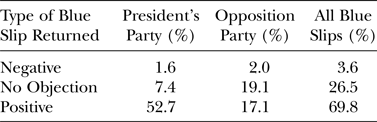
This latter group of senators’ blue slips seem to indicate that senators expected that these supportive statements would have an impact on the Judiciary Committee and chamber. This hypothesis of a positive aspect of the blue slip may further be supported by the volume and regularity by which senators offered nominees a strong recommendation. As Table 1 shows, almost 70 percent of all blue slips cataloged in our data set offered the nominee positive support.
Percentage of Blue Slips Returned by Type and Party

This support was also fairly regular across the Congresses (73rd–86th, 1933–1960) from which we collected data, with between 56 and 82 percent of blue slips returned each Congress indicating strong support for the nominee. This suggests that the practice of offering nominees varying levels of support was not simply limited to a handful of senators, but was used throughout the Senate and carried over from Congress to Congress. In our empirical analysis, we focus on the impact of these positive blue slips on the time between nomination and both committee action and Senate action for nominees to district and appellate courts.
DATA AND METHODS
The data analyzed in this article cover judicial nominations to the district and circuit courts considered by the Senate between 1933 and 1960, a period that spans the Roosevelt, Truman, and Eisenhower presidencies.Footnote 37 We end in 1960 because the National Archives and the Senate Judiciary Committee limit access to judicial nomination files until fifty years have passed from the time of the nomination. The time period offers Democratic and Republican control of the presidency, as well as unified and divided control of the Senate and presidency, allowing us to test the role party plays in the confirmation process in an era that predates the modern confirmation battles. Our examination of this time period helps illuminate the development of the blue slip as a manifestation of the individual prerogative of senatorial behavior.
From 1933 to 1945, President Franklin Roosevelt made 186 nominations to the district and circuit courts. Of those, 181 were confirmed by the Senate.Footnote 38 From the 73rd to the 78th Congress (1933–1945),Footnote 39 Democrats enjoyed comfortable majorities over Republicans in the Senate. President Truman made 164 nominations to the district and circuit courts, and 122 were confirmed. Unlike Roosevelt, Truman generally had slimmer Democratic majorities and, for the 80th Congress, a Republican-controlled Congress. President Eisenhower, in the course of his two terms, made 199 district and circuit court nominations, of which 173 were confirmed. There were very slim congressional majorities in the Senate during this time period.
Democratic Senators Henry F. Ashurst of Arizona and Fredrick Van Nuys of Indiana were the chairmen of the Judiciary Committee from 1933 to 1941 and 1941 to 1945, respectively. Senator Patrick McCarran of Nevada served two stints as chairman for the Democrats (1945–1947, 1949–1953), while Alexander Wiley from Wisconsin served as chairman when Republicans held the Senate from 1947 to 1949. Senator William Langer of North Dakota was the Republican chairman of the Judiciary Committee from 1953 to 1955. Senator Harley M. Kilgore from West Virginia was the Democratic chairman from 1955 until his death in 1956. Finally, Senator James O. Eastland from Mississippi was the Democratic chairman from 1956 until he retired in 1978.
Prior to Eastland's chairmanship, and thus for the first four decades of the blue slip, a negative or nonreturned blue slip did not kill a nomination. That is, committee hearings proceeded, often with a floor vote to follow. This changed with Eastland's chairmanship. A negative or nonreturned blue slip meant that a hearing would not be held. Since the end of Eastland's chairmanship of the Senate Judiciary Committee, the policy of whether a negative or nonreturned blue slip halted proceedings has varied; this controversy remains a charged political topic.Footnote 40
The blue slip data at the heart of our analysis were collected from the National Archives and Records Administration in Washington, DC, Records Group 46 of the United States Senate, 73rd–86th Congresses, Records of Executive Proceedings, Nomination Files, Judiciary Committee, Blue Slips, 1933–1960. All blue slips were scanned and coded into categories of negative, no objection, and positive. There were 503 nominations made between 1933 and 1960.Footnote 41 However, not all files for nominations were found at the National Archives, so we have 447 district and circuit court nominations available for analysis.Footnote 42
We use duration analysis, which is common in the literature, to examine the effect of the independent variables on whether and, if so, when the nominee was confirmed. That is, duration analysis incorporates both the confirmation decision and timing until the decision. We look at both committee and floor action. The data were collected from the Journal of the Executive Proceedings of the Senate and the Executive Calendars of the Senate Judiciary Committee. Any nomination allowed to expire when the Senate adjourned sine die was considered as not confirmed and as the final action of the Senate on that nomination. Any renomination of a nominee was handled as a separate event while including a control variable for these cases.Footnote 43
The independent variables are organized into three categories: blue slip, contextual, and political factors.
BLUE SLIP FACTORS
Nominees facing objection from a home-state senator should be defeated or face long delays until the problem is resolved. On the other hand, senators may also have an interest in helping nominees they support gain confirmation. Therefore, we test whether positive support for a nominee by a home-state senator increases the likelihood of confirmation and decreases the duration of the confirmation process. The opposite would be expected if the home-state senator(s) objected to a nominee.
For each nomination, measurement scales were created based on whether or not a senator returned the blue slip and the senators’ responses on returned blue slips to test whether the level of support a nominee receives has any effect on the dependent variables.Footnote 44 All nonreturned blue slips were placed into categories utilizing the understanding of what nonreturned blue slips meant to various chairman of the Judiciary Committee. Prior to Senator Eastland, a nonreturned blue slip was understood to mean the senator had no objection to the nominee.Footnote 45 Accordingly, all nonreturned blue slips prior to Senator Eastland assuming the chairmanship in March 1956 were coded as no objection. All those after were coded as an objection.Footnote 46
In constructing a measure of the influence of blue slips, we were concerned about the ability of a coding scheme to pick up the nuances of senatorial power with respect to judicial nominations. Along with the blue slip, senators of the president's party are also empowered by the norm of senatorial courtesy. As noted above, under this norm, senators of the president's party will recommend nominees for judicial vacancies in their state to the president. The norm of senatorial courtesy, alongside the institution of the blue slip, suggest that negative blue slips from senators of the president's party could be viewed as particularly serious breakdowns of the norms and customs regarding nominees. Conversely, positive blue slips from senators of the president's party may indicate that the nominee is the choice of that home-state senator. We expect that blue slips from senators of the president's party will carry extra weight with their colleagues. Therefore, the blue slip responses of senators were separated by negative, no objection, and positive. These three categories were then further separated into whether they were made by senators of the president's party or of the opposition party. This provided us with six categories for blue slips. In the models estimated below, “no objection” blue slips were excluded regardless of party in order to serve as an excluded category; we expected the effect of “no objection” blue slips to not vary by party.
CONTEXTUAL FACTORSFootnote 47
During times of divided party control of the Senate and the presidency, the opposition has a great deal of control over the president's nominations to the federal bench. An opposition Judiciary Committee chair can easily delay nominations by not holding hearings or votes. Likewise, the Senate majority leader holds a great deal of power on when the nomination will receive a floor vote. These opportunities for delaying and defeating nominees have also been found to have an effect on circuit court and district court nominees.Footnote 48 Times of divided government were coded 0, and unified government was coded 1.
Various studies have shown that early in a president's term, nominees are more likely to be confirmed and the confirmation will move more swiftly.Footnote 49 To account for any “honeymoon period,” the first year of the president's term was coded 1, the second 2, the third 3, and the fourth 4. Each term, even for a two-term president, was treated individually and not as a continuation. Hence, year 5 of the Eisenhower administration was also coded as a 1, year 6 as a 2, and so on.Footnote 50
Docket differences, their position in the judicial hierarchy, and their wider jurisdictions empower federal appeals court judges to have a greater impact on policy than district court judges.Footnote 51 Further, whereas senators are often seen as playing the dominant role in selecting district court judges, the president wields much more power in the selection of circuit court judges.Footnote 52 This includes the ability to select a nominee from another state within a particular circuit's jurisdiction when faced with opposition from home-state senators. Therefore, due to their greater importance and the power to select them being more evenly divided, one might expect the confirmation times of appellate judges to be lengthier. District court nominations were coded 0 and appeals court nominations 1.
Following Martinek, Kemper, and Van Winkle, we treated any renomination of a nominee who failed to be confirmed as a separate event and created a control variable to account for renominated individuals (coded 1 if an individual was renominated, 0 if not).Footnote 53 Sollenberger contemplates downward skewing problems that may occur due to this method of collection, but notes the rareness of renominations during our time period.Footnote 54 This method is further preferable for our analysis as blue slips are sent to each home-state senator for each nomination, not just the initial one.
POLITICAL FACTORS
By rule of the Senate, all federal judicial nominations must be referred to the Senate Judiciary Committee. The committee chair wields a great deal of power in establishing and following procedures for the confirmation of judges, including the blue slip. Therefore, the greater the ideological distance between the chair and the president, the longer a nominee should take to be confirmed. Hartley and Holmes point out that “individual Judiciary Committee chairs appear to have their own styles or approaches regarding judicial confirmations, at times quite distinct from party control.”Footnote 55 The absolute value of the difference between the DW-NOMINATE scores of the president and the chair were used to measure ideological distance. For the purposes of our analysis, both the first- and second-dimension scores were considered.Footnote 56
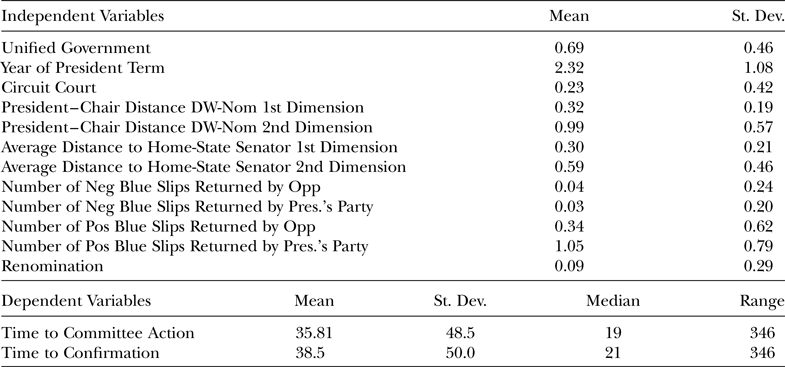
Similarly, the more ideologically distant a home-state senator is from the president, the more likely the senator should be to obstruct the president's nominees. This initial logic has also been supported by research on confirmation rates of appellate court nominees.Footnote 57 Therefore, nominees from a state with a senator ideologically distant from the president should take longer to be confirmed. The absolute value of the difference between the DW-NOMINATE scores of the president and the average of the home-state senators were used to measure ideological distance.Footnote 58 Table 2 presents descriptive statistics for the dependent and independent variables of interest.
Descriptive Statistics

METHODS
Event history models are used to analyze whether and, if so, when an event occurs. In the case of positive blue slips, we analyze whether the return of a positive blue slip both increases the likelihood of confirmation and decreases the duration of the confirmation process. The timing of events provides rich information and thus helps to further enhance our understanding of the underlying dynamics of interesting political phenomena.Footnote 59 One of the central choices in event history models is selecting a parametric or nonparametric model and, if choosing a parametric model, selecting the distribution most appropriate to the underlying data. Cox proportional hazards models are increasingly common in political science; they do not specify the nature of the duration dependence in advance, allowing the researcher to treat the baseline hazard as a function to be estimated from the data.Footnote 60 However, the primary weakness of the Cox model (a weakness it shares with many parametric models) is the assumption of proportional hazards. In most situations, this assumption is reasonable and occasional violations can be properly addressed by interacting the variable that violates the assumption with a function of time. However, in the presence of significant violations of the assumption of proportional hazards, models requiring that assumption may prove unworkable.Footnote 61
For the period under analysis here, 1933–1960, many nominations experience the event (are reported out of committee or confirmed) shortly after they are submitted to the Senate, suggesting a rising hazard rate early in the process and a falling hazard rate thereafter. Distributions with only one parameter (such as the popular parametric Weibull model) would not be able to accurately capture this movement in the baseline hazard. We therefore adopt a generalized gamma distribution to estimate our model. The model is one of the most flexible parametric distributions as it has two free parameters and does not assume that the hazards are proportional over time.Footnote 62
RESULTS
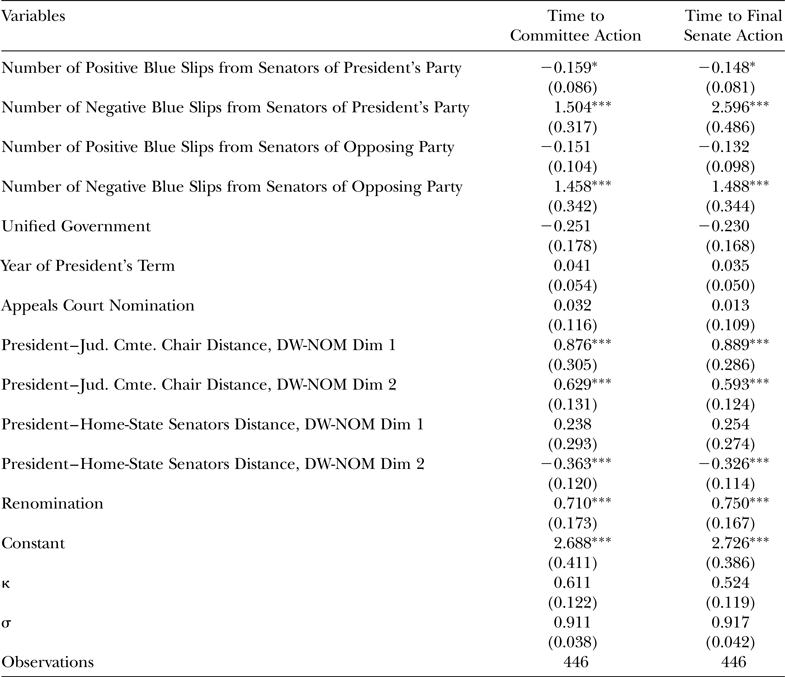
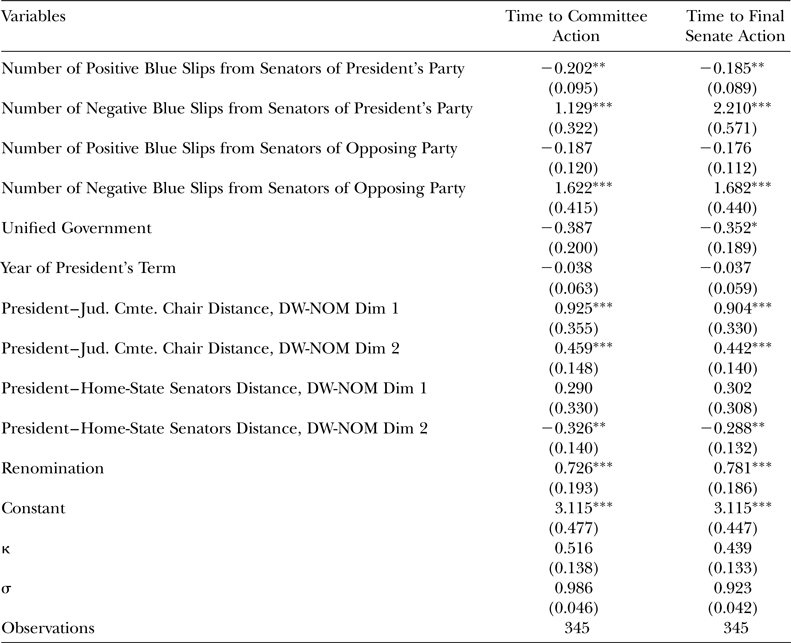
The event history models are presented for both of our dependent variables.Footnote 63 Table 3 shows the effects of the independent variables on committee action and final action by the Senate.
Event History Estimates of Time to Senate Action on Lower Court Judicial Nominations, 1933–1960

Standard errors in parentheses; ***p < 0.01, **p < 0.05, *p < 0.10, two-tailed tests; generalized gamma model.
As a preliminary consideration, it is appropriate to consider, for both models, whether the generalized gamma distribution is the appropriate distribution. In the committee action model, κ = .61 with a standard error of .12, allowing rejection of the hypothesis that it is equal to 1 (which would reduce to a Weibull) or 0 (which would reduce to a log-normal distribution). The same is true for the final Senate action model (κ = .52, σ = .12).
We begin by looking at the effects of the blue slip factors on committee action. The coefficients on the blue slips variables can be considered relative to the baseline category, which is the number of senators who returned blue slips asserting no objection to the nominations. As expected, negative blue slips increase delay for a nominee. For a nominee receiving one negative blue slip, the hazard rate for confirmation time falls by approximately 449 percent;Footnote 64 setting all other variables at the median (and setting the blue slips at two blue slips returned with no objection), the expected time to committee action is 27 days. One negative blue slip from a senator of the president's party raises the expected time to 120 days, and a negative blue slip by a senator opposing the president's party increases the expected time to failure by 430 percent, to 114 days. Looking at final action, one negative blue slip from a senator of the president's party raises the expected time to final action from 28 days (where all other variables are set at their median values and blue slips are both no objection) to 371 days. A negative blue slip from a senator not of the president's party raises the expected time to final Senate action to 123 days.
The effect of negative blue slips is comparable for senators of the president's party and senators of the opposition party, which is consistent with the expected negative role of the blue slip during this era. While the impact of negative values is significant, as they increase the time to committee action nearly fivefold and opposition by a senator of the president's party increases the time to confirmation nearly thirteen times, these numbers should be kept in context. Of the 446 nominations in our data set, only fourteen received one or more negative blue slips from senators of the president's party. Of those fourteen, only three nominations were confirmed by the Senate; the balance remained pending until the Senate returned them at the end of a session (or, in rare circumstances, until the president withdrew the nomination). A proper interpretation of the increases in the expected duration produced by negative blue slips is that, regardless of the party of the senator issuing a negative blue slip, such a blue slip typically brought the nomination to a halt.
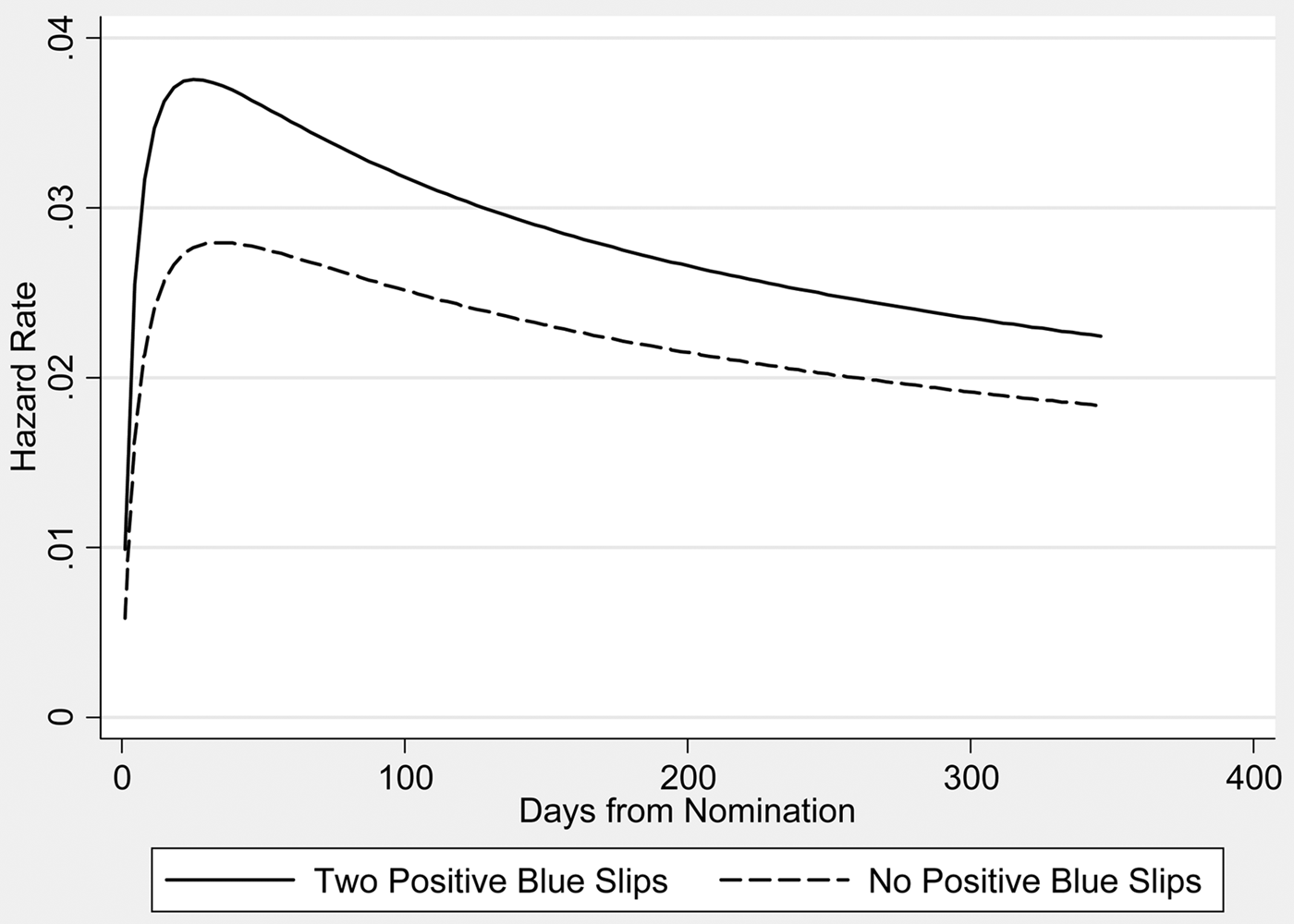
As we argue above, the possibility that remains unexplored in the literature is whether senators can reduce the time a nominee awaits committee (and full Senate) action. We hypothesize and test whether there may be a positive role for the blue slip in the confirmation process, with positive endorsements translating into reduced time to committee and Senate action for favored nominees. Our results suggest that positive blue slips indeed speed the time to committee action on the nominees and on final action as long as those blue slips are provided by senators of the president's party. The median value for time to committee action falls from 27 days to 23 days (a 15 percent increase in the hazard rate) with one positive blue slip by the president's party, and falls to 19 days (a 28 percent increase in the hazard rate) with two positive blue slips from senators of the president's party. The median time for full Senate action falls by 14 percent for one positive blue slip from a senator of the president's party, from 28 days with no positive blue slips to 24 days, and time to full Senate action falls by 28 percent, to 21 days, with two positive blue slips from senators of the president's party. Positive blue slips from the opposing party have no effect on the time to committee or final Senate action.Footnote 65 Figure 1 demonstrates the effect on the hazard rate of positive blue slips from the president's party.Footnote 66
Hazard Rate for Senate Final Action by Number of Positive Blue Slips from Senators of President's Party.

With regard to contextual factors, we find that the speed at which nominations are processed by the Senate Judiciary Committee and by the full Senate is not affected by the presence of unified government, the year of the president's term, or whether the nomination is to a district or circuit court. The lack of influence of these factors on time to Senate action illustrate the different nature of senatorial consideration of judicial nominees in a timeframe (1933–1960) well removed from the contemporary Senate. Renominations take about twice as long to be acted on by the Judiciary Committee and the full Senate; the median renomination cleared the Senate Judiciary Committee in 54 days and was confirmed in 59 days.
Next, the political factors considered confirm the proposition that ideology plays a greater role in affecting time to Senate action than contextual factors during this time period. As the distance between the Judiciary Committee chair and the president increased, the time to committee and final Senate action both increased; a 0.1 unit increase (all of these distances could theoretically range from 0 to 2) in the first-dimension distance between chair and president increases time to committee action by 9.1 percent and the time to final Senate action by 9.3 percent.Footnote 67 A 0.1 unit increase in the distance between the chair and president on the second dimension has a more modest effect, increasing time to committee action by 3.5 percent and Senate action by 3.3 percent. The distance between the home-state senators and the president on the first dimension have fairly modest effects, with the same unit change increasing time to committee action and time to final action by 2.6 percent. Finally, as senator–president distance on the second dimension increases, the time to Senate action decreases; a 0.1 unit increase in the distance reduces time to committee action 3.2 percent and time to Senate action 3.6 percent. As the Southern Manifesto illustrates, the second dimension is a much more prescient dimension when it comes to judges during this time period.Footnote 68 While there were economic issues taken up by the courts, they tended to be by the Supreme Court and not ones having to be enforced by lower federal judges, as were civil rights rulings. Thus, a president selecting nominees for lower federal courts was likely to know a senator's views on the racial issues of the day, knew they were especially important in certain states, and knew that in order to avoid a prolonged and serious fight, he had to take them into consideration when making a selection. The greater the divide between the president and the home-state senator on civil rights issues, the more the president likely had to take the senator's views into consideration.Footnote 69
THE SENATOR'S CHOICE
Having highlighted the importance of blue slips for the duration of judicial nominations, we now turn to a question implicated by these findings: What factors influence a senator's decision to return a blue slip? Do these factors differ for positive and negative blue slips? We continue by exploring the relationship between similar political and contextual factors (as above) and the choices senators make.
Studying blue slip behavior at the senator level allows us to isolate a particularly interesting quantity: the effect of senatorial courtesy. That is, holding all other variables constant, what is the change in the predicted probability of a blue slip obtained by changing a home-state senator's party to that of the president's?
In the analysis that follows, we used the same data as in the nominee-focused analysis above. Each nominee is virtually always associated with two home-state senators, so the size of our sample roughly doubles. The contextual and political variables are largely the same as above. To recap, our contextual variables in this analysis included unified/divided government, year of president's term, appellate/district court nomination, and whether the nominee is being renominated. The political variables differ slightly. We now considered the ideological distance (measured by the first and second dimensions of DW-NOMINATE) between the individual senator and the president, rather than an average of both home-state senators. We also included the ideological distance between each home-state senator and the Judiciary Committee chair on both dimensions of DW-NOMINATE.Footnote 70
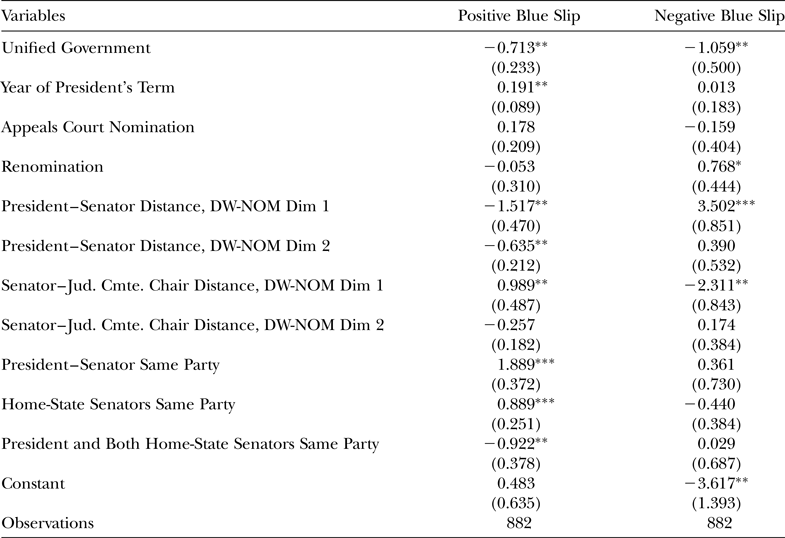
We also considered two new variables directly related to the notion of senatorial courtesy in this analysis. First, we included a dummy variable equal to 1 if both home-state senators are of the same party. Second, we included a dummy variable equal to 1 if the president and the senator are of the same party. When this dummy is equal to 1, senatorial courtesy is in effect for that individual senator. Finally, we interacted these variables to investigate how the senatorial courtesy affects senators differently depending on whether courtesy was also in effect for the other home-state senator. Table 4 presents the results of two logit analyses estimating the effect of these variables on individual senator decisions to return positive or negative blue slips.
Logit Estimates of Senator Blue Slip Actions

Robust standard errors in parentheses; ***p < 0.01, **p < 0.05, *p < 0.10, two-tailed tests. Negative blue slip results robust to estimation via rare events logit (Gary King and Langche Zeng. “Logistic Regression in Rare Events Data.” Political Analysis 9 (2001): 137–63).
Table 4 shows, among other things, a positive and significant association between senatorial courtesy (that is, the president and senator are of the same party) and returning a positive blue slip. If we hold all other variables at their mean (continuous) or mode (discrete), the model predicts that the probability of a positive blue slip is 0.77 when the president and senator are of the same party, as opposed to 0.34 when the president and senator are of opposite parties. Interestingly, Table 4 also shows that when both senators are of the same party of the president, the probability that an individual senator returns a positive blue slip goes down. This finding may be due to the fact that only one of the senators recommended the nominee, and the other senator is merely indifferent. Indeed, for about 20 percent of the observations for which both home-state senators are of the same party as the president, and one senator returns a positive blue slip, the other home-state senator returns a “no objection” blue slip as opposed to a positive blue slip. Yet when senatorial courtesy is in effect for only one of the two home-state senators, Table 4 shows that that senator is highly likely to return a positive blue slip, indicating the strength of the norm of senatorial courtesy. When both senators are of the opposite party of the president, there is also a positive and significant increase in the probability that both senators return a positive blue slip, perhaps indicating that there was some bargaining that occurred when the president was aware that he had no partisan ally among the home-state senators to ensure his most-favored nominee's approval. Future research should continue to explore this dynamic.
For negative blue slips, there are no significant relationships between our senatorial courtesy variables and the probability of returning a negative blue slip. Negative blue slips are rare in our data, as discussed above, which perhaps explains the lack of many strong statistical relationships between negative blue slips and our explanatory variables. Note that the results of Table 4 are unchanged when estimated with rare events logit (King and Zheng 2001).Footnote 71 These findings underscore the importance of considering all types of blue slip behavior, as many interesting dynamics in the data would be missed by considering only negative blue slips. Indeed, the effect of senatorial courtesy is best captured in our model of positive, rather than negative, blue slips.
The results for the contextual variables differ slightly from the event history models of nominee duration above. For instance, year of presidential term is positively and significantly associated with the return of a positive blue slip, whereas presidential term has no association with the duration of a nominee. Perhaps as presidents’ terms wear on and they become weaker, senators are more able to push for patronage appointees.
Interestingly, unified government is negatively and significantly associated with both types of blue slip behavior, whereas it has no significant association with nominee duration. While court type (appellate/district) has no association with blue slip behavior, renomination more than doubles the probability of a negative blue slip (holding all other variables at their mean/mode).
The political variables show that the ideological distance between senators and presidents impacts both types of blue slip behavior. There is a significant, negative association between the distance on both dimensions of DW-NOMINATE increases and the probability that a senator returns a positive blue slip. There is also a positive association between senator–president distance on the first dimension of DW-NOMINATE and returning a negative blue slip. Additionally, we observe surprising associations between the first-dimension distance from Judiciary chairs to senators and blue slip behavior. The signs on these coefficients are the opposite of those for president–senator distance.
We find that senators appear to use positive blue slips most often when the Judiciary Committee chair is not a member of their own coalition. In our data, we see that before the southerner Eastland took over, nonsoutherners returned positive blue slips about 63 percent of the time, whereas southerners returned positive blue slips more than 80 percent of the time, a significant difference. After Eastland took the chair, nonsoutherners returned positive blue slips about 78 percent of the time, compared to only 53 percent of the time for southerners, again a significant difference. There is no south/nonsouth difference for negative blue slips.Footnote 72 This result implies that senators were significantly more likely to use this agenda-setting tool when they could not rely on the Judiciary chair to set the agenda for them (i.e., whenever the Judiciary chair was not a member of their ideological coalition).
Our work highlights new research directions. For example, taking a broader view of the systematic factors at play between senators, the president, and the committee chair in the confirmation process beyond merely ideology could prove beneficial. Our senator-level analysis suggests an interesting puzzle: While ideological distance between senators and presidents is negatively associated with the probability of a positive blue slip, distance between senators and the Judiciary Committee chair is positively associated with the probability of a positive blue slip. The opposite magnitudes of these two associations suggest fundamentally different relationships that encourage further exploration; the change in senator behavior we observe as a function of whether the Judiciary chair was a member of the conservative coalition suggests one avenue for future work on this point. Further, while we have explored several political and contextual determinants of senators’ choices to issue blue slips of various types, the relationship of blue slip behavior to nominee quality or experience remains unknown for the period we studied. Future work might consider nominee quality directly. Given the patronage nature of many of the appointments we studied, it is unclear to what extent positive blue slips might be associated with higher quality nominees.
CONCLUSION
Institutional norms, such as the blue slip, give individual senators the ability to dramatically influence the appointments of federal judges. Though the debate over this influence continues vigorously today, the blue slip has actually been a functioning norm of the Senate Judiciary Committee for at least ninety years. Deputy Attorney General Warren Christopher noted in 1968 that “the views of any senators, whatever his Party, from the state where the vacancy exists cannot be ignored, for Senate tradition gives them a virtual right of veto.”Footnote 73 This research takes advantage of newly acquired data on available blue slips from 1933 to 1960 in order to demonstrate the multifaceted history of this institutional norm.
Our systematic empirical investigation of the blue slip shows that it served as an effective tool by which senators could delay the confirmation of a federal judicial nomination from their state. We show that the blue slip operated as a means by which individual senators exerted agenda control over judicial nominees in the weak parties era. Our findings also indicate how the important political issues of the day, namely, civil rights, helped shape the development of the blue slip and the relationship between senators, the president, and the committee chair.
In contrast to prior work, we showed that the blue slip also had a positive impact on judicial confirmations—that is, in the 1930s through 1950s senators used the blue slip to promote and expedite the appointment of nominees they supported much more often than they invoked the blue slip's dilatory powers. We further discussed the factors that could predict when senators tried to exert this influence, and in particular showed that the norm of senatorial courtesy had a strong association with senator behavior. As senatorial courtesy depends only on the party of the senator and president, along with the senator's home state, this norm allowed for senators to influence a national-level political process as individuals based on idiosyncratic factors.
The blue slip's role during an era of weak parties appears to be the institutionalization and protection of the individual prerogatives of senators. Whether this dynamic persists in the modern era is unclear. Unfortunately, the embargo on more recent blue slips precludes investigation as to whether these dynamics hold today. Today's Senate differs from the one we studied in two important ways: First, parties are stronger and more unified, and, second, senators themselves are more polarized along partisan lines. Given that there is no cross-cutting cleavage between partisan and ideological factions in the Senate today, our findings imply that members of the majority party should no longer need to use the blue slip in a positive manner, as the Judiciary Committee chair, a coalition ally, would be expected to automatically set the agenda in majority party senators’ favor. Conversely, while we find that positive blue slips from opposing party senators have no significant association with a nominee's time to committee action or confirmation, it may be the case that such a blue slip in today's polarized era might serve as a signal that the nominee enjoyed sufficient support to overcome the filibuster threshold. In sum, the issuance and impact of positive blue slips appears to be at least partially the product of contextual factors that have changed since the time horizon of our study. As such, future scholars should explore these dynamics as data become available.
Our work contributes to an understanding of the development of the blue slip, which plays a key role in the lower federal court confirmation process and is an important aspect of the individual prerogative that characterizes senatorial behavior. By isolating the role of senatorial courtesy, we are able to highlight the importance of party and patronage on the behavior of senators with respect to the blue slip. Further, our work points to intriguing dynamics between individual senators, committee chairs, and the president in advancing their respective goals in the Senate. In the era we studied, in which no faction exerted simultaneous control over the Judiciary Committee, the full Senate, and the presidency, the blue slip served as a vehicle for individual senators to set the confirmation agenda. Individualistic institutions like the blue slip perhaps were sustained to accommodate differing intensities of preferences on various issues among individual senators, a pattern seen with other tactics like the filibuster.Footnote 74 Seen in this light, the blue slip, in the era we studied, served as a means by which individual senators more effectively advocated for causes uniquely important to themselves in negotiations with the president. Thus, this seemingly individualistic institution may actually have served to strengthen the Senate more broadly relative to the president and served to maintain the institutional balance of power. Perhaps, then, seemingly individualistic institutions, like the filibuster, holds, and blue slips, developed in part out of checks-and-balances considerations vis-à-vis the power of the Senate relative to the president. Future work should continue to investigate this possibility.
We argue for a new perspective on the blue slip that contributes to the study of the history and evolution of institutions, namely, that the blue slip was developed to more formally protect individual senators and to reduce uncertainty in both securing confirmation for their preferred nominees and stopping nominations of those they opposed. During the middle of the twentieth century, senators used the blue slip to ensure that those they had recommended or selected for a judgeship were confirmed in a timely manner more often than they used this tool to hinder nominees they opposed. In essence, the blue slip served as the institutionalization of senators’ individual prerogatives, giving them substantial agenda control in an era of weak parties.
Appendix 1 BLUE SLIP POLICY OF JUDICIARY COMMITTEE CHAIRS, 1917–2012

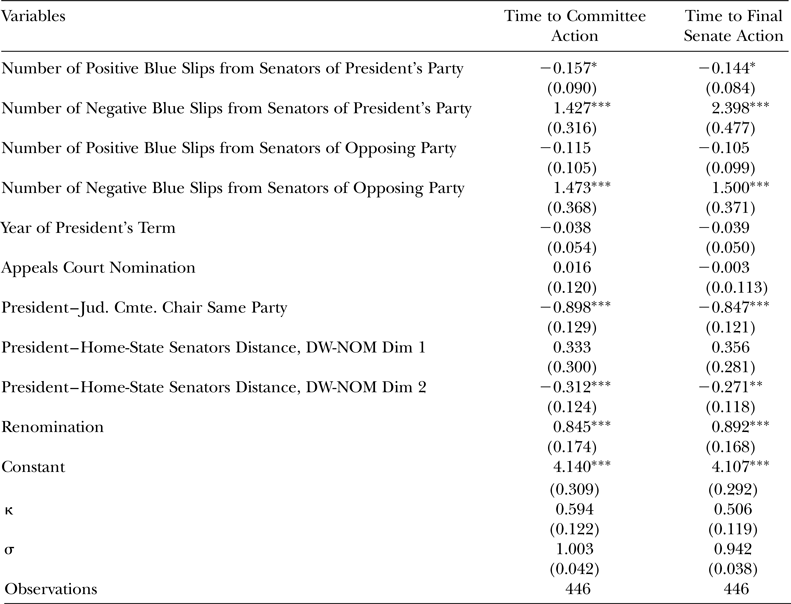
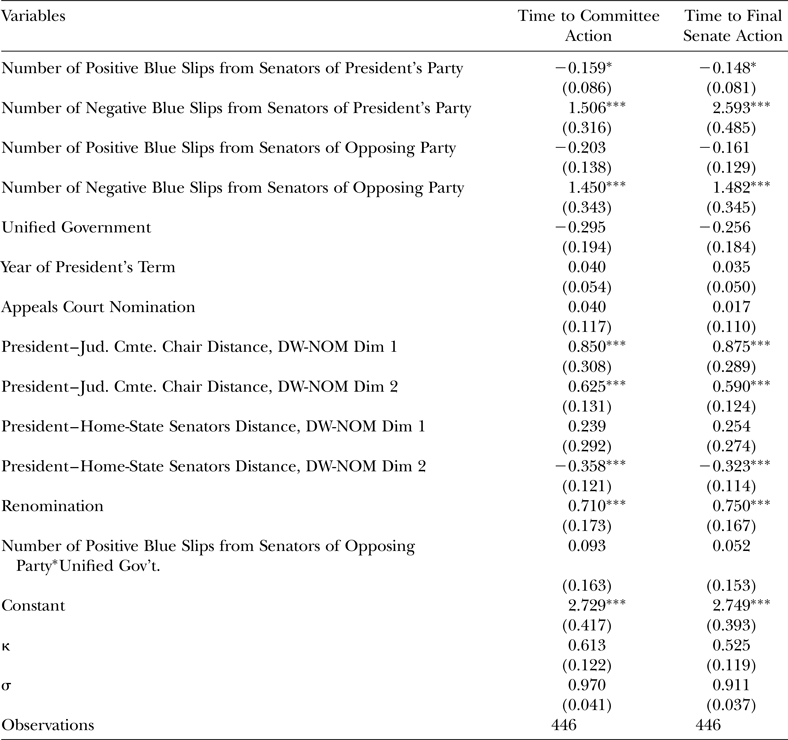
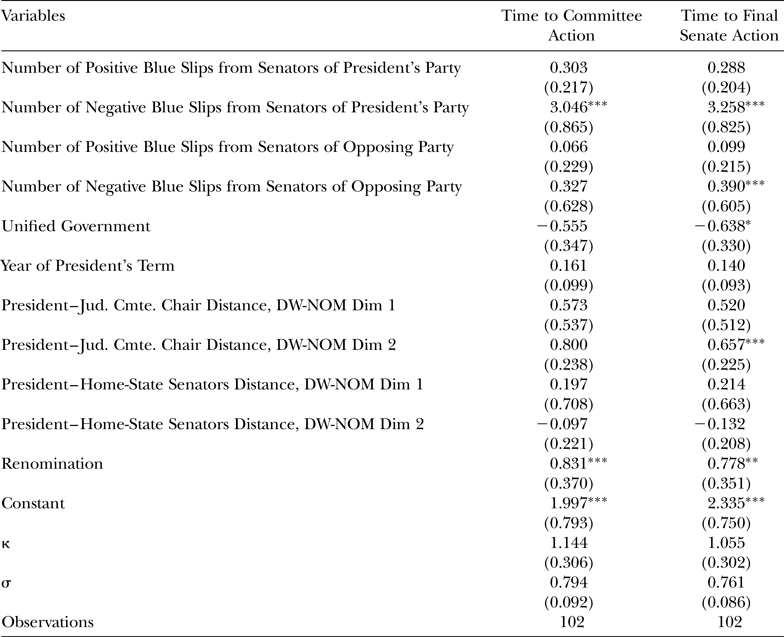
Appendix 2 ALTERNATIVE EMPIRICAL SPECIFICATIONS
Event History Estimates of Time to Senate Action on Lower Court Judicial Nominations, 1933–1960, President–Jud. Cmte. Chair Same Party

Event History Estimates of Time to Senate Action on Lower Court Judicial Nominations, 1933–1960, Positive Blue Slip Opp. Party-Unified Govt. Interaction

Event History Estimates of Time to Senate Action on Lower Court Judicial Nominations, 1933–1960, Courts of Appeals

Event History Estimates of Time to Senate Action on Lower Court Judicial Nominations, 1933–1960, District Courts