Introduction
Use of modern contraceptive methods enables couples to have the number of children they desire, when they desire them (birth spacing). Globally, family planning programmes have facilitated women’s access to contraceptives and services. Historically, many programmes, such as the Indian Family Planning Programme, have focused on female-oriented contraceptives and sought to control women’s fertility to meet numerically defined national population control goals (Yadav et al., Reference Yadav, Singh and Goswami2009). Therefore, male involvement in family planning was initially limited in these programmes (Tilahun et al., Reference Tilahun, Coene, Temmerman and Degomme2014). However, involving men in family planning is strongly recommended. First, not doing so can make men suspicious or encourage the belief that using contraceptives will make it easier for women to have extramarital sexual relationships (Bankole & Singh, Reference Bankole and Singh1998; Choiriyyah & Becker, Reference Choiriyyah and Becker2018). Second, not involving them may make them feel that their authority is being undermined (Bankole & Singh, Reference Bankole and Singh1998). The numerical goals and female focus of family planning programmes were questioned during the International Conference on Population and Development (ICPD) in Cairo in 1994, which encouraged a paradigmatic shift to focus on the reproductive rights of both women and men, instead of focusing on meeting numerical targets alone (Yadav et al., Reference Yadav, Singh and Goswami2009). The goals thus became to provide contraceptive methods to promote reproductive health choices for couples and increase women’s equality in the areas of education, health and economic opportunities.
Worldwide, fertility declined to 2.5 children per woman in 2019 (United Nations, 2019) from nearly double that number in 1960 (Bailey, Reference Bailey2013). Increase in the use of modern/traditional methods of contraception is one of the primary reasons for fertility decline (de Silva & Tenreyro, Reference de Silva and Tenreyro2017). This makes contraceptive prevalence an essential indicator of a family planning programme’s performance. In 2017, 63% of women globally were using contraceptives of some kind (United Nations, 2017). Generally, contraceptive prevalence is based on women’s self-reported contraceptive use. However, the validity of such self-reported prevalence levels becomes questionable when women’s answers don’t match those of their husbands (Choiriyyah & Becker, Reference Choiriyyah and Becker2018). Older studies conducted in some African countries (Ezeh & Mboup, Reference Ezeh and Mboup1997; Becker & Costenbader, Reference Becker and Costenbader2001; Becker et al., Reference Becker, Hossain and Thomson2006) have pointed out that men are generally more likely to over-report the use of (particular) methods of contraception compared with their wives. Several reasons, such as the social acceptability of contraception, not reporting personal matters to an outsider, husband–wife disagreement on use and lack of communication between couples may lead to such differences in reports (Beckman, Reference Beckman, Bulatao and Lee1983; Becker et al., Reference Becker, Hossain and Thomson2006; Link, Reference Link2011). Furthermore, women-controlled methods such as implants and injectable contraceptives can make it easier for women to hide their use of contraceptives. Therefore, considering only one partner’s response may lead to over-reporting or under-reporting of contraceptive prevalence. Moreover, the extent to which individuals’ responses to reporting and not reporting contraceptive methods are consistent with their spouse’s responses is important as it shows the involvement of men and women in reproductive health decision-making.
India was the first country in the world to launch a National Family Planning Programme in 1952. The objective of the programme was ‘reducing birth rate to the extent necessary to stabilize the population at a level consistent with the requirement of the national economy’ (Planning Commission, 1997). The establishment of the Department of Family Planning in 1966 under the Ministry of Health and Family Planning helped the programme to gain further momentum. The Indian family planning programme has undergone various phases since its reorganization in 1966; financial incentives, coercion and punitive measures were used to achieve demographic (two-child norm) and contraceptive targets, especially sterilization (Population Foundation of India, 2010). In 1996, the Government of India adopted a target-free approach (Population Foundation of India, 2010; Govil & Purohit, Reference Govil, Purohit and Rout2011).
Over time, India has experienced a decline in total fertility rate from 3.8 in 1990 (Registrar General of India, 2018) to 2.3 in 2016 (Registrar General of India, 2016). Social attitudes have become favourable towards contraception (Sharma et al., Reference Sharma, Mohan, Das and Awasthi2012; Sherpa et al., Reference Sherpa, Sheilini and Nayak2013) and contraceptive use has increased (IIPS, 1995; IIPS & ICF, 2017). The number of women using modern methods of contraception for spacing and limiting increased to 125 million in 2015 from 58 million in 1990 (UNDP, 2015). Female sterilization is the most prevalent contraceptive method in India (IIPS & ICF, 2017). Yet, factors such as patriarchy, the unequal status of women, lower education and taboos about discussing contraception can negatively affect contraceptive use. With the increasing spread of education and employment opportunities for women in India, contraceptive use is expected to increase. However, women may not be informing their husbands of their use of contraceptives.
The study aimed to investigate the concordance in responses of married couples in India about contraceptive use. Specifically, the study objectives were: 1) to assess the extent of consistency in spousal reports of current contraceptive use with method-specific consistencies and 2) to document the differentials of agreement on contraceptive use among couples.
Methods
Data and sample
The study utilized nationally representative unit-level data for matched Indian couples from the most recent National Family Health Survey conducted in 2015–16 (NFHS-4). The survey was conducted in all 36 states and union territories of India by the International Institute for Population Science, Mumbai, and ICF. The NFHS, referred to as the Demographic Health Survey (DHS) in the context of other countries, is conducted regularly to obtain population-based estimates of significant health concerns and risk behaviours. The DHS surveys are the only cross-sectional surveys on reproductive health behaviour in the developing world that cover the perspectives of both husbands and wives. The NFHS-4, the fourth in the NFHS series, provides information on population, health, health behaviour and nutrition at the national, state/union territory and district levels. The NFHS-4 sample was selected via stratified two-stage sampling. The detailed sample design has been provided in a previous report (IIPS & ICF, 2017).
The NFHS-4 survey collected information based on four schedules: Household, Woman, Man and Biomarker (IIPS & ICF, 2017). Each selected household was visited and information obtained about the household using the Household Questionnaire. Women and men within these households were interviewed face-to-face using Computer Assisted Personal Interviewing (CAPI) on mini notebook computers in state-specific languages. Women aged 15–49 years (N = 699,686) were interviewed using the individual Woman’s Questionnaire. The Man’s Questionnaire was administered only in the subsample of households selected for the state module (to be executed at state level); in total 112,122 men aged 15–54 were interviewed. The man’s questionnaire was a shorter version of the woman’s questionnaire and the majority of the questions asked to men were also asked to women. Husband and wife were interviewed separately by male and female investigators, respectively. Both female and male respondents were asked questions on knowledge and use of family planning. The NFHS-4 provides nine types of datasets, including the couple dataset, which contains the records of 63,696 couples.
For this study, variables about current contraceptive use reported by husband and wife were included. Since the couples’ reports of current contraceptive use can be affected by contraceptive use with non-spousal sexual partners, only couples who had just their spouse as a sexual partner in the last 12 months were included in the analysis. After excluding couples in which the respondent reported having a sexual partner other than their spouse, the analytical sample was reduced to 63,060 couples.
Outcome variables
The outcome variables were ‘agreement between spouses’ about ‘contraceptive use and specific method use’. All modern limiting and spacing methods, as well as traditional methods, were considered. Modern spacing contraceptive methods included pills, condoms, intrauterine devices and injections; couples use these to space pregnancies. Limiting methods are meant to limit family size permanently, and include female and male sterilization. Traditional methods considered under the study included rhythm/periodic abstinence and withdrawal.
Men were asked the following question on contraceptive use: ‘the last time you had sex, did you or your partner use any contraceptive, if yes, which method you or your partner used?’ Women were asked: ‘Are you or your partner currently using any contraceptive method to avoid pregnancy?’
Responses of husband and wife dyads on different methods of contraception were categorized into the following five groups: 1) husband and wife reported the same method; 2) husband and wife reported contraceptive use but different methods; 3) husband said no, and wife said yes to contraceptive use; 4) husband said yes and wife said no to contraceptive use; and 5) both reported no contraceptive use. The following classifications to assess agreement about contraceptive use were used:
-
1. Agreement on contraceptive use without focusing on any specific method, i.e. the use of any method reported by both the husband and wife (Becker et al., Reference Becker, Hossain and Thomson2006) (Exact agreement on method use).
-
2. Agreement on specific method used (Becker et al., Reference Becker, Hossain and Thomson2006) (Simple agreement on contraceptive use).
-
3. Agreement on use of limiting method.
Three method-specific indices of agreement (Becker et al., Reference Becker, Hossain and Thomson2006) were also calculated:
-
1. The ratio of the number of couples where both partners reported the use of the same method to either reporting any method (Total Exact Method Consistency).
-
2. The proportion of husbands reporting a given method whose wives reported the use of the same method (Marginal Distribution).
-
3. The proportion of husbands (wives) reporting a specific method, whose spouse did not report the method use. Specifically, it included the proportion of husbands who reported to use a method X to wives who did not report use of method X, and vice versa for wives.
Covariates
Covariates included respondent’s age and education level, number of children ever born, men’s opinion on contraceptive use (i.e. contraceptive is women’s business, and women who use contraception may become promiscuous), decision-making by wife, decision-making on contraceptive use, caste, rural–urban place of residence, wealth index and region of residence. All independent variables were categorical.
An index of decision-making by the wife was computed based on women’s responses alone considering who made decisions in the following four areas: (1) respondent’s (wife’s) health care, (2) large household purchases, (3) visits to family or relatives, and (4) how to use the husband’s earnings. A score of 1 was given when the decision was taken by the wife alone or jointly with her husband/others. For other decision-makers, a score of 0 was assigned. The total score ranged from 0 to 4. Three categories were prepared using the total score: no decision-making (score 0), partial decision-making (score from 1 to 3) and full decision-making (score 4).
Statistical analyses
Bivariate analysis, tests of association (Chi-squared) and agreement (Kappa-using weighted cases), and multivariate analysis (logistic regression) were conducted. First, bivariate analysis was done to study the association between men’s and women’s reports on contraceptive use, by urban–rural location, wealth index and regions of India. Multivariate logistic regression was used to estimate the odds ratios (ORs) regarding consistency in agreement between contraceptive use and other covariates. Three outcome variables from total users were computed for multivariate logistic regression analysis: (1) exact agreement on method use, (2) simple agreement on contraceptive use, and (3) agreement on limiting method. Consistency on non-use was not considered in computing these outcome variables. A correlation matrix of covariates was analysed to check for multicollinearity. Pairwise Pearson correlation coefficients for all variables were less than 0.5. This indicates that multicollinearity was not a major concern. All covariates were added in the multivariate analysis regardless of significance of the bivariate results. The NFHS is a two-stage stratified cluster sample (IIPS & ICF, 2017). The survey used sampling weights for men to ensure the representativeness of results at the national level (IIPS & ICF, 2017); sampling weights were calculated based on sampling probabilities separately for each sampling stage and for each cluster (IIPS & ICF, 2017). This minimizes the effects of clustering. Data were analysed using STATA version 16.0.
Results
Respondents’ characteristics
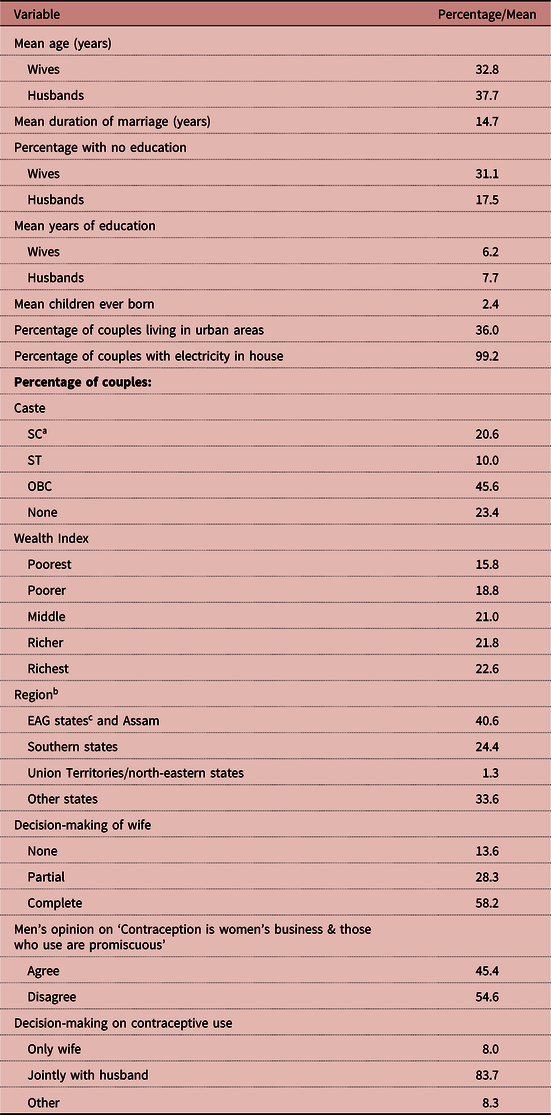
Women’s average age was approximately 32.8 years (SD = 8.1). Men’s average age was about 37.7 years (SD = 8.6). The average number of children per couple was 2.4. The majority of the couples (65%) lived in rural areas. Around 31% of women and 17.5% of men had no education. About 31% of couples belonged to Scheduled Castes and Tribes (SC/ST) – a designation for some historically disadvantaged socioeconomic groups. Thirty-five per cent of couples belonged to the poor and poorest wealth quintiles while 22.6% belonged to the richest quintile. More than 40% of couples lived in Empowered Action Group (EAG) states and Assam. Nearly 58% of wives had complete decision-making power. Decisions on contraceptive use were primarily taken jointly by the husband and wife (83.7%). Table 1 shows the sample characteristics.
Background characteristics of couples, India, 2015–16 (N = 63,060)

a The Scheduled Castes and Scheduled Tribes are officially designated groups of socially disadvantaged people in India and are re-coded in the Constitution of India.
b EAG states and Assam: Assam, Bihar, Chhattisgarh, Jharkhand, Madhya Pradesh, Odisha, Rajasthan, Uttar Pradesh, Uttarakhand; Southern states: Andhra Pradesh, Karnataka, Kerala, Tamil Nadu, Telangana; UTs/North-Eastern States: Andaman and Nicobar Islands, Arunachal Pradesh, Chandigarh, Dadra and Nagar Haveli, Daman and Diu, Lakshadweep, Manipur, Meghalaya, Mizoram, Nagaland; Other States: Goa, Gujarat, Haryana, Himachal Pradesh, Jammu and Kashmir, Maharashtra, Delhi, Punjab and West Bengal.
c In India, there are eight socioeconomically backward states, i.e. Bihar, Chhattisgarh, Jharkhand, Madhya Pradesh, Orissa, Rajasthan, Uttaranchal and Uttar Pradesh. These states lag behind in the demographic transition and have the highest infant mortality rates in the country, and are therefore referred to as the Empowered Action Group (EAG) states.
Contraceptive use
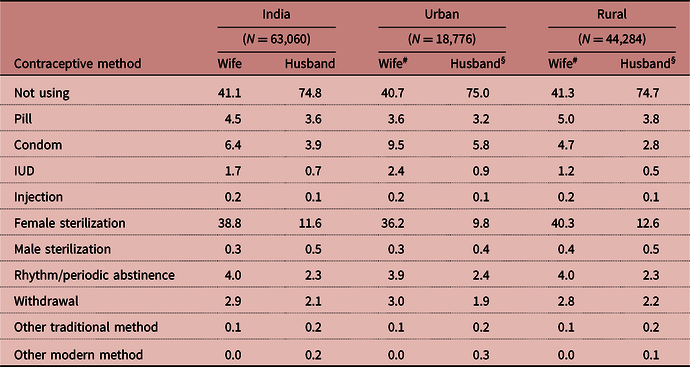
Table 2 shows the percentage distribution of couples using different methods of contraception by place of residence. A higher proportion of wives (58.9%) reported contraceptive use (any method) compared with their husbands (25.3%). Among wives, 39.3% reported using female/male sterilization compared with 12.2% among husbands. About 6.4% of wives and 3.9% of husbands said they used condoms. In total, 12.8% of wives and 8.5% of husbands reported using modern spacing methods. Use of contraceptives was slightly more in urban than in rural areas.
Percentage distribution of wives’ and husbands’ reports of current contraceptive use a in India by place of residence, India, 2015–16 (N = 63,060)

a Weighted by men’s sample weights to obtain nationally representative estimates.
#Cramer’s V = 0.110; §Cramer’s V = 0.090.
Concordance among couples’ reports
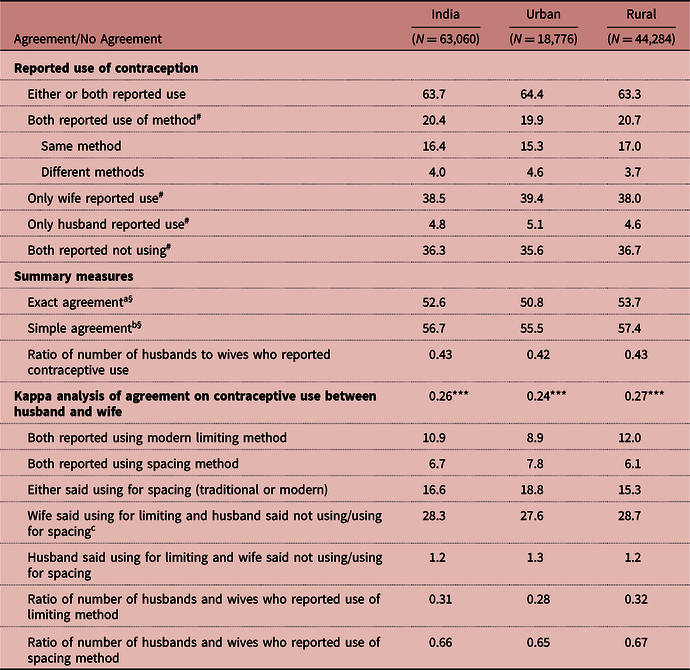
Table 3 shows the distribution of couples by reported use of contraceptives and various summary measures by place of residence. About 36% of couples (both partners) reported not currently using contraceptives. Report of non-use was slightly higher in rural than in urban areas. About 64% of couples (either husband or wife or both) reported the use of any contraceptive method; 38.5% of wives and 4.8% of husbands alone reported contraceptive use whereas their spouses did not report the use of any contraceptive method. Only 20.4% of couples agreed on the use of the same or different contraceptive methods. Among couples where both partners report use, a majority reported the same method (16.4%). Concordance on use of the same method was lower in urban India than in rural India (15.3% vs 17%). The effect size for this finding was weak (Cramer’s V = 0.087; Cohen, Reference Cohen1988). Overall, approximately five out of ten couples across India agreed on the exact reports of current use (method use or no use); this was slightly higher in rural than urban areas (Cramer’s V = 0.030). From the indicators, i.e. the ratio of the number of husbands and wives who reported contraceptive use to only husband/wife reporting use, it is clear that wives report more contraceptive use than their husbands in India.
Couples’ reports (percentage) of current contraceptive use (total, limiting and spacing methods) and measures of spouse agreement by place of residence, India, 2015–16 (N = 63,060)

a Exact agreement: spouses reported using the same contraceptive method, or both reported not using.
b Simple agreement: agreement between spouses on use without specifying a method (both reported use of any method) and non-use (both reported not using).
c Using for spacing contributes only 1% in total.
Kappa significance: *p < 0.05; **p < 0.01; ***p < 0.001.
#Cramer’s V = 0.087; §Cramer’s V = 0.030.
Variation in the responses of husbands and wives for limiting and spacing method was also explored. About 11% of couples agreed on the use of a limiting method, whereas only 6.7% agreed on spacing methods. Additionally, 28.3% of wives reported the use of a limiting method, but their husbands either reported use of a spacing method or no method.
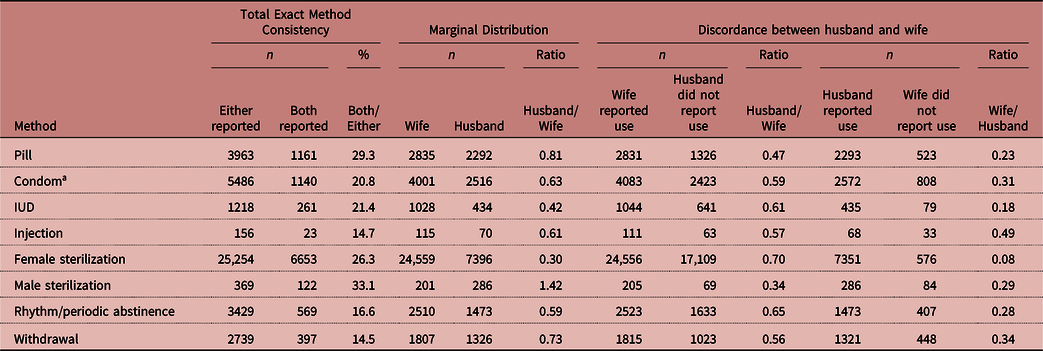
To gain further insight into the nature of the inconsistencies in reporting, Table 4 shows the method-specific responses of spouses. The first three columns give the percentages of ‘Either partner’ and percentage of ‘Both partners’ reporting a method, and the ratio Both/Either’. For convenience, this is called Total Exact Method Consistency. The Total Exact Method Consistency values were comparatively higher for male sterilization (33.1%), pills (29.3%) and female sterilization (26.3%). Withdrawal (14.5%), injections (14.7%) and the rhythm method (16.6%) had the lowest levels of concordance. The calculation of Marginal Distribution indicated that, except for male sterilization, more wives reported use of pills, condoms, IUD, injections, female sterilization and traditional methods than husbands. The most inconsistent response was for female sterilization, where for every ten wives, only three husbands reported the use of female sterilization. For the pill, this distribution was eight husbands per ten wives.
Selected summary measures of concordance/discordance among couples by contraceptive method, India, 2015–16 (N = 63,060)

a Includes female condoms. Numbers of reported female condom users were 111 wives and 10 husbands.
For couple-level comparisons, ratios of the number of husbands/wives who reported the method to the number of their spouses who did not report use of the same method were calculated. If wives reported the use of the pill, their husband’s non-reporting of use was 47%. However, if husbands reported the use of the pill, the wives did not report use in 23% of cases. If wives reported the use of condoms or IUD or injection, about 61% of husbands did not report the use of these methods. On the other hand, if husbands reported the use of any of these three methods (condoms, IUD or injection), wives’ discordance was 31%, 18% and 49% respectively. In the case of female sterilization, whenever a wife reported this method, 70% of times the husband did not report the method, but in the case of husbands reporting female sterilization, 8% wives did not report it.
Factors affecting concordance
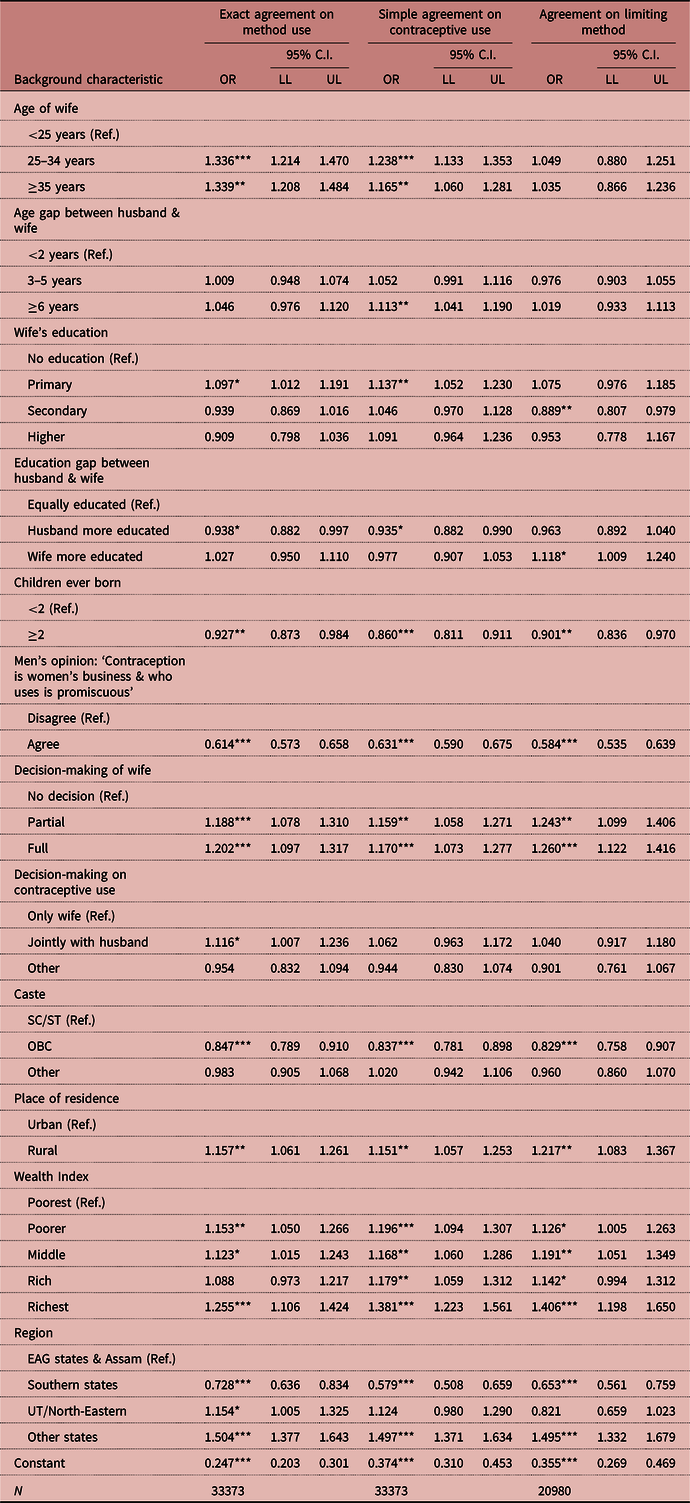
The multivariate logistic regression analyses, presented in Table 5, demonstrate the associations between different background characteristics and couples’ concordance on contraceptive use. Since non-use dominates the percentage of agreement on contraceptive use, and there was a poor level of concordance for use, for regression, three dependent variables related to (only) use of a method were considered. The first was ‘exact agreement on method use’, i.e. both reported use of the same method; the response categories were: no exact agreement (0) and exact agreement (1). The other two variables were: ‘simple agreement on contraceptive use’, i.e. both reported use of any contraceptive method (0 for no agreement, 1 for agreement) and ‘agreement on limiting method’ (0 for no agreement, 1 for agreement).
Odds ratios of couples’ agreement (exact and simple) on current contraceptive method used as a function of selected couple characteristics a , India, 2015–16

a Consistency/agreement among contraceptive users only; non-users were removed from the analysis.
Ref.: reference category.
*p < 0.05; **p < 0.01; ***p < 0.001.
Many of the covariates were significantly associated with all three outcome indicators. Decision-making by the wife was consistently positively associated with concordance across the three outcome variables. Couples where decisions were made by the wife, whether partially or fully, were 18–26% more likely to have concordant responses compared with couples in which the wife played no role in decision-making. Couples living in rural locations were 15–20% more likely to have concordant responses across the three outcomes than couples living in urban areas. Couples living in the southern states were 27–42% less likely to have concordance in their reports across the three outcomes compared with couples living in Assam and the Empowered Action Group (EAG) states (Bihar, Chhattisgarh, Jharkhand, Madhya Pradesh, Orissa, Rajasthan, Uttaranchal and Uttar Pradesh). The EAG states lag behind in the demographic transition and have the highest infant mortality rate in the country (Census of India, 2011). Couples living in states other than the southern states, north-eastern states and union territories were approximately 50% more likely to have concordance in reports on method use and total contraceptive use than couples living in Assam or the eight EAG states. Couples who lived in the north-eastern states or union territories were 15% more likely to have concordance in reports of exact method use than couples living in Assam or the EAG states.
Couples belonging to the richest wealth category were 26–40% more likely to have concordant reports across the three outcomes. Social stratification was also significantly associated with concordance. For example, couples belonging to Other Backward Classes (a social and economic category used by the Government of India for a type of vulnerable population) were less likely to have concordant reports than those belonging to Scheduled Caste/Tribes. Couples in which men believed that contraception was women’s business and that contraceptive use may make a woman promiscuous were 37–42% less likely to have concordance in their reports across the three outcomes than men who disagreed with these views.
Compared with women younger than 25, women older than 25 years were 17–34% more likely to have concordant reports for agreement on specific methods and contraceptive use. Women with an age gap of 6 or more years with their husband were about 11% more likely to have concordant reports on contraceptive use. Women with primary education were 10–13% more likely to have concordant reports on the use of a method and contraceptive use compared with women with no education. On the other hand, women with secondary education were 11% less likely to have concordance in reporting of use of a limiting method than women with no education. If the husband was more educated than the wife, there was approximately 6% less likelihood of concordance on contraceptive use. In contrast, if women were more educated, this increased the possibility of concordance in agreement on limiting method by 12%. Having more than two children was associated with a 7–14% decrease in the likelihood of concordance on exact agreement on method use, simple agreement on contraceptive use and use of limiting method as compared with couples with fewer than two children.
Reconstructing contraceptive use among men and concordance
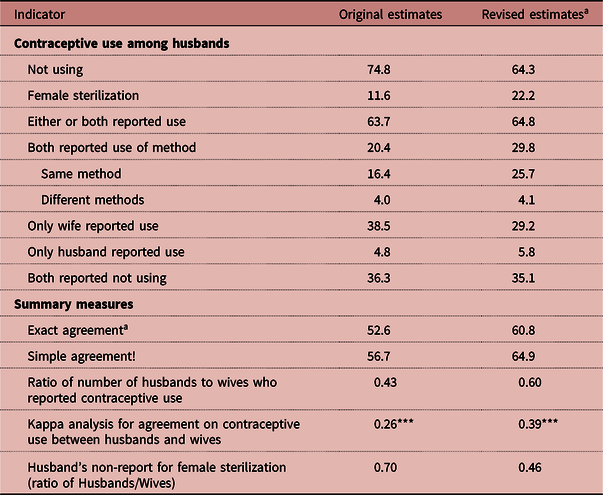
To understand the reasons for high discordance between husband and wife reporting on contraceptive or method used, the questions on contraceptive use posed to men and women were reviewed. It was found that while males were asked about contraceptive use at last sex, women were asked about the use of contraceptives at the time of interview (currently using). These questions provided the same results as were reported in the national report of NFHS-4. It was decided to re-compute contraceptive use among men (using all the relevant questions) to make it parallel to women. First, the results of current contraceptive use in the case of the wife, and contraceptive use at last sex, were compared with the ever-used contraceptive method, mainly for the permanent method. The results indicated that the numbers of current users of female sterilization matched exactly with ever-used female sterilization among wives (24,560 vs 24,560) (Table 6). In the case of husbands, ever-use of female sterilization was different from the use of female sterilization at last sex (14,274 vs 7329), whereas the number that reported male sterilization matched exactly (i.e. 286 vs 286). There were 5044 cases where the husband might have more than one marriage/partner. After considering all husbands who were married only once or had only one partner, the total number of ever-users (husbands) of female sterilization was 13,980, which remained close to the above figure. The value of female sterilization reporting among men (i.e. taking the revised figure for female sterilization from ‘ever-used contraception’ among husbands who were married only once and who were monogamous and adding the overall contraceptive rate stated by men) was inflated. Contraceptive use among men was re-calculated. Based on the revised indicator, the concordance from the original variable vs revised variable turned out to be 16.5% vs 25.7% with an increase in female sterilization from 11.8% to 22.2%. Therefore, it can be said that the question on contraceptive use at last sex might have underestimated the response and revision led to an approximately 10% increase in the level of concordance.
Comparison of study results with revised estimates, India, 2015–16 (N = 63,060)

a These estimates were revised using men’s response to ‘ever use’ for female sterilization. The detailed methodology is provided in the Results section ‘Reconstructing contraceptive use among men and concordance’.
***p < 0.001.
Discussion
Using the latest available data, this study assessed the differentials and determinants of concordance among couples’ reports of contraceptive use in India – the second most populous country in the world. The study aimed to understand whether there was any difference in the proportion of women and men reporting contraceptive use, which methods were reported more, the level of concordance among reports of couples on contraception use and the determinants of these outcomes. In contrast to some studies (Becker & Costenbader, Reference Becker and Costenbader2001; Becker et al., Reference Becker, Hossain and Thomson2006), but consistent with others (e.g. Gasca & Becker, Reference Gasca and Becker2018), it was found that a higher proportion of wives (59%) reported contraceptive use compared with their husbands (25%). The primary contraceptive method reported by both husbands and wives was female sterilization. This may be because the Indian family planning (FP) programme primarily focuses on women to space and/or limit excessive childbearing. This has underpinned the belief that FP is largely a woman’s business, with the man playing a very peripheral role. Agreement on the same method was again limited (16.5%); overall, approximately 21% of couples agreed that they used contraception irrespective of methods. There existed a substantial non-reporting from husbands regarding the use of female sterilization and other female-oriented contraceptives. Moreover, 36% of couples agreed that they did not use any contraceptive method. It must be acknowledged here that concordance on non-use may be there simply because women are surreptitiously using contraceptives and thus their answers matched those of their husbands.
In addition to providing information on current contraceptive use among Indian couples, this study contributes to the growing body of literature on contraception use in India and on couple studies. First, it demonstrated extensive discordance in couple reports on contraception, raising the question of whose report is more valid and whether the programme’s results regarding meeting FP goals are accurate. For example, higher reporting of condom use among wives than husbands alerts us to take the indicator of contraceptive prevalence (which is based on women’s reports alone) with a pinch of salt. Additionally, low concordance on withdrawal could be because some respondents may simply not be thinking of it as a method of contraception as it does not involve the use of a modern contraceptives.
Second, the results showed that negative male attitudes towards contraception reduce concordance. It is possible that the wives of husbands who had a negative attitude towards family planning were surreptitiously using contraceptives. This could potentially cause stress, and consume time and resources in maintaining secrecy over surreptitious contraceptive use and fear of being found out and intimate partner violence (Alio et al. Reference Alio, Daley, Nana, Duan and Salihu2009), which could have negative consequences for women’s overall health. Even if it is considered that men may not potentially report contraceptive use because they may consider it to be a personal matter, not to be shared with an unknown outsider or reporting bias, the fact cannot be denied that women may not be informing (hiding from) their husbands about the method they are using to control their fertility. The level of discordance in contraceptive method use raises several concerns related to power dynamics among Indian couples, society’s/husband’s acceptance and approval of FP and poor control of women of their own body and reproductive choices.
Third, the results indicate the need for greater communication between spouses regarding contraception and more social support for such discussions. For example, the results highlight that, in some cases, either the husband was unaware of the contraceptive use of his wife (especially female sterilization) or did not consider reporting it. In other instances, wives were unaware of contraceptive use by their husbands.
Fourth, the analysis raises questions about data quality as the questions were asked differently to men and women, possibly contributing to this wide variation among male and female respondents. One could expect sterilization to be under-reported with the ‘current use’ question and in ‘use at last sex’ question asked to men. This could possibly be rectified either with an ‘ever use’ question generally for any contraceptive use or specifically for each contraceptive method. It should be noted that differences in the answer to ‘current’ and ‘use at last sex’ may happen even when data are limited to a single sex. For example, women’s responses in a population-based household survey in the US showed differentials with respect to the use of female sterilization, male condoms and withdrawal (Fabic & Becker, Reference Fabic and Becker2017).
Several determinants were found to be significant in concordance among reports of husbands and wives. It can be speculated that these affect concordance in couples’ reports of contraceptive use of a specific method, with the caveat that more directed, in-depth investigation is required to understand the reasons for such disagreements. For example, women aged 25 and older may have had more concordant reports with their husbands because they may have developed more confidence with age. It is possible that older women have more confidence or comfort with their spouses due to the length of their marriage and thus contraceptive use is agreed upon more. In general, the age gap between spouses was not found to be associated with the concordance reports, except for simple agreement on contraceptive use, which showed higher concordance with a larger age gap. The existing literature also presents contradictory results; while more recently Gasca and Becker (Reference Gasca and Becker2018) did not find the age gap to be associated with covert use, Barbieri et al. (Reference Barbieri, Hertrich and Grieve2005) suggested that covert use increased with an increase in the age gap. Like other studies that have reported increased concordance with women’s years of education (Ezeh & Mboup, Reference Ezeh and Mboup1997; Becker et al., Reference Becker, Hossain and Thomson2006), the study results also indicated that women with primary education had higher concordant reports than women with no education on exact agreement and simple agreement. On the other hand, women with secondary schooling had fewer concordant reports for limiting method. It may be that more-educated women may be more assertive in reporting contraceptive use, leading to a disagreement with spouses’ reports. Another finding from the study showed that among couples in which husbands were more educated than wives, concordance was less likely. This may be because having fewer years of education than their husbands gave women less relative power to negotiate contraceptive use with their husbands.
It is possible that women with more than two children have met their desired fertility goals and are surreptitiously using any contraceptive or limiting methods. Concordance among reports can also be because of true concordance or deliberate misreporting on either spouses’ part. Whereas some studies have found lesser concordance in rural areas (Biddlecom & Fapohunda, Reference Biddlecom and Fapohunda1998; Blanc & Grey, Reference Blanc and Grey2002), this study found a striking high concordance among couples in rural areas, which may be an indicator of women’s lower autonomy in these areas. While the results were not consistently significant, richer couples tended to have more concordance, which may be due to having better communication as a result of lower financial pressures. States other than the EAG states and Assam may have higher socioeconomic indicators that encourage concordance, but the reasons for southern states having lower concordance cannot be discerned. Similarly, concerning social stratification, it is not known why Other Backward Castes would have lower concordance than Scheduled Castes/Tribes, which are similarly disadvantaged.
The study findings of the influence of a wife’s role in decision-making are consistent with the literature. While the study focused on concordance and not the decisions to use contraceptives per se, the findings mirror somewhat those of a recent study on household decision-making and contraceptive use in Bangladesh by Uddin et al. (Reference Uddin, Hossin and Pulok2017), which found that, compared with joint decision-making, the odds of using contraceptives were 51% lower when the husband alone made the decision. However, unlike Uddin et al. (Reference Uddin, Hossin and Pulok2017), which found that unilateral decision-making by women did not increase contraceptive use, the present study results found consistent positive associations with full decision-making by women. Decision-making on contraceptive use did not have any significant association with the outcome variable.
The study had its strengths and limitations. Among the strengths, the paper used a large, nationally representative dataset with the latest available data. Also, it studied couples’ responses instead of just one person’s response, highlighting the importance of investigating both spouses’ attitudes and contraception behaviours. Limitations included the failure to include domestic violence as a covariate. This was not included as it was only available for a subset of the sample and would have reduced the analytical sample to 25,000. However, analysis including the variable was conducted using a smaller sample, and this found no associations between concordance on reports of contraceptive use and domestic violence. The way questions were posed to male and female respondents was reviewed. It was found that males were asked the questions in a different manner. Therefore, revised estimates presented in Table 6 were obtained, but the entire analysis was not reviewed, keeping the study results consistent with the NFHS-4 report.
It is possible that responses were different because men don’t think of female sterilization as a contraceptive method if asked about use at last sex. It is also possible that asking women whether they are currently using contraception and asking men if they used a contraceptive at last sex is understood differently by males and females, leading to a discrepancy in responses. The study also did not investigate quality measures across states such as age heaping, and the expertise of male interviewers, which might have affected the responses.
In conclusion, the study results show wide discordance among reports of contraceptive use among married couples in India. The first implication is that data collection, training of male and female interviewers and checking data for accuracy needs to be conducted more stringently as these issues may have contributed to the wide discrepancy in responses among married couples. Second, there is probably a difference in the perception of males and females about what constitutes contraceptive use. Therefore, the questions related to contraceptive use need to be clarified to the interviewees in order to get true answers. Third, in some cases, women may be hiding contraceptive use from their husbands. Therefore, simply relying on women’s reports may not lead to accurate conclusions about contraceptive use and stronger methods to capture contraceptive prevalence such as validation of partner reports need to be developed. Given the positive association between concordance and decision-making by women, interventions to empower women to participate in decision-making and promote gender equity, while also including men into FP efforts at the same time, are needed. This highlights the importance of information, education and communication programmes to inculcate positive attitudes towards contraception, foster gender equality, encourage decision-making by women and involve men in family planning efforts.
Acknowledgments
The authors would like to thank Prof. Stan Becker, Johns Hopkins Bloomberg School of Public Health, for his valuable comments on a draft version of this manuscript.
Funding
This research received no specific grant from any funding agency, commercial entity or not-for-profit organization.
Conflicts of Interest
The authors have no conflicts of interest to declare.
Ethical Approval
The study entailed analysis of publicly available data and did not require approval from an Institutional Review Board. The authors assert that all procedures contributing to this work comply with the ethical standards of the relevant national and institutional committees on human experimentation and with the Helsinki Declaration of 1975, as revised in 2008.