INTRODUCTION
Taenia saginata is a tapeworm of humans with a global distribution and causing low morbidity (Lloyd, Reference Lloyd, Palmer, Lord and Simpson1998). However, in the intermediate host, bovine cysticercosis (=the disease caused by the larval stage of this tapeworm) causes financial losses and represents a significant problem with respect to food safety. According to the legislation in the European Union (EU) (Anonymous, 2000), carcasses with low-grade infection must be frozen before being sold, irrespective of the viability of the cysts, which substantially reduces meat value and increases costs through extra handling. Heavily infected animals are totally condemned. Bovine cysticercosis is detected during routine meat inspection (Anonymous, 2005). However, cysticerci are only detected if they are located on the surface of muscles or in musculature sliced during inspection, and it can be difficult to identify them, particularly viable ones which are transparent and thus not readily distinguished from the surrounding (e.g., fat) tissue. Importantly, some studies, employing an immunodiagnostic approach (specific detection of circulating T. saginata antigens) (Dorny et al. Reference Dorny, Vercammen, Brandt, Vansteenkiste, Berkvens and Geerts2000; Rodriguez-Hidalgo et al. Reference Rodriguez-Hidalgo, Benitez-Ortiz, Dorny, Geerts, Geysen, Ron-Roman, Proano-Perez, Chavez-Larrea, Barrionuevo-Samaniego, Celi-Erazo, Vizcaino-Ordonez and Brandt2003) have estimated that <10% of infected slaughter cattle are detected by routine meat inspection.
In Switzerland, meat inspection has revealed a mean prevalence of 0·58% in slaughter cattle between 2002 and 2005 (unpublished data for 469 317 cattle obtained from 6 abattoirs). These data are comparable with previous surveys (Gerber, Reference Gerber1991; Azzilonna, Reference Azzilonna1992; König et al. Reference König, Busato and Gottstein1996), and they also concur with recent reports from other European countries (Anonymous, 2004, 2006). However, the true prevalence of bovine cysticercosis in Switzerland is presently unknown.
The prevalences of T. saginata taeniosis in humans in different countries are largely unknown, as there is no mandatory reporting system. Estimates have been based on sales figures of specific drugs or on surveys with mostly selective sampling and using diverse examination methods. Cabaret et al. (Reference Cabaret, Geerts, Madeline, Ballandonne and Barbier2002) summarized all of the information available between 1973 and 2000. For European countries, prevalences ranged from less than 0·01% to 10%, with the highest rates having been determined for Slovakia and Turkey. Compared with the global situation, prevalences in Europe can be classified as being moderate (Murrell, Reference Murrell2005). The substantial prevalences (7–36%) in some African, Russian and Asian regions (Cabaret et al. Reference Cabaret, Geerts, Madeline, Ballandonne and Barbier2002; Li et al. Reference Li, Craig, Ito, Chen, Qiu, Qiu, Sato, Wandra, Bradshaw, Li, Yang and Wang2006; Wandra et al. Reference Wandra, Sutisna, Dharmawan, Margono, Sudewi, Suroso, Craig and Ito2006) and the considerable differences between regions are likely to be due to different eating habits, such as traditional dishes with raw or undercooked beef (Pawlowsky and Schultz, Reference Pawlowsky and Schultz1972).
Only few regionally restricted epidemiological surveys of bovine cysticercosis, which considered risk factor analyses, have been carried out in Western Europe. An extensive case-control study in Denmark revealed that the access of cattle to streams carrying effluent from sewage treatment plants was a major risk factor for low-grade infection (Kyvsgaard et al. Reference Kyvsgaard, Ilsoe, Willeberg, Nansen and Henriksen1991). Other risk factors reported in the literature include flooding of pastures, the use of sludge from sewage plants and tourist activities associated with defaecation on pasture or crops (Anonymous, 2000; Murrell, Reference Murrell2005). A recent, large case-control study in Belgium, which was based on abattoir records for cysticercosis in cattle from dairy and mixed farms, identified the geographical origin, number of slaughtered cattle, flooding of pastures, free access of cattle to surface water and proximity of waste-water effluent as risk factors for bovine cysticercosis in a herd (Boone et al. Reference Boone, Thys, Marcotty, de Borchgrave, Ducheyne and Dorny2007). In the present study, we undertook a case-control study to establish risk factors for the transmission of bovine cysticercosis on farms in Switzerland.
MATERIALS AND METHODS
Study design and data collection
From May 2005 to April 2006, bovine cysticercosis was investigated in 4 EU-approved abattoirs located in Switzerland (Bell AG, Önsingen; Marmy SA, Estavayer-le-Lac; Schlachthof St Gallen AG, St Gallen; Schlachtbetrieb Zürich AG, Zürich). The diagnosis of cysticercosis was based on the morphological detection of cysticerci during routine meat inspection, which includes incision and inspection of the outer (Musculus masseter) and inner (Musculus pterygoideus lat. et med.) chop muscles and the heart of all cattle of more than 6 months of age (Anonymous, 2005).
Farm owners and geographical origins of the selected animals were verified using the official Swiss cattle database, which guarantees traceability of each slaughtered animal since 1999. For further analyses, criteria for inclusion were applied to increase the probability that an infection with T. saginata was indeed ‘farm-borne’. These criteria included that an affected animal was kept on a farm for at least 9 months if only live cysticerci were detected, particularly in the heart, and for at least 24 months in the case of calcified lesions (heart and/or chop muscles). To allow comparability between case and control groups, the latter was randomly selected from 2 of the 4 EU-approved abattoirs (Bell AG, Önsingen and Marmy SA, Estavayer-le-Lac) providing 85·7% of the positive cases. Criteria for control farms included the presence of cattle with negative diagnoses kept for more than 9 months on a farm and an absence of reported cases of bovine cysticercosis, as confirmed by the owners. The criteria for the selection of the groups were fulfilled for 119 (72%) of all possible case farms and in 66 (84·4%) of the farms originally suggested as controls. All cattle included (from 79% of the case farms and from 73% of the control farms) were born on their respective farm.
In 110 of the 119 case farms, the diagnosis of cysticercosis at the abattoir was confirmed at the laboratory either morphologically or molecularly; the remaining 9 farms were selected based on convincing abattoir reports.
Information about structure, management and environment of the farms (addressing putative risk factors, see Table 1) as well as on the knowledge of the farmers about bovine cysticercosis was gathered between June 2005 and September 2006 using a structured interview based on a questionnaire of 35 questions. To identify human carriers of adult T. saginata on case farms, all people living or working on such farms were invited to provide 2 stool samples collected on different days, which were examined by standard diagnostic coproscopy and tested using a coproantigen enzyme-linked immunosorbent assay (ELISA) (Deplazes et al. Reference Deplazes, Eckert, Pawlowski, Machowska and Gottstein1991). For sediments of samples with inconclusive ELISA results, a sensitive flotation/filtration method was employed for the detection of taeniid eggs (Mathis et al. Reference Mathis, Deplazes and Eckert1996).
Definitions of factors included in the risk analysis for bovine cysticercosis in Switzerland

* Used to check for possible interactions.
Morphological and molecular analyses of cysticerci
Cysts containing a distinct white, unarmed scolex were classified as live cysticerci. Lesions or nodules with opaque contents or appearing already calcified were investigated further using a T. saginata-specific polymerase chain reaction (PCR) assay (Gonzalez et al. Reference Gonzalez, Montero, Harrison, Parkhouse and Garate2000) and were classified as dead cysticerci if test-positive. The isolation of genomic DNA was carried out using the NucleoSpin tissue kit (Macherey-Nagel, Oensingen, Switzerland), according to the manufacturer's instructions. PCR amplification using primers PTs7S35F1 and PTs7S35R1 (Gonzalez et al. Reference Gonzalez, Montero, Harrison, Parkhouse and Garate2000) was performed according to Stefanic et al. (Reference Stefanic, Shaikenov, Deplazes, Dinkel, Torgerson and Mathis2004). Every sample was tested in duplicate using 25 μl and 2 μl of DNA employing an annealing temperature of 61°C.
Four samples with indeterminate results were subjected to analysis using a PCR assay established during the study period in our laboratory using Taenia-specific primers Cest4/5, followed by direct DNA sequencing (Trachsel et al. Reference Trachsel, Deplazes and Mathis2007) employing a commercial service (Microsynth, Balgach, Switzerland).
Data handling and statistical analysis
Based on the variables from the questionnaire, 19 factors were selected for the final analysis. Definitions of the factors used are given in Table 1. These factors, together with 12 biologically comprehensible interactions, were subjected to a logistic regression analysis. The infection status (positive or negative) was the ‘response variable’. In a ‘stepwise backwards-selection’, factors were eliminated from the full model in an iterative process based on the Akaike information criterion (AIC) (Akaike, Reference Akaike1974) with the stepAIC function (Venables and Ripley, Reference Venables and Ripley2002) of the MASS package in the statistical software R 2.3.1 (R Development Core Team, 2006). It is known that automatic stepwise selection procedures are usually relatively conservative (Derksen and Keselman, Reference Derksen and Keselman1992). Such procedures can select models with too many predictors, some of them not being statistically significant. Therefore, the factors of the resultant model of this stepwise backwards-selection were tested for significance by a likelihood ratio test, in which the distribution of the test statistic is computed based on Monte-Carlo studies. This is better than assuming an asymptotic χ2-distribution (Good, Reference Good1994) and the Monte-Carlo procedure is suitable for computing empirical P-values in the present case with relatively small sample sizes. In the final model, the 95% confidence intervals (C.I.) of the factors were computed with the profile likelihood method (confint.glm) provided in the package MASS of the statistical software R 2.3.1.
Model diagnostics included: (i) the evaluation of the Pearson's χ2 goodness-of-fit test (Pearson, Reference Pearson1938) and (ii) the calculation of Pearson residuals (Cordeiro, Reference Cordeiro2004) to identify outliers. Observations with large residuals were evaluated further by re-fitting the model without the observations and comparing the estimated values.
RESULTS
The 119 case farms were identified based on the detection of viable cysts (47; 39·5%), calcified lesions (63; 52·9%) or on convincing abattoir reports only (9; 7·6%). Heavily infected carcasses, in which several cyticerci were detected (upon routine inspection) at different locations and which were thus condemned, were recorded from 3 farms.
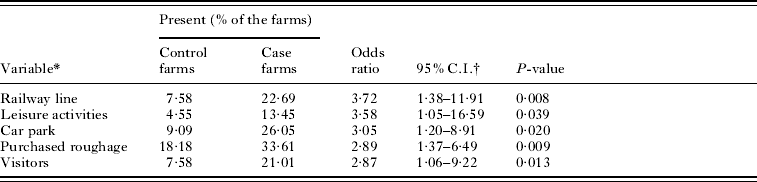
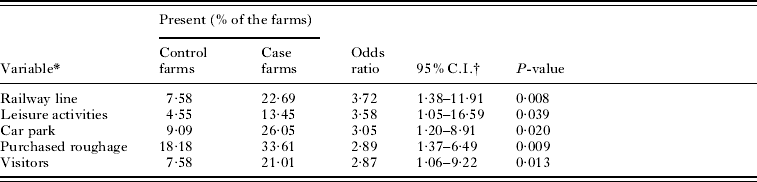
The logistic regression analysis revealed a final model with 5 risk factors associated with a farm having infected cattle: railway line, leisure-activities, car park, purchased roughage and visitors (Table 2). The Pearson's χ2 test, used to judge the goodness-of-fit of the final model, yielded a P-value of 0·4132, which was well in excess of 0·05. Therefore, the null hypothesis that the final model was appropriate cannot be rejected. Hence, we could conclude that the model fitted the data sufficiently well. The plot of the Pearson residuals indicated a random pattern. The re-fitting of the model by omitting the outliers (detected by the Pearson residuals analysis) did not yield any significant changes in the output. Hence, the residual analysis did not indicate a lack of fit of the model.
Significant results of the logistic regression analysis, examining possible risk factors for bovine cysticercosis in case farms positive for cysticercosis (n=119) and control farms free from this infection (n=66), computed by the profile likelihood method, and the resultant empirical P-value, based on a Monte-Carlo based likelihood ratio test
* As described in Table 1.
† 95% profile likelihood confidence intervals.
There was no evidence of human carriers of adult T. saginata, as a source of infection to cattle. No taeniid eggs were detected by conventional coproscopic examination of samples from 317 people from 49 case farms. Coproantigen ELISA revealed 266 (86·4%) negative and 42 (13·6%) inconclusive results. Further microscopical examination (using an egg enrichment approach) did not reveal any taeniid eggs in any of the latter 42 samples.
DISCUSSION
The results of this study document that leisure activities on or in the vicinity of cattle grazing areas and the presence of car parks result in a higher risk for bovine cysticercosis. The high population density in Switzerland, with a spreading urban agglomeration, promotes the use of agricultural land as recreation areas. As toilet facilities in such areas are scarce, contamination of agricultural land with tapeworm eggs associated with defaecation by humans is plausible. Tourism, as a risk for increasing the infection pressure with T. saginata eggs on pastures, has been postulated previously (Murrell, Reference Murrell2005), and dispersal of Taenia eggs at least 25 m from the site of deposition has been demonstrated (Gemmell and Johnstone, Reference Gemmell and Johnstone1976). A bordering railway line as a risk factor could be statistically confirmed in this study. According to Swiss Federal Railways (the national railway company which operates the major part of the railway network in Switzerland), approximately 60% of all trains (operating on all lines) still have carriages with ‘open’ toilets which release sewerage directly on to the tracks; fortunately, this practice will cease within the next 10 years.
Based on the questionnaire, ‘visitors’ were found to be a significant risk factor. This group of farms had approximately 300–3000 visitors per year, who were associated with organized commercial farm activities as a supplementary source of income. Additionally, while the transmission of cysticercosis may occur through direct contact of infected people with cattle, contamination of the manure followed by contamination of pastures (using liquid manure as a fertilizer) is likely to play a more important role in Switzerland. Indeed, domestic effluent was drained into a manure storage tank on 65·4% of all farms investigated.
The present study indicated that purchased roughage (e.g., hay or silage) was a risk factor, which could be explained by the fact that feed (of unknown origin) may contain eggs based on different risk factors. Nevertheless, it is surprising that this variable was associated with an infection risk. Possibly, the farmers' answers to the question as to whether they had purchased roughage were biased, depending on the presence/absence of infections on the farms. Such a reporting bias is a frequent problem in case-control studies. To minimize this type of bias, on-farm interviews were carried out in this study.
Bias in the diagnosis of cysticercosis could have occurred because of a false-negative classification of some control farms. Although not reported, it could not be excluded that cattle in this group harboured cysts due to the low sensitivity of the routine method of meat inspection. However, according to Kyvsgaard et al. (Reference Kyvsgaard, Ilsoe, Willeberg, Nansen and Henriksen1991), this effect would not cast doubt on the risk factors identified, but rather increase their significance.
For a number of potential risk factors (Table 1), no significant effect on the infection risk was shown in this study. Organic farming, although proposed to favour pasture-borne parasite infections, does not pose a specific risk for bovine cysticercosis. Transhumance in alpine regions, which was practised on almost half of the farms visited, was a suspected risk factor, because of the large area being grazed on alpine pastures. However, no risk could be attributed to this practice in the present study.
The sizes of the farms (mean area: 22·3 hectares; 95% C.I.: 20·2–24·4) and the herds (36·2 cattle units; 95% C.I.: 32·0–40·3) investigated are small as compared with many other countries. Most of the farms investigated were ‘family-run’, but 40·5% (95% C.I.: 33·4–48·0) had few employees (mean number: 3·2l; 95% C.I.: 2·5–3·9) which had no significant influence on the risk of infection.
Furthermore, unlike the results of the Danish and Belgian studies (Kyvsgaard et al. Reference Kyvsgaard, Ilsoe, Willeberg, Nansen and Henriksen1991; Boone et al. Reference Boone, Thys, Marcotty, de Borchgrave, Ducheyne and Dorny2007), no significant risk could be ascribed to cattle having access to streams potentially carrying effluent from sewage treatment plants or to flooded pastures or fields. In Switzerland, cattle are mostly provided with tap water, as the banks of streams are rarely privately owned. The use of sewage sludge as a fertilizer on pastures has been discussed as a possible source of T. saginata eggs (Cabaret et al. Reference Cabaret, Geerts, Madeline, Ballandonne and Barbier2002), but this practice is not permitted in Switzerland where such sludge is systematically disposed of by incinerating or composting.
No human carriers of adult T. saginata could be identified on the farms investigated in this study. However, people from only 41% of all case farms took the opportunity of being tested for infection; even from these farms, not all persons were included. The assumption that employees, many of whom originated from countries with high prevalence of T. saginata and were employed on a seasonal basis, were more likely to be infected with tapeworms could neither be supported nor refuted because of the low number of persons examined. Furthermore, the long period between the detection of cysticeri in the abattoir and the time of infection complicated the tracking of tapeworm carriers. Heavily infected carcasses which resulted from direct transmission from (an) infected person(s) were found in only 3 of the 119 case farms. That 116 of the 119 case farms had cattle with only low numbers of lesions strongly supports the importance of indirect transmission.
An interesting finding was that 29·4% of all case farms had previously experienced cases of cysticercosis (farms with repeated ‘current’ cases within the last 12 months were not considered). Even though infected animals detected at different times could have contracted the infection from the same source (as lesions can persist for many years), this high rate of repeated cases could reflect the continuity of certain risk factors.
This study was financially supported by the Swiss Federal Veterinary Office. We highly acknowledge the kind participation of the farmers interviewed and of the meat inspectors, in particular Dr P. Kraljevic and Dr H. P. Jakob, Bell AG (Önsingen) as well as Dr W. Holden, Marmy SA (Estavayer-le-Lac). This work represents the dissertation of Franziska Flütsch.