INTRODUCTION
The plant vigour hypothesis (PVH) proposes that herbivores prefer feeding on plants that grow more vigorously (Price Reference PRICE1991). A plant's ‘vigour’ refers to its comparative growth rate. The PVH has been supported in studies on insects (Baker Reference BAKER1972, Craighead Reference CRAIGHEAD1950, Furniss & Carolin Reference FURNISS and CAROLIN1977, Keen Reference KEEN1952, Price et al. Reference PRICE, ROININEN and TAHVANAINEN1987) and vertebrates (Bergström & Hjeljord Reference BERGSTRӦM and HJELJORD1987, Danell et al. Reference DANELL, HUSS-DANELL and BERGSTRӦM1985). Vigorous plants should also grow faster after herbivory to compensate for the damage (Coley & Aide Reference COLEY, AIDE, Price, Lewinsohn, Fernandes and Benson1990, Coley et al. Reference COLEY, BRYANT and CHAPIN1985). More vigorous plants should have higher nutrient concentrations and less vigorous plants more chemical defences (Price Reference PRICE1991) and this may be the basis of herbivore foraging decisions.
Herbivore size may influence foraging decisions with respect to plant vigour. Larger herbivores, like elephant, are less selective of plant modules. Rather than responding only to plant chemical or structural properties, a larger herbivore may also respond to plant size (Vivas et al. Reference VIVAS, SAETHER and ANDERSON1991, Wilson & Kerley Reference WILSON and KERLEY2003). Makhabu et al. (Reference MAKHABU, SKARPE, HYTTEBORN and MPOFU2006) found no relationship between the vigour of browse species and feeding preferences of the African elephant (Loxodonta africana). They suggested that the elephant selects whole plants, rather than just the new growth. The influence of plant vigour on food selection by Asian elephant species in a rain-forest environment has not yet been investigated.
Elephant species should be less selective than other herbivores. Lower metabolic requirements, larger gut volume and food retention time, mean larger herbivores survive on lower-quality food (Bell Reference BELL1971, Demment & van Soest Reference DEMMENT and VAN SOEST1985, Jarman Reference JARMAN1974, Shrader et al. Reference SHRADER, BELL, BERTOLLI and WARD2012). They can trade food quality for quantity by consuming an abundant, low-value resource instead of searching for less common, higher-value forage (Demment & van Soest Reference DEMMENT and VAN SOEST1985, du Toit & Owen-Smith Reference DU TOIT and OWEN-SMITH1989). For this reason we propose that the PVH is unlikely to explain Asian elephant food choices, but that plants with larger growth forms will be preferred.
Plants have been found to respond both positively and negatively to herbivory. A plant's regrowth rate may increase or, if too much plant material has been taken, decrease because, for example, plant resources are invested instead in the production of anti-herbivore defences (McNaughton Reference MCNAUGHTON1983). We investigated whether plant size or regrowth vigour after herbivory influence Bornean elephant (Elephas maximus borneensis) preferences.
Herbivore food preferences are reflected by the vegetation chosen in proportion to its availability (Johnson Reference JOHNSON1980). Selection-availability or avoidance ratios reveal if animals fed randomly or selectively. Where browse is plentiful it dominates the diet of some forest elephant species (Blake Reference BLAKE2002, Chen et al. Reference CHEN, DENG, ZHANG and BAI2006, Pradhan et al. Reference PRADHAN, WEGGE, MOE and SHRESTHA2008, Sukumar & Ramesh Reference SUKUMAR and RAMESH1992). But grasses were the major component of the diet of forest elephants throughout the year in Cameroon (Tchamba & Seme Reference TCHAMBA and SEME1993) and Olivier (Reference OLIVIER1978) found the Malaysian elephant to avoid feeding on woody trees and prefer palms, herbs and grasses. A seasonal deterioration in grass quality has been used to explain a preference for browse by the Asian elephant (Pradhan et al. Reference PRADHAN, WEGGE, MOE and SHRESTHA2008, Sukumar Reference SUKUMAR1990).
Based on the literature, we hypothesized that Bornean forest elephant diet would be dominated by species such as palms, gingers and woody trees rather than plants in the Poaceae, because the habitat types in which these are found are less common in this tropical forest landscape (English, unpubl. data). We expect elephant, therefore, to select plants proportional to their availability and especially the larger plants that provide abundant biomass. Due to an ability to feed on lower-quality food, because of its body size, we do not expect plant vigour to influence Bornean elephant food preferences.
METHODS
Study site
The Lower Kinabatangan Wildlife Sanctuary (LKWS) is located in South-Eastern Sabah, Malaysia. The sanctuary is a lowland floodplain that comprises a matrix of habitat types of degraded to highly degraded forest ecosystems. The floodplain is characterized by a warm, wet and humid tropical climate. Temperature variation is diurnal rather than seasonal and mean monthly temperatures range between 21ºC and 34ºC (Ancrenaz et al. Reference ANCRENAZ, CALAQUE and LACKMAN-ANCRENAZ2004). Floods mainly occur between November and March during the west monsoon with rainfall averaging 3000 mm y−1 (Sooryanarayama Reference SOORYANARAYAMA1995). Soils are predominantly alluvial, derived from sedimentary deposits often rich in magnesium and, in areas of freshwater swamp, soils often contain a high proportion of peat (Azmi unpubl. data).
This study focused on the area between the villages of Abai and Batu Puteh (5°18′–5º42′N, 117°54′–118º33′E), which were the downriver and upriver limits of the LKWS elephant population's range (Figure 1). The study area contains lots 1–7 (approximately 218 km2) of the LKWS including 89 km2 of protected forest reserves (Estes et al. Reference ESTES, OTHMAN, ISMAIL, ANCRENAZ, GOOSSENS, AMBU and PALMIOTTO2012). ‘Lots’ represent the different sections of the sanctuary. Elephants also used the privately owned forests and cultivated land, such as oil palm plantations that were adjacent to and between forested areas.
The Lower Kinabatangan Wildlife Sanctuary, Sabah, Malaysia (adapted from Clouded Leopard Project, Sabah, www.cloudedleopard.org).

Focal species
The Bornean elephant, an endangered subspecies of the Asian elephant (Elephas maximus), is found only in the eastern and central parts of Sabah (Alfred & Ahmad Reference ALFRED and AHMAD2010) as well as the extreme north of Indonesian Kalimantan. The main threat to the Bornean elephant population is the change in habitat from forest to agriculture, mainly oil palm plantations, and the resulting human-elephant conflicts. Elephant in LKWS are restricted to the linear fragments of forest along the Kinabatangan River (Estes et al. Reference ESTES, OTHMAN, ISMAIL, ANCRENAZ, GOOSSENS, AMBU and PALMIOTTO2012).
Vegetation sampling
Sampling sites were selected opportunistically throughout the elephant's home-range. These sites represented the elephant range used by the herds in March–June 2011, which is early dry season (Figure 1). We searched sections of the sanctuary from the river and tracks for elephants and recent elephant signs. Signs included fresh dung, urine, fresh footprints and recently browsed plants.
We established 50-m transects at places where elephants were feeding. The transects were at least 300 m apart to minimize site autocorrelation. One transect was established per day. We tracked fresh elephant signs including footprints, dung and signs of feeding to establish the transect along the group feeding path. All plants showing signs of elephant feeding within 2 m either side of transects were marked and labelled with the date and a reference number. Samples of all plant species were collected for identification at the Sabah Forestry Department Herbarium (SAN), Sandakan.
The height and basal diameter of the stem showing the feed signs were measured to establish the size and relative age of the plants selected by the elephants. Measures of availability were taken at 5-m intervals along the transect, where the species closest to the transect was recorded. Transects and marked plants were revisited and regrowth measured each month from April 2011 to December 2011. If the plant died or had been re-browsed by elephant or other herbivores, thus preventing measurements of regrowth, this was also recorded.
Selected plants had diverse growth forms and responded to herbivore feeding by recovering in different ways. Monthly regrowth measurements were taken on a selected new shoot closest to the node nearest the feed sign, or from the plant base, depending on how the plant recovered. Only recovery visible above the ground and within a 30-cm radius of the focal plant was measured. Measurements included new shoot growth in length, basal diameter of the new shoot and a count of the number of new shoots produced each month.
Data analysis
Plant species preference
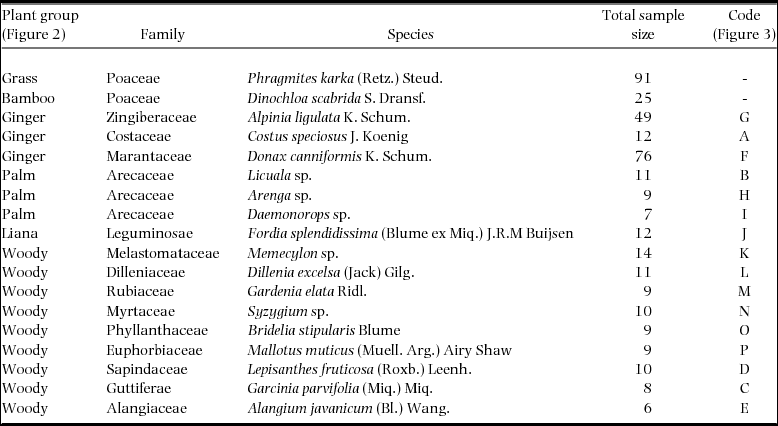
Plant species preference was calculated using the relative availability (RA) of each species compared with their relative use (RU) by the Bornean elephant. We focused only on frequently encountered species by limiting the preference analysis to those species for which more than five individual plants were sampled. Species and sample sizes included in analysis are listed in Table 1.
 \begin{equation*}
RA = \frac{{Na}}{{Ta}}
\end{equation*}
Plant species selected by Bornean elephant and available along transects within the Lower Kinabatangan Wildlife Sanctuary, Sabah, Malaysia. Plant species are included in analyses for Figures 2 and 3 and were identified by Sabah Forestry Department herbarium (SAN), Sandakan, Sabah.
Na is the number of available plants of a given species and Ta is the number of available plants across all species (185).
 \begin{equation*}
RU = \frac{{Nu}}{{Tu}}
\end{equation*}
Nu is the number of times a species was selected. Tu is the total number of plants selected for feeding across all species (182).
 \begin{equation*}
{\rm Preference}\,{\rm ratio} = \frac{{RU}}{{RA}}
\end{equation*}
Species with a preference ratio >1 were selected and those <1 were avoided (Petrides Reference PETRIDES1975). The ratios were then converted to binary numbers where selected = 1 and avoided = 0.
Grass and browse selection
Chi-square tests between grass, bamboo, palms, Zingiberales (ginger hereafter), lianas and woody trees were used to determine if the differences between use and availability were significant. Statistical analyses were undertaken using SPSS 18.0.
New shoot volume
The vigour of each species was determined by taking averages of (1) the average number of new shoots, (2) the average values of change in new shoot length and (3) the average growth in basal area of the new shoot for each species between months. These were then used to calculate the average new shoot volume for each species using the formula for a cone (V = πr 2h/3).
 \begin{eqnarray*}
&& = ({\rm shoot}\,{\rm basal}\,{\rm area} \times {\rm average}\,{\rm monthly}\,{\rm shoot}\,{\rm length})/3\\
&&\quad \times\, {\rm average}\,{\rm number}\,{\rm of}\,{\rm new}\,{\rm stems}\\
\frac{{\pi r^2 L}}{3} \times S
\end{equation*}
Where πr 2 is the basal area, L is the average growth in shoot length per month and S is the average number of new stems produced by the plant per month.
Plant vigour and size
The variables for plant vigour included the maximum monthly average for each species of growth in length of the new shoot (mm), number of new shoots produced and volume of new shoots (mm3). Poaceae were not included in the vigour analyses and species with sample sizes of less than five were removed. A Principal Component Analysis (PCA) was used to reduce confounding effects of partial correlation between variables of plant regrowth vigour, thus reducing the number of covariates in the model to two. The principal component with which volume was most strongly associated had an eigenvalue <1 and was therefore removed from the regrowth vigour analyses. The length of new growth and number of stems produced was analysed using a Generalized Linear Model (GLM) with the preference ratio, a binary logistic, as the dependent variable using SPSS 18.0. The regrowth vigour of woody trees was first analysed to compare to previous studies, then vigour of gingers, palms and lianas was included in analyses due to these other plant types being available to elephants in a rain-forest environment. Plant size, using the basal diameter of the main stem (mm), was also analysed using a GLM with the preference ratio as the dependent variable.
RESULTS
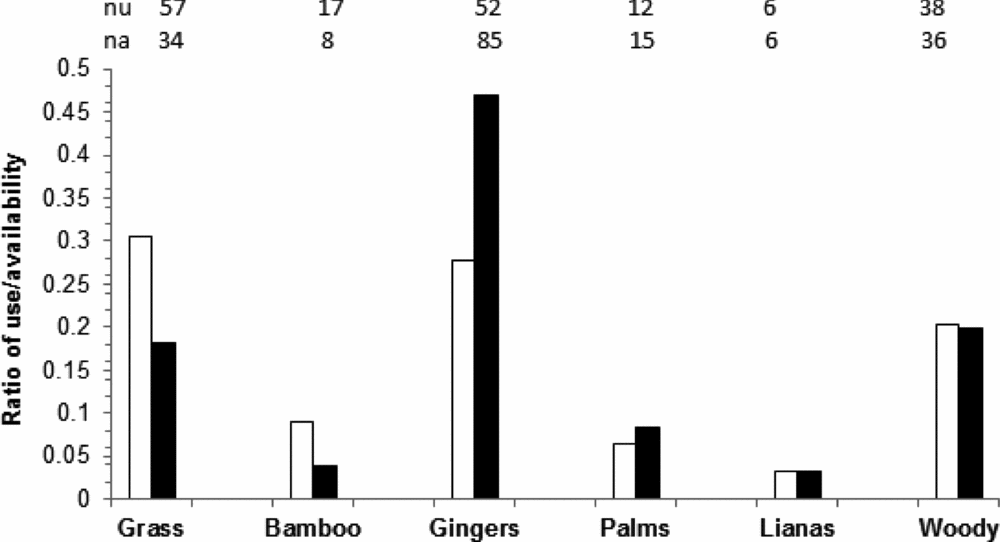
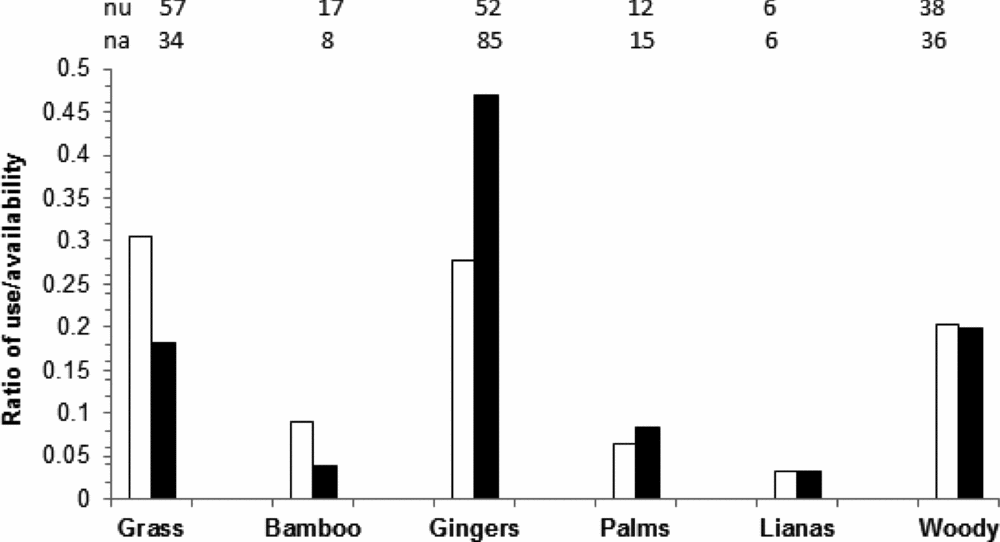
A total of 182 plants were eaten and 185 available plants were measured. Eighteen species were included in the analyses. Plant species were grouped into plant types for used and available comprising Poaceae (Phragmites karka, a grass and Dinochloa scabrida, a bamboo), gingers, palms, lianas and woody trees (Figure 2). The elephant favoured the grass and bamboo more than other plant types (Pearson chi-square, N = 18, χ21 = 0.920, P = 0.012) although these were less common in the landscape (43 available Poaceae samples) compared with other species (142 available samples). The elephant preferred six and avoided 10 of the most common species along transects (Figure 3). Palms such as Licuala sp., and gingers such as Costus speciosus and Donax canniformis, were selected. Woody trees were less common, but Garcinia parvifolia, Lepisanthes sp. and Alangium sp. were most abundant and selected.
The ratio of plants selected by the Bornean elephant and plant availability in the Lower Kinabatangan Wildlife Sanctuary, Sabah. Plant species are in plant groups (grass, bamboo, gingers, palms, lianas and woody species). Used ratios of plants are white bars and available ratios of plants are black bars. The number of individual plants used (nu) and number of individual plants available (na) for each plant group are shown. Grasses are Phragmites karka; bamboo Dinochloa scabrida; gingers include Alpinia ligulata, Costus speciosus and Donax canniformis; palms include Licuala sp., Arenga sp. and Daemonorops sp.; lianas include Fordia splendidissima and woody includes Memecylon sp., Dillenia excelsa, Gardenia elata, Syzygium sp., Bridelia stipularis, Mallotus muticus, Lepisanthes fruticosa, Alangium javanicum and Garcinia parvifolia.
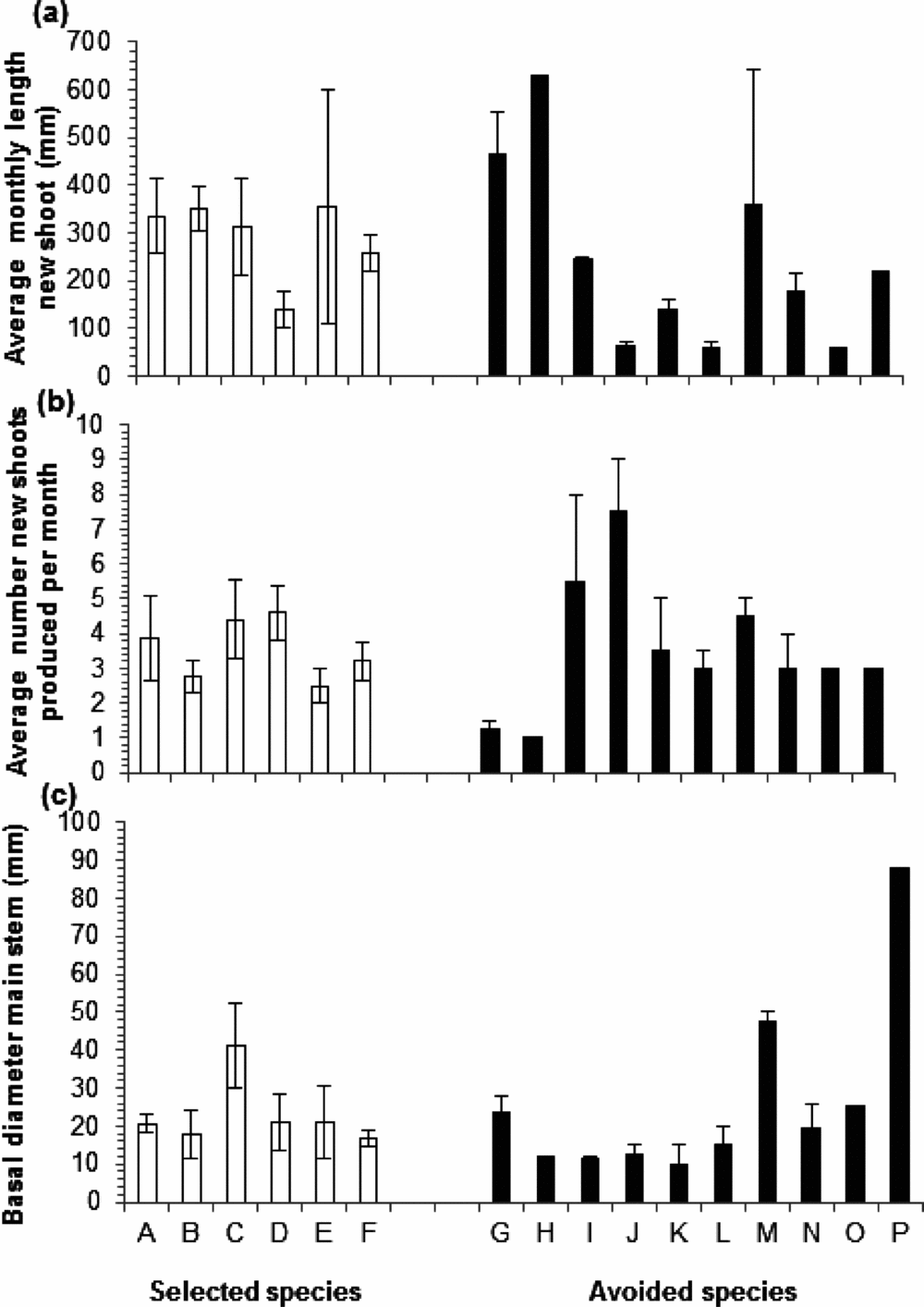
Plant selection and avoidance by the Bornean elephant in the Lower Kinabatangan Wildlife Sanctuary, Sabah, related to regrowth vigour for each species. Includes the average monthly growth in new shoot length (mm) (a) average monthly number of new shoots (b) and plant size using average basal diameter of the main stem (mm) (c). Error bars represent standard error of individual samples within a species. Selected species in white and avoided species in black. Letters correspond to species names given in Table 1.
The Bornean elephant did not select woody trees that recovered more vigorously (GLM Logistic Regression, Wald Chi-square, df = 5: new shoot length χ21 = 1.17, P = 0.278; number of new stems χ21 = 0.479, P = 0.489), nor did it prefer more vigorously regrowing species when more plant forms were included in analyses such as gingers, lianas and palms (GLM Logistic Regression, Wald Chi-square, df = 12: new shoot length χ21 = 0.598, P = 0.439; number of new stems χ21 = 0.231, P = 0.631). Plant size did not influence selection (GLM Logistic Regression, Wald Chi-square, df = 13: basal diameter χ21 = 0.117, P = 0.733). Favoured species were therefore not larger, their new growth not longer, nor did they produce more new stems than avoided plants.
DISCUSSION
We expected the Bornean elephant to select plants proportional to their availability and prefer palms, gingers, lianas and woody trees over grasses, including bamboos. We proposed that plant size, rather than plant regrowth vigour, might influence food choices. We did not find support for the influence of plant regrowth vigour or plant size on elephant food-plant choices but we did determine that the elephant in LKWS preferred to feed on Poaceae (Phragmites karka and Dinochloa scabrida) proportionately more than their availability, compared with other measured species.
Plant selection
Bornean elephant in the LKWS fed mainly on a subset of available species. Food-plant selection was not explained by the relative abundance of plant species. This finding is consistent with several other studies on the feeding behaviour of African elephant (Loxodonta africana), African forest elephant (Loxodonta cyclotis) and Asian elephant (Elephas maximus) (Codron et al. Reference CODRON, CODRON, LEE-THORP, SPONHEIMER, KIRKMAN, DUFFY and SEALY2011, McKay Reference MCKAY1973, Olivier Reference OLIVIER1978, Seydack et al. Reference SEYDACK, VERMUELLEN and HUISMAN2000, Short Reference SHORT1981, Sukumar Reference SUKUMAR1990, Williamson Reference WILLIAMSON1975, Wing & Buss Reference WING and BUSS1970).
Most studies of other elephant taxa (Loxodonta cyclotis) (Blake Reference BLAKE2002) and (Elephas maximus) (Sukumar Reference SUKUMAR1990) describe their preference for browse unless grass was the dominant vegetation, whereas Tchamba & Seme (Reference TCHAMBA and SEME1993) and Olivier (Reference OLIVIER1978) found grasses to be preferred despite being less abundant. In LKWS, although open grassed areas along forest margins (containing early-successional species such as bamboo) and riverine areas (containing semi-aquatic grasses such as reed), cover just 14% of the landscape (compared with 60% forested areas and 26% permanent swamp; English, unpubl. data). The Bornean elephant preferred feeding on the two Poaceae (Phragmites karka and Dinochloa scabrida) in riverine and open grassed areas along forest margins, than other species in the study. Thus, there is variation in the literature of the importance of grass species in the diet of the forest elephant relative to its abundance.
Asian elephants are believed to switch their diet preferences from grass to browse depending on seasonal changes in plant quality. For example, browse is consumed more in the dry season and grass in the early wet season (Sukumar Reference SUKUMAR1990); although some other studies found elephants to prefer grasses despite seasonal influences (Olivier Reference OLIVIER1978, Tchamba & Seme Reference TCHAMBA and SEME1993). Our study period was in the dry season when more browsing might be expected but still the Bornean elephant preferred to feed on the two Poaceae mentioned. Seasonal influence is unlikely to be a major factor influencing plant quality in our study site because, despite a wet and dry season, rainfall is common throughout the year. Moreover, one of the species (Phragmites karka) is semi-aquatic and found in close proximity to a permanent water source. Moreover, these species are also perennial. It is unknown if there was any natural open areas within the forest historically in Sabah. Logging is believed to have started at least a century ago and the area could have been inhabited for many centuries by nomadic villages and the forest cleared for farming purposes. The river itself has been affected by a series of disturbances due to flooding and natural processes decimating forest and replacing with open areas containing early-successional species such as grasses, including bamboos (R. Nilus pers. comm.). However, regardless of their origin, these areas provide the elephants with much of their preferred food plants.
A second scenario that might explain why the Bornean elephant prefers Poaceae in the LKWS is that the quality of other plants within the elephant herd's range may be poor, because the remnant habitat is poor or the overall habitat quality may have declined. Higher quality habitat may have been replaced by oil palm cultivation (Elaeis guineensis) and forced the elephant to use areas that may be less optimal for foraging, or it may be exceeding the forests capacity to support it. An increase in the LKWS elephant population in the last 10 y (<100– >200 individuals) (Ancrenaz pers. comm.) may have depleted preferred browse species and increased its use of Poaceae species to compensate. Bulk feeding on species such as reed and bamboo may enable elephants to meet intake requirements unable to be met by more abundant species.
Another scenario involves the influence of river hydrology on soil and plant quality through sediment and nutrient deposition by water filtered through the riparian zone. Rain-forest soil quality can range from highly leached, infertile soils to fertile, less-weathered, alluvial soils (Ashton Reference ASHTON, Losos and Leigh2004). Grasses, such as the common reed, in a floodplain landscape may be preferred due to the soil quality in riverine areas having higher nutrient concentration compared with soils further from the river where browse species are found. Moreover, vegetation growing on nutrient-deficient soils has been found to contain more chemical defences compared with plants found in areas with nutrient-rich soils (Coley et al. Reference COLEY, BRYANT and CHAPIN1985, Owen-Smith & Cooper Reference OWEN-SMITH and COOPER1987). Therefore, some plant species may be relatively high in chemical defences and of poorer quality to elephant within our study site. In addition, regular feeding increases soil nitrogen cycling and denitrification from herbivore dung deposition and urine, leading to elements being returned to the soil in readily available forms (McNaughton et al. Reference MCNAUGHTON, REUSS and SEAGLE1988, Reuss Reference REUSS and Walker1986, Risser & Parton Reference RISSER and PARTON1982). The result is improved nitrogen availability for plants in these areas (Hamilton & Frank Reference HAMILTON and FRANK2001, Holland & Detling Reference HOLLAND and DETLING1990, McNaughton et al. Reference MCNAUGHTON, BANIKWA and MCNAUGHTON1997, Risser & Parton Reference RISSER and PARTON1982). Whatever the cause of plant preference by the Bornean elephant in LKWS it is clear that the common reed and bamboo are a significant part of its diet in a way not previously appreciated.
Plant regrowth vigour and size
The Bornean elephant of the LKWS did not prefer more vigorously regrowing plant species. This finding supports predictions based on body size and metabolism where the elephant represents an upper extreme in their tolerance of lower-quality food compared with smaller herbivores (Bell Reference BELL1971, Demment & van Soest Reference DEMMENT and VAN SOEST1985, Jarman Reference JARMAN1974). For a larger animal that can accept a lower-quality diet, almost the whole plant is a homogenously acceptable food item, whereas for a smaller animal requiring a higher-quality diet a plant is a set of heterogeneous parts, from among which the more nutritious components must be selected (Bell Reference BELL1971, Jarman Reference JARMAN1974). High-quality parts of plants generally form smaller food items than do the low-quality parts. Thus, it is fitting that the diet selection of elephant, which must select their food for quantity rather than quality, should not be influenced by selection for more vigorous plants which are generally of higher nutritional quality (Price Reference PRICE1991).
Previous studies have found conflicting results in plant size preferences of elephants. The African forest elephant has been reported to prefer woody species with a smaller diameter at breast height (dbh) (Blake & Inkamba-Nkulu Reference BLAKE and INKAMBA-NKULU2004, Wing & Buss Reference WING and BUSS1970). In contrast, the Bornean elephant shows a preference for larger dbh in one woody species (Macaranga sp.) (Matsuyabashi et al. Reference MATSUYABASHI, LAGAN and SUKOR2006). Compared with small herbivores, an elephant may consume more modules of a plant as it has a larger bite size and use of a prehensile trunk. Thus elephant might respond positively to a plant's size because more edible components are available (bark, leaves, new shoots, fruit and roots) (Vivas et al. Reference VIVAS, SAETHER and ANDERSON1991, Wilson & Kerley Reference WILSON and KERLEY2003). We expected Bornean elephant to prefer larger plants as part of its optimal foraging strategy, as they should be less selective and conserve energy rather than seeking resources elsewhere (Charnov Reference CHARNOV1974). However, we found that selection and avoidance was not influenced by the size of the plant.
Our results suggest Bornean elephant foraging behaviour occurs at a larger spatial scale than at the plant level. Shrader et al. (Reference SHRADER, BELL, BERTOLLI and WARD2012) proposed that because elephant were generally forced to feed less selectively to provide sufficient intake, it is possible that it will make foraging decisions at the habitat or site level rather than at the individual plant level and this may also be the case with the elephants in our study.
Implications for management of habitat and population
Our findings about Bornean elephant food choices have direct implications for the restoration and management of elephant habitat in Sabah. Our results suggest that preservation of open areas along forest margins where Dinochloa scabrida is common (Dransfield Reference DRANSFIELD1992) and riverine areas where Phragmites karka are common is necessary for elephant conservation. Some forest disturbance is not deleterious as increased sunlight in ecotone and open areas encourages growth of early-successional species such as those preferred by the Bornean elephant. Currently open areas along forest margins are actively planted with tree species as this is considered the foundation state for restoration. We recommend, however, that wildlife and habitat rehabilitation managers set aside some open areas for Poaceae throughout the LKWS. Replanting of trees along the river bank is important for minimizing erosion and providing opportunities for food or movement to a number of species, such as primates. It is also visually appealing for ecotourism in the area. The importance of bamboos and reeds, and perhaps other species within Poaceae, for elephants, however, should be incorporated into management and restoration planning.
ACKNOWLEDGEMENTS
We thank Victoria University of Wellington for supporting the study and providing a doctoral scholarship and a completion scholarship for Megan English, and are grateful to the Economic Planning Unit and Sabah Wildlife Department for permitting the research in the Lower Kinabatangan Wildlife Sanctuary. Research was made possible by field assistants provided by HUTAN Kinabatangan Orang-utan Conservation Project and their Elephant Conservation Unit. We thank Danau Girang Field Centre for providing a vehicle and field staff, Dr John Sugau, Sabah Forestry Department, for identifying plant species and Professor Phillip Garnock-Jones from Victoria University of Wellington. This project was supported by funds to Megan English and Dr Wayne Linklater from Zoos Victoria, Australia.