Non-technical Summary
This study deals with fossil brachiopods. Brachiopods are a phylum of marine organisms, common and diversified in the Paleozoic, nowadays a relict group. The investigated fauna comes from Mount Józefka near Górno in the Holy Cross Mountains (central Poland). Its age is Late Middle Devonian to earliest Late Devonian, that is, approximately a period between 385 to 381 million years ago. Twenty species are present, belonging above all to atrypides, rhynchonellides, and spiriferides, but also to other brachiopod orders. Two of them are new and they are formally described for the first time here. Glosshypothyridina theophili new species is larger and has a less angular shape than the type species of the genus, G. procuboides. Kyrtatrypa stanislai new species is similar to middle Givetian K. pauli but has a higher shell and possesses rudimentary dental nuclei (internal feature of teeth, which are in turn a device allowing the articulation between the two valves of the brachiopod shell). Several new and previously published data on the internal structures of brachiopods belonging to Hypothyridina, Glosshypothyridina, Tullhypothyridina, and Kyrtatrypa are synthetized, allowing rectification of previous incorrect interpretations of these genera. Several species and evolutionary lineages are found to have persisted from the middle Givetian to the early Frasnian in the seas corresponding to the present-day area of the Holy Cross Mountains. This means that recovery after the mass extinction known as the Taghanic Biocrisis (middle Givetian) has been continuous through a minor extinction event at the Givetian–Frasnian boundary. However, a different response to global stresses is evident across the Middle–Upper Devonian boundary in the deeper zones of the ocean and the shallow settings related to reefs. Off-reef communities were more resilient, being probably affected by extinction only half as much as the more sensitive reef-related faunas.
Introduction
Middle and Late Devonian brachiopod faunas from the Holy Cross Mountains (central Poland) are abundant and diverse (Racki, Reference Racki1993a; Halamski, Reference Halamski2008; Jansen et al., Reference Jansen, Halamski, Mottequin and Linnemann2025). However, the degree of their recognition is unequal. The late Eifelian and early to early middle Givetian faunas, corresponding to a period of optimum conditions between the Kačák Event and the Taghanic Event, are studied in detail both taxonomically (Biernat, Reference Biernat1959, Reference Biernat1964, Reference Biernat1966; Halamski and Zapalski, Reference Halamski and Zapalski2006; Halamski, Reference Halamski2009; Baliński and Halamski, Reference Baliński and Halamski2023) and paleoecologically (Halamski et al., Reference Halamski, Baliński, Racki, Amler and Basse2022b; Woźniak et al., Reference Woźniak, Halamski and Racki2022). The same can be said about the early Frasnian brachiopod faunas, including those from deep-water forereef environments (Baliński, Reference Baliński2006; Baliński et al., Reference Baliński, Racki and Halamski2016; Skompski et al., Reference Skompski, Baliński, Szulczewski and Zawadzka2018). On the contrary, late middle to late Givetian brachiopods—i.e., those from the period immediately post-dating the Taghanic Event—are much less known outside of the southern, shallow-water Kielce Region (Racki, Reference Racki1993a): only single species have been worked out in detail (Halamski and Segit, Reference Halamski and Segit2006; Halamski, Reference Halamski2012; Halamski et al., Reference Halamski, Baliński and Kondas2024); the entire assemblages were described in provisory contributions (Racki et al., Reference Racki, Głuchowski and Malec1985), whereas no comprehensive taxonomic treatment is available.
The aim of the present paper was to provide the taxonomic treatment of an uppermost Givetian brachiopod assemblage from Józefka Hill near Górno in the Holy Cross Mountains (Figs. 1, 2), including in particular the description of two new species belonging to the genera Glosshypothyridina Rzhonsnitskaya, Reference Rzhonsnitskaya1978 and Kyrtatrypa Struve, Reference Struve1966. This is the fifth part of systematic studies of the abundant brachiopod faunas at Józefka (Baliński, Reference Baliński1995; Halamski; Reference Halamski2012, Baliński et al., Reference Baliński, Racki and Halamski2016; Skompski et al., Reference Skompski, Baliński, Szulczewski and Zawadzka2018) and the final complement of earlier studies of successive assemblages, particularly the diverse Biernatella-dominated fauna (Baliński et al., Reference Baliński, Racki and Halamski2016; Fig. 3). The Józefka succession is unique for the reappearance of the brachiopod-optimal biotope (Brachiopodetum sensu Struve, Reference Struve1963, or ‘brachiopod meadow’; see Halamski, Reference Halamski2023) during the late phase of the post-Taghanic recovery. This early Frasnian renewal was not observed at deeper-water sites in the Kostomłoty-Łysogóry Basin (Racki et al., Reference Racki, Głuchowski and Malec1985; Halamski et al., Reference Halamski, Baliński, Racki, Amler and Basse2022b).
Location of the Holy Cross Mountains against the Middle Devonian paleogeography of Poland (1) and of the studied outcrops in the Holy Cross Mountains (2). (3) Paleogeographic pattern of the late Givetian to middle Frasnian of Holy Cross Mountains, with the supposed location of key brachiopod sites. Distribution of the top-Givetian Alveolitella–Spinatrypina Assemblage (compare Racki, Reference Racki1993b, fig. 15) is shown. (4) Middle–Late Devonian synsedimentary tectonic framework of the Holy Cross region, showing setting of the submarine Górno Elevation (after Baliński et al., Reference Baliński, Racki and Halamski2016, fig. 1). C = Czarnów; J = Józefka (arrow; 50°50’23”N, 20°49’10”E); K = Kowala; L = Laskowa; M = Miłoszów; Ma = Marzysz; P = Posłowice; R = Radlin; S = Szydłówek; W = Wietrznia.
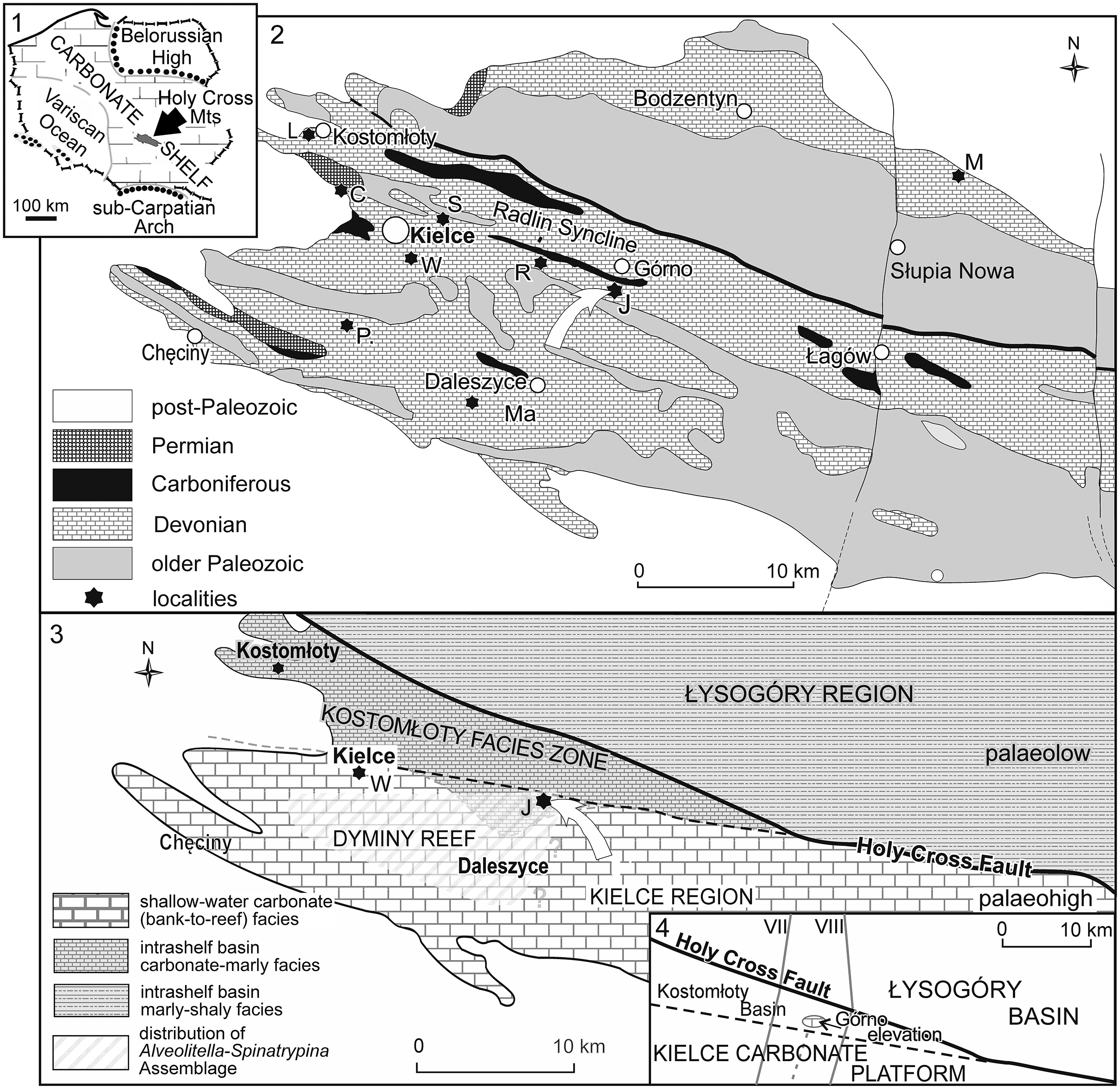
Figure 1. Long description
Panel 1 at the top-left is a small-scale map of Poland showing the Holy Cross Mountains located on a Devonian carbonate shelf between the Belorussian High to the Northeast and the Variscan Ocean to the Southwest.
Panel 2 is a large geological map of the Holy Cross Mountains. A legend indicates five geological units: post-Paleozoic, Permian, Carboniferous, Devonian (brick pattern), and older Paleozoic. Key localities marked with stars include Kostomłoty, Czarnów, Kielce, Wietrznia, Posłowice, Radlin, Józefka, Marzysz, and Miłoszów. The Radlin Syncline runs Northwest to Southeast through the center. A 10 kilometer scale bar is at the bottom right.
Panel 3 is a paleogeographic map of the same region. It is divided by the Holy-Cross Fault into the Łysogóry Region to the North and the Kielce Region to the South. The Łysogóry Region contains an intrashelf basin with marly-shaly facies. The Kielce Region features the Dyminy Reef with shallow-water carbonate facies. The Kostomłoty Facies Zone sits between them. A diagonal hatched pattern indicates the distribution of the Alveolitella-Spinatrypina Assemblage.
Panel 4 at the bottom-right is a tectonic framework diagram showing the Kielce Carbonate Platform separated from the Łysogóry Basin by the Holy Cross Fault. It highlights the submarine Górno Elevation and the Kostomłoty Basin.
(1) Location of the studied sections at Józefka hill near Górno (modified from Google Maps, http://maps.google.com; after Baliński et al., Reference Baliński, Racki and Halamski2016, fig. 2A). The main collection site for the present study was the road trench (Górno A), which is inaccessible today. (2) Transitional interval between the Laskowa Góra Beds and the Szydłówek Beds. (3) Detail of the faulted, tabulate, marly biostrome of the Laskowa Góra Beds in September 2006 (courtesy of Wojciech Krawczyński; after Baliński et al., Reference Baliński, Racki and Halamski2016, pl. 2, figs. 5, 6).
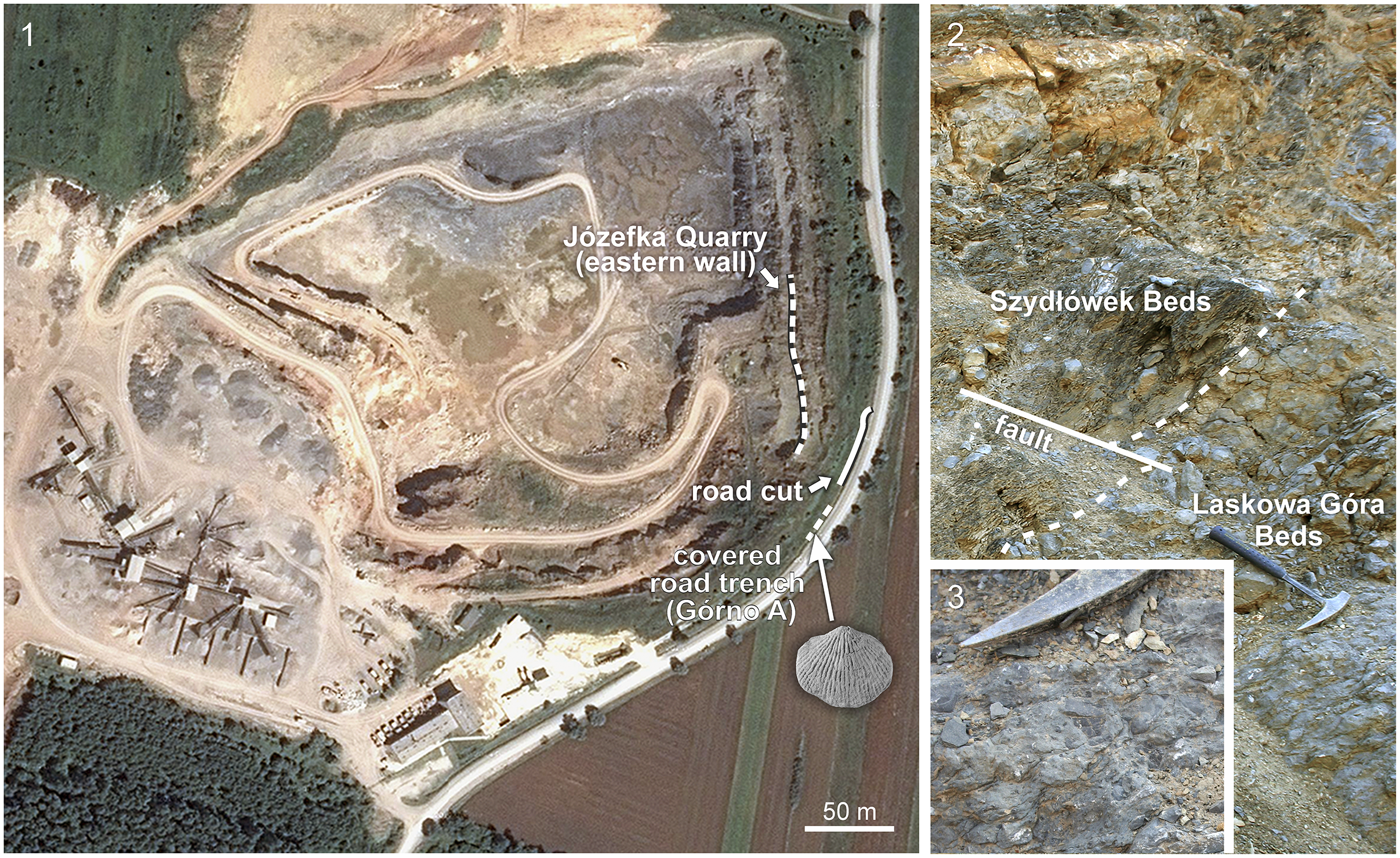
Figure 2. Long description
Panel 1 is a satellite view of Józefka Quarry. In the East, a dashed white line marks the Józefka Quarry eastern wall. To the South of this, a solid white line indicates a road cut. Further South along the main road, an arrow points to the covered road trench Górno A, accompanied by a small inset of a brachiopod shell. A 50 m scale bar is located in the bottom right corner. Panel 2, at the top right, shows a rock face with a diagonal fault line. The upper section is labeled Szydłówek Beds and the lower section is labeled Laskowa Góra Beds. A geological hammer lies on the rock for scale. Panel 3, at the bottom right, is a close-up photograph of a marly biostrome within the Laskowa Góra Beds, showing a fragmented, tabulate texture with a metal tool tip visible at the top for scale.
Generalized composite lithological sections of the upper Givetian to middle Frasnian strata exposed in the Górno area (modified from Baliński et al., Reference Baliński, Racki and Halamski2016, fig. 3), showing the position of the key brachiopod faunas, against the global and regional event stratigraphy (partly after Becker, Reference Becker and Linnemann2025), determined by the intermittent sea-level rise (modified from Racki, Reference Racki1993b, fig. 37). IIa, IIb, IIb/c (= IIb4), IIc = successive eustatic rises based on Johnson et al.’s (Reference Johnson, Klapper and Sandberg1985) cyclic scheme (see revision by Brett et al., Reference Brett, Baird, Bartholomew, DeSantis and VerStraeten2011 and Becker, Reference Becker and Linnemann2025). LGB = Laskowa Góra Beds, SB = Stringocephalus Beds; WB = Wietrznia Beds.
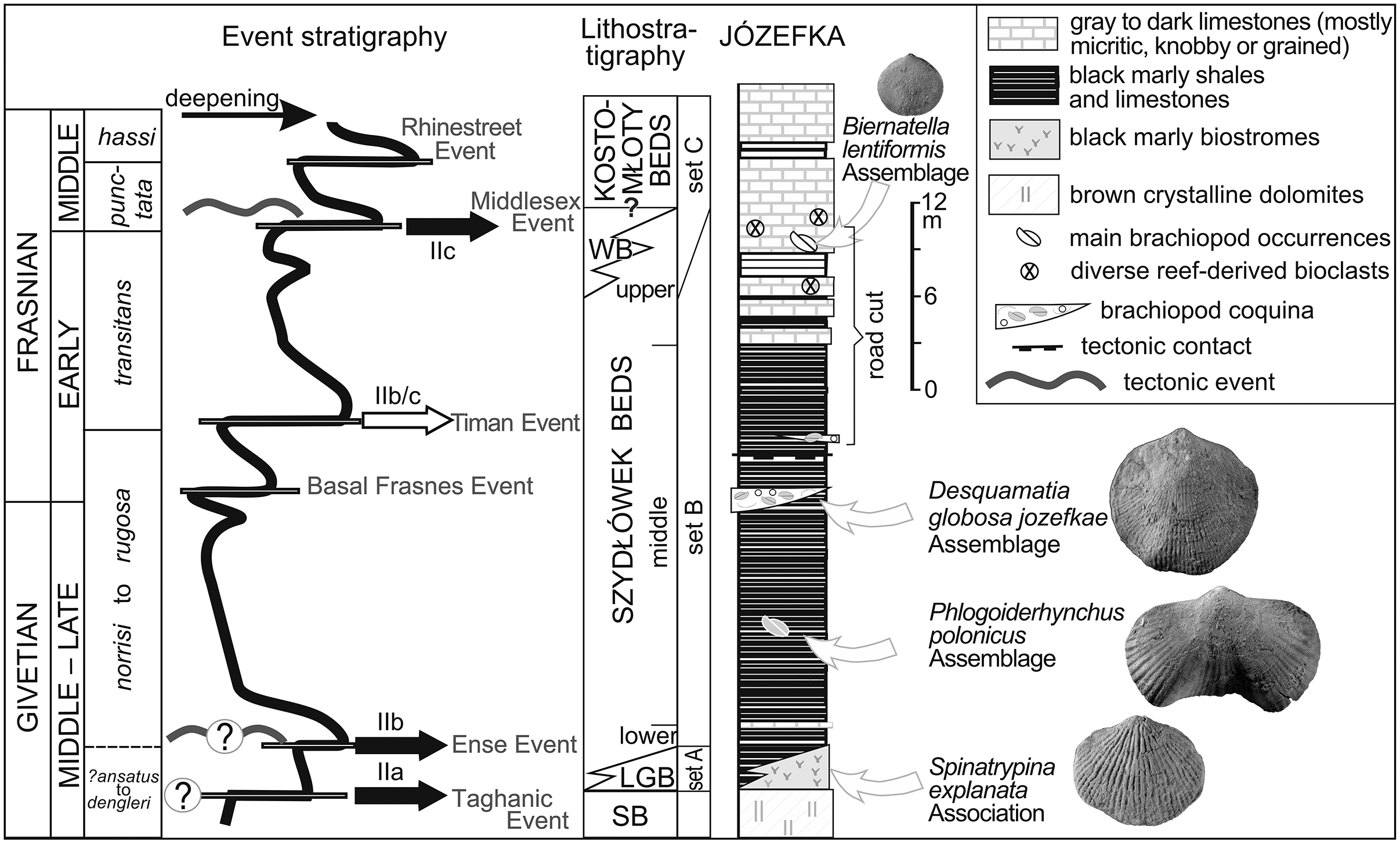
Figure 3. Long description
The diagram is organized into four main vertical sections from left to right.
1. Event Stratigraphy: The far-left column lists the Givetian (Middle to Late) and Frasnian (Early to Middle) stages. Sub-divisions include norrisi to rugosa, transitans, punctata, and hassi zones. A jagged black line represents sea-level fluctuations, with arrows pointing right indicating deepening events. Key events labeled from bottom to top include Taghanic Event (I I a), Ense Event (I I b), Basal Frasnes Event, Timan Event (I I b forward slash c), Middlesex Event (I I c), and Rhinestreet Event.
2. Lithostratigraphy: This column identifies rock units. At the base are Szydłówek Beds and Laskowa Góra Beds (set A), followed by the thick Szydłówek Beds (middle, set B), and the Wietrznia Beds and Kostomłoty Beds (upper, set C) at the top.
3. Józefka Section: A detailed vertical lithological column with a scale bar from 0 to 12 meters. Symbols indicate lithology:
* Bottom: Brown crystalline dolomites.
* Middle: A thick sequence of black marly shales and limestones.
* Top: Gray to dark limestones (micritic, knobby, or grained).
* Specific features include black marly biostromes, brachiopod coquina, and diverse reef-derived bioclasts.
4. Brachiopod Faunas: Arrows from the Józefka section point to four fossil assemblages and three circular grayscale photos of brachiopod shells on the right. From bottom to top, these are:
* Spinatrypina explanata Association.
* Phlogoiderhynchus polonicus Assemblage.
* Desquamatia globosa jozefkae Assemblage.
* Biernatella lentiformis Assemblage.
A legend in the top right defines the lithological patterns and symbols for tectonic contacts and events.
This new taxonomic treatment, along with previously published data, both from the Holy Cross Mountains and from other regions, is the basis for presenting a summary of paleobiogeographic patterns of representatives of the family Hypothyridinidae in the Middle Devonian and assessing the question of the relationship of faunas on both sides of the boundary between the Middle and the Late Devonian series. This ecological-evolutionary stasis among bottom-level shelly benthos contrasts with the well-documented extinction of the Hamilton/upper Tully fauna in the Appalachian Basin, the type area of the Taghanic Crisis and subsequent recovery (Brett et al., Reference Brett, Zambito, Welych-Flanagan, Baird and Bartholomew2025).
Geologic setting
A detailed description of the paleontological localities on and near the former Józefka Hill near Górno was given by Baliński et al. (Reference Baliński, Racki and Halamski2016). The reader is referred thereto for generalities. The hill itself is now non-existent, because it has been destroyed by quarrying. The rocks that are of industrial interest are mostly not those with rich fauna, so, generally speaking, the conditions for paleontological research are now worse than before, and the work must be based largely on materials collected several years ago.
Conodont-based stratigraphic studies by Małkowski (Reference Małkowski1981), Racki and Bultynck (Reference Racki and Bultynck1993), Baliński et al. (Reference Baliński, Racki and Halamski2016), and Skompski et al. (Reference Skompski, Baliński, Szulczewski and Zawadzka2018) demonstrated that the brownish-yellow (originally likely black, as can be seen in other outcrops in the region, e.g., Laskowa), dolomite-rich Stringocephalus Beds of the Givetian stage in the Górno succession are covered by a dark marly succession of the Laskowa Góra and Szydłówek beds (see Fig. 3). The boundary between these contrasting lithologies corresponds to the sedimentary record of the submergence of a stromatoporoid-coral biostromal bank in the shallow-water Kielce Region (Racki et al., Reference Racki, Głuchowski and Malec1985; Racki, Reference Racki1993b). Furthermore, a frozen mesogenetic dolomitization front is superimposed on this stratigraphic interval (see Narkiewicz, Reference Narkiewicz1991). The associated low-temperature hydrothermal hematite and ankerite mineralization was subsequently altered by irregular dedolomitization and limonitization due to weathering processes, as well as the illitization of the rock massif (Nieć and Pawlikowski, Reference Nieć and Pawlikowski2015).
At present the key stratigraphic interval is well-visible in the southern part of the active quarry at Józefka (Baliński et al., Reference Baliński, Racki and Halamski2016, pls. 1, 2; Figs. 2, 3). The two oldest units of the post-dolomite succession can easily be compared with the lithostratigraphic succession of the Kostomłoty Transitional Facies Zone (Racki, Reference Racki1993b). This zone represents a transitional area between the paleolow (basin) Łysogóry Region and paleohigh (carbonate platform) Kielce Region (Fig. 1C) with the key outcrops located in Laskowa and neighbouring quarries (as described by Racki et al., Reference Racki, Głuchowski and Malec1985, Reference Racki, Piechota, Bond and Wignall2004; Fig. 3). The outcrops are located in Kostomłoty, ~20 km northwest of the Górno area (see Fig. 1.2, 1.3). According to the conodont dating of Racki and Bultynck (Reference Racki and Bultynck1993), the uppermost part of the fossil-rich Laskowa Góra Beds at Józefka (Fig. 2.2, 2.3) possibly belongs to the Upper disparilis Biozone (= dengleri Biozone in the updated zonation of Becker, Reference Becker and Linnemann2025), and the basal Szydłówek Beds represent the lower falsiovalis Biozone (= norrisi Biozone).
The Laskowa Góra Beds appear to be thinner than those in the stratotype Kostomłoty area (up to 5 m compared to 5–6.7 m at Laskowa; Małkowski, Reference Małkowski1981; Racki and Bultynck, Reference Racki and Bultynck1993, fig. 2), or even locally wedging out (Fig. 3). This characteristic feature was also noted by Baliński et al. (Reference Baliński, Racki and Halamski2016) for the Szydłówek Beds (25–35 m versus ~100 m in the Kostomłoty sections; see Racki and Bultynck, Reference Racki and Bultynck1993; Racki et al., Reference Racki, Piechota, Bond and Wignall2004; Vierek, Reference Vierek2014; Skompski et al., Reference Skompski, Baliński, Szulczewski and Zawadzka2018). This rhythmic argillaceous basin-type thin-layered succession is characterized by the abundant occurrence of Styliolina kirovae Ljaschenko, Reference Ljaschenko1957 and the endemic rhynchonellide Phlogoiderhynchus polonicus (Roemer, Reference Roemer1866). The latter is a local guide fossil for the lower part of the Frasnian (Biernat and Szulczewski, Reference Biernat and Szulczewski1975; Sartenaer and Racki, Reference Sartenaer and Racki1992; Baliński, Reference Baliński2006). Additionally, the lens-like, bioclastic, brachiopod-crinoid accumulations in at least two levels (Filonowicz, Reference Filonowicz1969; Skompski et al., Reference Skompski, Baliński, Szulczewski and Zawadzka2018) indicate a transition of the Szydłówek Beds into the Wietrznia Beds, which represent the fore-slope facies of the northern Kielce platform periphery (Racki, Reference Racki1993b). In the Józefka area and the nearby Radlin section, the Givetian–Frasnian succession is overlain by the Frasnian Wietrznia and Kostomłoty beds (Baliński et al., Reference Baliński, Racki and Halamski2016; Fig. 3). These diverse lime-marly deposits already flank the developing Dyminy Reef in the Kielce Region (Racki, Reference Racki1993b).
The present paper focuses on the distinctive atrypide-dominated brachiopod fauna of the Laskowa Góra Beds, associated mostly with marly coral bafflestones (Racki, Reference Racki1993a, Reference Rackib). Filonowicz (Reference Filonowicz1969, p. 36) reported cyrtospiriferids and “Pugnax mesogona (Phillips, Reference Phillips1836)” (obviously a misidentification, because this is a Carboniferous species) from 3 m thick gray-green marls at this site at Górno. Małkowski (Reference Małkowski1981) listed atrypides, pugnacids, pentamerides, and dalmanellids; however, both early reports also include brachiopods belonging to a younger fauna with Phlogoiderhynchus polonicus from the overlying Szydłówek Beds. In fact, the rich collection studied here is derived almost exclusively from weathered rubble in yellowish, clayey deposits that occur ~100 m east of the quarry, in a shallow trench near the road between Daleszyce and Górno (called Górno A; Fig. 2.1). These fossiliferous deposits were affected by the post-dolomitization processes (noted above) that are typical of the frozen front, also evident in the Frasnian, brachiopod-rich Wietrznia Beds (Baliński et al., Reference Baliński, Racki and Halamski2016).
The succession that is unavailable nowadays (recovered during land reclamation) was likely formed by marly layers filled with thick-branched Alveolitella fecunda (Salée in Lecompte, Reference Lecompte1933) (Nowiński, Reference Nowiński1993; Racki, Reference Racki1993a, Reference Rackib), followed by bioclastic, crinoid-rich intercalations (cf. Małkowski, Reference Małkowski1981, fig. 3). However, comparing the currently exposed layers in the Józefka quarry, which are dominated by thinly branched tabulate species, points to a significant problem with rapid lateral variation, as evidenced also for the Givetian ramp-style slope succession in the Laskowa site (Racki et al., Reference Racki, Głuchowski and Malec1985, fig. 4)—lithologies differ over very small distances. These circumstances, strengthened by tectonic disturbances (Fig. 2.2), obscure stratigraphic relationships, particularly the correlation of the top Givetian successions in the Kostomłoty Zone. On the other hand, the Alveolitella fecunda acme is a key characteristic of the basal Sitkówka Beds in the Kielce carbonate platform (Hexagonaria/Alveolitella Limestone Level of Racki, Reference Racki1993b, fig. 3). The coral bioconstructions overlie the Jaźwica Member of the Kowala Formation (Narkiewicz et al., Reference Narkiewicz, Racki and Wrzołek1990), in which Alveolitella fecunda also occurs (Nowiński, Reference Nowiński1993). This level was redated as the Middle subterminus Subzone by Narkiewicz and Bultynck (Reference Narkiewicz and Bultynck2010), but the timing of its base is dubious (Racki, Reference Racki1993b, p. 144). This shallow-water Icriodus-based biostratigraphic unit correlates with most of the Upper disparilis Subzone in the deep-water ‘standard’ zonation scheme (equivalent to the dengleri Zone of Becker, Reference Becker and Linnemann2025). Notably, the pre-Ancyrodella interval of the Middle–Upper Devonian transition is still ambiguously subdivided.
The timing has two important implications for the setting of the brachiopod fauna under study and for revising earlier regional correlations (Nowiński, Reference Nowiński1993, fig. 17; Racki, Reference Racki1993b, fig. 3). (1) The top Givetian open-shelf biofacies in the Górno succession is likely equivalent exclusively to the upper part of the Laskowa Góra Beds in the type locality of Kostomłoty. However, the possibility of its younger age cannot be ruled out, because the Upper disparilis Subzone includes the basal Szydłówek Beds at Kostomłoty (Racki, Reference Racki1985). Thus, the diachronic nature of the top of the Laskowa Góra Beds should be emphasized, whereas their base remains undated in the Górno area. Because the abundant collection from the Laskowa quarry primarily comes from the poorly recognized hermanni-cristatus Biozone, this correlation suggests that the Józefka brachiopods could be younger. The hermanni-cristatus Zone, which is not proved in the Górno post-dolomite succession, although Schmidtognathus Ziegler, Reference Ziegler1965 was found by Małkowski (Reference Małkowski1981) in the lowest conodont sample. A stratigraphic gap and/or condensation in the basal part is probable for this drowning unconformity (see Godet, Reference Godet2013, for a review).
(2) According to the current eustatic model (Becker, Reference Becker and Linnemann2025), the Laskowa Góra Beds could record the Taghanic (IIa) onlap and the Geneseo Event (IIa-Gen) at Józefka during the recovery from the Taghanic Biocrisis (Fig. 3). The Ense transgression (IIb1; = Mesotaxis Event of Racki, Reference Racki1993b) resulted in the submergence of the Kielce platform in this part of the Kostomłoty Zone. The stepwise retrogradation pattern could be influenced by oscillating sea levels (Racki, Reference Racki1993b) and/or sedimentary tectonic activity (Racki and Narkiewicz, Reference Racki and Narkiewicz2000). This is evidenced by an elevated block to the north of the Górno area (Małkowski, Reference Małkowski1981; Fig. 1.4).
Material and methods
The brachiopods described in the present paper were collected over four decades by several workers across a number of locatities, as follows.
-
(1) Fauna of the Laskowa Góra Beds was systematically collected in the southern part of the trench along the Górno–Daleszyce road (southward from the part shown by Baliński et al., Reference Baliński, Racki and Halamski2016, pl. 3, fig. 1; Górno A in Fig. 2.1) by G. Racki and co-workers from University of Silesia between 1978 and 2005. A small portion of the collection [GIUS 4-208] comes from a nearby shallow trench that was dug in 1983 directly westward from the road. This southeastern part of the Józefka hill has always been more or less covered by fossil-rich residual clays (compare Filonowicz, Reference Filonowicz1969; Małkowski, Reference Małkowski1981) and is now completely inaccessible. Because the brachiopods were almost exclusively collected as loose specimens, some of them might have come from the Coeloterorhynchus-rich coquina layer(s) in the middle of the Szydłówek Beds (e.g., layer 3 in the road cut section; Baliński et al., Reference Baliński, Racki and Halamski2016, fig. 4; Fig. 3).
-
(2) The Laskowa Góra Beds were also sampled in the eastern wall of the Józefka quarry (see Baliński et al., Reference Baliński, Racki and Halamski2016, pl. 1, fig. 2) by A. Baliński, A.T. Halamski, G. Racki, and M.K. Zapalski in 2015.
-
(3) A brachiopod-rich lens in the Szydłówek Beds was sampled by S. Skompski and the late A. Radwański on the floor of the Józefka quarry in the 1990s. The floor was then much shallower than now (2025). This locality (now non-existent) was situated between the center and the western wall of the quarry (personal communication, S. Skompski, 12 February 2025).
-
(4) Another such lens in the Szydłówek Beds was sampled by A. Baliński, S. Skompski, M. Szulczewski, and I. Zawadzka near the western wall of the quarry in the 2010s (Skompski et al., Reference Skompski, Baliński, Szulczewski and Zawadzka2018).
Repositories and institutional abbreviations
The studied collection is deposited partly in the Faculty of Natural Sciences of the University of Silesia in Sosnowiec (GIUS), partly in the Institute of Paleobiology of the Polish Academy of Sciences in Warsaw (ZPAL), and partly in the S.J. Thugutt Geological Museum, Faculty of Geology, University of Warsaw (MWGUW). Other cited acronyms include: BM (The Natural History Museum [formerly British Museum, Natural History], London, UK); MB.B (Museum für Naturkunde, Berlin, Germany); MGUWr (Muzeum Geologiczne Uniwersytetu Wrocławskiego, Wrocław, Poland); SMF (Senckenberg Forschungsinstitut und Naturmuseum, Frankfurt am Main, Hessen, Germany). An unnumbered specimen coming from an institutional collection is referred to by the abbreviation s.n. (Latin, sine numero = without a number).
Systematic paleontology
The studied assemblage comes from the Laskowa Góra Beds and the Szydłówek Beds. It is thus older than the assemblage from the Wietrznia Beds of the same locality described earlier by Baliński et al. (Reference Baliński, Racki and Halamski2016). Several species present either in the Laskowa Góra Beds or in the Szydłówek Beds have already been described elsewhere, either in separate contributions (Halamski, Reference Halamski2012; Skompski et al., Reference Skompski, Baliński, Szulczewski and Zawadzka2018), or, if also present in the Wietrznia Beds, together with rest of the latter (Baliński et al., Reference Baliński, Racki and Halamski2016). Such species are listed in the systematic part and illustrated, but are not redescribed; in such cases, the first two parts of the study of brachiopods from the Józefka sections are given in the synonymies and the readers are referred thereto. An earlier report of Fitzroyella alata Biernat, Reference Biernat1969 as occurring in the Laskowa Góra Beds (Baliński et al., Reference Baliński, Racki and Halamski2016) is now considered unsubstantiated (in other words, this species is present solely in the Wietrznia Beds).
Synonymies are commented upon by means of a standardized set of signs, proposed by Richter (Reference Richter1948) and Matthews (Reference Matthews1973), as used by Halamski (Reference Halamski2009, p. 46, 47). Following Benichou et al. (Reference Benichou, Buschbom, Campbell, Hermann, Kvacek, Mergen, Mitchell, Rinaldo and Agosti2022), the authors of all cited systematic units are referenced in the bibliography. This is considered best practice in taxonomy papers.
Phylum Brachiopoda Duméril, Reference Duméril1805
Subphylum Rhynchonelliformea Williams et al., Reference Williams, Carlson, Brunton, Holmer and Popov1996
Class Strophomenata Williams et al., Reference Williams, Carlson, Brunton, Holmer and Popov1996
Order Strophomenida Öpik, Reference Öpik1934
Superfamily Strophomenoidea King, Reference King1846
Family Douvillinidae Caster, Reference Caster1939
Subfamily Douvillininae Caster, Reference Caster1939
Genus Douvillinaria Stainbrook, Reference Stainbrook1945
Type species
Strophodonta variabilis Calvin, Reference Calvin1878; Independence Shale, Middle Amana Beds, Frasnian; Iowa, USA.
? Douvillinaria sp. indet.
(1–17) Strophomenide, productide, protorthide, orthide, and pentameride brachiopods from the Laskowa Góra Beds of Górno, Holy Cross Mountains: (1–5) Skenidioides cf. S. polonicus (Gürich, Reference Gürich1896), juvenile shell, GIUS 4-292/5, in dorsal, ventral, lateral, posterior, and anterior views, respectively; (6–11) ?Douvillinaria sp. indet.: (6–10) juvenile specimen, GIUS 4-292/1, in dorsal, ventral, lateral, posterior, and anterior views, respectively; (11) interior of incomplete dorsal valve, GIUS 4-292/2’ (12–16) ?Spinulicosta sp. indet., slightly damaged shell, GIUS 4-292/3, in dorsal, ventral, lateral, posterior, and anterior views, respectively; (17) Devonoproductus sericeus (von Buch, Reference Buch1837), exterior of incomplete dorsal valve, GIUS 4-292/4. (18–20) Schizophoria schnuri prohibita Halamski, Reference Halamski2012, articulated shell, ZPAL Bp 73/1/9a/1, in dorsal, ventral, and posterior views, respectively. (21, 22) Physemella sp. indet., ventral valve, GIUS 4-292/9, interior and exterior views, respectively. Scale bars = 1 mm (1–11, 17); 10 mm (12–16, 18–22).
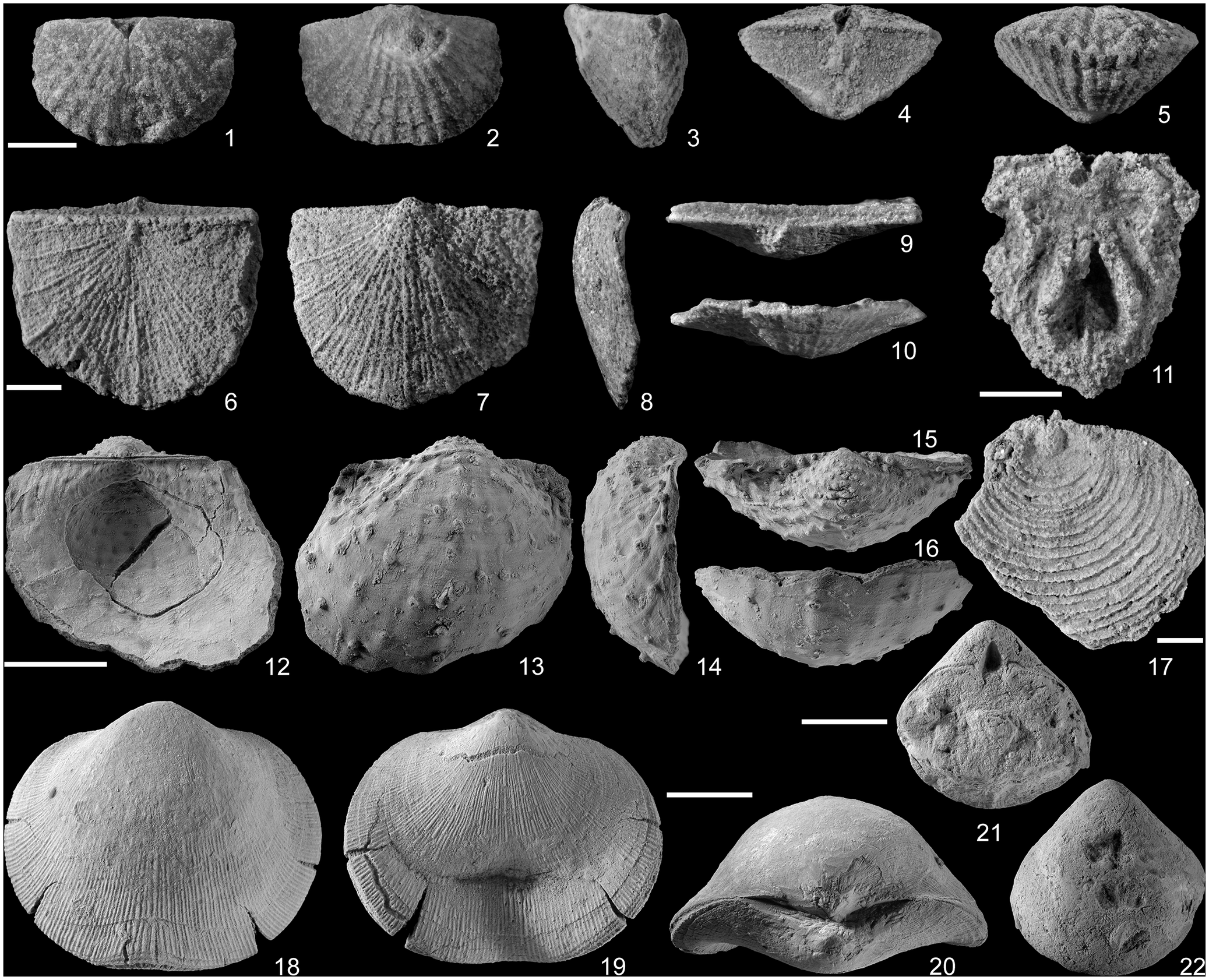
Figure 4. Long description
The photo plate contains 22 numbered panels arranged in four rows.
Row 1 (Panels 1 to 5): Skenidioides cf. S. polonicus. Small juvenile shells showing dorsal, ventral, lateral, posterior, and anterior views. The shells are semi-circular with fine radial ribbing. Scale bar equals 1 mm.
Row 2 (Panels 6 to 11): ?Douvillinaria sp. indet. Panels 6 to 10 show a juvenile specimen in dorsal, ventral, lateral, posterior, and anterior views, featuring a fan-like shape with prominent radial costae. Panel 11 shows the interior of an incomplete dorsal valve with complex internal structures. Scale bar equals 1 mm.
Row 3 (Panels 12 to 17): ?Spinulicosta sp. indet. and Devonoproductus sericeus. Panels 12 to 16 show a damaged shell in five views, characterized by a bulbous ventral valve with small spine bases. Panel 17 shows the exterior of an incomplete dorsal valve with concentric growth lines. Scale bars for 12 to 16 equal 10 mm; scale bar for 17 equals 1 mm.
Row 4 (Panels 18 to 22): Schizophoria schnuri prohibita and Physemella sp. indet. Panels 18 to 20 show a large articulated shell in dorsal, ventral, and posterior views, exhibiting a smooth, rounded profile with very fine striations. Panels 21 and 22 show the interior and exterior of a ventral valve of Physemella, which is triangular and robust. Scale bars equal 10 mm.
v Reference Baliński, Racki and Halamski2016 ?Douvillinaria sp.; Baliński et al., p. 136, pl. 5, figs. 2–12.
Materials
A subcomplete juvenile articulated shell and a fragmentary dorsal valve, GIUS 4-292/1,2.
Remarks
Brachiopods described and figured by Baliński et al. (Reference Baliński, Racki and Halamski2016) came mostly from the Laskowa Góra Beds of Józefka. A juvenile specimen and a dorsal interior, both not studied in the previous paper, are figured here.
Order Productida Waagen, Reference Waagen1883
Suborder Productidina Waagen, Reference Waagen1883
Superfamily Productoidea Gray, Reference Gray1840
Family Productellidae Schuchert, Reference Schuchert, Schuchert and LeVene1929
Genus Spinulicosta Nalivkin, Reference Nalivkin1937
Type species
Productus spinulicosta Hall, Reference Hall1857; Hamilton Group, Givetian; shores of Cayuga Lake, New York, USA (for justification for this spelling of the type species, see Baliński and Halamski Reference Halamski2013, p. 15).
? Spinulicosta sp. indet.
Materials
A single incomplete articulated shell, GIUS 4-292/3.
Description
The studied specimen is an articulated shell, mostly lacking marginal regions, except small remnants of anterior margin preserved in a single place. Shell probably rounded rectangular in outline, transverse, moderately convex. Preserved length 23.0 mm (estimated length ~24 mm), preserved width 27.1 mm (estimated width ~30 mm), thickness 10.3 mm. Umbo strongly incurved; beak fine.
Ornament of irregularly disposed spines, ~0.8–1.1 mm thick in marginal region, sometimes as if arising from small radial ridges, denser in umbonal region, more widely spaced near the margins; spines along hinge margin present; ventral interarea sublinear. Low undulating rugae, distinct and spaced < 1 mm in umbonal region, evanescent and spaced ~2–2.5 mm near the margins.
The concave dorsal valve has a dent ~11 mm long and 14 mm wide in the median region; it might correspond to the visceral cavity.
Remarks
This single specimen is tentatively identified as a representative of the genus Spinulicosta on account of irregularly disposed spines with radial ridges, although the latter are very weakly developed. Spinulicosta cf. S. spinulicosta was reported from the lower Givetian of Miłoszów (Baliński and Halamski, Reference Baliński and Halamski2023): it is similar in outline, but smaller in size; scarcity of material prevents a more detailed comparison.
Superfamily Linoproductoidea Stehli, Reference Stehli1954
Family Monticuliferidae Muir-Wood and Cooper, Reference Muir-Wood and Cooper1960
Subfamily Devonoproductidae Muir-Wood and Cooper, Reference Muir-Wood and Cooper1960
Genus Devonoproductus Stainbrook, Reference Stainbrook1943
Type species
Productella walcotti Fenton and Fenton, Reference Fenton and Fenton1924; Frasnian; Hackberry, Rockford, Iowa, USA (see details by Muir-Wood and Cooper, Reference Muir-Wood and Cooper1960, p. 177–179).
Devonoproductus sericeus (von Buch, Reference Buch1837)
* Reference Buch1837 Orthis sericea von Buch, p. 68.
v Reference Baliński, Racki and Halamski2016 Devonoproductus sericeus; Baliński et al., p. 137, pl. 5, figs. 13–17.
Type specimens
Specimens from von Buch’s collection (syntypes; not illustrated in the original publication), present repository unknown; ‘Kohlenkalkstein’ [Frasnian in reality], Oberkunzendorf [now Mokrzeszów Górny, Silesia, Poland], for detailed stratigraphy, see Halamski (Reference Halamski2013, p. 302–304) and Baliński et al. (Reference Baliński, Racki and Halamski2016, p. 137).
Materials
A single incomplete dorsal valve, GIUS 4-292/4.
Remarks
Devonoproductus sericeus was described by Baliński et al. (Reference Baliński, Racki and Halamski2016) on the basis of a collection coming mostly from the Frasnian. A single, poorly-preserved specimen from the Givetian, not studied in the previous paper, is figured here. Following Baliński et al. (Reference Baliński, Racki and Halamski2016), this species is defined broadly.
Class Rhynchonellata Williams et al., Reference Williams, Carlson, Brunton, Holmer and Popov1996
Order Protorthida Schuchert and Cooper, Reference Schuchert and Cooper1931
Superfamily Skenidioidea Kozłowski, Reference Kozłowski1929
Family Skenidiidae Kozłowski, Reference Kozłowski1929
Genus Skenidioides Schuchert and Cooper, Reference Schuchert and Cooper1931
Type species
Skenidioides billingsi Schuchert and Cooper, Reference Schuchert and Cooper1931; Black River Formation, Sandbian, Upper Ordovician; near the Ottawa River, Québec, Canada.
Skenidioides cf. S. polonicus (Gürich, Reference Gürich1896)
cf. Reference Gürich1896 Skenidium polonicum Gürich, p. 237, pl. 10, figs. 3, 14.
cf. Reference Baliński and Halamski2023 Skenidioides polonicus (Gürich, Reference Gürich1896); Baliński and Halamski, p. 17, figs. 7A–J, Z–BB, 8.
Materials
A single incompletely preserved juvenile specimen, GIUS 4-292/5.
Remarks
The available specimen is a juvenile shell 1.9 mm long and 3.0 mm wide. It can be tentatively referred to Skenidioides polonicus on account of the presence of a dorsal midrib pair (see Baliński and Halamski, Reference Baliński and Halamski2023, p. 17), but this identification is not considered secure due to the young age of the individual (see Baliński et al., Reference Baliński, Racki and Halamski2016, text-fig. 6) and imperfect preservation of the ornamentation, so open nomenclature is used.
Order Orthida Schuchert and Cooper, Reference Schuchert and Cooper1931
Family Schizophoriidae Schuchert and LeVene, Reference Schuchert, LeVene and Pompeckj1929
Genus Schizophoria King, Reference King1850
Type species
Conchyliolithus (Anomites) resupinatus Martin, Reference Martin1809; lower Carboniferous; England (the neotype selected for this species lacks precise locality data; see Bond, Reference Bond1941, p. 290).
Schizophoria schnuri prohibita Halamski, Reference Halamski2012
v* Reference Halamski2012 Schizophoria ( Schizophoria ) schnuri prohibita Halamski, p. 356, figs. 4A–C, E, M, Q, V–Y, BB–EE, 7A–II, 8C, E.
v. Reference Baliński, Racki and Halamski2016 Schizophoria schnuri prohibita ; Baliński et al., p. 145, pl. 10, figs. 21, 22.
Holotype
ZPAL Bp 64/1/1/1 (see Halamski, Reference Halamski2012, for type locality and stratum, and paratypes).
Materials
A single subcomplete arcticulated shell and eight fragmentary specimens, GIUS 4-208/1, 4-292/5–8, 4-294/1-3, and ZPAL Bp 73/1/9a/1, Bp 81/12a.
Remarks
This subspecies was described from the Laskowa Góra Beds of the Józefka quarry (Halamski, Reference Halamski2012). An early Frasnian representative of this genus from Kadzielnia in Kielce was identified as Schizophoria cf. S. prohibita, although it might also represent a new species (Racki, Reference Racki2024).
Order Pentamerida Schuchert and Cooper, Reference Schuchert and Cooper1931
Suborder Pentameridina Schuchert and Cooper, Reference Schuchert and Cooper1931
Superfamily Gypiduloidea Schuchert and LeVene, Reference Schuchert, LeVene and Pompeckj1929
Family Gypidulidae Schuchert and LeVene, Reference Schuchert, LeVene and Pompeckj1929
Subfamily Gypidulinae Schuchert and LeVene, Reference Schuchert, LeVene and Pompeckj1929
Genus Physemella Godefroid, Reference Godefroid1974
Type species
Physemella maillieuxi Godefroid, Reference Godefroid1974; middle Frasnian; Frasnes-lez-Couvin, Belgium.
Physemella sp. indet.
v. Reference Baliński, Racki and Halamski2016 Physemella sp.; Baliński et al., p. 145, pl. 10, figs. 23–25.
Materials
Four incomplete ventral valves, some embedded in rock, GIUS 4-292/9–12.
Remarks
Poorly preserved specimens tentatively assigned to this species occur in the Laskowa Góra Beds. It has been described in detail on the basis of a better collection from the Wietrznia Beds (Baliński et al., Reference Baliński, Racki and Halamski2016); the reader is referred thereto for description.
Order Rhynchonellida Kuhn, Reference Kuhn1949
Superfamily Uncinuloidea Rzhonsnitskaya, Reference Rzhonsnitskaya and Thalmann1956
Family Hypothyridinidae Rzhonsnitskaya, Reference Rzhonsnitskaya and Thalmann1956
Remarks
At present, the taxonomy of the family Hypothyridinidae remains unclear. This is due mainly to historical reasons, as discussed at length by Sartenaer (Reference Sartenaer2003). In summary, Atrypa cuboides Sowerby, Reference Sowerby, Sedgwick and Murchison1840, the type species of the genus Hypothyridina Buckman, Reference Buckman1906, which in turn is the type genus of the family, was described on the basis of a single specimen coming from Devonshire, a region characterized by complex geological structure. The internal structures of the type species and exact age of the type stratum were therefore unknown. As a consequence, on the one hand, Atrypa cuboides came to be interpreted too widely, whereas on the another hand, new genera within the family were proposed without adequate comparison with the genuine Hypothyridina. A systematic revision of the Hypothyridinidae, including Hypothyridina cuboides, was performed by Baxter (Reference Baxter1999), but her results remain unpublished and thus unknown to the most of scientific community; moreover, her nomenclatural proposals cannot be regarded as published for the purposes of zoological nomenclature (ICZN, 1999, Art. 9). In light of the analysis of the material of Hypothyridina cuboides from the type region (Baxter, Reference Baxter1999), the interpretation of Hypothyridina in both editions of the Treatise of Invertebrate Paleontology (Schmidt, Reference Schmidt1965; Savage, Reference Savage and Kaesler2002) must be considered misguided.
The interpretation of Hypothyridina by Baxter (Reference Baxter1999), followed by the present authors, is based on the premise that the type locality of Hypothyridina cuboides, described simply as ‘Plymouth’ in the original publication (Sowerby, Reference Sowerby, Sedgwick and Murchison1840) can be restricted to the Mount Wise Shell Bed (Ussher, Reference Ussher1907; Orchard, Reference Orchard1977), the age of which corresponds to a later part of the Givetian stage. Baxter (Reference Baxter1999) serially sectioned a specimen from a coeval bed in a nearby locality (Lummaton Shell Bed, middle to upper part of the Givetian). This specimen (BM 5839) served as a de facto epitype allowing greater clarity in the diagnosis of the species. This course of action was quite similar to that followed by Halamski and Baliński (Reference Halamski and Baliński2019) in their revision of Spirifera simplex Phillips, Reference Phillips1841, another commonly misunderstood species described initially from Devonshire.
According to Baxter (Reference Baxter1999), the family Hypothyridinidae is characterized by strong variability of external characters, but all its representatives lack the dorsal septum and the septalium. Out of a total of six genera (or eight, including uncertain ones) belonging to the family Hypothyridinidae, three are relatively similar externally, namely Hypothyridina, Glosshypothyridina Rzhonsnitskaya, Reference Rzhonsnitskaya1978, and Tullypothyridina Sartenaer, Reference Sartenaer2003 (= Hemihypothyridina Baxter, Reference Baxter1999, nomen nudum). Even if the proposed distinctions are not entirely clear, because Hypothyridina is said to differ from Glosshypothyridina in “the development of definite dental plates,” but Glosshypothyridina is described as possessing “well expressed dental plates” (Baxter, Reference Baxter1999, p. 381, 399), a workable comparison of the three genera can be devised (see Fig. 5, Table 1).
Synoptic comparison of internal features of Glosshypothyridina theophili n. sp. with those of the type species of the three genera discussed in the text. (1) Hypothyridina cuboides (Sowerby, Reference Sowerby, Sedgwick and Murchison1840), modified after Baxter (Reference Baxter1999, fig. 96). (2) Tullypothyridina venustula (Hall, Reference Hall1867), after Sartenaer (Reference Sartenaer2003, fig. 1). (3) Glosshypothyridina procuboides (Kayser, Reference Kayser1871), modified after Schmidt (Reference Schmidt1941a, pl. 7, fig. 19; distances between sections not provided in the cited publication). (4) Glosshypothyridina theophili n. sp. (see also Fig. 8). Scale bars = 5 mm.
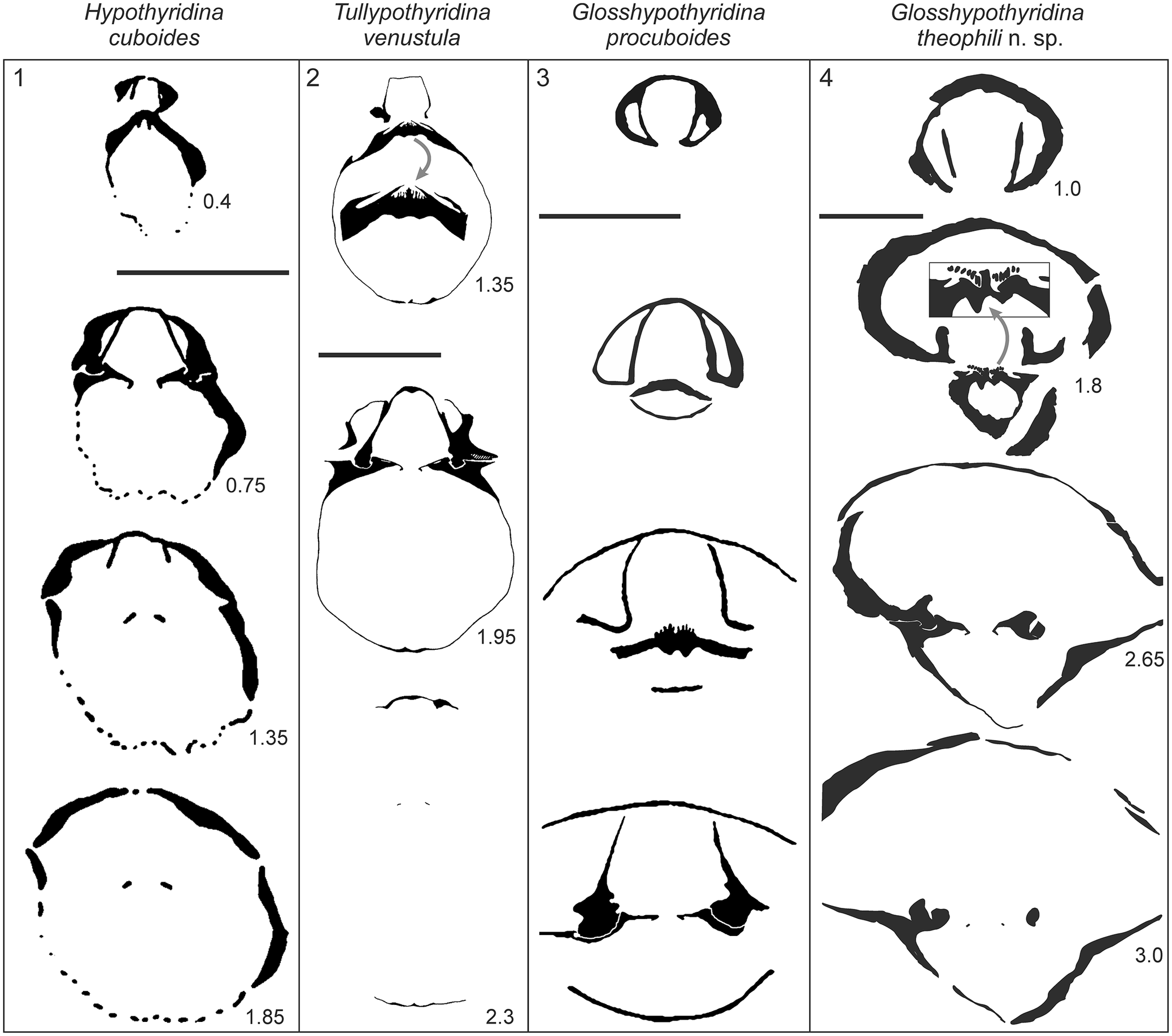
Figure 5. Long description
The diagram consists of four vertical columns, each labeled at the top with a species name and a panel number. Horizontal scale bars representing 5 mm are placed near the top of each column.
* Column 1: Hypothyridina cuboides. Contains four sections. The first section at 0.4 shows a small dorsal hinge structure. The second at 0.75 shows the development of the shell wall with dashed lines indicating incomplete preservation. The third at 1.35 and fourth at 1.85 show the widening of the internal cavity and small central dental plates.
* Column 2: Tullypothyridina venustula. Contains four sections. The first at 1.35 features a curved arrow pointing to a dark, serrated hinge plate. The second at 1.95 shows a large, circular shell outline with thick lateral walls. The third and fourth sections at the bottom are smaller fragments showing the ventral valve floor.
* Column 3: Glosshypothyridina procuboides. Contains four sections. The first is a small, circular hinge section. The second shows a triangular internal chamber. The third shows a wide, flat-bottomed shell with a central serrated process. The fourth shows the distal expansion of the shell walls.
* Column 4: Glosshypothyridina theophili n. sp. Contains four sections. The first at 1.0 shows the initial hinge. The second at 1.8 includes a rectangular inset box showing a magnified view of a serrated median septum, indicated by a curved arrow. The third at 2.65 and fourth at 3.0 show the broad, winged shape of the mature shell with distinct lateral cavities.
Comparison of three Middle to Upper Devonian genera of hypothyridinid brachiopods: Hypothyridina, Tullypothyridina, and Glosshypothyridina. HCM, Holy Cross Mountains
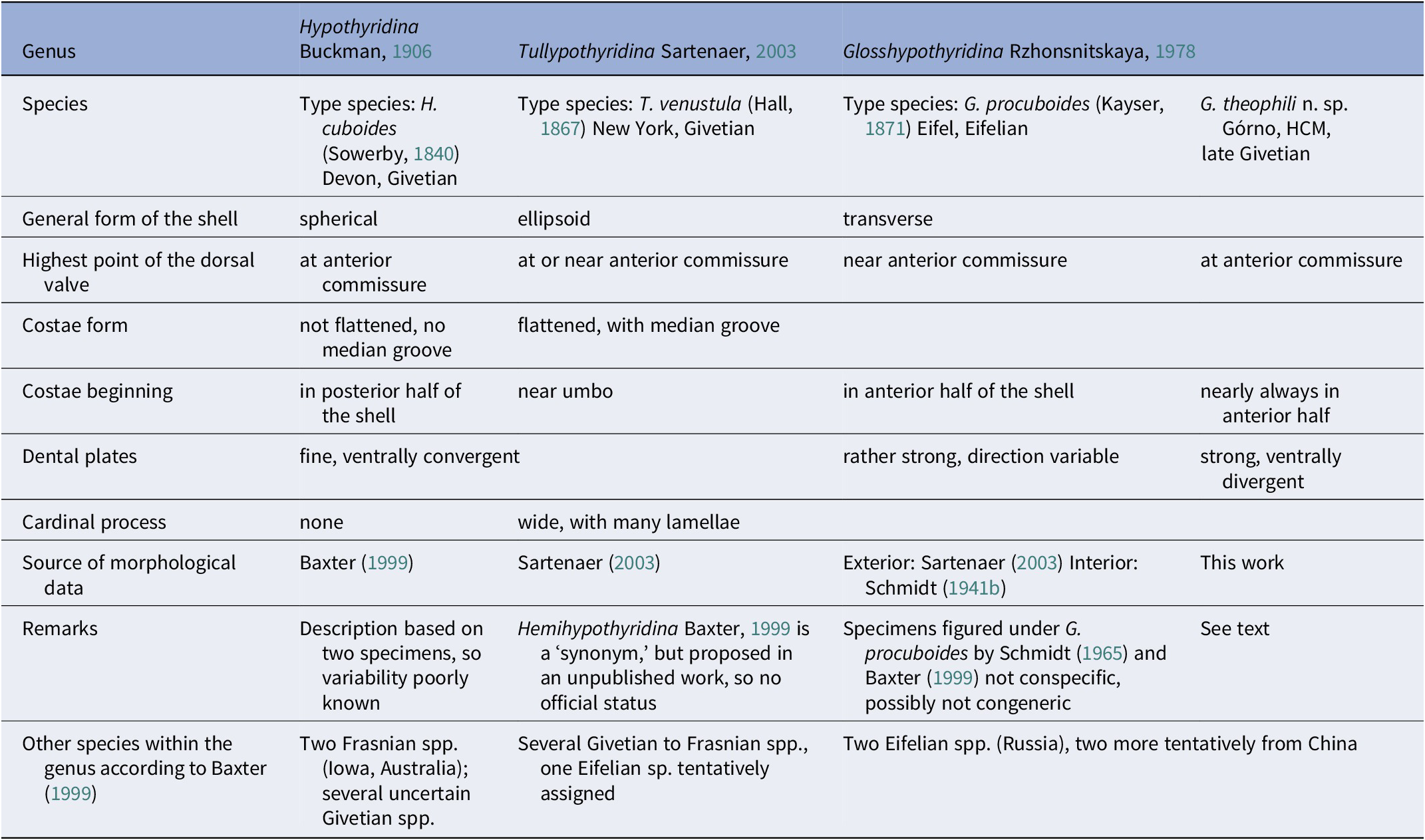
Table 1. Long description
The table consists of five columns. The first column lists the morphological or taxonomic category, while the subsequent columns provide data for the genera Hypothyridina, Tullypothyridina, and Glosshypothyridina (the latter split into two columns for different species).
* Species: Hypothyridina type species is H. cuboides (Givetian). Tullypothyridina type species is T. venustula (Givetian). Glosshypothyridina includes type species G. procuboides (Eifelian) and G. theophili n. sp. (late Givetian).
* General form of the shell: Hypothyridina is spherical; Tullypothyridina is ellipsoid; Glosshypothyridina is transverse.
* Highest point of the dorsal valve: All three genera have the highest point at or near the anterior commissure.
* Costae form: Hypothyridina costae are not flattened and have no median groove. Tullypothyridina and Glosshypothyridina have flattened costae with a median groove.
* Costae beginning: Hypothyridina starts in the posterior half; Tullypothyridina near the umbo; Glosshypothyridina in the anterior half.
* Dental plates: Hypothyridina and Tullypothyridina have fine, ventrally convergent plates. Glosshypothyridina has strong plates that are either variable in direction or ventrally divergent.
* Cardinal process: Absent in Hypothyridina; wide with many lamellae in Tullypothyridina and Glosshypothyridina.
* Source of morphological data: Baxter 1999 for Hypothyridina; Sartenaer 2003 for Tullypothyridina; Sartenaer 2003, Schmidt 1941b, and the current work for Glosshypothyridina.
* Other species: Hypothyridina includes Frasnian and Givetian species; Tullypothyridina includes Givetian to Frasnian species; Glosshypothyridina includes Eifelian species from Russia and China.
It follows thus that the interpretation of Hypothyridina based on serial sections of a specimen identified as ‘Hypothyridina sp. cf. H. impleta’ (Sowerby, Reference Sowerby, Sedgwick and Murchison1840) by Schmidt (Reference Schmidt1965) and Savage (Reference Savage and Kaesler2002) is erroneous, insofar as the sectioned brachiopod possesses a cardinal process and thus does not belong to the genus Hypothyridina. For the varying interpretations of Glosshypothyridina see below, under that genus.
Genus Glosshypothyridina Rzhonsnitskaya, Reference Rzhonsnitskaya1978
Type species
Rhynchonella procuboides Kayser, Reference Kayser1871; Eifelian (most probably late Eifelian, according to Sartenaer, Reference Sartenaer2003); Eifel, Germany.
Remarks
As observed by Sartenaer (Reference Sartenaer2003, p. 35), serial sections of Glosshypothyridina procuboides, the type species of the genus, figured by Schmidt (Reference Schmidt1941a, pl. 7, fig. 19; refigured by Savage, Reference Savage and Kaesler2002, fig. 766.1c–f) and Schmidt and McLaren (Reference Schmidt, McLaren and Moore1965, fig. 442.2; refigured by Savage, Reference Savage and Kaesler2002, fig. 766.1g–j) clearly do not belong to the same species, insofar as the former sectioned brachiopod lacks a dorsal septum and a septalium that the latter does possess. The interpretation followed here is based on the specimen sectioned in 1941; the original figure has better quality than that republished in the new Treatise and allows discerning a multilamellate cardinal process (see Fig. 5C).
Glosshypothyridina theophili new species
Glosshypothyridina theophili n. sp. from the Laskowa Góra Beds (1–25) and Szydłówek Beds (26–35) of Górno, Holy Cross Mountains. Seven shells, in dorsal, ventral, lateral, posterior, and anterior views, respectively: (1–5) GIUS 4-292/17; (6–10) GIUS 4-292/13; (11–15) GIUS 4-292/14; (16–20) holotype ZPAL Bp 73/1/13/1; (21–25) ZPAL Bp 73/1/13/2; (26–30) MWGUW ZI/124/1; (31–35) MWGUW ZI/124/2. Scale bars = 10 mm.
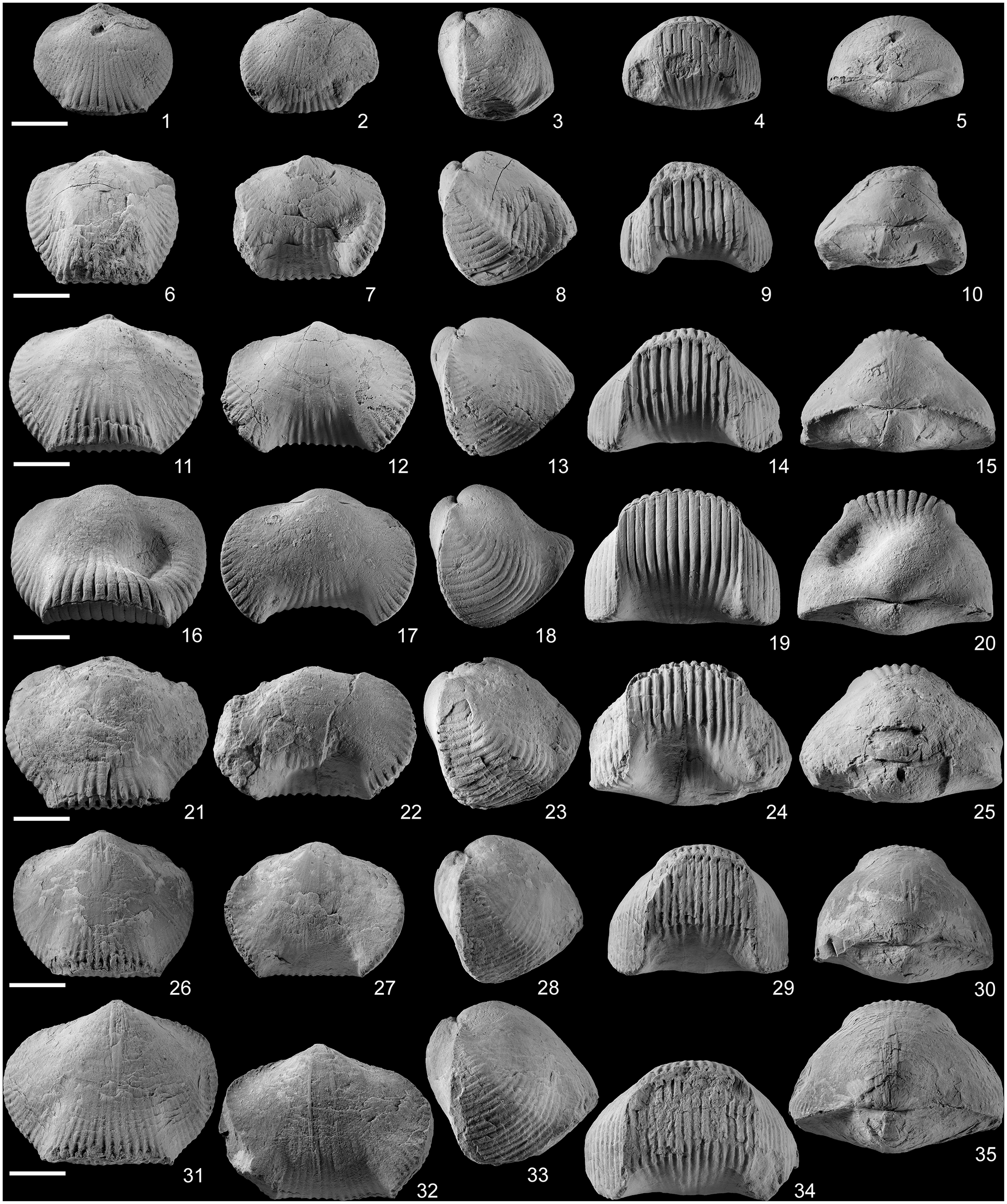
Figure 6. Long description
The photograph consists of 35 individual panels organized into seven rows, labeled 1 through 35. Each row represents one specimen.
* Row 1 (1–5): Specimen G I U S 4-292/17.
* Row 2 (6–10): Specimen G I U S 4-292/13.
* Row 3 (11–15): Specimen G I U S 4-292/14.
* Row 4 (16–20): Holotype Z P A L Bp 73/1/13/1.
* Row 5 (21–25): Specimen Z P A L Bp 73/1/13/2.
* Row 6 (26–30): Specimen M W G U W Z I/124/1.
* Row 7 (31–35): Specimen M W G U W Z I/124/2.
Within each row, the five panels show the shell from different perspectives:
1. The first column shows the dorsal view, revealing a triangular to sub-pentagonal outline with fine radial ribs near the anterior margin.
2. The second column shows the ventral view, highlighting the pedicle valve.
3. The third column shows the lateral view, illustrating the biconvexity and profile of the valves.
4. The fourth column shows the posterior view, focusing on the hinge line and umbo.
5. The fifth column shows the anterior view, emphasizing the uniplicate frontal commissure and the depth of the ribs.
White scale bars representing 10 mm are located at the bottom left of each row. The specimens vary in preservation, with some showing clear ribbing and others appearing more weathered or partially crushed.
Glosshypothyridina theophili n. sp. from the Laskowa Góra Beds of Górno, Holy Cross Mountains. (1–3) Grooved costae: (1, 3) ZPAL 73/1/13/4: (1) on ventral tongue; (3) on dorsal flank of the shell; (2) ZPAL Bp 73/1/13/5, on dorsal flank of the shell. (4) Anterior view of the partial internal shell mold (shell, ZPAL Bp 73/1/13/2), showing the empty spaces left by the dissolution of the dorsal marginal spines at the anterior commissure. (5, 6) GIUS 4-292/14, showing partially preserved, long ventral marginal spines (arrows) running along dorsal flank costae: (5) lateral view of the partial internal shell mold; (6) detail. Scale bars = 5 mm (1–5); 1 mm (6).
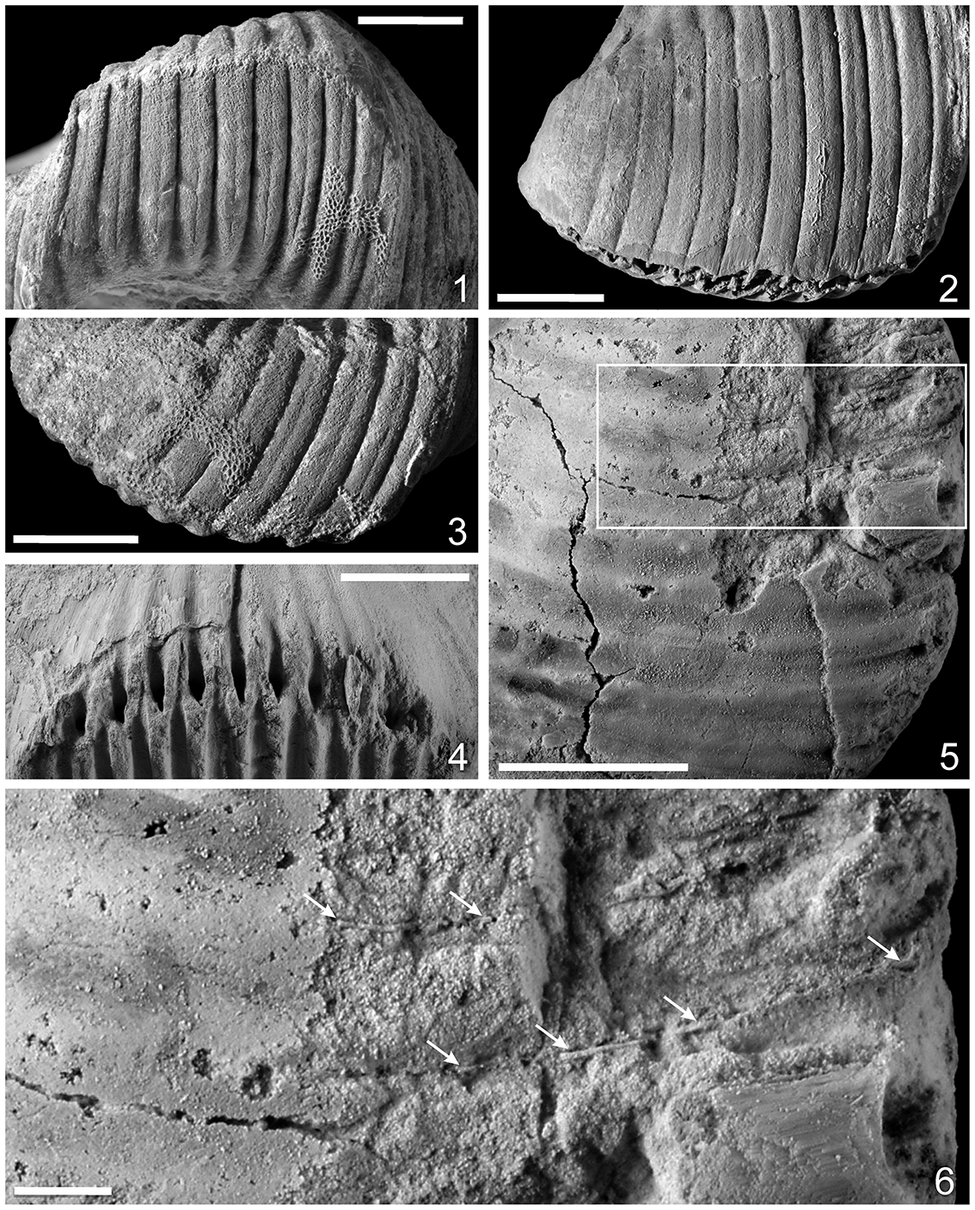
Figure 7. Long description
The figure consists of six panels numbered 1 through 6.
* Panel 1 at the top left shows a close-up of grooved costae on a ventral tongue. A white scale bar representing 5 mm is at the top right.
* Panel 2 at the top right displays grooved costae on the dorsal flank of the shell. A 5 mm scale bar is at the bottom left.
* Panel 3 in the middle left shows grooved costae on the dorsal flank of specimen Z P A L B p 73/1/13/4. A 5 mm scale bar is at the bottom left.
* Panel 4 in the middle left, below panel 3, provides an anterior view of a partial internal shell mold. It highlights a row of vertical, elongated empty spaces at the anterior commissure where dorsal marginal spines have dissolved. A 5 mm scale bar is at the top right.
* Panel 5 on the middle right is a lateral view of a partial internal shell mold. A white rectangle outlines an area of interest, and a 5 mm scale bar is at the bottom left.
* Panel 6 at the bottom is a high-magnification detail of the area boxed in panel 5. Six small white arrows point to thin, long ventral marginal spines that run along the dorsal flank costae. A 1 mm scale bar is at the bottom left.
Transverse serial sections of Glosshypothyridina theophili n. sp. from the Laskowa Góra Beds of Górno, Holy Cross Mountains, through shells GIUS 4-292/15 (1) and GIUS 4-294/4 (2). Distances in mm from the tip of the ventral umbo. Scale bars = 5 mm, unless otherwise labeled.
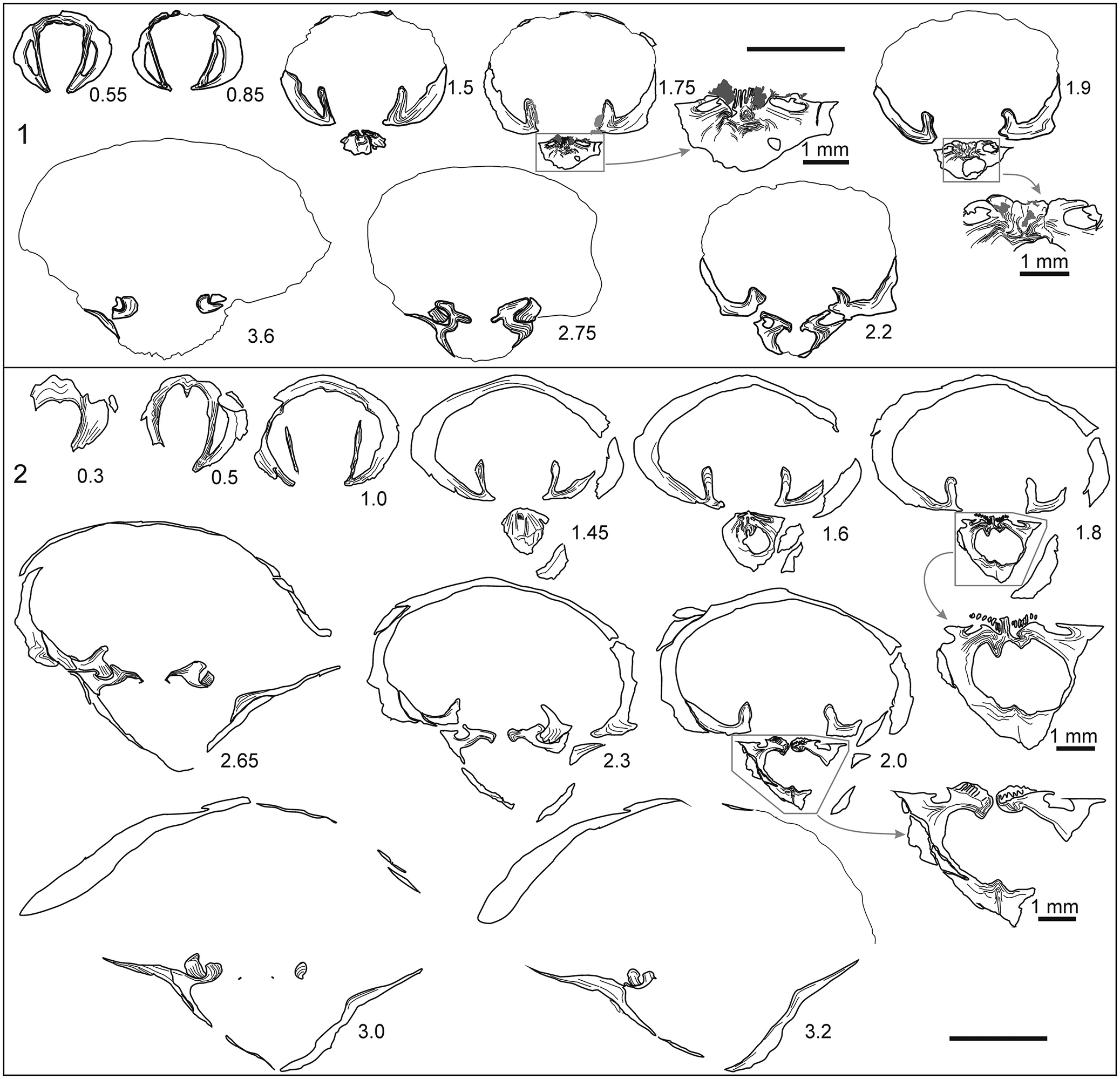
Figure 8. Long description
The diagram is divided into two horizontal panels.
Panel 1 contains eight primary cross-sections of shell G I U S 4-292/15. The sections are arranged in two rows. The top row shows sections at 0.55, 0.85, 1.5, 1.75, and 1.9 millimeters. The bottom row shows sections at 2.2, 2.75, and 3.6 millimeters. Two inset boxes provide 1 millimeter scale magnified views of the hinge and dental structures for the 1.75 and 1.9 millimeter sections. As the distance increases, the shell outline expands from a small circular shape to a wide, flattened biconvex form with complex internal crural plates.
Panel 2 contains eleven primary cross-sections of shell G I U S 4-294/4 arranged in four rows.
* Row one includes distances 0.3, 0.5, 1.0, 1.45, 1.6, and 1.8 millimeters.
* Row two includes distances 2.0, 2.3, and 2.65 millimeters.
* Row three and four show fragmented sections at 3.0 and 3.2 millimeters.
Two inset boxes with 1 millimeter scale bars show detailed views of the cardinal process and hinge plates for the 1.8 and 2.0 millimeter sections. The internal structures show a progression from simple apical plates to elaborate, curved brachial supports.
Scale bars representing 5 millimeters are located at the top right of panel 1 and bottom right of panel 2.
v. Reference Skompski, Baliński, Szulczewski and Zawadzka2018 Hypothyridina sp.; Skompski et al., p. 625, fig. 9M, N.
Type specimens
Holotype, articulated shell, ZPAL 73/1/13/1 (Fig. 6.16–6.20). Paratypes: ~20 articulated shells from the Laskowa Góra Beds, mostly somewhat deformed (crushed), collection numbers ZPAL Bp 73/1/13 and GIUS 4-292/13–22, 4-294/4; five complete and five fragmentary shells from the Szydłówek Beds, ZPAL 81/13a, MWGUW ZI/124. Type locality: Eastern wall of the Józefka quarry (former Mt. Józefka) near Górno, Holy Cross Mountains, Poland. Type stratum: Laskowa Góra Beds; upper part of the Givetian.
Diagnosis
Glosshypothyridina with relatively large shell, a nearly straight cardinal margin, and strong dental plates.
Occurrence
Józefka, quarry and roadcut (Laskowa Góra Beds and Szydłówek Beds).
Description
Shell transversely subhexagonal in outline, typically ~30–34 mm wide (maximum recorded width 38.7 mm), wider than long (width-to-length ratio 1.27–1.53, most often ~1.3), approximately as high as long, strongly dorsibiconvex; maximal width at approximate midlength; cardinal margin nearly straight, lateral margins rounded, anterior margin truncated, anterior commissure uniplicate. Ventral valve convex in umbonal region, flattened on flanks, with a low, flat-bottomed sulcus in the anterior half. Tongue high, broad, occupying 0.52–0.77 of the valve width, forming an angle of ~70o with the commissural plane, bordered by subvertical deflexions of the commissure, distally recurved posteriorly. Dorsal valve strongly convex, maximal height at anterior commissure, with a rounded fold appearing at approximate one-third of valve length; dorsal umbo exceeding the ventral one in larger specimens.
Ornamentation of low, thick, rounded costae developed some distance from smooth umbonal regions, separated by sublinear furrows; 8–15 on the tongue and 13–18 per lateral flank, with 0 or 1 parietal costae. In well-preserved shells, each ventral median and dorsal lateral costa is subdivided longitudinally by a median linear groove in proximity of the commissure (Fig. 7.1–7.3). Dorsal median and ventral flank costae become flattened near the commissure.
Interior
Ventral valve with short but distinct, ventrally divergent dental plates. Dorsal interior with wide, short cardinal process; hinge plates short, narrow, anteriorly divided, slightly inclined dorsally; dorsal median septum absent.
Long marginal spines (Fig. 7.5, 7.6) observed at median dorsal and lateral ventral margins, whereas much shorter spines occur at median ventral and lateral dorsal margins. On a shell 25 mm wide, the preserved length of one visible median dorsal spine reaches 9 mm.
Etymology
In honor of Teofil Żebrawski (5 April 1800–5 February 1887), Polish geodesist, biologist, archeologist, mathematician, cartographer, architect, and bibliographer.
Measurements
Mean values and ranges are given in the description. For the complete set of raw data, means, standard deviations, and variation coefficients, see Appendix.
Remarks
The studied brachiopods are included in the superfamily Uncinuloidea and the family Hypothyridinidae on account of their cuboid shape, numerous anteriorly flattened costae, the presence of a wide cardinal process, and lack of a dorsal septum and septalium (Savage, Reference Savage and Kaesler2002, p. 1092, 1127). The detailed comparison of the new species with the type species of Hypothyridina, Glosshypothyridina, and Tullypothyridina is given in the Table 1; it can be said in summary that the presence of a cardinal process precludes the assignment of the discussed brachiopod to Hypothyridina, whereas the strong and ventrally divergent dental plate separate it from both Hypothyridina and Tullypothyridina. Conversely, no major (genus-level) difference of our brachiopod with Glosshypothyridina can be found.
In comparison with Glosshypothyridina procuboides, the new species is larger (30–35 mm in width compared to values for G. procuboides reported as 25–30 mm in the Anti-Atlas by Halamski and Baliński, Reference Halamski and Baliński2013, p. 267; Halamski et al., Reference Halamski, Baliński and Koppka2022a, fig. 16; or even only up to 20 mm in the Eifel according to Höflinger and Jung, Reference Höflinger and Jung2020, p. 107), has a much less angular, nearly straight cardinal margin, and its dental plates are stronger.
The material at hand, sparse and often deformed, is not sufficient to allow a quantitative assessment of the variability. Nonetheless, there are minor discernible differences between the samples from the Laskowa Góra Beds (type stratum; N = 13; Fig. 6.1–6.25) and the overlying Szydłówek Beds (N = 6; Fig. 6.26–6.35). The shells from the latter are larger (width 32.0–38.7 mm, compared to 21.2–36.1 mm in the sample from the Laskowa Góra Beds), slightly less high (thickness-to-length ratio 0.90–1.01 compared to 0.94–1.17 in the type stratum), have a slightly wider tongue (width of the tongue-to-width ratio 0.56–0.77 compared to 0.52–0.69) and more costae in the tongue (13–15 compared to 9–11). These phenotypic differences could correspond either to biological evolution over a period of the order of a million years, or else to ecological differentiation between habitats characterized by dissimilar life conditions.
Superfamily Camarotoechioidea Schuchert, Reference Schuchert, Schuchert and LeVene1929
Family Septalariidae Havliček, Reference Havlíček1960
Genus Phlogoiderhynchus Sartenaer, Reference Sartenaer1970
Type species
Uncinulus arefactus Veevers, Reference Veevers1959; lower Frasnian; Fitzroy Basin, Western Australia.
Phlogoiderhynchus polonicus (Roemer, Reference Roemer1866)
Rhynchonellide brachiopods from the Laskowa Góra Beds of Górno, Holy Cross Mountains. (1, 3–6) Coeloterorhynchus dillanus (Schmidt, Reference Schmidt1941b), articulated shell, GIUS 4-292/32, in lateral, dorsal, ventral, anterior, and posterior views, respectively. Note probably syn vivo auloporid incrustation. (2) Phlogoiderhynchus polonicus (Roemer, Reference Roemer1866), articulated shell, ZPAL 73/1/11a/1, in dorsal view. Scale bars = 10 mm.
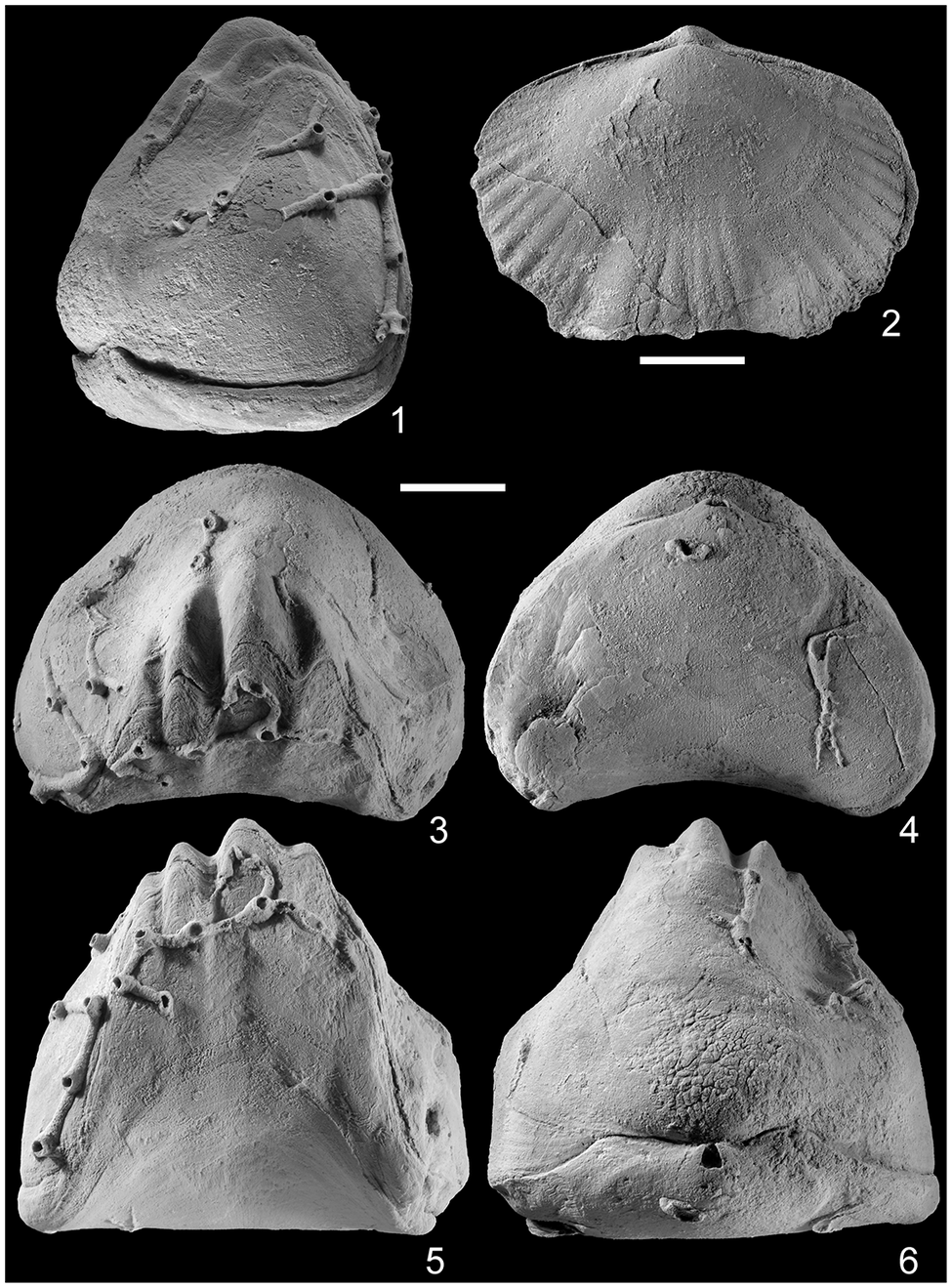
Figure 9. Long description
The photo consists of six panels labeled 1 through 6 against a black background.
* Panel 1 (top left): A lateral view of a Coeloterorhynchus dillanus shell, showing a triangular profile with small, tube-like auloporid incrustations attached to the surface.
* Panel 2 (top right): A dorsal view of a Phlogoiderhynchus polonicus shell, featuring a wide, fan-like shape with distinct radial ribbing. A white scale bar representing 10 mm is positioned below it.
* Panel 3 (middle left): A dorsal view of the Coeloterorhynchus dillanus shell, showing a prominent central fold and more tube-like encrustations. A white scale bar representing 10 mm is located above this panel.
* Panel 4 (middle right): A ventral view of the same shell, showing a smoother surface with a deep sulcus and fewer encrustations.
* Panel 5 (bottom left): An anterior view of the shell, highlighting the zig-zag commissure where the two valves meet, heavily encrusted with branching auloporid tubes.
* Panel 6 (bottom right): A posterior view of the shell, showing the hinge area and the rounded umbo with a slightly textured surface.
* Reference Roemer1866 Camarotoechia? polonica Roemer, p. 676, pl. 13, figs. 9, 10.
v. Reference Baliński, Racki and Halamski2016 Phlogoiderhynchus polonicus; Baliński et al., p. 147, pl. 11, figs. 1–5.
v. Reference Skompski, Baliński, Szulczewski and Zawadzka2018 Phlogoiderhynchus polonicus; Skompski et al., p. 625, text-fig. 9O.
Type specimens
Roemer’s original type material is lost, so the specimen MGUWr s.n., figured by Gürich (Reference Gürich1896, pl. 7, fig. 6) and refigured by Biernat and Szulczewski (Reference Biernat and Szulczewski1975, pl. 24, fig. 2) has been selected as the neotype (Biernat and Szulczewski, Reference Biernat and Szulczewski1975, p. 204).
Materials
Twelve variously preserved shells, GIUS 4-208/2, 4-292/23–31, and ZPAL Bp 73/1/11a/1, Bp 81/14.
Remarks
Phlogoiderhynchus polonicus, considered as a regional index species for the lower Frasnian, is present in the Szydłówek beds (Skompski et al., Reference Skompski, Baliński, Szulczewski and Zawadzka2018) and the Wietrznia beds (Baliński et al., Reference Baliński, Racki and Halamski2016). The reader is referred to the two already published descriptions.
Superfamily Pugnacoidea Rzhonsnitskaya, Reference Rzhonsnitskaya and Thalmann1956
Family Pugnacidae Rzhonsnitskaya, Reference Rzhonsnitskaya and Thalmann1956
Genus Coeloterorhynchus Sartenaer, Reference Sartenaer1966b
Type species
Coeloterorhynchus tabasensis Sartenaer, Reference Sartenaer1966b; middle and upper Frasnian, Upper Devonian; Iran.
Coeloteorhynchus dillanus (Schmidt, Reference Schmidt1941b)
* Reference Schmidt1941b Pugnax acuminatus dillanus Schmidt, p. 284, pl. 1, figs. 2–4.
v. Reference Baliński, Racki and Halamski2016 Coeloteorhynchus dillanus; Baliński et al., p. 147, text-figs. 9, 10, pl. 11, figs. 6–30, 32.
v. Reference Skompski, Baliński, Szulczewski and Zawadzka2018 Coeloteorhynchus dillanus; Skompski et al., p. 625, text-figs. 9A–J, P, 13.
Type specimens
Holotype, SMF XVII 962n, from Frasnian limestone contained in Famennian breccia, Langenaubach, Lahn-Dill Syncline, Germany (Schmidt, Reference Schmidt1941b, fig. 4). For paratypes, see Schmidt (Reference Schmidt1941b, p. 284, figs. 2, 3).
Materials
More than 20 articulated shells, GIUS 4-292/32, 4-294/5-14, and ZPAL Bp 73/3/12/1, Bp 81/9,10,15,16.
Remarks
This species is present in the Laskowa Góra, Szydłówek, and Wietrznia beds of Józefka. The reader is referred to detailed descriptions published in the previous papers dealing with the Józefka section (Baliński et al., Reference Baliński, Racki and Halamski2016; Skompski et al., Reference Skompski, Baliński, Szulczewski and Zawadzka2018).
Order Atrypida Rzhonsnitskaya, Reference Rzhonsnitskaya1960
Suborder Atrypidina Moore, Reference Moore, Moore, Lalicker and Fischer1952
Family Atrypidae Gill, Reference Gill1871
Subfamily Atrypinae Gill, Reference Gill1871
Genus Kyrtatrypa Struve, Reference Struve1966
Type species
Atrypa (Kyrtatrypa) culminigera Struve, Reference Struve1966; Junkerberg Formation, middle Eifelian; Hillesheim, Eifel, Germany.
Remarks
The distinction between Atrypa Dalman, Reference Dalman1828 and Kyrtatrypa was discussed at length by Halamski et al. (Reference Halamski, Baliński and Kondas2024, p. 233–235), because the discovery of Kyrtatrypa pauli Halamski and Baliński in Halamski et al., Reference Halamski, Baliński and Kondas2024 showed that differences between the two genera were less clear-cut than when only Kyrtatrypa culminigera, the type species of the latter genus, had been considered. The discovery of Kyrtatrypa stanislai new species (below) blurs the discussed distinction even more, insofar as the new species possesses minute dental nuclei. Dental nuclei were heretofore considered diagnostic for Atrypa (Copper, Reference Copper and Kaesler2002, p. 1396; Halamski et al., Reference Halamski, Baliński and Kondas2024, p. 235). However, careful examination of the serial sections of Kyrtatrypa culminigera (see Copper, Reference Copper and Kaesler2002, fig. 947e) reveals the presence of similar minuscule dental nuclei comparable to those in the species described below. As a consequence, the diagnosis of the genus Kyrtatrypa must be emended as follows: prominent, large, solid teeth, but minute dental nuclei may sometimes be present (otherwise as of Copper, Reference Copper and Kaesler2002). Conversely, only medium-sized to large dental nuclei should be considered diagnostic for Atrypa.
Kyrtatrypa stanislai new species
Atrypide brachiopods from the Laskowa Góra and Szydłówek beds of Górno, Holy Cross Mountains. (1–3) Desquamatia globosa jozefkae Baliński in Skompski et al., Reference Skompski, Baliński, Szulczewski and Zawadzka2018, articulated shell, ZPAL Bp 81/23, from the Szydłówek Beds, in dorsal, ventral, and posterior views, respectively. (4) Davidsonia cf. D. enmerkaris Halamski in Baliński et al., Reference Baliński, Racki and Halamski2016, fragmentary ventral valve, GIUS 4-292/52, from the Laskowa Góra beds, in dorsal view. (5) Spinatrypina (Exatrypa) explanata (von Schlotheim, Reference Schlotheim1820), articulated shell, GIUS 4-208/3, from the Laskowa Góra beds, in ventral view. (6–30) Kyrtatrypa stanislai n. sp. from the Szydłówek Beds of Górno, Holy Cross Mountains, five shells, in dorsal, ventral, lateral, posterior, and anterior views, respectively: (6–10) ZPAL Bp 73/3/1/2; (11–15) holotype ZPAL Bp 73/3/1/1; (16–20) MWGUW ZI/124/3; (21–25) MWGUW ZI/124/4; (26–30) MWGUW ZI/124/5. Scale bars = 2 mm (4); 10 mm (1–3, 5–30).
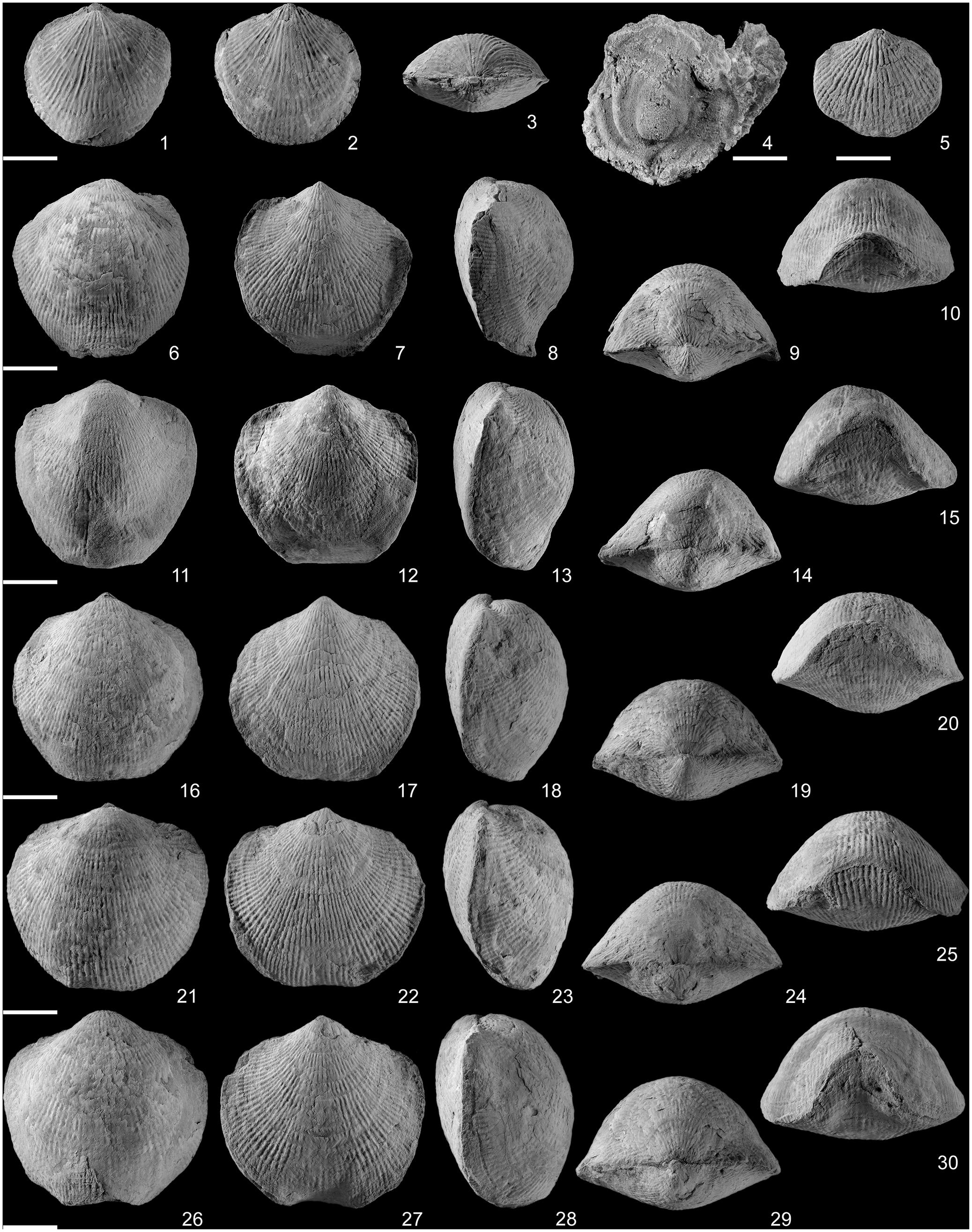
Figure 10. Long description
The photo contains 30 numbered views of fossilized brachiopod shells arranged in rows against a black background.
* Row 1: Specimens 1 through 5. Views 1 to 3 show a single shell of Desquamatia globosa jozefkae in dorsal, ventral, and posterior views. View 4 shows a fragmentary ventral valve of Davidsonia cf. D. enmerkaris. View 5 shows a ventral view of Spinatrypina explanata.
* Rows 2 through 7: Specimens 6 through 30. These rows display five different shells of Kyrtatrypa stanislai n. sp., with each shell shown in a standard five-view sequence: dorsal, ventral, lateral, posterior, and anterior.
* Row 2 and 3 (top right): Views 6 to 10 represent specimen Z P A L Bp 73/3/1/2.
* Row 3 (bottom left) and 4 (top right): Views 11 to 15 represent the holotype Z P A L Bp 73/3/1/1.
* Row 4 (bottom left) and 5 (top right): Views 16 to 20 represent specimen M W G U W Z I / 124 / 3.
* Row 5 (bottom left) and 6 (top right): Views 21 to 25 represent specimen M W G U W Z I / 124 / 4.
* Row 7: Views 26 to 30 represent specimen M W G U W Z I / 124 / 5.
The shells are generally rounded or sub-triangular with distinct radial ribbing patterns. Scale bars are provided on the left side of rows 1, 2, 3, 4, 5, and 7, and below specimen 4 and 5, indicating 2 mm for specimen 4 and 10 mm for all others.
Transverse serial sections of Kyrtatrypa stanislai n. sp. from the Szydłówek Beds of Górno, Holy Cross Mountains, through shells ZPAL Bp 73/3/1/12 (1) and ZPAL Bp 73/3/1/13 (2). Distances in mm from the tip of the ventral umbo. Scale bars = 5 mm.
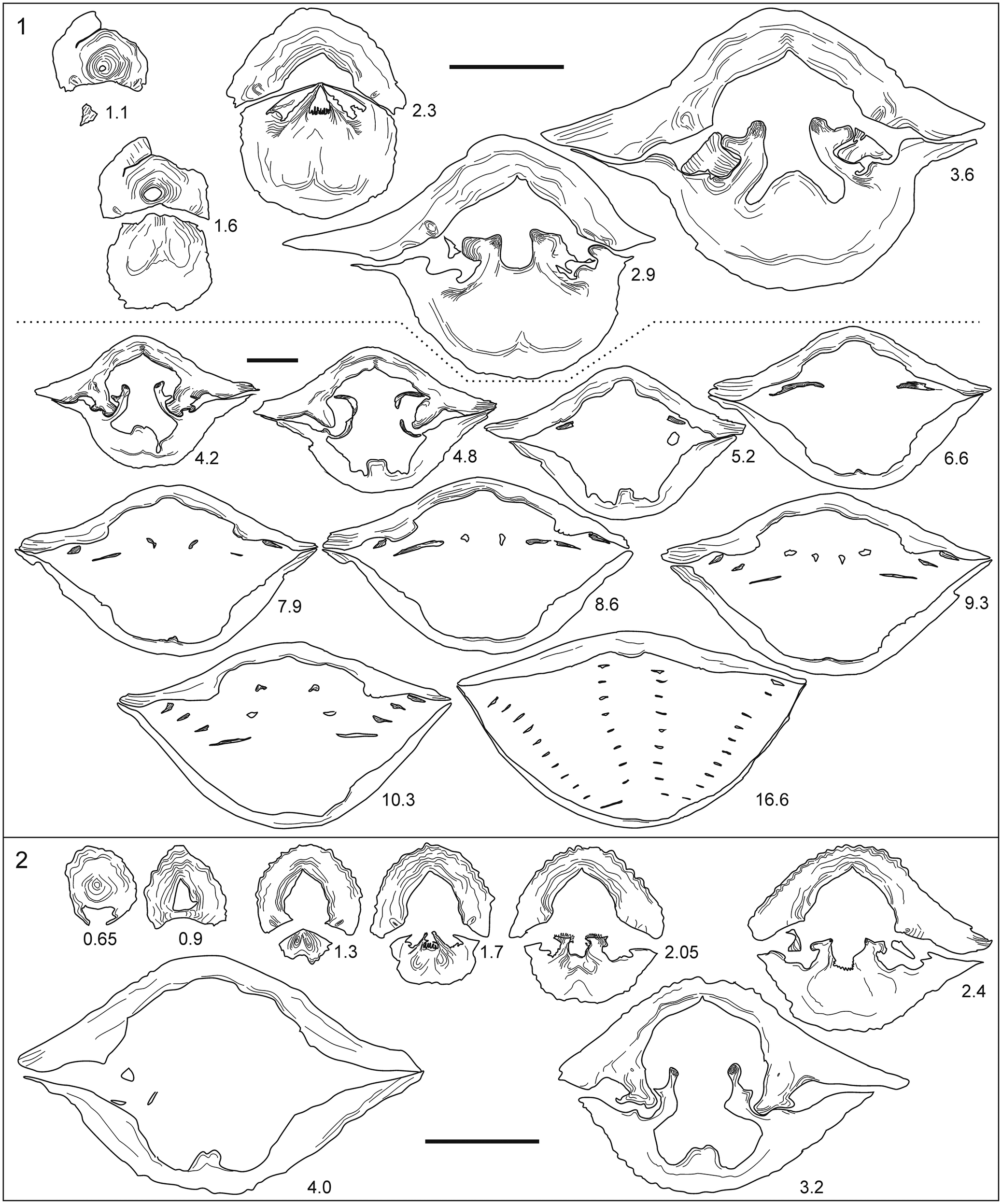
Figure 11. Long description
Panel 1 contains thirteen sections of shell Z P A L B p 73/3/1/12. The sequence begins at the top left with section 1.1, showing a small circular profile. As the distance increases through 1.6, 2.3, 2.9, and 3.6, the shell expands into a wide, winged shape with complex internal structures including a central cavity and dental plates. A dotted horizontal line separates the top row from the middle. Sections 4.2, 4.8, 5.2, and 6.6 show the gradual thinning of internal supports. The bottom two rows, sections 7.9, 8.6, 9.3, 10.3, and 16.6, show the shell becoming a broad, shallow V-shape with small internal punctae or ridges appearing in the final section.
Panel 2, located at the bottom, contains eight sections of shell Z P A L B p 73/3/1/13. The top row shows sections 0.65, 0.9, 1.3, 1.7, 2.05, and 2.4. These progress from a small solid circle to an arched shape with developing internal hinge structures. The bottom row contains section 3.2 on the right and 4.0 on the left, showing the fully expanded, wide-winged transverse profile of the brachiopod shell. Scale bars representing 5 mm are present in both panels.
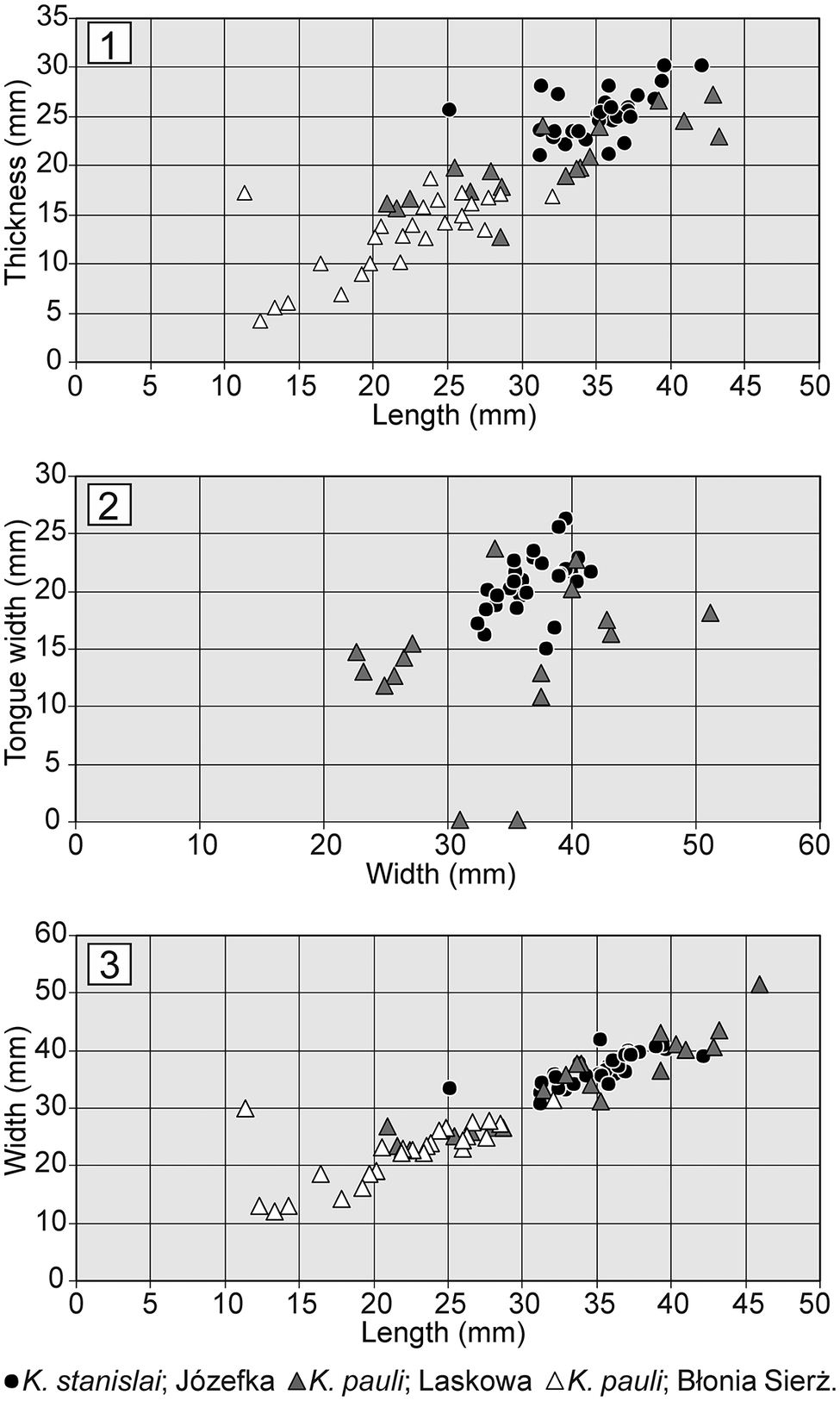
Biometric comparison of the lower Frasnian Kyrtatrypa stanislai n. sp. from Górno with the closest species, the middle Givetian K. pauli Halamski and Baliński in Halamski et al., Reference Halamski, Baliński and Kondas2024, from Laskowa and Błonia Sierżawskie, Holy Cross Mountains: (1) thickness as a function of length; (2) tongue width as a function of shell width; (3) width as a function of length.
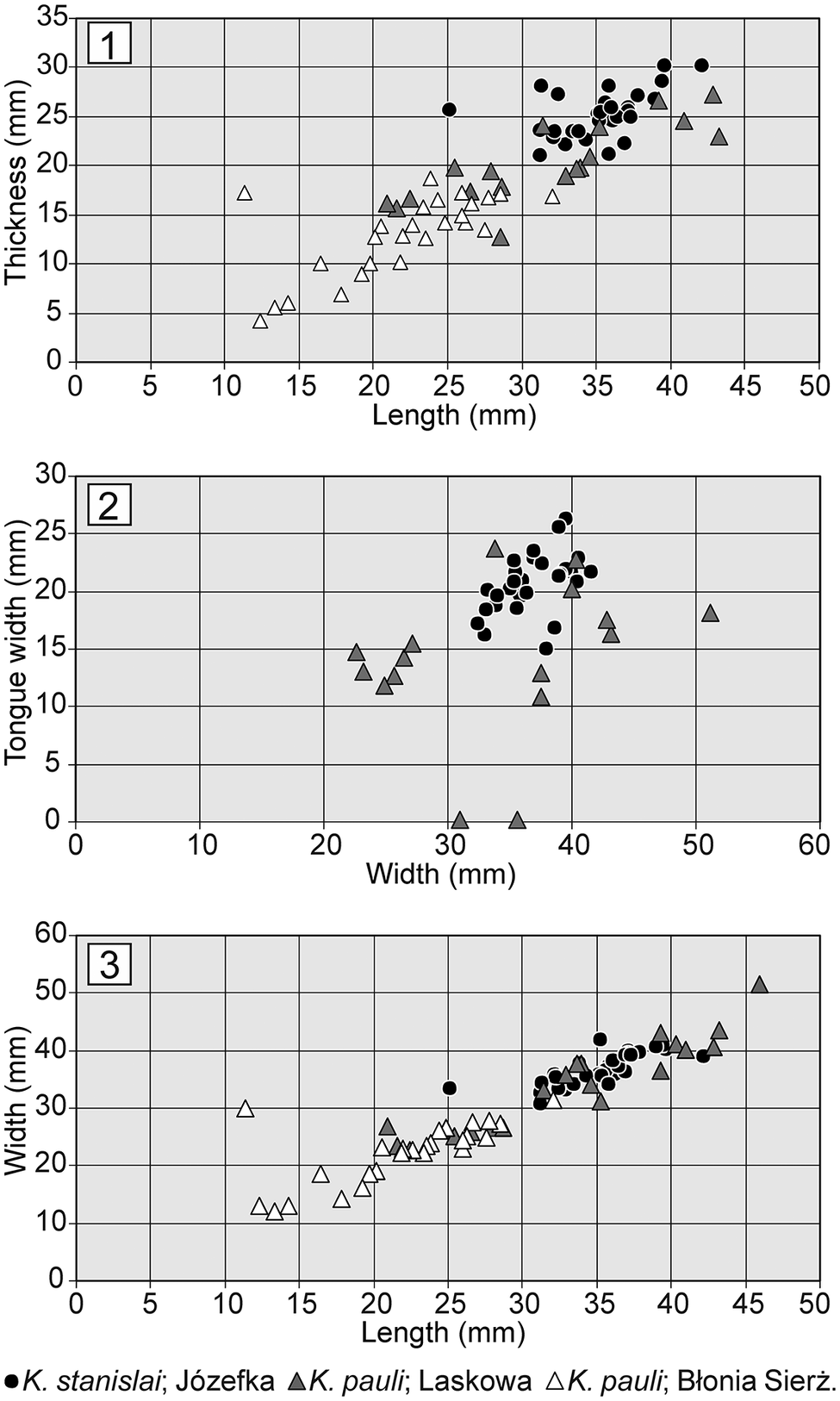
Figure 12. Long description
Three scatter plots arranged vertically, labeled 1, 2, and 3. A legend at the bottom identifies three data groups: black circles for K yrtatrypa stanislai from Józefka, dark gray triangles for K. pauli from Laskowa, and white triangles for K. pauli from Błonia Sierżawskie.
* Panel 1: Thickness in millimeters on the y-axis (0 to 35) versus Length in millimeters on the x-axis (0 to 50). Data shows a positive linear correlation. White triangles are clustered at the lower end (length 12 to 30, thickness 5 to 20). Dark gray triangles overlap and extend further (length 20 to 45, thickness 15 to 27). Black circles are concentrated at the upper end (length 30 to 43, thickness 21 to 30).
* Panel 2: Tongue width in millimeters on the y-axis (0 to 30) versus Width in millimeters on the x-axis (0 to 60). Dark gray triangles are scattered widely between width 22 and 52. Black circles form a tighter cluster between width 32 and 42, with tongue widths ranging from 15 to 27 millimeters.
* Panel 3: Width in millimeters on the y-axis (0 to 60) versus Length in millimeters on the x-axis (0 to 50). This plot shows a strong linear relationship for all groups. White triangles occupy the lower-left (length 12 to 28, width 12 to 28). Dark gray triangles span the middle to upper range (length 20 to 46, width 22 to 52). Black circles are tightly grouped in the upper-middle section (length 31 to 43, width 31 to 42).
Type specimens
Holotype, ZPAL Bp 73/3/1/1 (Fig. 9.16–9.20); paratypes, ZPAL Bp 73/3/1 and MWGUW ZI/124; mostly relatively well-preserved articulated shells. Type locality: Józefka quarry near Górno, Holy Cross Mountains, Poland. Type stratum: brachiopod-rich lens within the Szydłówek Beds, lowermost Frasnian.
Diagnosis
Large atrypine, possessing a distinctly convex ventral valve, teeth with minute dental nuclei, uniplicate anterior commissure with rather broad and often relatively high-rounded tongue, and rather coarse radial ornamentation.
Description
Shell rounded to shield-shaped in outline, dorsibiconvex, typically ~33–37 mm long, 34–39 mm wide, and 23–27 mm thick; approximately as long as wide: width-to-length ratio (0.91–)1.01–1.05(–1.31), mean 1.04, N = 30, usually markedly convex: thickness-to-length ratio (0.58–)0.68–0.72(–1.01), mean 0.71; N = 29. Maximum width at approximate posterior one-third of the length. Anterior commissure uniplicate; tongue, moderately wide, making (0.38)–0.53–0.59(–0.66), mean 0.55, N = 28, of the width of the shell, often high, rounded (parabolic-shape). Ventral valve distinctly convex in umbonal region, sometimes flattening on flanks, but only rarely being completely flat near the lateral margins; frills not observed; beak small, appressed to the dorsal umbo. Dorsal valve arched in anterior view, mostly high; beak hidden by the ventral valve.
Ornament of radial ribs, mostly 5 or 6 per 5 mm at anterior margin, 9 or 10 per 5 mm at 5 mm from the umbo.
Interior of both valves with thickened umbonal region. Ventral valve with thick pedicle callist; deltidial plates absent; teeth thick, solid, but with minute dental nuclei, barely visible in some transverse sections; median muscle scars narrowly incised in umbonal and posterior region, widening anteriorly.
Dorsal interior with deep sockets and distinct accessory middle socket ridge; socket plates thick, separated by deep cardinal pit; cardinal process short, lining socket plates and cardinal pit posteriorly; median myophragm thick and distinct; crura fibrous, laterally directed, spiralia with nine whorls in one of the sectioned specimens (Fig. 10.1).
Etymology
In honor of Stanisław Skompski (b. 1952; Latin form of the forename: Stanislaus; genitive: Stanislai), in recognition of his contributions to the geology of the Holy Cross Mountains; in particular, he collected a part of the described material of K. stanislai n. sp., including the holotype.
Measurements
Mean values and ranges are given in the description and the remarks. For the complete set of raw data, means, standard deviations, and variation coefficients, see Appendix.
Remarks
The studied brachiopods are included within Kyrtatrypa on the basis of teeth with minute dental nuclei (see Remarks under the genus), the uniplicate anterior commissure, and the distinctly (even if not strongly) convex ventral valve. Frills were not observed, which is likely due to the specimens having been extracted from hard limestone.
Kyrtatrypa stanislai n. sp. is close to older (late middle Givetian) K. pauli in shape and ornamentation. It differs therefrom in being higher (W/T mean 0.71, maximum 1.01; in K. pauli 0.60 and 0.79, respectively), having a less straight hinge line, and possessing rudimentary dental nuclei (fully absent in K. pauli, see discussion above). Moreover, the ventral valve of K. stanislai n. sp. is higher than that of K. pauli, which can often be nearly flat (Halamski et al., Reference Halamski, Baliński and Kondas2024, fig. 4M, R). The tongue of K. stanislai n. sp. is mostly rounded, whereas in K. pauli it is often subtrapezoidal (flattened in its top part). These differences, in addition to the stratigraphic separation of the two samples, are judged sufficient for warranting a species-level distinction, although it should be stressed that they can be appreciated if a sufficiently large sample is analyzed; single shells can sometimes be difficult to identify.
The studied species is known from the type locality and stratum only. Three other Frasnian species of Kyrtatrypa have been reported in the literature; all three are relatively easily distinguished from K. stanislai n. sp. Kyrtatrypa brandonensis (Stainbrook, Reference Stainbrook1938) from Iowa is distinctly wider than long, has a lower shell, and in particular, the ventral valve is lower; the ornament is somewhat denser. Kyrtatrypa teicherti (Coleman, Reference Coleman1951) from the Frasnian of Western Australia is similar in shape, but much smaller. The late Frasnian K. barnimi Halamski, Reference Halamski2013 from the Sudetes is globose.
Subfamily Spinatrypinae Copper, Reference Copper1978
Genus Spinatrypina Rzhonsnitskaya, Reference Rzhonsnitskaya1964
Type species
Spinatrypina margaritoides Rzhonsnitskaya, Reference Rzhonsnitskaya1964; Pragian; Siberia, Russia.
Subgenus Spinatrypina ( Exatrypa ) Copper, Reference Copper1967
Type species
Terebratulites explanatus von Schlotheim, Reference Schlotheim1820; Refrath beds, Frasnian; Refrath, Paffrath Syncline, Bergisches Land, Germany.
Spinatrypina ( Exatrypa ) explanata (von Schlotheim, Reference Schlotheim1820)
* Reference Schlotheim1820 Terebratulites explanatus von Schlotheim, p. 263.
. Reference Racki1993a Spinatrypina robusta Copper, Reference Copper1967; Racki, p. 312.
v. Reference Baliński, Racki and Halamski2016 Spinatrypina (Exatrypa) explanata ; Baliński et al., p. 151, text-fig. 12, pl. 15, figs. 1–33 [ubi syn.].
Type specimens
Lectotype MB.B s.n., selected by W. Struve, published and figured by Copper (Reference Copper1967, pl. 20, fig. 2), from Refrath beds (Frasnian), Paffrath Syncline, Bergisches Land, Germany.
Materials
More than 60 mostly imperfectly preserved articulated shells, GIUS 4-208/3–23, 4-292/32–51, 4-294/15–36.
Remarks
This species, common in the Laskowa Góra Beds, but present also in the Szydłówek Beds and the Wietrznia Beds, was described on the basis of > 80 articulated shells (all the three stratigraphic levels combined) by Baliński et al. (Reference Baliński, Racki and Halamski2016) as Spinatrypina (Exatrypa) explanata. The reader is referred thereto for description, biometric data, and illustrations. However, in an earlier contribution brachiopods from this level (Kielce region localities, see below) were identified as Spinatrypina (Exatrypa) robusta Copper, Reference Copper1967 (Racki, Reference Racki1993a). At present, no straightforward solution of this dilemma can be proposed: brachiopods from Górno agree nearly perfectly to Spinatrypina explanata in terms of planar shape, but are thicker (Baliński et al. Reference Baliński, Racki and Halamski2016, p. 151); on the other hand, Spinatrypina robusta is of similar thickness as brachiopods from Górno, but less wide (width-to-length ratio ~1.1). According to Copper (Reference Copper1967, p. 136), both species have restricted and disjunct stratigraphic ranges in the Refrath beds (topmost lower to lower part of middle Frasnian; Ma et al., Reference Ma, Ebbighausen and Becker2015): Spinatrypina (Exatrypa) explanata is present in their lower part (Steinbreche horizon, F2a) and Spinatrypina (Exatrypa) robusta in their upper part (Saalermühl horizon, F2b). The representatives of Spinatrypina (Exatrypa) from Górno are apparently morphologically rather uniform from the upper part of the Givetian to the lower Frasnian.
Provisionally, Spinatrypina (Exatrypa) robusta, a less wide and more biconvex variant, is included in the intraspecies variability of Spinatrypina (Exatrypa) explanata. In view of an apparently relatively long stratigraphic range of the brachiopod sample from Górno, such a solution, despite its imperfection, seems more satisfactory than describing a new species.
Subfamily Variatrypinae Copper, Reference Copper1978
Genus Desquamatia Alekseeva, Reference Alekseeva1960
Type species
Atrypa (Desquamatia) khavae Alekseeva, Reference Alekseeva1960; lower Eifelian; Urals, Russia.
Desquamatia globosa jozefkae Baliński in Skompski et al., Reference Skompski, Baliński, Szulczewski and Zawadzka2018
v* Reference Skompski, Baliński, Szulczewski and Zawadzka2018 Desquamatia globosa jozefkae Baliński in Skompski et al., p. 626, text-figs. 7, 8, 14, 15.
Type specimens
Holotype, ZPAL Bp 81/1 (Skompski et al., Reference Skompski, Baliński, Szulczewski and Zawadzka2018, fig. 7Z–DD) from the Szydłówek Beds of Józefka (Givetian-Frasnian boundary beds). For paratypes, see Skompski et al. (Reference Skompski, Baliński, Szulczewski and Zawadzka2018, p. 626).
Materials
More than 150 articulated shells, ZPAL Bp 81/1/2–8, 17–19, 23–25 and GIUS 4-208/24–27.
Remarks
This subspecies was described on the basis of > 150 articulated shells present in a fossiliferous lens in the Szydłówek Beds of the Józefka quarry (Skompski et al., Reference Skompski, Baliński, Szulczewski and Zawadzka2018).
Suborder Davidsoniidina Copper, Reference Copper1996
Superfamily Davidsonioidea King, Reference King1850
Family Davidsoniidae King, Reference King1850
Genus Davidsonia Bouchard-Chantereaux, Reference Bouchard-Chantereaux1849
Type species
Davidsonia verneuillii Bouchard-Chantereaux, Reference Bouchard-Chantereaux1849; upper Eifelian; Germany.
Davidsonia cf. D. enmerkaris Halamski in Baliński et al., Reference Baliński, Racki and Halamski2016
cf. Reference Baliński, Racki and Halamski2016 Davidsonia enmerkaris Halamski in Baliński et al., Reference Baliński, Racki and Halamski2016, p. 153, pl. 12, figs. 16–26.
Type specimens
Holotype, ZPAL Bp 73/1/19/1, from the lower Frasnian Wietrznia Beds (sets 21 and 22) of the Józefka roadcut. For paratypes, see Baliński et al. (Reference Baliński, Racki and Halamski2016, p. 153).
Materials
A fragmentary ventral valve, GIUS 4-292/52.
Remarks
Davidsonia enmerkaris has been described in detail on the basis of a rich collection from the Wietrznia Beds (Baliński et al., Reference Baliński, Racki and Halamski2016); the reader is referred thereto for description. The only specimen from the Laskowa Góra Beds is a small fragment of ventral valve with characteristic spiral grooves; it is tentatively referred to the discussed species, because the dorsal valve is not known. It can be noted Davidsonia enmerkaris is the youngest known representative of the suborder Davidsoniidina.
Order Athyridida Boucot, Johnson, and Staton, Reference Boucot, Johnson and Staton1964
Suborder Athyrididina Boucot, Johnson, and Staton, Reference Boucot, Johnson and Staton1964
Superfamily Athyridoidea Davidson, Reference Davidson1881
Family Athyrididae Davidson, Reference Davidson1881
Subfamily Helenathyridinae Dagys, Reference Dagys1974
Genus Biernatella Baliński, Reference Baliński1977
Type species
Biernatella polonica Baliński, Reference Baliński1977; Palmatolepis gigas Biozone, Frasnian; trench Z-4 south of Dębnik near Cracow, southern Poland.
Biernatella ovalis Baliński, Reference Baliński1995
Athyridide, spiriferide, and spiriferinide brachiopods from the Laskowa Góra Beds of Górno, Holy Cross Mountains. (1–4) Cyrtina cf. C. arkonensis Ehlers and Wright, Reference Ehlers and Wright1975, incomplete shell, GIUS 4-292/76: (2–4) dorsal, lateral, and posterior views, respectively; (1) detail of the delthyrium. (5–7) Echinocoelia parva Baliński in Baliński et al., Reference Baliński, Racki and Halamski2016, articulated shell, GIUS 4-292/62, in dorsal, lateral, and posterior views, respectively. (8–12) Echinocoelia sp. indet., complete shell, GIUS 4-292/67, in dorsal, ventral, lateral, posterior, and anterior views, respectively. (13–17) Ambothyris sp. indet., complete shell, GIUS 4-292/54, in dorsal, ventral, lateral, posterior, and anterior views, respectively. (19–23) Biernatella ovalis Baliński, Reference Baliński1995, slightly damaged shell, GIUS 4-292/53, in dorsal, ventral, lateral, posterior, and anterior views, respectively. (24–28) Emanuella aff. E. takwanensis (Kayser, Reference Kayser and von Richthofen1883), articulated shell, GIUS 4-292/72, in dorsal, ventral, lateral, posterior, and anterior views, respectively. (18, 29–33) Indospirifer sp. indet.; slightly damaged and partially exfoliated shell, GIUS 4-294/37: (29–33) dorsal, ventral, lateral, posterior, and anterior views, respectively; (18) detail showing micro-ornamentation preserved on a patch of the primary shell layer. (34) ?Reticulariopsis sp. indet., fragmentary ventral valve, GIUS 4-292/75, in exterior view. Scale bars = 1 mm (1–22), 2 mm (23–28), 5 mm (29–34).
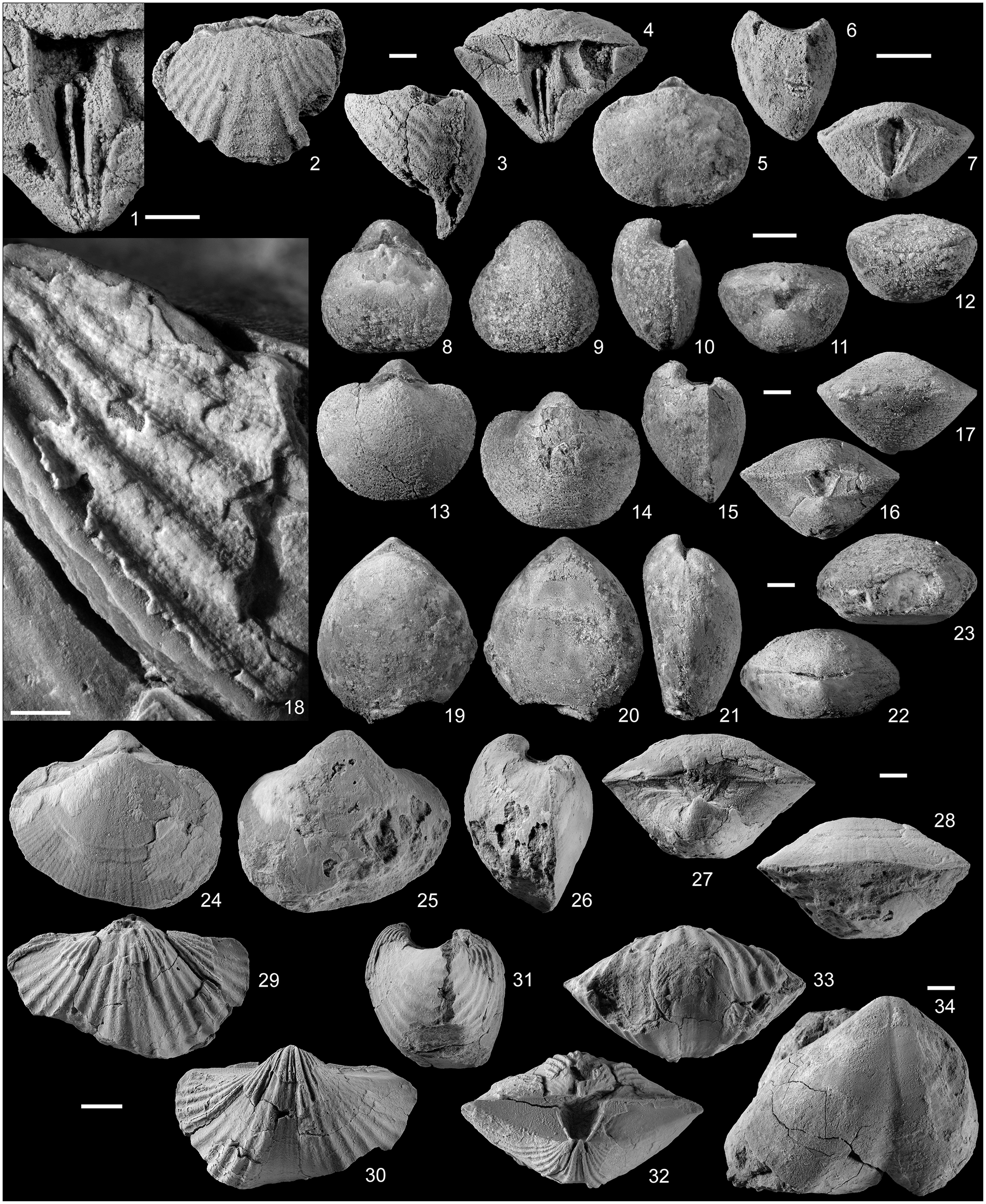
Figure 13. Long description
The plate contains 34 numbered black and white photographs of fossilized brachiopods.
- Top row (1 to 7): Cyrtina cf. C. arkonensis (1 to 4) showing a detailed delthyrium and dorsal, lateral, and posterior views of an incomplete shell. Echinocoelia parva (5 to 7) shows an articulated shell in dorsal, lateral, and posterior views.
- Second row (8 to 12): Echinocoelia species indet. showing a complete shell in dorsal, ventral, lateral, posterior, and anterior views.
- Third row (13 to 17): Ambothyris species indet. showing a complete shell in dorsal, ventral, lateral, posterior, and anterior views.
- Middle left (18): A high-magnification detail of micro-ornamentation on the primary shell layer of Indospirifer.
- Fourth row (19 to 23): Biernatella ovalis showing a slightly damaged shell in dorsal, ventral, lateral, posterior, and anterior views.
- Fifth row (24 to 28): Emanuella aff. E. takwanensis showing an articulated shell in dorsal, ventral, lateral, posterior, and anterior views.
- Bottom rows (29 to 34): Indospirifer species indet. (29 to 33) showing a partially exfoliated shell in dorsal, ventral, lateral, posterior, and anterior views. Item 34 is a fragmentary ventral valve of ?Reticulariopsis species indet. in exterior view.
Scale bars are provided for each group: 1 mm for items 1 to 22, 2 mm for items 23 to 28, and 5 mm for items 29 to 34. The shells vary from smooth and rounded to heavily ribbed and triangular.
Reference Baliński1995 Biernatella ovalis Baliński, p. 142, figs. 7A–C, G–M, O–Q, S, T, 8A.
Type specimens
Holotype, ZPAL Bp XXXVIII/25-1, from the Szydłówek Beds of Bocianek (Baliński, Reference Baliński1995, fig. 7G–K). For paratypes, see Baliński (Reference Baliński1995, p. 138, 142).
Materials
A single shell with damaged ventral valve, GIUS 4-292/53.
Occurrence
Upper Givetian of the Holy Cross Mountains (Szydłówek, nowadays Bocianek, suburb of Kielce, type locality; Józefka).
Remarks
External features, e.g., a very small, smooth shell and a small ventral interarea, of the specimen from Józefka indicate that it represents the genus Biernatella—athyridids with double spires. It is externally undistinguishable from Biernatella ovalis from the lower part of the Szydłówek Beds (upper Givetian), cropping out at Bocianek, ~13 km west-northwest of Józefka. Both forms have an elongate suboval shell outline, with the maximum width of the shell located more anteriorly than in all other species of the genus.
Order Spiriferida Waagen, Reference Waagen1883
Suborder Spiriferidina Waagen, Reference Waagen1883
Superfamily Adolfioidea Sartenaer, Reference Sartenaer1966a
Family Echinospiriferidae Ljaschenko, Reference Ljaschenko1973
Genus Indospirifer Grabau, Reference Grabau1931
Type species
Spirifer padaukpinensis Reed, Reference Reed1908; Middle Devonian, probably Eifelian; Padaukpin, Northern Shan States, Myanmar (Burma).
Indospirifer sp. indet.
Materials
A single shell, GIUS 4-294/37, with somewhat crushed anterior region, strongly decorticated, but with shell matter preserved in patches.
Description
Shell 29.3 mm wide, ~17 mm long, 16.7 mm thick, ventribiconvex; transverse with a long hinge margin, only slightly shorter than the maximum shell width at approximately one-third of the dorsal valve length; cardinal extremities narrowly rounded, lateral margins gently rounded, anterior margin truncated, anterior commissure uniplicate.
Ventral valve deeper than dorsal valve; interarea distinct, ~5 mm in height, apsacline, concave, with distinct longitudinal striation perpendicular to the hinge line; beak erect; delthyrium encompassing an angle of 52°, open but bordered by subvertical ridges; sulcus rather shallow, originating at the beak, laterally defined by bordering plications, anteriorly extended into a distinct tongue that is deflected almost at a right angle. Dorsal valve with a distinct fold appearing at the beak, bordered by a pair of distinct furrows.
Shell ornamentation of strong, rounded plications, 9 or 10 simple on each flank, four in sulcus, and five on fold, a single subdivision observed in the sulcus and on the fold; new plicae in the sulcus emerging from the plicae bounding the sulcus. Micro-ornament visible only on small patches of preserved shell matter (Fig. 12.16) consisting of concentric growth lines intersected by subradial capillae and sparsely distributed granules; capillae with a tendency to converge along the summits of the plicae.
The single available specimen reveals the presence of extrasinal dental plates and ctenophoridium.
Remarks
Only one subcomplete specimen of this species has been found and it is assigned to Indospirifer due to its plicate shell with a dorsal sulcus and a ventral fold, subradial capillae, and the presence of extrasinal dental plates and ctenophoridium. In these characters, it resembles the type species of the genus, I. padaukpinensis Reed, Reference Reed1908 from the Middle Devonian (reported as Eifelian, but not certain, see above) of Myanmar (Anderson et al., Reference Anderson, Boucot and Johnson1969) and perhaps also the lower Givetian of the Kuznetsk Basin (Russia; Izokh et al., Reference Izokh, Popov, Sobolev and Shcherbanenko2022), but differs mainly in a wider shell and a less inclined ventral interarea. Due to the damage to the anterior part of the studied shell, it is difficult to confirm the presence of the characteristic subradial arrangement of the median plicae that occurs in the type species. The specimen from Poland bears a strong external resemblance to I. exfoliata Cooper and Dutro, Reference Cooper and Dutro1982 described from the Frasnian Sly Gap Formation in New Mexico (Cooper and Dutro, Reference Cooper and Dutro1982), but the latter has a lower, more concave and more strongly inclined ventral interarea. Indospirifer orestes (Hall and Whitfield, Reference Hall and Whitfield1872) from the Frasnian Martin Formation in Arizona (Beus, Reference Beus1978) differs more clearly from the specimen studied here in its smaller size and a more elongated shell ornamented with fewer plicae.
Superfamily Ambocoelioidea George, Reference George1931
Family Ambocoeliidae George, Reference George1931
Subfamily Ambocoeliinae George, Reference George1931
Genus Ambothyris George, Reference George1931
Type species
Spirifera infima Whidborne, Reference Whidborne1893; Givetian; Lummaton, Devon, England.
Ambothyris sp. indet.
Reference Baliński and Halamski2023 Ambothyris sp.; Baliński and Halamski, p. 61, figs. 43A–Y, 44.
Materials
One complete and three almost complete shells, four shells damaged to varying degrees, GIUS 4-292/54–61.
Occurrence
A similar, if not conspecific form was described recently by Baliński and Halamski (Reference Baliński and Halamski2023) as Ambothyris sp. indet. from the lower Givetian beds at Miłoszów (Holy Cross Mountains, Poland).
Remarks
This rare brachiopod from Józefka shows great external similarity to Ambothyris sp. indet. described by Baliński and Halamski (Reference Baliński and Halamski2023) from the lower part of the Polygnathus timorensis Biozone of the Skały Formation at Miłoszów. Full discussion of taxonomic issues related to this form and comparisons with other similar species can be found in the above-mentioned paper.
Genus Echinocoelia Cooper and Williams, Reference Cooper and Williams1935
Type species
Echinocoelia ambocoelioides Cooper and Williams, Reference Cooper and Williams1935; Tully Formation, Givetian; New York, USA.
Remarks
This genus is represented in the studied material by two species. Echinocoelia parva Baliński in Baliński et al., Reference Baliński, Racki and Halamski2016 was described from early Frasnian strata in the Józefka section. In that contribution (Baliński et al., Reference Baliński, Racki and Halamski2016), the material from both Givetian and Frasnian strata was treated as a single species. The Frasnian Echinocoelia parva and the Givetian Echinocoelia sp. indet. are like each other in reaching similar size and having a similar ratio of the convexities of both valves, but differ in the outline of the valves (maximum width at approximate midlength of the dorsal valve in Echinocoelia parva, anteriorly in Echinocoelia sp. indet.). All specimens figured by Baliński et al. (Reference Baliński, Racki and Halamski2016) are from the Frasnian and represent the genuine Echinocoelia parva.
Echinocoelia parva Baliński in Baliński et al., Reference Baliński, Racki and Halamski2016
v*p Reference Baliński, Racki and Halamski2016 Echinocoelia parva Baliński in Baliński et al., Reference Baliński, Racki and Halamski2016, p. 157, pl. 17, figs. 8, 10–17, pl. 18, figs. 1–16.
Type specimens
Holotype, ZPAL Bp 73/1/23/1, from the lower Frasnian Wietrznia Beds of the Jóżefka roadcut (Baliński et al., Reference Baliński, Racki and Halamski2016, pl. 18, figs. 12–16). For paratypes, see Baliński et al. (Reference Baliński, Racki and Halamski2016, p. 157).
Materials
Five shells, GIUS 4-292/62–66.
Remarks
This species occurs sparsely in the Laskowa Góra Beds. It has been described in detail on the basis of a rich collection from the Wietrznia Beds (Baliński et al., Reference Baliński, Racki and Halamski2016); the reader is referred thereto for description.
For comparison with Echinocoelia sp. indet., see Remarks under the genus.
Echinocoelia sp. indet.
vp Reference Baliński, Racki and Halamski2016 Echinocoelia parva Baliński in Baliński et al., Reference Baliński, Racki and Halamski2016; p. 157, non pl. 17, figs. 8, 10–17, pl. 18, figs. 1–16.
Materials
Five shells, GIUS 4-292/67–71.
Description
Shell smooth, very small, reaching 3.9 mm in length, ventribiconvex, in the outline of a rounded triangle, with the greatest width slightly anterior to shell midlength. Ventral valve strongly convex, about twice as deep as the dorsal valve, with a massive umbo; sulcus not developed; interarea apsacline, curved, delthyrium open, beak erect to incurved. Dorsal valve weakly convex, with a broad and gentle median depression resulting in a slightly unisulcate anterior commissure.
Interior unknown. Micro-ornamentation poorly preserved, but concentric growth lines well discernible in places with preserved primary shell layer.
Remarks
The characteristic prominent, thick umbo of the ventral valve and the greatest width of the shell located rather anterior to the midlength, give the specimens studied a somewhat pear-shaped outline. This differentiates the described form from all other species in the genus Echinocoelia. The sample discussed here appears to represent a new species or subspecies, but no further attempts at taxonomic assessment have been made due to limited material.
For comparison with Echinocoelia parva, see Remarks under the genus.
Subfamily Rhynchospiriferinae Paulus, Reference Paulus1957
Genus Emanuella Grabau, Reference Grabau1923
Type species
Nucleospira takwanensis Kayser, Reference Kayser and von Richthofen1883; Middle Devonian; possibly Daguan (Takwan), Yunnan Province, southern China (see Hou et al., Reference Hou, Chen, Rong, Ma, Zhang, Xu, Su, Xian, Zong, Rong, Jon, Shen and Zhan2017, p. 458).
Emanuella aff. E. takwanensis (Kayser, Reference Kayser and von Richthofen1883)
aff. Reference Kayser and von Richthofen1883 Nucleospira takwanensis Kayser, p. 84, pl. 10, figs. 2, 2a–h.
v Reference Baliński, Racki and Halamski2016 Emanuella aff. takwanensis; Baliński et al., p. 158, text-fig. 14, pl. 18, figs. 17–31.
Materials
Two almost complete shells and a single fragmentary ventral valve, GIUS 4-292/72–74.
Remarks
This species occurs sparsely in the Laskowa Góra Beds. It has been described in detail on the basis of a rich collection from the Wietrznia Beds (Baliński et al., Reference Baliński, Racki and Halamski2016); the reader is referred thereto for description.
Superfamily Reticularioidea Waagen, Reference Waagen1883
Family Reticulariidae Waagen, Reference Waagen1883
Subfamily Reticulariopsinae Gourvennec, Reference Gourvennec1994
Genus Reticulariopsis Fredericks, Reference Fredericks1916
Type species
Spirifer (Reticularia) dereimsi Œhlert, Reference Œhlert1901; Emsian; Santa Lucia, León Province, Spain.
? Reticulariopsis sp. indet.
v Reference Baliński, Racki and Halamski2016 ?Reticulariopsis sp.; Baliński et al., p. 159, pl. 14, figs. 21–33.
Materials
Two fragmentary ventral valves, GIUS 4-292/75 and ZPAL Bp 73/1/25a/1.
Remarks
This species occurs sparsely in the Laskowa Góra Beds and in the Szydłówek Beds. It has been described in detail on the basis of a sample from the Wietrznia Beds (Baliński et al., Reference Baliński, Racki and Halamski2016); the reader is referred thereto for description.
Order Spiriferinida Ivanova, Reference Ivanova1972
Suborder Cyrtinidina Carter and Johnson in Carter et al., Reference Carter, Johnson, Gourvennec and Hou1994
Superfamily Cyrtinoidea Fredericks, Reference Fredericks1911
Family Cyrtinidae Fredericks, Reference Fredericks1911
Genus Cyrtina Davidson, Reference Davidson1859
Type species
Calceola heteroclita Defrance, Reference Defrance1824; Pragian; Néhou, Normandy, France.
Cyrtina cf. C. arkonensis Ehlers and Wright, Reference Ehlers and Wright1975
cf. Reference Ehlers and Wright1975 Cyrtina arkonensis Ehlers and Wright, p. 160, pl. 2, figs. 1–10, pl. 3, figs 1–20.
v Reference Baliński, Racki and Halamski2016 Cyrtina cf. arkonensis; Baliński et al., p. 160, pl. 19, figs. 1–19.
Materials
Two fragmentary shells and three incomplete ventral valves, GIUS 4-292/76–80.
Remarks
This species occurs sparsely in the Laskowa Góra Beds. It has been described in detail on the basis of a richer collection from the Wietrznia Beds (Baliński et al., Reference Baliński, Racki and Halamski2016); the reader is referred thereto for description. Difficulties in finding a meaningful taxonomy for the discussed genus were stressed by Halamski and Baliński (Reference Halamski and Baliński2013, p. 295), Gourvennec (Reference Gourvennec2019, p. 119), Halamski et al. (Reference Halamski, Baliński and Koppka2022a, p. 61), and Jansen (Reference Jansen2025, p. 217).
Order Terebratulida Waagen, Reference Waagen1883
Suborder Terebratulidina Waagen, Reference Waagen1883
Superfamily Cryptonelloidea Thomson, Reference Thomson1926
Family Cimicinellidae Stehli, Reference Stehli and Moore1965
Genus Cimicinoides Anderson, Boucot, and Johnson, Reference Anderson, Boucot and Johnson1969
Type species
Cimicinoides struvei Anderson, Boucot, and Johnson, Reference Anderson, Boucot and Johnson1969; Eifelian; Padaukpin, Northern Shan States, Myanmar (Burma).
? Cimicinoides sp. indet.
?Cimicinoides sp. indet. from the Laskowa Góra Beds of Górno, Holy Cross Mountains: (1–5) almost complete shell, GIUS 4-292/81, in dorsal, ventral, lateral, posterior, and anterior views, respectively; (6) posterior region of the shell in dorsal view; (7) endopunctate shell exterior. Scale bars = 5 mm (1–5); 1 mm (6, 7).
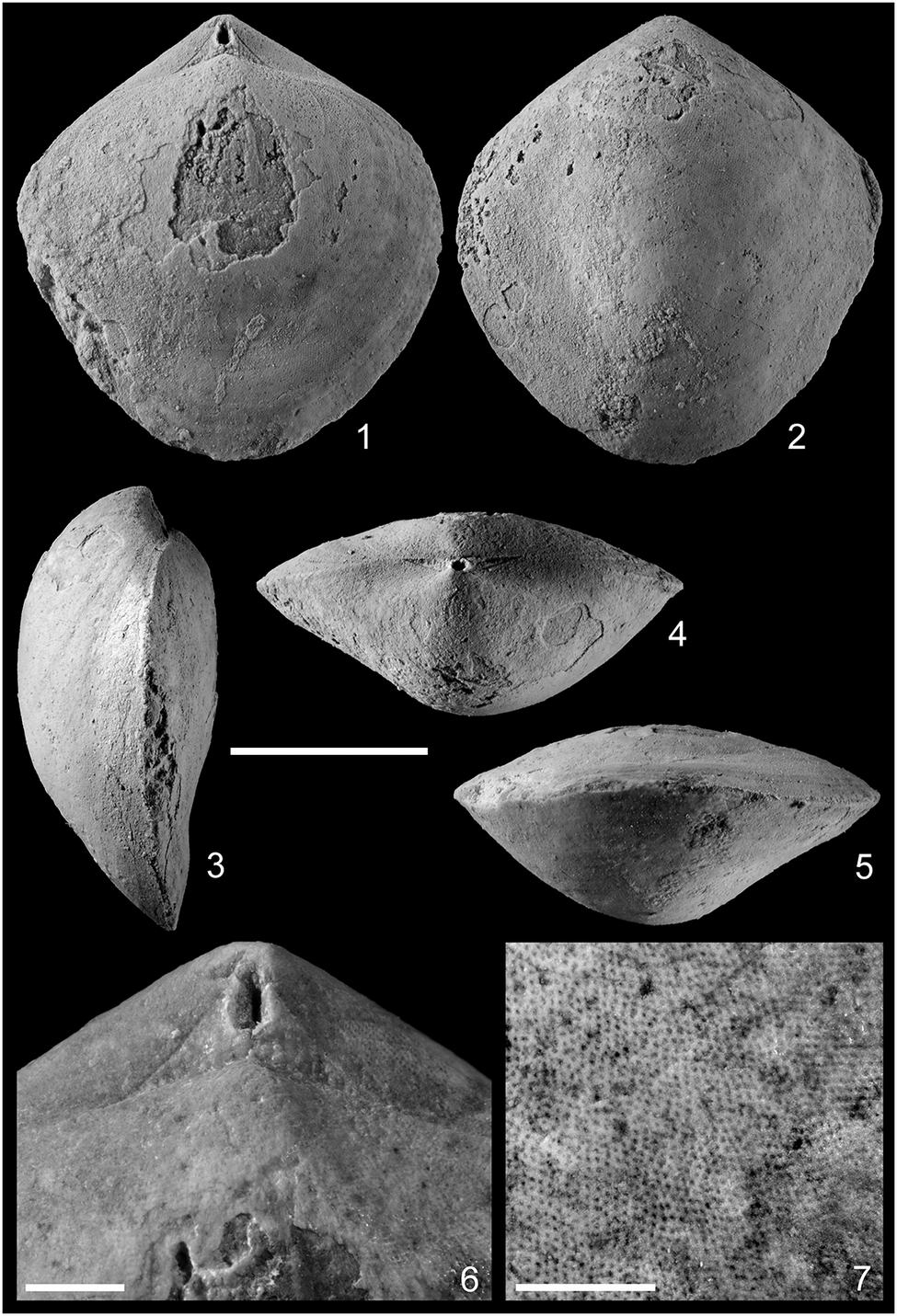
Figure 14. Long description
A multi-panel photo series of a fossilized brachiopod shell.
Panel 1 shows the dorsal view of the almost complete shell, which is roughly diamond-shaped with a pointed apex and a weathered central patch.
Panel 2 shows the ventral view, displaying a similar shape with a slightly more uniform, pitted surface.
Panel 3 shows the lateral view, revealing the biconvex profile of the two valves meeting at a sharp commissure.
Panel 4 shows the posterior view, highlighting the hinge line and a small circular pedicle opening at the apex.
Panel 5 shows the anterior view, illustrating the curved edge where the valves meet.
A white scale bar representing 5 millimeters is positioned between panels 3 and 4.
Panel 6 is a close-up of the posterior region in dorsal view, providing a detailed look at the pedicle opening and the surrounding shell structure.
Panel 7 is a high-magnification view of the endopunctate shell exterior, showing a dense pattern of microscopic pits or pores across the surface.
White scale bars representing 1 millimeter are located at the bottom of panels 6 and 7.
Materials
A single, almost complete shell, GIUS 4-292/81.
Description
Shell deltoidal in outline, 11.5 mm long, 10.9 mm wide, and 5.1 mm thick, ventribiconvex; posterolateral margins almost straight, anterior margin narrowly rounded, giving the shell a slightly rhomboidal outline; anterior commissure rectimarginate. Ventral valve more than twice as deep as the dorsal valve; beak suberect; palintrope prominent, occupying approximately one-sixth of the shell width; delthyrium closed by deltidial plates pierced by a large hypothyrid foramen. Dorsal valve shallow, without perceptible fold.
Shell macroscopically smooth, shell substance densely punctate; punctae ~180–240 per mm2. Interior unknown.
Remarks
The studied specimen reveals strong external resemblance to Cimicinoides struvei described from the Eifelian of Myanmar (Anderson et al., Reference Anderson, Boucot and Johnson1969). Both forms have similar shell size and shape, and a similarly prominent ventral palintrope and hypothyrid foramen. Differences include a slightly wider and less thick shell in the studied specimen.
Differences with other entirely smooth Devonian terebratulides are as follows: Centronella Billings, Reference Billings1859 has a mesothyrid to submesothyrid foramen (Cloud, Reference Cloud1942, p. 72); Oriskania Hall and Clarke, Reference Hall and Clarke1893 has a sulcate commissure (Cloud, Reference Cloud1942, p. 69); Elmaria Nalivkin, Reference Nalivkin, Nalivkin and Verber1947 apparently has a low dorsal fold (Nalivkin, Reference Nalivkin, Nalivkin and Verber1947, p. 133), but this genus is poorly known; Cryptonella Hall, Reference Hall1861 has a submesothyrid foramen (Jin and Lee, Reference Jin and Lee2006, p. 2024); Newberria Hall in Whiteaves, Reference Whiteaves1891 is larger (Cloud, Reference Cloud1942, p. 95) and has a more incurved beak. Because of the above-mentioned similarities and differences, the studied brachiopod is tentatively included in Cimicinoides, although evidently lack of knowledge about the internal structure makes this assignment provisional.
Evolution and paleobiogeography of the Hypothyridinidae
Glosshypothyridina
The genus Glosshypothyridina is represented by two undisputed species. The type species, G. procuboides, was described from the upper Eifelian of the Eifel and is also present in the lower Givetian (timorensis Biozone) of the Holy Cross Mountains (Baliński and Halamski, Reference Baliński and Halamski2023) and in the lower or middle Givetian of the Anti-Atlas (Halamski and Baliński, Reference Halamski and Baliński2013). Its other possible occurrences include the middle part of the Middle Devonian in Belgium and England (Sartenaer, Reference Sartenaer2003 and references therein), but these reports require confirmation. The species described here, G. theophili n. sp., is known solely from the upper Givetian of a single site of the Holy Cross Mountains (Fig. 15.1).
Paleogeographic distribution of Hypothyridina, Glosshypothyridina, and Tullhypothyridina. Due to significant uncertainties in taxonomy, distribution is shown twice: (1) with confirmed occurrences only; (2) with all unconfirmed reports. See text for further explanation. Background map modified after Scotese and McKerrow (Reference Scotese and McKerrow1990), Golonka et al. (Reference Golonka, Krobicki, Pająk, Van Giang and Zuchiewicz2006), and Murphy et al. (Reference Murphy, van Staal and Collins2011).
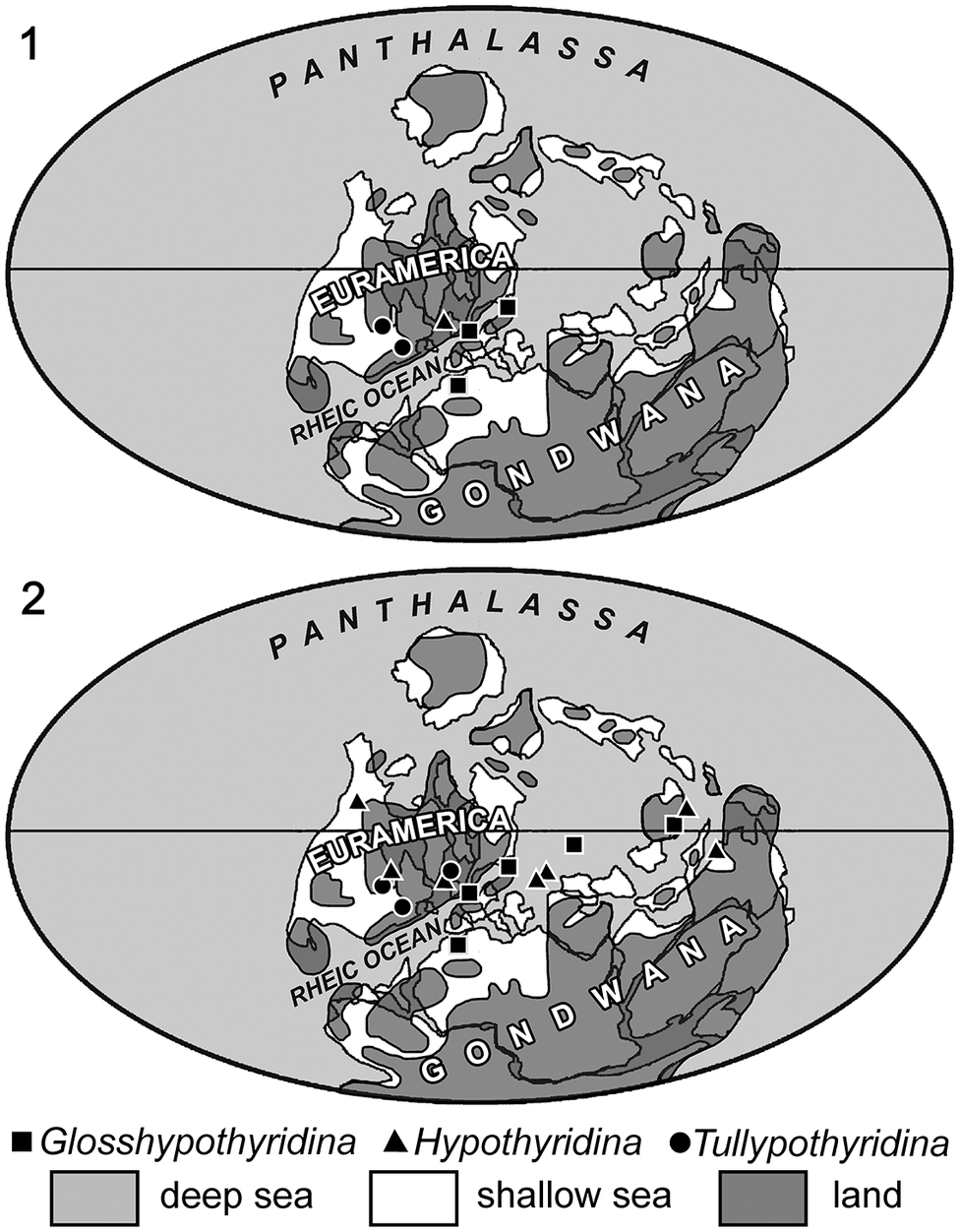
Figure 15. Long description
A two-panel paleogeographic map set. A legend at the bottom identifies three symbols: a black square for Glosshypothyridina, a black triangle for Hypothyridina, and a black circle for Tullhypothyridina. Shading indicates deep sea in light gray, shallow sea in white, and land in dark gray.
Panel 1, labeled at the top left, shows confirmed occurrences only. The map features the supercontinents Euramerica and Gondwana separated by the Rheic Ocean, all surrounded by the Panthalassa ocean. Occurrences are concentrated in the tropical and subtropical regions of Euramerica and the northern margin of Gondwana. Specifically, one circle is in western Euramerica, one triangle is in central Euramerica, and three squares are clustered near the Rheic Ocean margin.
Panel 2, labeled at the middle left, shows all reports including unconfirmed ones. This map displays a much wider distribution. In addition to the points in Panel 1, there are several triangles and squares spread eastward across the shallow seas of northern Gondwana and into the eastern Panthalassa margins. The distribution forms a broad latitudinal band across the equatorial region of the globe.
On the basis of general similarity in external and internal characters between the two species mentioned above, it can be safely assumed that Glosshypothyridina theophili n. sp. is an evolutionary descendant of the earlier G. procuboides. This speciation event occurred in place, namely on the southern shelf of the eastern part of Euramerica (Laurussia), or in other words in an area corresponding to present-day Europe. Glosshypothyridina procuboides spans at least three million years, from the late Eifelian (~387 Ma; Becker et al., Reference Becker, Marshall, Da Silva, Gradstein, Ogg, Schmitz and Ogg2020) to the later part of the early Givetian (~384 Ma). After the Taghanic Event, it was replaced by G. theophili n. sp. in the late Givetian (~380–379 Ma), although details here are unclear, because no representatives of the genus are known from any precisely dated strata immediately following the Taghanic Event (contrary to the very precisely dated replacement of Atrypa subtrigonalis Biernat, 1964 by Kyrtatrypa pauli; Halamski et al., Reference Halamski, Baliński and Kondas2024).
Two further species included by Baxter (Reference Baxter1999) in this genus are Hypothyridina batschatensis Rzhonsnitskaya, Reference Rzhonsnitskaya and Markowski1968 and Hypothyridina vulgaria Rzhonsnitskaya, Reference Rzhonsnitskaya and Markowski1968 (including both var. typica and var. coronatiformis Rzhonsnitskaya, Reference Rzhonsnitskaya and Markowski1968) from the Eifelian of the Kuznetsk Basin and two additional ones, included tentatively, Rhynchonella procuboides var. lungtungpeensis Kayser, Reference Kayser and von Richthofen1883 and Hypothyridina lungtungpeensis magna Chen in Xu et al., Reference Xu, Wan and Chen1978 are from the Middle to Upper Devonian of China (Fig. 15.2). According to Sartenaer (Reference Sartenaer2003), definite systematic placement of each of them requires confirmation. Based on the data available so far, it can be concluded that Glosshypothyridina is a genus found only in the Old World Realm (sensu Boucot and Blodgett, Reference Boucot, Blodgett, Brunton, Cocks and Long2001; see Jansen et al., Reference Jansen, Halamski, Mottequin and Linnemann2025, p. 841).
Tullypothyridina and Hypothyridina
Concerning Tullypothyridina, Baxter (Reference Baxter1999) included seven (sub)species within this genus (Hemihypothyridina of Baxter, Reference Baxter1999, nomen nudum), all from the USA, namely: Hypothyridina venustula robusta Cooper and Williams, Reference Cooper and Williams1935; Hypothyridina venustula multicostata Cooper and Williams, Reference Cooper and Williams1935; Rhynchonella intermedia Barris, Reference Barris1879; Hypothyridina intermedia magniventra Stainbrook, Reference Stainbrook1942; Rhynchonella emmonsi Hall and Whitfield, Reference Hall and Whitfield1877; and Hypothyridina emmonsi rotunda Cooper and Dutro, Reference Cooper and Dutro1982. Three others were tentatively included: Hypothyridina bifurcata Brice, Reference Brice1982 from Arctic Canada, Hypothyridina calva Markovsky in Ljaschenko, Reference Ljaschenko1959a from Russia, and Hypothyridina hunanensis Wang, Reference Wang1956 from China. Sartenaer (Reference Sartenaer2003) accepted solely Rhynchonella intermedia from Iowa as a member of Tullypothyridina (Fig. 15.1) but estimated that the presence of the genus in Europe is likely (Fig. 15.2) on the basis of some specimens figured by Phillips (Reference Phillips1841). So, Tullypothridina might be either a genus present solely in the Eastern Americas Realm (sensu Boucot and Blodgett, Reference Boucot, Blodgett, Brunton, Cocks and Long2001; formerly the Appalachian Province, Boucot et al. Reference Boucot, Johnson and Talent1969; see Jansen et al., Reference Jansen, Halamski, Mottequin and Linnemann2025, p. 841) or present in both Eastern Americas and Old World realms.
On the contrary, as for Hypothyridina, besides its European type species (Fig. 15.1), Baxter (Reference Baxter1999) included two other species in this genus—Hypothyridina magister Belanski, Reference Belanski1928 from Iowa and Hypothyridina margarita Veevers, Reference Veevers1959 from Western Australia—whereas seven other taxa from both the Old World and Eastern Americas realms were included tentatively. These uncertain taxa include: Hypothyridina cuboides latusa Ljaschenko, Reference Ljaschenko1960 and Hypothyridina contracta Ljaschenko, Reference Ljaschenko1960, both from the Volgo-Uralian region; Hypothyridina linglingensis Wang, Reference Wang1956 from Hunan; Hypothyridina cameroni Warren, Reference Warren1944 from the Mackenzie River region; Hypothyridina mesodevonica Ljaschenko, Reference Ljaschenko1969 from the Russian Platform; Hypothyridina cuboides var. crassicostata Nalivkin, Reference Nalivkin1951 from the southern Urals; and Hypothyridina florens Crickmay, Reference Crickmay1963 from Mackenzie River region (see Baxter, Reference Baxter1999). It is thus likely that this genus was indeed cosmopolitan (Fig. 15.2), as was often previously considered on the basis of its wide understanding (Savage, Reference Savage and Kaesler2002; see criticism by Sartenaer, Reference Sartenaer2003, p. 36), but it must be emphasized that at present such a statement should be considered as a working hypothesis, requiring confirmation through careful study of internal characters of all the presumed representatives all over the world. As a minimum requirement, it is recommended that wide and narrow understanding of the species Hypothyridina cuboides be carefully distinguished (see, e.g., Jansen et al., Reference Jansen, Halamski, Mottequin and Linnemann2025, fig. 26.9.Ah).
Remarks on the benthic ecosystem
The studied brachiopod collection is strongly dominated by Spinatrypina (Exatrypa) explanata, a species interpreted as a key member of an association related to tabulate coral thickets. These biostromes were formed in particular by the mass occurrence of Alveolitella fecunda; see Nowiński (Reference Nowiński1993), Zapalski (Reference Zapalski2012), Stadelmaier et al. (Reference Stadelmaier, Nose, May, Salerno, Schröder and Leinfelder2005), as Alveolites (Alveolitella) fecundus. As previously mentioned, the Alveolitella fecunda bafflestones are associated with the Ense (IIb) deepening pulse (see Fig. 3). This transgression caused the collapse of the carbonate factory on the Kielce carbonate platform and initiated the growth of the Sitkówka Bank Complex. The Alveolitella–Spinatrypina Assemblage is geographically linked to the Posłowice facies of the Jaźwica Member (Racki, Reference Racki1993b). However, its proliferation particularly characterized the shallowing phase of the ephemeral open-marine basin (see the diverse biota reconstruction by Racki, Reference Racki1993a, fig. 29). Massive tabulates, e.g., Alveolites Lamarck, Reference Lamarck1801; Crassialveolites Sokolov, Reference Sokolov1955; and Pachyfavosites Sokolov, Reference Sokolov1952, are also important builders (Nowiński, Reference Nowiński1993; Zapalski, Reference Zapalski2012). The Posłowice facies, best known from small outcrops in Posłowice (Racki and Racka, Reference Racki and Racka1981) and Marzysz (Racki, Reference Racki1993b, figs. 14, 15D, 16), developed in the Posłowice–Daleszyce area, which is located directly southwest of the Górno Basin (Fig. 1.3). Additionally, the Spinatrypina (Exatrypa) Association occurs in the top-Givetian interval of the coral-rich basal Wietrznia Beds at the Wietrznia W-Ia section (Makowski in Racki et al., Reference Racki, Makowski, Mikłas and Gawlik1993, p. 83, pl. 16, fig. 1; Racki and Bultynck, Reference Racki and Bultynck1993). Remarkably, large-shelled Desquamatia, gypidulids, schizophoriids, pugnacids, and Phlogoiderhynchus polonicus are also prominent brachiopods in coquinoid accumulations at this site.
Close ecological relationships between different species of tabulate corals on the one hand and Spinatrypina on the other hand are well known worldwide. Examples include the Spinatrypina–Thamnopora ‘community’ of Johnson and Flory (Reference Johnson and Flory1972) from the Eifelian of Nevada and the Thamnopora–Alveolites–Spinatrypina Association of Stadelmaier et al. (Reference Stadelmaier, Nose, May, Salerno, Schröder and Leinfelder2005) from the Givetian of the Eifel region. In the Givetian-Frasnian succession of the Rhenish domain, biotope 6 of Copper (Reference Copper1966) comprises a thicket ‘reef’ with attached atrypides, in which rheotropically-oriented Davidsonia, as well as small athyridides also occurred (compare the Mesophyllum-Alveolitidae Association of Nose et al., Reference Nose, Schröder and Fischer2017). Davidsonia is common in the Laskowa Góra Beds at Laskowa (Racki et al., Reference Racki1985) but also occurs in the Givetian faunas of Miłoszów (Halamski et al., Reference Halamski, Baliński, Racki, Amler and Basse2022b), and the Frasnian Biernatella Assemblage at Józefka (Baliński et al., Reference Baliński, Racki and Halamski2016). The scarcity of these cementing brachiopods suggest that laminar tabulate colonies played a minor role in the Górno A community. From the Thamnopora biostrome, Johnson and Flory (Reference Johnson and Flory1972) reported the frequent occurrence of Cryptatrypa Siehl, Reference Siehl1962 and the rarer Emanuella.
Three brachiopod species play a significant role in the Alveolitella fecunda biostromes on the Kielce platform: Spinatrypina (Exatrypa) explanata [see discussion above], Crurispina ‘inflata’ (Schnur, Reference Schnur1853), and Athyris sp. ex gr. A. concentrica (von Buch, Reference Buch1834), supplemented by rare schizophoriids, reticulariids(?), and strophomenides (Racki, Reference Racki1993a). The Górno A fauna is distinctly more diverse (20 taxa; see Table 2) and is also associated with a far richer biota. In addition to alveolitids (Nowiński, Reference Nowiński1993), two rugosan species of Peneckiella Soshkina, Reference Soshkina1939 and Pterorrhiza Ehrenberg, Reference Ehrenberg1834 were reported by Różkowska (Reference Różkowska1979). The most diverse components, however, include 19 columnal parataxa of the Schyschcatocrinus–Marettocrinus Association and calyces of Haplocrinites aremoricensis Le Menn, Reference Le Menn1985 (Głuchowski, Reference Głuchowski1993), showing affinities with younger faunas from the Kostomłoty Zone (Szydłówek, Czarnów). The bryozoan fauna (10 taxa; Morozova et al., Reference Morozova, Weis and Racki2002, Reference Morozova, Weiss and Racki2006; Ernst et al., Reference Ernst, Racki and Wyse Jackson2026) is dominated by thinly branched colonies of rhabdomesids, e.g., species of Primorella Romantchuk and Kiseleva, Reference Romantchuk and Kiseleva1968 and Bigeyella Morozova and Weiss in Morozova et al., Reference Morozova, Weiss and Racki2006. The ostracod association is not very rich (seven taxa), with the most abundant representatives being Bairdiocypris Kegel, Reference Kegel1932 and Plagionephrodes Morey, Reference Morey1935 (Malec and Racki, Reference Malec and Racki1993, table 3; compare Olempska, Reference Olempska1979, table 1). Other characteristic associates include the tentaculite Dicricoconus verchovensis (Ljaschenko, Reference Ljaschenko1959b) and the ophiuroid Furcaster cataphractus (Boczarowski, Reference Boczarowski2001) (Hajłasz, Reference Hajłasz1993; Boczarowski, Reference Boczarowski2001). The former is a marker species of the IIb transgressive episode on the East European Platform (Kyn Horizon; Racki, Reference Racki1993b, p. 156).
Synoptic overview of occurrences of brachiopod species in the Józefka section, including the Laskowa Góra Beds (L. G.) studied here (= Górno A), the Szydłówek Beds (Szyd.) studied partly here and partly previously, and the Wietrznia Beds (Wiet.) studied previously. Of 37 species present in the section, three are common to the Laskowa Góra Beds and the Szydłówek Beds, six to the Szydłówek Beds and the Wietrznia Beds, 11 to the Laskowa Góra Beds and Wietrznia Beds, and four are present in all the three units. x = present; - = absent
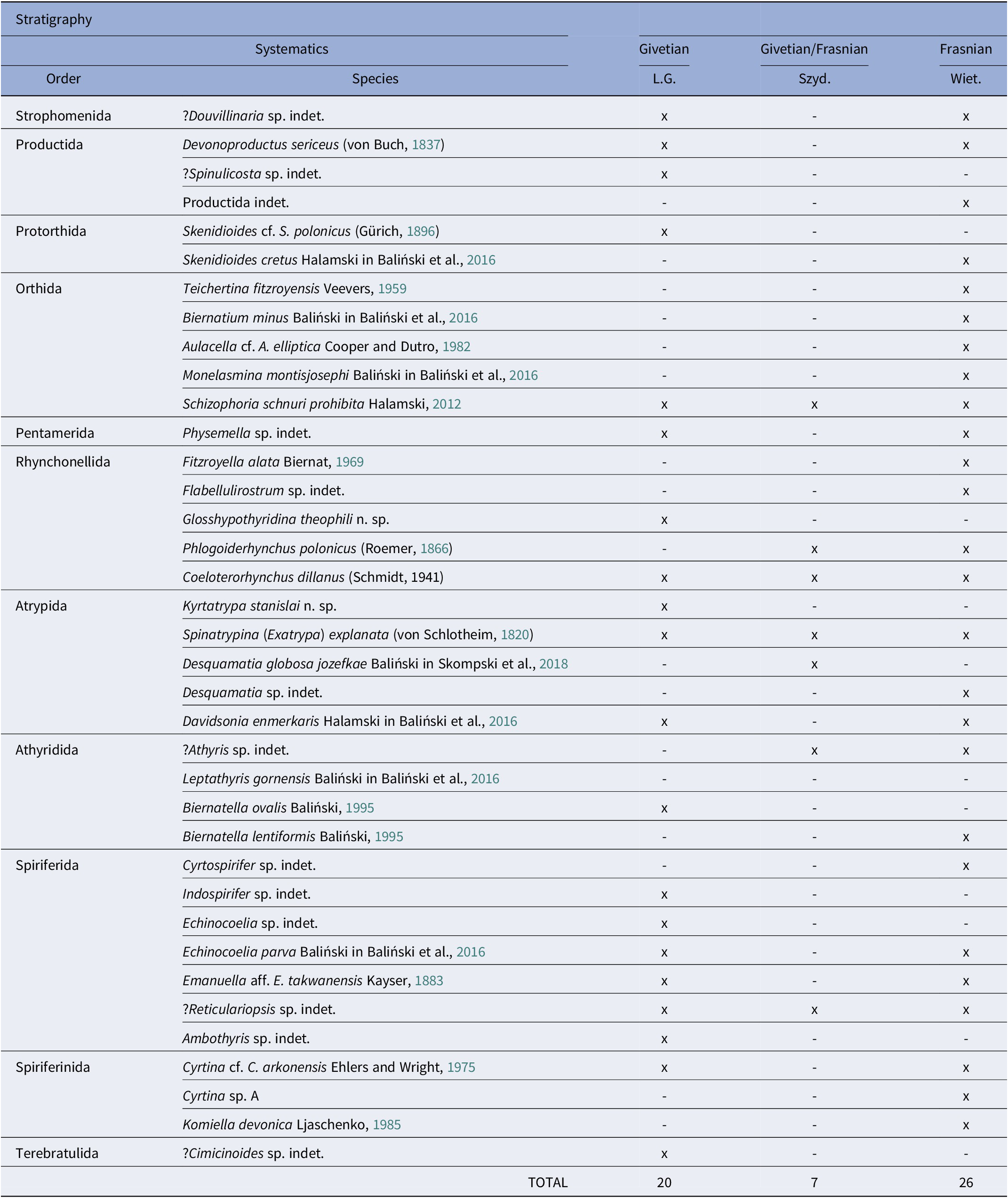
Table 2. Long description
The table is organized into five columns: Order, Species, L. G. (Givetian), Szyd. (Givetian/Frasnian), and Wiet. (Frasnian). Presence is marked with an ‘x’ and absence with a '-'.
* Strophomenida: ?Douvillinaria sp. indet. is present in L. G. and Wiet.
* Productida: Devonoproductus sericeus is in L. G. and Wiet.; ?Spinulicosta sp. indet. is in L. G. only; Productida indet. is in Wiet. only.
* Protorthida: Skenidioides cf. S. polonicus is in L. G. only; Skenidioides cretus is in Wiet. only.
* Orthida: Teichertina fitzroyensis, Biernatium minus, Aulacella cf. A. elliptica, and Monelasmina montisjosephi are in Wiet. only; Schizophoria schnuri prohibita is present in all three units.
* Pentamerida: Physemella sp. indet. is in L. G. and Wiet.
* Rhynchonellida: Fitzroyella alata and Flabellulirostrum sp. indet. are in Wiet. only; Glosshypothyridina theophili n. sp. is in L. G. only; Phlogoiderhynchus polonicus is in Szyd. and Wiet.; Coeloterorhynchus dillanus is present in all three units.
* Atrypida: Kyrtatrypa stanislai n. sp. is in L. G. only; Spinatrypina (Exatrypa) explanata is present in all three units; Desquamatia globosa jozefkae is in Szyd. only; Desquamatia sp. indet. is in Wiet. only; Davidsonia enmerkaris is in L. G. and Wiet.
* Athyridida: ?Athyris sp. indet. is in Szyd. and Wiet.; Leptathyris gornensis is absent in all three; Biernatella ovalis is in L. G. only; Biernatella lentiformis is in Wiet. only.
* Spiriferida: Cyrtospirifer sp. indet. is in Wiet. only; Indospirifer sp. indet., Echinocoelia sp. indet., and Ambothyris sp. indet. are in L. G. only; Echinocoelia parva and Emanuella aff. E. takwanensis are in L. G. and Wiet.; ?Reticulariopsis sp. indet. is present in all three units.
* Spiriferinida: Cyrtina cf. C. arkonensis is in L. G. and Wiet.; Cyrtina sp. A and Komiella devonica are in Wiet. only.
* Terebratulida: ?Cimicinoides sp. indet. is in L. G. only.
Total species counts: L. G. has 20, Szyd. has 7, and Wiet. has 26.
In general, branching organisms reduce current activity and allow sediment to accumulate. More robust dendroid reef builders construct loose frameworks, whereas delicate colonies stabilize sediments and produce biogenic micrite (Tsien, Reference Tsien, Geister and Herb1984). As many studies have implied, coral thicket ‘reefs’ and crinoid meadows thrived in the deeper waters of the gently sloping, topographically varied ramp-type slope (compare Caespitetum and Crinoidetum of Struve, Reference Struve1963; Copper, Reference Copper1966; Machel and Hunter, Reference Machel and Hunter1994; Pisarzowska et al., Reference Pisarzowska, Racki and Rakociński2022). These biota thrived presumably at depths of 20–30 m (Embry and Klovan, Reference Embry and Klovan1972; Racki et al., Reference Racki, Makowski, Mikłas and Gawlik1993, fig. 14; Noyahr et al., Reference Noyahr, Weissenberger, Harris and Banks2023, fig. 16), rather than 60–80 m as implied by Boulvain et al. (Reference Boulvain, Cornet, Da Silva, Delaite, Demany, Humblet, Renard and Coen-Aubert2004, table 2) for the Ardenne Frasnian mud mounds. Li and Jones (Reference Li and Jones2002) attributed such atrypide-coral faunas to distal-shelf benthic assemblages (BA 3–4), as defined by Boucot (Reference Boucot1975).
The rigid, stubby growth mode of the alveolitid colonies suggests mostly low-energy murky habitats and a high deposition rate in the more protected part of the northern Sitkówka Biostromal Bank periphery (Racki, Reference Racki1993b). This implication supported by the near-absence of disarticulated shells indicates the parautochthonous character of the Górno A shelly accumulations, and a minimal role of bioclastic material transported from the submarine sea mount north of present-day Józefka site, at least for shelly benthos. This taphonomic attribute contrasts with that of the younger Józefka coquinas (Skompski et al., Reference Skompski, Baliński, Szulczewski and Zawadzka2018).
Three autecological groups can be distinguished among the end-Givetian brachiopods:
-
(1) The dominant Spinatrypina (Exatrypa) explanata was presumably adapted to attach itself to tabulate corals. The generally flattened, widened shape of their shells suggests that they were able to streamline themselves in laminar currents within the benthic niche (Copper, Reference Copper1966, Reference Copper1967; Racki, Reference Racki1993a).
-
(2) Several species grew to fairly large sizes (25–40 mm in width), including unfrilled(?), globose Desquamatia, Schizophoria, Glosshypothyridina, and Coeloterorhynchus. These species exhibited pedunculate or reclining modes of life in coral and crinoid meadows during their juvenile stages. However, they became free-living and embedded their shells in the soft-bottom bioclastic ponds between and in front of coral thickets (Copper, Reference Copper1966; Racki, Reference Racki1993a; Webb and Schneider, Reference Webb and Schneider2013). On the other hand, biomechanical experiments on morphologically accurate, 3D-printed shell models suggest that the globose free-lying atrypides in particular would have relied more heavily on active pumping to induce flow through the mantle cavity (Dievert et al., Reference Dievert, Barclay, Molinaro and Leighton2019). Accordingly, a functional pedicle would have been necessary to orient the shell for efficient feeding. Strophomenides and productides were found to exhibit a similar ‘snowshoe’ habit on very soft (‘soupy’) seafloors (Fürsich and Hurst, Reference Fürsich and Hurst1974; Grant, Reference Grant1981; Dievert et al., Reference Dievert, Gingras and Leighton2021). Stanley (Reference Stanley2020) concluded that, as with similar concavoconvex pectinid bivalves, almost all of these brachiopods lived infaunally. They must have ejected water to create a pit into which they could descend for protection, with sediment covering their concave valves. However, the feeding position of the flattened, D-shaped strompomenid shells is debated: are they convex-down, as has traditionally been presumed, or convex-up? Dattilo et al. (Reference Dattilo, Freeman, Hartshorn, Peterman, Morse, Meyer, Dougan and Hagadorn2024) recently proposed a key adaptive trait that resolves this issue: a hinge-line structure enabling a wide gape of 40–45°. The unusual gaping enables feeding in slow, diffuse inhalant currents that are incapable of disturbing sediment in either convex-up or concave-up orientations.
-
(3) Other small to medium-sized species with a variety of shell shapes and ornamentation were probably pedunculate dwellers on macrobenthic sedentary organisms (also soft-bodied ones; Surlyk, Reference Surlyk2025) or attached to larger bioclasts in muddy interstitial substrata, e.g., fragmented crinoid stems, with the commissure steeply inclined to the sediment-water interface (Grant, Reference Grant1981; Cuffey et al., Reference Cuffey, Robb, Lembcke and Cuffey1995; Sandy, Reference Sandy1996; Richardson et al., Reference Richardson, Aldridge and Endersby2007). This group includes the minute protorthide Skenidioides, the larger ambocoeliids like Echinocoelia, Ambothyris, and Emanuella, as well as sporadic Biernatella and possibly also Cimicinoides. As demonstrated by Zambito and Schemm-Gregory (Reference Zambito and Schemm-Gregory2013), some eurytopic ambocoeliid species were capable of adopting a variety of life positions. On the other hand, besides fixosessile Davidsonia in a cryptic niche, curiosities include the pyramidally-shelled Cyrtina, which was attached either by a short pedicle or, if the pedicle was atrophied, only by the frequently asymmetrical ventral beak and interarea (Biernat, Reference Biernat1966).
Impact of the Taghanic event on the brachiopod faunas
The evolutionary significance of the Taghanic Biocrisis is better documented for pelagic taxa, e.g., goniatites and conodonts (extinction of Bipennatus Mawson, Reference Mawson1993; Sobolewiidae, Maenioceratidae, and Agoniatitina; radiation of Pharciceratidae; Aboussalam and Becker, Reference Aboussalam and Becker2011). According to Becker (Reference Becker and Linnemann2025, p. 914), the Taghanic Crisis is characterized by second order global extinctions, however, benthic faunas (including brachiopods) are less studied, so it is not always possible to clearly distinguish global extinctions from local extirpations (see also comment by Jansen et al. Reference Jansen, Halamski, Mottequin and Linnemann2025). Despite this caveat, Athyris spiriferoides (Eaton, Reference Eaton1831) and Mediospirifer audaculus (Conrad, Reference Conrad1842) can be quoted as examples of species extinct during the Taghanic Biocrisis (Brett et al., Reference Brett, Zambito, Welych-Flanagan, Baird and Bartholomew2025). According to Stigall (Reference Stigall2010, fig. S1), a radiation of Schizophoria took place in the late Givetian (disparilis Zone), and, more generally speaking, both extinction and speciation rates in brachiopods Schizophoria and Floweria Cooper and Dutro, Reference Cooper and Dutro1982, as well as in the bivalve Leiopteria Hall, Reference Hall1883, might have been significantly higher in the late Givetian than either before and after (Stigall, Reference Stigall2010, fig. 1). In the Holy Cross Mountains, Atrypa (Atrypa) subtrigonalis Biernat, Reference Biernat1964 is common in pre-Taghanic strata and not known in post-Taghanic ones (Baliński and Halamski, Reference Baliński and Halamski2023; Halamski et al., Reference Halamski, Baliński and Kondas2024); this is probably the last representative of the nominative subgenus of Atrypa that had appeared in the late Llandovery (Copper, Reference Copper2004).
The different parts of the section at Mount Józefka, which extends from the upper part of the Givetian stage to the lower Frasnian, allow the attempt of comparison of brachiopod faunas before and after the Ense and Basal Frasnes events at the Middle–Late Devonian boundary, i.e., during the ecosystem recovery following the major Taghanic Biocrisis (Becker, Reference Becker and Linnemann2025). The faunas of the Szydłówek and Wietrznia beds, even if the former was quite poor (seven species), have more species in common (11 species) than between the Laskowa Góra and Szydłówek beds (three species). The distinct difference in the taxonomic composition of the Górno and Laskowa faunas (the latter of which is under study) is further demonstrated by the distribution of the rhynchonellide Hadrotatorhynchus laskowaensis Sartenaer in Sartenaer and Racki, Reference Sartenaer and Racki1992. This species is limited to the transitional interval of the Laskowa Góra and Szydłówek beds in the Kostomłoty locality (Sartenaer and Racki, Reference Sartenaer and Racki1992). This is also confirmed by distinct crinoid associations (Głuchowski, Reference Głuchowski1993, fig. 17), which provide further evidence that the Laskowa Góra beds at Józefka are younger, at least within the sampled slice. This would also explain the affinities with the younger of the Szydłówek and Wietrznia beds (Baliński et al., Reference Baliński, Racki and Halamski2016). For example, Baliński (Reference Baliński2006, fig. 4) and Skompski et al. (Reference Skompski, Baliński, Szulczewski and Zawadzka2018) demonstrated that Coeloterorhynchus dillanus was a key component of the atrypide-rhynchonellide biota, likely associated mostly with storm-reworked crinoid shoals during the Middle-Upper Devonian transition in the Górno area. This species later flourished in the early Frasnian Flabellulirostrum–Coeloterorhynchus Assemblage, inhabiting muddy habitats in the northern Dyminy Reef slope toe (Baliński, Reference Baliński2006).
Our new data allow supplementing preliminary observations on the lack of a large-scale replacement of brachiopod faunas between the middle part of the Middle Devonian and the early Frasnian by Halamski (Reference Halamski2018). In the Józefka brachiopod-rich succession, local post-Taghanic diversity loss approached 30% over 5 Myr (six out of 20 taxa disappeared; see Table 2). The brachiopod dynamics pattern in the Kostomłoty Basin is inconsistent with the more significant faunal turnover observed in the sensitive Kielce platform faunas at the epoch boundary transition, influenced by endemic extinction and extraregional migration (Racki, Reference Racki1988, Reference Racki1993a). The extermination range of the Ense and Basal Frasnes events can be approximated even at ~70% within the stromatoporoid-coral carbonate bank domain (17 out of 25; Racki, Reference Racki1993a, fig. 33).
Conclusions
Brachiopods from the fossiliferous Laskowa Góra and Szydłówek beds cropping out at Mount Józefka near Górno (Holy Cross Mountains, Poland) are dated to the later part of the Givetian stage (mostly dengleri Conodont Biozone; Fig. 3). The fauna from the Laskowa Góra Beds (= Górno A) is dominated by Spinatrypina (Exatrypa) explanata and consists of 20 species. Alongside various atrypides, the fauna includes large-shelled rhynchonellides, e.g., Coeloterorhynchus dillanus and Glosshypothyridina theophili n. sp., as well as the large-sized orthide Schizophoria schnuri prohibita. These are associated with diverse spiriferides (mostly ambocoeliids) and rare productides, strophomenides, protorthides, pentamerides, athyridides, spiriferinides, and terebratulides (Table 2).
Glosshypothyridina theophili n. sp. is described as new. It differs from G. procuboides, the type species of the genus, in being larger, more angular, and in possessing stronger dental plates. Glosshypothyridina theophili n. sp. is considered an evolutionary descendant of G. procuboides.
Kyrtatrypa stanislai n. sp. is described as new. It is close to older (late middle Givetian) K. pauli in shape and ornamentation, and differs therefrom in being higher and possessing rudimentary dental nuclei. The diagnosis of the genus Kyrtatrypa is emended to include the presence of hitherto unreported minute dental nuclei in two species, K. culminigera (the type species) and K. stanislai n. sp. Only middle- to large-sized dental nuclei can be taken as diagnostic for Atrypa.
A synthesis of available published and unpublished data allows presentation of the following scenario for the family Hypothyridinidae. Glosshypothyridina is an exclusively Old World genus and the speciation event in the G. procuboides–theophili lineage took place in the area corresponding to the present-day Europe. Tullypothyridina might be a genus occurring exclusively in the Eastern Americas Realm, but there are unconfirmed reports from the Old World Realm. Hypothyridina, characterized by the lack of the cardinal process (this feature was incorrectly described in the revised Treatise on Invertebrate Paleontology; Savage, Reference Savage and Kaesler2002), appears as a genuinely cosmopolitan lineage.
The moderately diverse brachiopod fauna studied here represents the cosmopolitan Spinatrypina Association that thrived in a variety of niches within perireefal biostromal thickets in a protected ramp-slope portion of the Sitkówka Biostromal Bank. This mostly quiescent muddy habitat was dominated by a bloom of branching tabulate corals (especially Alveolitella fecunda), alongside more current-affected crinoid meadows. It preceded the early Frasnian, highly diverse, bottom-level Biernatella Assemblage, which has already been described in detail from this site by Baliński et al. (Reference Baliński, Racki and Halamski2016). Our present data from the brachiopod-optimal habitat (Brachiopodetum) confirm the absence of large-scale replacement of brachiopod faunas for the Euramerican shelf domain between the middle Givetian and the early Frasnian times during the post-Taghanic ecosystem recovery, despite its interruption by the successive Ense and Basal Frasnes global events (Fig. 3). In the Józefka brachiopod-rich succession, local diversity loss over 5 Myr was < 35%. This might have been only half of what the more sensitive fauna of the Kielce platform experienced (Racki, Reference Racki1993a). Thus, a different response to global stresses is evident for the sessile benthos across the Middle–Upper Devonian boundary in the intrashelf basin and the stromatoporoid-coral bank settings. From a supraregional perspective, ecological-evolutionary stasis existed among bottom-level shelly benthos in the eastern Rhenohercynian Sea of the southeastern Euramerican shelf from the middle Givetian to the early Frasnian. This stability contrasts with the well-documented extinction of the Hamilton/upper Tully fauna in the Appalachian Basin, the type area of the Taghanic Crisis and subsequent recovery (Brett et al., Reference Brett, Zambito, Welych-Flanagan, Baird and Bartholomew2025).
Acknowledgments
The authorities of the Józefka quarry (Kopalnia Józefka sp. z o.o.) are acknowledged for facilitating access to the outcrops. Additional material was made available for study thanks to the courtesy of S. Skompski, U. Radwańska, and M. Zapalski (all Faculty of Geology, University of Warsaw). The collection from the Górno A site was gathered over the course of several decades with the help of several workers and Masters students from the University of Silesia in Katowice, particularly A. Słupik and M. Racka. Comments by two anonymous reviewers were of much help in correcting imperfections of the first draft of this text.
Competing interests
The authors declare none.
Appendix
Biometric characteristics of studied species; measurements in mm. Measurements of the holotype in boldface. L = length of the shell; LG = Laskowa Góra Beds sample; m = mean; Ncf = number of costae and costellae on a flank; Ncp = number of parietal costae; Nct = number of costae and costellae on the tongue; sd = standard deviation; Sz = Szydłówek Beds sample; T = thickness of the shell; Tot. = total sample; v = variation coefficient (= sd/m); W = width of the shell; w = width of the sulcus; - = no data.
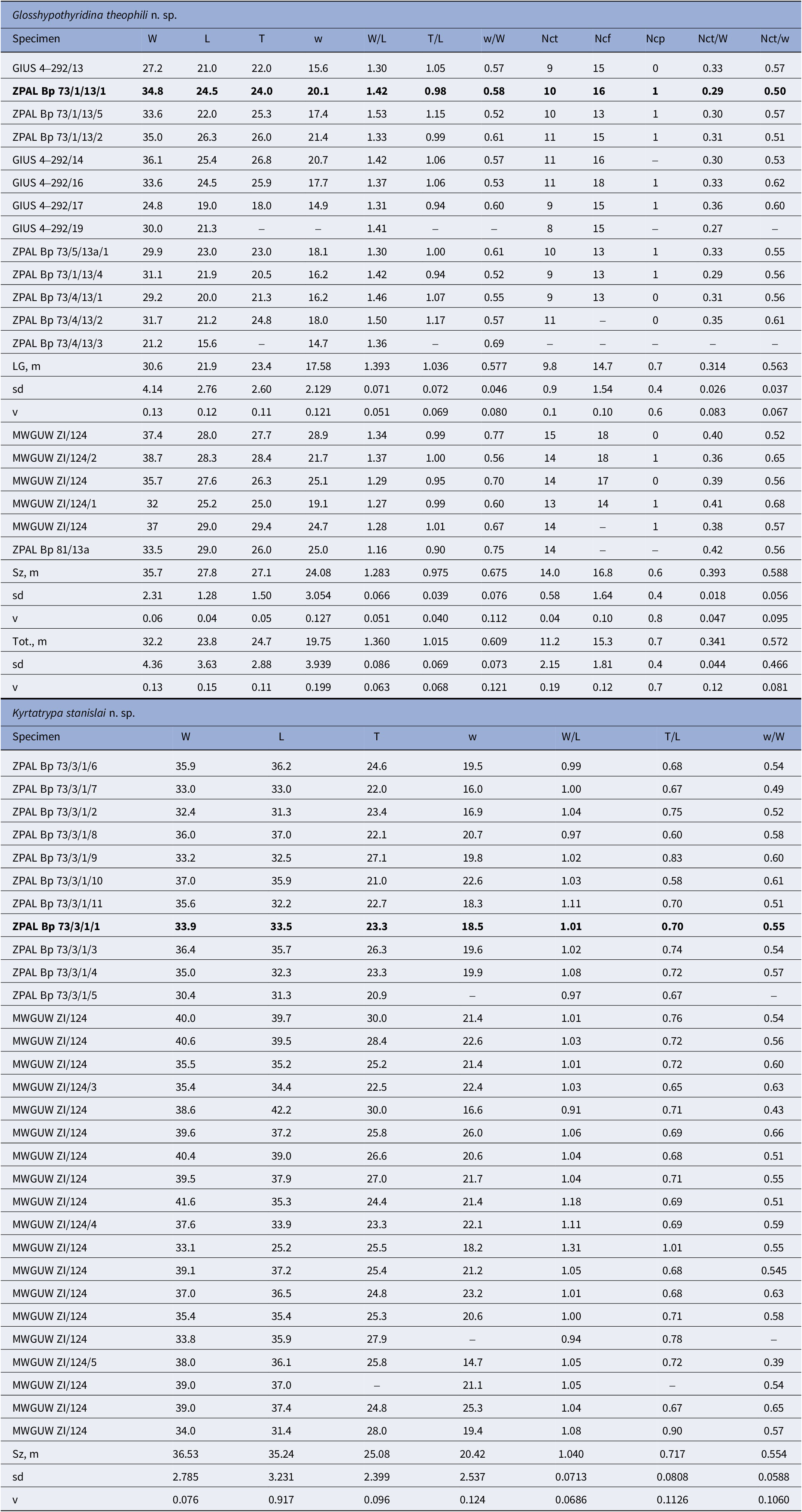
Table A1. Long description
The image contains two biometric tables.
Table 1: Glosshypothyridina theophili n. sp.
Columns include Specimen, W (width), L (length), T (thickness), w (sulcus width), and ratios W/L, T/L, w/W, along with counts Nct, Ncf, Ncp, and ratios Nct/W, Nct/w.
- Holotype Z P A L Bp 73/1/13/1: W 34.8, L 24.5, T 24.0, w 20.1, W/L 1.42, T/L 0.98, w/W 0.58, Nct 10, Ncf 16, Ncp 1, Nct/W 0.29, Nct/w 0.50.
- L G, m (mean): W 30.6, L 21.9, T 23.4, w 17.58, W/L 1.393, T/L 1.036, w/W 0.577.
- Sz, m (mean): W 35.7, L 27.8, T 27.1, w 24.08, W/L 1.283, T/L 0.975, w/W 0.675.
- Tot., m (total mean): W 32.2, L 23.8, T 24.7, w 19.75, W/L 1.360, T/L 1.015, w/W 0.609.
Table 2: Kyrtatrypa stanislai n. sp.
Columns include Specimen, W, L, T, w, W/L, T/L, w/W.
- Holotype Z P A L Bp 73/3/1/1: W 33.9, L 33.5, T 23.3, w 18.5, W/L 1.01, T/L 0.70, w/W 0.55.
- Sz, m (mean): W 36.53, L 35.24, T 25.08, w 20.42, W/L 1.040, T/L 0.717, w/W 0.554.
- Standard deviation (sd) for Sz: W 2.785, L 3.231, T 2.399, w 2.537.
- Variation coefficient (v) for Sz: W 0.076, L 0.917, T 0.096, w 0.124.