Introduction
Leptogium (Ach.) Gray is a genus of large foliose, eucorticate and mainly epiphytic species distributed worldwide (Sierk Reference Sierk1964; Otálora et al. Reference Otálora, Jørgensen and Wedin2014), including polar regions such as Antarctica (Øvstedal & Lewis Smith Reference Øvstedal and Lewis Smith2001). Leptogium specimens are attached to substrata by hapters, rhizines or hairs (Kitaura Reference Kitaura2012). A hairy species presents at least one surface covered by hairs (Sierk Reference Sierk1964; Awasthi & Akhtar Reference Awasthi and Akhtar1977; Jørgensen Reference Jørgensen1997), either simple or agglutinated. In species with simple hairs, such as L. puberulum Hue, the lower side has a velvety appearance, whereas in species with agglutinated hairs, for example L. menziesii (Ach.) Mont., the lower side is characterized by a beard-like appearance (Jørgensen Reference Jørgensen1997). Species with hairs on one or both surfaces were traditionally included in the section Mallotium (Ach.) Gray (Jørgensen Reference Jørgensen1971, Reference Jørgensen1997); however, molecular analyses revealed that this section and the genus as a whole are polyphyletic (Otálora et al. Reference Otálora, Martínez and Wedin2013, Reference Otálora, Jørgensen and Wedin2014).
The Antarctic continent, together with its maritime islands south of latitude 60°S, represents one of the most extreme climates on Earth. Its terrestrial biota is composed almost exclusively of cryptogamic species. Lichens are the most diverse organisms with more than 500 cited species (Spielmann & Pereira Reference Spielmann and Pereira2012). Leptogium species are widespread and locally abundant in the Antarctic Maritime Islands and the Antarctic Peninsula, covering wet or moist stony ground/soil (Øvstedal & Lewis Smith Reference Øvstedal and Lewis Smith2001). However, only three Leptogium species have been previously reported from Antarctica, the hairy L. puberulum and L. menziesii and the non-hairy L. crispatellum Nyl. (Dodge Reference Dodge1973; Lindsay Reference Lindsay1974, Reference Lindsay1978; Øvstedal & Lewis Smith Reference Øvstedal and Lewis Smith2001, Reference Øvstedal and Lewis Smith2004).
Leptogium puberulum is endemic to Antarctica and can be found on the Antarctic Peninsula as well as on the Maritime Islands (Hue Reference Hue1915; Dodge Reference Dodge1965, Reference Dodge1968, Reference Dodge1973; Lewis Smith & Corner Reference Lewis Smith and Corner1973; Lindsay Reference Lindsay1974; Redon Reference Redon1985; Jørgensen Reference Jørgensen1986; Lewis Smith Reference Lewis Smith1993; Sancho et al. Reference Sancho, Schulz, Schroeter and Kappen1999; Øvstedal & Lewis Smith Reference Øvstedal and Lewis Smith2001; see also Olech Reference Olech2001 for additional references) whereas L. menziesii is a subantarctic species, originally collected from the Strait of Magellan area (Acharius Reference Acharius1803) and also found on the Falkland Islands and South Georgia (Øvstedal & Lewis Smith Reference Øvstedal and Lewis Smith2001), in Australia (Verdon Reference Verdon1992; Øvstedal & Lewis Smith Reference Øvstedal and Lewis Smith2001), Chile (Galloway & Jørgensen Reference Galloway and Jørgensen1995; Øvstedal & Lewis Smith Reference Øvstedal and Lewis Smith2001), Japan (Hue Reference Hue1898), New Zealand (Galloway Reference Galloway1999; Øvstedal & Lewis Smith Reference Øvstedal and Lewis Smith2001) and Uruguay (Osorio Reference Osorio1972). Leptogium crispatellum was found on King George Island (Øvstedal & Lewis Smith Reference Øvstedal and Lewis Smith2004) and in New Zealand (Nylander Reference Nylander1888).
Through detailed morphological and anatomical descriptions, and using molecular analyses based mainly on recent collections, we propose three new species of Leptogium as new to science.
Materials and Methods
Taxon sampling and morphological studies
Specimens of Leptogium antarcticum, L. marcellii and L. puberulum were collected during the Brazilian Antarctic Expeditions (OPERANTAR XXVI, XXXIII, XXXIV) to the South Shetland Islands. Leptogium tectum and L. puberulum were collected during the Campaña Antártica de Verano (CAV 2015–2016) to James Ross Island (Table 1). All specimens were deposited in the herbarium of the Universidade Federal de Mato Grosso do Sul, Brazil (CGMS).

The type of L. puberulum, which is deposited in the herbarium of the Muséum National d’Historie Naturelle (PC), was not available for study. Specimens of L. puberulum were identified through published descriptions (Hue Reference Hue1915; Dodge Reference Dodge1965; Lindsay Reference Lindsay1974) and distinguished from other species by their typically thicker cortex with two or more layers of cells. The detailed species description provided here was based on fresh specimens collected from the Antarctic Maritime Islands. Additionally, we examined the holotype of L. crispatellum (H) and the neotype of L. menziesii (E).
Sections were hand-cut and all specimens were studied and described according to Kitaura & Marcelli (Reference Kitaura and Marcelli2013), using the same terminology but the sequence of characteristics was changed here. The term “lobule” was applied only to ornamentation with constricted bases, appearing to be vegetative propagules (Hale Reference Hale1983). Crenulate, verruciform and denticular appendages without constricted bases were considered functionally vegetative and are mentioned in the description when present. Lobules originating from cracks in the thallus were not considered ornamentation and the term “corona” is used according to Kitaura & Marcelli (Reference Kitaura and Marcelli2013). The thalline exciple is the tissue or all the tissues outermost to the proper exciple of a lecanorine apothecium (Kirk et al. Reference Kirk, Cannon, Minter and Stalpers2008), including the cortex of thalline exciple that can be composed of thick paraplectenchymatous tissue. The apical part of the thalline exciple cortex can differ from the base and mid-height, where structures such as denticules, isidia, lobules and circular ridges can arise, and we have highlighted this difference in the descriptions.
In Leptogium, the proper exciple is a thick paraplectenchymatous tissue between the hypothecium and thalline exciple and can be found in other species such as L. chloromelum (Sw.) Nyl., L. sessile Vain. and L. phyllocarpum (Pers.) Mont. (Swinscow & Krog Reference Swinscow and Krog1988). The proper exciple is lacking in all known Antarctic species of Leptogium.
DNA extraction, amplification and sequencing
Total DNA was extracted from freshly collected specimens using the Wizard® Genomic DNA Purification Kit (Promega, Madison, WI, USA). The nuclear ribosomal internal transcribed spacer region (ITS) was chosen for the analyses based on its ability to accommodate variability for the delimitation of fungal species (Schoch et al. Reference Schoch, Seifert, Huhndorf, Robert, Spouge, Levesque and Chen2012). The small subunit of the mitochondrial ribosomal RNA gene (mrSSU) is a more conserved region and widely used for phylogenetic studies of lichen-forming ascomycetes (Zoller et al. Reference Zoller, Scheidegger and Sperisen1999), including the Collemataceae revision of Otálora et al. (Reference Otálora, Jørgensen and Wedin2014).
The ITS region was amplified using the primers ITS1F (Gardes & Bruns Reference Gardes and Bruns1993) and ITS4 (White et al. Reference White, Bruns, Lee and Taylor1990); the mrSSU region was amplified using mrSSU1 and mrSSU3R (Zoller et al. Reference Zoller, Scheidegger and Sperisen1999). Amplifications for both regions were performed in 25 μl reactions containing 1× PCR Buffer (Promega), 0·2 μM of each primer, 0·2 μM of dNTPs, 2 μM of MgCl2, 1 unit DNA polymerase (Promega) and 5–20 ng genomic DNA. The PCR reactions were carried out in a Veriti Thermal Cycler (Applied Biosystems) using the following programs: (ITS) initial denaturation at 94 °C for 5 min, 30 cycles of 95 °C for 30 s, 54·8 °C for 30 s, 72 °C for 1 min and a final extension at 72 °C for 5 min; (mrSSU) initial denaturation at 5 min, 35 cycles of 95 °C for 1 min, 54 °C for 1 min, 72 °C for 1 min and a final extension at 72 °C for 10 min. The sequencing was performed with an ABI 3730 XL automatic sequencer (Applied Biosystems).
Phylogenetic analyses
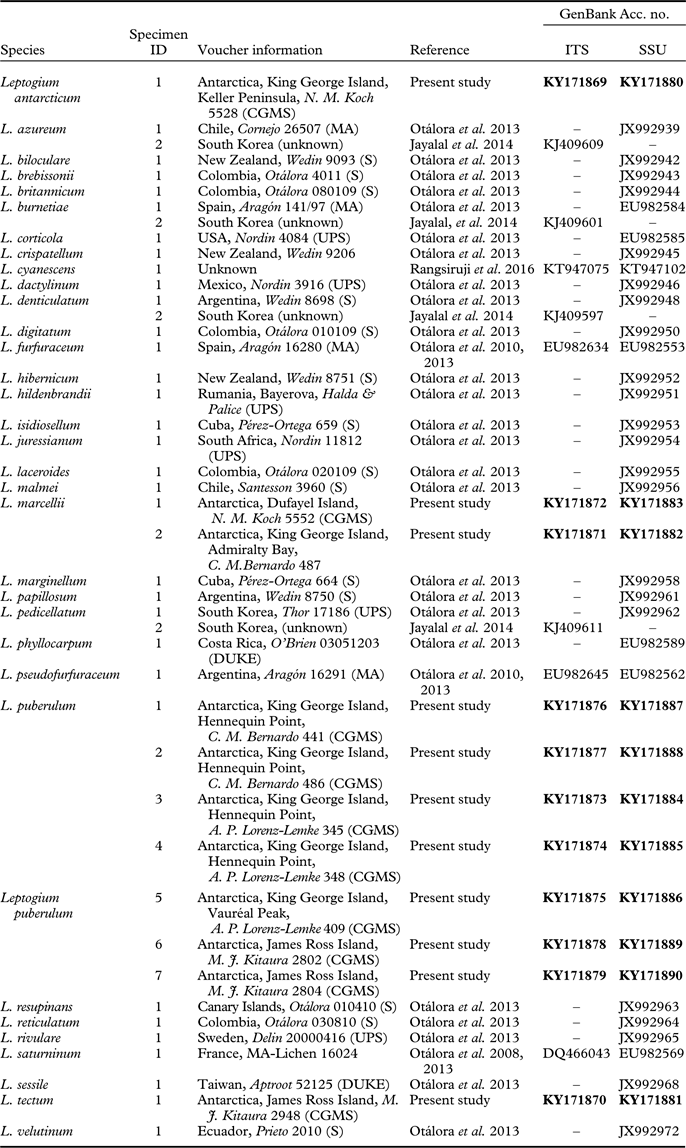
The sequences obtained were assembled with Geneious 8.1.7 (Kearse et al. Reference Kearse, Moir, Wilson, Stones-Havas, Cheung, Sturrock, Buxton, Cooper, Markowitz and Duran2012) and submitted to GenBank (Table 1). Sequences from other Leptogium species (sensu Otálora et al. Reference Otálora, Jørgensen and Wedin2014) available in GenBank were used in the analyses (Table 1). The ITS and mrSSU datasets were aligned using the MAFFT v.7.222 algorithm (Katoh et al. Reference Katoh, Misawa, Kuma and Miyata2002) available in Geneious v.8.1.7, with scoring matrix 200PAM/k=2, gap penalty=1·53, offset value=0·123 and automatic algorithm selection. Ambiguously aligned regions were removed using the Gblocks web server (Castresana Reference Castresana2000; Talavera & Castresana Reference Talavera and Castresana2007) with the less stringent options.
The best substitution models used in the phylogenetic analyses were indicated by jModelTest v.2.1.7 (Guindon & Gascuel Reference Guindon and Gascuel2003; Darriba et al. Reference Darriba, Taboada, Doallo and Posada2012), using the Akaike Information Criterion (AIC) and the Bayesian Information Criterion (BIC), respectively: GTR+G and TRN+G for ITS, TPM2uf+I+G and HKY+I+G for mrSSU.
For the maximum likelihood (ML) inference, the 50% majority consensus rule tree was estimated using PhyML plug-in in Geneious 8.1.7 (Guindon & Gascuel Reference Guindon and Gascuel2003), with 5000 bootstrap replicates and the best substitution model for each alignment, taking into consideration the AIC results in jModelTest. For the Bayesian (BA) inference, the maximum clade credibility tree was generated using BEAST v.1.8.2 (Drummond et al. Reference Drummond, Suchard, Xie and Rambaut2012) using the best substitution model resulting from each alignment, taking into consideration the BIC results in jModelTest. A Yule tree prior was assumed and for all other parameters the default priors were used. A run was performed for a chain length of 10 000 000, sampling every 1000 generations. The tree was generated from the combined sampled trees after discarding the first 20% as burn-in. Tracer 1.5 (Rambaut et al. Reference Rambaut, Suchard, Xie and Drummond2014) was used to check MCMC convergence (effective sample sizes ≥200). Clades that received bootstrap support ≥75% in the ML analysis or posterior probabilities ≥0·95 were considered well supported. Leptogium saturninum (Dicks.) Nyl., L. burnetiae Dodge and L. pedicellatum P. M. Jørg. sequences were used as outgroups for both datasets (ITS and mrSSU) and L. hildenbrandii for the mrSSU dataset, bearing in mind their position in clade C and close relationship with the Leptogium clade B group (sensu Otálora et al. Reference Otálora, Jørgensen and Wedin2014) and the availability of sequences in GenBank. The trees were edited in FigTree v.1.3.1 (Rambaut Reference Rambaut2009).
To provide additional support for species delimitation, the ITS sequences were used to calculate ML distances as the number of substitutions per site (s/s) using PAUP v.4.0b10 (Swofford Reference Swofford2003). Additionally, the ABGD web server (Puillandre et al. Reference Puillandre, Lambert, Brouillet and Achaz2011) was used to estimate the barcode gap in the distribution of pairwise distances with Pmin=0·001, Pmax=0·1, different gap width values (0·5, 1·0 and 1·5), Nb bins=20 as the settings, and the JC69 substitution model.
Results and Discussion
We obtained ITS and mrSSU sequences for one specimen each of Leptogium antarcticum and L. tectum, two specimens of L. marcellii and seven specimens of L. puberulum. ITS and mrSSU sequences from species positioned in Leptogium clade B (Otálora et al. Reference Otálora, Jørgensen and Wedin2014) were used in the phylogenetic analyses (Table 1). The sequence sizes varied between 484 and 587 base pairs (bp) for ITS, and 580 and 603 bp for mrSSU markers. After the removal of uncertain positions from the alignment, ITS and mrSSU datasets were composed of matrices of 491 and 596 bp, respectively.
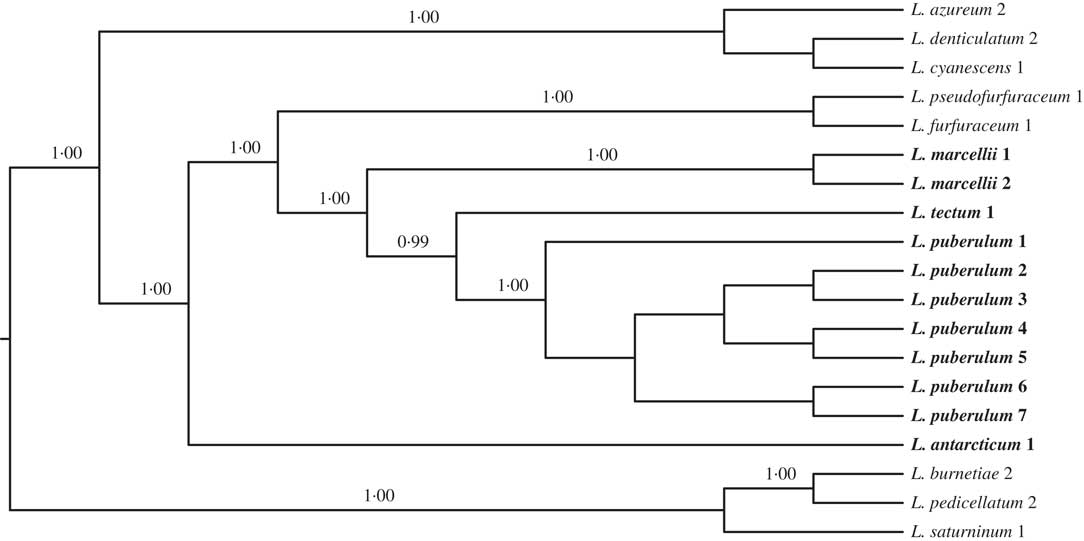
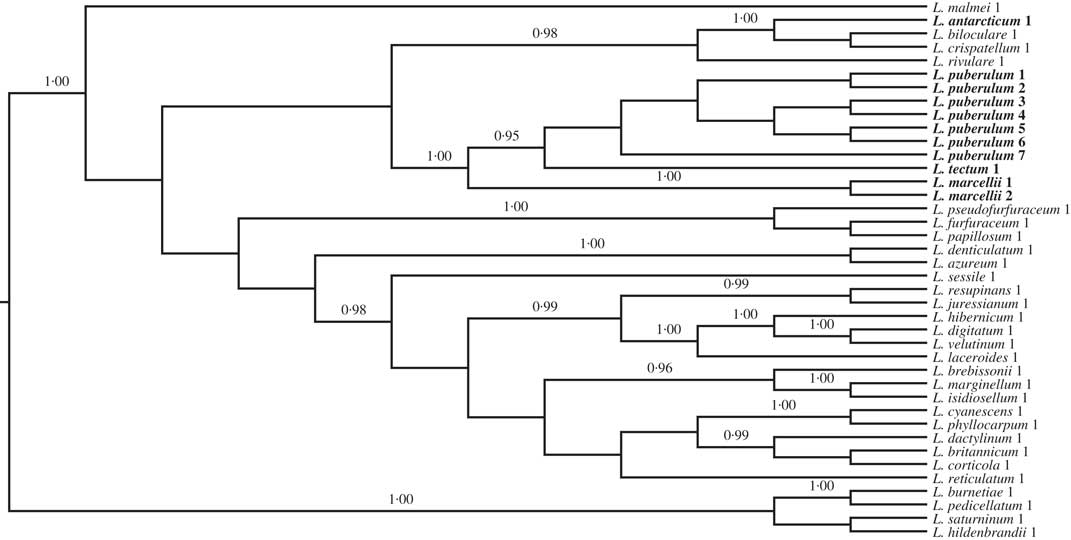
For the different datasets and using ML and BA approaches, the trees showed similar topologies and the phylogenetic positions of the three new species were consistently maintained. Thus, only maximum clade credibility (BA) trees are shown in Figs 1 (ITS) and 2 (mrSSU).
Bayesian Maximum Clade Credibility tree based on the ITS dataset showing the phylogenetic relationships among Leptogium antarcticum, L. marcellii, L. tectum and other Leptogium species. Posterior probabilities (PP)>0·95 shown above branches. Details of specimens are given in Table 1. Sequences obtained in this study are in bold.
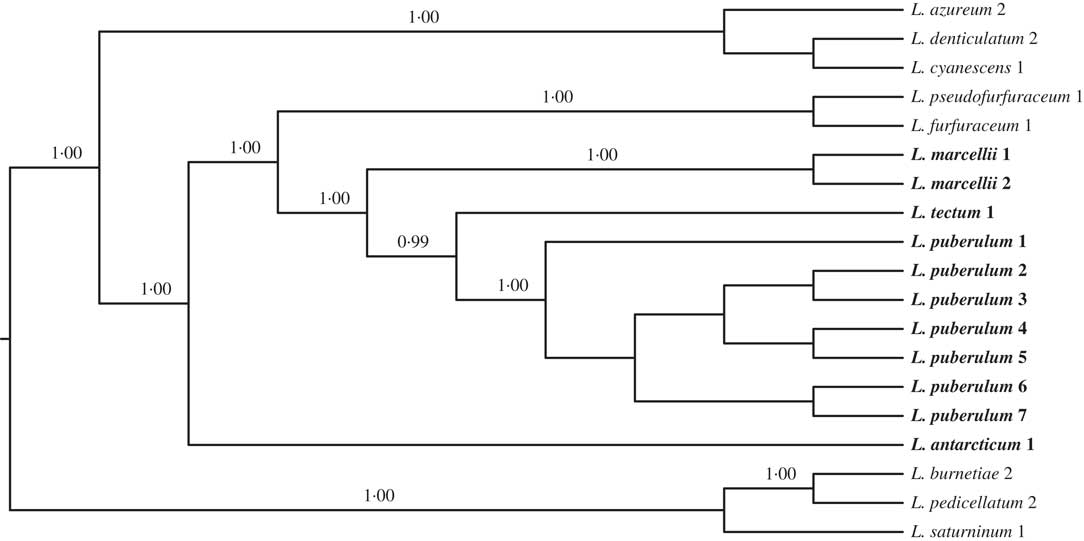
The ITS and mrSSU trees were in agreement regarding the highly supported close relationship between L. puberulum and L. tectum in a clade sister to L. marcellii. In addition, the ITS tree supports the relationship among all three species and L. furfuraceum (Harm.) Sierk and L. pseudofurfuraceum P. M. Jørg. & Wallace, but this is not apparent in the mrSSU tree (Fig. 2).
Bayesian Maximum Clade Credibility tree based on the mrSSU dataset showing the phylogenetic relationships among Leptogium antarcticum, L. marcellii, L. tectum and other Leptogium species. Posterior probabilities (PP)>0·95 are above branches. Details of specimens are shown in Table 1. Sequences obtained in this study are marked in bold.
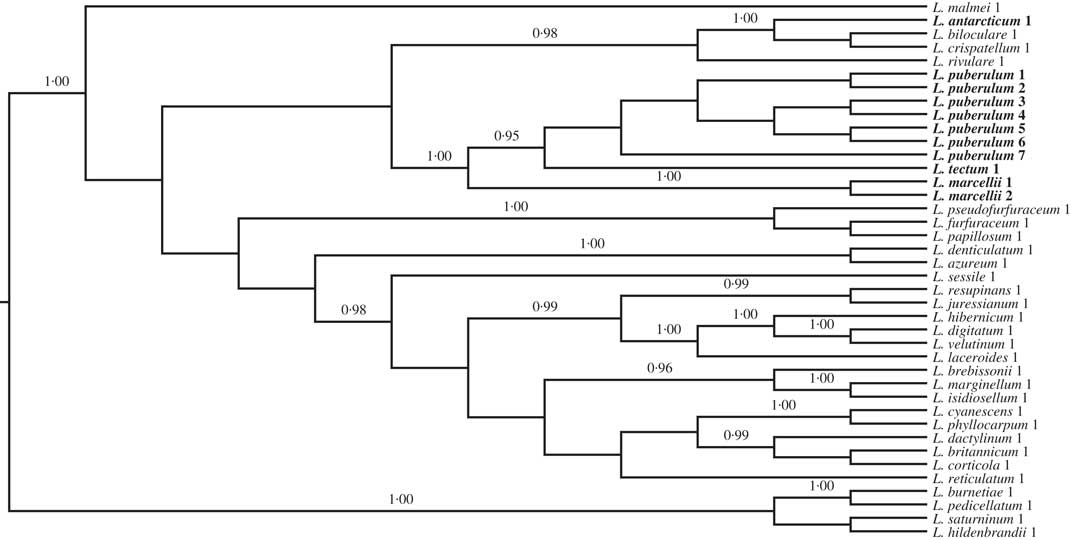
In the mrSSU analyses, L. antarcticum is related to L. biloculare F. Wilson, L. crispatellum and L. rivulare with high support values; however, with ITS the placement of these species inside the genus was unresolved because sequences for the latter three species were unavailable.
No morphological or geographical patterns were found in common between L. antarcticum and L. biloculare, L. crispatellum and L. rivulare. All trees showed the separation of clades B (L. denticulatum Nyl., L. azureum (Sw.) Mont., L. cyanescens (Rabenh.) Körber., L. puberulum, L. rivulare (Ach.) Mont., L. biloculare, L. crispatellum and others) and C (L. saturninum, L. pedicellatum and L. burnetiae and others) described by Otálora et al. (Reference Otálora, Jørgensen and Wedin2014), the three new species belonging to clade B.
For the purpose of species delimitation and the first placement of the three new species proposed here, the data provided is adequate. However, more data from other markers is necessary, especially because the greatest availability of sequences was for the mrSSU marker and its conserved nature may not reflect the real position of the new species inside Leptogium.
The ITS pairwise distance comparisons among L. antarcticum, L. tectum and L. marcellii, and their respective most-related species, suggest interspecific diversity. Sequences of L. tectum and L. puberulum presented 0·0340 s/s of ML distance (c. 3·15% of divergence), L. marcellii and L. puberulum 0·060 s/s (6·12% of divergence) and L. antarcticum and L. pseudofurfuraceum 0·265 s/s (17·00% of divergence). Although the intra- and interspecific genetic distances of Leptogium are not well known, the frequently used 3% of divergence threshold corroborates the delimitation of the three new species (Nilsson et al. Reference Nilsson, Kristiansson, Ryberg, Hallenberg and Larsson2008; Blaalid et al. Reference Blaalid, Kumar, Nilsson, Abarenkov, Kirk and Kauserud2013). In all partitions of the ABGD analyses (between maximal distance P=0·001 and P=0·01, as well as with the three different gap width values) the three new species were retained in separate groups. Besides the ABGD analysis, even low ML distances (as the c. 3·15% of divergence between L. tectum and L. puberulum) were considered adequate to delimit L. tectum as a new species because of significant morphological differences. The integrative approach of this study allowed an accurate delimitation of three new Leptogium species from Antarctica. Expanding the geographical ranges of these species using detailed morphological and anatomical characters as well as genetic analyses will probably reveal more species and disclose the real diversity of the genus on this continent.
Species Descriptions
Leptogium antarcticum Scur, Lorenz-Lemke & Kitaura sp. nov.
MycoBank No.: MB 822500
Similar to Leptogium puberulum but with agglomerated, ascending and ornamented lobes; beard-like hairs on lower side; margin of apothecia with circular wrinkles.
Type: Antarctica, South Shetland Islands, King George Island, Keller Peninsula, near Comandante Ferraz Antarctic Station (EACF), on mosses, 62°05'05·2"S, 058°23′40'7"W, 24 m, 7 December 2015, N. M. Koch 5528 (CGMS—holotype).
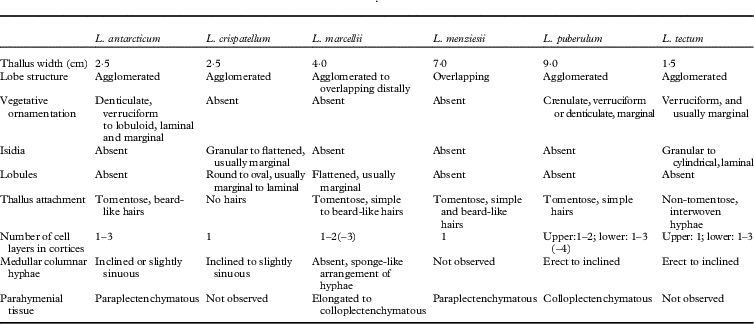
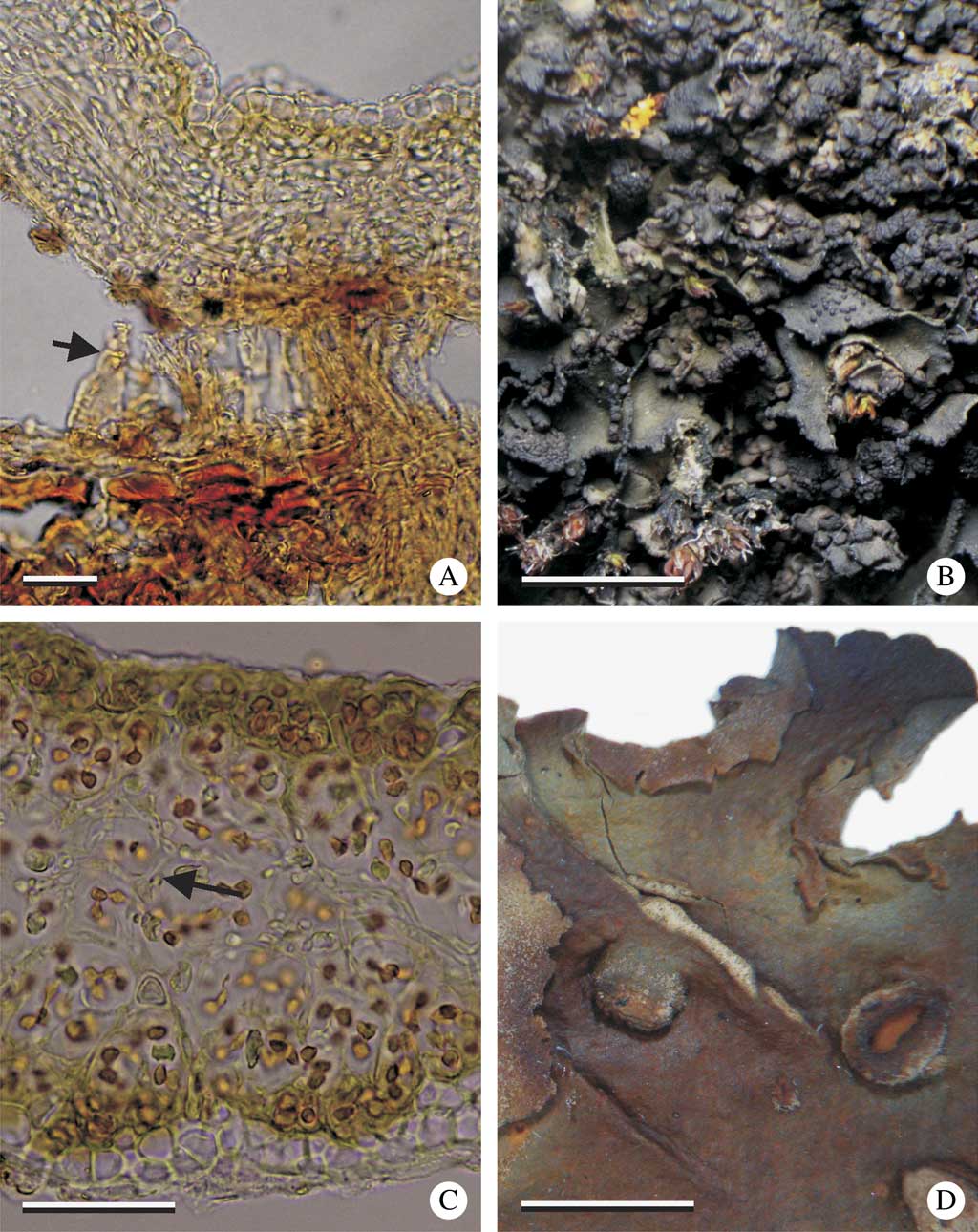
Thallus c. 2·5 cm wide, 85–125 µm thick, dark brown to blackish under fluorescent light, opaque, matt or shiny, grey to dark brown when observed under stereomicroscope with white light; maculae absent; lobes 0·5–2·0 mm wide, agglomerated, slightly attached, ascending; apices of lobes rounded, slightly revolute, smooth to rarely with ornamentation; lateral margins of lobes smooth to irregular, ascending, thickened; vegetative ornamentation denticulate, verruciform, cylindrical to lobuloid, with rounded apices, simple, 0·05–0·15×0·05–0·15 mm, laminal and marginal, originating from ridges; isidia and lobules absent. Thallus attached by beard-like hairs, 3–7 cylindrical cells long, 0·05–0·65 mm long, usually cream-coloured; rhizines and hapters absent; upper cortex smooth to slightly rugulose when viewed at ×20, composed of 1–3 layers of paraplectenchymatous cells, up to 20 µm thick, isodiametric to rectangular cells of 4·0–7·0 µm diam., covered by thick amorphous layer (similar to cuticle of leaves); lower cortex tomentose, grey, smooth and beard-like hairy when viewed at ×20, composed of one layer of isodiametric cells of 3·0–7·5 µm diam.; medulla with columnar hyphae c. 2·5 µm thick, inclined at c. 65° from the cortex or slightly sinuous, c. 4 cells long, frequent to scarce; photobiont cyanobacterium, yellow, frequent to abundant, spherical cells 2·5–5·0 µm diam., c. 8 cells per filament; gelatinous matrix frequent, hyaline.
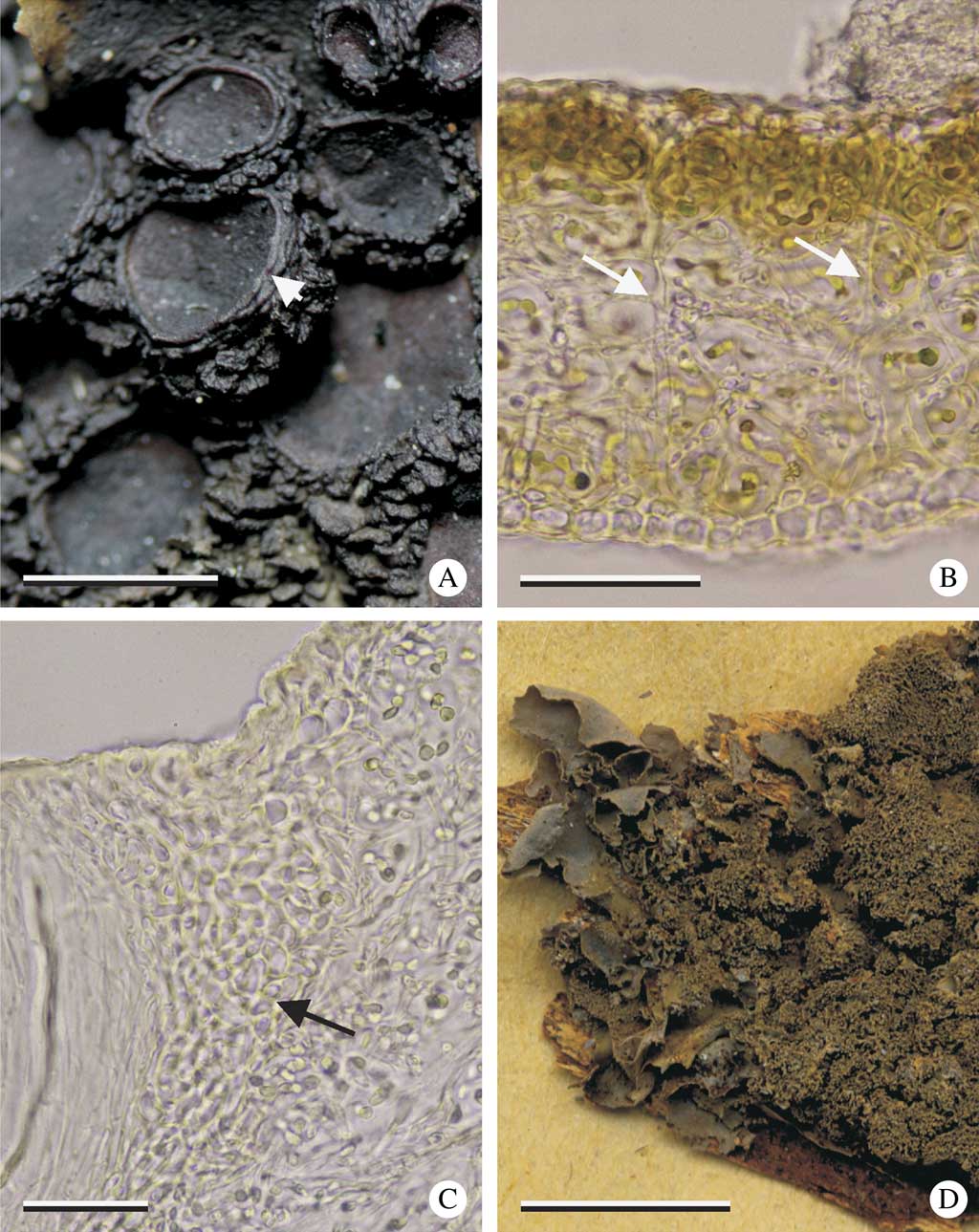
Apothecia up to 3·0 mm diam., laminal, adnate; disc plane to concave; basal paraplectenchymatous tissue absent; thalline exciple cortex concolorous with the thallus, base and mid-height with verruciform ornamentation and lobules, with simple and minute hairs, margin smooth or with denticules and circular ridges (Fig. 3A) as in L. sessile; composed of paraplectenchymatous tissue, 25–30 µm (3–5 cells) thick at the base, 10–15 µm (c. 2 cells) thick at mid-height, 3·0–5·0 µm (one cell) thick at the apex; corona and pedicel absent; parahymenial tissue continuous with hypothecium, with paraplectenchymatous tissue (Fig. 3C), c. 100 µm (up to 10 cells) thick at the apex, as tall as hymenium; proper exciple absent; hypothecium 20·0–25·0 µm thick, colourless, cell tissue subparaplectenchymatous to elongated; subhymenium up to 40 µm thick, colourless; hymenium c. 140 µm thick; asci not observed; ascospores fusiform, 20–25×10–15 µm (3–4×1–2 cells), apices acute, submuriform to muriform.
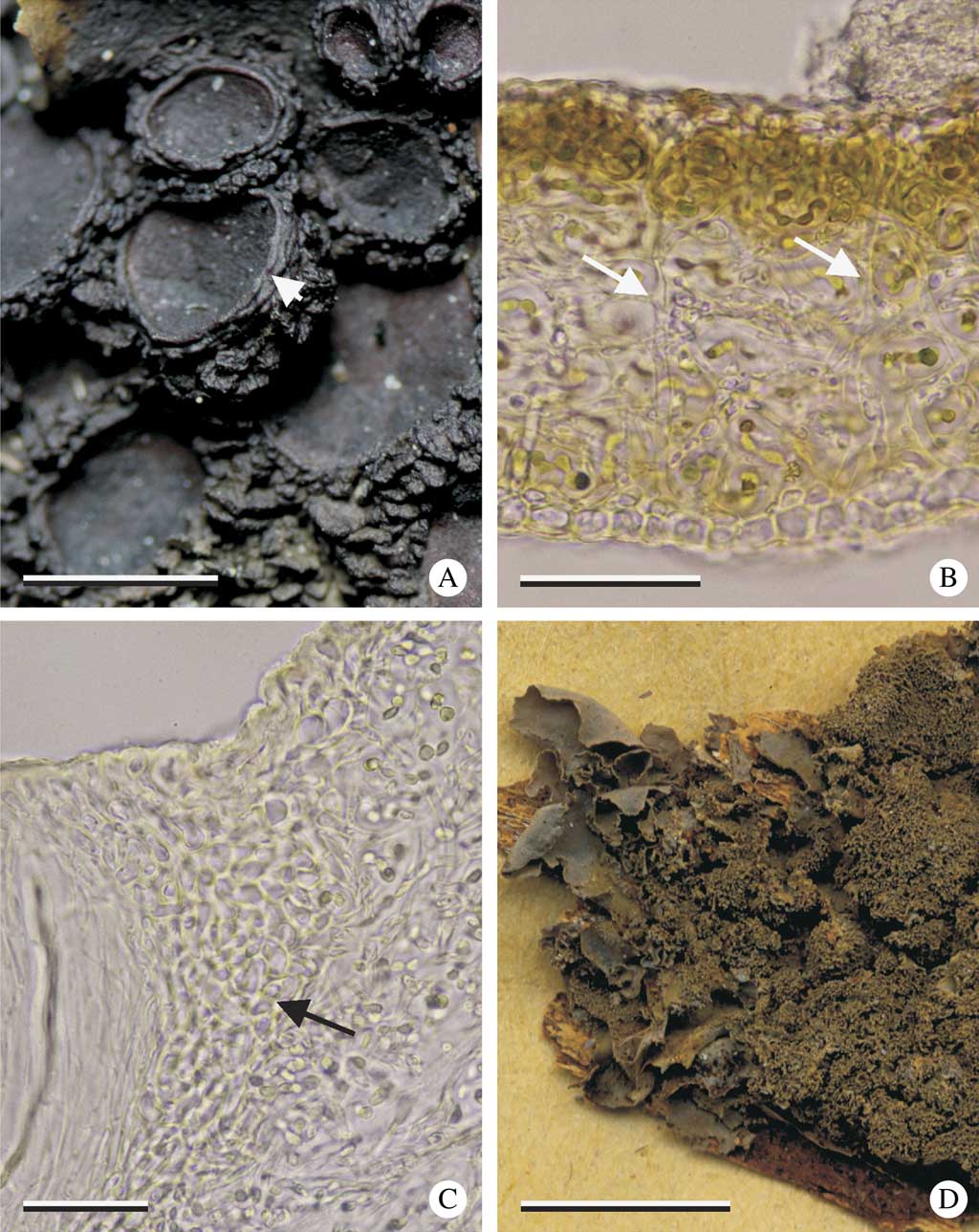
A–C, Leptogium antarcticum; A, holotype, arrow=circular ridges; B, TS thallus, arrows=inclined columnar hyphae; C, TS apothecium, arrow=paraplectenchymatous parahymenial tissue. D, Leptogium crispatellum, thallus (holotype). Scales: A=3 mm; B=20 µm; C=50 µm; D=5 mm. In colour online.
Pycnidia rare, immersed in the thallus; conidia bacilliform to bifusiform, c. 2·5×1·0 µm.
Etymology. The epithet refers to the Antarctic region where the species was found.
Distribution. Currently known only from King George Island, South Shetland Islands, Antarctica.
Discussion. Leptogium antarcticum is characterized by the agglomerated lobes, verruciform ornamentation on the lamina and margin, beard-like hairs on the lower surface, amphithecia with ornamentation and simple hairs, and the smooth margin of apothecia with circular wrinkles similar to L. sessile, a non-hairy species without ornamentation. The medulla of L. antarcticum is composed of inclined (Fig. 3B) to slightly sinuous columnar hyphae (Table 2).
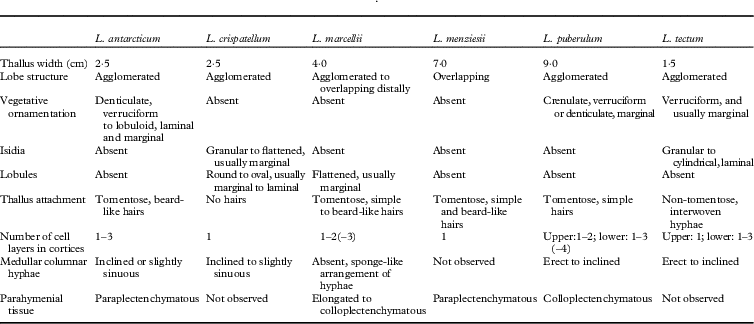
Characteristics distinguishing the Leptogium species found in Antarctica
Leptogium crispatellum Nyl.
Lichenes Novae Zelandiae 1888: 10 (1888); type: New Zealand, “corticola ad Greymouth”, 1888, R. Helms 214 (H–NYL 41462!—holotype; see Galloway Reference Galloway1985).
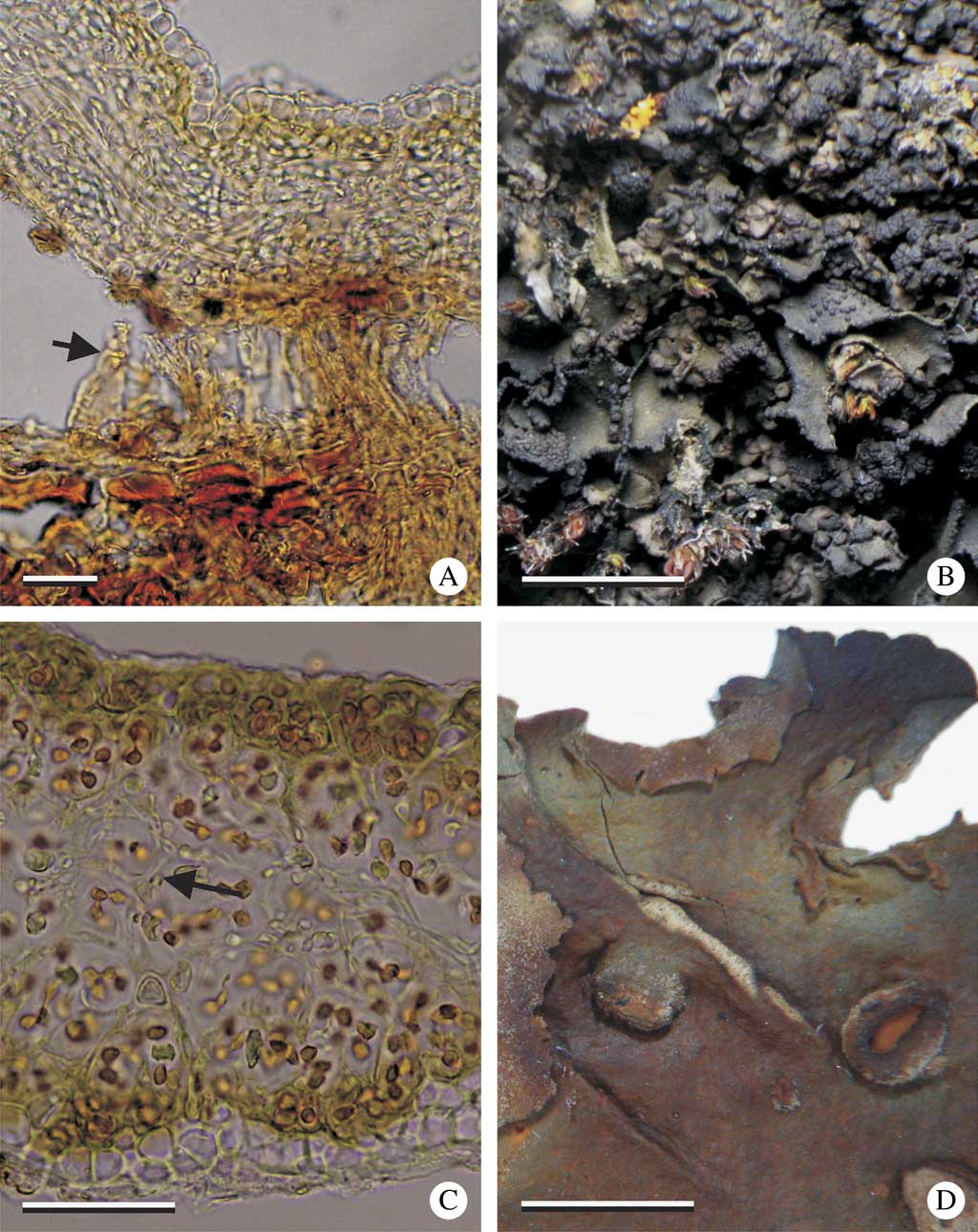
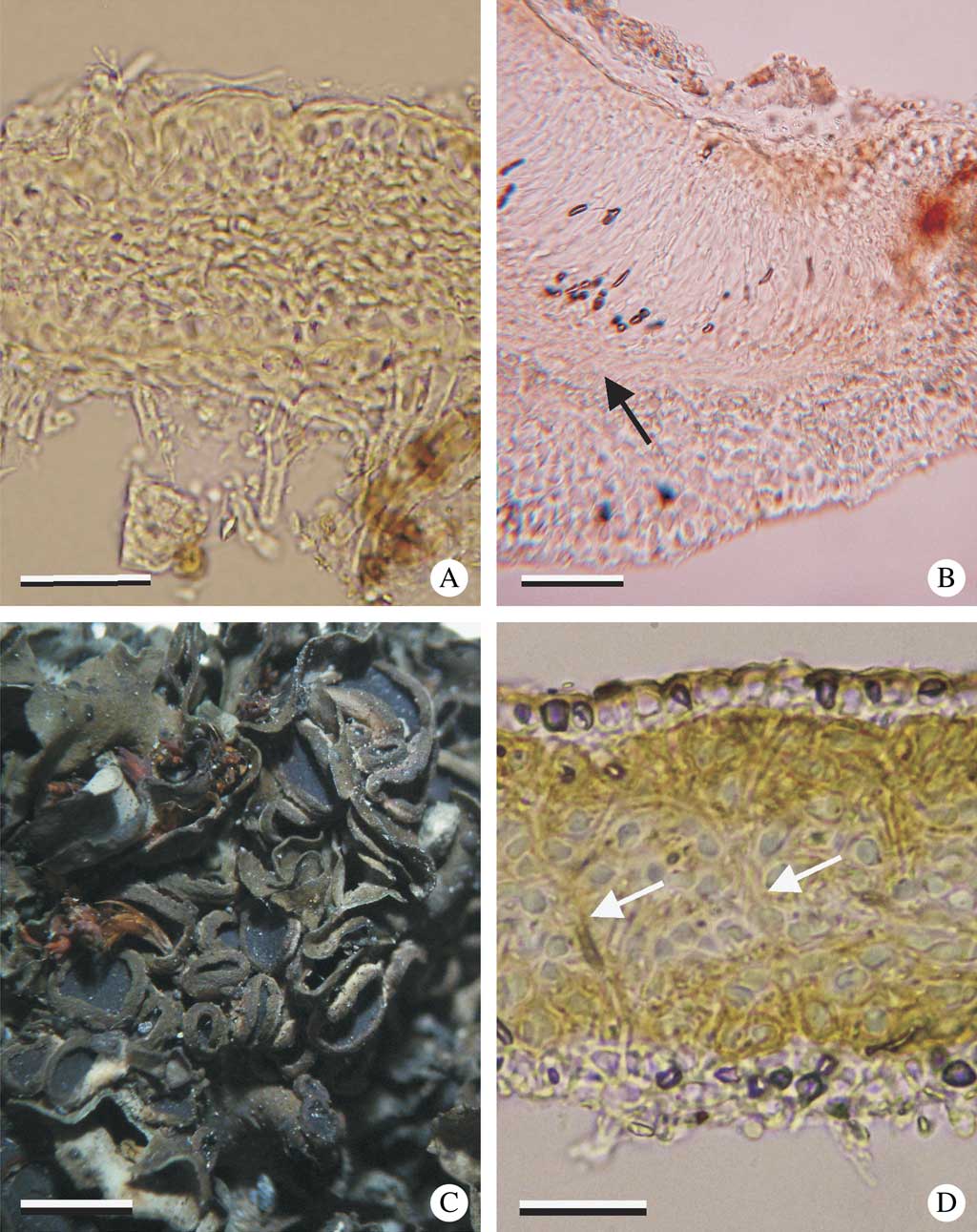
A, Leptogium crispatellum; TS thallus, arrow=detail of hapter. B & C, Leptogium marcellii; B, holotype; C, TS thallus, arrow=sponge-like arrangement of the medullary hyphae. D, L. menziesii (neotype). Scales: A=20 µm; B & D=3 mm; C=30 µm. In colour online.
Thallus c. 2·5 cm wide, 55–70 µm thick, grey to bluish grey under fluorescent light, opaque, matt, bluish grey when observed under stereomicroscope with white light; maculae present; lobes c. 2 mm wide, agglomerated, slightly attached, revolute to ascending; apices of lobes rounded, revolute to ascending, smooth; lateral margins of lobes smooth, revolute, crispate, thin; isidia granular to flattened, 0·05–0·15×0·04–0·10 mm, simple to very branched, erect, firm, concolorous with the thallus or slightly blackish, usually marginal but sometimes laminal, grouped, abundant, granular when young and flattened with age; lobules round to oval, apices rounded to truncate, 0·05–0·10×0·10–0·20 mm, usually simple but occasionally branched in just one plane, erect, firm, concolorous with the thallus, usually marginal to laminal, densely aggregated, abundant; thallus attached by short hapters (Fig. 4A), hairs absent on the margin and cross-sections of the thallus; upper cortex smooth when viewed at ×20; consisting of one layer of isodiametric cells, c. 10 µm diam.; lower cortex bluish grey, smooth when viewed at ×20, composed of one layer of isodiametric cells, c. 7·5 µm diam.; medulla with columnar hyphae 2·5 µm thick, inclined at 80–70° from the cortex or slightly sinuous, 5–7 cells high; photobiont cyanobacterium, blue, scarce to frequent in medulla, cells elliptic, number of cells per filament not determined; gelatinous matrix scarce, varying from yellow next to the upper cortex to hyaline below.
Apothecia and pycnidia absent.
Distribution. Australia (Verdon Reference Verdon1992); New Zealand (Nylander Reference Nylander1888; Müller Argoviensis Reference Müller Argoviensis1894; Galloway Reference Galloway1999); Tasmania (Verdon Reference Verdon1992); Subantarctic region (Marion and Heard Islands; Øvstedal & Lewis Smith Reference Øvstedal and Lewis Smith2001, Reference Øvstedal and Lewis Smith2004) and Antarctic region (South Shetland Islands; Øvstedal & Lewis Smith Reference Øvstedal and Lewis Smith2001, Reference Øvstedal and Lewis Smith2004).
Discussion. Leptogium crispatellum is characterized by agglomerated lobes, granular to flattened isidia and usually some rounded to oval lobules typically on the margin (Table 2). The thallus is thin (55–70 µm) with a smooth upper surface and the medulla is loosely packed with inclined or slightly sinuous columnar hyphae.
The type of L. crispatellum is pasted on a card, therefore hairs were not observed on the margins of lobes and cross-section of the thallus. The thallus is attached to the substratum by short hapters (Fig. 4A). Neither Verdon (Reference Verdon1992) nor Galloway (Reference Galloway1999) mentioned the presence of hairs.
Leptogium crispatellum differs from L. antarcticum by the presence of hapters and granular to flattened isidia with L. antarcticum having beard-like hairs and irregular vegetative ornamentation, such as denticulate, verruciform, cylindrical to lobuloid structures.
The presence of L. crispatellum in Antarctica is based upon two specimens (Ochyra 2700/80 and 2708/80) that were cited in Øvstedal & Lewis Smith (Reference Øvstedal and Lewis Smith2001, Reference Øvstedal and Lewis Smith2004) as Leptogium sp. A and L. crispatellum, respectively. However, both descriptions mentioned the presence of hairs on the lower side and the characteristics of these specimens from the South Shetland Islands and the Antarctic Peninsula did not match the holotype, which was collected in New Zealand. They could represent a new species or one of the species described in this work and more collections in other areas of Antarctica are required to confirm the presence of L. crispatellum on the continent.
Leptogium marcellii Kitaura, Lorenz-Lemke & A. A. Spielm. sp. nov.
MycoBank No.: MB 822501
Similar to Leptogium puberulum but with overlapping, ornamented lobes; beard-like hairs on lower surface; medullary hyphae loosely packed, with a sponge-like arrangement filled by the cyanobacterium and gelatinous matrix.
Type: Antarctica, South Shetland Islands, King George Island, Ezcurra Cove, Dufayel Island, on mosses, 62°10'06·5"S, 058°33'45·2"W, 16 m, 13 December 2015, N. M. Koch 5552 (CGMS—holotype).
Thallus c. 4 cm wide, 85–125 µm thick, dark brown to blackish under fluorescent light, opaque, matt, brownish to greenish grey when observed under the stereomicroscope with white light; maculae absent; lobes up to 4 mm wide, overlapped in the marginal part to agglomerated, slightly attached, ascending; apices of lobes rounded, slightly revolute and ascending, smooth or with ornamentation; lateral margins of lobes smooth to lobulate, ascending, crispate, thickened; isidia absent; lobules flattened, apices rounded, 0·2–1·0 µm diam., simple, erect, firm, concolorous with the thallus to blackish, usually scattered on the margin of the thallus, but also found in clusters on the lamina and on the margin of apothecia, frequent to rare; thallus attached by simple (non-agglutinated) hairs and beard-like hairs, more than 7 cylindrical cells long, 50 µm long or more when agglutinated, cream to white, abundant in the central region and scarce at the margin on the lower side; rhizines and hapters absent; upper cortex smooth to rugulose when viewed at ×20, composed of 1–2(–3) layers of paraplectenchymatous, isodiametric to rectangular cells, 5·0–10·0×5·0–7·5 µm, covered by thick amorphous layer (similar to the cuticle of leaves), c. 7·5 µm thick; lower cortex tomentose, light grey to whitish, smooth to rugulose when viewed at ×20, one layer of isodiametric cells, 5·0–7·5 µm diam.; medulla composed of loosely packed hyphae, in a sponge-like arrangement filled with the cyanobacterium; columnar hyphae absent; photobiont cyanobacterium, blue,, spherical cells, frequent within the medulla, c. 5·0 µm diam., number of cells per filament not determined; gelatinous matrix frequent, hyaline.
Apothecia (as determined only from additional material (Spielmann 4429) for which DNA sequences were not obtained) up to 2·5 mm diam., laminal, subpedicellate; disc concave; basal paraplectenchymatous tissue absent; thalline exciple cortex concolorous with the thallus to cream when pubescent, base and mid-height smooth to pubescent; margin ornamented with verruciform structures when young and with lobules when older, concolorous with the thallus; composed of paraplectenchymatous tissue, 25–30 µm (3–5 cells) thick at the base, 20–25 µm (2–3 cells) thick at mid-height, 12–17 µm (amorphous layer) thick at the apex; corona and pedicel absent; parahymenial tissue continuous with hypothecium, with cells elongated to colloplectenchymatous, c. 25 µm (3–4 cells) thick at the base, 25–75 µm (5–9 cells) thick at the apex, as tall as hymenium; proper exciple absent; hypothecium 12·5–15·0 µm, colourless, made of prosoplectenchymatous tissue of irregular cells; subhymenium 20–25 µm thick, colourless; hymenium 90–100 µm thick. Asci not observed; ascospores fusiform, 20·0–25·0×5·0–7·5 µm, apices acute, submuriform to muriform.
Pycnidia concolorous with the thallus, ostiole brown, sessile; conidia bifusiform to bacilliform, c. 5·00×1·25 µm.
Distribution. Currently known only from King George and Livingston Islands, South Shetland Islands, Antarctica.
Discussion. Leptogium marcellii is characterized by the presence of overlapping lobes, with marginal lobules. The lamina of the thallus also has ornamentation but this is more frequent on the margin (Fig. 4B). The thallus is 85–125 µm thick, and the medullary hyphae are loosely packed in a sponge-like arrangement with the cyanobacterium. Columnar hyphae were not found in the specimens examined (Table 2); the pattern of medullary hyphae can be used to identify this species (Fig. 4C).
The only material with apothecia (Spielmann 4429) was collected in 2007 but DNA sequences were not obtained from this specimen. Nevertheless, the anatomical and morphological descriptions of this specimen were included in the description of L. marcellii. The apothecia have margins that are ornamented with verruciform structures when young and with lobules when older whereas those of L. antarcticum have smooth or denticulate margins. In addition, L. antarcticum has ornamented amphithecia whereas L. marcellii does not. Leptogium marcellii also has overlapping lobes and lobules on the margin, differing from L. antarcticum which has agglomerated lobes, verruciform ornamentation on the lamina and margin, and slightly sinuous columnar hyphae in the medulla.
Leptogium marcellii is named in honour of Dr Marcelo Pinto Marcelli, an outstanding Brazilian lichenologist who believed that columnar hyphae and medullary hyphae of sponge-like arrangement with the cyanobacterium are characteristics with taxonomic importance in Leptogium, a belief that has consistently inspired the first author.
Selected specimens examined. Antarctica: South Shetland Islands: King George Island, Admiralty Bay, Stenhouse Point, saxicolous, 62°04·307'S, 58°22·455'W, 2014, C. M. Bernardo [487] & S. C. Feuerstein (CGMS); Livingston Island, Byers Peninsula, on mosses in the soil with small pebbles, 62°39'18·1"S, 61°08'40·4"W, 2007, A. A. Spielmann [4429], C. E. R. Schaefer & M. R. Francelino (CGMS—fertile specimen).
Leptogium menziesii (Ach.) Mont.
Ann. Sci. Nat. Bot. Biol. 18(3): 313 (1852). —Lichen menziesii Sm., apud Ach., Methodica Lichenum: 221 (1803) pro. syn.—Parmelia menziesii Ach., Methodica Lichenum: 221 (1803).—Collema menziesii (Ach.) Ach., Lich. Univer.: 645 (1810); type: Argentina, Staten Island, near Cape Horn, February 1789, Menzies s. n. (E!—neotype designated by Jørgensen Reference Jørgensen1975).
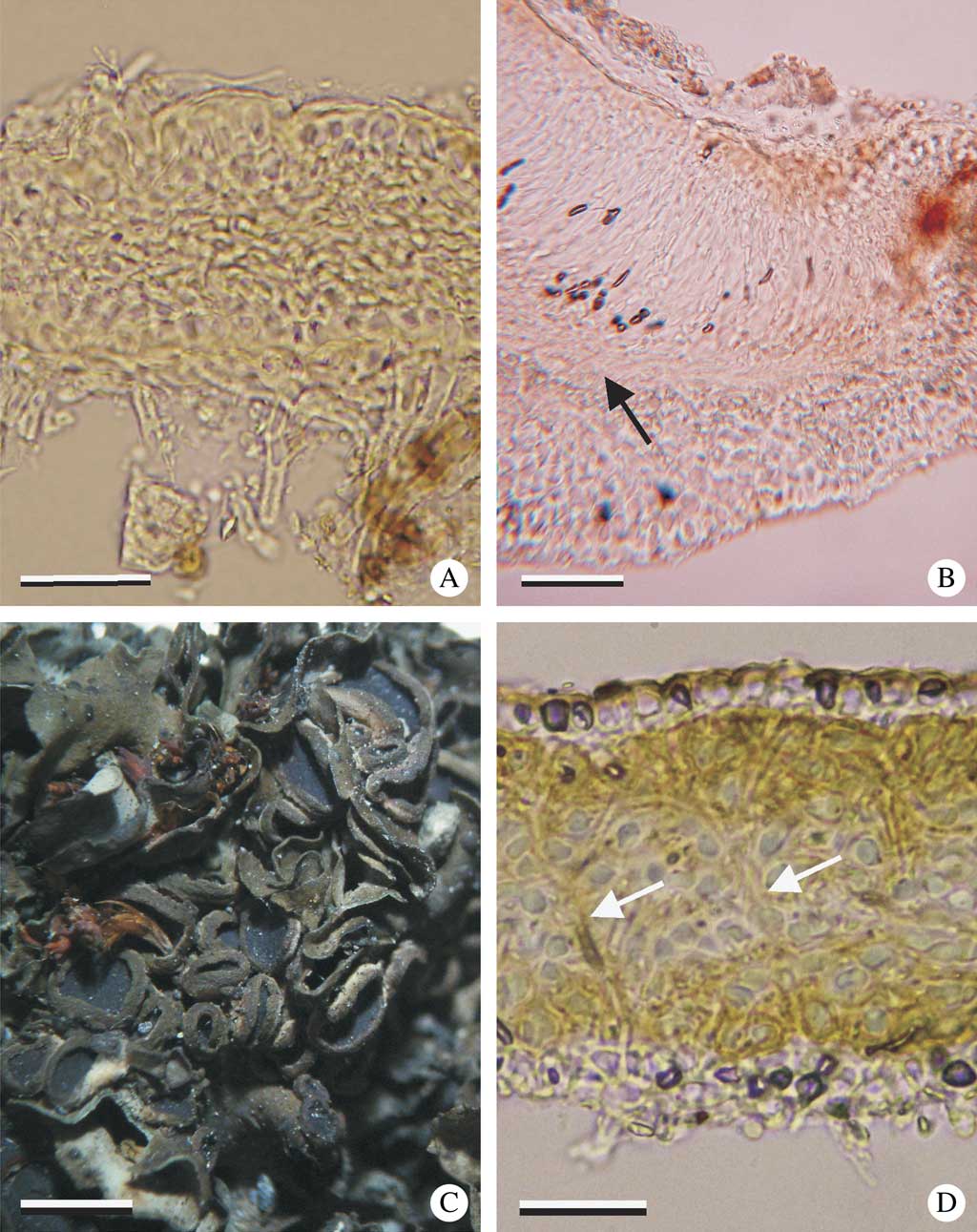
A & B, Leptogium menziesii; A, TS thallus (poorly conserved specimen); B, TS apothecium, arrow=hypothecium. C & D, Leptogium puberulum; C, upper surface and apothecia; D, TS thallus, arrows=columnar hyphae. Scales: A=30 µm; B & D=50 µm; C=3 mm. In colour online.
Thallus c. 7 cm wide, 50–75 µm thick, brownish grey under fluorescent light, opaque, matt, greenish grey with some brownish parts under stereomicroscope with white light; maculae absent; lobes up to 10 mm wide, overlapping, adnate; apices of lobes rounded, plane, smooth; lateral margins of lobes smooth, plane, straight, thin; isidia and lobules absent; thallus attached by simple and beard-like hairs, usually with 4 cylindrical cells, 100 µm long or more when agglutinated, cream on the lower cortex, abundant, upper cortex rugulose when viewed at ×20, composed of isodiametric cells, c. 10·0×5·0 µm, one layer of paraplectenchymatous cells; lower cortex tomentose, greenish grey, smooth and pubescent when viewed at ×20 magnification, isodiametric cells, c. 15·0×7·5 µm, one layer of paraplectenchymatous cells, covered by a thick amorphous layer (similar to the cuticle of leaves); medulla with hyphae and the cyanobacterium compactly woven in a closed pattern, columnar hyphae absent; photobiont cyanobacterium, blue, frequent within the medulla, cells elliptic, 5·0×7·5 µm, number of cells per filament not determined; gelatinous matrix scarce, hyaline.
Apothecia up to 1·5 mm diam., laminal, subpedicellate; disc concave; basal paraplectenchymatous tissue 35–40 µm (2–6 cells) thick, external cells covered by thicker amorphous layer; thalline exciple cortex yellow to beige, base and mid-height pubescent, margin smooth to slightly wrinkled, without ornamentation, with wrinkles visible to the naked eye, brown to blackish; composed of paraplectenchymatous tissue 65–70 µm (7–8 cells) thick at the base, 20–25 µm (c. 2 cells) thick at the mid-height, 20–25 µm (c. 2 cells) thick at the apex; corona absent; pedicel up to 0·5 mm long, smooth, pubescent, as tall as hymenium, with external cells of amphithecia covered by thicker amorphous layer (similar to cuticle of leaves); parahymenial tissue continuous with hypothecium, with paraplectenchymatous tissue, 15–18 µm (3 cells) thick at the base, 15–20 µm (8 cells) thick at the apices; proper exciple absent; hypothecium 25–30 µm thick, yellow, of prosoplectenchymatous tissue of irregular cells (Fig. 6A – arrow); subhymenium 15–20 µm thick, yellow; hymenium c. 125 µm thick. Asci not observed; ascospores not found (22–27×8–10 µm; Jørgensen Reference Jørgensen1975).
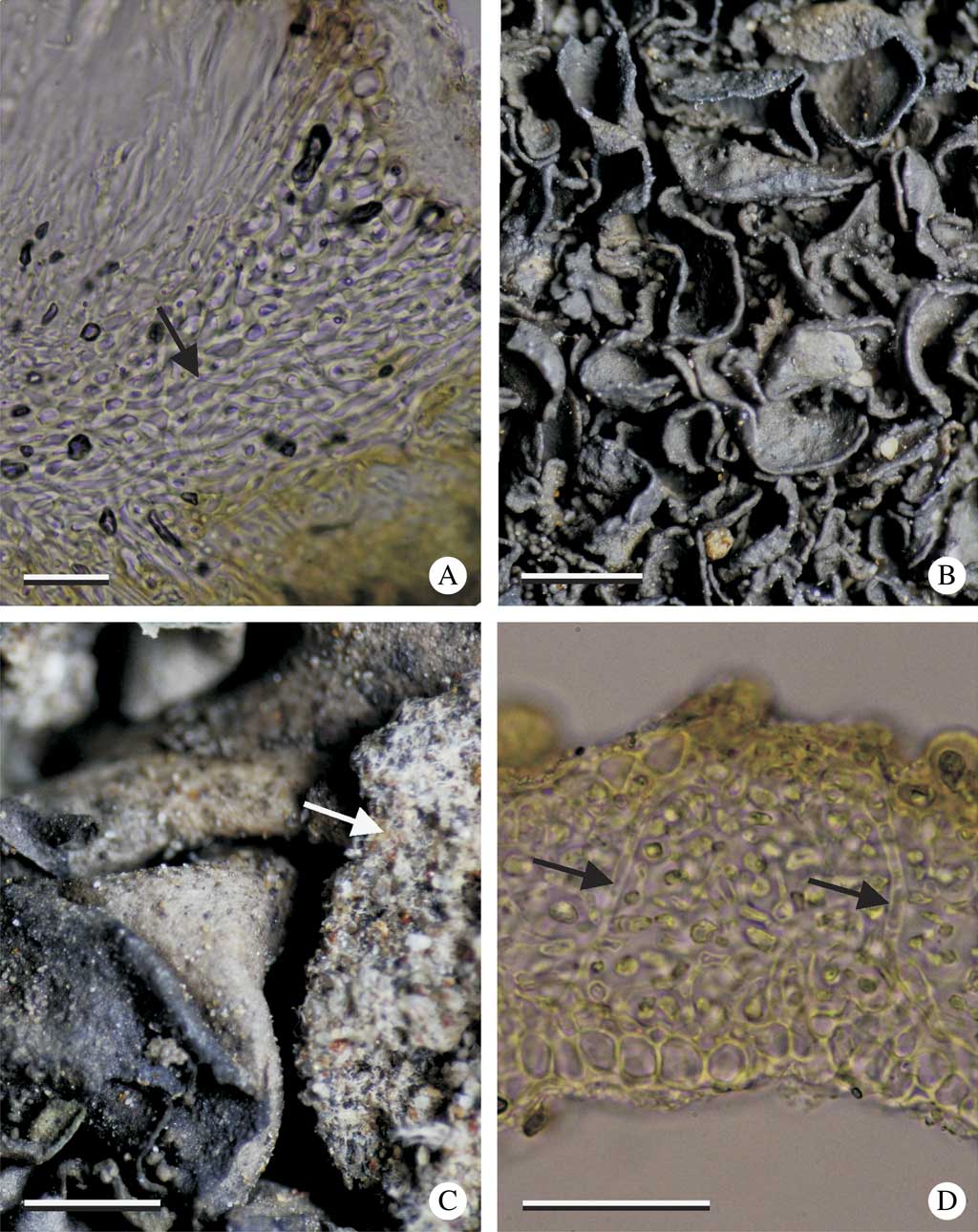
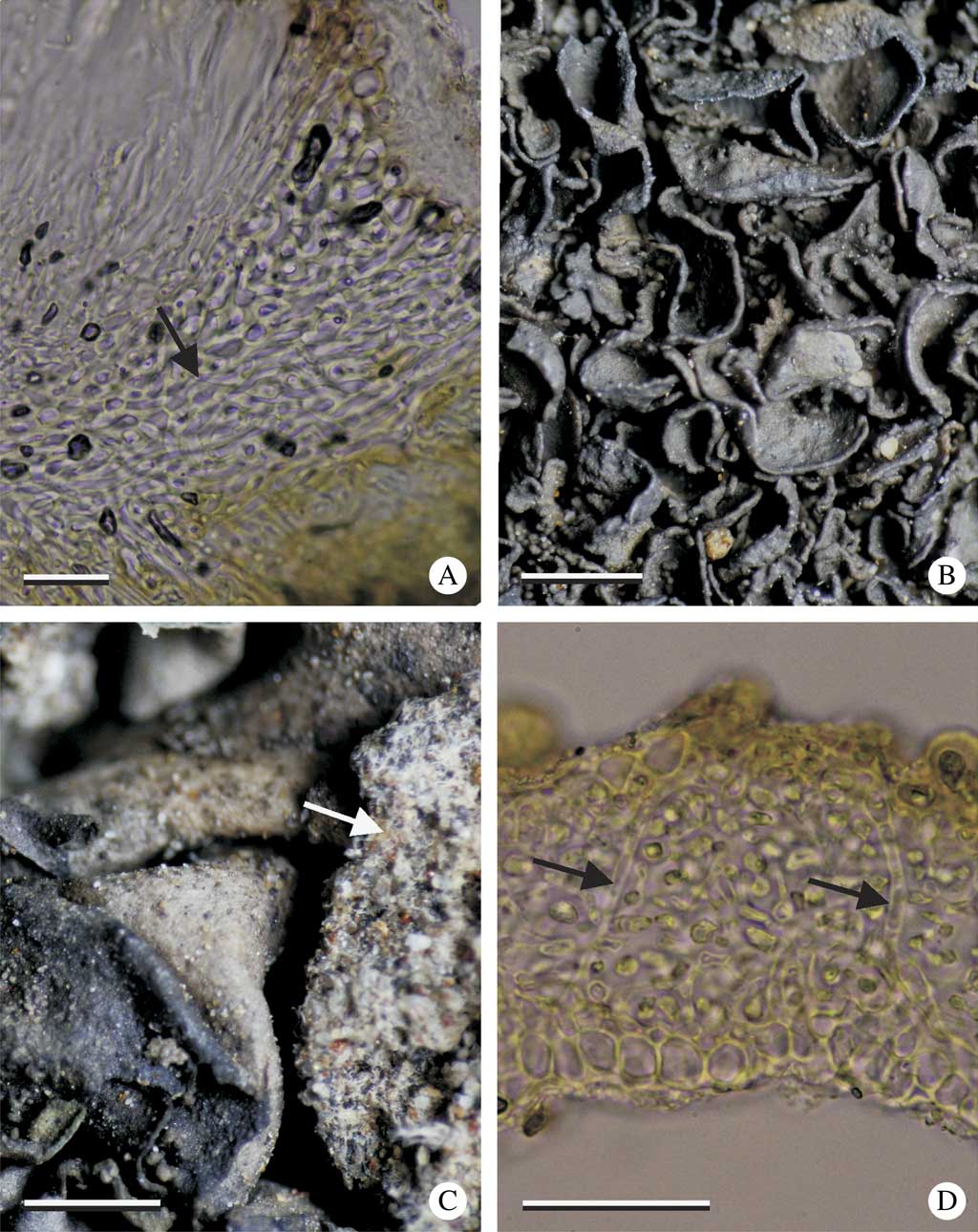
A, Leptogium puberulum, TS apothecium, arrow=colloplectenchymatous cells. B–D, Leptogium tectum; B, upper surface; C, lower side showing absence of hairs, arrow=hyphae interwoven with sand grains; D, TS thallus with columnar hyphae (arrows). Scales: A=20 µm; B & C=3 mm; D=50 µm. In colour online.
Pycnidia laminal, usually close to the thallus margin, concolorous with the thallus or brown; conidia bacilliform, 3·75×1·25 µm.
Distribution. Argentina, Staten Island (Jørgensen Reference Jørgensen1975); Chile, Fuegia (Galloway & Jørgensen Reference Galloway and Jørgensen1995); Falkland Islands; New Zealand; Peru; Antarctic region on South Georgia (Lindsay Reference Lindsay1974; Jørgensen Reference Jørgensen1975; Øvstedal & Lewis Smith Reference Øvstedal and Lewis Smith2001).
Discussion. Leptogium menziesii is characterized by overlapping lobes, the base of the apothecia (Fig. 4D) and pycnidia being covered by hairs and the non-ornamented thallus and apothecia. When young, Leptogium menziesii has simple hairs that become beard-like with age. The apothecia have a prosoplectenchymatous hypothecium and paraplectenchymatous parahymenial tissue. The quick process used to dry the specimen probably modified the thallus colour as well as the medullary hyphae; thus, the absence of columnar hyphae in this specimen is questionable (Fig. 5A). Leptogium menziesii does not have any ornamentation, whereas all the new species described here are ornamented (Table 2).
Leptogium puberulum Hue
Lichenes. In Deuxième Expédition Antarctique Française: 14 (1915); type: South Shetland Islands, King George Island, Admiralty Bay, “sur les pierres des éboulis et récolté sur la terre recouvrant un nunatak à 300 mètres d’altitude, XXIII excursion”, 25 December 1909, Louis Gain, 300 (PC—Hue’s collection).
Thallus up to 9 cm wide, 75–80 µm thick, usually brownish under fluorescent light, opaque, matt, whitish to beige or brown to blackish under stereomicroscope with white light; maculae not observed; lobes 2·0–5·5 mm wide, agglomerated, slightly attached, ascending; apices of lobes rounded, ascending, undulating, smooth to ornamented; lateral margins of lobes smooth, thickened, ascending, sinuous; vegetative ornamentation without constricted base, crenulate, verruciform or denticulate appendages, marginal, frequent to scarce; isidia and lobules absent; thallus attached by simple hairs, typically 4–6 cells long, spherical cells at the base (5–10 µm long) and cylindrical at the apex (10–15 µm long), cream to white; on the lower surface, frequent to abundant, the hairs agglutinated where the thallus is attached to the substratum; upper cortex smooth to slightly rugulose when viewed at ×20 magnification, 1–2 layers of isodiametric cells, 5·0 µm diam.; lower cortex tomentose, brown to whitish or yellowish, slightly rugulose when viewed at ×20 magnification, 1–3(–4) layers of isodiametric cells, 3·5–5·0 µm diam.; medulla with columnar hyphae 2·5 µm thick, erect to inclined, c. 70° from the cortex, 4–6 cells high, scattered between the medullary hyphae; photobiont cyanobacterium, green to blue, spherical cells 5·0 µm diam., frequent in medulla, number of cells per filament not determined; gelatinous matrix scarce, hyaline to brownish next to the cortices.
Apothecia 1·0–2·0(–5·5) mm diam., laminal, adnate to subpedicellate; disc concave to plane; basal paraplectenchymatous tissue absent; thalline exciple cortex brown when young to blackish yellow, base and mid-height smooth, glabrous or pubescent; margin usually smooth or with circular wrinkles similar to verruciform ornamentation in appearance, concolorous with the thallus, yellow to brown; composed of paraplectenchymatous tissue, 100 µm (6 cells) thick at the base, c. 40 µm (4–6 cells) thick at mid-height, 15–40 µm (3–6 cells) thick at the apex; corona interrupted, subtle, absent in young apothecia, generating verruciform ornamentation; pedicel originating from thallus, smooth or pubescent; parahymenial tissue continuous with the hypothecium, colloplectenchymatous cells, 35–40 µm (6–8 cells) thick at the base, 35–40 µm (5–8 cells) thick at the apex, two thirds to the same height as the hymenium; proper exciple absent; hypothecium 35–40 µm thick, slightly yellow, composed of prosoplectenchymatous cells; subhymenium 10·0–12·5 µm thick, colourless; hymenium 100–125 µm thick. Asci not observed; ascospores fusiform, 25·0–30·0×7·5–12·5 µm, 4–5×2–3 cells, apices acute to obtuse, submuriform to muriform.
Pycnidia laminal to marginal, black; conidia bifusiform to bacilliform, 3·75×1·25 µm.
Distribution. Antarctic Peninsula, Alexander Islands, Cockburn Island, Bouvet Island, Melchior Islands, South Orkney Island, South Georgia, South Sandwich Island and South Shetland Islands (Hue Reference Hue1915; Dodge Reference Dodge1965, Reference Dodge1968, Reference Dodge1973; Lewis Smith & Corner Reference Lewis Smith and Corner1973; Lindsay Reference Lindsay1974; Redon Reference Redon1985; Jørgensen Reference Jørgensen1986; Lewis Smith Reference Lewis Smith1993; Sancho et al. Reference Sancho, Schulz, Schroeter and Kappen1999; Øvstedal & Lewis Smith Reference Øvstedal and Lewis Smith2001).
Discussion. Leptogium puberulum is characterized by cortices composed of more than one layer of cells and hairs usually not agglutinated on the lower surface that are barely visible to the naked eye. The hairs are simple and short, usually 50 µm or 3–5 cells in length, giving the surface a velvety appearance. The hypothecium is prosoplectenchymatous and the parahymenial tissue colloplectenchymatous (Fig. 6A), differing from the apothecia of L. menziesii in which the hypothecium is prosoplectenchymatous and the parahymenial tissue is paraplectenchymatous. Jørgensen (Reference Jørgensen1986) included L. puberulum in the L. azureum group (non-hairy group), based on a study of the species present on Bouvet Island. However, the same author considered L. puberulum as a hairy species and included it in the key to the section Mallotium (Jørgensen Reference Jørgensen1997). Dodge (Reference Dodge1965) described the ascospores as ellipsoid, 30×15 μm, based on material from Deception Island (Follmann 13551D). This description is almost the same as that reported in the present study. However, Øvstedal & Lewis-Smith (2001) described the ascospores as broadly ovate with globose cells, measuring 17–20×14–16 µm; this material requires further examination.
Leptogium puberulum is similar to the non-ornamented species L. menziesii but differs by the presence of cortices with more than one layer of cells and the very different structure of the medulla (Table 2). Lobules may form on cracks of the thallus in L. puberulum, but in this case they probably are not a good taxonomic character because they are most likely simply adventitious.
Leptogium puberulum is locally abundant and widespread in the South Shetland Islands and James Ross Island (Øvstedal & Lewis Smith Reference Øvstedal and Lewis Smith2001). Specimens of L. antarcticum and L. marcellii were found together with L. puberulum but can be differentiated in the field by the presence of verruciform ornamentation and lobules, respectively.
Selected specimens examined. Antarctica: South Shetland Islands: King George Island, Hennequin Point, 2014, C. Bernardo [441, 486] & S. C. Feuerstein (CGMS); King George Island, Keller Peninsula, Point 35, 62°05'08·6"S, 058°23'56·6"W, saxicolous, 2016, A. P. Lorenz-Lemke [345, 348] & H. C. Oliveira (CGMS); King George Island, Vauréal Peak, Point 42, 62°10'59·6"S, 058°17'23·6"W, on moss, 2016, A. P. Lorenz-Lemke [409] & H. C. Oliveira (CGMS). James Ross Island: Clearwater Plateau, 64°01'28·32"S, 057°41'51·09"W, 245 m, 2016, M. J. Kitaura [2802, 2804], J. M. Lirio et al.
Leptogium tectum Lorenz-Lemke, Kitaura & Scur sp. nov.
MycoBank No.: MB 822502
Similar to Leptogium puberulum but lobes agglomerated, ascending and usually with granular to cylindrical isidia that are usually on the margin; the thallus is attached to the substratum by interwoven hyphae.
Type: Antarctica, James Ross Island, Clearwater Mesa, near Soledad Lake, growing in a hollow caused by aeolic erosion in basaltic rock, saxicolous, 64°00'36·90"S, 57°41'51·90"W, 213 m, 19 January 2016, M. J. Kitaura [2948], S. Coria & J. M. Lirio (CGMS—holotype).
Thallus c. 1·5(–2·0) cm wide, 75–150 µm thick, black under fluorescent light, opaque, usually matt, blackish grey to dark brown-grey when observed under stereomicroscope with white light; maculae absent; lobes or squamules 2–4 mm wide, agglomerated, ascending, slightly attached; apices of lobes rounded, ascending, smooth to irregularly ornamented; lateral margins of lobes smooth to irregularly ornamented, thickened, ascending, crispate; vegetative ornamentation verruciform, without constricted bases, usually marginal, apices rounded, simple; isidia granular to cylindrical, 0·10–0·15×0·075–0·1 mm, simple, erect, firm, concolorous with the thallus, laminal, grouped, rare to frequent, on the wider lobes and on both surfaces; lobules absent; thallus attached by interwoven hairs, originating at the base of lobes or squamules, hyphae mixed with sand grains or organic material, white to cream; rhizines and hairs not observed; upper cortex smooth to slightly rugulose when viewed at ×20, composed of one layer of pseudoparaplectenchymatous cells, 2·5–5·0 µm diam.; lower cortex non-tomentose, light brown to yellowish, smooth to rugulose when viewed at ×20, 1–3 layers with irregular to paraplectenchymatous cells, 5·0–7·5×2·5–5·0 µm, medulla with erect to inclined columnar hyphae, 4(–6) cells long, scarce (Fig. 6D), between tightly packed cyanobacterial cells; photobiont cyanobacterium, green or yellow, frequent within the medulla, spherical cells, 5·0 µm diam., number of cells per filament not determined; gelatinous matrix scarce, hyaline.
Apothecia and pycnidia absent.
Etymology. The epithet is from the Latin ‘tectus, -a, -um’, meaning ‘covered, hidden’. Both specimens of Leptogium tectum were found in a hollow.
Distribution. Currently known only from James Ross Island, Antarctica.
Discussion. Leptogium tectum is characterized by agglomerated and ascending lobes or squamules, with verruciform ornamentation and isidia. The thallus is attached to the substratum by interwoven hyphae that originate in the centre of the thallus, covering the substratum (Fig. 6C).
The specimens of Leptogium tectum are small and were found inside a hollow created by aeolic erosion on basaltic rock. Neither specimen has hairs but both are characterized by interwoven hyphae growing between the sediments below the lower surface, attaching the thallus to the substratum and differ from those in L. antarcticum and L. crispatellum which are attached by hairs and short hapters, respectively. The interwoven hyphae are not agglutinated and differ from beard-like hairs and rhizines.
Isidia can be found on both upper and lower lobe surfaces, increasing the exposed surface to the environment. When young, they consist of bundles of a pigmented gelatinous matrix composed of some fungal hyphal cells, and a small number of cyanobacterial cells which originate in the upper layer of the medulla and were characterized as saturninum-type isidium described by Stone et al. (Reference Stone, Hinds, Anderson and Lendemer2016).
Material examined. Antarctica: James Ross Island: Clearwater Mesa, near Soledad Lagoon, growing in a hollow originating from aeolic erosion in basaltic rock, saxicolous, 64°00′36·90″S, 57°41′51·90″W, 213 m, 2016, M. J. Kitaura [2948 I], S. Coria & J. M. Lirio.
We thank the Evolution and Dispersal of Antarctic Bipolar Species of Mosses and Lichens Project, Natália Mossmann Koch and Caique Medeiros Bernardo for collecting specimens of Leptogium antarcticum and L. marcellii; the curators of H and E for the loan of specimens; the editor and reviewers for critical revision of the manuscript; PROANTAR (Programa Antártico Brasileiro), IAA (Instituto Antartico Argentino), KOPRI (Korean Polar Research Institute) and researchers of King Sejong Station for field support. MJK and MCS are grateful to CNPq and CAPES for providing scholarships.