Introduction
Obsessive-compulsive disorder (OCD) is characterized by recurrent, stereotyped, distressing obsessions, and compulsions. It is common in the population and associated with significant impairment and disability (Kessler, Chiu, Demler, Merikangas, & Walters, Reference Kessler, Chiu, Demler, Merikangas and Walters2005). OCD is increasingly recognized as arising from dysfunction in frontal-subcortical circuitry. Cognitive studies in OCD most consistently find primary executive functioning deficits, consistent with frontal-subcortical dysfunction (Penades, Catalan, Andres, Salamero, & Gasto, Reference Penades, Catalan, Andres, Salamero and Gasto2005; Rao, Reddy, Kumar, Kandavel, & Chandrashekar, Reference Rao, Reddy, Kumar, Kandavel and Chandrashekar2008).
Within the past several years, response inhibition has been investigated more frequently in patients with OCD, and several studies have indicated that inhibitory control, or the ability to suppress irrelevant/interfering stimuli or behaviors, is impaired in OCD (Lipszyc & Schachar, Reference Lipszyc and Schachar2010; Rao et al., Reference Rao, Reddy, Kumar, Kandavel and Chandrashekar2008; van Velzen, Vriend, de Wit, & van den Heuvel, Reference van Velzen, Vriend, de Wit and van den Heuvel2014). The term “inhibition” refers to a range of cognitive and motor mechanisms. Most commonly, two components of response inhibition are discussed: restraint, the ability to withhold a response tendency, and cancellation, the ability to stop an action once it has been initiated (Bari & Robbins, Reference Bari and Robbins2013; Schachar et al., Reference Schachar, Logan, Robaey, Chen, Ickowicz and Barr2007). The construct of inhibition is particularly relevant to OCD, in that the gold standard therapy for OCD is exposure and response/ritual prevention (ERP), which involves exposure to feared stimuli, with subsequent inhibition of rituals. Although there are no studies directly examining behavioral inhibition in ERP for OCD, one child study has indicated that when therapists and parents discourage avoidance of an exposure stimulus, OCD symptoms reduce in severity (Benito, Conelea, Garcia, & Freeman, Reference Benito, Conelea, Garcia and Freeman2012). Thus, the inability to inhibit rituals is likely to negatively impact therapy outcomes, and response inhibition likely represents a key mechanism in not just the emergence, but also the persistence of OCD symptoms.
One task that has been shown to be particularly relevant to the measurement of response inhibition in OCD is the stop signal task (SST; Logan, Cowan, & Davis, Reference Logan, Cowan and Davis1984). This task measures the cancellation of a response, as there is a delay between the “go” cue (stimulus onset) and the onset of the “stop” cue. Multiple studies have demonstrated SSRT impairments in OCD samples (Lipszyc & Schachar, Reference Lipszyc and Schachar2010). Studies have indicated that OCD participants (undifferentiated subtypes) have slower SSRT as compared to healthy controls (Boisseau et al., Reference Boisseau, Thompson-Brenner, Caldwell-Harris, Pratt, Farchione and Barlow2012; de Wit et al., Reference de Wit, de Vries, van der Werf, Cath, Heslenfeld, Veltman and van den Heuvel2012; Menzies et al., Reference Menzies, Achard, Chamberlain, Fineberg, Chen, del Campo and Bullmore2007). OCD participants with contamination and checking symptoms have slower SSRT than controls (Chamberlain, Blackwell, Fineberg, Robbins, & Sahakian, Reference Chamberlain, Blackwell, Fineberg, Robbins and Sahakian2005; Chamberlain et al., Reference Chamberlain, Fineberg, Menzies, Blackwell, Bullmore, Robbins and Sahakian2007). To our knowledge, only one study has indicated no differences between OCD patients and controls in adults (Blom et al., Reference Blom, Samuels, Grados, Chen, Bienvenu, Riddle and Nestadt2011).
Unaffected relatives of OCD patients have also shown slower SSRT as compared to healthy controls, with no difference from OCD participants (Chamberlain et al., Reference Chamberlain, Fineberg, Menzies, Blackwell, Bullmore, Robbins and Sahakian2007; Menzies et al., Reference Menzies, Achard, Chamberlain, Fineberg, Chen, del Campo and Bullmore2007). However, one study did not find any differences between relatives of OCD patients compared to OCD participants and healthy controls (de Wit et al., Reference de Wit, de Vries, van der Werf, Cath, Heslenfeld, Veltman and van den Heuvel2012). In addition, there is no evidence of a direct relationship between OCD severity and SSRT impairment (Chamberlain et al., Reference Chamberlain, Blackwell, Fineberg, Robbins and Sahakian2005, Reference Chamberlain, Fineberg, Menzies, Blackwell, Bullmore, Robbins and Sahakian2007; de Wit et al., Reference de Wit, de Vries, van der Werf, Cath, Heslenfeld, Veltman and van den Heuvel2012). This evidence raises the possibility that response inhibition deficits may represent an abnormal trait marker in OCD and may not be directly related to severity of behavioral symptoms.
To our knowledge, no one has examined a sample of OCD patients with a lifetime diagnosis of OCD across a range of current symptom severity. We examined stop signal reaction time in participants with OCD as compared to healthy controls across two sequential blocks of the SSRT. We hypothesized that participants with OCD would show slower SSRT as compared to healthy participants. We also correlated SSRT with OCD symptomology to determine if there was a relationship in a sample of participants with more heterogeneous levels of severity.
Methods
Participants
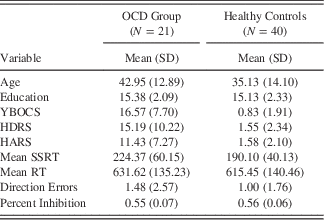
Twenty-one participants with a lifetime diagnosis of OCD were recruited from our hospital clinic, as well as from the general community. Forty-nine healthy controls were also recruited from the local community through flyers at local shops and universities. Eight of the controls were removed, as they had YBOCS severity scores over 8, and one was removed due to SCID-diagnosed bipolar disorder. Thus, 40 healthy control participants were included in the final sample. See Table 1 for demographic and clinical characteristics.
Demographic and clinical characteristics of OCD and healthy control participants

YBOCS=Yale-Brown Obsessive Compulsive Scale severity score; HDRS=Hamilton Depression Rating Scale; HARS=Hamilton Anxiety Rating Scale; SSRT=Stop Signal Reaction Time; RT=reaction time.
OCD participants met DSM-IV criteria for a lifetime diagnosis of obsessive-compulsive disorder. Exclusion criteria for the OCD group included current or past psychotic disorder or a clinical history of post-traumatic stress disorder (PTSD). Controls were free of current psychiatric disorders or past anxiety disorder. Ninety percent of OCD participants were receiving medication. Participants within the OCD sample were prescribed SSRIs (n=16), benzodiazepines (n=10), tricyclic antidepressants (n=4), antipsychotics (n=2), and atypical antidepressants (e.g., Wellbutrin, Effexor; n=8). Informed consent was obtained for this Butler Hospital IRB-approved study.
Procedures
Structured Clinical Interview for DSM-IV
The Structured Clinical Interview for DSM-IV (SCID-IV; First, Spitzer, Gibbon, & Williams, Reference First, Spitzer, Gibbon and Williams2002) is a semi-structured interview for making major Axis I diagnoses. It is administered by trained evaluators and includes an introductory overview, followed by specific diagnostic modules.
Yale-Brown Obsessive Compulsive Scale
The Yale-Brown Obsessive Compulsive Scale (Y-BOCS; Goodman, Price, Rasmussen, Mazure, Delgado, et al., Reference Goodman, Price, Rasmussen, Mazure, Delgado, Heninger and Charney1989) is an evaluator-administered questionnaire assessing severity of OCD symptoms, separated by obsessions and compulsions.
Hamilton Depression Rating Scale (HDRS; Hamilton, Reference Hamilton1960)
The Hamilton Depression Rating Scale (HDRS; Hamilton, Reference Hamilton1960) is an evaluator-administered questionnaire assessing severity of depressive symptoms.
Hamilton Anxiety Rating Scale (HARS; Hamilton, Reference Hamilton1959)
The Hamilton Anxiety Rating Scale (HARS; Hamilton, Reference Hamilton1959) is an evaluator-administered questionnaire assessing severity of symptoms of anxiety.
Y-BOCS Symptom Checklist (Y-BOCS SC; Goodman, Price, Rasmussen, Mazure, Fleischmann, et al., Reference Goodman, Price, Rasmussen, Mazure, Fleischmann, Hill and Charney1989)
The Y-BOCS Symptom Checklist (Y-BOCS SC; Goodman, Price, Rasmussen, Mazure, Fleischmann, et al., Reference Goodman, Price, Rasmussen, Mazure, Fleischmann, Hill and Charney1989) is a questionnaire assessing presence of current or past OCD symptoms.
Stop Signal Task
We used a computerized version of the stop-signal task to assess inhibition of prepotent motor responses (Logan et al., Reference Logan, Cowan and Davis1984). The task, adapted from Aron, Fletcher, Bullmore, Sahakian, and Robbins (Reference Aron, Fletcher, Bullmore, Sahakian and Robbins2003), was made slightly shorter to reduce participant fatigue. Total task time (after practice trials) was approximately 13 min. Participants underwent practice trials in which they were instructed that speed and accuracy were both important and were trained to inhibit themselves on approximately 50% of the trials. They then watched a computer screen on which a series of two blocks of 128 arrows per block were visually presented. Arrows pointed to either the right (50%) or the left (50%), and subjects responded accordingly by pressing the appropriate button.
The presentation order of right- and left-pointing arrows was randomized. In a randomly assigned proportion (25%) of trials, an audible stop-signal was heard after presentation of the arrow, and subjects were instructed to inhibit their motor response on these trials. On stop trials, the delay between the stimulus onset and the tone is termed the stop-signal delay (SSD). The inter-stimulus interval and the stop-signal delay were varied according to the subject’s performance, such that, subjects were able to successfully inhibit their responses on 50% of the stop trials. From these behavioral data, the stop-signal reaction time (i.e., processing time required to inhibit a prepotent motor response) was calculated for each subject. SSRT was estimated by subtracting average SSD from median no-signal reaction time.
Data Analysis
Groups did not differ with regard to education, but the OCD group was significantly older than the healthy control group (t(59)=–2.12; p=.038); thus, age was included as a covariate in the analyses. Analysis of covariance (ANCOVA) was carried out to examine between-group differences between OCD and healthy controls, controlling for age. Post hoc analyses examined differences between the two groups on block 1 and block 2 of the SST. A partial correlation with Pearson’s, covarying for age, was then carried out to determine if there was a relationship between SSRT and symptom severity. For all analyses, statistical significance was defined as p<.01. Effect sizes were calculated for all SST indices using partial eta squared.
Results
There were significant group differences with regard to OCD symptomology (YBOCS), depression (HDRS), and general anxiety (HARS), with the OCD group showing higher levels of clinical symptoms as compared to the healthy controls. Forty-eight percent of OCD participants had “subsyndromal” symptoms, classified as a YBOCS score below 16. Analysis of covariance showed no between-group differences in mean direction errors, “go” reaction time, or percent inhibition on “stop” trials. There were significant differences in mean SSRT for both blocks (F(2,61)=6.00; p=.004), with OCD participants having slower reaction times as compared to healthy controls. Effect sizes were medium to large (partial eta squared=0.171). Post hoc analysis of blocks 1 and 2 independently indicated that the OCD group had higher SSRT across both blocks (Block 1: (F(2,61))=4.27; p=.019; Block 2: (F(2,61))=4.76; p=.012).
We also investigated the relation between SSRT and measures of symptom severity in the OCD group. Mean SSRT did not significantly correlate with measures of OCD current severity (YBOCS total score), depression (HDRS total score), or anxiety (HARS total score) in either block. Exploratory analyses showed that the OCD subgroup with YBOCS scores 16 or over (n=11) had a mean SSRT of 196.83 (SD of 54.16), the OCD subgroup with YBOCS scores below 16 (n=10) had a mean SSRT of 254.67 (SD of 53.24), and, as noted in Table 1, the HC group had a mean SSRT of 190.10 (SD of 40.13). Effect size for the above-threshold OCD group versus the HC group were small (partial eta squared=0.004), and effect size for the below-threshold OCD group versus the HC group was large (partial eta squared=0.274).
Discussion
Previous studies have demonstrated impaired SSRT in OCD (Chamberlain et al., Reference Chamberlain, Blackwell, Fineberg, Robbins and Sahakian2005, Reference Chamberlain, Fineberg, Menzies, Blackwell, Bullmore, Robbins and Sahakian2007; Menzies et al., Reference Menzies, Achard, Chamberlain, Fineberg, Chen, del Campo and Bullmore2007). Consistent with these findings, we found that OCD participants demonstrate impairments in SSRT in the absence of differences in mean reaction time or errors. In contrast to prior studies, we used participants with a lifetime diagnosis of OCD, and they may not have met diagnostic criteria for OCD (YBOCS≥16) at the time of the assessment. There was no relationship between SSRT and measures of depression, anxiety, or OCD severity. In fact, although the subgroups were small, and results should be interpreted with caution, the mean SSRT for the patients with YBOCS scores below what is considered threshold for OCD (YBOCS<16) was surprisingly longer than those above threshold (YBOCS≥16). As noted above, there was no clear relationship between OCD symptoms and SSRT. This may indicate that SSRT represents a trait, rather than a state effect of the disorder. However, future studies should examine the relationship with severity in a larger sample.
Given several limitations to this study (modest sample size, lack of independent replication, lack of information about how recently OCD has remitted), results should be interpreted with caution. Although the sample size was small, particularly in the OCD group, significant findings were demonstrated regardless. OCD participants also had multiple comorbidities, indicating that this deficit may not be specific to OCD. However, our sample was representative of a typical OCD sample, as OCD rarely exists alone. In addition, studies have failed to support significant impairment in SSRT in depression, the most common comorbidity in this sample (Lipszyc & Schachar, Reference Lipszyc and Schachar2010).
Ninety percent of the OCD participants were also on medications, and 70% were on multiple psychiatric medications. The most common medications were SSRIs. This is likely related to the sampling frame, as most of the OCD participants were recruited from a hospital OCD clinic and were in psychiatric treatment. Studies have failed to support changes in SSRT with SRI medication use in controls (Chamberlain et al., Reference Chamberlain, Muller, Blackwell, Clark, Robbins and Sahakian2006; Drueke et al., Reference Drueke, Boecker, Schlaegel, Moeller, Hiemke, Grunder and Gauggel2010). Alternatively, although the majority of patients were not on medications that have a large impact on noradrenaline, reuptake inhibition of this chemical may preferentially impact SSRT in rats (Bari, Eagle, Mar, Robinson, & Robbins, Reference Bari, Eagle, Mar, Robinson and Robbins2009) and humans (Chamberlain et al., Reference Chamberlain, Muller, Blackwell, Clark, Robbins and Sahakian2006).
The inability to inhibit compulsive behaviors in the presence of an anxiety cue is a hallmark feature of OCD. The most effective treatment for OCD, exposure with response/ritual prevention (ERP), relies, at least in part, on this ability. Understanding the mechanisms behind response inhibition in OCD may enable us to use paradigms, such as the SST, as a predictor of outcome in behavior therapy or other therapies for OCD. Novel techniques may also be developed to improve patient’s ability to inhibit rituals to improve response to ERP. Despite the limitations of this study, the results indicate that future research into response inhibition in OCD and related disorders, particularly with regard to relationship with clinical outcome, is warranted.
Acknowledgments
Disclosure: This research was supported by NIH grant MH086400. Author Contributions: Drs. McLaughlin, Greenberg, and Rasmussen designed the study. Dr. McLaughlin and Mr. Kirschner wrote the protocol. Ms. O’Connell and Ms. Foster conducted literature searches and provided summaries of previous research studies. Ms. O’Connell and Mr. Kirschner assisted with data collection, under the supervision of Dr. McLaughlin. Dr. McLaughlin wrote the first draft of the manuscript and all authors contributed to and have approved the final manuscript. Conflicts of Interest: All authors have no conflicts to report.