INTRODUCTION
Farmlands can provide good habitat for some species of birds (Jacobson et al. Reference Jacobson, Sieving, Jones and Van Doorn2003). However, human population pressure, especially in developing countries, has led to intensification of land use, reduction of field margins necessary for prey cover and nest sites, decreased tree cover, poisoning of wildlife and increased erosion and pesticide use (Tella et al. Reference Tella, Forero, Hiraldo and Donazar1998; Green et al. Reference Green, Cornell, Scharlemann and Balmford2005; Thiollay Reference Thiollay2006). Conventional farming practices, characterized by intensive crop management, maximum economic yield and specialization (Benbrook Reference Benbrook1991; Cook Reference Cook1991; Jacobson et al. Reference Jacobson, Sieving, Jones and Van Doorn2003), have resulted in reductions of vegetation structure and food resources for wildlife (Jacobson et al. Reference Jacobson, Sieving, Jones and Van Doorn2003).
Farming practices that are deleterious to birds, particularly the increased use of a wider range of pesticides, pose a serious threat to many species, and have been implicated in the decline of several species and populations (Fuller et al. Reference Fuller, Gregory, Gibbons, Marchant, Wilson, Baillie and Carter1995; Chamberlain et al. Reference Chamberlain, Fuller, Bunce, Duckworth and Shrubb2000; Donald et al. Reference Donald, Green and Heath2001). Farmers often rely heavily on chemicals, causing risks to non-target species and to the environment (Singleton Reference Singleton2003). Birds of prey have been especially affected because they readily ingest prey that has been killed or immobilized by pesticides (Newton Reference Newton1979; Balcomb Reference Balcomb1983). In developing countries pesticides are widely available and their misuse is common (Konradsen et al. Reference Konradsen, Van Der Hoek, Cole, Hutchinson, Daisley, Singh and Eddleston2003). In Kenya, most farmers consider all birds of prey ‘nuisance birds’ because some species prey on domestic fowl and most farmers cannot differentiate between species. Thus, many farmers regard the unintentional killing of any raptors due to pesticide poisoning as a positive result that will reduce predation on free-ranging chickens and other domestic fowl (Odino & Ogada Reference Odino and Ogada2008).
This widely-held negative view of birds of prey amongst Kenyan farmers extends to owls for other reasons. Many African cultures believe that the sight or sound of an owl brings misfortune and even death. Thus, an owl settling on a hut is traditionally regarded as a messenger of death among the Xhosa of South Africa (Godfrey Reference Godfrey1941). In Malawi, more than 90 % of respondents interviewed about their knowledge of owls connected owls with bad luck, witchcraft and death (Enriquez & Mikkola Reference Enriquez, Mikkola, Duncan, Johnson and Nicholls1997). The cultural belief against owls remains strong, and few Africans will tolerate the presence of owls near their homes, but will rather chase them away or kill them by stoning (Enriquez & Mikkola Reference Enriquez, Mikkola, Duncan, Johnson and Nicholls1997). As human populations expand, owls in unprotected areas are increasingly at risk.
Cultural values are only one in a list of key factors that influence human behaviours in conservation (Byers Reference Byers1996). By positively affecting other factors, including farmers' economic situation or knowledge of owls, it may be possible to change antagonistic views of owls.
Amongst avian species, owls are highly sought after by bird watchers. But owls are particularly difficult to locate, so resident owls the presence and location of which are known by locals, can potentially be a focus for avian-based tourism. Bird tourism, though underdeveloped in Kenya, is based on a small niche market of birders keen to see as many bird species as possible, irrespective of the broader landscape situation. Thus, agricultural areas can support small-scale bird tourism that benefits local communities. Support for community projects that benefit wildlife is a fundamental component of community-based conservation (CBC), an approach which aims to make rural people an integral part of conservation efforts (Western & Wright Reference Western, Wright and Wright1994; Hackel Reference Hackel1999). However, CBC is not a panacea for wildlife conservation particularly because it is difficult to provide tangible benefits from conservation to communities in Africa as few benefits trickle down to local communities and few wildlife species can generate sufficient returns to offset costs of tourism such as infrastructure development and security (Infield Reference Infield2001; Adams & Infield Reference Adams and Infield2003).
Apart from tourism, owls potentially benefit farmers by eating crop pests. Therefore increasing farmers' knowledge of owls could increase their acceptance of owls and improve on-farm biodiversity and natural pest control. Improving farmer knowledge and ecological literacy has resulted in large reductions in pesticide use in rice paddies in Asia and subsequently improved fish yields, so that farmers now recognize both the ecological and financial benefits of changes in farm biodiversity (Pretty & Smith Reference Pretty and Smith2004).
As part of a wider study on the ecology and conservation of Mackinder's eagle owls (Bubo capensis mackinderi) in agricultural areas in central Kenya (Ogada Reference Ogada2008), we interviewed small-scale farmers about their farming practices and knowledge and attitudes towards owls. Mackinder's eagle owl is one of two subspecies of the nominate Cape eagle owl (B. c. capensis), with a discontinuous distribution from Zimbabwe to Kenya. The most significant populations of Mackinder's eagle owl occur in Zimbabwe and Kenya, but the subspecies has been recorded in Malawi and Tanzania, and may exist in Uganda (Jackson Reference Jackson1973; Zimmerman et al. Reference Zimmerman, Turner and Pearson1996; Carswell et al. Reference Carswell, Pomeroy, Reynolds and Tushabe2005; Dowsett-Lemaire & Dowsett Reference Dowsett-Lemaire and Dowsett2006). Owing to its affinity for highlands in East Africa, local populations of this regionally-threatened species are generally small and scattered throughout high peaks and rocky valleys (Bennun & Njoroge Reference Bennun and Njoroge1996). The owl is very adaptable to human-altered landscapes where it goes largely unnoticed roosting and nesting on inaccessible cliffs adjacent to agricultural lands over which it forages (Ogada Reference Ogada2008). Because of its close association with human activities, farming practices that are deleterious to owls, such as poisoning of prey species, could have serious and immediate effects on small populations of this owl.
For our study, we interviewed Kenyan farmers about vertebrate pests, including the severity of different pest species and use of control measures, particularly the level of pesticide use. We examined cultural perceptions of owls and the effectiveness of knowledge of owls and receiving benefits from tourism to discourage the chasing and killing of owls. We tested whether farmers' behaviour (i.e. the use of pesticides or other actions harmful to owls) was linked to their knowledge or attitudes towards owls.
We sought to discover whether (1) farmers more knowledgeable about owls and/or receiving benefits from owl-based tourism expressed positive attitudes towards owls, and (2) farmers more knowledgeable about owls and/or receiving benefits from tourism adopted practices less harmful to owls by using pesticides less often or avoiding killing owl prey.
METHODS
Study area
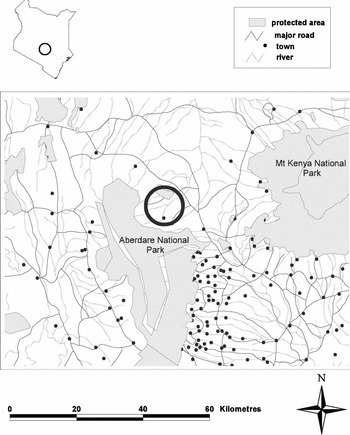
We conducted our research in the highlands of Nyeri District, central Kenya (S 00°11′22′, E 036°47′59′), adjacent to the Aberdare National Park and Forest on unprotected private land or government-owned land occupied by permanent squatters (Fig. 1). Human settlement is mostly in the form of small-scale farms, generally < 1 ha in area. The area comprises seven main population centres, where 1600–9500 people live within and around each centre and the total human population is estimated at 42 900 (GoK 2007). Settlement intensity corresponds to local rainfall patterns with the densest human settlement occurring at the highest elevations with the most rainfall (mean high elevation rainfall c. 110 mm month−1, mean low elevation rainfall c. 83.5 mm month−1). Farmers at higher elevations practise rainfed agriculture, while those at lower elevations use pumps to irrigate farms from adjacent streams and rivers. Most farms are located in valleys as close to water sources as possible. Farms support both subsistence and commercial agriculture. Major agricultural crops are beans, maize, potato, tomato, peas, onions and cabbage. There are 16 owl territories in the study area and a typical territory consists of a cluster of many small farms (minimum 8–24), owned, leased or illegally cultivated. Most farmers reside in villages or homes on the plateaus, not on their farms.
Location of study area in central Kenya.

Human disturbance within the study area was high, although small pockets of marginally degraded habitat exist and a few farms border large ranches that support wildlife. Though large mammals have been extirpated, some medium- and small-sized mammals (namely black-tipped mongoose [Herpestes sanguineus], genet [Genetta sp.], clawless otters [Aonyx capensis], bushbuck [Tragelaphus scriptus], suni [Neotragus moschatus], duiker [Sylvicapra grimmia], zebra [Equus quagga boehmi], colobus monkey [Colobus guereza], rock hyrax [Procavia johnstoni], tree hyrax [Heterohyrax sp.], scrub hare [Lepus saxatilis], crested porcupine [Hystrix cristata], crested rat [Lophiomys imhausi], ochre bush squirrel [Paraxerus ochraceus], numerous murid rodents, and domestic cattle, sheep and goats) remain in small populations (Ogada Reference Ogada2008). Mackinder's eagle owls are the largest resident avian predators.
Project background
Our study built upon initial work conducted on this population of Mackinder's eagle owls over the past 10 years by Paul Muriithi Kibuthu (PMK). Since 1997, he has guided tourists to see the hard-to-locate owls in return for a small fee, which he divides between the farmers whose land he accesses to view the owls. During PMK's interactions with farmers, he has informally educated them about the owls' natural history and explained the beneficial role of owls to farmers. The extra income earned from owl tourists, and knowledge of the ecological importance of owls imparted by PMK has encouraged some of the farmers to protect owls and their habitat. These farmers will not allow others, especially children, to disturb roosting and nesting owls. They also ceased burning vegetation directly adjacent to owl nest sites and they have reported to PMK if they have seen any threats to the owls or noticed any unusual owl behaviour. However, only three owl territories can logistically accommodate tourists, therefore the threat to owls from the local human population varies widely amongst territories.
Interview methods
Interviews were conducted from October to December 2005. Our target was to interview all farmers whose cultivated land was < 100 m from an owl nest or roost at eight different territories. Because the size and location of farms varied widely, in some territories we interviewed farmers whose farms were significantly > 100 m from an owl nest or roost site. In these territories, our aim was to conduct a minimum of eight interviews. At two of these territories we interviewed only two and seven farmers respectively, because we had difficulty in finding farmers to interview during our visits. Overall, we interviewed 72 farmers at eight owl territories, with 2–12 interviews conducted per territory.
We targeted farm owners, rather than hired labourers and only one owner per farm was interviewed. As farms were typically not inhabited, most potential respondents were interviewed while they were working in their farms. Potential respondents were approached by PMK and asked if they would consent to an interview about their farming practices, and knowledge and feelings about owls. If the farmer agreed, the interview proceeded; only one farmer refused to be interviewed.
Interview questions were designed to assess each farmer's knowledge of agricultural pests, the role of owls as natural pest controllers and their potential benefit to farmers, and the effectiveness of education and receiving benefits from tourism to further owl conservation. We collected demographic information including farmer age and gender, and farm history. We asked farmers about the major problems they faced in their work (for example financial, infrastructure or climate) and specifically, which pests were problems on their farms. We then asked farmers about control measures for six pest species or groups, which were common owl prey (Ogada Reference Ogada2008). The six species or groups included the giant pouched rat (Cricetomys gambianus), small mammals (mostly murid rodents, < 150 g in size), root-rat (Tachyoryctes splendens), scrub hare (Lepus saxatilis), weavers (Ploceus spp.) and spectacled mousebirds (Colius striatus kikuyuensis). Small mammals were lumped into the single category of ‘rats’ and all weaver birds were grouped together as the local language does not distinguish between species. We asked farmers which chemicals they used to control pests, and questioned them about their knowledge of and beliefs about owls, whether they were familiar with PMK's work with owls and how they felt towards his work. PMK supplied a list of farmers' names to whom he had given money acquired from owl tourism.
A social scientist from the University of Nairobi reviewed the questions from a cultural context to enhance their appropriateness and correctness of interpretation prior to beginning interviews (see Supplementary material at http://www.ncl.ac.uk/icef/EC_Supplement.htm, Appendix). Pilot surveys were tested with the translator and survey team prior to conducting interviews. We were confident that the presence of a foreigner (DLO) would not affect farmers' responses because most respondents had previously seen DLO in the area and many knew of her and knew that she did not understand Kikuyu.
Interviews were conducted by a paid intern from the National Museums of Kenya Ornithology Section who was new to the area and therefore not known by any of the potential respondents. All interviews were conducted one-on-one in Kikuyu and lasted 15–45 minutes. The interviewer translated answers from Kikuyu into English before recording them onto written forms. Interviews were not tape-recorded.
Interviews took the form of a conversation, structured around a series of specific interview questions that were open-ended (see Supplementary material at http://www.ncl.ac.uk/icef/EC_Supplement.htm, Appendix). Names of pest species were given in the local language. Occasionally, respondents did not fully answer all interview questions and therefore not all percentages of respondents' answers sum to 100 %. Responses were entered verbatim into an Excel spreadsheet. Answers implying the same meaning but using different syntax were combined for analyses.
For analyses, age groups were divided into five categories, namely 17–29, 30–39, 40–49, 50–59, 60–69 and 70–86 years. For comparisons of farmers' beliefs and behaviours by territory location, the territory with only two respondents was omitted. Farmers who received benefits from tourism automatically knew PMK. For analyses, farmers who received benefits were excluded from analyses that tested the effect of knowing PMK on their knowledge or attitudes. We assumed that responses from farmers who received benefits from tourism were influenced by financial rewards from tourism and not because of any education gained by knowing PMK. We made this assumption due to the high levels of poverty in the study area and the fact that behavioural research on conservation motives assumes that individuals act in their greatest economic self-interest (Costanzo et al. Reference Costanzo, Archer, Aronson and Pettigrew1986). Responses were analysed using Pearson chi-squared tests performed with JMP 4.0.3 (SAS) statistical software.
RESULTS
Demographics and background information
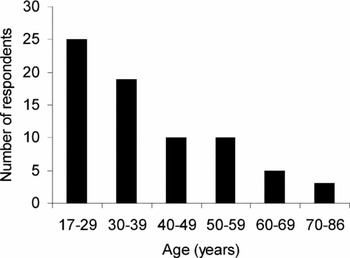
Respondents were 33 % female and 67 % male and ranged in age from 17–86 years (mean 38.9, SE = 1.7, n = 72) (Fig. 2). Although farmers were not asked about their education level, only one farmer was obviously illiterate and another semi-literate; the rest were literate. The farmers had cultivated their farms for a mean of 7.9 years. The majority of the land (73 %) had been cleared by the respondents prior to being cultivated. Nineteen respondents (26 %) benefited from tourism by receiving a portion of the proceeds from owl tourists.
Number of respondents in six age categories

Agricultural pests
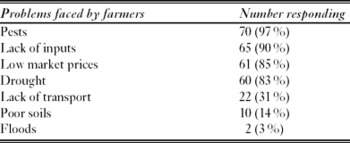
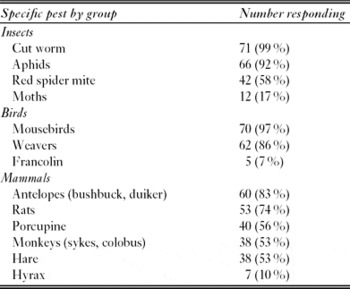
Farmers identified pests as their major problem (97 %), followed by lack of farm inputs (fertilizer, seeds, irrigation) owing either to high prices or lack of availability (90 %) (Table 1). According to farmers, only 2–3 species or groups of insects and birds accounted for the majority of crop damage, but they identified a much larger range of species or groups of mammalian pests (Table 2). Antelope, which included bushbuck (Tragelaphus scriptus), duiker (Sylvicapra grimmia) and suni (Neotragus moschatus), were the most commonly reported mammalian pest. Rats, the general term for all small mammals, were the second most commonly reported mammalian pest. Porcupines (Hystrix cristata), monkeys (Colobus guereza) and hares (Lepus saxatilis) were also reported as significant crop pests (Table 2).
Problems mentioned by farmers. Respondents were allowed multiple answers.

Significant agricultural pests mentioned by farmers. Respondents were allowed multiple answers. (Also mentioned but accounting for < 5 % of responses were thrips, boll worm, leaf miners, locust, beetles, waxbills, common bulbul, blue-eared starling, root rat, otter, wild pig and zebra.)

Pest control practices
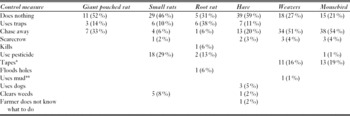
The majority of farmers (81 %) said they used chemical treatments to control agricultural pests. However, most used chemicals solely to control common insect pests (Table 2). Common control measures for mammals and birds were either to do nothing or to physically chase the pests from farms (Table 3). Only 28 % of farmers acknowledged using pesticides to control mammals or birds. Trapping and pesticides were mainly used to control rodents. Carbofuran was used to control rats and mousebirds by 45 % of farmers. Only one farmer mentioned that he did not take action against rodents and hares because he believed the owls fed on them. Plastic tapes (Table 3) strung throughout farms were used to scare away bird pests.
Responses from farmers about control measures used for six vertebrate pests that are also common prey of Mackinder's eagle owls. Numbers indicate number of positive responses (% of whole in brackets). *Cassette or videotapes are unwound from their cartridges and strung horizontally between trees and over crops as tightly as possible. Wind blowing through the tapes creates a low rumbling sound that scares away birds. **Mud is smeared on cobs to support the husk and create an additional barrier to the kernels.

Neighbouring farmers were not more likely to use pesticides than non-neighbouring farmers, thus pesticide use was not evidently influenced by peer-learning or pressure (χ2 = 7.89, df = 6, p = 0.25). Farmers who knew PMK might have more knowledge about owls and their habitats, but pesticide use was not influenced by knowing PMK or receiving benefits from tourism (knowing PMK: χ2 = 2.30, df = 1, p = 0.13; benefiting from tourism: χ2 = 0.36, df = 1, p = 0.55).
Other methods of pest control that could negatively impact owls, primarily hunting or trapping of rodents and hares, were used by 21 % of farmers and use of these methods was not influenced by neighbouring farmers (χ2 = 6.02, df = 6, p = 0.42), knowing PMK (χ2 = 0.06, df = 1, p = 0.81) or receiving benefits from tourism (χ2 = 1.84, df = 1, p = 0.17).
Knowledge of owls
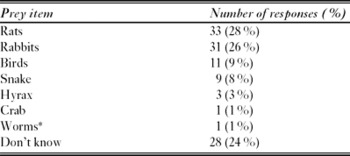
All respondents reported knowing about the owls living in the area and 65 % said that they had seen or heard owls. A majority of respondents (75 %) correctly named at least one type of owl prey. The remaining 25 % of respondents either did not know what owls eat (24 %) or answered incorrectly (1 %) (Table 4). Neither age group, nor gender influenced whether a person could correctly name an owl prey item (age: χ2 = 4.67, df = 4, p = 0.32; gender: χ2 = 1.41, df = 1, p = 0.23). However, farmers that benefited from owl tourism were more likely to know what owls eat than farmers that did not benefit (χ2 = 9.50, df = 1, p = 0.002). Surprisingly, farmers who knew what owls eat were more likely to use pesticides (χ2 = 3.97, df = 1, p = 0.05) or other methods of pest control that killed owl prey (χ2 = 5.72, df = 1, p = 0.02).
Responses to the question, ‘Do you know what owls eat?’ *Incorrect response.

Knowledge of PMK's work with owls
Most farmers (61 %) knew PMK as a member of the community, but 67 % of respondents did not know about his work with owls. Of those respondents who knew of PMK's work with owls, 21 % responded that his work with owls was ‘okay’ or ‘fine’ and 13 % stated that his work with owls was ‘impressive’. Farmers who knew PMK were not more likely to correctly name an owl prey item (χ2 = 2.29, df = 1, p = 0.13).
Cultural beliefs about owls
When asked, ‘What does your ethnic community believe about owls?’, 76 % of respondents said the owls' cry causes death and 6 % said ‘owls cause death’. A further 10 % of respondents said owls are a bad omen. The remaining 8 % of respondents replied that they had heard about their communities' beliefs about owls, but did not elaborate further.
Personal beliefs about owls
When asked, ‘What do you think about owls?’, a majority (68 %) responded that they did not accept the beliefs about owls and of those, 76 % responded that owls were ‘just like any other bird’, but 6 % arbitrarily said they were ‘weird’ birds or that they did not like the look of them. Only 26 % of respondents said they believed in the taboos about owls and of these, 26 % responded that they were ‘weird’ birds or that they did not like the look of them. A final 4 % responded that owls were ‘weird’ birds, but did not elaborate further. There was no correlation between a farmers' age or location, knowing PMK or benefiting from owl tourism and respondents' beliefs about owls, but more women than men believed in the negative superstitions associated with owls (age: χ2 = 0.85, df = 4, p = 0.93; location: χ2 = 5.51, df = 6, p = 0.48; know PMK: χ2 = 0.04, df = 1, p = 0.84; benefited from tourism: χ2 = 2.36, df = 1, p = 0.12; gender: χ2 = 3.68, df = 1, p = 0.05).
Feelings toward owls
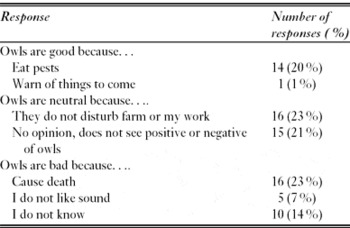
Only 20 % of farmers responded positively about owls, despite the fact that the majority knew that owls eat agricultural pests (Table 5). Most respondents had a neutral feeling toward owls (44 %). Thirty per cent of respondents thought owls were bad and 14 % did not know. Whether or not respondents knew PMK or benefited from tourism affected how they felt about owls. More respondents who knew PMK or benefited from tourism answered owls were ‘good’ or a benefit to them (know PMK: χ2 = 12.84, df = 3, p = 0.005; benefited from tourism: χ2 = 12.71, df = 1, p = 0.005). The more knowledgeable respondents were about owl diet, the more likely they were to respond that owls were ‘good’ for them. Of the farmers who did not know what owls eat, none answered that owls were ‘good’ for them, while the majority who knew what owls eat answered that owls were ‘good’ for them (χ2 = 23.58, df = 3, p < 0.0001).
Responses to the questions ‘Do you think the presence of owls is good or bad for you? Why? Total exceeds 100 % because six respondents answered in more than one category.

DISCUSSION
Crop damage is a serious threat to small-scale Kenyan farmers. Small- to medium-sized antelope (5–55 kg) were the most frequently mentioned mammalian pests, though the impacts of small mammals may have been underestimated by farmers. A few farmers described the diurnal zebra mouse (Lemniscomys sp.) as the species they had seen or killed in their farms, suggesting farmers may know little of the five species of nocturnal rodents known to occur on farms in the study area and that account for 41 % of prey abundance of Mackinder's eagle owls (Ogada Reference Ogada2008).
The use of pesticides to control vertebrate pests was not widespread amongst farmers and pesticides were used primarily to control small mammals and insects. Trapping and hunting of vertebrate pests was only practised by a minority of farmers and likely had little impact on owls as these methods of killing rodents rarely have great effects on the population (Smith Reference Smith and Smith1994). The additional cost of pesticides and the ineffectiveness of both trapping and pesticides were some reasons farmers cited for their lack of use. By necessity, poor African farmers are risk-averse, low-capital investors and cannot afford to apply effective and usually more expensive rodent control measures (Brown Reference Brown and Smith1994). As a result, they often apply control measures too late, use inappropriate methods without much success and often employ excessive quantities of rodenticides (Brown Reference Brown and Smith1994; Singleton Reference Singleton2003).
Our study documented what is becoming increasingly common in Kenya, namely the misuse of carbofuran to kill vertebrate pests or other conflict species (Odino & Ogada Reference Odino and Ogada2008). Almost half of the pesticide applied was carbofuran, which is a broad spectrum insecticide/nematicide used to control soil and foliar insect pests (USEPA [US Environmental Protection Agency] 2006). Carbofuran is highly toxic, relatively cheap compared to other pesticides, and widely available (Odino & Ogada Reference Odino and Ogada2008). Reports and observations of pesticide use during our fieldwork revealed largely unsuccessful attempts at controlling mousebirds using carbofuran. This resulted in the death of a Mackinder's eagle owl that ate a poisoned mousebird during our study (P. Kibuthu, personal communication 2005).
Given the lack of affordability of rodenticides to most farmers, it was not surprising that the majority of them opted to ‘do nothing’ about the pests despite the significant impact on their livelihoods. The other main form of pest control was to ‘chase away’, which obviously is time consuming. In Cameroon, most small-scale farmers shouted to deter animals from damaging their crops (Arlet & Molleman Reference Arlet and Molleman2007). For poor farmers these presumably ineffectual methods of pest control may be their only option.
Mackinder's eagle owls prey on small-mammalian agricultural pests and they were well known to farmers. Despite the benefits owls may offer farmers in reducing pest populations, negative beliefs about owls still persist particularly amongst women.
Knowledge of owl diet was high amongst farmers and this might increase support for owl conservation. In Tanzania, students who were more knowledgeable about wildlife were less likely to say national parks should be discontinued if tourists ceased to visit them than students who knew less about wildlife (Harcourt et al. Reference Harcourt, Pennington and Weber1986). Support for manatees and their conservation has been correlated with boaters' knowledge in Florida (USA) (Aipanjiguly et al. Reference Aipanjiguly, Jacobson and Flamm2003).
An interesting finding of our study was that farmers who benefited from tourism were more likely to know about owl diet. Providing financial incentives to poor farmers is clearly important. However, it is not clear if financial rewards may influence farmers' abilities to learn and retain knowledge because farmers who benefit from tourism may interact with tourists and learn more about owls. But our finding suggests that financial or other in-kind benefits may go beyond influencing attitudes toward wildlife as has been shown in previous studies (Gadd Reference Gadd2005; Gillingham & Lee Reference Gillingham and Lee1999; Infield Reference Infield1988; Mehta & Kellert Reference Mehta and Kellert1998) and may in fact influence knowledge of beneficiaries.
Although farmers who had knowledge of owl diet or received benefits from owl tourism showed a higher appreciation of owls, those that knew about owl diet were more likely to use pesticides or kill owl prey on their farms. Thus, knowledge of owls was not associated with farmer behaviours that benefited owls. This finding suggests that farmers who knew about owls may also know more about pest control strategies. It is likely farmers may not connect pesticide use or the killing of owl prey as being harmful to owls in the same way that most farmers knew owls eat agricultural pests, but did not think owls benefited them.
CONSERVATION IMPLICATIONS
Poor farmers need affordable and effective methods of pest prevention and control, particularly for vertebrate pests. Without these, farmers will continue to use cheap, highly toxic insecticides to poison vertebrate pests that have far-ranging harmful ecological effects for biodiversity conservation.
Promoting biodiversity conservation on farms can mitigate crop damage from pests (Pretty & Smith Reference Pretty and Smith2004) and species that consume a lot of rodents and other vertebrate pests can be beneficial to farmers. The acceptance of culturally taboo animals such as owls is unlikely to occur without education initiatives, and these need to stress the beneficial role of predators to farmers. But giving people new information about conservation benefits does not necessarily change their behaviour (Byers Reference Byers1996). Ultimately, receiving financial benefits will likely be the biggest motivating factor for changing attitudes and even this may not alter farmer behaviour.
Rarely can birds attract tourism revenue that can offset costs and provide benefits to entire communities (flamingos in Kenya's Rift Valley lakes may be an exception). Thus, tourism revenues will be small from less-charismatic or nocturnal bird species such as owls. If owls and other predators are to persist in agricultural areas, it is also important for farmers to understand the ecological benefits of owls. However, it is equally important for conservation practitioners to understand the context and motivations of behaviours and to acknowledge the importance of factors other than conservation education and economic benefits including, ownership and empowerment factors that influence environmental behaviour (Byers Reference Byers1996).
ACKNOWLEDGEMENTS
We gratefully acknowledge the support and cooperation of the Ministry of Education of the Republic of Kenya and National Museums of Kenya. This research was funded by National Geographic Society Conservation Trust, SeaWorld & Busch Gardens Conservation Fund, John Ball Zoo Society Wildlife Conservation Fund, Peregrine Fund-East Africa Project, Miami Metrozoo, Leslie Brown Memorial Grant and Tarrytown FWC. Dr Penninah Ogada gave helpful comments on the content of interview questions. Esther Muthoga conducted the interviews. Father Boniface of Gataragwa Catholic Parish provided logistical support. Comments by Adrian Craig, Douglas Sheil and two anonymous reviewers greatly improved this manuscript. We thank the farmers from Kiawara, Bellevue, Watuka and Ngare Ngiro communities who participated in interviews, which were the foundation for this research.