INTRODUCTION
In his foundational work, March (Reference March1991) argues that the fundamental tension in the center of a firm's long-term survival is the need to exploit existing assets and capabilities for short-term profits and, at the same time, to explore new knowledge and technologies to ensure its future success (March, Reference March1991; O'Reilly & Tushman, Reference O'Reilly and Tushman2013). In his view, developing the capability for resolving tensions between exploration and exploitation is essential for system survival and prosperity. Researchers conceptualized this capability as organizational ambidexterity (Birkinshaw & Gupta, Reference Birkinshaw and Gupta2013; Nosella, Cantarello, & Filippini, Reference Nosella, Cantarello and Filippini2012).
Several researchers have provided evidence that organizational ambidexterity is linked to better performance in a fast-changing environment (He & Wong, Reference He and Wong2004; Hill & Birkinshaw, Reference Hill and Birkinshaw2014). However, it is a rather complex challenge for firms to achieve organizational ambidexterity (Levinthal & March, Reference Levinthal and March1993; March, Reference March1991). It is because the achievement of ambidexterity involves simultaneously pursuing two incompatible objectives, which requires contradictory structures, processes, and capabilities in one firm (He & Wong, Reference He and Wong2004; Tushman & O'Reilly, Reference Tushman and O'Reilly1996). As March (Reference March1991) has persuasively argued, both exploration and exploitation are self-reinforcing and competing for scarce resources, which eventually causes them to crowd each other out.
Building on the work of March (Reference March1991), research on ambidexterity has viewed exploration and exploitation as distinct and incompatible processes, and conceptualizations of ambidexterity have mainly focused on the inherent tensions and conflicts between exploration and exploitation (Gupta, Smith, & Shalley, Reference Gupta, Smith and Shalley2006). The main approaches to ambidexterity accept this assumption and have proposed either structural (spatial) or sequential (temporal) separation strategies as a way for addressing conflicts (Cunha, Bednarek, & Smith, Reference Cunha, Bednarek and Smith2019; O'Reilly & Tushman, Reference O'Reilly and Tushman2008). Others, like contextual ambidexterity (Gibson & Birkinshaw, Reference Gibson and Birkinshaw2004), have suggested that in an ambidextrous organizational context, competing frames can be balanced at the individual level, which has departed from March's (Reference March1991) original view of framing exploration and exploitation as paradoxical in nature. To be consistent with the seminal work of James March (Reference March1991), we maintain the assumption of conflict between exploration and exploitation and only focus on structural and sequential approaches in this study.
The pursuit of both exploration and exploitation through structural or sequential separation is proved to be feasible and beneficial to organizational performance (He & Wong, Reference He and Wong2004; O'Reilly & Tushman, Reference O'Reilly and Tushman2004). Structural approaches to ambidexterity posit the way that spatially separates exploration from exploitation across different organizational units (Jansen, Tempelaar, Van den Bosch, & Volberda, Reference Jansen, Tempelaar, Van den Bosch and Volberda2009; Lubatkin, Simsek, Ling, & Veiga, Reference Lubatkin, Simsek, Ling and Veiga2006), whereas sequential approaches emphasize temporally shifting among competing activities that promote exploration or exploitation, respectively (Gupta et al., Reference Gupta, Smith and Shalley2006; Jansen, George, Van den Bosch, & Volberda, Reference Jansen, George, Van den Bosch and Volberda2008; O'Reilly & Tushman, Reference O'Reilly and Tushman2013). Although they both define ambidexterity, the two approaches differ strongly in their configuration (Cannaerts, Segers, & Warsen, Reference Cannaerts, Segers and Warsen2020). Structural ambidexterity emphasizes the separate structures with different measurement and incentive systems (Benner & Tushman, Reference Benner and Tushman2003), and the role of the top management team as a means for strategic integration (García-Granero, Fernández-Mesa, Jansen, & Vega-Jurado, Reference García-Granero, Fernández-Mesa, Jansen and Vega-Jurado2018). Sequential ambidexterity, meanwhile, has been described with the shifting of centrifugal and centripetal structures and processes in a firm's competitive environment (Sheremata, Reference Sheremata2000; Volberda, Reference Volberda1996).
Implicitly, these two approaches are treated as discrete alternatives and mutually exclusive (Cunha et al., Reference Cunha, Bednarek and Smith2019). However, extant authors have ignored the possibility that companies may deliberately deploy different approaches of ambidexterity, in a way that structural and sequential separation co-present in companies at the same time (Foss & Kirkegaard, Reference Foss and Kirkegaard2020). Ambidexterity scholars have predominantly emphasized the two approaches are initially proposed as separate ways to deal with the achievement of ambidexterity, but have less insight about the combination between structural and sequential approaches, and the organizational configurations that advance such combination (Kauppila, Reference Kauppila2010; O'Reilly & Tushman, Reference O'Reilly and Tushman2013), which is a major meaningful gap in the current study.
Researchers have only recently begun to consider that blended modes may be more convincing to fully explain ambidexterity in the realistic enterprise activity (Cunha et al., Reference Cunha, Bednarek and Smith2019; Foss & Kirkegaard, Reference Foss and Kirkegaard2020; Hansen, Wicki, & Schaltegger, Reference Hansen, Wicki and Schaltegger2019). As Foss and Kirkegaard (Reference Foss and Kirkegaard2020) have argued, blended ambidexterity is a deliberate choice involving the challenge of combining different logics and is better to reflect the nature of the market faced. In a similar vein, some researchers argue that firms are likely to create ambidexterity through a combination of different types of antecedents at multiple organizational levels, rather than through any single organizational antecedent alone (Harris & Wood, Reference Harris and Wood2020; Kauppila, Reference Kauppila2010). In this regard, a combination of structural and sequential ambidexterity can be configured in different ways and thus call for research regarding ambidexterity to take a configurational approach that involves a systems perspective in which the two modes are viewed in holistic fashion (Ortiz De Guinea & Raymond, Reference Ortiz De Guinea and Raymond2020).
In response, we advance a configurational approach to combine structural and sequential ambidexterity in which we stress how structural and temporal antecedents that generate both exploration and exploitation fuse into one mode in organizations. Consequently, two research questions addressed by this study are as follows:
1. How do structural and sequential approaches combine to achieve high ambidexterity?
2. What are the different organizational configurations that equally lead to high ambidexterity regarding the combination of structural and sequential approaches?
In posing these questions, we aim to capture a comprehensive picture of how a firm can create ambidexterity in a blended and configurational way, combining insights from studies on structural ambidexterity and sequential ambidexterity. To this end, we introduce the set-theoretic methods, in particular the fuzzy-set qualitative comparative analysis (fsQCA) to conduct configurations of blended ambidexterity (Crilly, Zollo, & Hansen, Reference Crilly, Zollo and Hansen2012; Ragin, Reference Ragin2009). By identifying how effects combine to produce outcomes (Lacey & Fiss, Reference Lacey, Fiss, King, Felin and Whetten2009), fsQCA is particularly appropriate for advancing the holistic insights about how an ambidextrous organization can be systematically built.
We have designed a two-stage study to investigate 102 firms – a pilot study with 10 firms before turning to the investigation of another 92 firms. To understand the organizational elements in prior literature that support both structural and sequential ambidexterity, we have conducted interviews in stage one, and finally filtered out eight elements that are at the core of organizational configurations for ambidexterity from the external environmental level to internal organizational and individual levels. And then questionnaire surveys to collect the quantitative data of 92 firms are conducted in stage two. Along with documentary evidence, we set up a database and average the different data source for each firm as input of fsQCA.
Based on our findings, we first advance a quadripartite approach to structure and compare these configurations, and identify four patterns for achieving high organizational ambidexterity, two separate ones and two blended ones. We then explore the inherent link between organizational ambidexterity and organizational design regarding the configurations for combining structural and sequential approaches, which are concluded as two mechanisms of multielements (complements and substitutes) and multilevels (fit and interaction). Finally, we introduce the ‘Yin-Yang’ framework to interpret the rationality of combining the structural and sequential approaches and find that it fit well with the ideas of this Chinese indigenous cognitive frame.
Our contribution to organizational ambidexterity theory is threefold: (1) we introduce a configurational perspective to combine structural and sequential approaches which are treated as exclusive in existing studies. The results fit well with recent arguments for studying organizational ambidexterity from a holistic perspective, which is grounded in the complexity and configurational approach (Ortiz De Guinea & Raymond, Reference Ortiz De Guinea and Raymond2020; van de Wetering, Mikalef, & Helms, Reference van de Wetering, Mikalef and Helms2017). (2) We demonstrate the possibility of integrating structural and sequential approaches by combining different organizational elements through configurational design to achieve high organizational ambidexterity. Inherent link between organizational ambidexterity and organizational design regarding the configurations for combining structural and sequential approaches is explored, which can serve as the logic foundation of ‘blended ambidexterity’, answering Foss and Kirkegaard's calls for expanding ambidexterity research in a blended way (Foss & Kirkegaard, Reference Foss and Kirkegaard2020). (3) We embed our findings into the ‘Yin-Yang’ framework and explain the mechanism of combining structural and sequential approaches in the logic of ‘dominant-subordinate’, which introduces the ‘asymmetrical balancing’ mechanism of the ‘Yin-Yang’ framework (Li, Reference Li2014) into the ambidexterity literature. Such research might serve scholars and practitioners with a more holistic and sophisticated view on organizational configurations that support the pursuit of exploration and exploitation.
THEORETICAL BACKGROUND
Structural and Sequential Approaches to Ambidexterity
Organizational ambidexterity was first introduced by Duncan (Reference Duncan1976), and was later adapted to denote the successful pursuit of contradictory activities inside firms, such as exploration and exploitation (Duncan, Reference Duncan1976; March, Reference March1991). Drawing on March's (Reference March1991) initial work, we define organizational ambidexterity as the capability that organizations can accomplish high levels of both exploration and exploitation in this study.
Essentially, exploration and exploitation are conceptualized as two fundamentally different activities (Gupta et al., Reference Gupta, Smith and Shalley2006; March, Reference March1991; Martin, Keller, & Fortwengel, Reference Martin, Keller and Fortwengel2019). Exploration includes activities like search, variation, risk-taking, discovery, innovation, research, and development (Auh & Menguc, Reference Auh and Menguc2005), while exploitation involves refining, production, efficiency, selection, implementation, and execution activities (March, Reference March1991). The two processes are regarded as incompatible, competing for organizational scarce resources, and requiring different organizing and management methods (Foss & Kirkegaard, Reference Foss and Kirkegaard2020; Levinthal & March, Reference Levinthal and March1993; March, Reference March1991).
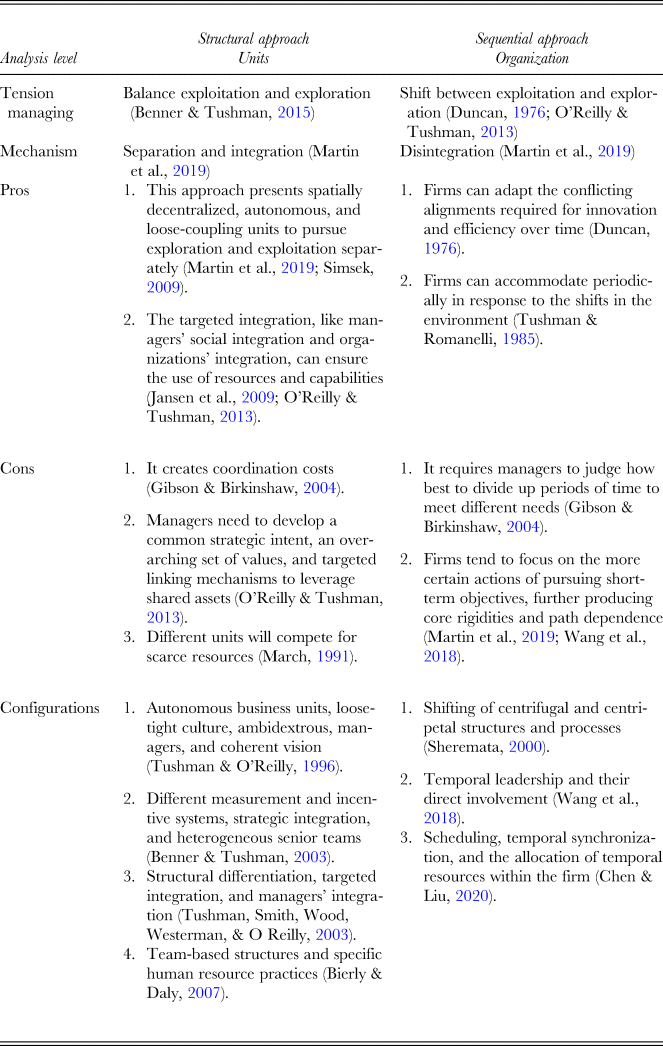
Drawing from this assumption, research on ambidexterity has proposed either structural (spatial) or sequential (temporal) approaches to address the tensions between exploration and exploitation (Cunha et al., Reference Cunha, Bednarek and Smith2019; O'Reilly & Tushman, Reference O'Reilly and Tushman2008). The structural approach is grounded on the spatial separation of organizational units – each unit is equipped with one of ‘paradoxical’ activities (Benner & Tushman, Reference Benner and Tushman2003). Tushman and O'Reilly (Reference Tushman and O'Reilly1996) suggest that ambidextrous organizations manage long-term growth and short-term efficiency simultaneously through the structural separation of independent units (Tushman & O'Reilly, Reference Tushman and O'Reilly1996). The sequential approach implicates a dynamic perspective on the decision of ‘either exploitative or exploratory’ and is realized through the enabling mechanism of temporal separation (Raisch, Birkinshaw, Probst, & Tushman, Reference Raisch, Birkinshaw, Probst and Tushman2009). This temporal dimension determines whether a firm would pursue ambidexterity simultaneously or sequentially over time (Blarr, Reference Blarr2012). Although the two approaches both define ambidexterity, they differ strongly in their characteristics as shown in Table 1. In particular, organizational factors that foster configurations for structural and sequential ambidexterity are different (Cannaerts et al., Reference Cannaerts, Segers and Warsen2020).
Characteristics of structural and sequential approaches

One of the important issues is that the literature of ambidexterity usually treats the two approaches as mutually exclusive and does not recognize that firms may intentionally deploy different approaches of ambidexterity at the same time (Foss & Kirkegaard, Reference Foss and Kirkegaard2020). As Foss and Kirkegaard (Reference Foss and Kirkegaard2020) have argued, ambidexterity scholars have ignored the possibility that different types of approaches may be co-present in companies, and even within business units at the same time. Consequently, these challenging views regarding ambidexterity have led to calls for researchers to explore the impact of combining different types of approaches on organizational ambidexterity, as well as the configurations of combining these approaches (Cunha et al., Reference Cunha, Bednarek and Smith2019; Foss & Kirkegaard, Reference Foss and Kirkegaard2020; Hansen et al., Reference Hansen, Wicki and Schaltegger2019). We seek to address these open questions in this study.
Configurational Design of Organizational Ambidexterity
The configurational approach includes a systems perspective and allows scholars to focus on how organizational aspects are linked together within cases (Fiss, Marx, & Cambré, Reference Fiss, Marx and Cambré2013; Ortiz De Guinea & Raymond, Reference Ortiz De Guinea and Raymond2020), which can help scholars explore the path to achieve organizational ambidexterity more comprehensively and integrate the theory and practice better. Accordingly, research on organizational ambidexterity are suggested to be carried out from a configurational perspective (Jansen et al., Reference Jansen, Tempelaar, Van den Bosch and Volberda2009; O'Reilly & Tushman, Reference O'Reilly and Tushman2013; Simsek, Reference Simsek2009), and it does not only come from the pursuit of exploratory and exploitative activities, but also from the way in which these activities or behaviors are effectively mobilized and integrated to produce new combinations within the organization (Jansen et al., Reference Jansen, Tempelaar, Van den Bosch and Volberda2009; O'Reilly & Tushman, Reference O'Reilly and Tushman2008).
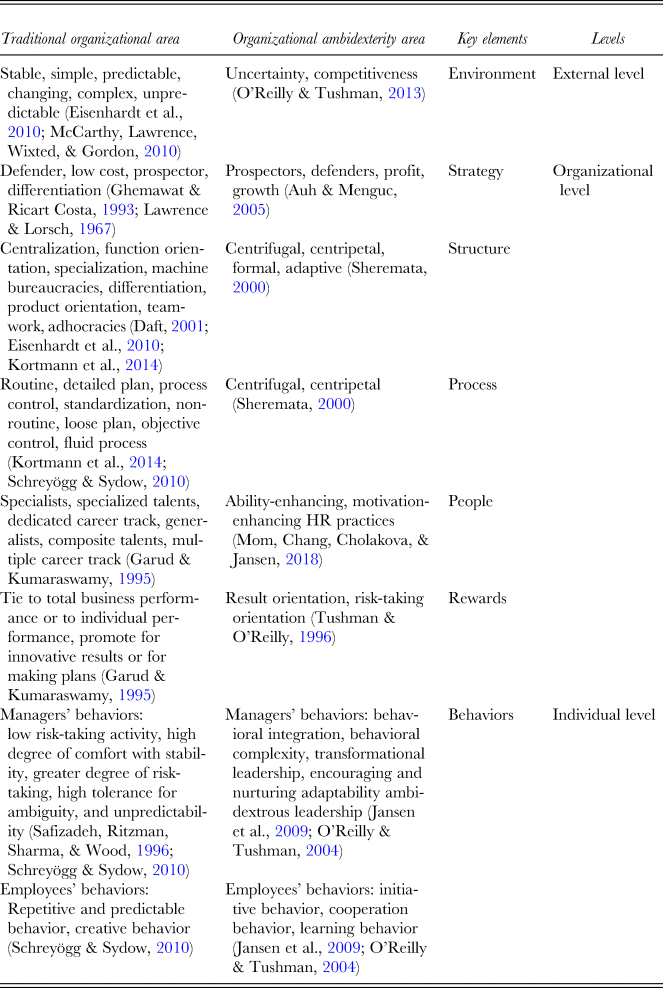
From the middle of the past century, issues related to the configurational approach have been well discussed in the context of traditional organizations (Burns & Stalker, Reference Burns and Stalker1961; Daft, Reference Daft2001; Mintzberg, Reference Mintzberg1980). Scholars have extensively explored the organizational design elements that constitute the configurations (Stanford, Reference Stanford2007). For example, Leavitt (Reference Leavitt and March1965) has proposed a framework of organizational systems that contained four elements – structure, task, technology, and staff; Mintzberg (Reference Mintzberg1980) has suggested that every organization had five parts, including the technical core, top management, middle management, technical support, and administrative support; In Galbraith's Star Model™, we could find the organizational configuration includes five elements – strategy, structure, process, people, and rewards (Galbraith, Reference Galbraith2014). Others have classified these elements by using a mechanistic-to-organic structural dimension (Adler, Goldoftas, & Levine, Reference Adler, Goldoftas and Levine1999). Organic structures are typically connected with loose coupling, open communication, improvisation, and de-emphasized on formal rules and procedures, while mechanistic structures reflecting tight coupling, routinization, control, and bureaucracy (Eisenhardt, Furr, & Bingham, Reference Eisenhardt, Furr and Bingham2010; Lawrence & Lorsch, Reference Lawrence and Lorsch1967). The views of these scholars have proved that the basis of the configuration is organizational elements (see Table 2), which is supported by Meyer, Tsui, and Hinings (Reference Meyer, Tsui and Hinings1993) who proposed the configurational approach to organizational analysis should focus on the complex interactions among elements of a system in producing an outcome.
Key elements of configurational design choices

Therefore, applying the configurational approach to the study of organizational ambidexterity, we should focus on the influence of the composition of the set of organizational design elements and deepen our understanding of how these elements complement or substitute each other to affect organizational ambidexterity (Huang, Battisti, & Pickernell, Reference Huang, Battisti and Pickernell2021; Zimmermann, Hill, Birkinshaw, & Jaeckel, Reference Zimmermann, Hill, Birkinshaw and Jaeckel2020). Relevant researches have suggested different antecedents to resolve tensions between exploration and exploitation, for example, organizational structures (O'Reilly & Tushman, Reference O'Reilly and Tushman2004), human resource systems (Patel, Messersmith, & Lepak, Reference Patel, Messersmith and Lepak2013; Prieto & Pilar Pérez Santana, Reference Prieto and Pilar Pérez Santana2012), and senior management teams (García-Granero et al., Reference García-Granero, Fernández-Mesa, Jansen and Vega-Jurado2018). It is also proposed that in order to achieve countervailing functions of exploration and exploitation, organizations have to successfully manage the technology, organizational structure, operating processes, and labor requirements (e.g., Kortmann, Gelhard, Zimmermann, & Piller, Reference Kortmann, Gelhard, Zimmermann and Piller2014; Rivkin & Siggelkow, Reference Rivkin and Siggelkow2003). Since the organizational attributes for exploration and exploitation collide, the combination of exploration and exploitation would require a hybrid configurational design (Doty, Glick, & Huber, Reference Doty, Glick and Huber1993), as Foss and Kirkegaard (Reference Foss and Kirkegaard2020) suggest that blended approach for achieving ambidexterity requires making choices regarding organizational design elements, such as job descriptions, decision rights, rewards, channels of communication, and the allocation of resources (Foss & Kirkegaard, Reference Foss and Kirkegaard2020).
Further developing this idea, we have identified some key organizational elements through literature, and finally filtered out eight elements that are at the core of organizational design from three levels (see Table 2), which can respond to the research needs to explore the configurational recipes of organizational ambidexterity.
METHODS
In this study, we employed a set-theoretic approach based on the fsQCA, which is an analytic technique applying a configurational understanding of how causal conditions work conjointly to bring about outcomes (Fiss, Reference Fiss2011; Ragin, Reference Ragin2009). By using the logic of set theory to conceptualize cases as the configurations of causal attributes, fsQCA examines members of the set of the outcome, and identifies combinations of attributes associated with the outcome of interests. In fsQCA, a case is understood as the combination of ‘causal conditions’ and the ‘outcome’ (Ragin, Reference Ragin2000). The comparison of cases using Boolean algebra and algorithms allows a logical reduction of numerous, complex causal conditions, resulting in a reduced set of configurations that lead to the outcome (Fiss, Reference Fiss2011). This approach lies between conventional qualitative and quantitative analyses, combining the complexity of case analyses with a degree of generalizability through formal analysis (Crilly, Reference Crilly2011). fsQCA has been deliberately designed to both conceptualize and analyze the causal complexity of organizational phenomena (Fiss, Reference Fiss2007; Misangyi et al., Reference Misangyi, Greckhamer, Furnari, Fiss, Crilly and Aguilera2017).
fsQCA is appropriate for this study due to the three central features of our research questions. First, fsQCA is particularly well suited for viewing organizations as configurations and examining the interdependence of causal effects of organizational outcomes (Fiss et al., Reference Fiss, Marx and Cambré2013). It examines the combination of various causal conditions rather than the influence of a single condition on the outcome (Ragin, Reference Ragin2000). Prior analysis suggests that there are multiple causes and mechanisms of organizations to achieve ambidexterity, such as sequential ambidexterity and structural ambidexterity, involving structures, processes, top managers, and other organizational elements (O'Reilly & Tushman, Reference O'Reilly and Tushman2013; Turner, Swart, & Maylor, Reference Turner, Swart and Maylor2013). The realization of exploration and exploitation in organizations is the result of interactions among various elements. There is no single element that can lead to ambidexterity on its own. Thus, the causal conditions and outcomes are ‘best understood in terms of set membership’ (Fiss, Reference Fiss2007; Misangyi et al., Reference Misangyi, Greckhamer, Furnari, Fiss, Crilly and Aguilera2017). fsQCA helps to investigate how various organizational elements conjointly interact to form the configurations that lead to ambidexterity.
Secondly, by identifying how effects combine to produce outcomes, fsQCA is particularly appropriate for the advancement of multilevel theory (Lacey & Fiss, Reference Lacey, Fiss, King, Felin and Whetten2009). fsQCA, as a fuzzy-set approach, does not concern about the isolated and independent effects of each level, but the combined causal effects at different levels (Greckhamer, Reference Greckhamer2011). Organizational ambidexterity, in essence, is considered ‘a multilevel phenomenon’ (Birkinshaw & Gupta, Reference Birkinshaw and Gupta2013; Raisch & Birkinshaw, Reference Raisch and Birkinshaw2008). Embracing multilevel attributes is very important for understanding the underlying mechanisms of achieving organizational ambidexterity (Schreyögg & Sydow, Reference Schreyögg and Sydow2010). With/through fsQCA, we explore these mechanisms by looking at the elements through external, organizational, and individual levels, and study the complex forms of interactions and complementarities among them, which is normally hard to achieve through traditional quantitative methods.
Thirdly, fsQCA offers researchers a tool to conduct both a deep qualitative analysis of cases and a cross-case systematic comparison (Schneider & Wagemann, Reference Schneider and Wagemann2012). Through the in-depth understanding of cases, we decide whether a case belongs to a certain set. By using Boolean algebra, fsQCA also ensures us a formal analytical tool to capture the diversity of causal combinations and enables us to systematically analyze the combinations of elements across different levels linked to the organizational ambidexterity in this study (Fiss et al., Reference Fiss, Marx and Cambré2013).
Data Collection
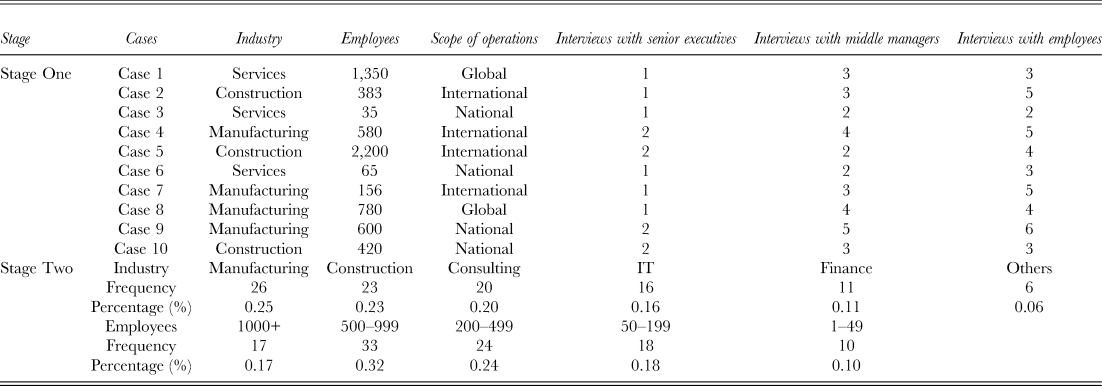
The data collection process for this study includes two stages – a pilot study with 10 firms before turning to the investigation of another 92 firms. Stage one, we investigated 10 firms in China and conducted semi-structured interviews with different types of interviewees including executives, middle managers, and first line employees, as shown in Table 2. The average length of each interview is no less than 30 minutes, and all interviews were recorded and subsequently transcribed. These interviews ended with filling questionnaires to collect the quantitative data, and collected questionnaires with 14 senior executives, 31 middle managers, and 40 employees.
Stage two, with the help of the ‘Entrepreneur Alliance Program’, we grouped and selected 92 firms to be investigated, which has differences in their types, operating environments, and scales, and it is helpful to ensure the diversity of our data. In this stage, we collected questionnaires with 92 senior executives and 100 employees from the 92 firms.
The total samples of 102 firms contribute rich data sources: (1) 85 deep interviews with senior executives, middle managers, and employees, (2) 277 questionnaires from the interviewees of 102 firms, (3) public reports, published cases, and internal strategy documents of the 102 enterprises. By integrating the different data sources into one database and averaging the multiple questionnaires of the same firm, we finally get the case data for each firm as input of fsQCA. Table 3 provides detail of the cases.
Summary of the data

Measures and Calibrations for Set Membership
The outcome of interest in the present study is the achievement of organizational ambidexterity. While most case firms were likely to pursue some combinations of exploration and exploitation, we defined the case with high ambidexterity when it scored high on both exploration and exploitation. Draw on March (Reference March1991)'s original work, we assessed exploration and exploitation respectively with two items, which are adapted from the coding of interviews. Based on the combined ambidexterity perspective, we measured organizational ambidexterity with the ‘interaction’ between exploration and exploitation (Cao, Gedajlovic, & Zhang, Reference Cao, Gedajlovic and Zhang2009; Simsek, Reference Simsek2009).
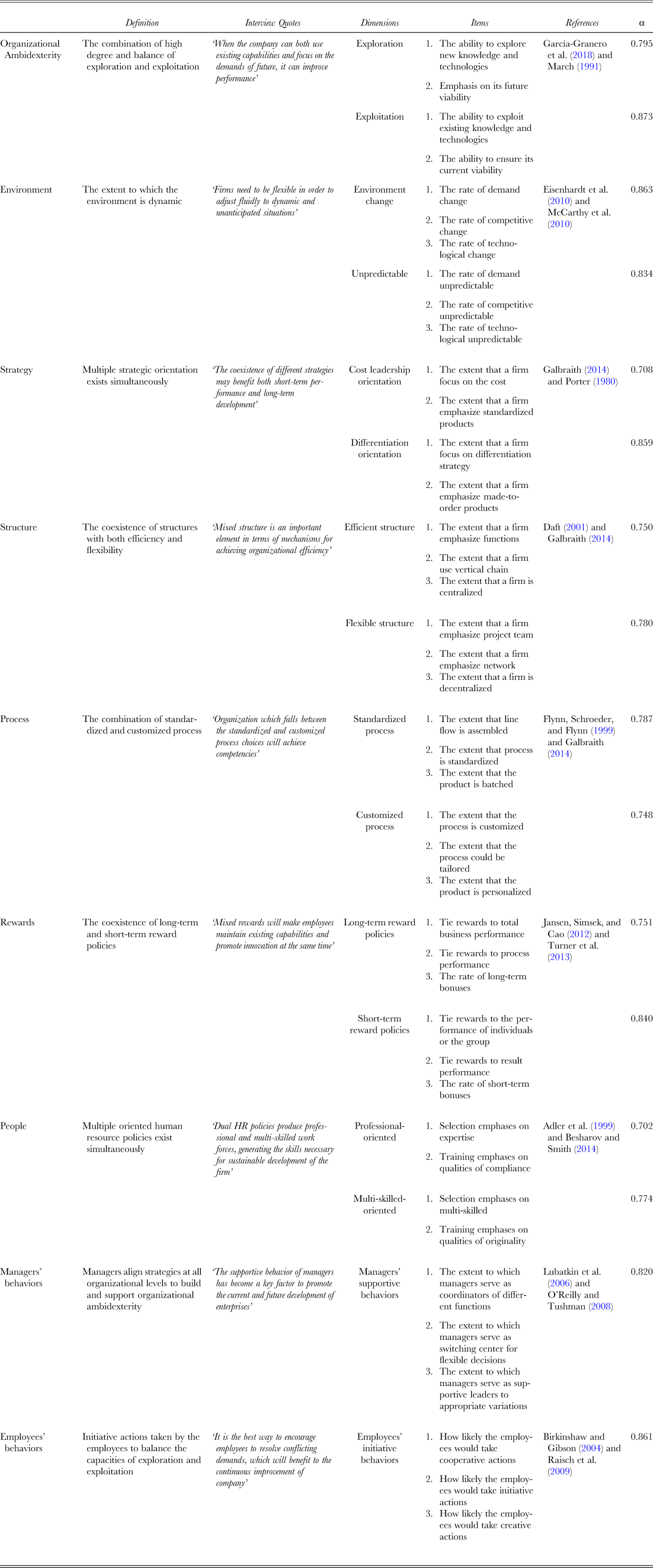
The causal conditions connected to ambidexterity were identified based on the organizational design elements of configuration, which comprises environment as the element of external level, five organizational elements – strategy, structure, process, rewards, people – as the organizational level, and behaviors of managers and employees as the individual level. According to the descriptions of these conditions in ambidexterity literature (shown in Table 2), these elements are characterized with both exploration and exploitation dimensions (Ebben & Johnson, Reference Ebben and Johnson2005) in this study. To ensure the accuracy of the measurement, we assessed these elements refer to the existing mature scales and made adaptive modifications according to the coding of qualitative evidence gathered from the cases. Measurement of outcome and conditions are shown in Table 4.
Measurement of outcome and conditions

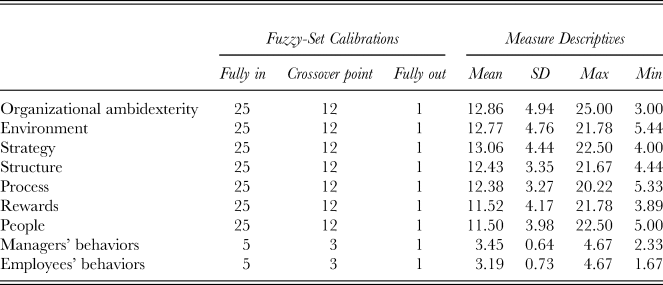
In this study, the variables were calibrated to fuzzy sets by the direct method, which used three thresholds with full membership (0.95), full non-membership (0.05), and a crossover point of maximum ambiguity of membership (0.5) (Fiss, Reference Fiss2011; Greckhamer, Reference Greckhamer2016; Ragin, Reference Ragin2006). According to Cao et al. (Reference Cao, Gedajlovic and Zhang2009), some of the conditions and outcome were measured with the ‘interaction’ between two dimensions in this article, for example, organizational ambidexterity = exploration * exploitation, we obtained the score for these variables from 1 to 25. We set the crossover point as 12 – the 50th percentile values of 1–25, as we mainly focus on high organizational ambidexterity, and we can get more precise configuration results in this way. The reasons why we use ‘interaction measure’ (multiplying two dimensions) are as follows: (1) The way we use multiplication is a both/and logic, which is consistent with the conditions’ definitions that are characterized with ambidextrous dimensions. (2) The multiplicative product result can not only ensure the balance of the two dimensions of ambidexterity, but also can make sure that they are both at a high degree. Thus, we can use the result of the product as the basis for judging whether the organization has achieved high ambidexterity – we regard the conditions as present or the organization achieving high ambidexterity only when the product result exceeds 12. We transformed the outcome and conditions into set membership as shown in Table 5. The basic descriptive statistics of the variables are reported as well.
Fuzzy-set membership calibrations and measure descriptive statistics

Once the three thresholds of full membership, full non-membership, and the crossover point were defined, all of these conditions were transformed from raw scores into set measures ranging from 0 to 1, known as the truth table. The transformation was automated in the software of fsQCA 3.0 and outputted the truth table. The data used in this study can be accessed at an open science framework database.
RESULTS
Necessity and Sufficiency Analyses
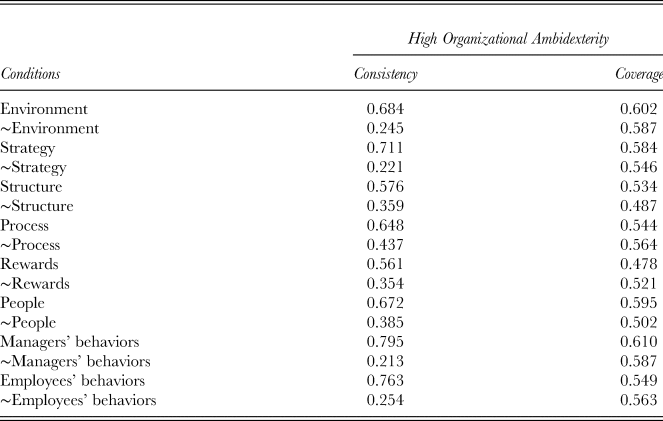
Following past recommendations (e.g., Rihoux & Ragin, Reference Rihoux and Ragin2008; Schneider & Wagemann, Reference Schneider and Wagemann2012), we conducted necessity analyses of all attributes and their negation, applying the recommended consistency benchmark of 0.90 (Schneider & Wagemann, Reference Schneider and Wagemann2012), and evaluated the conditions’ coverage to ensure that any potentially necessary conditions were also empirically nontrivial (Gabriel, Campbell, Djurdjevic, Johnson, & Rosen, Reference Gabriel, Campbell, Djurdjevic, Johnson and Rosen2018). Table 6 shows the result of the necessity analyses of eight causal conditions for high organizational ambidexterity. Our analysis did not result in any necessary conditions as the consistency value of all conditions is less than 0.9. This means attribute combinations linked to high organizational ambidexterity should be examined.
Necessity analyses

Notes: We conducted sufficiency analysis using fsQCA 2.5, applying a consistency benchmark of ≥0.8 (Ragin, Reference Ragin2009) complemented by a PRI score benchmark of ≥0.7 (Du & Kim, Reference Du and Kim2021; Greckhamer, Furnari, Fiss, & Aguilera, Reference Greckhamer, Furnari, Fiss and Aguilera2018) to avoid simultaneous subset relations of configurations in both the outcome and its absence (Schneider & Wagemann, Reference Schneider and Wagemann2012).
Robustness Checks
Given that QCA is a set theory method, we use one of the set theory specific methods – adjusting the consistency threshold for robustness testing (Ragin, Reference Ragin2009). Schneider and Wagemann (Reference Schneider and Wagemann2012) believe that the raw consistency threshold selected by the researcher will determine the number of truth table rows (that is, the number of configurations) in the process of minimizing the analysis, thereby affecting the final analysis result (Schneider & Wagemann, Reference Schneider and Wagemann2012). Learning from Ordanini, Parasuraman, and Rubera (Reference Ordanini, Parasuraman and Rubera2014), we reran our sufficiency analysis with a higher consistency threshold of 0.85 (compared with consistency benchmark of ≥0.8 used in our main models). The solutions remained similar (Ordanini et al., Reference Ordanini, Parasuraman and Rubera2014).
Configuration Analyses
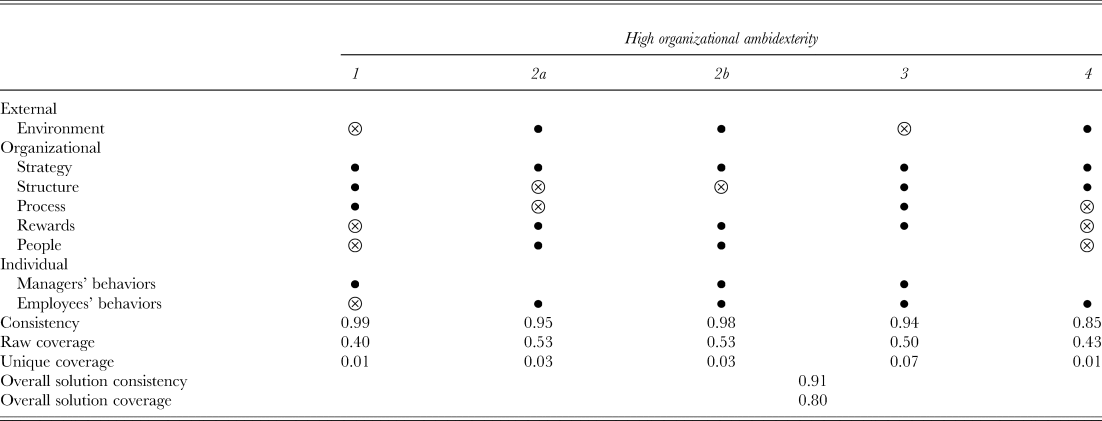
Table 7 shows that five configurations of causal conditions were consistently linked to membership in the set of cases with high organizational ambidexterity. We reported the intermediate solutions consisting of core and peripheral conditions. The format of presenting the results was based on Ragin (Ragin, Reference Ragin2009). The peripheral conditions were represented by smaller symbols (black circles ‘ ’ indicate the presence, and circles with a cross-out ‘
 ’ indicate the absence) compared to the core conditions. We also reported measures of consistency and coverage for the overall solution and each individual configuration.
Configurations for high organizational ambidexterity

Notes: Black circles indicate the presence of a condition, and circles with ‘x’ indicate its absence. Large circles indicate core conditions; small ones, peripheral conditions. Blank spaces indicate ‘don't care’.
We grouped the solutions in accordance with core conditions. In general, the results showed the evidence of set-theoretic relationships and supported the existence of both first-order and second-order equifinality (Fiss, Reference Fiss2011). By mentioning first-order equifinality, we mean the equifinal types of exhibiting different core characteristics (e.g., Configuration 1 vs. Configuration 3). Second-order equifinality, on the other hand, means neutral permutations within a given first-order equifinal type (e.g., Configuration 2a vs. Configuration 2b). By outlining the multilevel characteristics, we have named five configurations that support organizations to pursue both exploration and exploitation.
Static environment-differentiated structure-managers’ integration
Configuration 1 combines the absence of the dynamic environment, mixed rewards, dual HR policies, and employees’ initiative behaviors together with the presence of ambidextrous structures as core conditions, along with multiple strategies, combined process, and managers’ supportive behaviors as the complementary conditions. It suggests that in a static environment, lacking mixed rewards, dual HR policies, and employees’ initiative behaviors, the paradox of exploration–exploitation also can be dealt with if there are ambidextrous structures and strategy, combined process, and supportive behaviors of top managers. The key feature of this causal path is the differentiation in organizational structures, supplemented by integrative behaviors of top managers. In this situation, this configuration is consistent with the most common structural approaches in existing ambidexterity research (O'Reilly & Tushman, Reference O'Reilly and Tushman2013). By reviewing the interview data obtained at Stage 1, we have found that case 9 is consistent with this configuration. As a mature manufacturing company, core business units are responsible for routine work and exploit existing capabilities, whereas the separated R&D department is responsible for grasping new demands emerging in the market and developing new products.
Dynamic environment-ambidextrous strategy-managers’ and employees’ support
Configuration 2a and 2b combines the presence of multiple strategies as core conditions along with the complementary conditions of dynamic environment, mixed rewards, dual HR policies, and employees’ initiative behaviors, together with the absence of ambidextrous structures. Configuration 2a and 2b both show that firms embedded in dynamic environments can achieve both high exploitation and exploration mainly through their ambidextrous strategies, mixed rewards, and dual HR policies. This is consistent with sequential ambidexterity, which shifts the structure over time to align with firm's strategy and environment (Boumgarden, Nickerson, & Zenger, Reference Boumgarden, Nickerson and Zenger2012). Among the companies we have interviewed, case 10 falls into this configuration. Case 10, a construction company, tends to diversify its strategy and market positioning in response to the changing environment. According to changes in the environment, it makes dynamic adjustments in the regular businesses and new businesses in new fields. Correspondingly, rewards and staff policies are adjusted along with the ongoing projects. By comparing the differences between Configuration 2a and 2b, there are trade-offs between top managers’ behaviors and process. Configuration 2b takes managers’ supportive behaviors as its complementary conditions while Configuration 2a takes the combined process, which implies that as long as top managers’ supportive behaviors are present, the firm is able to achieve ambidexterity – with or without ambidextrous processes. This means that the presence of top managers’ supportive behaviors and the absence of the combined process are substitutive to achieve ambidexterity.
Through comparing Configuration 1 and Configuration 2, we posit our first proposition:
Proposition 1: Structural approach is a better match to the static environment, and sequential approach is more in line with the dynamic environment.
Static environment-diversified rewards-managers’ and employees’ support
Configuration 3 regards mixed rewards as core conditions, supported by the complementary conditions of multiple strategies, ambidextrous structures, combined process, managers’ supportive behaviors, and employees’ initiative behaviors, along with the absence of the dynamic environment. It shows that when mixed rewards are the core condition, whether its human resource policy is ambidextrous has little impact on the outcome. We have reviewed the case information and found that case 4 matched this configuration. As a manufacturing company, case 4 deals with relatively stable orders most of time, only occasionally receiving new demands. At this point, the firm will integrate the R&D department and production department into a temporary organization in which allows them to work together toward a specific task goal in a given period of time, so that it can obtain synergies across the different units. This configuration provides a cooperative relationship and a shared basis of understanding, cutting the boundaries across the two units and breaking the communication barriers (Jansen et al., Reference Jansen, Tempelaar, Van den Bosch and Volberda2009). In this way, exploitive and explorative activities can be taken into account through the separated structure and temporary objective-based mechanism (Gupta et al., Reference Gupta, Smith and Shalley2006; Jansen et al., Reference Jansen, George, Van den Bosch and Volberda2008), to support an emphasis of incremental product innovation in a relative static environment (Foss & Kirkegaard, Reference Foss and Kirkegaard2020). In this regard, Configuration 3 can be understood as a solution that blends structural approach with sequential approach.
Dynamic environment-ambidextrous strategy-employees’ initiatives
Configuration 4 combines the presence of employees’ initiatives as core conditions, together with complementary conditions of dynamic environment, multiple strategies, and ambidextrous structures, along with the absence of combined process, mixed rewards, and dual HR policies. It indicates a possible scenario that in a dynamic environment, firms mainly rely on employees’ initiative behaviors, multiple strategies, and ambidextrous structures to achieve ambidexterity. Reviewing the investigation of the cases, we have found small-scale new ventures matched this configuration. For example, case 3, a start-up consulting company, not only needs to reduce cost, but also needs to respond promptly to and fulfill customers’ requirements in a dynamic environment. Limited and scarce resources often make ventures more inclined to focus on short-term actions, resulting in organization myopia (Martin et al., Reference Martin, Keller and Fortwengel2019; O'Reilly & Tushman, Reference O'Reilly and Tushman2013; Wang, Luo, Maksimov, Sun, & Celly, Reference Wang, Luo, Maksimov, Sun and Celly2018). However, case 3 can balance short-term benefits with long-term growth just because of it hiring a small group with strategic visions, assisting the firm planning its future development to adapt the rapidly changing competitive environment. From here, we see that one single approach is not feasible for the small-scale new ventures due to resource constraints, and thus they seek some combinations of different approaches (Wang et al., Reference Wang, Luo, Maksimov, Sun and Celly2018). Taken together, Configuration 4 reflects a solution that blending sequential approach with the structural approach, which is a result achieved under a dynamic environment. Analyzing Configuration 3 and Configuration 4, we propose the following:
Proposition 2: Structural approach and sequential approach can be combined to compensate for each other's drawbacks, thus facilitating the organization to achieve high ambidexterity.
In conclusion, we have reviewed the five configurations for high organizational ambidexterity and offer the following proposition:
Proposition 3: Organizations can achieve ambidexterity through the interaction of multiple organizational elements from multiple levels.
DISCUSSION
The purpose of this study is to explore the configurations of organization design choices associated with the combination of structural and sequential approaches to high ambidexterity, which could advance our understanding on interrelations between structural and sequential approaches and their combination mechanism in achieving ambidexterity. From a systematic and holistic configuration perspective, we apply the analytical framework including eight organizational design elements across environmental, organizational, and individual levels. We then introduced the fuzzy-set analysis to examine how these conditions combine to deal with tensions between exploration and exploitation.
Noteworthily, the configurations identified for high ambidexterity demonstrate that different approaches can be combined with each other to achieve ambidexterity. Configuration 1 is a typical structural approach, and Configuration 2 (2a and 2b) is more likely to be a sequential approach. Configuration 3 and Configuration 4 seem to be solutions that successfully combine the structural approach and the sequential approach, where Configuration 3 relies mainly on the structural approach while making sequential approach subsidiary, and Configuration 4 is just the other way around.
Interlink and Interaction Between Structural and Sequential Approaches
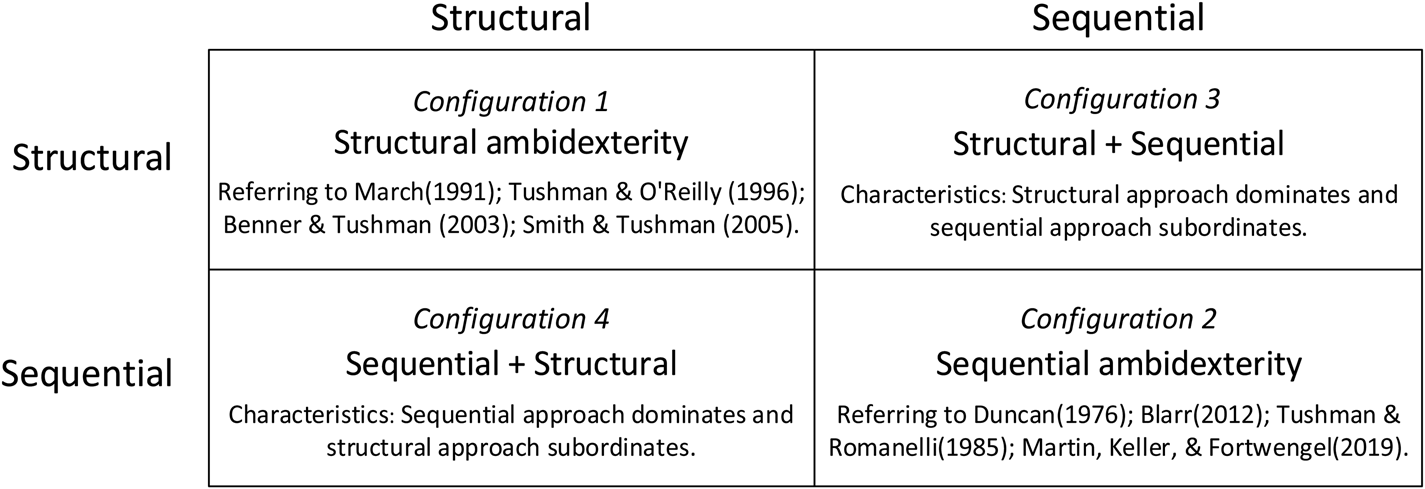
Our first contribution to organizational ambidexterity theory is to explore the interlink and interaction between structural and sequential approaches from a configurational perspective. We have found four patterns for achieving high organizational ambidexterity (see Figure 1), where structural ambidexterity (Configuration 1) and sequential ambidexterity (Configuration 2) fit accurately into the spatial and temporal separation strategies (Cunha et al., Reference Cunha, Bednarek and Smith2019; O'Reilly & Tushman, Reference O'Reilly and Tushman2008); the patterns represented by Configuration 3 and Configuration 4 confirm the assumption that these separate approaches can be combined in a way that one approach dominates and the other subordinates.
Four patterns for achieving high organizational ambidexterity

The structural + sequential pattern (Configuration 3) indicates that based on structural differentiation, disadvantages (e.g., competing for scarce resources and coordination costs) associated with the structural approach can be addressed by integrating exploratory and exploitative units into a temporary organization, which assembles employees across different types of units to strive to accomplish a specific task within a given period (Jansen et al., Reference Jansen, Tempelaar, Van den Bosch and Volberda2009; Liu & Leitner, Reference Liu and Leitner2012). In this pattern, temporary mechanism can make up the limitations of structural differentiation, enabling integration of exploration and exploitation in every temporary task. This view is consistent with the idea that apart from social integration of the management teams, ambidextrous organizations need formal organizational integration mechanisms to provide necessary horizontal linkages across the different units (Jansen et al., Reference Jansen, Tempelaar, Van den Bosch and Volberda2009).
The sequential + structural pattern (Configuration 4) adopts a long-term mechanism on the basis of dynamically adjusting strategies and shifting structures over time. More specifically, firms can cover the deficiencies (e.g., organizational myopia) of sequential approach by forming an ambidextrous structure that ventures can take into account the present and future. It also answers the call that studies should reveal the effects of structural attributes for spatial and temporal separation of ambidexterity (Jansen et al., Reference Jansen, Tempelaar, Van den Bosch and Volberda2009). In sum, the patterns of Configuration 3 and Configuration 4 show that the core feature of combining structural and sequential approaches is that they can bridge each other's shortcomings, which is the value of the blended patterns. Compared with the two separate approaches, the blended approach encourages a broader range of applications in practice (Foss & Kirkegaard, Reference Foss and Kirkegaard2020; Ortiz De Guinea & Raymond, Reference Ortiz De Guinea and Raymond2020). Thus, we have answered the first research question of this study.
Inherent Link Between Organizational Ambidexterity and Organizational Design
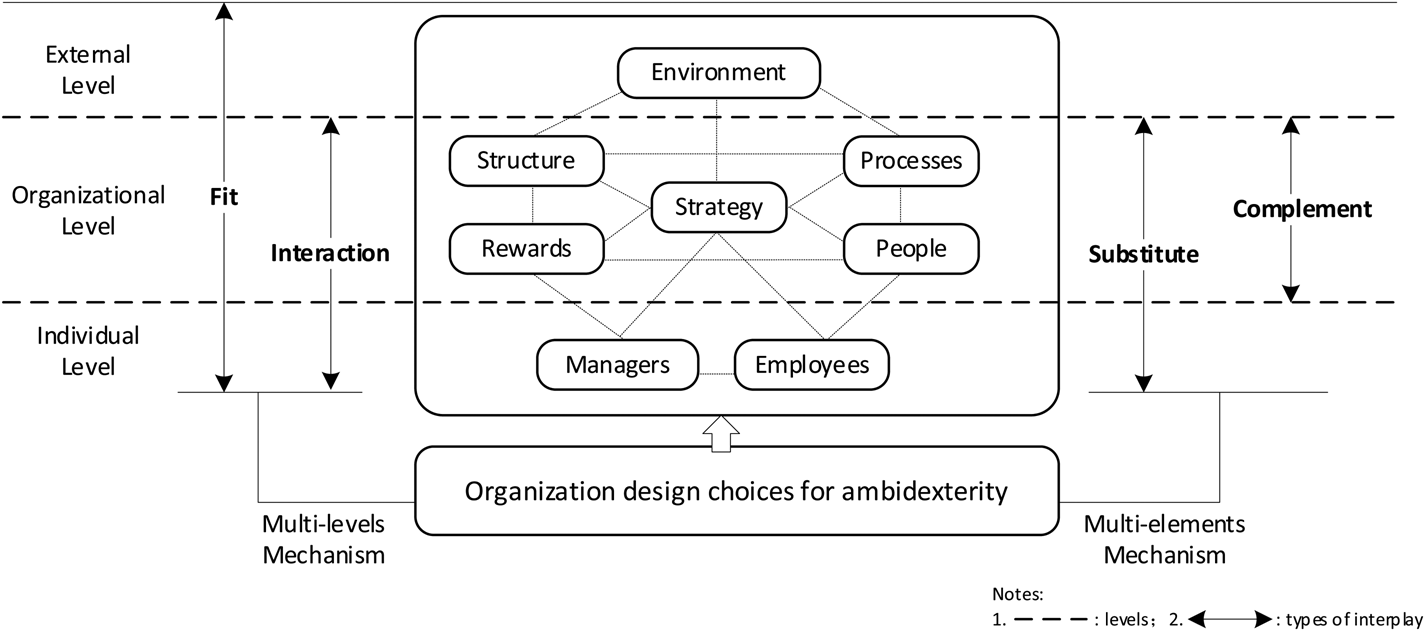
Our second contribution is to discuss the inherent link between organizational ambidexterity and organizational design regarding the configurations for combining structural and sequential approaches, which are concluded as two mechanisms of multielements and multilevels (see Figure 2).
Multielements and multilevels mechanisms in designing ambidextrous organization

Firstly, by adopting a configurational perspective, our results show that organizations can achieve ambidexterity through interaction of multiple organizational elements, while no single factor alone is sufficient to produce high organizational ambidexterity (as the consistency value of all conditions is less than 0.9 in necessity analyses). This is supported by Park, Pavlou, and Saraf (Reference Park, Pavlou and Saraf2020) who propose that organizational ambidexterity is achieved by the complex interdependencies among multiple organizational elements, rather than by any single element in isolation. Furthermore, by answering calls for adopting configurational approach to illustrate conflicting views emanating from sequential approach and structural approach (Fiss, Reference Fiss2011; Ortiz De Guinea & Raymond, Reference Ortiz De Guinea and Raymond2020; Wilden, Devinney, & Dowling, Reference Wilden, Devinney and Dowling2016), our results show that the competing approaches can be integrated by combining different organizational design elements which serve as complements or substitutes in constituting these configurations (see Figure 2).
Analyzing Configuration 3 and Configuration 4, we believe that the structural and sequential approaches are not completely opposed to each other but can be well integrated. The common feature of the two configurations is that the way they achieve ambidexterity reflects a combination of hard (e.g., structure and process) and soft (e.g., rewards and behaviors) organizational design elements. Configuration 3 integrates different units into a temporal organization to bridge the weaknesses in horizontal communication, and combine soft elements (e.g., rewards) to ensure specialization advantages and encourage individuals’ proactivity (Foss & Kirkegaard, Reference Foss and Kirkegaard2020). This view is consistent with the idea that ambidextrous organizations need formal organizational integration mechanisms to provide necessary horizontal linkages across exploratory and exploitative units (Jansen et al., Reference Jansen, Tempelaar, Van den Bosch and Volberda2009). Configuration 4 reflects that the hard elements which belong to the structural approach (e.g., structure, process) also can overcome the limitations of sequential approach (e.g., organizational myopia) through combining soft elements (e.g., employees’ behaviors), which answers the call that studies should reveal the effects of structural attributes for spatial and temporal separation of ambidexterity (Jansen et al., Reference Jansen, Tempelaar, Van den Bosch and Volberda2009). Hence, the structural and sequential approaches to achieve ambidexterity are complementary, not alternative, through the complement or substitute of different organizational design elements (Kortmann, Reference Kortmann2012). Complement occurs between hard and soft elements, where applying one practice would raise the value of employing another practice (e.g., Configuration 3 structure and rewards); while substitute occurs within hard or soft elements, where the presence of either one would lead to the same outcome (e.g., Configuration 4 rewards and employees’ behaviors).
Secondly, we propose that organizational design elements achieving ambidexterity are multilevel. Dominant theories have described the triggers, conditions, and approaches that shape organizational ambidexterity from individual, organizational, and external environmental levels, yet few studies have combined these perspectives (Harris & Wood, Reference Harris and Wood2020). We argue that there is complex interplay among external environment, internal organization, and individuals in fostering an ambidextrous organization, which are summarized as fit and interaction (Birkinshaw & Gupta, Reference Birkinshaw and Gupta2013).
The interplay between external and internal levels (organizational and individual) are viewed as fit. We draw this conclusion from the comparison of Configuration 3 and Configuration 4. In this comparison, we can see clearly about how the environment affects organization design choices in achieving ambidexterity. High ambidexterity is more likely to be dominated by elements of organizational-level in a relatively static environment (e.g., Configuration 3); while the organization is more biased toward individual-level elements in a dynamic environment (e.g., Configuration 4). While previous researches have primarily regarded the environment as a possible moderator for organizational ambidexterity (Junni, Sarala, Taras, & Tarba, Reference Junni, Sarala, Taras and Tarba2013; Simsek, Reference Simsek2009), our study shows that the choices of conditions in terms of achieving high ambidexterity is associated with the degree of environmental dynamism. This finding is aligned with the idea that activities should be organized differently in response to their internal and external environments (Eisenhardt et al., Reference Eisenhardt, Furr and Bingham2010).
Meanwhile, the results of Configuration 3 and Configuration 4 offer a multilevel explanation of interaction between organizational and individual levels and suggest the necessity of multilevel interaction and combination in dealing with the exploration–exploitation paradox. The findings echo the emerging literature on the microfoundations of organizational ambidexterity which takes the related multilevel interdependences into consideration (Harris & Wood, Reference Harris and Wood2020).
The Blended Approach and ‘Yin-Yang’ Framework
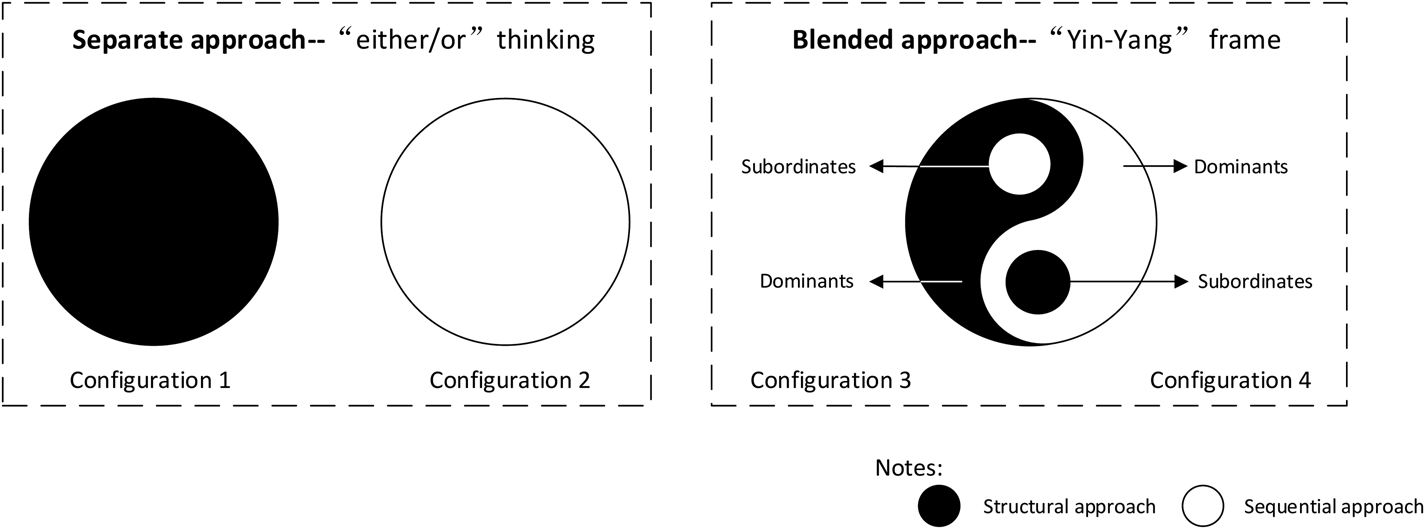
Our third contribution is that we introduce a Chinese ideological and cultural system – ‘Yin-Yang’ framework (Li, Reference Li2014) to interpret the mechanism of integrating structural and sequential approaches, which is shown in Figure 3.
The relationship between blended approach and ‘Yin-Yang’ framework

Existing studies treat the structural approach and sequential approach as exclusive, regarding them as incompatible with an ‘either/or’ thinking (O'Reilly & Tushman, Reference O'Reilly and Tushman2013). This logic denies the possible coexistence of paradoxical elements in the same place at the same time, while firms may indeed intentionally deploy different ambidexterity approaches (even within the same business unit) at the same time (Foss & Kirkegaard, Reference Foss and Kirkegaard2020; Li, Reference Li2014). And the ‘either/or’ logic is insufficient to explain why and how concerning the coexistence of trade-off and synergy as the ambidexterity required for the balance between exploration and exploitation (Li, Reference Li2014; March, Reference March1991).
Therefore, we try to use the ‘Yin-Yang’ framework to interpret the rationality of combining the structural and sequential approaches, which can fully recognize and appreciate the coexistence of paradoxical approaches in the same place at the same time (Li, Reference Li2008, Reference Li2014; Li, Leung, Chen, & Luo, Reference Li, Leung, Chen and Luo2012). Firstly, we have embedded them into the ‘Yin-Yang’ framework (see Figure 3) and found that they could fit well with the ideas of this Chinese indigenous cognitive framework. A mutually reinforcing effect can be achieved, and thus organizations can create an internal dynamic for structural and sequential approaches to co-exist in the long term. The inner logic of blended patterns is to learn from others’ strong points and overcome one's weak points. This logic explains why the contradictory approaches can co-exist from a perspective of dynamics, which is in line with the view of ‘Yin-Yang’ framing that treats the paradoxical approaches as not only partially contradictory for trade-off but also partially complementary for synergy (相生相克 in Chinese) with a ‘either-and’ thinking (Li, Reference Li2014).
Secondly, the mechanism that structural and sequential approaches can be blended shown by Configuration 3 and Configuration 4 also echo the ‘asymmetrical balancing’ mechanism of ‘Yin-Yang’ framing, where one of the approaches is dominant while the other is subordinate (Li, Reference Li2014, Reference Li2016). As shown in Figure 3, Configuration 3 implies that the structural approach is taken as the dominant while the sequential approach is taken as the subordinate so that explorative activities can also occur temporarily (e.g., incremental product innovation) cross separated units in a relative static environment; Configuration 4 implies that the sequential approach is taken as the dominant while the structural approach is taken as the subordinate for introducing the long-term mechanism in a sequentially alternating context to shape an ambidextrous structure. As the ‘asymmetrical balancing’ treats the yin and yang opposites as unitary entities, we apply the same logic to explain the structural and sequential approaches. We believe that the ‘Yin-Yang’ framework is best positioned to manage paradoxes in a unique manner and has the unique value of truly explaining paradox by reframing paradox into duality as opposites-in-unity (Li, Reference Li1998, Reference Li2008; Li et al., Reference Li, Leung, Chen and Luo2012).
Implications for Understanding March's Rationales of Ambidexterity
Our study also has implications for understanding March's rationales of ambidexterity. Firstly, it answers March's call – loose coupling – for multilevel analysis of ambidexterity. Our findings show that organizations are complex combinations of activities, goals, and meanings; they complete the coordinated tasks, and it will be unimaginable without them. This striking integration of the formal organizations should not conceal the many ways where organizations are loosely coupled (March, Reference March1981). Adaptation requires a balance between exploration and exploitation but is continually threatened by the tendency of each to extinguish the other. To some extent, whether action is treated as originating from expectations and preferences using a logic of results or from the application of rules to situations using a logic of appropriateness, it must be suitable for ecological contexts. Interactive views on conflict are an important contribution to the ecological view of organizational behavior, but they are by no means the whole ecological story (March, Reference March1996).
Secondly, March was interested in papers that discuss how Chinese ideas and organizations have ways of conceiving, confronting, or embracing ambiguity (Augier, March, Rhee, & Zhou, Reference Augier, March, Rhee and Zhou2012). Based on the investigation and research of Chinese companies, we have found parts that echo Chinese culture. In the Chinese ideological and cultural system, we call it ‘Yin-Yang’, which means a cognitive system of balancing the opposite dimensions as partially contradictory and complementary (Li, Reference Li2016). In our study, the elements of casual conditions are characterized with both exploration and exploitation attributes, which fits the ‘holistic content’ tenet of the Yin-Yang framework. Besides, the five configurations imply that ambidexterity is multilevel, and the outcome is associated with the combination of attributes from different levels. This is supported by the Yin-Yang framework, because it takes all entities at all levels as holistic and dynamic systems (Li et al., Reference Li, Leung, Chen and Luo2012). This is a response to the core view of the Yin-Yang framework that opposite elements are always partially complementary and partially conflicting so that they must seek their holistic and dynamic balancing within the boundary of a given threshold (Li, Reference Li2016). Similarly, under the guidance of this Chinese epistemology, our study might advance our understanding on the impact and interrelation of external contexts, organizational design, and individual behaviors on achieving ambidexterity.
By introducing the fuzzy-set approach into the realm of ambidexterity, we initiate a novel way of examining the multilevel cause–effect relationships in achieving organizational ambidexterity. Our findings prove that a set-theoretic approach is able to explore the equifinal configurations and their core and peripheral conditions, which are not easily examined by standard, non-Boolean approaches. This study proves that the QCA method can be a promising and appropriate approach to examine the complexity of organizational ambidexterity.
Regarding the managerial implications of this study, reflective practitioners could benefit from taking a wider view on the array of design choices and operating modes for managing ambidexterity. Our study provides five equifinal paths to achieve organizational ambidexterity. Achieving both exploration and exploitation simultaneously can be difficult and usually costly. Instead of focusing on the ambidextrous design of every individual organizational element, top managers can orchestrate ambidexterity by choosing the most reasonable and effective solution as suggested by us. Our study also suggests that firms need to combine the elements across different levels in their organizational design and pay extra attention on the role of behaviors.
Limitations and Future Research Directions
This study has limitations too. First, the limited size of our sample did not permit statistical testing for more than eight causal conditions. Other factors such as firm size and industry also play a critical role in achieving ambidexterity, but they were not incorporated into the study. Secondly, the outcome we examine in this study is to achieve ambidexterity, which means high exploitation and high exploration. The opposite of high ambidexterity is low ambidexterity, however, it is not within the scope of this study. Future research should investigate those low ambidexterity cases, which allows for a thorough and comprehensive understanding on the approach for ambidexterity.
DATA AVAILABILITY STATEMENT
The data that support the findings of this study are openly available in Open Science Framework at https://osf.io/84bxs/