Influenza causes substantial morbidity and mortality in the United States, with an estimated 140,000–810,000 hospitalizations and 12,000–61,000 deaths occurring annually since 2010. 1 Although hospitalization is often evaluated as an outcome of influenza, it can also be a risk factor for influenza virus infection. Reference Nesher, Tsaban and Dreiher2
Hospital-acquired (HA) influenza occurs despite hospital infection control measures. Outbreaks of HA influenza have been shown to account for considerable expenses in antiviral treatment, Reference Wilson, Wood and Schaecher3 antibiotic use, Reference Shiley, Lautenbach and Lee4 increases in length of hospital stay, Reference Naudion, Lepiller and Bouiller5 and poor clinical outcomes. Reference Sayers, Igoe and Carr6,Reference Zhou, Li and Gu7 Multiple studies have been published describing outbreaks and case series of HA influenza, Reference Wilson, Wood and Schaecher3,Reference Chow and Mermel8–Reference Ostovar, Kohn, Yu, Nullet and Rubin10 yet its prevalence in the United States is likely underestimated given that most studies rely on clinician-driven testing to identify cases of HA influenza. Comprehensive studies that characterize HA influenza across a wide variety of healthcare systems in the United States are lacking. An earlier study conducted through the US Influenza Hospitalization Surveillance Network (FluSurv-NET) during the 2010–2011 season found that 172 (2.8%) of 6,171 patients hospitalized with laboratory-confirmed influenza had onset of infection during their hospitalization. Reference Jhung, D’Mello and Perez11 In the United States and Canada, studies have shown prevalence rates of hospital-acquired or hospital-onset influenza ranging from 2% to 7% of influenza-related hospitalizations, depending on the setting. Reference Wilson, Wood and Schaecher3,Reference Chow and Mermel8–Reference Wilkinson, Mitchell and Taylor12 We used data from FluSurv-NET, a large US population-based surveillance system, to estimate rates of HA influenza over 8 recent influenza seasons (2011–2012 through 2018–2019).
Methods
FluSurv-NET, a large, multicenter, US network sponsored by the Centers for Disease Control and Prevention (CDC), conducts population-based surveillance for laboratory-confirmed influenza-associated hospitalizations among children and adults through a network of acute-care hospitals in select counties in states that participate in the Emerging Infections Program (California, Colorado, Connecticut, Georgia, Maryland, Minnesota, New Mexico, New York, Oregon, and Tennessee) and the Council of State and Territorial Epidemiologists Influenza Hospitalization Surveillance Project (Michigan, Ohio, and Utah). The surveillance system covers a total catchment population of >27 million people, representing ∼9% of the US population. Reference Chaves, Lynfield, Lindegren, Bresee and Finelli13 Persons met the FluSurv-NET case definition if they were residents of the predefined FluSurv-NET catchment area, had a hospital admission date between October 1 and April 30 of each season, and had a positive influenza test (based on specimen collection date) no more than 14 days prior to or during hospitalization. Influenza testing was clinician-driven or based on facility testing practices, and laboratory confirmation was defined by a positive test result from rapid antigen diagnostic testing, molecular assays, indirect or direct fluorescent antibody assay, or viral culture.
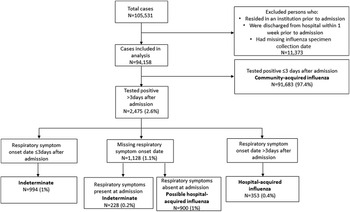
We defined community-acquired (CA) influenza as a hospitalized case with a positive influenza test between 14 days before and ≤3 days after admission (Fig. 1). We defined HA influenza as a case with a positive influenza test date and respiratory symptom onset date >3 days after hospital admission. We defined possible HA influenza as a case with a positive influenza test >3 days after hospital admission and a missing date of respiratory symptom onset but with explicit documentation that no respiratory symptoms were present at admission. We defined cases with a positive influenza test >3 days after hospital admission, but with respiratory symptom onset prior to or within the 3 days following hospital admission, as indeterminate. For cases who were transferred between multiple hospitals, we used the earliest date of hospital admission. We excluded cases who were previously discharged from any hospital within 1 week prior to the current admission, resided in an institutional care setting prior to hospitalization or had missing date of influenza specimen collection.
Flow diagram of case definitions for hospital-acquired (HA) influenza, possible HA influenza, community-acquired (CA) influenza, and indeterminate status among patients hospitalized with influenza. For persons who were missing a date of respiratory symptom onset, we used data from the admission history and physical examination note to determine whether respiratory symptoms were present at admission. If respiratory symptoms were absent, a case was defined as indeterminate; if present, a case was defined as possible. Numbers are unweighted values; percentages are weighted values.

During the 2011–2012 through 2016–2017 influenza seasons, trained surveillance staff conducted medical chart abstractions for all patients. Charts were abstracted using a standardized case report form to collect information on underlying conditions, interventions, and in-hospital outcomes. Because of high case counts during the 2017–2018 and 2018–2019 seasons, a minimum set of variables was collected for all patients: age, sex, surveillance site, date of hospital admission, and positive influenza laboratory testing data. In addition, a sampling scheme for medical chart abstractions was implemented for patients 50 years of age or older in 2017–2018 and for patients 65 years of age and older in 2018–2019, as previously described. Reference Chow, Rolfes and O’Halloran14 During the 2017–2018 season, surveillance sites were given the option to complete medical chart abstractions for 25% or 50% random samples or 100% of patients 65 years of age and older and 50% random samples or 100% of patients 50 to 64 years of age. During the 2018–2019 season, sites were given the option to complete medical chart abstractions for 50% random samples or 100% of patients 65 years of age and older. Medical chart abstractions were conducted for all patients younger than 50 years and all patients of any age who died during their hospitalization. Of the 14 surveillance sites, 7 sites opted to implement a sampling strategy during the 2017–2018 season, and 6 sites opted to implement a sampling strategy during the 2018–2019 season.
A patient was considered vaccinated if they had received a current season influenza vaccination at least 14 days prior to the date of the positive influenza test associated with the hospitalization. Influenza vaccination status was ascertained using up to 4 sources: hospital medical record, state vaccination registry, outpatient provider records, or patient or proxy interview. We also captured antiviral treatment during hospitalization and included receipt of oseltamivir, peramivir, or zanamivir. In addition, we collected data on the following interventions and outcomes: intensive care unit (ICU) admission, invasive mechanical ventilation, in-hospital death, and ICU and hospital length of stay (LOS).
We estimated the weighted prevalence of HA influenza overall, and by season, by dividing the weighted number of HA cases over the total number of influenza hospitalizations. We described the demographic and clinical characteristics and outcomes of HA cases, possible HA cases, and CA cases. We described the timing of HA influenza diagnosis among patients admitted to the ICU in a subset of patients with complete ICU admission and discharge dates.
We calculated unadjusted incidence rates per 100,000 population of HA and possible HA influenza by season and overall by using the weighted count of HA or possible HA cases as the numerator and the National Center for Health Statistics’ (NCHS) vintage bridged-race postcensal population estimates for the counties included in the surveillance catchment area as the denominator. 15 Because influenza testing in FluSurv-NET is clinician driven and not systematically performed, we collected supplemental data on influenza testing practices on a sample of patients hospitalized with acute respiratory illness (ARI). Reference Reed, Chaves and Daily Kirley16 We used these data to adjust HA and possible HA influenza rates for underdetection using a multiplier approach as described by Reed et al. Reference Reed, Chaves and Daily Kirley16 Data were analyzed using SAS version 9.4 software (SAS Institute, Cary, NC). Data were appropriately weighted to reflect the probability of sampling for complete medical record abstraction for patients 50 years of age or older. Sample sizes are listed as unweighted numbers, whereas percentages, medians, and interquartile ranges are reported as weighted values. FluSurv-NET sites obtained human subjects and ethics approvals from their respective state health department and academic partner Institutional Review Boards (IRBs) as needed. CDC determined this activity met the requirement for public health surveillance; therefore CDC IRB approval was not required.
Results
Among 94,158 influenza-associated hospitalizations included in our analysis, 91,683 (97.4%) had CA influenza, 353 (0.4%) had HA influenza, 900 (1.0%) had possible HA influenza and 1,222 (1.2%) were indeterminate (Fig. 1). The overall prevalence of HA influenza varied by season, ranging from 0.1% in 2013–2014 to 0.6% in 2016–2017 (Table 1 and Supplementary Fig. 1a online). The overall adjusted rate of HA influenza was 0.4 per 100,000 and ranged from a low of 0.1 during 2013–2014 to a high of 0.8 during 2016–2017 (Table 1 and Supplementary Fig. 1a online). After including possible HA influenza cases, the overall prevalence of HA influenza increased to 1.3% of all influenza-related hospitalizations and the overall adjusted rate of HA influenza increased to 1.5 per 100,000 (with a range of 0.4 during the 2011–2012 season to 2.2 during the 2014–2015 season) (Table 1 and Supplementary Fig. 1b online).
Prevalence, Unadjusted Rates, and Adjusted Rates for Hospital-Acquired Influenza and Possible Hospital-Acquired Influenza

a All estimates were weighted to account for the complex sample design.
b Rates were adjusted for underdetection of influenza using multipliers that accounted for the frequency of influenza testing and the average sensitivity of the assays used to test for influenza each season.
Among the 353 HA influenza cases, 50.7% were 65 years of age or older, 51.8% were female, and 63.3% were non-Hispanic White (Table 2). Most of the HA influenza cases (76.6%) were identified during January through March across seasons. The most common presenting nonrespiratory symptoms at admission were fever and chills (40.0%) followed by fatigue and weakness (32.1%), altered mental status (25.1%), and nausea or vomiting (21.0%). Among children with HA influenza, 52.0% had at least 1 underlying medical condition, with neurologic disorder being the most common (21.7%) (data not shown). Among adults with HA influenza, 95.7% had at least 1 underlying medical condition, with cardiovascular disease being the most common (51.5%), followed by immunocompromised conditions (29.2%) and renal disease (26.7%). Among HA influenza cases, 93.8% received antiviral treatment, 34.5% were admitted to ICU, 19.8% required mechanical ventilation, and 6.7% died; most HA influenza cases who were admitted to the ICU (79.2%) tested positive for HA influenza 1 or more days after ICU admission. Among 110 HA influenza cases with complete ICU admission and discharge dates, 33.5% had a positive influenza test prior to or within 2 days after ICU admission, 13.3% tested positive ≥3 days after ICU admission, 4.1% tested positive within 2 days after ICU discharge, and 49.1% tested positive ≥3 days after ICU discharge (data not shown). Among all HA cases, the median time from hospital admission to positive influenza test was 9 days (interquartile range [IQR], 6–16) and the median time from positive influenza test to hospital discharge was 6 days (IQR, 3–12) (data not shown).
Characteristics and Outcomes of Patients with Hospital-Acquired, Possible Hospital-Acquired and Community-Acquired Influenza, FluSurv-NET, 2011–2012 through 2018–2019

Note. ICU, intensive care unit; IQR, interquartile range; HA, hospital acquired; CA, community acquired. Indeterminate cases (N = 1,222) have been excluded from this table.
a Weighted values.
b Influenza A subtype information available for 51% of HA cases, 46% of CA cases and 54% of possible HA cases.
c Nonrespiratory symptom data available 2014–2015 through 2018–2019; symptoms not mutually exclusive.
d Among children with HA influenza, 22% had neurologic disorder, 13% with immunocompromised condition, 13% with cardiovascular disease, and 9% with chronic lung disease.
e Antiviral treatments included oseltamivir, peramivir, or zanamivir.
f Limited to cases ≥6 months of age; vaccination status missing for 1 patient in 2011–2012 and 7 patients in 2012–2013.
Clinical characteristics, interventions, and outcomes among possible HA influenza cases were similar to those of HA influenza cases (Table 2). When comparing HA and CA influenza cases, we detected some notable similarities and differences. Median age was 65 years among HA influenza and 64 years among CA influenza cases. The prevalence of several nonrespiratory symptoms at admission differed between HA and CA influenza cases; altered mental status (25.1% vs 13.2%) and seizures (2.4% vs 1.1%) were more frequent among HA influenza cases. Other symptoms that are commonly associated with influenza illness were more frequent among CA influenza cases, including fever and chills (66.3% vs 40.0%), fatigue (44.6% vs 32.1%), and myalgias (26.6% vs 14.8%). Although overall, a higher proportion of HA versus CA influenza cases had underlying conditions, asthma (14.1% vs 21.1%) and chronic lung disease (19.9% vs 29.5%) were more frequent among CA influenza cases. Compared with HA influenza cases, a lower percentage of CA influenza cases were admitted to ICU (15.5%), required mechanical ventilation (5.7%), and died in-hospital (2.3%) (P < .0001 for all 3 outcomes). The median hospital LOS for HA influenza cases was 18 days (IQR, 11–31). When restricting CA cases to only those who were admitted for >3 days, the median LOS for CA cases was 6 days (IQR, 4–8) (data not shown).
Overall current season influenza vaccine coverage was similar among groups, ranging from 44.9% among HA influenza cases to 38.9% among possible HA influenza cases, and 45.7% among CA cases (Table 2). Among children with HA influenza, 52.4% were vaccinated and among adults with HA influenza 43.0% were vaccinated (data not shown).
Discussion
Using a large, multisite, population-based surveillance system with >250 acute-care hospitals and >90,000 patients of all ages hospitalized with laboratory-confirmed influenza over 8 influenza seasons, we estimated that 0.4 per 100,000 persons acquired influenza infections during hospitalization. While our analysis adjusted for influenza testing practices at admission, these rates are likely underestimated because we did not adjust for influenza testing probability after hospital admission. Although HA influenza cases were rarely identified, a high proportion of HA influenza cases received ICU care, required mechanical ventilation, had extended hospital lengths of stay, and died during hospitalization.
Overall rates of HA influenza were low and did not vary substantially by influenza season. Our estimates were low compared to other studies from the United States and Canada, where prevalence ranged from 2% to 7%. Reference Wilson, Wood and Schaecher3,Reference Chow and Mermel8,Reference Jhung, D’Mello and Perez11,Reference Wilkinson, Mitchell and Taylor12 and other countries, where prevalence ranged from 2% to 24%. Reference Naudion, Lepiller and Bouiller5,Reference Zhou, Li and Gu7,Reference Alvarez-Lerma, Marin-Corral and Vila17–Reference Godoy, Torner and Soldevila25 The low prevalence observed in our analysis may be explained in part by our conservative HA influenza case definition, which required a positive influenza test result >3 days after hospital admission as well as the absence of respiratory symptoms within the first 3 days of admission. Several other studies required a positive influenza test with onset of symptoms ≥2 or ≥3 days after hospital admission. Reference Naudion, Lepiller and Bouiller5,Reference Zhou, Li and Gu7–Reference Ostovar, Kohn, Yu, Nullet and Rubin10,Reference Huzly, Kurz, Ebner, Dettenkofer and Panning18,Reference Eibach, Casalegno and Bouscambert20,Reference Macesic, Kotsimbos, Kelly and Cheng21 Across seasons, we found that most cases were identified in January through March. The increased frequency of HA influenza cases identified during peak winter months likely correlate with peak influenza activity. These trends may also reflect increased provider awareness and testing for influenza among hospitalized patients during influenza season peaks. The lower frequency of HA influenza outside peak months of influenza activity highlight potential missed opportunities to detect HA influenza early and late in the influenza season in patients who do not display typical respiratory symptoms and are thus not tested for influenza. Systematic surveillance for influenza virus infection among patients hospitalized during the influenza season may allow for increased detection of cases and more rapid implementation of infection control measures to reduce morbidity and mortality associated with HA influenza.
More than 90% of hospitalized cases had underlying conditions, and most underlying conditions were more frequent among HA influenza compared with CA influenza cases, which is consistent with other studies. Reference Alvarez-Lerma, Marin-Corral and Vila17,Reference Khandaker, Rashid and Zurynski22 Specific populations that may have increased susceptibility to hospital-acquired influenza compared with the general population include pregnant women, Reference Wilkinson, Mitchell and Taylor12 geriatric patients, Reference Eibach, Casalegno and Bouscambert20 and immunosuppressed patients. Reference Pollara, Piccinelli and Rossi26 This likely relates to the underlying reason for initial hospitalization. Notably, 2 underlying conditions, asthma, and chronic lung disease, which are known risk factors for severe influenza, were more common among CA influenza cases than HA influenza cases. 27 These findings may reflect a lower threshold for influenza testing and hospital admission for patients with chronic underlying lung disease. During the influenza season, targeted surveillance for influenza among patients with chronic underlying conditions who are admitted for reasons other than influenza, may help facilitate early diagnosis and treatment among patients at increased risk for influenza complications.
Our study, along with others, demonstrated that patients with HA influenza have a high frequency of severe influenza-associated outcomes including longer hospital length of stays and increased rates of ICU admission, mechanical ventilation, or death. Reference Jhung, D’Mello and Perez11,Reference Wilkinson, Mitchell and Taylor12,Reference Macesic, Kotsimbos, Kelly and Cheng21 Although the proportion of cases requiring ICU admission in our analysis (34.5%) was comparable to a previous analysis on HA influenza within FluSurv-NET (42%) and a study conducted by Godoy et al Reference Godoy, Torner and Soldevila25 (32%), it is higher than other studies conducted in Canada (8%), Australia (17%), and France (6%). Reference Naudion, Lepiller and Bouiller5,Reference Huzly, Kurz, Ebner, Dettenkofer and Panning18,Reference Taylor, Mitchell and McGeer19 Importantly, although HA influenza was associated with a higher frequency of severe outcomes, our study was not designed to assess causality. Most HA influenza cases tested positive for influenza on or after the date of ICU admission. Also, other interventions, such as mechanical ventilation, may have similarly occurred prior to development of HA influenza. The median length of stay among HA influenza patients was markedly longer than for CA influenza patients, consistent with other studies. Reference Jhung, D’Mello and Perez11,Reference Khandaker, Rashid and Zurynski22
Multiple studies have investigated approaches to mitigate the rate of HA influenza infections. Evidence-based approaches to prevention include vaccination of all healthcare workers and patient contacts, as well as rigorous hand hygiene. Reference Weedon, Rupp and Heffron9,Reference O’Reilly, Dolan, Nguyen-Van-Tam and Noone28,Reference Amodio, Restivo, Firenze, Mammina, Tramuto and Vitale29 In our analysis, <50% of patients were vaccinated prior to hospitalization, with similar coverage among HA and CA cases, highlighting opportunities for improving prevention efforts among high-risk individuals. Other studies have found that isolation of infected individuals in single-occupancy rooms, Reference Munier-Marion, Benet, Regis, Lina, Morfin and Vanhems30 implementation of droplet precautions for patients with suspected or confirmed influenza, 31 and targeted visitor restriction during mid-January through mid-March Reference Bischoff, Petraglia, McLouth, Viviano, Bischoff and Palavecino32 help reduce exposure to influenza. In addition, rapid screening of visitors for symptoms of acute respiratory illness, instruction of visitors in proper use of hand hygiene and personal protective equipment as directed by facility policies, and education about influenza vaccination may help to reduce exposure to and transmission of influenza from visitors to hospitalized patients. 31 Early rapid detection of influenza virus infection with implementation of early treatment and infection control measures has been shown to reduce hospital length of stay, to lower hospital occupancy, and to decrease the spread of HA influenza. Reference Nesher, Tsaban and Dreiher2,Reference Bouscambert, Valette and Lina33,Reference Peaper, Branson and Parwani34
This study had several limitations. Influenza testing within FluSurv-NET is clinician-driven or based on different facility-based testing policies, which likely resulted in an underestimation of HA influenza cases, particularly among those who present with nonrespiratory symptoms or asymptomatically. Reference Vanhems, Benet and Munier-Marion35 Rates of HA influenza and possible HA influenza varied across seasons; variability in rates could in part be due to changes in the way respiratory symptom data were collected over the study period. The frequency of influenza testing may have been higher among more severely ill patients, such as those admitted to ICU or receiving mechanical ventilation resulting in increased detection of HA influenza among patients who were more severely ill compared with less severely ill patients. Additionally, longer lengths of stay among HA influenza cases may not have been a result of the HA influenza; in some cases, the HA influenza likely occurred as a result of ongoing opportunities for exposure during a prolonged hospital stay. Finally, we were unable to classify some patients as having HA or CA influenza because data on respiratory symptom onset was missing.
Surveillance for influenza-associated hospitalizations over 8 seasons showed that rates of hospital-acquired influenza are low but likely underestimated. Although HA influenza was uncommon, severe outcomes occurred more frequently among patients with HA influenza. Prevention of influenza through annual influenza vaccination, early diagnosis and treatment of suspected or confirmed influenza among hospitalized patients, and implementation of robust hospital infection control measures can help to prevent HA influenza and its impacts on patient outcomes and the healthcare system.
Acknowledgments
We thank Kimberly Yousey-Hindes, MPH, CPH, Amber Maslar, CPA, Tamara Rissman, MPH, at the CT Emerging Infections Program, Yale School of Public Health; Emily Fawcett MPH, Jeremiah Williams, MPH, Katelyn Lengacher MPH, Kyle Openo DrPH, Stepy Thomas, MSPH, Suzanne Segler, MPH, and Monica Farley, MD, at the Georgia Emerging Infections Program; Maya Monroe, MPH, at the Maryland Department of Health; Jim Collins MPH, RS, Justin Henderson, MPH, and Shannon Johnson, MPH, at the Michigan Department of Health and Human Services; Anna Strain, PhD, Ruth Lynfield, MD, and the FluSurv-NET Laboratory and Surveillance Team at the Minnesota Department of Health; Salina Torres, PhD, MPH, at the New Mexico Department of Health; Sarah Khanlian, MPH, Kathy Angeles, MPH, Lisa Butler, MPH, and Robert Mannsman, MPH, at the University of New Mexico Health Sciences Center; Alison Muse, MPH, Elizabeth, Dufort, MD, and Katarina Manzi, BS, at the New York State Department of Health; Christina Felsen, MPH, Maria Gaitán, and Christine Long, MPH, at the University of Rochester School of Medicine and Dentistry; Krista Lung, MPH, Nicholas Fisher, BS, and Eli Shiltz, MPH at the Ohio Department of Health; Matthew Laidler, MS, Magdalena Scott, MPH, and Nicole West, MPH, at the Oregon Health Authority; Katie Dyer, Karen Leib, RN, Tiffanie Markus, PhD, Terri McMinn, Danielle Ndi, and John Ujwok at the Vanderbilt University School of Medicine; Mary Hill, MPH, Melanie Crossland, MPH, Andrea Price, LPN, Ryan Chatelain, MPH, Jake Ortega, MPH, and Ilene, Risk, MPH, at the Salt Lake County Health Department; and Keegan McCaffrey at the Utah Department of Health.
Financial support
This work was supported by the Centers for Disease Control and Prevention through the Emerging Infections Program cooperative agreement (grant no. CK17-1701); the 2008–2013 Influenza Hospitalization Surveillance Project cooperative agreement (grant no. 5U38HM000414); the 2013–2018 Influenza Hospitalization Surveillance Project cooperative agreement (grant no. 5U38OT000143); and the 2018–2023 Influenza Hospitalization Surveillance Project cooperative agreement (grant no. 5NU38OT0002970).
Conflicts of interest
E.A. has been a consultant to Pfizer and Sanofi-Pasteur and has been a member on the safety monitoring boards of Kentucky BioProcessing and Safo-Pasteur. His institution also received grant funding from MedImmune, Regeneron, PaxVax, Pfizer, GSK, Merck, Novavax, Sanofi-Pasteur, Micro, and Janssen. W.S. has been a consultant to VBI Vaccines. All other authors report no potential conflicts.
Supplementary material
To view supplementary material for this article, please visit https://doi.org/10.1017/ice.2021.392