In 1997, Susette Kelo bought a small house in New London, Connecticut.Footnote 1 A year later, the Pfizer pharmaceutical company announced its intention to build a large research facility near Kelo’s neighborhood. A development corporation created by the city (NLDC) put together a plan to support and take advantage of the Pfizer facility by developing the land around it. Kelo’s house was in a parcel that the NLDC would use for one of several possible purposes related to a state park or marina.
After the city council approved the NLDC plan in 2000, Kelo and other property owners sued in state court. One of their claims was that the proposed taking of their property would violate the Fifth Amendment requirement that government could take property only for a “public use.” After a mixed decision in the trial court, the Connecticut Supreme Court ruled in favor of the city in 2004.
Kelo and the other plaintiffs asked the US Supreme Court to hear the case on the basis of the takings issue, and the Court agreed. In June 2005, the Court affirmed the state supreme court ruling in Kelo v. City of New London by a 5–4 vote. In the decision, the Court’s four liberal justices voted in favor of the city, and its three strong conservatives voted in favor of Kelo. The city won by gaining the vote of Justice Anthony Kennedy, one of the Court’s two moderate conservatives.
The decision was greeted with widespread dismay and outrage, and one result was a wave of state legislation limiting government action to take private property (Nadler and Diamond Reference Nadler2008; Wolf Reference Wolf2008). Yet the Court’s ruling was not a sharp departure from precedent. Indeed, it was a reaffirmation of the broad definition of public use that the Court had established in Berman v. Parker (348 U.S. 26, 1954), a case in which it rejected a challenge to use of the eminent domain power for urban redevelopment in Washington, DC (see Lavine Reference Lavine2010).
Berman had been unanimous, so the close division of the justices in Kelo was noteworthy. But if the Court was to divide, the lines of division among the justices were more or less as observers of the Court’s takings decisions had expected: for two decades the Court’s conservatives had favored a broader interpretation of the takings clause as a protection of property than had its liberals.
In the absence of that prior history, however, the liberal-conservative split in Kelo might have been difficult to predict. In the years since the Berman decision, both liberals and conservatives had come to doubt the value of urban renewal—liberals probably more than conservatives, because of the perception that urban renewal projects were detrimental to African American communities (Lavine Reference Lavine2010, 469–73). Indeed, the NAACP submitted an amicus curiae brief in support of Susette Kelo, a brief cosigned by the Southern Christian Leadership Conference and other groups.
As for the litigants in Kelo, conservative justices might sympathize with an economically troubled city that sought to spur development in conjunction with the initiative of a business corporation. For their part, liberal justices might sympathize with a woman who was far from wealthy and who was in danger of losing a home that she loved, especially with a large company implicitly standing on the other side.Footnote 2 Why, then, did the Court’s liberals favor the city and its strong conservatives favor Kelo?
This article is an effort to answer that question but from a much broader perspective. Understanding the lines of division in Kelo requires consideration of the linkages between general ideological stances and positions on specific policy issues among political elites. Why are certain policy positions labeled as liberal and conservative, and why do people who think of themselves as liberals or conservatives tend to take certain sets of positions across a range of issues?
The Supreme Court is a good arena in which to examine the linkages between issues and ideology. Further, the attributes of those linkages have important implications for our understanding of the Court. After considering these linkages in general terms among political elites and in the Court, I analyze them more closely in the field of takings law. The linkage between the justices’ broad ideological positions and their responses to takings issues changed fundamentally around 1980. The article describes that change and then analyzes its sources.
Issues and Ideology among Political Elites
The term “ideology” is used in many ways (Gerring Reference Gerring1997; Jost Reference Jost2006, 652–53). I adopt one meaning that is common in both the practice and study of American politics: an ideology is a set of positions on political and policy issues that go together in the sense that they tend to be held by the same people.Footnote 3 The most prominent expression of this conception, under the term “belief system” rather than ideology, is Philip Converse’s (Reference Converse and Apter1964, 207–8) idea of constraint or correlation among the ideas and attitudes that an individual holds (see also Peffley and Hurwitz Reference Peffley1993, 64–66; Poole and Rosenthal Reference Poole1997, 4–5; Lewis-Beck et al. Reference Lewis-Beck, Jacoby and Weisberg2008, 203, 205). In the United States, of course, the most widely shared clusters of ideas and attitudes are referred to as liberalism and conservatism.
This conception of ideology is routinely used to describe bodies such as Congress and the Supreme Court. Positions on issues are labeled as conservative and liberal, and individual policy makers are themselves labeled on the basis of their positions on aggregates of issues. Because there is a high level of constraint among political elites, even analyses of Congress and the Court that begin without designating votes as liberal or conservative end up with a structure of votes and policy makers that fits a unidimensional conception of ideology fairly well (Poole and Rosenthal Reference Poole1997; Grofman and Brazill Reference Grofman and Brazill2002; Martin and Quinn Reference Martin and Quinn2002). Moreover, public policy makers and other politically sophisticated people think consciously about their own place and the places of others on an ideological scale from very conservative to very liberal.
Building on this conception, I approach the linkage between issues and ideology inductively rather than deductively. It may be possible to define liberal and conservative positions in takings law, to take one example, on the basis of general premises that underlie liberalism and conservatism. But I begin instead with a descriptive question: how people whose positions on other issues define them as liberals or conservatives actually line up on a particular issue such as takings. Do conservatives and liberals diverge in the takings field, and if so, which side does each group take?Footnote 4
Underlying that descriptive question, and considerably more important, is a question of explanation: on what basis do liberals and conservatives choose positions on particular issues such as takings? One possibility is that people who are politically aware do operate deductively. Indeed, some of the issue positions associated with liberalism or conservatism can be understood as the products of broad premises, especially attitudes about equality (Schwartz Reference Schwartz, Olson and Zanna1996, 10; Jost Reference Jost2006, 654).
Another possibility is that conservatives and liberals adopt positions on the basis of their attitudes toward subsets of society. Nelson and Kinder (1996, 1055–56) refer to “group-centric” opinion, “shaped in powerful ways by the attitudes citizens possess toward the social groups they see as the principal beneficiaries (or victims) of the policy”—or, to expand this conception, by attitudes toward advocates for competing policies. A range of research has pointed to the impact of people’s identifications with groups and attitudes toward groups on their opinions about public policy (e.g., Conover Reference Conover1984, Reference Conover1988; Jelen Reference Jelen1993; Nelson Reference Nelson1999; Cohen Reference Cohen2003; Grant and Rudolph Reference Grant and Rudolph2003).
Group-centric opinion typically has been viewed not as an element of ideological thinking but rather as an alternative to it. That view is reflected in the classic distinction in The American Voter between a small proportion of voters whose thinking about the vote choice could be understood as ideological and a much larger number who think in terms of the interests of social groups (Campbell et al. Reference Campbell, Converse, Miller and Stokes1960, 218–50; see Lewis-Beck et al. Reference Lewis-Beck, Jacoby and Weisberg2008, 267–72). Not surprisingly, studies have found that ideological thinking and attitude constraint are more prevalent among social and political elites than among other citizens (Kritzer Reference Kritzer1978; Jennings Reference Jennings1992; Jost, Federico, and Napier Reference Jost, Federico and Napier2009, 314–15). Thus the scholarship on political attitudes suggests that the distinction is primarily between political elites and sophisticates who think systematically about issues in ideological terms and less knowledgeable people who respond to politics on other bases—especially their identifications with, and attitudes toward, political and social groups.
This distinction clearly has some validity, yet it seems overdrawn in two related ways. First, the connections among issues that are reflected in attitude constraint cannot be understood solely in logical terms (McClosky and Zaller Reference McClosky1984, 259; Tedin Reference Tedin1987, 77; Sturgis, Roberts, and Allum Reference Sturgis2005, 33–34). One reflection of this reality is the temporal change that sometimes occurs in the ideological labeling of particular issues (Lewis-Beck et al. Reference Lewis-Beck, Jacoby and Weisberg2008, 208–9; Noel Reference Noel2012).
Second, ideology is connected with groups. Liberals and conservatives differ in their attitudes toward social groups (Sullivan, Piereson, and Marcus Reference Sullivan and Marcus1982, 70–76; Jost et al. Reference Jost, Federico and Napier2009, 325), and this is true of political elites such as delegates to national party conventions (Jennings Reference Jennings1992; see McClosky Reference McClosky1964, 372–73). For that reason, perceptions of who will benefit from a particular policy can affect positions on that issue. People also have attitudes toward conservatives and liberals, attitudes strong enough to make these ideological groups part of many people’s social identities. Those attitudes are especially strong among political elites (Devine Reference Devine2011). As a result, even knowledgeable people may choose positions on an issue on the basis of their attitudes toward the ideological groups on the two sides (Kuklinski, Metlay, and Kay 1982, 633–34).
To borrow (and adapt) terms used by Converse (Reference Converse and Apter1964, 209), then, the connections between issues and ideology may be either “logical” or “social,” that is, based on general premises that underlie liberalism and conservatism or on perceptions of the groups that support and benefit from competing positions. It seems likely that both logical and social processes help to define conservative and liberal positions in particular issue areas and that they are intertwined. One way to probe the roles of these two processes is by analyzing temporal change in the ideological structure of attitudes or behavior in an issue area. This article undertakes such an analysis for takings issues in the Supreme Court.
Issues and Ideology in the Supreme Court
The Supreme Court is an attractive venue for analysis of the linkage between issues and ideology. For one thing, the justices’ partial autonomy from external influences and the ambiguity of the law in most cases they hear give them a relatively high level of freedom to respond to issues in terms of their own policy preferences.Footnote 5 Thus, their votes and opinions provide good evidence of their general ideological views and their attitudes about specific issues.
Further, the attributes of cases facilitate inquiry into the impact of attitudes toward groups. Every case involves both specific litigants and broader interests that would be affected by the Court’s decision. In general, litigants are affected by the Court’s specific ruling, while broader interests are affected by the Court’s promulgation of legal doctrines. To the extent that the justices define cases in terms of affected groups, they can respond to the litigants, to the broader interests, or to both. The identities of organizations that file amicus curiae briefs and of lawyers who represent the parties and amici provide the justices with evidence about group interests.
For students of the courts, analysis of the linkage between issues and ideology can inform our understanding of judicial decision making. Scholars have done well in describing the justices’ policy preferences in ideological terms, and they have begun to chart changes in the justices’ ideological stances over time (e.g., Epstein, Martin, et al. Reference Epstein, Martin, Quinn and Segal2007). But relatively little has been done to identify the sources of those ideological stances and more specific issue positions or the sources of change in them.Footnote 6
Inquiry into those sources is informative in itself. Moreover, what that inquiry finds has implications for explanations of Supreme Court decision making. Especially important is the role of the Court’s political and social environment. In the standard depiction of the Court, its environment is a potential constraint on the justices’ ability to act on their policy preferences, but the preferences themselves are internal to the justices. If justices’ preferences are partly a product of their perceptions of groups as advocates and beneficiaries of alternative policies, then people outside the Court who help create those perceptions also shape the justices’ preferences. For this reason, the “internal” and “external” forces in decision making may not be as distinct as they have seemed to be.
Some strands of scholarship on the Court are relevant to this inquiry. Harold Spaeth and his collaborators applied Milton Rokeach’s (Reference Rokeach1968, 134–38) distinction between attitudes toward objects and attitudes toward situations to the Court (Spaeth and Parker Reference Spaeth and Parker1969; Spaeth et al. Reference Spaeth, Meltz, Rathjen and Haselswerdt1972; see also Rohde and Spaeth Reference Rohde and Spaeth1976, 77–78, 83–84). The situations were conceptualized as legal issues (such as search and seizure), the objects as the litigants, defined by role (such as people who suffered injuries). Empirical analyses showed that both objects and situations affected the justices’ voting patterns, with their relative importance differing across fields of policy.
Some behavioral scholarship has tracked shifts in ideological alignments on issues. A few studies have analyzed change in the dimensionality of the justices’ votes over time as issues or perceptions of issues evolve. Two studies documented the existence of change in the field of economic regulation (Ducat and Dudley Reference Ducat and Dudley1987; Hagle and Spaeth Reference Hagle and Spaeth1993), and a third (Epstein and Reference Epstein and Segal2006 2006) did so for freedom of expression.
More broadly, work that takes a historical institutionalist perspective has shown that perceptions of issues by people who think of themselves as liberals or conservatives are contextual and socially constructed (e.g., Kahn Reference Kahn and Kersch2006). This point has been documented in studies of change in the ideological labeling of positions on economic regulation (Gillman Reference Gillman1993), the rights of criminal defendants (Kersch Reference Kersch2004), and freedom of expression (Graber Reference Graber1991; Rabban Reference Rabban1997). Some of this work points to the impact of shifts in the perceived beneficiaries of certain policies on ideological perceptions of issues (Rabban Reference Rabban1997, 381–92; Kersch Reference Kersch2004, chap. 2).
These strands of scholarship indicate the value of analyzing linkages between issues and ideology in the Supreme Court and provide evidence about the sources of those linkages. This article focuses more directly on the logical and social sources of the linkages. It also takes a new step by combining systematic analysis of change in the ideological element of the Court’s decisions with close analysis of potential determinants of that change.
Because the lineup of the justices in the Kelo case was intriguing, the takings area seemed a potentially useful area to study. An exploration of the Court’s takings decisions indicated that there had been a marked change in the ideological pattern of the justices’ votes in takings cases around the 1970s and 1980s. That change is the focus of the study in this article.
The study gives primary attention to the period from 1937 to 2012, a period that includes substantial numbers of takings cases before and after the change of the 1970s and 1980s. An earlier ideological change in the 1930s was also identified, and I will discuss that shift briefly. The study will be presented in three parts. The first provides a brief overview of takings issues in the Supreme Court. The second analyzes ideological voting in takings cases, describing the change that occurred in the linkage between ideology and the takings issue. The third turns to explanation, probing the sources of the shift of the 1970s and 1980s. The methodology used in the second and third parts of the study will be discussed in the sections on those parts.
Takings Issues in the Supreme Court
The Fifth Amendment to the US Constitution concludes with the takings clause: “nor shall private property be taken for public use, without just compensation.” The takings clause was incorporated into the due process clause of the Fourteenth Amendment, albeit with some ambiguity, in Chicago, Burlington and Quincy Railroad Co. v. Chicago (166 U.S. 226, 1897).
The Court began to give sustained attention to the takings clause around 1870. For the most part, the questions that the Court has addressed in this field concern three broad issues that relate to terms in the clause.Footnote 7 The first is when government has actually taken property. The most important aspect of this issue concerns government regulation of the use of property. In Pennsylvania Coal Co. v. Mahon (260 U.S. 393, 1922), the Court made explicit what earlier decisions had suggested, holding that government regulation sometimes constitutes a taking for which compensation is required (Fischel Reference Fischel1995, chap. 1). The question of when regulation does constitute a taking has been the subject of considerable attention within and outside the Court.
The second issue is whether a government taking is for a public use. On the basis of the language of the takings clause, it is well established that government can take property only for a public rather than a private use. The Court has generally interpreted “public use” broadly, as it did in Berman and Kelo.
The third issue is the amount of compensation that is due for a taking. This issue has been the least prominent of the three, and on the whole it is the least consequential. But the Court has decided many cases involving this question.
In the cases that the Court hears, the takings clause is sometimes connected to other legal provisions. In the late 19th and early 20th centuries, there was an intertwining between substantive due process and protection against takings under the Fourteenth Amendment, an intertwining that arguably still exists (Berger Reference Berger1995; Ely Reference Ely1996, 122). Cryptic opinions were common in that era, and it is often quite uncertain whether the Court was ruling on takings or on substantive due process. This ambiguity is reflected in the recent assertion by retired Justice John Paul Stevens (Reference Stevens2011, 16–17) that the Court did not actually incorporate the takings clause into the Fourteenth Amendment in 1897 because its Chicago, Burlington and Quincy decision (and later takings decisions) was instead based on substantive due process.
Commentators regularly refer to the Court’s jurisprudence on the takings clause as confused, sometimes describing it as “a muddle” (Rose Reference Rose1984, 561; Gaba Reference Gaba2007, 569). As one legal scholar put it, “the jurisprudence that has developed under” the takings clause “is a top contender for the dubious title of ‘most incoherent area of American law’” (Schroeder Reference Schroeder1996, 1531). Citing the effects of divisions among the justices, another scholar referred to “the futility of reconciling what may be, at bottom, irreconcilable rulings” (Lazarus Reference Lazarus1997, 1101). Fortunately, the inquiry in this article does not require a reconciliation.
The Ideological Dimension in Takings Cases
The linkage between the justices’ positions on takings issues and their general ideological stances can be identified by comparing the structure of divisions in nonunanimous takings decisions with the overall structure of votes in the Court. Of course, the justices’ votes provide only a summary of their positions on issues that they address, but that summary facilitates analysis of how positions on takings relate to general patterns of liberalism and conservatism in the Court.
Multiple sources were used to find takings cases. A list by Meltz (Reference Meltz2005) and citations in Congressional Research Service (2004, 2010) identify large numbers of takings decisions, but neither is comprehensive. A Lexis word search of Supreme Court decisions was undertaken to fill in the gaps, based on a reading of opinions that indicated the most useful terms to search.Footnote 8 The cases obtained from these sources were read to identify those in which the opinion for the Court (or, in the case of decisions without a majority opinion, any opinion on the majority side) actually decided a takings issue.
The justices’ votes in these cases were coded on the basis of their positions on the takings issue in the case rather than on the overall outcome of the case. A justice who did not write or join an opinion that addressed a takings issue was not coded for that decision.
The identities of the justices who voted on the two sides in each case were compared with the justices’ Martin-Quinn scores for that term. Those scores are transformations of the justices’ voting patterns (Martin and Quinn Reference Martin and Quinn2002). Ho and Quinn (Reference Ho and Quinn2010) have described limitations of the Martin-Quinn scores, but the scores are well suited to this analysis. Because they are based on the structure of votes rather than on a coding of votes as liberal or conservative, they do not rest on assumptions about the ideological direction of votes. They also reduce the impact of idiosyncratic variation in voting patterns in a single term. The circularity of explaining the justices’ votes with a measure based on those votes is not a concern because the goal is to compare the dimensionality of votes in one field with the dimensionality of the justices’ votes across all fields.
The procedure used was simple. In nonunanimous decisions, the median of the Martin-Quinn scores for the justices on the two sides in a case (i.e., those supporting and those opposing the takings claim) were computed. Each case was then coded for whether the set of justices who sided with the claimant in a takings case was more liberal or more conservative than the set who opposed the claimant and for the magnitude of that difference.
As it turned out, there was a distinct change from one period to the next. The sharpest line between periods is the one between the 1979 and 1980 terms of the Court, though there is still a large difference between earlier and later periods if the line is drawn somewhat earlier or somewhat later.Footnote 9
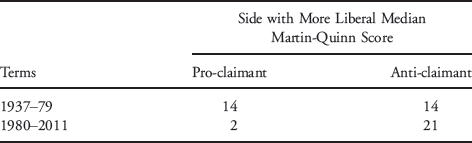
Table 1 shows the results when the line is drawn after the 1979 term. In the nonunanimous cases decided since then, the justices who favor a takings claim have been more conservative than those who oppose the claim more than 90% of the time. In this respect the Kelo decision was typical of the past three decades.
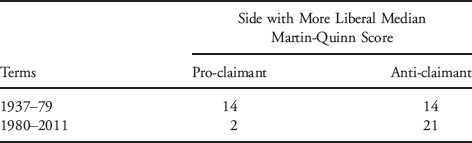
This pattern contrasts sharply with the 1937–79 terms. When the Court divided during that period, it was equally likely that the pro-claimant justices would be more liberal or more conservative than the anti-claimant justices. Such a nonrelationship between the overall pattern of votes in the Court and the pattern of votes in a field of substantive policy (as distinguished from structural issues such as federalism) is quite unusual. During the 1937–79 period, economic issues of other types divided the justices along ideological lines (Schubert Reference Schubert1965, 127–46, 160–70, 173; Rohde and Spaeth Reference Rohde and Spaeth1976, 134–45, 161–67). Of course, the same was true of civil liberties issues.
The distinction between the two periods can be described in another way, by the frequency of decisions with strong ideological divisions. The difference between the median Martin-Quinn scores of the two sides in a case is only an approximate measure because those scores are not necessarily linear (Ho and Quinn Reference Ho and Quinn2010, 846–47). But this measure illuminates the change that occurred over time. Martin-Quinn scores are coded so that higher scores are more conservative. In 18% of the cases in the 1937–79 terms, the median score for the pro-claimant justices was at least 3.0 points higher than the median for the anti-claimant justices, a substantial difference; the anti-claimant median was at least 3.0 points higher 25% of the time. In the 1980–2011 terms, in contrast, the comparable figures were 52% and 4%. By this measure as well, takings changed from a distinctly nonpolarized issue to one with a clear polarity.
A focus on nonunanimous decisions exaggerates the degree of dissensus in the Court. In the 1937–79 terms, 57% of the takings decisions were unanimous, and the rate of unanimity declined only slightly (to 52%) in the 1980–2011 terms.Footnote 10 Even so, the change in the ideological orientation of nonconsensual decisions shows that justices’ perceptions of takings cases changed quite substantially. And even if unanimous cases are included, the justices increasingly polarized in takings cases: the standard deviations of the nine justices’ proportions of pro-claimant votes were 8.2 in the natural court of the 1975–80 terms, 11.0 in the 1981–85 natural court, and 24.6 in the long natural court of the 1994–2005 terms.
The nonideological pattern of votes in takings cases in the 1937–79 period contrasted not only with the period that followed but also with the preceding period. Analysis of voting in the years before 1937 is complicated by the blurring of takings and substantive due process in opinions, which makes it difficult to identify takings cases, and by the absence of measures of the justices’ ideological positions that are also available for later periods. Still, it is useful to summarize what can be discerned about the voting patterns in the quarter century prior to 1937. Takings cases were identified by the same methods used for the 1937–2011 terms.
In the 1910–20 terms, five nonunanimous takings decisions were identified. In four of the five, the coalition that favored a takings claim was more conservative than the coalition against the claim, on the basis of the analyses of voting in that era by Leavitt (1970, 146, 186).Footnote 11 The ideological differences between the two coalitions were much larger in those four cases than in the one case in which the pro-claimant coalition was more liberal. In the 1921–36 terms, 14 nonunanimous takings decisions were identified. On the basis of Snyder’s (1958, 235) division of the justices into three ideological “cliques,” the justices in the most conservative clique voted more favorably to the takings claimant than those in the most liberal clique in 11 of the 14 cases. In one case, the liberal clique was more favorable; in two, the two cliques were about equally favorable.
These findings should be interpreted cautiously. Still, they indicate that the justices of the 1910–36 period responded to takings cases largely along liberal-conservative lines. In that respect, voting patterns resembled those of the period since 1980. The absence of ideological voting in the 1937–79 period was certainly an anomaly in comparison with the justices’ voting on other substantive issues; it appears to be an anomaly in the history of takings law as well.
Leaving aside the period prior to the 1937 term, it is clear that the Court moved from a period in which liberals and conservatives were equally likely to support takings claims to a period in which conservatives were far more favorable to those claims. From the 1940s to the 1970s, takings law as a whole did not have an ideological meaning for the justices. The justices’ liberalism or conservatism may have affected their responses to takings cases, but that effect was specific to individual cases rather than general. Since the 1980s, in contrast, takings law has had the kind of clear linkage with ideology that typically exists in fields of substantive law: when the justices disagree in takings cases, the Court’s conservatives have been far more supportive of litigants with takings claims than its liberals. The question, then, is why that change occurred.
Explaining the Change
That question of explanation will be framed in terms of the relative importance of what I have called logical and social sources of the connections between issues and ideology. The change can be classified as logical to the extent that it resulted from change in the content of takings cases that altered the relationship between takings and the premises that guide the justices’ general ideological stances. It can be classified as social to the extent that it resulted from change in the alignments of social and political groups as beneficiaries and advocates in the takings field.
In this inquiry I examine attributes of several related phenomena: takings as a legal and political issue outside the Court, the cases that the Court heard, and the justices’ individual and collective responses to those cases. Evidence on these phenomena can be used to weigh the importance of logical and social sources of the connections between issues and ideology.
Evidence was gathered from several kinds of sources. Books, law reviews, newspapers, and other sources were canvassed to build a picture of takings as a legal and political issue. Parties, lawyers, and amici in Supreme Court takings cases were identified. Several attributes of the Court’s cases and decisions were analyzed, along with patterns in the justices’ votes.
Takings Outside the Court
In the years from the late 1930s through the early 1970s, takings law and policy were not a significant public issue. National party platforms never referred to takings even indirectly.Footnote 12 There were only occasional references to takings-related matters in the New York Times, none of them treating takings as a matter of national debate or importance.
All this began to change in the 1970s because of two related developments. The first was a reaction against the environmental movement and the success of that movement in shaping public policy. The second was a conservative reaction to the perceived liberalism of the federal courts and elite segments of the legal profession and to the success of liberal interest groups as legal advocates.
Early in the 1970s, there was a degree of consensus on the need to protect the physical environment. But this consensus declined with a growing perception of the trade-offs involved in environmental protection (Kraft and Vig Reference Kraft, Vig and Kraft2000). People in the business community, farmers and ranchers, and other landowners increasingly resented the economic costs and restrictions on business practices entailed by environmental regulation. One result was a “property rights” movement that acted largely as an opponent of the environmental movement (Marzulla Reference Marzulla1995; Meltz Reference Meltz1995, 1–7; Pralle and McCann Reference Pralle, McCann and Foster2000; Olivetti and Worsham Reference Olivetti2003, chap. 3). The decline in consensus was reflected in national Republican Party platforms, which moved from enthusiastic support for environmental protection to considerable skepticism between 1972 and 1980.
Meanwhile, a new conservative legal movement emerged (Southworth Reference Southworth2008; Teles Reference Teles2008). One facet of that movement was an effort by legal scholars and others to establish and articulate conservative positions on constitutional issues, an effort reflected in the development of the Federalist Society as a national organization of lawyers (Southworth Reference Southworth2008, 130–41; Teles Reference Teles2008). As part of this effort, some conservative legal theorists developed arguments for broad interpretations of the takings clause, especially in the area of regulatory takings. Most prominent was Richard Epstein of the University of Chicago Law School, whose arguments for a sweeping invalidation of economic regulations through the takings clause were widely circulated over several years and ultimately presented in his book Takings in 1985.
Another facet of the conservative legal movement was the creation and growth of conservative public interest law firms that were intended to counter their liberal counterparts by pressing conservative legal positions on the courts. Several of these firms included takings issues on their agenda. That issue was especially important to the Pacific Legal Foundation (PLF), one of the earliest and most active firms. The founding of the PLF in 1973 was driven in part by concern about the success of liberal litigating groups on environmental issues (Teles Reference Teles2008, 60–61).
During President Reagan’s second term, lawyers in the Justice Department joined the effort to expand protections of property through the takings clause. One reflection of that effort was Executive Order 12630, issued in 1988, which expanded the obligation of federal agencies to provide compensation for regulatory takings. The Reagan administration also appointed judges who favored a broad reading of the takings clause to the lower courts that have the greatest impact on takings law, the Claims Court (now the Court of Federal Claims) and the Court of Appeals for the Federal Circuit (Kendall and Lord Reference Kendall and Lord1998, 533–38).
Because of these developments, takings became a significant issue for conservatives even outside the legal system. The 1992 Republican platform included long discussions of property rights and takings, and every Republican platform since then has referred to takings. The “Contract with America” announced on behalf of Republican candidates for the House in 1994 included a provision allowing private property owners to recover money from the federal government for federal action that reduced the value of their property, and a version of that proposal passed the House in 1995. The vote on that bill and other congressional votes on property rights proposals in the years that followed generally split along partisan and ideological lines.
Takings Cases in the Court
The renewed concern with takings that first developed in the 1970s was reflected in litigation activity. Conservative public interest groups began to submit amicus briefs on the merits of takings cases in the Supreme Court in 1978. The Reagan administration submitted an amicus brief on behalf of the takings claimant in Nollan v. California Coastal Commission (483 U.S. 825, 1987), a major case on regulatory takings. The PLF sponsored the Nollan case, and the Washington Legal Foundation brought two later takings cases.Footnote 13 The lawyers who present oral arguments on behalf of claimants in takings cases have included counsel for those two groups as well as Rex Lee and Charles Fried, each of whom had been solicitor general in the Reagan administration.
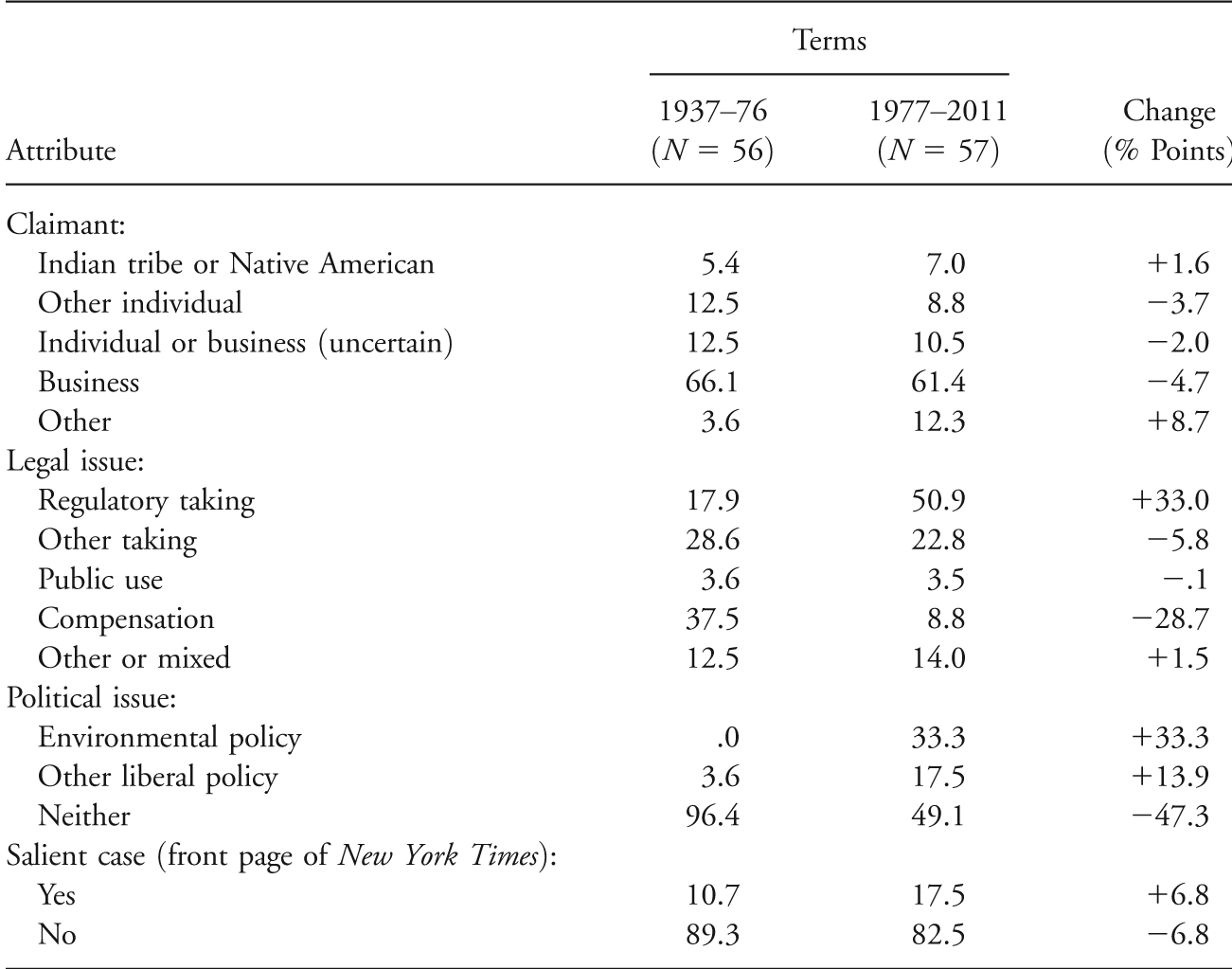
In light of this activity, it is not surprising that cases brought to the Court increasingly involved regulatory takings, environmental policy, and broad legal and policy issues. The same attributes are reflected in the cases that the Court accepted for decisions on the merits. Table 2 summarizes some characteristics of takings cases in the Court before and after the mid-1970s, when takings as a legal and policy issue began to change.
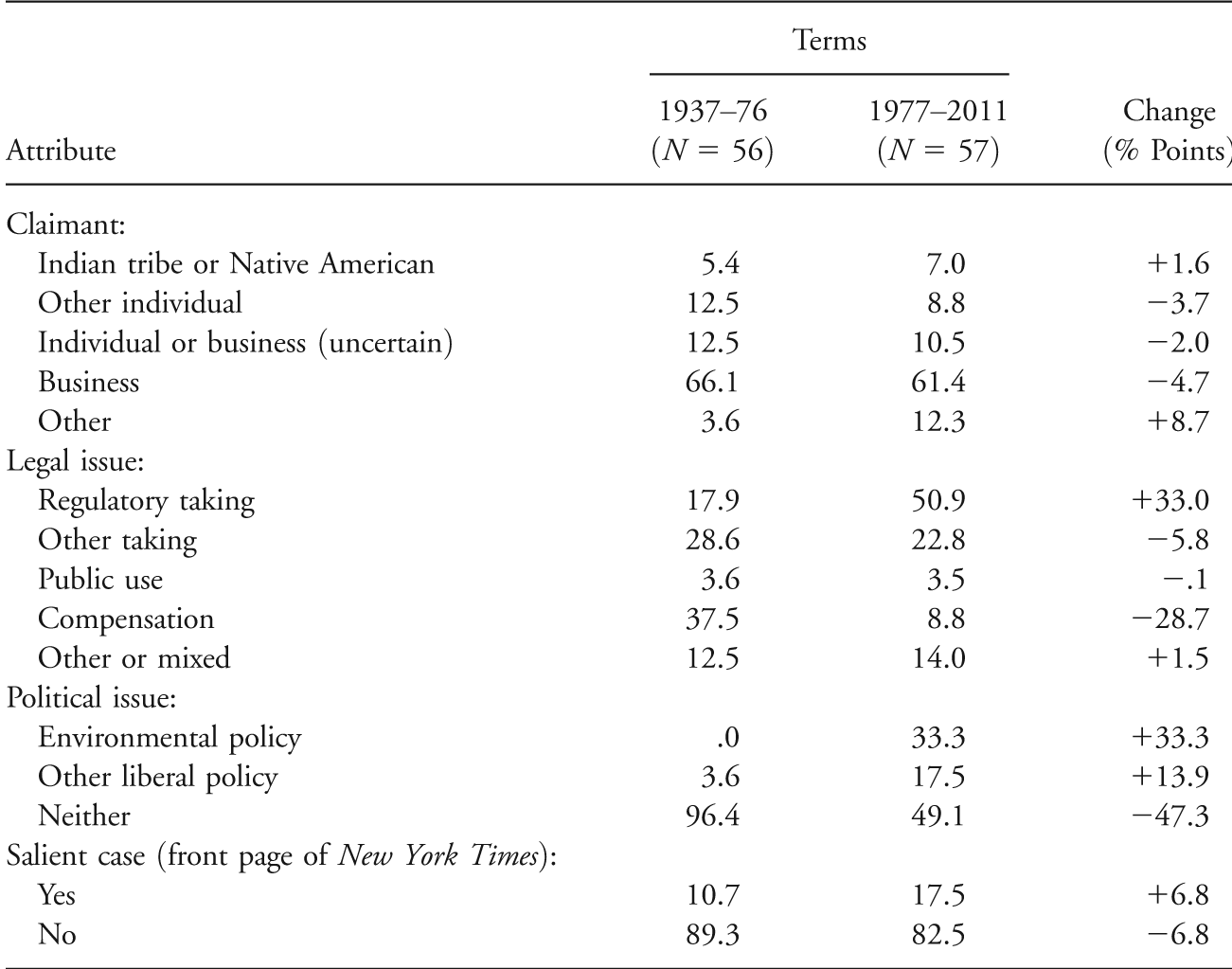
Source Front-page coverage in the New York Times for the 1946–2004 terms was taken from Epstein, Segal, et al. (2007, 153–74); for other terms, archives of the Times were consulted. Other information was coded from the Court’s decisions.
Note “Change” is the increase or decrease in that attribute from the 1937–76 period to the 1977–2011 period. The claimant is the party asserting a takings claim. “Other taking” refers to the question of whether a taking had occurred, apart from regulatory takings cases. “Political issue” refers to cases in which a government policy to protect the environment, broad or narrow, or a policy of the other branches that was generally identified as politically liberal was directly challenged by the claimant.
The takings cases that the Court decided in the 1937–76 terms were generally narrow in their issues, unconnected with the wider challenges to government power over economic activity that had characterized some takings cases prior to 1937. That attribute is underlined by the high proportion of cases about the amount of compensation to be paid for a taking, on the whole the least consequential type of takings issue. By the most commonly used measure of salience for Court decisions, whether a decision was reported on the front page of the New York Times (Epstein and Segal Reference Epstein and Segal2000), only six takings decisions in that era were salient, and in one of those cases the takings issue was not the source of interest in the case.
The cases that the Court decided in its 1977–2011 terms were quite different. Although the types of takings claimants changed little, there was a substantial decline in compensation cases and a corresponding growth in regulatory takings cases. Challenges to environmental policies emerged for the first time and became common, and there was a growing number of cases in which takings claimants challenged other liberal government policies on issues such as rent control and labor-management relations. More cases involved issues with potentially broad impact, especially on the question of when regulation of property constitutes a taking. That change is reflected in a higher rate of salient decisions by the standard New York Times measure.Footnote 14
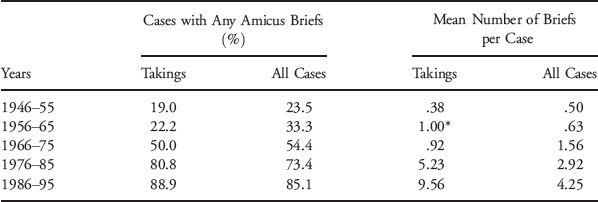
The growing political and legal salience of takings cases in the Court was reflected in amicus activity (Reference Thorpe, Evans, Simon, McIntosh and Hatcher2010). As table 3 shows, the proportions of cases with amicus briefs and the average numbers of amicus briefs per case generally lagged behind the overall rates in the Court until the mid-1970s, after which they grew even more rapidly than did amicus briefs in general. By the decade from 1986 through 1995, the mean number of briefs per takings case was more than double the average across all cases.
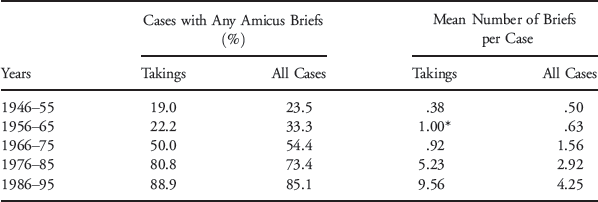
Source Data on takings cases were collected from the US Reports and the microfiche Records and Briefs of the Supreme Court. Data on all cases are from Kearney and Merrill (2000), 752–53.
* This figure is artificially high because one case in which takings were not the central issue had several amicus briefs. If that case is excluded, the mean is 0.50.
There are some general patterns to the lineup of amici in takings cases since the mid-1970s. Opponents of takings claims typically include governments defending their powers, frequently with briefs representing multiple states. These governments are usually joined by private liberal groups, most often groups with environmental interests. Takings claimants receive the preponderance of their support from conservative groups, with business groups and ideological groups (including public interest law firms) the most prominent.
Court Decisions and Justices’ Votes
These changes in the politics of takings and in the cases that the Court decided point to an explanation for the change in the relationship between takings and the justices’ general ideological stances. But a closer look at the justices’ positions in takings cases provides additional information to inform an explanation.
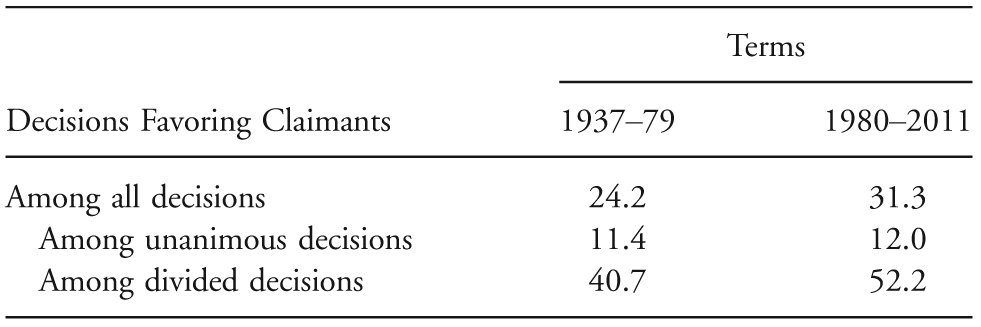
At the outset, it can be noted that some broad patterns in the Court’s decisions changed only marginally between the two eras. Those patterns are presented in table 4. The proportion of unanimous decisions declined slightly, claimants’ success rate increased slightly, and claimants continued to lose the overwhelming majority of unanimous decisions. The biggest change was a 12 percentage point increase in claimants’ success in cases that divided the Court.
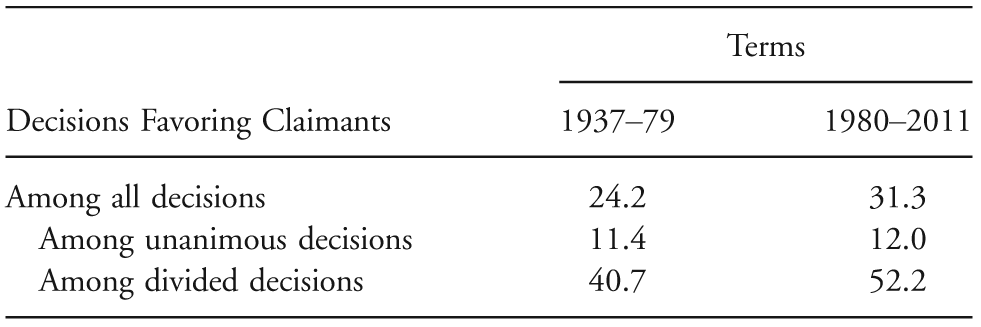
Note Decisions are coded on the basis of justices’ votes on the takings claim, not on the overall outcome for the parties. Three decisions in which there was not a majority for or against the takings claim were excluded. In the 1937–79 terms, 56.5% of all decisions were unanimous; in the 1980–2011 terms, 52.0% were unanimous.
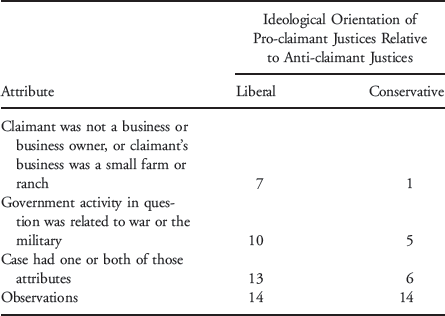
In the 1937–79 terms, the key question is how the 14 nonunanimous cases in which the justices who supported a taking claim were more liberal than the justices on the other side differed from the 14 cases in which the pro-claimant justices were more conservative. In most respects, the two sets of cases were quite similar, and there were no sharp differences in justices’ relative positions among different types of takings issues.Footnote 15
But the two sets differed in two relevant respects, shown in table 5. The first is the identities of claimants. Cases in which the pro-claimant justices were more liberal than justices on the other side were considerably more likely to have a claimant that was not a business or business owner or a claimant whose business was a small family farm or ranch. Second, cases in which the pro-claimant justices were more liberal were more likely to involve government activity related to the military or the conduct of a war. Altogether, 13 of the 14 cases in which pro-claimant justices were more liberal involved nonbusiness parties, small agricultural businesses, or military-related takings. Only six of the 14 cases in which pro-claimant justices were more conservative had any of those attributes.
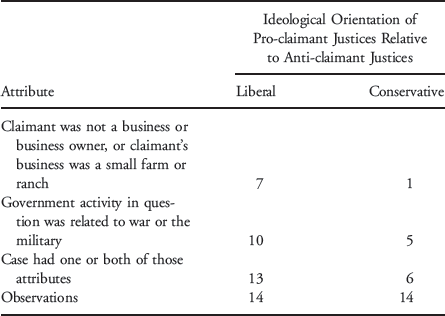
Note Claimants are categorized on the basis of information in the Supreme Court’s opinions and, where needed, information in lower-court opinions. In one “liberal” case there was some uncertainty about the claimant, but the information available from the court opinions in the case strongly suggests that he was an individual without any business. That case also fell in the war/military category.
These two attributes are hardly a complete explanation of the difference between the two sets of cases in the ways that justices lined up on the two sides. In conjunction with other evidence, however, they indicate that in an issue area that had become disconnected from broad ideological stances, justices responded to individual cases on the basis of relatively specific attributes of those cases.
The shift to a clear ideological dimension in the justices’ voting can be traced in terms of subsets of the Court. Did both liberal and conservative justices change positions, or did the change occur only on one side of the ideological spectrum? On the conservative side, did the change come from justices who were already serving on the Court in the 1970s, or did it result from new appointments to the Court in the 1980s?
These questions can be addressed by examining the justices’ voting records, but only with care. Because attributes of the cases the Court decides in a field change over time, neither a justice’s voting records in two periods nor the records of two justices who served over different periods are fully comparable. Still, the justices’ patterns of voting can tell us something about how the change occurred.
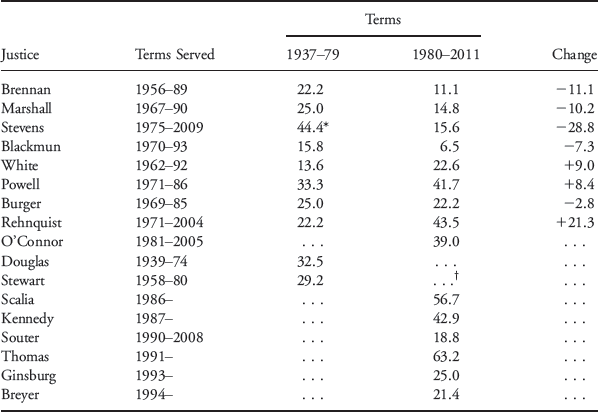
The overall patterns are depicted in table 6, with William O. Douglas and Potter Stewart included for comparison even though neither participated in many cases (in Douglas’s case, in any cases) in the second period. The data suggest that the movement toward more ideological voting in takings cases reflected voting changes among both liberal and conservative justices. William Brennan and Thurgood Marshall became distinctly less favorable to claimants in the 1980s, Byron White and Lewis Powell became more favorable, and William Rehnquist became far more favorable. John Paul Stevens and Harry Blackmun showed the same trend as Brennan and Marshall, though their voting is harder to interpret because Stevens participated in only a small number of pre-1980 cases and Blackmun was becoming more liberal overall over time (Greenhouse 2005). Warren Burger was an exception, changing little in his voting record. If analysis is restricted to cases decided in the 1970s and 1980s, to make the justices’ records more comparable with each other, similar patterns appear.
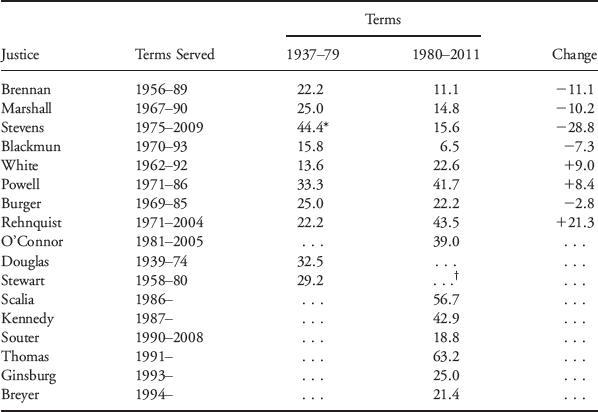
* Justice Stevens participated in nine cases prior to the 1980 term.
† Justice Stewart participated in only four cases in the 1980 term (voting for the claimant in one of the four cases).
In themselves, the voting records suggest that the movement toward clear ideological lines in takings cases came about equally from conservative and liberal justices. But as noted earlier, that suggestion might be inaccurate because of changes in the content of the cases that the Court heard. Although content is difficult to measure systematically, it seems clear that takings claimants in the post-1980 period were more likely to make arguments for significant expansions in the protections provided by the takings clause than were claimants in the earlier period. That was true of regulatory takings cases such as Nollan and Lucas v. South Carolina Coastal Council (505 U.S. 1003, 1992). And in Kelo, although both the majority and the dissenters argued that they were faithfully following the Court’s precedents on public use (including Berman), a ruling in favor of Kelo would have represented a shift in the Court’s position (see Barros 2008).
For that reason, it can be argued that a justice whose doctrinal position remained fixed would have voted for takings claimants at a lower rate after 1980. In turn, the justices’ voting records could be interpreted as showing that the move toward ideological polarization in takings came chiefly from the conservative justices. But this argument should not be overstated. The post-1980 Court still heard many takings cases that did not involve arguments for major changes in the law, and it is unlikely that the reduced rate of support for takings claims by the liberal justices who remained on the Court in the 1980s can be explained solely by a change in case content.
The three Republican appointees who joined the Court in the 1980s all had relatively high proportions of support for takings claimants, and Antonin Scalia’s support was quite high. But Sandra Day O’Connor and Anthony Kennedy had records similar to those of Rehnquist and Powell, suggesting that membership change was not the key driving force in the growth of ideological voting. The justices who joined the Court in the 1990s are not as directly relevant to the change, but their voting patterns were similar to those of conservatives who were already on the Court in the 1980s, though Clarence Thomas was even more favorable to takings claimants than Justice Scalia.Footnote 16
To a considerable extent, the development of a strong linkage between the justices’ general ideological stances and their positions in takings cases was driven by regulatory takings cases. As table 2 shows, regulatory decisions became far more numerous in the post-1980 period. They also became far more polarized. In each of the three nonunanimous regulatory cases prior to 1980, the pro-claimant justices were more conservative than their colleagues. But 80% of the regulatory takings cases in that period were unanimous, twice the proportion for all other cases. In the 1980–2011 terms fewer than half of the regulatory cases were unanimous, and the pro-claimant justices were more conservative than their colleagues in each of the nonunanimous decisions.
But regulatory takings cases were far from the whole story, because divisions among the justices became much more consistent ideologically in the nonregulatory cases. In the nonunanimous pre-1980 decisions that did not involve regulatory takings, the median difference between the median Martin-Quinn scores for the two sides was −0.341, meaning that the pro-claimant side was slightly more liberal than the anti-claimant side. In the 1980–2011 terms, the median difference in nonregulatory cases was 2.127, with the pro-claimant side substantially more conservative than the anti-claimant side. Similarly, the justices who supported claimants in divided decisions that did not involve environmental protection or other liberal policies in the post-1980 period were, on average, considerably more conservative than justices who opposed claimants.
Pulling the Evidence Together
Taken together, developments outside the Court, changes in the cases that the Court heard, and changes in the justices’ voting patterns suggest an explanation for the reestablished linkage between ideology and takings issues. In the 1970s takings started to become a conservative cause. The cases that the Court heard in the field increasingly reflected that development, with many challenges to environmental regulations and other liberal programs and large numbers of amicus briefs that reflected the growing ideological divisions over takings law and policy. The justices responded by dividing along ideological lines in a way that they had not done for several decades. As in other issue areas, the Court has continued to reach unanimity in a high proportion of cases. But when the justices do disagree, the ideological sides have become predictable in a way that they were not prior to 1980.
It is not obvious why the ideological lines on the Court should be so consistent, extending across all types of takings cases—and, notably, across all types of claimants. As table 2 shows, the proportion of claimants that were businesses was actually a little lower in the 1980–2011 terms than in the 1937–79 terms. Moreover, in the cases that divided the Court in the 1980–2011 terms, some of the businesses with takings claims were small enterprises that were barely distinguishable from individuals. Why were the liberal justices less favorable than conservatives to these claimants, parties that generally can be characterized as underdogs in comparison with the governments that opposed them? To return to the article’s original question, why was it the Court’s strong conservatives rather than its liberals who supported Susette Kelo?
The best answer is that developments in takings litigation created a context for cases such as Kelo, a context that shaped justices’ perceptions of these cases. Whatever may have been their sympathy (or lack of sympathy) for the claimants in specific cases, the justices connected those cases with the broader tides in the takings field, tides that had moved their attitudes about takings law toward one side or the other.
Kelo is especially interesting in that respect. The Court’s decision against the challenge to a redevelopment project in Berman v. Parker and for a broad interpretation of public use united the Court’s conservatives and liberals. Half a century later, why was it the Court’s conservatives rather than its liberals who implicitly moved away from Berman by supporting Kelo? Kelo was about the public use requirement of the takings clause, and a ruling in Susette Kelo’s favor would not have affected the regulatory takings issues that were at the heart of the battles over takings law and policy. Nor was the case about environmental policy. Moreover, a ruling for Kelo would have struck a blow against local government policies that had become the object of considerable suspicion on the political left. For those reasons, as discussed earlier, the liberal justices might well have been drawn to support Kelo as an economic underdog and conservatives to support New London’s effort to enhance the benefits of its partnership with a large business.
But the ideological redefinition of takings law worked against such a lineup. Indeed, that redefinition was reinforced by the participants in the Kelo case (see Wilkerson 2010). Kelo’s challenge to the taking of her home was sponsored by the Institute for Justice, a conservative public interest law firm that had succeeded the PLF as the leading legal advocate for takings claims. Kelo received amicus support from a long list of conservative political groups (though not from the business community). These participants provided a clear cue that Kelo was part of the general conservative drive for a more expansive interpretation of the takings clause.Footnote 17 Both conservative and liberal justices seemed to focus on the long-term goals and interests of groups in the takings field rather than on the specific interests of the litigants in Kelo.
The ideological shift in the Court in takings law had both logical and social sources. On the one hand, issues in takings cases from the late 1970s on connected with liberalism and conservatism in a way that had not been true in the preceding era. Many of those cases involved challenges to environmental regulation or to other programs that were understood as liberal.
On the other hand, the polarization of liberal and conservative justices in takings cases extended beyond cases with clear ideological connotations, and that extension seems best explained by the identification of takings claims as a whole with conservative advocates. In the period from the 1940s through the 1960s, takings law did not serve as a cause for groups on the left or the right. Beginning in the late 1970s, it became such a cause for conservatives, and the groups associated with that cause implicitly labeled arguments for a broad interpretation of the takings clause as conservative. That labeling pervaded cases that divided the justices, regardless of the specific issue and the litigants.
Of course, these logical and social processes were not independent of each other. For one thing, change in the content of takings cases reflected the efforts of conservative advocates. The best interpretation of the change in the linkage between ideology and the takings issues is that logical and social sources were closely connected and mutually reinforcing.
Conclusions
The evolution of the linkage between the takings issue and the justices’ ideological stances may not be typical. There are areas of legal policy in which the ideological element in the justices’ responses to cases appears to be stable. Even in areas with instability, the processes that bring about change may vary a good deal. Thus there is a need for caution in generalizing from what happened in the takings field.
What happened in takings, however, does point to some broader lessons. In conjunction with what scholars have gleaned from some other fields of policy, it demonstrates that the linkages between ideology and issues in the Supreme Court are neither immutable nor simply a product of logical deduction from general premises. Rather, how justices line up on particular issues reflects social and political processes outside the Court.
Unstable and contingent linkages between issues and ideology complicate explanations of justices’ choices that emphasize their policy preferences. Scholarship on the justices’ behavior typically treats preferences as internal to a justice, even when preferences appear to change over the course of a Supreme Court career. But to a considerable degree, preferences on policy issues are socially constructed. The conversion of takings from a nonideological issue back to an ideological issue reflected a change in both the cases that came to the Court and the advocates who supported the two sides. In thinking about the justices’ value systems, then, we need to keep in mind the political and social context that shapes the justices’ attitudes toward cases.
This article has provided only a limited examination of the linkages between issues and ideology in the Supreme Court. Other issues remain to be considered. To take one example, the Court itself may help to define those linkages, not only for itself but for people outside the Court. Indeed, the Kelo decision may have had this effect. These issues merit consideration in the effort to gain a fuller sense of justices’ attitudes and their impact on the Court’s decisions.