INTRODUCTION
In ruminants, propionate serves as an energy source and may also act independently as metabolic mediator of nutritional status (Harmon Reference Harmon1992). It can contribute up to 0·60 of the substrate necessary for gluconeogenesis (Manns & Boda Reference Manns, Boda and Willes1967; Manns et al. Reference Manns and Boda1967; Drackley et al. Reference Drackley, Overton and Douglas2001). Considerable energy has to be provided by diets in the form of propionic acid in the rumen or glucose in the intestine. Propionic acid can be supplied by favourable carbohydrate fermentation in the rumen, but excess intake of readily fermented carbohydrate or starch (high grain) could lead to acidosis and laminitis (Owens et al. Reference Owens, Secrist, Hill and Gill1998). Furthermore, the increased ruminal propionate production from feeding high-concentrate diets or feed additives (e.g. monensin) has been associated with the improved animal performance. In fact, the usable energy from the fermentation is increased if hydrogen is used to reduce pyruvate to propionate rather than to reduce CO2 to CH4 (Ørskov Reference Ørskov1977); heat-increment energy losses for acetate are higher than for propionate unless adequate glucogenic precursors are available for efficient acetate utilization (Tyrrell et al. Reference Tyrrell, Reynolds and Moe1979). In most areas of China, roughages, mainly from cereal production, are still the major component of rations in beef cattle feeding. Roughage diets generally promote high ruminal production of acetate relative to propionate (Cronjé et al. Reference Cronjé, Nolan and Leng1991). A number of studies have reported that addition of gluconeogenic precursors, such as sodium or calcium salts of propionate, increased ruminal propionate production (Harmon & Avery Reference Harmon and Avery1987; Veenhuizen et al. Reference Veenhuizen, Russell and Young1988), decreased the ratio of acetate to propionate and pH in the rumen (Villalba & Provenza Reference Villalba and Provenza1997; Rigout et al. Reference Rigout, Hurtaud, Lemosquet, Bach and Rulquin2003), and improved the digestibilities of dry matter (DM), organic matter (OM), neutral detergent fibre (NDF) and acid detergent fibre (ADF) (Sheperd & Combs Reference Sheperd and Combs1998). Propionate infusion also led to an increase of milk and protein yield (Miettinen & Huhtanen Reference Miettinen and Huhtanen1996; Hurtaud et al. Reference Hurtaud, Rulquin and Verite1998; Sheperd & Combs Reference Sheperd and Combs1998).
In contrast, other studies, mostly conducted using dairy cattle (Sheperd & Combs Reference Sheperd and Combs1998; Patton et al. Reference Patton, Sorenson and Hippen2004; McNamara & Valdez Reference McNamara and Valdez2005), revealed no improvement in lactational response after feeding substantial doses of propionate to dairy cows. Overton & Waldron (Reference Overton and Waldron2004) concluded in a review that the lack of lactational response to propionate supplementation is due to its small contribution relative to the total ruminal production. Furthermore, inconsistent results from the literature might be because of unidentified differences in animal characteristics. Animals differing in breed, physiological state or feeding conditions might respond differently to propionate supplementation. Information on feeding values of calcium propionate in beef cattle, especially in feeding conditions in China, is lacking. According to previous studies (by the present authors, data not published), the average daily gain (ADG) of steers supplemented with calcium propionate at 200 g/day increased by 126 g/day relative to control and the benefit was 0·29 Renminbi (RMB)/day. The objectives of the current work were to investigate the effects of calcium propionate supplementation on ruminal pH and fermentation, and nutrient digestibility in beef cattle.
Allantoin and uric acid are referred to as ‘purine derivatives’ (PD). In cattle, the daily excretion of PD is linearly correlated with the amount of microbial purines absorbed. Accordingly, the response between PD excretion in urine and the absorption of microbial purines, together with the ratio of total nitrogen to purine-nitrogen in mixed rumen microbes, was calculated to estimate microbial protein supply from PD excretion (IAEA 1997). PD has been suggested as a useful index of microbial nitrogen production in the rumen (Verbic et al. Reference Verbic, Chen, Macleod and Ørskov1990; Chen et al. Reference Chen, Mayuszewski and Kowalczyk1996). Therefore, the urinary excretion of PD was also measured.
MATERIALS AND METHODS
Animals and experimental design
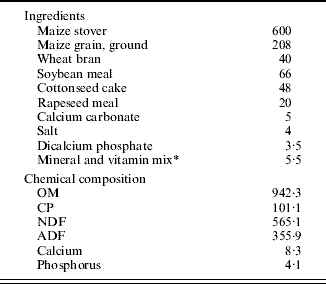
Eight ruminally cannulated Chinese Simmental steers, averaging 3·5 years of age and 462±14 kg body weight (BW), were assigned to a replicated 4×4 Latin square arrangement of treatments. The treatments were: control (without calcium propionate), LCaP (calcium propionate – low), MCaP (calcium propionate – medium) and HCaP (calcium propionate – high) with 100, 200 and 300 g calcium propionate per steer per day, respectively. The supplement of calcium propionate feed additive grade (0·99 calcium propionate, Qingdao Hecreat Bio-tech Company, Qingdao, China) was purchased and was added to the concentrate portion when it was pelleted in the feed mill. Diets consisted of 0·60 maize stover and 0·40 concentrate (Table 1). Feed intake including 5·4 kg forage and 3·6 kg concentrate per steer per day was restricted to a maximum of 0·90 of ad libitum intake. Experimental periods were 21 days, with 11 days of adaptation and 10 days of sampling. Steers were housed in individual pens (3×3 m) for the adaptation period. Steers were fed twice daily at 07.00 and 19.00 h and fresh water was available throughout the experimental period. Refusals were measured daily at 16.00 h during the adaptation period and the amount of feed offered was adjusted for a target of 0·05 refusals. On day 8, steers were restricted to 0·90 of their respective ad libitum intake determined during the prior 7 days in an attempt to ensure that there were no refusals during the sampling periods. Samples of diets were collected once weekly for DM determination, and then composited by period. The samples were dried in an oven at 55°C for 48 h, and ground with a mill to pass through a 1 mm screen (FZ102, Shanghai Hong Ji Instrument Co. Ltd, Shanghai, China) for chemical analysis. The animals were weighed at the beginning and the end of the 21-day experimental period. The experimental protocol was approved by the Animal Care and Use Committee of the Shanxi Agriculture University.
Ingredient and chemical composition of the basal diet (in g/kg DM)
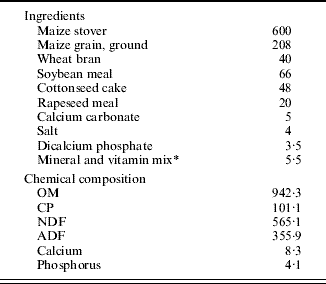
* Contained 42 ppm Co, 3500 ppm Cu, 20 000 ppm Fe, 12 000 ppm Mn, 12 000 ppm Zn, 1200 ppm I, 600 ppm Se, 3000 IU/g of vitamin A, 500 IU/g of vitamin D and 15 IU/g of vitamin E.
In situ ruminal degradability
Ruminal degradation kinetics of the maize stover and concentrate mix used in the present study were measured using a nylon bag technique on days 12–14 of each experimental period for each steer. The maize stover and concentrate mix were ground with a mill to pass through a 2·5 mm screen (FZ102, Shanghai Hong Ji Instrument Co. Ltd, Shanghai, China). Approximately 3 g of maize stover and 4 g of concentrate were then weighed in 90 mm×160 mm nylon bags made of monofilament Pecap polyester (Guangzhou Minyuan Business Co. Ltd, Guangdong, China) with a mean pore size of 47±2 μm and heat sealed. Individual bags were placed into the rumen through the ruminal fistula 2 h after feeding. The duplicated bags were suspended in the rumen of each steer for 0, 4, 8, 12, 24, 36, 48 and 72 h. An empty bag without sample for each incubation time was also incubated in the rumen as a control. All bags were removed at the end of the incubation period and were manually rinsed in cold tap water until the effluent remained clear. The bags were subsequently dried at 65°C for 12 h and then at 100°C for 24 h. All bags were weighed to determine DM disappearance.
Kinetics of nutrient disappearance in situ in the rumen was estimated using the non-linear regression procedure of SAS (SAS 1996). For each steer, period and type of feed, the following model was fitted to the fraction of nutrient disappearance (McDonald Reference McDonald1981):

where a is soluble fraction, b is slowly degradable fraction, c is fractional degradation rate constant at which b is degraded, L is lag time (h) and t is time of incubation (h).
Effective degradability (ED) of feed was determined using ED=a+[bc/(c+k)], where k was the particulate passage rate out of the rumen and was 0·025/h for maize stover and 0·058/h for concentrate mix according to the current measurements (Liu et al. Reference Liu, Wang, Huang, Dong, Yang and Wang2008) according to the procedure of Yang et al. (Reference Yang, Beauchemin, Koenig and Rode1997) using Cr-fixed NDF and Yb acetate as forage and concentrate markers, respectively.
Ruminal pH and fermentation
Ruminal pH and fermentation characteristics were measured for 2 consecutive days, days 19 and 20 of the experimental period, for each steer. At 0, 3, 6, and 9 h after the 07.00 h feeding, rumen fluid was obtained from several sites within the rumen (reticulum, dorsal and ventral sac). Ruminal pH was immediately measured using an electric pH meter (Sartorius Basic pH Meter PB-20, Sartorius AG, Goettingen, Germany). The samples were then strained through four layers of cheesecloth. Five millilitres of filtrate was preserved by adding 1 ml of 250 g/l (w/v) meta-phosphoric acid to determine volatile fatty acid (VFA), and 5 ml of filtrate was preserved by adding 1 ml of 20 g/l (w/v) H2SO4 to determine NH3. The samples were subsequently stored frozen at −20°C until analysed.
Apparent digestibility in the total tract
Steers were dosed via ruminal cannula with 2 g of chromic oxide per steer per day in two equal proportions at 07.00 and 19.00 h beginning 7 days before sampling and continuing throughout the sampling period for use as a digestion marker. At 3, 6 and 9 h after the 07.00 h feeding, faecal samples (approximately 200 g wet weight) were collected for each steer from the rectum on days 16–20 and pooled by steer and period. After being dried at 55°C for 48 h, the samples were ground in a feed mill to pass through a 1 mm sieve for chemical analyses. DM excreted in faeces was calculated by dividing chromium input (grams of chromium per day) by chromium concentration (grams of chromium per kg of DM) in the faeces (Ferret et al. Reference Ferret, Plaixats, Caja, Gasa and Prió1999). Excretion of other components in the faeces was calculated by multiplying DM flow by their concentration in faecal DM.
Urine collection and PD measurements
Total urine output was collected using urine collection aprons (Hobbs et al. Reference Hobbs, Hansard and Barrick1950; Liu et al. Reference Liu, Wang, Huang, Dong, Yang and Wang2008) between days 12 and 21 of the period. Urine was collected daily into containers to which was added 100 ml sulphuric acid per litre of urine (sufficient to maintain pH<3). The containers were weighed, mixed well and 0·01 of the daily portions were pooled over the 10-day period for each animal. At the end of the collection period, 20 ml urine samples (a subsample taken from the 10-day pooled urine sample) was diluted to 100 ml with distilled water, then divided into two subsamples and stored at −20°C for analysis of allantoin and uric acid. Total urinary PD excreted (mmol/day) were estimated as the sum of uric acid and allantoin.
Chemical analyses
DM content of the ingredients (maize stover and concentrate mix) and diet were determined by oven drying at 65°C for 24 h. Analytical DM content of oven-dried samples (maize stover, concentrate mix, diet and faeces) was determined by drying at 135°C for 3 h (AOAC 1990; method 930·15). The OM content of samples (maize stover, concentrate mix, diet and faeces) was calculated as the difference between DM and ash contents, with ash determined by combustion at 550°C for 5 h. The NDF and ADF contents of samples (maize stover, concentrate mix, diet and faeces) were determined using the methods described by Van Soest et al. (Reference Van Soest, Robertson and Lewis1991) with heat stable alpha amylase and sodium sulphite used in the NDF procedure, and expressed inclusive of residual ash. Content of N in the samples (maize stover, concentrate mix, diet and faeces) was determined by the Kjeldahl method (AOAC 1990; method 976·05). Ruminal VFA were separated and quantified by gas chromatography (GC102AF; Shanghai Specialties Ltd, China) using a 2-m (ø4-mm) fused PEG2000, Chromsob WAW DMCS column (GC102AF; Shanghai Specialties Ltd, China) with 2-ethylbutyric acid as internal standard. Ammonia N content of ruminal samples was determined using the method of AOAC (1990). Allantoin and uric acid in urine were determined by ultraviolet–visible spectrophotometer UV-2100 using the procedure of IAEA (1997). Chromium concentrations in the samples were determined by an atomic absorption spectrophotometry (TAS-990; Beijing Purkinje General Instrument Co. Ltd, China) according to the AOAC (1990).
Statistical analyses
Data were analysed using the mixed model procedure of SAS (Proc Mixed; SAS 1996) to account for effects of square, period within square, animal within square and treatment. The treatment was considered a fixed effect; square, period within square and animal within square were considered random effects. Data for ruminal pH, VFA and ammonia N were summarized by sampling time and then analysed using the same mixed model but with time included as a repeated measure using compound symmetry. Linear and quadratic orthogonal contrasts were tested using the CONTRAST statement of SAS with coefficients estimated based on the calcium propionate application rates. Effects of the factors were declared significant at P<0·05 and trends were discussed at P<0·10 unless otherwise noted.
RESULTS
Ruminal pH and fermentation
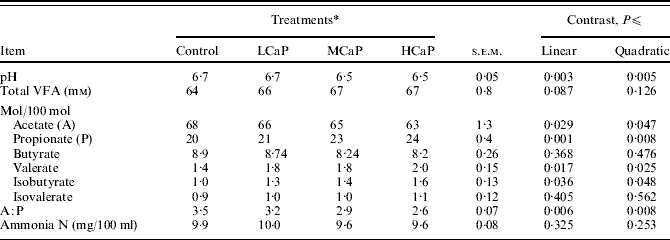
Ruminal pH, ammonia N and VFA profiles are shown in Table 2. Mean ruminal pH was both linearly and quadratically decreased with increasing calcium propionate supplementation. Total ruminal VFA, butyrate and isovalerate concentrations were not affected by calcium propionate supplementation. Molar proportion of acetate decreased both linearly and quadratically, whereas those of propionate, valerate and isobutyrate increased both linearly and quadratically with increasing calcium propionate supplementation. As a consequence, ratio of acetate to propionate was reduced both linearly and quadratically. Greater calcium propionate supplementation did not affect ruminal ammonia N content.
Effects of calcium propionate supplementation on ruminal pH and fermentation in steers
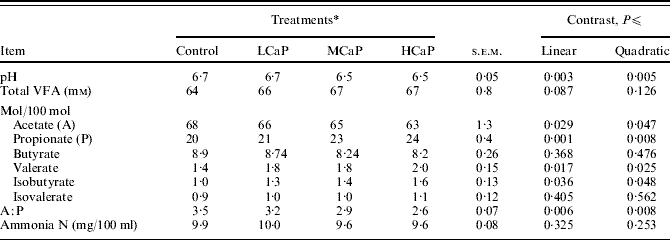
* Control (without calcium propionate), LCaP, MCaP and HCaP with 100, 200 and 300 g/steer/day calcium propionate, respectively.
Effective ruminal degradability
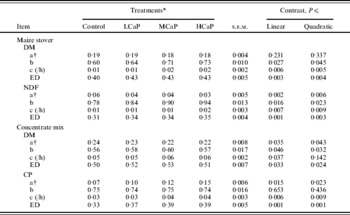
In situ ruminal digestion kinetics and ED of maize stover and concentrate mix are shown in Table 3. For maize stover, the soluble fraction of DM was not affected, whereas a linear and quadratic response of ruminal potentially degradable fraction, degradation rate and ED were observed with increasing calcium propionate supplementation. Regarding the digestion kinetics of NDF, the soluble fraction decreased both linearly and quadratically, whereas a linear and quadratic increase in ruminal potentially degradable fraction and degradation rate and ED were observed with greater calcium propionate supplementation.
In situ ruminal digestion kinetics and ED of maize stover and concentrate mix

* Control (without calcium propionate), LCaP, MCaP and HCaP with 100, 200 and 300 g/steer/day calcium propionate, respectively.
† Parameters were calculated from the fitted equation y=a+b(1−e−c(t−L)) for t>L, where y is the proportion of DM disappearance from the nylon bag at time t, a is the soluble fraction, b is the slowly degradable fraction, c is the fraction rate constant at which b is degraded, L is lag time (hours) and t is time of incubation (hours). ED was calculated using equation a+bc/(c+k), where k=0·025 or 0·058/h for maize stover or concentrate mix, respectively.
For concentrate mix, the soluble fraction decreased both linearly and quadratically, potentially degradable fraction and ED of DM increased both linearly and quadratically with greater doses of calcium propionate supplementation. The degradation rate of the potentially degradable fraction of DM increased linearly. The potential degradable fraction of crude protein (CP) was not affected, whereas a linear and quadratic increase in ruminal soluble fraction, degradation rate and ED of CP were observed with greater calcium propionate supplementation.
Urinary PD
Urinary PD are shown in Table 4. Daily urinary excretion of uric acid was not affected by the treatments, but urinary excretion of allantoin and PD responded both linearly and quadratically to calcium propionate supplementation, being highest for MCaP, intermediate for HCaP and lowest for control and LCaP.
Effects of calcium propionate on urinary excretion of PD in steers

* Control (without calcium propionate), LCaP, MCaP and HCaP with 100, 200 and 300 g/steer/day calcium propionate, respectively.
Digestibility in the total tract
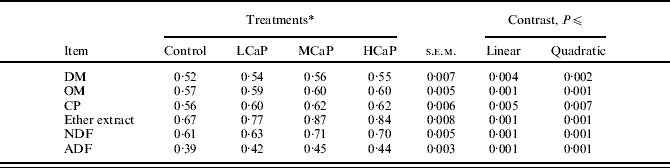
Coefficients of component digestibilities in the total tract are shown in Table 5. Digestibilities of OM, CP and fibre in the total tract responded with similar pattern to calcium propionate supplementation. The digestibilities of DM, OM and CP increased with greater calcium propionate supplementation until the medium level, and were then unchanged with the high calcium propionate supplementation. Similarly, the digestibilities of NDF or ADF were increased until the MCaP and then declined slightly with additional Ca propionate.
Effects of calcium propionate supplementation on coefficient of component digestibility in the total tract of steers
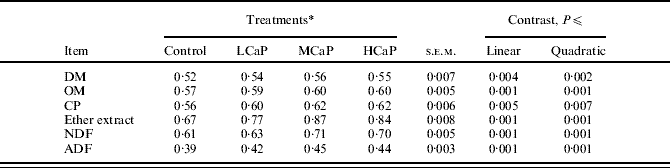
* Control (without calcium propionate), LCaP, MCaP and HCaP with 100, 200 and 300 g/steer/day calcium propionate, respectively.
DISCUSSION
Linear and quadratic reduction of ratio of acetate to propionate with increasing calcium propionate supplementation was due to increasing propionate concentration in the rumen (13, 14, 15 and 16 mm for control, LCaP, MCaP and HCaP, respectively) since the concentration of acetate did not change (range 42–44 mm). Furthermore, increasing propionate concentration probably resulted from exogenous supplementation of calcium propionate rather than from increased rumen production. The amounts of propionate added were 0, 422, 844 and 1266 mm per steer per day for control, LCaP, MCaP and HCaP, respectively, whereas the increases in the rumen were 143, 296 and 407 mm for LCaP, MCaP and HCaP, respectively, compared with control. This calculation assumes a rumen volume of 50 litres and a dilution rate of 0·10/h. This estimate might be inaccurate because ruminal absorption was not considered. Similarly, the trend towards increased total VFA concentration with increasing calcium propionate was also probably due to addition of calcium propionate from feeds. The present results are consistent with the findings of Judson & Leng (Reference Judson and Leng1973) who reported that the increase in ruminal propionate production was less than the amount added in sheep given intraruminal infusions of sodium propionate. However, the present results are in contrast to the findings of Harmon & Avery (Reference Harmon and Avery1987) that ruminal propionate increased more than the sodium propionate added to the high-concentrate diet of steers. Rigout et al. (Reference Rigout, Hurtaud, Lemosquet, Bach and Rulquin2003) reported a reduction in acetate concentration but production of propionate was not increased compared with the amount added. The reasons for the inconsistent effects of propionate supplementation on VFA production or on VFA profiles in the studies are not clear as animal, diets and type of propionate were different. It is speculated that the effect of propionate supplementation might vary with diet (e.g. concentrate proportion), type of animal or physiological status of the animals. The results from the present study suggest that adding calcium propionate has minimal effect on VFA production but could significantly change VFA profiles in the rumen. Lack of effect of calcium propionate supplementation on ruminal acetate proportion is consistent with high ruminal pH across the treatments. Ruminal pH in the present study was within the optimum range for cellulolytic bacteria activity (Russell & Wilson Reference Russell and Wilson1996). This result is consistent with Villalba & Provenza (Reference Villalba and Provenza1997) who reported that infusion of propionate decreased ruminal pH and acetate, but did increase the molar proportion of ruminal propionate. Similarly, Rigout et al. (Reference Rigout, Hurtaud, Lemosquet, Bach and Rulquin2003) reported that increasing the amounts of infused propionate linearly increased the percentage of ruminal propionate at the expense of ruminal acetate, butyrate and valerate.
The linear increase of in situ ruminal ED of maize stover DM and NDF was consistent with total VFA concentration that was numerically increased with increasing calcium propionate. Nevertheless, ruminal concentration of VFA is not a direct measure of ruminal VFA production. Information is limited regarding the effects of propionate supplementation on feed degradation in the rumen although studies have shown that ruminal VFA concentration is affected with propionate supplementation (Harmon & Avery Reference Harmon and Avery1987; Veenhuizen et al. Reference Veenhuizen, Russell and Young1988). In addition, feeding behaviour of dairy cattle was also changed with longer eating time but shorter ruminating time when propionate salts were intraruminally infused (Oba & Allen Reference Oba and Allen2003); those authors also reported that more water was consumed by cows treated with propionate. These changes due to propionate supplementation would suggest that there are potential effects on feed digestion in the rumen. Furthermore, the linear and quadratic responses of ED of maize stover DM and NDF were consistent with the results of both linearly and quadratically increased nutrient digestibility in the total tract with calcium propionate supplementation. It can be concluded that the improvement in the total digestibilities of DM, NDF and ADF due to calcium propionate supplementation was partially attributed to improved ruminal degradation.
It is also possible that calcium propionate also improved component digestion in the intestine since the fractional increase in overall digestibility of DM and NDF is slightly greater than that of ruminal ED measured in vitro. This suggestion needs to be taken with great caution, as rumen degradability was not directly measured. However, the improvement in the total digestibility with calcium propionate supplementation in the present study agrees with the findings of Sheperd & Combs (Reference Sheperd and Combs1998) who reported that digestibilities of DM, OM, NDF and ADF were increased by 8·3, 8·0, 19·4 and 20·4%, respectively, for cows receiving infusions of propionate compared with control cows when fed a high-forage diet (0·60 forage). The authors were not clear why digestibility was increased, but lower intake with propionate infusion might be a factor, as passage rate of digesta was not affected. Rigout et al. (Reference Rigout, Hurtaud, Lemosquet, Bach and Rulquin2003) reported that milk yield in cows fed propionate tended to increase linearly with increasing amounts of propionate. Similarly, Miettinen & Huhtanen (Reference Miettinen and Huhtanen1996), Hurtaud et al. (Reference Hurtaud, Rulquin and Verite1998) and Sheperd & Combs (Reference Sheperd and Combs1998) found propionate infusion led to an increase in milk and protein yield. It is speculated that improved animal growth rate and milk yield might result from increased digestibility in the digestive tract with calcium propionate supplementation.
The quadratic response to calcium propionate supplementation with no further improvement of in situ ruminal degradation and total digestibility is consistent with results indicating that rumen fermentation with high dose of calcium propionate supplementation (300 g/steer/day) was not beneficial. The results suggest that calcium propionate could affect rumen fermentation and feed digestibility in the total tract in a dose-dependent manner in certain circumstances.
The increased urinary excretion of PD suggested that microbial protein production in the rumen is increased with increasing calcium propionate supplementation. The improved in situ ruminal degradation of maize stover would also support an increase of ruminal microbial protein synthesis. Ruminally fermentable carbohydrate was the key dietary factor affecting microbial protein synthesis (Krause et al. Reference Krause, Combs and Beauchemin2002). In addition, the in situ ruminal CP degradability of concentrate mix was improved with increasing the dose of calcium propionate, but ruminal ammonia N concentration did not increase. This could be due to an enhanced growth of ruminal microbial populations that would increase the ammonia N consumption, especially the fibre-degrading populations with calcium propionate supplementation. Cellulolytic bacteria derive their N exclusively from ammonia N (Russell et al. Reference Russell, O'Connor, Fox, Van Soest and Sniffen1992). Calcium propionate supplementation may improve ruminal fibrolytic bacterial activity as in situ ruminal ED of NDF was improved linearly. Nevertheless, ammonia N concentration was higher than 5 mg/dl, which is said to be necessary to support optimal microbial growth (Satter & Slyter Reference Satter and Slyter1974).
CONCLUSION
Increasing supplementation of calcium propionate in the diet of steers linearly and quadratically decreased ruminal pH and ratios of acetate to propionate. However, rumen fermentation pattern was not changed since change of ratio of acetate to propionate was due to calcium propionate supplementation. In situ ruminal NDF degradation of maize stover and CP degradability of concentrate mix were improved with increasing dose of calcium propionate. Urinary excretion of PD was also increased, suggesting an increase of ruminal microbial production. Nutrient digestibility in the total tract was quadratically affected with no further increase between medium and high calcium propionate levels. The results suggest that calcium propionate modulates the digestive microorganisms or enzymes in a dose-dependent manner. The optimum calcium propionate dose was about 200 g/steer/day and a further increase to 300 g/steer/day was not beneficial in improving the feed utilization in the present experimental conditions. The mode of action of calcium propionate in the digestive tract of cattle is unclear. Further study is warranted to focus on the mechanism of calcium propionate in the digestive tract.
This work was supported by a grant from 11th Five-Year key projects of National Scientific Research Foundation of China (2007BAD5B04). The authors thank the staff of Shanxi Agriculture University Beef Unit for care of the animals.