TABLE OF CONTENTS
Introduction98
1. PERSONAL ADORNMENT OR DRESS99
Hairpins/Dress Pins99
Buttons102
Beads102
Armlets103
Finger-Rings103
2. TOILET, SURGICAL OR PHARMACEUTICAL INSTRUMENTS105
Mixing Palettes105
Mirror106
Ligula106
Simple hook106
Spatula or spoon107
Tweezers107
3. TEXTILE WORKING AND MANUFACTURE107
Sewing needles107
Netting needle107
Spindle whorls107
Loomweights and miscellaneous weights108
4. HOUSEHOLD UTENSILS AND FURNITURE111
Metal vessels111
Stone vessels113
Pestles122
Ostrich egg shell vessels122
Spoons125
Furniture fittings and fragments125
Locks126
Keys126
Handmills127
Statuette bases128
Flint artefacts (Strike-a-lights?) By Graeme Barker128
5. OBJECTS USED FOR RECREATIONAL PURPOSES130
Counters/discs130
6. OBJECTS ASSOCIATED WITH WRITING132
7. OBJECTS ASSOCIATED WITH FISHING132
Fish hooks132
Net weights132
8. OBJECTS ASSOCIATED WITH MILLING (COMMERCIAL)132
Donkey mills (?)132
9. OBJECTS AND WASTE MATERIAL ASSOCIATED WITH METAL WORKING132
Lead ingot?132
Melted lead132
Slag and clinker132
10. OBJECTS ASSOCIATED WITH BONE WORKING133
Bone offcuts or unfinished objects133
11. FASTENINGS AND FITTINGS133
Nails/rivets/studs/tacks133
Clamps135
12. BUILDING MATERIALS136
13. TOOLS136
14. OBJECTS ASSOCIATED WITH TRANSPORT136
15. OBJECTS ASSOCIATED WITH RELIGIOUS BELIEFS AND PRACTICES136
Miniature altars136
Other objects137
16. MILITARY OR HUNTING EQUIPMENT137
Arrow-heads137
Ballista/catapult/musket balls138
17. OBJECTS THE FUNCTION OR IDENTIFICATION OF WHICH IS UNCERTAIN139
References144
Materials Concordance145
Concordance of Small Find Numbers147
Index150
INTRODUCTION (P.M.K.)
Background and acknowledgements
‘Small Finds’ is a convenient term for those artefacts which fall into none of the major categories for study, despite the fact that some of them (notably the stone objects) may be far from small. It is a commonplace of many excavations that this category represents something of an afterthought – objects which seem at first sight, by reason of difficulty of identification, poor preservation and invariability over long periods of time, to have less to contribute to the interpretation of an excavation than other artefacts. (See Corinth xii, v.)
It must be admitted that the objects described in the following pages suffer more than they should in this regard. While the excavation was in progress, they were catalogued in a variety of different hands and with varying degrees of skill and detail. They were eventually allocated to the Director of the excavation, Dr John Lloyd, for reporting, largely by default. The question of illustration seems never to have been tackled systematically: few items were photographed and the choice of items for drawing seems to have been somewhat haphazard. (There is unfortunately no record of the illustrators who made the drawings, but a number of different hands are apparent.) The list of items which could be usefully reported here is therefore somewhat shorter than it might have been in more favourable circumstances: in mitigation, I ask the reader to consider the difficulties surrounding the conduct of the entire project as they were described by Dr Lloyd in Berenice i, 11–14.
During the years following the conclusion of the excavation in 1975 and the publication of the first volume of the excavation reports in 1977, Dr Lloyd worked intermittently on the small finds report, most notably with the assistance (funded by the Society for Libyan Studies) of Alison Macdonald in 1994. A preliminary catalogue of the objects was prepared and in many instances research was carried out on identifications and parallels. The correspondence files of Dr Lloyd show that he consulted widely, and he would probably have wished to make more extensive acknowledgements of help than I am in a position to do on his behalf: of particular note are the report provided by Prof. Graeme Barker on the worked flints (nos. H257–264) and that provided by Dr Martin Henig on the intaglio (H62). It is clear that Dr Henig also provided a number of other useful comments and references. A provisional arrangement of the line drawings was also prepared.
This was the state of the material when it came into my hands following the death of Dr Lloyd in 1999. Alison Macdonald was extremely helpful to me in establishing the status quo. Some further re-arrangement, and wholesale re-numbering of the catalogue was called for, and this in turn necessitated some re-arrangement of the drawings. Not all classes of material had been researched and I have done what I can to make good some of the gaps. I have not myself seen the objects and am therefore unable to make good any defects in the original reporting. The text which follows is therefore a composite creation of both authors. Where comments are made in the first person, they are qualified by the initials JAL or PMK to make clear their authorship.
Delay in publication
The preceding words were written in 2003, at which time it was hoped that publication would follow without significant delay, in the final volume (iv.2) of the Excavations at Sidi Khrebish, Benghazi (Berenice) monograph series. Two of the major components of that volume still remain incomplete, and the Council of the Society for Libyan Studies has decided that the small finds report should not be held back any longer. The reader should be aware, however, that there has been little opportunity to revise or update the text since 2003.
The significance of the small finds
The body of material listed here is very modest, considering the scale of the excavation and the richness of other categories of finds (pottery, lamps, glass etc.). This may be due in part to the generally hurried manner in which much of the excavation was conducted, which would not have favoured the smaller and more friable objects, such as those of metal. But it may also suggest orderly, rather than chaotic, abandonment of structures when they came to the end of their existence. The more valuable items would therefore have been removed and not lost. (It strikes me as a curiosity of the present list that there is no identifiable fragment of a steelyard or of metal weights, which elsewhere are often found on urban sites.) Metal objects are rarely so closely datable as items of pottery or glass, but they may on occasion suggest cultural links. The cast bronze handle in the shape of a hand, H104, falls into this category as a Campanian import with close parallels from Pompeii. Links between Berenice and Campania were strong in the late Hellenistic period (see Berenice ii, 410 ff. for the coarse wares and Berenice iii.1, 9–29 for black-glazed ware) and in the first century AD (see Berenice ii, 412 f. and Berenice iii.1, 320–26). Otherwise, there are few objects which are not widely paralleled on classical sites in the Mediterranean region.
Another purpose which ‘small finds’ may serve is in the interpretation of function of buildings or rooms. The character of the small temple in Area X (Berenice i, 67 ff.) is defined as much by the objects found within it as by its actual structure. (See nos H103, H266, H375, H377, H378, H381.) But apart from this, the only association between objects and structures which is at all suggestive is the number of ballista balls found along the line of the Hellenistic defences. (See nos H394–406 and Berenice i, 46–47.)
Terminology and abbreviations
The term ‘bone’ is used without any attempt to distinguish ivory. The term ‘bronze’ has been chosen rather than the often-preferred ‘copper alloy’: no metallurgical analyses were carried out. The following abbreviations are used for dimensions.
- D.
-
diameter
- H.
-
height
- L.
-
length
- T.
-
thickness
- W.
-
width
- PL. etc.
-
preserved length etc.
- max. D. etc.
-
maximum diameter etc.
In each catalogue entry, the figure in brackets preceding the dimensions of the object is the small find number by which it is identified in the primary records and in the excavation store. (The precise location and manner of storage of the material is currently unknown: it has been moved several times since the excavations took place.) Context data take the form (e.g.) ‘G7.7’, signifying ‘Area G, trench 7, layer 7’. Those contexts which provided significant chronological information for the interpretation of the site were grouped together as appropriate and thus formed the list of Dated Deposits which was presented in provisional form in Berenice i, 289–311 and more amply (with revisions) in Berenice iii.1, 417–92. Where the contexts cited belong to any such deposits, the relevant information is given in the entry.
1. PERSONAL ADORNMENT OR DRESS
HAIRPINS/DRESS PINS
The order of presentation follows the typology established by Crummy (Reference Crummy1983, 19 ff.) for Colchester. It may be noted that of the 36 items listed here, only six were found in contexts that are datable earlier than the third century AD.
Bone
Pins with plain conical head (Colchester Type 1)
-
H1 Head and part of shaft. Polished.
(3724) PL. 3.8 cm; max. D. 0.55 cm. Fig. 1
SK+. Surface find.
Items of personal adornment or dress. Scale 1:2 except where indicated.

Not illustrated
-
H2 Three joining fragments comprising head and part of shaft. Highly polished.
(3600) PL. 9.75 cm; max. D. 0.3 cm. W28.9. Building W, late levels overlying courtyard.
Context date: late Roman +.
Pins with transverse grooves beneath a rounded head (Colchester Type 2)
-
H3 Three shallow grooves, widely spaced. Rough, eroded surface. Possibly unfinished.
(3814) L. 8.3 cm. Complete. Fig. 1
P102.9. Deposit 110: Building P1, Room 7, fill of kiln (Berenice iii.1, 468).
Context date: mid third century AD.
-
H4 Head and part of shaft. Rudimentary groove around half of circumference only, immediately below head. Polished. Possibly a tool or instrument of some kind rather than a pin.
(2573) PL. 10.0 cm, D. 0.7 cm. Fig. 1
D14.2. Late levels overlying road metallings immediately north of Building P4.
Context date: late Roman.
Pins with more or less spherical head (Colchester Type 3)
-
H5 Cut marks visible on head and shaft. Lightly polished.
(1788) PL. 8.3 cm; max. D. 0.4 cm. Tip broken off. Fig. 1
J31.14. Deposit 101: Building J3, fill of cistern (Berenice iii.1, 464).
Context date: mid third century AD.
-
H6 Rather crude faceted shaft. Polished.
(3515) PL. 6.6 cm; max. D. 0.45 cm. Tip broken off. Fig. 1
BB23.4. Building BB, robber trench of south wall.
Context date: mid third century AD + .
-
H7 Rather crude workmanship. Polished.
(3440) PL. 4.2 cm; max. D. 0.25 cm. Tip broken off. Fig. 1
BB5.1. Building BB, surface level.
Context date: mid third century AD +.
-
H8 Head and beginning of shaft. Polished. A tiny hole in the centre of the tip of the head indicates lathe-turning.
(2715) PL. 1.0 cm. Fig. 1
F22+. Church (Building G), surface find.
Pins with reels beneath a conical or ovoid head (Colchester Type 5)
-
H9 One ring. Flattened ovoid head. Swollen upper shaft. Highly polished.
(3815) PL. 8.3 cm. Complete. Fig. 1
P102+. Building P1, Room 7, surface find.
-
H10 Ovoid head above three reels, the lower two very thin. There is a tiny hole in the centre of the tip of the head, suggesting lathe-turning. Polished. Fine workmanship.
(1746) PL. 2.5 cm; max. D. 0.7 cm. Most of shaft missing. Fig. 1
L24.9. Building L1, dump levels and fill in southeast corner.
Context date: second century AD and later.
-
H11 Four reels gradually increasing in diameter towards beginning of shaft. Polished.
(3519) PL. 6.4 cm; max. D. 0.45 cm. Upper part of head and lower part of shaft broken off. Fig. 1
W72.1. Deposit 142: tip levels sealing construction trench of church tower (Berenice iii.1, 477).
Context date: first half of sixth century AD +.
Pins with a reel or bead-and-reel shaped head (Colchester Type 6)
-
H12 Double reel/long bead/reel. Head unevenly carved. Scratch marks on shaft. Highly polished.
(1998) PL. 6.6 cm; max. D. 0.6 cm. Lower part of shaft broken off. Fig. 1
P Vat 23.2. Deposit152: Building P1, Room 2, fill of vat 18 (Berenice iii.1, 481).
Context date: seventh century AD.
-
H13 Double reel/long bead/double reel. A small depression at centre of the tip of the head suggests lathe-turning. The shaft is slightly faceted and appears to have been hand carved. Polished.
(1935) PL. 4.9 cm; max. D. 0.5 cm. Lower part of shaft broken off. Fig. 1
P59.3. Building P1, disturbed surface levels in southwest corner of courtyard.
Context date: seventh century AD +.
-
H14 Single reel at head of shaft. Above, probable (but not certain) traces of the base of a bead. Not polished.
(2550) PL. 5.8 cm; max. D. 0.6 cm. Tip broken off. Fig. 1
D1.8. Building P4, robber trench.
Context date: mid third century AD +.
-
H15 Single reel at head of shaft, with stub of broken element above. Upper shaft decorated with four incised rings. Polished.
(4000) PL. 3.1 cm. Upper part of head and lower part of shaft broken off. Fig. 1
SK+. Surface find.
-
H16 Two broad reels. Rest of head missing. Polished.
(3231) PL. 7.0 cm; max. D. 0.4 cm. Tip broken off. Fig. 1
W44.6: late levels immediately north of northeast corner of church (Building G).
Context date: late Roman +.
Miscellaneous
-
H17 Most of the shaft has been broken off. Head in form of stylised amphora. A tiny depression in the centre of the tip of the head indicates lathe-turning. Polished.
(1105) PL. 2.6 cm. Fig. 1
X6.1. Building B2, robbing layers in southwest corner.
Context date: mid third century AD or later.
The same pin head type has been found at Corinth in contexts of the first to second centuries AD (Corinth xii, nos. 2345 (lathe-turned), 2346).
-
H18 Most of shaft missing. Pine-cone head decorated with spiral grooving. Three rings below. Lightly polished.
(88) PL. 2.1 cm. Fig. 1
H9.1. Deposit 85: Building H, Room 7, unsealed upper levels overlying the demolition deposits (Berenice iii.1, 459).
Context date: mid third century AD +.
For a similar pin head from Knossos, found in a late second/early third century AD context, see Sackett (Reference Sackett1992) 387, no. E103.
-
H19 Part of head and most of shaft broken off. Spiral grooving on head; rather crude lattice pattern at top of shaft. Lightly polished.
(4001) PL. 5.0 cm. Fig. 1
SK+. Surface find.
Not illustrated
-
H20 Plain globular head surmounted by small reel. Top of shaft is rectangular in section and decorated with incised cross-hatching. Crude workmanship. Polished.
(3874) PL. 2.5 cm. Most of shaft missing. CC3.7/2. Deposit 35: Building CC2 (east), accumulation over floor (Berenice iii.1, 434). Context date: second half of first century BC ?
Seven shaft fragments of round section, all plain:
-
H21 (392) H1.25. Deposit 83: Building H, lower abandonment levels (Berenice iii.1, 457). Context date: early third century AD.
-
H22 (467) B7.1. Deposit 39: Building B2, Room 4, sealed levels beneath concrete floor (Berenice iii.1, 435). Context date: Augustan?
-
H23 (1402) B4.23. Building B1.
-
H24 (3188) V9.4. Deposit 69: Building T, construction make-up levels (Berenice iii.1, 447). Context date: Flavian.
-
H25 (3621) W81.3. Occupation of church (Building G).
-
H26 (3808) CC1+. Area CC, surface find.
-
H27 (3828) CC1.8. Deposit 36: Building CC2 (West), occupation and demolition levels (Berenice iii.1, 434). Context date: Augustan or later.
These might have belonged to pins, spoon handles or to other instruments such as styli.
Bronze
Pins with heads comprising a spool motif surmounted by a flattened sphere (Colchester Type 2)
-
H28 Circular-section reel/ flattened sphere. Apparent hexagonal section of shaft may be partly a product of corrosion.
(1308) PL. 7.1 cm. Fig. 1
L24.1. Deposit 73: Building L1, undifferentiated tip levels overlying the building (Berenice iii.1, 450).
Context date: second to mid third centuries AD +.
-
H29 Part of head, probably of similar type to the preceding. Damaged and heavily corroded.
(2513) PL. 2.5 cm. Fig. 1
A32.1. Area K, northwest corner, surface clearance.
Pins with a more or less spherical head (Colchester Type 3)
-
H30 Spherical head decorated with radiating incised lines.
(3297) PL. 6.3 cm. Tip missing. Fig. 1
F30.2. Deposit 142: Church, unsealed tip levels around the church tower (Berenice iii.1, 477).
Context date: mid sixth century AD +.
-
H31 Head has conical upper half and rounded lower half. Incised lines radiate from the tip of the head, which is slightly knobbed. Spiral grooving on upper part of shaft.
(2145) PL. 5.2 cm. Probably complete. Fig. 1
R18.1. Clearance of Turkish grave levels overlying Building R1, Room 3.
Context date: Turkish period. The pin may derive from the late Antique levels into which the Turkish graves were cut; these are dated mainly to the mid fourth century AD, with two sherds of seventh century AD fineware and a fragment of probably post-Roman glass (Berenice iii.1, 471, Deposit 122).
-
H32 Almost spherical head and part of shaft.
(3157b) PL. 3.1 cm. Fig. 1
F22.13. Deposit 158: late occupation within the church (Berenice iii.1, 482).
Context date: Islamic (but producing earlier material down to the seventh century AD).
-
H33 Almost spherical head and part of shaft.
(3109) PL. 2.2 cm. Two joining fragments. Fig. 1
F27.10. Building W, robbing layers.
Context date: mid third century AD + .
Not illustrated
-
H34 Spherical head and part of shaft.
(3767a) PL. 3.5 cm; D. (head) 0.8 cm, D. (shaft) 0.3 cm. SK+. Surface find.
-
H35 Spherical head and part of shaft.
(3848) PL. 1.2 cm; D. (head) 0.4 cm, D. (shaft) 0.2 cm.
CC1.16. Deposit 10: fill of pit predating building CC1 (Berenice iii.1, 426). Context date : second century BC (possibly third?).
-
H36 Part of shaft of pin, tapering to a point.
(2321) PL. 7.5 cm; D. (shaft) 0.3 cm. R35.5. Deposit 46: Building R1, Room 5, make-up levels below floor (Berenice iii.1, 437). Context date: AD 25–30.
BUTTONS
The two following items were initially classified as spindle whorls because the single central hole seemed ill-suited to use as a button, but the relevant literature is persuasive. See Elderkin Reference Elderkin1928 as well as Corinth xii, 123 and no. 296 and examples from Knossos (Sackett Reference Sackett1992, 380 and 387, nos. E11a from a Hellenistic context and E107, probably Severan).
-
H37 Bone. Underside flat, top convex; two incised concentric rings towards edge of upper face. Polished; probably lathe-turned.
(2262) D. 2.4 cm; D. (perforation) 0.7 cm. Complete. Fig. 1
R31.10. Building R2, Room 6, ashy levels associated with ovens.
Context date: second century AD (fine pottery).
-
H38 Bone. Upper side polished and slightly convex, decorated with raised rings: one at the edge and two towards the centre around the perforation. Underside flat and roughly finished.
(3857) D. 3.4 cm, D. (hole) 0.75 cm, T. 0.2–0.3 cm. Fragment. Fig. 1
H22.3. Deposit 82: Building H, fill of cistern 2 (Berenice iii.1, 457).
Context date: early third century AD.
BEADS
Clay
-
H39 Cylindrical bead with ends tapered so as to fit snugly with neighbouring beads. Fine brownclay. One of three found together.
(1828) L. 0.9 cm; max. D. 0.8 cm. Fig. 1
J32.2. Deposit 71: Building J1, Room 9, sealed level beneath concrete floor (Berenice iii.1, 449).
Context date: early second century AD.
For clay discs which may have served either as spindle whorls or as simple beads, see no. H80 below.
Bone
-
H40 Roughly carved male (?) bust. Hole drilled through centre of longer sides. The base is not completely flat and it is conceivable that the piece may have broken off a larger object (a handle?) and been reworked as a bead or pendant. Lightly polished.
(1716) L. 1.7 cm; max. W. 0.8 cm. Fig. 1
P42.4. Area P, disturbed context. Possibly Hellenistic.
Possibly once the head of a pin: cf. Crummy (Reference Crummy1983) 25 and fig. 23, no. 445.
Glass
These will be treated in a forthcoming report by Jennifer Price.
ARMLETS
Bone
-
H41 Part of circular armlet (?). Triangular section, with broad shallow groove in the shortest side. Polished. Not certainly an artefact: possibly part of the mandibular canine of a boar (domestic or wild), although the shallow groove is generally absent in males and much deeper in females (pers. comm. Dr U. Albarella, who examined a drawing).
(2751). Max. external D. c.12 cm; internal D. c. 9 cm. Three joining fragments. Fig. 1
SK+. Surface find.
Not illustrated
-
H42 A fragment of a similar armlet or tusk.
(2348) PL. c. 7 cm, D. c. 11 cm. P10+. Area P, surface find.
Bronze
-
H43 Plain penannular armlet, slightly misshapen. Circular section tapering slightly towards terminals, which are thickened and rounded.
(2733a) Internal dimensions 5.5 × 7.0 cm. Complete. Fig. 1
J+. Area J, surface find.
FINGER-RINGS
Bronze
Plain
-
H44 Rounded rectangular section. Heavily corroded.
(1445) Internal D. 1.7–1.8 cm. Fig. 1
A30.1. Bullldozer redeposited levels overlying Building B2.3, northeast corner.
Context date: Hellenistic/Roman.
-
H45 Rectangular section with slight groove on inner face.
(276) Internal D. 1.5 cm. Fig. 1
H5.2. Deposit 84: Building H, lower levels overlying the building (Berenice iii.1, 457).
Context date: early third century AD.
-
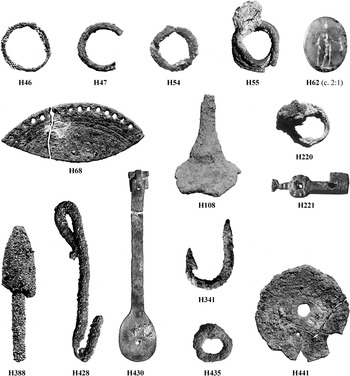
H46 Heavily corroded.
(3319) Internal D. c. 1.8 cm. Three joining fragments. Figs. 1, 2
F27.12. Building W, pre-building levels.
Context date: up to second quarter of third century AD.
-
H47 Rounded section. Heavily corroded.
(3217) Internal D.1.7 cm. About one third missing. Figs. 1, 2
W25.7. Building W, Room 2, demolition debris sealed by collapsed concrete (associated with Deposit 98, Berenice iii.1, 462).
Context date: mid third century AD.
-
H48 Small ring, circular section. Perhaps a link or hair-ring.
(2654) Internal D. c. 1 cm. Two fragments. Fig. 1
G10.8. Deposit 158: late occupation levels within the church (Berenice iii.1, 482).
Context date: Islamic.
-
H49 Bronze ring, oval in section, flattened on one side; small gap between ends. Signs of wear on inner face.
(3707) D. c. 2.4 cm, W. c. 0.65, T. c. 0.3 cm. Complete. Fig. 1
R101+. Area R, surface find.
Various small finds. Scale 1:1 except where indicated.

Turkish period?
Not illustrated
-
H50 Four fragments, fairly corroded.
(310) Internal D. 1.8 cm. M2.1. Area M (late Roman city wall), surface level.
-
H51 Lumpily corroded.
(2175) Max. D. 1.4 cm. S8.8. Building S1, robber trench.
-
H52 (1881) Internal D. 0.9 cm. L19b.2. Deposit 73: Building L1, tip levels overlying the building (Berenice iii.1, 450). Context date: second to mid third centuries AD.
Coiled
-
H53 Single coil. Rectangular section, rounding towards ends. Hoop somewhat flattened.
(1635) Internal D. c. 1.0 × 1.7 cm.Fig. 1
SK+. Surface find.
-
H54 Single coil. Rectangular section. Heavily corroded. Ends do not appear to be broken.
(3497) Internal D. c. 1.3 cm. Three joining fragments. Figs. 1, 2
BB22.1. Building BB, surface level: mid to late Roman.
-
H55 Triple coil. Rounded section. Ends of coil clipped. A heavily corroded element attached to the top of the ring proved after cleaning to be made up of three silver fractions of dirhams datable to the tenth or eleventh centuries AD (Berenice i, 232). The coins were probably a setting for the ring, although if so it is not clear how they were attached to it. Traces of a textile (thread) binding were visible on one of the coils immediately below the coins (see fig. 2). This might have reinforced a fine wire harness of which no recognizable remains survived.
(2603) D. of hoop c. 1.6 cm. Figs. 1, 2
G9+. Found during the removal of the levels immediately below the Turkish-period graves overlying the northeast corner of the church (Building G).
The ring is probably to be associated with the Islamic occupation of the church and its environs (Berenice iii.1, 482 ff., Deposits 158–165).
Decorated
-
H56 Rectangular section. Incised chevron pattern on outer surface. The hoop may originally have been fixed by a soldered overlapping joint.
(1466) Internal D. 2.0 cm. Fig. 1
J18.2. Building J1, late level (associated with Deposits 136–138, Berenice iii.1, 475).
Context date: sixth century AD.
With bezels
-
H57 Part of ring with dark blue glass set in a small oval mount.
(700) L. of bezel 1.8 cm, max. W. of bezel 1.2 cm. Fig. 1
N+. Area N, surface find.
Cf. Warden (Reference Warden and White1990) 38 and pl. 27, no. 257 for a similar ring from Cyrene with a red stone (cornelian?).
-
H58 Part of ring with large flat bezel, ovoid in outline. Irregular depressions in upper surface of bezel suggest a glass or enamel inlay, now lost.
(2614) L. of bezel 1.9 cm, W. 1.2 cm. Fig. 1
G7.7. Deposit 158: late occupation within church (Berenice iii.1, 482).
Context date: Islamic.
-
H59 Bronze ring with thin band, rectangular in section, and raised ovoid mount (for a stone?).
(1671) D. 1.6 cm, W. 0.3 cm, T. 0.05 cm. Fragment. Fig. 1
P30.1. Area P, Byzantine level.
Turkish period?
Not illustrated
-
H60 Fragments of bronze setting for blue glass stone. Very fragile and corroded.
(93) L. of stone 0.9 cm, W. of stone 0.7 cm. H1.2. Deposit 84: Building H, lower levels overlying the building (Berenice iii.1, 457). Context date: early third century AD.
-
H61 Circular section hoop with square attachment (bezel?) pierced centrally. Slightly corroded.
(3752) Max. D. 1.7 cm, D. of hoop 0.7 cm. bezel 0.8 cm. W+. Area W, surface find.
Intaglio, by Martin Henig
-
H62 Cornelian intaglio. The god Hermes stands frontally, and faces right. He holds his money-bag in his left hand and his kerykeion in his right; his chlamys is draped over his right fore-arm. Base line. Left and right would of course be reversed in impression, when the gem was used as a seal.
(3078) 1.3 × 1.1 cm, slightly convex. Fig. 2
G18.5. Deposit 166.4: south aisle of church (Berenice iii.1, 486).
Context date: first half of sixth century AD (or later).
Although the gem was found in a Byzantine context, it is probably of the second century AD. This was a very common type throughout the Roman Empire: see Henig Reference Henig1994, 133 nos. 260 and 261 and references cited. A relatively large number of clay sealings from the ancient public record office (nomophylakion) of Cyrene, burnt down in the early years of the second century AD, portray Hermes; most of them exhibit a rather simplified anatomy and stylization of the facial features and kerykeion (Maddoli Reference Maddoli1963–64, 69–72, figs. 10 and 11, nos. 68–103).
2. TOILET, SURGICAL OR PHARMACEUTICAL INSTRUMENTS
I am very grateful to Dr Ralph Jackson for his advice on this section [PMK, 2014].
MIXING PALETTES
See Milne (Reference Milne1907) 171; also Sackett (Reference Sackett1992) 395 no. S45 (from a Trajanic context at Knossos).
-
H63 Blue grey slate. Polished upper (larger) surface, with wear marks. Wide shallow depression worn in centre of upper side. Underside unpolished.
(65) L. 12.9 cm, W. 7.2 cm, T. 1.25 cm. Complete except for a few chips. Fig. 3
H5.2. Deposit 84: Building H (Room 9), lower levels overlying the building (Berenice iii.1, 457).
Context date: early third century AD.
-
H64 Dull grey slate. Polished upper surface, slightly irregular but with few signs of wear. Unpolished below.
(2101) PL. 4.5 cm; W. 2.7 cm; T. 0.6 cm. Fig. 3
R7.4. Building R1, Room 2.
Context date: uncertain, perhaps early Roman imperial.
Toilet, surgical or pharmaceutical instruments (H63–72); items associated with textile working (H73–80). Scale 1:2.

Not illustrated
-
H65 Greenish grey slate, incomplete.
(271) PL. 6.0 cm, PW.8.7 cm, T. 1.6 cm. H1.24. Deposit 85: Building H (courtyard), unsealed upper levels overlying the building (Berenice iii.1, 459). Context date: mid third century AD.
-
H66 Blue-black slate, incomplete. Polished on upper surface, with depression caused by wear. Unpolished below. Bevelling of edges steeper than H63–65.
(1912) PL. 6.5 cm, W. 6.6 cm, T. 0.6 cm. L24.3. Deposit 73: Building L1, tip levels overlying the building (Berenice iii.1, 450). Context date: second to mid third centuries AD.
-
H67 Green grey slate, incomplete. Polished upper surface but no marked areas of wear. Roughly finished below, with three incised grooves parallel to long sides.
(262) PL. 8.3 cm, PW. 4.0 cm, T. 0.5 cm. H8.2. Deposit 84: Building H (Room 3), lower levels overlying the building (Berenice iii.1, 457). Context date: early third century AD.
MIRROR
-
H68 Fragment of bronze hand-mirror (Lloyd-Morgan Type K), a popular type of the first century AD. Part of rim of circular plate decorated with holes around edge at approx. 4 mm. intervals and on the rear (non-reflecting) face with three concentric incised circles. Broken along curve, making fragment leaf-shaped, possibly intentional.
M+. Area M, surface find.
Cf. Lloyd-Morgan Reference Lloyd-Morgan1981; Sackett (Reference Sackett1992) 377 no. M607 from Knossos (Roman or later context).
LIGULA
For full discussion of these instruments, which almost certainly served minor pharmaceutical and cosmetic as well as surgical purposes, see Milne (Reference Milne1907) 51 ff., Crummy (Reference Crummy1983) 59–61, Michaelides (Reference Michaelides1984) and Jackson (Reference Jackson1986) 156–8.
-
H69 Bronze. Small head, thickened, rounded and set at slight angle to shaft. Lower part of shaft bent, with tip missing.
(32) PL. c. 11 cm. Fig. 3
B1.5. Building B3, ashy level probably representing waste from the lamp kiln (Deposit 107, Berenice iii.1, 466).
Context date: mid third century AD + .
SIMPLE HOOK
Sharp and blunt hooks were widely used in ancient surgery and are well attested archaeologically (Jackson Reference Jackson1986, 139–40; Jackson Reference Jackson1990; Michaelides Reference Michaelides1984; Milne Reference Milne1907, 85–88 with pls. 23, 24). They were sometimes combined with other instruments but this example seems to be of the simple kind. It could presumably have had non-surgical applications.
-
H70 Bronze. The shaft tapers towards both ends, one of which is hooked and pointed. Decorated in middle with four raised rings.
(3868) L. 16.1 cm. Complete. Fig. 3
CC2.2. Deposit 37: Area CC, dump levels overlying Deposit 36 (Berenice iii.1, 434).
Context date: Augustan ?
SPATULA OR SPOON
The spatula/spoon was a multi-purpose instrument, used in surgery, for pharmaceutical, cosmetic and toilet preparation, and with other applications too (Milne Reference Milne1907, 58–59). The length and the shape of the scoop of this example perhaps indicate that it once belonged to a cyathiscomele or spoon-probe (cf. Milne Reference Milne1907, 61–62; Crummy Reference Crummy1983, 60 and fig. 65, nos. 1926–32; Bliquez Reference Bliquez2003).
-
H71 Bronze. Leaf-shaped spoon and part of shaft. Slight ridge at centre of blade, which is of shallow V-shaped profile. Traces of ring-decoration at junction of shaft and spoon (much corroded).
(649) PL. c. 6.3 cm, L. of head c. 5.4 cm. Two fragments. Fig. 3
J5.6. Deposit 137: Building J1, amphora dump (Berenice iii.1, 475).
Context date: mid sixth century AD.
Cf. Corinth xii, no. 1334, ‘probably late Roman period’.
TWEEZERS
-
H72 Bronze. Misshapen, blades corroded together.
(1925b) PL. 4.3 cm. Tips of blades missing. Fig. 3
P49.6. Building P2, levels overlying the west cistern.
Context date: late Roman/Byzantine (cf. Deposit 155, Berenice iii.1, 481).
Cf. Crummy (Reference Crummy1983) 59 and fig. 63.
3. TEXTILE WORKING AND MANUFACTURE
SEWING NEEDLES
For discussion of sewing needles, see Crummy (Reference Crummy1983) 65.
Bone
-
H73 Rounded, slightly pointed head. Oval shaft, diminishing in thickness towards the head. Figure of eight eye with part of a second eye below.
(558) PL. 2.4 cm. Most of shaft broken off. Fig. 3
SK+. Surface find.
Needles with multiple eyes are known from Hadrianic to mid second century AD contexts at Knossos (Sackett Reference Sackett1992, 385–86, nos. E63 and E76), but with the eyes set closer together. Cf. also Corinth xii, nos. 1260–62, attributed to the third and fourth centuries.
-
H74 Part of eye and shaft. Shaft rather crudely carved. Slightly polished.
(3098) L. 6.9 cm. Broken at both ends. Fig. 3
V5.5. Building T, southwest corner, unstratified (clearance).
Not illustrated
-
H75 Part of eye and shaft, as H74. Shaft of circular section. Polished.
(3482) PL. 2.8 cm, D. of shaft 0.35 cm. Broken at both ends. W64.11. Building W, late Hellenistic level below courtyard of Roman building.
-
H76 Part of eye and shaft. Shaft of circular section. There is a slight but clear horizontal incision in the side of the shaft 1.2 cm below the eye. Below this the surface of the shaft is slightly cut away, to give a hooked effect. Polished.
(3862) PL. 6.3 cm, max. D. of shaft 0.5 cm. Broken at both ends. CC3.4. Makeup for upper Roman street metalling adjacent to Building CC3. Context date: second century AD (fine pottery).
Bronze
-
H77 Complete but misshapen and heavily corroded.
(3479) L. 8.2 cm. Fig. 3
V+. Area T, surface find.
Not illustrated
-
H78 Shaft with two tiny projections at blunt end, possibly part of eye. Heavily corroded.
(828) PL. 4.7 cm. L8.3. Building L3, unstratified (clearance).
NETTING NEEDLE
Cf. Crummy (Reference Crummy1983) 67 and fig. 70, no. 1996. At this coastal location it seems unnecessary to consider an alternative use for band-weaving (Wild Reference Wild1970, 73).
-
H79 Bronze. Complete except for part of one pair of prongs. Heavily corroded.
(1307) L. 12.9 cm. Fig. 3
X26. Building X, earth blocking of earlier doorway in north temenos wall. Late Hellenistic.
Cf. Delos xviii, 202 and pl. lxix.550, item 93 (many refs.).
SPINDLE WHORLS
For discussion of the nature, purpose and identification of spindle whorls see Blinkenberg (Reference Blinkenberg1931) 130–43, Crummy (Reference Crummy1983) 67 and Sackett (Reference Sackett1992) 405.
Clay spindle whorls (or beads?)
-
H80 Flattened sphere of rather irregular shape, with central perforation. Local clay.
(1396) D. 2.5 cm; D. (perforation) 0.7–1.0 cm. Complete. Fig. 3
X16.3. Building X, tip layers within abandoned temenos.
Context date: mid first century AD+ (fine pottery).
Similar: 380 examples from all contexts (typical measurements: D. 2–3 cm, T. 1.5–2 cm, D. of hole 0.5–0.8 cm).
Not illustrated
-
H81 Disc made from a sherd of African Red Slip ware. Single central perforation. Used as a spindle whorl?
(654) D. 3.0 cm, T. 0.4 cm. B10.1. Area B.
Clay spindle whorls were very common at Sidi Khrebish and have already been briefly reported in Berenice ii, 317. They occurred in contexts ranging in date from late Hellenistic to Islamic. They were particularly frequent in mid and late Roman levels and turned up in all areas of the site. Deposits 101 and 103, cistern fills of the mid third century AD in houses J3 and L5 (Berenice iii.1, 464–65), produced 17 and 53 examples respectively, but otherwise no large groups were noted. It is possible that some were simple clay beads (an interpretation perhaps supported by these two groups). For similar objects elsewhere, interpreted as spindle whorls, see Delos xviii, 267 and pl. lxxxiii, item 138; Warden (Reference Warden and White1990) 49, nos. 361–64 (Cyrene); Wilson (Reference Wilson and Robinson1930) 128 and fig. 295 (Olynthus) and Tatton-Brown (Reference Tatton-Brown1992) 225 (Gravina, S. Italy).
LOOMWEIGHTS AND MISCELLANEOUS WEIGHTS
This account of the Sidi Khrebish finds develops the previous discussion by John Riley (Berenice ii, 315–16 with fig. 117). For discussion of the purpose and typology of loomweights in the Graeco-Roman period see in addition Sackett (Reference Sackett1992) 399–406 and Tatton-Brown (Reference Tatton-Brown1992) 218–20.
Two types of loomweight, the discoid and the truncated pyramid, were predominant at Sidi Khrebish, with the former eight times more common than the latter (122:15). There were also four examples of a lentoid shape with a central hole. This is further evidence for what seems to have been a variable pattern of loomweight type preference in the Aegean world. For example, at Knossos on Crete (which was joined to Cyrenaica as a Roman province from the first century BC), there was a strong preponderance of the pyramidal version in the Hellenistic and Roman periods, to c. AD 200, followed by the discoid type in second place and by a few examples of a local biconical type (Sackett Reference Sackett1992, 402–3). At Corinth, a conical loomweight was much preferred (Corinth xii, 146 ff.; see also ibid., 147 for the variability of usage at many other sites in the Aegean region). In Cyrenaica the discoid and pyramidal varieties are known from Euesperides, the Greek and early Hellenistic predecessor of Berenice and the pyramidal from Apollonia (Berenice ii, 316; a report on the loomweights from Euesperides by Paul Roberts is in preparation). In the Sanctuary of Demeter at Cyrene, pyramidal loomweights were the most common (28 exx.), followed by lentoid weights as H86–88 (17 exx.) and by a type in the shape of a bivalve shell (7 exx.: Warden Reference Warden and White1990, 64–65). The shell type is also known from Delos (Delos xviii, pl. lviii, item 75a).
Most of the reliably stratified loomweights from Sidi Khrebish came from Hellenistic and early Roman contexts no later than the first century AD. The many large dated deposits belonging to the second to mid third centuries AD and to the sixth and seventh centuries AD produced few examples. The evidence from the site therefore does not contradict the hypothesis, based primarily on the Roman authors, that the warp-weighted loom was largely superseded by the horizontal tension-beam loom from the first century AD (Wild Reference Wild1970, 67). We do not know, of course, how representative the Sidi Khrebish evidence is of Berenice as a whole. At Knossos there are concentrations of weights which suggest contemporary use for weaving in two Augustan deposits; finds in contexts down to the Severan period could be residual or used for other purposes (Sackett Reference Sackett1992, 402–3, 406). A small number of unfired, presumably sun-dried, discoid weights (which could be dissolved in water) is noteworthy. However, the recorded examples were mostly from Hellenistic levels, with one from an early Roman context.
None of the Sidi Khrebish loomweights preserved evidence of the stamps, impressions or other marks, which are a fairly common feature of these objects in Greece and Magna Graecia (notably so at Knossos [Sackett Reference Sackett1992, pls. 330, 331] and Gravina [Tatton Brown Reference Tassinari1992, 219]; see also Wilson [1930] for Olynthus and Corinth xii, nos. 146–72) and at other Cyrenaican sites (Berenice ii, 316 for Apollonia and Euesperides, though none of the 53 examples from Cyrene was stamped: Warden Reference Warden and White1990, 64–65). Most were single finds, with very occasionally two in the same layer. Nothing can therefore be deduced about the siting of looms in the houses at the site.
It cannot be excluded that some of these objects served purposes other than weaving. A single example of a discoid weight pierced centrally as well as at its edge, found in a sixth century AD context, might have been a lid, while other discs could perhaps have been used as weights for fishermen's nets.
Regrettably the principal types and sub-types were not weighed.
Types 1 and 2: discoid loomweights
These were made from the local coarse-gritted clay (Benghazi local fabric 1: see Berenice ii, 94), with either one (type 1) or two perforations (type 2) towards the outer edge. Some examples had traces of a light-coloured slip. Various sizes were noted, with a greater variety present amongst the two-hole weights.
The complete and fragmentary examples of Types 1 and 2 numbered 122, including three apparently unfired weights, made of dark mud with many grits.
Type 1a: D. 8.5 cm, T. 1.9 cm.
Not illustrated: 4 examples (including Deposits 32, 61).
Type 1b: D. 10.1 cm, T. 2.3 cm.
Not illustrated: 9 examples (including Deposits 16, 32, 46, 169).
-
H82 Variant with a central perforation as well as one at the edge.
(2243) D. c. 10 cm, T. 1.9 cm. Well worn but complete. S10.7. Deposit 141: Building S1, fill of cistern (Berenice iii.1, 477). Context date: sixth century AD.
Type 1c: D. 11.5 cm, T. 2.5 cm.
Not illustrated: 7 examples.
Type 2a: D. 6.3 cm, T. 1.8 cm.
-
H83 (807) Fig. 4
K4.5. Building K1.
Context date: Hellenistic (fine pottery).
Loomweights and miscellaneous weights. Scale 1:3.

Similar: 1 example (Deposit 70).
Type 2b: D. 7.7 cm, T. 2.5 cm.
Not illustrated: 2 examples (one from Deposit 32).
Type 2c: D. 8.4 cm, T. 2.6 cm.
Not illustrated: 10 examples (including Deposits 20, 32, 44, 69).
Also 2 unfired weights, D. 8.0 cm, T. 2.0, 3.3 cm. (one from Deposit 32).
Type 2d: D. 9.2 cm, T. 2.0 cm.
-
H84 (1174) Fig. 4
B5.11. Deposit 32: Building A1, levels overlying and within the building (Berenice iii.1, 432).
Context date: first third of first century BC, with later intrusions.
Similar: 9 examples (including Deposits 48, 63).
Also 1 unfired weight, D. c. 9.4 cm, T. 3.7 cm.
Type 2e: D. 10.0 cm, T. 2.8 cm.
Not illustrated: 13 examples (including Deposits 13, 68 × 2).
Type 2f: D. 12.0 cm, T. 3.4 cm.
-
H85 (2480) Fig. 4
A31.1. Area A, mixed surface level (Hellenistic to second century AD fine pottery).
Similar: 3 examples (one from Deposit 44).
Also: 57 fragments of discoid loomweights (including Deposits 32 × 4, 43, 55, 60, 61, 63, 72, 73, 75, 119, 122, 137, 140).
Type 3: lentoid loomweights
These are similar to the discoid weights but are either biconvex, conical or bi-conical in cross-section with a single central perforation. They were rare at Berenice in comparison to other types. Cf. Warden (Reference Warden and White1990) 65, nos. 487–89 from Cyrene.
-
H86 Circular weight, flat on one side and conical on the other, with large central perforation. Benghazi local fabric 1.
(1718) D. c. 6.8 cm. Complete. Fig. 4
J22.4. Building J2, fill of pit.
Context date: late first/early second century AD (fine pottery).
-
H87 Lentoid weight with central perforation. Benghazi local fabric 1. Probably hand made.
(444) D. c. 10.3 cm. Half of the weight is missing. Fig. 4
H17.7. Building H, pre-demolition level.
Context date: up to early third century AD (fine pottery).
Not illustrated
-
H88 Lentoid (?) weight with an approximately central perforation. Unfired mud containing many grits.
(2313) D. c. 6.5 cm, T. c. 3.3 cm. R14.8. Deposit 40: Area R, Hellenistic Building 1, sealed level beneath stone floor in Room F (Berenice iii.1, 435). Context date: not before c. AD 15/20.
See also another unfired example, Berenice ii, 317 and fig. 117, no. D740, from Deposit 16 (Building A1, Room 3, pit cut into Deposit 15: Berenice iii.1, 428). Context date: first third of first century BC?
Type 4: pyramidal loomweights
Sixteen examples of the truncated pyramidal type were found. All were made in Benghazi local fabric 1. Five sizes were noted.
Type 4a: H. 5.7 cm, W. of base 3.6 cm.
-
H89 (915) Fig. 4
J6.58. Deposit 168.2: Area J, fill of aqueduct (Berenice iii.1, 488; see also Berenice i, 200).
Context date: late Hellenistic/early Roman.
Similar: 3 examples (Deposits 32, 33, 60).
Type 4b: H. 6.3 cm, W. of base 4.4 cm.
-
H90 (926) Fig. 4
J10.3. Area J, mixed context (Hellenistic and late Roman fine pottery).
Similar: 5 examples (including Deposits 69, 163).
Type 4c: H. 7.6 cm, W. of base 4.1 cm.
Not illustrated: 1 example. Additionally, Berenice ii: 316 and fig. 117, no. D737 (surface find).
Type 4d: H. 8.0 cm, W. of base 4.5 cm.
Not illustrated: 2 examples (one from Deposit 46).
Type 4e: H. 8.5 cm, W. of base 4.3 cm.
-
H91 (635) Fig. 4
B9.2. Area A, surface level.
Similar: 1 fragment.
Miscellaneous Weights of Clay or Stone
-
H92 Related to the pyramidal loomweight type, but with unequal sides giving the form of a truncated wedge. Local fabric 1 with a creamish wash on two sides. (= Berenice ii, 316, no. D738)
(2220) H. 7.6 cm, W. of base 4.4 × 2.1 cm. Complete. Fig. 4
R 31.2. Area R, surface level.
Not illustrated
-
H93 Flat circular weight made of limestone. Single central hole.
(60) D. 5.9 cm, T. 1.6 cm. Complete. H5.2. Deposit 84: Building H, lower levels overlying the building (Berenice iii.1, 457). Context date: early third century AD.
-
H94 Flat circular weight made of limestone, rather worn. Single central hole.
(927) D. 6.8 cm, T. 2.2 cm. Half of the weight is missing. J10.3. Area J, mixed level (Hellenistic and late Roman fine pottery).
-
H95 Circular stone weight, crudely made. Single central hole.
(1312) D. c. 6.4 cm, T. c. 2.5 cm. Complete. A21 extension.4. Building A1, undated level.
-
H96 Flat circular weight made of stone. Single central hole.
(1500) D. 5.5 cm, T. 1.4 cm. Complete. B5.25. Building B1, occupation level. Context date: Hellenistic (fine pottery).
-
H97 Circular weight made of limestone. One surface flat, the other convex. Single central hole squarish in shape.
(3192) D. 6.6 cm, T. 1.4 cm. Half of the weight is missing. V9.4. Deposit 69: Building T, construction make-up levels (Berenice iii.1, 447). Context date : Flavian.
-
H98 Flat pottery disc, probably shaped from the base of a coarseware vessel. Single central hole. Possibly a lid rather than a weight.
(3166) D. 6.5 cm, T. 0.5 cm. Complete. G9.18. Church (Building G), robbing of apse paving. Context date: Islamic (or later).
-
H99 Flat, circular weight, made of plaster, coloured on one side. Single central perforation.
(3423) D. 5.0 cm, W. 1.1 cm. Z10.2. Featureless excavation to the west of Area W.
-
H100 Flat, circular weight, made of grey-brown smooth clay with grey grit (Benghazi local fabric 1? See Berenice ii: 94). Single central perforation. Perhaps a spindle whorl.
(504) D. 3.5 cm, W. 0.85 cm. SK+. Surface find.
-
H101 Clay weight with single perforation towards one side. Worn from circular shape?
(1181) D. 3.5–4.0 cm, W. c. 1.0 cm. SK+. Surface find.
-
H102 Limestone object (natural?) with single off-centre perforation.
(—) W. 1.8 cm, D7.4. Building P4, associated with fine pottery of the mid first century AD.
4. HOUSEHOLD UTENSILS AND FURNITURE
METAL VESSELS
Bronze
-
H103 Fragments of circular bronze bowl formed from two beaten elements riveted together.
(1995) D. 15.0 cm, H. 7.0 cm. Figs. 5, 6
X44.3. Deposit 61:extensive tip levels overlying Building X and pre-dating the construction of Building B2 (Berenice iii.1, 443). For the precise findspot, see Berenice i, 70 f. with fig. 14, no. 12.
Context date: third quarter of first century AD.
Household utensils: metal vessels. Scale 1:2 except where indicated.

Various small finds. Scales as indicated.

No close parallels found, but in view of the findspot this was perhaps a thymiaterion. For short thymiateria/candelabra cf. Boube-Piccot Reference Boube-Piccot1975, 209–11 with pls. 144–46.
-
H104 Part of cast handle in the form of a human hand. The junction of the grip and hand was marked by a beaded moulding which is partially preserved. At the base of the hand there are two simple volutes. The back of the hand carries relief decoration dominated by a stylised palm branch.
(511) PL. 4.5 cm. Three fingers partly broken off; part of base of hand and grip broken off. Figs. 5, 6
J5N.10. Building J1, room 3, pre-floor level, but contaminated by robber trench material. The fine pottery comprised Italian sigillata and 2 sherds of third to fourth century AD African Red Slip ware.
Examples from Pompeii suggest that the handle would originally have consisted of an ornate fluted bow, terminating in two such hands: it would have been one of a pair on either side of a large basin (Pernice Reference Pernice1925, 31–32; Stefanelli Reference Stefanelli1990, no. 97, fig. 211; Tassinari Reference Tassinari1993, type S2121 [6 exx.] with pls. 138–40; Willers Reference Willers1907, 72 and fig. 41, no. 9). Tassinari (Reference Tassinari1993) no. 7275, type H1100, shows that the same type of cast attachment, placed vertically, could also be used to attach the single, straight handle of a patera. This is surely a genuine Campanian export.
-
H105 Curved handle decorated with a hunting dog and a wild boar in combat. The animal protomes spring from stylised Ionic capitals.
(1890) L. 8.8 cm. Fig. 5
P55.4. Building P2, room 1, robber trench (fine pottery spread to fourth century AD).
This fine piece comes almost certainly from the carrying ring of a set of bathing equipment (strigils, flask, etc). See H. Eschebach, Pompeji: erlebte antike Welt (Leipzig 1978) pl. 47 (Pompeii); G.M.A. Richter, The Metropolitan Museum of Art: Greek, Etruscan and Roman Bronzes (New York 1915) 298 no. 869 (no provenance).
-
H106 Heavily corroded handle of jug, with thumb-rest.
(1961). D. of vessel c. 8 cm.Fig. 5
P48.7. Building P1, courtyard. Late Roman level (fine pottery).
For typical examples, see Tassinari (Reference Tassinari1993) types B1251, B2200 and the like.
-
H107 Upright or near upright handle of jug (?). Both terminals splayed and flattened. Upper terminal very corroded.
(219) L. 8.3 cm. Probably complete.Fig. 5
H10.1. Deposit 85: Building H, unsealed levels overlying the building (Berenice iii.1, 459).
Context date: mid third century AD.
-
H108 Part of curving handle and wall of closed vessel (?). The rim of the vessel may survive, but the piece is too fragmentary for certainty.
(3046) D. not measurable. Figs. 2, 5
SK+. Surface find.
-
H109 Lid of small container. Heavily corroded.
(1719) Max. H. 1.4 cm. Complete. Fig. 5
P36.2. Building P1, robber trench (fine pottery spreads to seventh century AD).
-
H110 Lid with chain, probably from a flask. Chain attached to lid by split pin, fastened on inside of lid. Heavily corroded.
(2635) D. 7.4 cm, H. 3.2 cm. Reassembled from two fragments. Parts of the lid and chain broken off. Figs. 5, 6
G11.3. Deposit 157.1: Church, lower filling of cistern (Berenice iii.1, 482).
Context date: fifth to sixth centuries AD.
Cf. an early Byzantine bronze flask lid from Sardis (Waldbaum Reference Waldbaum1983, 94 and pl. 36, no. 534; I am grateful to Martin Henig for this reference [JAL]).
Not illustrated
-
H111 Part of folded over rim of (?) bowl. An incised groove runs along the lower edge of the rim.
(435) D. (outer) of rim c. 7.5 cm. B9.1. Building B2, surface level.
-
H112 Flat base of small vessel. The walls of the vessel, scarcely preserved, appear to curve slightly inwards. Heavily corroded.
(650) D. of base c. 5.6 cm. Building H, room 7, immediately above mosaic pavement. Level related to Deposit 83, early third century AD (Berenice iii.1, 457).
-
H113 Upright rim of bowl, slightly bent. Fairly corroded.
(1744) D. (rim) c. 19 cm. L40.3. Deposit 73: Building L1, tip levels overlying the building (Berenice iii.1, 450). Context date: second to mid third centuries AD.
Iron
-
H114 Handle (?), possibly of small pail or bucket. Very corroded.
(2468) Max. W. c. 11 cm. Fig. 5
X40.2. Deposit 61: Building X, tip levels overlying the building (Berenice iii.1, 443).
Context date: third quarter of first century AD.
Cf. Crummy (Reference Crummy1983) no. 2115, from Colchester.
-
H115 Small iron bowl with thick flaring walls and flattened base. Irregularly formed, although possibly distorted by heavy corrosion. No clear indication of a spout.
(2473) D. c. 14 cm, max. H. c. 5 cm. Seemingly complete. Fig. 5
R43.1. Deposit 156: Building R3, room 6, accumulation above mosaic pavement (Berenice iii.1, 482).
Context date: fourth to seventh centuries AD.
John Lloyd made extensive enquiries about this puzzling piece without coming to any clear conclusion. Its thickness is perhaps deceptive, due to corrosion, but it has the appearance of a crucible. If this was its purpose, this would have been for bronze-smelting, but it would remain unparalleled and in any case there is no record of traces of bronze or slag within it. (There was, however, a minor concentration of slag in Area R: see section 9 below.) Another possibility is that it was a simple open lamp.
Not illustrated
-
H116 Two joining fragments of wall and base of (?) bowl, similar to the preceding.
(1715)
J23+. Area J, surface find.
Lead
-
H117 Small flat-bottomed container, rather battered. The base is circular but the walls have been distorted so that in plan the vessel is virtually oblong, with several indentations.
(2475) D. (base) 3.1 cm, H. 5. 6 cm. Possibly complete. Fig. 5
R43.1. Deposit 156: Building R3, room 6, accumulation above mosaic pavement (Berenice iii.1, 482).
Context date: fourth to seventh centuries AD.
-
H118 Stopper. Shaft circular in section, widening and splaying into rounded, flattened top.
(2747) L. 4 cm. Fig. 5
G11.11. Deposit 157.1: Church, lower filling of cistern (Berenice iii.1, 482).
Context date: fifth to sixth centuries AD.
Not illustrated
-
H119 Part of walls and base of vessel, perhaps a small pail or bucket. Very battered and fragile. The vessel appears to have been made from a single sheet of lead. The slightly undulating base has been pressed upwards, leaving a 2 cm deep folded ring foot. The sides of the vessel curve slightly inwards from the base upwards but may originally have been vertical. Traces of two lugs on the sides.
(2337) D. (upper walls) c. 14 cm, D. (base) c. 18 cm, PH. c. 11 cm.
X53.6. Deposit 45: Building X, fill of cistern 1 (Berenice iii.1, 437).
Context date: first half of first century AD?
-
H120 Four fragments, probably related and once part of a small container. Now very distorted and badly corroded. Possible rim, possible square base or lid and pinched or distorted corner.
(2435) Max. L. 8.0 cm, max. W. 4.25 cm, T. c. 0.3 cm.
P Vat 3.2. Deposit 113: Building P1, contents of vat 3 (Berenice iii.1, 469).
Context date: mid third century AD.
-
H121 Four fragments, probably related. Possibly belonging to a small container.
(2102) Max. L. 7.5 cm, max. W. 3 cm.
R9.1. Area R, surface level.
STONE VESSELS
Vessel descriptions are based in part on notes by A. Bonanno. Alabaster and marble identifications are by D. Michaelides.
Alabaster
-
H122 Lid in brown alabaster. Complete apart from central knob, of which only the stump survives, and one or two chips. Probably Alabastro Cotognino (Egypt).
(2026) Max. D. 7.8 cm. Fig. 7
S15.2. Area S, late Roman level (fine pottery).
-
H123 Part of a deep bowl. Horizontal, projecting rim and comparatively thick wall (c. 2 cm). Probably Alabastro Cotognino.
(1190) External D. 14.2 cm. Fig. 7
A19.7. Building K1, room 3. Hellenistic (found in association with part of a ‘West Slope’ style amphora probably of the second century BC: Berenice iii.1, 79 no. B104).
-
H124 Part of deep bowl with everted rim and thick wall (c. 2.5 cm). Alabastro Listato (Algeria, near Oran?).
(2510) D. not measurable. Fig. 7
Q4+. Area Q (east of third century AD city wall and tower), surface find.
-
H125 Part of small flat-bottomed bowl. Flat, down-sloping rim and simple lug handle. Alabastro Cotognino ( Egypt).
(3246) D. 10.1 cm (excluding handle); H. 4.8 cm. Fig. 7
W23.7. Building W, fill of robber trench. Early sixth century AD (fine pottery).
Household utensils: vessels of alabaster and marble. Scale 1:3.

Not illustrated
-
H126 Part of rim and wall of deep vessel. Plain flat rim and almost vertical wall. White alabaster.
(1162) D. c. 20 cm, P.H. 7.3 cm, L19.3. Deposit 73: Building L1, tip levels overlying the building (Berenice iii.1, 450). Context date: second to mid third centuries AD.
Marble
For the range of stone mortaria at Delos, see Delos xviii, 110 ff. item 58e, with fig. 136 (spouts) and pls. xliv, xlv.
-
H127 Part of bowl or mortarium. An ogival lug, very similar to a spout, emerges from a carved ivy leaf slightly raised on the wall. A small hole has been drilled into the wall (but does not pierce it) in the space at the interior of the lug. Traces of dark red paint on the exterior wall. Fine-grained white marble, probably Proconnesian or Thasian.
(1562) D. c. 29 cm. Fig. 7
SK+. Surface find.
-
H128 Rim, lug and part of the wall of bowl or mortarium. A V-shaped lug, similar to a spout, emerges from a carved ivy leaf slightly raised on the wall. On a horizontal plane with the rim two volutes meet on the interior of the lug. At the centre of each volute is a perforation. Another hole perforates the wall of the bowl from the interior of the lug. Parts of an iron dowel project on each side of the lug, and the oxidization of the iron has discoloured the marble to some extent. On the interior of the vessel, just below and to one side of the hole which pierces the wall, is a circular indentation, 0.2 cm in diameter. Interior of bowl very smooth. Exterior less well finished. Very fine grained white marble, probably Pentelic.
(223) D. c. 29 cm. Fig. 7
H1.2. Deposit 84: Building H, lower levels overlying the building (Berenice iii.1, 457).
Context date: early third century AD.
Cf. Corinth xii, no. 818 (pl. 61, first century AD).
-
H129 Rim, lug and part of the wall of bowl or mortarium. The lug, which is damaged, resembles a spout and emerges from a carved ivy leaf slightly raised on the wall. The walls taper slightly towards the base. Fine-grained white marble, probably Proconnesian or Thasian.
(2787) D. c. 19.5 cm. Fig. 7
SK+. Surface find.
-
H130 Rim, lug and part of the wall of bowl or mortarium. V-shaped lug, similar to a spout. Walls become thicker half way down surviving fragment. Exterior unpolished below handle. Remainder of fragment polished. Medium-grained white marble, probably Proconnesian.
(1566) D. c. 21.3 cm. Fig. 7
L3.3. Building L3, upper level (probably late Roman or later: fine pottery not studied).
-
H131 Rim, lug and part of wall of bowl or mortarium. Similar to H130 but with a simpler U-shaped lug. Rather coarse-grained white marble, probably Proconnesian.
(1793) D. c. 20 cm. Fig. 7
J41.14. Building J2, room 8, fill. Mid third century AD (fine pottery).
-
H132 Part of bowl or mortarium. U-shaped lug flanked by two small knobs on each side. The walls taper towards the base, which consists of a slightly raised disc. Very fine-grained marble with light grey veins, probably Hymettan.
(1567) D. 15. 8 cm, H. 5 cm. Fig. 8
SK+. Surface find.
-
H133 Rim, lug and part of the wall of mortarium. Simple rectangular lug. The walls become thinner towards the base and in one area heavy wear has reduced the wall thickness to 0.4 cm. Polished internally and on top of rim only. Fine-grained white marble, probably Thasian or Proconnesian.
(899) D. 23 cm. Fig. 8
L3.3. Building L3, upper level (probably late Roman or later: fine pottery not studied).
-
H134 Rim, lug and part of the wall of bowl or mortarium, similar to the preceding. The walls become thicker towards the base. Fine-grained white marble, probably Proconnesian or Thasian.
(618) D. 12.7 cm. Fig. 8
SK+. Surface find.
-
H135 Rim and part of the wall of bowl or mortarium. Flat horizontal rim, discoloured by fire (?). Fine-grained white marble, probably Pentelic.
(3880a) D. 18 cm. Fig. 8
P56.3. Area P, associated with fine pottery of the first to mid third centuries AD.
Household utensils: vessels of marble. Scale 1:3.

Similar (not illustrated)
-
H136 Fine-grained white marble, probably Pentelic.
(3290) D. 14 cm, W 32.3. Building W, miscellaneous late Roman level.
-
H137 Fine-grained white marble, probably Thasian.
(3341) D. not measurable. F30.7. Deposit 132: Church, back-fill of construction trench for tower (Berenice iii.1, 474). Context date: second half of fifth century AD.
-
H138 White marble, probably Hymettan.
(3429) D. not measurable. G14.1. Church (Building G), surface level.
-
H139 Part of base and walls of bowl or mortarium. Slightly raised circular base, with small groove at junction of base and walls. Probably Proconnesian.
(2446) D. (base) 8.7 cm. Fig. 8
P48.2. Area P, miscellaneous late Roman level (fine pottery to at least second half of fifth century AD).
Similar (not illustrated)
-
H140 Fine-grained white marble, probably Pentelic.
(1801) D. (base) c. 16 cm. J28.1. Deposit 138: Building J1, late levels (Berenice iii.1, 476). Context date: first half of sixth century AD.
-
H141 Rim, lug and part of wall of bowl or mortarium. Thick-walled vessel, carinated below lug. Rectangular lug set slightly below rim of vessel, creating small ledge. Relatively crude workmanship. Coarse-grained white marble, probably Proconnesian.
(931) D. at least 24 cm. Fig. 8
J9.3. Area J, miscellaneous late level (fine pottery to fifth century AD).
-
H142 Rim, lug and part of wall of bowl or mortarium. Rectangular lug, surface in same horizontal plane as top of rim. Fairly crude workmanship. White marble, probably Thasian.
(3289) D. c.19.5 cm. Fig. 8
V17.2. Deposit 119: Building T, overlying levels (Berenice iii.1, 469).
Context date: mid third century AD.
-
H143 Part of mortarium. Rounded rectangular lug. The wall diminishes rapidly in thickness towards the base (internal wear?). Highly polished internally, roughly finished on the exterior. Hard, compact, cream-coloured stone with frequent red cloudy patches. Tripolitanian marble (?) (calcare marmoso ondato di rosa).
(1565) D. c. 24 cm. Fig. 8
SK+. Surface find.
-
H144 Part of base and wall of heavy mortarium. The base is flat but a slight projection suggests it may have rested on three or four slightly raised feet. Coarse-grained white marble, probably Thasian.
(2071) D. (base) c. 24 cm. Fig. 8
R1.4. Area R, accumulation on road surface. Early second century AD or later (fine pottery).
-
H145 Part of base and wall of a bowl or mortarium. The walls taper considerably towards the flat base (internal wear?). Very fine-grained white marble, probably Hymettan.
(1809) D. (base) c. 17 cm. Fig. 8
J34.2. Area J, robber trench. Fourth century AD or later (coin, House of Valentinian: 364–378).
Similar (not illustrated)
-
H146 Probably Pentelic marble.
(3876) D. of base not measurable. J12.3. Area J, robber trench (fine pottery not studied).
-
H147 Fine-grained white marble.
(1657) D. of base not measurable. P11.10. Area P, robber trench (no fine pottery).
-
H148 Rim and part of walls of large bowl or basin. Flat rim with a slight rounded projection to the exterior. The walls thicken towards the base. Medium-grained white marble, probably Thasian.
(1410) D. at least 50 cm. Fig. 8
X24.1. Area X, surface level.
Similar (not illustrated)
-
H149 Medium-grained white marble, probably Proconnesian.
(1465) Plain flat rim. D. c. 28 cm. A30.3. Deposit 32: Building A1, levels overlying and within the building (Berenice iii.1, 432). Context date: Hellenistic, perhaps early first century BC.
-
H150 Part of lug and wall of deep bowl or basin. Rounded rectangular lug, decorated on its upper surface with radiating grooves. White marble, probably Thasian.
(2728) D. not measurable. Fig. 8
G12.7. Area G, immediately north of church. Miscellaneous level associated with late buildings (no fine pottery).
For this and the following item cf. Corinth xii, nos. 827–29 (generally considered late Roman). The central motif on top of the lug could have been a cross.
-
H151 Lug and part of wall of deep bowl or basin. Rounded rectangular lug decorated on its upper surface with radiating grooves. Further grooves delineate the rim of the vessel. White marble, probably Thasian.
(3181) D. not measurable. Fig. 8
V5.5. Deposit 119: Building T, overlying levels (Berenice iii.1, 469).
Context date: mid third century AD.
Not illustrated
-
H152 Part of rim and wall of wide bowl. Flat rim. White marble, probably Pentelic.
(3878) D. at least 26 cm.
L30.3. Deposit 73: Building L1, tip levels overlying the building (Berenice iii.1, 450). Context date: second to mid third centuries AD.
-
H153 Part of wide, shallow basin. Decorated on outside by a groove above a concave depression. Coarse-grained white marble, probably Thasian.
(687) D. c. 36 cm. H. 5 cm. Fig. 9
H2.11. Deposit 84: Building H, lower levels overlying the building (Berenice iii.1, 457).
Context date: early third century AD.
-
H154 Small mortarium. The three lugs and the spout are very abraded and must originally have been more rectangular in shape. Rounded base. Medium-grained white marble.
(2125) D. 10.5 cm, H. 3 cm. Fig. 9
R18.12. Area R, fill of pit cut into natural sand. Hellenistic, probably second century BC (fine pottery).
Household utensils: vessels of marble and volcanic stone. Scale 1:3.

See Sackett (Reference Sackett1992) 395 no. S40 from Knossos (Augustan) for a similarly modest example.
Wall fragments of bowls or mortaria (not illustrated)
-
H155 Proconnesian. (178) H8.2. Deposit 84: levels associated with squatter occupation overlying the floors of Building H (Berenice iii.1, 457). Context date: early third century AD.
-
H156 Probably Proconnesian. (3881) S16.3. Area S, mid to late Roman level (fine pottery).
-
H157 Probably Thasian. (3882) S11.3. Area S, mid to late Roman level (fine pottery).
-
H158 Probably Thasian. (3879) P61.3. Area P, associated with fine pottery to mid third century AD.
-
H159 Part of wide, shallow basin. Flat, horizontal rim with groove near internal edge. This is followed on the interior by a cavetto moulding which ends in a pronounced ridge. The surface is smoothed and polished on the inside. On the outside a groove separates the unsmoothed wall from the base, which bears the marks of a claw chisel. Coarse-grained white marble, probably Proconnesian.
(1875) D. at least 60 cm. H. 3.0 cm. Fig. 9
P49.3. Area P, disturbed late level (fine pottery to seventh century AD).
-
H160 Rim of wide, shallow basin similar in design and execution to the preceding. The base is thicker and slightly raised. Traces of two (broken) perforations survive, one in the base (D. 1.0 cm), the other halfway up the wall (external D. 1.0 cm, narrowing to 0.7 cm where it penetrates the interior). Coarse-grained white marble, probably Proconnesian.
(2449) D. not measurable but probably smaller than H159; H. 3.8 cm. Fig. 9
P48.2. Area P, miscellaneous late Roman level (fine pottery to at least second half of fifth century AD).
The broken perforations are perhaps drill-holes for an ancient repair (with clamps: see section 11 below). Nos. H159 and H160 are surely fragments of circular table-tops. For typical profiles from Delos, see Delos xviii, 57, fig. 83. Closest to our examples is fig. 83.8. (See also H208.)
-
H161 Part of large shallow object, perhaps a dish or basin but more probably a table-top. Rim and interior polished. Underside roughly finished. Rounded lip, with a cavetto moulding on the interior and a small ledge where this meets the floor. Fairly coarse-grained white marble.
F22.1. Church (Building G), robber trench of north wall.
The findspot suggests that this piece is likely to have been an item of church furniture. The curvilinear design finds parallels in Byzantine silver salvers, e.g. Cruikshank Dodd (Reference Cruikshank Dodd1961) no. 11, from Hungary (I am grateful to Marlia Mango for this reference [JAL]). However, if it belonged to such a vessel (and not, say, to an altar screen), considerations of weight would seem to rule out a portable object. For table-tops in church contexts (without, however, a close parallel to the present item), see Roux Reference Roux1973, 133–96.
Volcanic stone
-
H162 Rim, lug and part of wall of mortarium in grey lava. Rectangular lug. The walls taper slightly towards the middle and thicken again towards the base.
(1683) D. 22 cm. Fig. 9
J31.1. Building J3, level associated with late ovens (much fine pottery of fifth/sixth centuries AD)
-
H163 Part of mortarium in hard dark stone, probably basalt. Groove below rim on exterior. The base is slightly raised and rounded. Smooth internally, roughly finished on the outside.
(3880) D. 32 cm, H. 7.7 cm. Fig. 9
J22.1. Area J, surface level.
-
H164 Part of shallow mortarium in very hard grey/black stone, probably basalt. Flat rim barely rises above floor of vessel. Very thick base resting on a wide low ring foot.
(2374) D. 22 cm, H. 4.4 cm. Fig. 9
P56.5. Area P, surface level.
Mortarium fragments in volcanic stone, not illustrated
-
H165 Part of rim, walls and base. Lava. Rounded rim. Walls thicken towards the base then taper considerably towards the its centre. Flat base separated from curve of the outer wall by slight groove.
(1037) D. 28 cm, H. 6.8 cm. SK+. Surface find.
-
H166 Part of walls and base. Lava.
(4003) D. (base) 28 cm, H. 9.2 cm. J41.15. Area J, built into late Roman wall.
-
H167 Part of rim, spout, walls and base. Lava. Flat rim with U-shaped spout at the same level. Curved walls and flat base in form of slightly raised disc.
(1386) D. c. 40 cm, H. 7 cm. B4.1. Building B2, surface level.
-
H168 Part of rim, lug, walls and base. Lava. Slightly rounded rim. Rectangular lug with slight groove at junction with rim, which is at the same level. Curved walls. Base rests on shallow ring foot.
(4004) D. 28 cm, H. 6 cm. J+. Area J, surface find.
-
H169 Part of rim, lug, walls and base. Lava. Slightly rounded rim. The lug consists of a very slight rounded triangular projection from the rim, possibly just poor finishing since the vessel is crudely made. Curving walls which flatten to form the base.
(2394) D. 30 cm, H. 8.0 cm. R14.14. Area R, late Hellenistic or early Augustan level (fine pottery).
-
H170 Part of rim and wall. Lava. Wide flat rim and curving wall.
(2306) D. not measurable. R30.1. Area R, surface level.
-
H171 Part of rim, lug, wall and base. Hard grey crystalline stone (basalt?). Pentagonal lug at same level as rim. The wall is carinated c. 3 cm below rim and then flattens to form the base.
(2663) D. 30 cm, H. 7.0 cm. G4.3. Church (Building G), robber trench of nave pavement.
-
H172 Part of rim, lug, and part of wall and base. Basalt (?). Slightly projecting rounded lug on the same horizontal plane as the flat rim. Thick walls and flat base. Fairly smooth interior surface, outside heavily pitted.
(1244) D. 40 cm, H. 10 cm. J7+. Area J, surface find.
-
H173 Part of wall and base. Basalt (?). Base very thick (6 cm); sides much thinner and almost vertical.
(1618) D. (base) 10 cm, PH. 8.5 cm. J21.1. Area J, surface level.
Limestone
Unless otherwise stated the material is a soft but compact white limestone, almost certainly local.
-
H174 Part of rim, lugs, spout and wall of mortarium. Compact white limestone. The spout is damaged but appears to have been rectangular, and was flanked by two small lugs. Interior smooth, exterior roughly dressed (chisel marks clearly visible).
(3223) Two joining fragments. D. c. 22 cm. Fig. 10
W11.4. Building W, fill of robber trench of north wall of room 1. Late Roman (fine pottery).
Household utensils: vessels of limestone (H174–95); pestle (H197); table top (? – H208). Scale 1:3.

Similar (not illustrated):
-
H175 Part of rim, spout and wall.
(4005) D. not measurable. SK+. Surface find.
-
H176 Part of rim, wall and base. Soft limestone; crude workmanship.
(2008) D. 32 cm. H. 8.0 cm. R10.7. Deposit 63: Building R1, fill of cistern (Berenice iii.1, 445). Context date: mainly second half of first century AD, with some later disturbance.
-
H177 Part of rim, wall and base of mortarium. Grey coraline limestone. Pattern of incised lines, perhaps a rosette, on underside of base.
(1324) D. 25.3 cm. H. 10.0 cm. Fig. 10
X20.2. Area X, accumulation on road surface (fine pottery to early third century AD).
Not illustrated
-
H178 Part of rim and wall of large basin. Flat rim. The walls thicken towards the base, then taper towards centre of base.
(2087) D. 52 cm. PH. 7 cm. R10.6. Building R1, miscellaneous level.
-
H179 Part of rim, wall and base of bowl. Moulded rim above a series of minute grooves on the exterior. There is a more substantial external groove towards the base. Partly darkened by fire.
(1770) D. 15 cm. H. 3.5 cm. Fig. 10
L45.3. Deposit 73: Building L1, tip levels overlying the building (Berenice iii.1, 450).
Context date: second to mid third century AD.
-
H180 Part of rim and wall of bowl. Rim similar to the preceding; steep wall.
(1574) D. 14 cm. Fig. 10
SK+. Surface find.
Similar (not illustrated):
-
H181 (1572) D. 18 cm. SK+. Surface find.
-
H182 Part of rim and wall of bowl. Vertical rim with grooves on the exterior.
(3651a) D. 17 cm. Fig. 10
W76.6. Dump levels east of Building W (fine pottery not studied).
-
H183 Part of rim and wall of bowl. Two close set grooves below rim on exterior.
(3651b) D. 17 cm. Fig. 10
W76.6. (As H182).
-
H184 Part of rim of bowl. Upright rim with grooves on the exterior.
(3651c) D. 17 cm. Fig. 10
W76.6. (As H182).
-
H185 Part of wall and base of bowl. Steep-sided. Flat base with shallow ring foot.
(1573) D. (foot) 14.5 cm. Fig. 10
SK+. Surface find.
-
H186 Part of wall and base of bowl. Steep wall; low disc-base.
(1571) D. (base) 13 cm. Three joining fragments. Fig. 10
SK+. Surface find.
Similar (not illustrated):
-
H187 (1736) D. (base) c. 10 cm. P42.2. Area P, miscellaneous late level (fine pottery to seventh century AD).
-
H188 (1107) D. of base not measurable. H15.3. Deposit 84: Building H, lower levels overlying the building (Berenice iii.1, 457). Context date: early third century AD.
-
H189 (2485) D. (base) 9 cm. P59.2. Area P, miscellaneous late level (fine pottery to fifth century AD).
-
H190 (3651d) D. of base not measurable. May belong to H182, H183 or H184. W76.6. (As H182).
-
H191 Part of wall and base of bowl. Curving walls; disc-base. Cross scratched on underside.
(1769) D. (base) 9 cm. Fig. 10
L45.3. Deposit 73: Building L1, tip levels overlying the building (Berenice iii.1, 450).
Context date: second to mid third century AD.
-
H192 Part of wall and base bowl. Similar to the preceding.
(1575) D. (of base) 6.5 cm. Fig. 10
SK+. Surface find.
-
H193 Part of wall and base of bowl. Thick disc-base.
(3883) D. (base) 9 cm. Fig. 10
R27.3. Building R2, miscellaneous late level (fine pottery to sixth/seventh centuries AD).
-
H194 Part of wall and base of bowl. Relatively thin-walled.
(1916) D. (base) 14 cm. Fig. 10
L44.3. Deposit 73: Building L1, tip levels overlying the building (Berenice iii.1, 450).
Context date: second to mid third century AD.
-
H195 Part of wall, lugs and base of small bowl. The better-preserved lug has the form of V-shaped spout. The other is broken but may have been rectangular. Raised disc-base with carved central rosette. Decorated on the exterior with curving vertical lines. Fairly crude workmanship. Possibly part of a lamp but no trace of burning.
(3675) D. (base) 3.3 cm. Fig. 10
BB33.1. Area BB, surface level.
Sandstone
Not illustrated
-
H196 Part of rim, walls and base of soft sandstone bowl. Rounded rim and vertical sides, thickening towards flat base.
(1884) D. 36 cm, H. 6.5 cm. J56.4. Deposit 25.1: Area J, undisturbed lower fill of Hellenistic cistern (Berenice iii.1, 430). Context date: c. 100 BC.
PESTLES
-
H197 Small marble pestle in the shape of a thumb. Medium-grained white marble.
(484) Max. D. 3.0 cm, W. 5.5 cm, H. 5.0 cm. Fig. 10
SK+. Surface find.
The finger-pestle (though surely most often representing a thumb) is common throughout the Greco-Roman world and shows little change in character between the fifth century BC and the mid-Roman period. Cf. Boardman and Hayes (Reference Boardman and Hayes1973) 122 and pl. 53, no. F205 (Tocra); Warden (Reference Warden and White1990) nos. 451, 452 and refs. (Cyrene); Sackett (Reference Sackett1992) 395 no. S41 (Knossos, Augustan context); Corinth xii, nos. 1430–36; Delos xviii, 117 f. with pl. xlvii, item 59 k.
Not illustrated
-
H198 Marble pestle shaped roughly like a fish with bulbous head. Surface is rough with oblique grooves covering whole area. Two round depressions preserved on each side, opposite each other.
(1676) Max. D. 19.0 cm, H. 19 cm. P32.1. Area P, robber trench (third century AD?).
[For lack of illustration it is impossible to say more about this curious object, which may in fact be a finger-pestle.]
-
H199 Limestone pestle (?) of elongated egg-shape. Broken at one end. Smooth all round.
(2040) PL. 21 cm, max. D. 9 cm. R24.2. Building R3, Room 3, late Roman robber trench.
See also no. H269 below.
OSTRICH EGG SHELL VESSELS
Forty-seven fragments of ostrich egg shell were recovered during the excavations. They were readily identifiable by their curvature, fabric and generally uniform thickness. Open vessels (drinking cups?) made from ostrich eggs are attested from archaic contexts at Cyrene (Warden Reference Warden and White1990, no. 464: 31 fragments, all undecorated) and from late Roman levels at Tocra (Boardman and Hayes Reference Boardman and Hayes1973, 122, under no. F195: ‘it was clear that the shells had been chipped into halves, probably for use as cups, and there are several fragments with striations along the line of the chipped lip’). Only three fragments bore traces of decoration.
The greatest concentration of finds was in and around the church (Building G): 29 fragments in all, about half of which came from levels associated with the Islamic reoccupation. Six fragments came from the cella of the small temple, Building X, and may represent the remains of a votive offering. Otherwise the finds were isolated and spread widely across the site. Ostrich egg was present in contexts ranging from the first century BC through to Islamic. However, the prolific abandonment deposits of the mid third century AD failed to produce a single example, which is not inconsistent with the hypothesis of a breakdown in relations between town and country during this period. (See Lloyd Reference Lloyd and Stucchi1990.)
Not illustrated
-
H200 Two joining fragments with a V-shaped groove 1 mm. wide on the outer surface (a scoring-line for the intended separation of the egg into halves?).
(2287) Max. dimensions 5.6 × 3.8 cm. R27.3. Area R, Byzantine level (fine pottery).
-
H201 Fragment carved in relief with a leaf motif enclosed by a curving border.
(3578) Max. dimensions 2.1 × 1.9 cm. W74.5. Area W, miscellaneous Roman/Byzantine level (fine pottery to sixth century AD).
Also: 44 fragments, none greater in size than 6.9 × 4.8 cm and mostly much smaller. Various contexts.
SPOONS
Only bone spoons were found, with either round or pear-shaped bowls. Only H203 comes from a well stratified context, whose date is consistent with that proposed by Crummy (Reference Crummy1983, 69) for the introduction of spoons with round bowls.
Spoons with a round bowl
-
H202 Tip of bowl and end of handle broken off. The bowl is more finely worked on the inside, with a perceptible rim and traces of spiral grooving at the centre. The latter, together with a tiny central indentation, suggest that the inner bowl was worked with the help of a lathe. The exterior retains traces of cut marks. Similar marks are visible on the handle, which is cut away where it meets the bowl. Polished.
(958) PL. 8.7 cm, D. (bowl) 2.0 cm.Fig. 11
H17+. Building H, surface find.
Spoons (H202–6); furniture fittings (H209–17); locks and keys (H218–22). Scale 1:2.

Cf. Corinth xii, no. 1398 (attributed to the second century AD); Sackett (Reference Sackett1992) 388 no. E116 from Knossos (later second century AD; very close); Warden (Reference Warden and White1990) no. 336 from Cyrene.
-
H203 Plain spoon carved from a single piece of bone. End of handle broken off. On underside of bowl, offset projection of handle ends in inverted ‘V’ shape, outlined by incised grooves. Polished.
(3069) PL. 9.3 cm, D. (bowl) 2.1 cm. Fig. 11
V9.4. Deposit 69: Building T, construction levels (Berenice iii.1, 447).
Context date: Flavian.
Cf. Sackett (Reference Sackett1992) 385 no. E56 from Knossos (Trajanic context); Corinth xii, nos. 1396, 1397 (first or second centuries AD).
Not illustrated
-
H204 Plain spoon. Handle broken off near bowl. Polished.
(1577) PL. 3.5 cm, D. (bowl) 2.3–2.4 cm. SK+. Surface find.
Spoons with a pear-shaped bowl
-
H205 Plain spoon. End of handle broken off. Carving marks apparent, especially on underside of bowl. Polished.
(2527) PL. 7.8 cm, L. (bowl) 2.95 cm, max. W. (bowl) 1.7 cm. Fig. 11
A32.1. Area A, surface level.
-
H206 Handle broken off near bowl. Shallow bowl, flat on underside. Upper surface of handle decorated with shallow cuts, with a deep notch between handle and bowl. Polished.
(1463) L. 4.5 cm, L. (bowl) 3.3 cm, max. W. (bowl) 1.8 cm.Fig. 11
SK+. Surface find.
Cf. Sackett (Reference Sackett1992) 388 no. E119 from Knossos (later second century AD).
Not illustrated
-
H207 Fragment of spoon. Most of handle and part of bowl broken. Deep notch between handle and bowl, as H206. Two pairs of irregular grooves on underside of bowl, aligned with the outer edges of the handle. Polished.
(2565) PL. 4 cm. F5.2. Area F (pottery not studied).
FURNITURE FITTINGS AND FRAGMENTS
Table top (?)
-
H208 Part of marble table top (?) or counter. Recomposed from sixteen fragments by D. Michaelides, who identifies the marble as Proconnesian. The preserved edge of the slab is rounded and cut away underneath to receive a support.
(3873) PL. 21.2 cm, PW. 24.6 cm, T. varies from 2.3 cm (edge) to 2 cm. Fig. 10
R24.16. Building R3, room 4, miscellaneous level (fine pottery Hellenistic to later first/early second century AD).
See also nos. H159–H161 above.
Handles
-
H209 Bronze ‘omega’-shaped handle of box (?) or casket. Rounded terminals, with traces of rivets.
(731) 4.4 × 4.0 cm. Complete. Fig. 11
J9.5. Building J1, miscellaneous level (Hellenistic to mid third century AD fine pottery).
-
H210 Bronze handle of box (?). The surviving terminal is rounded and pierced by two holes, one containing a rivet.
(3373) Max. W. 8.7 cm. Part of one terminal broken off. Fig. 11
V11.1. Deposit 118: Building T, levels overlying the building (Berenice iii.1, 469).
Context date: mid third century AD.
Hinges and Hinge Spacers
For discussion of the manufacture and use of bone hinges see Waugh & Goodburn (Reference Waugh, Goodburn and Frere1972). See also Corinth xii, nos. 865–874; Sackett (Reference Sackett1992) pl. 317 (Knossos, including spacers); Warden (Reference Warden and White1990) 44 and pl. 30, nos. 295, 296 (Cyrene).
-
H211 Part of hinge turned from long bone. Three grooves near one end and two symmetrically placed perforations in the side. An ancient chip has removed a long sliver of the surface, extending from the lower perforation to the end above the grooves. The exterior surface appears finished and is lightly polished, but the interior is only roughly worked.
(46) L. 8.9 cm, D. c. 3 cm. Sawn at one end. The other end (above the grooves) is abraded, but the symmetrical spacing of the perforations suggests that this was the intended length. About half of the cylinder is broken off. Possibly a waste piece.Fig. 11
H1.1. Deposit 85: Building H, unsealed levels overlying the building (Berenice iii.1, 459).
Context date: mid third century AD.
-
H212 Part of hinge. Three grooves near one end, cut by the surviving perforation. Exterior polished. The interior is roughly finished.
(2414) PL. 7.2 cm, D. c. 3.8. cm. The end near the grooves is sawn. Possibly a waste piece. Fig. 11
R24.16. Building R3, room 4, miscellaneous level (fine pottery Hellenistic to later first/early second century AD).
-
H213 Part of hinge turned from long bone. Three grooves near one end, with one small perforation (D. 0.4 cm.). Traces of polishing on exterior surface; interior roughly finished.
(2314) L. 10.5 cm, D. c. 3.6 cm. Two joining fragments. Both ends are sawn. Probably unfinished. Fig. 11
R12.2. Building R 1, room 4, miscellaneous level (fine pottery to mid first century AD).
-
H214 Small moulded bone cylinder, perhaps a hinge spacer unit or finial. Finely turned, with two broader grooves and a delicate central groove on the exterior and a slight central projection on the interior.
(1714) Max. D. (outer) 3.0 cm, W. 0.6 cm. Complete (two joining fragments). Dark brown in colour, probably through burning. Fig. 11
J23.10. Deposit 50: Building J2, room 1, sealed level beneath concrete floor (Berenice iii.1, 439).
Context date: first half of first century AD.
-
H215 Similar to the preceding but very slightly larger. Outer face highly polished.
(2098) Max. D. 3.1 cm, W. 0.6 cm. Complete. Fig. 11
R26.3. Building R2, miscellaneous level (fine pottery to sixth/seventh century AD).
-
H216 Part of turned bone cylinder similar to H214 but larger. Exterior highly polished.
(1439) Max. D. 4.0 cm, W. 0.9 cm. About two thirds missing. Fig. 11
A30.2. Building B2, level associated with ovens 1 and 2 (later first century AD: coin of AD 69–79 and fine pottery).
-
H217 Part of turned bone cylinder, perhaps a hinge spacer or a small container. Decorated externally with light grooves, symmetrically arranged. Each end of the cylinder is recessed (one on the outside, the other on the inside), as if to fit an interlocking series. Alternatively the recesses may have been designed to receive a base and lid. Highly polished and finely worked.
(2122) L. 4 cm, max. D. 3.5 cm. About half missing. Fig. 11
R12.3. Building R1, room 4, robber trench (mid Roman or later).
LOCKS
Cf. Waldbaum (Reference Waldbaum1983) pls. 23–25.
Bronze
-
H218 Two fragments of bronze casting of a lock. One piece with upturned edges, the other flat; both have holes punched through for rivets; one rivet preserved.
(1185) L. 5.5 cm, W. 4.5 cm, H. 1.4 cm. Fig. 11
A19.8. Deposit 32: Building A1, levels overlying and within the building (Berenice iii.1, 432).
Context date: first third of first century BC, with later intrusions.
KEYS
Bronze
-
H219 Head of bronze key; small rectangular block with four teeth; small part of shaft, square in section, flush along one side.
(311) L. 0.8 cm, W. 1.4 cm, T. 0.3 cm. Fragment. Fig. 11
H5.11. Deposit 85: Building H, unsealed upper levels overlying the building (Berenice iii.1, 459).
Context date: mid third century AD.
Cf. Corinth xii, nos. 970–975.
-
H220 Bronze key ring; ring, flat in section, with small key attached at right angle. Key set in square block on outer edge of ring; round in section with attachment pointed horizontally.
(3430) PL. 2.4 cm, L. (key) 1.4 cm, D. (ring) 1.7 cm, W. (key) 0.7 cm, T. 0.6 cm. Complete. Figs. 2, 11
V5.5. Deposit 119: Building T, accumulation overlying the abandoned building (Berenice iii.1, 469).
Context date: mid third century AD.
Possibly similar to Corinth xii, no. 977, attributed to the third or fourth century.
-
H221 Bronze key. Head circular with hole in centre and T-shaped protrusion to one side; decorated with incised lines. Working attachment to other side well-worn. Shank hollow, ovoid in section. Fragment of bronze wire still attached to hole in head.
G10.8. Deposit 158: late occupation levels within the church (Berenice iii.1, 482).
Context date: Islamic.
Rotary keys found at Corinth were considered not to have been introduced before the fourth century AD (Corinth xii, 137). This item seems likely to be of Islamic date.
Iron
-
H222 Iron key or latch-lifter. Rectangular bar with ringed end, bent at right angles and ending in a wedge shape.
(544) c. 10 × 8 cm. Fig. 11
B11.7. Deposit 32: Building A1, levels overlying and within the building (Berenice iii.1, 432).
Context date: first third of first century BC, with later intrusions.
Compare the iron keys from the Republican settlement at Gravina (Macnamara Reference Macnamara1992, fig. 112) and from the Augustan fort at Haltern (Harnecker Reference Harnecker1997, nos. 537–547, pls. 45, 46).
Not illustrated
-
H223 Broken iron spike with ringed end. Key or latch lifter as the preceding. Heavy corrosion has obscured shape of shaft. Now roughly circular but broken end suggests originally rectangular in section. Corrosion has also exaggerated proportions of the object.
(253) Max. L. 9.2 cm, D. (of ring) 3.0 cm, W. (of shaft) 2.4 cm (but probably less originally). H1.16. Deposit 85: unsealed levels overlying Building H (Berenice iii.1, 459). Context date: mid third century AD.
HANDMILLS
Lever mills
For mills of this type, see Delos xviii, 126 ff., item 61f.
-
H224 Top part of hopper quern in volcanic lava. On one of the shorter sides (partly visible at the left in fig. 6) a letter
 is incised. Example of late Hellenistic type.
(1919) L. 36 cm, H. 11 cm, T. 14 cm.Fig. 6
R14.11. Deposit 169: Building R1, Room 4, make-up levels beneath floor (Berenice iii.1, 490).
Context date: AD 25/30?
 is incised. Example of late Hellenistic type.
Not illustrated
-
H225 Irregularly shaped fragment of flat quern in volcanic lava, probably lower part of hopper quern.
(2134) Max. L. 17 cm. SK+. Surface find.
-
H226 Irregularly shaped fragment of flat quern in volcanic lava, probably lower part of hopper quern. Similar to H225. Striated base.
(2528) L. 9 cm, H. 8.5 cm, T. 3 cm. X+. Surface find.
-
H227 Irregularly shaped fragment of flat quern in volcanic lava, probably lower part of hopper quern. Similar to H225. Striated base.
(2250) L. 23 cm, H. 17 cm, T. 4 cm. S5.7. Street between areas L and S.
-
H228 Irregularly shaped fragment of flat quern in volcanic lava, probably lower part of hopper quern. Similar to H225.
(2183) L. 19 cm, H. 11 cm, T. 2.5 cm. R32.6. Area R.
-
H229 Irregularly shaped fragment of flat quern in volcanic lava, probably lower part of hopper quern. Similar to H225. Piece smooth on both sides and worn down from edge on one side.
(2283) L. 13 cm, H. 8 cm, T (at edge) 3.5 cm, T. (at break) 1.0 cm. R32.8. Area R.
-
H230 Hopper quern in hard crystalline volcanic lava.
(2529) L. 24 cm, H. 14 cm, T. 6 cm, bottom half. X24.3. Area X.
Rotary handmills
For mills of this type, see Delos xviii, 131 ff., item 62.
Not illustrated
-
H231 Rotary quern in hard crystalline grey volcanic lava.
(3282) T. 5.5.cm. Blackened by fire. G17.9. Deposit 143: tip levels against outside of north wall of church. Context date: first half of sixth century AD.
-
H232 Rotary quern in hard crystalline grey volcanic lava.
(2734) T. 5 cm. G3.1. Deposit 158: late occupation levels within the church (Berenice iii.1, 482). Context date: Islamic.
-
H233 Rotary quern in hard crystalline grey volcanic lava.
(3193) T. 5.8 cm, blackened by fire. Two joining fragments. F22.7. Deposit 158: late occupation levels within the church (Berenice iii.1, 482). Context date: Islamic.
-
H234 Fragment of rotary quern in black/blue volcanic lava.
(2722) D. unknown. T. 7.5 cm. G6.9. Deposit 159: destruction level in north aisle of church (Berenice iii.1, 484). Context date: seventh century AD.
-
H235 Broken lower half of rotary quern in black/blue volcanic lava. Small central hole. Bevelled edge. (3646) External D. 37.5 cm, D. (hole) 1.8 cm, T. 2.5 cm. W90.2. Area W.
-
H236 Fragment of rotary quern in black/blue volcanic lava.
(3339) D. unknown. T. 8.5 cm. W35.6. Area W.
-
H237 Fragment of rotary quern in black/blue volcanic lava. Small central hole.
(3581) External D. 42 cm. D. (hole) c. 3 cm, T. 3.0 cm. W80.1. Area W.
-
H238 Rotary quern in hard crystalline grey volcanic lava.
(3340) T. 5.8 cm, blackened by fire. W35.6. Area W.
-
H239 Rotary quern in hard crystalline dark grey volcanic lava.
(3434) T. 8 cm. W15+. Area W, surface find.
-
H240 Rotary quern in hard crystalline grey volcanic lava.
(3435) T. 4.5 cm. F29.8. Church (Building G), associated with sixth-century fine pottery.
-
H241 Rotary quern in hard crystalline grey volcanic lava.
(3008) T. 7 cm. F21+. Church (Building G), surface find.
-
H242 Upper half of rotary quern in very heavy, hard sandstone. Loaf-shaped disc with central hole and triangular notch on the edge.
(115) External D. 29 cm, D. (hole) 8 cm, T. 7 cm. J5.1. Area J, late level.
-
H243 Upper half of rotary quern (or possibly mortarium) in coraline limestone as H242. Disc-shaped with central hole. Along the diameter runs a groove with a square section. Another small hole perforates the disc in the groove along the centre of its radius.
(206) External D. 39 cm, D. (central hole) 7 cm, D. (second hole) 2.5 cm, T. 9 cm. J27.1. Area J.
-
H244 Upper half of rotary quern in grey/white stone as H242. Rounded but not circular.
(2318) T. 3.5 cm. R2.4. Area R.
-
H245 Upper half of rotary quern in hard, crystalline grey stone as H242. Disc-shaped with central hole.
(—) External D. 39 cm, D. (hole) 3 cm, T. 5 cm. SK+. Surface find.
-
H246 Lower half of rotary quern in beige/yellow stone as H242. Disc-shaped with raised area in centre, containing hole.
(3312) External D. 32 cm, D. (raised area) 6 cm, D. (hole) 2 cm, T. 4 cm. SK+. Surface find.
-
H247 Broken lower half of rotary quern in black/blue volcanic lava. Small central hole. Bevelled edge.
(—) External D. 46 cm, D. (hole) 1.5 cm, T. 4.5 cm. SK+. Surface find.
Unidentifiable fragments of volcanic lava querns:
-
H248 (—) J22.1. Deposit 144: Building J2, Room 1, unsealed late occupation levels (Berenice iii.1, 479). Context date: seventh century AD.
-
H249 (2632) G1.4. Deposit 158: late occupation levels within the church (Berenice iii.1, 482). Context date: Islamic.
-
H250 (2749) G12.3. Church (Building G).
-
H251 (2650) G7+. Church (Building G), surface find.
-
H252 (3044) V5.2. Building T, third-century destruction level.
-
H253 (1939) P49.4. Area P, robber trench with fifth and sixth-century fine ware.
STATUETTE BASES
Not illustrated
-
H254 Flat disc with depression on upper surface, probably to receive the statue. Four fragments. Coarse-grained light grey marble: Proconnesian.
(1917) D. 21.8 cm, T. 3.0 cm. P40.5. Area P, destruction level, first half of seventh century AD.
-
H255 Fragment of rectangular flat slab with a circular depression in middle of upper surface, probably to receive a statue. Fine-grained light grey marble: Hymettan.
(1557) PL. 13 cm, PW. 9 cm, T. 3.0 cm. B23.9. Deposit 18: Building B1, lower levels (Berenice iii.1, 428). Context date: first half of second century BC.
-
H256 Fragment of circular slab with depression on upper surface. [Stone not described.]
(1781) D. 14 cm, H. 4.2 cm. J49.9. Building J3, courtyard, possibly second century AD (fine ware).
FLINT ARTEFACTS (STRIKE-A-LIGHTS?) by Graeme Barker
Eight flint implements were recovered from the Sidi Khrebish excavations. Most of them are classic Middle Palaeolithic artefacts: there are two large Levallois cores (H257, H258), a flake from such a core (H259), two discoid cores, the first retouched as a scraper (H260, H261), two side scrapers (H262, H263), and a fragment of a leaf point (H264). Two further cores and three flint nodules also came to light.
The finest Palaeolithic succession in Cyrenaica was excavated in the Haua Fteah cave near Apollonia (McBurney Reference McBurney1967). The same types as the Sidi Khrebish specimens occur in this cave in the Levallois-Mousterian layers, which date to perhaps c. 75,000–40,000 years before the present. The analysis of the faunal sample revealed that the meat diet of the Middle Palaeolithic bands using the cave consisted of about 50% cattle, 30% goat, 10% horse, and 10% gazelle (McBurney Reference McBurney1967, 28). The bands occupying the Benghazi area probably made similar base camps at caves like Hagfet et-Tera, at the junction between the coastal plain and the Gebel Akhdar, and then made forays onto the plains to hunt horse and cattle and into the hills for goat and gazelle. Presumably the flint implements found at Sidi Khrebish were discarded by a Middle Palaeolithic band occupying the Benghazi area for a short time before moving on in the annual round of hunting and gathering. The presence of the large cores and flakes manufactured from them suggests that the implements were made on site by the band rather than being carried into the area as a prepared toolkit. Surface occurrences of these artefacts are relatively common on the coastal plain and in the coastal dunes (McBurney and Hey Reference McBurney and Hey1955); it is quite likely that the people of Berenice collected them in and around the town, regarding them as a useful source of the flint needed for starting their fires, or they may just be residual occurrences.
-
H257 Large flake of grey flint, cortex on one side. Retouched. Probably Middle Palaeolithic side scraper with possible prepared platform, i.e. made with Levallois-Mousterian techniques.
(1909) Fig. 12
P36.2. Area P, robber trench.
Context date: spread of material through to the seventh century AD (fine ware).
-
H258 Fresh brown-grey flint flake, retouched on both sides. Perhaps a scraper. Possibly Middle or Upper Palaeolithic.
(3196) Fig. 12
G10.5. Deposit 158: late occupation within church (Berenice iii.1, 482).
Context date: Islamic.
-
H259 Fresh pale purple-grey flake, retouched to point. Probably Upper Palaeolithic, retouched as scraper.
(732) Fig. 12
J6.62. Deposit 168.1: J6 street section, Hellenistic street levels (Berenice iii.1, 487).
Context date: late second/early first centuries BC.
-
H260 Grey flint flake, fresh flint, retouched as small scraper. Late upper Paleolithic (?) or later (Neolithic).
(3816) Fig. 12
H22.2. Deposit 82: Building H, fill of cistern 2 (Berenice iii.1, 457).
Context date: early third century AD.
-
H261 Grey-yellow chert flake, retouched. Upper Palaeolithic (?), or Epipalaeolithic/Neolithic.
(2610) Fig. 12
G1.5. Deposit 158: late occupation within church (Berenice iii.1, 482).
Context date: Islamic.
-
H262 Grey-brown flint, fresh, orange cortex on one side. Blade retouched on one side as scraper. Probably Upper Palaeolithic.
(1210) Fig. 12
X19.1. Deposit 61: Building X, tip levels overlying the temple (Berenice iii.1, 443).
Context date: third quarter of first century AD.
-
H263 Grey flint flake, orange cortex. Possibly retouched. Possibly Middle/Upper Palaeolithic, but doubtful.
(2253) Fig. 12
R24.22. Area R, incorporated within rubble wall of late Roman structure.
-
H264 Silver-grey flint blade (snapped at base). Shaped to point. Retouched either side and probably polished on both sides. Neolithic?
(3720) Fig. 12
W9.1 Area W, surface level.
Chipped stone artefacts. Scale 1:3.

Not illustrated
-
H265 Brown flint core, very abraded, but certainly with flakes struck from it. Possibly Middle Palaeolithic.
(1585) X9.4. Area X, level associated with small-scale manufacturing. Context date: spread of material to mid third century AD (fine ware).
-
H266 Joining fragments of large flint nodule. Brown flint, grey surface. Unlikely to have been worked.
(1337 and 1979) X29.2 (Deposit 61) and X45.4 (Deposit 43). Building X, floor level and subsequent abandonment within cella of temple (see Berenice i: 70 f.). Context date: not before c. AD 25.
This nodule may have had a ritual function. See further H381 below.
-
H267 Flint nodule, pale grey-yellow. Traces of cortex. Possibly polished on part of surface.
(1737) P37.2. Area P, late Roman level (fine ware).
-
H268 Large penis-shaped flint nodule, snapped at base. Probably natural break. Could be an example of the sexual shapes which tend to turn up on prehistoric sites — natural, but in effect an artefact. Impossible to date even if it was so used.
(2465) R40.2. Area R, surface level.
-
H269 Large grey flint core, orange cortex on one side: c.15 cm long, 11 cm wide, 9 cm high. This is the type of flint most commonly used in the Benghazi area (same flint as in the Benina cave). Probably Middle Palaeolithic.
(4002) G9.8. Church (Building G), robber trench. Probably post seventh century AD.
Possibly used as a pestle.
5. OBJECTS USED FOR RECREATIONAL PURPOSES
COUNTERS/DISCS
Bronze
Not illustrated
-
H270 Bronze disc with three pierced holes; fragment, half corroded away.
(545) D. 4.5 cm, T. c. 0.1 cm. B9.7. Building A1. Hellenistic?
-
H271 Bronze disc with several randomly pierced holes, rim curved upwards. Fragment, badly corroded.
(631) D. c. 6 cm, T. 0.2 cm. B12.10. Building A1.
-
H272 Circular bronze button (?). Fairly corroded.
(658a) D. 4 cm, T. 0.2 cm. L7+. Area L, surface find.
-
H273 Bronze disc, flat on one side, rounded on the other, with raised circle in centre.
(3809) D. 2.5 cm, T. 0.4 cm. SK+. Surface find.
Bone
-
H274 Circular bone counter with slight central indentation; underside flat, top decorated with raised rings, two at the edge and one towards the centre around the indentation.
(1851) D. 3.2 cm, T. 0.3 cm. Fragment. Fig. 14
L55.4. Deposit 103: Building L5, fill of cistern (Berenice iii.1, 464).
Context date: mid third century AD.
Cf. Corinth xii, no. 1679 (first or second century AD).
Not illustrated
-
H275 Cylindrical bone counter worked from fish vertebra. Concentric rings incised on top and base.
(1115) D. 1.5 cm, T. 0.9 cm. Complete. X16.1. Area X.
-
H276 Cylindrical bone counter worked from fish vertebra.
(1110) D. 1.7 cm, T. 1.3 cm. Complete. L19.1. Deposit 73: Building L1, tip levels overlying the building (Berenice iii.1, 450).
Context date: second to mid third century AD.
Extremely common at Corinth: see Corinth xii, no. 1707; also at Delos (Delos xviii, 331, item 173c).
Clay discs
Chipped or ground from broken potsherds: typical examples are shown in fig. 13.
-
H277 Eastern Sigillata A, base of form B323, ground off around the foot-ring. (—) D. 4.6 cm. D18.6. Deposit 109: unsealed levels overlying Building P4 (Berenice iii.1, 467). Context date: mainly mid third century AD.
-
H278 African Red Slip ware. (—) D. c. 2.4 cm. H8.3. Deposit 84: Building H, lower levels overlying the building (Berenice iii.1, 457). Context date: early third century AD.
-
H279–80 African Red Slip ware: 2 examples. (—) J31.14. Deposit 101: Building J3, fill of cistern (Berenice iii.1, 464). Context date: mid third century AD.
-
H281 African Red Slip ware, third-century fabric. (—) J50.7. Deposit 102: unsealed levels overlying Building J3 (Berenice iii.1, 464). Context date: mid third century AD.
-
H282–83. African Red Slip ware: 2 examples. (—) D. 4.0 and 3.2 cm. L55.4. Deposit 103: Building L5, fill of cistern (Berenice iii.1, 464). Context date: mid third century AD.
-
H284 African Red Slip ware, third-century fabric. (—) 3.0 × 3.2 cm. D11.1. Deposit 109: unsealed levels overlying Building P4 (Berenice iii.1, 467). Context date: mainly mid third century AD.
-
H285 African Red Slip ware. (—) D. 2.5 cm. F22.13. Deposit 158: late occupation levels within the church (Berenice iii.1, 482). Context date: Islamic.
-
H286 African Red Slip ware. (—) G7.22. Deposit 158 (as the preceding).
-
H287 African Red Slip ware. (3635) D. 2.6 cm, T. 0.6 cm. BB21.6. Building BB.
-
H288 Fine ware, possibly African Red Slip ware. (3438) D. 2.8 cm, T. 0.7 cm. SK+. Surface find.
-
H289 Gritty orange coarse ware (African Black-Top?). (—) D. 4.2 cm. J31.14. Deposit 101: Building J3, fill of cistern (Berenice iii.1, 464). Context date: mid third century AD.
-
H290 Coarse ware. (3825) P102.7. Deposit 110: Building P1, Room 7, fill of kiln (Berenice iii.1, 468). Context date: mid third century AD.
-
H291 Coarse ware. (3288) D. 2.8 cm, T. 0.7 cm. G17.10. Deposit 143: tip levels against outside of north wall of church. Context date: first half of sixth century AD.
-
H292–94 Coarse ware. (3143) three examples. F22.11. Deposit 158 (as the preceding).
-
H295 Pink/white coarse ware. (—) D. c. 6 cm. P14.1. Area P, superficial.
-
H296 Coarse ware. (3287) D. 4.8 cm, T. 0.9 cm. W16.5. Building W.
-
H297 Coarse ware. (3363) D. 2.4 cm, T. 0.4 cm. W48.3. Building W.
-
H298 Coarse ware. (3622) D. 0.9 cm, T. 0.5 cm. W81.3. Church (Building G).
A selection of counters made from potsherds.

Plaster discs
Chipped from fragments of painted wall-plaster
Not illustrated
-
H299 2 half pieces of different discs. (3871) H22.3. Deposit 82: Building H, fill of cistern 2 (Berenice iii.1, 457). Context date: early third century AD.
-
H300 (3858) H22.2. Deposit 82 (as the preceding).
-
H301 Half preserved. Pierced by remains of central hole. (1856) L55.4. Deposit 103: Building L5, fill of cistern (Berenice iii.1, 464). Context date: mid third century AD.
-
H302 (2089) D. 6.5 cm, T. 1.5 cm. R24.11. Deposit 123: Building R3, Room 4, contents of vat (Berenice iii.1, 471). Context date: second quarter of fourth century AD.
-
H303 (1145) D. 4.8 cm, T. 0.9 cm. H+. Area H, surface find.
-
H304 (1596) D. 6.2 cm, T. 1.2 cm. L25.3. Area L, Byzantine level.
Marble discs
Identifications where given are by D. Michaelides; not illustrated.
Pentelic
-
H305 One quarter of counter, rounded edge. Side A polished, B cut. (—) P57.1. Area P, Byzantine level.
Proconnesian
-
H306 Side A polished, B cut. (1328) T. 1.3 cm. L24.1. Deposit 73: Building L1, tip levels overlying the building (Berenice iii.1, 450). Context date: second to mid third centuries AD.
-
H307 Roughly edged. (—) Max. D. 6.8 cm, T. 1.7 cm. L55.4. Deposit 103: Building L5, fill of cistern (Berenice iii.1, 464). Context date: mid third century AD.
-
H308 Roughly edged. (—) Max. D. 6.7 cm, T. 1.6 cm. L55.4. Deposit 103 (as the preceding).
Proconnesian
-
H309 (—) Max. D. 3.5 cm, T. 1.0 cm. L55.4. Deposit 103: Building L5, fill of cistern (Berenice iii.1, 464). Context date: mid third century AD.
-
H310 Roughly edged. Side A polished, B semi-polished. (1785) D. c. 5 cm, T 1.2 cm. H+. Area H, surface find.
-
H311 (—) Max. D. 4.0 cm, T. c. 1.2 cm. L56.2. Buildings L3–5, sand trench.
-
H312 One quarter preserved. Both sides semi-polished. (—) T. 0.9 cm. L56.2. Buildings L3–5, sand trench.
-
H313 One quarter preserved. Both sides polished. (—) T. 1.2 cm. L56.2. Buildings L3–5, sand trench.
-
H314 Roughly edged. (—) D. 5 cm, T. 1.0 cm. P58.1. Area P, Byzantine destruction level.
-
H315 Roughly edged. (—) D. 5 cm, T. 1.5 cm. P59.6. Area P, Byzantine robber trench.
-
H316 Roughly edged. (2195) D. 4.5 cm, T. 1.5 cm. R32.4. Area R.
-
H317 Roughly edged fragment. (—) T. 1.2 cm. F23.6. Church (Building G), western end.
Marmo Scritto A
-
H318 Both sides polished. (1455) D. 4.5 cm, T. 1.8 cm. P1 ext.+. Area P, surface find.
Marmo Scritto B
-
H319 Half preserved, side A polished, B semi-polished. (—) D. 6.2 cm, T. 1.6 cm. B4.20. Deposit 105: Building B2, fill of cistern (Berenice iii.1, 465). Context date: mid third century AD.
-
H320 Both sides semi-polished. (1282) D. ? cm, T. 1.4 cm. L25.1. Buildings L3–5, mixed late level.
-
H321 Half preserved, side A polished, B semi-polished. (—) Max. D. c. 8 cm, T. 1.6 cm. L55.4. Deposit 103: Building L5, fill of cistern (Berenice iii.1, 464). Context date: mid third century AD.
-
H322 Side A polished, B semi-polished. (—) Max. D. c. 6 cm, T. 1.5 cm. L55.4. Deposit 103 (as the preceding).
-
H323 Both sides polished. (2039) D. 4.5 cm, T. 1.3 cm. S14.2. Deposit 145: Building S, period 3, associated late levels (Berenice iii.1, 479). Context date: early to late.
-
H324 Side A polished, B semi-polished. (1523) D. 3.5 cm, T. 1.5 cm. P16.2. Area P, Byzantine robber trench.
-
H325 Side A polished, B cut. (—) D. 4.2 cm, T. 1.2 cm. R24.18. Building R3, mixed level.
-
H326 Half preserved, very well smoothed and cut: opus sectile ? (3623) D. 5.5 cm. W79.1. area W.
Bigio
-
H327 Both sides polished. (1455) D. 3 cm, T. 1.3 cm. P1 ext. +. Area P, surface find.
Cipollino
-
H328 Roughly edged fragment. Side A polished. (1560) D. c. 3.5 cm, T. 1.1 cm. B20.4. Deposit 32: Building A1, levels overlying and within the building (Berenice iii.1, 432). Context date: Hellenistic, perhaps early first century BC.
-
H329 Fragment. Side A polished, B cut. (—) T. 1.5 cm. L43.1. Deposit 73: Building L1, tip levels overlying the building (Berenice iii.1, 450). Context date: second to mid third centuries AD.
-
H330 Roughly edged, half preserved. Side A polished, B semi-polished. (126) T. 1.5 cm. B3.1. Deposit 106: demolition levels overlying Building B2 (Berenice iii.1, 465). Context date: mid third century AD.
-
H331 Roughly edged, both sides polished. (—) D. c. 3.8 cm, T 1.3 cm. P Vat 22 (sic). Deposit 151: Building P1, Room 2, contents of vat 17 (Berenice iii.1, 479, 480). Context date: seventh century AD.
-
H332 Roughly edged, both sides polished. (—) D. 3 cm, T. 1.3 cm. BB23.1. Area BB, robber trench.
-
H333 Roughly edged, both sides cut. (—) D. c. 5 cm, T. 1.5 cm. F22.7. Deposit 158: late occupation levels within the church (Berenice iii.1, 482). Context date: Islamic.
Unidentified marble (not seen by D.M.), dimensions not recorded
-
H334 (—) J31.14. Deposit 101: Building J3, fill of cistern (Berenice iii.1, 464). Context date: mid third century AD.
-
H335 (—) R24.3. Deposit 127: Building R2, Room 3, accumulation above floor (Berenice iii.1, 472). Context date: second half of fifth century AD.
-
H336 (—) J31.1. Deposit 139: Building J2, level overlying late ovens (Berenice iii.1, 476). Context date: mid or late sixth century AD.
-
H337 (—) J41.16. Building J2, third-century robber trench.
-
H338 (—) R16.1. Building R1, superficial.
-
H339 (—) R110.6. Area R.
6. OBJECTS ASSOCIATED WITH WRITING
-
H340 Bronze stylus, circular in section, decorated with a band of incised spiral decoration; square and flat head.
(1925a) L. 10.5 cm, W. (shank) 0.4 cm, W. (head) 0.7 cm. Complete. Fig. 14
P49.6. Area P, destruction level: associated pottery to at least fourth century AD.
Objects associated with recreation (H274), writing (H340), fishing (H341), metal working (H344) and bone working (H345–347); fastenings and fittings (H351–362); tools (H367, H368); terret (H374). Scale 1:2 unless otherwise indicated.

For styli at Corinth, mostly of bone, see Corinth xii, 185 f. with pl. 83; for Delos, Delos xviii, 253 ff. with pls. lxxx, lxxxi, item 125. I am a little doubtful as to whether the (cuboid?) head really signifies a stylus rather than a pin [PMK].
7. OBJECTS ASSOCIATED WITH FISHING
FISH HOOKS
-
H341 Barbed hook. End of shaft flattened and rounded (for tying). Bronze, fairly corroded.
(3104) Complete. Figs. 2, 14
F27.4. Deposit 142: tip levels outside church tower (Berenice iii.1, 477).
Context date: mid sixth century AD.
Cf. Corinth xii, nos. 1447, 1448 (date uncertain); Delos xviii, 201 and pl. lxix.551, 553, item 92.
NET WEIGHTS
For possible clay net weights, see p. 108 above, Loomweights and miscellaneous weights.
8. OBJECTS ASSOCIATED WITH MILLING (COMMERCIAL)
DONKEY MILLS (?)
See Delos xviii, 133 with pl. lii, item 62c.
Fragments of possible donkey mills are discussed here on the supposition that these are normally associated with the commercial production of flour. Handmills are discussed in section 4, on the assumption that these are normally associated with domestic use.
Not illustrated
-
H342 Large fragment of bottom half of donkey quern in volcanic lava. Whether round or square base unknown, but probably round. Diameter unknown but large.
(2236) PH. 43 cm, PT. 11 cm. R4.2. Area R.
-
H343 Fragment possibly from top section of donkey quern in volcanic lava. Curved with section of rim surviving.
(2362) L. 20 cm, H. 15 cm, T. 4 cm. P55.6. Area P, robber trench.
9. OBJECTS AND WASTE MATERIAL ASSOCIATED WITH METAL WORKING
LEAD INGOT?
-
H344 Rectangular block of lead, thicker and slightly splayed at one end. Perhaps part of a small ingot.
(830) Max. H. 5.6 cm, max. T. 3.1 cm. Fig. 14
L4.2. Deposit 87: Building L3, lower fill of well (Berenice iii.1, 460).
Context date: third century AD.
MELTED LEAD
Fifteen lumps of lead ore (?) or splashes of lead waste were found, including five pieces which were circular in outline and plano-convex in section as if they had been allowed to set in a crucible. Lead can obviously be melted easily (even accidentally) and worked anywhere without sophisticated equipment, and there was no detectable pattern (either chronological or topographical) in their distribution across the site.
SLAG AND CLINKER
Material identified as metal slag was found in all the excavated areas of the Sidi Khrebish site, although since it was not examined by a metallurgical specialist the accuracy of the identification may be questionable in some instances. The overwhelming majority of the finds appeared to be iron slag. Large quantities of clinker (vitrified fuel ash) were found in association with the Hellenistic kilns in Building K (Berenice i: 62, 211) and other fragments were recorded in Area D (one), Area G (two), Area J (one possible fr.), Area R (one possible fr.) and Area S (one possible fr.). It may be that some of the slags are in fact clinker.
Although no major groupings of slag were noted, some areas produced relatively large clusters of finds: Area P (19 pieces) and Area R (14 pieces: note also the heavy iron bowl H115 found in this area) in the western half of the site, and Areas F and G (36 pieces), Areas T and V (22 pieces), Area W (30 pieces) and Area AA (8 pieces) on the east. Most of these finds came from late Roman and later levels. If they were not redeposited, they perhaps reflect small-scale metalworking associated with the church (Building G) and its satellite community, and with the workshops and houses set up elsewhere on the site in late antiquity. No structural evidence for smelting or smithing operations was positively identified, however.
Not illustrated
204 pieces of slag, probably from iron-working. All from Roman or post-Roman levels.
6 fragments of clinker, mostly greenish in colour and partially vitrified.
10. OBJECTS ASSOCIATED WITH BONE WORKING
The local working of bone for pins, needles, furniture hinges and inlay, spoons, tool handles and a wide variety of other objects is widely attested in the Roman world (e.g. Corinth: Corinth xii, 278; Knossos: Sackett Reference Sackett1992, 389; Colchester: Crummy Reference Crummy1983, 149–60; Silchester: Boon Reference Boon1974, 284–85) and it is not surprising that further evidence should come to light at Berenice. A number of carefully sawn horse and donkey metacarpals, suggesting tool manufacture, were identified amongst the animal bones from Sidi Khrebish (Berenice ii, 22). The waste material discussed below supports this interpretation. It is likely that many of the bone objects described in other sections of this report were made locally, and some may in fact have been unfinished (see nos. H3, H213).
BONE OFFCUTS OR UNFINISHED OBJECTS
-
H345 Roughly cut shaft with trapezoidal section, trimmed from part of a long bone.
(2615) L. 11.3 cm. Broken at both ends. Fig. 14
F1.1. Area F, surface level cut by Turkish graves.
-
H346 Part of unfinished object. Flattened triangular section. Cutting marks on one surface. One end of the object has a wedge-shaped tip, possibly finished.
(246) L. 4.7 cm. Broken at one end.Fig. 14
H2.11. Deposit 83: Building H, lower abandonment levels (Berenice iii.1, 457).
Context date: early third century AD.
-
H347 Fragment of a circular object. Exterior surface smoothed and polished. Interior unfinished.
(2349) D. (external) c. 3 cm. Fig. 14
Deposit 62: Building H, room 5, sealed by concrete floor (Berenice iii.1, 444).
Context date: third quarter of first century AD.
Not illustrated
-
H348 Fragment of a circular object (?). Interior roughly finished, with a diameter of c. 1.4 cm. Exterior unfinished, with numerous angular cuts. About half of the object survives. Not polished.
(2638) Max. W. 2.35 cm, max. T. 0.7 cm. D3.2. Area D, upper level. Late Roman (fine ware).
-
H349 Flattish, roughly rectangular strip with irregular cut marks on all long surfaces. Ends vertically cut, suggesting a complete length. Not polished.
(2735) L. 7.9 cm, max. W. (ends) 2.2 and 3.1 cm; max. T. 0.9 cm. D18.2. Area D, upper level. Late Roman (fine ware).
-
H350 Irregular fragment with numerous cut marks. Not polished.
(3011) L. c. 7 cm, max. W. 2.4 cm. D8.1. Area D, surface level.
11. FASTENINGS AND FITTINGS
NAILS/RIVETS/STUDS/TACKS
These objects, basic to all forms of carpentry during the period of occupation of the site, do not lend themselves readily to informed comment; it seemed unhelpful, however, simply to provide a lengthy itemized list. In place of this, a few broad generalizations represent perhaps the most that can be distilled from that list.
Bronze
132 bronze nails were listed: both round and square heads were observed, and both round and rectangular shanks. Rectangular heads were comparatively rare (3 examples), whereas rectangular shanks were more common than round ones in the approximate ratio of 7:5. The size of head varied between 0.5 and 2.3 cm, and the thickness of the shank between 0.2 and 1.2 cm. (at its thickest surviving point). Over-all lengths were rarely measurable but varied between 1.6 and 12.2 cm.
There was no obvious concentration of nails in any particular sector of the excavation, nor could any chronological evolution (or change of preference) be detected from consideration of those found in dated deposits.
-
H351 Bronze nail with round head and rectangular shank.
(2434) PL. 3.8 cm, D. (head) 0.8 cm, shank 0.6 × 0.3 cm. Fig. 14
P48.3. Area P, Byzantine level.
For a similar decorative head, see Sackett (Reference Sackett1992) 377 no. M619 from Knossos.
Other bronze nails/rivets of interest, not illustrated
-
H352 Bronze rivet, fairly corroded.
(449a) L. 1.6 cm. A20.2. Deposit 32: Building A1, levels overlying and within the building (Berenice iii.1, 432). Context date: Hellenistic, perhaps early first century BC.
-
H353 Bronze rivet, fairly corroded.
(449b) L. 1.3 cm. A20.2. Deposit 32 (as the preceding).
-
H354 Bronze rivet. Poor condition.
(3715) D. (head) 0.7 cm. P100.5. Deposit 77: Building P1, Room 11, sealed levels beneath mosaic. Context date: first quarter of second century AD (and early third?).
-
H355 Nail with round head and round shank; two concentric rings incised on head.
(96) PL. 1.1 cm, D. (head) 1.1 cm, D. (shank) 0.3 cm. H8.3. Deposit 84: Building H, lower levels overlying the building (Berenice iii.1, 457). Context date: early third century AD.
-
H356 Nail with round head and semi-circular shank.
(281) PL. 3.5 cm, D. (head) 1.7 cm, D. (shank) 1.2 cm. Badly corroded. H1.26. area H.
-
H357 Bronze rivet with head and part of shank.
(1669) PL. 2.0 cm, D. (shank) 0.4 cm, D. (head) 1.2 cm. P10.1. Area P, disturbed Byzantine level.
-
H358 Bronze tack.
(3840) L. 1.6 cm, D. (head) 1.5 cm, D. (shank) 0.3 cm. CC2+. Area CC, surface find.
Iron
Some 361 iron nails or fragments of nails were noted from the excavation. Where this could be determined, the head was invariably round and the shank rectangular. The dimensions of iron nails were recorded more rarely than for their bronze counterparts, probably due to the uncertainties arising from heavy corrosion. Lengths varied between 3.0 and 9.4 cm, with four exceptional examples (from Area R) c. 20 cm long. Heads were up to 3.2 cm in diameter. It is unsurprising that the size-range is generally somewhat larger than that of the bronze nails.
-
H359 Circular, hollowed iron stud with projecting square shaft (broken). Possibly some sort of decorative boss.
(548) D. (head) 2.5 cm. Fragment. Fig. 14
B9.8. Building A1.
Context date: Hellenistic?
CLAMPS
The use of clamps, generally of lead, for repairs to domestic items of clay or stone, is common throughout the Greco-Roman world. Cf. Macnamara (Reference Macnamara1992) nos. 1987–1990 from Gravina; Sackett (Reference Sackett1992) 366 no. M72 from Knossos; Warden (Reference Warden and White1990) 43 and pl. 29, nos. 282–284 from Cyrene.
Lead
-
H360 Badly corroded.
(2439) Max. L. 5.5 cm, Max. W. 1.6 cm, T. (stem) 0.5 cm. Fig. 14
R24.27. Area R.
-
H361 Broken.
(845) 6.0 × 3.1 cm. Fig. 14
K3.8. Area K.
-
H362 Small lead clamp, almost complete.
(2658) Max. L. 3.0 cm, Max. W. 1.5 cm. Fig. 14
G7.21. Deposit 158: late occupation levels within the church (Berenice iii.1, 482).
Context date: Islamic.
Presumably used to mend a broken vessel.
Not illustrated
-
H363 Bent lead bar, possibly remains of clamp. Roughly rectangular in section. Broken ends of two small projections appear c. 1 cm. from either end.
(380) L. 7.8 cm. J5.3. Building J1, overlying levels (Islamic).
-
H364 Piece of lead clamp? Only one end remains, with projection, circular in section, emerging from part of a bar.
(1194) L. 3.8 cm. SK+. Surface find.
Iron
Not illustrated
-
H365 Part of iron clamp?
(452) B6.10. Building A1, Room 2: no later than first century BC.
-
H366 T-shaped iron object, possibly part of clamp. Corrosion heavy, but all ends of piece appear broken.
(617) L. (cross bar) 5.3 cm, L. (upright) 6.2 cm, W. (cross bar) 1.6 cm, W. (upright) 2.0 cm, tapering to 0.5 cm. SK+. Surface find.
12. BUILDING MATERIALS
Brick and tile were rarely used at Berenice: their occurrence is discussed in Berenice ii, 312–15.
13. TOOLS
Iron
-
H367 Iron tool, possibly a knife. Handle, complete and wedge shaped, narrowing towards blade which is only partially preserved.
(2455) L. 7.0 cm, W. of handle (flat) 1.3 cm, Max. W. of blade 2.0 cm. Fragment. Fig. 14
A34.1. Area A.
-
H368 Iron knife, sword or dagger blade, broken with tang. Tang tapers to roundish, flattish head, probably not broken.
(1305) L.19.5 cm, W. 5.5 cm. Fig. 14
X+. Area X, surface find.
Not illustrated
-
H369 Large iron blade fragment (?) broken except for one small edge.
(1163b) X15.2. Deposit 61: extensive tip levels overlying Building X and pre-dating the construction of Building B2 (Berenice iii.1, 443). Context date: third quarter of first century AD.
-
H370 Length of iron strip folded over on itself. Possibly formed blade.
(2347) L. 8.0 cm. P10.6a. Deposit 80: Building P3, Room 7, sealed level beneath mosaic (Berenice iii.1, 456). Context date: first half of second century AD.
-
H371 Fragment of iron blade (?), with possible perforations.
(1923) L. 3.5 cm, W. 1.8 cm. P56.6. Area P, Byzantine or later robber trench.
-
H372 Part of pointed iron blade or plate, with tip bent upwards. Probably broken at wide end, but corroded over. Possibly part of tool.
(2230) PL. 8.0 cm, Max. W. 4.5 cm, T. 0.5 cm. S11.3. Area S, associated with fine pottery of the third century AD or later.
-
H373 Iron blade of knife or dagger, broken at both ends. Apparently double-edged, with sides curving as they taper to point. Thickened by corrosion.
(3831) PL. 7.0 cm, W. (tapered end) 0.9 cm, W. (broad end) 2.1 cm, T. 0.8 cm. CC1.11. Area CC, possibly Hellenistic.
14. OBJECTS ASSOCIATED WITH TRANSPORT
-
H374 Bronze terret; ring with round knobs either side and decorated head on top, attachment at base.
(269) H. 7.7 cm, W. 5.4 cm. Fragment. Figs. 6, 14
H13.2. Deposit 85: unsealed levels overlying Building H (Berenice iii.1, 459).
Context date: mid third century AD.
For cart- and harness-fittings in general, see Boube-Piccot Reference Boube-Piccot1980, passim and in particular no. 602 (pl. 122) for a similar terret surmounted by a head of Silenus.
15. OBJECTS ASSOCIATED WITH RELIGIOUS BELIEFS AND PRACTICES
MINIATURE ALTARS
See the discussion by Deonna in Delos xviii, 373 ff., items 189, 190, 193 and particularly pls. ciii, civ, cx. It is notable that three of the following six items were found within the small temple of the first century AD in Area X (see Berenice i, 65–72).
-
H375 Part of miniature altar. Soft white limestone, crudely finished. Much battered. Rectangular upright base with simple chamfers round bottom and top. The upper chamfer divides the body from the upper section which is rectangular with a central circular depression (for burning incense). Plain on three sides, the fourth (the front?) with a sharp oblique cut bordered by two slight projections.
(1993) H. 9.5 cm, W. 6.2 cm. Fig. 15
X44.3. Deposit 61: extensive tip levels overlying Building X and pre-dating the construction of Building B2 (Berenice iii.1, 443; see also Berenice i, 69 fig. 14, no. 11).
Context date: third quarter of first century AD.
-
H376 Part of miniature altar. White limestone, comparatively well-carved. Square base with simple chamfer supporting inset rectangular shaft which is capped by the same chamfer in reverse. Two grooves delineate the chamfers. Above the upper chamfer rise four angular projections (one broken) surrounding a central circular depression. There is a very crude central hollow below but it may be a pick mark.
(2296) H. 8.5 cm, W. 7.1 cm. Fig. 15
R34.2. Area R, south building, room C: upper destruction level.
-
H377 Part of miniature altar. Soft white limestone slightly discoloured in places by fire. Square plinth with central rectangular socket below. Above this the altar rises in the form of a column resting on a moulded base. The shaft is decorated with a single horizontal groove at mid-height. Grooves delineate the base and the simple ‘Doric’ capital which widens to a square abacus. Above this rises an inset rectangular element with rectangular depression. Somewhat battered, but carefully worked.
(2405) H. 9.2 cm, W. 6.4 cm. Fig. 15
X34.1. Area X, unstratified.
-
H378 Part of miniature altar. Soft white limestone. All that survives is a circular concave base (?) with central rectangular recess. Plain cavetto moulding above this to overlapping cornice. Above line of circular cornice another cavetto decorated with two parallel incised lines. The second line delineates the beginning of a circular shaft, largely missing. (The whole object may equally be the other way up.)
(1208) H. 4.9 cm, W. 9.0 cm. Fig. 15
X47.2. Deposit 61: cf. H375 above.
Objects associated with religious beliefs and practices. Scale 1:3.

Not illustrated
-
H379 Part of miniature altar. White limestone, broken at both ends. Quite well finished. Rectangular element surmounted by simple projecting chamfer. Above this the broken stump of a shaft, possibly once circular. (The object is possibly the other way up).
(2346) P10.6a. Deposit 80: Building P3, Room 7, sealed level beneath mosaic (Berenice iii.1, 456). Context date: first half of second century AD.
-
H380 Lower part of miniature altar. White limestone, generally battered. Rectangular plinth surmounted by a crudely circular, fluted shaft. Six deep grooves mark the six flutes. Broken above.
(3852) AA+. Area AA, surface find.
OTHER OBJECTS
-
H381 Part of stalactite. White with central brown core.
(1992) T. varies from 3.5–2.5 cm.Fig. 15
X45.3. Deposit 61: extensive tip levels overlying Building X and pre-dating the construction of Building B2 (Berenice iii.1, 443). A votive offering left in the temple? (See Berenice i: 70 f. with fig. 14, no. 8.)
Context date: third quarter of first century AD.
Note also a flint nodule found in the same context, no. H266 above.
Not illustrated
-
H382 Lead fragment with Arabic writing on one side, in inscribed boxes.
(2113) L. 4.3 cm, W. 3.8 cm, T. 0.05 cm. R2.2. Turkish grave.
-
H383, H384 Two inscribed Turkish (?) lead tablets.
(1739) SK+. Surface find.
16. MILITARY OR HUNTING EQUIPMENT
ARROW-HEADS
Bronze
-
H385 Bronze arrow-head with short barbs; tang oval in section.
(1027) PL. 7.2 cm, L. (head) 4.2 cm, max. W. (head) 1.6 cm. Fig. 16
A19.8. Deposit 32: levels overlying and within Building A1 (Berenice iii.1, 432).
Context date: first third of first century BC, with later intrusions.
Arrow-heads. Scale 1:2.

Similar to Warden (Reference Warden and White1990) nos. 371, 372 from the Sanctuary of Demeter at Cyrene and to Corinth xii, nos. 1512–1514 (attributed to the fourth century BC).
-
H386 Bronze arrow-head with long barbs; angular tang. Original working-marks clearly apparent on head.
(1220) PL. 6.85 cm, L. (head) 2.65 cm, max. W. (head) 1.4 cm. One barb missing. Fig. 16
B5.23. Building B2, post-demolition phase (fine pottery Hellenistic to mid third century AD).
-
H387 Bronze arrow-head similar to H385 or H386. An inscribed monogram ‘
$\overline{{\rm BE}}$
’ on one side of head. Badly corroded.(997) PL. 6.0 cm, L. (head) 3.4 cm, max. W. (head) 1.5 cm. Barbs missing. Fig. 16
A19.8. Deposit 32 (as H385).

The monogram has been discussed briefly by Joyce Reynolds (Reference Reynolds and Luni2010, 225 f.), and will be treated more extensively in her revised epigraphic report (forthcoming).
-
H388 Bronze arrow-head, curving in towards tip, with short barbs; shaft irregular oval in section. Fairly badly corroded.
(3112) PL. 6.2 cm, L. (head) 3.0 cm, max. W. (head) 1.7 cm. Tang and point broken, one barb missing. Figs. 2, 16
T16.4. Area T.
-
H389 Bronze arrow-head; ridge down length on either side, rhomboid in section. Two breaks on lower edge indicate that there may have been barbs as H385 or H386.
(3750) PL. 4.2 cm, L. (head) 3.6 cm, max. W. (head) 1.7 cm. Tang and point broken. Fig. 16
SK+. Surface find.
Not illustrated
-
H390 No details recorded.
(640) K3.8. Area K, context possibly first century AD (fine ware).
Iron
-
H391 Iron arrow-head; three-finned, one fin considerably longer than the other two. Triangular in section. Tang does not seem to be broken, but is short and therefore may be. Heavily corroded.
(2225) PL. 4.6 cm, L. (head) 3.5 cm, max. W. (head) 1.5 cm. Fig. 16
R28.6. Deposit 75: Building R2, Room 1, make-up levels pre-dating the building (Berenice iii.1, 453).
Context date: first half of second century AD.
Three-finned arrow-heads of the Greek period (in bronze) seem generally to have been socketed rather than tanged. Cf. Blinkenberg (Reference Blinkenberg1931) 195 and pl. 23, item 608 (61 examples, two of which were found in a deposit of the late fifth century BC); Corinth xii, nos. 1517–1519 (fifth or fourth century BC); Delos xviii, 209; Warden (Reference Warden and White1990) nos. 367, 368 from Cyrene. Closer parallels, barbed and with a solid tang, occur in the Augustan fort at Haltern (Harnecker Reference Harnecker1997, nos. 827–829, pls. 78, 79). The barbs are easily lost through corrosion.
-
H392 Iron arrow-head with pointed tang. Heavily corroded.
(2481) L. 8.0 cm. Fragment. Fig. 16
A32, ‘sand layer under spit 1’. Area A.
The size of this head suggests that it belonged to a rather larger arrow, perhaps a ballista bolt.
Not illustrated
-
H393 Iron arrow-head. Almost complete.
(3889) L. 3.2 cm, Max. W. 1.8 cm. SK+. Surface find.
BALLISTA/CATAPULT/MUSKET BALLS
The vast majority of these were found in close association with the Hellenistic defences in Area W (Berenice i, 46, 47) and it has been argued (ibid., 52) that they may have been connected with attacks on the city which took place at some point between 96 and 62 BC. Many of the remainder were also found in Hellenistic contexts and those found elsewhere were probably residual or re-used (as pounders, for instance). A preliminary discussion of the markings on the stone balls has been published by Joyce Reynolds (Reference Reynolds and Luni2010, 226–8) and further comments may be expected in her forthcoming revised epigraphic report.
Those marked with an asterisk are illustrated in figure 17.
Inscribed ballista balls.


17. OBJECTS THE FUNCTION OR IDENTIFICATION OF WHICH IS UNCERTAIN
Bone
-
H418 Bone peg with small central indentation in the top of flattened head, with narrow waist below; body broadens slightly then tapers to rounded point. Polished.
(2571) L. 5.3 cm, max. D. c. 0.8 cm. Complete. Fig. 18
D7.6. East end of Area P, associated with fine pottery of the first century AD.
-
H419 Cylindrical bone handle decorated with slightly irregular spiral hatching; two grooves and raised rings at either end. Polished.
(2585) L. 4.1 cm, D. 0.8 cm. Fragment. Fig. 18
D16 W.3. Building P4, upper level containing mainly second or third-century fine pottery.
-
H420 Cylindrical bone handle, partly hollow (to receive the tang of a blade?). Pin hole in top of flattened end with deep groove and two shallow grooves below, and another band of three grooves towards opposite end.
(1430) L. 4.4 cm, max. D. 0.8 cm. Fragment. Fig. 18
L67.5. Deposit 73: Building L1, tip levels overlying the building (Berenice iii.1, 450).
Context date: second to mid third centuries AD.
-
H421 Flat bone handle with rounded tip, widening out then tapering slightly. The broken end is wider, with parts of two holes preserved. Decorated on both sides with patterns of concentric grooves. Polished.
(1820) L. 6.0 cm, max. W. 1.5 cm. Fragment. Fig. 18
T18.10. Area T.
-
H422 Bone ferrule. Convex on the highly polished outer face, rounded over at one end, with an internal seating; flat at the other end.
(1850) Max. D. 2.4 cm, L. 1.4 cm. Fragment. Fig. 18
L53.4. Deposit 86: Building L3, sealed level beneath mosaic (Berenice iii.1, 460).
Context date: early third century AD.
Objects of uncertain function or identity. Scale 1:2.

Not illustrated
-
H423 Cylindrical bone object with small incision at one end; inner face unworked, outer face polished.
(3269) D. (outer) 2.5 cm, W. 2.0 cm, T. 0.5 cm. Fragment. T17.1. Deposit 69: Building T, construction levels (Berenice iii.1, 447). Context date: Flavian.
-
H424 Part of sloping-sided bone cuboid, broken on fourth side.
(2592) Max. L. 2.8 cm, W. 0.7 cm. Fragment. G8.8. Church (Building G).
Bronze
-
H425 Bronze rod, rectangular to circular in section, tapering to point; plain head.
(437) L. 6.7 cm, T. c. 0.3 cm. Complete. Fig. 18
B6.2. Building A1.
-
H426 Bronze spatula, square in section; head curves out in slight heart shape, shaft tapers to a point. Badly corroded.
(377) L. c. 8.8 cm, max. T. 0.4 cm. Complete. Fig. 18
H14.3. Deposit 84: Building H, lower levels overlying the building (Berenice iii.1, 457).
Context date: early third century AD.
-
H427 Bronze rod, circular in section; shaft tapers slightly to tip which curves out at almost a right angle, end of shaft broken. Possibly a bodkin. Fairly corroded.
(1871) L. 6.2 cm. Fragment. Fig. 18
P32.1. Area P, disturbed level.
-
H428 Bronze rod square in section; twisted at both ends into crook. Badly corroded.
(3361) PL. (when straight) c. 13 cm, D. 0.4 cm. Complete. Figs. 2, 18
V18.2. Building T, mixed level (robbing).
-
H429 Bronze handle or fitting: tapering rectangular rod attached to a ring at one end. Other end broken.
(2629) L. 5.2 cm, D. of ring 2.8 cm. Fragment. Fig. 18
G9.14. Deposit 158: late occupation levels within the church (Berenice iii.1, 482).
Context date: Islamic.
-
H430 Bronze object with flat, ovoid head and flat shaft ending in folding-back hinge. Small hole in centre of head and 0.5 cm before hinge.
(2579) PL. 8.8 cm, W. (shank) 0.5 cm, W. (head) 1.7 cm. Two fragments. Figs. 2, 16
F18.2. Deposit 162: accumulation above floor in Room 5 of the late buildings west of the church (Berenice iii.1, 484).
Context date: Islamic.
-
H431 Bronze spatula (?) with wedge-shaped, flat head, tapering to blunt end. Broken at both ends. Slightly corroded.
(1771) L. 7.2 cm, W. 0.4–1.2 cm. Fragment. Fig. 18
L45.3. Deposit 73: Building L1, tip levels overlying the building (Berenice iii.1, 450).
Context date: second to mid third centuries AD.
-
H432 Bronze ring, circular in section; small, broken knob on outer face.
(824) D. 5.5 cm, T. 1.0 cm. Almost complete. Fig. 18
H12.2. Deposit 84: Building H, lower levels overlying the building (Berenice iii.1, 457).
Context date: early third century AD.
-
H433 Bronze ring, circular in section; three incised grooves on upper, outer and lower faces. Slightly corroded.
(1425a) D. 3.6 cm, T. 0.5 cm. Complete. Fig. 18
B8+. Area B, surface find.
-
H434 Thin bronze ring and fragments of two others, found attached together, may have joined to form one ring.
(1732a–c; a illustrated) D. 2.3 cm, T. 0.1 cm. Fig. 18
SK+. Surface find.
-
H435 Small bronze ring, heavily corroded.
(3038) D. 1.8 cm, T. 0.5 cm. Complete. Figs. 2, 18
F22.7. Deposit 158: late occupation levels within the church (Berenice iii.1, 482).
Context date: Islamic.
-
H436 Curved bronze clasp; wide end (where break apparent) marked by three incised grooves, tapering to blunt point.
(1732d) L. 2.5 cm, W. (clip end) 0.4 cm, tapers to c. 0.2 cm, T. 0.1 cm. Fragment. Fig. 18
SK+. Surface find.
-
H437 Bronze spatula (?), rectangular in section; head fairly wide and flat, tapering shaft, broken at end. Fairly corroded.
(1280) PL. 3.5 cm, max. W. 0.9 cm. Fragment. Fig. 18
SK+. Surface find.
-
H438 Bronze ring with three grooves on upper, outer and lower faces; raised ridge on inner face. Fairly corroded.
(121) PL. 3.4 cm, D. 5.0 cm, T. 0.4 cm. Fragment. Fig. 18
H8.2. Deposit 84: Building H, lower levels overlying the building (Berenice iii.1, 457).
Context date: early third century AD.
-
H439 Small bronze sheet wrapped to form hollow cylinder (or piping). Broken at both ends.
(1925c) L. c. 2.0 cm, D. 0.7 cm. Fragment. Fig. 18
P49.6. Area P, Byzantine destruction level.
-
H440 Fragment of bronze wire, square in section; two more fragments intertwined at one end.
(3674) L. 2.1 cm, T. 0.1 cm. Two fragments. Fig. 18
W32 (beneath layer of mud brick). Building W, Room 3, third-century destruction level (Berenice i: 225, fig. 45a).
-
H441 Bronze disc with central perforation and thickened edge. Possibly a lid or a decorative fitting.
(3070) D. 3.7 cm, T. 0.2–0.3 cm, D. (perforation) 0.6 cm. Figs. 2, 16
F22.1. West end of church (Building G).
-
H442 Part of circular bronze lamina with raised beading around circumference and unidentifiable decoration in the middle: presumably an ornamental fitting.
(1805) D. c. 3.0 cm. Fragment. Fig. 18
J4.1. Area J.
Not illustrated: a further 106 unidentifiable bronze fragments.
Iron
-
H443 Iron spatulate object, fairly flat and tapering to hook at one end and to blunt point at other.
(3583) L. 5.2 cm. Fragment. Fig. 18
W79.6. Area W.
-
H444 Iron rod with hook at one end, other end broken. Corrosion makes it difficult to tell whether the shaft was circular or rectangular in section.
(2140) L. 5.3 cm. Fragment. Fig. 18
R10.1. Building R1, superficial.
-
H445 Rectangular iron strip, tapering to point at one end, other end broken. In section the broken end is square, like a nail shank, the rest of object is flattened and wider. Possibly a tool (auger?).
(414d) PL. 8.0 cm, W. (broken end) c. 1.0 cm, W. (central) c. 1.6 cm, T. c. 0.7 cm. Fragment. Fig. 18
A23.1. Deposit 32: Building A1, levels overlying and within the building (Berenice iii.1, 432).
Context date: Hellenistic, perhaps early first century BC.
-
H446 Remains of square or rectangular iron plate, pierced by nail (?) at an angle, with adjacent hole possibly for another.
(1548) 7.0 × 7.2 cm. Fig. 18
P+. Area P, surface find.
-
H447 Large iron ring or link, slightly mis-shapen.
(2097) Approx. D. c. 5.2 cm. Complete. Fig. 18
R1.8. Street surface between Areas R and P, possibly first century AD.
Not illustrated
-
H448 Part of linked iron chain, rusted together.
(2208) L. of link 6.0 cm, W. 2.5 cm. All badly corroded. R32.5. Area R.
-
H449 Upper part of iron fibula (?) from hinge to point, badly corroded at cross bar end.
(3802) PL. 3.1 cm, L. (cross piece) 1.6 cm, W. (cross piece) 0.9 cm. CC1.10. Area CC, probably no later than first century BC.
Also a further 36 unidentifiable fragments of iron.
Lead
-
H450 Large lead rivet? Circular hollow shaft, with two flanges, one at either end. Some sort of fixing object.
(1879) L. 6.0 cm. Fig. 18
J56.3. Deposit 25.2: Area J, disturbed upper fill of Hellenistic cistern (Berenice iii.1, 430).
Context date: c. 100 BC with occasional intrusions.
-
H451 Broken lead object, leaf-shaped; Once pierced longitudinally by two holes which would admit pointed ends from rectangular shaft, perhaps for some sort of handle attachment.
(3190) 5.3 × 5.8 cm. Fig. 18
V9.4. Deposit 69: Building T, construction levels (Berenice iii.1, 447).
Context date: Flavian.
-
H452 Bracelet-like object.
(513) D. 5.0 cm, T. c. 0.6 cm.Fig. 18
J5.7. Area J.
Not illustrated: 25 further fragments of unidentifiable worked lead objects.
Clay
Not illustrated
-
H453 Painted terracotta fragment. Flat, thick-walled upper portion terminates in sharp shoulder which curves under into thinner walled lower part. Two horizontal scratched lines faintly discernible below shoulder. Coarse orange/brown fabric with self slip and traces of white paint.
(413) PH. 3.0 cm, PW. 2.8 cm. A23.6. Deposit 32: Building A1, levels overlying and within the building (Berenice iii.1, 432). Context date: Hellenistic, perhaps early first century BC.
Barytes or feldspar
Twenty two fragments of this mineral, which is said to occur naturally amongst the limestone bedrock of the plain, were found at the site. They appeared to be unworked, apart possibly from the following items.
Not illustrated
-
H454 Shaped into long rectangle, smoothed on both sides, palette? yellow-brown colour.
(479) 13 × 7 × 0.6 cm. A23.7. Deposit 32: Building A1, levels overlying and within the building (Berenice iii.1, 432). Context date: Hellenistic, perhaps early first century BC.
-
H455 Broken but possibly once rectangular, one side smooth and dull, other broken and shiny in places. Yellow-brown colour.
(3131) 10 × 7.5 × 1 cm. D21.4. Third-century level in street north of Building P4.
Other stone objects
Not illustrated
-
H456 Broken limestone relief. Three edges preserved. The object is decorated in two registers, both recessed below the outer surface which forms a frame. The lower register is divided into two by a plain ‘column’ and the two panels so formed are hatched with incised lines crossing diagonally. Two incised horizontal lines divide this from the upper register. This is slightly inset and surrounded by a slightly curved frame. The decoration is of incised lines and dots, possibly representing two figures. Crude local workmanship.
(3819) T. 2.7 cm. H22.3. Deposit 82: Building H, fill of cistern 2 (Berenice iii.1, 457). Context date: early third century AD.
-
H457 Miniature architectural fragment. Soft limestone. Fragment is recomposed of three pieces. Roughly rectangular shape, depicting in relief a long strip which ends in the shape of a swallow's tail, under which hang a ‘U’ and ‘I’ shaped element.
(1005) L. 8.5 cm, W. 3.0 cm. X5.4. Area X.
-
H458 Unworked, roughly rectangular piece of blue-black slate. Polished above, very roughly smoothed elsewhere. Palette/whetstone?
(733) Approx. dimensions: 12.2 × 6.5 × 1.8 cm. J7 W baulk. Area J.
-
H459 As the preceding but broken. Slate shows slight signs of working on the preserved edge. Polished above, rough underside. Palette/whetstone?
(1773) Max. L. 8.0 cm, Max. W. 7.8 cm, T. 1.9 cm. L50.1. Deposit 73: Building L1, tip levels overlying the building (Berenice iii.1, 450). Context date: second to mid third centuries AD.
-
H460 Broken slate, polished on one side. Function uncertain, perhaps a palette.
(1913) Max. L. 11.0 cm, Max. W. 9.0 cm, Max. T. 1.5 cm. P37.2. Area P, destruction level, possibly third century AD.
-
H461 A piece of pumice stone, or some volcanic material. Flat and smooth on one side only, where it has been used for polishing stone or marble (?).
(2533) Approx. 9 × 7 × 4 cm. X33.4. Deposit 44: Building X, fill of well (Berenice iii.1, 436). Context date: second quarter of first century AD.
-
H462 Greenish-grey pumice stone. Smooth on underside only: the rest fits snugly into the hand and depressions in the stone indicate it was held principally with thumb, forefinger and middle finger, with fourth and little finger tucked up behind.
(734) J7W baulk. Area J.
MATERIALS CONCORDANCE
Bone
-
Armlets, H41, H42
-
Beads, H40
-
Buttons, H37, H38
-
Container? H217
-
Counters/discs, H274–276
-
Ferrule, H422
-
Handles, H419–421
-
Hinges and spacers, H211–217
-
Miscellanea, H423, H424
-
Needles, H73–76
-
Offcuts/unfinished objects, H345–350
-
Peg, H418
-
Pins, H1–27
-
Spoons, H202–207
Bronze
-
Armlet, H43
-
Arrow-heads, H385–390
-
Clasp, H436
-
Counters/buttons/discs, H270–273
-
Fish hook, H341
-
Handles, H104–108, H209, H210
-
Hooks, H70, H341
-
Keys, H219–221
-
Ligula, H69
-
Lock, H218
-
Mirror, H68
-
Miscellanea, H425–431, H437, H439–442
-
Nails, rivets etc., H351–358
-
Needles, H77–79
-
Pins, H28–36
-
Rings, finger, H44–H61
-
Rings, other, H432–435, H438
-
Spatula/spoon, H71
-
Stylus, H340
-
Terret, H374
-
Tweezers, H72
-
Vessels, H103–113
Clay
-
Beads, H39
-
Discs, H81, H98, H277–298
-
Spindle whorls, H80, H81, H100
-
Loomweights, H82–91
-
Terracotta fragment, H453
-
Weights, H92, H98, H100, H101
Iron
-
Arrow-heads, H391–393
-
Chain, H448
-
Clamps, H365, H366
-
Crucible? H115
-
Fibula? H449
-
Keys, H222, H223
-
Lamp? H115
-
Miscellanea, H443–446
-
Nails etc., H359
-
Tools, H367–373
-
Vessels, H114–116
Lead
-
Clamps, H360–364
-
Ingot? H344
-
Inscribed tablets, H382–384
-
Miscellanea, H450–452
-
Musket ball, H417
-
Vessels, H117–121
-
Waste, p. 00
Ostrich egg
-
Vessels, H200, H201
Plaster
-
Counters/discs, H299–304
-
Weight? H99
Slag/clinker, p. 00
Stalactite, H381
Stone, alabaster
-
Vessels, H122–126
Stone, barytes or felspar
-
Worked fragments, H454, H455
Stone, cornelian
-
Intaglio, H62
Stone, flint
-
Chipped artefacts, H257–267
-
Natural fragments, H268, H269
-
Sexual shape? H268
Stone, limestone
-
Architectural fragment, H457
-
Ballista/catapult balls, H394–414
-
Lamp? H195
-
Miniature altars, H375–380
-
Pestle? H199
-
Relief, H456
-
Rotary mill, H243
-
Vessels, H174–195
-
Weights, H93, H94, H97, H102
Stone, marble
-
Counters/discs, H305–339
-
Pestles, H197, H198
-
Statuette bases, H254, H255
-
Table tops? H159–161, H208
-
Vessels, H127–161
Stone, sandstone
-
Ballista/catapult balls, H415, H416
-
Bowl, H196
-
Rotary mill, H242
Stone, slate
-
Mixing palettes, H63–67, H458–460
Stone, unidentified
-
Rotary mills, H244–246
-
Statuette base, H256
-
Weights, H95, H96
Stone, volcanic
-
Donkey mills, H342, H343
-
Handmills/querns, H224–241, H247–253
-
Pumice stones, H461, H462
-
Vessels, H162–173
CONCORDANCE OF SMALL FIND NUMBERS

INDEX
Altars, miniature, H375–380
Architectural fragment, H457
Armlets, H41–43
Arrow-heads, H385–393
Ballista balls, H394–416
Barytes, H454, H455
Bathing equipment, H105
Beads, H39, H40, H80
Bone offcuts/unfinished objects, H345–350
Buttons, H37, H38, H272
Catapult balls, H394–416
Chain, H448
Clamps, H360–366
Clasp, H436
Counters/discs, H270–339
Crucible? H115
Donkey mills, H342, H343
Feldspar, H454, H455
Ferrule, H422
Fibula? H449
Fish hook, H341
Flint artefacts, H257–269
Furniture fittings and fragments, H208–217
Handles, H104–108, H114, H209, H210, H419–421
Handmills, lever, H224–230
Handmills, rotary, H231–241
Hinges and spacers, H211–217
Horse/cart fitting, H374
Ingot? H344
Intaglio, H62
Keys, H219–223
Lamps? H115, H195
Lead ingot? H344
Lead tablets, H382–384
Ligula, H69
Lock, H218
Loomweights, H82–91
Miniature altars, H375–380
Mirror, H68
Mixing palettes: see palettes
Musket ball, H417
Nails, rivets etc., H351–359
Needles, H73–79
Palettes, H63–67, H454, H458–460
Peg, H418
Pestles, H197–199
Pins, H1–36
Pumice stones, H461, H462
Relief, H456
Querns: see handmills, donkey mills
Rings, finger, H44–62
Rings, other, H432–435, H447
Spatula, H71
Spindle whorls, H80, H81
Spoons, H71, H202–207
Stalactite, H381
Statuette bases, H254–256
Stopper, H118
Stylus, H340
Surgical instruments, H69–72
Table tops? H159–161, H208
Terracotta fragment, H453
Terret, H374
Tools, H367–373
Thymiaterion? H103
Vessels, metal, H103–121
Vessels, ostrich egg, H200, H201
Vessels, stone, H122–196
Weights, miscellaneous, H92–102