Bioaerosols are a major environmental contaminant in healthcare settings, and flushing uncovered toilets is a potential source of pathogenic bioaerosols like Clostridioides difficile.Reference Johnson, Mead, Lynch and Hirst1–Reference Best, Sandoe and Wilcox4 Clostridioides (formerly Clostridium) difficile is a gram-positive, anaerobic, spore-forming bacterium shed from the gastrointestinal tract,Reference Ghose5–Reference O’Neill, Adams, Bowman and Riley7 and C. difficile infection (CDI) is the most commonly reported hospital-acquired infection in the United States.Reference Magill, O’Leary and Janelle8 It affects nearly half a million people and causes ~15,000 deaths annually.9 The spore-forming nature of C. difficile allows the bacteria to persist in the environment. Clostridioides difficile spores can contaminate a hospital room; they have been found on toilets, bedsheets, bedpans, wash basins, bed rails, floors, and walls of rooms occupied by patients with CDI.Reference Fekety, Kim, Brown, Batts, Cudmore and Silva10–Reference Weinstein and Hota13 Several studies have experimentally demonstrated the production of aerosolized C. difficile spores from toilet plumes.Reference Best, Fawley, Parnell and Wilcox3,Reference Best, Sandoe and Wilcox4,Reference Magill, O’Leary and Janelle8,Reference Barker and Jones14 Intestinal dysbiosis permits colonization and infection with C. difficile, which could lead to an increase in other intestinal pathogenic organisms such as Enterococcus, another serious hospital-acquired infection.
Enterococcus is a genus of gram-positive cocci-shaped bacteria. Enterococci are facultative anaerobes, meaning they can survive in oxygen-poor environments.Reference Fisher and Phillips15 Two species of Enterococcus (E. faecalis and E. faecium) are commensal bacteria found in >90% of human intestinal microbiomes. However, these strains can be pathogenic due to overproliferation via intestinal dysbiosis. Additionally, these strains can become vancomycin resistant by acquiring β-lactam–resistant genes.Reference Fisher and Phillips15,Reference Satlin and Walsh16 Vancomycin-resistant Enterococcus (VRE) infections account for ~4% of all reported hospital-acquired infections in the United States.Reference Hidron, Edwards and Patel17 A large study of 1,647 environmental samples collected in a hospital reported a 12% positive culture rate for VRE infected patients’ rooms had a culture positive rate of 70%.Reference McDermott, Skally, O’Rourke, Humphreys and Fitzgerald-Hughes18
A previous study conducted by at the University of Iowa quantifying bioaerosols produced from a toilet in a healthcare setting found that the concentration of bioaerosols from hospital bathrooms was 210 colony-forming units per cubic meter (CFU/m3) at baseline.Reference Knowlton, Boles and Perencevich19 In the current study, we aimed to determine the extent to which toilet flushing increases bioaerosol contamination in bathrooms of patients with CDI.
Methods
Room notifications and patient consent
All trials were conducted in the following units at the University of Iowa Hospitals and Clinics (UIHC): neurology, surgery specialty, gynecology/oncology, urology, surgery/hematology, medical observation, medical specialty, or bone marrow transplant. UIHC infection preventionists notified the research team of admitted patients who had been diagnosed with CDI within the previous 24 hours. The bathrooms of patients with CDI were sampled within 48 hours of patient diagnosis. If the patient had been discharged and terminal cleaning of the room had already been completed, sampling was not performed.
All patients were given a brief explanation of the goal of the study and were asked for verbal consent to perform sampling. If consent was not given, the room was not sampled. There was no requirement for waste to be visible in the toilet because previous studies have shown that toilets that appear empty produce detectable levels of aerosolized bacteria. All sampling was completed between December 2017 and September 2018. The goal of this pilot study was to collect samples from 25 rooms. This study was approved by University of Iowa Institutional Review Board (IRB no. 201601705).
Bioaerosol sampling description
Bioaerosol sampling was completed using a specially designed bioaerosol sampling cart used in previous bioaerosol research (Supplemental Fig. 1 online).Reference Knowlton, Boles and Perencevich19 The cart comprised 3 bioaerosol samplers (BioStage impactors, SKC, Eighty Four, PA) attached to the side of the cart so that when the leading edge was flush with the toilet rim, the samplers were at predetermined distances of (0.15 m, 0.5 m, and 1.0 m). The samplers were 0.6 m from the floor and 0.23 m above the rim of toilet. Each sampler was connected to an encased pump (serial nos. VP0935A-V1028-D2-0511; 00601036, AC0401A-A1110-E1-178; and I1001004T, I1001005T; Medo, Roselle, IL). The airflow for each pump was adjusted independently via a flow control valve (0.95-cm 2-way valve; serial no. 104, 104-N03, Ingersoll Rand, Davidson, NC). A primary standard airflow calibration device (Bios Defender 510, Mesa Labs, Butler, NJ) was used calibrate all sampling to a flow rate of 28.3 L/min before sampling began.
Sample collection and incubation
The sampling cart was placed directly against the toilet. An optical particle counter (AeroTrak particle counter 9306-V, TSI, Shoreview, MN) was placed on a level surface ~18 cm from the toilet rim and between 12 cm and 18 cm from the ground. Particle concentrations were measured at 6 different sizes: 0.3 μm, 0.5 μm, 1.0 μm, 3.0 μm, 5.0 μm, and 10.0 μm. Data were recorded every 60 seconds during sampling. Particle concentrations were measured for 19 of the 24 trials. Particle concentration data were summed for each minute of the trial, and recording continued for 40 minutes.
Pre-reduced cycloserine-cefoxitin fructose agar with horse blood and taurocholate (CCFA-HT) plates, a selective media for C. difficile anaerobic growth, were placed into each sampler, with an additional covered plate placed on top of the cart as a negative control. All equipment was properly placed before flush sampling began. Air was sampled continuously for 20 minutes. During the sampling, the researcher detailed all activity in the patient room. The door separating the bathroom from the patient room was open during sampling, so although the primary source of aerosols was the bathroom, a small amount of room air was also potentially sampled.
After preflush sampling was completed, all equipment was turned off, and preflush plates were removed from the sampler, labeled, and placed in a cooler for transport to the lab. New CCFA-HT plates were placed into each sampler, and all equipment was activated again. After 3 minutes of sampling, the toilet was flushed, and sampling continued for an additional 20 minutes. There was a total of 8 plates were collected during each trial: 1 at each distance before flushing, 1 at each distance after flushing, as well as 1 control plate before flushing and 1 control plate after flushing. The dimensions of the room and the humidity levels were also recorded. A sling psychrometer (Bacharach, Pittsburgh, PA) was used to measure the relative humidity in the room.
Bioaerosol content culture and identification
Plates were incubated in an anaerobic chamber for 48 hours after sample collection. Total colony counts were obtained at 24 and 48 hours after sampling. Each distinct colony phenotype was transferred onto a separate CCFA-HT plate and incubated for an additional 48 hours in the anaerobic chamber. The genus and species of each colony were identified using matrix-assisted laser desorption/ionization time-of-flight mass spectrometry (MALDI-TOF MS). The primary organism of interest was C. difficile; therefore, a highly selective media and anaerobic incubation method was used to promote C. difficile growth. Aerobic organisms or organisms not suited to grow in this environment would not have been detected and are underrepresented in this study.
Statistical analysis
Bacterial density was measured as colony-forming units per cubic meter of air sampled (CFU/m3). This value was calculated by multiplying air flow rate by the number of minutes sampled to determine the total volume of air sampled at that trial. The number of colonies present after 48 hours incubation was then divided by the total air volume sampled, and that value was multiplied by 1,000. A trial was counted as positive if at least 1 of the 6 plates used during that sampling time showed at least 1 colony of bacterial growth after incubation.
To account for pairing between preflush and postflush samples, the McNemar test was used to compare the rate of positive cultures, and the Wilcoxon signed-rank test was used to compare particle concentration and bacterial density.
Results
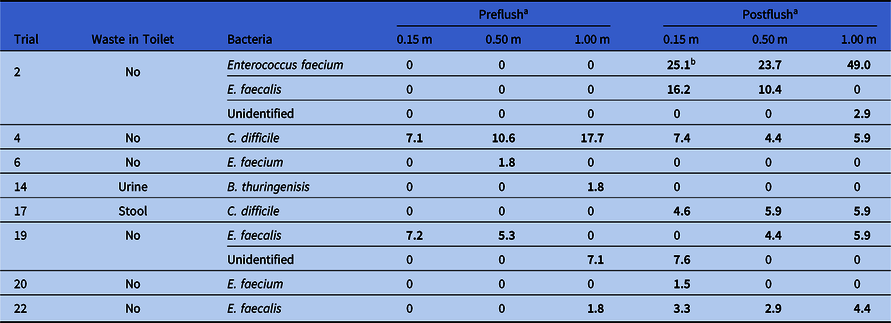
In total, 24 bathrooms were sampled before and after flushing, and 8 of these bathrooms yielded growth on at least 1 of the 6 plates collected from each bathroom during aerosol sampling, which we defined as a positive sample. For the remaining 16 bathrooms, no growth was detected on any of the sampling plates (Table 1). We detected no difference between rooms that had positive culture and rooms that had negative culture by hospital unit, presence of waste in the toilet, or amount of time from notification to room sampling. The average relative humidity was higher in rooms that yielded a positive culture than in rooms that yielded a negative culture, although this difference was not statistically significant. The mean average relative humidity in positive-culture rooms was 72% (interquartile range [IQR], 60%–82%) versus 68% (IQR, 47%–82%) in negative-culture rooms.
Demographics of Patient Rooms

Note. CDI, Clostridioides difficile infection; IQR, interquartile range.
a The Fisher exact test was used for categorical variables, and the Wilcoxon rank-sum test was used for continuous variables.
The culture-positive trials are shown in Table 2. Of these 8 trials, 6 were performed on toilets with no visible waste; 1 trial was performed on a toilet containing urine; and 1 trial was performed on a toilet containing stool. Only 1 trial showed a positive culture at all 3 distances both before and after flushing, and 4 additional trials showed a positive culture on at least 3 of the 6 sample plates used. The remaining 3 trials showed bacterial growth on only 1 of the 6 sample plates. In total, 28 bacterial identifications were made from the 8 culture-positive rooms. The most frequently cultured species was Enterococcus faecalis (36%), followed by C. difficile (32%), and Enterococcus faecium (18%). Environmental bacilli accounted for 3% of the species found, and 11% of the colonies grown could not be identified via MALDI-TOF.
Positive Bioaerosol Cultures

Note. CFU, colony-forming units.
a Values represent the bioaerosol concentration given in CFU/m3 for each organism cultured.
b Values above zero are shown in bold.
To determine whether aerosolization from the toilet plume was affecting the bioaerosol distribution, the culture rates were compared using samples taken before and after flushing. The percentage of positive preflush plates was 12.5% (9 of 72), and the percentage of positive postflush plates was 26.4% (19 of 72). Postflush plates had a significantly higher probability of culturing positive than preflush plates (P = .0309).
At 0.15 m from the edge of the toilet, the mean bioaerosol concentration before flushing was 1.3 CFU/m3 compared to 5.9 CFU/m3 after flushing. The mean concentration before flushing at 0.5 m was 1.6 CFU/m3 compared to 4.7 CFU/m3 after flushing. Finally, the 1.0-m concentration before flushing was 2.6 CFU/m3 compared to 6.7 CFU/m3 after flushing. Although we detected no significant differences, concentrations were higher after flushing at all 3 distances, and the distance closest to the toilet (0.15 m) trended toward significance (P = .0781) (Fig. 1).
Bioaerosol by distance before and after flushing. Mean and standard deviations are shown. Results of the total colony count are from the original sample plate and represent both pathogenic and apathogenic bacteria.

Across all trials, we detected a significant increase in particle concentrations after flushing compared to before flushing at the 2 largest particle sizes measured: 5.0 µm (P = .0095) and 10.0 µm (P = .0082). Concentrations of the smallest and the 2 largest particle sizes (0.3 µm, 5.0 µm, and 10.0 µm) significantly increased after flushing in the positive culture trials. No difference was detected in concentrations of particles from negative-culture trials (Fig. 2).
Preflush and postflush particle concentration data are shown for both negative rooms (n = 13) and positive rooms (n = 6) where complete data were obtained. The average particle concentration did not significantly change in any negative culture rooms. The particle concentration significantly increased (**P > .05) for the 0.3-µm, 5.0-µm, and 10-µm particle sizes in the positive-culture rooms.

Discussion
Toilet plumes are a potential source of pathogenic bioaerosol contamination in patient rooms.Reference Johnson, Mead, Lynch and Hirst1,Reference Barker and Jones14,Reference Roberts, Smith and Snelling20 In this study, we evaluated the bioaerosol production and particle concentration from the toilet plumes of toilets in rooms of patients with CDI. We collected 24 before-and-after samples in patient bathrooms during this pilot study. We found a 2-fold increase of positive cultures in postflush samples compared to preflush samples. In addition, the likelihood of culturing positive was affected by distance both before and after flushing. However, our pilot study was underpowered to detect a true difference before versus after flushing. Furthermore, bacteria were only detected in one-third of the sampled rooms. Most bacteria identified were pathogenic (86%); however, this result was most likely an overestimation due to our culturing methods. We detected an increase in bioaerosols after flushing compared to baseline, which suggests that the act of flushing the toilet could impact the amount of bioaerosols in the room.
An increase in particle concentration was strongly associated with positive bioaerosol culture, indicating an overall higher level of contamination in the air after flushing in those rooms. Humidity might have utility as an indicator of a positive culture because the rooms with a positive culture were, on average, 3% more humid than negative-culture rooms. Thus, humidity might play a factor in the concentration and dispersal patterns of bioaerosols in the environment.
Enterococcus spp. represented 54% of the total positive cultures. This finding is notable because Enterococcus is another major hospital-associated infection in which hospital environmental contamination can play a significant role in patient transmission.Reference McDermott, Skally, O’Rourke, Humphreys and Fitzgerald-Hughes18 Although resistance testing was not performed on these samples, the presence of Enterococcus should be evaluated further because the presence of VRE aerosolized samples could significantly contribute to VRE environmental contamination.
The results from this pilot study echo findings from other studies in which C. difficile was cultured from hospital toilets. Roberts et alReference Roberts, Smith and Snelling20 used a portable cyclone sampler for 4 days over a 2-year period in 2 separate wards to test for evidence of C. difficile contamination, and C. difficile spores were detected in 50% of the trials. Although we only detected bacteria in 19% of total number of samples collected in our study, C. difficile was detected in 32% of those samples, comparable to the study by Roberts et al.
Best et alReference Best, Sandoe and Wilcox4 experimentally seeded toilets with 10Reference O’Neill, Adams, Bowman and Riley7 CFU/mL of C. difficile, a concentration that is comparable to the amount of bacteria shed from an infected person’s stool. They performed flush experiments to determine the number of C. difficile containing bioaerosols created by the toilet.Reference Best, Sandoe and Wilcox4 An air sampler continuously collected measurements for 90 minutes after the toilet was flushed. The C. difficile aerosolized samples measured 36 CFU immediately after the toilet was flushed. In our present study, we improved upon these previous designs by sampling bioaerosols from toilets in the rooms of patients with active C. difficile infections. The previous studies were conducted in controlled environments under conditions that are not consistent with the healthcare setting.
The strengths of this pilot study included a detailed analysis of factors that could impact aerosol production in the room. Additionally, the collection of preflush samples provided a baseline concentration of bioaerosols in the air, thus increasing the likelihood that the observed postflush bioaerosol concentrations were attributable to the toilet plume. Previous studies have demonstrated that bioaerosols can be found in high concentrations in a patient bathrooms. However, previous research only identified total aerosolized bacteria and not specific pathogens, as we did in this study.Reference Knowlton, Boles and Perencevich19 This work builds on previous studies by quantifying and defining the bacterial bioaerosols captured.
This study has several limitations. First, it was a pilot study with a limited sample size. Several rooms were not sampled because patients were reluctant to lose access to their bathrooms for the 60-minute trial. Because CDI promotes frequent diarrhea, not including patients with potentially more severe symptoms may have excluded the more heavily contaminated toilets. Additionally, the sample collection protocol used was time-consuming, which limited the number of rooms that could be sampled per day. The plates used for culturing were designed to detect C. difficile and were incubated in an anaerobic chamber; therefore, culture and detection of many aerobic pathogenic bacteria, such as Escherichia coli, was not possible.
To account for these limitations, future studies should consider using plates and culture methods designed to detect a broader range of bacteria. Also, the room of patients infected with other gastrointestinal pathogens, as well as the rooms of healthier control patients, should be cultured for a better understanding of normal bioaerosols in hospitals and not just those of patients with CDI. Finally, the use of a smaller, higher flow rate sampling device would allow for a shorter sampling time and less labor-intensive process, which would allow additional rooms to be sampled during any given period.
In conclusion, toilet flushes are a potential source of bioaerosols that could lead to environmental contamination and infection transmission in the healthcare setting. Patients who are infected with enteric pathogens require frequent toilet usage, which leads to heavy toilet contamination. This study potentially supports the hypothesis that toilet flushing may lead to the spread of clinically significant pathogens in healthcare settings. More information is needed to determine the risk factors associated with toilet flushing and environmental contamination by pathogens.
Supplementary material
To view supplementary material for this article, please visit https://doi.org/10.1017/ice.2020.11
Acknowledgments
The findings and conclusions are those of the authors and do not necessarily represent the official position of the Centers for Disease Control and Prevention.
Financial support
G.W., L.B., M.S., D.D., and E.P. were supported by the Centers for Disease Control Prevention Epicenters Program. G.W. and V.J. were also supported by funds from the Heartland Center for Occupational Health and Safety.
Conflicts of interest
The authors have no conflicts of interest to declare related to this article.