


Introduction
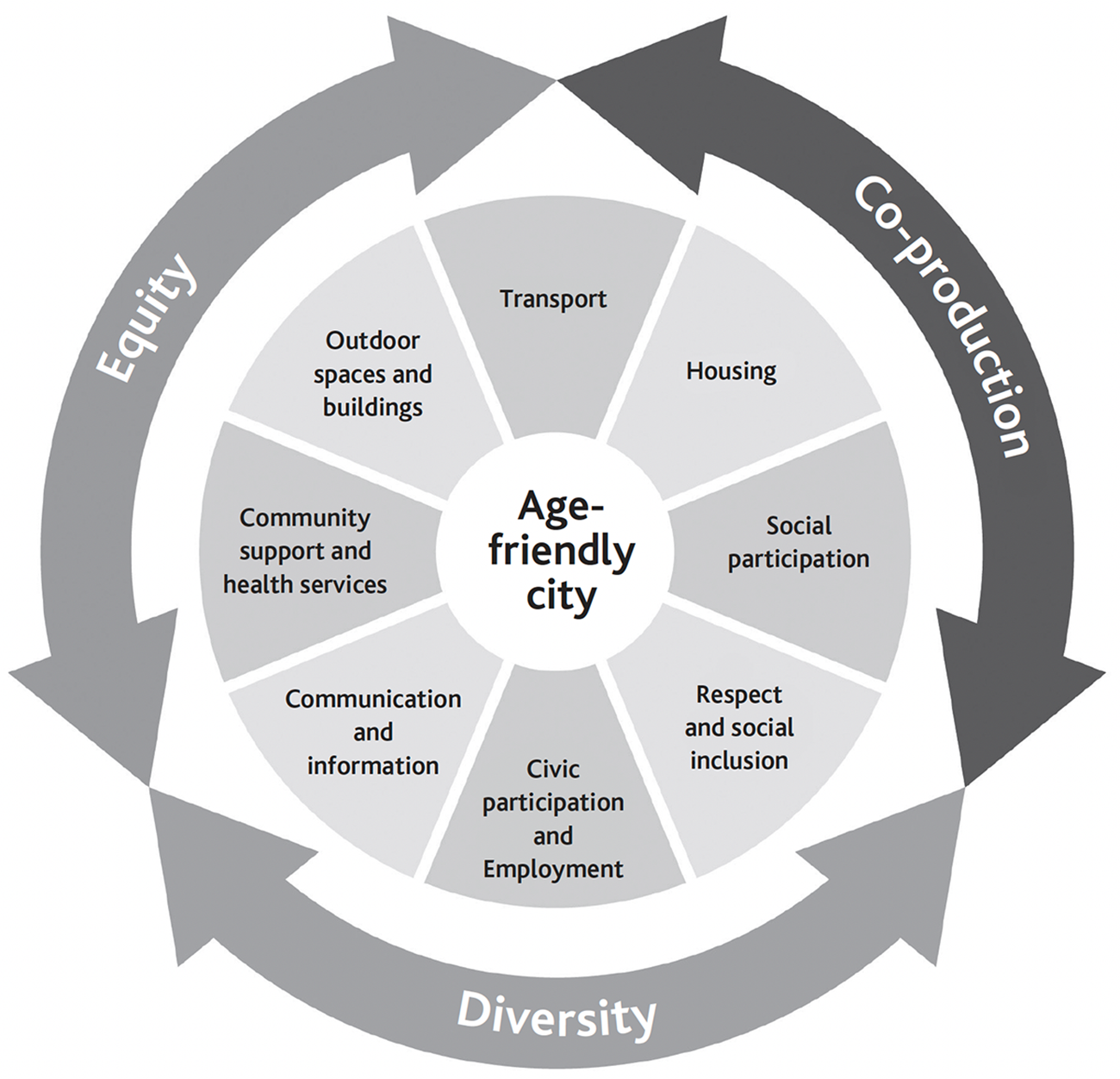
The World Health Organization’s (WHO) Age-Friendly Cities and Communities (AFCC) framework, introduced in 2007, aims to address the challenges and opportunities associated with population ageing and urbanization (WHO 2007). We define AFCC as environments that ‘optimize opportunities for health, participation, and security’ as people age, focusing on fostering accessible services, inclusive built environments and opportunities for social connection across eight domains (Figure 1) (Plouffe and Kalache Reference Plouffe and Kalache2010, 735). Since 2010, the framework has been adopted by over 1,800 cities and communities in 60 countries (WHO 2026).
Spatial justice framework for AFCC (Buffel et al. Reference Buffel, Yarker and Doran2024).

Research has highlighted the age-friendly (AF) movement’s successes in raising awareness of ageing issues in urban planning, challenging ageism, fostering innovative community models for ageing, and bolstering interdisciplinary and intersectoral collaboration (van Hoof et al. Reference van Hoof, Marston, Kazak and Buffel2021; Greenfield and Buffel Reference Greenfield and Buffel2022). These achievements underscore the enduring significance of the AF approach, not just as a policy response to ageing but also as an agent of system-level change (Greenfield and Pope Reference Greenfield and Pope2025). The framework has evolved to include measurement of ‘equity … accessibility of the physical environment, and inclusiveness of the social environment’ (van Hoof et al. Reference van Hoof, Marston, Kazak and Buffel2021, 2; WHO 2015). The WHO continues to highlight the need to ‘reduce inequities and protect those who are most vulnerable’ (2018, 2), but gaps in evaluation remain (Black and Oh Reference Black and Oh2022).
Age-friendly initiatives (AFIs) face significant challenges to their progress and inclusivity. Menec and Brown stress the need to ‘acknowledge the broader political and economic forces that affect cities’ and communities’ ability to become more age-friendly’ (Reference Menec and Brown2022, 192), particularly in addressing place-based inequalities among marginalized and minoritized older populations (Phillipson et al. Reference Phillipson, Doran, Yarker, Buffel, Cutchin and Rowles2024). Rising inequalities and austerity measures have strained local budgets, leading to substantial cuts in services and infrastructure that benefit older people (McDonald et al. Reference McDonald, Scharf and Walsh2023). These reductions disproportionately impact marginalized older people, reinforcing cumulative, intersectional and place-based disadvantages (Baars et al. Reference Baars, Dannefer, Phillipson and Walker2006; Finlay and Finn Reference Finlay and Finn2021; Walsh et al. Reference Walsh, Scharf, Van Regenmortel, Wanka, Walsh, Scharf, Van Regenmortel and Wanka2021). The AFCC framework has been criticized for its lack of attention to diversity (in both places and populations), limiting its effectiveness in supporting the most excluded groups (Fitzgerald and Caro Reference Fitzgerald and Caro2014; Golant Reference Golant2014; Buffel and Phillipson Reference Buffel and Phillipson2018; Torku et al. Reference Torku, Chan and Yung2021; Chivers Reference Chivers2022).
Critical gerontology challenges individualized and biomedical accounts of later life, instead attending to how structural inequality, power and political economy shape the experience of ageing (Baars et al. Reference Baars, Dannefer, Phillipson and Walker2006). Critical social gerontology calls for engagement with theories of spatial justice, to examine ‘how social inequalities among older adults are determined or shaped by place, and how AFIs might be able to mitigate or exacerbate place-based inequalities’ (Greenfield Reference Greenfield2018, S44). Spatial justice attends to the (unintentional) shadow side of AF programmes that operate in the service of neo-liberal agendas characterized by state withdrawal, service privatization, decreasing budgets and the responsibilisation of older adults (Joy Reference Joy2020, Reference Joy2021). Actions within AFCC programmes delivered at the local level are often expected to ‘swim upstream against policies that do not provide the options people need throughout their lifetimes’ (Ball and Lawler Reference Ball and Lawler2014, 25). This is compounded by place-based, structural and cumulative disadvantage, where in a context of inadequate investments, local government and non-profit sectors are left ‘scrambling to meet increasingly complex, acute, and emergency needs’ (Joy Reference Joy2020, 168).
Spatial justice also interrogates processes of othering in AF discourse (van Dyk Reference van Dyk2016), tensions between autonomy/vulnerability and the narratives of active/abject third/fourth ages (Higgs and Gilleard Reference Higgs and Gilleard2020). Queer, trans and disability perspectives challenge marginalization narratives, advocating relational and asset-based approaches over deficit framing (Beckett Reference Beckett2006; Brice Reference Brice2020), pointing towards aged interdependence as an opportunity for connection rather than the usual tropes of need or burden (Naughton et al. Reference Naughton, Cunha, Padeiro and Santana2023).
Building on Fainstein’s (Reference Fainstein2010) concept of the ‘just city’, Buffel, Yarker, and Doran propose a spatial justice framework for AFCC, which centres on co-production, equity and diversity (Figure 1) and aims to address ‘the power structures and modes of oppression that shape inequalities for urban ageing populations’ (Reference Buffel, Yarker and Doran2024, 229). However, the spatial justice framework remains under-explored in empirical research, particularly across diverse international contexts, limiting our understanding of how AFCC initiatives address structural inequalities and support spatial justice in varied urban settings (Buffel et al. Reference Buffel, Yarker and Doran2024).
This article addresses this gap through the first empirical application of the ‘spatial justice framework for AFCC’ (Buffel et al. Reference Buffel, Yarker and Doran2024). Drawing on seven international case studies – Akita, Bilbao, Brno, Brussels, Manchester, Oslo and Quebec – selected for their sustained engagement in AFCC initiatives, it illustrates organic AF practices aligned with the spatial justice framework components (co-production, equity, diversity) and reflects how they might contribute to spatial justice for older people. The discussion then reflects on the spatial justice framework, in light of those findings, by focusing on the dynamics of age inequality highlighted by a spatial justice lens.
A spatial justice framework for AFCC
Over recent decades, scholars in critical geography and urban studies have stressed the need to consider space and place in questions of social justice (Fainstein Reference Fainstein2009, Reference Fainstein2010; Harvey Reference Harvey1996; Soja Reference Soja2010). In a genealogy of justice in planning thought, Dadashpoor and Alvandipour (Reference Dadashpoor and Alvandipour2020) name five schools: equity, communicative, just, critical-spatial and Southern. Each has different philosophical origins and different emphases, such as resource access and distribution, deliberative democratic process, equity, recognition, identity, power, domination, participation and rights. Spatial justice is a multidimensional concept, interweaving ‘the distributional dimensions of urban planners, the procedural norms of lawyers, the lived experience emphasized by sociologists, and the manifestation of power in space’ (Dadashpoor and Dehghan Reference Dadashpoor and Dehghan2025, 2). Being interdisciplinary, multidimensional and inclusive presents a challenge to its definition and application, with each school of thought prioritizing different dimensions. This spatial turn complements critical gerontology’s own attention to structure and power, extending its analysis of inequality in later life to the specific geographies in which ageing takes place (Baars et al. Reference Baars, Dannefer, Phillipson and Walker2006; Phillipson et al. Reference Phillipson, Doran, Yarker, Buffel, Cutchin and Rowles2024). Applying a spatial justice lens to AFCC therefore builds a bridge between critical gerontology and urban theory, examining AFIs as sites where spatial inequalities are produced, reinforced or challenged.
This article draws on Fainstein’s Just City (Reference Fainstein2010), which proposes three hallmarks of urban justice, in the context of Western capitalist urban environments: equity, deliberative democracy and diversity. In the spatial justice framework for AFCC (Figure 1), deliberative democracy, a process central to the planning context, has been replaced by ‘co-production’, a cornerstone of AF work (WHO 2007; Buffel Reference Buffel2018). Harvey (Reference Harvey, Marcuse, Connolly, Novy, Olivo, Potter and Steil2009) argues that Fainstein’s approach insufficiently addresses structural inequalities within capitalist production. While this critique is important, the approach aligns closely with the objectives, orientation and context of AFCC programmes, and is appropriate for studying spatial justice at the meso-scale. We return to this in the discussion when considering future applications of the framework.
The spatial justice framework for AFCC (Figure 1) ‘encourages a critical examination of how urban and ageing policies enable or restrict equitable access to social, cultural, economic, political and civic resources, and the extent to which older people have opportunities to take advantage of, and have a say over, how these resources are used’ (Buffel et al. Reference Buffel, Yarker and Doran2024, 9). A spatial justice lens informs AFCC programmes in two ways: understanding which places benefit from resource allocation and assessing their capacity to support communities, especially those facing exclusion (Buffel et al. Reference Buffel, Yarker and Doran2024).
The three components – co-production, equity and diversity – allow exploration of AF work and its impact on marginalized groups. While recognizing their interrelativity, these were kept analytically separate to focus on distinct questions: co-production examines representation and participation in decision making; equity addresses resource distribution and access; diversity focuses on minoritized identities and needs. Joy (Reference Joy2020) uses a similar approach (distribution, recognition, rights to/of the city) to study Toronto’s Seniors’ Strategy in the context of universal provision and identity-based needs.
In Greenfield et al.’s (Reference EA, J, E and Amir Koren2026) study of initiatives that address ageing equity and diversity, components were reported together. As a multidimensional concept, spatial justice components will vary by context; Greenfield et al.’s study focused on racialized diversity, while Oswald and Cooper’s study of older Black lesbian women explores ‘multiple intersecting marginalized identities’ (Reference Oswald and Cooper2024, 1) in relation to equity and justice. As a cross-national study, this article seeks to illustrate each component, its interrelatedness in diverse contexts and how groups are impacted differently.
Co-production is central to AF work, as older people’s participation fosters ownership and control over resource allocation (Doran and Buffel Reference Doran and Buffel2018; Urbaniak and Wanka Reference Urbaniak, Wanka, Urbaniak and Wanka2023). Participation may involve collaborative decision making or engagement in institutions and community organizations. Yet participatory processes can reinforce power hierarchies and inequalities (Yarker and Buffel Reference Yarker and Buffel2022). Marginalized groups often face barriers limiting engagement (Greenfield and Reyes Reference Greenfield and Reyes2022; Hammond et al. Reference Hammond, Crompton, White, Buffel, Yarker and Doran2024). Co-production can become tokenistic, failing to redistribute resources to marginalized groups (Day Reference Day2024). This raises critical questions about whether older people – especially marginalized groups – are involved in decisions granting access to and control over urban resources.
Equity seeks fairer distribution of resources and opportunities by asking ‘Who benefits? Who remains excluded? What contributes to exclusion? And what can be done differently?’ (Buffel et al. Reference Buffel, Yarker and Doran2024, 10). Age-friendly policies prioritizing equity aim to direct benefits to historically excluded groups, making them redistributive not only economically but ‘politically, socially, and spatially’ (Fainstein Reference Fainstein2010, 36). Within spatial justice debates, equity refers to a fairer distribution of resources to those already disadvantaged. Equality – the equal treatment of people regardless of starting point – is, according to Fainstein, ‘too complex, demanding and unrealistic to be an objective in the context of capitalist cities’ (Reference Fainstein2010, 36). However, addressing inequality remains integral to spatial justice theory and practice, and distinctions can blur when policies aim to improve both equality (across populations) and equity (within populations). As Greenfield et al. (2024) note, terms such as equity and diversity are rarely used by practitioners; ‘equity’ is therefore interpreted through participants’ responses in this article.
Diversity ensures recognition and inclusion of older people with marginalized or minoritized identities, extending benefits of AF programmes to a wider range of groups. These include racially and ethnically minoritized older people, sexual and gender minorities, those in deprived areas and those with health needs or cognitive differences (Buffel et al. Reference Buffel, Yarker and Doran2024). Diversity alone does not guarantee spatial justice, but examining how policies recognize and address varied needs is crucial. As the older population becomes increasingly heterogeneous, it is important to recognize diversity both within and between groups, understanding that their needs may conflict (Fainstein Reference Fainstein2009). By addressing these diverse needs, AFIs can better facilitate fair and inclusive access to resources, services and opportunities, thereby advancing spatial justice.
This article applies a spatial justice framework (Buffel et al. Reference Buffel, Yarker and Doran2024) to data from seven international cities, using co-production, equity and diversity as analytical categories. Organic AF practices (emerging from the AF context in their particular location) that fall under each category of the framework are described and the article reflects on how they might contribute to spatial justice for older people by addressing the following research questions (RQs):
(a) How are older people, particularly from marginalized groups, involved in decision-making processes around AF programmes (co-production)?
(b) How can AF programmes contribute to fairer resource distribution and access for older people from marginalized groups (equity)?
(c) In what ways do AF programmes recognize and respect the identities and needs of diverse older populations (diversity)?
Methodology
This article is part of the Ageing-in-Place in Cities project that used a multiple case study approach (Doran et al. Reference Doran, Yarker, Buffel, Satake, Watanabe, Kimoto, Kodama, Kume, Suzuki, Makabe and Ota2025) to generate ‘an in-depth, multi-faceted understanding of a complex issue in its real-life context’ (Crowe et al. Reference Crowe, Cresswell, Robertson, Huby, Avery and Sheikh2011, 1). This approach is well-suited to analysing commonalities and differences across cities, providing a deeper, context-specific understanding of localized AF practices (Rémillard-Boilard et al. Reference Rémillard-Boilard, Buffel and Phillipson2021).
Case selection
Purposive sampling was used to select the cities based on three criteria: (1) a demonstrated, sustained commitment to ageing as a policy priority; (2) at least ten years of active AF policy development and implementation; and (3) diversity in geographic location, cultural, socio-economic and demographic characteristics. The cities’ long-standing engagement with AFIs ensured that they offered sufficient experience of developing and implementing AF work to examine how these initiatives advance spatial justice. Although policy commitment and AF policy development informed the selection of case studies, this article is not intended as a policy analysis. The primary focus is on AFIs and how they address co-production, equity and diversity, but the article also refers to policies at different levels of government where these are important for understanding the development or implementation of those initiatives. Access to key stakeholders was a crucial logistical consideration, as their cooperation was vital for facilitating data collection (Crowe et al. Reference Crowe, Cresswell, Robertson, Huby, Avery and Sheikh2011).
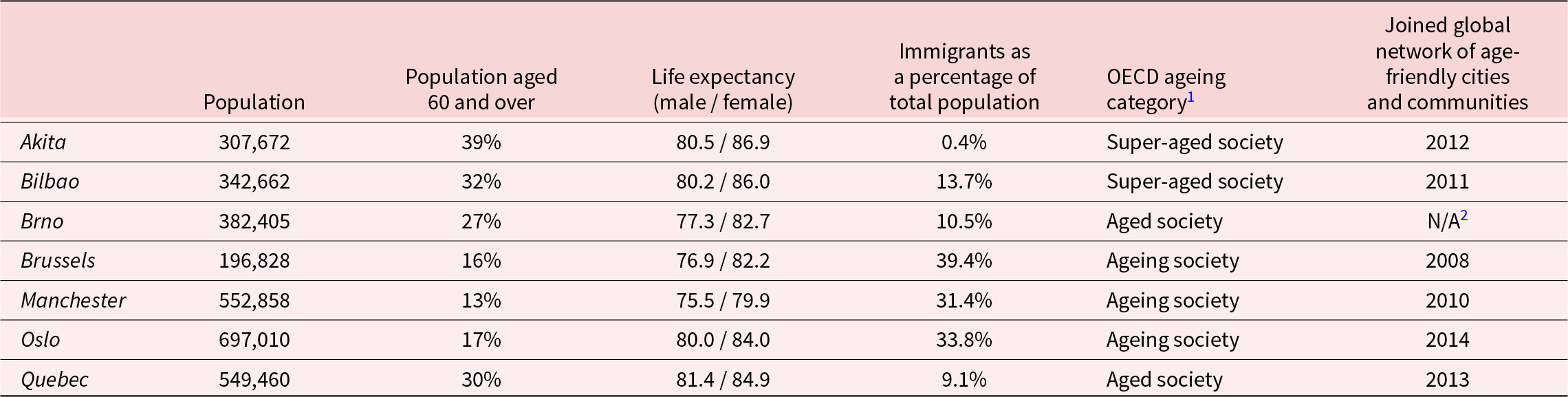
The seven selected cities were: Akita (Japan – AK), Bilbao (Spain – BL), Brno (Czech Republic – BR), Brussels (Belgium – BX), Manchester (United Kingdom – MC), Oslo (Norway – OS) and Quebec (Canada – QB). Table 1 summarizes their key characteristics.
Key characteristics of case study cities

Table 1 Long description
City characteristics are listed for Akita, Bilbao, Brno, Brussels, Manchester, Oslo, and Quebec, covering population, population aged 60 and over, life expectancy for male and female, immigrants as a percentage of total population, an OECD ageing category with a footnote marker, and the year joined the Global Network of Age Friendly Cities and Communities. Populations range from 196,828 in Brussels to 697,010 in Oslo. Population aged 60 and over is 39 per cent in Akita, 32 per cent in Bilbao, 27 per cent in Brno, 16 per cent in Brussels, 13 per cent in Manchester, 17 per cent in Oslo, and 30 per cent in Quebec. Life expectancy, male and female respectively, is 80.5 and 86.9 in Akita, 80.2 and 86.0 in Bilbao, 77.3 and 82.7 in Brno, 76.9 and 82.2 in Brussels, 75.5 and 79.9 in Manchester, 80.0 and 84.0 in Oslo, and 81.4 and 84.9 in Quebec. Immigrants as a percentage of total population are 0.4 per cent in Akita, 13.7 per cent in Bilbao, 10.5 per cent in Brno, 39.4 per cent in Brussels, 31.4 per cent in Manchester, 33.8 per cent in Oslo, and 9.1 per cent in Quebec. OECD ageing category is Super aged society for Akita and Bilbao, Aged society for Brno and Quebec, and Ageing society for Brussels, Manchester, and Oslo. Joined Global Network of Age Friendly Cities and Communities is 2012 for Akita, 2011 for Bilbao, not listed for Brno with a footnote marker, 2008 for Brussels, 2010 for Manchester, 2014 for Oslo, and 2013 for Quebec.
Notes:
1 Classifies cities by the proportion of older people aged 65 years or more (OECD 2020).
2 Brno is part of the WHO European Healthy Cities Network since 1996 (as opposed to the WHO Global Network for Age-Friendly Cities and Communities [GNAFCC]) and integrates its AFIs within the broader ‘Healthy City’ programme.
Data collection
Between March 2022 and June 2024, the seven case studies were developed through: (1) collaboration with in-country experts to create city profiles (see supplementary data); (2) semi-structured interviews across a wider group of key stakeholders; and (3) fieldwork in each city, involving site visits and observations of AF settings and initiatives, which were used to provide contextual understanding but did not form part of the data analysis for this article. This research received ethical approval from the institution’s ethics committee (Review Reference 2021-11,832-20,386).
Relationships were developed with in-country experts, approached through existing contacts or public profiles. Selection was based on their roles as AF programme leads or researchers with expertise in ageing and AF initiatives. To ensure a robust understanding of each city’s context, city profiles were developed through a structured process combining stakeholder input, document review and targeted literature searches. Using a standardized template, information was collected on (1) urban characteristics (governance, city history, economic change and national context); (2) demographic data (ageing trends, life expectancy and population diversity); and (3) the development of AF initiatives (history, actors and local policies). In addition, the research team conducted a review of secondary sources, including government reports, local census data and academic publications, to supplement and verify the collected data. This combination of expert input and data verification ensured that the city profiles were comprehensive and consistent across the cases. The city profiles were used as contextual data for this article (Table 1), with particular reference to the reported examples of AF initiatives that demonstrate co-production, equity or diversity.
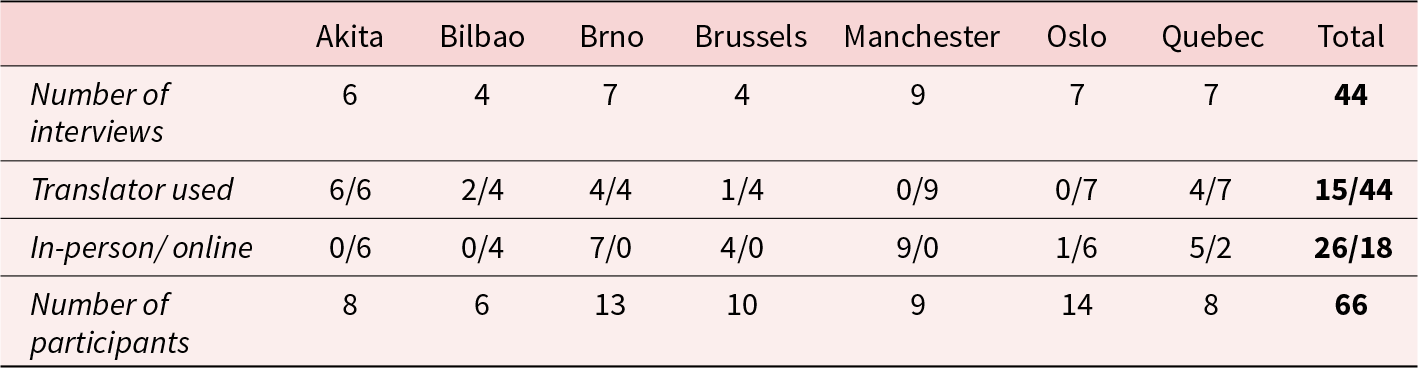
Building on the city profiles, authors 2, 3 and 4 conducted semi-structured interviews with key stakeholders (n = 66) using purposive sampling guided by the in-country experts to ensure that a diverse representation of individuals was involved in the AF programmes in each city. Participants were sent (via email) an overview of the study. They represented a cross-section of people able to provide informed insights about local AFCC activity through their involvement in planning, coordinating, delivering or researching AF work (local government, researchers, community-based organizations, private organizations, older people). Interviews continued for each city until data saturation was achieved – when the research team agreed that the questions had been answered fully. While some interviewees had already contributed to the city profiles, the interviews allowed us to further explore key themes, validate initial data and gain deeper insights into how AFIs can support spatial justice. The interview guide was sent ahead of the interviews, giving participants the opportunity to ask questions about the scope and purpose of the interview. There was also a scripted introduction to explain the aims of the project. As some of the questions relate to sensitive information, participants were informed that their identities would be kept anonymous. There was no participant drop-out or refusal to take part. The sample included local government employees/representatives (‘LG’ n = 28); older people supporting/volunteering with AF programmes (‘OPV’ n = 11); representatives from community/third sector organizations (‘Com’ n = 15); academics (‘Aca’ n = 9); and private sector stakeholders (‘PSS’ n = 3) (Table 2). Some participants had dual roles, for example older volunteers who were also working in community organizations (Com/OPV).
Summary of interview data

Table 2 Long description
Interview counts, translator use, interview mode, and participant totals are listed for Akita, Bilbao, Brno, Brussels, Manchester, Oslo, Quebec, and an overall total. Number of interviews by location are Akita 6, Bilbao 4, Brno 7, Brussels 4, Manchester 9, Oslo 7, Quebec 7, totaling 44. Translator used is Akita 6 of 6, Bilbao 2 of 4, Brno 4 of 4, Brussels 1 of 4, Manchester 0 of 9, Oslo 0 of 7, Quebec 4 of 7, totaling 15 of 44. In person and on line counts are Akita 0 and 6, Bilbao 0 and 4, Brno 7 and 0, Brussels 4 and 0, Manchester 9 and 0, Oslo 1 and 6, Quebec 5 and 2, totaling 26 in person and 18 on line. Number of participants are Akita 8, Bilbao 6, Brno 13, Brussels 10, Manchester 9, Oslo 14, Quebec 8, totaling 66.
The interviews were guided by a semi-structured interview schedule, pilot-tested in February 2022, covering key areas: priorities of AF work; governance and delivery structures; and examples of AFIs. Following on from the city profiles, the components of the spatial justice framework were mentioned explicitly, with questions, for example, about the identification, involvement and recognition of marginalized groups and any associated challenges or barriers. Interviews were conducted both virtually (via Zoom n = 26) and in person at local government or community-based workplaces (n = 18) during fieldwork visits, lasting between 34 and 92 minutes, with some (n = 15) conducted using an interpreter (Table 2). All participants were intervewed in their professional capacity focusing on their AF programme involvement. All interviews were audio recorded with participant consent and transcribed by a third party. Interview data, including post interview reflections, was managed using NVivo 12.
Data analysis
The analysis drew on data from the city profiles and interviews. Braun and Clarke’s (Reference Braun, Clarke and Cooper2012) six-phase thematic analysis offered a structured yet flexible approach for both deductive and inductive coding. The analytic categories of the spatial justice framework provided a theoretical lens to anchor the analysis, while inductive coding allowed for the emergence of sub-themes, ensuring a comprehensive analysis of the data. The top-level categories, ‘co-production’, ‘equity’ and ‘diversity’ from the spatial justice framework (RQa–c) were applied, and ‘challenges and barriers’ were included to highlight cross-cutting issues related to implementing programmes in different contexts.
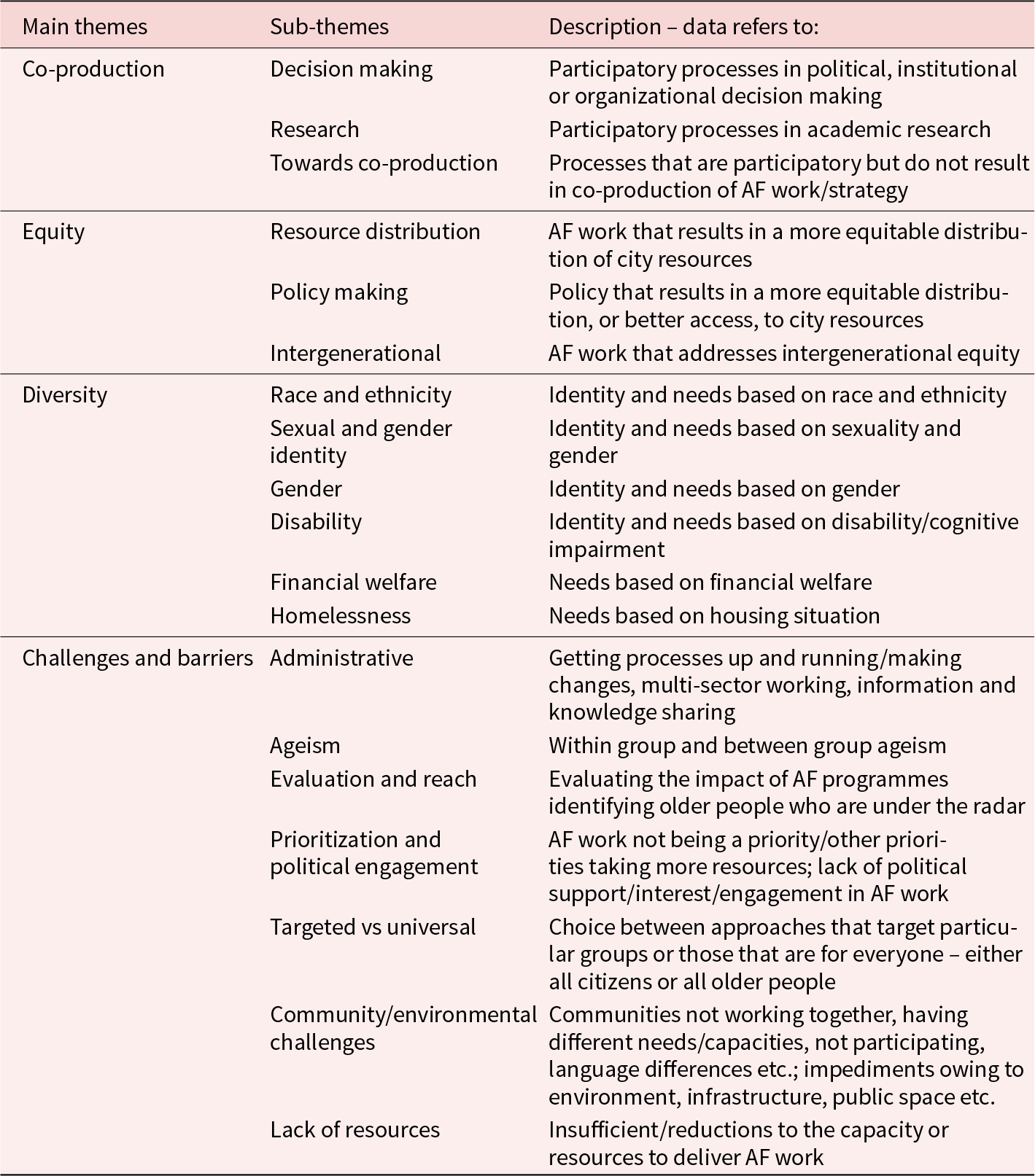
The interview transcripts and examples of initiatives taken from the city profiles were given an initial round of deductive coding. A second round of inductive coding was used to identify sub-themes emerging from the data (see Table 3). Sub-themes were identified based on their relevance to the research questions, but also through recurrent patterns in participants’ reflections. The first author led the analysis process, with the analysis regularly reviewed and validated by the research team to ensure consistency with the defined themes and sub-themes. Finally, the authors collaboratively selected the AFIs that best addressed the research questions and exemplified initiatives that demonstrated co-production, equity and diversity across different contexts. At this stage (Phase 6 – report writing, Braun and Clarke Reference Braun, Clarke and Cooper2012) the research team reflected on the Spatial Justice for AFCC framework through discussions on code descriptions and the interrelatedness of the framework components. Equity and diversity were reported separately, although significant overlap and interconnectedness were found between them, which has been highlighted in the findings and is taken up in the discussion. Supplementary Appendix 2 contains an epistemic and reflective statement for the project, research team and individual authors. This is important given the highly interpretive nature of applying the spatial justice framework across different socio-national contexts, and the team’s closer connection to the Manchester case study.
Examples of themes and sub-themes

Table 3 Long description
Three columns list main themes, sub themes, and a description of what the data refers to. Under main theme, Co production, sub themes are Decision making, Research, and Towards Co production, each described as participatory processes, including cases that do not result in co production of AF work or strategy. Under Equity, sub themes are Resource distribution, Policy making, and Intergenerational, each described as AF work or policy that results in more equitable distribution or better access to city resources, including intergenerational equity. Under Diversity, sub themes are Race and Ethnicity, Sexual and Gender Identity, Gender, Disability, Financial welfare, and Homelessness, each described as identity and needs based on the named characteristic or housing situation. Under Challenges and barriers, sub themes are Administrative, Ageism, Evaluation and reach, Prioritisation and Political engagement, Targeted vs Universal, Community or environmental challenges, and Lack of resources, with descriptions covering implementation and coordination issues, ageism, impact evaluation and identifying under the radar older people, political priority and support, approach choice, community and environmental impediments, and insufficient capacity or resources to deliver AF work.
Findings
The analysis identified a range of AFIs that address each of the three research questions (see earlier). A spatial justice lens directs attention to questions central to critical social gerontology about who is involved in decision making, who benefits from AFIs and which groups of older people remain excluded. Though not exhaustive, the examples illustrate how AFIs advance ‘co-production’, ‘equity’ and ‘diversity’, while also revealing the challenges that stakeholders face in pursuing these goals. Although the components are closely interrelated, they are presented separately for analytical purposes. The discussion reflects on the limitations of this approach and what this means for developing the spatial justice framework for AFCC. Throughout this section, information drawn from the city profiles (see earlier) are cited by page number, for example ‘(City Profiles 23)’; quotations from interview participants are cited using anonymised codes indicating city, stakeholder role and interview number (see Table 2).
Co-production
Co-production has been a core element of the AFCC framework since its inception (WHO 2007), emphasizing the central involvement of older people, including those from marginalized groups, in decision-making processes around AF policies and initiatives. This section explores the various mechanisms employed by city authorities, and the organizations working with them, to ensure that older people have a voice in shaping AF programmes (RQa).
The findings revealed two distinct approaches to co-production: universal and targeted (sub-theme ‘targeted vs universal’ Table 3). Universal approaches embedded AFIs within broader city-wide objectives, aiming to benefit the entire population rather than focusing specifically on older people. These approaches often fostered intergenerational collaboration and shared priorities, but risked diluting the distinct representation of older people in decision making. In contrast, targeted approaches recognized the specific needs and aspirations of older people, implementing dedicated structures such as advisory boards or older people’s councils, to ensure that their voices were amplified in decision making. While universal approaches fostered inclusivity across entire populations, targeted approaches focused on ensuring the active participation and representation of older people with particular attention to marginalized groups.
Universal approaches were evident in Akita, Brussels and Quebec, each shaped by their unique social and demographic contexts. In Akita, co-production within the AF agenda had a strong intergenerational focus. The challenges that came with being ‘super-aged’ (Table 1) were coupled with the exodus of younger people seeking better job opportunities in larger cities. This demographic shift prompted the city to prioritize initiatives that fostered intergenerational solidarity and collaboration, recognizing the importance of retaining younger residents to support its ageing population. An older volunteer explained, ‘the reason why I said I want young people to find good work based in Akita is because at the moment … a lot of young people go to big cities like Tokyo or Osaka. But if they could find [a] good workplace in Akita city, they will tend to stay in Akita and they could maybe live with or live near their parents. That is a very good thing for elderly people who have children living nearby and also good for young people’ (AK OPV 02). Akita held ‘democratic workshops’ three times a year, inviting people of all ages to contribute ideas to the age-friendly Akita Action Plan (City Profiles 7). Age-friendly policies were shaped by diverse perspectives, in response to the city’s unique demographic pressures and by fostering solidarity and shared responsibility across generations.
In Brussels and Quebec, universal approaches were embedded within top-down, multi-sectoral policy frameworks aimed at addressing the needs of diverse populations. In Quebec, local AF work was embedded in the ‘2021–2024 Universal Accessibility Action Plan’ (City Profiles 45), which includes older people, families and people with disabilities. This idea, expressed within local government as ‘no one is left behind’ (QB LG 44), was contradicted by ongoing advocacy for more tailored approaches. An older volunteer stated: ‘this elderly roundtable had a meeting with a municipal representative for the elderly. And they expressed their wish to have an age friendly, so elderly-only committee, not necessarily related or connected to disability. And we’ve had two meetings expressing this will and this desire on their part. However, there hasn’t been concrete follow-through yet’ (QB OPV 41). Although co-production mechanisms existed (City Profiles 45), older people were not specifically prioritized in decision-making processes. Both cities had recently transitioned from targeted approaches, which focused on addressing the specific needs of older people, to universal strategies. This shift had generated frustration among some AF stakeholders working in community organizations. In Brussels, for example, a participant reported that the city council ‘always comes to them later, when it’s actually too late, and it’s [the senior advisory board] not really acting as a council anymore because they don’t really have a voice’ (BX Com/OPV 09). These examples illustrated the challenges of balancing universal inclusivity with the meaningful representation of older people in decision-making processes, particularly in contexts where political priorities had shifted away from targeted engagement. In these cities we were not able to ascertain how older people from marginalized or minoritized groups were involved in decision making.
In contrast, targeted approaches were evident in Bilbao, Oslo and Manchester, where older people’s voices were amplified through dedicated structures, such as advisory councils and elected groups, to address specific needs. In these cities, older people played an active role in designing policies, providing feedback on proposals and/or holding local governments accountable for AF programmes (City Profiles 12–14, 32–34, 38–40). ‘Super-aged’ Bilbao, where nearly one-third of the population is aged 60 and over (Table 1), exemplified a targeted approach to co-production, rooted in its tradition of civic engagement and the Age-Friendly Basque Country movement, which emphasized participatory governance (Zuniga et al. Reference Zuniga, Buffel and Arrieta2023). The Engine Group (Equipo Motor), a volunteer team of people aged over 60, worked closely with municipal officials, receiving training and access to formal spaces, which enabled meaningful engagement with the city council, including the mayor. Their efforts had shaped policies and evolved: ‘we are proud of the third plan… The other two plans before were issued by the council. And this third plan is based on our work’ (BL OPV 19). However, frustrations with bureaucratic delays remained, as proposals navigated multiple layers of approval. Despite these challenges, Bilbao’s co-production model remains a powerful example of integrating older people into the policy-making process. That said, the Engine Group reported that the recruitment of older people from racial and ethnic minorities was an ongoing challenge.
Oslo and Manchester, despite being classified as ‘ageing societies’ with relatively smaller proportions of people aged 60 and over (Table 1), also exemplified targeted approaches, driven by sustained political leadership in advancing the AF agenda over the past decade (City Profiles 32–34, 38–39). This leadership placed older people at the core of decision making through elected older people’s councils, boards and advisory groups. In Manchester, stakeholders noted a culture of accountability: ‘views are being taken more seriously now, and they’re sitting on more boards, and there’s more older people more confident to speak out’ (MC Com 11), demonstrated by the Older Peoples’ Board’s role in shaping the post-Covid recovery plan. Similarly, Oslo’s central council of older people, supported by a dedicated budget and secretariat, collaborated with district-level councils to ensure representation at local and city-wide levels. However, in both Manchester and Oslo, stakeholders noted that marginalized groups often remained under-represented owing to barriers such as language, financial constraints, low awareness and distrust between dominant and minoritized groups. Despite these challenges, both cities prioritized diversity in their co-production efforts, with Manchester establishing specialist advisory panels for LGBTQ+ issues, equality and mental health to ensure broader representation in its AFIs.
The question (RQa) of how older people are involved in decision-making processes presents a spectrum of increasing participation, from ad hoc surveys and consultation events (Brno) to regular consultations (Akita, Brussels, Quebec), to integrating consultation, co-creation/production and evaluation processes into the institutional frameworks (Bilbao, Manchester, Oslo). The findings show that when co-production is part of a targeted AF approach, more attention is paid to the inclusion of minoritized and marginalized groups, although this is still reported as a challenge. While there was evidence of representation and participation in decision-making processes, evidence of older people having meaningful ownership or control over critical resources, such as funding, public spaces and urban planning priorities, was not found (Lefebvre [1968] Reference Lefebvre, Kofman and Lebas1996). This raises questions as to the efficacy of co-production methods as a cornerstone of AFCC and spatial justice, which we will return to in the discussion.
Equity
Fainstein notes that ‘deliberative democracy operates poorly in situations of social and economic inequality’ (Reference Fainstein2010, 29) and that the hallmark of ‘equity’ within the spatially just city responds to this. As seen earlier, in some cities co-production processes give some groups of older people a say in decision-making processes which may lead to a redistribution of resources towards older people. However, beyond the representation of marginalized groups in decision-making processes (reported earlier as a challenge in AF work), the extent to which co-production results in a fairer distribution of resources towards these groups remains unknown and unreported.
Equity, as a component of spatial justice, was the most difficult to evidence owing to the lack of robust evaluations of AFCC initiatives, limited disaggregated data to assess impacts on marginalized older populations and the absence of standardized equity measures for cross-national comparisons (van Hoof et al. Reference van Hoof, Marston, Kazak and Buffel2021). In practice, this meant that clear evidence of resource redistribution was largely unavailable. As a result, the analysis focuses on initiatives that have the potential to either redistribute or give better access to resources for marginalized or minoritized groups (RQb). The initiatives reported in this section are a mix of both equality and equity measures.
The ways in which equity/equality-focused policies were designed and implemented varied significantly across cities, reflecting local priorities and contexts. In Brussels, for example, spatial inequalities were starkly evident with 30.8 per cent of households in the two lowest deciles of household income (City Profiles 23). The inequality was described as a ‘social distortion between the two sides of the canal of Brussels: The left side of the canal is the poorest part of the city’ (BX LGE 07). To address these disparities, Brussels had adopted a ‘10-minute city’ approach to ensure that essential services were accessible within a short distance for pedestrians or cyclists. While this broader urban strategy aimed to reduce place-based inequalities and redistribute resources to historically underserved, poorer neighbourhoods across all ten city districts, it was not specifically aligned with the goals of the AFCC agenda and did not directly address the unique challenges faced by older adults within those areas, although the ‘Maisons de Quartier’ [local community centres] were part of the strategy to address specific populations of older people within neighbourhoods (City Profile 26). This is an example of how ‘equality’ measures may not account for the specific needs and differential starting positions of particular groups of older people.
In contrast, Manchester City Council provided a more targeted approach, particularly for addressing age-related inequalities. While badged as ‘equality’ measures, initiatives were directed towards disadvantaged groups and could therefore improve equity. As a city with a younger demographic (Table 1), Manchester developed age-specific guidance for equality impact assessments – tools designed to evaluate how policies and services affect different groups, with a focus on mitigating inequalities. This guidance ensured that ‘our services and policies are age aware and address the specific age-related inequalities that arise as we get older’ (MCC 2024a, 1). Unlike gender, race, sexual identity and disability, age inequality is often overlooked, particularly in ‘younger’ cities where older people are a minority. As a stakeholder explained, ‘the older people we do have are living in much worse circumstances, so their need is greater, their isolation is greater. And because they’re not in greater numbers, they could be missed’ (MC LG 12). To address these challenges, Manchester’s AF strategy cuts across health, social, environmental and economic dimensions with programmes targeting particular areas of deprivation and marginalized or minoritized populations (City Profiles 33 – Urban Villages Project). One key initiative under this strategy supported an estimated 8,000 older people in accessing £24 million in unclaimed pension credits (a social security benefit), directly improving their financial security and unlocking access to additional financial support (MCC 2024b).
Transport emerged as a key domain for enhancing access to essential resources and services, such as health care, social activities and amenities, across the seven cities. A coordinated, comprehensive and affordable public transport service can significantly enhance equity by increasing mobility for older people living in economically deprived areas or those facing environmental barriers, thereby reducing social isolation and supporting inclusion (Fainstein Reference Fainstein2009). Stakeholders described a range of transport policies and initiatives relevant to local AF work, including free travel schemes for older people in Manchester and Quebec, low-cost travel options in Akita, Brussels and Bilbao, and customized door-to-door services in Brno, Oslo and Quebec for those with reduced mobility. The Oslo scheme was the outcome of a consultation with older people, and beneficiaries reported an 80 per cent increase in their activity levels and nearly 80 per cent improvement in health (City Profile 40). However, one stakeholder (OL 34 OPV) thought that the pink buses were ageist in drawing attention to older people with mobility issues and another raised the impossibility of parking in the city, affecting car-dependent older adults (OL 35 Com). These schemes can be interpreted as improving both equality, when applied to all older people, and equity, when targeted at particular groups.
Collectively, these initiatives illustrated how transport policies can contribute to advancing spatial justice by addressing barriers to mobility and supporting access to essential services for older people (RQb). Across the cities, public transport policies were widely recognized for improving mobility among older populations (de Sá et al. Reference de Sá, Sudsataya, Fry, Salehi, Katiki, Mcleod, Rathmell, Cylus, Lafortune, Buffel, Doran, Officer and Naci2024). However, evaluations of their specific impacts on marginalized groups were notably lacking, making it difficult to assess whether these policies effectively promoted equity, by addressing the particular needs of disadvantaged groups, or equality, by improving access to resources for all older people.
Stakeholders across the cities voiced their ambition to address place-based inequalities facing older populations (e.g. gender inequality in Bilbao, socio-economic inequality in Brno and Brussels). The challenge of working across different policy agendas and bureaucratic silos with reduced resources (Table 3 ‘Challenges and Barriers’) was identified as significant: ‘There’s a whole host of people facing inequalities, who all want their voices to be heard … It’s like, well, who do we give priority to, or how do we do this so that we meet everybody’s needs?’ (MC Com 11). While equity and equality are distinct concepts within spatial justice theorizing, in practice and policy documents they were used interchangeably to signify improvements in both, addressing injustices based on unfair disadvantage and inequalities.
Diversity
The challenge of delivering a more equitable distribution across a heterogeneous older population relates to ‘diversity’ and the need to recognize different groups, particularly those who experience cumulative disadvantage. For diversity to be a meaningful component of spatial justice, it is not enough to simply acknowledge the heterogeneity across older populations. Age-friendly cities and communities must strive to understand the intersecting needs, strengths and assets of individuals and groups as they age, ensuring that services are both targeted and tailored (Oswald and Cooper Reference Oswald and Cooper2024). In this section, a range of initiatives targeted at differences of race and ethnicity, sexuality and gender identity, and cognitive capacity are presented (RQc). In addition to the examples presented, the research also revealed other initiatives addressing groups affected by isolation (Akita, Manchester), homelessness (Brussels, Quebec) and disability (Manchester). Questions related to ‘diversity’ provided the richest source of data in this study; however, despite some stakeholders acknowledging intersectional disadvantage, there was a significant gap in the data in terms of how this was identified and addressed through AF programmes.
Racially and ethnically minoritized groups
Engaging older people from diverse ethnic communities in AFIs was a challenge highlighted in the more ethnically diverse cities, including Bilbao, Brussels, Manchester, Oslo and Quebec (Table 1). In Oslo, the City Hall organized a seminar for organizations working with immigrant populations to address these challenges. One attendee reflected on the experience: ‘It’s 149 nationalities … we have to challenge ourselves and think how can we meet everybody … So that’s why we started to work different[ly]’ (OL LG 33). This shift in approach involved engaging directly with communities to build relationships (e.g. through shared meals), finding out what was important to them (such as family relations) and which topics were culturally sensitive (like dementia, sexual identity and alcohol abuse). Information about AF services was provided in alternative spaces (outside the mosque, in shopping centres) and the ways in which services would be used differently within communities were carefully considered (e.g. Pakistani women came to use the exercise bikes, while men preferred the café). The change in tactics proved successful, with the number of nationalities using the centre increasing from 8 in 2018 to 85 in 2023.
Using a co-creation approach, Manchester City Council works with communities in specific neighbourhoods to overcome the barriers to entry that certain groups face concerning generic AFCC programmes (City Profiles 33). Co-creation takes an asset-based approach to building on a community’s strengths and potential. Quebec’s community organizations focused on two minority groups of older people more at risk of being excluded in the French-speaking context; the 3,000 First Nations people living outside their settlements; and the English-speaking community (those whose first language was not French). For the former, the programmes intervene to make health services more accessible, taking account of the trust issues between this population and white Canadians. For English-speaking older people, there is a comprehensive offer of health, social, cultural and intergenerational activities. The delivery organizations apply ‘collective impact’ as a methodology where the focus is on relationship building, shared understanding and knowledge exchange.
Sexuality and gender minorities
Sexual identity in older populations has been an under-researched area within the AFCC movement (Chivers Reference Chivers2022), and in some cities’ AFCC programmes (Akita, Bilbao, Brno, Brussels, Quebec) no related initiatives were reported. In Greater Manchester, stakeholders from across the AF ecosystem reported on the long-standing commitment to LGBTQ+ rights, reflected in the LGBTQ+ Older People’s Advisory Panel, which worked alongside the LGBTQ+ Advisor to implement a regional strategy aimed at improving services and support for LGBTQ+ older people. This reflected a connection between ‘diversity’, ‘equity’ and ‘co-production’, where participatory processes enabled minoritized groups to have a voice, and resources were reallocated through targeted action plans.
In Oslo, national policy created a supportive context for local AF work. Following a private bill in the parliament, the government prioritized the needs of sexual and gender minoritized (SGM) older people within the care sector. The Inland Norway University of Applied Sciences supported this by creating a free digital handbook, a seven-minute video and a tutorial to stimulate discussions on providing care for SGM older people. These resources were designed to raise awareness and improve understanding of the challenges faced by this group (City Profiles 40). The initiative also included 15 hours of training at seven senior centres across the city. In 2017, the first ‘rainbow café’ was launched to provide a safe and welcoming space for SGM individuals to connect, share experiences and access support. Since then, the programme has expanded, with rainbow cafés now running in four boroughs of the city. One volunteer shared: ‘There was a man who came to us, and said, “Finally I’ve found a safe space”; he was ninety, it was about time’ (OL OPV 32). This initiative illustrated how targeted interventions can create inclusive spaces and address the specific needs of minoritized older adults.
People living with dementia (PLWD)
Dementia is a significant issue within the AFCC movement as it affects social inclusion and the ability of older adults to navigate their environments. As a ‘super-aged’ society, Japan has taken a leading role in developing dementia-friendly communities (Turner and Cannon Reference Turner and Cannon2018). In this context, stakeholders in Akita reported an increase in dementia cafés, providing support for individuals and their families. Similarly, in Manchester, dementia awareness was integrated into its AF programme, with ‘Dementia Friends training’ for council staff, and dementia considerations included in equality impact assessments (equity) (MCC 2024a). The city also established an Older People’s Mental Health Panel to co-produce solutions (co-production), supporting the broader AFCC goal of addressing diverse needs in service provision (equity and diversity).
Oslo’s dementia strategy combined both top-down policies and bottom-up initiatives. A third-sector organization lobbied the government on dementia issues, produced policy recommendations, provided training and administered contracts for dementia-friendly societies – organizations that adapted their services to better support PLWD. The approach also addressed ethnic diversity by providing materials in multiple languages and recognizing cultural differences; there is no word for dementia in Sami. In tackling cultural stigma and shame around mental health, stakeholders acknowledged that ‘it’s not enough to translate a brochure’ (OL Com 35). Bottom-up initiatives included the appointment of dementia coordinators in each district, cultural organizations adapting their services, and senior centres piloting new activities such as dance training. One participant reflected: ‘It’s so wonderful at my age to be able to try something new, and to be taken so seriously, that I get to learn something even if I might forget exactly what it was’ (OL LG 36). Practical adaptations were balanced with ensuring that people have information that reduces the stigma.
Across the cities, the diverse identities and needs of minority groups were addressed through a mix of top-down and bottom-up initiatives (RQc). These efforts suggest that resources had been intentionally redirected to better support these groups. However, the lack of robust evaluation made it difficult to assess the true impact of these initiatives, with the available evidence largely based on local and anecdotal observations. Stakeholders observed positive outcomes for older people attending services, but the ongoing challenge remained in identifying and meeting the needs of those who did not or could not access services (Table 3 ‘evaluation and reach’). Across all three components, examples of AF programmes co-designed and co-produced with older people were found, but many initiatives were delivered ‘for’ rather than ‘with’ older adults, perpetuating parternalistic attitudes towards older people. Different approaches to spatial justice can either mitigate or perpetuate stereotypes of older people (or older minoritized groups) that associate ageing with deficiency and need rather than the strengths and assets held by individuals and communities (Naughton et al. Reference Naughton, Cunha, Padeiro and Santana2023). We take this up in the discussion on developing the framework.
Discussion: AFCC practice through a spatial justice lens – co-production, equity, diversity
Spatial justice provides a critical framework for examining place-based inequalities among older people, yet its empirical application to AFCC is limited (Buffel et al. Reference Buffel, Yarker and Doran2024). This article begins to fill this gap by demonstrating AFCC initiatives that support spatial justice across seven international cities. Specifically, it explores how these initiatives address three core dimensions of spatial justice: co-production (older people’s involvement in decision making), equity (distribution of and access to resources) and diversity (recognition and respect for diverse identities and needs). The article advances critical social gerontology in two ways. First, it demonstrates the value of a spatial justice lens for examining AFIs by directing attention to questions about how older people are involved in decision making, who benefits from these initiatives and which groups of older people remain excluded. Second, it demonstrates both the opportunities and the limitations of AFIs in addressing inequalities and argues for a more ambitious AF agenda that places greater emphasis on redistributing power and resources, and centring the rights and voices of groups of older people who have historically been marginalized in research, policy and practice (Yeh et al. Reference Yeh, Greenfield, Plasencia, Buffel, Yarker and Doran2024).
Applying a spatial justice lens to empirical data highlights how policies and initiatives can potentially address spatial injustice by taking into account place-based and contextual difference. This article demonstrates the significant role of place and context in shaping the priorities and implementation of AFIs (Yarker et al. Reference Yarker, Doran and Buffel2026). The findings illustrate how place and context mediate AF agendas, offering insights into how AF work can be adapted to different spatial phenomena, and highlighting the real-world diversity often missing from the generic AFCC concept (Buffel et al. Reference Buffel, Yarker and Doran2024).
Examining how spatial justice components appear across case studies reveals patterns shaped by local context. In co-production, two approaches emerged: universal and targeted. Universal approaches, seen in Akita, Brussels and Quebec, embed AFIs into city-wide strategies benefiting all residents and aligning with urban priorities. While promoting inclusion, they risk overlooking specific needs of older people, especially marginalized groups (Imrie Reference Imrie2012). Targeted approaches, exemplified by Bilbao, Oslo and Manchester, use dedicated structures like older people’s boards to amplify voices, yet challenges remain in equitable representation and meeting diverse needs. This raises questions as to how co-production as a component of spatial justice can work towards equity and diversity through more effective and sustained inclusion of groups that are experiencing disadvantage.
Equity, understood by practitioners as an orientation to both equality and equity outcomes, emerged as a cross-cutting theme of spatial justice where disadvantage and marginalized identities are inextricably tied (Greenfield et al. Reference EA, J, E and Amir Koren2026; Oswald and Cooper Reference Oswald and Cooper2024). Initiatives reveal both promising developments and persistent challenges in supporting fairer resource distribution for disadvantaged older people. Initiatives like Manchester’s campaign to connect older residents with unclaimed pension credits and Brno’s, Oslo’s and Quebec’s tailored transport services demonstrate the potential of targeted interventions to reduce social exclusion in later life. The lack of robust evaluation and disaggregated data limits understanding of these initiatives’ impacts, raising questions about whether interventions genuinely redistribute resources or reinforce existing inequalities. These findings echo calls for improved metrics and monitoring of equity outcomes in AF work (WHO 2015; van Hoof et al. Reference van Hoof, Marston, Kazak and Buffel2021) and the urgency of embedding equity as a core principle within AF frameworks (WHO 2018).
Findings on diversity show that AFCC can advance spatial justice by recognizing and respecting the identities and needs of diverse older populations (racial and ethnic minorities, sexual minorities and those with cognitive differences). Yet major gaps persist, including initiatives for the ‘oldest old’ (Higgs and Gilleard Reference Higgs and Gilleard2020), those with complex health needs (Golant Reference Golant2014) and people facing cumulative or intersecting disadvantage. Some initiatives acknowledged community strengths, but across all components older people were often framed as care recipients, reinforcing vulnerability narratives and risking further stigmatization of minority groups (Naughton et al. Reference Naughton, Cunha, Padeiro and Santana2023). Keeping diversity distinct in the analysis allowed the identification of initiatives based on difference, but did not reveal how decisions were made with respect to conflicts regarding competing agendas between groups, or to what extent AF work reinforced existing structures of marginalization.
As components of spatial justice, co-production, equity and diversity are interrelated on multiple levels. Equity emerged as a cross-cutting component of both co-production and diversity, such that fair redistribution of, and access to, resources and decision-making structures are foundational principles of spatial justice (Fainstein Reference Fainstein2009). This suggests that when applying a spatial justice lens to AFCC, the question of ‘who benefits’ from AF programmes is critical. The findings reveal that current practice leaves this critical question unanswered. At this point, a spatial justice lens is limited to highlighting the gaps between the ambitions set out by the WHO on ageing inequality (2018), the critiques from social gerontology (Buffel and Phillipson Reference Buffel and Phillipson2018; Yeh et al. Reference Yeh, Greenfield, Plasencia, Buffel, Yarker and Doran2024) and the ability of the AF ecosystem to respond.
The findings concur with Joy’s study of Toronto’s Seniors Strategy, where ‘aging as a form of difference is being ignored by narrow political projects that seek to limit more substantive redistribution, and… the AFC program does not fundamentally challenge this willful blindness. For this reason, the program can be limited in improving the lives of seniors’ (Reference Joy2020, 172). However, the work delivered by AFCC stakeholders, while falling short of the emancipatory agenda set out by critical gerontology (Buffel and Phillipson Reference Buffel and Phillipson2018; Joy Reference Joy2021; Yeh et al. Reference Yeh, Greenfield, Plasencia, Buffel, Yarker and Doran2024), can be viewed as an achievement in spite of the political, financial and environmental constraints. The cross-city analysis reinforces this view: most initiatives improve access, visibility or participation but do not shift the underlying distribution of resources or address the structural drivers of marginalization. Yet, within these constraints, AFCC actors are often delivering forms of localized, context-responsive work that mitigate exclusion in practical ways. This points to the constraints for AFCC working at the meso scale, unable to address the wider systemic and historical issues. This limitation applies to both AFCCs and the spatial justice framework for AFCC.
Developing the spatial justice framework for AFCC
The findings support further development of the spatial justice framework for AFCC. As mentioned in Harvey’s (Reference Harvey, Marcuse, Connolly, Novy, Olivo, Potter and Steil2009) critique of Fainstein’s approach, and demonstrated in the findings, the scale at which spatial justice initiatives are both targeted and analysed reveals important gaps. The spatial justice framework for AFCC integrates the WHO’s approach to AF interventions at the meso scale. This allows for local adaptation, but neglects the wider systemic and structural drivers of spatial inequalities. Further development of the framework could better account for the wider context and power structures at the regional, national and global levels, perhaps investigating ‘power’ as an additional spatial justice component. The framework could also benefit from the development of each component’s spatiality investigated at different scales, for example body, household, neighbourhood, community and distributed community. The framework could integrate a relational approach to understanding how ageing spatialities and spatial relations impact ageing populations (Yarker et al. Reference Yarker, Doran and Buffel2024). There is also potential to combine the framework with analytical approaches that look across ageing spatialities through assemblage approaches (Naughton Reference Naughton2022).
The spatial justice framework for AFCC is sufficiently flexible to be applied to different contexts, as demonstrated in the findings. However, further development could highlight how different understandings of spatial justice impact the way AF work is done. For example, in Brno, which has a less diverse population, post-socialist concepts of equality informed the universal approach, and less attention was paid to difference and therefore ‘diversity’. Asset-based community approaches to justice would be reflected in capacity-building initiatives such as leadership training for older people (co-production/equity). Rights-based approaches could highlight citizenship, participation and representation, which are key drivers of programmes aimed at gaining control of resources (co-production/equity). The framework has the potential to adapt to place-based spatial justice agendas: for example, a focus on community assets could direct resources towards particular communities in light of specific impacts of urban development on older people living in deprived areas (Finlay and Finn Reference Finlay and Finn2021). The first empirical application of the framework has brought many of these development areas to light, and further work is needed to refine the framework and assess its value for understanding and advancing spatial justice for diverse groups of older people.
Limitations
This article is subject to several limitations. First, although purposive sampling was used to capture diverse perspectives, the research drew in part on actors within or linked to AF programmes in the case study cities, which may have introduced some bias in how successes and challenges were reported. This was mediated by relationship building based on honest and open communication, and the recruitment of stakeholders with more critical views, that is, academics, older volunteers and community organizations. Additionally, the use of English as the study language may have caused some loss of nuance owing to varying proficiency levels or the use of translators. Cross-validation of secondary data helped mitigate these limitations by enhancing reliability through multiple perspectives. Future studies could benefit from cross-national research teams.
Second, the focus on cities with established AF programmes in relatively wealthy economies limits the applicability of findings to lower-resourced settings, particularly in the Global South, where drivers of inequality may differ significantly. Although each city formed a single case within the multiple case study design, cities reflect substantial diversity in neighbourhood composition, governance arrangements and resource allocation. The city profiles capture some of these differences, but they were not the focus of the analytic aims of this article. We recognize that these variations may influence how AFIs are implemented, and should be explored in future work.
A further limitation is that this article does not centre the lived experiences and voices of minoritized older people. Other outputs from this project use ethnographic and co-produced methods (e.g. Authors 3), and future work should integrate these perspectives. Finally, while the spatial justice framework effectively highlights areas for improvement in specific contexts, it requires further refinement to integrate with the AFCC’s domains (Figure 1) and incorporate measurable indicators to evaluate the effectiveness of AF programmes.
Conclusion and future directions
Despite its limitations, this article contributes the first empirical application of the spatial justice framework for AFCC, identifying areas where more attention is needed to advance spatial justice for older people, particularly those experiencing exclusion, marginalization and minoritization. It reveals how a spatial justice lens has the potential to help push the boundaries of AF work to ask more critical questions about who benefits, how different needs are recognized and how decision making includes or excludes certain groups and potentially maintains existing (dis)advantage. The findings support the call for rigorous evaluation of AF programmes, particularly with respect to the impact of initiatives on minoritized and marginalized groups. Without disaggregated data capable of answering the question of ‘who benefits’ from AF programmes, the spatial justice lens is limited to identifying how practice is falling short of the AF movement’s emancipatory ambitions. With better data and further development, the spatial justice framework has the potential to guide AF work towards more equitable outcomes for older people facing multiple or cumulative disadvantage. Ultimately, applying a spatial justice lens offers a pathway for AFCCs to move beyond inclusion in principle towards equity in practice, ensuring that those historically excluded are not only considered but empowered in shaping the places they call home. If the AF movement is to address inequalities in later life, greater attention must be paid to who influences decisions, who benefits from AFIs, and which groups of older people continue to be excluded.
Further information can be found in the supplementary materials.
Supplementary material
The supplementary material for this article can be found at https://doi.org/10.1017/S0144686X26101068
Acknowledgements
We would like to thank the AF programme teams and key stakeholders from Akita, Bilbao, Brussels, Brno, Manchester, Oslo and Quebec who helped gather the data for this study. The study would have not been possible without the invaluable support of our international collaborators and participants. Special thanks to the editor and reviewers whose constructive feedback helped to strengthen the clarity and contribution of this article.
Financial support
The article has benefited from the support of the Leverhulme Trust (RL-2019–011). This work was also supported by UKRI through the Horizon Europe Guarantee (EP/X030482/1), associated with the HOMeAGE Marie Skłodowska-Curie Actions Doctoral Network.


 Open access

