Introduction
Dementia is an umbrella term used to describe over 100 conditions, of which Alzheimer's disease (AD) is the most common. Alzheimer's Disease International estimated that there were over 35 million people with dementia worldwide in 2010 (Wimo and Prince, Reference Wimo and Prince2010). This number is predicted to double every 20 years (Ferri et al., Reference Ferri2005) placing enormous pressure on healthcare resources. Yet, dementia is not a normal part of aging so there is considerable interest in preventing or delaying the onset of this syndrome.
The criteria for diagnosing AD, which affects between 60% and 80% of those with dementia (Alzheimer's Association, 2011), was first proposed in 1984 by the National Institute of Neurological and Communicative Disorders and Stroke (NINCDS) and the Alzheimer's Disease and Related Disorders Association (ADRDA). Memory, language, orientation, problem solving, perceptual skills, attention, and functional abilities may all be affected in AD according to the NINCDS-ADRDA criteria. Without any cure, the aim of the current treatment is palliative maintenance of cognition to limit the severity of the resultant disability on the patient and the burden on their caregiver.
Petersen described a clinically distinct patient subpopulation with “mild cognitive impairment” (MCI) (Petersen et al., Reference Petersen, Smith, Waring, Ivnik, Tangalos and Kokmen1999) which experience memory complaints beyond those expected for their age (amnestic MCI) or other cognitive deficits (single nonmemory and multidomain MCI). Each of the MCI subtypes have recently been shown to accompany a loss of functional ability (Ames et al., Reference Ames, Burns and O'Brien2010). MCI cases convert to AD at an increased rate of up to 15% per year, whereas conversion to AD is just 1% in those aged over 65 years. Therefore, MCI may be an early disease stage where intervention to prevent or delay dementia may be most effective.
Vitamin B12 metabolism
Vitamin B12 is a term used to describe a group of molecules having in common a corrin ring structure and central cobalt atom. This vitamin is a cofactor in two reactions, namely (1) the regeneration of methionine (required in methylation and DNA synthesis) from homocysteine; and (2) the rearrangement of methylmalonic acid (MMA), an organic acid which has neurotoxic properties in cell culture (Okun et al., Reference Okun2002), to succinyl-CoA (an intermediate in the citric acid cycle).
Vitamin B12 storage and distribution
More than 80% of serum vitamin B12 is stored bound to the glycoprotein haptocorrin (also known as transcobalamin-I), a blood transport protein that is available only to storage liver cells. Less than 20% of serum vitamin B12 is stored bound to transcobalamin-II (TC-II), which is available to all cells of the body that undergo DNA synthesis. Holotranscobalamin (B12:TC-II) has a very short half-life of just six minutes in circulation; thus holotranscobalamin levels are an early indicator of vitamin B12 deficiency (Herbert, Reference Herbert1994).
A diet in which as little as 0.1 μg vitamin B12 per day is absorbed is sufficient to prevent the onset of traditional signs of vitamin B12 deficiency, namely megaloblastic anemia and degeneration of the spinal cord. A diet meeting the recommended dietary allowance (RDA) in Australia of 2.4 μg for an adult of either gender allows for significant stores of vitamin B12 in the liver and that bound to haptocorrin in circulation. Enterohepatic recirculation allows for vitamin B12 to be released into the bile from the liver and reabsorbed at the distal ileum. On reabsorption, vitamin B12 binds TC-II for redistribution to the other tissues of the body. Absorption of vitamin B12 at the distal ileum is dependent upon its coupling to the intrinsic factor released by the parietal cells in the stomach.
Risk factors for vitamin B12 deficiency
Those experiencing pernicious anemia (an auto-immune reaction to either the parietal cells or intrinsic factor) go on to develop vitamin B12 deficiency through malabsorption if untreated. Patients having surgical alteration of the distal ileum, Crohn's disease, and using metformin are also at an increased risk for malabsorption. Herbert (Reference Herbert1994) estimates that deficiency could take as long as 20–30 years to develop in persons having normal absorption/reabsorption and suddenly ceasing to include substantial amounts of vitamin B12 in their diet during adulthood. This is due to the large amount of vitamin B12 that can be stored in the body and recycled through enterohepatic reabsorption. Deficiency could develop within 1–3 years in those experiencing malabsorption.
Prevalence of vitamin B12 deficiency
Vitamin B12 deficiency has been defined as serum vitamin B12 levels below a clinical cut-off falling in the range of 100–150 ρmol/L (McLean et al., Reference McLean, Benoist and Allen2008). McLean et al. (Reference McLean, Benoist and Allen2008) also defined a “high threshold” for vitamin B12 insufficiency at between 200 and 250 ρmol/L; which was used in a quarter of the 127 studies that these researchers reviewed.
Vitamin B12 deficiency is common in school-age children, pregnant women, and the elderly but is not associated with geographical location or level of economic development. Prevalence of deficiency may be as high as 49% in India, which is possibly related to widespread vegetarianism. In Finland, 6.1% of community-dwelling over-65-year olds are deficient (Loikas et al., Reference Loikas2007); 7.8% are deficient in Israel (Figlin et al., Reference Figlin2003); and 15.3% are deficient in Canada (Garcia et al., Reference Garcia, Paris-Pombo, Evans, Day and Freedman2002). In China, 19.7% of over-60-year olds are deficient (Wang et al., Reference Wang2009) and up to 24.8% of 74–80-year olds living in The Netherlands may be deficient (van Asselt et al., Reference van Asselt1998).
Subclinical low-normal serum vitamin B12 levels (150–250 ρmol/L) fall between the lower reference value and the “high threshold”. The traditional signs of vitamin B12 deficiency are not commonly reported with subclinical low-normal vitamin B12 levels. Nonetheless, there is considerable interest in investigating whether subclinical low-normal vitamin B12 levels contribute to cognitive decline.
Vitamin B12 deficiency and neurodegenerative disease
Deficiency of vitamin B12 has long been implicated in the pathogenesis of megaloblastic anemia and subacute combined degeneration of the spinal cord (Lanska, Reference Lanska2009). Commercial preparations of vitamin B12 replaced concentrated liver extracts in the 1950s for correcting pernicious anemia and were effective in preventing further degeneration of the spinal cord and cognitive decline in almost all of 36 cases (Brewerton and Asher, Reference Brewerton and Asher1952). Cognitive decline, neuropathy, myelopathy, and sensory neuropathy have also been associated with deficiency (Aaron et al., Reference Aaron, Kumar, Vijayan, Jacob, Alexander and Gnanamuthu2005; Gadoth et al., Reference Gadoth, Figlin, Chetrit, Sela and Seligsohn2006).
Elevated serum or urine homocysteine or MMA levels are markers for vitamin B12 deficiency. Hyperhomocysteinemia has been associated with cardiovascular disease (Redeen et al., Reference Redeen, Ryberg, Petersson, Eriksson, Nagga and Borch2009) and Alzheimer's disease (Annerbo et al., Reference Annerbo, Kivipelto and Lokk2009; Siuda et al., Reference Siuda2009). A postulated mechanism of disease may also be through overstimulation of the N-methyl-D-aspartate (NMDA) receptor; causing neuronal cell death through an influx of calcium ions and oxidative stress (Lipton et al., Reference Lipton1997). Methylmalonic acid may have a direct neurotoxic affect as an organic acid causing dysfunctional myelination (Okun et al., Reference Okun2002). Therefore, vitamin B12 insufficiency, leading to elevated homocysteine and MMA levels, may possibly be a preventable cause of neurodegenerative disease.
If low vitamin B12 levels contribute to dementia, there may be an opportunity for treatment or prophylaxis of “at risk” groups in earlier decades. This review will explore the role of vitamin B12 insufficiency in cognitive impairment and dementia by identifying studies in the literature that address the following questions:
1. Is vitamin B12 associated with neurodegenerative disease?
2. Is a low or low-normal vitamin B12 level associated with cognitive impairment?
3. What medical conditions or treatments are associated with vitamin B12 derangements and why?
4. Can vitamin B12 treatment reverse or arrest cognitive impairment or dementia?
Methods
A search of Medline (ISI), PsychINFO (CSA), and PubMed databases was undertaken using the key words: “(vitamin B12 AND cognit*) OR (vitamin B12 AND dementia)” in March 2011. This search returned 460 items in Medline (ISI), 683 items in PsychINFO (CSA), and 783 items in PubMed. These items were initially screened by title and year for articles that potentially addressed the research questions and that were published after 1995. This cut-off was applied because clinical definitions and laboratory methodologies change over time; however, articles published prior to 1995 were also included for historical reference. For the purpose of this review, vitamin B12 deficiency was defined as a serum vitamin B12 measurement <150 ρmol/L, whereas a subclinical low-normal vitamin B12 level was defined as falling in the range 150–250 ρmol/L.
Articles not reporting original research were screened out at this initial stage. Case reports (n = 6), observational/case-control studies (n = 43), intervention studies (n = 8), placebo-controlled studies (n = 9), meta-analysis/literature reviews (n =8), in vitro/cell culture and studies in animal models (n = 4), and instructional/clinical handbooks (n = 2) were retained if written in English (n = 78) or if an English translation was readily available (n = 2).
Studies relying on food frequency questionnaires/nutrient intake reports, rather than measurement of biochemical markers, were excluded (n = 9). Articles reporting on studies and clinical trials were scrutinized for relevance, use of protocols, and clinical definitions for cognitive impairment, dementia, and vitamin B12 deficiency. Fourteen intervention studies were excluded for the following reasons:
• intervention involving a vitamin B12 supplement in combination with commercial or experimental antidementia drugs (n = 2),
• the supplement used or the length of the intervention or follow-up periods were not described (n = 7),
• treatment and control or placebo groups were poorly matched with respect to age or baseline vitamin B12 or homocysteine levels, or cognitive test scores (n = 3),
• the sample size was too small to see an effect (n = 2),
• intervention studies with folate and vitamin B12 were included due to their similar biochemical pathways, whereas combination therapies with other nutrients or “nutriceuticals” were excluded (n = 1).
Studies that were of a similar type and addressed the same research question were grouped for discussion, allowing for duplication. Forty-three studies were identified investigating the association of vitamin B12 and cognitive impairment or dementia. Seventeen intervention studies reported on the efficacy of vitamin B12 therapy.
Results
Is vitamin B12 associated with neurodegenerative disease?
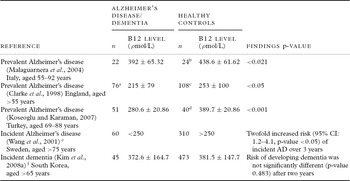
Most observational studies investigating the association of vitamin B12 levels with neurodegenerative disease have compared AD patients to healthy controls (Table 1) because AD accounts for between 60%–80% of all reported dementia cases (Alzheimer's Association, 2011).
Is vitamin B12 associated with Alzheimer's disease?

a AD confirmed by histology at autopsy.
b Healthy controls, matched by age, level of education, and nutritional and socioeconomic status.
c Healthy controls, comparable by age, gender, and smoking status.
d Healthy controls, comparable by age and nutritional status.
e Community-dwelling, healthy volunteers aged 75 years and above.
f Community-dwelling, healthy volunteers aged 65 years and above.
Serum vitamin B12 levels <250 ρmol/L were associated with a twofold increased risk for incident AD within three years in those aged 75 years and over in Sweden (Wang et al., Reference Wang, Wahlin, Basun, Fastbom, Winblad and Fratiglioni2001). Vitamin B12 levels were also significantly lower in AD patients compared with healthy controls in 69–88-year olds living in Turkey (Koseoglu and Karaman, Reference Koseoglu and Karaman2007); and in over-55-year olds living in Italy (Malaguarnera et al., Reference Malaguarnera, Ferri, Bella, Alagona, Carnemolla and Pennisi2004) and in Oxford, UK (Clarke et al., Reference Clarke, Smith, Jobst, Refsum, Sutton and Ueland1998). This association was not confirmed in a large study in over-65-year olds living in South Korea (Kim et al., Reference Kim2008a). It is noteworthy that vitamin B12 levels associated with AD were in the subclinical low-normal range in four of the five studies reviewed.
The association of non-Alzheimer-type dementias with low-normal vitamin B12 levels
The association of neurodegenerative disease with subclinical low-normal vitamin B12 levels is not confined to AD. Mean serum vitamin B12 levels were similarly low but within the reference range in vascular dementia patients (169 ± 5.36 ρmol/L, versus healthy controls 389.7 ± 20.86 ρmol/L; p-value <0.001) (Koseoglu and Karaman, Reference Koseoglu and Karaman2007) and in patients with Parkinson's disease (216 ± 66.8 ρmol/L, versus neurological controls excluding dementia patients, 283.5 ± 114.4 ρmol/L; p-value <0.05) (Triantafyllou et al., Reference Triantafyllou2008).
Serum vitamin B12 levels were not different between epileptic and non-epileptic patients (Gorgone et al., Reference Gorgone2009), nor in autistic versus non-autistic children (Pasca et al., Reference Pasca2008). This review has not identified any studies of vitamin B12 levels in Huntington's disease, frontotemporal dementia (FTD), or dementia with Lewy bodies. Subclinical low-normal serum vitamin B12 levels (<308 ρmol/L) were associated with a faster rate of brain volume loss in one study of 107 community-dwelling elderly (p-value 0.003) (Vogiatzoglou et al., Reference Vogiatzoglou2008). A large study of 1,102 over-60-year olds also revealed an association between vitamin B12 deficiency (<148 ρmol/L) and white matter lesions (p-value 0.001) (de Lau et al., Reference de Lau, Smith, Refsum, Johnston and Breteler2009).
Vitamin B12 deficiency precedes neurodegenerative disease
We identified just one longitudinal study in which a large sample (n = 1,648) was followed over an extended time (ten years); their data confirmed that vitamin B12 deficiency (<150 ρmol/L) preceded a decline in cognition as measured by the Mini-Mental State Examination (MMSE) in those aged 65 years and over (Clarke et al., Reference Clarke2007). This study does not demonstrate that vitamin B12 deficiency caused cognitive decline; possibly those experiencing vitamin B12 deficiency had a faster rate of cognitive decline compared to those not experiencing deficiency.
Is a low or low-normal vitamin B12 level associated with mild cognitive impairment?
Siuda et al. (Reference Siuda2009) compared 55 cases of MCI (Petersen criteria) with 44 age-, gender-, and education-matched healthy controls; they found that MCI patients had a lower mean serum vitamin B12 level (338.35 ± 213.8 ρmol/L versus 396.79 ± 122.3 ρmol/L; p-value 0.0012) (Siuda et al., Reference Siuda2009). No other studies were identified in which vitamin B12 levels were compared between MCI cases and healthy controls.
Vitamin B12 deficiency and cognitive impairment in AD
In one study, low serum vitamin B12 levels <147.6 ρmol/L were associated with lower MMSE scores in AD patients (14.7 ± 7.3 versus 16.9 ± 5.7, n = 643; p-value <0.01) (Whyte et al., Reference Whyte2002), albeit the patients with low serum vitamin B12 levels were also older (p-value 0.01).
Stuerenburg et al. (Reference Stuerenburg, Mueller-Thomsen and Methner2004) also report an association between cognitive impairment in AD and low serum vitamin B12 levels. In their study, the MMSE scores of 24 AD patients in the bottom tenth percentile for vitamin B12 level (<136 ρmol/L; MMSE 15.7 ± 6.1) were significantly lower than MMSE scores for the 24 AD patients in the upper tenth percentile for vitamin B12 levels (>441 ρmol/L; MMSE 20.0 ± 4.6; p-value <0.05). Neither vitamin B12 level nor MMSE score were associated with age in the latter study.
Vitamin B12 deficiency and cognitive impairment is not confined to Alzheimer's disease
The association between cognitive impairment and low serum vitamin B12 levels is not confined to AD. In one study, lower serum vitamin B12 levels were found in 51 cognitively impaired (MMSE <26) Parkinson's disease patients compared with 60 non-impaired Parkinson's disease patients (203.0 ± 90.3 ρmol/L versus 227.4 ± 114.4 ρmol/L; p-value <0.05) (Triantafyllou et al., Reference Triantafyllou2008).
In a second study, 830 community-dwelling participants aged 75 years and older were screened for cognitive impairment (MMSE < 22) and serum vitamin B12 levels. Serum vitamin B12 levels in the lower quartile (<157 ρmol/L) were associated with a twofold increased risk of cognitive impairment when compared to vitamin B12 levels in the upper quartile (>275 ρmol/L; 95% CI: 1.11–4.27) (Hin et al., Reference Hin2006). These findings contradict those of a longitudinal study of 499 over-70-year olds, in which vitamin B12 levels were neither associated with cognitive impairment at baseline (measured by standardized cognitive performance tests assessing memory, language, conceptualization, and visuospatial ability) nor with increased risk of developing dementia over a seven-year period (Kado et al., Reference Kado2005).
Vitamin B12 deficiency, high serum folate, and cognitive impairment
A large US survey of cognitive impairment and vitamin B12 levels in 1,301 community-dwelling volunteers aged 60 years and older found that participants with low serum vitamin B12 levels (<148 ρmol/L) and elevated folate levels (>59 nmol/L) were four times more likely to experience cognitive impairment (OR 4.3; 95% CI: 2.3–8.0) than individuals with normal levels of vitamin B12 and folate (Selhub et al., Reference Selhub, Morris, Jacques and Rosenberg2009). The latent period of effect could not be determined from this observational study. Such an association was not confirmed in a second study of comparable size (n = 1,535) and age distribution (Miller et al., Reference Miller, Garrod, Allen, Haan and Green2009).
One possible reason for the discrepancy in results is that the Wechsler Adult Intelligence Scale (WAIS – third edition) was used to detect cognitive impairment in the Selhub et al. (Reference Selhub, Morris, Jacques and Rosenberg2009) study, whereas the MMSE was used in the Miller study. Yet, in their original publication of the MMSE, Folstein et al. (Reference Folstein, Folstein and McHugh1975) demonstrated that the MMSE and WAIS correlated well with respect to measuring cognitive performance in a mixed patient population, including dementia and psychiatric patients. Any underlying difference between the two instruments to detect cognitive impairment in the general population, may explain the differing findings of Selhub et al. (Reference Selhub, Morris, Jacques and Rosenberg2009) and Miller et al. (Reference Miller, Garrod, Allen, Haan and Green2009).
What medical conditions or treatments are associated with vitamin B12 derangements and why?
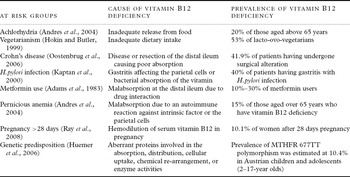
The prevalence of vitamin B12 deficiency increases with age and is associated with a number of conditions and treatments (Table 2). The main causes of vitamin B12 deficiency are (1) poor dietary intake (as in vegetarianism), (2) poor absorption (occurring in achlorhydria, pernicious anemia, Helicobacter pylori (H. pylori) infection, Crohn's disease, and metformin use), and (3) poor distribution (genetic predisposition for aberrant proteins that are inefficient in transport or cellular uptake of vitamin B12).
Causes of vitamin B12 deficiency

Note. There are many studies confirming each cause of vitamin B12 deficiency. This table gives a substantive reference for each cause listed.
Vitamin B12 deficiency and hyperhomocysteinemia in older age
Older age is a risk factor for neurodegenerative disease (Profenno et al., Reference Profenno, Porsteinsson and Faraone2009) with the risk of onset of dementia approximately doubling each five years after the age of 65 (Jorm et al., Reference Jorm, Korten and Henderson1987; Di Carlo et al., Reference Di Carlo2002). Vitamin B12 deficiency is also age-associated and the conditions giving rise to deficiency also increase with age, such as achlorhydria, Crohn's disease, pernicious anemia, and diabetes requiring treatment with metformin.
There is also the further risk that diet deteriorates with age; for instance, those living alone may be less able to cook and poor teeth may also lead to less consumption of meat. These factors may lead to a higher risk for vitamin B12 deficiency and hyperhomocysteinemia. Further to this, Serot et al. (Reference Serot2005) found that homocysteine levels in cerebrospinal fluid (CSF) increased with age, independently of vitamin B12 status in 121 participants.
The Conselice Study of 1,016 over-65-year olds living in the Italian community found that elevated homocysteine levels (mean 14.5 μmol/L) were associated with poorer cognitive performance (MMSE scores 24–25 versus MMSE >28), whereas no association between cognition and vitamin B12 levels was identified in this sample of patients without dementia (Ravaglia et al., Reference Ravaglia2003).
The Main–Syracuse Longitudinal Study (MSLS) similarly found that cognitive performance in a neuropsychological battery of tests (including visuospatial organization, scanning and tracking, working memory, and verbal memory) was positively correlated with vitamin B12 level and inversely correlated with homocysteine level in 812 over-60-year olds (Elias et al., Reference Elias2006).
A study in 2,096 dementia-free participants of the Framingham Offspring Study also found an inverse relationship between cognitive performance and homocysteine levels, and this association was confined to those aged 60 years and over (Elias et al., Reference Elias2005). Similarly, the Northern Manhattan Study enrolling 1,822 over-65-year olds and 1,049 under-65-year olds also found that MMSE scores were inversely correlated with homocysteine levels and positively correlated with vitamin B12 measurements only in those aged over 65 years (Wright et al., Reference Wright, Lee, Paik, Stabler, Allen and Sacco2004).
There is a correlation in those aged 60 years and over between poor cognitive performance and elevated homocysteine levels, of which vitamin B12 insufficiency is a cause. Vitamin B12 levels are also positively correlated with measures of cognition in some, but not all, studies. Randomized controlled trials investigating the efficacy of vitamin B12 replacement therapy to correct hyperhomocysteinemia and reverse or arrest cognitive decline in the elderly are warranted. The duration of intervention required to adequately test the efficacy of vitamin B12 replacement therapy in this role is difficult to estimate and intervention would need to commence before the onset of irreversible cognitive changes.
Neurological complications of metformin use
Peripheral neuropathy is a condition common to both diabetes and vitamin B12 deficiency. Bell (Reference Bell2010) reported metformin-induced peripheral neuropathy associated with vitamin B12 deficiency in a 69-year-old diabetic patient of six years. In a prospective case-control study of 122 diabetics, metformin use for more than six months was associated with both low serum vitamin B12 levels and peripheral neuropathy (Wile and Toth, Reference Wile and Toth2010).
In cell culture, therapeutic levels of metformin induced overexpression of the beta-site amyloid precursor protein-cleaving enzyme 1 (BACE1) (Chen et al., Reference Chen2009). BACE1 is a component of β-secretase, which initiates cleavage of the amyloid precursor protein (APP) to its pathogenic form. Pathogenic Aβ peptide may then aggregate and deposit as amyloid plaques, which are found in the brains of AD patients at autopsy. Metformin use may accelerate the formation of amyloid plaques through this mechanism. Also, in a mouse model, BACE1-regulated myelination of nerve cells (Willem et al., Reference Willem2006) and so upregulation of its expression, as may occur during metformin use, may also induce dysfunctional myelination.
Can vitamin B12 treatment reverse or arrest cognitive impairment or dementia?
Potentially reversible dementias account for only 9% of all cases; in fact, in a comprehensive meta-analysis, only 0.6% of all dementias partially or fully resolved (Clarfield, Reference Clarfield2003). One study found that 25% of 181 patients meeting Diagnostic and Statistical Manual of Mental Disorders (DSM-III or DSM-IV) criteria for dementia were vitamin B12 deficient (with serum levels <147.6 ρmol/L). Nineteen deficient patients were followed up after commencing vitamin B12 therapy alone, only three of whom showed improvement of MMSE scores to normal levels (>24) (Cunha et al., Reference Cunha1995). Concordant with the findings of Clarfield (Reference Clarfield2003), only a small number of dementias were reversible with vitamin B12 therapy, possibly because supplements were commenced in responding patients at an early stage before the onset of irreversible neurodegenerative disease.
Is timing or stage of disease important for therapeutic opportunity?
Martin et al. (Reference Martin, Francis, Protetch and Huff1992) found that vitamin B12 therapy was significantly more beneficial for vitamin B12 deficient patients showing cognitive dysfunction for less than one year (gaining 24 points on the Mattis Dementia Rating Scale, MDRS); than patients experiencing cognitive dysfunction for more than one year (losing three points on the MDRS; p-value 0.0076).
Abyad (Reference Abyad2002) also demonstrated a time-limited window of opportunity for successful treatment with vitamin B12 in 56 nursing home residents and outpatients showing cognitive dysfunction and vitamin B12 levels <300 ρmol/L. Patients showing neurological symptoms for less than 12 months gained an average of six points on MMSE score (p-value 0.0065) with six patients symptomatic for less than six months normalizing their MMSE score. Patients symptomatic for more than 12 months also gained an average of four points on their MMSE score; however, this change was not significant (Abyad, Reference Abyad2002).
In single case reports, vitamin B12 treatment has been reported to correct or alleviate schizophrenia (Kuo et al., Reference Kuo, Yeh, Yeh and Tzeng2009), subacute combined degeneration with sensory dysfunction (Puntambekar et al., Reference Puntambekar, Basha, Zak and Madhavan2009), peripheral neuropathy (Bell, Reference Bell2010), cerebellar ataxia (Gochard et al., Reference Gochard, Mondon, De Toffol and Autret2009), extrapyridimal symptoms (Akdal et al., Reference Akdal, Yener and Kurt2008; Dogan et al., Reference Dogan2009), and personality, emotional, and behavioral changes associated with frontotemporal hypoperfusion (Akdal et al., Reference Akdal, Yener and Kurt2008).
Placebo-controlled trials for reversing cognitive impairment
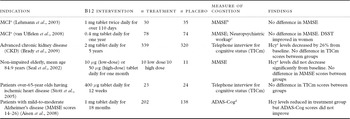
In each of these cases, the successful outcome of using vitamin B12 supplements occurred when vitamin B12 deficiency was detected or highly suspected. Vitamin B12 therapy for reversing cognitive impairment has been attempted without success in only a small number of placebo-controlled trials identified in this review. Of these, only two trials had sufficient numbers to detect any effect (Table 3).
Can vitamin B12 treatment arrest or reverse cognitive impairment or dementia?

a Mild cognitive impairment (MCI) diagnosed by clinical consensus (Petersen criteria).
b Mini-Mental State Examination (MMSE).
c Including memory by the Auditory Verbal Learning Test (AVLT), executive function by the Verbal Fluency Test (VFT), information processing speed by the Digit Symbol Substitution Test (DSST), and attention by the Abridged Stroop Color Word Test (SCWT-A).
d Cognitive section of the Alzheimer's Disease Assessment Scale (ADAS).
e Homocysteine (Hcy).
Homocysteine, a marker for vitamin B12 deficiency, was measured in three of the six placebo-controlled studies. In advanced kidney disease patients, Brady et al. (Reference Brady2009) found that while the vitamin B12 intervention reduced homocysteine levels by 26% there was no benefit to cognition. Similarly, Aisen et al. (Reference Aisen2008) reported lowering homocysteine levels with vitamin B12 therapy, yet ADAS-Cog scores did not improve in AD patients. Stott et al. (Reference Stott2005) also reported lowering homocysteine levels in patients with ischemic heart disease but with no improvement in cognition on commencing vitamin B12 therapy. The latter placebo-controlled trial was conducted over just 12 weeks, which may be too short a time period to detect differences in changes to cognition between placebo and treatment groups. In another study, vitamin B12 therapy neither lowered homocysteine levels nor improved MMSE scores (Seal et al. Reference Seal, Metz, Flicker and Melny2002), albeit using a lower dose vitamin B12 intervention than the previous two studies and for a short period of just one month.
In cases of deficiency, intervention should be commenced at a sufficiently high dose and continued over an adequate period to correct the biochemical deficiency. Doses of up to 50 μg daily taken orally for one month were inadequate to decrease homocysteine levels in the study by Seal et al. (Reference Seal, Metz, Flicker and Melny2002), whereas doses in excess of 1 mg daily for 18 months did lower homocysteine levels in the three other studies. Restoring biochemical status to within the higher normal range may be essential to preventing further cognitive decline and other adverse outcomes associated with hyperhomocysteinemia, such as cardiovascular disease, despite the fact that cognition was not shown to improve on commencing vitamin B12 therapy.
Depression has been associated with low vitamin B12 levels in later life (Kim et al., Reference Kim2008b) and may also affect cognitive test scores. Studies in which an association between cognitive test scores and vitamin B12 levels are investigated are susceptible to confounding if participants having depression are not identified. Of the six studies described in Table 3, only the study by Brady and colleagues evaluated depression in their participants and this was achieved via the Global Depression Scale (GDS). There is a need for more robust studies in which participants are screened for depression and the risk of confounding with depression is reduced. This can be achieved by excluding participants identified as depressed or by adjusting statistical analyses to include depression as a covariate.
Only one of six placebo-controlled trials reported a benefit for vitamin B12 treatment, other than a reduction of homocysteine levels. Vitamin B12 treatment was reported to improve attention and information processing speed in women (van Uffelen et al., Reference van Uffelen, Chinapaw, van Mechelen and Hopman-Rock2008); no other differences between treatment and control groups were reported.
Intervention studies in neurological patients presenting with vitamin B12 deficiency
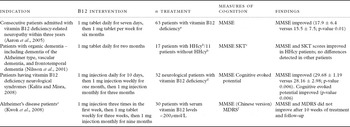
None of the placebo-controlled studies selected for patients that were vitamin B12 deficient at baseline, the very group that would be expected to benefit the most from vitamin B12 treatment. Selecting only patients presenting with vitamin B12 deficiency might yield more positive findings; however, withholding treatment from vitamin B12 deficient patients would be unethical. Four studies were identified in this review in which vitamin B12 treatment was evaluated in neurological patients presenting with deficiency (Table 4).
Vitamin B12 treatment in neurologic patients with vitamin B12 deficiency

a Serum vitamin B12 level <147.5 ρmol/L.
b Hyperhomocysteinemia, serum homocysteine levels >19.9 μmol/L.
c Short memory and language test.
d Serum vitamin B12 level <155 ρmol/L.
e National Institute of Neurological and Communicative Disorders and Stroke and Alzheimer's Disease and Related Disorders Association (NINCDS-ADRDA) criteria.
f Mattis Dementia Rating Scale.
Improvement in cognitive test scores was seen in vitamin B12 deficient patients who were either mildly cognitively impaired (Kalita and Misra, Reference Kalita and Misra2008) or who were more severely cognitively impaired (Aaron et al., Reference Aaron, Kumar, Vijayan, Jacob, Alexander and Gnanamuthu2005). Vitamin B12 therapy was equally beneficial in both groups, yielding moderate improvements in cognition when measured by the MMSE. Cognitive test scores failed to improve in one of the four studies which included AD patients with relatively higher vitamin B12 levels (up to 200 ρmol/L) at baseline. Depression in study participants was assessed only in the study by Kalita and Misra (by clinical assessment) of the four studies described in Table 4. The possibility of depression confounding cognitive test scores and low serum vitamin B12 levels cannot be ruled out in these studies.
Each study investigated megadoses of up to 1 mg of vitamin B12 daily. This review has not identified any studies in vitamin B12 deficient patients followed for more than ten months. One limitation common to these and other studies is that it is not possible to estimate the latent period of exposure to low vitamin B12 levels before the onset of symptoms. Vitamin B12 deficiency over a prolonged period of time may result in irreversible neurological complications which may not resolve on commencing replacement therapy.
Intervention studies in non-impaired individuals with low vitamin B12 levels
This review identified just two studies in which vitamin B12 therapy, prescribed to improve cognition or prevent cognitive decline, was evaluated in vitamin B12 deficient but otherwise healthy volunteers. In one study, participants were enrolled who did not have a history of dementia, had a MMSE score >19 at enrolment and had a vitamin B12 level between 100 and 200 ρmol/L. All participants received either 1 mg vitamin B12 (n = 54), 1 mg vitamin B12 and 0.4 mg folate (n = 51), or a placebo (n = 57) orally for 24 weeks. A comprehensive neuropsychological workup including the MMSE and the WAIS, failed to detect any benefit from using vitamin B12 with or without folate. In this study, participants were assessed using the GDS. Depression was investigated as a covariate (Eussen et al., Reference Eussen2006).
The second study enrolled 16 community-dwelling individuals with vitamin B12 deficiency (<150 ρmol/L) and no history of cognitive deficit. Participants were given a water injection intramuscularly for four weeks followed by 1 mg injection of vitamin B12 weekly for four weeks and then monthly for four months. MMSE scores remained unchanged after the vitamin B12 intervention, confirming the results from Eussen et al. (Reference Eussen2006), though in a much smaller sample of relatively short duration. Verbal Word Learning test scores did improve significantly in this small study; however, the authors could not rule out a practice effect and did not screen for depression (van Asselt et al., Reference van Asselt2001).
Placebo-controlled studies to improve cognition in functional vitamin B12 deficiency
Functional vitamin B12 deficiency is detected by elevated homocysteine or MMA levels. Functional deficiency arises as a result of either genetic predisposition for aberrant proteins involved in vitamin B12 biochemical pathways (Tanaka et al., Reference Tanaka2009) or exposure to nitrous oxide, inactivating the methionine synthetase-vitamin B12 complex (Myles et al., Reference Myles, Chan, Leslie, Peyton, Paech and Forbes2008). This review identified two placebo-controlled studies that enrolled patients having elevated homocysteine or MMA levels at baseline.
In one study, 253 healthy participants without dementia and aged 65 years and over having elevated homocysteine levels (>13 μmol/L) were randomized to two groups. Half were required to take a daily B-vitamin tablet including vitamin B12 (500 μg), folate, and pyridoxine (n = 126), and half received a placebo tablet. The treatment group did not improve in MMSE score after two years of treatment (McMahon et al., Reference McMahon, Green, Skeaff, Knight, Mann and Williams2006).
In a second study of 140 participants with elevated MMA levels (>0.4 μmol/L), half received 1 mg vitamin B12 by injection and half received isotonic saline weekly for four weeks. Neuro-psychiatric workup included MMSE and the Cambridge Cognitive Examination (CAMCOG) at baseline and after three months (Hvas et al., Reference Hvas, Juul, Lauritzen, Nexo and Ellegaard2004). Cognitive test scores were inversely associated with age and improved in both treatment and placebo groups; hence any benefit of vitamin B12 therapy in improving cognition may be due to a placebo effect in this study.
Discussion
The studies identified in this review present a body of evidence showing that a subclinical low-normal serum vitamin B12 level up to 250 ρmol/L is associated with AD, vascular dementia, and Parkinson's disease. Vitamin B12 deficiency (<150 ρmol/L) is associated with cognitive impairment. Vitamin B12 deficiency may precede cognitive impairment, but there is currently insufficient evidence to determine whether a low vitamin B12 level is causative in the onset or progression of neurodegenerative disease and cognitive impairment. The duration of any cause and effect between low vitamin B12 levels and neurological pathology remains to be established. An association between neurodegenerative disease and subclinical low-normal serum vitamin B12 levels (up to 250 ρmol/L) is evident, meriting increased monitoring and treatment for vitamin B12 insufficiency in elderly patients.
A need for better-resourced studies following patients over a longer period
Having established the association of vitamin B12 insufficiency with neurodegenerative disease, the challenge is to discern the direction, if any, of causation. Most neurological impairments present a slow, progressive course (Josephs et al., Reference Josephs2009) and vitamin B12 levels may take a number of years to deplete (Herbert, Reference Herbert1988). Studies investigating causation would need to continue over an extended period of time.
Low serum vitamin B12 levels may play a role in the pathogenesis of neurodegenerative disease; however, it is equally plausible that neurological impairment may lead to poor nutrition and hence to inadequate dietary intake. Also, any association may simply be coincident or the factors predisposing patients for neurodegenerative disease may simply also expose the patient to a higher risk of vitamin B12 deficiency, for example, poor nutrition. Further intervention studies in large samples followed over an extended period of time are required. This will allow for further investigation of the role, if any, of vitamin B12 in the onset or progression of neurodegenerative disease, as well as the latent period of effect of vitamin B12 insufficiency before cognitive deficits are evident.
A need for studies with more robust measures of cognition
The MMSE (Folstein et al., Reference Folstein, Folstein and McHugh1975) remains the most highly utilized screening tool for cognitive impairment in primary care. Consequently, almost all of the studies included in this review detect cognitive impairment by a low MMSE score and report on changes in cognition by MMSE score; despite the availability of alternative, more robust instruments for measuring cognition. The majority of studies identified in this review utilized MMSE score as a measure of cognition, largely without adjusting for age and education, or screening patients for depression or delirium.
Notably only two placebo-controlled studies reviewed included a comprehensive neuropsychiatric workup. Future studies would benefit from more comprehensive instruments for measuring cognition, such as the Alzheimer's Disease Assessment Scale – Cognitive section (ADAS-Cog) or CAMCOG. Other instruments may be less affected by differences between the groups with respect to age or education than the MMSE. These may provide greater sensitivity for detecting changes in cognition over time or between groups.
Depression has been associated with low serum vitamin B12 levels in those aged over 65 years (Kim et al., Reference Kim2008b) and may also affect performance on cognitive tests. Yet, few studies investigated this possible confounder in their participants. Future studies investigating the association between vitamin B12 levels and cognitive impairment would benefit from more robust study designs which either exclude participants who are identified as having depression or that include depression as a covariate in statistical analyses.
Patients who may benefit from vitamin B12 therapy
Petersen et al. (Reference Petersen, Smith, Waring, Ivnik, Tangalos and Kokmen1999) estimated that the annual rate of conversion from MCI to AD was between 10% and 15%, whereas only 1%–2% of the normal population convert to AD each year. Cognition in MCI patients, measured by the MMSE, did not improve with vitamin B12 therapy in two placebo-controlled trials yet mean serum vitamin B12 levels were lower in MCI patients. This may signal that low vitamin B12 levels contribute to this early disease stage; that MCI patients are less able to meet their dietary requirements; or that the factors that predispose the patient to MCI also lead to poor vitamin B12 status. The MMSE may also be a poor choice for measuring change in cognition in MCI patients. In any event, vitamin B12 therapy may be beneficial for patients presenting with MCI.
Few studies were identified that investigated whether concurrent conditions and treatments giving rise to vitamin B12 deficiency serve to exacerbate neurological complications. Older patients (over the age of 75 years), vegetarians (consuming a high folate, low vitamin B12 diet), and metformin users (not using insulin) are at increased risk for vitamin B12 deficiency. This alone may modify their risk for cognitive impairment and neurodegenerative disease, therefore warranting more studies that specifically investigate cognitive impairment and neurodegenerative disease in these patient populations. Additional monitoring of vitamin B12 levels and supplement therapy are warranted in such potentially high-risk groups.
One criticism of mandatory or voluntary fortification of foods with folate is that this may mask vitamin B12 deficiency in a segment of the population that would otherwise experience traditional signs of deficiency, such as megaloblastic anemia, and that would otherwise be treated earlier. This same argument extends to the need to monitor serum vitamin B12 levels for those receiving folate therapy.
Improving vitamin status in the elderly through the provision of supplements or nutrient-dense foods, which include vitamin B12 and folate, may be of benefit. However, in older age, CSF homocysteine levels become independent of serum vitamin B12 levels so it may be that no amount of treatment will reverse the biochemical deficiency or prevent the ensuing neurological complications of hyperhomocysteinemia. Randomized controlled trials are required to investigate whether oral or parenteral vitamin B12 treatment adequately alters the CSF levels of homocysteine and MMA in the elderly.
Measures of cognition improved marginally in three of four intervention studies that were carried out in vitamin B12 deficient neurological patients. Vitamin B12 therapy did not improve cognition in non-cognitively impaired individuals with low vitamin B12 levels, nor in those experiencing functional vitamin B12 deficiency. Also, there is no evidence that patients with normal vitamin B12 levels (>250 ρmol/L) would benefit from vitamin B12 therapy.
This review did not assess the efficacy of vitamin B12 in improving cognition in combination therapy with other supplements (other than folate, with which it shares a biochemical role in regenerating methionine) or medications used when treating cognitive changes. Only two studies of this type were found and more are required to identify whether there is a role for vitamin B12 therapy alongside pharmaceutical agents to prevent further cognitive decline in the patient.
There is a lack of clinical data on neurodegenerative disease and long-term metformin use despite its long market history (outside of North America) and early association with vitamin B12 deficiency (Tomkin, Reference Tomkin1972; Bauman et al., Reference Bauman, Shaw, Jayatilleke, Spungen and Herbert2000). Diabetics using metformin presenting in older age with neurological impairments may benefit from vitamin B12 supplements (to correct vitamin deficiency). Calcium supplements were also shown to reverse the drug interaction preventing vitamin absorption (Bauman et al., Reference Bauman, Shaw, Jayatilleke, Spungen and Herbert2000); and insulin therapy was found to correct the metformin-induced overexpression of BACE1 in cell culture (Chen et al., Reference Chen2009). There is a need for large studies in diabetic populations to identify whether metformin use increases the risk for neurodegenerative diseases and cognitive impairment, and whether this effect is ameliorated with vitamin B12 therapy.
High folate and low vitamin B12 levels may be associated with cognitive impairment
The finding of an association between low serum vitamin B12 levels and high folate levels with cognitive impairment in one study raises concern, as mandatory folate fortification (of wheat products) was first introduced in Australia in 1994 and was later introduced in the USA and Canada in 1998. Folate fortification of foods was introduced to prevent neural tube defects and is now being practiced in over 19 countries. Comparing postfortification era (1999–2000) vitamin levels in a large segment of the US population to pre-fortification era (1988–1994) values, Pfeiffer et al. (Reference Pfeiffer, Caudill, Gunter, Osterloh and Sampson2005) found that the prevalence of high serum folate levels (>45.3 nmol/L) increased from 7% to 38% in over-60-year olds (Pfeiffer et al., Reference Pfeiffer, Caudill, Gunter, Osterloh and Sampson2005), exposing a significant segment of the population to high folate levels for over a decade.
Vitamin B12 is neuroprotective; a high intake of folate may drive the distribution of vitamin B12 toward overutilization in the cytosol/methionine regeneration pathway, possibly disrupting the supply of vitamin B12 and its neuroprotective effect. An older vegetarian population may present an adequate sample in which to further test the hypothesis that high folate in the setting of low levels of serum vitamin B12 contributes to an increased risk of cognitive impairment. The vegetarian diet likely leads to a low vitamin B12 intake, alongside consumption of folate-rich foods. Large studies in diverse populations where folate fortification of foods is not widespread are required.
Conflict of interest
D. Ames is a former editor of International Psychogeriatrics.
Description of authors’ roles
D. Watters, D. Ames, A. Mander, and R. Carne wrote the research questions and assisted in writing the paper. E. Moore searched the journal databases and wrote the paper. A. Mander, D. Watters, and D. Ames provided further papers for inclusion. K. M. Sanders assisted in writing the paper.
Acknowledgments
We would like to acknowledge the valuable support provided by The University of Melbourne, Deakin University, and Barwon Health for research assistance and electronic resources provided to complete this review of the literature.