Introduction
Understanding the key factors involved in the control of folliculogenesis through the use of molecular biology technologies [e.g. quantitative polymerase chain reaction (qPCR)] could be useful for improving the efficiency of in vitro follicle culture (IVFC) and consequently optimizing the use of oocyte ovarian reserve (Alhamdan et al., Reference Alhamdan, Maalouf, Campbell, Hernandez-Medrano and Marsters2020).
When the ovarian follicles develop from the secondary to the tertiary stage, the regulation changes from intraovarian to extraovarian, as the follicles begin to form the antrum. The transition from late preantral to early antral follicles is crucial during folliculogenesis. Previous microarray analysis in goats performed by our team (Magalhães-Padilha et al., Reference Magalhães-Padilha, Geisler-Lee, Wischral, Gastal, Fonseca, Eloy, Geisler, Figueiredo and Gastal2013) identified 14,323 genes expressed in secondary and tertiary follicles; 10 selected genes related to folliculogenesis produced inconsistent results in microarray analysis with noticeable differences among replicates. These genes (ABLIM, SLIT3, TYMS, GTPBP1, AKR1C4, ARHGEF12, CLEC6A, CYTL1, PIK3R6, and MAOB) regulate angiogenesis, DNA synthesis and repair, and oocyte maturation, among other functions, which are essential for cell development (Dong et al., Reference Dong, Yang, Yang and Gui2004; Candelaria et al., Reference Candelaria, Taja-Chayeb, Arce-Salinas, Vidal-Millan, Serrano-Olvera and Dueñas-Gonzalez2005; Uppendahl et al., Reference Uppendahl, Felices, Bendzick, Ryan, Kodal, Hinderlie, Boylan, Skubitz, Miller and Geller2019). Therefore, in an attempt to clarify the relative transcript abundance of the mRNAs of these 10 genes, qPCR analysis is extremely important as it is a more accurate method.
To the best of our knowledge, despite the importance of the aforementioned genes, no studies have specifically investigated the expression of those genes during the transition from secondary to tertiary follicles in any species to date. Therefore, this study aimed to compare the abundance of mRNA of those 10 genes between secondary (preantral) and tertiary (antral) follicles in goats.
Materials and methods
Collection of ovaries and follicle harvest
Slaughterhouse ovaries from 1-year-old to 3-year-old crossbred goats (n = 30) were transported to the laboratory, and late secondary (<350 µm) and early tertiary (>350–600 µm) follicles were manually dissected and selected as previously reported (Magalhães-Padilha et al., Reference Magalhães-Padilha, Geisler-Lee, Wischral, Gastal, Fonseca, Eloy, Geisler, Figueiredo and Gastal2013).
Goat follicle RNA extraction and qPCR analysis
Secondary (n = 100) and tertiary (n = 100) follicles were used for total RNA extraction using an RNeasy Mini Kit (Qiagen, Maryland, USA). The RNA was of high quality (i.e. optical density 260/280 ratio of 1.8–2.0) (Magalhães-Padilha et al., Reference Magalhães-Padilha, Geisler-Lee, Wischral, Gastal, Fonseca, Eloy, Geisler, Figueiredo and Gastal2013).
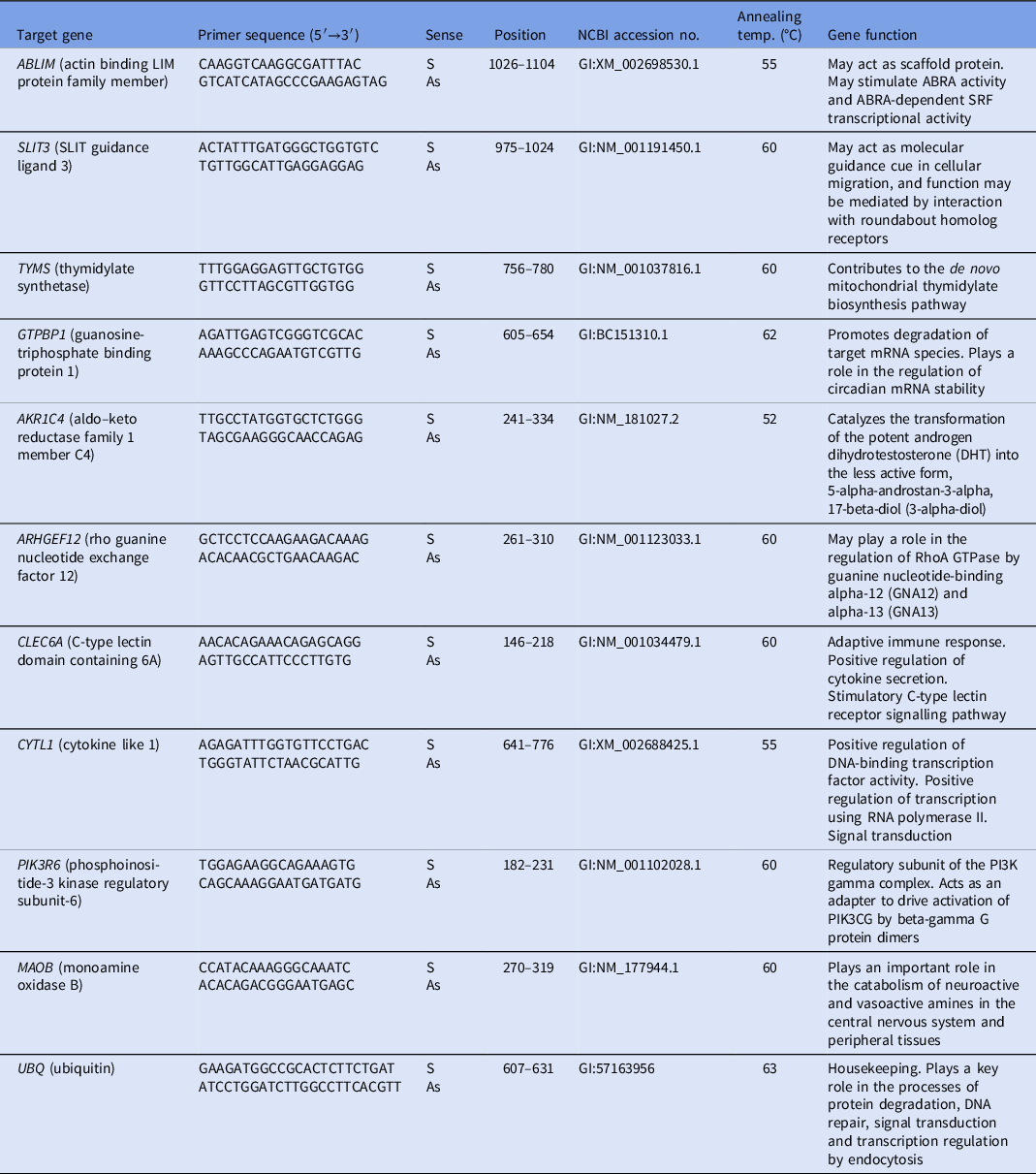
The primers (Table 1) were designed using Gene Runner software version 3.05 (Hastings Software, Inc.). mRNA was reverse transcribed using an iScript™ cDNA synthesis kit (Bio-Rad, Hercules, California, USA) with random primers. The ubiquitin gene was used as a reference (Lima et al., Reference Lima, Brito, Rodrigues, Silva, Magalhães-Padilha, Lima, Celestino, Campello, Silva, Figueiredo and Rodrigues2011). Reference genes are expressed constitutively by different cell types (Nelson and Cox, Reference Nelson and Cox2004) and are used to normalize data. qPCR analysis was performed in triplicate. The ΔΔCT method was used to transform CT values into normalized relative steady-state mRNA levels (Lima et al., Reference Lima, Brito, Rodrigues, Silva, Magalhães-Padilha, Lima, Celestino, Campello, Silva, Figueiredo and Rodrigues2011).
Primer sequences used for gene expression in goat secondary and tertiary follicles

AS, antisense; S, sense.
Statistical analysis
The pool of follicles was considered the experimental unit. Three pools of follicles were collected from each category. The pools contained 33, 33, and 34 follicles for each category, totalling 100 follicles per category (pools of c. 33 follicles/category; n = 100 follicles/category). We collected three pool of follicles from each category. Data were analyzed with SAS software using unpaired Student’s t-test A probability of P < 0.05 indicated that a difference was significant, and probabilities between P > 0.05 and P < 0.1 indicated that the difference approached significance. Data are presented as the mean ± standard error of mean (SEM).
Results
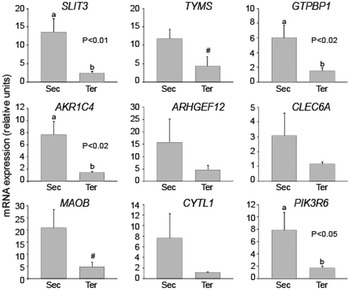
Of the 10 genes tested, only one gene, ABLIM, did not produce an abundance of its transcript in any of the stages. The relative abundance of mRNA transcripts for SLIT3, GTPBP1, AKR1C4, and PIK3R6 was upregulated (P < 0.05) in secondary follicles when compared with tertiary follicles. Moreover, TYMS and MAOB mRNA expression only approached being significantly higher (P = 0.06) in secondary follicles compared with in tertiary follicles (Fig. 1). However, there was no difference (P > 0.05) between secondary and tertiary follicles in the expression of ARHGEF12, CLEC6A, or CYTL1 mRNA (Fig. 1).
Mean (±SEM) relative abundances of mRNA of SLIT3, TYMS, GTPBP1, AKR1C4, ARHGEF12, CLEC6A, MAOB, CYTL1, and PIK3R6 in preantral and early antral follicles of goats. a,bBars with different superscripts differ (P < 0.05). # TYMS and MAOB was lower (P < 0.1) in tertiary follicles. Measurable mRNA levels for ABLIM were not detected in any follicular category. Sec, secondary follicle; Ter, tertiary follicle.

Discussion
This study showed for the first time the relative mRNA abundance of some key folliculogenesis-related genes and may provide foundational knowledge for the improvement of IVFC systems in goats. In the current study, SLIT3 gene expression was upregulated in secondary follicles compared with in tertiary follicles. In sheep fetal ovaries, SLIT2, SLIT3, ROBO1, ROBO2, and ROBO4 mRNA transcripts were highly expressed in primordial follicle oocytes, suggesting that this gene has greater importance in the formation, activation, and early development of follicles (Dickinson et al., Reference Dickinson, Hryhorskyj, Tremewan, Hogg, Thomson, McNeilly and Duncan2010). Altogether, these data support the concept of the importance of the SLIT/ROBO pathway in the regulation of different phases of early folliculogenesis. A recent study found that the SLIT3 gene was downregulated in intersex sheep when compared with normal sheep, demonstrating the importance of this gene in fertility (Li et al., Reference Li, Xu, Liu, Xu, Cai and Lan2020).
GTPBP1 triggers the PI3K pathway, which is involved in the mechanism of follicular activation, among other pathways (John et al., Reference John, Shidler, Besmer and Castrillon2009). In the ovarian follicle, GTPBP1 mRNA expression was observed in stromal cells (Magalhães-Padilha et al., Reference Magalhães-Padilha, Geisler-Lee, Wischral, Gastal, Fonseca, Eloy, Geisler, Figueiredo and Gastal2013). To achieve a better survival rate of isolated secondary follicles after IVFC, the maintenance is recommended of a greater number of stromal cells around the basement membrane of secondary follicles compared with tertiary follicles during follicular isolation. Therefore, we suggested that the higher GTPBP1 mRNA transcript level in secondary follicles compared with in tertiary follicles may be explained by the different amounts of stromal cells around those follicles.
TYMS plays a crucial role in DNA synthesis and repair (Candelaria et al., Reference Candelaria, Taja-Chayeb, Arce-Salinas, Vidal-Millan, Serrano-Olvera and Dueñas-Gonzalez2005), processes that are important for cellular turnover during folliculogenesis, while MAOB is involved in the mechanism of ovulation. In this study, the relative mRNA abundance of TYMS and MAOB was downregulated (P = 0.6) in tertiary follicles. mRNA expression of MAOB is downregulated by oestrogen (Shih et al., Reference Shih, Wu and Chen2011), which may explain our finding for tertiary follicles, as the tertiary follicles have greater numbers of granulosa cells and consequently a higher level of oestrogen (Latham et al., Reference Latham, Wigglesworth, McMenamin and Eppig2004).
The reason for the higher relative mRNA abundance of AKR1C4 in secondary follicles compared with in tertiary follicles observed in this study remains to be clarified. However, previous reports have shown a role for this gene directly in steroid metabolism during preantral and antral folliculogenesis (Rizner and Penning, Reference Rizner and Penning2014). The AKR1C4 gene encodes an enzyme that has a primary function in the conversion of the prostaglandins H2 (PGH2) to PGF2α (Ulbrich et al., Reference Ulbrich, Schulke, Groebner, Reichenbach, Angioni, Geisslinger and Meyer2009). Ultimately, the action of PGF2α influences the process of regression of the corpus luteum, capable of promoting stimuli for follicular growth (Gauvreau et al., Reference Gauvreau, Moisan, Roy, Fortier and Bilodeau2010; Araújo et al., Reference Araújo, Sponchiado, Pugliesi, Van Hoeck, Mesquita, Membrive and Binelli2015).
The PIK3R6 gene is a regulatory subunit of the PIK3R6 family and is involved in cell growth, proliferation, differentiation, and survival (Yu and Cui, Reference Yu and Cui2016). In this study, the upregulated PIK3R6 relative abundance of mRNA in secondary follicles supports the concept that oocyte growth occurs predominantly during the preantral follicle phase (Hunzicker-Dunn et al., Reference Hunzicker-Dunn, Lopez-Biladeau, Law, Fiedler, Carr and Maizels2012).
It has been reported that the ARHGEF12, CLEC6A, and CYTL1 genes participate in the regulation of different stages of folliculogenesis (Dong et al., Reference Dong, Yang, Yang and Gui2004). Therefore, the fact that the mRNA transcript levels were similar in secondary and tertiary follicles suggests their equal importance at both stages during the transition from the preantral to early antral follicle phase.
In conclusion, the relative mRNA abundance of the majority of the studied folliculogenesis-related genes (SLIT3, GTPBP1, AKR1C4, and PIK3R6) was upregulated in secondary follicles (preantral phase) compared with in tertiary follicles (antral phase) in goats. As differences in gene expression may reflect stage-specific follicular requirements, our data suggest the need to alter and monitor medium composition during IVFC.
Acknowledgements
D.M. Magalhães-Padilha has a Research Productivity Scholarship from the National Council for Scientific and Technological Development (CNPq), Brazil.
Financial support
This research was supported by SIU (Gastal EL).
Conflicts of interest
There was no conflict.
Ethical standards
The research protocol (#11-007) was approved by the Institutional Animal Care and Use Committee of Southern Illinois University.