INTRODUCTION
Although child neglect is the most prevalent form of child maltreatment, research on the neurocognitive effects of maltreatment has focused on physical and sexual abuse. The core feature of child neglect is a chronically impoverished parent-child relationship (Scannapieco, Reference Scannapieco2008). The relationship between a consistent caregiver and infant is an essential experience-dependent interaction for normal development. Preclinical studies of early privation and investigations of atypical rearing situations with humans suggest that the absence of a reliable and consistent caregiver for a young child is associated with a negative impact on the developing brain, which, in turn, has effects on the adult brain (De Bellis, Reference De Bellis2005) and overall function (McGloin & Widom, Reference McGloin and Widom2001). The seminal studies of Harlow and colleagues suggested that the nature, age of onset, duration of neglect, and the availability of an enriched environment during primate infancy were important contributors to becoming an “isolate” versus a normal functioning adult primate (Harlow, Harlow, & Suomi, Reference Harlow, Harlow and Suomi1971). In prospective studies, child neglect has been associated with significantly lower intellectual development in young children who were recruited for low birth weight (1000 g) (Strathearn, Gray, O’Callaghan, & Wood, Reference Strathearn, Gray, O’Callaghan and Wood2001) and with persistent effects of lower IQ and academic achievement in adulthood (Perez & Widom, Reference Perez and Widom1994).
Neglect may be experienced by a child, a member of a social species, as traumatic, causing anxiety and leading to adverse brain development (De Bellis, Reference De Bellis2005). Neglect may be comorbid with witnessing family violence. In the National Survey of Child and Adolescent Well-Being, the first nationally representative study of children referred to the child welfare system (Burns et al., Reference Burns, Philips, Wagner, Barth, Kolko and Campbell2004), high rates of domestic violence were reported (Hazen, Connelly, Kelleher, Landsverk, & Barth, Reference Hazen, Connelly, Kelleher, Landsverk and Barth2004). In a twin study of 1116 families of monozygotic and dizygotic 5-year-old twin pairs, children exposed to high levels of domestic violence had IQs that were on average 8 points lower than unexposed children (Koenen, Moffitt, Caspi, Taylor, & Purcell, Reference Koenen, Moffitt, Caspi, Taylor and Purcell2003). These subjects were not assessed for posttraumatic stress disorder (PTSD). IQ was negatively associated with number of traumas and PTSD re-experiencing symptoms in children who experienced interpersonal violence (Saltzman, Weems, & Carrion, Reference Saltzman, Weems and Carrion2006). Family violence and PTSD symptoms may also contribute to lower IQ and cognitive deficits in neglected children.
The developing brain areas most vulnerable to early stress include the prefrontal cortex, hippocampus, and corpus callosum (Teicher et al., Reference Teicher, Ito, Glod, Andersen, Dumont and Ackerman1997). These structures are influenced by the biological stress systems (De Bellis, Reference De Bellis2001). The stress response involves secretion of many neurotransmitters (e.g., norepinephrine and dopamine). During prolonged stress, dopamine and norepinephrine levels are raised, possibly leading to prefrontal cortex dysfunction (Arnsten, Reference Arnsten1998; Arnsten & Goldman-Rakic, Reference Arnsten and Goldman-Rakic1998), and then to symptoms of inattention and impairment in executive functions, new learning, and memory.
Traumatic events are common in the lives of children (Copeland, Keeler, Angold, & Costello, Reference Copeland, Keeler, Angold and Costello2007). The diagnosis of PTSD is defined as the development of characteristic symptoms after a person experiences a life-threatening traumatic event (referred to as a Type A trauma), such as child abuse or witnessing family violence, and reacts with fear or disorganized behavior, followed by three categorical symptom clusters for at least one month: Cluster B – intrusive re-experiencing of the trauma(s); Cluster C – persistent avoidance of stimuli associated with the trauma(s) or numbing of responsiveness; and Cluster D – persistent symptoms of increased physiological arousal (American Psychiatric Association, 2000).
Neglect is defined as failure to provide for or supervise one’s child. In a young child, caregiver neglect can be life-threatening. Stress in children with or without a diagnosis of PTSD may affect selective attention, hindering their ability to remember and to discriminate between relevant and irrelevant information (Lupien, Fiocco, & Wan, Reference Lupien, Fiocco and Wan2005). Neglect commonly co-occurs with physical or sexual abuse (Kaufman, Jones, Stieglitz, Vitulano, & Mannarino, Reference Kaufman, Jones, Stieglitz, Vitulano and Mannarino1994), traumatic events that may lead to PTSD. Pediatric maltreatment-related PTSD is associated with adverse brain development (De Bellis et al., Reference De Bellis, Keshavan, Shifflett, Iyengar, Beers, Hall and Moritz2002). Neurocognitive deficits reflecting these stress-sensitive brain regions include intelligence and academic achievement, and specific measures of executive function, language, memory, and learning. Abused children with DSM-IV-defined PTSD showed poorer attention and executive function during a comprehensive neurocognitive assessment than nonabused controls (Beers & De Bellis, Reference Beers and De Bellis2002). Neglected children and adults with neglect histories demonstrated lower IQ, delays in academic achievement and neurocognitive function, antisocial behaviors, and impairing psychopathology (Eckenrode, Laird, & Loris, Reference Eckenrode, Laird and Doris1993; Kolko, Reference Kolko1992; McGloin & Widom, Reference McGloin and Widom2001; Perez & Widom, Reference Perez and Widom1994; Widom, DuMont, & Czaja, Reference Widom, DuMont and Czaja2007). However, there are no published studies comprehensively examining specific neurocognitive domains in neglected children.
The primary purpose of this study was to examine neurocognitive functions in neglected children. Given that neglected children are more likely to witness domestic violence and have other traumas, we assessed subjects for a variety of DSM-IV Type A traumas and PTSD. We hypothesized that neurocognitive problems may be seen in neglected children resulting from the traumatic experience of neglect (e.g., failures to provide or supervise) and traumatic experiences (e.g., physical abuse, emotional abuse, and witnessing violence) (Levy, Markovic, Chaudry, Ahart, & Torres, Reference Levy, Markovic, Chaudry, Ahart and Torres1995), resulting in PTSD symptoms. In this investigation, we examined IQ, fine-motor skills, language, visual-spatial, memory/learning, attention/executive functions, and academic achievement in nonsexually abused medically healthy children with a history of neglect, with and without PTSD, and a demographically matched group of nonneglected children. We hypothesized that children with neglect would perform less well on standardized neurocognitive tests and academic achievement than controls, and that those with neglect and PTSD would show the poorest performance. We further explored the interrelationships between PTSD and maltreatment measures, and neuropsychological functioning for our PTSD subsample, hypothesizing that the greater the PTSD symptomotology and number of maltreatment experiences, the lower the neurocognitive performance.
METHODS
Participants
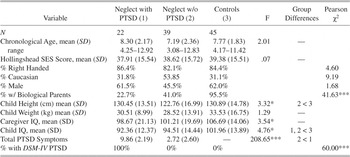
Participants were: Neglect with PTSD (n = 22), Neglect without PTSD (n = 39), and Controls (n = 45). Neglect was defined as a child having a history of Department of Social Services (DSS) defined neglect with absence of sexual abuse. The Neglect Groups were recruited through advertisements targeted at DSS agencies. The groups were similar on age, gender, race, and Hollingshead Index of socioeconomic strata (SES). Controls were recruited from the same surrounding community through Duke University Medical Center Institutional Review Board (IRB)-approved advertisement at schools and pediatric clinics. Participants statewide were eligible. To reduce selection biases, participants who lived greater than 75 miles from the Research Program were given overnight accommodations. Exclusion criteria were: (1) full-scale (FS) IQ < 70; (2) disability that made a comprehensive interview of the child difficult; (3) significant medical illness, head injury, or neurological disorder; (4) autism or pervasive developmental disorder; and (5) birth weight under 5 lbs or severe prenatal compromise with neonatal intensive care unit (NICU) stay. The groups were significantly different on caregiver IQ, with the Neglect Groups performing at a lower level than Controls. Given the low number of children in the neglect group who were living with their biological parents, caregiver IQ was not covaried in the data analyses. See Table 1. The local university hospital IRB committee approved the study. Legal guardians gave informed consent and children assented prior to participation.
Clinical characteristics for the neglected children with PTSD (Group 1), neglected children without PTSD (Group 2), and nonmaltreated children (Group 3)

Note
*p < .05; **p < .01; ***p < .001.
Neuropsychological Measures
The battery was selected a priori to assess the functions of fine-motor, language, visual-spatial processing, memory/learning, attention/executive functions, and reading and mathematics achievement. The battery was age-appropriate, psychometrically sound, and driven by core hypotheses. Given the limited research in this area, the battery was designed to broadly examine cognitive function.
NEPSY
NEPSY (Korkman, Kemp, & Kirk, Reference Korkman, Kemp, Kirk, Kaufman and Kaufman2001) is a child neuropsychological battery that consists of 36 psychometrically developed subtests designed for children ages 3–12. The core battery consists of 14 subtests that measure language, fine-motor, visual-spatial, memory/learning, and attention/executive functions. Scales produce an age-based scaled score (mean of 10 and standard deviation of 3). Participants were administered the core 14 subtests plus Block Construction. We included age-based scaled scores for the supplementary tasks for Auditory Attention (Auditory Attention Task, Response Set Task), Memory for Faces (Immediate, Delay), and Memory for Names (Learning Trials, Delayed).
Conners’ Continuous Performance Test-II
This test (Conners & MHS, Reference Conners and Systems2000) measures the participant’s selective attention, sustained attention, and impulsivity. We include the t scores for the errors of omission and variability. Although higher scores reflect more impairment, we reversed the scores to keep the interpretation of all tasks in the same direction (i.e., higher scores reflecting a better performance).
The Peabody Picture Vocabulary Test-III
This test (PPVT-3) (Dunn, Dunn, & Williams Reference Dunn, Dunn and Williams1997) provides a measure of receptive vocabulary with age-based standard scores.
Wechsler Intelligence Scale for Children-III /Wechsler Preschool and Primary Scale of Intelligence-Revised
Participants received the age-appropriate version of the Wechsler scale, either the WISC-III (6.0 to 16;11 years of age) or the WPPSI-R (2.5 to 7.5 years of age) (Wechsler, Reference Wechsler1989, Reference Wechsler1991). A two-subtest short-form, comprised of Vocabulary and Block Design, generated an IQ score.
Woodcock-Johnson Tests of Academic Achievement
Age-based standard scores were employed for the three subtests and overall score for reading and mathematics of the WJ-III (Woodcock, McGrew, & Mather, Reference Woodcock, McGrew and Mather2001).
Wechsler Abbreviated Scales of Intelligence
The WASI (Stano, Reference Stano1999) is built on the Wechsler scales of intellectual functioning. The two-subtest version (Vocabulary and Matrix Reasoning) generated a caregiver IQ score.
Clinical Measures
The Kiddie Schedule for Affective Disorders and Schizophrenia – Present and Lifetime Version (K-SADS-PL) (Kaufman et al., Reference Kaufman, Birmaher, Brent, Rao, Flynn and Moreci1997)is a semi-structured interview that was administered to caregivers and subjects. We also used archival records as sources of information. The KSADS-PL was modified to include additional information about: (1) life event questions, including traumatic events from the Child and Adolescent Psychiatric Assessment (Angold et al., Reference Angold, Prendergast, Cox, Harrington, Simonoff and Rutter1995); (2) disorders not present in the KSADS-PL; (3) a structured scale was added to quantify symptom frequency; and (4) algorithms were created to determine Axis I psychiatric disorders based on DSM-IV criteria. Disorders were assigned a severity score of mild, moderate, or severe. This modified version is available on request.
The failure to supervise index was composed of adding positive responses to any of seven questions: (a) neglect resulting in serious accidents; (b) caregiver not knowing child’s whereabouts; (c) being left home alone; (d) unexplained school absences; or witnessing caregiver (e) using drugs or (f) drunk; and (g) exposure to inappropriate adult sexual activity (α = .77). Failure to provide was defined using three questions regarding basic physical or medical care (α = .71). Physical abuse was defined using five questions regarding discipline by a caregiver resulting in bruises or serious injury, or resulting in severe pain, scars, or an inability to sit or walk without pain; or being pushed into objects, shaken, burned, or being threatened with a deadly weapon (α = .41). Witnessing interpersonal violence was defined using ten questions regarding: (a) witnessing a threatening or violent crime in which significant injury occurred or could have occurred; (b) witnessing a traumatic death; (c) being the victim of a serious threatening or violent crime not perpetrated by a caregiver; (d) being present during threats to important attachment figures; witnessing explosive arguments involving threatened or actual harm to (e) caregivers or (f) other family members; (g) hearing about a serious fight involving threats or harm to attachment figures that occurred at home; (h) witnessing physical rage; or (i) witnessing, or (j) hearing about other family members’ attempts to hurt themselves (α = .76). Emotional abuse was defined by three questions regarding a caregiver making hurtful comments or swearing at the child or witnessing or hearing about other family members’ physical abuse (α = .48). All but one child with a history of neglect reported family violence from the interpersonal violence section and was excluded from the analyses.
Interviewers were individually trained to obtain 80% agreement for PTSD and over 90% agreement for the presence of any lifetime major Axis I disorder with a board certified child and adolescent psychiatrist and experienced child trauma interviewer (MDDB). Discrepancies were resolved by reviewing archival information or by reinterviewing the child or caregiver. If diagnostic disagreements were not resolved with this method, consensus diagnoses were reached between a child psychiatrist (MDDB) and child psychologist (SRH).
Statistical Analyses
Demographic variables and parent/caregiver IQ were examined using either chi square or analysis of variance (ANOVA). For neurocognitive domains and academic achievement, we conducted a series of multivariate analyses of variance (MANOVAs) across each of the domains: fine-motor, language, visual-spatial, memory/learning, attention/executive functions, and academic achievement. Follow-up pairwise comparisons using Tukey’s least significant difference (LSD) test were conducted on the tasks within each domain, and on selected NEPSY supplemental scores.
Partial Eta Square (ηp2) was reported to describe effect sizes for significant differences (Small < .06; Medium = .12; Large > .16). Pearson Product Correlations were conducted between the a priori neuropsychological domains, IQ, and achievement measures, and PTSD and maltreatment-related variables for neglect subjects with PTSD, to examine the relationship between neurocognitive function and trauma measures. For this exploratory analysis, we engaged in a data reduction strategy to limit the number of neurocognitive variables. We calculated alpha coefficients to determine the internal consistency of each domain, and created domain scores by averaging the standard scores employed within each domain. For the IQ, reading, and mathematics domains, we employed the scores generated by the Wechsler scales and WJ-III, respectively. The primary intent was to reduce the number of tests into manageable domains and to provide support for their internal consistency. Significance testing was two-tailed with alpha = 0.05. Data are presented as mean ± standard deviation (SD). For the three-group comparisons, a Bonferonni Correction is indicated in Table 2.
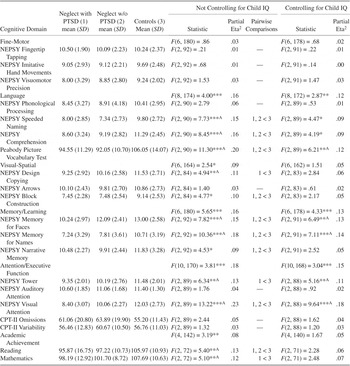
Neuropsychological findings for the neglected children with PTSD (Group 1), neglected children without PTSD (Group 2), and nonmaltreated children (Group 3)

Note
*p < .05; **p < .01; ***p < .001; Ap < .05 with Bonferonni Correction within cognitive domain.
RESULTS
Neuropsychological Findings Across Groups
Intelligence quotient (IQ)
A significant group difference on IQ, with a moderate effect size was present (ηp2 = .09). Follow-up pairwise comparisons revealed the two Neglect Groups to perform significantly lower than the Controls, but not from one another. We did not control for IQ, given its potential association with many of the neuropsychological variables used in this study and the possible subsequent elimination of group differences that otherwise would be present. We believe that IQ is not necessarily a confounding variable in this study, but a consequence of neglect (De Bellis, Reference De Bellis2001; Perez & Widom, Reference Perez and Widom1994). A secondary analysis was conducted controlling for IQ in the data analysis to determine the effect of IQ on the results. See Table 2.
Fine-Motor
No group differences were present.
Language
MANOVA revealed significant group differences. Follow-up univariate analyses indicated group differences on NEPSY Speeded Naming, NEPSY Comprehension of Instructions, and PPVT-3, with moderate to large effect sizes. The findings suggest that the verbal fluency and overall receptive language capabilities for both Neglect Groups were significantly lower than for the Controls, but the Neglect Groups did not differ from one another.
Visual-Spatial
MANOVA revealed significant group differences. Follow-up univariate analyses showed the groups to differ on NEPSY Design Copying and NEPSY Block Construction with moderate effect sizes. Follow-up comparisons showed that the Neglect Groups were significantly lower on Block Construction, and the Neglect with PTSD Group was lower than the Controls on the NEPSY Design Copying.
Memory/Learning
MANOVA revealed significant group differences. Univariate findings revealed significant differences between the groups on all tasks with medium to large effect sizes. Pairwise comparisons revealed that the Neglect Groups performed significantly lower on Memory for Faces, Memory for Names, and Narrative Memory tasks than the Controls. When examining the supplemental scores from the NEPSY Memory for Faces and Memory for Names subtests, significant group differences were apparent for Memory for Faces-Immediate Recall, F(2, 93) = 4.91, p < .01, and Memory for Faces-Delayed, F(2, 93) = 8.70, p < .001. For Immediate Recall, pairwise comparisons showed the Neglect with PTSD Group performed lower than the Control Group. For Memory for Faces-Delayed, pairwise comparisons showed the Neglect with PTSD Group performed lower than both the Control and Neglect without PTSD Groups. Effect sizes ranged from moderate (η2 = .1) to large (η2 = .16), respectively. The Memory for Names Learning Trials supplemental score produced significant group differences, F(2, 93) = 9.23, p < .001. Similar findings were noted for the Memory for Names-Delayed Recall supplemental score, F(2, 93) = 11.25, p < .001. Effect sizes were large (η2 ranged from .17 to .20). Pairwise comparisons for each supplemental score revealed the two Neglect Groups to perform lower than Controls, but the Neglect Groups did not differ from each other.
Attention/Executive Functions
A significant MANOVA was generated. Follow-up univariate analyses revealed specific group differences on NEPSY Tower and NEPSY Visual Attention, with medium to large effect sizes, respectively. Follow-up pairwise comparisons revealed the Neglect with PTSD Group to perform significantly lower than the Control Group, but no differences were noted between the two Neglect Groups or the Neglect without PTSD Group and the Controls. For NEPSY Visual Attention, both Neglect Groups performed significantly lower than the Controls, but there were no group differences between the two Neglect Groups.
Academic Achievement Findings
A significant MANOVA was generated, indicating the presence of differences in academic achievement. Follow-up pairwise comparisons showed both Neglect Groups to perform lower than Controls for reading; however, only the Neglect with PTSD Group was lower than the Controls for mathematics. The two Neglect Groups were not significantly different from each other on either reading or mathematics.
Group Comparisons Controlling for Intellectual Functioning
As shown in Table 2, after controlling for IQ, the neuropsychological domains of Language, Memory/Learning, and Attention/Executive Functions continued to reflect significant differences across groups.
Within the Language domain, NEPSY Speeded Naming, NEPSY Comprehension, and PPVT-3 remained significantly different between the groups with moderate effect sizes.
For the Memory/Learning domain, NEPSY Memory for Faces and NEPSY Memory for Names remained significantly different between groups, with moderate effect sizes. For the supplemental memory measures from the NEPSY, each of the four tasks reflected significant group differences. Memory for Faces–Immediate, F(2, 92) = 4.37, p < .02, Memory for Faces–Delayed, F(2, 92) = 7.01, p < .001, Memory for Names–Learning Trials, F(2, 92) = 6.34, p =.003, and Memory for Names–Delayed, F(2, 91) = 7.11, p < .001, persisted in showing group differences, with moderate effect sizes across tasks.
For Attention/Executive Functions the groups continued to be significantly different on NEPSY Tower and NEPSY Visual Attention, with moderate to large effect sizes.
Relationships Between PTSD Symptoms, Maltreatment Variables, and Neuropsychological Functions for the Neglect with PTSD Group
Using the a priori conceptual domains, we examined the internal consistency of each of the neuropsychological domains by calculating Cronbach’s Alpha statistics: Fine-Motor (α = .49), Language (α = .68), Visual-Spatial (α = .66), Memory/Learning (α = .52), and Attention/Executive Functions (α = .52). Note, we did not include the PPVT-3 in the language domain as the inclusion of this within the domain lowered the overall alpha coefficient. We choose the subtest combination that generated the higher measure of internal consistency. The magnitude of these alpha coefficients suggests marginally acceptable internal consistency for each of the domains. This was most likely because of the small number of items/tasks contained within each domain. Satisfactory levels of alpha depend on test use, number of tests, and interpretation. Because relatively low (e.g., .50) levels of criterion reliability do not seriously attenuate validity coefficients (Schmitt, Reference Schmitt1996), we used these domains to examine the relationships between PTSD symptoms, maltreatment variables, and neuropsychological domains.
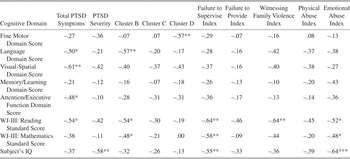
Table 3 shows the Pearson Correlations produced between the neurocognitive domains, reading, and mathematics achievement, and child IQ; and the PTSD symptoms and maltreatment variables for the Neglect Group with PTSD. For the PTSD symptom variables, total PTSD symptoms negatively correlated with Language, Visual-Spatial, Attention/Executive Function, and the WJ-III Reading measures. PTSD severity negatively correlated with IQ. Negative correlations were seen between Language, WJ-III Reading Standard scores, and WJ-III Standard scores, and total PTSD cluster B symptoms of re-experiencing trauma. Cluster D symptoms negatively correlated with the Fine Motor domain.
Pearson correlations between the neuropsychological domains and maltreatment-related variables for neglected children with PTSD

Note
*p < .05; **p < .01; ***p < .001.
For the maltreatment variables, the Failure to Supervise Neglect Index negatively correlated with the WJ-III Reading and Mathematics Standard scores, and child IQ. The Witnessing Interpersonal Violence Index negatively correlated with WJ-III Reading Standard scores. Emotional abuse negatively correlated with WJ-III Reading and Mathematics Standard scores, and child IQ. All correlations, whether significant or not, were mainly in the expected direction, with greater numbers of PTSD symptoms or maltreatment events associated with poorer cognitive function. We examined the maltreatment variables in the larger sample of neglected children and found similar findings.
DISCUSSION
Neglected children showed significantly lower IQ, language, visual-spatial, learning/memory, and attention/executive functions and academic achievement than Controls. After controlling for child IQ, all measures remained significant except visual-spatial and academic achievement. These differences survived Bonferonni Corrections. Selected differences in complex visual attention, visual memory, verbal memory and learning, planning, problem solving, receptive language, and speeded naming were noted. Effect sizes were medium to large. Although academic skill differences were present, these did not persist when IQ was covaried. Covarying for IQ was not undertaken in previous studies (Perez & Widom, Reference Perez and Widom1994). These findings suggest problems with school-based learning and a vulnerability to ongoing risk for neurodevelopmental challenges in neglected children, particularly in memory and attention/executive function. These challenges may become more severe with maturation, leading to school failure and poor quality of life (McGloin & Widom, Reference McGloin and Widom2001).
Our clinical assessment finding of experiences of family violence in all but one of the neglected children is interesting. Domestic violence is commonly seen in the child welfare system, where, to our knowledge, PTSD prevalence rates in neglected children were not reported. In the National Survey of Child and Adolescent Well-Being (Burns et al., Reference Burns, Philips, Wagner, Barth, Kolko and Campbell2004), high rates of intimate partner violence (28.7%) were self-reported using a parental self report measure, the Conflict Tactic Scales. These measures were significantly related to child internalizing and externalizing behavioral problems (Hazen et al., Reference Hazen, Connelly, Kelleher, Landsverk and Barth2004). This report did not examine child PTSD. In our sample, 61 of 62 neglected children reported experiencing family violence resulting in a rate of 36% with PTSD. Our study examined family violence during a comprehensive interview with the caregiver and child, as well as and using the conflict tactic scale and archival record reviews. This may have lead to the higher (and possibly more accurate) family violence rates in neglected children that we reported here.
Except for poorer Memory for Faces–Delayed Recall, we did not see major significant differences in neurocognitive abilities between the neglected children with PTSD and those without PTSD, although significant correlations were seen between PTSD symptoms and maltreatment indexes, and neurocognitive function. Many of the neurocognitive tests were lower in the group with PTSD. Our preliminary study may not have been adequately powered to test this hypothesis. These findings may also suggest that the DSM-IV PTSD taxon may not be relevant to the neurocognitive functioning of children in this age group. Children with threshold versus subthreshold PTSD have similar impairment because of their PTSD symptoms (Carrion, Weems, Ray, & Reiss, Reference Carrion, Weems, Ray and Reiss2001). A lower threshold of symptoms may be developmentally more appropriate when making a diagnosis of PTSD in preschool children, as this diagnosis was originally intended for adult combat veterans (Scheeringa, Wright, Hunt, & Zeanah, Reference Scheeringa, Wright, Hunt and Zeanah2006). This controversial area in the trauma literature is being addressed in the DSM-V.
Our findings agreed with other studies showing lower IQ in neglected children (Perez & Widom, Reference Perez and Widom1994), and work showing that IQ was inversely related to the severity of abuse (Carrey, Butter, Persinger, & Bialik, Reference Carrey, Butter, Persinger and Bialik1995), particularly in our study, using the emotional abuse index. We also showed that lower IQ was related to neglect (the failure to supervise index) and to total PTSD symptoms. Neglect was the only maltreatment subtype associated with cognitive delay and an associated IQ decline to the point of intellectual disability (Strathearn et al., Reference Strathearn, Gray, O’Callaghan and Wood2001). In contrast to an adult combat-related PTSD study, our results did not show lower IQ in neglected subjects with PTSD (Macklin et al., Reference Macklin, Metzger, Litz, McNally, Lasko, Orr and Pitman1998). In a magnetic resonce imaging (MRI) study, De Bellis and colleagues showed that the greater the number of years of experiencing the maltreatment trauma that lead to PTSD, the lower the IQ (De Bellis et al., Reference De Bellis, Keshavan, Clark, Casey, Giedd and Boring1999). In another cross-sectional study, lower IQ and Verbal IQ were significantly associated with a greater number of traumas and cluster B re-experiencing symptoms (Saltzman et al., Reference Saltzman, Weems and Carrion2006). Child maltreatment is a risk for PTSD after combat exposure (Bremner, Southwick, Johnson, Yehuda, & Charney Reference Bremner, Southwick, Johnson, Yehuda and Charney1993). We speculate that the studies showing lower IQ in adult PTSD may need to control for child maltreatment to address this issue. Note that IQ was lower in the caregivers of our neglect subjects. Because we were unable to obtain IQ measures on a significant percentage of the biological parents of the neglected children, we cannot comment on the possibility of premorbid familial differences between groups. This is a limitation of this study. However, it should be noted that most parents who commit maltreatment were themselves maltreated as children, making these types of analyses inherently complex. Both Neglect Groups performed more poorly than Controls in academic achievement, agreeing with previous studies, which did not control for child IQ (Cicchetti & Toth, Reference Cicchetti, Toth, Goldberg, Muir and Kerr1995; Gaudin, Reference Gaudin and Dubowitz1999; Kendall-Tackett & Eckenrode, Reference Kendall-Tackett and Eckenrode1996; Kinard, Reference Kinard2001; Trickett & McBride-Chang, Reference Trickett and McBride-Chang1995). Achievement findings did not persist when controlling for IQ. Our results replicate and strengthen the previous findings of lower IQ and clarify the findings of lower academic achievement in neglected children.
Although few of measures for the Neglect Group fell within a deficient range, the findings of poorer performance in neglected children in language, visual-spatial, memory/learning, and attention/executive function suggests relative weaknesses in neurological functioning involving stress sensitive areas, such as the dorsolateral and medial prefrontal cortex, right hemisphere, and hippocampal regions in neglected children without the confounding effects of borderline IQ or mild mental retardation, a study exclusion, and a common outcome of child neglect (Perez & Widom, Reference Perez and Widom1994). In a prospective neuroimaging study of children with impairing PTSD symptoms secondary to interpersonal violence, baseline PTSD symptoms predicted reductions in hippocampal volumes at 1 to 1.5 years follow-up (Carrion, Weems, & Reiss, Reference Carrion, Weems and Reiss2007). For our sample, cognitive deficits may be more evident as our sample matures.
Using the NEPSY, nonabused and neglected children performed worse than controls on tests of auditory attention and response, while scoring higher than physically abused and neglected children for the Tower subtest (Nolin & Ethier, Reference Nolin and Ethier2007). Our findings are generally consistent with this study; however, we did not uncover significant group differences in auditory attention, nor did we find that the Neglected Group performed higher than the Controls on any task.
After controlling for child IQ, our findings revealed significant group differences in language, learning memory, and attention/executive function. Our language finding extends the previous work, which shows poor language comprehension in neglect (Allen & Oliver, Reference Allen and Oliver1982). We saw significantly negative associations between higher PTSD and cluster B re-experiencing symptoms and lower language abilities. Neglected children have decreased verbal learning capacity (Lee & Hoaken, Reference Lee and Hoaken2007; Pears & Fisher, Reference Pears and Fisher2005). Children with language impairments are likely to resort to physical aggression because their language disability prevents them from using verbal resolutions (N. J. Cohen, Reference Cohen2001), leading to disruptive behavioral problems. If these deficits are a result of PTSD symptoms, then treatment with an evidence-based method, such as trauma-focused cognitive behavioral therapy (J. A. Cohen, Deblinger, Mannarino, & Steer, Reference Cohen, Deblinger, Mannarino and Steer2004) may forestall this negative trajectory.
In our study, neglected children showed poorer verbal memory than controls. Delayed recall differences were seen in neglected children with PTSD. Research with adults who have a history of maltreatment showed memory deficits when compared to nonmaltreated adults (Eisen, Goodman, Qin, Davis, & Crayton, Reference Eisen, Goodman, Qin, Davis and Crayton2007). Memory and childhood neglect is understudied.
Visual-Spatial Processing was lower in neglected children. In this study, lower Visual-Spatial function was related to a greater number of PTSD symptoms. In one study, neglected children with physical abuse, compared to neglected children without physical abuse, tended to score much lower on tests of manual dexterity, auditory attention, and visual-motor integration (Nolin & Ethier, Reference Nolin and Ethier2007). A review of 167 children with history of child protective services maltreatment found that 45% of the 42 younger children (< 2½ years old) exhibited significant developmental delay in sensorimotor functioning (Urquiza, Wirtz, Peterson, & Singer, Reference Urquiza, Wirtz, Peterson and Singer1994). Using the NEPSY, maltreated children in foster care had significantly lower scores for visuospatial processing (Pears & Fisher, Reference Pears and Fisher2005). These authors found that children placed in foster care before age two years had poorer visuospatial scores. In these later studies, it was not clear if brain injury, such as shaken baby syndrome, was exclusionary. We excluded subjects with neurological disorders in this investigation. We should also note that the Visual-Spatial finding did not persist after controlling for child IQ.
We did not see any difference in the fine motor domains. Because nonevidenced-based treatments are in practice for sensory-motor integration disorder in neglected children, further empirical studies are needed to understand these neurocognitive functions and to provide evidenced-based treatments for neglected children.
The only significant finding noted was that the Neglect with PTSD Group performed poorer than the Neglect without PTSD Group and Controls on NEPSY Memory for Faces–Delayed Recall. The Neglect with PTSD Group performed poorer than the Control Group on NEPSY Design Copying and NEPSY Tower. These findings may reflect poorer visual-spatial, memory/learning, and attention/executive function in neglected children with PTSD. Given our correlational data, our findings of visual-spatial processing and attention/executive function were negatively correlated with total PTSD symptoms. Interestingly, we did not see any other significant correlations with maltreatment variables. These findings agree with previous work showing poorer attention/executive function in maltreated children with PTSD compared with a matched control group (Beers & De Bellis, Reference Beers and De Bellis2002). However, it should be noted that the two maltreatment groups were not significantly different from each other on most cognitive domains. This may be a result of small sample size. Future work in this pediatric area should consider cumulative PTSD symptoms as opposed to the DSM-IV PTSD taxon in their analyses (Carrion et al., Reference Carrion, Weems, Ray and Reiss2001; Scheeringa et al., Reference Scheeringa, Wright, Hunt and Zeanah2006).
Relationship of Neuropsychological Domains to PTSD and Maltreatment Measures in the Neglect Group with PTSD
All of the significant correlations and most of the correlations were in the expected direction, with lower IQ, neurocognitive function, and academic achievement being associated with more PTSD and maltreatment measures. Total PTSD and cluster B symptoms were negatively and significantly related to poorer language, visual-spatial, and attention/executive functions, as well as poorer reading and mathematics achievement, while PTSD severity was negatively related to lower IQ. Maltreatment related indexes such as failure to supervise, witnessing family violence, and emotional abuse were negatively and significantly related to poorer reading and mathematics achievement and lower IQ. These correlations were clinically meaningful. Neurocognitive domains seem to be negatively effected by PTSD symptoms, while maltreatment related indexes were related to poorer academic achievement, rather than specific neurocognitive domains. We may speculate that poor academic achievement is moderated by the effects of PTSD symptoms on cognitive function in neglected children. This indicates that a pattern of academic delay begins early in the educational process. Mandatory screening for family violence and PTSD symptoms in children referred for neglect that results in treatment with evidenced-based interventions may reverse these processes.
In summary, this study examined differences in IQ, academic achievement, and neurocognitive functioning in neglected children with and without PTSD versus controls. Our findings continue to provide evidence for significantly lower performance of neglected children. Given the high prevalence of neglect and the limited literature on its neurocognitive outcomes, longitudinal neurobiological studies are warranted. Such studies may assist us in developing specific cognitive rehabilitative strategies to help improve neglected children’s education and quality of life. Given that our findings correlated with PTSD symptoms and severity, the study of PTSD symptoms, in addition to the study of the PTSD diagnosis, may require further investigation in children. For those children who cannot be raised by their biological parents, secondary intervention such as adoption may booster lower IQs, even for children adopted after age 4 years (Duyme, Dumaret, & Tomkiewicz, Reference Duyme, Dumaret and Tomkiewicz1999). Given the appropriate investigations and resources, neglected children may fulfill their potentials (Koluchova, Reference Koluchova1972, Reference Koluchova1976).
ACKNOWLEDGMENTS
This investigation was supported with funding from NIMH grants K24 MH071434 (Principal Investigator: Dr. De Bellis) and R01 MH61744 (Principal Investigator: Michael D. De Bellis, M.D.), and K23 MH064111 (Principal Investigator: Eve G. Spratt, M.D.). The authors thank Sue R. Beers, Ph.D., for her initial contributions to this work, and the staff of the Duke Healthy Childhood Brain Development, Developmental Traumatology Research Program. The manuscript is new and original and it has never been published either electronically or in print. All of the authors have no conflict of interest affecting this study.