There exists a widespread view about rating agencies, first proposed by Harold (Reference Harold1938), that some sort of revolution occurred during the 1930s in the social uses of ratings. It originated in a rather technical way when, on 11 September 1931, the Comptroller of the Currency, William Pole (the man in charge of supervising banks with a federal charter or ‘national banks’), announced that bank examiners had started to rely on ratings in order to assess the solidity of a bank's balance sheet.Footnote 1 The new rule permitted certain securities considered as safe to be favored by recording them at their face value, rather than at their (lower) actual market price: in a context of plummeting asset prices (this happened at the end of the horrendous summer 1931 which saw bank collapses all over the world) this was a significant move. More importantly, the ‘favored securities’ included US Government, State and Municipal bonds as well as all bonds enjoying any of the ‘first four ratings by statistical corporations’, as the likes of Moody's and Standard Statistics were known.Footnote 2 By contrast, securities with lower grades from the same corporations were booked at market price. This is how ratings made their début in regulation.
This move, according to Harold, was a first step in a succession of far-reaching arrangements that caused ratings to become ingrained in the fabric of the US financial system. Indeed, following the Banking Act of 1933 and introduction of deposit insurance, ratings became tools to monitor the quality of banks' portfolios and essentially supervise them (Harold Reference Harold1938). Both critics and supporters or insiders of rating agencies agree with this notion of a series of epoch-making decisions during the 1930s to which the modern financial system would be heir. A Moody's Investors Service memorandum traces the origins of the modern cut-off between ‘investment grade’ (the four top notches mentioned in the Pole ruling) and ‘speculative grade’ (those below) to the announcement of 11 September 1931 (Fons Reference Fons2004). Likewise, according to Frank Partnoy (Reference Partnoy1999, Reference Partnoy, Fuchita and Litan2006), an outspoken critic of the role of the agencies in the subprime crisis, the regulatory moves initiated in 1931 opened the door to modern conflicts of interest.Footnote 3 Thanks to these moves, the agencies now controlled the marketability of securities, something he calls a ‘regulatory license’. This created conflicts of interest since rating agencies would derive revenues from certifying that individual securities be proper fodder for safety-hungry institutional investors. This enormous power held the promise of a disaster when, in the 2000s, rating agencies succumbed to the temptation of rating the new subprime securities they hardly understood. In other words, according to the regulatory license view, transformations in the social uses of rating in the 1930s were the original sin that eventually caused the subprime crisis, and the corollary is that the extirpation of rating is the first stage on the road to financial safety.
But in fact, surprising as it may sound, this reading of the crisis is also endorsed by rating agencies such as Moody's, whose officials have recently emphasized that they long for the more rapid removal of the regulatory license (because it would clarify their responsibility, they claim).Footnote 4 The more recent debate has exhibited a most curious twist, whereby rating agencies advocate removal of reference to their grades for regulatory purposes while reports accumulate on the difficulty of excising rating from regulatory frameworks and prudential supervision.Footnote 5 It looks as if our societies have become addicted to ratings, enabling providers of ratings to be comfortable with the prospect of an ostensible reduction of their role – as if they knew better. And if this metaphor were to be continued, the rating agencies would be like drug dealers, insisting that substances are taken at the consumer's risk.
To understand the logic at work, it is important to take a harder, closer look at the rise of rating, something that is missing in previous accounts by economic historians or legal scholars. This article makes a contribution by providing a novel perspective on the rise of rating as a regulatory tool.Footnote 6 We suggest that before regulatory reliance on rating was legislated by US authorities, there already existed a similar mechanism at work, which may be called by analogy to Partnoy, ‘legal license’. As we proceed to argue, the regulatory license built on the legal license, which the agencies had received long before 1931, and a case could in fact be constructed that at the heart of the speculative mechanics of the 1920s was something very similar to the process that has been observed more recently. To be clear, both banks who originated the products and those who distributed them were, already in the 1920s, highly dependent on the decisions of rating agencies for they benefited from ratings being generous (as they would be able to sell more products without facing liability risks).
To show this, we examine systematically the population of reports from court cases quoting the statistical corporations and provide empirical evidence of a legal license in the increasing incidence of courts' quotations of the agencies' output in truth discovery, damages assessment etc., as well as in the connotations of the language used in opinions rendered during the period 1900–40. This trend began before the 1930s.Footnote 7 In fact, by the time Pole issued his ‘landmark’ ruling, concepts of financial prudence had already made their way into US courts, which relied on the output of the statistical organizations to assess the behavior of trustees, bankers and brokers. As a result, the regulatory moves of the 1930s were significant in that they replaced court-enforced assessments by law-making, regulation and regulatory agencies, not by placing the output of the agencies at the center of the US financial system, for it was already there.Footnote 8
I
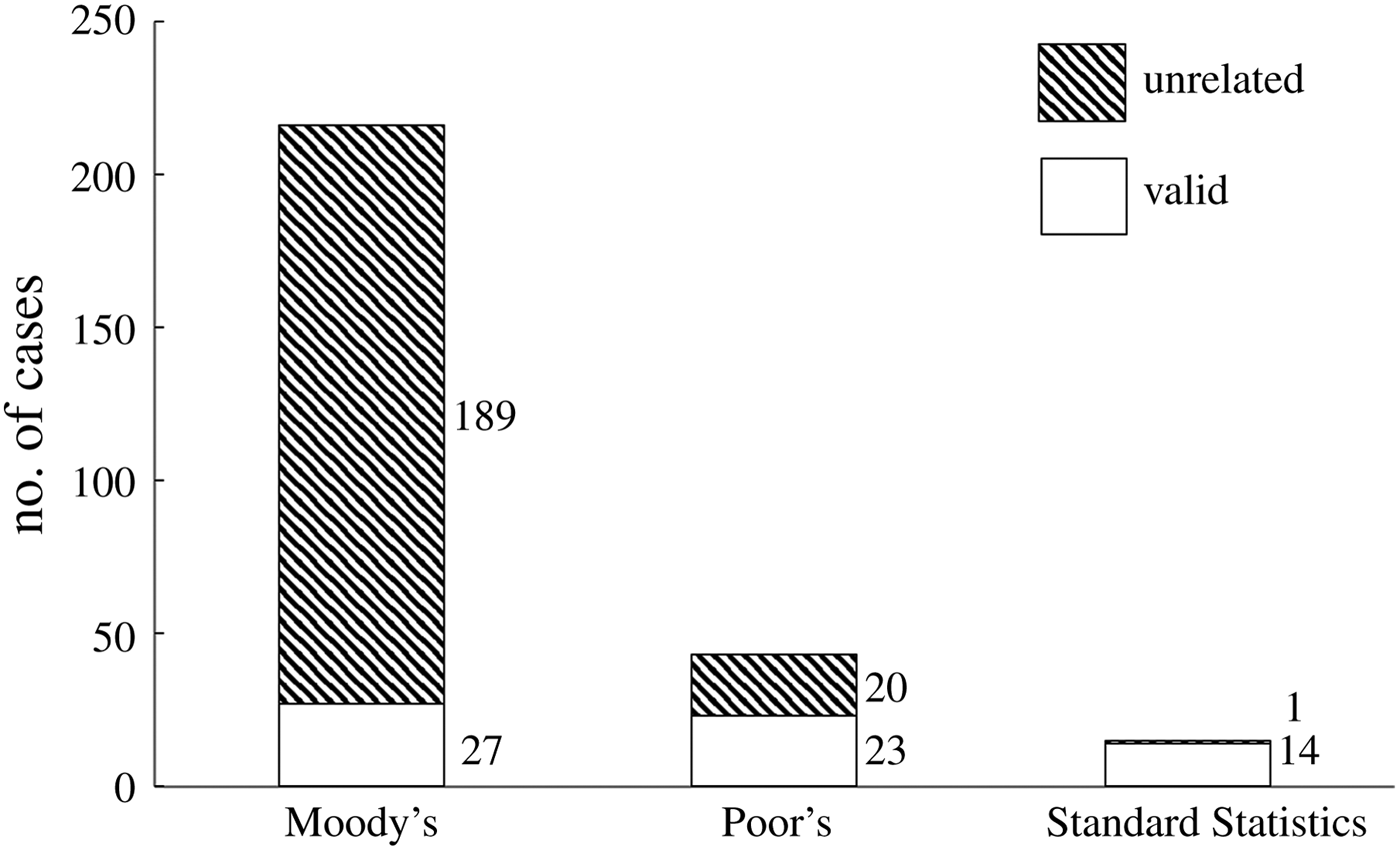
In this section, we examine a population of cases found to have quoted at least one relevant statistical organization during the period 1900–40. The source is Westlaw. Relevant rating agencies include the main players on the market during this period, Moody's, Poor's, Fitch and Standard Statistics, for which consistent manuals exist and which formed the bulk of the industry. Relevant cases are those including language implying that one agency output is used as a tool in truth discovery, assessment of damages, etc.Footnote 9 An identical Westlaw query was applied uniformly to the four agencies.Footnote 10 It returned respectively 216 hits for Moody's, 43 for Poor's, 15 for Standard Statistics and 4,306 for Fitch. Output was then manually purged,Footnote 11 yielding a total of 52 cases with 27 quoting Moody's, 23 quoting Poor's and 14 quoting Standard Statistics (multi-quotation occurred, so the number of cases quoting a given agency may not add up to the total of cases quoting a least one agency). Fitch had to be dropped from the analysis because almost all the many cases retrieved were unrelated to the rating agency.Footnote 12
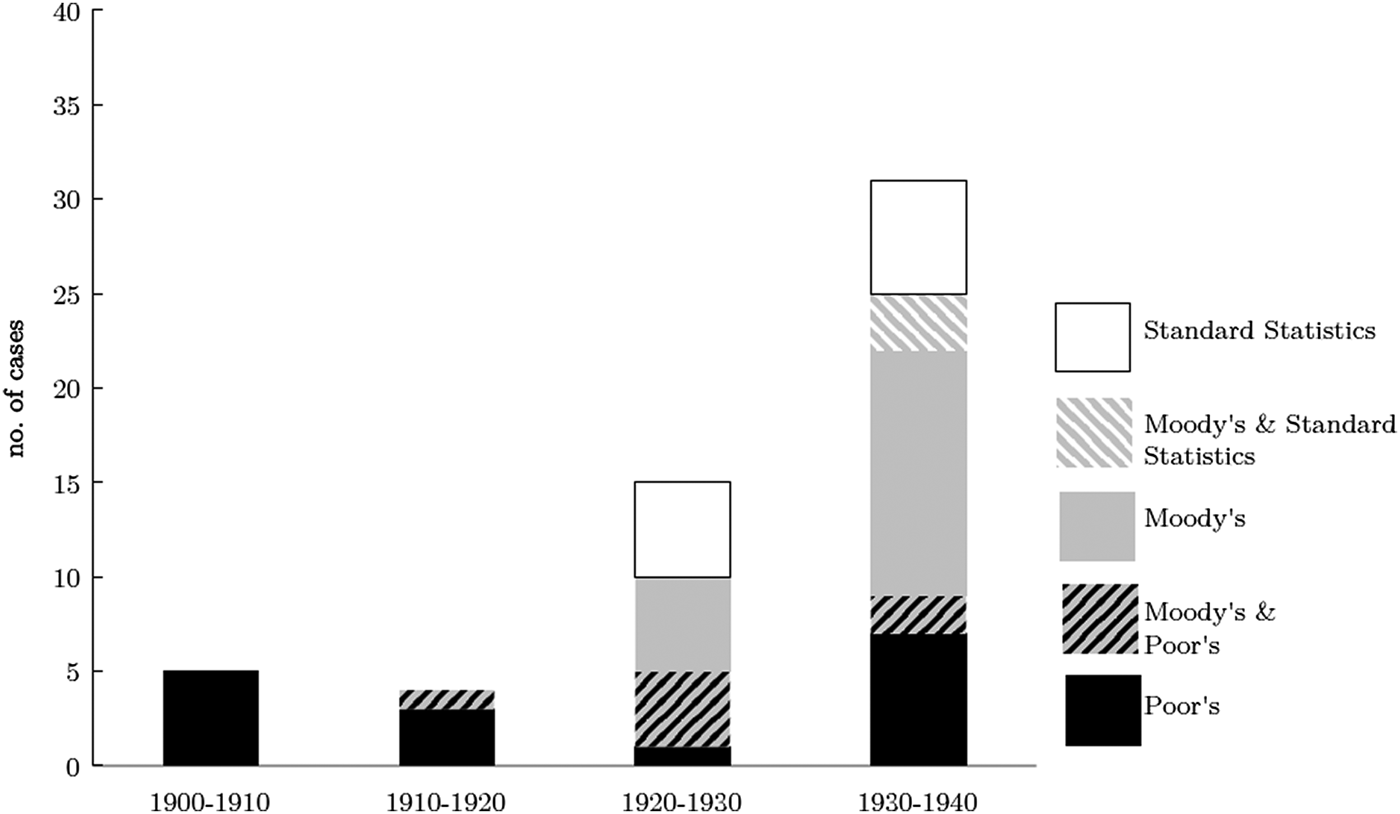
Evolution is summarized on Figure 1, which shows the rise in the incidence of court references to statistical organizations.Footnote 13 Obviously, not only was the relevance of rating agencies for court decisions a phenomenon already present in the 1900s, but it can be argued that the take-off occurred in the 1920s, before rating became embedded in regulation.
Number of cases per period (individual and joint)

Relative reliance on different organizations is another interesting matter to examine. In terms of incidence, Poor's was the leader till about 1920 when Moody's overtakes it. Standard Statistics is a latecomer, with the first quotation only in 1923.Footnote 14 By and large, during the interwar years Moody's can be described as the leader, with Standard Statistics gradually pulling out and catching up with Poor's. Poor's relative decline ended up with the merger between Poor's and Standard Statistics in 1941.Footnote 15 Interestingly, this ranking coincides with what is known of the industry's league tables in terms of size, breadth of coverage, etc.Footnote 16
II
The occasions for relying on the statistical organizations' output were varied. The ‘output’ that features in the court reports included chiefly the manual (which described and rated the securities) but also, when it existed as a separate product, the price list. Our imperfect, but heuristic typology relies on the parties involved in the lawsuit. Three main categories are identified (by declining order of importance in our population of cases): (1) taxman and corporate; (2) trustee; (3) brokers and/or stock sale fraud.Footnote 17
Tax cases include disputes between a taxpayer and the taxman (Commissioner of Internal Revenue) and the output of the statistical organizations is used for ascertaining the veracity of some data (price, worth etc.). For example, in Isaac L. Merrill v. Commissioner of Internal Revenue Footnote 18 the petitioner, Isaac L. Miller, purchased Russian Government bonds ‘during the years from 1916 to 1918’, bonds which the Soviet Government repudiated in February 1918. The bonds, however, ‘were continuously quoted on the market at a low price and were sold through a broker at a price far below their cost to the petitioner’,Footnote 19 and were hence viewed by him as falling under section 23(e) of the Revenue Act of 1928, which under certain circumstances allows for deductions from gross income. ‘The records of the Standard Statistics Co.’Footnote 20 were used to reconstruct the price evolution of the ‘bonds of the Russian Government (Fifth War Loan) 5 1/2's, 1926’Footnote 21 and sort the valuation issue. To this type of lawsuit we may add ‘corporate’ ones, which typically pitted one company against the other and where the products of statistical organizations were used to ascertain the bare facts of the case.Footnote 22
In ‘trustee’ cases, trustees feature as defendants in suits filed for mismanagement of entrusted money. In such cases, statistical organizations acted in the capacity of instrument of evidence. This could be done indirectly, with the court relying on the material in one manual to demonstrate imprudence of the trustees. For example, in 1902, in the Supreme Judicial Court of Massachusetts' Green v. Crapo Footnote 23 the ‘question whether, having money to invest, the trustees were justified in buying [certain company's] bonds’Footnote 24 was examined under the light of Poor's Manual which showed that in ‘1885 and 1886’Footnote 25 the company ‘did not even pay its expenses’.Footnote 26 In other cases, reliance was not merely on the technical facts, which the court then used to make its own inference (a loss-making company cannot be a sound investment, in the previous example), but on the organization's opinion itself. For example, in a 1922 case, where the trustee is said to have benefited from discretionary powers, the audit judge turned to Moody's in order to assess the adequacy of a certain investment, made in 1915 at 98.12 but trading at 70 to 72 at the time of the audit: ‘In Moody's Manual for 1914, these … bonds are rated: “Security, very high; Salability, good; net rating, A.” His manual gives the facts from which this conclusion is drawn. It appears from the testimony that bonds of this issue were brought out by Drexel & Co. and Harrison & Co., both banking houses of this city of the highest reputation, etc.’Footnote 27
Brokers and/or stock sale fraud cases encompass suits against brokers or sellers of securities for false representations or erroneous reporting. An illustrative example is Henry v. Kopf in 1925 where the ‘defendant sought to sell to the plaintiff certain stock of the “Houdini Picture Corporation” [whose value predictably vanished!], and made therein certain material misrepresentations of fact to the plaintiff, and thereby fraudulently induced the plaintiff to purchase 125 shares of such stock at $10 each; that said shares of stock were of no value’.Footnote 28 Claiming misrepresentation on behalf of the broker (who had mentioned a dividend that could be as high as 50 percent) the plaintiff asked for reimbursement. In the hearing before the Superior Court of New Haven County the plaintiff produced as witness one R. S. Bradley, a banker, who ‘testified that … he examined Moody's Current Rating Book as to the stock’Footnote 29 and this is how he could see that the stock was worthless.
III
From poring through these cases, it appears that courts used the products of statistical organizations as both reliable fact-establishing outlets and providers of significant opinion. Indeed, the language of more than one court report construes the various products of early rating agencies as representative of ‘established opinion’. Poor's Manual was a ‘well known publication of railroad statistics’ (1901),Footnote 30 an ‘authority upon the amount and value of the stocks and bonds’ (1907),Footnote 31 and was ‘testified an authoritative treatise on the subject [of Railroads]’ (1908).Footnote 32 Before buying securities, one orator consulted ‘Poor's Manual, and found therein a pretty full history’ (1914).Footnote 33 In a 1916 case, a testimony was received that the Chairman of the Board of Calumet & Chicago Canal & Dock Co, in order to investigate anomalies in balance sheets, would ‘consult different financial magazines, such as the Economist and Poor's Manual’.Footnote 34 In another case decided in 1918, an investor ‘did not know whether [one road] would be a good investment … He also testified that he knew that Poor's and Moody's Manuals were the best publications.’Footnote 35 In 1920 Moody's Manual is said to be describing a transaction ‘with exactness’.Footnote 36 In a case from 1923, a witness testified that ‘he gathered his information concerning this stock from various publications, particularly from the list published by the Standard Statistics Company’.Footnote 37 Therefore, by the time the 1931 decision was taken, ‘market quotations and other financial data appearing … in the regularly published reports of business surveys, … Moody's Manual, Standard Statistics, and other like publications’Footnote 38 were acknowledged as ‘an authority upon the amount and value of the stocks and bonds of … corporations in this country [the United States]’.Footnote 39 Thus it is that, while the 1930s did see an inflation of similar statements, court recognition of the agencies as valuable providers of information was a significantly older phenomenon.
This recognition, however, may be construed in a rather modest way as the admission by courts of documents thought to be transparent to brute fact. This would have been as opposed to their exclusion of agencies' output as ‘hearsay’, a position which would have required Mr Moody or some other to come in person and testify. This interpretation may be supported by two cases where lower courts refused to admit agencies' output (presumably because they were hearsay). In Trakas v. Cokins (1922)Footnote 40 a broker sought to disprove his wrongdoing by showing how the security was described by Moody's Manual, but was prevented by a lower court from doing so; however, the Appellate Court of Illinois First District ruled that the lower court's decision to ‘refuse to permit defendant to testify that [Moody's Manual of Railways and Corporation Securities of 1918] was a standard manual for 1918’Footnote 41 was erroneous and found in favor of the broker (appellant), asking for a retrial.Footnote 42 A few years later in Henry v. Kopf (1925),Footnote 43 the Supreme Court of Errors of Connecticut found that a court in New Haven had erred in refusing evidence about Moody's Manual. When asked ‘if [Moody's] was a “recognized authority”, upon objection of the question’Footnote 44 the witness did not answer. The lower court had also ruled that if Moody's Manual had been produced it would not admit it. In ordering the retrial, the Supreme Court pointed to the exclusion of evidence. In its decision it commented that the reports such as that of Moody's, ‘based upon a general survey of the whole market, and … constantly … acted upon by dealers’ are ‘far more satisfactory and reliable than individual entries, or individual sales or inquiries’ and concluded that ‘courts would justly be the subject of ridicule, if they should deliberately shut their eyes to the sources of information which the rest of the world relies upon, and demand evidence of a less certain and satisfactory character’.Footnote 45 According to this interpretation, the manuals entered into courts the way the Farmer's Almanac did: as a natural and legitimate instrument to tell the financial weather – an instrument which courts would have been ridiculous not to use liberally. There is no doubt that this interpretation is particularly plausible when the most ‘technical’ output (such as pricing) was used. In such cases, the agencies were not that different from the Farmer's Almanac, telling people whether it had been a warm or a cool financial day.
IV
Thus one aspect of the growing reliance on ratings has to do with their merit as technical sources of information. On the other hand, the language found in a number of cases (especially those involving brokers or trustees) reveals a pattern, which invites an alternative interpretation of the growth of courts' reliance on ratings agencies – one whereby the enforcement by courts of rating opinions granted the agencies a genuine legal license. Indeed, if one looks at the language used in courts when the legitimacy of the agencies' output is discussed, one finds that, in all cases where motivations for the use of an agency's manual are stated, no direct endorsement by the court is offered; instead, it is said that the manuals or agency's output represent a kind of benchmark conventionally accepted by the banking and security's trading profession.
To quote just a few excerpts in a long list of supporting statements: in 1920 a discussion of the contents of one edition of Moody's Manual is followed by the inference that through the statements made in the manual certain properties of the security become apparent to ‘financiers and investors’.Footnote 46 In Henry v. Kopf just discussed, the higher court stated that in so far as the expert called by plaintiff ‘was found to be a dealer in stocks and acquainted with the market value of stocks’,Footnote 47 ‘he was a proper witness as to what market reports are accredited as trustworthy’.Footnote 48 In 1927, a testimony is received ‘that such books as the publications of “Standard Statistics” are used and relied upon in the banking and security trading world’.Footnote 49 In a 1930 case, it is said that the vice president of Stanley Corporation's duties included ‘the reading over of Moody's and Standard Statistics investment service’.Footnote 50 In a 1935 case, it is declared that ‘all of the banks admittedly subscribed’ to ‘Moody's and other statistical manuals’.Footnote 51 In other words, the point is that the courts were striving to rely on the financial industry's own recognized standards. This amounts to the sanctioning of a form of self-regulation (a mechanism that is substantially similar to the mechanism that has been said to be at the heart of the subprime crisis).
We suggest interpreting this ruling strategy as stemming from the ‘prudent man principle’, which, according to previous writers, was forged in the US by Harvard College v. Amory (1830).Footnote 52 In this landmark case, it was decided that Trustees should ‘observe how men of prudence manage their own affairs, not in regard to speculation, but in regard to the permanent disposition of their funds, considering the probable income, as well as the probable safety of the capital to be invested’.Footnote 53 As J. H. Langbein put it, a result of Harvard College v. Amory was that ‘the standard of prudent investing was the standard of industry practice’.Footnote 54 Of course, defining the industry practice must have been a challenge for the courts, which would have to weigh one entry against the other. Alternatively, if the community had grown its own handbooks, then it would be much easier to identify ‘speculative’ investments. Significantly, this expression comes up quite often in our database of cases quoting the authority of statistical agencies, as opposite to prudent, or the case being ‘conservative’ or ‘high rating’ investment (thus belying attempts to find in the 1931 OCC ruling the origin of the investment versus speculative grade wording).Footnote 55In re McDowell et al. has a clear statement of the mechanism at work. There, one of the trustees testified that ‘he knew that Poor's and Moody's Manuals are the best publications, but he could not tell whether he consulted them before or after the purchase of the bonds’, prompting the judges to state that ‘the trustees did not employ such vigilance, sagacity, diligence, and prudence as, in general, prudent men of discretion and intelligence employ in like matters of their own affairs’.Footnote 56
In summary, reference to rating came up in a number of situations, as a valid test to decide whether agents had behaved in a prudent manner. It is not surprising therefore that we came across the agencies in cases involving trustees' investments, because trustees are supposed to manage prudently the monies which they have received from others or in cases involving banks, since banks, as emphasized by Brandeis (Reference Brandeis1913) before World War I, were likewise dealing with ‘other people's money’.
V
But if this latter interpretation is accepted, then we are dealing with a case where courts accepted the products of the agencies without reference to what they thought of them. It is possible or likely that courts and judges thought highly of them (this is suggested, for instance, by an instance where Justice Brandeis quotes John Moody's Truth on Trusts, not a manual or rating book, although certainly a reference volume).Footnote 57 But what exactly the courts thought is irrelevant. In the above quotes, we are always dealing with the claim that ratings are routinely used and processed by myriad financiers and thus somehow ‘aggregate’ the financial industry standards. Such standards can then be used to gauge an individual's behavior. Now, suppose that there existed a loophole in the way ratings were being produced (too high a grade for a certain type of product that would be really ‘crap’). Then intermediaries would have been tempted to nonetheless distribute such ‘crap’ as they would not have faced ex post liability – a mechanism similar to the posited logic of the ‘regulatory license’.
Indirect evidence that is relevant to this view can be gleaned from John Moody's own memoir (The Long Road Home). This book provides a discussion of two interesting episodes taking place in the early twentieth century.Footnote 58 They are interesting, because they underscore the existence of an early form of modern conflicts of interest. In one episode, Moody had been contacted by the lawyers of one prominent corporation (as one of the ‘largest industrial corporations in the United States’), which had hired the ‘best legal talent in America’ to fight what appears to have been an anti-trust lawsuit. They invited him into a room where he was surrounded by a ‘dozen lawyers’ who wanted him to ‘certify the correctness of the figures’Footnote 59 produced by the said company. The figures intended to show that other firms that had not been sued ‘had been even more guilty of gouging the public’. As Moody states, ‘the certification of an outsider would of course carry more weight with the court than any unsupported statements presented by the defendant itself ’.Footnote 60
In the other instance, Moody was approached by representatives of the ‘public interest’ or buy-side. The context was that of the public inquiry into the ‘Money Trust’ and he claims that individuals who pushed the inquiry (such as Senator Robert M. LaFollette, the brothers Gifford and Amos Pinchot and Louis Brandeis) would have ‘looked to [him] in 1910 or 1911 to expose the alleged stupendous “money-trust”, which the Pujo committee in Congress attempted to chase’.Footnote 61
As Moody confesses, in both cases the ‘temptation’ was there, especially in the anti-trust case where lawyers for the big firm would have declared that they would ‘make it worth [his] while to do this’. Pointing to the reasons why, after playing with the idea for ‘one afternoon’, he decided against it, John Moody suggests moral imperatives (‘I was struggling to preserve my honor and integrity in the business world’) and long-run unsustainability (‘Once started, there would be no stoppage; I would continue to follow this downward path. I might grow quickly rich, as there would be a myriad of such opportunities ahead, I well knew. But I also knew that I would have to continue to live with myself. And I turned it down’).Footnote 62 In other words, the kind of temptation John Moody acknowledges having experienced is very similar in essence to its modern avatar in the subprime crisis, and this is suggestive.
The examples may not be perfect – since they stage Moody himself rather than his manuals. On the other hand, with such a highly personalized branding as existed in early statistical agencies, Moody the expert and Moody the provider of grades were two sides of the same coin. Moreover, Moody's testimony is not isolated. A similar line of argument could be developed on the basis of Babson's discussion of his own experience as an originator of the firm that eventually became Standard Statistics. Babson explicitly states that concerns about unmanageable conflicts of interest are what led him to cash out.Footnote 63 In summary, the analysis underscores the fact that, early on, the agencies controlled a veto point, as delegated by the US court system, that this veto point was valuable and that as a result conflicts of interest were just around the corner.
VI
If a license is valuable and if agencies enjoyed a legal license, then one would expect them to be tremendously profitable before the interwar market crash. Indeed, all the intermediaries who were concerned about demonstrating good behavior (banks, trustees, etc.) during the phase of euphoria in the 1920s would purchase the manuals (and would then be able to tell the judges they had done so) and this would boost Moody's profits. In other words, the strong pro-cyclicality that has been observed for the profitability of rating agencies during the 2000s should be observed as well during the interwar period. Many observers of the modern crash have faulted the ‘issuer pays model’, suggesting that the charging of sellers rather than buyers can have deleterious effects. But our reasoning implies that the charging of buyers, or rather ‘trustees’ or delegated agents for the investors, is likely to have similar consequences.Footnote 64
There is a dearth of statistical information on the financial performance of the agencies during the interwar period, largely because they were private firms and have no open records. However, Moody's went public in late 1928 (probably not incidentally as this was a year of financial euphoria and booming profits) and as a result of disclosure rules for NYSE securities, some data for Moody's from 1929 to 1938 is available at Harvard Business School's Baker Library (and since Moody's was the market leader this is valuable proof). This material enabled us to construct Figure 2, which shows the nominal operating income and Moody's stock price (Dow Jones Industrial adjusted).Footnote 65 The result is striking: the behavior of both statistics was strongly pro-cyclical. Mirroring movement in sales, Moody's stock price plummeted following the market crash of 1929, more than the Dow Jones, and kept falling until 1933. Moody's stock price started recovering after 1934, thus essentially amplifying stock market trends.
Moody's stock price (DJ adjusted) and pre-tax net operating income (nominal)
A complete examination of the sources of historical fluctuations in the profitability of rating corporations is beyond the scope of this article (and perhaps not feasible at all give the fragmentary character of extant data), but at first blush, we can use Moody's own 1931 Report where the subject of the dramatic decline of revenues in 1931 is discussed:
No field of business activity in America has been hit any harder this past year than the general banking and investing field. This fact has naturally affected the business and profits of your company very intensely. The markets for the types of goods and services which your company produces have been very seriously curtailed. Over eighty per cent of our Manuals are ordinarily sold to stockbrokers, bond dealers, investment houses and banking institutions; our various forms of investment and advisory services are also sold to these same interests, or to private investors, a large percentage of whom, in bear markets and hard times, are not actively interested in the investment markets and will not spend money for any form of service.Footnote 66
This quotation underlines, first, that then just as now, part of the revenues of rating firms came from advisory and, second, that a large fraction of the revenues from sales of manuals came from the financial industry. This makes sense given what we have argued about ratings that would be used in the case of litigation. Thus, the myriad small unit banks across the country that acted as distributors of New York issued securities, the large web of stockbrokers who chased customers, and the investment banks who needed the ratings to demonstrate good behavior were the principal subscribers of rating services. After 1931, thousands of small unit branches went bust. Brokers or investment banks no longer needed to demonstrate goodwill since origination and distribution had stopped. When examined closely, the investor pays/issuer pays dichotomy becomes less clear, because many subscribers of the manuals had an evident interest in the boom. Issuing activity evidently contributed a large fraction of the rating industry's revenues, thus explaining the boom–bust pattern.Footnote 67
In summary, we are struck by the fact that conventional arguments about regulatory license and the great subprime disaster appear to neglect the fact that agencies' conflicts of interest are not new. This article suggests one reason for this: namely, that before the regulatory license there was a legal license.Footnote 68 This urges us to both scapegoat less the rating agencies' regulatory license when we observe it and to be less comfortable when we don't.
VII
Upon reflection, finding that regulatory license was heir to legal license may not be so surprising (but one would have liked this to be a more prominent part of the recent debate over rating agencies and their regulation). An important tradition of scholarship in law and economics has discussed the reasons for choice between common law and regulatory law as proper instruments to enforce rights (Shavell Reference Shavell1984; Posner Reference Posner1998). Other scholars have discussed aspects of the historical transition from common law to regulatory law, which they have associated with the Progressive and/or New Deal Era (Landis Reference Landis1938; Glaeser and Shleifer Reference Glaeser and Shleifer2003). Our evidence suggests a similar process in the realm of ratings. Rather than regulators suddenly reaching out for (ill-conceived) ratings we have emphasized the existence of a seamless transition between court arbitration and regulatory arrangements.
A good illustration of this transition is provided by the way early state statutes adopted after 1911 and ostensibly designed to protect investors against fraudulent schemes ended up relying on the courts. ‘Blue Sky Laws’ (as they were known, since fraudulent schemes included the sale of real estate ‘in the blue sky’; Macey and Miller Reference Macey and Miller1991) were intended to limit ‘speculative’ investments. Some ‘safe’ investments (such as state bonds) were explicitly listed but in other cases statutes included more ambiguous language. In Trakas v. Cokins (1922), the issue was a section of the State of Illinois' Blue Sky Law which mentioned that among the securities that could be lawfully sold in Illinois were ‘securities listed in a standard manual or in manuals approved by the Secretary of the State of Illinois’. As we saw, the defendant, a broker, had been prevented by a lower court from testifying ‘that [Moody's Manual] was a standard manual of 1918’ and the higher court found this was erroneous, so that eventually the Illinois Blue Sky Law was relying on the agencies. In effect, however, the regulator had waited for the courts to decide what was meant by ‘a standard manual’. The authors of state statutes must have meant Moody's, Poor's or Standard Statistics, courts found.Footnote 69
From this vantage point, the Comptroller of the Currency's 1931 ruling was just bucking the trend (in this sense his own liability was addressed by the practice of the US judiciary). And indeed, if one examines more carefully the historical record on the alleged turning point of 1931, one is bound to realize that the ‘landmark’ decision was made in language that suggests bank examiners (to whom the instruction was directed) were already familiar with the matter: the wording of the original instruction assumed that examiners knew what a rating was and how to use it, and it also identified four agencies as – legitimate? – providers or such grades.Footnote 70 The rather concise instruction it gave provided no further elaboration, and this implies that Pole understood that bank examiners understood how to work with the agencies' manuals and grades. Likewise, it appears from archival evidence that the instruction dated back to 29 August, two weeks before the official announcement. By announcing it about two weeks later and emphasizing that he would rely on rating agencies' grades, Pole was probably attempting to reassure markets. But how could this possibly be reassuring if nobody knew what ratings were? These facts do not square very neatly with the view of a revolution brought about by a 1931 ruling coming ‘out of the blue’.
Some may emphasize that there was still a discontinuity after 1931 because regulators can do things far more abstract and dangerous than common law courts. One is, according to the regulatory license view, the granting of a privilege that is not ‘bound’ by performance. But our evidence suggests that this is probably too optimistic a view. The authority the US courts delegated to Moody's and others in the first half of the century was not merely limited to ascertaining facts at hand. They recognized the grades and financial opinions as a relevant benchmark of prudent practice. But such opinions were nothing but the ‘wisdom of the industry’ and we fail to see the fundamental difference with today. What if the industry at large fails, which obviously has been the case in the subprime crisis and arguably was the case in the interwar crisis?
In fact, when discussing the modern failure of rating agencies few realize that it had a precedent in the agencies' ‘inability’ to predict the 1931 bond debacle (although this interwar ‘failure’ has been documented statistically; Braddock Reference Braddock1958, Flandreau et al. Reference Flandreau, Gaillard and Packer2011). This is too short an article to demonstrate that the legal license contributed to the interwar debacle. But we have provided some evidence supporting the view that if anyone believes in the story that the regulatory license caused the subprime crisis, then they should be prepared to consider that the legal license was a significant element of the interwar problems and, as a result, that there is something deeper involved and there are more ‘pernicious’ motives behind our inextinguishable thirst for rating.
VIII
This article has offered some background to the ‘landmark’ regulatory decisions taken in 1931 and during the following years and which are said to have caused rating agencies to become ingrained in US financial capitalism. This view of an epoch-making transition in 1931 is held by both supporters and critics of the rating agencies. It is associated with the concept of ‘regulatory license’ emphasized by Frank Partnoy. The alternative we have articulated in this article is that, by the time the 1931 decision was taken, the statistical organizations already had a license. It stemmed from the recognition and enforcement by the courts of norms of prudence construed as emanating from the financial industry and of which the rating agencies were experts and arbiters. The decision in 1931, in our alternative scenario, would not be as significant as suggested by the regulatory license view. In other words, what we are arguing here is that the courts granted the agencies a property right over the ascertaining of financial behavior, and regulators only took note of this property right.
According to this alternative, the 1930s indeed witnessed a shift in the replacement of court litigation (and states' Blue Sky Laws) by federal regulation. But there was substantial continuity as to the tool on which all these supervisory arrangements relied to judge financial behavior, and ascertain ‘investment grade’. Owing to the courts' reliance on the expertise of agencies, the organizations were already entrenched in the fabric of United States capital markets. Before the statistical organizations became ‘nationally recognized’ by Federal supervisors, they had in fact been ‘recognized nationally’ by US judges and this generated tensions not unlike those that have been discovered lately. In summary, there is more to the story of the rise of ratings than some bureaucratic conspiracy that would have taken the Great Depression as pretext.
This illustrates a serious policy difficulty, which legal scholars have recognized. In capitalist societies, norms may arise that the community will accept and decision-makers are naturally guided by these norms. But the problem is that adherence to such norms may cause inferior decisions and lead to perverse outcomes (Hill Reference Hill2010). The twist which our study adds to such discussion is that there is a strong demand for – in our language, an addiction to – such norms. They are enablers: could a market exist without its operators being provided with a liability framework? In discussing ways to handle the problem, a choice is often offered between legal and regulatory solutions. The depressing lesson from history is that these respective strategies may not be so different in the long run: we suspect that the outcome from law-based management of liability in the interwar period was not so different from that of the modern regulation-based framework, with a Great Crash and a Subprime Crisis respectively arising. The challenge would be to fundamentally rethink how modern capital markets operate. Pending this, expect further addiction.
Appendix
Three individual searches were performed on Westlaw, seeking to find hits corresponding to quotations of a rating agency in the case proceedings for the years 1900–40. The searches always followed the same blueprint namely:

For example, in the case of Moody's the following query was implemented:

Next, the cases were each screened for the correctness of the reference. Moody's and to a lesser extent Poor's were the most problematic cases, with the search query yielding the largest number of unrelated cases.Footnote 71 Whilst for Moody's and Poor's only 12.5% and 53.5% of the cases (respectively) remained after dropping the unrelated ones, for Standard Statistics the number is 93.3%, with the only case dropped being a reference in New State Ice Co. v. Liebmann (1932) to a previous hearing of Mr. L. H. Sloan, vice president of the Standard Statistics Company, in a LaFollette subcommittee of the Senate Committee on Manufactures (an amusing coincidence given the discussion by John Moody of Senator LaFollette's taste for rating).Footnote 72
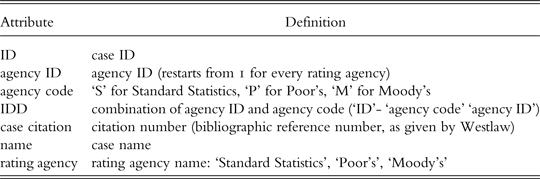
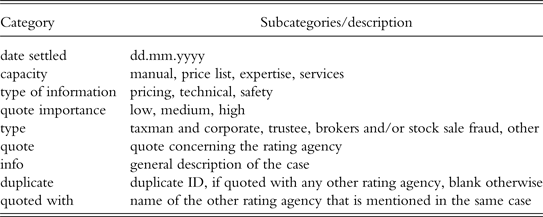
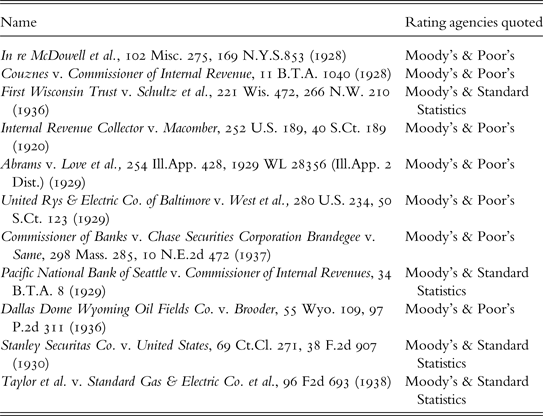
Furthermore, all cases were assigned the following attributes: ID, agency ID, agency code, IDD, case citation, name and rating agency (Table A.1). All variables of interest (incidence of quotations according to the type of information, capacity in which the agency acted, co-quotations etc.) were examined across time and recorded as indicated in Table A.2. Apart from the unrelated cases, all the remaining ones were furthermore coded: cases were also examined for co-quotations. Namely, whenever a case quoted more than one rating agency simultaneously a note was taken. As can be seen from Table A.3, no cases had reference to more than two rating agencies.
Number of unrelated vs valid cases by rating agency
Attributes of quotes found
Subcategories used in coding quotes
Legal cases with reference to more than one rating agency