Statement of research significance
Research Question: Do older adults with a self-reported prior history of traumatic brain injury (TBI) obtain more low scores on cognitive testing than those with no prior history of TBI?
Main Findings: Prior history of TBI was not associated with the number of observed low scores on cognitive testing.
Study Contributions: Results of the present study indicate that a self-reported history of TBI did not increase the probability of obtaining low scores on cognitive testing among older adults. However, more comprehensive characterization of TBI history (e.g., severity, frequency, recency) is needed to evaluate associations between TBI and cognitive test performance among older adults.
Introduction
Traumatic brain injury (TBI) is frequently associated with cognitive impairment in the acute post-injury phase (McCauley et al., Reference McCauley, Wilde, Barnes, Hanten, Hunter, Levin and Smith2014; de Freitas Cardoso et al., Reference de Freitas Cardoso, Faleiro, de Paula, Kummer, Caramelli, Teixeira and Miranda2019), typically followed by a degree of improvement and stabilization in the first few years that follow (Barker et al., Reference Barker, Horner and Bachman2010). However, a remote history of TBI has been shown to be a risk factor for cognitive impairment and dementia in older adults (Barnes et al., Reference Barnes, Byers, Gardner, Seal, Boscardin and Yaffe2018; Fann et al., Reference Fann, Ribe, Pedersen, Fenger-Gron, Christensen, Benros and Vestergaard2018; Li et al., Reference Li, Li, Li, Zhang, Zhao, Zhu and Tian2017). In clinical settings, neuropsychologists are frequently faced with interpreting a patient’s performance on objective neuropsychological measures and determining whether these reflect an expected pattern of performance associated with a remote TBI versus other etiologies, including typical aging. In the absence of clear or consistent evidence of low scores within a cognitive domain, a particular challenge is the clinical decision to confidently attribute low scores spread across a comprehensive neuropsychological test battery to the patient’s remote TBI versus normal variability in performance. The use of multivariate base rates (MBRs), or the number of low test scores observed across a battery of tests, can inform the expected frequency of low scores on objective neuropsychological measures, thereby guiding clinician interpretation and reducing the potential for over pathologizing a single or limited set of low scores (Romero et al., Reference Romero, Coleman, Heir, Leach and Proulx2022). To date, the expected prevalence of low scores among older adults with a history of TBI has not been characterized.
MBRs of low scores have been documented across a number of non-clinical populations (Holdnack et al., Reference Holdnack, Tulsky, Brooks, Slotkin, Gershon, Heinemann and Iverson2017; Karr et al., Reference Karr, Garcia-Barrera, Holdnack and Iverson2017). Findings suggest that low scores on standard neuropsychological measures are common, even among study samples that have excluded individuals with conditions that might negatively influence cognitive performance (Ivins, Arrieux, Schwab, Haran, & Cole, Reference Ivins, Arrieux, Schwab, Haran and Cole2019; Karr et al., Reference Karr, Rivera Mindt and Iverson2022). Base rates of low scores have been shown to be significantly associated with sociodemographic factors, especially age and education (Grewal et al., Reference Grewal, Gowda-Sookochoff, Kirk, Morgan and O’Connell2023). Among older adults, research indicates that a failure to account for MBRs may lead to an increased risk for false positive detection of diminished cognitive functioning – suggesting that it is normal to obtain a number of below expectation scores across a battery of cognitive tests (Brooks et al., Reference Brooks, Iverson, Holdnack and Feldman2008; Brooks et al., Reference Brooks, Iverson and White2007). Given that many older adults present for neuropsychological assessment in order to clarify the presence and severity of cognitive changes (Romero et al., Reference Romero, Coleman, Heir, Leach and Proulx2022), the use of MBRs to provide information beyond standard demographic corrections to normative data has the potential to improve accuracy in identifying decrements in cognitive functioning by providing benchmarks to differentiate between thresholds for low scores resulting from expected intraindividual variability from low scores that reflect reliable cognitive decline.
MBRs have been used to inform the interpretation of low neuropsychological test scores in multiple studies with older adults without cognitive impairment (Grewal et al., Reference Grewal, Gowda-Sookochoff, Kirk, Morgan and O’Connell2023; Kiselica et al., Reference Kiselica, Webber and Benge2020; Romero et al., Reference Romero, Coleman, Heir, Leach and Proulx2022). Studies have varied in the type of setting that data were collected in (e.g., clinical [Grewal et al., Reference Grewal, Gowda-Sookochoff, Kirk, Morgan and O’Connell2023; Romero et al., Reference Romero, Coleman, Heir, Leach and Proulx2022] vs. research [Kiselica et al., Reference Kiselica, Webber and Benge2020]), as well as inclusion criteria for determining the absence of cognitive impairment. Similar to studies that examined base rates of low neuropsychological test scores among adults (Holdnack et al., Reference Holdnack, Tulsky, Brooks, Slotkin, Gershon, Heinemann and Iverson2017; Ivins et al., Reference Ivins, Arrieux, Schwab, Haran and Cole2019; Karr et al., Reference Karr, Garcia-Barrera, Holdnack and Iverson2017; Karr et al., Reference Karr, Rivera Mindt and Iverson2022), the presence of one or more low scores was common across studies focused on older adults (Grewal et al., Reference Grewal, Gowda-Sookochoff, Kirk, Morgan and O’Connell2023; Kiselica et al., Reference Kiselica, Webber and Benge2020; Romero et al., Reference Romero, Coleman, Heir, Leach and Proulx2022). However, despite high rates of TBI among older adults (Waltzman et al., Reference Waltzman, Haarbauer-Krupa and Womack2022), these studies did not assess for an association between TBI history and MBRs of low scores on neuropsychological measures. Consequently, it is unknown whether older adults with a TBI history might be expected to produce low scores on cognitive testing at greater frequencies than cognitively intact older adults without a history of TBI.
The National Alzheimer’s Coordinating Center (NACC) database, representing the integration of clinical, neuroimaging, and neuropathological data from 34 past and present National Institute of Aging (NIA) – funded Alzheimer’s Disease Research Centers (ADRCs) across the United States from September 2005, has been used to examine the relationship between history of TBI and cognition in older adults. Findings from studies using the NACC database have been equivocal in establishing a predictive relationship between a history of self-reported TBI and Alzheimer’s disease (AD). For example, Sugarman et al. (Reference Sugarman, McKee, Stein, Tripodis, Besser, Martin and Alosco2019) did not identify a relationship between self-reported history of TBI and AD neuropathologic changes or cognitive function in a sample of 4,761 autopsy participants. Moreover, TBI history did not appear to alter the rate of cognitive decline in several NACC studies (Schaffert et al., Reference Schaffert, Chiang, Fatima, LoBue, Hart and Cullum2023; Schaffert et al., Reference Schaffert, LoBue, White, Chiang, Didehbani, Lacritz, Rossetti, Dieppa, Hart and Cullum2018; Tripodis et al., Reference Tripodis, Alosco, Zirogiannis, Gavett, Chaisson, Martin, McClean, Mez, Kowall, Stern and Adamson2017). In contrast, research examining NACC data have reported an association between history of TBI and earlier onset of AD-related cognitive decline (LoBue et al., Reference LoBue, Wadsworth, Wilmoth, Clem, Hart, Womack, Didehbani, Lacritz, Rossetti and Cullum2017; Schaffert et al., Reference Schaffert, LoBue, White, Chiang, Didehbani, Lacritz, Rossetti, Dieppa, Hart and Cullum2018). As can be inferred from results examining associations between TBI history and AD, disentangling contributors to onset and course of cognitive decline in older adults is complex. These findings underscore conflicting evidence for cognitive decline in older adults with a history of TBI.
Kiselica et al. (Reference Kiselica, Webber and Benge2020) examined the use of MBRs in a cognitively normal older adult sample, as well as a sample of individuals with mild cognitive impairment (MCI). Using the NACC Uniform Data Set 3.0 Neuropsychological Battery (UDS3NB: Weintraub et al., Reference Weintraub, Besser, Dodge, Teylan, Ferris, Goldstein, Giordani, Kramer, Loewenstein, Marson, Mungas, Salmon, Welsh-Bohmer, Zhou, Shirk, Atri, Kukull, Phelps and Morris2018; Weintraub et al., Reference Weintraub, Salmon, Mercaldo, Ferris, Graff-Radford, Chui, Cummings, DeCarli, Foster, Galasko, Peskind, Dietrich, Beekly, Kukull and Morris2009), they sought to examine the relationship between base rates of low scores and cut-point stringency in the cognitively normal sample. Similar to prior studies (Brooks et al., Reference Brooks, Iverson, Holdnack and Feldman2008; Brooks et al., Reference Brooks, Iverson and White2007; Brooks et al., Reference Brooks, Iverson and White2009; Holdnack et al., Reference Holdnack, Tulsky, Brooks, Slotkin, Gershon, Heinemann and Iverson2017; Schretlen et al., Reference Schretlen, Testa, Winicki, Pearlson and Gordon2008), they identified high base rates of low scores with expected variability based on the cut point used to identify abnormal performance. Kiselica et al. (Reference Kiselica, Webber and Benge2020) noted that this variability in low scores based on the selected cut-point had implications for the interpretation, as well as labeling, of low scores and their relationship to cognitive dysfunction.
The current study aimed to use MBRs to examine whether older adults with a self-reported history of TBI obtain low scores on UDS3NB measures at a greater frequency than those who do not. We tested the hypothesis that history of self-reported TBI was associated with low score frequency. The sample was characterized by sociodemographic variables, as well as neuropsychiatric symptoms given how frequently these types of symptoms are reported by individuals following TBI. We also included assessment of depressive symptoms and dementia severity, as both have the potential to negatively impact performance on objective cognitive assessment. Given limited prior studies examining MBRs and TBI characteristics (e.g., frequency, severity), as well as other relevant variables such as dementia severity (Grewal et al., 20,023), we also conducted exploratory analyses to examine the extent to which self-reported TBI characteristics are associated with performances on UDS3NB measures.
Method
Participants and design
We submitted a request for UDS data through NACC on June 30, 2023. Institutional Review Board approval from participating ADRCs was obtained for data collection procedures. Since 2005, approximately 30 ADRCs have contributed to the NACC UDS, which is a database of standardized cognitive, behavioral, and functional participant evaluations; a full description has been previously published (Beekly et al., Reference Beekly, Ramos, Lee, Deitrich, Jacka, Wu, Hubbard, Koepsell, Morris and Kukull2007; Weintraub et al., Reference Weintraub, Salmon, Mercaldo, Ferris, Graff-Radford, Chui, Cummings, DeCarli, Foster, Galasko, Peskind, Dietrich, Beekly, Kukull and Morris2009). Data included in this manuscript was obtained in compliance with the Helsinki Declaration.
The provided UDS data included 47,772 participants through March 2023. Selection criteria included adults 65 years or older, consistent with published definitions of older adults (Sanderson & Scherbov, Reference Sanderson and Scherbov2008), for whom English was their primary language, absence of self-reported history of alcohol or substance abuse, completion of UDS3NB, and self-report of either no history of TBI (i.e., absent) or remote/inactive history of TBI. Participants who self-reported recent/active, unavailable, or unknown TBI history were excluded (see Supplemental Figure 1).
Measures
TBI history
TBI history was self-reported as either “absent,” meaning no prior history of TBI, or “remote/inactive,” meaning the most recent TBI occurred more than 1 year prior to the research study visit and the participant endorsed a full recovery or no current treatment. TBI history was also characterized, per self-report, with respect to frequency (“no,” “single,” or “repeated/multiple” prior TBIs) and severity (brief LOC [<5 minutes], extended LOC [≥ 5 minutes], or no LOC).
Cognitive tests
The UDS3NB measures have been previously described in detail (Weintraub et al., Reference Weintraub, Besser, Dodge, Teylan, Ferris, Goldstein, Giordani, Kramer, Loewenstein, Marson, Mungas, Salmon, Welsh-Bohmer, Zhou, Shirk, Atri, Kukull, Phelps and Morris2018). The following measures were included in the current analyses: Montreal Cognitive Assessment, Craft Story 21, Benson Complex Figure copy and recall, Number Span, Multilingual Naming Test, letter fluency test (F, L), category fluency (animals, vegetables), and the Trail Making Test Parts A and B. The 12 primary scores were included in analyses; participants with missing data were excluded. To maintain uniformity within the test battery and consistency across participants, measures that were only included in prior versions of the UDS and not the UDS3NB were not included.
Mood scales
Depressive symptomatology was assessed using the Geriatric Depression Scale, short form (GDS-SF), a 15-item scale comprised of common symptoms of depression among older adults (Shiekh, Reference Shiekh1986). Scores range from 0-15; scores between 5-9 suggest possible depression and scores 10 or above are highly suggestive of clinical depression.
Dementia severity
The Clinical Dementia Rating (CDR) Dementia Staging Instrument was used to determine a global rating of dementia severity. Scores capture the following range of cognitive functioning: cognitively normal (CDR = 0), mild cognitive impairment (CDR = 0.5), mild dementia (CDR = 1), moderate dementia (CDR = 2), and severe dementia (CDR = 3; Morris, Reference Morris1993).
Neuropsychiatric symptoms
We assessed between-group differences on the Neuropsychiatric Inventory Questionnaire (NPI-Q; Cummings et al., Reference Cummings, Mega, Gray, Rosenberg-Thompson, Carusi and Gornbein1994). The NPI-Q consists of informant report on a series of neuropsychiatric symptoms (e.g., delusions, hallucinations, agitations) that were rated as present or absent in the past month.
Statistical analyses
We compared participants with and without a self-reported history of TBI at their baseline visit on sociodemographic variables, cognitive status, and symptoms of depression using either t-tests or chi-square tests; effect sizes were reported as either Cohen’s d or Cramer’s V. Raw scores for UDS3NB measures were input into a regression equation that adjusted for age, sex, and years of education and converted to standardized z-scores using procedures described by Weintraub et al. (Reference Weintraub, Besser, Dodge, Teylan, Ferris, Goldstein, Giordani, Kramer, Loewenstein, Marson, Mungas, Salmon, Welsh-Bohmer, Zhou, Shirk, Atri, Kukull, Phelps and Morris2018) based on performance on baseline cognitive testing in a cognitively intact (i.e., CDR = 0) subsample within the UDS3. In brief, the multivariable regression model produced an expected raw score for a given test adjusted for age, sex, and education. The difference between the expected and observed score was divided by the standard error of the estimate to compute a standardized z-score.
Multivariate Base Rates (MBRs) of Low Scores
Using the resultant standardized z-scores derived from the regression procedure described above, we examined the number of low scores falling below multiple cutoffs (SDs): ≤ 16th, ≤ 9th, ≤ 5th and ≤ 2nd percentiles, respectively, for each participant. MBRs of low scores were examined by individual test scores and self-reported history of TBI. For self-reported history of TBI (absent vs. remote/inactive), we applied criteria adopted from Kiselica et al. (Reference Kiselica, Webber and Benge2020) to define an atypical number of low scores as the number of low scores at a given cutoff (e.g., ≤ 5th percentile) for which 5% or less of a sample of cognitively normal (CDR = 0) older adults obtained low scores. These criteria indicated that cutoffs of 4 or more scores ≤ 5th percentile (5.2% of cognitively normal older adults) and 3 or more scores ≤ 2nd percentile (3.6% of cognitively normal adults), respectively, captured 5% or fewer of cognitively normal older adults (Kiselica et al., Reference Kiselica, Webber and Benge2020). Base rates of low scores were reported for the full sample and for cognitively normal participants (CDR = 0). We also performed exploratory between-group difference analyses of MBRs of low scores by self-reported TBI severity and frequency.
Correlates of Low Scores
To assess for sources of variance in frequency of low scores (≤ 5th percentile cutoff), and specifically unique variance attributable to self-reported TBI history, we analyzed Spearman rank-order correlations and Mann-Whitney U tests. Specifically, we assessed for associations between age, sex, education, GDS score, TBI history, and time elapsed since most recent TBI within both cognitively normal (CDR = 0) and mild cognitive impairment (CDR = 0.5-1) groups. To reduce risk for Type I error, the Benjamini-Hochberg (BH) procedure to adjust for multiple comparisons was used (Benjamini & Hochberg, Reference Benjamini and Hochberg1995). The false discovery rate was 0.05. We conducted 12 statistical tests as part of these analyses; results were interpreted as statistically significant if the test p value was smaller than the BH value. Analyses were conducted using SPSS version 28.0.
Results
After applying the selection criteria, as can be seen in Table 1, 7,363 participants were included in analyses; of those, 6,456 reported no history of prior TBI (TBI-) and 907 reported a remote history of TBI (TBI+). Sociodemographic comparisons revealed statistically significant differences between participants with and without a self-reported history of TBI. Participants in the TBI + group obtained more years of education than those in the TBI- group (TBI+: M = 16.7, SD = 4.7, TBI-: M = 16.6, SD = 5.7; p<0.01, Cohen’s d = 0.10, 95% CI: 0.02, 0.17); had higher Global CDR scores than those in the TBI- group (TBI+: M = 0.32, SD = 0.33, TBI−: M = 0.27, SD = 0.33; p<0.01, Cohen’s d = 0.15, 95% CI: 0.08, 0.22); and had higher scores on the GDS-SF (TBI+: M = 1.90, SD = 2.23, TBI-: M = 1.57, SD = 2.06; p<0.01, Cohen’s d = 0.16, 95% CI: 0.09, 0.23). Additionally, men were overrepresented in the TBI+ group (54.2%) as compared to the TBI- group (40.0%; χ2 = 66.14, p<0.01, Cramer’s V = 0.10), and there were more white participants in the TBI+ group (86.0%) than the TBI- group (78.9%; χ2 = 42.07, p<0.01, Cramer’s V = 0.08). Notably, the effect sizes for these differences were negligible (Cohen’s d ≥ −0.16, ≤ 0.15 and Cramer’s V<0.10). There were no statistically significant between-group differences in ethnicity or number of APOE e4 alleles (i.e., 0, 1, or 2). Sensitivity analyses assessing for differences secondary to primary language, alcohol use, substance abuse, and missing cognitive data revealed a negligible difference in TBI history between participants who did and did not meet inclusion criteria. Specifically, 427 of 3,027 (14.1%) of older adults who did not meet inclusion criteria as compared to 907 of 7,363 (12.3%) older adults who met inclusion criteria reported a prior TBI history (χ2 = 6.13, p = 0.01, Cramer’s V = 0.01). Additionally, there were only negligible between-group differences (i.e., Cramer’s V<0.06) with respect to TBI frequency and severity (see Supplemental Table 1).
Description of study sample

Note. 1“Unknown” was reported for 24 participants in the TBI- group and 2 in the TBI + group. 2GDS data “not available” or “could not be calculated” for 79 participants in the TBI- group and 10 participants in the TBI group. 4“Unknown” was reported for 2,067 participants in the TBI- group and 280 participants in the TBI + group. 5APOE e4 data were available for 5,016 participants; 4,389 in the TBI- group and 627 in the TBI + group.
Neuropsychiatric symptoms
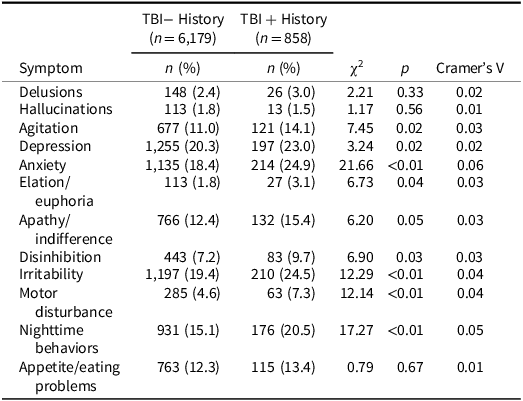
As can be seen in Table 2, informants of participants with TBI + more commonly endorsed that the participant experienced anxiety (24.9% vs. 18.4%), irritability (24.5% vs. 19.4%), motor disturbance (7.3% vs. 4.6%), and nighttime behaviors (20.5% vs. 15.1%) compared to TBI-. However, the effect sizes were small in magnitude (Cramer’s V<0.10). There were no other statistically significant differences between groups.
Differences on the Neuropsychiatric Inventory Questionnaire (NPI-Q) among older adults with and without a self-reported history of traumatic brain injury

Multivariate base rates of low scores
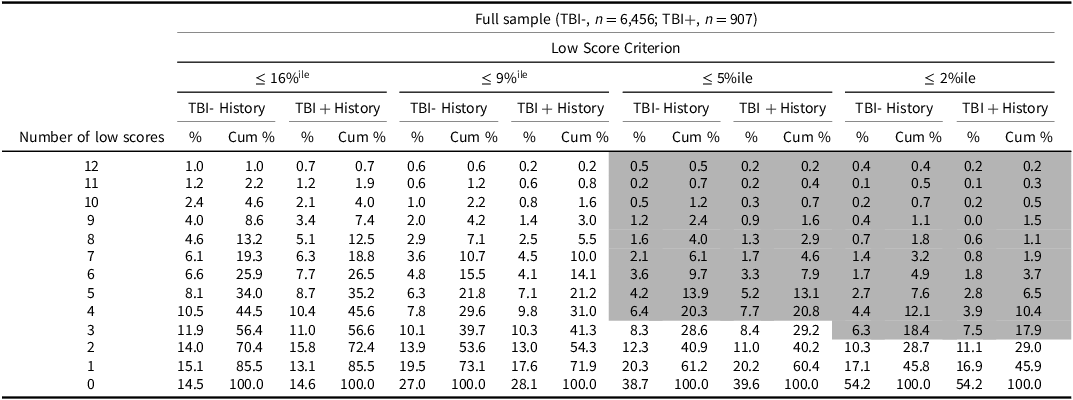
MBRs of low scores for the full sample across all cutoffs are displayed in Table 3. Among the full sample, at the 5th percentile cutoff, 20.3% of the TBI- participants and 20.8% of the TBI + participants obtained 4 or more low scores which did not result in a statistically significant difference (χ2 = 0.08, p = 0.78, Cramer’s V = 0.00). Similarly, at the 2nd percentile cutoff, 18.4% of the TBI- participants and 17.9% of the TBI + participants obtained 3 or more low scores which did not result in a statistically significant difference (χ2 = 0.23, p = 0.64, Cramer’s V = 0.01).
Prevalence of low scores on the Uniform Data Set 3 cognitive test battery among older adults by self-reported history of traumatic brain injury

Note. TBI = traumatic brain injury; Cum % = cumulative percentage; CDR = Clinical Dementia Rating; gray shading is used to denote the percentages of participants obtaining an atypical number of low scores using adapted criteria from Kiselica et al. (Reference Kiselica, Webber and Benge2020).
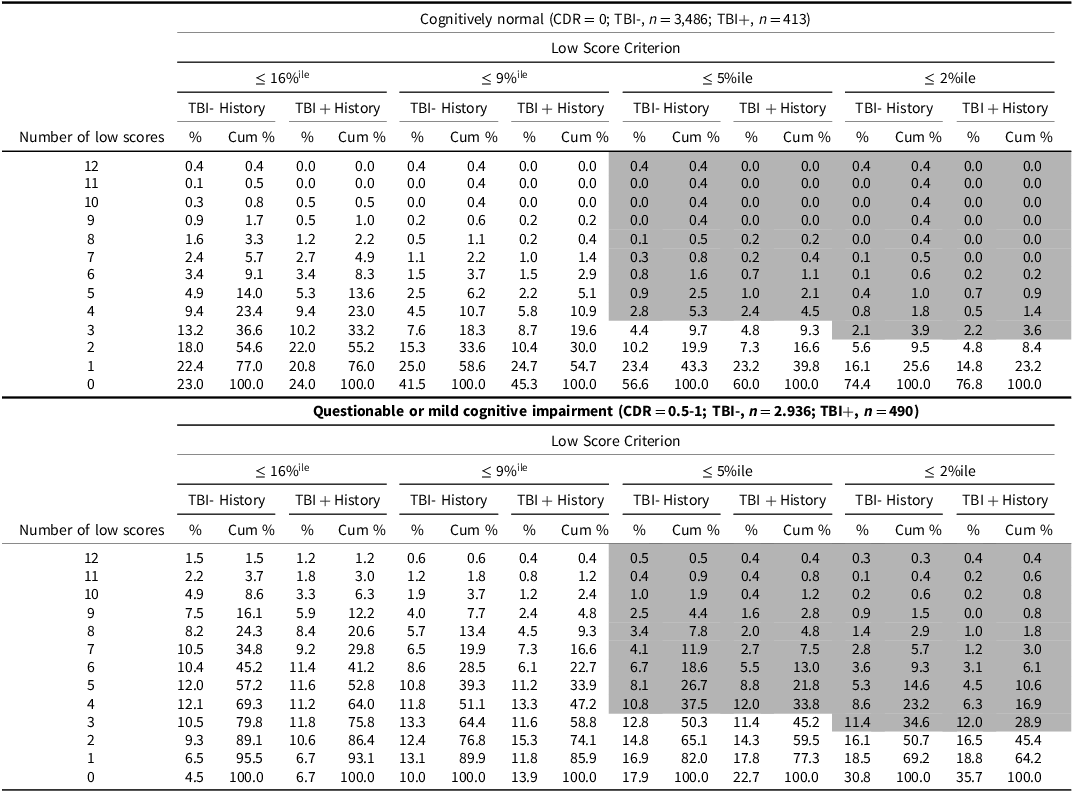
Table 4 reports MBRs of low scores stratified by cognitive status. Among cognitively normal participants (CDR = 0), at the 5th percentile cutoff, 5.3% of the TBI- participants and 4.5% of the TBI+ participants obtained 4 or more low scores which did not result in a statistically significant difference (χ2 = 0.40, p = 0.53, Cramer’s V = 0.01). At the 2nd percentile cutoff, 3.9% of the TBI- participants and 3.6% of the TBI + participants obtained 3 or more low scores which did not result in a statistically significant difference (χ2 = 0.09, p = 0.77, Cramer’s V = 0.01). Among participants rated as having questionable or mild cognitive impairment (CDR = 0.5-1), at the 5th percentile cutoff, 37.5% of the TBI- participants and 33.8% of the TBI+ participants obtained 4 or more low scores which did not result in a statistically significant difference (χ2 = 2.36, p = 0.12, Cramer’s V = 0.03). At the 2nd percentile cutoff, 34.6% of the TBI- participants and 28.9% of the TBI + of participants obtained 3 or more low scores which did result in a statistically significant difference (χ2 = 6.08, p = 0.01); however, the effect size was negligible (Cramer’s V = 0.04).
Prevalence of low scores on the Uniform Data Set 3 cognitive test battery among older adults by self-reported history of traumatic brain injury and cognitive status

Note. TBI = traumatic brain injury; Cum % = cumulative percentage; CDR = Clinical Dementia Rating; gray shading is used to denote the percentages of participants obtaining an atypical number of low scores using adapted criteria from Kiselica et al. (2020).
Exploratory analyses assessed for between-group differences in MBRs of low scores and self-reported TBI frequency and severity. As shown in Figure 1, there did not appear to be differences in the number of low scores on cognitive tests among participants who reported either a single TBI with brief LOC (i.e., < 5 minutes), repeated/multiple TBIs with brief LOC, or no TBI. Applying the first criterion for an atypical number of low scores, 4 or more scores ≤ 5th percentile, there were no between-group differences, χ2(2) = 1.03, p = 0.597, Cramer’s V = 0.04; similarly, applying the second criterion, 3 or more scores ≤ 2nd percentile, there were no between-group differences, χ2(2) = 0.97, p = 0.617, Cramer’s V = 0.03.
Prevalence of low scores among older adults with a self-reported history of traumatic brain injury with brief loss of consciousness (<5 minutes) stratified by frequency (single TBI, repeated/multiple TBIs, or no TBIs).

As shown in Figure 2, there did not appear to be differences in the number of low scores on cognitive tests among participants who reported either a single TBI with extended LOC (i.e., < 5 minutes), repeated/multiple TBIs with extended LOC, or no TBI. Applying the first criterion for an atypical number of low scores, 4 or more scores ≤ 5th percentile, there were no between-group differences, χ2(2) = 0.86, p = 0.652, Cramer’s V = 0.03; similarly, there were no between-group differences after applying the second criterion, 3 or more scores ≤ 2nd percentile, χ2(2) = 1.89, p = 0.389, Cramer’s V = 0.05.
Prevalence of low scores among older adults with a self-reported history of traumatic brain injury with extended loss of consciousness (≥5 minutes) loss of consciousness stratified by frequency (single TBI, repeated/multiple TBIs, or no TBIs).

And as shown in Figure 3, there did not appear to be differences in the number of low scores on cognitive tests among participants who reported either a single TBI without LOC, repeated/multiple TBIs without LOC, or no TBI. Applying the first criterion for an atypical number of low scores, 4 or more scores ≤ 5th percentile, there were no between-group differences, χ2(2) = 3.11, p = 0.204, Cramer’s V = 0.06; similarly, applying the second criterion, 3 or more scores ≤ 2nd percentile, there were no between-group differences, χ2(2) = 3.60, p = 0.165, Cramer’s V = 0.07.
Prevalence of low scores among older adults with a self-reported history of traumatic brain injury without extended loss of consciousness loss of consciousness stratified by frequency (single TBI, repeated/multiple TBIs, or no TBIs).

Correlates of low scores
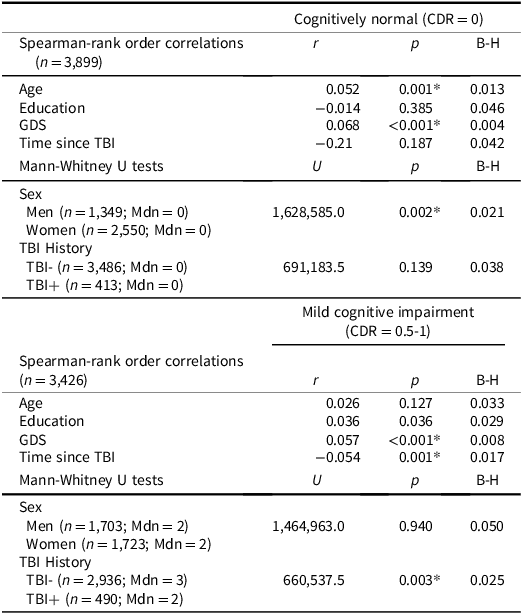
Results of Spearman rank-order correlations and Mann-Whitney U tests are displayed in Table 5. Among cognitively normal participants (CDR = 0), age, sex, and GDS score showed an association with low score frequency. Specifically, there were positive correlations between age (r = 0.05, p = 0.001), GDS score (r = 0.07, p<0.001), and low score frequency such that older age or a greater burden of depression symptoms was associated with a higher number of low scores. Regarding sex, men (Mdn = 0, M = 0.93, SD = 1.51) obtained low scores more frequently than women (Mdn = 0, M = 0.80, SD = 1.39); however, low scores were uncommon among cognitively normal participants.
Correlates of low score (≤ 5th %ile) frequency

Note. B-H = Adjusted Benjamini-Hochberg p value; CDR = Global Clinical Dementia Rating; GDS = Geriatric Depression Scale; TBI = traumatic brain injury; MCI = mild cognitive impairment; Mdn = median. Only 35 participants had CDR>1. *indicates statistical significance after Benjamini-Hochberg adjustment for multiple comparisons.
Among participants with mild cognitive impairment (CDR = 0.5-1), GDS score and time interval since most recent TBI showed an association with low score frequency. There was a positive correlation between GDS score (r = 0.06, p<0.001) and low score frequency such that a greater burden of depression symptoms was associated with a higher number of low scores. In contrast, there was a negative correlation between time since TBI (r = −0.05, p = 0.001) and low score frequency, such that a shorter time interval, or more recent TBI, was associated with a higher number of low scores. Regarding TBI history, participants with no prior TBI history (Mdn = 3, M = 3.08, SD = 2.65) obtained low scores more frequently than participants with a prior history of TBI (Mdn = 2, M = 2.69, SD = 2.58).
Discussion
The current study leveraged the NACC observational dataset to examine potential differences in the prevalence of low scores on neuropsychological measures among older adults with and without a self-reported history of TBI. Self-reported history of TBI was not associated with the frequency of low scores on the NACC UDS 3.0 neuropsychological battery. There were, however, several interesting associations identified; among participants rated as cognitively normal, older age, male sex and greater levels of depressive symptomatology were associated with more low scores while neither TBI history nor time since TBI showed an association. Additionally, among participants rated as showing questionable or mild cognitive impairment, greater levels of depressive symptomatology, and shorter time since TBI, and no prior history of TBI were associated with prevalence of low scores. It is worth noting that very few participants reported sustaining their TBI close in time to data collection (2% within 1 year; 13.5% within five years), therefore it is less likely that the association between low scores and shorter time since TBI is attributable to pre-existing low scores prior to TBI. Although findings primarily highlight a lack of association between history of self-reported TBI and frequency of low scores on cognitive measures, they also support existing findings regarding psychological and sociodemographic correlates of MBRs and underscore nuances of examining cognitive functioning among older adults with self-reported TBI histories.
Research examining the association between TBI history and late-life cognitive decline is complex and largely reliant on documentation of self-report archived in medical records. For example, large-scale studies of Veterans Health Administration and the Danish Civil Registration System reported statistically significant associations between TBI history and risk of dementia (Barnes et al., Reference Barnes, Byers, Gardner, Seal, Boscardin and Yaffe2018; Fann et al., Reference Fann, Ribe, Pedersen, Fenger-Gron, Christensen, Benros and Vestergaard2018) and aggregated research has yielded similar results (Gu et al., Reference Gu, Ou and Liu2022). One would expect individuals with dementia to display a greater frequency of low scores than those without, after accounting for factors influencing performance such as educational attainment, sex, or other social determinants of health. Interestingly, the current study did not detect a clinically meaningful difference in MBRs between individuals with and without a history of TBI.
History of TBI has been identified as a risk factor for dementia, although establishing an association between TBI and specific dementia subtypes has been more elusive, particularly given limitations associated with using clinical diagnoses and increasing evidence obtained in vivo and postmortem supporting a relationship between TBI and multiple neuropathologies, as well as polypathology (Brett, Gardner, Godbout, Dams-O’Connor, & Keene, Reference Brett, Gardner, Godbout, Dams-O’Connor and Keene2022). For example, the relationship between TBI history and neuropathological changes associated with AD and non-AD related disorders is mixed (Agrawal et al., Reference Agrawal, Leurgans, James, Barnes, Mehta, Dams-O’Connor, Mez, Bennett and Schneider2022; Crane et al., Reference Crane, Gibbons, Dams-O’Connor, Trittschuh, Leverenz, Keene and Larson2016; Sugarman et al., Reference Sugarman, McKee, Stein, Tripodis, Besser, Martin and Alosco2019; Weiner, Crane, Montine, Bennett, & Veitch, Reference Weiner, Crane, Montine, Bennett and Veitch2017), suggesting that the role of TBI history in conferring risk for cognitive change in older adults is decidedly more complex than might be inferred when only considering clinical diagnosis. The current findings indicate the need for further investigation into the relationship between TBI history and clinical cognitive changes in older adults.
Challenges inherent to TBI research are evident in attempting to interpret the results of the present study. As has been described elsewhere, TBI history is often not comprehensively characterized in research and clinical settings (Gaudet, Iverson, Kissinger-Knox, Van Patten, & Cook, Reference Gaudet, Iverson, Kissinger-Knox, Van Patten and Cook2022). For example, critical components of TBI history such as the exact number of prior TBIs (i.e., measured continuously rather than categorically [e.g., multiple vs. none]), the time interval between prior TBIs (e.g., 2 months vs. 20 years), and nature and severity of prior TBIs, are often lacking. Given evidence for associations between cognitive decline later in life and TBI-related variables (e.g., Chanti-Ketterl et al., Reference Chanti-Ketterl, Pieper, Yaffe and Plassman2023; Lennon et al., Reference Lennon, Brooker, Creese, Thayanandan, Rigney, Aarsland, Hampshire, Ballard, Corbett and Raymont2023), more detailed characterization of TBI history has the potential to improve research and clinical care and treatment for older adults with a TBI history.
Moreover, these findings should be considered within the context of several limitations. First, the NACC dataset includes information about participants’ self-reported history of TBI, though this information is not corroborated with medical records or collateral report. It is possible that participants may inaccurately report their TBI history, including the presence and severity of a potential injury. In addition, categorization of TBI severity was limited to injuries with or without loss of consciousness and did not conform to standardized diagnostic criteria (Silverberg et al., Reference Silverberg, Iverson, Group, Cogan, Dams-O-Connor, Delmonico, Graf, Iaccarino, Kajankova, Kamins, McCulloch, McKinney, Nagele, Panenka, Rabinowitz, Reed, Wethe, Whitehair and Zemek2023; Management of Concussion/mTBI Working Group, 2009). For participants who endorsed a history of a TBI with LOC, length of LOC was reported as less than or greater than 5 minutes, which limited the ability to examine possible differences in individuals with very brief or more extended LOC duration. The NACC dataset includes limited information pertaining to factors associated with social determinants of health (e.g., neighborhood disadvantage, education quality, access to healthcare, etc.), reducing the ability to examine these contextual factors in multivariate analyses. However, it is noted that the next iteration of the UDS, the UDS4, will include assessment of social determinants of health. NACC data included participants who obtained scores on cognitive measures that were at the floor (lowest possible achievable score) and ceiling effects (highest possible score) were evident on several measures. Resultantly, multivariable regression models developed to produce standardized scores adjusted for age, sex, and education likely do not meet all statistical assumptions (Weintraub et al., Reference Weintraub, Besser, Dodge, Teylan, Ferris, Goldstein, Giordani, Kramer, Loewenstein, Marson, Mungas, Salmon, Welsh-Bohmer, Zhou, Shirk, Atri, Kukull, Phelps and Morris2018); however, these concerns are mitigated by the large relative sample size (Schmidt & Finan, Reference Schmidt and Finan2018). Of note, research has demonstrated a propensity of the Weintraub et al. (Reference Weintraub, Besser, Dodge, Teylan, Ferris, Goldstein, Giordani, Kramer, Loewenstein, Marson, Mungas, Salmon, Welsh-Bohmer, Zhou, Shirk, Atri, Kukull, Phelps and Morris2018) linear regression procedure to produce overestimates of divergence of age, sex, and education adjusted means relative to non-linear procedures (Kornak et al., Reference Kornak, Fields, Kremers, Farmer, Heuer and Forsberg2019). Consequently, linear modeling may have resulted in a marginal overrepresentation of the frequency of low scores in this study; such overrepresentation is present across subgroups and does not meaningfully alter comparative results. Future research will benefit from non-linear modeling procedures described by Kornak et al. (Reference Kornak, Fields, Kremers, Farmer, Heuer and Forsberg2019). Lastly, we excluded participants with missing cognitive data to ensure fidelity of multivariable base rates with respect to observed test scores. In so doing, participants with more significant cognitive impairment, who only partially completed the cognitive test battery may have been excluded; however, this limitation is mitigated somewhat by results of sensitivity analyses showing negligible difference in TBI history between participants who met and did not meet inclusion criteria.
In conclusion, MBRs of low scores on cognitive testing do not appear to reliably differentiate between older adults with and without self-reported TBI histories, which question the clinical utility of this methodology within this patient population. However, it is unclear whether, or the extent to which, this finding may vary as a function of prior TBI frequency and/or severity. Results raise the possibility that among older adults with suspected questionable or mild cognitive impairment, shorter duration of time since most recent TBI may increase the probability of obtaining low scores on cognitive testing. Future investigations reliant on participant self-report will benefit from gathering more comprehensive details through the use of standardized measures (e.g., Brain Injury Screening Questionnaire; Dams-O’Connor et al., Reference Dams-O’Connor, Cantor, Brown, Dijkers, Spielman and Gordon2014) regarding the frequency, nature, and severity of prior TBIs.
Supplementary material
The supplementary material for this article can be found at https://doi.org/10.1017/S1355617725000116
Acknowledgements
Competing interests
CEG receives royalties from Oxford University Press Inc. CEJ has no conflicts of interest to declare. MLA receives royalties from Oxford University Press Inc., research support from Rainwater Charitable Foundation Inc. and Life Molecular Imaging Inc., and has also received a single time honorarium from Michael J Fox Foundation for services unrelated to this study.
Financial support
The NACC database is funded by NIA/NIH Grant U24 AG072122. NACC data are contributed by the NIA-funded ADRCs: P30 AG062429 (PI James Brewer, MD, PhD), P30 AG066468 (PI Oscar Lopez, MD), P30 AG062421 (PI Bradley Hyman, MD, PhD), P30 AG066509 (PI Thomas Grabowski, MD), P30 AG066514 (PI Mary Sano, PhD), P30 AG066530 (PI Helena Chui, MD), P30 AG066507 (PI Marilyn Albert, PhD), P30 AG066444 (PI John Morris, MD), P30 AG066518 (PI Jeffrey Kaye, MD), P30 AG066512 (PI Thomas Wisniewski, MD), P30 AG066462 (PI Scott Small, MD), P30 AG072979 (PI David Wolk, MD), P30 AG072972 (PI Charles DeCarli, MD), P30 AG072976 (PI Andrew Saykin, PsyD), P30 AG072975 (PI David Bennett, MD), P30 AG072978 (PI Neil Kowall, MD), P30 AG072977 (PI Robert Vassar, PhD), P30 AG066519 (PI Frank LaFerla, PhD), P30 AG062677 (PI Ronald Petersen, MD, PhD), P30 AG079280 (PI Eric Reiman, MD), P30 AG062422 (PI Gil Rabinovici, MD), P30 AG066511 (PI Allan Levey, MD, PhD), P30 AG072946 (PI Linda Van Eldik, PhD), P30 AG062715 (PI Sanjay Asthana, MD, FRCP), P30 AG072973 (PI Russell Swerdlow, MD), P30 AG066506 (PI Glenn Smith, PhD), P30 AG066508 (PI Stephen Strittmatter, MD, PhD), P30 AG066515 (PI Victor Henderson, MD, MS), P30 AG072947 (PI Suzanne Craft, PhD), P30 AG072931 (PI Henry Paulson, MD, PhD), P30 AG066546 (PI Sudha Seshadri, MD), P20 AG068024 (PI Erik Roberson, MD, PhD), P20 AG068053 (PI Justin Miller, PhD), P20 AG068077 (PI Gary Rosenberg, MD), P20 AG068082 (PI Angela Jefferson, PhD), P30 AG072958 (PI Heather Whitson, MD), P30 AG072959 (PI James Leverenz, MD).