Introduction
Deliberative mini-publics constitute a tangible institutional form of deliberative democracy, but they are far from embodying it in its fullest sense (Chambers, Reference Chambers2012). Despite their intuitive appeal and reasonably wide-scale adoption, they are not without critics, especially from a participatory perspective (Pateman, Reference Pateman2012). A prominent argument is that, by contriving a deliberative ideal but only including a small portion of affected citizens, they are disconnected from the ‘real world’ of politics in a manner that undermines their legitimacy (Parkinson, Reference Parkinson2006).
The recent systemic turn in deliberative democracy is in part an attempt to recapture the mass political dimension of deliberative democracy. There are already a number of contributions to systems thinking in deliberative democracy.Footnote 1 Mansbridge et al.’s (2012) version emphasizes specific sites involving different types and styles of deliberation that collectively produce deliberative outcomes. Goodin (Reference Goodin2005) envisages a kind of system where different styles of deliberation occur in sequence. Dryzek’s (Reference Dryzek2009, 2010) account of deliberative systems focuses on the need for ‘deliberative capacity’ and provides specific criteria for assessing the extent that it is constituted by ‘structures to host deliberation that is authentic, inclusive and consequential’ (Dryzek, 2010: 137).
Importantly, the systemic ‘turn’ does not preclude a role for mini-publics in deliberative systems. Rather, it provides new opportunities for exploring the prospects and limits of their role in deliberative democratization (Dryzek, Reference Dryzek2009). In systemic terms mini-publics are no longer viewed as discrete entities, but as parts of an interconnected wider system composed of various sites for deliberation.
Accordingly, assessment of mini-publics requires a systemic approach that links the assessment of the quality of deliberation in mini-publics with macro-political impacts. A systemic analysis is ideally sensitive to the function of a mini-public within the democratic system, as well as the particular characteristics of that system and its interaction with deliberative design. For example, a mini-public may represent the very best practice in terms of design and implementation, but its impact will depend on other features of the deliberative system – such as the way in which decision makers treat their outputs (e.g. Dryzek et al., Reference Dryzek, Goodin, Tucker and Reber2009).
This focus on the interconnectedness of mini-publics to the deliberative system is relatively novel.Footnote 2 Moreover, there has not yet been any attempt to specifically look at mini-publics through the lens of deliberative capacity as part of a deliberative system. The empirical challenge is to examine how various sites, such as mini-publics, contribute to the system’s deliberative capacity. Here we seek to meet this challenge by assessing specific mini-publics in a way that is sensitive to the reciprocal relationship between them and features of the wider system.
To highlight these dynamics we employ the concept of deliberative capacity. The approach is illustrated using two mini-public case studies with different design features and political contexts – although despite this difference, we find that they share certain features with respect to deliberative capacity.Footnote 3
The first case study concerns the 2009 Australian Citizens’ Parliament (ACP), a national-level deliberative event involving 150 participants drawn from each of the Australian Federal electorates, addressing the broad topic of how best to strengthen the Australian parliamentary system. The second case concerns the 2012 Iniziativa di Revisione Civica (Civic Revision Initiative, CRI), a government-commissioned mini-public comprising 20 citizens, focussed on the amalgamation of five municipalities near Bologna, Italy.
The paper begins by introducing the concept of deliberative capacity, which informs the assessment that follows. The methods used for this assessment are briefly explained before each of the case studies are introduced and analysed with respect to their contribution to deliberative capacity within their particular political contexts. We then compare the results and consider the implications for assessing mini-publics as part of a deliberative system before drawing the major conclusions from this assessment.
Deliberative capacity and assessment of mini-publics in deliberative systems
In adopting a systemic approach to assessing mini-publics we draw on Dryzek’s (Reference Dryzek2009) conceptualization of deliberative capacity building.Footnote 4 Deliberative capacity is grounded in an understanding of democracy as an ongoing project, and can be used to envision strategies towards discursive democratization of societies. Importantly, according to Dryzek, the idea of deliberative capacity is particularly suited for comparative analysis of different systems – a task that we seek to undertake here. While it might be possible to quantify differences, Dryzek’s own employment of this concept for empirical studies follows a qualitative and interpretive approach (Stevenson and Dryzek, Reference Stevenson and Dryzek2012), which we also adopt in this paper. Indeed, in the wake of the systemic turn deliberative democrats have remarked that, besides more positivist approaches, qualitative and interpretive methodologies can give a fundamental contribution in shaping our understanding of deliberative democracy (see Hendriks et al., Reference Hendriks, Ayirtman Ercan and Boswell2013).
The concept of deliberative capacity provides diagnostic criteria for assessing the system – via deliberative authenticity, inclusiveness, and consequentiality – although the specifics can be difficult to elaborate. We describe these features and their implications for assessment of mini-publics in greater detail below.
Authenticity
Deliberation exhibits authenticity to the extent that it is unaffected by coercion, induces reflection about preferences, reveals claims that are systematically connected to more general principles, and exhibits reciprocity (Dryzek, 2010: 136–137). Although these principles of deliberative authenticity are relatively well accepted among deliberative democrats (see e.g. Goodin, Reference Goodin2005), identification in practice is more challenging and less well developed (Thompson, Reference Thompson2008). Apart from the discourse quality index (Steenbergen et al., Reference Steenbergen, Bächtiger, Spörndli and Steiner2003), there are relatively few clear and widely accepted diagnostic criteria for authentic deliberation.Footnote 5
In the absence of a definitive metric of deliberative authenticity we adopt descriptive analyses, both of the process of deliberation and of the nature of transformations among the group. In terms of the deliberative process, Gastil (Reference Gastil2008, cited in Gastil, Reference Gastil2013) provides a useful diagnostic for qualitatively assessing deliberation, based on the criteria of analytical rigour (related to what Bächtiger and Gerber refer to as contestation, Reference Bächtiger and Gerber2014) and social relationships (related to the appreciative dimension identified by Curato et al., Reference Curato, Niemeyer and Dryzek2013).Footnote 6 This analysis has been performed for the ACP by Gastil (Reference Gastil2013) and we deploy a similar approach, although less extensive and formal, for the CRI. We also draw on analysis by Curato et al. (Reference Curato, Niemeyer and Dryzek2013) on the nature of discussion that parallels this approach, which tracks the relative amount of time dedicated to ‘appreciative’ (social relationship) and ‘contestatory’ (analytical rigour) inquiry. This study also draws on analysis of deliberative transformation of both preferences and underlying ‘discursive’ perspectives, which are analysed for both studies. The approach uses Q methodology to assess the available discourses, their transformation during the deliberative process and relationship to preferences (Niemeyer et al., Reference Niemeyer, Batalha and Dryzek2013).Footnote 7
Our assessment of deliberation also recognizes that it is generally more straightforward to identify when deliberation is clearly not authentic. For example, a process may be dominated by more powerful, or privileged members of the community in ways that Young (Reference Young1999) objects to. Moreover, as Curato et al. (Reference Curato, Niemeyer and Dryzek2013) recognize in relation to the ACP, deliberation can lack a clear epistemic dimension of the sort that is likely to induce considered reflection on preferences.Footnote 8
Inclusiveness
Inclusiveness is important for assessing a mini-public’s democratic qualities. Dryzek (Reference Dryzek2009) adopts a ‘discursive’ approach to inclusiveness (Dryzek and Niemeyer, Reference Dryzek and Niemeyer2008), which refers ‘to the range of interests and discourses present in a political setting’. This contrasts with the common approach to mini-public recruitment, involving ‘descriptive’ forms of representation (Mansbridge, Reference Mansbridge2000) to reflect the demographic characteristics of the population (e.g. age, gender, education). We include both approaches in assessing the inclusiveness of the two case studies.
We also take into account another dimension that is especially relevant to mini-publics. That is, the representativeness of arguments via selection of invited speakers and the views they may bring to the forum. This, we suggest, has major repercussions on the quality of a mini-public’s deliberation and the perception of its legitimacy (see Dryzek, Reference Dryzek and Niemeyer2010).
Finally, inclusivity is important in regard to oversight of the organization of a mini-public – particularly where it is being commissioned by a decision maker in empowered space (vs. public space) – since this aspect affects the ability of public deliberation to have an impact.Footnote 9 The agenda that is set for a mini-public by the organizers also has an important inclusive (as well as deliberative and consequential) impact. It not only has the potential to include or exclude particular discourses, it can also serve to limit the impact of the process itself, particularly where a public deliberation occurs late in the decision making process and is reduced to merely confirming or denying a proposal as opposed to shaping it (Renn and Webler, Reference Renn and Webler1992; MacKenzie and O’Doherty, Reference Mackenzie and O’Doherty2011). This is a problem that links inclusiveness and consequentiality.
Consequentiality
Consequentiality implies that a mini-public should ‘have an impact’ or ‘make a difference’ on collective decisions or social and collective outcomes. It is the criterion of deliberative capacity that facilitates the evaluation of the impact of mini-publics on the broader deliberative system. ‘Impact need not be direct’ as in explicit policy decisions;Footnote 10 instead, it may include, for example, ‘informal products of a network’, ‘influence on decision makers’, or ‘even cultural change’ (Dryzek, 2010: 10). In the case of mini-publics, one possibility is that the findings of mini-publics can help clarify and inform public debate (Niemeyer, Reference Niemeyer2014) and thus, add to the deliberativeness of the system as a whole in a much more inclusive way (MacKenzie and Warren, Reference Mackenzie and Warren2012).
Mini-publics and interconnected deliberative systems
From a systems’ perspective, the three standards of deliberative capacity as applied to mini-publics cannot be divorced from interconnectedness with the political context in which they take place (Thompson, Reference Thompson2008). For example, deliberativeness is possible to the extent that the norms of deliberation are at least relatively accessible to participants in a given cultural context (Sass and Dryzek, Reference Sass and Dryzek2014). Some authors claim that deliberative authenticity is generally difficult to achieve among citizens – with Rosenberg (Reference Rosenberg2007), perhaps, a prominent sceptic that remains sympathetic to deliberative democracy as a normative project. Despite his pessimism, Rosenberg recognizes a bigger picture with respect to the potential for improving the deliberative capacity of citizens. This includes the potential for mini-publics to improve the broader democratic system (Michels, Reference Michels2011).Footnote 11
There are many external factors that will influence authenticity in a mini-public, including the nature of the issue, its salience in the public sphere, and whether it has already been subjected to deliberation as part of a functioning deliberative system (e.g. MacKenzie and O’Doherty, Reference Mackenzie and O’Doherty2011). The salience of the issue will also depend on its proximity and accessibility, with local and immediate issues more likely to readily engage a mini-public than a remote and distant one and, consequently, mini-public deliberation at a local government level more readily achievable than at the national level (e.g. Boswell et al., Reference Boswell, Niemeyer and Hendriks2013).
Ultimately, deliberative authenticity is a product of interaction between a specific deliberative mini-public design and its ability to create authenticity in light of the background deliberative capacity and the broader political context. A particular design can be ‘fit for purpose’ – with respect to features such as length, facilitation style, etc. – to match the specific capacities of participants, the issue at hand, etc. (Carson and Hartz-Karp, Reference Carson and Hartz-Karp2005). Or it can fail to match design and context, resulting in a lower authenticity. A systems approach to assessing authenticity needs to be sensitive to this potential for interaction.
The same is true for inclusiveness, particularly in a discursive sense. Certain discourses for an issue may correlate with a willingness to engage in authentic deliberation.Footnote 12 On the other hand, willingness to be included can also be created within a deliberative system – for example, again, by improving the status of mini-publics on par with the esteem given to legal juries (Gastil, Reference Gastil2010). These practices will feed into the prevailing disposition toward public participation in mini-publics.Footnote 13
The same forces will also impact consequentiality, where different systems will differentially engage mini-publics (Goodin and Dryzek, Reference Goodin and Dryzek2006). The dominance of elite decision making can crowd-out the potential impact of mini-public deliberation, in both the informal and formal sense. The level and size of the constituency will also be a feature, where mini-publics commissioned at the local level of government have a very different impact on politics than at national level.
Developing a deliberative capacity narrative
Having set out a demanding agenda for assessing mini-publics in a systemic context, we concede that we cannot do justice to the task by conducting an exhaustive analysis of our two case studies in the space provided. Here we develop a narrative that draws primarily on pre-existing analyses.Footnote 14 The ACP in particular is covered by a wide body of literature (see Carson et al., Reference Carson, Gastil, Hartz-Karp and Lubensky2013). The CRI is less extensively analysed, being a more recent and much smaller event, but a number of comparable assessments are available.Footnote 15 We draw on this literature as well as limited primary analysis, including conducting interpretive analysis of the local debates covered by the media.
Australian Citizens’ Parliament (ACP)
The ACP took place in Canberra, between 6 and 8 February 2009, as a deliberative experiment commissioned from within public space (i.e. not by government: empowered space). To be sure, the event was made possible thanks to the engagement of a relatively elite corner of public space, which included academics, and distinguished personalities in Australian society. Indeed, the impetus for the ACP came from the newDemocracy Foundation, which funded the event in conjunction with an Australian Research Council Linkage Project grant (LP0882714).
A team of researchers from three Australian universities developed the ACP under the oversight of the steering committee of newDemocracy, which included a number of former members of the federal parliament from across the political spectrum. The intent was to engage citizens in what was effectively a ‘meta-deliberation’ (Dryzek, Reference Dryzek2009) concerning the Australian democratic process, guided by a central question: How can Australia’s system of government be strengthened to serve us better?
The design of the ACP drew heavily on the Twenty-First Century Town Meeting (e.g. Hartz-Karp, Reference Hartz-Karp2005). The event featured speeches from government and civil society representatives as well as breakout groups where participants discussed the sub-topics, followed by plenary sessions for reporting findings. The main outcome comprised 11 proposals, remaining after a process of voting, right at the end of the ACP in order to narrow a more extensive list. A sub-group of participants were charged with drafting a document detailing the proposals, which were presented to a representative of the then Prime Minister at the concluding ceremony.
Wider political context
The ACP was intended to reflect the best possible practice in deliberative engagement, as well as setting the agenda for meta-deliberation about Australia’s parliamentary system. It fell short of its aims. This was not entirely due to design, but attributable also to inconsistency with the national political setting.
The ACP pursued an ambitious topic relating to parliamentary reform in a country that is simultaneously reputed for being conservative in relation to political reform with a population that is both disengaged with politics, but also generally satisfied (although often unfamiliar) with established parliamentary institutions (McAllister, Reference Mcallister2014). Moreover, there is evidence that, even though Australia has embraced the adoption of mini-publics at the state and local levels of government, they appear to be less well received at the national level.Footnote 16
We consider the implications of these features and the design of the deliberative process through the components of deliberative capacity.
Authenticity
Organizers claim that ‘the ACP was firmly based on the principles and ideals of deliberative democracy’ (Hartz-Karp et al., Reference Hartz-Karp, Carson, Gastil and Lubensky2013: 289). Gastil (Reference Gastil2013: 105) argues that it ‘met a high standard for a democratic social process among the participants by maintaining a spirit of equality, mutual respect and consideration of diverse views’. There was also a sense of egalitarian discourse prevailing in the process (Bonito et al., Reference Bonito, Meyers, Gastil and Ervin2013: 127). As Marsh and Carson (Reference Marsh and Carson2013) put it, ‘[t]he commitment, engagement and integrity evident amongst most participants was of very high, indeed exemplary order’.
Though it heralded a high degree of satisfaction among most, if not all, participants, there were manifest limits to deliberative authenticity in terms of the ‘overall discursive analytic rigour’ of the ACP – although it did appear to produce at least some level of epistemic improvement.Footnote 17 Indeed, the organizers of the event acknowledge that ‘the design of a deliberation is insufficient to determine deliberativeness’ (Hartz-Karp et al., Reference Hartz-Karp, Carson, Gastil and Lubensky2013: 292). This was not least because the broad design parameters of the forum created critical limitations on its capacity for authentic deliberation.
The first limitation relates to the ACP’s broad charge and numerous proposals, which adversely impacted the level of scrutiny for each proposal. Both participants and organizers cite the issue of time as one of the ACP’s main constraints. There was not enough time ‘to unpack and reflect on the complexity of the task participants faced’ (Hartz-Karp et al., Reference Hartz-Karp, Carson, Gastil and Lubensky2013). Assessing a wide range of proposals within 15–30-minute intervals of breakout discussion limited the capacity for authentic deliberation. Moreover, the extended attention to developing cohesion and respect within the group, though desirable, further undermined the prospect of contestation of ideas – which is (arguably) equally important in a deliberative context (Bächtiger and Gerber, Reference Bächtiger and Gerber2014).Footnote 18
The second limitation concerns issue framing. Curato et al. (Reference Curato, Niemeyer and Dryzek2013) observed that the sub-topics for discussion set by the organizers were disproportionately framed in positive terms. This induced an excessively ‘appreciative enquiry’ that affirmed perceived strengths rather than engaging in contestation, issue-spotting, and collective problem-solving. Although there were highly positive reports about the forum’s capacity to uphold important deliberative virtues of respect, inclusion, and equality, particular design choices can serve to limit a mini-public’s deliberative capacity, in this case for authentic deliberation.
Inclusiveness
Inclusiveness was built in the design of the ACP in a number of ways. First, the scale of the event – 150 participants, one from each federal electorate – was intended to provide a significantly large gathering capable of representing diversity among the Australian voting population.
The main criterion for selection of participants involved descriptive representation according to demographic characteristics: gender, age, and education – with a quota also allocated to indigenous participants.Footnote 19 Nevertheless, the ACP also appears reasonably discursively representative. Analysis of democratic discourses among the participants (Niemeyer, Reference Niemeyer2010) is comparable with an earlier study of discourses of Australian democracy by Dryzek (Reference Dryzek1994) – although a slight political bias resulted from the withdrawal of some participants.Footnote 20
Organizers also extended the scope of participation beyond the ACP itself by providing for participants, who were not selected to take part in the main event, to participate in an ‘Online Parliament’ where they developed proposals using an online deliberation platform which would then be taken to the ACP ‘proper’. Gastil and Wilkerson (Reference Gastil and Wilkerson2013) observe that this initiative had some influence in the ACP, although online deliberations engaged fewer people in less substantial ways than what was expected by the organizers (Hartz-Karp et al., Reference Hartz-Karp, Carson, Gastil and Lubensky2013: 290).
There was also a serious attempt to achieve representativeness among the speakers who presented at the event. To ensure balance, these were drawn from across the political spectrum to cover the main topics relevant to the central question, including representatives from indigenous Australians and experts covering issues such as electoral reform. To this extent, the ACP had the capacity for inclusiveness in terms of both the descriptive characteristics of the CPs and their discursive positions.
The design of the ACP also presented ample opportunities for participants to have their voices heard. The ACP’s remit was framed in broad terms so as not to constrain the scope of topics.Footnote 21 As a consequence, over 50 proposals on widely different topics were up for discussion. While it is difficult to claim that all possible proposals received due attention, there is reasonable scope to suggest that the ACP, by design, had the capacity to accommodate a range of views and indeed, policy agendas, with few constraints.
Consequentiality
The ACP had only a modest impact in any sense of consequentiality. This was despite considerable resources and careful planning by the organizers, keen interest among participants and attendance by influential politicians across the political spectrum.
The ACP generated academic discussion on deliberative democracy (Carson et al., Reference Carson, Gastil, Hartz-Karp and Lubensky2013) but not wider public discussion about Australian democracy. Moreover, it certainly did not lead to wide support for similar large scale mini-publics to deal with policy issues at the federal level (Boswell et al., Reference Boswell, Niemeyer and Hendriks2013) – at least in the short term (see below). This, at least, partly reflects Australian political culture (at the national level), which is focused on electoral representation and the democratic role of citizens being limited to the act of voting – although there is evidence that this could change when citizens have a chance to meaningfully participate in forums such as the ACP (Curato and Niemeyer, Reference Curato and Niemeyer2013).
Part of the lack of impact was due to circumstance, particularly in relation to media coverage – which is always problematic for deliberative forums. The ACP coincided with the dramatic and tragic Victorian bushfires, which crowded out any attention that it might have received (Rinke et al., Reference Rinke, Knoblock, Gastil and Carson2013).
Overall assessment and systemic interactions
Overall, the deliberative capacity of the ACP was constrained by a number of factors, including design, political context, and circumstance. Authenticity was undermined by a participant pool that was drawn from a population that is largely disengaged from politics. Those who participated found themselves on a sharp learning curve, grappling with an ambitious agenda. These aspects, and the emphasis on group cohesion over contestation of ideas, had a knock-on effect that contributed to the lack of consequentiality, where a relatively long ‘wish list’ without a coherent justificatory discourse was unlikely to gain traction in either empowered space or the wider public.
Civic Revision Initiative (CRI)
The CRI was conceived and conducted under very different circumstances to the ACP. The CRI was commissioned by decision makers (empowered space) in local councils who sought to draw citizens into ‘invited spaces’ to solicit their counsel. The intention was that the CRI be ‘scaled up’ so that the results could impact on public debate more widely – with the resulting report publically disseminated to help other citizens make a well-considered choice on a forthcoming referendum on the amalgamation proposal.
The CRI involved a 3-day deliberative event held in Monteveglio, Bologna during 3–5 October 2012. The topic concerned a proposed amalgamation of five municipalities (towns) in the Valsamoggia region in a relatively urbanized valley between Bologna and Modena. The CRI was influenced by the model of the Oregon Citizens’ Initiative Review (Gastil and Richards, Reference Gastil and Richards2013). It comprised 2 days of presentations, including group discussion and questioning by participants. Participants worked mainly in small rotating groups, with a plenary session at the end of each day to share insights and consider the task ahead. The 3rd day was devoted to the development of a report, which was written by the participants as a group (see Iniziativa di Revisione Civica, 2012).
Wider political context
In contrast to the ACP, the topic of amalgamation considered by the CRI was a prominent and controversial issue. Public debates were ongoing since 2009. Moreover, the experiment took place in a region with a high level of social capital – particularly with respect to political engagement by its citizens (Sabatini, Reference Sabatini2005).Footnote 22
However, despite the high level of public interest in the issue, public debate was not characterized by high quality deliberation. The issue had been dominated by the expressed support from the councils for amalgamation, which undermined both public debate and the perceived legitimacy of the outcome. In particular, there was interest in deliberative participation to help deal with the ‘symbolic politics’ – or arguments that promote narrow interests and undermine public deliberation (Edelman, Reference Edelman1985; Niemeyer, Reference Niemeyer2004) on a very hot issue.
As well as being commissioned from within empowered space, the CRI was also supported by some actors in the public space (including civil society organizations) who opposed the amalgamation. Many were deeply sceptical about the manner in which the process was implemented. They also disagreed with the broad approach to participation, and their limited influence in the organization of the event. Nevertheless, limited collaboration in the process itself was forthcoming from these groups, despite their scepticism.
The scene was thus set for a potentially controversial and closely observed mini-public. The extent to which these external features of the issue interacted with the features specific to the CRI with respect to inclusiveness, authenticity, and consequentiality are assessed below.
Inclusiveness
A total of 20 participants were recruited across the five municipalities using random-stratification – similar to, but less sophisticated than the ACP, which also sought a demographically representative sample on the basis of age, gender, and level of education.
However, despite demographic representation, subsequent analysis suggests that relatively poor discursive representation was achieved. The sample was skewed toward support for amalgamation. Moreover, one discourse critical of the amalgamation, was altogether absent (Niemeyer et al., Reference Niemeyer, Felicetti and Ruggero2012).Footnote 23
This weakness was compensated, to some extent, by presentations to the CRI by local actors representing a diversity of positions and contributing to discussion within the group.Footnote 24 A range of discourses were given a ‘voice’ via representation by invited speakers, including politicians, business owners, and civil society representatives.
Nonetheless, the CRI was less inclusive than the ACP, at least partly by virtue of the politics of the issue and its dominance by empowered space. Opponents of amalgamation, while invited to speak, were excluded from the organization of the CRI itself and thus the ability to shape its design, particularly the agenda.
A problem of the CRI lies in the timing of the event in the policy process. The assembly took place toward the end of a long political process culminating in a specific referendum proposal. The proximity of the referendum constrained the discussion to merely considering whether or not to support the amalgamation and not what kind of (if any) amalgamation process might be most desirable. This aspect, in conjunction with design, impacted upon the authenticity of the deliberation, as discussed below.
Authenticity
Deliberation was generally respectful during the CRI, despite the controversial nature of the issue. There was also a tendency for arguments to be ‘other regarding’ — going beyond immediate self-interest. Participants made frequent reference to the common good and discussions followed a pattern of generalizable interests.Footnote 25 Despite inequality in the level of speaking among participants during the plenary sessions (Jennstål and Niemeyer, Reference Jennstål and Niemeyer2014) productive and inclusive discussions were observed in the breakout groups.
There was also a reasonably strong epistemic dimension to the deliberations. This included critical scrutiny of the publicly available information. Participants lamented how decisions concerning the amalgamation process were not well informed and many came to agree that neither was the general public, despite the high level of interest in the issue.
The final document produced by the CRI illustrates the sophistication of participants’ comprehension of the issue and their ability to critically appraise the amalgamation proposal. Arguments covered six topic areas, 10 major considerations, four recommendations to the administration, four fundamental arguments justifying participants’ preferences, and two widely shared matters of major concern regarding the amalgamation process (Iniziativa di Revisione Civica, 2012).
Moreover, although the majority of participants reported positively on their experience of the CRI, there were design issues and procedural improvizations that limited the capacity for authentic deliberation. The abovementioned narrow framing of the event around the referendum proposal, late in the political process, is one such feature – in contrast to the relatively unconstrained remit of the ACP. The CRI participants were effectively limited to a binary choice whether to recommend acceptance of rejection of the amalgamation proposal that was to be put to the forthcoming referendum.
Participants attempted to overcome this constraint by focussing on ‘how’ the amalgamation should proceed – such as asking administrators to articulate a clear plan for the Unified Council. However, this narrow frame limited the potential consequentiality of this strategy, either in terms of reflection about the preference options or with respect to the actual amalgamation itself.Footnote 26
The capacity for the CRI to seriously consider alternative and mutually justifiable options was thus impaired. Instead, the limited scope of the process created conditions for ossifying positions, without necessarily clarifying them (c.f Knight and Johnson, Reference Knight and Johnson2011).Footnote 27
This effect was also reinforced by a procedural improvization during the CRI involving an unscheduled ‘vote’ on the referendum proposal – resulting in 16 ‘yes’ votes, three ‘no’ votes, and one abstention. This ‘vote’ constrained deliberation by imposing an oppositional and aggregative logic. Therefore, the results were a poor reflection of the more nuanced positions of participants that emerges in the CRI report. Where a ‘yes’ vote implied unqualified endorsement of the amalgamation proposal, the participants’ report actually provided a more contingent and reserved position. The act of voting crowded out this nuance, in effect, undermined the deliberativeness of the process. It also had an impact on consequentiality, as will be discussed below.
Consequentiality
The CRI stood to make a much stronger impact on the broader deliberative system than the ACP. The combination of formal institutional support, and the plan to link the outputs of the CRI to the referendum, ought to have provided a clear mechanism for transmitting the discourses from the mini-public to the wider public space. However, its consequential potential was undermined by a number of factors relating to both the internal design, broader political dynamics and, to some extent (as for the ACP), unforeseen circumstances.
As mentioned above, the original plan was for the CRI Report to be disseminated via mail to all households affected by the amalgamation proposal, as well as being made available on the websites of local institutions and promoted by posters in public areas. The intention was to inform the public debate and induce reflection about the referendum. Importantly, the focus in conveying the outcome was supposed to involve the justificatory arguments of the CRI participants – rather than the outcome of the improvized vote – and contribute to what Niemeyer (Reference Niemeyer2014) refers to as harnessing mini-publics for ‘deliberation making’ rather than decision making (c.f. MacKenzie and Warren, Reference Mackenzie and Warren2012).
However, owing to administrative oversight, the mailout of the report was not implemented.Footnote 28 Consequently, the circulation was limited to the websites of local councils and interested local associations.
This eventuality severely constrained the CRI’s capacity to improve deliberation in public space in the lead up to the referendum, at least in a deliberative sense. It undermined the potential to overcome the misleading signals implied by the outcome of the improvized vote. A widely available report containing more nuanced arguments could have offset the impression that the participants ‘overwhelmingly’ supported the amalgamation – had the documents reached voters’ homes, permitting citizens to give it a more careful reading (see Gastil et al., Reference Gastil, Richards and Knobloch2014).
Instead of increasing deliberative capacity, the dominance of the improvized vote fuelled a partisan clash among local political actors. Supporters of amalgamation highlighted the ‘yes’ vote outcome, without the reservations expressed by so many of the CRI participants. The CRI failed to enhance the media’s capacity to cover the referendum in deliberative terms – a missed opportunity to enhance the quality of deliberation in the broader public sphere. It also amplified a simplistic ‘pro-’ or ‘anti-amalgamation’ discourse that dominated local media.Footnote 29 Opposition forces attempted to balance the dominant discourse and highlight more nuanced arguments, critical of the amalgamation, in the report – as well as critiquing the process itself. These events undermined the potential for the CRI to nudge the political debate surrounding the amalgamation in a more deliberative direction.
Overall assessment and systemic interactions
Despite an initially promising set of circumstances, the CRI was unable to counter symbolic politics (Edelman, Reference Edelman1985) and adversarial discourses in the deliberative system that characterized the amalgamation debate before the event. The outcome stems from both design and political context, but in this case it appears that the effect of design (or departure from design) was particularly critical – and the incident was amplified by the politics of the issue. This situation affected the CRI’s legitimacy owing to a perception of bias that undermined its potential to contribute to deliberative capacity.
However, the impact of the CRI is not entirely negative. There is tentative evidence of wider positive systemic effects. The CRI has generated interest in conducting further deliberative events by the local governments involved, as well as others beyond the region. This is partly inspired by enthusiasm for deliberative engagement by the participants themselves – as evidenced in the final documents of both CRI and ACP. In other words, decision makers in empowered space recognize the potential for the deliberative inclusion of citizens in decision making – although, as our assessments demonstrate, the ultimate success of this impact depends on the way in which they are implemented and their interaction with the wider system. This observation only makes our assessment even more important, lest the deliberative capacity building of mini-publics is lost through concept stretching and strategic use for narrow political ends.
Discussion
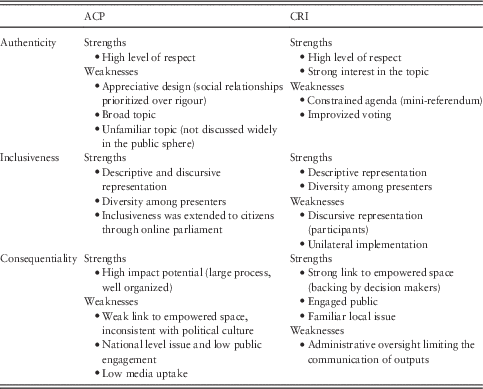
Both case studies suggest a number of barriers to enhancing deliberative capacity using mini-publics. These relate to challenges, both with respect to mini-public design and wider political context. Table 1 presents a summary of our assessment.
Deliberative capacity: Australian Citizens’ Parliament (ACP) and civic revision initiative (CRI)

With the support of empowered space and public interest, the CRI had the capacity to consequentially shape public deliberation in the deliberative system. This potential was ultimately undermined by a combination of administrative oversight and changes to the design format (via an improvized vote), negatively impacting deliberativeness.
By contrast, the ACP faced greater barriers to consequentiality from the outset, partly because of the political context in which it was conducted, but also because of specific design features and its experimental purpose. In our assessment, the ACP’s emphasis on inclusiveness came at the expense of deliberativeness – in particular authentic reason-giving. The attempt to include a large number of participants on a broad topic, in a short space of time, undermined consequentiality, producing a large number of proposals without elaboration or justification, and disconnected from the prevailing public political discourse.
The deliberative capacity approach to assessing mini-publics highlights: (a) the interconnectedness among different aspects of deliberation affecting the internal deliberative capacity of mini-publics, as well as (b) the challenges mini-publics face when making an impact on the deliberative system. Both the ACP and CRI illustrate how design weaknesses in one aspect of the deliberative capacity also affect the others. For example, ACP’s (high) inclusiveness came at the expense of authenticity of deliberation, and consequently its impact in the deliberative system. On the other hand, the CRI’s relatively low inclusiveness (discourses) undermined its perceived legitimacy and, therefore, the capacity to shape the public discussion about amalgamation in a more deliberative fashion.
Mini-publics in deliberative systems
Importantly, the limitations with respect to deliberative capacity also involved an interaction between the design features and the nature of the broader political context. In the ACP, the treatment of the event by decision makers in empowered space directly undermined its consequentiality. Moreover, the public disdain for political institutions, before the event, contributed to the over-compensation in design favouring appreciative discourse over a robust contestation of ideas.
However, it is also possible that the wider political system can interact with mini-publics in ways that compensate for some of their internal weaknesses. The strong public interest in the CRI issue is one example – albeit one that suffered from weaknesses in other respects of the case study.
Conversely, mini-publics may address weaknesses in the deliberative system, such as the poor levels of inclusion or reason-giving. For example, the motivation for convening the CRI was an attempt to inject more authentic modes of public discussion into a contentious issue in a discursive space and to dispel symbolic politics. Had the CRI been implemented as planned, conceivably it could have contributed to the deepening of the systemic deliberation on the proposals subject for referendum.
Thinking in systemic terms can also help improve the design and implementation of mini-publics to maximise deliberative capacity. The CRI example underscores the importance of coordination between mini-public design and implementation and public administration. The improvization and administrative oversight in the CRI case are not insurmountable implementation issues.
These issues do, however, demonstrate the need for certain kinds of administrative competence and local expertise for effective implementation. Increased emphasis on scaling up and systems thinking requires administrators that are able to bridge the requirements of deliberative politics with the institutional and legal framework of liberal democratic institutions. The capacity to implement deliberative procedures consistent with the normative commitments of deliberative democracy, require a system that develops a pool of organizers and deliberative advocates who understand the interconnected qualities of deliberative capacity building.
Finally, the role of mini-publics in deliberative systems would be enhanced if actors, interests, and discourses from public, as well as empowered, space are included in the implementation of deliberative events from the outset, as well as providing advocacy for their use.Footnote 30 Although there are challenges with engaging civil society and institutional actors in deliberation (Hendriks, Reference Hendriks2006), doing so improves accountability, quality, effectiveness, and overall success of deliberative initiatives. Inclusive governance could also address scepticism that undermines the legitimacy of mini-publics, as well as improve their deliberative qualities. In the case of the CRI, excluding dissenting voices from the organization process limited both inclusivity and consequentiality. This, we suggest, is one important lesson to be drawn from our comparative cases.
The ACP did, in fact, engage with institutional actors from empowered space. However, we have argued that it could have been more consequential with greater support from these actors (despite manifest goodwill). Although we have noted this was also constrained by the deliberativeness of the event, we have also observed an inconsistency with the culture of governance at the Australian Federal Government level. However, we also recognize that building this element of capacity involves a longer-term perspective than the life of our case studies.
Longer-term capacity building
Although the evidence for capacity building in the short term is mixed, the case studies appear to have promoted the expansion of deliberative practices in the longer term. For example, afterwards, ACP participants expressed a strong desire to get more involved in politics and favour more engagement through consequential deliberation, especially within their communities (Felicetti et al., Reference Felicetti, Gastil, Hartz-Karp and Carson2012), which is consistent with evidence from other mini-publics (Delli Carpini et al., Reference Delli Carpini, Cook and Jacobs2004). In the case of the CRI, the Emilia-Romagna region has subsequently established a fund to support the development of forums for citizens’ participation in councils considering an amalgamation process (Regione Emilia-Romagna, 2014).
However, tracing these indirect effects of mini-publics to longer-term deliberative capacity building is challenging. Without a dedicated research project it is difficult to attribute specific effects. Although we are reasonably confident that these longer-term impacts are real, assessing them – including the extent to which CRI and ACP may have favoured the development of subsequent deliberative mini-publics or even mass-public deliberation – is beyond the scope of this paper, and possibly premature. Whatever the case, dismissing the democratic function and deliberative capacity building potential of mini-publics out of hand, can reflect a narrow (non-systemic) and short-term focus.
Conclusion
The application of the concept of deliberative capacity provides a valuable framework for understanding the deliberative and democratic qualities of mini-publics, as well as their potential to contribute to the deliberative capacity of democratic systems. Achieving authentic, inclusive and consequential deliberation entails a number of distinct yet interconnected challenges. Both case studies illustrate how the internal consequences of small variations in the design and implementation of mini-publics can amplify the consequences in the wider deliberative system. At the same time interconnectedness between the mini-public and the wider system emerges as a key aspect that affects their deliberative capacity.
Although the comparative assessment of the two case studies yields interesting findings in relation to deliberative capacity and deliberative systems, the strength of conclusions are limited by the small number of cases. A systematic research effort is required to investigate the deliberative capacity of a larger sample of mini-publics and explore the connections to the wider deliberative system.
Acknowledgements
The research was conducted as part of an Australian Research Council Discovery Project (DP120103976). The authors are grateful to John Dryzek for kindly underwriting the research with his own funds while administrative approval was pending. He also provided very useful comments on an earlier draft of this paper. Colleagues that participated at the 2014 ECPR Joint Session on ‘Systematising Comparison of Democratic Innovations’ also provided constructive feedback. Finally, the authors thank two anonymous reviewers who gave them very helpful suggestions.