Introduction
With population ageing, the productive contribution of older adults to society has received growing attention in many of the world's most developed countries. Increased life expectancy, the delay of the onset of health problems and, in Europe particularly, the early retirement schemes of the 1980s and 1990s mean that today's older people are active and visible members of the community for much longer than their predecessors. The current policy rhetoric, and to some extent lay opinion, is that old age can be a ‘successful’ or ‘productive’ phase of life (Rowe and Kahn Reference Rowe and Kahn1997). In particular, the post-retirement phase provides opportunities to remain socially active because, for most people in their early years of retirement, employment and family obligations reduce and limiting health problems are still far away. With the ageing of the cohorts born during or shortly after the Second World War, the number of retired older adults will increase considerably during the coming decades. This has led to the general view that young-older people are an untapped resource for society, and that increasing their social engagement will increase aggregate social capital in society (Kaskie et al. Reference Kaskie, Imhof, Cavanaugh and Culp2008; Komp, van Tilburg and Broese van Groenou Reference Komp, van Tilburg and Broese van Groenou2009).
Empirical evidence supports the positive view of the socially-engaged ‘young-old’ person. On the macro level, trend studies have shown a positive engagement in later life. Putnam (Reference Putnam2000) reported that, in contrast to a decline in social engagement in the all-age population, recent cohorts of older people had increased engagement in both formal and informal forms of social participation, such as volunteer work, leisure activities and contacts with relatives and friends. This trend has been observed in other United States studies (Ajrouch, Akiyama and Antonucci Reference Ajrouch, Akiyama, Antonucci, Wahl, Tesch-Roemer and Hoff2007; Goss Reference Goss1999) and in northern European countries such as Sweden (Agahi and Parker Reference Agahi and Parker2005), Finland (Pohjalainen Reference Pohjalainen1991) and The Netherlands (Bekkers Reference Bekkers2007; Knulst and van Eijck Reference Knulst and van Eijck2006). An exception is involvement in religious organisations, which has been declining in all age-groups, including younger old people (e.g. Ajrouch, Akiyama and Antonucci Reference Ajrouch, Akiyama, Antonucci, Wahl, Tesch-Roemer and Hoff2007; Roes Reference Roes2008). On the micro level, cross-sectional and longitudinal studies have verified that social productivity increases over the life-course, is relatively high in early old age, and decreases after the early seventies (Choi and Chou Reference Choi and Chou2010; Erlinghagen and Hank Reference Erlinghagen and Hank2006; Gray Reference Gray2009; Verbrugge, Gruber-Baldini and Fozard Reference Verbrugge, Gruber-Baldini and Fozard1996).
Explanations for the relatively high social participation of young-older people are twofold. The first focuses on the life-phase: being ‘young-old’ is to have a rather unstructured life that leaves time and energy for social participation, which gives more meaning to life and helps people gain control over their social environment (Baltes and Carstensen Reference Baltes and Carstensen1996). This life-phase is delineated by the opening life event of retirement and the closing event of the onset of serious and chronic health problems, which happen at various ages. For convenience, the age range from 55 to 75 years is often used to mark the ‘young-old’ life stage (Komp, van Tilburg and Broese van Groenou Reference Komp, van Tilburg and Broese van Groenou2009). From a micro perspective, age differences in social participation are explained by age-related differences in individual characteristics, such as ceasing employment and losing good health.
The second explanation refers to cohort differences – the distinguishing attributes of successive birth cohorts – particularly the suggestion that the current cohort of young-older people in the United States of America (USA) are more committed to community and have stronger societal values than preceding cohorts (Fraser et al. Reference Fraser, Clayton, Sickler and Taylor2009; Putnam Reference Putnam2000). It has been argued that this applies particularly to the cohorts that experienced the Great Depression and World War II and became very civic-minded and that engaged in volunteering for much of their life, despite their relatively low education (cf. Elder Reference Elder1974). The proposition alludes to the importance of cultural values and attitudes as well as socio-demographic characteristics as determinants of social participation. There is clear evidence that successive birth cohorts have different characteristics, for example that today's young-older people have more resources (e.g. educational level and benefits of marriage) than their predecessors (Goss Reference Goss1999; Rotolo and Wilson Reference Rotolo and Wilson2004), but comparable evidence about differences in cultural values is limited – most studies show only differences between old age and young adulthood (Bekkers Reference Bekkers2007; Bekkers and Ruiter Reference Bekkers, Ruiter, Dekker and Hart2009).
This paper focuses on one age group, the ‘young-old’, to shed light on their potential for social productivity. Instead of taking a lifecourse perspective, which compares the young-old with other age-groups, we use the ‘cohort perspective’ and compare 60 to 69-year-olds of different birth cohorts. Such an analysis turns away from the effects of individual ageing and focuses on changes over time, which may be shared by all age groups, or a period effect, or particular to a narrow age group and replicated in successive cohorts, an age-group effect, or thirdly be a cohort effect. If increasing levels of social participation of the young-old are explained by, for example, the higher educational level of the more recent cohort, this enables better predictions about the social productivity of future young-older people. To establish whether the social participation rates of the young-old are increasing, two birth cohorts have been compared. Data from the Longitudinal Aging Study Amsterdam (LASA) on the attributes of the cohort born between 1923 and 1932 (aged 60–69 years in 1992) have been compared with those of the cohort born between 1933 and 1942 (aged 60–69 in 2002). We focused on the characteristics that are known to impact on social participation levels and that may also differ by birth cohort (e.g. educational level and health). The aim is to examine the extent to which cohort differences in social participation can be explained by cohort differences in individual characteristics.
Types of social participation
Social participation is a very broad concept that encompasses many and diverse activities ranging from working for organisations to inter-personal and friendship activities. The distinctions among ‘community participation’, ‘social integration’ and ‘socially active’ are not entirely clear (Mendes de Leon Reference Mendes de Leon2005). Basically, social participation involves social activities outside the home that provide opportunities to meet other people in productive or recreational activities. We distinguished formal and informal social participation (Klumb and Baltes Reference Klumb and Baltes1999). Formal social participation refers to activities in which a person is of service to groups or individuals in the community through their involvement in political and voluntary organisations – this form most interests local and national governments. In this study, we have concentrated on participation in community organisations and distinguished: (a) membership of community organisations, (b) active involvement in community organisations, as by helping at meetings and being executive or committee members, and (c) participation in religious organisations. Informal social participation refers to personal involvement in the community, in which the individual is more concerned with his or her own development and wellbeing. This embraces social participation in which people are generally involved in an individual and irregular way. We distinguished: (a) having a large personal network as an indicator of integration in various social domains, (b) participation in cultural activities, e.g. visiting museums or cinemas, and (c) participation in recreational activities, e.g. dining out and visiting sports events or amusement parks.
Determinants of social participation
The determinants of formal and informal participation vary from personal and social resources to inter-personal and societal norms and values (Bekkers Reference Bekkers2005; Choi Reference Choi2003; Warburton and McDonald Reference Warburton and McDonald2009; Warburton et al. Reference Warburton, Terry, Rosenman and Shapiro2001; Wilson Reference Wilson2000; Wilson and Musick Reference Wilson and Musick1997). We focus here on personal and social resources as the available data lack information on norms and values. Four indicators of individual resources were chosen that vary among individuals as well as birth cohorts: educational level, health, employment and marital status. Individual resources refer to ‘resources attached to individuals that make productive activities possible’ (Wilson and Musick Reference Wilson and Musick1997: 698). Education is one of those resources and influences the qualifications, skills and knowledge that are useful in society. Schooling socialises people, influences their norms and values, and encourages children to become interested in communal and societal matters (Gesthuizen Reference Gesthuizen2006). There is considerable evidence that in all age groups the more educated are more involved in volunteer work and other forms of social engagement (seeChoi Reference Choi2003; Erlinghagen and Hank Reference Erlinghagen and Hank2006; Gesthuizen Reference Gesthuizen2006). Across the developed world, the educational system improved considerably during the second half of the last century and created unprecedented occupational and recreational opportunities for the most recent cohort (e.g. Roes Reference Roes2008). It is thought that higher rates of social participation among the recent cohort are partly the consequence of a generally higher level of education.
The second indicator of individual resources is health, because poor health restricts social interaction. Many dimensions of health, including subjective health, chronic diseases and physical disability, have been found to restrict participation in volunteer work (Bath and Deeg Reference Bath and Deeg2005; Choi Reference Choi2003; Erlinghagen and Hank Reference Erlinghagen and Hank2006; Wilson and Musick Reference Wilson and Musick1997). In fact, the onset of health problems is the major reason for a reduction in social participation in old age (Broese van Groenou and Deeg Reference Broese van Groenou, Deeg and Boer2006; Bukov, Maas and Lampert Reference Bukov, Maas and Lampert2002). Some evidence suggests that the most recent cohorts report more health problems than their predecessors (Ahacic, Parker and Thorslund Reference Ahacic, Parker and Thorslund2003; Lalive d'Epinay, Maystre and Bickel Reference Lalive d'Epinay, Maystre and Bickel2001). If this is the case, the rising prevalence of perceived health problems might have suppressed the level of social participation among the most recent cohort of older people.
The third indicator used is paid employment. Its time demands suggest a negative association between paid employment and volunteer work. There is evidence that people in full-time employment on average spend less time on formal and informal social participation (Klumb and Baltes Reference Klumb and Baltes1999), but that part-time employment positively associates with participation in voluntary organisations (Choi Reference Choi2003; Choi and Chou Reference Choi and Chou2010). On the other hand, employment is also a form of social integration that encourages volunteering by increasing the opportunities to meet people and to be asked to participate in volunteer work (Wilson Reference Wilson2000). In addition, employment brings higher income, whereas the unemployed and early retired may have more limited financial resources, and as a result less capacity to assist voluntary organisations or to participate in cultural and social activities. Among older people, employment seems to be weakly related to volunteer work (Erlinghagen and Hank Reference Erlinghagen and Hank2006), probably because older adults spend comparatively few hours per week on either volunteering or paid work. In general, employment need not restrict social participation because of time limits, but rather is expected to increase participation because of increased social and financial resources. During the 1980s and 1990s in many western European countries, early retirement schemes were abundant, but very recently the opportunities for early retirement have sharply diminished. The higher employment rate of the recent cohort is expected to increase their levels of social participation in comparison to the preceding cohort.
The fourth indicator used is marital status. Having a spouse or intimate partner provides support and company at social events. Empirical studies show that married people are more active in social organisations and participate more often in leisure activities than single persons (Choi Reference Choi2003; Erlinghagen and Hank Reference Erlinghagen and Hank2006; Kalmijn and Broese van Groenou Reference Kalmijn and Broese van Groenou2005). As a result of rising divorce rates since the 1970s and the gradual cultural acceptance of the status, the number of single people has increased considerably, not least among the young-old (Tomassini et al. Reference Tomassini, Glaser, Wolf, Broese van Groenou and Grundy2004). As singles less often participate in formal and informal organisations, and as the 2002 cohort had more than the 1992 cohort, this may have suppressed the level of social participation among the young-old.
For all types of social participation, large differences are usually found between men and women, and between younger and older people. Men and young adults are more often involved in formal participation than women and older people, and women more often participate in informal groups than men (Klumb and Baltes Reference Klumb and Baltes1999). These differences probably arise from sex and age differences in the individual resources that have been described. For example, in general men are more highly educated than women, and relatively more young adults are married than older people. Given these associations, sex and age are treared as control variables in this study and not as determinants of social participation.
Methodology
The sample
LASA is a continuing study of the physical, emotional, cognitive and social functioning of older adults (Deeg et al. Reference Deeg, van Tilburg, Smit and de Leeuw2002). It began with a representative national survey in 1992 of 3,107 people aged between 55 and 85 years. The sample was stratified by sex and age, and the respondents were selected from the registers of 11 municipalities in the west, north-east and south of The Netherlands. The response rate among 60 to 69-year-olds was about 62 per cent and similar for men and women. Data collection was through a face-to-face interview on physical, emotional, cognitive and social functioning, a medical interview with clinical measurements, and a self-completion questionnaire. Follow-ups were conducted at three-year intervals from 1995/96 to 2005/06. In 2002/03 a new sample of 55 to 64-year-olds was selected from the same 11 municipalities, and achieved a response rate of 57 per cent. The 60 to 64-year-olds of the new sample and the 60 to 69-year-olds of the 2001/02 follow-up were used for this study. Data for the 1992 or earlier cohort were available for the 1,008 respondents aged 60–69 years to the 1992/93 wave (birth years 1923–32). Data for the 2002 or recent cohort were available for the 922 respondents aged 60–69 years to the 2001/02 wave (birth years 1933–42). Given the dates of the waves, 74 respondents were included in both the 1992/93 and the 2001/2002 wave, being just 60 years of age at baseline and 69 at the follow-up. They were deleted from the follow-up sample, leaving 848 respondents for analysis in the 2002 cohort.
The measures
The first two types of formal social participation concern membership and volunteering in community organisations. The respondents indicated whether they were members of 12 types of community organisations, ranging from trades unions, political parties and sports organisations to choirs, but not including church membership. We created a variable for whether the respondent was a member of at least one of these organisations (‘0’ no, ‘1’ yes). For those who were members, two supplementary questions were asked: whether the respondent was active on boards or committees and carried out chores (for both ‘0’ no, ‘1’ yes). A positive answer on either of these questions was recorded as volunteering in community organisations (‘0’ no, ‘1’ yes). The third type of formal participation is involvement in religious organisations, which was indicated by two variables. Information on the frequency in a week of attending religious meetings was coded from ‘1’ for ‘never’ to ‘6’ for ‘weekly or more’. The respondents were considered to be religiously involved when attending meetings at least monthly (‘0’ no, ‘1’ yes).
The first measure of informal social participation is the size of the personal network, which was assessed using the domain-contact method (van Tilburg Reference Van Tilburg1998). With respect to seven role-relationship types (household member, child, other kin, neighbour, work contacts, members of organisations and others), the respondents were asked to identify people (other than their partner) with whom they had frequent contact and who were important to them (scored from 0 to 75). A large network was defined as those in the highest tertile of the distribution with at least 19 members, sufficient to indicate participation with many people in various domains (‘0’ no, ‘1’ yes). The second type of informal participation concerns cultural activities. Four types of cultural activities were presented and respondents were asked to rate the frequency of attendance on a four-point scale (‘1’ never, ‘2’ yearly, ‘3’ monthly, ‘4’ weekly). Those who visited museums, theatres, cinemas and/or social-cultural centres at least monthly were deemed as participating in cultural activities (‘0’ no, ‘1’ yes). The third type of informal participation is in recreational activities, and five types were stipulated: those who made visits to restaurants, bars, sports events, zoos or amusement parks at least monthly, or went shopping for pleasure at least once a week were considered to participate in recreational activities (‘0’ no, ‘1’ yes).
The level of attained education varied from less than primary school (‘1’) to university degree (‘9’). The scores were recoded into three categories: ‘1’ for low (elementary school or less), ‘2’ for medium (secondary school), and ‘3’ for high (college or university degree). For health we used information on functional limitations and chronic diseases. As the indicator for functional limitations, the respondent reported on the ability to perform three activities: using stairs, cutting toenails and using own or public transport. For each activity the respondent could indicate whether he or she could perform it at four levels (‘0’ without difficulty, ‘1’ with some difficulty, ‘2’ only with help, and ‘3’ not at all). The total score (range 0–9) was dichotomised into ‘0’ for no limitations, and ‘1’ for one or more limitations. For chronic diseases we calculated the presence of seven chronic diseases and recoded them in three groups to distinguish co-morbidity (‘0’ no chronic diseases, ‘1’ one chronic disease and ‘2’ two or more diseases). For employment status, information about the hours of employment per week was recoded into three categories (‘0’ no paid work, ‘1’ 1–20 hours, ‘2’ more than 20 hours). Four marital status categories were distinguished: never married, married, divorced and widowed.
Procedures
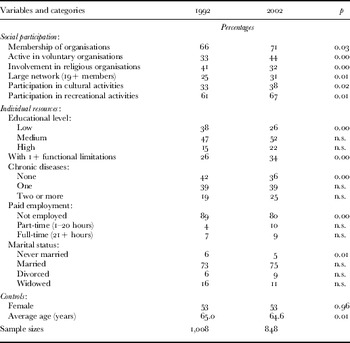
Descriptive statistics were used to examine the cohort differences in five types of social participation, four types of determinants, sex and age (Table 1). As all the dependent variables were dichotomies, logistic regression analysis was used to examine which independent variables affected cohort differences in social participation. The first model examined the cohort effect on participation, adjusting for sex and age because of their variable composition in the two cohorts. In the second to fifth models, the four indicators of individual resources were entered successively to examine their unique contributions to the variation. For these separate regressions, only the odds ratio (OR) for the cohort is shown in Table 2. This report focuses on the change in OR for the cohort in each of the models. To illustrate, the adjustment for educational level decreased the OR for the cohort to a non-significant level, so it can be concluded that the cohort difference in education explains the cohort difference in social participation. Next, all indicators and control variables were entered in a full model. The interaction effects between cohort and each of the six independent variables were estimated in the full model. The final model is presented in Table 3 and shows all the terms including any significant interaction effects.
Characteristics of 60–69 year-olds, The Netherlands, 1992 and 2002

Notes: The p value is for the chi-squared statistic for the cohort difference. n.s. not significant.
Source of data: Longitudinal Aging Study Amsterdam: for details see text.
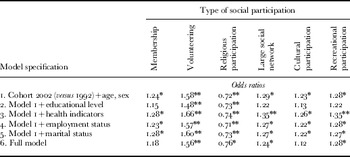
Odds ratios for five types of social participation in 2002 relative to 1992

Notes: The sample size was 1,856 people. Separate models with controls, adjusted successively for sex and age, educational level, health, employment and marital status.
Significance levels: * p<0.05, ** p<0.01.
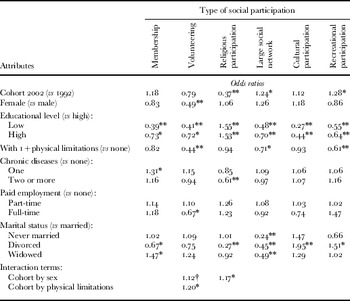
Differences between 2002 and 1992 in five types of social participation among people aged 60–69 years, The Netherlands.

Notes: The sample size was 1,856 people. Logistic regression models: full model with interaction terms. vs: versus, indicating reference category.
Significance levels: † p<0.1, * p<0.05, ** p<0.01.
The results
Cohort differences
The descriptive statistics show a clear increase in social participation of all kinds except religious participation from 1992 to 2002 (Table 1). The largest increase was in volunteering, from 33 per cent in the 1992 cohort to 44 per cent in the 2002 cohort. Regarding membership of organisations, having a large network and cultural and recreational participation, the increases were smaller, from five to six percentage points. Involvement in religious organisations decreased from 41 per cent in the earlier cohort to 32 per cent in the later. All the changes are statistically significant. It can be concluded that the net social participation of young-older people in the LASA samples increased over the decade. The two cohorts also differed with respect to the level of education and employment status, with the recent cohort being more educated and having a higher prevalence of part-time jobs. Regarding health status, the later cohort was significantly less healthy, as indicated by the higher proportion with at least one functional limitation (34% versus 26%), and more co-morbidity (25% versus 19%). Considering marital status, the recent cohort had comparatively more divorcees and fewer were widowed, but the proportions of married and non-married were similar. There were no sex differences between the cohorts and the age differences were very small.
Differences in formal social participation
The logistic regression analyses show the degree to which the cohort differences in social participation associated with cohort differences in the independent variables (Table 2). Adjusted for sex and age, members of the recent cohort were 1.24 times more likely to be a member of at least one community organisation than the members of the earlier cohort (Table 2, model 1). Adjusting for educational level (model 2) decreased the OR to a non-significant 1.15. Adjusting for health (model 3) and marital status (model 5) increased the OR to 1.28 (p<0.05). Adjusting for employment status (model 4) did not change the OR (1.23); in other words, the cohort difference in employment did not significantly associate with the cohort difference in membership. Table 3 shows the direct effects of the individual characteristics in the full model. Educational level and marital status had most influence on being a member of community organisations; the lower/medium educated and divorced were less often members than the more educated and married, whereas the widowed were more likely than the married to be organisation members. The lack of significant interaction effects shows that the determinants of organisational membership were similar in 1992 and 2002. The OR for the later cohort in the full model was not significantly different from 1.0 (OR=1.18, p>0.05). It can be concluded that the increase in organisational membership over the decade can be ascribed mainly to the higher educational level of the more recent cohort. The increase in membership would have been larger if the relatively large number of divorcees in and relatively poor health status of the recent cohort had not suppressed their propensity to participate in organisations.
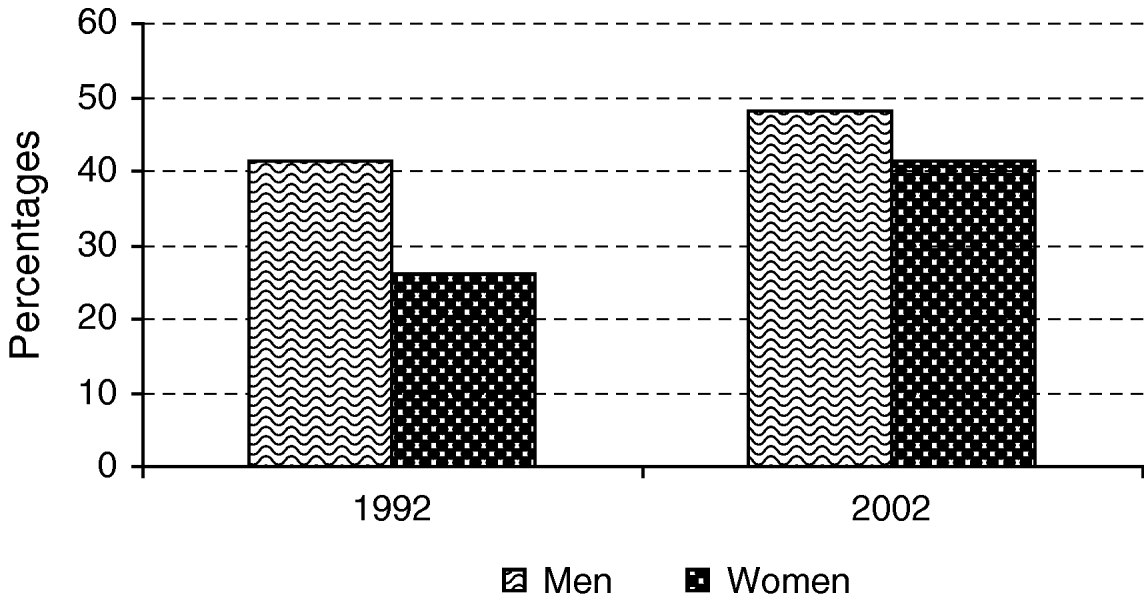
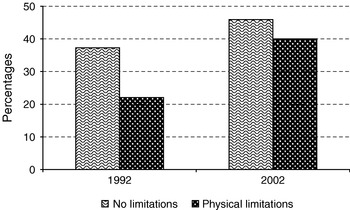
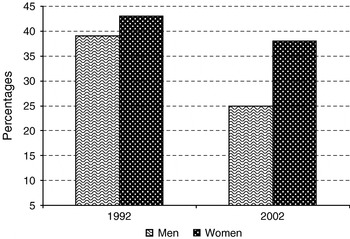
Table 2 shows that, adjusted for sex and age, members of the recent cohort were 1.58 times more likely to volunteer than the earlier cohort members. Adjusting for educational level decreased the OR (1.48, p<0.01), whereas adjusting for health increased the OR (1.66, p<0.01). After adjusting for all individual characteristics, the OR for volunteering was 1.56 (p<0.01), indicating that the effect of more education was just about counterbalanced by worse health. The full model in Table 3 shows that, in general, having more education, having no physical limitations and not working (as opposed to working full-time) positively associated with being a volunteer in community organisations. An analysis of the interaction effects showed that the effect of physical limitations on volunteering differed between the cohorts (OR=1.20, p<0.05). The interaction effect is indicated by cross-tabulations of volunteering and physical limitations in 1992 and 2002, which reveal that the physically limited were less involved in volunteering in 1992 but not in 2002 (Figure 1). Another interaction effect showed that the gender difference in volunteering changed over time (OR=1.12, p<0.10). Men were more likely than women to volunteer in both 1992 and 2002, but the gender difference was smaller in 2002 (Figure 2). It appears that women increased their level of volunteering between 1992 and 2002 to a greater degree than men.
Volunteering among young-older people, by gender, The Netherlands.
Volunteering among young-older people by physical limitations, The Netherlands.

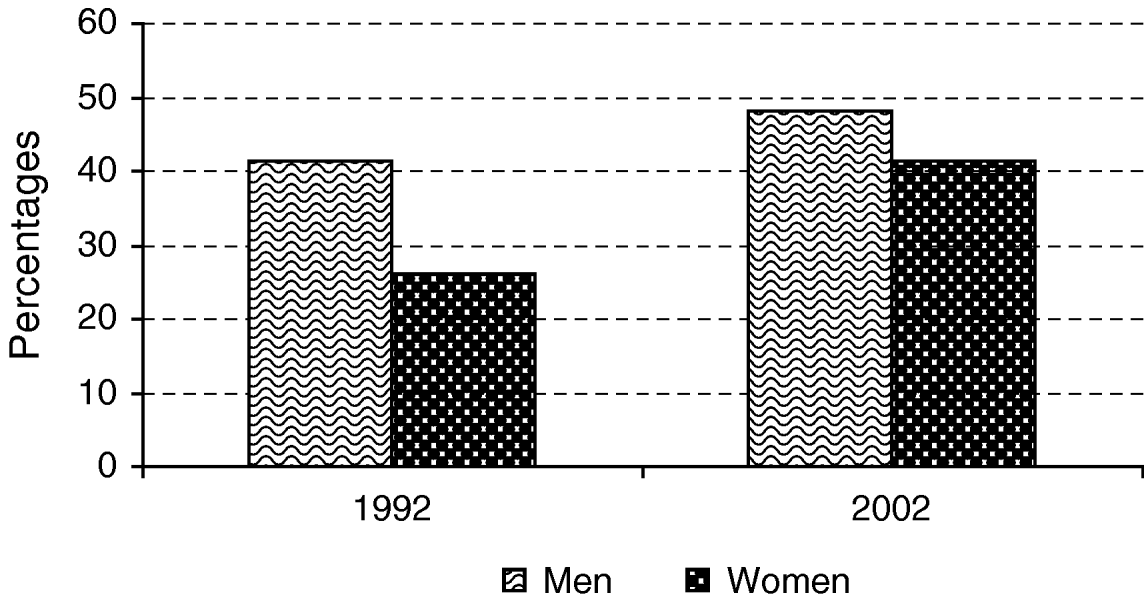
Participation in religious organisations decreased over the decade. The recent cohort was, adjusted for sex and age, only 0.72 times as likely to participate as the earlier cohort (Table 2). The difference narrowed only slightly when the individual determinants were included. The final model in Table 3 shows that religious participation was more likely among the low and medium-educated than the more-educated, and less likely among people with two or more chronic diseases than among those with none. In addition, divorcees were less likely to be involved in religious groups than the married, but there was no difference between the married and the other marital status categories. Finally, the decrease in religious participation was greater for men than women, as indicated by the significant interaction between cohort and sex (OR=1.17, p<0.05; see Table 3 and Figure 3).
Involved in a religious group: young-older people by gender, The Netherlands.

Differences in informal social participation
After adjusting for sex and age, the recent cohort was 1.29 times more likely to have a large social network compared to the earlier cohort (p<0.05; Table 2). Being more educated decreased the OR to 1.22 (p>0.05), whereas being physically limited increased the OR to 1.35 (p<0.01). After taking all individual characteristics into account, the later cohort had a significantly larger network (OR=1.24, p<0.05), from which it might be concluded that the effect of health outweighed the effect of education. Regardless of cohort, larger networks associated with a high level of education, no physical limitations and being married. There were no significant interaction effects, so the determinants of a large network were similar in 1992 and 2002. It is concluded that the recent cohort had larger networks, mainly in association with its higher educational level and despite their worse health.
Adjusted for sex and age, the recent cohort was 1.23 times more likely to participate in cultural activities than the earlier cohort (Table 2). As with volunteering and having a large network, the OR decreased when adjusting for educational level (OR=1.13, p>0.05). Adjusting for other characteristics did not change the OR significantly and there were no significant interaction effects. The full model reported in Table 3 shows that the OR for the recent cohort decreased to a non-significant 1.12 (p>0.05). In addition, a high educational level and being divorced increased the OR for cultural participation. It can be concluded that the increase in cultural participation is explained by the higher level of education and, to a lesser degree, by the larger number of divorcees in the recent cohort.
Members of the recent cohort were, when adjusted for sex and age, 1.28 times more likely to participate in recreational activities than the earlier cohort (Table 2). Adjusting for educational level reduced the OR somewhat (1.22, p<0.05), whereas adjusting for health indicators increased the OR (1.31, p<0.01). The full model in Table 3 shows that the net effect of birth cohort was 1.28 (p<0.01), suggesting that the effect of educational level was counteracted by the effect of health. In addition, the full model shows that, regardless of cohort, having a higher educational level, no physical limitations and being divorced increased the OR for recreational participation. Interaction effects were estimated in the full model but were not statistically significant.
Conclusions and discussion
This study set out to examine whether and why the social participation rates of 60–69 year-olds in 2002 in The Netherlands were higher than those of their age-peers in 1992. Three major conclusions have been reached: first, there were higher rates of both formal and informal social participation in 2002 than in 1992; second, the increase was the net effect of a higher level of education and worse health in the recent cohort; and third, the influences of gender and physical disability on volunteering and of gender on religious participation changed over the decade. These conclusions are discussed further below.
The increase in social participation applied to four of the five types of social participation, including involvement in community organisations, size of personal networks and individual leisure activities. This higher rate of social participation in 2002 provides strong evidence that the Dutch young-old replicated the pattern of increased social engagement, described in the reports of cohort studies in the USA and Europe (e.g. Ajrouch, Akiyama and Antonucci Reference Ajrouch, Akiyama, Antonucci, Wahl, Tesch-Roemer and Hoff2007; Einolf Reference Einolf2009; Knulst and van Eijck Reference Knulst and van Eijck2006; Pohjalainen Reference Pohjalainen1991). It is interesting that a similar trend has been observed in several western societies, given national differences in the socio-economic and cultural contexts. National levels of expenditure, democracy and religiousness have proven to be of importance to social participation in the general population (e.g. Ruiter and De Graaf Reference Ruiter and de Graaf2006). The relatively high volunteering rates of Dutch older adults, as reported by Erlinghagen and Hank (Reference Erlinghagen and Hank2006), are probably because, at least in part, the Dutch national context stimulates and facilitates social engagement in later life. As increased social participation of the young-old has been reported in different countries, two preliminary conclusions can be drawn. First, the change in cohort characteristics of the young-old is consistent, e.g. they are becoming more educated in many affluent nations and, second, national contexts are becoming more facilitative of their social participation. Cross-national studies on successive cohorts of the young-old are needed to examine whether and why there is a rich-country trend towards increased social participation in later life.
The recent cohort's reduced religious participation is in line with the secularisation of many western societies, and suggests that church attendance depends less on the phase of the lifecourse and more a matter of choices made earlier in life (cf.Coleman, Ivani-Chalian and Robinson Reference Coleman, Ivani-Chalian and Robinson2004; Wilkinson and Coleman Reference Wilkinson and Coleman2010). Given the continued decline in religious involvement, future cohorts of the young-old are likely to be less involved in this type of formal participation. Our findings suggest that the young-old have replaced participation in religious organisations with involvement in other social domains, including more volunteering in community organisations and larger networks. This shift from church to other types of community organisations has been reported by others (Ajrouch, Akiyama and Antonucci Reference Ajrouch, Akiyama, Antonucci, Wahl, Tesch-Roemer and Hoff2007; Rotolo and Wilson Reference Rotolo and Wilson2004).
The increase in the four types of social participation arose at least in part from the higher educational level of the recent cohort. The direct effect of educational level was strong in all types of social participation, reflecting that educational attainment (or exposure) is a robust and important determinant of social participation. As the educational level of the general population continues to rise, it can be expected that future older adults will be more socially engaged in both formal and informal groups. As educational level reflects competencies as well as pro-active social behaviour, investing in education will not only raise the economically-productive capacity of future cohorts but will also bring returns in greater social participation.
The positive effect of educational level on social participation was approximately counterbalanced by the negative effect of poor health. As the recent cohort was in worse health than the earlier, this suppressed the increase of social participation, in particular regarding organisational membership and volunteering. Health status proved to be an important and robust determinant of social participation, except in cultural activities. Two particularly interesting findings were reached about the influence of health on the activities of the young-old. On the one hand, the cohort's health deteriorated over the decade, but on the other hand, the differences in participation between the non-disabled and the disabled decreased, as shown on Figure 2. The suggestion is that the disability level in 2002 was not sufficiently severe to restrict volunteer work. On the other hand, the recent cohort may truly suffer from more disability and diseases than the earlier cohort. The medical and technological developments that have brought improved diagnosis and treatments may have reduced age-specific mortality but added to aggregate years of disability (cf. Crimmins Reference Crimmins2004). This trend is consistent with reports of a trend towards unhealthier lifestyles among young-older people, indicated by less physical activity and more unhealthy eating habits and (among women) more smoking (Visser et al. Reference Visser, Pluym, van der Horst, Poppelaars, Seidell and Deeg2005). If the trend of worsening health continues in the coming cohorts of young-older people, this may reduce their social participation. Prevention programmes should therefore aim to promote healthy lifestyles among the late-middle aged and the young-old, not least at younger ages. If successful, they may indirectly enhance social participation.
The employment status of the young-old was of little importance to social participation. The higher employment rate of the recent cohort did not explain the increase in participation and there was no direct effect of employment status on social participation, except that full-time employment restricted volunteer work. The limited impact of employment status on social participation has been shown by other studies (e.g. Erlinghagen and Hank Reference Erlinghagen and Hank2006). This suggests that the postponement of retirement in this age group should not lead to less social participation. On the contrary, being employed status is more likely to facilitate social participation, albeit indirectly by increasing employees' financial and network resources.
The larger number of divorcees in the recent cohort does not explain the increase in social participation over time, but it has been shown that being divorced impacts on various types of social participation. Being divorced increased the likelihood of cultural and recreational participation, but decreased the odds for organisational membership, religious participation and having a large network. This suggests that divorcees more readily engage in individualised types of social participation than in formal organisations. They did not volunteer more than the married, which is inconsistent with findings from studies of the general American and Dutch populations that have found a negative effect of divorce on social participation (e.g. Choi Reference Choi2003; Kalmijn and Broese van Groenou Reference Kalmijn and Broese van Groenou2005). In the studied age-group, were likely to have been estranged early in adult life and may have subsequently adjusted their volunteering to the level of married people of the same age. For those who had not remarried, volunteering may have seemed a good way to keep socially involved. Regarding the increased prevalence of divorce in the general population, our findings suggest that this may not retard the level of informal social participation of the young-old and have a slight negative effect only on participation in formal organisations.
The increase in volunteering was greater for women than men, and the decrease in religious participation was greater for men than women. The fact that women were more involved in religious organisations and, at the same time, increased their volunteering in other types of organisations (cf. Pohjalainen Reference Pohjalainen1991), suggests that Dutch women have been looking for other organisations besides the church in which to be involved. They may be taking administrative positions in sports clubs, for example, and joining men on the committees of social clubs. The women seemed to be interacting in larger social circles outside kin, church and neighbourhood than they used to do. Studies of the trends in future cohorts of younger old people should focus on gender differences, and examine to what degree women continue to be productive in society.
This study has examined five types of social participation among people aged 60–69 years in 1991 and 2002. The differences between the two cohorts were greatest for volunteering and least for participation in personal networks and in cultural and recreational activities. This cannot be explained by the fact that the young-old have more spare time – more of the recent cohort worked, and they worked more hours. Our study could not include dispositional factors such as altruism and societal values, but as the birth years of the two cohorts were only ten years apart, any differences were likely to be small (Bekkers and Ruiter Reference Bekkers, Ruiter, Dekker and Hart2009). Still, social values are an important predictor of volunteering and other types of pro-social behaviour. As the population's participation in religious groups decreases, dispositional factors that are not faith-based will become more important in future cohorts. Including dispositional factors in the study of social engagement will also shed more light on the differences between cohort and ‘generation’, referring to a shared set of values among people in a specified birth cohort (cf. Einolf Reference Einolf2009; Rotolo and Wilson Reference Rotolo and Wilson2004).
We have to recognise that the trends reported in our study may reflect both cohort and period effects. Cohort effects reflect circumstances of birth and the lifecourse, whereas period effects are consequences of influences particular to an era. As we compared the same age group (two birth cohorts) in just two years, it is not possible to conclude whether the observed trends arise from characteristics of the birth cohort or of the period in which the observations were made. Longitudinal data enable a better distinction of the two effects (Elder and Giele Reference Elder and Ziele2009). Such cohort-sequential analysis can reveal to what degree changes in social participation are reported in both birth cohorts and in different years. With the new LASA observation in 2008/09, we will soon be able to compare changes in social participation of various age groups of older people during the 1990s and 2000s.
This study has increased our understanding of the social productivity of young older people in two ways. First, we have shown that part-time employment does not restrict social participation and that full-time employment restricts volunteer work but not other forms of social participation. This suggests that in calculating the social productivity of the young-old, we should not limit the group to retirees but also include those in part-time employment. Second, we have seen that the health of 60 to 69-year-olds is worsening, which decreases the number of younger old people that have the capacities for social productivity. As more young older people are full-time employed and in poor health, their social productivity will be restrained. In our sample, the higher educational level of the young-old still counteracted the negative effects of poor health and working full-time, but one can envisage a time when the educational level of the entrants to old age stabilises, and that this may prevent a further rise in the level of social participation. One solution may be to focus on the social participation of the less educated. Our findings suggest that they find it less attractive to participate actively in society and probably need different incentives to become involved. If society seeks benefits from the increasing number of young-older people in the coming years, community organisations will have to be more pro-active and creative in recruiting not only the more willing educated but also the disinclined less educated.
Acknowledgements
The Longitudinal Aging Study Amsterdam is financed in large part by the Netherlands Ministry of Health, Wellbeing and Sport. The reported analysis was supported by a grant from the Dutch Society for Scientific Research (NWO-MaGW, 400-05-715).