Milk and milk products have traditionally been one of the main components of human nutrition. They are considered as a natural source of amino acids and bioactive peptides with antihypertensive, antimicrobial and antithrombotic properties (Park et al. Reference Park, Juarez, Ramos and Haenlein2007). Milk fat contains approximately 70% saturated, 25% monounsaturated, and 5% polyunsaturated fatty acids (Grummer, Reference Grummer1991) and the high-fat diets, especially those rich in saturated fats, can elicit detrimental effects on cardiovascular disease risk factors such as blood low density lipoprotein (LDL) cholesterol (Williams, Reference Williams2000). Thus, improving the nutritional quality of milk fat has been the topic of recent research (Nudda et al. Reference Nudda, Battacone, Atzori, Dimauro, Rassu, Nicolussi, Bonelli and Pulina2013).
The milk fatty acid profile, however, can be modified and improved through the administration of a diet with a higher percentage of green fodder (Elgersma et al. Reference Elgersma, Ellen, Van Der Horst, Muuse, Boer and Tamminga2004) or through the administration of dietary plant-based supplements with a high lipid content, such as linseed (Dhiman et al. Reference Dhiman, Satter, Pariza, Galli, Albright and Tolosa2000). According to Moallem (Reference Moallem2009) linseed is the most available botanical source of n-3 fatty acids, which contains more than 500 g α-linolenic acid (ALA; C18:3 n-3) per kilogram of total fatty acids as well as a high proportion of linoleic acid (LA; C18: 2 n-6).
Several studies have shown the beneficial effect of dietary linseed supplementation on milk fatty acids in ewe (Caroprese et al. Reference Caroprese, Albenzio, Bruno, Fedele, Santillo and Sevi2011), goat (Chilliard et al. Reference Chilliard, Ferlay, Loor, Rouel and Martin2002) and cow (Moallem, Reference Moallem2009), with a decrease in SFA and an increase in MUFAs, PUFAs and CLA. Dietary extruded linseed supplementation also leads to a greater increase in PUFA and CLA content in cows, ewes and goats milk compared with supplementation with unheated linseed (Moallem, Reference Moallem2009; Fernandez & Rodriguez, Reference Fernandez and Rodriguez2012).
Vitamin E (in the form of α-tocopherol), that is the major lipid-soluble antioxidant of lipoproteins and bio-membranes and can be transferred from feed to milk and its binding to the fat globule membrane is considered as the main factor in the oxidative stability of milk (Yang et al. Reference Yang, Chang, Peh and Chen2004). In goats treated with intramuscular vitamin E, an improved plasma oxidative status and mammary-gland-tissue activity were observed (Yang et al. Reference Yang, Chang, Peh and Chen2004), through a decrease in thiobarbituric acid reactive substances (TBARS).
The antioxidant effect of vitamin E could be completed by natural antioxidant as plant polyphenols from fruits and vegetables that could induce complementary effect on rumen biohydrogenation of PUFA and then on milk fatty acid profile. In fact, Gladine et al. (Reference Gladine, Morand, Rock, Bauchart and Durand2007), showed synergistic effects of a mixture of plant extracts rich in polyphenols and vitamin E in the prevention of lipoperoxidation in plasma of sheep.
Of the many plant substances with antioxidant properties that can be used as dietary supplements, verbascoside is present in various plants belonging to the Bignoniaceae, Buddlejaceae, Gesneriaceae, Labiatae, Oleaceae, Orobanchaceae, Scrophulariaceae, and Verbenaceae genera. In addition, this molecule is not only an antioxidant (Lee et al. Reference Lee, Woo and Kang2005; Casamassima et al. Reference Casamassima, Palazzo, Martemucci, Vizzarri and Corino2012), but also a hypocholesterolemic (Palazzo et al. Reference Palazzo, Vizzarri, Cinone, Corino and Casamassima2011; Casamassima et al. Reference Casamassima, Palazzo, Vizzarri, Cinone and Corino2013a) and hepatoprotective compound (Lee et al. Reference Lee, Woo, Choi, Shin, Lee, You and Jeong2004; Casamassima et al. Reference Casamassima, Palazzo, Martemucci, Vizzarri and Corino2012).
The positive effects of verbascoside on plasma lipid parameters have also been observed in weaned pigs (Pastorelli et al. Reference Pastorelli, Rossi and Corino2012), suckling lambs (Casamassima et al. Reference Casamassima, Palazzo, D'alessandro, Colella, Vizzarri and Corino2013b) and on milk yield in lactating ewes (Casamassima et al. Reference Casamassima, Palazzo, Martemucci, Vizzarri and Corino2012).
There are studies showing the positive effects of dietary extruded linseed supplementation on milk quality (Caroprese et al. Reference Caroprese, Marzano, Marino, Gliatta, Muscio and Sevi2010, Reference Caroprese, Albenzio, Bruno, Fedele, Santillo and Sevi2011; Nudda et al. Reference Nudda, Battacone, Atzori, Dimauro, Rassu, Nicolussi, Bonelli and Pulina2013) and using plant polyphenols associated with vitamin E on modifying the milk fatty acid profile (Ferlay et al. Reference Ferlay, Martin, Lerch, Gobert, Pradel and Chilliard2010) and reducing plasma liperoxidation (Gobert et al. Reference Gobert, Martin, Ferlay, Chilliard, Graulet, Pradel, Bauchart and Durand2009) in cows. The aim of the present study was to assess the effects of dietary antioxidant substances, such as verbascoside and vitamin E, on dairy performance, milk fatty acid composition, milk oxidative parameters and milk cholesterol in milking Lacaune ewes, fed a diet contained extruded linseed.
Materials and methods
Diet and animals
The trial lasted 98 d and was conducted on 44 Lacaune ewes. At the beginning of the test (40±2 d post partum) the animals were divided into four groups of 11 ewes each, homogeneous by age (4–6 years), body weight (54·06±2·85 kg), parity (III–V) and body condition score (2·32±0·11). All ewes were reared in single boxes (size 1·5×3·0 m) and all experimental procedures involving animals were in accordance with European Community guidelines and approved by the Italian Ministry of Health.
Each animal received a daily isoenergetic diet as follows:
-
CON group: 700 g basal concentrated pellets, without extruded linseed, and meadow hay ad libitum;
-
L group: 700 g concentrated pellets, containing extruded linseed 200 g/kg feed, and meadow hay ad libitum;
-
LVB group: 700 g concentrated pellets, containing extruded linseed 200 g/kg feed plus antioxidant supplement 2·86 g/kg feed, and meadow hay ad libitum;
-
LVBE group: dietary treatment similar to LVB group plus vitamin E 14·29 g/kg feed.
The feed ratio was commensurate with the physiological and productive requirements of milking ewes, according to NRC (1985).
Samples of dietary ingredients (concentrate and meadow hay) were collected at the start of the trial for chemical analysis that were performed in duplicate. The dry matter (DM) content of the feed was determined by oven-drying at 105 °C for 24 h and was expressed as g/kg feed. Dried feed samples were analysed for crude protein, ether extract and ash (Association of Official Analytical Chemists, 2000; AOAC), neutral detergent fibre (NDF), acid detergent fibre (ADF) and lignin using the Fibertec™ Systems (Foss, Hillerod, Denmark), and lipid extract (Folch et al. Reference Folch, Lees and Stanley1957). Chemical analyses were expressed as g/kg DM.
The antioxidant supplement titrated at 0·5% verbascoside, 5 mg active ingredient/g supplement, contained a water-soluble extract of Verbenaceae (Lippia spp.) leaves, prepared on an industrial scale by a standardized procedure which includes ultrasonic extraction with 60% aqueous ethyl alcohol (EtOH) followed by spray drying with maltodextrins as an excipient. The natural extract content of the feed supplement is: gallic acid, 1·75±0·07; 3·4-dihydroxybenzoic acid, 0·45±0·04; methyl gallate, 1·91±0·09; isoverbascoside, 0·43±0·04 and verbascoside, 4·47±0·08 g/kg.
The quantitative analysis of the natural extract was performed in duplicate by HPLC-UV-DAD according to Piccinelli et al. (Reference Piccinelli, DeSimone, Passi and Rastrelli2004). To avoid oxidation in the feed, the supplement was microencapsulated within a protective matrix of hydrogenated vegetable lipids using spray-cooling (Sintal Zootecnica, Isola Vicentina, Vicenza, Italy).
The dietary microencapsulated vitamin supplement contained 20% of D, L-α-tocopherol acetate, covered with a protective film consisting of a mixture of vegetal fatty acids, and stabilized with a natural antioxidant provided by IZA (Forlì, Italy).
The animals were subjected to the following experimental controls:
-
a) body weight and body condition score (BCS) at 0, 49 and 98 d
-
b) individual milk yield at 0, 14, 28, 42, 56, 70, 84 and 98 d
-
c) milk samplings for qualitative analysis at 0, 49 and 98 d.
Milk sampling and analysis
Ewes were hand-milked twice daily (08·00 and 20·00). Morning and evening milk was collected in metal buckets and weighed using an electronic scale. The milk yield was calculated using the Fleischmann method according to Barillet (Reference Barillet1985), and the production data were reported in three periods: 0–42, 42–98, 0–98 d.
Milk samples were individually collected in 100 ml standard bottles, refrigerated (4 °C), and transported to the laboratory for chemical analysis. All determination were performed on duplicate samples. The fat content, total protein, lactose, NDR (non-fat dry residual) and density of each milk sample, were determined using an IR spectrophotometer (Milko Scan 133B, Foss Electric, DK-3400 Hillerod, Denmark). Somatic cells were counted using a Foss Electric Fossomatic 90 Cell Counter (International Dairy Federation, 1995), and the urea content was determined using an Eurochem CL-10 with differential pH.
The milk fatty acid analysis was performed on milk fat, according to Folch et al. (Reference Folch, Lees and Stanley1957), fatty acids were transesterified by sodium methoxide in methanol (Christie, Reference Christie1982) and quantified using a Trace GC-2000 series gas chromatograph equipped with a flame ionization detector (ThermoQuest, CE, Instruments, Italy). Fatty acids were separated on a fused silica capillary column (SP-2560, 100 m×0·25 mm; Supelco Inc., Bellefonte, PA, USA). Helium served as a carrier gas. The injector temperature was set at 250 °C and the detector temperature at 270 °C. The oven temperature was programmed as follows: 70 °C for 2 min increased by 3 °C/min to 100 °C, held for 5 min, increased at 3 °C/min to 165 °C, held for 10 min, increased at 3 °C/min to 220 °C and held for 35 min. The total run time was 102 min. Individual fatty acid methyl esters were identified by comparing them with the retention time of a known external standard (Supelco TM 28 FAME Mix components) and quantified using the internal standard methyl-nonadecanoic acid ester (Sigma Chemical Co., St. Louis, MO, USA). In addition, high purity individual CLA cis-9, trans-11 and trans-10, cis-12 (Sigma Chemical Co., St. Louis, MO, USA) were used to identify the CLA isomers of our interest.
Milk cholesterol content was determined according to Fletouris et al. (Reference Fletouris, Botsoglou, Psomas and Mantis1998), briefly samples (0·2 g) are saponified in capped tubes with 0·5 m methanolic KOH solution by heating for 15 min at 80 °C. Water is added to the mixtures, and the unsaponifiable fractions are extracted with hexane to be further analysed by capillary gas chromatography. A fused silica capillary column (30 m×0·25 mm id), coated with SPB-1 (Supelco Inc., Bellefonte, PA) with 1·0-mm film thickness, was used in this study. Oven temperature was set at 285 °C, injector temperature at 300 °C, and flame ionization detector temperature at 300 °C. The flow rates were 2 ml helium/min 30 ml hydrogen/min and 300 ml air/min. The injection volume was 1 ml with a split ratio of 20 : 1.
Vitamins A and E were extracted from milk samples according to Zhao et al. (Reference Zhao, Tham, Lu, Hoon Lai, Lee and Moochhala2004), and analysed on an HPLC system (Kontron Instruments, Milan, Italy) consisting of an autosampler (HPLC Autosampler 360, Kontron Instruments, Milan, Italy) with a 20 μl loop, a high pressure mixing pump and a 5 μm, 250×4·60 mm C18 column (Phenomenex, Torrance, CA, USA). The mobile phase was 100% methanol at a flow rate of 1·0 ml/min. A fluorimeter detector were used. Vitamins A and E were identified by comparing the retention time of the samples with the retention time of the pure (>97%) standards purchased from Sigma Aldrich (St. Louis, USA). Quantification was performed using Kroma System 2000 (version 1.8.1) comparing peak area with standard reference curves.
TBARS levels were determined according to Manglano et al. (Reference Manglano, Lagarda, Silvestre, Vidal, Clemente and Farré2005). The absorbance was read at 532 nm in a spectrophotometer and a standard curve was generated using 1,1,3,3-tetramethoxypropane (Sigma Aldrich, St. Louis, USA). The results were expressed as μmol thiobarbituric acid per liter of milk.
The atherogenic index (AI) and thrombogenic index (TI) were calculated according to Ulbricht & Southgate (Reference Ulbricht and Southgate1991) as follows: AI [C12:0+(4×C14:0)+C16:0]/[(ΣPUFA n-6 and n-3)+(ΣMUFA)], and TI [C14:0+C16:0+C18:0]/[(0·5×ΣMUFA)+(0·5×n-6)+(3×n-3)+(n-3/n-6)].
Statistical analysis
After assessing the frequency distribution, all variables were subjected to analysis of variance using the GLM procedure of the Statistical Package for the Social Sciences (SPSS, Chicago, IL, USA, 2011). The analysis included between-subjects main effect (D) of dietary supplementation (CON, L, LVB and LVBE), within-subjects main effect of sampling time (T), and interaction of dietary supplementation×sampling time (D×T). Somatic cells were converted into a logarithmic scale to normalize their frequency distribution prior to the statistical analysis. An individual ewe was the experimental unit. The differences between means were considered significant for P<0·05 using the Sheffè test.
Results
Productive parameters
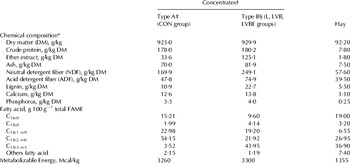
The chemical composition of the feed and meadow hay is reported in Table 1.
Chemical composition and fatty acid profile of diets

† Ingredients of administrated concentrates: barley, soybean flour, corn flour, extruded linseed (for experimental groups only) wheat bran, wheat flour, molasses, dicalcium phosphate, calcium carbonate, sodium chloride, sodium bicarbonate, magnesium oxide. Minerals and vitamins supplement /kg of concentrate: iron (FeSO4) 100 mg; iodine (Ca(IO3)2) 5,00 mg; cobalt(CaSO4) 3·00 mg; zinc (ZnO) 100 mg; selenium (Na2SeO3) 0·30 mg. Vitamins: A 40·000 U.I; D3 4·000 U.I; E acetate 40 mg; B1 3·0 mg; B2 2·0 mg; B6 0·40 mg; B12 0·010 mg
‡ Type A: control concentrate without extruded linseed and dietary supplements (CON group)
§ Type B: experimental concentrate with 200 g of extruded linseed·kg−1 of concentrate (L group). Experimental concentrate with 200 g of extruded linseed +2·86 g of verbascoside supplement·kg−1 of concentrate (LVB group). Concentrate with 200 g of extruded linseed +2·86 g of verbascoside supplement +14·29 g of microencapsulated vitamin E supplement (D, L-α tocoferil acetate)·kg−1 of concentrate (LVBE group)
* Samples were analysed in duplicate (n=2)
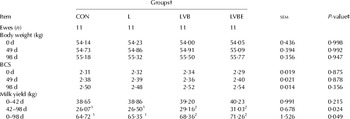
Table 2 lists the productive parameters of the ewes. The 700 g concentrate/ewe per day was completely consumed by the ewes.
Body weights, BCS and milk yield in Lacaune ewes

† CON, control diet; L, 200 g of extruded linseed·kg−1 of concentrate; LVB, 200 g of extruded linseed+2·86 g of verbascoside supplement based·kg−1 of concentrate; LVBE, 200 g of extruded linseed+2·86 g of verbascoside supplement+14·29 g of microencapsulated vitamin E·kg−1 of concentrate
‡ 1,2within a row, means without a common superscript differ (P<0·05)
Body weight and BCS were not influenced by the experimental dietary treatment. Table 2 however shows a milk yield improvement (P<0·05) in the LVB and LVBE groups, by 5·6 and 10·1% compared with the CON group and by 4·6 and 9·0% compared with the L group, respectively. No differences were observed between the L and the CON groups. The positive effect of dietary treatment on milk yield was significant in the second period of the trial (42–98 d) which influenced the entire experimental period.
Milk quality parameters
Data on the milk chemical composition are not reported because no statistical differences were noticed between experimental and CON groups. Only a dietary treatment effect (P<0·05) on milk fat content was observed (5·76 vs. 6·77, 6·83, 6·89 g 100 g−1 in CON, L, LVBE, LVB groups respectively). Milk fat content was significantly higher in the L (17·5%), LVB (19·6%) and LVBE (18·6%) groups compared to the CON group, starting with the second sampling (49 d). Milk fat content in the L, LVB and LVBE groups showed an increase (P<0·05) by 14·5, 17·6 and 17·3% respectively, due to the dietary time effect, from the beginning to the end of the trial. Instead, the CON group showed no appreciable variations throughout the trial period.
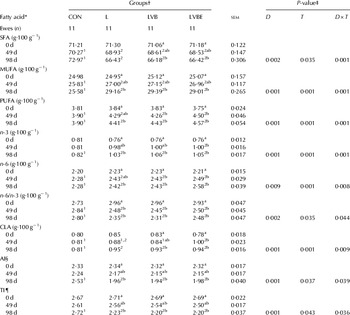
Table 3 reports SFA, MUFA, PUFA, CLA (C18:2 cis-9, trans-11 and trans-10, cis-12) fatty acid.
Milk fatty acid profile in Lacaune ewes

† See Table 2 for details of groups
‡ D, fixed effect of dietary supplementation; T, fixed effect of time; D×T, interaction dietary supplementation×time; 1·2within a row. means without a common superscript differ (P<0·05); a.b.c within a column. means without a common superscript differ (P<0·05)
§ AI, atherogenic index
¶ TI, thrombogenic index
* Samples were analysed in duplicate (n=2)
At the end of the trial, SFA values decreased (P<0·05) by about 9·0% in the L, LVB and LVBE groups compared to the CON group, respectively. Dietary time effect over time reduced (P<0·05) milk SFA in the L, LVB and LVBE groups, while values in the CON group remained almost unchanged.
At the end of the trial (98 d), the dietary treatment effect increased significantly (P<0·01) MUFA and PUFA values in the L, LVB and LVBE groups compared with the CON group.
At the end of the test, MUFA values increased by 14·0, 15·0 and 13·4%, while PUFA values increased by 13·0, 13·6 and 17·2% in the L, LVB and LVBE groups compared with the CON group, respectively. The time of the dietary treatment, from the first to the third sampling, showed an increase (P<0·01) in both MUFA and PUFA milk fatty acid content, while values in the CON group remained almost unchanged. In addition, the dietary treatment significantly influenced the milk n-3 and n-6 PUFA contents. At 98 d, n-3 fatty acid highlighted increase in values (P<0·01) by 27·1% in the L group and by 29·6% in the LVB and LVBE groups, compared with the CON group. The length of the trial from the first to the third sampling also markedly increased (P<0·01) the n-3 values in the three experimental groups, while the CON group in the same period showed no significant variation. At the end of the test, n-6 fatty acids values showed an increase (P<0·05) in the L, LVB and LVBE experimental groups by 6·1, 7·0 and 13·2% compared with the CON group. The duration of the trial, caused an increase (P<0·01) in n-6 fatty acid in the three experimental groups; no time effect was observed in the control group.
Dietary treatment influenced the n-6/n-3 fatty acid ratio which significantly decreased (P<0·05) by 16·0, 17·9 and 11·4% in the L, LVB and LVBE groups, respectively. In the same groups the time of feed administration influenced the n-6/n-3 ratio from the first to the third sampling, with a significant reduction (P<0·05) in values which was not observed in the CON group.
At the end of the trial CLA showed an increase (P<0·01), by 18·7% in the L and LVBE groups and by 15·0% in the LVB group, compared with the control group. The duration of the trial also positively influenced the milk CLA content (P<0·01), from 0 d until 98 d, in the L, LVB and LVBE experimental groups, while over the same period the CON group showed no variation.
The milk atherogenic and thrombogenic indexes which measure the extent of atherosclerosis and thrombosis risks were lower (P<0·01) in the L, LVB and LVBE groups than the control group. In the same groups the time of dietary treatment also produced a decrease (P<0·05) in these indexes, from the beginning until the end of the trial.
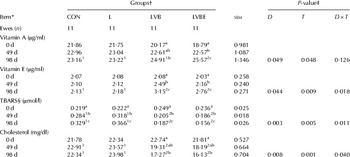
The experimental treatment statistically influenced the milk content of vitamins A and E, TBARS and cholesterol (Table 4).
Milk oxidative status parameters and milk cholesterol in Lacaune ewes

† See Table 2 for details of groups
‡ D, fixed effect of dietary supplementation; T, fixed effect of time; D×T, interaction dietary supplementation×time; 1·2within a row. means without a common superscript differ (P<0·05); a.b within a column. means without a common superscript differ (P<0·05)
§ Thiobarbituric acid reactive substances
* Samples were analysed in duplicate (n=2)
At 98 d, the vitamin A content was higher (P<0·05) by about 7·0% in the LVB group and about 10·0% in the LVBE group compared with the CON and L groups. An increase (P<0·01) was observed in vitamin A, from 0 d until 98 d, in the LVB and LVBE groups, while in the CON and L groups, in the same period, no variation was shown.
The milk vitamin E value was higher (P<0·01) in the LVB and LVBE groups by 47·9 and 29·6% compared with the CON group and by 44·5 and 26·6% compared with the L group, respectively, while over the same period the CON and L groups showed similar values.
The dietary time effect was also significant (P<0·01) throughout the experiment with an increase in the vitamin E values by 51·4 and 35·9% in the LVB and LVBE experimental groups, respectively; while in the same time period the CON and L groups values remained unchanged.
The milk TBARS values highlighted a decrease (P<0·01) in LVB and LVBE groups by 43·2 and 52·6% compared with the CON group and by 48·9 and 57·4% compared to the L group, respectively. A marked reduction (P<0·05) in TBARS levels was also observed, from 0 d until 98 d, in the LVB and LVBE groups respectively; while in the same time period the CON and L groups showed a significant increase (P<0·05).
The dietary treatment produced a marked decrease in milk cholesterol content (P<0·01) in the LVB and LVBE groups. The latter showed lower cholesterol values by 22·7 and 27·8% respectively compared with the control group and by 28·0 and 32·7% compared with the L group, at the end of the test. The duration of the trial also highlighted a time effect (P<0·01) in the same experimental groups with a significant decrease in values (P<0·01) from the beginning until the end of the trial, while the milk cholesterol content of the CON and L groups showed no statistical variation.
Discussion
The higher milk yield observed in the experimental LVB and LVBE groups, compared with the L and CON groups, is probably due to the capability of verbascoside to exhibit antibacterial activity (de Andrade Lima et al. Reference de Andrade Lima, Cavalcanti de Amorim, da Fonseca Ribeiro de Sena, de Andrade Chiappeta, Pereira Nunes, de Fátima Agra, Leitão da-Cunha, Sobral da Silva and Barbosa-Filho2003) which produced an improvement in feed efficiency, since no statistical differences in milk yield were observed between the two experimental groups. The improved milk yield is in agreement with our previous studies on Lacaune ewes supplemented with 10 mg verbascoside/ewe per d during the peripartum period (Casamassima et al. Reference Casamassima, Palazzo, Martemucci, Vizzarri and Corino2012). A milk yield increase was also observed by Chiofalo et al. (Reference Chiofalo, Riolo, Fasciana, Liotta and Chiofalo2010) in Valle del Belice ewes fed with a rosemary extract rich in phenolic compounds. The administration of substances with an antioxidant activity such as sylimarin, can lead to an improvement in milk yield and welfare in goats and cows during the peripartum period (Tedesco et al. Reference Tedesco, Domeneghini, Sciannimanico, Tameni, Steidler and Galletti2004, Reference Tedesco, Turini and Galletti2005).
We found no effect of the linseed dietary supplement on milk yield in the L and CON groups, which is in line with Martinez Marin et al. (Reference Martinez Marin, Gomez-Cortes, Gomez Castro, Juarez, Perez Alba, Perez Hernandez and de la Fuente2011) on lactating goats fed with a linseed supplementation.
Milk quality parameters
The higher milk fat content in the L, LVB and LVBE groups may only be due to the dietary linseed effect, since no significant differences in this parameter between the LVB and LVBE groups were observed. The lack of effect of the dietary verbascoside and vitamin E supplements on milk fat content is in agreement with the findings of Mardalena et al. (Reference Mardalena, Warly, Nurdin, Rusmana and Farizal2011) in lactating goats supplemented with different percentages of antioxidant substances. It also concurs with our previous studies (Casamassima et al. Reference Casamassima, Palazzo, Martemucci, Vizzarri and Corino2012) on Lacaune ewes supplemented daily with 10 mg verbascoside/ewe In a study on lactating ewes fed with extruded linseed Caroprese et al. (Reference Caroprese, Albenzio, Bruno, Fedele, Santillo and Sevi2011) found a milk fat increase. Shingfield et al. (Reference Shingfield, Bernard, Leroux and Chilliard2010) suggested that the increased absorption of fatty acid in the mammary gland due to a blood fatty acid increase after diet integration with lipid source, led to the higher milk fat content.
The higher milk vitamins A and E content in the LVB and LVBE groups may be due to the effect of the verbascoside based dietary supplement which produces an increased concentration of blood vitamins (Casamassima et al. Reference Casamassima, Palazzo, Martemucci, Vizzarri and Corino2012) and a higher availability for the mammary gland. In the LVBE group a possible effect of vitamin E supplementation can be ruled out because no additional vitamin increase was detected in this group compared with the LVB group. In experiments on lactating cow and goats, Martin et al. (Reference Martin, Fedele, Ferlay, Grolier, Rock, Gruffat and Chilliard2004) found a positive correlation between blood vitamin A and E concentrations and their milk content. In addition, in dairy cows an increase in plasmatic vitamin E absorption was observed by the mammary gland in a PUFA-rich diet (Durand et al. Reference Durand, Scislowski, Gruffat, Chilliard, Bauchart, Hocquette and Gigli2005). A higher milk vitamin E content may increase the nutritive value of milk and improve its oxidative status through the protective action against oxidant flavour formation especially when the milk PUFA fatty acid content is high (Politis, Reference Politis2012). The lower milk TBARS content in the LVB and LVBE groups is in agreement with Yang et al. (Reference Yang, Chang, Peh and Chen2004) results who reported that the levels of TBARS in milk of goat, following vitamin E injection, paralleled that of plasma.
The LVB and LVBE groups showed a lower cholesterol level in milk, probably due to the verbascoside activity in reducing blood cholesterol (Casamassima et al. Reference Casamassima, Nardoia, Palazzo, Vizzarri and Corino2014) that could lead to a minor taken-up of blood cholesterol in mammary synthesis, since the relation between blood and milk cholesterol concentration remains unclear (Long et al. Reference Long, Patton and McCarthy1980; Viturro et al. Reference Viturro, Meyer, Gissel and Kaske2010).
The additional dietary vitamin E supplementation in the LVBE group showed no variation in milk cholesterol and TBARS levels compared with the LVB group.
Milk fatty acid profile
In the present study, linseed supplementation increased both the MUFA and PUFA contents of sheep milk, together with a reduction of SFA in the L, LVB and LVBE groups than the CON group. The higher milk MUFA content, mainly C18:1 fatty acid, is the result of ruminal biohydrogenation of C18:2 and C18:3 fatty acids, and of desaturation of C18:0 in the mammary gland by the action of the Δ9-desaturase enzyme (Dhiman et al. Reference Dhiman, Satter, Pariza, Galli, Albright and Tolosa2000). Oleic acid, the most representative of MUFA fatty acids, may improve the milk nutritional value by limiting human plasmatic LDL cholesterol without acting on HDL cholesterol concentration and thus positively modifying the LDL/HDL ratio (Ulbricht & Southgate, Reference Ulbricht and Southgate1991). The increase observed in the present study of C18:3 n3 in milk ewes could be primarily attributed to the linseed added to the ration, in fact the supplementation of extruded linseed resulted in an increase of α-linolenic acid in milk both in ewes (Mele et al. Reference Mele, Contarini, Cercaci, Serra, Buccioni, Povolo, Conte, Funaro, Banni, Lercker and Secchiari2011) and in cows (Akraim et al. Reference Akraim, Nicot, Juaneda and Enjalbert2007). In addition, the increased dietary intake of C18:3 in linseed-supplemented ewes resulted in increased levels of vaccenic acid (C18:1 trans-11) and increased CLA C18:2 cis-9, trans-11, the main milk CLA isomer of which it makes up between 80 and 90% (Bauman et al. Reference Bauman, Baumgard, Corl and Griinari1999) by Δ9-desaturase activity (Caroprese et al. Reference Caroprese, Marzano, Marino, Gliatta, Muscio and Sevi2010).
In the L, LVB and LVBE groups, the lower n-6/n-3 ratio led to an improvement in milk quality and nutritional values since the ratio was lower than 5. This is the maximum value recommended for a healthy diet and to better control cardiovascular, inflammatory and autoimmune diseases and cancer risks (Wijendran & Hayes, Reference Wijendran and Hayes2004).
In the same groups the atherogenic and thrombogenic indexes also decreased due to the decrease in lauric, myristic and palmitic fatty acids, thus highlighting a milk quality improvement. Our findings are in agreement with other studies (Caroprese et al. Reference Caroprese, Albenzio, Bruno, Fedele, Santillo and Sevi2011; Nudda et al. Reference Nudda, Battacone, Atzori, Dimauro, Rassu, Nicolussi, Bonelli and Pulina2013) on ewes and goats fed a diet supplemented with extruded linseed and showing an improvement in AI and TI indexes. Milk fat with high atherogenic index values has detrimental effects on human health. It is known that in the human diet, SFA contributes to coronary diseases, whereas the unsaturated fatty acids, including CLA, MUFA (in particular oleic acid) and PUFA, have a protective effect against cardiovascular diseases (Williams, Reference Williams2000). It has been demonstrated that fatty acid composition of sheep cheese is dependent on the fatty acid composition of raw milk (Gomez-Cortes et al. Reference Gomez-Cortes, Bach, Luna, Juarez and de la Fuente2009), so the improvement of fatty acid profile in milk with dietary integration can result in naturally enriched dairy products.
Conclusions
The results of the present study clearly demonstrate that extruded linseed and verbascoside supplementation produced an improvement in ewes yield and quality of milk due to the fat content increase and the fatty acid profile, vitamins A and E, oxidative stability improvement and in addition a lower cholesterol content, suggesting that the use of present dietary strategy could be followed in husbandry practice. In addition, linseed and verbascoside supplementation to ewes can contribute to improve the healthy properties of milk, since its consumption benefits human health. The vitamin E enriched diet did not provide any additional improvement on yield and quality of sheep milk.