In April 1960, only months before Congo's official independence on 30 June, Notre Kongo, the periodical of the Association of the BaKongo, a leading political party in Congo, questioned Belgian ownership of the collections of the Royal Museum of the Belgian Congo near Brussels.Footnote 1 If Congo was becoming an independent nation, did it not have the natural right to possess its own national heritage? Were the objects in the museum's collections not a resource of the country, like its mineral wealth? These challenges, and the support they received across the political spectrum in Congo, led to long-term, continuing conflict between Congo and Belgium over ownership of museum collections. Initially, these debates played a role in the nations' bilateral relations, but gradually their impact extended into the national cultural politics of the Mobutist state and international world heritage politics.
The debates over ownership of the collections reveal competing interpretations of decolonization and demonstrate the role of cultural heritage in structuring expectations about the process of decolonization and the postcolonial imagination of Congo's cultural sovereignty. Using the history of Congolese demands for postcolonial cultural restitution, this article investigates the process of decolonization as a ‘drama of competing visions’ and argues for a thematic and periodization shift in the approach to the history of Congo's decolonization.Footnote 2 It does so by moving away from the history of the political and military events of the late 1950s and early 1960s, and instead turning to the debates over cultural sovereignty that took place from the late colonial era until the 1980s.
The dominant construction of the category of decolonization emerged in the West in the face of anticolonial struggles and was organized around Western governmental frameworks, shaping not only the historical processes of decolonization but also the historical view of that process.Footnote 3 Consequently, the literature emerging from the former colonizer and the later nationalist histories define decolonization as a moment of rupture, in which new and sovereign nation-states were (or should have been) created.Footnote 4 Far too often, the moment of political independence is portrayed as the end of a process. In the case of Congo, the scholarship is dominated by a focus on political and military events taking place between roughly 1955 and 1965.Footnote 5 The first Congo Crisis, or the Katangese Secession and the regional conflicts of the early 1960s, is generally described as part of the process of decolonization. This means that Mobutu's second coup in 1965 is often seen as the end of the era of decolonization and the beginning of the postcolonial state in Congo.Footnote 6 This article questions that periodization and argues that independence was more a starting than an end point for the process of decolonization, and advocates for an examination of the history of the Mobutist state through the lens of decolonization.Footnote 7
Taking the perspective of debates over cultural heritage is particularly productive in this context. As the embodiment of (imagined) identities and cultures, and their pasts, heritage ties the immaterial to the material, a (usable) past to a present, and ‘having culture’ to the possession of cultural artifacts (or ‘cultural property’), often in the form of monuments, historical sites, landscapes, and museum collections.Footnote 8 A product of ‘ways of valuing the past that arose in Renaissance and Enlightenment Europe and … bolstered by nationalism and populism’ and by Western obsession with identity (both collective and individual), heritage was projected upon non-Western cultures within the context of colonialism and shaped by colonial collecting and displaying practices.Footnote 9 Zoe Strother recently observed that if ‘heritage is culture conceived as property, it is also property obtained through legally determined rights of succession’.Footnote 10 Thus, it should come as no surprise that ownership of these collections became the subject of debate in the process of decolonization; after all, Belgian rhetoric about Congo was rife with references to the colony as its ‘maturing child’. With the European nation-state as a model, the newly independent country sought to create itself as the guardian of its cultural heritage, which would enable it to construct a cultural legitimacy that underwrote its political legitimacy.Footnote 11
The different values accorded to cultural heritage in this article emphasize its usefulness as an economic resource, a cultural artifact, and as a political tool, both in terms of national and international politics. The history of debates over cultural heritage will also reveal the connections between an economic interpretation of the process of decolonization as a battle for the restitution of economic resources, a view of decolonization as a cultural struggle over the symbols of a past, and an interpretation of the process as a political struggle for cultural sovereignty.
CULTURAL HERITAGE AND CONTESTED COLONIAL GUARDIANSHIP
The ‘scramble for art’ accompanying the European presence on the continent caused large numbers of ethnographic artifacts to flow into newly established European museums and fed the development of anthropology as a science.Footnote 12 Originally mere curios, these objects became scientific artifacts, players in the construction of narratives about the ‘civilizing mission’, and eventually art.
The older narrative of the ‘civilizing mission’, in which the objects were proof of the need for the transformation of ‘primitive’ African cultures, shifted towards a rhetoric of cultural guardianship. Preservation and protection of ‘traditional arts’ from modernity's destructive effects now became a motivating factor for the colonial presence. Conveniently, this perceived decline in traditional arts was blamed not on colonial modernity itself, but on Congolese inability to properly deal with the seductions of modernity, which the colonial power believed resulted in their abandonment of traditional life.
This cultural guardianship was implemented via initiatives to protect and preserve the colony's production of ‘traditional’ arts and crafts, but also resulted in an increased political profile of the collection of the Tervuren museum in Belgium. The latter had been created by Leopold II for the promotion of Belgian colonialism, a role it continued to fulfill. A new Congolese art room, created in the 1950s, underlined the new status of traditional art as heritage, and a resource of the colony, worthy of protection.Footnote 13
The political role of art as heritage also became important to the Congolese. The rising status of Congolese art resulted, during the 1950s, in efforts by traditional Congolese leaders like the Kuba king, to either prevent the sale and exportation of more objects, or at the very least have more control over this trade, and eventually to suggest that some objects in the West should find their way back. Interestingly, these demands were not aimed at restoring objects to their former roles in Congolese life, but instead appropriated Western redefinitions of them as representatives of cultural heritage, ‘art’, and museum objects.
A few small, mostly ethnographic, museums existed in Congo by the late 1950s, but these were created and controlled by colonial organizations, most prominently the Friends of Indigenous Art.Footnote 14 Although the museums in Leopoldville and Elizabethville attempted to engage an audience of évolués, few Congolese were involved in their management and organization. There were, however, initiatives taken by the Congolese themselves to create museums. The Kuba king, the representative of one of the most well-known artistic cultures in Congo, was historically invested in retaining control of Kuba heritage. He did this by trying to exert influence over the local missionary art school and by trying to create a local museum.Footnote 15 The Lunda ruler, the Mwata Yamvo, also organized a small museum in Musamba in the Katanga province. By providing a space deemed safe for the preservation and protection of objects by Western standards, these rulers hoped to keep objects local, and wrest control from the colonizers over what had become financially valuable objects that represented a traditional cultural authenticity.Footnote 16
Initially, Belgian colonial officials approved of what they believed was a ‘desire … to preserve in Africa those objects whose value our administration has revealed to them’.Footnote 17 With independence on the horizon, however, Congolese interest in the creation of museums extended into a desire to see the collections of the museum in Tervuren, Belgium, returned to Congo. Congolese visitors started to express irritation when visiting the Tervuren museum, ‘in the face of the expatriation of the riches they [were] starting to regard as a cultural patrimony’.Footnote 18
In an environment as hostile to the political aspirations of its colonial subjects as Belgian Congo was, cultural politics were an avenue through which strategies for self-representation took shape. Attempts to create locally controlled museums, and dissatisfaction with the Tervuren museum's possessions signaled the rising political role of traditional arts as heritage, a role that would become even stronger in negotiations for independence.
LES CONTENTIEUX: NEGOTIATING DECOLONIZATION AFTER INDEPENDENCE
With Congolese independence on the horizon, Congolese political organizations and the media picked up on the earlier references to Belgium's possession of large collections of Congolese ethnographic and art objects, and reformulated them as elements in the quest for decolonization.Footnote 19 What made these collections so important was both the financial value they had garnered at this point, which cast them as economic resources, and their symbolic value as representatives of an African precolonial heritage.
The appropriation of economic resources, a fundamental aspect of Belgian colonialism, took center stage in Belgian-Congolese negotiations in preparation of independence. Roundtable meetings addressed the political structure and economic processes of separation. Ownership of several large colonial companies (such as the Union Minière du Haut-Katanga, the largest mining company) was shared by private and state interests, and although Congolese negotiators expected the state holdings to be transferred to the independent Congo, this plan was far less appealing to Belgium since it would make the newly independent republic a large stockholder in various Belgian companies in Congo. The failure of the transfer of these holdings resulted in demands for their restitution by the newly independent Congolese government. These disputes, referred to as the contentieux, dragged out for several decades.Footnote 20
Accounts of the history of the contentieux neglect the fact that from the early to late 1960s the demands for the restitution of the Tervuren collections became systematically attached to the demands listed as contentieux. Initially, these included all the collections of the museum and the ownership of the buildings, but gradually the demands focused on the collections of ethnographic materials, particularly on those categorized as art. It was clear that possession of these particular collections played an important role in how sovereignty was imagined in Congo by both the media and the political world, but there was little reflection in these early years on how these collections would be ‘put to work’ once returned to Congo. The focus instead was on their depiction as essentially illegally owned goods.
The Congolese demands caused a stir at the museum in Tervuren. It did not help that the Belgian government officials in the early 1960s initially acknowledged that Congo's demands had a ‘legal base’.Footnote 21 Although these were kept off the agenda during the roundtable negotiations, the Belgian government realized that the issue would eventually surface, making it crucial for them to control negotiations to avoid the depletion of what was now considered Belgian patrimony and to make sure the debate would not become a trial on the legitimacy of Belgian colonialism.
The RMCA's response to the Congolese demands highlighted the fact that the Belgians had a far more limited view of decolonization than the Congolese, in part because of their different views of the colonial past. Lucien Cahen, who had become director of the RMCA in 1958, constructed a defense of his institution's possessions. First, he pointed out the universal scientific value of the collections as they existed.Footnote 22 Secondly, he argued that none of the museum's collections had been acquired in an improper or illegal manner. Thirdly, Cahen questioned Congo's focus on Tervuren's collections instead of other collections of Congolese art abroad. Lastly, he cast doubt on the newly independent country's ability to safeguard the valuable collections of art, as evidenced by the presence of objects ‘of direct (fraudulent) Congolese provenance’ for sale on the New York art market.Footnote 23 In portraying Congo as an immature state unable to protect the heritage still in place, Cahen reaffirmed Belgium's role as cultural guardian, and Tervuren as a safe haven for Congolese art.
Cahen's response to Congo's claims was not entirely negative. In the early 1960s, he employed a dual strategy and suggested an alternative by which the RMCA ‘would assist in the creation of a large national museum in Leopoldville’ and perhaps provide it with a ‘gift … in the context of exchange and in an atmosphere of understanding and mutual respect’, provided it would ‘not be accountable for filling a national museum’.Footnote 24
The chaotic situation following Congo's independence delayed official negotiations about the contentieux, although a partial resolution emerged in 1965 whereby the holdings of the former colonial companies were transferred to the new nation and an arrangement was reached about the colony's debt.Footnote 25 Congolese claims on Tervuren's art collections remained unresolved, however, only to re-emerge later, both in the context of the national cultural politics of Mobutu's regime and as elements in its international aspirations.
THE INSTITUTE OF NATIONAL MUSEUMS IN ZAIRE
Asked about the founding of the Institut des Musées Nationaux, current and former employees speak of Léopold Senghor's visit to Congo in the late 1960s. The Senegalese president is said to have asked Mobutu to visit a museum to admire the world-renowned Congolese traditional art. Realizing that Kinshasa had no museum to showcase its national art, Mobutu decided to create the institute. Whether this exchange between Senghor and Mobutu actually occurred is secondary to the exemplary founding myth it provides for the IMNZ. It depicts Mobutu as the keeper of his nation's artistic heritage and places him alongside Senghor, one of the great symbols of African independence and cultural identity, setting the museum's founding firmly in the tradition of African cultural independence and Pan-African unity. The documented history behind the museum's founding, however, takes us back to the contentieux and the construction of Congo's cultural sovereignty by Mobutu's regime.
Mobutu's rise to power in 1965 initiated a period of relative stability. Belgium's early enthusiasm for his reign was quickly tempered and relations between the two countries fluctuated, which the Belgians blamed on Mobutu's ‘unreliability’. While Mobutu could be irascible, Belgium's discomfort also had to do with his effort to construct economic and cultural sovereignty for Congo by pursuing the ownership of economic and cultural resources in a renewed commitment to an extended process of decolonization. These processes, however, served an increasingly authoritarian system of power.
After unsatisfactory negotiations with Belgium in 1966 over the remaining contentieux and particularly the ownership of the Union Minière du Haut-Katanga, the mining company was nationalized by Mobutu's regime. This was the first step in a series of nationalization processes in Congo's economic sector. Less than a year later, claims on the ownership of the Tervuren collections also resurfaced, now driven by Mobutu's presidential office, and the discourse formulating the demands became more explicitly about cultural sovereignty and representation – in other words, the use of the collections for the Congolese state.
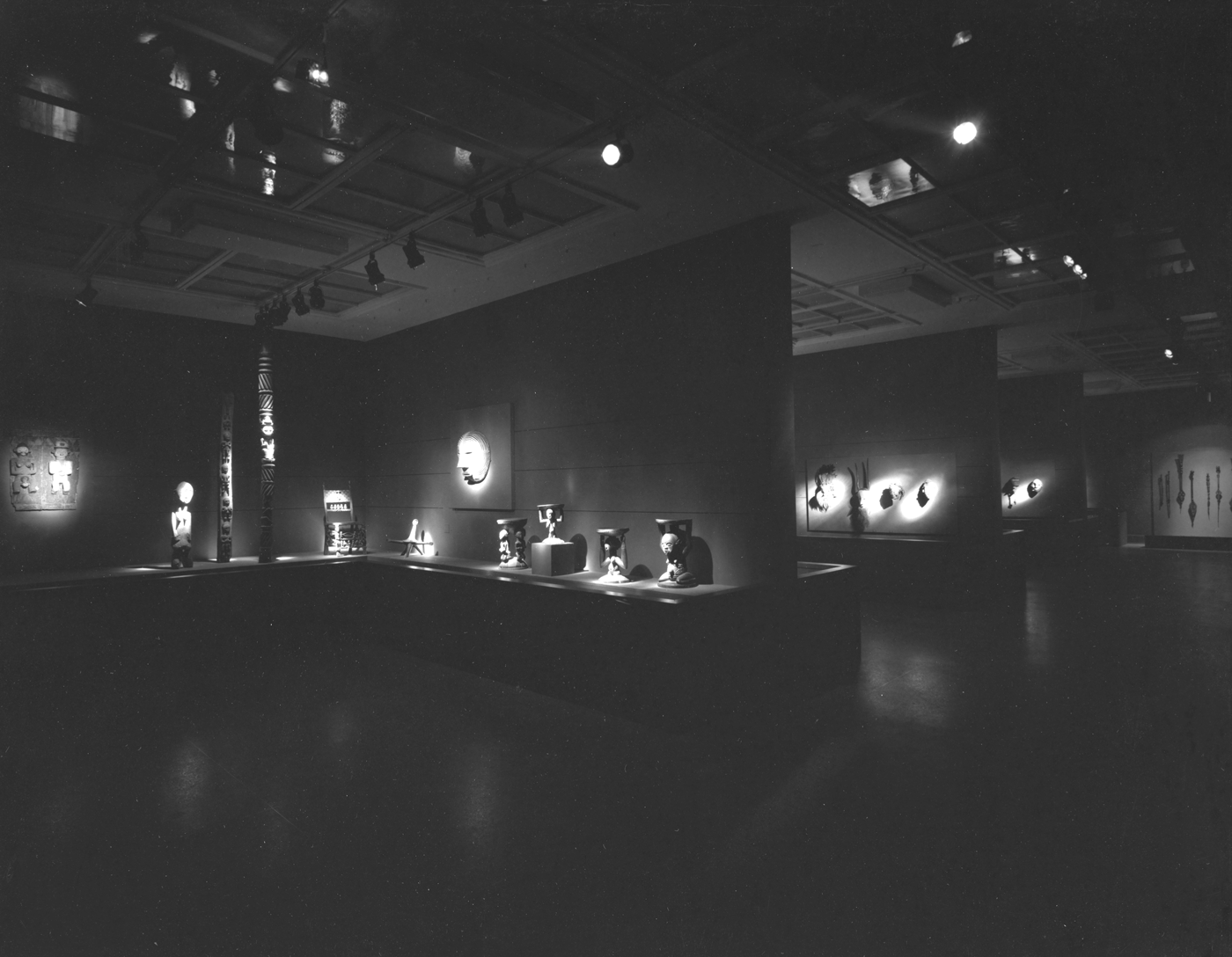
What brought the Congolese demand for cultural restitution back to the foreground was the controversy over the traveling exhibition Art of the Congo, co-organized by the RMCA and the Walker Art Center in Minneapolis. Made from select pieces of Tervuren's collections, Art of the Congo relied on the prestigious place of traditional Congolese arts in the realm of ‘primitive’ arts and served to advance the position of the RMCA in Belgium as the proper place for the protection and appreciation of Congolese cultural heritage. That exhibit, which toured prestigious American museums in 1967–9, provoked the ire of Mobutu, who saw it as the ultimate illustration of Congo's lack of control over its resources, its inability to represent itself through its own cultural heritage, and a continuation of colonial structures of representation and possession in a postcolonial setting.Footnote 26
Belgium was more responsive to Congolese demands this time, but paid careful attention to the framing of the negotiations. It wanted the term ‘restitution’ avoided at all costs because its use acknowledged the legitimacy of Congo's interpretation of decolonization as a compensation for previous exploitation. Also, Cahen wanted the talks to ‘start from the principle that there are no more Congolese claims on all or part of the “museum of Tervuren’”. Congo was to drop all references to the other contentieux in the talks because they tied negotiations over Tervuren's collections to debates about the Belgian colonial regime. There were also practical requirements: Congo had to have a museum to house the objects and needed to develop legislation against exportation of traditional art from Congo. By pointing out these deficiencies, and ascribing them to the postcolonial government instead of the colonial past, the Belgian government again undermined the idea of Congo as a legitimate, or ‘adult’, state – implying instead that it needed guidance and development – and erased the failings of the colonial state. If these demands were met, Cahen suggested, he would be able to convince the Belgian government to donate to Congo the two hundred pieces of the Art of the Congo exhibition.Footnote 27 Additionally, he suggested Congo and Belgium could collaborate in creating the necessary cultural infrastructure in the form of a museum institute in Congo. That proposal would allow the museum to play a significant role in shaping the cultural contours of postcolonial Congo. Furthermore, it would enable Tervuren's staff to do field research again: since the advent of Congolese independence, the museum's scientists had not had ready access to the country, which in the long run could negatively affect Tervuren's reputation as a center for the study of Congo.
In his communications with Mobutu, Cahen was careful to frame the museum project in terms of its benefits for Congo, emphasizing that the museum would be unique in Africa and comparable to what Leopold II had created in Tervuren: ‘The spirit in which the exhibitions will be created will be motivated by a concern to show the similarities in the regional diversity of traditional Congolese styles [and] the similarities in the Negro-African arts and cultures [in general]’, he wrote to ‘mon Général.’Footnote 28 But in his communications with the Belgian government, Cahen held back, emphasizing the need for care in choosing the terms to describe the possible transfer of objects as a ‘long-term (or permanent) deposit, thus without an official transfer of the property title’.Footnote 29 During the late 1960s and early 1970s, when Zaire was riding the wave of the copper boom, Mobutu had money to spend on nation-building projects. A museum, unequaled in Africa and showcasing the region's famous (and valuable) traditional art, was the kind of project he envisioned.
The agreement for the creation of the Institute of National Museums was signed on 30 April 1971.Footnote 30 Officially, the Belgian contribution was limited to a five-year period of technical help supplied by the experts in Tervuren, the planning of mutual field missions (during which the new museum institute would benefit from Tervuren's logistical aid), and internships for the Institute's staff at Tervuren.Footnote 31 In practice, however, the cooperation was very close, especially because Cahen was also named general director of the museum institute in Kinshasa.Footnote 32
Aside from gaining opportunities for field research for the RMCA, Cahen succeeded in (temporarily) avoiding the issue of real restitution. And whereas the negotiations began with the idea that a ‘gift’ of objects would be forthcoming, this clause did not make it to the final agreement, leaving the option of a gift up to the good will of Belgium. The agreement made Belgium look like a benevolent former colonial power, graciously willing to assist in the development of a struggling third world nation.
The Mobutu regime, on the other hand, obtained from the Belgians the know-how and educational resources to create a national museum, which Mobutu hoped would become a symbol of cultural sovereignty and a valuable tool to promote nationhood and create a form of citizenship.Footnote 33 The presidential office wanted the IMNZ to create a national collection of traditional art for national and international exhibitions. It also saw the IMNZ as a place where the creation of scholarly knowledge about Congo's traditional cultures could be reclaimed from foreign scientific institutions. Lastly, the IMNZ could serve as a place for the formation of a Zairian intellectual upper class.Footnote 34 This Zairian vision of the IMNZ was underwritten by the International Council of Museums, which was enthusiastic about the opportunities presented in Kinshasa, believing that the creation of a ‘truly African museology’, removed from European traditions and adapted to ‘building a new culture combining traditions and progress’, was central to decolonization.Footnote 35
THE POLITICS OF AUTHENTICITY AND ZAIRIAN CULTURAL SOVEREIGNTY
Creating a museum institute in Zaire did not end the discussion about cultural restitution. Cultural politics came to the forefront of Mobutu's national politics in the 1970s under the new ideology of authenticité. The cultural and political agenda of this new phase in cultural politics couched the issue of restitution in a broader struggle for cultural identity and sovereignty.
In 1971, Mobutu's regime made authenticité the state's official ideology, with the goal being a veritable ‘cultural revolution’, in which a new national, authentic Zairian nation would be born out of the values and traditions of precolonial Zairian cultures. The discussion about the contentieux was now recast in a much wider context, where the literal reclaiming of objects of cultural heritage from Tervuren in the name of the nation developed into a symbolic reclaiming of the entire heritage. Despite its guise as cultural politics aimed at erasing the impact of colonialism, in reality authenticité entailed an appropriation of colonial epistemes for the construction and justification of postcolonial systems of power.Footnote 36
The most visible practices associated with authenticité were marches and public spectacles, called animations culturelles et politiques (cultural and political entertainment), and new rules aimed at promoting traditional cultures.Footnote 37 Western dress was discouraged in favor of the abacost (from the French à bas le costume, ‘down with the suit’) for men and the pagne (wrapper) for women. Colonial monuments were removed from the cityscape, and Christian names abandoned in favor of Bantu names. The country, its famous river, and its monetary unit were renamed Zaire. The fabled traditional art was considered one of the ‘natural’ resources for this cultural ‘revolution’; its continued presence in the showcases of Tervuren, therefore, was all the more heinous in the eyes of Mobutu's regime.
The legitimacy of the state of Zaire and the ‘narrative of the past’ were of unique concern to Mobutu's regime.Footnote 38 As the space where the embodiment of cultural authenticity was preserved, the museum was (theoretically) able to transfer this authenticity back to a nation and its population through its exhibitions and educational activities, radically altering the position of the museum objects in the narrative of progress. Instead of being mere representatives of a culturally ‘pure’ past, they now played a role in the making of the modern future of Zaire as a nation. The precolonial past that was central to the imagination of authenticité, however, was rarely defined in the affirmative, merely as the absence or erasure of colonialism. The undemocratic start of Mobutu's regime in a coup, and its structural origin in the colony, needed to be erased, making this exercise in history construction through the erasure of the colonial era doubly important.
The process of cultural decolonization that authenticité was designed to advance was similar to political and economic processes of decolonization aimed at nationalization of the country's economic resources. The nationalization of the Union Minière was followed by the ‘Zairization’ of foreign-owned businesses in 1973, driven by a desire to keep their profits in Zairian hands. Although the effects were disastrous and attempts were made to reverse some of these policies years later, they were similar to the process of cultural decolonization attempted with authenticité: the goal was the nationalization of resources, whether cultural or economic, thereby reversing the effects of colonialism.Footnote 39
Not surprisingly, the politics of authenticité and increasing claims on the country's resources led to reinvigorated attention to the issue of cultural restitution, with Mobutu strategically relaunching the debate during an international meeting of art critics in Kinshasa. Addressing the opening session of the conference, he broached the subject of restitution in language directed at a larger, international battle in which Zaire was taking the lead:
Our artistic patrimony has been subjected to systematic pillage. And we, who address you and attempt to reconstruct this rich patrimony, we are often reduced to powerlessness. As a consequence, the art objects, often unique, are located outside Africa. [This conference should] draw the world's attention [to this subject] so that the rich countries, which possess the artworks of the poor countries, can return part of them.Footnote 40
More confrontational than before, Mobutu evoked an image of colonialism as ‘systematic pillage’. With the international press present, he was speaking not only to art critics, but to a wider audience of formerly colonized nations and colonizers, thereby casting himself as an international leader of formerly colonized nations.
These cultural politics demonstrate that the art-culture system that James Clifford so aptly named ‘a machine for making authenticity’ had ramifications far beyond the mere recategorization of artifacts as art.Footnote 41 These ideas impacted the realm of politics, as, in the colonial context, authentic traditional culture came to be regarded as the antidote for the side effects of modernization, or as the antidote to political ramifications of the implementation of Western economic modernization without political representation. Despite the rhetoric, in the case of authenticité this relationship between tradition and modernity was reversed. ‘Authentic’ cultural traditions and the country's heritage were the very road to a modernity in the shape of a unified nation-state. Mobutu also used authenticité to strengthen the undemocratic political system that succeeded the authoritarian colonial state. It is important to note that in the case of authenticité the postcolonial state, and not the people of Zaire, was presented as the legitimizing body for cultural authenticity, in an attempt to divert attention away from ethnic identity politics. In the case of traditional art, its possession by a Zairian state institution (the IMNZ) was desired, not its return to its communities of origin.
The campaign for cultural authenticity naturally impacted the IMNZ. It raised the museum institute's status as a keeper of the nation's true identity and made the issue of the restitution of collections from Tervuren more pressing, but the regime also became anxious about the involvement of so many Belgians in what should be a national operation and pressed for the ‘Zairization’ of the IMNZ's operations. This resulted in an increased role for the young Zairian researchers in collecting and research expeditions, although the leadership of the institute remained in Belgian hands.
Within the microcosm of the museum we see how, in practice, the concept of authenticité was interpreted quite broadly. The vagueness of the concept made it a powerful canvas for the projection of the ambitions and dreams of a generation of Zairians that had come of age in the era of independence. Several of the young Zairians working at the museum in the early 1970s professed their initial excitement about authenticité. It appeared to legitimize the scientific and public missions of the museum and reconnected Zaire to a broader Pan-African body of thought that encouraged pride, both in an African cultural identity and in a black racial identity (a connection it had lost with the demise of Lumumba more than a decade earlier). Two of the young women who were working at the IMNZ while completing their PhDs in anthropology, Nzembele and Tshiluila, were encouraged in their desire to venture beyond their own ethnic communities in their research. For both women, building a national museum and emancipating the creation of knowledge about Zairian cultures, meant engaging scientifically with the diversity of the nation.Footnote 42 For government officials like Kama Funzi Mudindambi – the liason between the presidential office and the museum – authenticité meant the decolonization of the IMNZ's operations via a Zairization of its leadership.Footnote 43
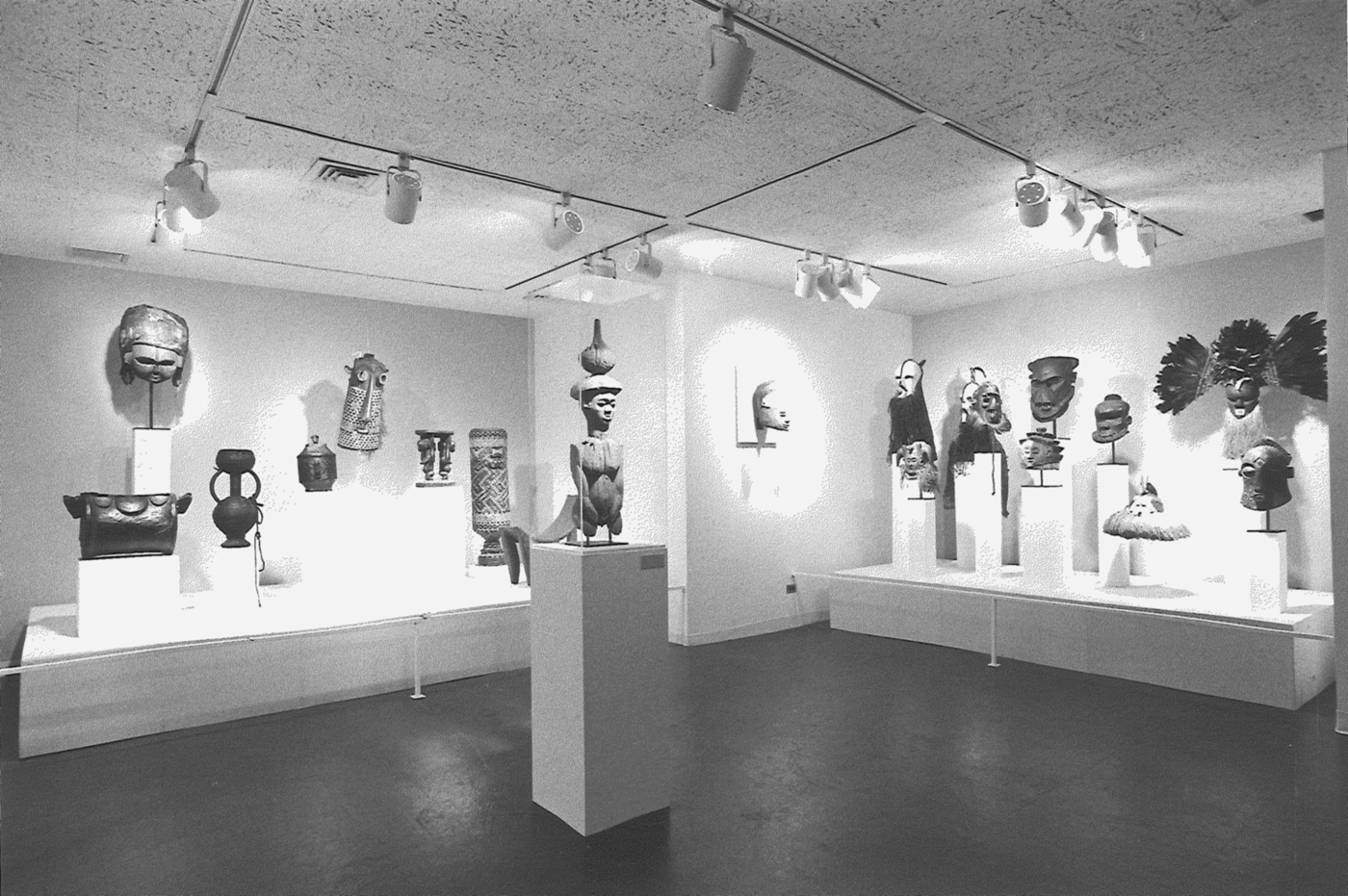
The presidential office also asked the IMNZ to organize some national and international exhibitions during these years. One of these, Art from Zaire, toured several North American museums from 1975 to 1978, effectively reclaiming the representation of Zairian traditional cultures from the RMCA's 1967 Art of the Congo (See Figs. 1 and 2). Interestingly, the exhibitions show us that authenticité failed to fulfill its ambition to create a ‘new aesthetic vision’.Footnote 44 It had little effect on the way objects were displayed or contextualized, which relied heavily on Western paradigms of art display. The main difference between the 1967 and 1975 exhibitions lay in their political messages: while the first had been a postcolonial display of colonial rationales for cultural guardianship, the 1975 exhibition was a successful international promotion of the cultural sovereignty of Mobutu's regime.Footnote 45
Art of the Congo, Walker Art Center, 1967. Courtesy of the Walker Art Center.

Art From Zaire, Africa American Institute, 1976. Courtesy of the AAI.
The vagueness of authenticité made it, in White's words, ‘one of the most powerful rhetorical tools of the regime’.Footnote 46 To dismiss it as mere ‘clouds of smoke’, as Thomas Turner does, subordinate the cultural aspect to the political goals, as Jean-François Bayart does, or to see it merely as the ‘dramatization of postcolonial commandment’, or a grotesque mask for power, as Achille Mbembe does, disregards authenticité's initial appeal to Zairians and foreigners alike.Footnote 47 The dubious origin of the politics did not take away from their genuine reception by the Zairian population in the early 1970s, or from the belief of both government officials and intellectuals in the validity and role of cultural legitimacy in creating sovereignty for the postcolonial nation and state. As Michael G. Schatzberg has pointed out: ‘While seeing the authenticity campaign as a cynical mechanism of political control and domination [it can also be] understood as a manifestation of cultural nationalism, or of nation-building.’Footnote 48 Although by the middle of the decade, the corrupt, authoritarian nature of Mobutu's regime was apparent, the opportunity to create a ‘new’ cultural identity in a post- and anticolonial context had at one point appeared liberating and invigorating.Footnote 49
INTERNATIONALIZATION OF DEBATES OVER CULTURAL HERITAGE
Developments in the world of heritage preservation and international cooperation also confirmed the emphasis on cultural heritage as a legitimizer of cultural sovereignty and gave rise to an international conservation regime in which the protection, movement, and possession of cultural property was increasingly monitored. Mobutu's regime profited from this international context, since it provided both a forum and a semi-legislative framework for the campaign for restitution. Despite promoting the regime's international, and particularly Pan-African profile, the results of the strategy were mixed.
After the Second World War, heritage became increasingly important in national and international political agendas. The 1954 Convention for the Protection of Cultural Property in the Event of Armed Conflict expressed the need to protect cultural property, particularly in the context of wartime destruction. Its reasoning rested on a belief in the collective ownership of cultural heritage and a shared responsibility for protecting that heritage as the property of humankind. This ‘cultural internationalism’, as legal scholar John Merryman has characterized it, made way for a ‘cultural nationalism’ by the 1970s.Footnote 50 The 1970 UNESCO Convention on the Means of Prohibiting and Preventing the Illicit Import, Export and Transfer of Ownership of Cultural Property showed how international opinion on heritage had changed since the postwar years. Created to help nation-states protect the cultural heritage within their borders against illegal removal, it emphasized that nations had a natural right to a cultural heritage. Yet this new regulation held an important caveat: the regulations were nonretroactive.Footnote 51 While recognizing the nation-state as the custodian of cultural heritage, the 1970 UNESCO convention disavowed the possibility of international discussion of the status of objects removed during colonization. While suggesting the possibility of bilateral negotiations for disputed objects, as Ana Filipa Vrdoljak notes, the document indicated ‘the need to maintain the integrity of [these] collections for “scientific purposes’”.Footnote 52
By the 1970s, there was an international conservation regime for the protection of national heritage rights. Unlike Merryman, I argue that the cultural internationalism of the 1950s was not replaced by a cultural nationalism, but that those schools of thought provided competing interpretations of the importance of a nation's heritage. Just as art became a universal category that included ‘primitive’ arts, so did heritage. Casting art objects from formerly colonized countries as ‘world heritage’ weakened claims for repatriation and restitution from former colonies in the light of Western museums' continued claims in the name of the protection of world heritage. As David Lowenthal has remarked, ‘Universalism endows the haves at others’ expense.’Footnote 53
A closer look at the Belgian-Zairian debates reveals these competing interpretations of heritage and their political effects. They became another avenue for the expression of competing interpretations of the colonial past, particularly when considered alongside the ideology of authenticité. Zaire's demands for cultural restitution and the history of international discussion and legislation on cultural heritage became intertwined at this point. In October 1973, Mobutu addressed the UN in New York, repeating his message about colonial pillage and the need for postcolonial cultural restitution. Zaire requested that cultural restitution be placed on the agenda for the 28th meeting of the UN General Assembly, arguing that ‘these works represent the hand and heart of the forefathers … it is natural and just to restitute to these underdeveloped countries their beacons of light, their authentic images of a continued future’.Footnote 54 Zaire proposed a resolution stipulating that ‘the cultural heritage of a people conditions in the present and in the future the growth of their artistic values and general development’. By using the language of nationalism and heritage to contest the nonretroactive nature of UNESCO 1970, Zaire underlined that this great transfer of art from poor to rich countries had often been a consequence of colonial occupation.Footnote 55 The proposed resolution was immediately backed by nine other African countries.
During the debate over the proposed resolution, the European countries contested the language indicating that colonialism alone was responsible for scattering poor countries' cultural heritage. Instead, they also put blame on ‘unscrupulous traffickers and the ignorance, complacency and even at times the collusion of locals who out of greed, avarice, or naiveté contributed to the clandestine expropriation of artistic and cultural treasures that are truly irreplaceable’.Footnote 56 The resulting adaptation of the resolution was significant because it pushed it back in the direction of UNESCO 1970, which had singled out the illegal art trade as the culprit for the depletion of cultural heritage in former colonies.Footnote 57
The resolution that passed was watered down and difficult to enforce internationally. Nonetheless, Zaire's maneuvering had a clear impact on Zairian-Belgian relations and provoked frantic responses in Tervuren. Mere weeks after Mobutu's speech to the UN, Belgian Minister of Foreign Affairs Renaat Van Elslande attempted to influence media reports on this issue by holding a press conference in Kinshasa where he mentioned the existing collaboration between the museums in Kinshasa and Tervuren and Belgium's financial help to the IMNZ. He emphasized that the latter was well on its way to creating a national collection by gathering objects in rural Zaire. He also mentioned that ‘it was envisioned that Belgium would transfer a certain number of pieces, meant to complete the collections created [in Kinshasa] … the idea was not to empty the halls of Tervuren, but to select in service of the blank spots in the Zairian collections’.Footnote 58 That message created dismay in Belgium, where it seemed too defensive, too much like an admission of guilt or disavowal of the Belgian colonial regime in Congo.
Cahen, who had so diligently negotiated the agreement with Zaire over the creation of the National Institute for Museums, was deeply frustrated. Now, any return of objects from Tervuren to Zaire would look like the result of pressure exerted by Zaire through the UN and the media.Footnote 59 Cahen tried to regain control of the situation with a press conference in Kinshasa, but that plan was blocked by the Zairian presidency. Increasingly, the ability to define ‘the true character of the Belgian gesture’ became more important than the actual content of a transfer.Footnote 60 For Belgium, and particularly Tervuren, the ability to define the repatriation of objects as a ‘gift’ was a central motivation for offering objects from their collections. Calling it a restitution implied a different interpretation of the process whereby the objects were obtained, and therefore of the nature of the Belgian colonial regime. Zaire's attempt to change the parameters of the debate by way of the international scene was an attempt to reengage with a process of decolonization through the political construction of a symbolic example of cultural sovereignty.
The strength of an ideology like authenticité was that it functioned on two different levels: the national and the international. On a national level, it promoted a Zairian cultural exceptionalism that encouraged Zairians to take pride in their cultural heritage. Hence, it promoted an allegiance to the state that constructed itself as the guardian of that heritage. It simultaneously created the international opportunity for Mobutu to take the lead in the discussion about the rights of postcolonial counties to possess their cultural heritage, and consequently also the discussion about the rights of non-Western and formerly colonized countries as nations. Although the 1973 UN resolution lacked enforceability, the institutional framework the UN and UNESCO offered in the form of an international conservation regime along with the discourse for framing claims in nationalist terms that aligned with the goals of authenticité, enabled Mobutu's regime to demand the return of the embodiment of its past.
There was, however, no tangible result from Belgium's promises and the Mobutu regime's international machinations. Despite years of argument, by the start of 1976, no transfer of art objects had taken place. In part, this was because economic nationalization in Zaire soured the relation between the two countries. On the other hand, Tervuren's hesitations – which it justified by invoking the lack of a proper museum building in Kinshasa and the failure of the government to gain control over the illegal art trade – also played a role.Footnote 61 Both parties ignored the fact that the IMNZ already had a real museum building in Lubumbashi. The centralization politics of Mobutu's regime would not tolerate yet another of the country's resources to be in the hands of Katanga, the mining region. Plans for museum buildings in Kinshasa (the IMNZ was housed in temporary barracks) were developed, but financial concerns and power struggles within Mobutu's regime prevented their realization.
THE OBJECTS OF CONTENTION
In 1976, the agreement between Belgium and Zaire that established the cooperation between the IMNZ and Tervuren was coming to an end. The museum institute had amassed a considerable collection by organizing collecting trips throughout Zaire and buying from art traders in the capital. Its scientific activities were underway, as was the education of its young Zairian staff at Tervuren and at Belgian universities. But this all came to a halt by 1975. Due to the economic crisis (caused by the nationalization process and the end of the copper boom), money for the museum evaporated, along with any serious plans for a real museum building. A continuing cooperation with Tervuren was necessary for its survival.
Tervuren also had a stake in continuing cooperation. Although the Belgian museum attempted to broaden its collections and research beyond the scope of the former colony, it was still heavily oriented toward Zaire. Continued cooperation between these institutions would be mutually beneficial. Luckily, relations between the two governments improved somewhat between November 1975 and September 1976, because of a partial compensation of foreign business owners affected by the nationalization of the country's economic resources. Additionally, Zaire made an important gesture toward Belgium. During a UNESCO colloquium in Venice, Eugénie Nzembele Safiri, a young employee of the IMNZ, publicly sided with the Belgian interpretation of a transfer of art: ‘There has been … a “gentleman's agreement” on the subject of a gift of pieces of ethnographic art that will be complementary to the collections gathered by Zaire itself.’Footnote 62 This statement endorsed the interpretation of the transfer as a ‘gift’ and ‘support’ for the IMNZ's collection, not as restitution.
But what would be the content of the gift? Initially, the Zairian demand had been driven by Mobutu's desire for the objects in the 1967 Art of the Congo exhibit in the United States. In response, in the early 1970s Cahen drew up a list of pieces that took as its starting point the two hundred objects of the exhibit. However, forty of these, including some of the most prestigious, were replaced by ‘similar’ items.Footnote 63 Only one of the objects on this revised list (a ndop, a royal Kuba statue) eventually made it to the IMNZ.
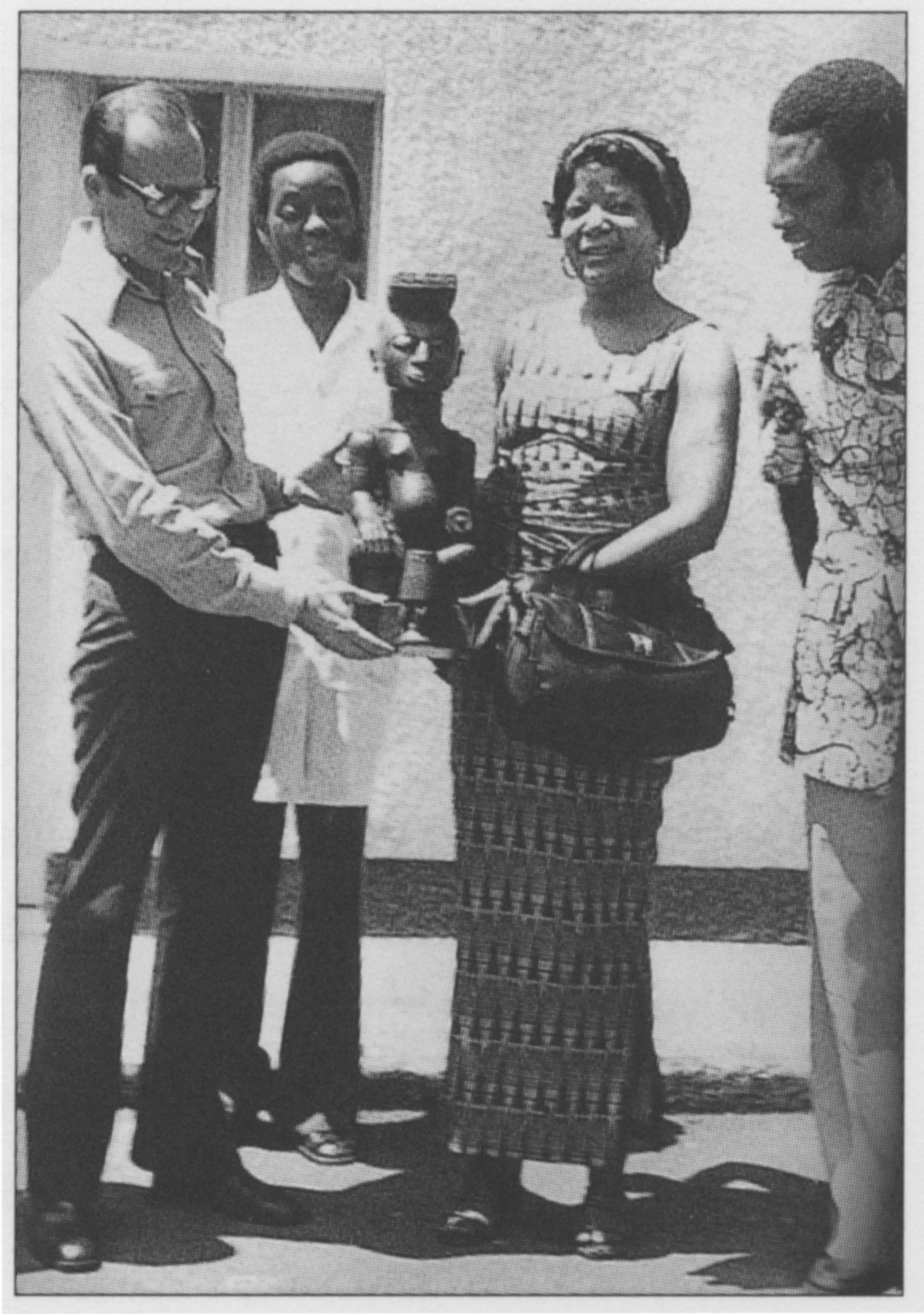
The physical return of objects took place on four separate occasions. Minister Van Elslande made the first transfer in person in March 1976 by handing over the valuable ndop.Footnote 64 Only a limited number of ndop, which represent Kuba kings, exist. The oldest were made in the mid to late eighteenth century. Another generation of these statues, stylistically somewhat different, was made in the late nineteenth and early twentieth centuries, likely in response to collector interest. The ndop returned to Zaire was one of the second-generation statues, and had been collected by the colonial administrator M. Blondeau between 1924 and 1930.Footnote 65 Since Tervuren possessed another example of these later statues, in addition to one of the original ones, the Belgian sacrifice was limited.
The return of a ndop in 1976. From left to right: Nestor Seeuws (IMNZ), Kieto (IMNZ), Commissioner of arts and culture, Mbemba Yowa and Zola (IMNZ). Courtesy of RMCA, Tervuren.
The symbolic value of the ndop statue should not be underestimated, however. The Kuba king had been recognized by the colonial regime as an influential figure and was subsequently assimilated into a system of indirect rule exceptional for Belgian colonialism. Based on their royal art and centralized political system, the Kuba community was also, from its ‘discovery’ by explorers and missionaries, considered superior to other Congolese cultures. By spearheading the return of materials to Zaire with a royal Kuba statue, Tervuren affirmed the connection between a certain version of the country's precolonial past, organized around a centralized form of political power, and the current nation. The ndop was a symbol of ‘indigenous power’, but it represented the only form of indigenous power recognized by the colonial authorities, and stood for a centralized, undemocratic system of rule. Considering Mobutu's reliance on the image of the ‘chief of chiefs’ to justify the centralization of power in the presidential office, it was an apt choice of object.Footnote 66
Two larger shipments of material were sent in 1977. Thirty-two of the sixty objects had been the property of the colonial Museum of Indigenous Life (MVI) in Leopoldville, which had become the victim of the chaotic 1960s. Jean Vanden Bossche, director of that museum, had shipped material for use at the World Exposition of 1958 in Brussels. After the exposition closed, these objects toured in Germany and Austria. By the time the tour ended in August 1960, the situation in Congo had changed drastically. Instead of sending the objects back, Vanden Bossche decided to deposit them at Tervuren until the situation in Congo stabilized.Footnote 67 Since the MVI seems to have become property of Congo, there is a legal argument to be made that these objects already belonged to Zaire.Footnote 68
Staff at Tervuren were aware that the shipments, with a mere 28 objects from the museum's own collection, could scarcely be perceived as a genuine gesture of cooperation. Cahen admitted that ‘the current shipment, which just contains objects originally from the Museum of Indigenous Life, could pose a diplomatic problem’ and confirmed that ‘[t]here needs to be a real contribution aside from the four boxes of the Museum of Indigenous Life, which are nothing but a return to Zaire of what belongs to it’.Footnote 69 Nonetheless, the next shipment followed the same pattern. The bulk of the material had been part of the collection of the Institute for Scientific Research in Central Africa (Institut de Recherche Scientifique en Afrique Centrale – IRSAC) and was sent to Tervuren around the time of independence.Footnote 70 The institute's material had little artistic or financial value, having been collected mostly for ethnographic research purposes. After 1977, there was scant political will at Tervuren to send more shipments. Cahen had retired and his successors were not as invested in the IMNZ.Footnote 71 Further shipments would also have to come from Tervuren's own collections. Another temporary rapprochement between Belgium and Congo in 1981 led to political pressure on Tervuren and a last shipment of 54 objects, all from its own collections.
In total, 1,042 objects left Tervuren for the museum institute in Kinshasa, of which 869 originally came from the IRSAC. Thirty-two had belonged to the collections of the former Museum of Indigenous Life in Leopoldville, and only 114 came from the reserves of Tervuren.Footnote 72 These 114 were selected to compensate for the lacunae in the collection the IMNZ had amassed, but without damaging Tervuren's collection.Footnote 73 The curators thought them interesting or attractive enough to be used in museum displays, but, with the exception of the ndop, they were certainly not among what Tervuren thought of as its ‘masterpieces’. For IMNZ employees, the shipments were a great disappointment. The former collections of IRSAC had little value for a museum institute whose primary purpose was to create a collection on par with prestigious Western museums.Footnote 74 Far from being the restitution of Tervuren's collections demanded by Congo, the true meaning of the transfers lay in their symbolic value. Mobutu's regime could still use the transfers as propaganda, as a symbol of Zaire's cultural sovereignty and an affirmation of its ability to stand up to the former colonial power.
CONCLUSION
What connects the discourse on the economic value of the museum collections of Tervuren with the politics of authenticité and the international claims to cultural heritage is the usefulness of cultural heritage as a (multifaceted) resource for the process of decolonization. There is a clear evolution visible, however, in the manner in which museum objects and collections were approached. As contentieux, their economic value was central. The latter faded into the background in favor of their role as cultural representatives of a vague but politically useful precolonial past, as well as their political value as props for the ideology authenticité and for Mobutu's international political maneuvering. In each of these incarnations however, cultural heritage could be deployed for the construction of postcolonial sovereignty.
Saloni Mathur has characterized the restitution debates between India and the United Kingdom as ‘replaying the history of power relations between West and non-West, and positioning of the museum as a neocolonial institution’.Footnote 75 In this case, although the debates over restitution were deeply affected by the history of power relations between Belgium and Congo, ‘neocolonialism’ is not the appropriate description. That term suggests a new or recreated stage in the countries' relationship. Instead, these events were directly connected to negotiations about Congolese independence and must be seen as part of a continuing process of decolonization, taking place over several decades.
The debates described in this article are not merely about the literal return of objects from Tervuren to Zaire; they are about the right to define the meaning of the transfers, which by extension meant filing judgment on the character of colonialism and the content of the process of decolonization. Tervuren triumphed in this debate about the definition of the transfers. The initial demands from Congo were formulated in terms of restitution, but Tervuren and the Belgian government consistently directed the discussion away from the concept and language of restitution. In a 1979 article for the UNESCO publication Museum, Huguette Van Geluwe, one of Tervuren's curators, referred to the return of the objects as ‘Belgium's contribution to the Zairian cultural heritage’.Footnote 76
The term restitution was inextricably bound up with a view of Belgian colonialism as a system of exploitation. Defining a transfer as ‘gift’ or ‘support’, however, affirmed Belgium's self-image as a benevolent (former) colonizer. Not only did Tervuren retain almost its entire collection, its involvement with the IMNZ lent it an air of generosity, leaving its cultural guardianship largely untouched. Ultimately, Belgium's ability to define the transfer, content, and timing made it more an act of domination than an exchange between equals. This does not detract, however, from the effectiveness of the Mobutu regime's use of the IMNZ in the context of authenticité, and of the demands for restitution, to project a cultural sovereignty to an international audience.
Despite providing a forum for debates about cultural property, the organizations (like UNESCO) behind the international conservation regime failed to provide a sufficiently powerful framework to support the demands of former colonies like Congo. Instead, they sanctified the continued existence of deep structural inequality between the West and its former colonies by facilitating ‘symbolic’ acts like the transfers between Belgium and Zaire.
Today, some at Tervuren argue that since no transfer of titles of the objects ever took place, Tervuren can still legally claim ownership. Due to unrest in Congo, objects from the IMNZ collection emerged on the international art market during the late 1990s and early 2000s. Among them were a number of the pieces from the transfers; so Tervuren had some legitimate concerns about the safety of the collections in Kinshasa. The Belgian museum attempted to recover some of the stolen pieces, but the efforts met with limited success.Footnote 77
This article is not intended as a plea for the return of Tervuren's collections to Congo, but rather an attempt to demonstrate that debates about cultural restitution need to be approached with an awareness of their historical development. While Belgium's attempts to evade the subject in the early 1960s were disingenuous given the political awareness of the potential validity of the claims, the reluctance of the RMCA to return material to the IMNZ in the late 1970s cannot be automatically read in the same way, given the increasingly kleptocratic manner in which the Mobutu regime operated at that point.
Homi Bhaba, inspired by Frantz Fanon, speaks of the ‘problem of how, in signifying the present, something comes to be repeated, relocated and translated in the name of tradition, in the guise of a pastness that is not necessarily a faithful sign of historical memory but a strategy of representing authority in terms of the artifice of the archaic’.Footnote 78 Central to the history in this article is the capacity of objects to act as signs and repositories of an imagined precolonial past and to serve as both symbol and embodiment of the country's national resources and cultural sovereignty. Ironically, it was their location at Tervuren that legitimized them as authentic art objects, lent them their allure and legitimacy as heritage in the eyes of the postcolonial Congolese regime, and gave them the ability to fortify the authenticity of the postcolonial nation.
This article establishes the cultural politics of decolonization as an avenue through which authoritarian power structures of the colonial state, which relied on narratives of guardianship, were reproduced in the postcolonial cultural narratives used to construct legitimacy for the state. The politics of authenticité were rooted in the very knowledge structures produced by the colonial system it attempted to erase. Both the objects themselves (through the meanings projected upon them) and the importance attached to the act of restitution demonstrate the belief in the capacity of art objects – and culture at large – to legitimize a collective Zairian identity, and hence a nation. In what Bayart has called the ‘process of cultural extraversion’, control and possession of the museum objects provided a basis for such a legitimation and for the emergence of a ‘true’ postcolony. The state would not only ‘have’ culture, it would also be able to construct an ‘authentic’ nation on the basis of an extraversion of the cultural authenticity accorded to these objects.Footnote 79 Mobutu's regime could construct a new history that attempted to erase the impact of the colonial era, all the while building upon colonial regimes of value and categories of art and sovereignty.