The study of politics in its broadest sense permeates American studies. It informs its entire character and content. Conference panels, research monographs and periodicals invariably consider the distribution, deployment and application of power. Indeed, there is little within the subject that is not overtly or at least implicitly touched by politics. However, politics has fared less well as a subdiscipline within American studies in both the UK and continental Europe. At the same time, although issues associated with the study of US political processes can be found at points across the humanities and social sciences, the study of US domestic politics within university government and politics departments has fallen away.
This article examines the reasons for these developments. It considers the place of US politics within American studies, its relationship with European political science and the divide between the study of US politics in Europe and that in the US itself. It suggests on the basis of this that US politics, as a subfield, faces critical difficulties.
I
Although there are significant numbers of foreign-policy specialists, and representations of American power inevitably inform international relations, the study of the US domestic political process in both the UK and continental Europe has long been a relatively small-scale operation. At the end of the 1980s there were about a hundred individuals (out of 2,500 entries) listed in the Directory of European Political Scientists whose interests included US politics and policy. As David McKay noted over twenty years ago in 1991, “only a handful” of these studied the US exclusively.Footnote 1
The “handful” to which McKay referred has undoubtedly been further reduced in size during subsequent years. Surveys of the political science profession in the UK conducted by the Political Studies Association (PSA) from 2003 onwards (respondents were allowed to choose more than one field) indicate that 20 per cent in 2003 and 23.6 per cent in 2009 identified North America as one of the geographical areas that they covered in their research. When respondents were asked if they studied “American politics” (amongst other subjects) within their research, the figures ranged between 8.4 per cent in 2002 and 9.1 per cent in 2009. However, these numbers were significantly lower than those for many of the other subfields. In 2009, for example, just over 30 per cent pointed to “British politics” while 20 per cent reported that their research activities included the politics of one European country or more apart from the UK. A further 20 per cent listed the European Union, while almost 28 per cent were engaged in the study of comparative politics. More importantly, when, in 2002, the PSA conducted a survey in Britain in which respondents were asked about the geographical area covered in their research and were required to pick just one field, only 3.8 per cent selected North America. The figure would have included foreign- as well as domestic-policy specialists.Footnote 2
Detailed survey figures are not available for continental Europe but some conclusions can be drawn. As in the UK, there are some scholars who focus on the US policy process and are based within political science. Their ranks include Jennifer Merchant, author of Procréation et politique aux Etats-Unis, 1965–2005 (2005) and Vincent Michelot (Le président des États-Unis: Un pouvoir impérial? (2008)). However, the numbers are small and, as a proportion of the political science community, probably much lower than those in the UK. For the most part, and in contrast to the UK, political science departments in continental Europe have long eschewed approaches to politics based upon and structured around territorially defined areas. As Charles Lees has noted in an extended critique of single-country studies of politics, “evidence suggests that university employers, publishers, and journal editors alike see the single-country tradition as detached from the core of the discipline”.Footnote 3 Instead, there has been an emphasis upon the application of particular theoretical traditions, state formation, comparative politics and broad issues of governance. Many place a premium on multidisciplinarity and interdisciplinarity and the interplay with the other social sciences, most notably sociology.
US politics receives more consideration on American studies programmes than in political science. However, teaching and research in American studies should be seen within its institutional context.
Although there are some “independent” American studies teaching programmes (at, for example, the University of Southern Denmark in Odense), American studies options or modules are often placed within English-language programmes, where they are offered alongside, or in competition with, modules considering other English-speaking countries, English literature, cultural studies or, in some instances, business-related modules. Although there are exceptions, (the American Studies Center at the University of Warsaw incorporates a substantial “politics” component), politics is generally a poor relation. Indeed, it is more often than not an adjunct to history and literature.
The difficulties facing the study of US politics in continental Europe may intensify. A question mark has been placed against the future of English-language teaching (to which, as has been seen, American studies is generally allied) in some parts of western Europe as fluency in English comes to be seen as a “given” across large swathes of higher education. The decline, and perhaps demise, of English-language teaching has been postponed as the “great recession” has brought about a swelling in the numbers applying for almost all university courses but it will at some point resume. Indeed, the term “tsunami” has been used to describe the projected drop in numbers.
Within this context, the survival of American studies may increasingly depend upon its ability to reanchor itself in other contexts. It might be that more courses and greater research activity could be structured around the study of historical migration patterns to the US from particular European countries. Ties with cultural studies offer other opportunities. However, American studies will inevitably become “leaner” as a consequence of these developments. Furthermore, there is little or no chance that political science will embrace the “area” as a basis for teaching and research. As a discipline, it seems set to concentrate on broad, transnational issues of governance.
As a consequence of these developments, those who study the domestic politics of the US as their primary research interest are not for the most part being replaced as they reach retirement age. Although some PhD projects in contemporary history could be included in a headcount, it is also difficult to identify new entrants into the profession. PhD students working on the domestic politics of the US are, at most, very few and far between.
The results are also evident if papers and panels at national and transnational scholarly gatherings are considered. US politics is, as a subject, more or less unrepresented in the proceedings of the European Consortium of Political Research (ECPR) or at conferences organized by the PSA in the UK. If the April 2011 PSA conference programme is surveyed, just four papers addressed the US political process. Of these, two (which examined youth citizenship and digital-era governance) were based upon comparative approaches.Footnote 4 Across the continent, there is only one dedicated organization considering US domestic politics as well as foreign-policy issues (the American Politics Group, which is formally a subgroup of the PSA).
At the same time, despite generous efforts by planners to implement a form of affirmative action and bring in politics panels, the subject is not well represented within American studies conferences. If the 2010 conference of the European Association for American Studies is considered, and even if the broadest forms of definition are employed, just one of the twenty-five workshops could be defined as “politics” (Lobbying and American Democracy: Undue Influence or Dynamic Participatory Democracy?). Although some other workshops drew upon political themes, their primary focus was the depiction and representation of political actors (most notably particular Presidents) rather than institutional relationships or political processes. If the 2011 conference programme of the Nordic Association for American Studies is considered, just three of the seventeen sessions addressed topics that, taking the broadest of definitions, could be fairly regarded as “politics.”
II
Teaching and research in US politics have, then, two defining characteristics. The are small-scale and, within continental Europe, for the most part separated from political science departments. These difficulties are compounded by three other processes and developments.
First, even where it is located within political science, the study of US politics has remained closely tied to history in both the UK and continental Europe. This limits its ability to build bridges with political science. In the UK the relationship between history and politics has been particularly close and goes back a long way. In 1932, politics had barely emerged as a recognizable discipline and its study at the University of Oxford was described in the following terms: “The subject is taught by a very few specialists and a large number of philosophers and historians who approach it with varying degrees of enthusiasm or disgust.”Footnote 5 Where politics was considered separately, the “Westminister model” held sway. Challenges were reined in.Footnote 6 Even in 1966, almost 40 per cent of those teaching politics at university level in Britain had history as their first-degree subject.Footnote 7 Associations with the social sciences were necessarily limited.
Second, because of the divide between the study of US politics and political science, the study of US politics in Europe has become a theoretical and methodological laggard. As noted above, political science departments within continental Europe have long drawn on “grand theory.” Increasingly, they have also been informed by behaviouralism (with its attendant emphasis on the testing of variables, quantification and the application of statistical methodologies) or, in more recent years, the employment of institutionalist approaches. For the most part, and in contrast to some other fields within political science, the study of US politics has remained untouched by all of this. Within the subject there has thus been little or no consideration of causality or the ways in which causal variables might be weighted. There is limited methodological self-reflection and the assumptions informing analyses often remain hidden and unacknowledged.
As a consequence of this, there is relatively little methodological consistency. Indeed, there can be a randomness about the explanatory process. Sometimes there is an implicit privileging of agency-based variables as articles and books stress the capacity of actors to bring about change. Indeed, in some accounts, it seems that the preferences and personal backgrounds of political actors play a large and perhaps determinate part in shaping policy outcomes. For the most part, however, studies draw upon (albeit unconsciously) what might be termed formal or “old” institutionalism. They concentrate on formally structured institutions and processes. Studies of policymaking focus on events and developments on Capitol Hill and in the White House and, to some extent at least, in the state capitals. Power relationships between political actors are considered, but arguably the frame of reference is confined to a limited range of participants.
Third, professional and market pressures draw the few US politics specialists away from research activity. There is a greater demand for textbook authorship than in many other subfields of the discipline. This is in large part because themes from within the subject are sometimes taught within secondary and further education. Within the UK, US politics has, to date at least, survived the structural changes that successive governments have imposed on A-levels and remains the most popular option (aside from the mandatory UK government and politics component) within the politics specifications offered by the examination boards. Alongside the supply of textbooks, educational publishing companies have entered the market offering extensive coverage of core topics, contemporary issues and exam strategies. There are less intense but comparable pressures in much of continental Europe as those teaching English at school and gymnasium level (as well as in universities) seek to take language teaching beyond the narrow confines of traditional classes and introduce their students to social, cultural and political issues in the countries under consideration.
In much of Europe, researchers are also drawn away in another way. The growth of twenty-four-hour news networks has, alongside more established media outlets, created an at times intense demand for specialist and expert commentaries. In small countries, where broadcasters lack the financial and human resources available to their counterparts in the larger nations, academic commentators are used extensively to add to news reports.
III
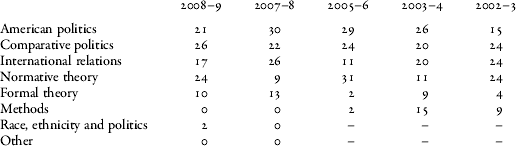
The study of US politics in Europe is at the same time largely cut off from political science within the United States itself. In part, this is because only a limited proportion of US political scientists focus on US political processes. Most researchers work instead in other fields. The papers accepted for publication by the American Political Science Review (APSR) can be used as a basis for assessing this. The APSR is customarily rated as the flagship journal (in terms of both familiarity and impact) of the profession. It secured the number one position in a 2007 survey amongst US political scientists and was given the number two position amongst British political scientists.Footnote 8 According to the APSR's data, less than a quarter of the papers that have been published address issues in “American politics” (see Table 1).
American Political Science Review – distribution of papers accepted, 2002–9, by field (%)
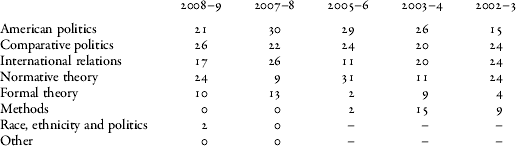
Source: adapted from American Political Science Association, APSA Journal Editor's Reports (2011), available at www.apsanet.org/content_4579.cfm. Note: the dashes indicate that records were not collected using that category during the years in question.
More importantly, there is a theoretical and methodological gulf between the study of US US politics in Europe and the study of the subject in the US, just as there is a divide between the study of US politics and many other fields of political science in Europe. It is perhaps telling that the principal academic politics organization in the US is the American Political Science Association. In the UK it is the Political Studies Association.
The divide between US politics in Europe and the discipline in the US is long established. In I916, when Harold Laski (who was later to write both The American Presidency (1940) and The American Democracy (1948)), joined Harvard, he stressed the extent of the gulf: “I realized … that, as a European, I had entered upon an experience wholly different in character from anything I had known.”Footnote 9 Six decades later, Nelson Polsby, from the University of California, Berkeley, provided a transatlantic “bridge” for many British scholars. As Alan Ware recalled relatively recently:
For “Americanists” of that time doing research in the United States was often difficult, and often a lonely and solitary experience. The “Nelson connection” made it not only possible for us to write our books and articles, but made the time spent in field work an enjoyable one. Some of the scholars of that era – like David Morgan and Richard Hodder-Williams have now retired – but in the late 1970s and 1980s periodic academic encounters between us often began with “Have you seen Nelson recently?” or “I've just come back from Berkeley, and Nelson said …”Footnote 10
However, when, in 1972, Polsby considered (although he immediately disowned the term) “the British science of American politics” he was not, despite his attachments to the UK, being altogether complimentary. His comments highlight the divide. In a review article, he surveyed six books on the US political process by British authors that had been published from 1961 onwards. These were Max Beloff's The American Federal Government (1969), John D. Lees's The Political System of the United States (1969), Allen M. Potter's American Government and Politics (1969), Malcolm Shaw's Anglo-American Democracy (1968) and M. J. C. Vile's books The Structure of American Federalism (1961) and Politics in the USA (1970). With the partial exception of Vile's meso-level study of federalism, all were broad “survey” texts. Polsby noted in harsh but accurate terms that the sources on which these studies (and others published at the time) drew were invariably American in origin:
Lack of first-hand information over the long run impoverishes the more derivative literature. Texts can all too easily became credulous, cranky and soft-headed unless their authors have continuous access to a flow of reliable scholarly literature, and the means of assessing this literature against first-hand knowledge of the institutions and practices it purports to describe.Footnote 11
At that point, there were no credible British micro-level and hardly any meso-level studies of the US. Polsby drew an unfavourable comparison between British studies of the US and the accounts of British politics by American scholars:
The evidence of British contribution to the advanced study of American political and governmental institutions which they reveal is slight. There are no British contributors to the contemporary scholarly study of Congress, the Presidency, the executive branch, the parties or the courts. There are no British counterparts to Austin Ranney's Pathways to Parliament, Harry Eckstein's Pressure Group Politics, Samuel Beer's Treasury Control or numerous works by Leon EpsteinFootnote 12
The evolutionary path followed by US political science in recent decades has widened the gulf still further. In the US, from the 1950s and 1960s onwards (although some place it in the first half or even at the beginning of the twentieth century), there was a transformative process. Although there were always dissenters, perhaps notably from those on the neo-Marxist edges and others who from the late 1970s and early 1980s brought “the state back in,” the “behaviouralist revolution” shifted the locus of attention towards the attitudes and behaviour of individuals and aggregates of individuals. Elected officials and voters attracted particular attention.
The more important shift was, however, in terms of methodologies. Political analysis increasingly employed quasi-scientific methodologies resting on the operationalization of concepts, the construction of formalized and testable hypotheses, and structured forms of data collection. Case studies in politics began to resemble, at least in form, the experiments undertaken in the natural sciences. Through this, the discipline had, it was said, become value-free. This allowed the study of politics to proclaim itself, without too many feelings of presumption or status inferiority, to be “political science.” Writing critically at the end of the 1950s, Bernard Crick noted the scale of the shift that he argued had been evident in the US from the 1930s onwards:
And the education of the American teacher of politics in the 'thirties became more and more a training in research techniques and less and less an education in history and philosophy. His gains in sociological techniques were all too often at the expense of cutting away the very foundations (inadequate though they were in themselves) of any genuine sociological knowledge … Men who had a profound ignorance even of the history of their own national politics, men who knew little but technique, were trained and began to teach.Footnote 13
Crick's onslaught against what he regarded as a false “scientism” was hardly a detached view.Footnote 14 Nonetheless, much of US political science became more or less synonymous with the testing of models through multivariate correlations, regression and tests of statistical significance.Footnote 15 In the years after Crick was writing, the trend has been reinforced and bolstered by the employment of new technology, the increasing availability of “harder” data, the development of game theory and the spread of rational-choice approaches.Footnote 16
The hegemony of behaviouralism and the methodologies with which it is associated have at times provoked dissent. Research work within the discipline has, it has been said, become abstruse and inaccessible and, as a consequence, of little relevance to those outside the ranks of the profession. It can, furthermore, be argued that behaviouralism and the insistence upon quantification necessarily limit the research questions that can be asked, prohibit the consideration of variables for which quantifiable proxies cannot be found, and deter researchers from surveying long-term processes of path dependence or assessing concepts of equilibrium and change. The discipline tends to discuss propositions rather than theories. It seeks to establish correlations and levels of significance, but the question “why” (or at least a long-term “why”) can remain unexplored or at least underexplored.
The “Perestroika Movement” emerged within the profession in the year 2000 to address some of these issues. The email from which the “movement” originally sprang not only lambasted the small group that seemingly controlled APSA but also pointed to the ways in which behaviouralism and quantitative techniques seemed to monopolize the association's journal, the American Political Science Review (APSR). The email asked, “why are all the articles of APSR from the same methodology – statistics or game theory … Where is political history, international history, political sociology, interpretive methodology …?”Footnote 17 Some changes followed. Theda Skocpol, who had done so much to reintroduce the state into scholarly discourse, served as APSA president in 2002–3. In 2003, the association established Perspectives on Politics to broaden discussion within the profession and between the profession and “the broader scholarly and reading publics.”Footnote 18
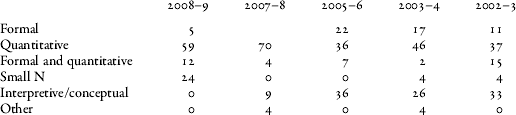
Nonetheless, behaviouralist approaches remain largely predominant within US political science. Although there has been a proliferation of subfields as the profession has expanded and to meet the challenges posed by social change and the rise of new social movements (most obviously the growth of feminism), a process that some have depicted as fragmentation, most of the studies that provide a basis for career advancement are structured around behaviouralist and quantitative methodologies. This is evident if the papers accepted for publication by the APSR are considered on the basis of the approaches adopted (see Table 2).
American Political Science Review, distribution of papers accepted, 2002–9, by approach (%)
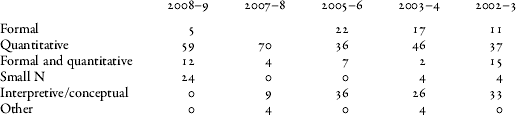
Note: the allocation of years was changed in the 2009 and 2010 APSR reports and therefore the figures are not comparable. Source: adapted from American Political Science Association, APSA Journal Editor's Reports (2004–10) (2011), www.apsanet.org/content_4579.cfm. “Small N” studies are based upon observations drawn from a relatively small number of participants.
All of this is far removed from European accounts of the US political process. Indeed, it has been said, with only some flippancy, that while in Europe the study of US politics is a subfield within history, particularly contemporary history, it is in the US a sub-field of mathematics.Footnote 19
The consequences that follow from this can be seen in the flows of scholars between posts and conferences. While US scholars make contributions to US politics conferences and seminars in Europe, and hold Fulbright positions at European universities or centres such as the Rothermere American Institute (University of Oxford) and the Eccles Centre for American Studies (British Library), it is largely a one-way trade. The panels at the annual conferences of the American Political Science Association (or the panels at conferences organized by regional political science associations) include significant numbers of European contributors, but in many cases their papers address issues in European politics, comparative politics, political theory, international relations and, occasionally, US foreign-policy topics. With only occasional exceptions, US domestic policy is very largely the preserve of American scholars.
IV
Although it can be argued that European approaches and political studies that draw upon the humanities, most notably history, provide contextual insights that may be missed in the construction and testing of hypotheses, the prospects for the study of US politics in Europe are unpromising. Not only do many of those engaged in the subject have the weakest of ties with political science in both Europe and the US, but the numbers involved barely constitute a critical mass.
What options remain open to those of us left in the field? It follows that we should take a much closer look at the development of political science within the US itself and in Europe. Nonetheless, there are constraints on those who would seek to ape the approaches that now govern the US profession. In particular, it would be difficult to match the methodological skills, in particular the employment of statistical data, of those who have undertaken graduate training in the US. In short, European researchers cannot hope to match their American counterparts at their own game.
Having said this, there are some, albeit limited, opportunities and possibilities. Despite the hegemony of behaviouralist approaches, US political science is not monolithic. Whereas politics and history are, as noted above, closely tied together in Europe, the nature of their relationship remains under-explored and under-theorized. In the US, this has been undertaken, at least in some arenas, through historical institutionalism and American political development (APD).
Historical institutionalism stresses the ways in which political opportunity and the room for manoeuvre that particular political actors (such as the President) may have is shaped by longer-term patterns of development. Many institutionalist accounts acknowledge the importance of formal institutions and institutional arrangements (such as Congress and the rules that govern its legislative procedures), but also emphasize the importance of less formal structures and processes. Indeed, Peter Hall has defined institutions as “the formal rules, compliance procedures, and standard operating practices that structure the relationship between individuals in various units of the polity and economy.”Footnote 20 Such institutional configurations “foster the emergence of particular definitions of mutual interest … and how they also often shape political outcomes by facilitating the organization of certain groups while actively disarticulating others.”Footnote 21 In other words, institutions not only shape behaviouir but also set goals and preferences. Within this context, the concept of path dependence is pivotal. Over time, rules, arrangements, systems and procedures become “sticky.” Particular political outcomes, particular those at “critical junctures,” create “feedback mechanisms” that lock in or reinforce the structures and patterns established by those outcomes. In simple terms, the political (and perhaps economic) costs of changing course become high or perhaps prohibitive. That does not mean that the entire architecture of politics remains static: “rather, it is particular aspects of social relations that become deeply embedded.”Footnote 22
As part of this process, historical-institutionalist accounts emphasize the part played by the constituencies and interests created as a result of earlier policy changes. Some cite the classic 1935 account of US tariff policy by E. E. Schattschneider. In this, he reversed customary representations of causality and spelled out the ways in which “new policies create a new politics.”Footnote 23 Protectionist trade policies such as those adopted in the wake of the Wall Street crash through the Smoot-Hawley Act of 1930, he asserted, always have unintended consequences. They laid the basis for the growth of economic interests (under the “shelter” of tariffs) that then sought to maintain those tariffs and other restrictions on trade. These industries “form the fighting legions behind the policy.” They gain further traction and influence because, at the same time, “the losers adapt themselves to the new conditions imposed upon them, find themselves without the means to continue the struggle, or become discouraged and go out of business.”Footnote 24
The thinking behind Schattschneider's study of tariff policy has found an echo in major studies published in recent decades. Paul Pierson has stressed the way in which established paths are bolstered and reinforced by feedback loops. Despite the hopes of the conservative movement from the late 1970s onwards, government social provision proved resistant to reform or downsizing.Footnote 25 More recently, in her account of President George W. Bush's 2005 attempt to reform Social Security, Fiona Ross notes that while it may have appeared as if Bush, who was at the time flanked by conservative Republican majorities in both chambers of Congress, had a real chance of enacting a partial privatization, the embedded nature of the existing policy regime and the value attached to it by important political constituencies (most notably senior citizens) meant that reform was never feasible.Footnote 26
There have been challenges. It can be argued that although historical institutionalism invokes notions of “structure and agency,” agency is often subject to neglect. There is too great an emphasis upon the constraints that institutional arrangements impose upon political actors. Nonetheless, there have been attempts to address this. For example, Lawrence Jacobs and Desmond King point to the ways in which institutional frameworks and the self-conscious actions of individuals and groups interact with each other so as to create opportunities for change. They talk of “structured agency.” Reform and presidential “success” is brought about at “the intersection of agency and structure … Presidents have opportunities to lead, but not under the circumstances they choose or control.”Footnote 27 American political development (APD) and its journal (Studies in American Political Development) draw upon the methods and approaches associated with historical institutionalism and have applied them, in particular, to accounts of the emergence of the American polity and state at federal, state and local level.Footnote 28 Stephen Skowronek's 1982 book, Building a New American State: The Expansion of National Administrative Capacities, 1977–1920, which largely defined APD, considered the effects of path dependence. It concentrated on “the structure of the preestablished regime, the struggle for political power and institutional position that it frames, and the disjunction in time between environmental changes and new governing arrangements.”Footnote 29 Scholars within APD and institutionalist frameworks have considered the American state as both a dependent and an independent variable. They have looked at the ways in which the state was constructed and the ways in which the structures of the state and its capacity shaped the character of policymaking processes.
There may, however, be some limits on APD's capacity to offer opportunities for scholars working outside the US. Although Desmond King (the Andrew W. Mellon Professor of American Government at the University of Oxford) has made a very substantial contribution to the study of the American state and the making of civil rights policy (through such books as Separate and Unequal: African Americans and the US Federal Government (2007)), as well as the US political economy, APD is perhaps a more constrained venture than some of its pioneers had originally hoped. For the most part, history, the discipline to which, as noted above, many European scholars remain attached, kept its distance from APD. Instead, many within history turned towards cultural themes and maintained their reluctance to embrace theory-driven projects.Footnote 30 Furthermore, while there have been important moves towards comparative political development (which could offer opportunities to those who have a comparative advantage through their knowledge and understanding of other nations as well as of the US), and the 1992 book Structuring Politics: Historical Institutionalism in Comparative Analysis, included accounts that surveyed policy development and processes in countries such as France, the UK and Sweden, as well as the US, APD has, as the term suggests, remained very largely focussed on the US alone.Footnote 31
The second and perhaps more promising area of opportunity lies in the development of a dialogue with those engaged in the study of comparative politics and comparative political economy (CPE). There are two ways in which this could be undertaken. First, and most obviously, the US could be used within comparative accounts. Comparative studies of the US and other nations allow researchers to isolate and control variables and thereby look at the defining characteristics of political processes more closely. Recent economic policy processes offer an example. Although many on the left believed that the American Recovery and Reinvestment of 2009 (the $787 billion fiscal stimulus) pursued by the Obama White House and the Congressional Democrats should have been larger if the output gap was to be closed, the measure was still very large as a proportion of gross domestic product when compared with those adopted in Europe. In the UK, the stimulus policies undertaken by Gordon Brown's government were very limited indeed and largely confined to a temporary reduction in VAT. Comparative analysis allows us to identify the core variables that may have shaped the different measures that were adopted.Footnote 32 It thereby offers a more instructive and contextualized understanding of developments and events in the US itself. Some European scholars such as Sergio Fabbrini and Erik Åsard have a long and distinguished record of comparative study upon which others could build.
There is a second way in which comparative approaches can be utilized by students of US politics. Research could consider the extent to which the cross-national models constructed within comparative politics and CPE “fit” the US. Much recent work within CPE has, for example, been informed and structured by the “varieties of capitalism.” Developed by Peter Hall and David Soskice, this considers the forms of coordination between firms and suggests on the basis of this that there is a divide between “coordinated market economies” (such as Germany), which rely on a degree of inter-firm cooperation through, for example, employers’ organizations, and “liberal market economies” (most notably the US), within which there is much greater competition and peak business organizations are comparatively weak.Footnote 33 Arguably, however, the structure of the US economy is much more of a composite regime. As Stephen Amberg has noted in a study of US labour market policy: “regimes are better considered composites of institutions and organizations rather than totalizing power structures in which all the institutions line up for a common purpose.”Footnote 34
This critique of approaches associated with the varieties of capitalism could be extended. Alongside these, comparative political economy has sought to construct other models and “fits.” There have, for example, been studies seeking out “fits” between particular economic types and electoral systems. Many of us who study the US political process have an instinctive aversion to approaches such as these. We are only too familiar with the messy, contradictory and often profoundly dysfunctional character of the American political process. Again, it is instructive to consider the work undertaken and the insights offered by APD. It invariably pulls away from methodologies that suggest or imply that arrangements and relationships tend towards order or some form of equilibrium. All too often, despite efforts to create an “iconography of order,” the polity is characterized by a substantial degree of disorder, incongruity and fragmentation. APD research “exposes sources of disorder, introduces incongruity and fragmentation into depictions of the political norm, and pushes to the foreground an essentially dynamic view of the polity as a whole.”Footnote 35
In other words, there is a strong case for putting the models and constructs developed in comparative politics and comparative political economy to the test. Although such models are ideal types, the application of such models to the US (and to some extent, of course, to all national polities) can nonetheless be problematic. They often rest at an empirical level upon proxies or quantifiable variables that are available to researchers across significant numbers of countries and, all too often, these mask important shifts, processes and trends. In other words, comparative studies do not always stand up, or at least they have serious questions to answer when set against the harsh realities of the “disorder, incongruity and fragmentation” that, as Orren and Skowronek noted, characterize the US polity.
V
The study of domestic US politics in Europe has never been firmly embedded within either American studies or political science. Although there was a period when British universities could each boast one “Americanist” in their politics departments (or, in a few instances, numbers that seemed to offer the possibility of securing a critical mass), this hope has now been lost as the locus of political studies in the UK has increasingly shifted towards the broader questions of governance that define political science in much of continental Europe. Indeed, it is no exaggeration to say that there are now survival issues. This article has sought to argue that the future of US politics as a recognizable and distinct subfield largely depends upon its willingness and ability to move towards and engage with comparative politics and comparative political economy. The alternatives are not particularly promising.