Alicja M. Lacinska and Michael T. Styles reply: We appreciate the comment by C. R. M. Butt on the publication by Lacinska & Styles (2013) on the silicified serpentinites described from the Hajar Mountains in the United Arab Emirates. This comment is based on his very extensive knowledge of laterites and regoliths from ancient shield areas around the world; the degree to which this knowledge is directly applicable to the rocks formed at the margins of a recently uplifted mountain range, as described in the original paper, is debatable.
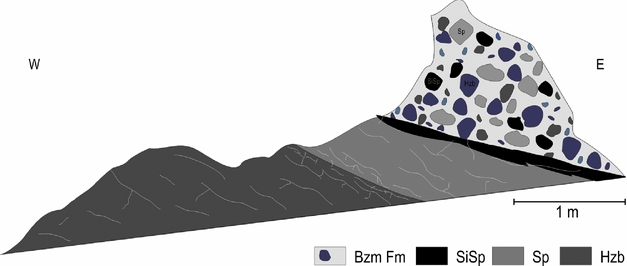
He states that the rocks are a silicified saprolite but there is no clear evidence that a saprolite was the precursor to silicification rather than an unweathered rock as we have described. The silicified rocks pass directly down into the silica-veined serpentinites with no obvious change in character (Fig. 1). This is shown in more detail in a paper describing the overlying ophiolite-derived conglomerates in the Barzaman Formation (Lacinska et al. Reference Lacinska, Styles, Farrant, Rollinson, Searle, Abbasi, Al-Lazki and Kindi2014). We advanced the model for the process of silicification rather than the ‘standard’ lateritic profile, and are pleased that he agrees that this is a plausible mechanism.
Schematic diagram showing lithological contact at Idhen, UAE. The silicified serpentinite (SiSp, black colour) overlies serpentinite (Sp) and harzburgite (Hzb). All units are cross-cut by an irregular array of carbonate- and chalcedony-dominated veins (modified from Lacinska et al. Reference Lacinska, Styles, Farrant, Rollinson, Searle, Abbasi, Al-Lazki and Kindi2014).
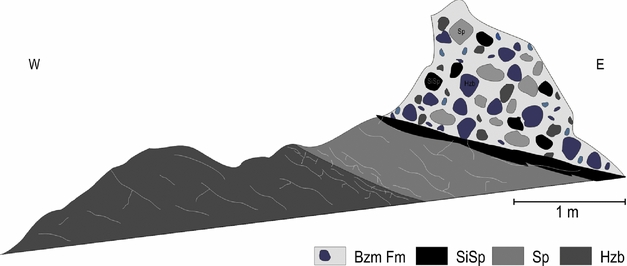
Butt then discusses the formation of silicified saprolites formed over dunites in shield areas. Firstly, most of the silicified rocks discussed by us are not formed from dunite but from serpentinized harzburgite. Many show ghost pseudomorphs of orthopyroxene that are present in both the silicified rocks and the underlying serpentinites. A diagram showing the profile formed during regolith formation is presented by Butt, but it must be stressed that none of these layers are seen in the rocks under discussion. The profile seen in the Oman-UAE ophiolite is as shown in Figure 1. Our paper clearly states that the silicified serpentinite lies directly above serpentinite. Butt continues to describe the geomorphological features resulting from silicified regolith in shield terrains but, once more, this is not applicable to the rocks described. There is no inversion of relief and complete erosion of serpentinized peridotite. The partially serpentinized peridotites and serpentinites form a continuous belt of low hills along the western margin of the Hajar Mountains. The silicified serpentinite comprises an almost continuous horizon that forms the uppermost surface beneath the Miocene Barzaman Formation (Lacinska et al. Reference Lacinska, Styles, Farrant, Rollinson, Searle, Abbasi, Al-Lazki and Kindi2014) or Quaternary deposits (dune sands or alluvial fan deposits).
Butt speculates on the timing of silicification and suggests that ‘. . .it will have ceased prior to significant erosion of the lateritic regolith; consequently if sediments derived from such erosion can be identified and dated, then this might provide more direct evidence for the timing of weathering and silicification’. Our paper clearly states that the silicified serpentinite (but no component of a regolith profile) are common constituents of the basal conglomerates of the overlying Barzaman of late Miocene–Pleistocene age (Lacinska et al. Reference Lacinska, Styles, Farrant, Rollinson, Searle, Abbasi, Al-Lazki and Kindi2014). This is the only constraint on the minimum age; the maximum age is undefined but is Late Cretaceous following obduction, uplift and erosion of the ophiolite.
In broad terms the conclusion reached by Butt in his comment is essentially the same as ours: the silicified serpentinite is a marker of a period of weathering and erosion during Tertiary time. We think that our more conservative conclusions were appropriate. There is no direct evidence that these rocks provide proof of lateritic weathering in these particular places, although they are described from other areas in the UAE as mentioned in our paper. It is possible that his interpretation is correct, but it remains speculative without supporting information. Inferences about climate changes from the Arabian area based on these rocks should be treated with caution.
Acknowledgments
The authors thank Andy Farrant for comments on earlier versions of the text.