The Eurasian spice trade was the long-distance luxury trade par excellence of the early modern world economy and, despite periodic irritation among historians for the attention that it has received, the questions that it raises remain compelling, particularly in the context of global history. What, however, can be said that is of any novelty on the subject and is not merely a revisitation of the important contributions of Frederic Lane, Fernand Braudel, Christopher Wake, and Niels Steensgaard?Footnote 1 Sanjay Subrahmanayam recently attempted to open up the argument surrounding Atlantic versus Levantine routes with a discussion of the reasoning for a Mamluk intervention against the Portuguese in the Indian Ocean between 1506 and 1509.Footnote 2 Working more as an economic historian, interested in series and markets rather than individuals and psychological motivations, what I would like to propose to readers here is to break new ground in three steps, or rather, directions, as the ways forward cover very different ground and do not amount to a singular argument.Footnote 3
I will begin with a close analysis of what was happening on the all-important re-export trade leg (known as the trato de Europa) between Lisbon and primarily central European consumers. Second, I would like to open up our comprehension of the European pepper market to the dynamics of new rival products that rapidly came to overshadow Piper nigrum, particularly in southern European markets.Footnote 4 This was primarily, but not exclusively, the many different species of capsicum peppers that rapidly conquered southern Europe, and which also established themselves in Africa, South Asia, and China, where, from a first recording in 1671, they started to replace the use of black pepper. Third, I would like to suggest that, in line with current historiographical trends shifting economic history into the realm of cultures of consumption, we engage as historians with European demand structures in order to understand why pepper dropped off so sharply as a constituent good in incoming East Indian cargoes over the course of the seventeenth century. Traditional explanations for this fall-off – the ‘supply-led conspiracies’ or lack of income elasticity with respect to spices – are either outdated or, as is true in the latter case, have been disproven by detailed econometric analysis. What I propose here is a theory of cultural demystification. The Portuguese, it is argued here, by opening direct trading links to the sources of supply broke the spell – the mystification – that had sustained the spice trade from the time of Alexander the Great. Support for this argument can be found in the dynamics of the European market for spices: it is shown here that the market was underpinned by desire rather than function, even when it related to the Galenic pharmacopoeia and the integration of spices into treatments aiming at good health.
The hub of profits on the spice trade: the trato de Europa
The French historian Fernand Braudel wrote, echoing a sixteenth-century commentator, that, as the long-distance luxury trade par excellence of the early modern economy, profits on the Eurasian spice trade sprouted like ‘tropical plants’.Footnote 5 The oriental spice trade had constituted the backbone of the greatness of cities such as Venice, as the Quinque Savii alla Mercanzia repeatedly reminded the city elders and as foreigners visiting the city never failed to comment.Footnote 6 The Portuguese empire in the East sought to imitate and improve upon the Venetian model, shaping itself around the sources of spice supply, and the bulk of state revenues soon came to depend principally upon the spice trade, as we can appreciate from analysis tracing the revenues accruing to the Portuguese crown over the course of the sixteenth century.Footnote 7
Historiography, however, provides ready answers why the Portuguese were never able to make much from their running of the spice trade in the longer run. Economic historians in the 1970s and 1980s made much of the weaknesses within both the theory and the practice of the Portuguese monopoly, adopted so as to allow the Portuguese the privilege of price setting, while shutting down competitors operating the traditional supply routes of spices onto the European market via the caravan routes from Cambay, and up the Red Sea.Footnote 8 Lack of adequate enforcement, the endemic corruption of customs officers on state salaries (which the Portuguese crown habitually failed to pay due to shortages of specie), a high proportion of shipwrecks on returning fleets, and a failure to seize mastery of production all compromised the early successes of the Portuguese spice trade fairly rapidly.Footnote 9
In what follows, attention will be drawn to developments on the re-export leg of the spice trade. This was not only the most significant leg of the trade from the perspective of potential profits but tends to get left out of the picture. Vitorino Magalhães Godinho, for example, traced trade flows across the world's four continents, but terminating them in Lisbon, as if commercial flows issued from the Portuguese capital rather than merely rolling through it.Footnote 10 The study of re-export is only one step in a more concerted look at the European structures for demand, which might yield fresh insights into the vicissitudes of the spice trade over this period.
If the Portuguese miscalculated in thinking that they could run a monopoly without controlling the act of production, they also miscalculated in not seeing the trade through to the final stages of its global commodity chain.Footnote 11 The Portuguese did, of course, create the Feitoria de Flandres in 1499 for this purpose, established on mediaeval precedents.Footnote 12 It remains a much misunderstood institution, however, in terms of both its importance and the way in which it functioned. Stephen Bindoff wrote of its closure in 1549: ‘Whatever the reasons for this step, or its immediate consequences, it symbolised the passing of an age’.Footnote 13 This excessive dramatization merely echoes standard Portuguese historiography, which embeds the closure of the Feitoria within the notion of a thoroughgoing ‘structural crisis’ (viragem estrutural) afflicting the Portuguese Empire.Footnote 14 How can this closure be reconciled, however, with archival documents that indicate a renewal of the factory's former privileges and exemptions in 1554, confirmation by letter patent of King Philip in 1560, the resolution passed by the Estates General in Brussels on 17 October 1577 that magistrates of Antwerp extend their ‘sauvegarde et assurance’ to the Portuguese nation, and that their jurisdiction be written into the Rechten ende costumen van Antwerpen of the city of Antwerp in 1582?Footnote 15 Estimates of the Portuguese merchant population in Antwerp similarly expanded, rather than declined, from the twenty members listed in 1548. A registre communal of 1552 mentions 100 Portuguese merchants, whereas a list of 1572 suggests that the number of permanent Portuguese residents (moradores) was 94, which may have disguised a far more substantial colony of between four and five hundred people.Footnote 16 In fact, Flanders remained the nodal point for Portuguese sales of spices right through to 1618, when the New Christian merchant Duarte Gomes Solis wrote that ‘The merchants that buy spices in Portugal, do so in order to send them to Flanders where the greater part of Your Highness's trade of the Indies is sold, in addition to that transported by the rebels [i.e., the Dutch]’.Footnote 17
To all intents and purposes, however, the institution was a red herring: by 1505, and evolving from an important decree issued on 1 January 1505, the bulk of spice supplies in the warehouses of the Casa da India were sold privately by the crown in private contracts to consortia of European merchant capitalists in return for much needed silver and copper.Footnote 18 The state quittance records (cartas de quitação) provide testimony of the increasing quantities of spices that were contracted out rather than run through the crown Feitoria (see Graph 1).Footnote 19
Spices moving through the Antwerp Crown Feitoria 1498–1526, compared to volumes managed by the Casa da Índia. Sources: for Crown Feitoria, see the Cartas de quitação del-Rei Dom Manuel, nos. 584, 15, 350, and Arquivo Histórico Portuguez, vol. 7, doc. 53, pp. 321ff; for the Casa da Índia, I have drawn on Cartas de quitação, nos. 223, 432, 603, 649.

Contracts were initially signed between an Italian consortium and João de Pina, treasurer at the Casa da Índia in Lisbon.Footnote 20 The German merchant community, too, perceiving the changing climate of trade, quickly moved its interests in the spice trade from Antwerp to Lisbon. We find a contract for 400 quintals of pepper signed with Fernão Chamorro in October 1510 and a carta missiva of 1 January 1512 committing the king to hand goods over to Pero Encuria and Chamorro again, both agents of German firms.Footnote 21 The Feitoria, then, as a sales idea, was rapidly and almost completely overshadowed, even if it lingered on until 1548, and reopened after 1554, albeit in the first instance largely as an means for the king to make private purchases of luxury manufactures for his personal use.Footnote 22
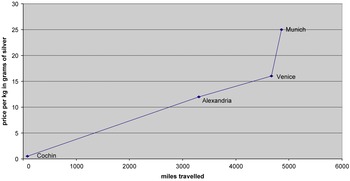
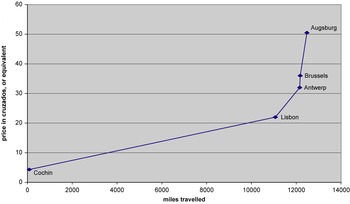
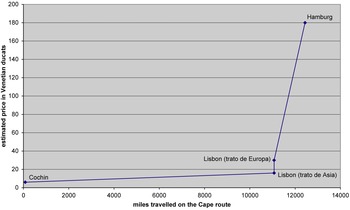
But let us analyse what was happening to the capital. If we plot the accumulation of value of pepper as it moved along the commercial axis from producer to consumer, we can see how the greatest appreciation in the goods’ value took place in the final leg of the trade, the re-export trade from Lisbon to continental European consumers (see Graphs 2.1, 2.2, 2.3). It was on the re-export leg of the trade, then, that the lion's share of profit was to be made, not on the innovative but arduous Cape of Good Hope route to the Indies. Perhaps we should not be that surprised: economists would tell you that the mark-ups tend to be more pronounced the further one moves down the sales’ chain, as the risk of non-sale increases for the salesperson. The implications of these findings are nonetheless quite profound. First, the Eurasian pepper trade did not benefit the Portuguese crown monopoly holders so much as it did private sub-contractors: these were merchant capitalists who bought the spice cargoes at the Casa da Índia in Lisbon, and distributed them across Europe through the principal emporia of that period, notably in Antwerp. In my doctoral work, I have investigated the manifold configurations of these consortia–in terms of market function as contratadores and compradores, in terms of the scale of enterprise, and in terms of nationality (there were northern Italians, High Germans, New Christians, and the consulado de Burgos).Footnote 23 Importantly, however, it was rare that any of these sub-contractors turned to private Portuguese freight contractors, preferring Dutch, Hanseatic, and Breton shipping. In 1510, for example, the Fuggers commissioned the Ste. Marie de Saint-Pol-de-Léon to carry six quintals of pepper from Lisbon to Antwerp. The ship belonged to a certain Pierre Leroy.Footnote 24 Even the large Portuguese converso spice consortia of the latter part of the sixteenth century, such as that of Tomas Ximenes and Ruy Lopez d'Evora, were giving freight contracts out to the German Birckman Company.Footnote 25
The Venetian redistributive system c.1485.

The Portuguese redistributive system, 1517–19.

The Portuguese redistributive system, 1585.

If we plot the data we have on Portuguese shipping arriving in the port of Antwerp against shipping arriving in Lisbon from Asia as regression analyses, we can appreciate that the collapse of Portuguese shipping on the money-spinning tratos de Europa was comparably more severe than the fate of shipping running the intercontinental trade (Graph 3); the respective decline coefficents are 0.857 and 0.475.
The decline of Portuguese shipping arriving in the port of Antwerp compared to that arriving in the port of Lisbon. Sources: Livro 209, C.F.P.A., A.N.T.T., Lisbon; T. Bentley Duncan, ‘Navigation between Lisbon and Asia’, in E. J. Van Kley and C. K. Pullapilly, eds., Asia and the west. Encounters and exchanges, Notre Dame: University of Notre Dame Press, 1981.

The second conclusion to draw is that the sharing of profits at various stages of the trade was more equable on the traditional Levantine trade route than on the Cape of Good Hope route. Defenders of Immanuel Wallerstein's modern world system might be happy to find evidence here of the developing polarities between core and peripheral areas of the globe over the course of the sixteenth century.Footnote 26
The market for pepper substitutes: competing or supplementary trade?
Trading spices, first-hand contact, and exposure to the spices’ natural habitats multiplied Portuguese awareness of the extent of cultivation or natural occurrence, and the varieties and sub-species of particular plants. Pepper was found to grow in coastal areas across the Indian Ocean, with large regional markets from Pegu to Acheh and Priaman. Further, many oriental spices found their equivalent in similar products arriving from Portuguese Africa, and this overlap was only exacerbated with the gradual colonization and integration of Portuguese Brazil, hugely rich in vegetal life. Many of these spices became cheaper and, if often not always considered to have the refinement of their oriental equivalents, would appear to undercut those competing from India on the basis of price in the marketplace. As we shall see, however, the principal threat was that of the capsicums, which flourished in domestic gardens across southern Europe and required almost no domestic expenditure.
From the perspective of global history, it is time that a survey and consequent interpretation be made of this overlap in competing goods. To all intents and purposes, Douglas Irwin's analysis of the Anglo-Dutch rivalry for the East India pepper trade with the Brander–Spencer analysis of duopolistic export competition on the basis of a single, homogenous good can only be considered as fundamentally flawed.Footnote 27 Was it the case, however, that Portuguese goods were competing against each other, or should we merely see this as supplementary trade, extras voraciously consumed by a European market that could not get enough of these same products? Unfortunately, we cannot obtain the necessary data to tackle such a question; what we would need to know is how many new customers were created who would not have bought oriental spices with their established household income, as opposed to the number of customers who were lured off their traditional purchases of oriental spices through the conviction that they were now obtaining the same products for half the price they had been accustomed to pay. And we need to ascertain the Portuguese authorities’ position on the subject, struggling, like the director of an opera house, with the question of what system of variable seat pricing to be adopted so as to maximize revenue.
There were no tools available to the Portuguese from which detailed market analysis might have been conducted, but the possibility that substitutive goods were threatening the market for oriental spices was perceived at an intuitive level. This was particularly vocal as far as private contractors (who had rented out specific lines of trade or routes) were concerned. We hear in 1579 from the private contractors of the Indies trade in ginger and nutmeg, Fernão Lopez and Diogo de Barreira, who argued that they were forced to sell the exclusive contract for less than they had paid the crown, owing to competition from substitutes arriving from Brazil and other regions of India beyond their control.Footnote 28 This may have included São Tomé ginger, which had just appeared on the European market in 1575, and of which as much as 2000 quintals had been bought up by one Gaspar Carnero in Lisbon at 7000 reis a quintal.Footnote 29
To be sure, officialdom moved quickly to extinguish the threat. The Brazilian natural geographer Ambrósio Brandônio suggested that a crown monopoly of ginger be declared in 1578, although in Bahia this order went largely ignored.Footnote 30 At some time before 1593, the crown found itself constrained to prohibit planting in São Tomé ‘for the damage it did to that of India’ (pelo prejuízo que fazia ao da Índia).Footnote 31 But, by this time, the challenge to oriental ginger had passed outside Portuguese political control. Of the two varieties of ginger cited in a Hamburg commercial price list of 1592, that of Calicut was selling for 6 marks, 6 shillings (102 shillings), while ginger from the Spanish colony of Santo Domingo was selling at 18½ shillings, that is, more than five times less.Footnote 32
There are a number of other instances of direct government intervention to protect its traditional products from new competition. Brazilian indigo exports, for example, were circumscribed so as to leave the European market open for indigo cultivated in Gujurat (and, perhaps, woad from the Azores) even though, as Brandônio insisted patriotically, ‘one would not prefer that which is made in the Indies’.Footnote 33 But neither in this instance, nor in other attempts to protect particular markets, as in the case of the South American red-dye-producing brazil wood (Cesalpinia sappan and brasiliensis), could state intervention effectively stop imports from elsewhere. The indigo arriving in Frankfurt-am-Main between 1624 and 1627 was ultimately from Santo Domingo, while that in the Hamburg price list of 1592 was from Caracas: in both cases, from the New World.Footnote 34
The pepper market was considerably more complex, if only because the differentiation here was not one, as with indigo, of variance related to geographical provenance. I know of no distinction registered, for example, between Sumatran and Keralan pepper on the European market. Rather, as Pliny remarked, there existed a wide range of products one could consider piperitis, or of peppery taste.Footnote 35
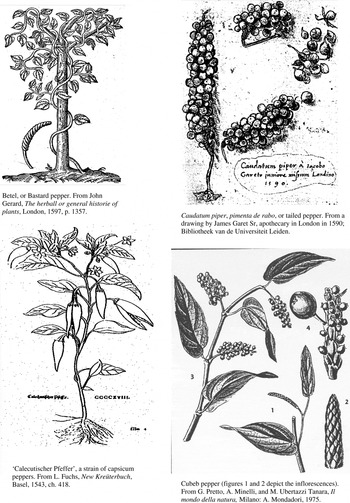
Some of the pepper substitutes, it is true, were never exported beyond the Levant, despite widespread adoption by the Portuguese from host societies across the Indies. Betel, or ‘bastard pepper’ (Piper betle L. or Chavica betel), while producing a leaf ‘of the taste of Pepper, yet very pleasant to the palate’ in one contemporary European's opinion, was traditionally chewed along with the areca nut.Footnote 36 However, this was not only a messy affair but considered vulgar by the standards of European civility. Alfonso de Albuquerque liked to refer to Portugal's enemies as ‘full of betel and niggers’ (cheos de betele e de negras).Footnote 37 Embira, also known colloquially as pimenta longa (Xylopia frutescens andaromatica) is another example of a pepper that did not travel beyond its domestic catchment area, which Gerard defined as ‘in all the tract of the countrie where Nata and Carthago are situated’.Footnote 38 It was reported by Brandônio as ‘an excellent drug’, producing ‘all the effects of pepper, cloves and cinnamon; and it dyes like saffron, a thing that no-one will believe until he tries it, and it has a good smell’.Footnote 39 It was made known to the West through Monardes and a spate of succeeding botanists such as Gerard and Durante. At the same time, Brandônio criticized ‘the people in this country’, who ‘take no interest in anything’. In other words, it was not exported. Today, the embira growing in the Panama canal area is collected only by many small birds, though its wood is used by local farmers for construction and tools.
Pepper substitutes.

Continued

A third type of pepper, known variably as African cubebs, West African pepper, Ashantee pepper, pimenta de rabo, Piper caudatum, piper salvatico, and São Tomé pimento (Piper guineense or Piper clusii Cas. DC.), was explicitly prohibited, in the face of the danger of product substitution.Footnote 40 Its taste and particularly odour is akin to common black pepper, though less bitter and of ‘a sharpe, quicke taste’, decidedly hotter and more pungent.Footnote 41 Its seed is buried inside a smooth, hard shell that does not usually wrinkle, a fact that struck the Portuguese when they compared it to ordinary Asian pepper, which lost a lot of chaff (casca) on its long journey from the East.Footnote 42 To Leo Africanus, ‘this tailed or long pepper so far excelleth the pepper of the East Indies, that an ounce thereof is of more force than halfe a pound of that other’.Footnote 43
The export of this product to Europe has a well-documented history for the fifteenth century and, on Portuguese arrival in the region, the São Tomé settlers were encouraged to buy in the Niger delta to resell to the crown for a fixed price.Footnote 44 With the advent of trade with the Orient, the crown apparently moved to censure any further import of pimenta de rabo, and after about 1507 no further imports of this product to Portugal are documented in official records, although a contraband trade arose with northern Europe. An English ship on a visit to the Gold Coast in 1553, for example, picked up a cargo of grains of paradise and ‘pepper’, and J. Welsh's A voyage to Benin, written in 1588, observes the homebound transport of this pepper. Both of these two episodes surely concerned pimenta de rabo.Footnote 45
A fourth pepper, cubeb pepper (Piper cubeba, L.f.), a climbing, woody dioecious shrub indigenous to Java, southern Borneo, and Sumatra, also had behind it a long tradition of sale on the European market. First mentioned in the writings of Constantinus Africanus of Salerno in the eleventh century, it was repeatedly mentioned thereafter, both by travellers to the Far East such as Marco Polo and Odoric and also in European inventories such as that of Pierre Gilles (1358) and pharmacopoeia such as the Confectbuch of Hans Folcz of Nuremberg (d.1480) and Saladinus’ Compendium aromatoriorum (Bologna, 1488).Footnote 46 Like pepper, it was prized for its aromatic smell and hot, somewhat bitter taste.
As was the fate of pimenta de rabo, the European market for cubebs seems to have dwindled over the course of the sixteenth century. Thus, while 191 quintals of cubebs were contained in the cargo of 1504 imported to Portugal, between 1508–1512 the factor at Cannanore purchased only 1.6 quintals.Footnote 47 Garcia d'Orta speaks of them as seldom used in Europe, other than in medicine.Footnote 48 Why was this the case? Sixteenth-century orthodoxy suggests that they were held in such high esteem by Indians that they were not released for export to Europe.Footnote 49 High prices on the European market seem to confirm this. An ordinance stipulating the sales price of drugs by apothecaries in the city of Ulm in 1596 suggests that Fructus carpesiorum vel cubebarum commanded 8 kreuzers per half ounce, that is, four times the price of black and white pepper and a value akin to that of the best manna, opium, and amber, but the smallness of the measure (in terms of Rosinen or ‘raisins’) suggests that it was in very short supply.Footnote 50 It comes as a great surprise, consequently, to hear from Duarte Barbosa that, in Asia, by contrast, the price of cubebs was so low that he did not consider it worthwhile citing a figure: they were only sold for oil.Footnote 51 What this might have meant is that cubebs were not chased out by the ease of access to and the proliferation of other substitutes, closer perhaps in taste to Piper nigrum, but that it was such a marginal taste that the demand did not articulate itself clearly enough to suppliers, who would otherwise have imported in greater quantities.
Another species was long pepper (Piper longum, L.), appreciated since classical times, if sometimes confused for the buds of the generic pepper plant. If chemistry today has revealed that, in terms of chemical composition and qualities, long pepper resembles ordinary black pepper, European scientific opinion commonly attributed to long pepper the quality of heat in the third degree, but advised that it not be substituted for black pepper.Footnote 52 Gerard, citing Monardes, suggests that long pepper is ‘in taste, sharper and hotter than common blacke Pepper, yet sweeter, and of better taste’; Orta suggests that its taste was ‘biting and rather bitter’ (algum tanto amarga).Footnote 53
But, if this was once considered an item of luxury and Pliny could report that long pepper cost as much as 15 deniers a pound as opposed to black pepper's 4 deniers, the situation had somewhat reversed by the sixteenth century.Footnote 54 On the Antwerp market in 1517, long pepper, at 8 dinheiros, was worth less than half the value of black pepper (19¾ dinheiros).Footnote 55 Garcia de Orta commented how, within his recent memory, the price of long pepper at Cochin had plummeted from 15–20 cruzados per quintal to little more than 5.Footnote 56 By the nineteenth century, long pepper had long been neglected outside traditional Indian medicine and only the Dutch were reputed to import it.Footnote 57
A sixth pepper was the Ethiopian or African pepper, colloquially known as ‘Vita longa’ and in shops, according to Gerard, ‘Amomum’, of which there were understood to be two variants or species but which botany has proved in the final event to be two quite independent plants: Xylopia aromatica of the Anonaceae family (see embira) and Habzelia aethiopica.Footnote 58 Sixteenth-century botanical texts described Ethiopian pepper as a tall shrub – ‘a smal tree, in manner of an hedge bush’, and Durante reminds us not to confuse it with the cubeb pepper – producing clusters of pod-like fruits, about two inches long, ‘of a browne colour, vneuen, and bunched or puft vp in diuers places, diuided into fiue or sixe lockers or cels, each whereof containeth a round seeds somewhat long, lesser than the seedes of Paeonie, in taste like common Pepper or Cardamomum, whose facultie and temperature it is thought to haue, wherof we hold it a kinde’.Footnote 59
I have not found records indicating that this pepper was extensively traded, although Gerard suggests that it was ‘brought vnto vs from Aethiopia’ and Durante that it arrived in Europe via Alexandria. This was the Habzelia (formerly Xylopia aetiopica), nowadays colloquially known as Negro pepper or Guinea pepper, a native of western Africa.Footnote 60 It was associated with Ethiopia only as a result of the imprecision of sixteenth-century cosmographical discourse.
A closer relative to black pepper, from the New World and discovered growing on the island of Santiago (Jamaica) in much the same way as pepper by Christopher Columbus in 1494, was allspice, or pimienta Jamaica, as it became known throughout the Spanish-speaking world. Botanists such as Augustin de Candolle (1778–1841) and John Lindley (1799–1865) chose to classify the plant as Eugenia pimento and Pimenta officinalis respectively, on the basis of its proximity to pepper. The large, black, peppercorn-sized berries produced by the evergreen allspice tree, part of the myrtle family indigenous to the West Indies and South America (Pimenta dioica, syn. P. officinalis) and recognizable for its rattling seeds when dried, are much used today for their pickling qualities and their aromatic versatility in both sweet and savoury dishes. The taste is eclectic, hinting at a blend of cinnamon, nutmeg, cloves, and vaguely, as its name suggests, pepper.Footnote 61 In earlier days, however, it was not used greatly outside Levantine cuisine, despite commercial interest from court and piratic raids on Hispaniola.
It is unclear what position the Portuguese adopted as far as the trade in West African malagueta (Aframoma genus, colloquially known as grains of paradise) is concerned. Hümmerich insists that the crown prohibited its export to Europe in 1506, citing the dangers of its prejudicing the oriental trade.Footnote 62 But there is no reason to believe him. He may simply have misinterpreted the brief of 2 April 1506, Desideras ut nobis, which reaffirmed the nominal monopoly of the crown over such products.Footnote 63 In any case, repeated crown contracts for the management of the malagueta trade, first with Bartolomeu Marchione in 1507, 1509, and 1510, and then with the Italian Calliro Redolho in 1512, followed by the Genoese Caticho in 1514, make nonsense of Hümmerich's proposition. By contracting out the rights to the malagueta trade over the following decade, the Portuguese crown was only relinquishing what control it had left over the quantities of malagueta exported to the European market.Footnote 64
What needs to be established, as elsewhere, is whether malagueta ‘pepper’ was genuinely considered a substitute, and hence a competitive threat to oriental pepper. They do not, after all, share a common botanical origin. In appearance, the seeds are reddish, round, and somewhat warty, with white insides; more akin to cardamom than pepper. Commentators, however, singled out a both pungent and burning taste.Footnote 65
Ivana Elbl asserts that ‘the Portuguese … never spoke of malagueta in connection with pepper of any kind’. Godinho would agree: ‘There was no equivalent of the malagueta among the Asian spices; for this reason its trade continued as normal’.Footnote 66 Indeed, botanically, malagueta was immediately allied to the cardamom out of deference to the Ancients, who thought as much, and its seeds, collected in husky pods, recorded as Cardamom major (maius), medium, and minus.Footnote 67 But Clusius, in his Exoticorum libri decem of 1605, was already insisting that ‘malagueta cardamomũ non est’. In northern Europe, malagueta gradually became known as malagueta pepper, although only from the eighteenth century, when it was no longer widely consumed.Footnote 68
There are, however, other reasons to consider malagueta and pepper as being in direct competition with each other. Their culinary applications had always widely mirrored each other: that is, they were frequently used in conjunction with each other, or as a substitute for the other, as was the case in the preparation of the spiced wine hippocras.Footnote 69 I believe that sixteenth-century Europeans genuinely found little to distinguish between the taste of cardamom and pepper. Gerard, for example, linked the taste of Xylopia aromatica with that of common pepper and cardamom. There are, however, explicit testimonies of the time that bring the two spices together: the Nuremberg chronicle of 1493, for example, in which malagueta is described in the following way: ‘although not as wrinkled as that of the Orient, it however reminds one of real pepper from its sharpness and form, in fact, in everything’.Footnote 70
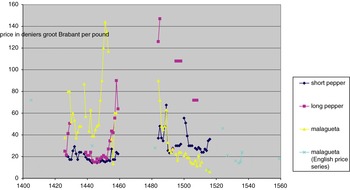
The issue of product substitution remains to be explored in terms of the dynamics of the price differential between Asian and African spices and volumes of respective supply. If, throughout the fifteenth century, African spices commanded the highest prices on European markets, largely as a function of their scarcity and their position as a novelty good, thereafter the situation reversed itself. While pepper fetched 22 cruzados at the Casa da India in 1514, malagueta was sold for precisely half that amount.Footnote 71Pimenta de rabo tended to sell for the same price as malagueta, while allspice from Jamaica was sold for as much as six times less than oriental pepper on Spanish markets.Footnote 72 Together, African and Caribbean peppers formed, for a while, a penumbra of cheaper peppers available to consumers, which lay beneath a convincing market dominance established by black pepper (see Graph 4).
Price substitutability on the Antwerp pepper market, 1409–1559.

Obviously, it is hard to come to firm conclusions regarding the dynamics of substitute spices on the basis of price evidence alone. It is often far harder to collect data relating to the volumes of import. Malagueta is perhaps the most propitious of the substitute spices in yielding its volumes of import, so we shall treat it as a case in point. From the time that the first cargoes of malagueta were brought back by Diogo Gomes from the Rio Grande in 1465, volumes of import developed rapidly. Under the contracting arrangements with Marchione, a peak import volume of 155,000 kg was reached in 1509–10. Only thereafter did imports gradually fall off to around 40,000 kg. Sadly, there are few further indications of subsequent Portuguese imports, since the concessions thereafter changed their form and were no longer granted according to the product in question (malagueta) but the specific area. There is only the record of a royal sale of 400 quintals in 1537, but it is not even known under what arrangement.Footnote 73 In any case, quantities marketed were never very large, never more than a tenth of Asiatic spice sales.
From the second half of the sixteenth century we have little and only sporadic mention of this product. An anonymous report made in 1572 for the Portuguese king on his fort at Mina complained that ‘His Highness is losing a great deal by not profiting from the malagueta available between Cabo das Palmas and here [Mina]’.Footnote 74 Malagueta seems to have been ignored even by Flemish ‘robbers’. The St. Jan, for example, which arrived in Antwerp in 1560 laden with 700 tonnes of West African cargo, chose to bear a heavy load of São Tomé sugar and various gums (gommes).Footnote 75 Statistical analysis of the composition of the West-Indische Companie's return cargoes from West Africa between 1623 and 1626 suggests that malagueta constituted only 403,210 guilders (or 2.6%) of the entire cargo.Footnote 76 Meanwhile, English sources from the 1680s and 1690s indicate that malagueta was ignored by passing slave ships and that the Sierra Leone establishments of the English were advised to take over the trade: it was, moreover, a ‘windward cargo’, in other words destined for sale on the Windward Coast west of the Gold Coast, rather than to be brought home.Footnote 77 The unit of sale was the cess, a rough basket of iron, which was traditionally exchanged for one of spice and suggestive of the fact that this was no longer a high-value spice traded in small quantities.Footnote 78 Otherwise, and on a different tack, culinary sources suggest that the grain of paradise, once so revered in French culinary texts of the thirteenth century such as the famous Viandier, was gradually replaced by standard pepper.Footnote 79
To conclude, Elbl's insistence that pepper and malagueta were two completely different spices provokes her to make the very bold statement that ‘the actual cause of the decline of the malagueta prices had nothing to do with Asian pepper’. Instead, she blames ‘the short-sighted policy of the Crown around the beginning of the sixteenth century’.Footnote 80 I, by contrast, have attempted to demonstrate the consumptive overlap between black and malagueta ‘pepper’ from contemporary descriptions of their respective tastes and culinary applications and then, using available quantitative and price data, have tried to show how the interchange between the two products’ market destinies is reducible to the inauguration of systematic Portuguese trade with the East. If malagueta never fully abandoned the European market subsequently, and was a readily accessible substitute for northern Europe before its own ships ventured to sail for India, it never managed to challenge pepper in the way that the capsicums did.
The challenge mounted by capsicum substitutes from the Spanish Americas was of a different order. Regardless of the efficacy of crown legislation, this was a realm beyond Portuguese political interference. Second, there were many species of the Capsicum genus: an ‘infinite number’ according to Diego Chanca, physician on Columbus’ second voyage to the West Indies, although Bernabé Cobo, travelling in Spanish America in the seventeenth century, reckoned that there were forty kinds ‘as large as limes or large plums; another as small as pine nuts or even grains of wheat, and between the two extremes are many different sizes’.Footnote 81
While the African peppers largely disappeared from the world market over the course of the sixteenth century, the American Capsicum genus, from dominating the cuisine of the New World, spread determinedly across the world. Today, the pimento is the world's third most produced spice, behind pepper and cloves.Footnote 82 Contemporary writers such as Gabriel Soares de Sousa (1540s–1591) and Hans Staden (1525–79) both point out how this pepper was taken by the French when the coast was not actively patrolled by the Portuguese coastguard, Georg Marcgrave (1610–48), adding that it was brought not only to northern Europe but also across the Atlantic to Africa, becoming the Angolanjindungos.Footnote 83 More recently, Chinese scholars have been looking at the early modern dissemination of capsicum peppers across China.Footnote 84 With respect to Europe, Carol Clusius, following Peter Martyr, describes how American capsicum, or Spanish pimento, was rapidly brought into Castilian gardens and used all the year round. Castore Durante reports how easy it was to sow in vegetable gardens or terracotta pots, concluding that ‘it has become absolutely common’ (è fatto per tutto volgare). It also grew in northern Europe. Clusius saw the pimiento cultivated ‘in vast plantations’ at Brünn (Brno) in Moravia in 1585, and the plant was also grown in England before 1597 by Gerard, who speaks of its pods as well known and sold in the shops at Billingsgate by the name of Ginuie Pepper.Footnote 85
From the outset, capsicum pepper was confused with black pepper. The colloquial denomination of this plant in the Hispanophone world was pepe d'India, suggesting the West Indies, and subsequently taken up by a number of European botanists such as Castore Durante, who Latinized it to Piper indicum et siliquastrum. Probably the worst confusion was sown by the botanist Leonhard Fuchs, who misnamed Capsicum longum as Calicut pepper in his De historia stirpium.Footnote 86
Columbus was not impressed by the similarity of taste (‘pepper in shells like beans, very strong but not with the flavour of the Levant’), though the common pungency was remarked upon both by Peter Martyr and by Columbus’ crew member Michele de Cuneo (‘a fruit ... full of small grains as biting as pepper’).Footnote 87 The former consequently suggested that capsicum peppers should actively be used to substitute pepper. This is confirmed by Jan Nieuhof (1618–72) and Georg Marcgrave, who describe the use in Brazil of the ubiquitous inquitaia condiment (capsicum pepper pounded with salt).Footnote 88 Interference subsequently took place not only within South American domestic markets but particularly within the Mediterranean, already less receptive to the harsher taste of black pepper, and into whose culinary repertoire Spanish pimento has more lastingly permeated. Castore Durante, an Italian, reported as early as 1585 how ‘it is used in all condiments and foods as it is of better taste than standard pepper’; he personally recommends its use in pan biscotto and in broths.Footnote 89 Nicólas Monardes also preferred capsicum pepper to piper nigrum, and urged its use since – across Spanish America – it cost nothing but the sowing.Footnote 90 It is difficult to gauge in detail the progress of capsicums into European society, and I would relish the chance to devote systematic research to the problem. The significance of this trend, however, is immediately apparent from modern international trade flows, which demonstrate how dramatic are the imports of pimento into Iberia, compared both with the quantities imported to other European countries and imports of black pepper into these countries. Almost four times as much pimento is imported into Spain per head of population than is the case for Germany, and almost eight times as much as pepper imported into Spain.Footnote 91 The story of Hungarian paprika, also a pimento, suggests that its success in the eighteenth century was primarily substitutive and based on its cheapness of production.Footnote 92
Towards the European consumer
Attention to the re-export trade inevitably brings one close to the consumers themselves. Who were they, and did they have a voice in the articulation of the spice trade? There is a copious literature now on the markets for consumption of the various luxury goods carried back from the East, but only for the eighteenth century, when a public sphere, social habits such as shopping, and a readily identifiable and articulate bourgeoisie had emerged. The task is much harder for the sixteenth century, though we can still glean considerable information from private diaries and household and institutional accounts, widespread particularly across the Low Countries and the German world as Haushaltbuecher.Footnote 93 Other historians have modelled wage data in a bid to show that, while spices entered social ranks at the level of skilled artisans in the Middle East, a relatively commonplace spice such as sugar was very much the preserve of the royal court and magnates of the Polish scene during the sixteenth century, although the seventeenth century saw more costly spices such as cinnamon making headway as an ingredient in the ‘iced sugars’ (cukrów lodowatych) offered at civic receptions, such as that held for the Swedes in Warsaw's town hall in 1656.Footnote 94
One of the problems over which economic historians have consequently stumbled is how to categorize spices so as to understand in what kind of consumer market they were operating. Were spices, for instance, goods subject to the economic laws of conspicuous consumption? They clearly were, as we can appreciate from objects such as the bezoar stone (pedra bazar), a stomachic concretion of the Himalayan goat, decorated with the finest filigree gold and set upon dinner tables with the ostensible function of providing an instant anti-venom should one be needed, but more important for their show of wealth and exoticism.Footnote 95 Attention was also drawn to the nutmeg grater one would wear attached to one's belt as a dandy parading around town, much as one would be accustomed to do today with an extravagant key-chain.Footnote 96 But spices were also very private concerns: kept by royalty in small boxes as épices de chambre, as was the case with the Polish queen Jadwiga Piast, or in leather pouches with other valuables of the royal wardrobe.Footnote 97
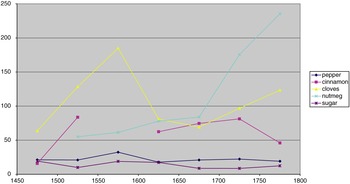
An interesting phenomenon to trace is the geographical configuration of the taste for spices: why certain spices had much stronger markets in certain countries than others, and why that might have been.Footnote 98 It is also worth disaggregating some of the ‘fine spices’, particularly cloves and nutmeg, from the fortunes of the pepper trade. Sustained price series through the early modern era are quite hard to come by but, if we look at the French case (Graph 5), we see that cloves offered a marked surge in value in a much more dramatic way than pepper over the sixteenth century, while nutmeg came into its own from the 1670s, precisely at the time that Nicolas Boileau wrote his famous satire ‘Vous aimez la muscade, on en a mis partout!’.Footnote 99 From the angle of culinary texts of this period, Jean-Louis Flandrin has been able to provide evidence of these passing fads for different spices.Footnote 100 It is tremendously exciting that we are by and large able to match the dynamics registered in price information and volume of supply with the publication dates of these texts.
Relative movements of spice prices, 1450–1800: the French case. Source: H. Mauruschat, Gewürze, Zucker und Salz im vorindustriellen Europa: eine preisgeschichtliche Untersuchung, Göttingen: Univ., Wirtschafts- u. Sozialwiss. Fak., 1975, ‘Preise in Frankreich’, Table 2.

Explaining the vicissitudes of the Eurasian spice trade via a theory of cultural demystification
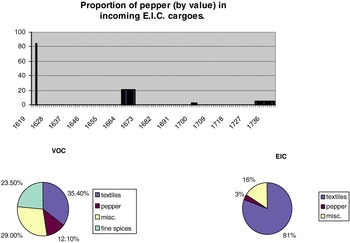
The argument that I would like to go on to elaborate here concerns one of the possible frameworks that we might like to use to explain – beyond all the logistical shortcomings, failings in economic strategy, and market overlaps already discussed here – why it was that the Portuguese were never able to reap any lasting rewards from the spice trade. This is related to the phenomenon of the onset of decline in the spice trade. The Portuguese complained of slowing profits from the 1550s and started to substitute their spice cargoes for cotton textiles, as a Spanish mid-century memorandum reports.Footnote 101 These were various cotton textiles ‘de muchas suertes’, as well as silks; Boyajian has estimated that, if pepper alone constituted 85% of returning Portuguese cargoes by weight, for the period 1580–1640 spices and drugs as a whole fell to 22% of returning cargoes by value, with cotton cloth assuming the lion's share at 62%.Footnote 102 This trend is similar in the configurations of the returning Dutch and English cargoes of the seventeenth century (see Graph 6).
Composition of incoming cargoes from the East Indies, 1668–70. Sources: R. Davis, ‘English foreign trade, 1650–1700’, Economic History Review, 7, 1954, pp. 163–6; N. Steensgaard, ‘The growth and composition of the long-distance trade of England and the Dutch Republic before 1750’, in James D. Tracy, ed., The rise of merchant empires, Cambridge: Cambridge University Press, 1990–1, pp. ; D. Ormrod, ‘Northern Europe and the expanding world-economy: the transformation of commercial organisation, 1500–1800’, in S. Cavachiocci, Prodotti e tecniche d'Oltremare delle Economie Europee, secoli XIII–XVIII, Prato: Istituto Internationale di Storia Economica, 1998, p. 681. Note, by ‘value’, purchase price rather than sale price is intended.

How can we explain this? Economic historians have had recourse to two types of arguments. Peter Kriedte, in common with many Marxist historians of the 1970s and 1980s would suggest ‘supply-led conspiracies’: spices were victims of the company policy of the Dutch and English, who preferred to invest in the intensive and profitable plantation economies of the western hemisphere. Plantations returned massive yields in the case of sugar and later tobacco, on the back of cheap labour costs and reduced transport costs on the lengthy transoceanic haul, as well as offering greater possibilities of production.Footnote 103 Both the profits to be made from sugar and the cheapness of slave labour have been exaggerated in this model. Other economic historians have suggested that spices were relatively income-inelastic products; that consumers have a much more insatiable appetite for textiles, say, than pepper.Footnote 104 But Ormrod's analysis is flawed by basing itself largely upon today's reading of spices as incidental and ornamental commodities. At the same time, detailed econometric analysis by a team of Belgian scholars working on the Antwerp market has shown that spices were, in fact, very income-elastic, if not quite so much as a product such as wine.Footnote 105
Otherwise, we are stuck with detailed and accurate descriptions of the changing precepts of European taste, though there is discussion whether bon goût has more to do with France under Louis XIV than Spain of the Golden Age.Footnote 106 In both cases, however, the changes are more easily demonstrated than explained. Flandrin fails to explain why taste should have changed so profoundly over the seventeenth century, breaking with a deeply entrenched and centuries-long tradition of good living. Braudel tried to concentrate his explanations on the ‘snob effect’: the formula that, when a rare product comes within reach of the masses, its consumption rises sharply, to fall off conclusively as it ‘loses its attraction’.Footnote 107 But it remains a very unsatisfactory explanation, not strong enough to explain the unseating of several millennia of collective practice. History, moreover, offers too many exceptions to this rule. The story of paprika in eighteenth- and nineteenth-century Hungary, for example, would suggest that what had been introduced as a cheap palliative for the poor's mealy and repetitive diet rapidly impressed itself on middle-class households for its ‘irresistible taste’ (ellenállhatatlan íz) and soon became a national institution.Footnote 108
I would like to propose here a different kind of approach, one predicated on a cultural theory of demystification. ‘Demystification’ is similar to a tendency within modernization (‘disenchantment of the world’) that Max Weber worked on extensively, but I want to tailor the term more specifically to the realities of the spice trade.Footnote 109 These commodities had been consumed for thousands of years on a kind of bubble of expectation and desire first triggered by the wonder of Alexander the Great's expeditions to the East, which was fed by two thousand years of continental separation and intrigue.Footnote 110 Once spices could be freely carted back to Europe with no more ceremony or dazzle than the salt of Setúbal, or the stinking alum of the papal mines of Tolfa, the spell was broken.
I have sought elsewhere to demonstrate that spices were indeed a mystified product in the consciousness of mediaeval men and women.Footnote 111 We can appreciate this from the valuable accoutrements that often accompanied these spices, as well as the mythical properties and origins invented for these products. Late mediaeval readers would be obliged to turn to Books of Marvel or Fable to inform themselves about spices; they were not typically entered into herbaria alongside other commonplace plants. That said, mystification did not place spices into the world of the supernatural. The lore surrounding spices did not intersect with the occult, which preferred what the literature prefers to consider ‘abominations’ – viper's blood, bull's penises, swallows nests.Footnote 112 Rather, as Jacques Le Goff explains, ‘There was a tendency to characterize marvels as rarities rather than supernatural phenomenon, as unexplained rather than inexplicable events. Marvels took place on the fringes of this world, not in another world’.Footnote 113
How, then, did the Portuguese spice trade demystify spices? To begin, opening a single sea-going passage to the sources of provenance killed any speculation as to the paradisiacal origins of the spice trade. A massive dispersal of information detailing the parts of the world now open to the European gaze swamped European presses at the beginning of the sixteenth century – some of it very geographically specific, such as the pamphlet Calcoen, which came out in Antwerp in 1504, detailing the spices growing along the Malabar coast and their manner of cultivation.Footnote 114 Others, such as Sebastian Münster's Cosmographia (1544) or Giovan Battista Ramusio's three volumes of Navigationi i viaggi (1550–9), were massive compilations that took in the whole world. Paradise and classical geographical constructions such as Taprobana or Aures Chernosesus became places banished to the extremities of maps, while Portuguese botanists such as Garcia de Orta could scoff at the common belief that aloes wood grew in a terrestrial paradise, arguing that he had not yet ‘deserved’ to go there (nunca mereci ir) but he could ascertain having a fairly good knowledge of where the wood grew, and none of the four rivers of Paradise flowed through the vicinity.Footnote 115 With the world ever more comprehensively mapped out, and spices allocated their provenance within that new Euclidean cosmos, the first step to demystifying spices was taken.
A second step towards the demystification of spices was bringing the plants home and into the realm of first-hand experience. Prior to this, spices had been known only in their finished form, not as plants. They had been brought back as bark, seeds, or resins. This had led to all kinds of distortions and misunderstandings. In the Livre des simples medicines from the fourteenth century, nutmeg was portrayed with oak leaves, as it was of course not known what the trees that produced the fruit looked like.Footnote 116 In Johann Wonnecke von Cube's Hortus sanitatis (Mainz, 1485), the pepper plant is given vine leaves, as it was thought (correctly) that the plant was an epiphyte. A further long-standing botanical fallacy was that of the Dioscoridian sheath or pod (χɛρατωνια).Footnote 117 Now, however, the spices were brought back to Europe as plants and seedlings, and grown in hothouses and incorporated into botanical gardens, of which the first was founded in Padua by Aldrovandi in 1545, but rapidly copied across Europe (Pisa, 1547; Aranjuez, 1555; Bologna, 1567; Leiden and Amsterdam, 1587). The Belgian botanist Clusius reported that he had seen branches of cinnamon both in Holland and at Bristol, and his garden at Leyden was famed for its ‘Indian plants’.Footnote 118 The construction of botanical gardens had coincided with or, to be more precise, was a product of a momentous development in the history of science: the creation of botany as an academic discipline. Botany won its first chair in a Western university at Padua in 1533, to be followed by Pisa and Bologna, and was thus able slowly to break free from the coat-tails of medicine. As the botanist Adam Zaluziansky of Bohemia (d.1610) explained: ‘Botany, which is as it were a special branch of Natural Philosophy (Physica), should form a unit by itself before it can be brought into connection with other sciences, it must be divided and unyoked from Medicine’.Footnote 119 Botany was a groundbreaking discipline at that time: it set itself bold academic projects that seized the spirit of the times, such as going about the composition of the Book of Nature, the classification of all plants known to man. Previously this had been done in the most rudimentary of fashions, according to the ‘Dioscorides alphabeticus’ principle, that is, listing plants in alphabetical order. The task that early modern botanists such as Andrea Cesalpino set themselves was of an altogether different order: it was to determine what were the important criteria for the groupings of plant matter and then to set about constructing the families (or genera) accordingly.Footnote 120
Spices in the mediaeval tradition – as we have seen – had not taken their place in herbals, but were treated separately in Books of Marvels. When they were included in herbals, then it was as a supplement, commonly in categories such as ‘Exotici’ or ‘Rariores’.Footnote 121 Now, by bringing these plants into the Book of Nature, the plants that produced spices were being reduced to the same phenomenological scale as indigenous species of vegetation. This constituted, I would claim, another momentous demystification.
The third demystificatory strand that undid the marvellous dimension to spices and everything for which they had once stood, and that occurred a little further down the road, was not, as one might suppose, the new trends in medical practice known as Chemiatrie of Paracelsian science, which was only really a superimposition of a new pharmacopoeia of mineral products on top of a much more ancient and enduring Galenic one.Footnote 122 Rather, it was the optical revolution and the first glimpses of the micro-organic world, as first witnessed in Robert Hooke's Micrographia of 1665. Initially, observing animalcules, microscopic matter, was merely the joy of watching a hitherto hidden world perform inexplicable rites. In time, however, the micro-organic world provided the real challenge to Galenic medicine, formulated as it had once been on the spices of the Orient. Pathology, the treatment of the body's ailments, became a cellular concern: the point of onslaught on the human body of disease and, by equal measure, corrective pharmaceutics, was no longer the organism in general, but the cells. Medicine became finely honed, to the point that the constituent and acting agents within remedies were individuated as chemicals, enzymes, bacteria, acids.Footnote 123 At this point in the history of medicine, spices became totally demystified: the scientific investigation no longer proceeded at the level of the plant, be it a willow or a bezoar stone, but in the micro-organic world.
We have seen, then, that spices were mystified products which were, by separate stages, demystified. The final issue that I need to and wish to demonstrate in this article is that the mystification of these goods had some bearing over the functioning of the market. There is little room for mystification in the traditional explanations provided by historians as to why spices enjoyed such widespread consumption in mediaeval and early modern Europe. The arguments provided tend to be purely functional. That spices were used as a preservative in an age prior to the refrigerator is one such commonplace argument.Footnote 124 Other arguments qualify this position:Footnote 125 here, spices were a palliative to the taste of rotting meat. In both cases, the consumption of spices is closely correlated with that of meat; yet, despite accepting that meat prices were generally outstripping cereal prices on European markets at this time, it is hard to prove that per capita consumption was declining.Footnote 126 There is, nonetheless, quite a lot of substance to both of the arguments above. Peppered meat was known in German-speaking lands as Konservenfleisch, meat prepared for conservation, and Rhine toll accounts of the early modern period bear witness to the trade of barrels of Neunaugen pruckei, a fish preserved separately in vinegar, smoked, or in pepper.Footnote 127
Recent scientific research has shown, however, that indigenous herbs such as onion, garlic, allspice, and oregano are much more effective in the process of enzyme retardation, killing up to 80% of bacteria, while black and white peppers actually perform rather poorly, killing only 25% of bacteria.Footnote 128 The implication of this research is profound: mediaeval society would not have bothered to import pepper at great cost from the Orient to carry out functional tasks that domestic substitutes could do much better. The West's import of pepper, then, had rather less to do with function, then, than with taste. And the ‘market of desire’, which caters to taste, as economists inform us, operates in a very different way to the market for functional goods. They are different markets: the former fragile, concerned with high-value goods, capped by little supply, attracting high government taxes; the latter ubiquitous goods, with a more stable market presence and whose sale tends to be more actively facilitated by government.
What about the role of spices in Galenic medicine? Surely medical practice is an eminently functional one: people consume medicines because they have been shown to cure somehow rather than because they come in fancy blue bottles. This kind of view of early modern medicine does not hold. Modern pharmacognosy would corroborate many of the functional medical uses to which spices were put in the early modern world, administered individually as simples. The fact that pimentos are useful in the chemoprevention of cardiovascular disorders and cataracts did not escape physicians 500 years ago. That they are a recognized source of vitamins C and E and are high in antioxidants, a valuable tool in the fight against cancer, would not, however, have occurred to doctors at that time. Then, when we enter the realm of composite medicines (compositae), on which, as contemporary writers on medicine such as Timothy Bright (practised 1573–94) inform us, the greater part of the apothecary's art rested, the functional validation falls away. Modern medicine sets a lot of store by single-acting drugs: simple agents whose properties are understood. The problem with compositae is that the more agents involved, the more difficult it is to understand what is going on. Now, the showpiece medicines of Renaissance Europe were concoctions such as the diamargariton, or theriac, which consisted of sixty-four separate ingredients and demanded such lengthy and specialized preparation that specific pharmacies known as triacanti sprang up in centres of production such as Venice.Footnote 129 It is hard to perceive the medical logic that went into the preparation of these cocktails, often of the strangest of ingredients, even from the perspective of the pharmacological theory of the day, as set out in tremendous detail by scholars such as Arnau de Villanova.Footnote 130 William McNeill is hardly off the point when he writes: ‘it is very doubtful whether the physiological benefits … outweighed the harm done by some of the common forms of treatment’.Footnote 131
Maintaining health in late mediaeval Europe, then, had everything to do with little blue bottles. It also had to do with putting one's faith in God – as we can appreciate from the culture of ex-votos littering dispensaries and pharmacies, as we find, for instance, in the frescos in the Château d'Issogne in the Val d'Aosta. Furthermore, if we were to peruse the popular Tacuini Sanitatis, or handbooks of health, which circulated widely from their re-birth in northern Italy in the 1380s, then we would find all kinds of activities peripheral to the biological action of ingested medicine brought into the question: from the right amount of chatting to the effects of sunbathing.Footnote 132
With this digression into mediaeval medical theory, I have simply tried to underline how the late mediaeval European consumption of spices was overwhelmingly driven by the market of desire. The market of desire, I have argued here, was underpinned by a mystification that, with the unveiling of the Orient undertaken by the Portuguese, started to be discredited in gradual phases. It is difficult to map these phases directly on to price fluctuations, given the multiple factors bearing on the market, including social dynamics such as the ‘snob effect’. Aggregated volumes of import (see above, p. 412) are more useful. At this stage, I am keener to establish a conceptual scheme. That scheme seeks to override limited arguments accounting for the failure in the running of the Portuguese spice trade in terms of the specific shortcomings of the Portuguese administration. Rather, it urges that attention switch to the shifting structures of demand based upon ruptures in the deep-seated conceptions of the products of the East as cherished by European consumers. It must be emphasized that the new products of the East to infiltrate European markets were cut loose from the myths and traditions of the ancient world, and tended to find purely utilitarian uses, such as the wave of cotton cloths (sinabaffs, ladrilho, topetins, enrolados), or else – like tea and coffee – were adapted to the social rites of the emergent, open-minded middle classes.