1. Introduction
Empirical evidence (Emad and Roth, Reference Emad, Roth, Pelton, Reis and Moore2007; AMC, 2011; Maringa, Reference Maringa2015) in past research has suggested that seafarer students tended to disengage with learning and assessment when traditional assessments (oral examinations, written assignments and multiple-choice questions) required them to construct responses purely based on the analysis of information presented, devoid of a real-world context, making them rely solely on their ability to regurgitate memorised information. Disengaged students opted for surface-learning approaches (Maltby and Mackie, Reference Maltby and Mackie2009) relying on rote learning instead of assimilating and analysing information critically towards preparation for such assessment tasks. For example, one of the ways a seafarer is certified as competent to work onboard commercial ships is through an assessment based on memorised answers in an oral examination. However, the ability to memorise is a lower-level cognition, and memory lapses may lead to unintentional skill and knowledge-based errors (Wiggins, Reference Wiggins1989) leading to poor academic achievement. Although one may argue that traditional assessments like oral examinations can also be authentic in particular contexts, Mueller (Reference Mueller2006) suggests that they are on the lower end of the continuum of authenticity when they focus on the attributes of recall and regurgitation. Traditional assessment methods adopted in seafarer education are promoted by the Standards of Training, Certification and Watchkeeping (STCW) code that was introduced by the International Maritime Organization (IMO) in 1978 (revised through major amendments in 1995 and 2010) to provide global, minimum standards of competence assessment. Although traditional assessment methods may be effective in assessing knowledge-based components of a task, they are somewhat decontextualised in nature and make it difficult to provide students with a real-world context for skills and knowledge application (Boud and Falchikov, Reference Boud and Falchikov2006).
Prior to the STCW code, countries established their own standards. However, STCW did not prove to be as effective as expected due to criticisms from stakeholders that complained of vague and unclear standards left to individual interpretations by maritime nations (Maringa, Reference Maringa2015). As a result, the STCW code was revised with amendments in 1995 (referred to as STCW’95) to address previous concerns and improve upon the training mandate to make it outcome based, requiring seafarer students to demonstrate their competence by performing tasks that resembled workplace duties (Emad and Roth, Reference Emad, Roth, Pelton, Reis and Moore2007). STCW’95 did not fully eliminate the vagueness in assessment standards, however, as it specified methods to demonstrate competence but did not provide specific methodologies, leaving these to the discretion of the assessor (Robson, Reference Robson and Zhukov2007). The code specifies methods (simulator, specialist training etc.) to demonstrate competence but does not provide clear and detailed guidelines on how to use these methods to collect evidence of competence. For example, how sophisticated and advanced should the simulators be to reflect STCW standards? The STCW code only provides recommended performance standards for non-mandatory types of simulators. Even after the latest revision of the STCW code in 2010, its vagueness continues to leave too much room for interpretation by maritime education and training (MET) institutes, which use varying combinations of assessments (Bhardwaj, Reference Bhardwaj and Loginovsky2009) for students to demonstrate the performance standards in the STCW code.
Performance standards should ideally communicate performance expectations from workplace duties, encompassing not only the technical skills but also the underpinning skills and knowledge. For example, planned distribution of cargo and recording information (as specified by the STCW code) are not the only skills required for carrying dangerous goods. Assessment should also identify essential underpinning skills, such as problem identification and solving if there are any unexpected occurrences with the carriage. The MET institutes complying strictly with the STCW code will assess seafarers in accordance with inadequate performance standards, producing graduate seafarers lacking workplace skills. This is a major concern for seafarer employers.
In education, authentic assessments appear as a model that integrates knowledge and skills acquired in the classroom with employment, replicating the tasks and performance standards typically faced by professionals in the world of work (Wiggins, Reference Wiggins1989), making it suitable for implementation in the vocational-based seafarer education and training. Due to a global absence of evidence regarding the impact of authentic assessment in seafarer education, the authors investigated seafarer students’ academic achievement (measured through their assessment scores) in authentic assessment as compared with traditional assessments (Ghosh et al., Reference Ghosh, Brooks, Ranmuthugala and Bowles2020). However, past researchers (Law and Eckes, Reference Law and Eckes1995; Bailey, Reference Bailey1998, p. 205; Dikli, Reference Dikli2003, p. 16; Abeywickrama, Reference Abeywickrama2012) described traditional assessments as a ‘one-shot’ or single-occasion tests that are implemented at the end of the learning period in a summative manner. Since authentic assessments are characterised by providing students with more than one opportunity (Wiggins, Reference Wiggins1989; Gulikers, Reference Gulikers2006), the authors also distinguished the two assessments on the basis of their implementation. The traditional assessment was implemented in a summative format while the authentic assessment was implemented formatively.
Hence, in Ghosh et al. (Reference Ghosh, Brooks, Ranmuthugala and Bowles2020), the authors of this paper investigated the difference in seafarer students’ academic achievement (traditional versus authentic) for the unit ‘Managerial and Leadership Skills’ delivered in the third year of the Bachelor of Nautical Science programme. Students completing this unit acquire the knowledge and skills required by a senior seafarer officer to organise and manage efficient operation onboard a merchant ship. Hence, all the students enrolled in this unit had not only completed two years of the Bachelor programme but also had seagoing experience. The students who enrolled in the unit in Semester 1 were classified as the ‘control group’ that underwent a traditional assessment. The traditional assessment comprised of two case study scenarios presented and described only on paper in the absence of a real-world context. The students provided written responses on paper to essay-type questions based on their analysis of the described scenarios relying solely on their ability to recall how the scenarios would have played out in the real world onboard ships.
In comparison, another cohort of students who enrolled in the same unit in Semester 2 were assessed authentically through the same case studies described on paper. Although the authentically assessed students also provided written responses on paper to the same essay-type questions, the authentic assessment differed from the traditional assessment by providing a real-world authentic context to the assessment task through a simulation and practical demonstration of the same case study scenarios as employed in the traditional assessment, enacted by staff at the Australian Maritime College (AMC). For example, one case study that described ship staff abandoning the ship using a life raft during a fire was demonstrated at the AMC training pool. The pool was equipped with facilities to launch a real life raft in simulated waves, strong winds, darkness, rain, and smoke. The simulation also included ringing of the emergency alarms and staff playing the role of panicking seafarers jumping into the pool to replicate a possible emergency. In comparison with the authentic assessment, the students who were assessed traditionally relied only on their imagination and experience to visualise the described scenarios.
Although one may argue that the descriptive case studies in themselves (without the simulation) may have provided the real-world contexts, the simulations engaged the sensory perceptions of the students, requiring them to demonstrate the ability to analyse, assimilate, and integrate presented information and construct responses towards it. This was similar to the workplace, where professional seafarers analyse available information and take required action, and thus it distinguished the traditional from the authentic assessment.
In addition to the authentic design, the assessments also differed in the nature of their implementation. The authentic assessments were formative in nature and held on two different days (three weeks apart). The second authentic task was implemented once the students had received individual feedback through the assessment rubric on their performance in the first authentic task. In comparison with the authentic assessment, the traditional assessment was summative in nature and both case studies were implemented at the assessment. However, the duration of the authentic assessment (combined) was the same as that of the traditional assessment. The assessment details and rubric were provided to both the student groups at the beginning of the semester. To avoid the introduction of additional variables, the unit, learning content, lecture delivery methods, lecturer, assessment rubric, total duration of the assessment, and assessment questions were kept constant. The number of completed semesters and academic workloads were the same for both groups. Both the assessments were supervised by external invigilators appointed by the AMC.
The first case study used for assessment required students to respond to a ‘man overboard’ situation at sea and to describe a rescue operation; and the second case study required students to respond to a situation that involved abandoning the ship using a life raft. All students were required to complete the courses ‘Proficiency in Survival Craft’ and ‘Personal Survival Techniques’ to acquire the technical skills required to respond to the emergencies described in the cases studies. Additional to the courses, the students were also trained to acquire the underlying competencies required to respond to the case studies in the unit of ‘Managerial and Leadership Skills’. The syllabus of lectures included training the students to develop their abilities of task and workload management (assigning required personnel towards task implementation, adhering to time and resource constraints, prioritisation of tasks etc.), resource management (considering crew experiences in deciding course of action, recognising barriers to communication etc.), and decision making (conducting situation analysis and risk assessment, obtaining and maintaining situational awareness, and selecting the right course of action).
Findings of the research in Ghosh et al. (Reference Ghosh, Brooks, Ranmuthugala and Bowles2020) confirmed that the seafarer students’ academic achievement was significantly higher (student scores improved by 17⋅3%) in the formative authentic assessment when compared with the summative traditional assessment. Although in past research higher academic achievement was attributed to the ‘authentic’ design of the assessment and the formative nature of its implementation, further research was required to investigate the factors of assessment that the students may have perceived to be significant and that influenced their perception of authenticity in assessment leading to higher academic achievement. These factors will provide guidance to assessors in the designed authentic assessment with the aim of improving scores and the resulting academic achievement. Hence, using the same but independent sample of authentically assessed students, the research presented in this paper investigated student perceptions of authenticity in assessment to reveal the factors of assessment that correlated significantly with their academic achievement.
As a result, the following research question (RQ) was developed:
RQ: What is the correlation between seafarer students’ perception of authenticity in assessment and their academic achievement in the associated assessment tasks?
The developed RQ enabled the development of the following research variables:
(1) independent variable: Perceptions of authenticity in assessment; and
(2) dependent variable: Students’ academic achievement.
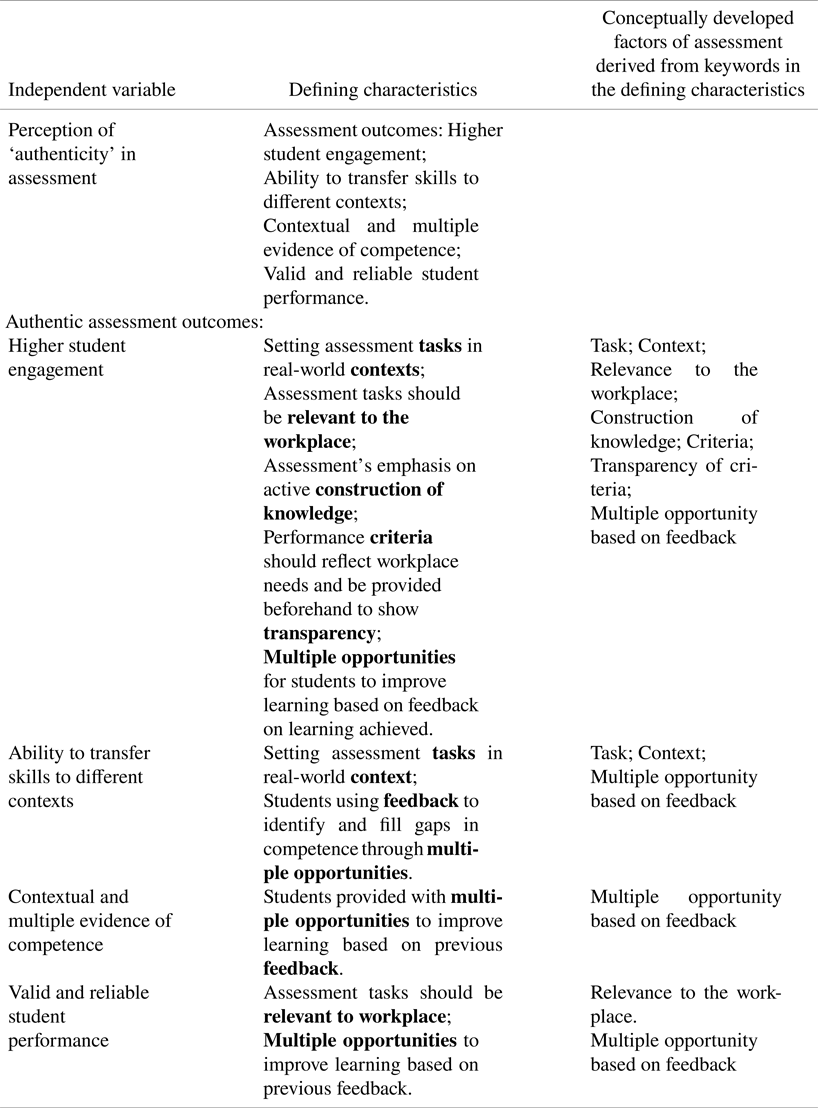
This research identified seafarer students’ ‘perception of authenticity in assessment’ as the independent variable. The term ‘authenticity’ in this regard referred to the characteristics (e.g. setting assessment tasks in real-world contexts) of the authentic assessment that students may perceive as significant towards the outcomes of: higher student engagement; ability to transfer skills to different contexts; contextual and multiple evidence of competence; and valid (relevant to workplace) and reliable (multiple and consistent) student performance (Ghosh et al., Reference Ghosh, Bowles, Ranmuthugala and Brooks2017). The defining characteristics of authentic assessment that led to the aforementioned outcomes were derived from the definition of authentic assessment based on the works of the most commonly cited authors in the area. Based on an extensive literature review (Ghosh et al., Reference Ghosh, Bowles, Ranmuthugala and Brooks2016, Reference Ghosh, Bowles, Ranmuthugala and Brooks2017), the authors of this paper used the characteristics of authentic assessment provided by the most commonly cited authors and defined the assessment as one encompassing: tasks resulting in outcomes in a real-world context that require an integration of competence to solve forward-looking questions and ill-structured problems; processes that require performance criteria to be provided beforehand and evidence of competence to be collected by the student; and outcomes that result in valid and reliable student performance, contextual and multiple evidence of competence, higher student engagement, and transfer of skills to different contexts.
The characteristics derived from the definition are summarised in Table 1. Subsequently, the key words (bold in Table 1) in the defining characteristics of authentic assessment were used to develop conceptually the factors of assessment (task, context, criteria etc.). The development of the factors is also shown in Table 1.
Defining independent variable to provide conceptually developed factors of assessment for measuring seafarer students’ perception of authenticity

Based on the conceptually developed factors (Table 1), this project adapted a questionnaire – mostly from Gulikers (Reference Gulikers2006) – which was used to obtain student responses regarding their perceptions of authenticity in assessment. In Stage 1, the perceptions of authenticity for the conceptually developed factors were correlated to the dependent variable of students’ academic achievement (defined by their composite numeric scores obtained in the authentic assessment tasks). Stage 2 extracted new factors of assessment through a factor analysis. Using the student responses from the perception survey, an additional correlational analysis was conducted between students’ perception of authenticity for the new factors of assessment and their scores in the authentic assessment. Both stages of investigation revealed significant findings towards the design of authentic assessments for higher academic achievement of students.
2. Research methodology
2.1. Questionnaire design
This paper used a questionnaire to measure seafarer students’ perceptions of authenticity in assessment. To develop the questionnaire, past research in the area of authentic assessment was scanned to investigate if existing published questionnaires and/or items could be used for the purpose. Additionally, an internet search was conducted for the same purpose. The final survey document developed for this research used all the questions from Gulikers (Reference Gulikers2006) to form Questions 5–27. Since that questionnaire was developed for social work students, the word ‘social worker’ was replaced with the word ‘seafarer’ in the questionnaire developed for this project. One question was adopted from the National Survey of Student Engagement (NSSE) to form Question 28a–28e. Two questions were devised by the authors of this paper to form Questions 29 and 30a–30b. The first four questions enquired about the student's demographic details. Questions 5–27 and 29–30 were scored on a five-point Likert scale ranging from 1 (totally disagree) to 5 (totally agree). Only Question 28 was scored on a four-point Likert scale ranging from 1 (very little) to 4 (very much). The Likert scale was reverse coded for negatively worded questions (i.e., Questions 10, 11, 18, 23, 26, 28a). Question 30a required a response on the nominal scale of ‘Yes’ or ‘No’.
2.2. Validity and reliability of the questionnaire
Since the questionnaire constructed for this research was mainly drawn (barring three questions) from Gulikers (Reference Gulikers2006), it initially derived its validity and reliability from the values published by that author. According to Gulikers (Reference Gulikers2006), all scales of the survey had a reasonable internal consistency, shown in Cronbach's alpha ranging from 0⋅63 to 0⋅83. The Cronbach's alpha for the survey used in this research had a value ranging from 0⋅69 to 0⋅75. The adaptation of Gulikers's questionnaire for the purposes of this research study was validated through an expert validation process. The questionnaire was reviewed through a pilot survey by 12 fellow academics and researchers within the AMC, where the research was conducted. The pilot survey respondents suggested retaining most of the original questions but defining the terms ‘context’, ‘criteria’, ‘oriented’, ‘under-graduate’, post-graduate’, and ‘output’ used in the survey, for the students. The respondents also suggested excluding the demographic question enquiring about the age of the students and including a question related to their educational qualifications.
2.3. Data collection
The survey was administered on completion of the authentic assessments for the treatment group. A general announcement was made in class and an email was sent inviting students to participate in the survey. A minimal risk ethics application approval was obtained for this research project.
2.4. Sampling considerations and response rate
The sampling technique used in this research was based on convenience sampling, which relies on opportunity and participant accessibility and is used when the study population is large, and the research is unable to test every individual (Robson, Reference Robson2011; Clark, Reference Clark2014). A key consideration while sampling was to ensure that the treatment group was comprised of randomly assigned students in which each participant had an equal chance of being chosen based only on the sequence of enrolment in the individual semesters. The groups were not sorted based on any other pre-determined characteristics, such as qualifications, academic ability, age or work experience that may have affected the outcomes of this research. This ensured that the relationship between the two variables remained the same in all segments of the sample, which is essential for correlational research (Graziano and Raulin, Reference Graziano and Raulin2000). Moreover, in correlational research the coefficient of determination (r 2) that allows us to estimate how useful the relationship between the dependent and independent variables might be in a prediction (and is a measure of effect size), should be considered significant only if the minimum sample size is 30 (Graziano and Raulin, Reference Graziano and Raulin2000; Blondy, Reference Blondy2007; Suresh and Chandrashekara, Reference Suresh and Chandrashekara2012). This research thus exceeded the recommended minimum sample size. Although 102 students were asked to respond to the survey, just 98 students participated in the study. Out of the 98 respondents, 93 surveys were usable for analysis, as five surveys were discarded due to incomplete/absent responses.
The assessments required students to respond to case study scenarios based on situations that they might encounter on board ships. It was realised that students with work experience may have encountered similar situations and hence were better equipped to answer the questions than students without enough sea experience. Hence, students enrolled in the selected unit (and the respondents) were expected to have completed the minimum work experience of one and half (operational level) to three years (management level) on ships.
2.5. Data analysis
The correlation analysis was conducted in two stages using the statistical software package SPSS 23.
2.5.1. Stage 1: Correlation analysis between students’ perception of authenticity in assessment (for factors derived conceptually) and their scores
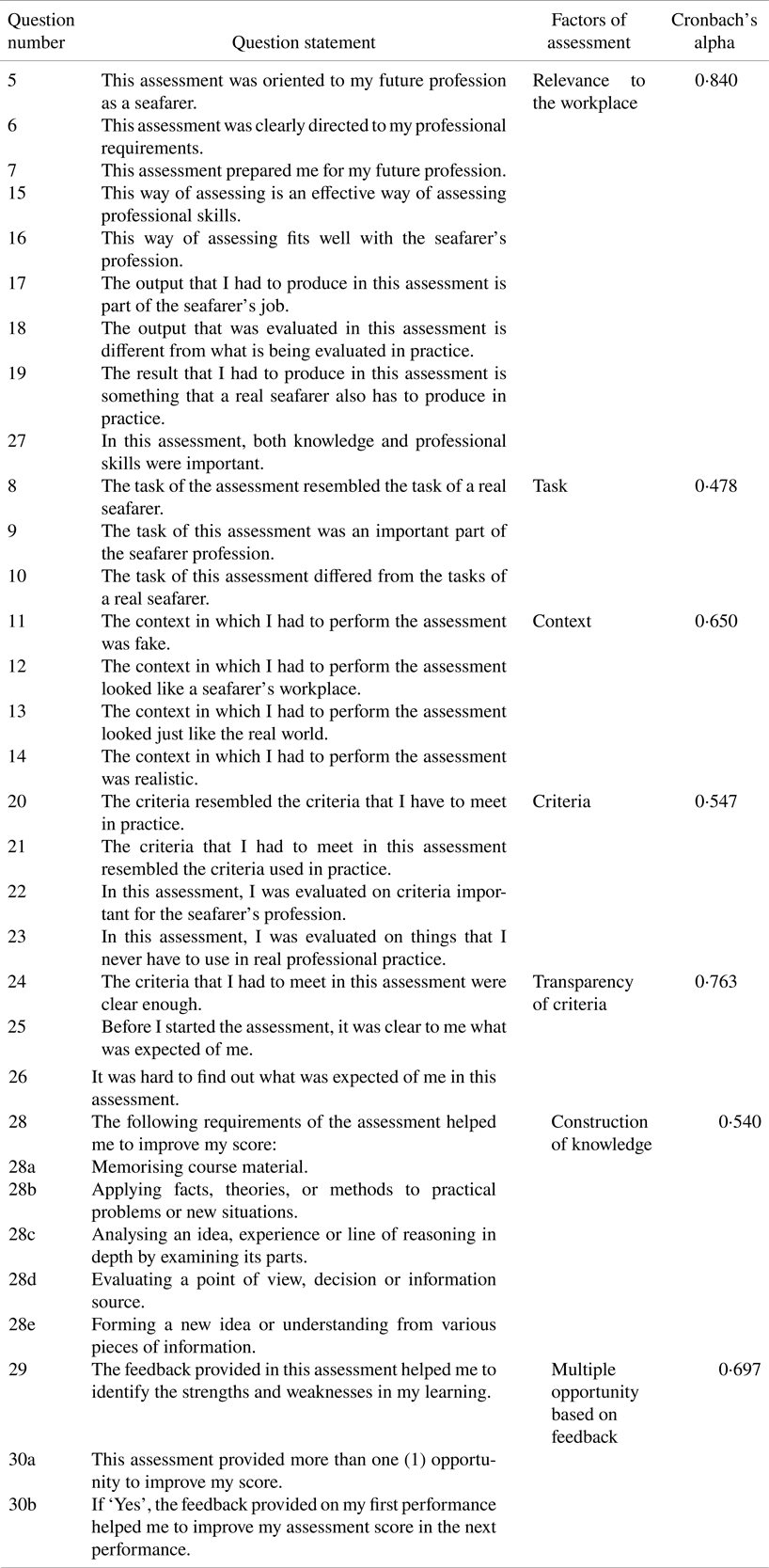
The questionnaire statements were categorised under the conceptually developed factors of assessment (task, context, criteria, etc.) as set out in Table 1. Questions categorised under a common factor were subjected to an inter-reliability analysis (Cronbach's alpha) to ensure that they were significantly correlated to each other. This is detailed in Table 2.
Survey questions categorised under conceptually developed factors of assessment, and their inter-reliability values

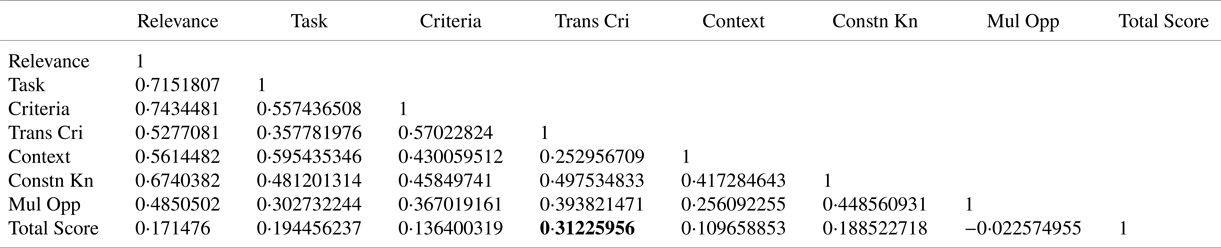
For the purposes of this paper, a Cronbach's alpha value of greater than 0⋅70 (Tavakol and Dennick, Reference Tavakol and Dennick2011) was considered statistically significant for reporting. Table 2 showed that an inter-reliability analysis of the categorised survey questions revealed an acceptable Cronbach's alpha value (0⋅70 or greater) for only two factors of assessment, i.e., relevance to workplace and transparency of criteria. Since an acceptable value of Cronbach's alpha was found for a low number, i.e., only two factors, a correlation analysis between seafarer students’ perception of authenticity in authentic assessment for all the developed factors and their scores in the associated assessment task was conducted. The correlation between the variables (perception of authenticity and scores) was considered significant if the correlation coefficient (R) value was higher than 0⋅25 (Clark, Reference Clark2014).
The findings of the correlation analysis conducted in stage 1 are discussed in the ‘Results’ section below.
2.5.2. Stage 2: Correlation analysis between students’ perception of authenticity in assessment (for factors extracted through factor analysis) and their scores
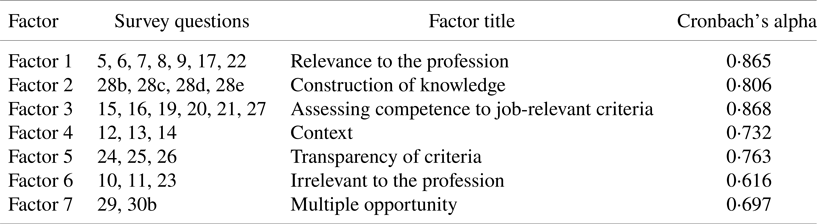
Since the majority of the conceptually developed factors of assessment (except transparency of criteria and relevance to workplace) had a low value (less than 0⋅70) of Cronbach's alpha, a factor analysis to develop new factors of assessment statistically was conducted. Next, a factor analysis to remove multicollinearity and extract factors that are relatively independent of one another was conducted. The survey questions loaded cleanly (without overlap) under the seven new factors. The construction of knowledge questions (28b–28d) clustered in Factor 2, the ‘context’ questions (question 12–14) item in Factor 4, the ‘transparency of criteria’ questions (24–26) in Factor 5, and the ‘multiple opportunity’ questions (29–30b) in Factor 7. Hence, these factors retained the original titles. The questions that were reverse coded clustered in Factor 6, which was therefore titled irrelevant to the profession.
Conversely, the questions related to the conceptually developed factors of relevance to the workplace, task and criteria did not cluster in the expected way; and loaded unevenly (split loading) in Factors 1 and 3. Although a limitation of factor analysis is that factor names may not accurately reflect the variables within the factor, especially in the case of split loadings (Yong and Pearce, Reference Yong and Pearce2013), this research used the factor naming technique suggested by Neill (Reference Neill2008). Neill advocated for using the majority of the loading items for naming each factor. The items in Factors 1 and 3 were reviewed to provide meaningful names for the extracted factors based on the top loadings for each factor. Additionally, each factor was subjected to an inter-reliability analysis (Cronbach's alpha) to verify if the values were greater than 0⋅70. Table 3 details the survey question numbers with their factor loadings, together with the factor titles, and the Cronbach's value of inter-reliability analysis.
Factors extracted using factor analysis: categorised survey questions, titles, and inter-reliability values

Based on the inter-reliability values of Cronbach's alpha, Table 3 revealed that the factor analysis extracted five factors with an acceptable value of more than 0⋅70. Factors 6 and 7 were rejected due to low Cronbach's alpha values of less than 0⋅70. The selected factors (1–5) cumulatively explained 60% of the variance in the data, which was considered significant (Williams et al., Reference Williams, Brown and Onsman2010) for further correlation and regression analysis. Thus, stage 2 investigated the correlation between seafarer students’ perceptions of authenticity for the new factors (1–5) of assessment extracted through factor analysis and their scores in the associated assessment task. The correlation between the variables (perception of authenticity and scores) was considered significant if the correlation coefficient (R) value was higher than 0⋅25 (Clark, Reference Clark2014). The findings of the correlation analysis conducted in stage 2 are discussed in the ‘Results’ section below.
3. Results
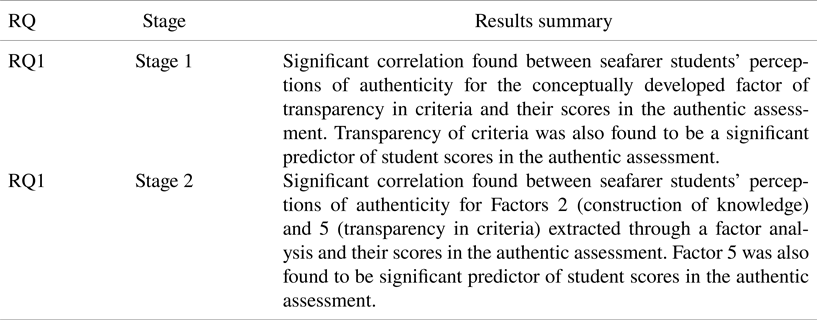
The results of the RQ are summarised for each stage of investigation in Table 4.
Summary of results

Reporting of the results below is organised by each stage of data analysis.
3.1. Stage 1
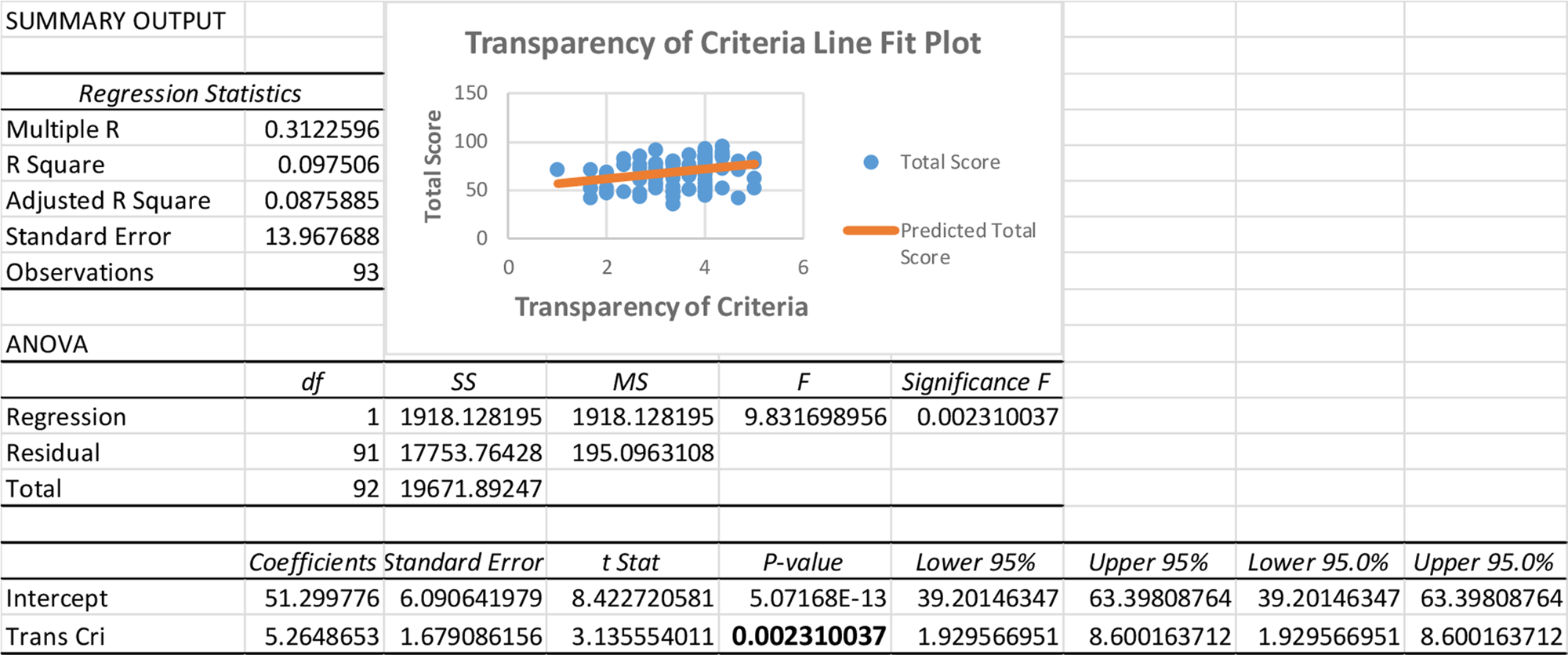
The R-values for the correlation between the students’ perceptions of authenticity (for the conceptually developed factors) in authentic assessment and their scores in the associated assessment task are detailed in Table 5. The R-values in Table 5 show significant correlation (R-value higher than 0⋅25 is outlined in bold) between students’ perceptions of authenticity for the factor transparency of criteria and their scores in the authentic assessment. Using the significantly correlated factor (transparency of criteria) and the scores in the authentic assessment, a linear regression analysis based on the recommended (Sarkar et al., Reference Sarkar, Keskin and Unver2011) confidence level of 95% (or P-value 0⋅05 or less) was conducted. Although confidence levels can be represented as 90%, 95%, 99% or any percentage (between 0 and 100%), the authors of this paper chose the most commonly used confidence level of 95% (Tan and Tan, Reference Tan and Tan2011). The findings of the regression analysis are detailed in Figure 1.
R-values of student perceptions of authenticity (conceptually developed factors) in authentic assessment and their scores in the associated assessment task

Regression analysis of seafarer students’ perceptions of authenticity in transparency of criteria and their scores in authentic assessment

The bold P-value (less than 0⋅05) of the factor transparency of criteria, as shown in Figure 1, revealed the factor to be a significant predictor of student scores in authentic assessment. However, this finding was based on a relatively lower value (8⋅8%) of the adjusted R-square.
3.2. Stage 2
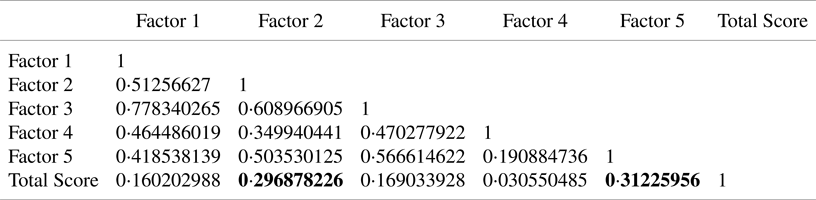
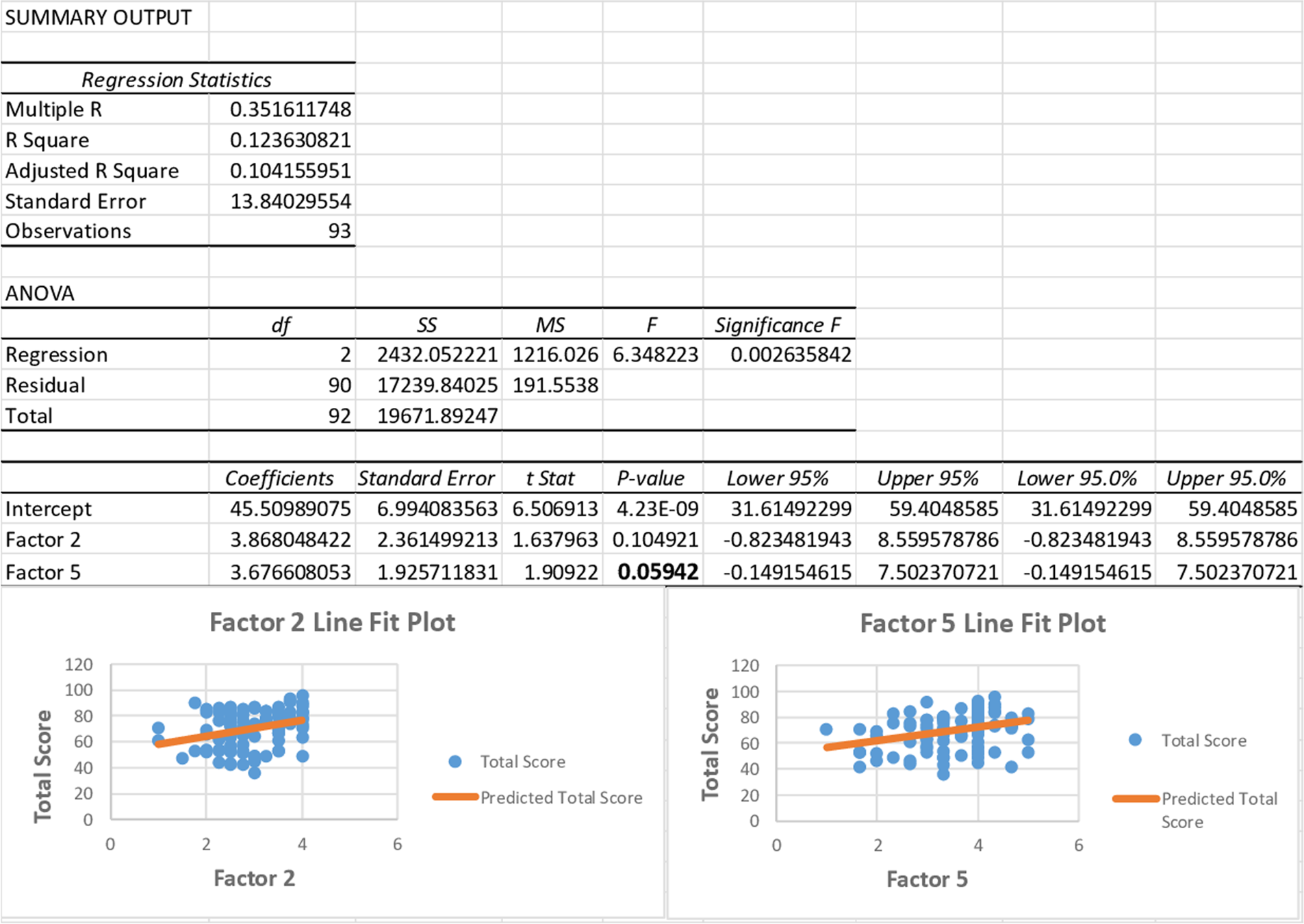
The R-values for the correlation between the students’ perception of authenticity for the factors of assessment (extracted through factor analysis) and their scores in authentic assessment are detailed in Table 6. The R-values in Table 6 show significant correlation (R-value higher than 0⋅25 is outlined in bold) between students’ perceptions of authenticity for Factors 2 and 5 and their scores in the authentic assessment. Using the significantly correlated factors (2 and 5) and the scores in the authentic assessment, a multiple regression analysis based on the recommended (Sarkar et al., Reference Sarkar, Keskin and Unver2011) confidence level of 95% (or P-value 0⋅05 or less) was conducted. The findings of the regression analysis are detailed in Figure 2.
R-values of students’ perceptions of authenticity (factors extracted through factor analysis) in authentic assessment and their scores in the associated assessment task

Regression analysis of seafarer students’ perceptions regarding authenticity in Factors 2 and 5 and their scores in authentic assessment

The bold P-value (less than 0⋅05) of the factor transparency of criteria, as shown in Figure 2, revealed the factor to be a significant predictor of student scores in authentic assessment. However, this finding was based on a relatively lower value (10⋅4%) of the adjusted R-square.
4. Discussion
4.1. Transparency of assessment criteria as a significant predictor of academic achievement
Transparency of assessment criteria is essential for learning (Reddy, Reference Reddy2007; Biggs and Tang, Reference Biggs and Tang2011) and providing the criteria at the beginning of the learning period (thus making the assessment transparent) is an essential and key requirement for authentic assessment (Wiggins, Reference Wiggins1989). Findings of this research project (Figures 1 and 2) confirmed that the factor transparency of criteria is essential for learning, since students had significantly higher achievement when they found the assessment criteria to be transparent. Knowing the assessment criteria (detailing standards of performance) beforehand provided a roadmap of the subject to be learned, while allowing the students to construct their understanding of the topic. This project provided the assessment criteria at the beginning of the learning period through the use of assessment rubrics. Although the rubric was provided to the control as well as the treatment group, the real-world scenarios demonstrated in the authentic assessment allowed the authentically assessed students to analyse the scenarios and construct responses towards the achievement of the standards described in the rubric. For example, when the students were asked to ‘recognise all the barriers to effective communication’ in the assessment rubric, the authentically assessed students were able to experience the wind and rain that hampered communication in the emergency scenario. In comparison with the authentically assessed students, the traditionally assessed students were unable to recognise the same barriers to communication from the descriptive case studies which lacked the demonstrated scenarios. The authentically assessed students thus used the rubrics to reflect on their learning and carry out self-assessments of their thinking and practices towards achievement of the required standards.
This finding corroborated the findings of the past research (Gulikers, Reference Gulikers2006; Jonsson, Reference Jonsson2008) where transparency of assessment criteria enhanced student achievement in authentic assessment. Gulikers (Reference Gulikers2006) also found the transparency of assessment criteria to be the strongest influence on social work students’ learning and their development of skills out of other factors such as task and context. Jonsson (Reference Jonsson2008) focused only on the correlation between transparency of assessment criteria and student scores and revealed that increasing transparency of criteria improved students’ performances. The significance of transparency of criteria on student achievement was also found by Hattie (Reference Hattie2009) and Hattie and Timperley (Reference Hattie and Timperley2007). To ascertain the major influence on student achievement, Hattie (Reference Hattie2009) and Hattie and Timperley (Reference Hattie and Timperley2007) synthesised more than 800 meta-analyses in education and found that making the criteria more explicit leads to improvement of skills since students become more aware of what constitutes a successful performance. Clarity in expectations engages students in the task, which further increases the chance of enhancing their achievement. Hattie (Reference Hattie2009) and Hattie and Timperley (Reference Hattie and Timperley2007) also argued that without transparency in assessment criteria, providing students with the feedback on their performance is devoid of context. Feedback directed to the transparent criteria enables students to reduce the gap between their current level of competence and the expected level. Well-directed feedback can then be used by students to adjust their learning strategies towards higher achievement (Hattie and Timperley, Reference Hattie and Timperley2007; Hattie, Reference Herrington2009).
4.2. Impact of feedback provided to students on their academic achievement
The formative assessment employed in this research project provided students with an opportunity to receive individual feedback on their performance in the first authentic case study (AA1) before attempting the second case study (AA2). According to Zhang and Zheng (Reference Zhang and Zheng2018), feedback on a student's current ability to perform an assessment task and providing suggestions to improve and to attain their expected levels, encourages the student to take necessary actions to close the gap in their ability. This was confirmed empirically in Ghosh et al. (Reference Ghosh, Brooks, Ranmuthugala and Bowles2020). For example, higher academic achievement in AA2 (student scores improved by 12%) as compared with AA1 indicated that using the feedback obtained, seafarer students recognised the gaps in their knowledge, re-evaluated their learning approaches and implemented new strategies to improve their scores. In comparison with the formative assessment, the feedback obtained by the students in the summative traditional assessment task proved to be too late for the control group students to make any adjustments to their learning process to improve their scores.
The positive impact of providing feedback to students on their academic achievement was reaffirmed empirically in this paper, thus advancing past research by the authors (Ghosh et al., Reference Ghosh, Brooks, Ranmuthugala and Bowles2020). The findings of that research evidenced that higher academic achievement in authentic assessment was not only due to the authentic element of the assessment but could also be attributed to the formative nature of its implementation. The correlation study in this paper confirmed that the group of seafarer students that had significantly higher academic achievement in the authentic assessment perceived the transparency of criteria factor to be the most significant predictor of their achievement (Figures 1 and 2). This also indicated that the seafarer students who underwent formative authentic assessment were able to improve their performance in the second assessment task resulting in an improved academic achievement using the feedback provided to them on their performance in the first task. The individual feedback provided (through the assessment rubrics) enabled the students to conduct a self-assessment of their existing knowledge and skills using the assessment criteria provided at the beginning of the learning period. The students then adopted learning strategies towards obtaining higher academic achievement in the second authentic assessment task.
4.3. Significance of construction of knowledge in authentic assessment
In stage 2, Factor 2 (construction of knowledge) also significantly correlated to the student scores in authentic assessment. A further regression analysis, assuming a 95% confidence level, did not find the factor to be a significant predictor of scores however. If this paper had assumed a 90% confidence level, Factor 2 also would have been considered a significant predictor of students’ academic achievement. The choice of whether to use a 90 or 95% confidence interval is somewhat arbitrary (Tan and Tan, Reference Tan and Tan2011), and the 95% confidence level for this research was chosen due to its common use. However, this should not diminish the value of the factor of construction of knowledge and, hence, should be included in designing authentic assessment for students.
4.4. Low value of adjusted R-square
The findings of the regression analysis presented in this paper are based on a relatively low value (8⋅8% in stage 1 and 10⋅4% in stage 2) of adjusted R-square. The adjusted R-square value focuses on explaining the observed variation in the dependent variable due to the independent variable (Lukacs et al., Reference Lukacs, Burnham and Anderson2010). This implied that the significant factor (transparency of criteria) in this study, although important, did not explain the majority of the variance in the student scores. This was also evidenced by the fact that Factor 1 accounted for the majority of the variance (38⋅5%) and, did not correlate significantly to the scores. Hence, it was a possibility that the correlation and regression model adopted in this paper may not have included important factors of assessment before measuring the independent variable of perception of authenticity in assessment. For example, factors of assessment such as collaborative assessment (Gulikers, Reference Gulikers2006; Ashford-Rowe et al., Reference Ashford-Rowe, Herrington and Brown2014), student ownership of task design (Gulikers, Reference Gulikers2006), completion of task and collation of evidence of competence by students over a sustained period (Morrissey, Reference Morrissey2014), and presentation of student work to an audience (Herrington, Reference Herrington1997) were rejected at a theoretical level for the following reasons:
• Collaborative assessment was rejected since the research by Gulikers (Reference Gulikers2006) revealed that students and teachers rated this factor (described as ‘social context’) as the least important dimension of authentic assessment. Moreover, demonstrating individual competence in the units of learning is essential for seafarer certification (IMO, 2011).
• Factors such as collaborative assessment, student ownership of task design, and completion of task over a sustained period of time were also rejected to avoid plagiarism in student work. This research required seafarer students to complete the assessment task under the supervision of externally employed invigilators. The factors were also rejected since inclusion of these factors in the assessment design would have created uncontrolled additional variables (e.g. variation in student groups, variation in task design and variation in time taken to complete task) other than the authentic design which would have affected student performance.
• The factor requiring presentation of student work to an audience was rejected since it was incongruous to the nature of the assessment task developed for this paper.
The relatively low value of adjusted R-square may have resulted also from the use of the quantitative survey to measure student perceptions. This is because the use of Likert scales in the quantitative survey may have limited the students from outlining, describing and adequately conveying the other factors of authentic assessment that they perceive to be significant towards obtaining a higher academic achievement. Instead, the students were compelled to choose the significant factors amongst the choices provided through the survey, which may have led to an inadvertent omission of factors. This was also evidenced by the perception study by Gulikers (Reference Gulikers2006) in which the quantitative data did not reveal an overall differing perception of authenticity in task, but the qualitative investigation revealed otherwise.
Goodwin and Leech (Reference Goodwin and Leech2006) recommended examining the variability in the data (dependent and independent variable) if the resulting correlation was lower than expected. Lack of variability (indicated through low values of standard deviation) lowers the correlation value between variables (Goodwin and Leech, Reference Goodwin and Leech2006). To examine the variability, this research calculated the standard deviation values for the student survey responses for perception in authenticity (independent variable) and the composite student scores (dependent variable). The standard deviation for student scores was 14⋅6 (mean score 69⋅8/100; minimum 36/100; maximum 96/100). The standard deviation thus indicated a relatively low value, which may have contributed to the lower correlation between the variables. Similar to the dependent variable, the standard deviation values of the student responses to the perception survey had relatively low values, which may also have contributed to the lower correlation.
Lack of variation in student scores indicated evenness in student performance. This may imply that the evenness in performance may have been due to the transparency in assessment criteria that provided all students with the same guidelines to obtain higher academic achievement. This argument is based on past researchers (Black and Wiliam, Reference Black and Wiliam1998a, Reference Black and Wiliam1998b; Sadler and Good, Reference Sadler and Good2006; Jonsson, Reference Jonsson2008), who claimed that transparency in criteria is not only an effective means to improve performance but also a provider of equality in academic achievement. The researchers argued that in studies characterised by formative assessments and transparent criteria, the difference in student achievement between high- and low-performing students is typically reduced.
5. Conclusion
Past research (Ghosh et al., Reference Ghosh, Brooks, Ranmuthugala and Bowles2020) by the authors found that seafarer students’ academic achievement was significantly higher in formatively implemented authentic assessment in which students constructed responses based on the assimilation, integration, and analysis of information presented in real-world settings. This was opposed to a summative traditional assessment that focused on students constructing responses based on memorisation and regurgitation of information. Building on past research findings from Ghosh et al. (Reference Ghosh, Brooks, Ranmuthugala and Bowles2020), the authors investigated factors of authentic assessment (task, context, etc.) that correlated significantly to higher academic achievement (measured using scores obtained in the assessment tasks). Findings derived through factor analysis confirmed that the factor transparency of criteria correlated significantly with student scores. This finding confirmed that providing students with assessment criteria at the beginning of the learning period provides them with clear indications on standards of performance expected in the assessment tasks. Using the feedback provided on their performances in formatively implemented authentic assessment tasks, the students conduct a self-assessment of their learning. Once the gaps in their knowledge and skills are recognised, the students focus on aspects of learning that will improve their performance and overall scores, making them autonomous learners and eventually, skilled professionals.
One may argue that a key limitation of this paper was that the findings of this project were based on a relatively low value of adjusted R-square. The adjusted R-square value focuses on explaining the observed variation in the dependent variable due to the independent variable. However, the focus of this paper was not to explain variation, but to find an association through correlation between the independent variable (perception of authenticity) and dependent variable (scores). In this context, the adjusted R-square value was irrelevant; and the low R- square value with statistically significant parameters was more valuable than a high R-square value accompanied with statistically insignificant parameters. The researcher acknowledge that a limitation of this project resulted due to the use of the quantitative methodology adopted to enhance generalisability of findings. The quantitative methodology used a survey based on a Likert scale that limited the response of the seafarer students to a perception survey. Hence, certain variables (collaborative assessment and student ownership of task design) may have been rejected at a theoretical level and intentionally omitted from the data analysis model used in this project. Therefore, future research will investigate seafarer students’ perceptions through the use of qualitative methodologies, such as interviews, focus groups etc. Although certain variables were excluded, this research uncovered significant factors of assessment which if included, in the design of the assessment, will guide authentically assessed students towards higher academic achievement.