Introduction
The processes of prenatal growth and development form an ordered pattern of changes, genetically programmed and modified by environmental factors. Research shows that the dimensions of the body at birth are only 40% influenced by maternal and infant genotypes, and approximately 60% by non-genetic factors (Kornafel, Reference Kornafel1995), in particular the external environment (i.e. growth modifiers) (Wolański, Reference Wolański2012). As some studies have shown, birth weight is more sensitive that birth length. Birth length is more influenced by genetic factors, and this dimension has not changed significantly in recent decades. As well as environmental factors, the body build of mothers may influence the weight of newborns. Women are now fatter and bigger than they were several decades ago, and this impacts directly on the birth weight of their babies (Cole, Reference Cole2003).
In the case of external factors, the socioeconomic conditions prevailing in the life of the mother seem to be most important. The groups of factors limiting the implementation of the genetic predispositions during prenatal development include multi-faceted environmental impacts, for example education and profession of parents, wealth of the family, level of medical care and hygiene, diet and level of nutrition, number of children in a family, as well as structure of urbanization (Hollomon et al., Reference Hollomon, Dobbins and Scott1998; Luo et al., Reference Luo, Wilkins and Kramer2006; Mortensen et al., Reference Mortensen, Diderischen, Arntzen, Gissler, Cnattinius and Schnor2008; Griffiths et al., Reference Griffiths, Balakrishna, Fernandez Rao and Johnson2016).
Undeniably, changing socioeconomic conditions over the last century have left their mark on neonatal size and final body size of the individuals born in those days. Poland – the largest and most populous country in Central Europe – is one of the countries that have undergone the biggest political and systemic changes. Until the end of World War I, Poland was divided for over 100 years between three invaders who treated the occupied lands and populations differently, resulting in large differences in economic levels between these (Gawryszewski, Reference Gawryszewski2005). The years following World War I brought unification of the state, stability and finally economic growth across the country. However, Poland was hit badly by the global economic crisis of the 1930s and then affected by World War II, resulting in the deaths of approximately 6 million citizens and a destroyed infrastructure and economy (Materski & Szarota, Reference Materski and Szarota2009). After World War II Poland experienced a forced economic transformation from the Soviet Union (Davies, Reference Davies2005). There were also large migration movements and the birth rate increased significantly. The next two decades brought a reconstruction of the country and a slowly developing socialist economy. The 1970s saw a rapid development of the economy and agriculture, as well as a marked improvement in the quality of life of the population, thanks to large foreign loans (Wykrętowicz, Reference Wykrętowicz1976). The next decade brought a severe economic crisis, which ended in the 1989 downfall of communism and the slow return to a capitalist economy (Siuta-Tokarska & Kotulska, Reference Siuta-Tokarska and Kotulska2010; Morawski, Reference Morawski2011).
To sum up, for a period of over 100 years Poland underwent significant and often dramatic changes in political and economic systems and in its demographic and social structure. This is reflected in the indicators of fertility, mortality and morbidity of the Polish population. All these factors have had an impact on the neonatal dimensions of children born during that period (Kornafel, Reference Kornafel2006; Pawlińska-Chmara, Reference Pawlińska-Chmara2006). The main aim of this study was to investigate how those historical, political and economic changes occurring from the late 19th century to the 2000s have affected the birth weight of newborns. Additionally, changes in weight and body height of young women (potential mothers) were analysed.
Methods
The analysis included two cities in Poland in which systematic measurements of newborns were performed on a large scale and for which data have been kept to this day. The selected cities (Kraków and Poznań) had a similar number of inhabitants at the beginning of the twentieth century (159 and 157 thousand, respectively). In 2010 the number of inhabitants of Kraków was slightly higher than in Poznań (757 and 556 thousand, respectively). Data from 1985–2010 were obtained from medical records stored in the archives of the Stefan Żeromski Specialist Hospital in Kraków and the Gynecology and Obstetrics Hospital of the Medical University in Poznań. Both were public hospitals, providing their services to all city residents, regardless of social status. Therefore, the data are representative of all citizens of the cities. Consent to use the medical data was granted by the hospital management. Hospital cards with data for newborns from each year were randomly selected. Information about the weight of newborns from previous years was taken from the literature (Kornacki, Reference Kornacki1948; Kaliszewska-Drozdowska, Reference Kaliszewska-Drozdowska1976, Reference Kaliszewska-Drozdowska1992; Bocheńska, Reference Bocheńska1978). Data for women came from different cross-sectional studies conducted in the two cities (Jasicki, Reference Jasicki1965; Kaliszewska-Drozdowska & Malinowski, Reference Kaliszewska-Drozdowska and Malinowski1975; Malinowski, Reference Malinowski1976; Bocheńska, Reference Bocheńska1978; Chrzanowska et al., Reference Chrzanowska, Gołąb, Bocheńska and Panek1992, Reference Chrzanowska, Gołąb, Żarów, Sobiecki and Brudecki2002; Cieślik, Reference Cieślik1994; Kaczmarek, Reference Kaczmarek2001; Krzyżaniak, Reference Krzyżaniak2009; Woronkowicz et al., Reference Woronkowicz, Cichocka, Kowal, Kryst and Sobiecki2012). Analysis of the material covered 15,884 newborns, and 3612 women aged 18 years. The study concerned all newborns born at term (37–41 weeks) and weighing from 2.5 to 4.5 kg. Over the past decades, different types of scales have been used to measure birth weight, but it has always to the nearest 0.01 kg.
Measurements of individual features for all the survey series (presented as graphs) were matched with a trend line. The degree of a polynomial of all lines was matched by means of Snedecor’s F-distribution test. In all cases it was the 1st degree (straight line). Analysis of differences between individual cohorts was made by one-way analysis of variance (ANOVA) and the Tukey test. Analysis of differences between cities was made using Student’s t-test. All the statistical analyses were made using Statistica 10.0 and GraphPad Prism 5.01 software.
Results
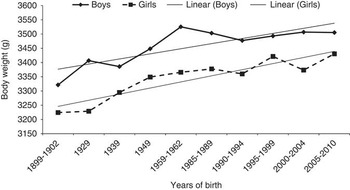
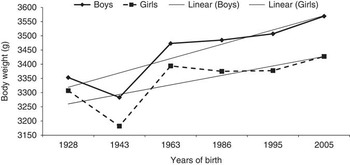
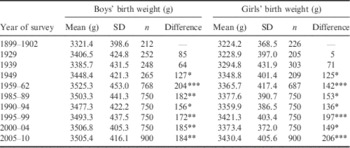
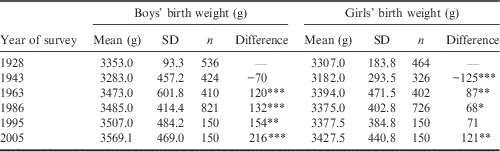
Data analysis showed that in the study periods (115 years for Kraków and nearly 90 years for Poznań) the birth weights of boys and girls evolved in a similar way (Figs 1 and 2). For both cities a general upward trend in birth weight was observed, clearly shown by the trend lines in the figures. However, the changes were not gradual; noticeable fluctuations of varying direction and intensity occurred depending on the environmental conditions. In Kraków, the lowest birth weights for both boys and girls were recorded in the late 19th and early 20th century: 3.321 kg and 3.224 kg respectively. In the following decades, these values were increasing, especially in the case of boys. The weight of the girls did not increase so intensely (Tables 1 and 2).
Secular changes in birth weight of newborns from Kraków.

Secular changes in birth weight of newborns from Poznań.

Descriptive statistics and differences (in relation to the years 1899–1902) between mean birth weights in Kraków

*p<0.05; **p<0.01; ***p<0.001.
Descriptive statistics and differences (in relation to the year 1928) between mean birth weights in Poznań
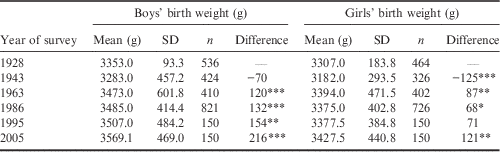
*p<0.05; **p<0.01; ***p<0.001.
A decrease in birth weight was first observed following the outbreak of World War II (1939), but only in boys. The years following World War II saw a clear increase in body weight of newborns from Kraków. The maximum value was observed at the beginning of the 1960s (for boys) and after this period a reverse trend was observed: birth weight was decreasing until the 1990s. The girls’ birth weight increased up to the 1980s, and only in the next decade did their birth weight decrease. In the late 20th and early 21st century the birth weight of male newborns in Kraków increased, but only to a small extent, and so the last decade resulted in a slowdown in the upward trend. In the case of female newborns an upward trend was also maintained, but with certain fluctuations. In 2010 in Kraków, newborns weighed 3.505 kg (boys) and 3.430 kg (girls).
Despite the slightly shorter observation period, Poznań also saw a general upward trend in birth weights. In this city unique data on the birth parameters of newborns during World War II (1943 year) were available. This was when the Poznań newborns had the lowest birth weight. Two decades after the war, birth weight increased significantly for both sexes; for the boys that trend continued into the early 21st century. For the girls a small downward trend in body weight until the 1990s was observed. The subsequent years were marked by an upward trend, similar to the boys. Significant differences in birth weight between the newborns from Kraków and Poznań were recorded only in the 1920s.
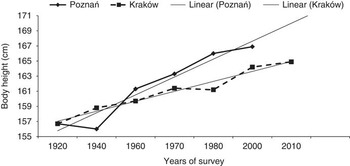
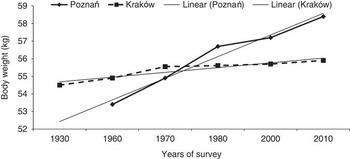
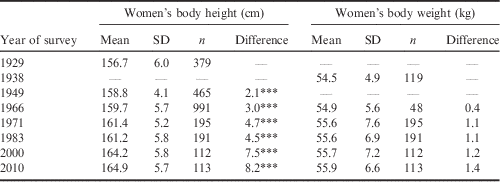
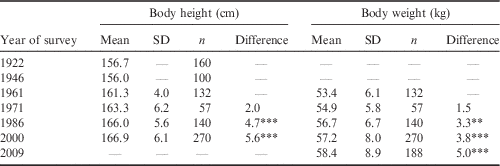
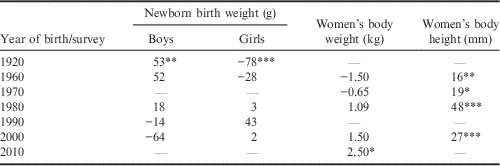
Upward trends in body weight and height were also observed for young women (potential mothers) from Kraków and Poznań (Tables 3 and 4, Figs 3 and 4). Body height in the 1920s was identical in both cities, at 156.7 cm. Over the next 2–3 decades, women from Kraków were taller than those from Poznań, and these differences were statistically significant. However, in subsequent years this trend reversed and has been sustained until the present. At the beginning of the 21st century women from Poznań were about 2.5 cm taller than those from Kraków. In the case of body weight, due to a lack of relevant data, analysis covered only the past 50 years. In the 1960s women from Kraków were heavier. However, in the following decades, as in the case of body height, this trend was reversed, particularly in recent years: in the 2000s women from Poznań were significantly heavier, by on average 2.5 kg (Table 5).
Secular changes in body height of women from Kraków and Poznań.

Secular changes in body weight of women from Kraków and Poznań.

Descriptive statistics and differences (in relation to the year 1929) between means of women body height and weight in Kraków
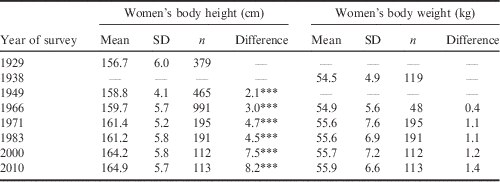
***p<0.001.
Descriptive statistics and differences (in relation to the year 1961) between means of women’s body height and body weight in Poznań
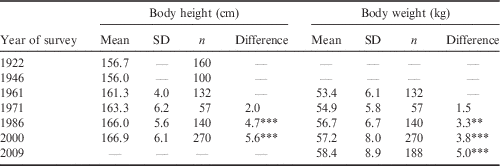
**p<0.01; ***p<0.001.
Differences in birth weights of newborns, and in women’s body height and body weight, between Kraków and Poznań
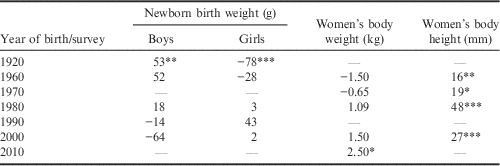
*p<0.05; **p<0.01; ***p<0.001.
Discussion
This analysis of inter-generational changes in birth weight of newborns from two major cities in Poland has shown that in the last century there was an increase in weight in newborns of both sexes. Although they showed some fluctuations in birth weight, a secular trend was unquestionable. Those changes were generally parallel to changes in the socioeconomic conditions in the country. A similar trend was also observed for the basic body dimensions of young women. Favourable socioeconomic changes in the 20th century correlated not only with a positive secular trend in body size (both at birth and adult), but also with improvements in demographic indicators (reduction in maternal and post-partum mortality, longer life expectancy).
By analysing birth weight in different periods of time, a relationship was found between this parameter and the existing economic and political situation of the country. It often resulted in large variability between each series of tests, although not affecting the overall upward trend. Birth weight proved to be sensitive to the negative socioeconomic situation, especially in periods of great disadvantage, including World War II and the period of martial law in the early 1980s. In the case of World War II, the measurement data of newborns have only been preserved in Poznań. Birth weight decreased strongly in comparison to the previous series of tests and was lowest in the history of research on newborns in that city.
Other authors have made similar observations during various conflicts, for example in Croatia, where the birth weight increased until the early 1990s. The outbreak of the Balkan War after the break-up of Yugoslavia reversed the trend. Only after stabilization of the political situation did natal parameters start to grow again (Brialić et al., Reference Brialić, Rodin, Vrdoljak, Plavec and Capkun2006). In that case, a sudden deterioration in socioeconomic conditions and high levels of stress resulted in the inhibition of the upward trend. A reduction in birth weight was also observed in Argentina in 1992–2002, when the country experienced a number of political and social conflicts (Grandi & Dipierri, Reference Grandi and Dipierri2008). A similar phenomenon was also observed in Iran; in the years 1970–1990 the country saw an improvement in living conditions, and consequently increased weight of newborns. The sanctions imposed on the country meant that in the next decades (1990–2010) birth weight decreased by approximately 80 g (Mirmiran et al., Reference Mirmiran, Moslehi, Asghari, Jambarsang, Mehrabi and Azizi2013). In Poland, it is also worth noting that short-term adverse socioeconomic changes (for example the crisis of the 1930s or martial law in the early 1980s) had indirectly resulted in a temporary decrease in birth weight only in the case of the male gender. It could confirm a higher ecosensitivity among boys. Girls, a sex with a higher resistance, did not respond to such changes.
Inter-generational changes in birth weight have different directions, depending on the population studied, the time of analysis and socioeconomic situation of the country. Many populations have shown a positive secular trend with varying intensity for decades. The number of scientific papers on this issue throughout the entire 20th century is relatively small. It is known that in Norway, birth weight increased by an average of almost 200 g between 1860 and 1984 (Rosenberg, Reference Rosenberg1988). A similar trend was observed in the 20th century in Iceland, where for eight decades the birth weight of newborns increased by an average of 85 g. The author of a paper on Iceland suggested that the main factor behind that trend was a positive secular trend in maternal body size (Biering, Reference Biering1985).
Most developing and some developed countries have also been experiencing an increase in birth weight in recent decades. This trend is mostly due to a constant improvement in socioeconomic conditions. This situation has been recorded, among others, in Canada in the 1980s and 1990s (Wen et al., Reference Wen, Kramer, Platt, Demissie, Joseph, Liu and Sauve2003); in Chile, where from 1974 to 2000 the birth weight increased by more than 200 g (Amigo et al., Reference Amigo, Bustos and Zumelzu2002); and in China, in which the last three decades have seen a strong increase in birth weight (Zong et al., Reference Zong, Li and Zhu2011; Shan et al., Reference Shan, Chen, Wang, Zhao, Teng and Wu2014). A positive trend was also recorded in Malaysia (Chen, Reference Chen1990), Papua New Guinea (Ulijaszek, Reference Ulijaszek2001) and Bosnia and Herzegovina (Hadzihalilovic et al., Reference Hadzihalilovic, Halilovic, Brahimaj, Begic, Tupkusic and Mesalic2009). In all these countries, the biggest changes were observed in the periods of strong economic recovery and enrichment of society.
Germany is another perfect example. The country, divided in 1949 into two parts with different systems and wealth, was re-unified in 1990, and since then the post-communist eastern part has received approximately 2 trillion Euros, which have resulted in, among other things, rapid improvement in socioeconomic conditions and unlimited access to varied food products. The result was an increase in average birth weight by 150 g (Hesse et al., Reference Hesse, Voigt, Sälzler, Steinberg, Friese and Keller2003).
In Poland, political transformation did not have such an impact on the birth weight of newborns, which has not changed significantly in recent decades (Kryst, Reference Kryst2014). Due to the lack of such large financial assistance from the outside, the process of systemic change has been much slower and has resulted in the collapse of many companies, increased unemployment and stagnation in agriculture. It has not been until the last dozen years that significant improvement in the situation of Poles had been observed. In some countries, e.g. Russia, economic changes in recent decades have not caused such a visible improvement in the situation of society. As a result, many regions have seen a decrease in birth weight, by 33–81 g, depending on the city (Kozlovskaya et al., Reference Kozlovskaya, Bojko, Odland and Grjibovski2007). Moscow, where the financial resources of the country are concentrated, has observed an opposite trend of increasing birth weight (Tretyak et al., Reference Tretyak, Godina and Zadorozhnaya2005).
In the case of highly developed countries, birth weight has not changed significantly, and even a slight downward trend has been observed. Such a situation can be found, for example, in Israel (Davidson et al., Reference Davidson, Litwin, Peleg and Erlich2007), the Netherlands (de Wilde et al., Reference de Wilde, van Buuren and Middelkoop2013) and the United States, where the positive trend of varying severity, observed from the 1930s (Johnson et al., Reference Johnson, Choh, Soloway, Czerwinski, Towne and Demerath2012), has now been reversed, as current data indicate (Donahue et al., Reference Donahue, Kleinman, Gillman and Oken2010; Oken, Reference Oken2013). Some authors explain this by a shorter average duration of pregnancy, for example due to the higher incidence of Caesarean sections in developed countries (Schack-Nielsen et al., Reference Schack-Nielsen, Mølgaard, Sørensen, Greisen and Michaelsen2006). Poland has also experienced this trend: in the 1980s 7% of births were Caesareans, while now it is 25% (Kryst, Reference Kryst2014). It may be possible, however, that other yet unidentified factors are responsible for this phenomenon. For example, fetal development may be affected by air pollution. Toxins contained in smog (produced by traffic, industry and coal-fired furnaces) can affect the intrauterine development of the fetus. They interfere with the transport of oxygen and nutrients through the placenta from mother to fetus, inhibiting its growth (Zhao et al., Reference Zhao, Liang, Tao, Zhu and Du2011). According to the European Environment Agency (2013), Kraków was the third most polluted European city in 2013. This may have some role in the observed inhibition of the upward trend in birth weight in Kraków, as in Poznań, which does not have a similarly serious problem with pollution, an upward trend in birth weight is still present.
The 20th century was particularly difficult for the countries of Central Europe. Wars and economic crises have been interspersed with periods of prosperity and economic growth. Overall, however, analysing the period as a whole, Poland has significantly improved its living conditions. With the increase in GDP, the overall socioeconomic situation of Polish families has improved (Morawski, Reference Morawski2011). This has indirectly resulted in a reduction in poverty, higher levels of education, improved hygiene and better access to increasingly sophisticated medical procedures. Great progress has also been made in nutrition: especially after the political transformation, access to a varied diet increased, which made it easier for Poles to have a correct and balanced diet. This is reflected by the course of the trend line, showing an increase in birth weight of newborns and body size of young women.
As this research shows, the relationship of birth size to the size of the mother is undisputed. Secular changes in birth weight are associated with similar changes in women. As has been noted by other authors, women are bigger and fatter than in previous decades (Cole, Reference Cole2000). This is directly linked to the increasing birth weight of their children (Cole, Reference Cole2003). A secular trend for only the size of newborns would be dangerous and threaten the health and even the lives of women. Moreover, it is suspected that there is a ‘braking’ mechanism in this case. This research has shown, therefore, that the secular changes in women and their children go hand in hand.
The main limitation of this study might be the fact that the children of the oldest cohorts (born before WWII) could have been selected in some way. The data came from medical records, so many children could have been omitted because they were born at home, not in hospital. Also, as noted earlier, only newborns born at full term were analysed. In the case of hospital data, it was not a problem to verify this. However, for other data, information about the timeliness of births was based solely on information given by the authors of different publications.
Undoubtedly, the economic situation of a country is closely linked to the socioeconomic conditions in which women live, and thus their developing fetuses. Access to adequate financial resources, a balanced diet, a good education, a reduction in stressors, proper medical care and increased awareness of mothers will condition the development of the fetus, and consequently its natal dimensions.
Acknowledgments
This survey was financed by the University of Physical Education in Kraków (grant number 16/MN/KA/2011). The authors declare that they have no conflict of interest.