



Two narratives, one found in the Palestinian midrash Kohelet Rabbah (KR),Footnote 1 and the other in John Moschos's Spiritual Meadow (Pratum spirituale [PS]),Footnote 2 composed in very close temporal and geographical proximity,Footnote 3 share striking similarities in plot and content.Footnote 4 To explore these intriguing similarities, I analyze two sets of stories from KR and consider their parallels elsewhere in rabbinic literature and in the PS. I argue that the first story found in KR stems from the same narrative milieu as the story in PS. The second story in KR uses an ancient Mediterranean motif that appears to fit the context of PS much better than that of KR. This motif's first appearance in rabbinic literature is in KR; we can therefore reasonably assume that KR derived it from the same narrative milieu from which it also came to PS. In neither case do I believe that PS directly influenced KR: the former was known only in narrow monastic circles,Footnote 5 and it is doubtful that the editor of KR would have been able to read it. Direct influence therefore being highly unlikely, the similarity between KR and PS is perhaps better explained by their common resort to a shared narrative tradition.
The following comparison of the two sets of stories will address both their extensive similarities and the differences between them, taking into account previously undiscussed textual case studies and reflecting on different models for explaining parallel traditions. While the question of the relationship between Christian authors and the late antique rabbis has been thoroughly investigated by pioneers of modern Judaic studies such as Samuel Krauss and Louis Ginzberg,Footnote 6 and numerous contemporary scholars have continued the inquiry,Footnote 7 the relationship between John Moschos's work and Palestinian rabbinic writings has never been systematically treated (with the notable exception of one very enlightening study by Hillel Newman).Footnote 8 My questions in this study are typical of comparative analyses: Did KR borrow the narrative tradition from Christian lore? Alternatively, was the church author impressed by the rabbis’ midrashic teachings? Or, did both Moschos and KR absorb the story from a shared narrative milieu? Alongside these comparative inquiries, I seek to understand the shared narrative's cultural context.Footnote 9 I hope that this reading of these two stories will facilitate the discovery of cultural treasures of Jewish and Christian narrators that are still hidden in the “small boxes” of their own tales.
What Is in a Small Box?
Kohelet Rabbah 3:2–8Footnote 10
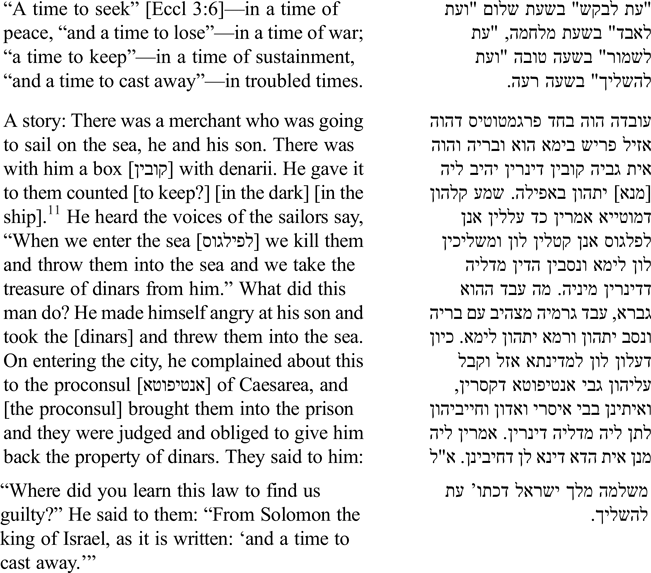
Let us summarize this brief tale, brought to illustrate Ecclesiastes 3:6. A certain trader embarks on a sea journey, carrying with him a small box (קובין), which contains a considerable amount of denarii. He overhears sailorsFootnote 12 plotting to kill him and his son and take possession of the money once the ship enters the high sea.Footnote 13 In order to avert this scenario, the father and son pretend to quarrel,Footnote 14 after which the merchant throws the box into the sea and survives. Upon arrival to Caesarea, he complains to no less a personage than the proconsul, who demands that the sailors cover the merchant's loss. Alive and also newly wealthy, the merchant explains to the confounded sailors that the words of Ecclesiastes were the blueprint for his clever plan. It is good to “cast away,” meaning, to lose wealth in troubled times, after which one can be rewarded again.Footnote 15 The link to the verse appears artificial, and the end of the story is not particularly convincing.Footnote 16 Of course, storytellers, from time immemorial, have sent their heroes on long journeys, including sea travel, in order to bring them back, having gained a new perspective.Footnote 17 Is this what happened here? Has the narrator invented the plot solely to substantiate Solomon's recommendations? While plausible, this is not the only possibility. I propose that we move in a different direction and seek to understand this tradition within a broader narrative milieu. But first, let us reflect on the whimsical vocabulary of our rather modest story.
This short and slightly elliptical tale had deteriorated severely in transmission. Saul Lieberman tried to reconstruct the text with the help of suggestions made by the medieval author R. Yiẓḥak ben Sheshet Perfet (Rivash, 1326–1408), who read this story in a letter from a correspondent.Footnote 18 Lieberman devoted special effort to explaining the following phrase: קובין דדינרין יהיב ליה מנא יתהון באפילה (which could be translated: “a box with denarii. He gave [it] to them to keep it in the dark”; however, this is a corrupted version; see further). The ambiguous word קובין (kubin) was emended by Lieberman, following an explanation proposed by Rivash, to קיבוטרין (kibutrin). Rivash assumed that this term refers to a certain box belonging to a ship's crew.Footnote 19 Lieberman also followed Rivash in understanding אפילה (ʾafelah) “darkness” to be a corruption of אילפא (ʾilfaʾ), the Aramaic term for “ship.”Footnote 20 Lieberman proposed that the merchant-father in the story gave his son the box, and the son attracted the negative attention of the sailors by counting the dinars in the box—although none of this is found in the story.Footnote 21 But comparative analysis offers us another way to understand this story. Reading the story together with a similar one recorded in the writings of John Moschos frees us from needing to search for ways to justify the logic of the KR narrative.
The Story of a Jeweller Who, by a Wise Decision, Saved His Life at SeaFootnote 22
One of the fathers said there was a jeweller of the kind known as a gem-engraver. He had some valuable stones and pearls when he went aboard a ship together with his servants [παίδων αὐτοῦ];Footnote 23 it was his intention to go do business elsewhere. By divine providence, it happened that he became fond of the crewman who was detailed to wait upon him. This servant slept at his side and ate the same food he ate. One day, the servant overheard the sailors whispering [τῶν ναυτῶν ψιθυριζόντων] to each other and determining among themselves to throw the gem-engraver into the sea, to get their hands on the stones he had with him. It was a very disturbed servant who went in to wait on the good man. “Why are you so gloomy [στυγνός] today, boy?” asked the man, but the other kept his own counsel and said nothing. He asked him again: “Come now, tell me what the matter is,” at which the servant broke into tears and sobbed out that the sailors were planning to do this and that to the jeweller, who asked: “Is this really so?” “Yes,” was the reply; “That is what they have decided among themselves to do to you.” Then the jeweller called his sons and said to them: “Whatever I tell you to do, do it at once and without arguing.” Then he unfolded a linen cloth and said to them: “Bring the inlaid chests” [φέρετε τά μου ζικία], and they brought them. He opened them and began taking out the stones. When they were all set out, he began to say: “Is this what life is <all about>? Is it for these that I put my life in danger and at the mercy of the sea when, in a little while, I shall die, and take nothing with me out of this world?” He said to his sons: “Empty it all into the sea.” As soon as he spoke, they cast the riches into the sea. The sailors were amazed—and their conspiracy was frustrated.
The common points between the two tales are clear. In both stories, a wealthy merchant goes on a journey by sea, accompanied by his son(s) or servants.Footnote 24 Moreover, both stories feature a small box with precious contents that attracts the sailors’ attention and inspires them to pursue a course of criminal intent. In both stories the would-be criminals are prevented from achieving their goal when the object of their desire is thrown into the sea.
The odd term used for the small box is an additional point of connection between the KR and PS versions of the story. This term drew lexicographical speculation not only from Lieberman, but also from scholars of Byzantium who read Moschos. As John Duffy and Gary Vikan observe, “One of the distinguishing features of the Pratum is its language: Moschos writes Greek that tends towards the colloquial, and he is one of a handful of authors who bring us close to the Byzantine vernacular of the period. This informal style allows him to admit certain words from everyday language which, if writing in a more elevated manner, he would likely avoid.”Footnote 25 According to the Greek text, the man orders the lads to fetch the chest by saying φέρετɛ τά μου ζικία. An accompanying note in the Migne edition explains that the word ζικία is unattested and that, to judge by the ancient Latin translation, the intention is capsulas.Footnote 26 Thus, according to Migne, the term βικία may have been intended.Footnote 27 This attempt at emendation was described by Duffy and Vikan as “admirable, in view of the context, but … not the correct one.”Footnote 28 They proposed their own emendation: “But the problem is not deep-seated, for it can be removed by a slight shift of the elements, namely by reading φέρɛτɛ τά μουζικία. This again confronts us with a rare word, μουζικίον, but fortunately it is attested twice in another story of the same John Moschos, and apart from that in no other Greek author. … We may conclude, then, from the two surviving examples that at the very least μουζικίον denotes a small box for keeping precious objects.”Footnote 29 Ultimately, Duffy and Vikan identify this object with the ivory pyxides used in pagan and Christian rituals. This highly creative explanation was accepted, in part, by Jeffrey Featherstone and Cyril Mango.Footnote 30
In my view, however, Migne's suggestion, followed by Lampe, that ζικίον is a mistaken rendering of βικίον (vessel, box) seems most plausible. The phonetical proximity of the Aramaic קובין /קוביא of KR and the Greek βικία is evident, as is the usage of the same word in the everyday life of fifth-century Roman Palestine. Naturally, the term was ביקיא, which somehow came to be corrupted into קובין = קיביא in its transmission to KR.Footnote 31
The primacy of Moschos's text to KR is apparent in ways other than in its preservation of this term. The story aims to show that life is worth more than money, and that a clever traveller managed to save his life by derailing the plans of those who would steal his money. It is notable that Moschos's text does not present a typical Christian hagiographic story, lacking as it does the glorification of pious monks or ascetics. It is thus reasonable to assume that the story was likely a widespread narrative with picaresque, entertaining elements mobilized for the needs of the Christian narrator.Footnote 32 Clearly, the tale has no inherent connection to the third chapter of Ecclesiastes and was likely not crafted to elucidate Ecclesisates 3:6. It is more likely that the already-existing story was adapted for and by KR.Footnote 33 The rabbinic narrator of KR considered it important to reward his pious hero by compensating him for his lost money, thereby imparting to his audience a sense of the probity and reliability of the local legal system.
Although, as we have seen above, the story in PS appears more original than the one in KR, we should not assume that the latter was borrowed from the former. Rather than posit a rigid, linear model of an “interaction effect,” I suggest an alternative model whereby KR and PS both drew their stories from the shared living narrative milieu of their time.Footnote 34 The commonalities between these stories allow us to detect something of the common culture within which these stories were created.Footnote 35 As the writings of John Moschos were probably known only to his monastic brethren, I reiterate my earlier rejection of the possibility that the editors of KR read this text. The KR editors’ awareness and use of stories circulating among the Greek-speaking population of the Land of Israel is far more likely.Footnote 36
What Is in the Fish?
A second commonality between KR and PS, found in a second pair of stories, evinces a different kind of relationship between the two compilations. This is a shared motif, a single plot item, which we might dub “the treasure in the belly of the fish.” This motif travelled early on from the ancient Orient to the Mediterranean Basin and I will demonstrate that Moschos and KR utilize this motif at around the same time. Let us begin with the small and rather elliptical fish story that appears in KR 11:1.
Kohelet Rabbah 11:1Footnote 37

In this story, the puzzling verse from Ecclesiastes was read not as a metaphor but as an order to perform a ritual. Making sense of the plot is difficult. The narrator does not explain why the man threw the bread into the sea every day or why this seemingly foolish act yielded such a great reward. The story in KR was most likely imported from another context, as it contains far too much detail for it to serve the primary purpose of illustrating Ecclesiastes 11:1. Given the known “encyclopaedic” tendencies of KR's editors,Footnote 38 it is reasonable to posit that the editors endeavoured to enrich KR by gleaning material liberally from different sources that could somehow be connected to a verse. In this case, KR's source is the congeries of complex folk stories of the KR editors’ environment.Footnote 39 KR's version of the story is much simpler than both its Babylonian Talmud parallel (B. Shabbat 119a) and Moschos's Christian version. The version found on B. Shabbat 119a is rather well known:Footnote 40
B. Shabbat 119aFootnote 41

Hillel Newman reads this story together with the nonrabbinic parallel in PS.Footnote 42 Newman first notes that Moschos relates a story he heard from a woman named Mary on the Greek island of Samos, who told him of a Christian woman of Nisibis in Babylonia who was married to a pagan:Footnote 43
They possessed fifty miliarisia. One day, the husband said to his wife: “Let us lend out that money and get some advantage from it, for in drawing on it a little at a time, we are going to spend it all.” The wife answered: “If you insist on lending this money, come: lend it to the God of the Christians.” He said to her: “Well, where is this God of the Christians, so we can lend it to him?” She said: “I will show you. Not only shall you not lose your money, but it shall even earn interest for you and the capital shall be doubled.” He said to her: “Come on then; show me and we will lend to him.”
To summarize the remainder of the story: The woman takes her husband to the church of Nisibis, where he gives his money to the poor. Three months later, unable to meet his own expenses, the husband returns to the church and finds a coin on the floor. His wife sends him off to use the coin to buy food and he buys bread, wine, and fish. When his wife opens the fish, she finds within it a precious gem, which the husband sells for three hundred miliarisia. And then:
Filled with wonder at the goodness of God, she said to him: “Oh husband, see how good and generous and affluent is the God of the Christians! Look how he has not merely returned to you the fifty miliarisia you lent him together with interest, but in only a few days has given you the capital multiplied by six! Know therefore that there is no other God, neither on earth nor in heaven, but him alone.” Convinced by this miracle and learning the truth by experience, he immediately became a Christian and glorified our God and Saviour, Jesus Christ, with the Father and the Holy Spirit.
Newman explains:
The importance of this parallel lies not only in the shared motif of the fabulous gem in the fish but also in the fact that both Jewish and Christian stories explicitly cast the appearance of the gem as repayment of a religious loan, thereby validating the extraordinary stature of the borrower. Joseph lends to the Jewish Sabbath; the pagan lends to the god of the Christians. Joseph's belief is vindicated at the expense of the gentile; the faith of the pagan's wife is vindicated, and he becomes a Christian. Without belittling all that is unique to each story, I suggest that the similarities are not merely coincidental, especially because both would appear to be Babylonian,Footnote 44 and they are roughly contemporary.Footnote 45
There is yet another Babylonian appearance of the motif of “a precious stone in a fish's belly,” in B. Bava Batra 133b, this one unexplored by Newman:
B. Bava Batra 133b

This story is clearly of Babylonian origin. The narrative details and peculiarities of the story's plot deserve an in-depth analysis that it will not receive here.Footnote 46 I will simply note that despite the story's Land of Israel setting, there is no Palestinian rabbinic parallel. There is no hint in the plot of a Palestinian historical background. The marriage of the unsuccessful son of an ancient sage to the daughter of the king's servant is portrayed as a fall from grace. The husband's buying his wife a fish on the birth of their child seems like an amusing invention of the Babylonian narrator, who is focused on the motif of the precious stone in the fish's belly.
Hillel Newman points to a different fish story, coming from the Palestinian composition, Bereshit Rabbah, which may further illuminate the motif:
Bereshit Rabbah 11:4Footnote 47

At first glance, the only nexus between this story and the motif analyzed above is the act of buying and eating fish. No miracle is found within the fish's stomach.Footnote 48 However, a much later version of this story includes the miraculous motif.
Pesikta Rabbati 23Footnote 49

The end of this story does bear some resemblance to the miraculous “precious stone in a fish belly” motif; the appearance of this motif at the very end of the story leaves the impression that it is an addition, and potentially an easily disposable one at that.Footnote 51 Newman compared Bereshit Rabbah's and Pesikta Rabbati's versions to the Bavli's and identified a commonality—both are “fish stories” in which divine providence is somehow exposed through the protagonist's purchase of a fish at the market. In Bereshit Rabbah's version, however, there is no gem and no loan repayment. In Pesikta Rabbati, these elements appear secondarily as a Hebrew addition to the Aramaic story,Footnote 52 probably under the influence of the aforementioned Bavli version.Footnote 53
Nonetheless, it is quite possible that the motif of the precious stone found in the fish's bowels was widespread since ancient times in both East and West. The motif first appears in the fifth-century BCE Histories of Herodotus,Footnote 54 and thereafter in lists of literary traditions such as Kālidāsa's The Recognition of Śākuntalā Footnote 55 and early medieval Jewish and Muslim texts.Footnote 56 Thus, the motif of the precious stone miraculously found in the fish's belly is a universal migrating motif. However, it did not appear in classical Palestinian literature until quite late. In Kohelet Rabbah, the motif is embedded in a genuine Palestinian narrative.Footnote 57
The artificiality of the appearance of the “precious stone in the fish's belly” motif in KR attests to its origins in another narrative milieu. As noted earlier, the motif in KR is much less well integrated into the work than it is into the story related by Moschos.
* * * * *
This essay has analyzed two narratives common to Kohelet Rabbah and Pratum spirituale. One of them is a true parallel, in the sense that the two stories about a box thrown into the sea are clearly descended from a common prototype, and the Christian version is primary. My assumption is based not only on the similarity of numerous plot elements, but also on the verbal echoes of the Greek prototype. The second shared story demonstrates the common deployment of a particular motif: the treasure in the belly of a fish. This motif came from the ancient Orient to the Mediterranean Basin earlier than the rabbinic and Christian compilations in which we find it, and was incorporated into both these compilations around the same time.
Rummaging in the “small boxes” of late antique rabbinic and Christian compilations, then, has yielded an important discovery: these two literary traditions, the rabbinic and the Christian, participate in a shared world of narrative discourse. Consideration of these textual parallels affords us a glimpse of the common culture that lies behind these texts and shapes these stories. I hope that this study, together with others, will catalyze further comparative analysis and lead to the unearthing of additional shared literary topoi and motifs in broader circulation—topoi and motifs that are neither particularly Jewish nor especially Christian, but which were adopted, and adapted, by both religious groups.


