INTRODUCTION
Most of the investigations focused on mood selection among Spanish heritage speakers (HSs) have found that this population tends to exhibit a high degree of variability in their interpretation and use of mood morphology in variable contexts (Giancaspro, Reference Giancaspro2019; Montrul, Reference Montrul, Potowski and Cameron2007, Reference Montrul2009; Pascual y Cabo et al., Reference Pascual y Cabo, Lingwall, Rothman, Biller, Chung and Kimball2012; Van Osch & Sleeman, Reference van Osch and Sleeman2018, inter alia). However, with very few exceptions (Isabelli, Reference Isabelli2006; Perez-Cortes, Reference Perez-Cortes2020b; Viner, Reference Viner2018), the majority of these studies have focused on the development of mood alternations in late-acquired structures, involving the expression of (non)-presuppositions in adjectival contexts (Busco a alguien que quiere [IND] /quiera [SUBJ] trabajar “I am looking for someone who wants to work”), factuality in concessive clauses (Aunque estudia [IND] /estudie [SUBJ], suspenderá el examen “She will fail the exam, despite studying/even if she studies”) or truth-value evaluations in non-assertive constructions (No creo que tiene [IND] /tenga [SUBJ] razón “I don’t think he’s right”).Footnote 1 Given HSs’ gradual reduction of input and activation of the heritage language (HL) as a result of being schooled in the majority language (Wong-Fillmore, Reference Wong-Fillmore1991), it is possible that extensive exposure to—and consistent use of—these late-acquired mood alternations might have been rather limited. As noted by several researchers (Perez-Cortes et al., Reference Perez-Cortes, Putnam and Sánchez2019; Putnam & Sánchez, Reference Putnam and Sánchez2013; Sánchez, Reference Sánchez2019), these conditions could lead to increasing difficulties in the access to and retrieval of indicative and subjunctive forms, potentially resulting in restructuring of the HL system (Miller & Rothman, Reference Miller and Rothman2020; Putnam et al., Reference Putnam, Perez-Cortes, Sánchez, Köpke and Schmid2019). The time-course of development and acquisition of these contrasts is not the only concern that should be taken into account when considering previous analyses on this topic. Van Osch et al. (Reference van Osch, Hulk, Sleeman, Aalberse, Bellamy, Child, González, Muntendam and Parafita Couto2017), for example, observed that most of the literature tends to restrict examinations of modal contrasts to one mood only (i.e., subjunctive), even when structures feature mood alternations, effectively preventing us from drawing conclusions about HSs’ knowledge of indicative/subjunctive contrasts. The present investigation contributes to this body of research in several ways. On the one hand, it focuses on HSs’ interpretation and use of both indicative and subjunctive mood within an unexplored early acquired mood alternation (i.e., reported speech contexts), where the presence of a certain modal form in the embedded clause indicates whether a report is to be interpreted as an assertion or a command (see sentences 2a and 2b in the text that follows). On the other hand, and following Giancaspro (Reference Giancaspro2019), this study also proposes to revise and expand the notion of HL divergence, adopting a more comprehensive analysis of HSs’ performance that goes beyond the extent to which HSs and controls are comparable and examines the nature and implications of said contrast instead.
DOUBLE MOOD SELECTION: THE CASE OF VERBA DICENDI
In Spanish, the modality of a proposition can be conveyed by means of a wide range of linguistic expressions, such as adverbs, verbal periphrases (i.e., modal verbs), or mood morphology. The most commonly examined manifestations in the literature involve the use of indicative and subjunctive mood, which have traditionally been explained in Spanish—as well as other languages—through a realis/irrealis contrast. While indicative is generally associated with reality and factuality, subjunctive is often perceived as a marker that situates an event in the realm of thought and alternative worlds (Haverkate, Reference Haverkate2002). In some predicates, the presence of a particular modal form is syntactically selected by the matrix verb and therefore obligatory (1). There are cases, however, where the alternation of indicative and subjunctive is also possible but pragmatically driven, as in (2):


In (1a) and (1b) the matrix verbs in both sentences (i.e., know and forbid) select a specific mood, barring the presence of any other forms in the subordinate clause. In contrast, the structures illustrated in (2) allow for the alternation of indicative and subjunctive based on semantic/pragmatic factors. In Spanish, verbs of communication such as decir (“to say/tell”) or contestar (“to reply”), also known as verba dicendi, exhibit this type of double-mood selection in reported speech contexts. When indicative mood is used, the embedded predicate is to be interpreted as an assertion (2a); in contrast, the presence of subjunctive indicates that the report involves the expression of a command (2b). While subjunctive is the preferred grammaticalization of directive force, reported commands can also be expressed through periphrases of obligation:

This detail is particularly relevant for the present study for two reasons. First, HSs—especially those with low levels of proficiency in the heritage language (HL)—tend to favor the use of analytical forms (such as tener que “have to” in [3]) over synthetic ones (i.e., sean “to be[SUBJ]” in [2b]) to express a wide range of semantic notions, such as progressivity, habituality, or futurity (Cuza, Reference Cuza2010; Silva-Corvalán, Reference Silva-Corvalán1994). This preference, which is connected to the vulnerability of morphosyntax to attrition and restructuring (or what is referred to as “the morphology problem” by Polinsky & Scontras, Reference Polinsky and Scontras2020 in connection to HL grammars), is commonly observed in situations of language change or intergenerational linguistic loss (Maher, Reference Maher, Seliger and Vago1991). In these settings, analytical forms that are already present in the speakers’ grammars progressively replace an increasingly reduced inflectional paradigm as the preferred linguistic exponents of a particular semantic notion. Additionally, the presence of periphrastic forms to express a jussive meaning is also available in English, where reported commands may also be conveyed via modal verbs:Footnote 2

As illustrated by the previous examples, indirect commands in English usually select a matrix verb (i.e., tell) that inherently denotes the illocutionary force intended by these types of predicates, which can either be followed by an infinitival clause (4) or by the—optional—complementizer that, a modal verb, and an uninflected form, as in (5). The existence of this last structure in the dominant language grammar could reinforce the activation of its quasiequivalent in the weaker/heritage language (see [3]), potentially leading to its adoption—rather than subjunctive mood—to convey reported commands (Putnam et al., Reference Putnam, Carlson and Reitter2018). It is proposed that the convergence of factors mentioned in the preceding text (i.e., HSs’ preference for analytical forms and structural overlap with English) is likely to result in an increase of HSs’ odds of using periphrases of obligation in lieu of subjunctive, especially among those with lower levels of proficiency in Spanish, who tend to present more variability in the domain of morphosyntax (Polinsky & Scontras, Reference Polinsky and Scontras2020, p. 9).
THE ACQUISITION OF MOOD ALTERNATIONS BY HERITAGE SPEAKERS OF SPANISH
The consensus among studies dedicated to the acquisition of mood alternations by Spanish HSs is that variability tends to emerge in predicates where subjunctive is traditionally expected (Giancaspro, Reference Giancaspro2019; Montrul, Reference Montrul2009; Viner, Reference Viner2018). In tasks targeting interpretation, this often manifests as a gradual loss of mood distinctions, affecting subjunctive contexts more substantially (Montrul, Reference Montrul, Potowski and Cameron2007; Pascual y Cabo et al., Reference Pascual y Cabo and Rothman2012; Van Osch et al. Reference van Osch, Hulk, Sleeman, Aalberse, Bellamy, Child, González, Muntendam and Parafita Couto2017). In production, the overextension of indicative regardless of the semantic/pragmatic intent of the speaker is common and explains most of the intergenerational differences in mood selection documented among Spanish HSs living in the United States (Ocampo, Reference Ocampo and Bergen1990; Silva-Corvalán, Reference Silva-Corvalán1994). Several factors appear to influence the degree of maintenance of said alternations in heritage speakers’ grammars. Researchers agree that higher levels of proficiency in the HL not only increase the likelihood of retaining semantic contrasts in contexts featuring variable mood selection (Giancaspro, Reference Giancaspro2019; Montrul, Reference Montrul, Potowski and Cameron2007, Reference Montrul2009) but also decrease HSs’ rates of morphological optionality (Perez-Cortes, Reference Perez-Cortes2021; Perez-Cortes et al., Reference Perez-Cortes, Putnam and Sánchez2019; Sánchez, Reference Sánchez2019). The frequency of use of the HL has also been found to play a role in mood selection (albeit in obligatory contexts), whereby higher rates of activation of this language increase subjunctive use in disjoint reference desideratives, which trigger subjunctive selection (Perez-Cortes, Reference Perez-Cortes2016). Lastly, HSs’ age of onset of bilingualism also appears to modulate subjunctive interpretation and use in variable contexts, as sequential bilinguals (exposed to the dominant language after age 4.0) are slightly more likely to produce and prefer this mood in conditions where it would traditionally be expected, such as nonpresuppositional contexts (Giancaspro, Reference Giancaspro2019).
THE DEVELOPMENT OF DOUBLE MOOD SELECTION IN REPORTED SPEECH CONTEXTS
As noted in the introduction, the body of research presented up to this point has very often focused on the examination of mood contrasts within late-acquired structures. The variable contexts analyzed in the present study (i.e., reported assertions and commands), in contrast, appear between the ages of 2.5–4.0 in the speech of both Spanish (Mahler, Reference Mahler1997) and English monolinguals (Goodell & Sachs, Reference Goodell and Sachs1992), and exhibit little variability from an early age.Footnote 3 The jussive predicates targeted in this investigation are inherently connected to imperative forms, which are also known to emerge early in Spanish monolinguals (Gathercole et al., Reference Gathercole, Sebastián and Soto1999). As a result, the use of subjunctive mood to convey indirect commands is consistently documented as being stable—and error-free—between ages 2.5 and 3.3 (Blake, Reference Blake1983). Research on mood selection by child heritage bilinguals, in contrast, is very scarce and primarily focused on their reduced use of subjunctive as a result of limited exposure to Spanish (Floyd, Reference Floyd1990; Merino, Reference Merino1976). To my knowledge, Perez-Cortes (Reference Perez-Cortes2020a) is the only study that has examined the development of variable mood selection in reported speech contexts by child HSs of Spanish from a cross-sectional as well as a longitudinal perspective. This investigation analyzed child HSs’ use of subjunctive in a series of oral narratives produced by 150 children between the ages of 4.0 and 11.11. Data on reported speech contexts showed that while they invariably used indicative to report assertions since age 4.0, they exhibited morphological variability in the expression of indirect commands. The optionality observed in this condition was correlated with participants’ age and level of proficiency in the HL. Thus, older children and those with lower levels of proficiency in Spanish were more likely than their younger and highly proficient counterparts to prefer the use of indicative and English-like infinitival constructions (i.e., El niño le dice *a parar [INF] de hablar a él, “The boy tells him to stop talking to him”) rather than subjunctive to convey directive force.
Despite the documented instances of morphological optionality observed among younger bilinguals, sociolinguistic studies focused on adult HSs of Spanish living in the United States have noted that subjunctive use in jussive contexts seems to remain strong across generations, a finding that also applies to other early acquired deontic predicates, such as desideratives and purpose clauses (Silva-Corvalán, Reference Silva-Corvalán1994; Viner, Reference Viner2018). To date, only Perez-Cortes (Reference Perez-Cortes2020b) has empirically tested HSs’ knowledge of mood alternations in the variable contexts analyzed in this investigation. While her focus was on determining the factors that might drive intraspeaker variability among HSs with intermediate levels of proficiency in Spanish, data from a truth-value judgment and an elicited production task indicated that this group of bilinguals retained the distinction between indicative and subjunctive to a higher extent than in previously tested non-obligatory contexts. Results from 17 intermediate HSs indicated that participants were very likely to associate the use of indicative to reported assertions and subjunctive to indirect commands, especially when the matrix verb of communication was frequent (vs. infrequent) and the embedded verb irregular (vs. regular). The same trend was detected in production, although the rates of subjunctive use were much lower in this domain. Interestingly, participants at the higher end of the proficiency spectrum often overextended the use of subjunctive to assertive contexts in both tasks, mirroring the pattern observed in a group of Spanish controls. In contrast, those with lower levels of Spanish proficiency presented the opposite tendency, preferring the use of indicative regardless of the semantic/pragmatic context.
THE STUDY
While these investigations provide invaluable information about how factors like proficiency, frequency, regularity, and age of onset of bilingualism may affect Spanish HSs’ knowledge of mood contrasts, very little is still known about how this group of bilinguals interprets and uses mood alternations in reported speech constructions. The present study addresses this issue by seeking answers to the following research questions:
1. a. To what extent do Spanish HSs differ from Spanish-dominant controls (SDCs) in their interpretation of indicative and subjunctive as markers of assertions and commands in reported speech contexts?
b. If a divergence between both groups is observed, what is the nature of this contrast?
Based on the findings summarized thus far, it is hypothesized that while most HSs are likely to significantly differ from their SDC counterparts, their level of proficiency in the HL will be a strong predictor of their performance, determining the degree to which they adhere to SDCs’ patterns. Specifically, it is anticipated that as HSs’ proficiency increases, so will their likelihood of associating indicative as a marker of a reported assertion and subjunctive as an indicator of an indirect command. Participants with lower levels of proficiency in Spanish, in contrast, are expected to diverge from SDCs to a greater extent, accepting the use of either indicative or subjunctive for any of the contexts provided (i.e., assertive/jussive). In their case, this would likely indicate a loss of modal contrasts within reported speech constructions, as they would no longer distinguish between both moods in these contexts.
2. a. To what extent do Spanish HSs exhibit the same patterns of indicative and subjunctive use as Spanish-dominant controls (SDCs) when reporting assertions and commands?
b. In the event that both groups diverge significantly from each other, what is the nature of their differences?
Previous research suggests that HSs will be more likely to converge with SDCs in their use of indicative in assertive contexts; however, it is also predicted that they will exhibit higher rates of morphological variability than controls in jussive contexts, where subjunctive would be expected (Giancaspro, Reference Giancaspro2019; Perez-Cortes, Reference Perez-Cortes2020b). Proficiency is once more hypothesized to be likely to modulate HSs’ rates of morphosyntactic optionality, particularly in the case of indirect commands. As posited in “Double Mood Selection: The Case of Verba Dicendi,” it is possible that the inherent vulnerability of morphology in HL grammars as well as the partial linguistic overlap between Spanish and English in this condition—where both languages allow for the use of periphrases of obligation/modal verbs as markers of directive force—might also impact participants’ likelihood of subjunctive use. In particular, HSs might be more inclined to resort to these types of analytical forms (rather than synthetic ones) when expressing directive force, which would entail the preference for periphrases of obligation such as tener que or deber (“have to” or “should/ought to”) to subjunctive mood in production. This pattern is predicted to be more prominent among HSs with lower levels of proficiency in the HL, as they are the ones who typically exhibit more morphological deficits (Polinsky & Scontras, Reference Polinsky and Scontras2020) and difficulties integrating linguistic information (Perez-Cortes et al., Reference Perez-Cortes, Putnam and Sánchez2019) in this domain. In contrast, it is possible that advanced HSs and SDCs may overextend the use of subjunctive to assertive contexts in both tasks, a trend that is not likely to appear in bilinguals with lower levels of proficiency, who may favor periphrases or indicative forms regardless of the semantic/pragmatic context (Perez-Cortes, Reference Perez-Cortes2020b).
With these predictions in mind, we expect that HSs’ overall likelihood of interpreting and using indicative and subjunctive following SDCs patterns (i.e., establishing a relation between their presence/absence and directive force) might be higher than in mood alternations that are late-acquired (Perez-Leroux, Reference Perez-Leroux, Nelson, Aksu-Koc and Johnson2001; Silva-Corvalán, Reference Silva-Corvalán1994), as argued in the previous sections.
PARTICIPANTS
A total of 101 participants were divided into two groups. The first one was formed by 76 HSs of Spanish (18 males and 58 females; age range: 18–34; M = 23.44; SD = 2.8), all of whom were students at a public research university located in the northeast of the United States. The second group of participants, who served as controls, included 25 Spanish-dominant bilinguals (7 males and 18 females; age range: 20–36; M = 26.61; SD = 5.3) recruited from the same institution as the experimental group. As recommended by Pascual y Cabo and Rothman (Reference Pascual y Cabo, Lingwall, Rothman, Biller, Chung and Kimball2012), this group included first-generation immigrants who lived in the same country as the HS group (in this case, the United States) and who were bilingual in the majority and minority language (i.e., English and Spanish) but dominant in the latter.Footnote 4 All subjects completed two screening tasks prior to their participation in the experiment. The first task was a language background questionnaire (LBQ), which gathered information about their linguistic histories and patterns of language use. The second one was a proficiency test adapted from the Diploma de español como lengua extranjera (DELE) exam, originally adopted by Montrul and Slabakova (Reference Montrul and Slabakova2003) and commonly used in Spanish HL research.
Results from the LBQ indicated that the majority of HSs had been born in the United States (80.8%), although there was also a small percentage (19.2%) who had immigrated to this country during early childhood from a Spanish-speaking region (age range: 1.0–7.0; M = 3.4; SD = 1.8). More than 66% of the participants in the sample were classified as simultaneous bilinguals (exposed to both languages from birth to 3.0), while the remaining (34%) were labelled as sequential (exposed to English after 3.0). The countries of origin of their families reflected the heterogeneity of the Latino population living in the area where the study was conducted. Seventeen percent of the participants’ families had emigrated from Ecuador, 15% from the Dominican Republic, followed closely by Colombia (14%), Puerto Rico (12.5%), and Mexico (11%). The rest of the sample (30.5%) represented a wide range of nationalities, including Cuba, Perú, Spain, El Salvador, Guatemala, Chile, and Honduras. Participants in the Spanish-dominant group had all been born and raised in Spanish-speaking countries (Dominican Republic (n = 5); Mexico (n = 4); Ecuador (n = 4); Puerto Rico (n = 3); Colombia (n = 3); Perú (n = 2); Cuba (n = 2); Uruguay (n = 1); and Spain (n = 1)) and had been living in the United States for a little more than a decade (length of residence range: 1–12; M = 6.6; SD = 3.09).Footnote 5
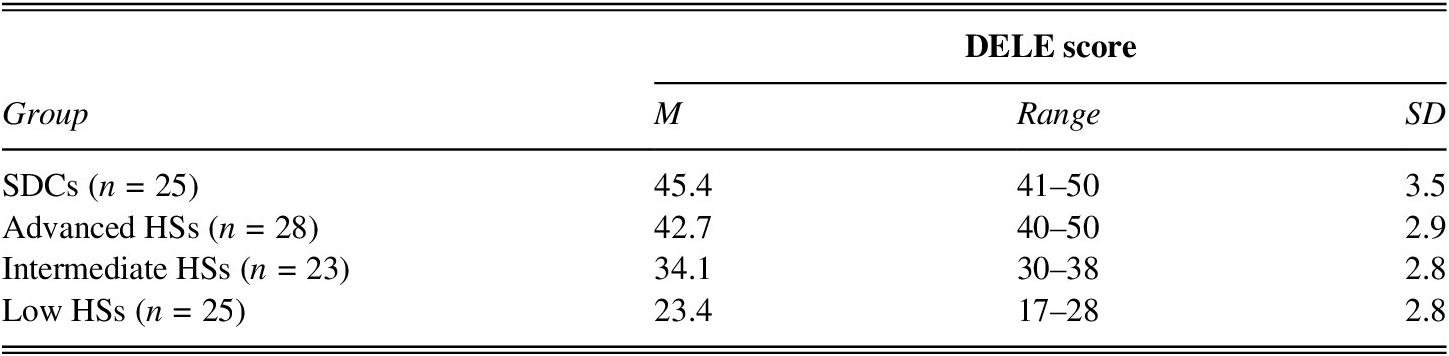
As noted previously, participants also completed an adapted version of the DELE test, which included 50 multiple-choice questions that targeted their lexical and grammatical knowledge in Spanish. Results of a one-way ANOVA revealed significant differences across participants’ DELE scores (F(3, 97) = 253.979, p = .000). Bonferroni post-hoc comparisons confirmed that these contrasts were significant between all groups, attesting that all of them differed from each other with regards to their proficiency level (as measured by the DELE). A summary of the results obtained is included in Table 1.Footnote 6
Participants’ results from the DELE test

MATERIALS AND PROCEDURES
In addition to the screening tasks mentioned, all subjects were asked to complete two experimental tasks: a truth-value judgment task, which examined their interpretation of indicative and subjunctive mood in reported speech constructions, and a picture-based sentence completion task, designed to document their mood preferences in production in the same type of contexts. These tasks were presented on a 13-inch screen laptop and delivered in a self-paced and incremental manner using a PowerPoint slide-show. On average, participants spent between 75–90 minutes on the experimental session.
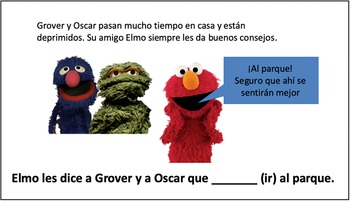
The first task administered was an untimed written sentence completion task (SCT) that included 44 items (12 target, 32 distractors).Footnote 7 In this test, participants were presented with a picture and a context that depicted one of the following possible situations: (a) a character that described an action performed by others, or (b) a character that urged others to complete a particular task. Once the context had been established, participants were asked to click on the space bar, which prompted an incomplete sentence to appear on the screen. After reading it, they were instructed to write the missing information using the most appropriate form of a given verb in their response:Footnote 8
The context provided in Figure 1, for example, motivated Elmo’s intervention, which urged his friends to go to the park. The sentence that appeared at the bottom of the screen was designed to summarize the previous scenario and, as such, was expected to trigger participants’ use of subjunctive (i.e., vayan (“to go”)—or, as noted, of a periphrases of obligation such as tienen que/deben ir (“have/ought to go”)—to convey a jussive interpretation.
Sample item from the sentence completion task (jussive condition).

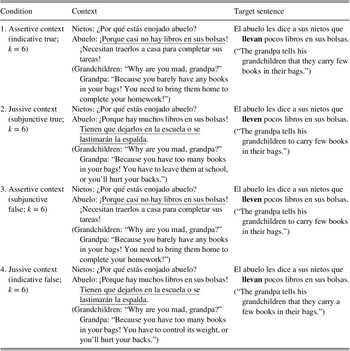
The second task was an untimed written truth-value judgment task (TVJT; Crain & Thornton, Reference Crain and Thornton1998) and included a total of 44 situations (12 target, 32 distractors). To complete it, participants were asked to read a scene involving several characters interacting with one another and decide whether the sentence that appeared at the end of the dialogue accurately described the context provided (i.e., True) or not (i.e., False). Following the design of TVJTs, the scenarios were subdivided into four different conditions.
While participants were exposed to each context (assertive vs. jussive) a total of six times, they never saw the same scenario or sentence more than once. The goal of this task was twofold: on the one hand, it examined the extent to which Spanish–English bilinguals (both HSs and SDCs) would associate indicative mood with reported assertions and subjunctive mood with indirect commands. On the other hand, it was also set to determine whether certain infelicitous uses (i.e., conditions 3 and 4 from Table 2) would be less likely to be detected than others. This last detail is particularly relevant for the present study, as it provided more information about the nature of HSs’ variability in mood alternations, which has generally only been documented in contexts where subjunctive would have been expected (see Van Osch et al. Reference van Osch, Hulk, Sleeman, Aalberse, Bellamy, Child, González, Muntendam and Parafita Couto2017 for a summary).
Main conditions of the truth-value judgment task

RESULTS AND ANALYSIS
To facilitate interpretation, the following sections present the results of each task separately and in the opposite order in which they were administered. The statistical analyses used involved a series of mixed-effects binary logistic regression models (GELINMIXED function) conducted using SPSS (Statistical Package for the Social Sciences) v. 26.
MOOD DISTINCTIONS IN INTERPRETATION: LOOKING AT PARTICIPANTS’ TVJT DATA
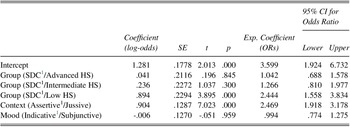
Participants’ responses in this task were coded based on whether they considered a particular reported-speech construction to be the correct representation of the contextual preamble provided (1 True, 0 False). The reliability of the items included in the test (k = 12)—measured using Cronbach’s alpha—was found to be slightly below average (α = .66). However, as noted by Plonsky and Derrick (Reference Plonsky and Derrick2016), this is not surprising given the heterogeneity of the sample.Footnote 9 Because the experimental design involved a dichotomous dependent variable, a mixed-effects binary logistic regression model was used to estimate the effects of Group (SDCs, advanced HS, intermediate HS, and low HS), Context (assertive, jussive), Mood (indicative, subjunctive), and their interaction on participants’ responses. The model, which also included random intercepts for participant as well as item, revealed statistically significant effects for the fixed factors of Group (F (3, 1117) = 5.522; p= .001), Context (F (1, 1117) = 38.865; p= .000), as well as for the three-way Group*Context*Mood interaction (F (15,1117) = 20.882; p = .000), but not for Mood (F (1, 1117) = .003; p > .05).
Predicted likelihood of True responses based on the fixed effects of Group, Context, and Mood

1 Indicates that this was the category of reference.
As observed in Table 3, low-proficiency HSs were the only group of HSs whose overall TVJT performance statistically differed from that of SDCs (log-odds = .894, p = .000). Specifically, they were found to be 2.4 times more inclined to assess all conditions as being True, which represented 74% of their total responses in this task. This tendency to accept any modal forms as markers of reported assertions and commands suggested a generalized lack of differentiation between indicative and subjunctive mood. Such pattern was not observed in any of the remaining groups, whose probability of interpreting constructions as True ranged from 54% (Advanced HSs and SDCs) to 59% (Intermediate HSs). The model also rendered significant fixed effects for Context, revealing that participants were almost 2.5 times more likely to identify a given construction as True if the target context was jussive (M = .71; SE = .023) than if it was assertive (M = .50, SE = .024), as suggested by the former’s positive log-odds (.904) and high odds-ratio (2.469).Footnote 10 This could indicate that participants’ differentiation between indicative and subjunctive was less clear in jussive contexts, where infelicitous (i.e., “False”) uses of indicative may not have been identified as such. The lack of mood effects obtained in this general model revealed that participants’ probability of evaluating a reportative construction as True was not significantly affected by the type of modal form (indicative/subjunctive) that appeared in the subordinate clause, ruling out any potential bias toward a particular mood.
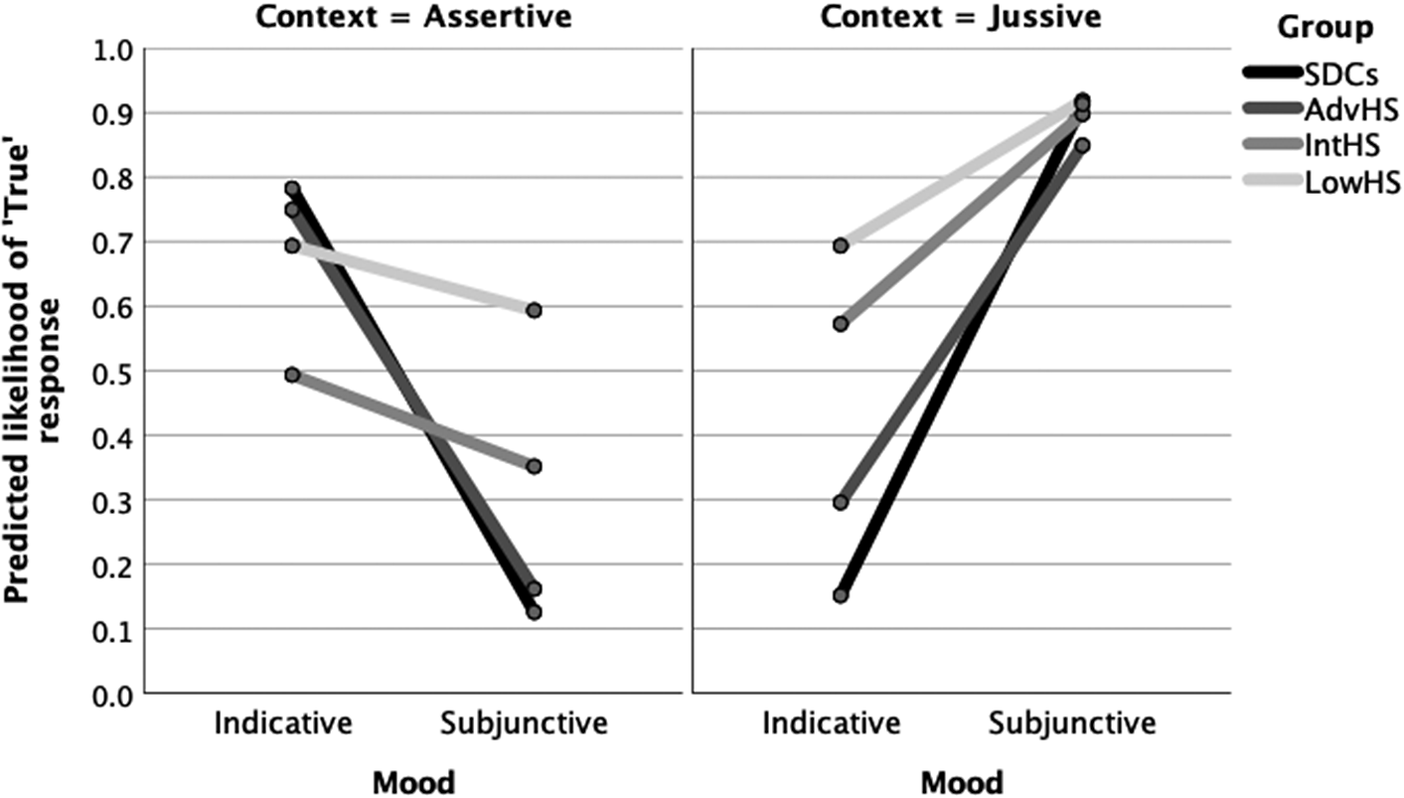
The significant three-way interaction plotted in Figure 2 explained how the factors of Group, Context, and Mood interacted with each other, illustrating the extent to which they modulated participants’ responses in this task.
Participants’ likelihood of providing True responses as a function of Group, Context, and Mood.

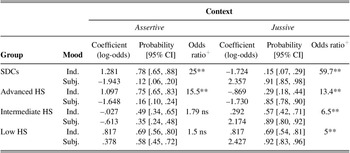
To facilitate the presentation, results from each semantic context (assertive and jussive) are reported separately, analyzing participants’ performance from a within-subjects perspective first, followed by the examination of between-subjects contrasts. If we focus on the interpretation of assertions, the previous literature (Bosque, Reference Bosque, Hualde, Olarrea and O’Rourke2012) suggests that indicative mood—rather than subjunctive—should be the preferred marker to express this type of reports. As shown in Table 4, the data seem to point to a more complex distribution among all groups.
Predicted probabilities of True responses as a function of Context, Mood, and Group

+ Odds ratios (ORs) were calculated based on the difference between participants’ likelihood (log-odds) of “True” responses when indicative and subjunctive mood were present. ORs for each context indicate how much more/less likely participants were to assign “True” to the expected mood (indicative in assertive contexts and subjunctive in jussive ones) than to the unexpected/infelicitous one.
*p < .05; ** p < .01; ns = not significant.
Post-hoc pairwise comparisons confirmed that SDCs and Advanced HSs where the only two groups of bilinguals who exhibited significant differences when evaluating indicative and subjunctive complements within this semantic context, showing a notable preference toward the former (indicative) as a marker of reported assertions. Intermediate HSs’ and Low HSs’ responses, in contrast, did not vary significantly based on the mood featured in the subordinate clause, suggesting a loss of modal contrasts in this particular context.
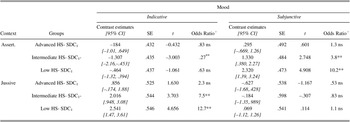
Between-group comparisons (see Table A1 in the Appendix for all relevant interactions) revealed that, while most HSs provided statistically comparable responses to SDCs in contexts where indicative was featured, differences increased when the presence of subjunctive was evaluated (as a reminder, the use of this form was expected to be pragmatically infelicitous). As seen in Figure 2, participants’ likelihood of providing a True response in this case increased exponentially as their proficiency in Spanish decreased. Specifically, SDCs (M = .12, SE = .037) and Advanced HSs (M = .16, SE = .034) were found to be equally likely to reject this mood as a marker of reported assertions (p > .05, OR= 1.3), while Intermediate HSs (M = .35, SE = .061) and Low HSs (M = .58, SE = .089) were between 3–10 times more likely to accept the use of subjunctive in this semantic context.
The results reported in Table 4 also revealed a certain degree of variability across participants, which emerged as an overacceptance of subjunctive where it would be generally deemed infelicitous, as well as a higher-than-expected percentage of False responses when indicative was present. A possible explanation for these findings is that the flexible nature of the task could have allowed for a contextual reanalysis of certain scenarios, as in (6):

Although theoretically felicitous and plausible, an assertive interpretation of the previous context might not have been participants’ preferred option. In this case, for example, the presence of an authoritative figure (i.e., father) who is normally in a position of power could have overridden the contextual cues provided in the scenario, driving participants to assume that it was more likely that the father was berating the children rather than stating a fact. This trend, however, could also be suggestive of a lack of distinction between indicative and subjunctive. To fully understand participants’ performance as a whole, it was imperative to also evaluate their responses in the jussive condition.
Even though, as described in “Double Mood Selection: The Case of Verba Dicendi,” subjunctive has traditionally been the expected marker of indirect commands, our findings suggest that this may not have been the case for all participants. Results from the jussive context (right-hand column in Figure 2) captured a trend that was also observed in the assertive condition: as participants’ proficiency in Spanish decreased, so did the magnitude of the contrast between indicative and subjunctive, pointing to a potential loss of modal distinctions. Post-hoc comparisons (see “Jussive” results from Table 4) revealed that SDCs were almost 60 times more likely to judge a sentence featuring subjunctive rather than Indicative as True when the context conveyed a jussive reading. The contrast between both moods, however, was still significant but far less striking among Advanced HSs (p = .000, OR = 13.4), and decreased even more in groups with intermediate (p = .000, OR = 6.5) and low levels of proficiency in the HL (p = .000, OR = 5). While SDCs and HSs did not significantly differ in their judgment of subjunctive forms as markers of reported commands (see Table A1 in the Appendix for more details), higher rates of “True Indicative” among intermediate and low-proficiency HSs, who also exhibited a decreased contrast between indicative and subjunctive forms, suggested that these two groups of participants did not discernibly prefer one mood over another as a marker of reported commands.
MOOD DISTINCTIONS IN USE: ANALYZING PARTICIPANTS’ ELICITED PRODUCTIONS
The previous section provided information about participants’ likelihood of interpreting a particular modal form as the marker of reported assertions and/or commands. In what follows, we document their preferences with respect to the same forms and contexts in production. Because the focus of this article is to examine mood selection in variable contexts, it was decided that only items where indicative and subjunctive had been used would be included in the analysis, although additional details about participants’ alternatives to these forms will also be provided. This decision resulted in the exclusion of 180 responses (16.6% of the total). All remaining responses, whose internal consistency using Cronbach’s alpha was deemed reliable (α = .72), were coded as either 1 (“subjunctive”) or 0 (“indicative”).Footnote 11
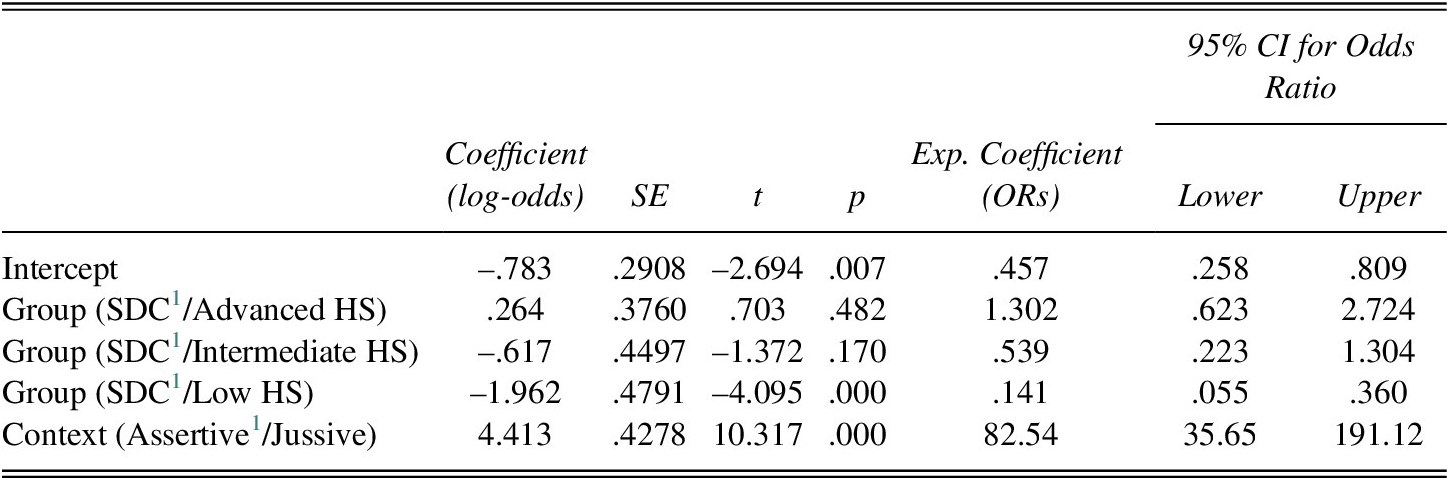
A mixed-effects binary logistic regression model was run to estimate the effects of Group (SDCs, Advanced HS, Intermediate HS, and Low HS), Context (Assertive, Jussive) and their interaction (Group*Context) on participants’ responses. The model, which also included the same random intercepts as in the previous task (i.e., participant and item), revealed statistically significant effects for the fixed factors of Group (F (3, 900) = 29.242; p = .001) and Context (F (1, 900) = 178.343; p = .000)—both of which are reported in Table 5—as well as for the two-way interaction of Group*Context (F (3, 990) = 18.104; p = .000), examined in more detail soon thereafter.
Predicted likelihood of subjunctive responses based on the fixed effects of Group and Context

1 Indicates that this was the category of reference.
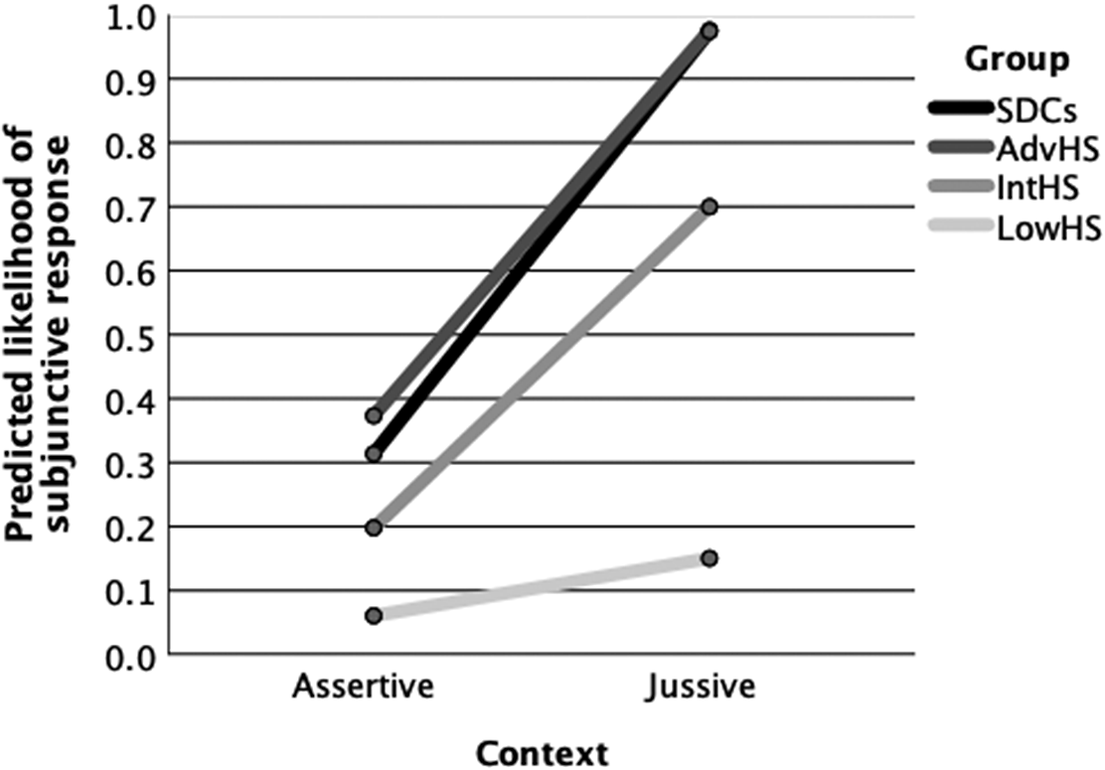
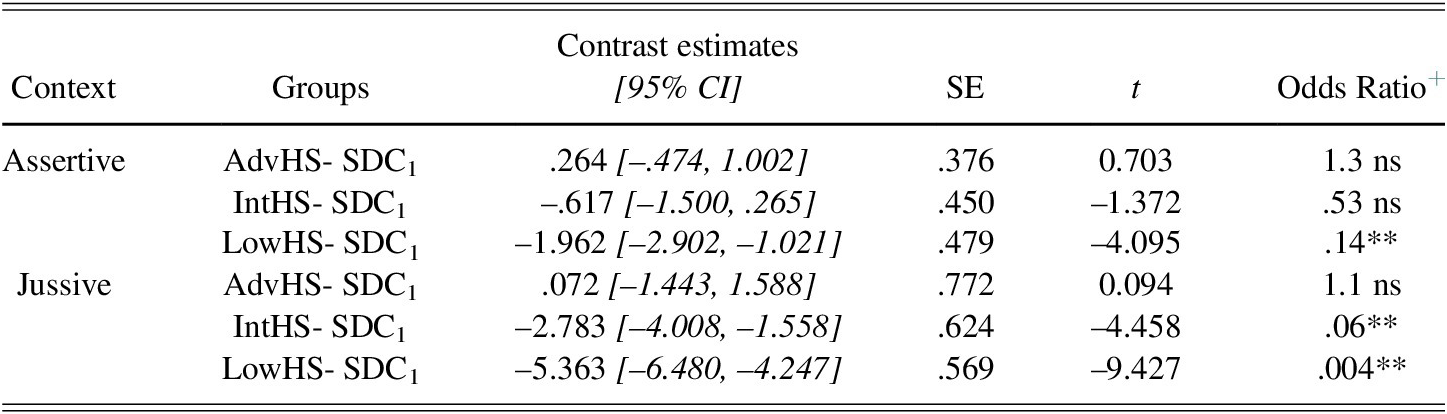
A preliminary analysis of the results indicated that, once more, the only group that statistically differed from SDCs in their likelihood of producing subjunctive mood was that of Low HSs. Specifically, these participants were found to use this form significantly less often than Spanish-dominant bilinguals, as suggested by the negative log-odds (–1.962) and low odds ratio (.141) reported. Participants’ probability of producing subjunctive was also found to be 82 times higher in jussive contexts (i.e., reported commands) than in assertive ones, implying that the overextension of this mood to all semantic contexts was not widespread. The aforementioned probabilities, however, did not provide information about whether/how these two factors (i.e., Group and Context) interacted with each other, or the extent to which their interplay may have modulated participants’ responses, which was crucial to fully address our second research question. These issues were examined by looking more closely at the significant two-way interaction (Group*Context), also included in the original model:
Participants’ likelihood of producing Subjunctive as a function of Group and Context.

As a reminder, in this task participants were asked to write the missing verb within a reportative construction that depicted either an assertive or a jussive context. We start the analysis by focusing on their rates of subjunctive use within the subordinate clause of assertive predicates, traditionally described as having indicative as their preferred morphological marker.
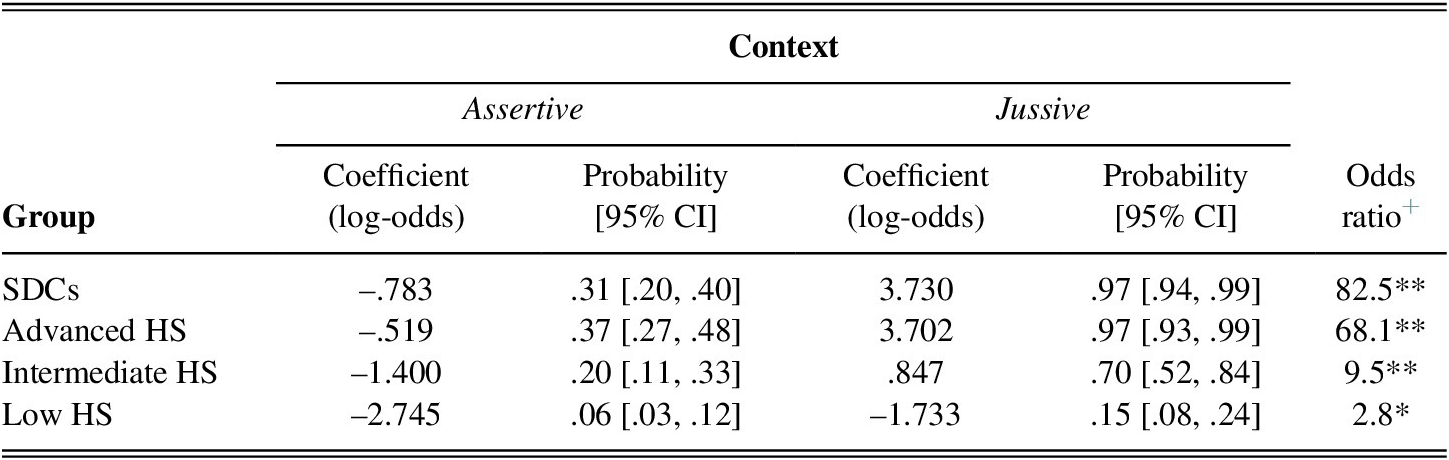
Predicted probabilities of Subjunctive use as a function of Context and Group

+ Odds ratios (ORs) were calculated based on the difference between participants’ likelihood (log-odds) of using subjunctive in each context. The reference category for these contrasts was “Assertive”; thus, ORs indicate how much more/less likely participants were to use subjunctive in jussive contexts (vs. assertive ones).
*p < .05; ** p < .01; ns = not significant.
As shown in Table 6, the use of subjunctive in assertive predicates represented between 31–37% of SDCs’ and Advanced HSs’ responses, a finding that could be connected to their previously reported tendencies to reanalyze these contexts to jussive ones in the TVJT (see “Mood Distinctions in Interpretation” for more details). This trend has been documented among Spanish monolinguals (Serrano, Reference Serrano2004) and Spanish HSs with higher levels of proficiency in the HL (Perez-Cortes, Reference Perez-Cortes2020b) in the past, and points to the vitality of subjunctive mood among these groups and its prevalence in reported speech constructions. Although the likelihood of producing subjunctive within assertive predicates was lower among Intermediate HSs (M = .20, SE = .054), their odds of doing so were not statistically different from those of SDCs (p > .05, OR = .53), as noted in Table A2 (see Appendix). In contrast, Low HSs’ probability of subjunctive use in this condition was almost non-existent (M = .06, SE = .022), making them the only group of participants whose odds differed from SDCs’ in this respect (p = .000, OR = .004).
If we focus on the use of subjunctive in jussive predicates (right-hand side of Figure 3), it is clear that this mood was the preferred form to express reported commands among both SDCs (M = .97, SE = .012) and Advanced HS (M = .97, SE = .014), who exhibited statistically similar probabilities of producing it in this context (p > .05, OR = 1.1). While the likelihood of using subjunctive in both Intermediate (M = .70, SE = .080) and Low HSs (M = .15, SE = .039) was statistically lower than for SDCs (ORs = .06 and .004, respectively), these two groups displayed very different patterns of use. As shown in Table 6, intermediate HSs were significantly more likely than their lower proficiency counterparts to produce subjunctive in this condition (p < .01, OR = 13.2), revealing crucial differences between these two groups of HSs.
As mentioned, the statistical models run for this task only included responses where participants used indicative or subjunctive mood. While these were the only two forms produced in the assertive condition, jussive predicates elicited a wider range of responses:
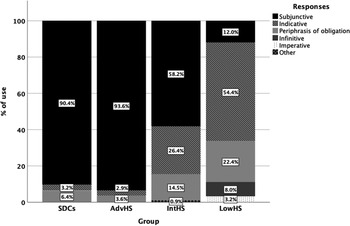
Distribution (%) of verbal forms used in jussive contexts as a function of response type and group.

Figure 4 reveals that morphological variability increased as participants’ proficiency in Spanish decreased. As theorized by Putnam and Sánchez (Reference Putnam and Sánchez2013) and more recently by Perez-Cortes et al. (Reference Perez-Cortes, Putnam and Sánchez2019) and Sánchez (Reference Sánchez2019), HSs with lower levels of proficiency in the HL often experience difficulties when integrating morphophonological, syntactic, and semantic information, especially in the domain of production, which is often affected more prominently. Two of the most common consequences of this process are the emergence of increased rates of optionality when using subjunctive mood, and a gradual weakening of form-meaning mappings, which would explain the trends observed among Intermediate and Low HSs in this study. Before we describe the nature and distribution of these groups’ morphological alternatives to subjunctive mood in more detail, it is worth noting that not all the responses that were given in this task would be traditionally considered ungrammatical or non-target. As mentioned in “Double Mood Selection: The Case of Verba Dicendi,” the most notable exception involved the use of periphrases of obligation (as in example 3), which can alternate with subjunctive mood as potential grammaticalizations of directive force in reported commands in both Spanish and English. Following our predictions, periphrases emerged in all groups, and were one of the most common alternatives to subjunctive (after indicative mood) among HSs.Footnote 12 As illustrated in Figure 4, intermediate and low-proficiency participants resorted to periphrases of obligation more often, especially in the case of latter, for whom the rates of use of these forms (22.4%) were higher than those of subjunctive (12%). The presence of these constructions among these two groups of HSs suggests that while they might not have been able to retrieve and use synthetic (subjunctive) forms as successfully as their more proficient counterparts, they were capable of identifying alternatives that could also convey directive force. In addition to these forms, Intermediate and Low HSs also expressed indirect commands by resorting to the use of indicative in the subordinate clause (8), imperatives (9), infinitival constructions (10), and other idiosyncratic forms that could not be assigned to a specific category (11):


With the exception of indicative and imperatives, most of these utterances were produced by participants in the Low HS group, reinforcing the hypothesis that these HSs were the most affected by morphological optionality (and potentially indicating the presence of deeper grammatical restructuring).
DISCUSSION AND CONCLUSIONS
The purpose of this investigation was to analyze Spanish HSs’ interpretation and use of indicative and subjunctive in early acquired mood alternations and determine to what extent they differed from those of a group of Spanish-dominant controls. Results from both experimental tasks revealed that, with the exception of Advanced HSs, the remaining groups of HSs significantly diverged from the control group in both domains (i.e., interpretation and use). As hypothesized, proficiency in the HL was a strong predictor of participants’ performance, modulating the degree of variability exhibited in both tasks.
Data from a TVJT indicated that while SDCs and advanced HSs displayed a clear distinction between indicative and subjunctive mood in reported speech constructions, predominantly associating the former to assertive contexts and the latter to jussive ones, intermediate and low-proficiency HSs did not seem to have any distinct preferences with regard to mood choice. The performance of these two last groups in the TVJT not only differed from that of SDCs’ and Advanced HSs’ but also from each other. In spite of exhibiting a high likelihood of associating indicative and subjunctive mood to their traditional semantic contexts of use when the sentence to be judged matched the context presented in the scenario (i.e., assertive context reported using indicative, or jussive context reported using subjunctive), they were both less likely to identify infelicitous uses of these modal forms when there was a mismatch between the scenario and the target sentence. Despite these similarities, Intermediate HSs’ odds of detecting infelicitous uses of indicative in jussive contexts were higher than those observed in Low HSs, whose performance revealed a generalized preference toward true responses regardless of the semantic/pragmatic intent of the speaker. This set of results illustrates the continuum of HSs’ outcomes and highlights how proficiency in the HL modulates the maintenance (or loss) of mood distinctions that emerge in variable contexts such as the one examined in the present study.
The results obtained in production reinforced the importance of considering participants’ level of Spanish proficiency when examining mood alternations in reportative constructions. This factor played a crucial role in the expression of indirect commands, where the presence of linguistic alternatives to subjunctive increased as proficiency in the HL decreased (see Figure 4). In this type of predicates, SDCs and Advanced HSs were the only two groups who displayed statistically comparable odds of subjunctive use, which represented more than 90% of their responses. In contrast, Intermediate and Low HSs not only exhibited a much lower likelihood of reporting commands using these forms but also resorted to a wider range of linguistic strategies to convey directive force. Despite the similarities between these two groups of HSs, the probability of producing subjunctive in this context was much higher for Intermediate HSs than for their lower proficiency counterparts, who barely used this form. Interestingly, subjunctive also emerged in the expression of reported assertions, where three out of the four participating groups—SDCs, Advanced, and Intermediate HSs—displayed comparable odds of using this form when it was not expected (rates of use oscillated between 20–40%). The tendency to extend this mood to contexts where indicative would traditionally be used suggests a certain degree of semantic reanalysis of the experimental contexts presented, following the trends observed in the TVJT (see example 6 for more details). As mentioned in previous sections, subjunctive overtextension is not rare among Spanish-speaking populations (Serrano, Reference Serrano2004) or even among HSs with high levels of proficiency (Perez-Cortes, Reference Perez-Cortes2020b), and reflects the prevalence of this form even in contexts that allow for mood alternations (Perez-Cortes, Reference Perez-Cortes2021). This trend was not observed in Low HSs, who resorted to using indicative instead.
On the whole, the results examined in this study revealed that HSs with intermediate and low levels of proficiency in the HL (i.e., Spanish) significantly diverged from SDCs in their interpretation and use of indicative and subjunctive in reported speech contexts. Without further explanations, however, this conclusion would be an oversimplification of the data, which is why we would like to propose that a more nuanced analysis is needed to fully understand the nature of this contrast. First, is it essential to clarify what we mean when we use the term “divergence” in HL research. As noted by Giancaspro (Reference Giancaspro2019), this notion “includes multiple ways in which HSs can differ from HL-dominant controls … [such as] employing a certain linguistic form more or less often than them” (p. 45). This observation reminds us that not all the linguistic alternatives that emerged in HSs’ responses (especially among intermediate and low-proficiency participants) necessarily entailed the preference or use of forms traditionally considered ungrammatical or non-target. In fact, previous research has shown that it is not uncommon for HSs to favor structures that are present in monolingual or Spanish-dominant bilinguals’ grammars but that are used to a lesser extent by these groups. In the data presented by Perez-Cortes et al. (Reference Perez-Cortes, Putnam and Sánchez2019), Spanish HSs avoided the production of subjunctive in disjoint-reference desideratives (i.e., Quiero que cierre la puerta “I want them to close the door”)—which feature obligatory selection of this mood—by adopting an existing structure in monolingual/SDCs’ grammars (i.e., coreferential construction as in Quiero cerrar la puerta “I want to close the door”). The preference for analytical forms rather than synthetic ones discussed in “Double Mood Selection: The Case of Verba Dicendi” would be another instance of such divergences, affecting not only HSs’ mood selection but also the expression of aspectual contrasts, voice, or tense (Cuza, Reference Cuza2010; Silva-Corvalán, Reference Silva-Corvalán1994). This last example is particularly relevant for the present investigation, as periphrases of obligation were the second most frequent alternative to subjunctive mood use in jussive predicates. As proposed by Perez-Cortes et al. (Reference Perez-Cortes, Putnam and Sánchez2019) and Sánchez (Reference Sánchez2019), the use of such analytical forms in production could merely suggest a preference for these expressions over subjunctive as a result of processing constraints, without having any particular consequences at the level of representation. This trend could be reinforced by the fact that participants’ dominant language (English) also resorts to their use when reporting commands, and that they are also a frequent alternative to subjunctive among Spanish child monolinguals (Dracos et al., Reference Dracos, Requena and Miller2019) as well as SDCs, as seen in the results of the present study. The prevailing presence of periphrases among Intermediate and Low HSs, however, could also be an indicator of—or eventually lead to—a weakening or reconfiguration of the mapping between syntactic/semantic features and morphophonological exponents (Polinsky & Scontras, Reference Polinsky and Scontras2020). Although the present study appears to point toward the latter, especially in the case of low-proficiency HSs, future studies should focus on individual results across tasks to tease these two hypotheses apart. The inclusion of a longitudinal component to determine the effects of prolonged periphrases preference/use—rather than subjunctive—in reported commands could also further our understanding of how this preference may gradually shape HL grammars, providing an explanation for the loss of mood contrasts among lower proficiency individuals who overwhelmingly favor these analytical forms over subjunctive mood.
Additional alternatives that do not typically appear in the speech of SDCs also emerged in the data, suggesting a certain level of restructuring in the grammars of Spanish HSs.Footnote 13 We would like to argue that this is most likely the case of HSs with low-proficiency in Spanish, for whom indicative-subjunctive contrasts in reported speech contexts were almost non-existent. The nature of the divergences documented in this group’s productions not only provide invaluable information about the ways in which their heritage and dominant language influence their grammars but also illustrate the continuum that is characteristic of bilingual populations whose languages are constantly coactivated (Sunderman & Kroll, Reference Sunderman and Kroll2006). In addition to using periphrases of obligation (7), HSs with lower levels of Spanish proficiency also resorted to the use of imperatives in the subordinate clause (9) to report indirect commands. The present study proposes that, while this strategy is not attested in the grammars of monolinguals or Spanish-dominant bilinguals, its use implies a considerable degree of knowledge of the heritage language, and in particular of the potential morphological alternatives that might be available to express directive force (albeit in different linguistic environments). Similarly, the use of a finite form (i.e., indicative mood, as in 8) rather than a nonfinite construction (10) denotes speakers’ awareness for the need of an inflected form after the complementizer que (“that”) in Spanish. This preference contrasts with that of their dominant language, where an infinitival construction is the most common way of expressing indirect commands (see “Double Mood Selection: The Case of Verba Dicendi” for more details).
Following Giancaspro (Reference Giancaspro2019), we would like to argue that it is imperative to embrace a more comprehensive analysis of HSs’ performance, focused not only on determining the extent to which they diverge from monolinguals/Spanish-dominant bilinguals but also on exploring the nature of these contrasts. In fact, it was through a detailed examination of participants’ divergences and the adoption of a more nuanced definition of what this term might entail that the present study revealed the role played by HSs’ level of HL proficiency in modulating their linguistic outcomes, shedding additional light on how indicative and subjunctive are interpreted and used in early acquired mood alternations.
Competing Interest
The author(s) declare none.
APPENDIX
Predicted likelihood of True response a function of Context, Group, and Mood.

*p < .05; ** p < .01; ns = not significant.
Predicted likelihood of Subjunctive response a function of Context and Group

*p <.05; ** p < .01; ns = not significant.