Implications
The fruit of Ligustrum lucidum (FLL) have recently received considerable attention for its various biological activities. However, only limited data on the use of FLL as a feed additive in layers are available. This work provides data of effects of FLL on performance, egg quality and blood biochemical parameters of layers during the late laying period. The results show that FLL can improve egg production performance and egg quality, and meanwhile reduce serum cholesterol concentrations and improve lipid metabolism in laying hens, which indicated that FLL can be used as a feed additive in layers diet at late laying stages.
Introduction
Since the 1940s, antibiotics have been widely used as a feed additive for livestock. However, while they can be effective in promoting animal growth, extensive research has now demonstrated several adverse consequences of their use as feed additives, such as the occurrence of endogenous animal infections, accumulation of drug residues, development of drug resistance and the decline of immune function in livestock and poultry. In the light of this, considerable efforts have been made toward developing alternatives to stabilize the health and growth performance of livestock. Among the potential alternatives to antibiotics, herbal medicinal plants and their extracts are now becoming important in animal and poultry production in view of their wider beneficial applications such as promoting growth and production, immune enhancing effects and safeguarding health (Alagawany and El-Hack, Reference Alagawany and El-Hack2015; Alagawany et al., Reference Alagawany, Farag, Dhama, El-Hack, Tiwari and Alam2015).
The fruit of Ligustrum lucidum Ait. (Nuzhenzi in Chinese) is an important traditional medicine, and has been used for the prevention and treatment of several human diseases, such as coronary heart disease and diabetes (Gao et al., Reference Gao, Li, Li, Liu, Fan, Liu, Zhao, Li and Han2009). Oleanolic acid (OLA) and ursolic acid are the main bioactive compounds in L. lucidum (Shi et al., Reference Shi, Ma and Cai1998), and have attracted significant research attention because of their various biological activities and their anti-inflammatory, antioxidative, antiprotozoal, antimutagenic and anticancer properties (Dinkova-Kostova et al., Reference Dinkova-Kostova, Liby, Stephenson, Holtzclaw, Gao, Suh, Williams, Risingsong, Honda, Gribble, Sporn and Talalay2005). Medical studies have shown that FLL and its main active constituents are excellent biological antioxidants which protect cells from damaging effects of lipid peroxidation that is stimulated by oxidative stress (Yim et al., Reference Yim, Wu, Pak and Ko2001).
Most poultry farmers prefer to keep their hens in to the late production period in order to achieve higher egg weights and for economic reasons, rather than substituting them with new birds. However, egg production and egg quality decrease with age (Nobakht et al., Reference Nobakht, Shivazad, Chamany and Safameher2006). There are few research reports available on the use of FLL as a feed additive in livestock nutrition, particularly in broilers. Therefore, the present study was conducted to determine the effects of in-feed dietary supplementation of laying hens with FLL during the late laying period in order to observe the effect on egg laying performance, egg quality and the serum metabolic profile of the birds.
Material and methods
Preparation of Ligustrum lucidum fruit sample
Fruits of L. Lucidum were purchased from a drugstore in Luoyang, Henan Province, China, and ground into a fine powder in a knife mill, before being stored at 4°C in a refrigerator.
Ligustrum lucidum chemical composition analysis
Fruit of L. lucidum powder (1 g) was accurately weighed and placed in a capped glass tube before being mixed with an appropriate amount of 70% methanol solution and soaked for 30 min to allow the solvent to wet the plant material. The tube containing the sample was then immersed into an ultrasonic water bath, and irradiated for the pre-set extraction temperature and time. After extraction, the sample was centrifuged at 9600 r.p.m. for 10 min, and then the supernatant was collected and diluted for HPLC analysis.
Animals, diets and experimental design
A total of 360 72-week-old Lohmann Brown laying hens were employed in a 7-week cage-trial. Birds were fed on a corn-based basal diet for 4 weeks before the trial to allow them to adapt and reach a standard rate of egg production. After a further 1-week cage-adaptation period (70 cm length×30 cm width×40 cm height), the birds were allocated to three groups with eight replicates of 15 birds each (housed in five adjacent cages, three birds per cage). No differences (P>0.05) were observed in egg production rate or egg weight among the three groups before the start of the trial (day 0). Within each replicate group birds were allotted equally into the upper and lower cages to minimize the effects of cage level.
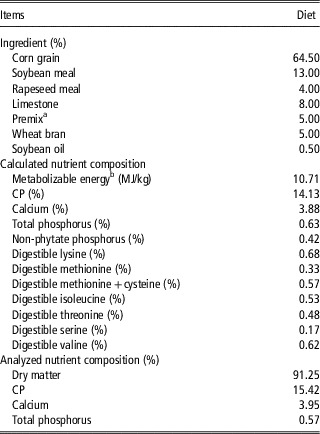
The three treatment groups comprised of a control group (fed the basal diet), group I (basal diet+0.25% FLL) and group II (basal diet+0.5% FLL). The diets were formulated to be isocaloric, isonitrogenous and to meet the nutrient requirements of laying hens according to the Management Guide of National Research Council (NRC, 1994). Nutrition composition are shown in Table 1. In groups I and II, the powered FLL was added to the basal diet at the expense of wheat bran. All the diets were prepared fresh every other week during the 7-week experimental period. Birds were allowed access to feed and water ad libitum throughout the experiment and were exposed to a 17 : 7 light-dark cycle. All experimental procedures were approved by the Institutional Animal Care and Use Committee of Henan University of Science and Technology, China.
Ingredient composition and analyzed nutrient contents of the basal diet

aComposition per kilogram of diets: vitamin A, 4000 IU; vitamin D3, 1200 IU; vitamin E, 6 mg; vitamin B1, 1.4 mg; vitamin B2, 3 mg; vitamin B6, 1.0 mg; vitamin B12, 0.01 mg; pantothenic acid, 7.5 mg; choline chloride, 500 mg; biotin, 0.15 mg; Ca,7500 mg; P, 3000 mg; Mn, 72 mg; Zn, 56 mg; Fe, 60 mg; Cu, 25 mg; I, 0.50 mg; Se, 0.10 mg.
bMetabolizable energy was calculated from data provided by Feed Database in China 2009.
Laying performance
Daily records of egg production, egg weight, cracked-eggs and mortality of birds and weekly records of feed consumption were maintained throughout the experimental period. Laying rate (including of cracked-eggs), cracked-egg rate and feed conversion ratio were calculated.
Egg quality
At the end of the experiment, 40 saleable eggs (no shell defects, cracks or double-yolks)/treatment (five eggs per replicate) were collected and used to determine egg quality. Egg albumen height, yolk color, eggshell thickness, egg shape index and eggshell breaking strength were determined by a Digital Egg Tester DET-6000 (Nable, Kyoto, Japan). Egg protein quality was assessed by determination of Haugh units according to the formula: Haugh units=100×log (H+7.57−1.7W0.37), where H is the albumen height and W is the weight of the egg (Card and Nesheim, Reference Card and Nesheim1972).
Blood sampling and serology
At the end of the experiment 40 hens from each group (five from each replicate) were randomly selected and bled from the brachial vein. The blood collection procedure was limited to a maximum of 2 min in order to minimize the influence of handling stress. In each case, ~5.0 ml of blood was collected into a non-heparinised disposable test tube. The serum was separated by centrifugation at 3000 r.p.m. for 10 min at room temperature, and stored at −20°C for analysis. Serum concentrations of total protein, albumin, glucose, calcium, triglycerides (TG), total cholesterol (TC), high-density lipoprotein cholesterol (HDL-C), low-density lipoprotein cholesterol (LDL-C), alkaline phosphatase (ALP), alanine aminotransferase (ALT) and aspartate aminotransferase (AST), were determined using commercially available kits (Weihai Wego Biotechnology Co. Ltd, Weihai, China). Glucose and total protein were determined by the hexokinase enzymatic method (Kunst et al., Reference Kunst, Draeger and Ziegenhorn1983) and the Biuret method (Gornall et al., Reference Gornall, Bardawill and David1949), respectively. Albumin in serum was determined by colorimetric testing using the bromocresol green dye binding procedure (Beng and Lim, Reference Beng and Lim1973). Total cholesterol and HDL-C were measured by the enzymatic photometric method (CHOD-PAP method; Deeg and Ziegenhorn, Reference Deeg and Ziegenhorn1983) and TG were determined by the colorimetric enzyme method of Fossati and Prencipe (Reference Fossati and Prencipe1982). In addition, ALP, ALT and AST activities were analyzed using the optimized UV test according to the IFCC modified method without pyridoxal phosphate (Schumann et al., Reference Schumann, Bonora, Ceriotti, Férard, Ferrero, Franck, Gella, Hoelzel, Jørgensen, Kanno, Kessner, Klauke, Kristiansen, Lessinger, Linsinger, Misaki, Panteghini, Pauwels, Schiele, Schimmel, Weidemann and Siekmann2002). All the analyses were conducted using a biochemical analyzer (TBA-120FR; Toshiba Ltd, Kyoto, Japan).
Statistical analysis
Statistical analyses were performed using SPSS software (SPSS Inc., Chicago, IL, USA). The normality of data distributions was checked using the Kolmogorov–Smirnov test. One-way ANOVAs were performed to examine differences among groups. The significance of mean differences between groups were identified by Duncan’s multiple range test. Results are presented as least-square means. Statistical significance was determined at P<0.05.
Results
Ligustrum lucidum composition
Oleanolic acid, ursolic acid and total flavonoids are known to be the main bioactive compounds in the FLL. In the present study, the ultrasound-assisted extraction of OLA, ursolic acid and total flavonoids from L. Lucidum was investigated with HPLC-photodiode array detection. The yields of OLA, ursolic acid and total flavonoids were 7.490, 1.607 and 78.142 mg/g, respectively.
Laying performance
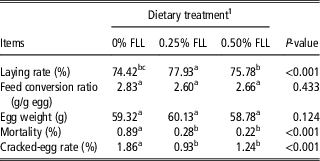
The laying performance of hens from the different dietary treatments are presented in Table 2. Compared with the control group, addition of 0.25% and 0.50% of FLL to the hens’ diets significantly affected egg laying rate, mortality and cracked-egg rate. Birds fed with 0.25% FLL-supplemented diets exhibited an increase (P<0.001) in their laying rate, whereas the mortality and cracked-egg rates of birds fed with 0.25% and 0.50% FLL-supplemented diets were decreased (P<0.001) compared with the control group. No significant differences were found in egg weight (P=0.124) or feed conversion ratio (P=0.433) among treatment groups during the entire experimental period.
The effects of dietary supplementation of the fruit of Ligustrum lucidum (FLL) on laying hen performance*

a,b,cMeans in the same row not sharing a common superscript differ significantly at P<0.05.
*Data are presented as least-square means.
1 0% FLL: control diet+0% FLL; 0.25% FLL: control diet+0.25% FLL; and 0.50% FLL: control diet+0.50% FLL.
Egg quality
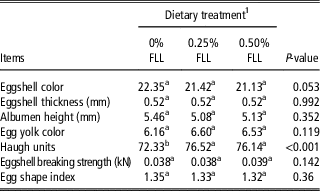
The effects of dietary supplementation of FLL on egg quality are shown in Table 3. Dietary FLL supplementation had no significant effect on eggshell color, eggshell thickness, albumen height, egg yolk color, eggshell breaking strength or egg shape index. Haugh unit values were significantly higher (P<0.001) in hens fed a diet supplemented with 0.25% and 0.50% FLL than in the control group.
The effects of dietary supplementation of the fruit of Ligustrum lucidum (FLL) on egg quality of laying hens*

a,bMeans in the same row not sharing a common superscript differ significantly at P<0.05.
*Data are presented as least-square means. n=40/group.
1 0% FLL: control diet+0% FLL; 0.25% FLL: control diet+0.25% FLL; and 0.50% FLL: control diet+0.50% FLL.
Blood biochemical parameters
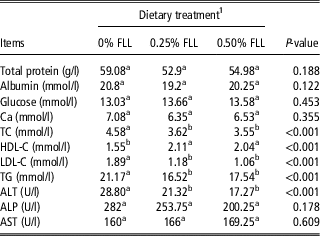
Blood biochemical parameters of hens from the different dietary treatment groups are shown in Table 4. The addition of FLL to the hens’ diets did not affect the levels of serum total protein, albumin, glucose, Ca, ALP or AST. However, serum TC, LDL-C, TG, ALT were reduced in FLL-supplemented birds (P<0.001) and serum HDL-C concentrations were increased (P<0.001), compared with control birds.
The effects of dietary supplementation of the fruit of Ligustrum lucidum (FLL) on the level of blood biochemical parameters of laying hens*

TC=total cholesterol; HDL-C=high-density lipoprotein cholesterol; LDL-C=low-density lipoprotein cholesterol; TG=triglyceride; ALT=alanine aminotransferase; ALP=alkaline phosphatase; AST=aspartate aminotransferase.
a,bMeans in the same row not sharing a common superscript differ significantly at P<0.05.
*Data are presented as least-square means. n=40/group.
1 0% FLL: control diet+0% FLL; 0.25% FLL: control diet+0.25% FLL; and 0.50% FLL: control diet+0.50% FLL.
Discussion
Following the ban on use of antibiotics as growth promoters in livestock production, medicinal herbs have been widely advocated to livestock producers as alternatives (Hernández et al., Reference Hernández, Madrid, García, Orengo and Megías2004). Among the various medicinal herbs that could be useful in this regard, a wide range of spices, herbs and extracts have been demonstrated to improve digestive tract function of livestock by increasing the activity of digestive enzymes in the gastric mucosa and enhancing nutrient utilization (Srinivasan, Reference Srinivasan2005). Czech et al. (Reference Czech, Kowalczuk and Grela2009) confirmed that herbs or herbal by-products could be used in the animal production industry to improve growth performance, and suggested that their beneficial effects may arise from the enhancement of feed intake and digestive secretion, as well as increasing immune stimulation, and imparting antiviral and antioxidant properties (Yan et al., Reference Yan, Meng, Ao, Wang, Jang and Kim2011b). Historically, FLL has been one of the most valuable medicinal herbs in China and has long been considered as a herbal remedy for the prevention and treatment of various human diseases (Gao et al., Reference Gao, Li, Li, Liu, Fan, Liu, Zhao, Li and Han2009). Oleanolic acid and ursolic acid are the main bioactive compounds in FLL, which not only has the biological hepatoprotective activity, effects on protection of stomach and strong heart anti-cardiac arrhythmia and reduction of cholesterin and hypertension and blood sugar but has also other pharmacological functions like anti-inflammatory and antiviral effects, immunological regulation, inhibition of platelet aggregation and resistance to oxidation and so on (Dinkova-kostova et al., Reference Dinkova-Kostova, Liby, Stephenson, Holtzclaw, Gao, Suh, Williams, Risingsong, Honda, Gribble, Sporn and Talalay2005; Lin et al., Reference Lin, Yen, Ng and Lin2007; Gao et al., Reference Gao, Li, Li, Liu, Fan, Liu, Zhao, Li and Han2009). The present study was designed to evaluate the effects of dietary FLL, with a view to its potential inclusion in the diet as an alternative feed additive for laying hens. The results showed that dietary inclusion of FLL led to a higher egg laying rate than a non-FLL-supplemented diet. Moreover, the mortality and cracked-egg rates of the FLL-supplemented groups were significantly lower compared with the control diet. Similar findings were reported by Ma et al. (Reference Ma, Shan, Chen, Du, Song, Li and Xu2005), who observed that a diet supplemented with herbal medicine (L. lucidum and Schisandra chinensis) significantly improved egg production in laying hens. The results of the current study are also consistent with our previous study which suggested that the inclusion of a Chinese herbal mixture increased feeding efficiency in laying hens (Li et al., Reference Li, He, Wang and Xu2016). It is generally considered that herbal additives could improve the flavor and palatability of poultry feed, subsequently increasing the total feed intake and growth performance of the birds (Wenk, Reference Wenk2003). The observed improvement in egg production parameters with phytogenic additive supplementation may be due to the provision of certain compounds that improve digestion, absorption and utilization of nutrients in the digestive tract (Almuhanna et al., Reference Almuhanna, Ahmed and Al-Yousif2011). Also, this improvement in egg production may be related to positive effects of the biological activity of bioactive components such as OLA, ursolic acid and total flavonoids present in FLL and able to cause greater efficiency and utilization of nutrients, resulting in improved productive performance (Gao et al., Reference Gao, Li, Li, Liu, Fan, Liu, Zhao, Li and Han2009; Shi et al., Reference Shi, Shan, Zhang, Chen, Cheng, Li and Ma2009). Tian et al. (Reference Tian, Ma and Du2002) found that the major component of FLL is OLA which is thought to enhance antioxidant activity and immunity. Shi et al. (Reference Shi, Shan, Zhang, Chen, Cheng, Li and Ma2009) reported that supplementation with FLL promoted the growth of layer chickens. Dietary feeding of essential oil isolated from herbal plants improved the secretion of digestive enzymes, enhanced nutrients digestibility and improved the performance for broiler (Jang et al., Reference Jang, Ko, Yang, Ha, Kim, Kim, Kang, Yoo, Nam, Kim and Lee2004). In the present study, the findings indicate that a dietary supplementation level of 0.25% FLL in the diet of laying hens results in the best improvement in reproductive performance in terms of egg laying rate and cracked-egg rate.
Eggs are an important source of nutrients for humans and it is well known that their composition can be modified through the manipulation of laying hen diets (Caston et al., Reference Caston, Squires and Leeson1994). In the present study, the inclusion of FLL in the diet of laying hens had no significant effect on the mean values of eggshell color, eggshell thickness, albumen height, egg yolk color, eggshell breaking strength or egg shape index. Similar results were reported by Yan et al. (Reference Yan, Meng and Kim2011a), who observed no effect of the inclusion of wild-ginseng in the diets on egg quality parameters (albumen height, eggshell thickness and shell breaking strength). However, there were significant effects on the Haugh unit values of laying hens, which was increased in the FLL-supplemented birds. The Haugh unit score is known as an indicator of egg freshness and is related to shelf life (Williams, Reference Williams1992). Our findings are in agreement with an earlier study which showed that 2% blends of ziziphora, menta, peppermint and nettle improved egg Haugh unit values in laying hens (Sayedpiran et al., Reference Sayedpiran, Nobakht and Khodaei2011). However, further research is needed to explore more fully the influence of FLL on egg quality parameters, particularly with regard to their mode of action in affecting egg composition in laying hens of different ages.
Biochemical blood parameters usually reflect the health of an animal. These parameters are vital indicators of the nutritional and physiological status of birds and animals (Alagawany and El-Hack, Reference Alagawany and El-Hack2015). In the present study, the addition of FLL to the diet of laying hens had little influence on the physiology of birds. No changes in serum total protein, albumin, glucose or calcium concentrations were observed during the whole experiment period in either experimental treatments, compared with the control group. The total protein content of poultry blood increases with age as a result of metabolic changes in the animal and reflects various disorders of nutritional character resulting from either insufficient or excessive intake of proteins in feed mixtures (Pavlík et al., Reference Pavlík, Pokludová, Zapletal and Jelínek2007). Our results regarding protein content of the serum were within the range for laying hens, that is, between 32.0 and 62.0 g/l and the observed lack of effect of FLL supplementation on serum protein content is consistent with the previous study of Popiela et al. (Reference Popiela, Króliczewska, Zawadzki, Opaliński and Skiba2013), who reported that the total content of protein in blood of layers was not affected by dietary supplementation of amaranth grains.
In the present study, dietary inclusion of FLL reduced serum TG and TC, as well as LDL-C concentrations, but increased HDL-C levels. In partial agreement with the present findings, Bölükbaşi et al. (Reference Bölükbaşi, Erhan and Kaynar2008) reported that herbal plant supplementation of laying hen diets significantly depressed serum TG and TC levels. In the same context, Rahimi et al. (Reference Rahimi, Teymouri Zadeh, Karimi Torshizi, Omidbaigi and Rokni2011) pointed out that blood TG levels, as well as TC and LDL-C concentrations were significantly reduced by addition of phytogenic feed additives (PFA) to chicken diets, but HDL-C increased. Radwan Nadia et al. (Reference Radwan Nadia, Hassan, Qota and Fayek2008) observed that layers fed diets supplemented with rosemary leaves at 0.5% or 1% had significantly lower levels of total lipids compared with the control group, whereas the concentrations of TC, HDL-C and LDL-C in the sera were not affected. In contrast, El-Latif et al. (Reference El-Latif, Saleh, Allam and Ghazy2013) found that addition of rosemary to chicken diets led to increased serum concentrations of TG, TC and LDL, whereas concentrations of total protein, albumin and uric acid did not change significantly. In addition, Osman et al. (Reference Osman, Yakout, Motawe and Ezz El-Arab2010) noted that rosemary supplementation at levels of 0.5 and 1 g/kg diet did not significantly affect the serum concentration of protein, albumin, creatinine or cholesterol. Medicinal plants and their products often influence blood lipid parameters in opposing ways (Alagawany et al., Reference Alagawany, Farag, Dhama, El-Hack, Tiwari and Alam2015). The discrepancies among these studies might be due to the differences in the PFA used, the product type (powder, essential oil, phenolic compounds, etc.), dose and style of administration, as well as experimental conditions.
The levels of three important markers of liver damage connected with fat metabolism and cholesterol synthesis were also investigated in the present study. The two enzymes mainly present in the liver are ALT and ALP (Króliczewska et al., Reference Króliczewska, Zawadzki, Bartkowiak and Skiba2008). Aspartate aminotransferase is an intracellular enzyme present in all tissues but at particularly high concentrations in the myocardium, skeletal muscles, liver and brain (Króliczewska et al., Reference Króliczewska, Zawadzki, Bartkowiak and Skiba2008). In poultry, its activity in blood serum depends on age, increasing until sexual maturity is reached and decreasing thereafter in adult birds. In the present study, the activities of ALT were significantly reduced in hens fed either 0.25% or 0.50% FLL. However, no differences in ALP and AST levels were observed in the supplemented and unsupplemented groups, although there was a tendency toward a decrease in ALP with increasing level of FLL in the diet. Any abnormal increases in serum levels of ALT, ALP and AST can imply liver damage (hepatocellular degeneration), so the observed decrease in the levels of ALT may be suggestive of hepatoprotective effects of FLL. However, studies on the effects of FLL on blood parameters of laying hens or other animals are currently very limited, and further studies are necessary to investigate more fully its effects on animal health and performance.
Conclusion
In conclusion, the results indicate that supplementation of laying hen diets with FLL at an inclusion level of 0.25% can improve egg production and lower mortality rates as well as lower cracked-egg rates compared with unsupplemented hens, or those supplemented with a higher inclusion level of 0.5%. Moreover, supplementation with FLL reduced serum cholesterol concentrations as well as LDL-C, and increased blood serum levels of HDL-C. However, further studies are needed to assess the potential cholesterol-depressing effects of FLL supplementation.
Acknowledgments
This study was financially supported by the National Natural Science Foundation of China (project no. U1504324; Beijing, PR China), the National College Students Innovation and Entrepreneurship Training Program (project no. 201610464077), the Advanced Cultivation Fund of Henan University of Science and Technology (project no. 2015GJB027) and Doctoral Cultivation Fund of Henan university of Science and Technology (project no. 4025-13480066).