INTRODUCTION
Logging is a widespread economic activity in the tropics (Alavalapati & Zarin Reference ALAVALAPATI, ZARIN, Zarin, Alavalapati, Putz and Schmink2004). Harvesting of trees, and its impact on the surrounding vegetation, is known to affect animals also, particularly the medium- and large-sized vertebrates (Fredericksen & Fredericksen Reference FREDERICKSEN and FREDERICKSEN2002, Heydon & Bulloh Reference HEYDON and BULLOH1997). Given that in tropical rain forests about 70% of tree species need animal vectors to disperse their seeds and colonize new, appropriate, sites for recruitment (Ghazoul Reference GHAZOUL2005, Howe & Smallwood Reference HOWE and SMALLWOOD1982), the loss of these vectors could have serious consequences on logged forests, potentially affecting forest understorey composition and diversity (Chapman & Chapman Reference CHAPMAN and CHAPMAN1995, Wright Reference WRIGHT2003). Since medium- and large-bodied seed-dispersing vertebrates (e.g. birds and mammals) are often preferred game species, hunting can have significant negative impacts on their populations (Peres Reference PERES2001, Redford Reference REDFORD1992). However, logging may also affect vertebrate dispersers (Chapman et al. Reference CHAPMAN, BALCOM, GILLESPIE, SKORUPA and STRUHSAKER2000, Johns Reference JOHNS1986) and if that is the case, it may also disrupt seed dispersal patterns (Johns Reference JOHNS1992) and, potentially, indirectly impact plant recruitment and understorey plant communities.
Primates are important seed dispersal agents (Andresen Reference ANDRESEN2002, Feer & Forget Reference FEER and FORGET2002, Chapman & Russo Reference CHAPMAN, RUSSO, Campbell, Fuentes, MacKinnon, Panger and Bearder2006). In sites where they have been extirpated or their populations reduced, some tree species have shown massive seed accumulation, germination and establishment of offspring beneath fruiting trees (Chapman & Chapman Reference CHAPMAN and CHAPMAN1995). Local extirpation of vertebrate dispersers could affect seed dispersal and plant recruitment in two ways: either leaving non-dispersed seeds, or their emerging seedlings, vulnerable to negative distance- or density-dependent mortality (Connell Reference CONNELL, den Boer and Gradwell1971, Janzen Reference JANZEN1970) and with no seedling recruitment or, alternatively, by reducing the spatial extent of seed dispersal (sensu Janzen Reference JANZEN1970), favouring locally monodominant seedling recruitment (Dirzo et al. Reference DIRZO, MENDOZA and ORTÍZ2007), if distance- or density-dependent mortality factors cannot compensate for the massive rain of seeds beneath parental trees. Thus, changes of the seed dispersal kernel could have important effects on understorey composition.
In this study we investigated whether timber extraction per se (independent of hunting) can bring about indirect effects on understorey plant recruitment and diversity through its impact on a dominant mammal dispersal agent, Ateles geoffroyi, in the rain forest of the Mayan Zone (State of Quintana Roo, in the Yucatan Peninsula, Mexico). We focused our analysis on the recruitment consequences of the tree Manilkara zapota, which is characteristic of tropical moist forests of Meso-America (Pennington & Sarukhán Reference PENNINGTON and SARUKHÁN1998), and particularly abundant in the Mayan Zone. Manilkara zapota has fleshy fruits that are consumed by A. geoffroyi (González-Zamora et al. Reference GONZÁLEZ-ZAMORA, ARROYO-RODRÍGUEZ, CHAVES, SÁNCHEZ-LÓPEZ, STONER and RIBA-HERNÁNDEZ2009). At the study site, ripe fruits are found at the end of the rainy season (October–December) and, if unconsumed, they are dropped in large quantities under fruiting trees. This may be responsible for the frequently observed seedling banks of this species in the Mayan zone of the Yucatan (Cruz-Rodríguez & López-Mata Reference CRUZ-RODRÍGUEZ and LÓPEZ-MATA2004). This effect could be expected, however, only if the consumption by other frugivores, including bats (several species), squirrels (Sciurus spp.), and birds (e.g. Ortalis spp.) known to feed on M. zapota (G. Gutiérrez-Granados pers. obs.) does not compensate for the absence of spider monkeys. Although we did not measure the impact of logging on bats, our observations suggest that the most serious impact of logging is on the most sensitive groups of large-bodied frugivores, such as primates. This is consistent with evidence documenting little or no effect of logging on frugivorous bat abundance, including important seed dispersal taxa such as Artibeus spp. (Presley et al. Reference PRESLEY, WILLIG, SALDANHA, WUNDERLE and CASTRO-ARELLANO2009).
Based upon this information we hypothesized that if logging, independently of hunting, affects spider monkey abundance, indirect effects on M. zapota recruitment would occur, in terms of high recruitment of seedlings and saplings of this species under the canopy of reproductive trees and that this, in turn, could affect understorey plant community structure, in terms of reduced species richness and/or diversity indices. We specifically compared, in logged versus unlogged sites: (1) the presence/absence of A. geoffroyi; (2) the number of fallen fruits with no evidence of having been manipulated by A. geoffroyi (intact fruits), as an indirect indicator of a lack of dispersal; (3) M. zapota sapling density under and around canopy focal trees; and (4) total sapling diversity under focal trees of M. zapota.
METHODS
Study sites
The study was carried out in the Municipality of Felipe Carrillo Puerto (88°00′–88°20′W, 19°00′–20°00′N), within a region known as Quintana Roo's Zona Maya, in the Yucatan Peninsula, Mexico. In this area, climate is hot (mean temperature 26 °C) and relatively wet (with an average rainfall of 1500 mm y−1). Semi-evergreen tropical forest is the predominant vegetation (Pérez-Salicrup Reference PÉREZ-SALICRUP, Turner, Geoghegan and Foster2004).
Logging is practiced by local Mayan inhabitants based upon a stand rotation scheme of 25-y cycles. The main harvested species is Swietenia macrophylla King (mahogany) and in the studied areas the volume extracted was about 300 m3 which implies about 4–6 trees ha−1 depending on the extent of the stand and abundance of mahogany. Although mahogany is the predominant target of logging, the management programme considers the harvesting of 15 additional species. Logging activities in the study sites were carried out in 1996 (i.e. our sampling took place 8 y after logging) and harvested sites were subsequently left unlogged, according to the indigenous communities' management plans.
Throughout the study area the spider monkey was not observed to be hunted by local people between 2004 and 2007. This is in accordance with Jorgenson (Reference JORGENSON1993), who documented that spider monkeys are not harvested by Mayan hunters, despite the fact this species is widely hunted throughout the Neotropics. Nevertheless, A. geoffroyi seems to be absent or in low abundance in logged areas (Gutiérrez-Granados Reference GUTIÉRREZ-GRANADOS2009). Given the programme includes the extraction of about 1500 m3 y −1 of species whose fruits are used by A. geoffroyi as food, including Brosimum alicastrum, Manilkara zapota, Pouteria campechiana and Bursera simaruba (Gutiérrez-Granados Reference GUTIÉRREZ-GRANADOS2009), we posit that the absence of this frugivore at the logging sites may be the result of timber extraction activities per se.
Sampling design
Our sampling design involved the use of geographically independent pairs of logged and unlogged sites. The sites of each pair were adjacent but still spatially separated (range of distances 10–30 km). The first pair of contrasting sites was located in the Mayan community of Nueva Loria, where A. geoffroyi troops persist in an area deliberately set aside as unlogged reserve; adjacent to it (c. 20 km apart), there is a timber stand that has been logged and shows no evidence of persisting A. geoffroyi populations (Gutiérrez-Granados Reference GUTIÉRREZ-GRANADOS2009). The second pair was set out in Petcacab, in which the local community maintains an area dedicated to logging and an area, c. 10 km apart, has been set aside as unlogged reserve. Finally, at X-Maben we used the timber extraction area and a site with no logging located some 30 km apart. All sites are similar in floristic composition, however vegetation structure showed some differences between management conditions (Gutiérrez-Granados Reference GUTIÉRREZ-GRANADOS2009). All paired sites are similar in area (c. 100 ha), except at X-Maben, where the unlogged site is about three times larger than its logged counterpart. Study logging stands are part of a large forested area, comprising c. 179 000 ha, locally known as Permanent Forested Areas, which comprise intermingled stands logged at different times (since 1985) or scheduled for it.
Hunting
To further confirm Jorgenson's report (Reference JORGENSON1993, Reference JORGENSON, Primack, Bray, Galletti and Ponciano1998) that there is no hunting of A. geoffroyi in the Zona Maya we carried out a series of unstructured interviews (Jorgenson Reference JORGENSON1993), in order to assess hunting preferences of local people. We interviewed 25 adult persons from the logged site and 18 from the unlogged site in Nueva Loria; this represents about 20% and 23% of all land owners, respectively. In Petcacab and X-Mabén we interviewed 35 adults, representing 10% of the landowners. All interviews were performed between October 2004 and February 2006. The interviewees were asked which of the local mammals they hunt and the percentage of persons indicating that they preferably hunt a given species was used as an indicator of hunting pressure on that species. In addition to the interviews, we surveyed the sites for the presence–absence of A. geoffroyi using line transects. These transects were walked at dawn (05h00–08h00). Additional transects were walked in all sites during morning hours (09h00–12h00), in order to census spider monkeys feeding on M. zapota or on any another fruiting species. Censuses were conducted on clear or overcast but not on rainy days, at walking velocities of approximately 1 km h−1, by one person per site. Transects were 3 km long, and were walked on the same days, so that confounding effects of time could be disregarded (Gutiérrez-Granados Reference GUTIÉRREZ-GRANADOS2009). This analysis is based on a census effort of 130 km and 126 km in logged and unlogged sites, respectively. Although spider monkeys travel long distances for feeding (Chapman & Russo Reference CHAPMAN, RUSSO, Campbell, Fuentes, MacKinnon, Panger and Bearder2006), we are confident that sightings are independent due to the geographic independence among sites.
Fruit removal
We used the number of fruits that fell under a focal tree (passive dispersal) as an indirect indicator of the lack of dispersal. Terrain topography was sufficiently flat to discount the possibility of fruit movement from adjacent trees. We counted fruits of M. zapota found under fruiting trees using four 2 × 2-m plots, each set out at the four cardinal points (N, S, W, E) and at two distances: under focal trees and 5 m beyond the focal tree's canopy. The plots located beyond the projected area of the canopies were intended as controls to assess passive movement of fruits, and not to assess areas where seeds could be dispersed by Ateline primates, which can be as far as 1100 m (Chapman & Russo Reference CHAPMAN, RUSSO, Campbell, Fuentes, MacKinnon, Panger and Bearder2006). Sample size was 21 and 19 focal trees in the logged and unlogged sites, respectively. To ensure independence of trees, we only sampled trees with no conspecific individuals within a radius of at least 30 m. Thus we have certainty that the fruits we counted were produced only by the focal tree. M. zapota fruits are not totally consumed by A. geoffroyi so fruit remnants could be found under the crown (G. Gutiérrez-Granados pers. obs.). Thus we examined the fruits for evidence of having been manipulated (mature fruits squashed) and/or partially eaten (tooth marks) by A. geoffroyi. Given that fruits were counted on the ground, some of them could have been used by terrestrial mammals as well. Therefore, we carefully inspected each fruit and discarded those in which bites were made by mammals other than A. geoffroyi. We were able to reliably distinguish, from the tooth marks, those fruits bitten by rodents, the most important seed predators on the ground (Gutiérrez-Granados Reference GUTIÉRREZ-GRANADOS2009).
Given that lack of dispersal can be confounded with an overproduction of fruits in either management conditions we took care to select trees with similar diameter sizes (comparison between logged and unlogged sites: t = 0.60, df = 38, P = 0.54), and thus likely similar fruit production, assuming a relationship between diameter at breast height (dbh) and fruit production (as has been shown in some tropical trees: Chapman et al. Reference CHAPMAN, WRANGHAM and CHAPMAN1994). In addition, in an independent census we found that the production of fruits was equivalent among M. zapota trees in unlogged and logged sites; 167 ± 83 and 177 ± 72 fruits per tree, respectively (t = 0.09, df = 14; P = 0.49).
Plant recruitment
In order to assess if there was an effect of the absence of A. geoffroyi on M. zapota sapling density, we conducted a census of established saplings (30 cm > height < 150 cm) of this species. Saplings of such height range could correspond to plants 1.5–5 y old (Cruz-Rodríguez & López-Mata Reference CRUZ-RODRÍGUEZ and LÓPEZ-MATA2004). This indicates that our sampling of recruitment looks at plants that established after the logging operations were performed on the study sites. Plants were counted using 2 × 2-m plots set out at the four main cardinal positions, at the same two distances as those of fruit censuses. In plots that were set out under focal trees, we also estimated species richness and diversity (Shannon's index) using all saplings present in the plots. We used Shannon's index to examine if diversity was negatively correlated with the abundance of M. zapota, as an indirect effect of timber extraction activities.
Data analysis
All analyses were performed using STATISTICS 6 (StatSoft Inc. 2001). We used a generalized linear model (GLM) approach to analyse the effects of management condition (unlogged/logged; which, we hypothesize, will reflect A. geoffroyi condition: presence/absence, or abundant/not abundant) and distance (under and beyond the canopy) on our four independent variables of interest: M. zapota total number of fruits, number of M. zapota fruits bitten by A. geoffroyi, number of M. zapota saplings and sapling species richness. We performed a blocked ANOVA considering geographic areas as a random effect, and logging condition and distance from parent tree (beneath/beyond) as fixed effects. In addition, we performed an analysis of covariance using Shannon's Diversity Index as the response variable and two categorical explanatory variables: areas and management condition (logged/unlogged), in order to document whether changes in the number of M. zapota saplings (as a response to A. geoffroyi presence/absence) had a relationship with understorey diversity. Residuals of all response variables fitted normal distributions (Shapiro–Wilk test, P > 0.05 in all cases). All our results were considered statistically significant when P < 0.05.
RESULTS
Hunting surveys and Ateles geoffroyi sampling
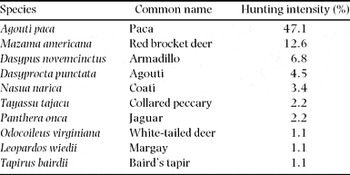
Interviews showed a contingent of ten mammal species used by local hunters (Table 1). Of these, the paca was the preferred game species, which is heavily hunted for consumption, with a hunting preference nearly four times higher than that of the red brocket deer, the second-most-preferred species. The rest of the species had hunting frequencies of only 1.1–6.8%. From this paper's perspective, however, the most salient aspect of the interviews was the lack of reports of hunting A. geoffroyi in the study areas.
Mammals preferred as game species in the study area. Hunting intensity was defined as the percentage of persons indicating that they preferably hunt a given species. Scientific and common names are according with Emmons & Feer (Reference EMMONS and FEER1997).

Data from the censuses in unlogged sites indicated the presence of at least two resident A. geoffroyi troops with five members each in Nueva Loria; three troops with four animals in Petcacab, and one troop with seven individuals in X-Maben. Besides of resident troops we recorded 18 travelling troops throughout the whole sampling period, yielding an overall mean of 15 ± 8 individuals per man-km sampling effort. In contrast, no individuals of A. geoffroyi were seen, with the equivalent sampling effort, in the logged sites.
Fruit removal
Considering all plots, we collected 100 and 546 fruits in unlogged and logged sites, respectively. In unlogged sites we recorded 82.3% of fruits with evidence of manipulation (bitten and squashed) by A. geoffroyi, while 13.3% of the fruits had rodent teeth marks, and 4.5% fruits were so heavily damaged that identification of animal bite was not possible. In logged sites, in contrast, we recorded fruits with rodent bite marks in 62.5% of them, and 37.5% were impossible to identify. The absence of A. geoffroyi in these areas suggests that these fruits with unidentifiable animal marks must have been damaged or manipulated by animals other than A. geoffroyi.
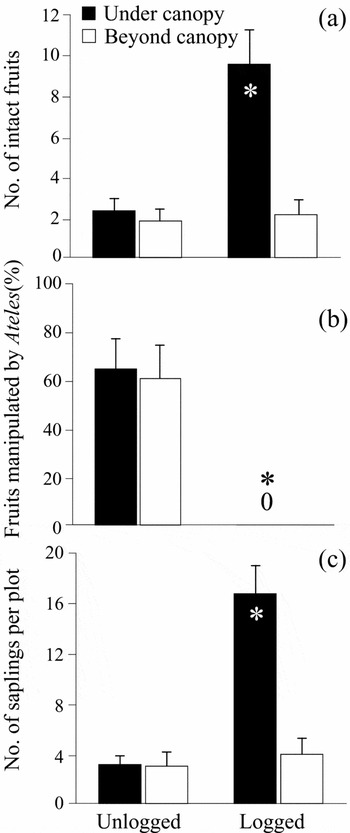
We recorded about five times more intact fruits in the plots located under the crowns of focal trees from the logged sites (without A. geoffroyi) than in those of the unlogged sites (with A. geoffroyi) (F = 25.7, df = 1,75; P < 0.001; Figure 1a; Table 2). There were no significant differences between the plots of the two management conditions when comparing fruits from plots located beyond the crowns of M. zapota (Tukey P > 0.05; Figure 1a).
Total number of fallen intact fruits (a), fruits of Manilkara zapota with evidence of manipulation by monkeys (b), and M. zapota saplings (c) in unlogged (black bars) and logged (white bars) sites. Error bars denote 1 SE. Asterisks (*) denote statistical differences (Tukey P < 0.05).

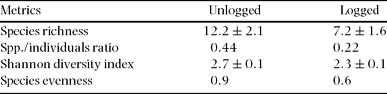
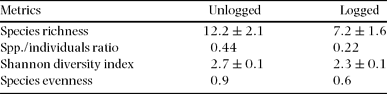
Sapling species richness and diversity under the canopy of Manilkara zapota trees from unlogged and logged sites at the Quintana Roo Mayan zone, Mexico. Numbers denote mean ± SE. For statistical comparisons see text.
On the other hand, there were six to eight times more fruits with signs of A. geoffroyi manipulation in the unlogged sites than in logged ones (F = 55.7, df = 1,75; P < 0.001). However, there were no statistical differences between logged and unlogged sites in the number of A. geoffroyi-manipulated fruits under and beyond the canopy of the focal trees (F = 3.7, df = 1,75; P > 0.05; Figure 1b; Table 2).
Manilkara zapota seedling recruitment
Saplings closely mirrored the pattern observed with fruits (Figure 1c). There was a greater accumulation of M. zapota saplings under tree canopies in the logged sites than in the unlogged ones (F = 42.2, df = 1,75; P < 0.001; Table 2). Meanwhile, the density of saplings outside the area of the projection of the tree crowns was not different between management conditions (Tukey P > 0.05; Figure 1c).
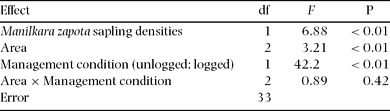
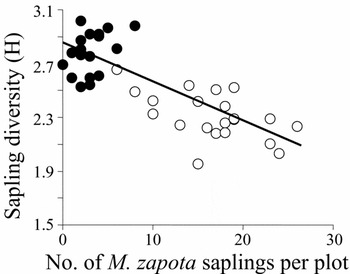
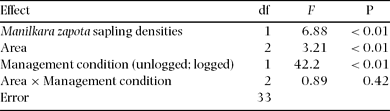
In the logged sites M. zapota was the dominant species in the understorey plots. This species contributed more than 50% of total seedlings recorded under canopies in 16 out of the 21 trees. In unlogged sites not a single tree had M. zapota as the understorey-dominant species beneath the tree crowns (Fisher test χ2 = 24.1, df = 1; P = 0.0001). In addition, sapling species richness was greater in the unlogged areas than in the logged ones (F = 74.2, df = 1,34; P < 0.001) (Table 2). Furthermore, species diversity (Shannon's Index), collectively considering the plots from all three areas was 20% higher in the understorey plots of the unlogged sites than in those of the logged sites. Likewise, evenness was 27% higher in unlogged sites than in logged ones. The three areas of study had a consistent trend of a reduced diversity in the logged sites, where A. geoffroyi monkeys were absent (F = 42.2, df = 1,33; P < 0.01; Table 3). Concordant with this, we detected a significant linear, negative relationship (Figure 2), whereby 63% of the variation in diversity of the plots is accounted by M. zapota density (F = 67.6, df = 1, 38; P = 0.0001).
Results of the analysis of covariance with Shannon's index as response variable and Manilkara zapota saplings densities as the continuous explanatory variable.
Relationship between Shannon's diversity index and Manilkara zapota sapling densities in unlogged and logged sites where H = 2.83 – 0.029 (density). Black circles show unlogged sites and white logged ones.

DISCUSSION
Population declines of frugivorous primates have been associated with hunting as a primary driver of defaunation (Peres & Palacios Reference PERES and PALACIOS2007, Wright Reference WRIGHT2003). However, it is also known that timber extraction has negative effects on primate populations (Chapman et al. Reference CHAPMAN, BALCOM, GILLESPIE, SKORUPA and STRUHSAKER2000, Johns Reference JOHNS1986) and a synergism between these activities has also been suggested (Peres Reference PERES2001), but information on the indirect effects of logging on primates and their interaction with plants has been poorly researched. Previous assessments of the abundance of A. geoffroyi in the study zone showed a decline in its abundance, associated with logging activities (Gutiérrez-Granados Reference GUTIÉRREZ-GRANADOS2009). Such declines are striking because both Jorgenson (Reference JORGENSON1993) and the interviews we performed consistently indicate this species is not used as game by the local inhabitants, lending support to our argument of an indirect effect of logging leading to spider monkey population decline, in the absence of hunting. Several reasons have been proposed as mechanisms that provoke declines in primate abundance in logging sites, including (1) loss of connectivity between rain forest tracts (Johns Reference JOHNS1986); (2) extraction of trees that primates use as food (Johns Reference JOHNS1992); and (3) changes in primate social structure, behaviour and fitness (Chapman et al. Reference CHAPMAN, BALCOM, GILLESPIE, SKORUPA and STRUHSAKER2000, Johns Reference JOHNS1986). The first two factors have been observed in our study site (Gutiérrez-Granados Reference GUTIÉRREZ-GRANADOS2009), while the third has not been studied. Although the community management schemes practiced in the Zona Maya suggest that forest fragmentation and loss of forest cover are not massive (Bray et al. Reference BRAY, MERINO-PÉREZ, NEGREROS-CASTILLO, SEGURA-WARNHOLTZ, TORRES-ROJO and VESTER2003), thus allowing for spider monkey populations to persist, it is possible that human settlements and larger roads used by local inhabitants may cause some loss of connectivity between rain forest tracts, which may affect primate populations. In addition, we know that the logging operations in the study area involve the harvesting of several species that are important feeding resources for spider monkeys, including M. zapota (Gutiérrez-Granados Reference GUTIÉRREZ-GRANADOS2009). Thus, although the end product of logging is a decline in the abundance of spider monkeys, the analysis of the relative importance of the factors that operate as drivers of population decline of A. geoffroyi in the absence of hunting warrants further attention.
In addition to the decline of A. geoffroyi, our results reveal indirect effects that escalate beyond the spider monkeys themselves, affecting their interactions with plants. Although we lack an experimental manipulation to confirm cause and effect relationships, our observations, derived from replicated paired comparisons, in which the noise of inter-site comparisons was avoided, consistently showed that in the areas where A. geoffroyi had been extirpated there were more undispersed fruits, more established saplings of M. zapota and lower diversity under tree crowns. This is consistent with previous reports documenting Ateles spp. as important seed dispersers of more than 100 tree species (Andresen Reference ANDRESEN2002, Feer & Forget Reference FEER and FORGET2002, Russo et al. Reference RUSSO, CAMPBELL, DEW, STEVENSON and SUAREZ2005), including M. zapota in our study site (Gutiérrez-Granados Reference GUTIÉRREZ-GRANADOS2009), and other tropical sites (Feer & Forget Reference FEER and FORGET2002). Thus, their demise could have important consequences on seedling recruitment and spatial dynamics, as has been shown in other studies (mostly related to hunting: Chapman & Chapman Reference CHAPMAN and CHAPMAN1995, Clark et al. Reference CLARK, POULSEN and PARKER2001, Link & Di Fiore 1996, Nuñez-Iturri & Howe Reference NUÑEZ-ITURRI and HOWE2007, Russo & Augspurger Reference RUSSO and AUGSPURGER2004, Stevenson & Aldana Reference STEVENSON and ALDANA2008), and on population genetic structuring of M. zapota and other tropical trees facing similar situations (Pacheco & Simonetti Reference PACHECO and SIMONETTI2000).
Seed dispersal is strongly linked to regeneration dynamics and long-term maintenance of diversity in tropical rain forests. For instance Russo & Augspurger (Reference RUSSO and AUGSPURGER2004) showed that seed depositions under Virola calophyllum crowns are less diverse than those effectively dispersed by A. paniscus (Russo & Augspurger Reference RUSSO and AUGSPURGER2004). The fact that M. zapota is not effectively dispersing, but rather developing high-density seedling carpets beneath parent tree canopies in the logged sites, could have negative consequences on overall understorey plant diversity (Chapman & Chapman Reference CHAPMAN and CHAPMAN1995, Clark et al. Reference CLARK, POULSEN and PARKER2001, Nuñez-Iturri & Howe Reference NUÑEZ-ITURRI and HOWE2007). The long-term persistence of such seedling banks could be exacerbated by the lack of other seed or seedling predators in the understorey, as is the case of terrestrial herbivorous mammals in logged forests of our study site (Gutiérrez-Granados Reference GUTIÉRREZ-GRANADOS2009). Our findings are in accordance with recruitment-limitation arguments (Hurtt & Pacala Reference HURTT and PACALA1995), and suggest that high densities of M. zapota propagules will negatively affect understorey diversity. A long-term study of the dynamics of recruitment is needed to clarify this issue. If this or other mechanisms maintain such high-density patches in the long term, we would expect additional consequences on overall plant diversity beneath frugivore-dependent trees. The numerical predominance of M. zapota as a tree in logged sites (Gutiérrez-Granados Reference GUTIÉRREZ-GRANADOS2009) may be related to these long-term effects but this is another aspect that warrants further work.
The indirect effects of timber extraction could have serious consequences on the maintenance of tropical tree diversity, as disruption of active dispersal by primates may affect coexistence mechanisms of tropical trees (Chapman & Onderdonk Reference CHAPMAN and ONDERDONK1998, Clark et al. Reference CLARK, POULSEN and PARKER2001). This dispersal limitation may be causing the development of dense M. zapota sapling carpets and reduced species diversity. According to the Janzen–Connell effect of distance- or density-dependent mortality (Connell Reference CONNELL, den Boer and Gradwell1971, Janzen Reference JANZEN1970), we should expect thinning of such high-density seedling carpets. However, our results suggest that the Janzen–Connell effect may not be strong enough to eliminate the continuous recruitment of non-dispersed seeds of M. zapota, which in turn affect understorey diversity. At very local spatial scales, such as the ones examined in our study (under and near tree crowns), dispersal limitation may decrease diversity by increasing local abundance of common, potentially dominant species (Muller-Landau Reference MULLER-LANDAU2007).
Intense recruitment limitation in combination with moderate to severe disturbance, such as that reported in logging activities (Johns et al. Reference JOHNS, BARRETO and UHL1996), can cause a reduction in species richness until it reaches the minimum number to be expected with a given recruitment limitation (Hurtt & Pacala Reference HURTT and PACALA1995, Köhler & Huth Reference KÖHLER and HUTH2007). Therefore, intensification of recruitment limitation by human disturbances may affect, over the long term, overall tropical tree diversity (Chapman & Onderdonk Reference CHAPMAN and ONDERDONK1998, Forget & Jansen Reference FORGET and JANSEN2007). It has been shown that the effects of timber extraction can persist for decades after logging (Chapman et al. Reference CHAPMAN, BALCOM, GILLESPIE, SKORUPA and STRUHSAKER2000). Thus short-term changes in plant diversity and structure driven by the loss of dispersal agents in logged sites, as observed in this study, need to be monitored to assess if their consequences persist over many years.
Primates, through their foraging activities and dispersal patterns, can influence tree species distribution (Andresen Reference ANDRESEN2002, Chapman & Onderdonk Reference CHAPMAN and ONDERDONK1998, Wehncke et al. Reference WEHNCKE, VALDEZ and DOMÍNGUEZ2004), thus operating as a key functional group in tropical forests and as an important element in conservation plans. Regardless of whether conservation programmes are developed to protect nature-dominated areas or areas under forest management, such as logging, one aspect that deserves attention is the conservation not only of taxa, but of ecological processes such as plant–animal interactions.
ACKNOWLEDGEMENTS
This study was supported by Mexico's National Commission on Biodiversity (CONABIO), project BJ005. We are grateful to Diego Pérez-Salicrup who read previous drafts of this paper and offered valuable input. GGG was supported by a doctoral fellowship from CONACyT and UNAM throughout his studies in UNAM's graduate programme (Posgrado en Ciencias Biológicas).