Introduction
In scholarly writings, political discourse, and public conversations, the Urdu language in India is understood to be a symbol of Muslim identity and culture. Based on an ethnographic study and quantitative language data collected over an eight-month period in Old Delhi in 2005 and 2006, this article challenges this widely held notion and shows that the symbolic meanings of Urdu have been undergoing a major transformation in post-colonial India. Using a combination of insights and methodologies from sociolinguistics and linguistic anthropology, I trace this transformation in three key areas.
First, I study the language-ideologiesFootnote 1 of ordinary Muslims and Hindus belonging to three different generations—the old, the middle-aged, and the youth. I show that Urdu does not index an exclusive Muslim identity to the first generation of Muslims and Hindus born before the Partition of India in 1947.Footnote 2 To the middle generation born after Partition, however, Urdu becomes exclusively associated with Muslim identity. And for the generation of Muslims born in the early 1980s, Urdu has acquired yet another symbolic meaning: it indexes a poor, uneducated, and conservative Muslim identity. Consequently, young Muslims of this generation disaffiliate from the Urdu language and culture, and claim that they speak a mixed language containing elements of Hindi, English, and Punjabi.Footnote 3
Secondly, I examine the use of the sounds /f/, /z/, /kh/, /gh/, and /q/, which distinguish Urdu from Hindi on the spoken level,Footnote 4 among the three generations of Muslims and Hindus.Footnote 5 By analysing the recorded speech of the first generation of Muslims and Hindus, I show that among them the distribution of these sounds is quite comparable. This suggests that the use of Urdu does not index an exclusively Muslim identity for the older generation. These sounds, however, largely disappear from the speech of middle generation Hindus, while Muslims of the middle generation retain them. This reflects—as well as contributes to—the formation of the ideology that Urdu symbolizes a Muslim identity. A study of these sounds further shows that three of these sounds—/kh/, /gh/, and /q/—are being lost from the speech of third generation Muslims. Consequently, the spoken language of Muslim youth is becoming different from that of their parents’ and grandparents’, and, conversely, quite similar to that of their Hindi-speaking friends.
Thirdly, I discuss the adoption of Devanagari (the script used to write Hindi) by a section of the Muslim population, including the youth, to write Urdu, which has been written in the Urdu scriptFootnote 6 for centuries. It is important to note that many scholars of Urdu contend that the script is the most robust distinguishing marker of Urdu from Hindi, and therefore they have resisted the adoption of Devanagari, arguing that Urdu will merge into Hindi and lose its identity.Footnote 7 I show that this ongoing change in the orthographic practices of Muslims further reinforces the shift in the symbolic meanings of Urdu.
An investigation into the layers of meanings of Urdu unravels the social and political processes that lead to the sedimentation of these meanings. I conclude the article with the claim that the symbolic meanings of languages are not fixed: they are in a state of flux—continually constituting and reconstituting themselves. My data further suggest that the reconstitution of symbolic meanings can take place fairly quickly if powerful social and political forces are present. My findings also underscore that the meanings of languages are organically linked to the sociolinguistic conditions of their speakers and evolve in conjunction with them.
The rest of this article is organized as follows: the next section gives background information on Urdu and Hindi followed by an account of the existing literature on the symbolic meanings of Urdu. Then I discuss the theoretical framework, data, and methodology, followed by a section on the sociopolitical factors that contribute to the reconfiguration of the meanings of Urdu. Finally I provide an analysis of the data, which demonstrate the mutation in the symbolic meanings of Urdu. I conclude the article with a summary of my key points.
Background on Urdu and Hindi
Since Urdu and Hindi are often defined in relation to each other, a brief note on the sociolinguistic relationship between them is in order. Both Urdu and Hindi belong to the Indo-Aryan sub-branch of the Indo-European language family. On the spoken level, the relationship between them is comparable to that between two varieties of English. In ordinary conversational discourse, Urdu and Hindi speakers understand each other quite well. This is because Urdu and Hindi are marked by bivalency—the use of linguistic elements that could simultaneously belong to both.Footnote 8 The bivalent elements between Urdu and Hindi include a vast majority of commonly used nouns such as ‘rōtī’ (‘bread’), ‘chāwal’ (‘rice’), and verbs such as ‘khānā’ (‘to eat’), ‘pīnā’ (‘to drink’), and prepositions such as ‘par’ (‘on’) and ‘kō’ (‘to’). However, in literary genres and religious discourses, Urdu and Hindi can become mutually incomprehensible.Footnote 9
Furthermore, Urdu and Hindi have traditionally been written in different scripts. Urdu employs a modified version of the Persian script. It has also borrowed the sounds /f/, /z/, /kh/, /gh/, and /q/ from Persian and Arabic and preserved them.Footnote 10 Other borrowings from Arabic and Persian include a large number of educated vocabulary items. Often the words that Urdu has borrowed from Arabic and Persian, Hindi has borrowed from Sanskrit. For example, the word ‘history’ in Urdu is ‘tārīkh’, a loanword from Arabic, whereas in Hindi it is ‘itihās’, a loanword from Sanskrit. Another point of distinction is that although Hindi has also borrowed words from Persian and Arabic—far fewer than Urdu, however—the above sounds have been replaced with their nearest Hindi equivalents, namely /ph/, /j/, /kh/, /g/, and /k/.Footnote 11
Symbolic meanings of Urdu in the existing literature
The ideology that associates Urdu with Muslims and Hindi with Hindus can be evidenced in political discourse, day-to-day conversations, and scholarly works. In the political discourse of contemporary India, Urdu is unequivocally associated with Muslim identity and politics. In 2007, Sonia Gandhi, the president of the All India Congress Committee, wrote a letter in Urdu to some prominent Muslims in the state of Uttar Pradesh seeking their votes, and also signed her name in Urdu. This linguistic exercise is important since Sonia Gandhi, the Italian-born wife of the late prime minister Rajiv Gandhi, does not know Urdu. She apparently did this as a gesture of linguistic accommodation to Muslims. Furthermore, in 2006, the Sachar Committee, which was charged with the examination of the socioeconomic conditions of Muslims, recommended opening Urdu-medium schools in areas where Muslims constitute a significant portion of the population.Footnote 12 Moreover, in states such as the National Capital Territory of Delhi, Uttar Pradesh, and Bihar, Muslims themselves have demanded and secured an official second-language status for Urdu.
Many scholars argue for the association of Urdu with Muslims on the grounds that Urdu's script, its loanwords, and its distinctive sounds are all borrowed from Persian and Arabic, languages associated with Islam and Muslims.Footnote 13 Similarly, scholars argue that Devanagari, the script used to write Hindi, and its vocabulary derived from Sanskrit are associated with Hindu identity and culture. While discussing the symbolic meanings of Urdu and Hindi in the twentieth century, Robert King notes:
Hindi is written in the Devanagari script, derived from one of the scripts used to write Sanskrit. Urdu is written in a modified version of the Persian script, itself originally derived from the Arabic script. The essential iconic proportion that must always be borne in mind is this: Hindi: Hindu: Hinduism = Urdu: Muslim: Islam (emphasis mine).Footnote 14
It is clear from the above quote that, according to Robert King, Urdu and Hindi iconically and categorically represent Muslim and Hindu identities respectively. He further assumes a similar association between the Urdu language, its script, and Islam, on the one hand, and Hindi, Devanagari, and Hinduism on the other. He notes:
The power of language as icon must never be underestimated. Like it or not, the Urdu script means Muslim, the Devanagari script means Hindu. The Urdu script as seen by an angry, inflamed Hindu mob summons up talismanic images from the present and the past: cow slaughter, temple-bashing, iconoclasm, crescent and star, Aurangzeb, green… The Hindi script conveys to an enraged Muslim mob Vishnu and Shiva and a score of many-headed gods and goddesses, cowdung, music before the mosque, dead pigs flung into mosques, Shivaji (emphasis original).Footnote 15
The ideology that associates Sanskrit elements with Hindu, and Persian and Arabic elements with Muslim identities is not new. The noted Indian linguist Ashok R. Kelkar remarked in the introduction to his book on the phonology of Hindi and Urdu:
Hindi is associated with the Devanāgarī script (called Nāgarī for short) and the drawing upon Sanskrit for ‘higher vocabulary’ and metrics, with secular nationalism and Hindu revivalism… Urdu is associated with a modified form of the Perso-Arabic script and the drawing upon Classical Persian… for ‘higher vocabulary’ and metrics and with Muslim renaissance and the courts of the Muslim princes (emphasis mine).Footnote 16
In fact, the roots of the ideology of associating Urdu and Hindi with Muslims and Hindus respectively, which is evidenced through the discussion above, can be traced even further back in history to the Hindu nationalist discourse of the late nineteenth century.Footnote 17 Christopher King argues that ‘… the divide came with the beginning of the Hindi movement in the 1860s when some Hindus began to assert that one could no longer be a good Hindu and an advocate of Urdu at the same time’.Footnote 18
The first half of the twentieth century saw further mobilization along religio-ethnic lines, which contributed to the identification of Urdu with Muslims. In the 1930s, as the movement for independence from the British was growing in strength, so was the Muslim League's struggle for the establishment of Pakistan. The League contended that the Hindi language was being promoted at the cost of Urdu, and that only a new Muslim state would be able to salvage Urdu. After the creation of Pakistan, Jinnah, the leader of the Pakistan movement, speaking at Dhaka University in 1948, clearly articulated the association of Urdu with Muslims. He argued that Urdu ‘… more than any other provincial language [of Pakistan], embodies the best that is in Islamic culture and Muslim tradition and is nearest to the languages used in other Islamic countries’.Footnote 19
Despite insights provided by these studies on the role of Hindi (and Urdu) in the emergence of Hindu nationalism, they suffer from two major limitations. First, because of their theoretical engagement with the macro phenomenon of nationalism, these studies treat language merely as a symbol of political allegiance; they have little to say about how Urdu and Hindi speakers employ these languages on a more micro local level—for example, in their daily social practices. During my fieldwork, I met several Hindus in Old Delhi, born before 1947, who read, wrote, and spoke Urdu. One such person was 74-year-old Shambhunath GuptaFootnote 20 who read the Gita in the Urdu script, rather than Devanagari. He also read newspapers in Urdu.Footnote 21
I also met many young Muslim men and women who did not claim that they spoke Urdu nor did they write in the Urdu script. One such Muslim was Sukaina Shahnawaz, a 20-year-old hijab-clad woman from Old Delhi. During her tālīm (‘learning’ session) at Zakir Husain College, where she studied, Sukaina read Fazael-e-Amal, an Islamic book containing selected texts from the Quran and Hadith, in the Devanagari script. In her speech, unlike Muslims of the first and second generations, she did not pronounce many of the distinctive Urdu sounds.
The first example above clearly suggests that, while it is true that the nineteenth century Hindu nationalist movement strove to transform the symbolic meanings of Urdu and Hindi as languages of Muslims and Hindus, the transformation did not become crystallized until much later. The second example suggests that the meanings of Urdu and Devanagari are yet again both in transition as young Muslims like Sukaina are adopting Devanagari for writing and reading Urdu. The existing literature on Urdu and Hindi fails to explain why Mr Gupta, a Hindu, read religious and secular texts in the Urdu script. It also fails to explain why Sukaina, a young Muslim woman born and raised in Old Delhi, did not claim that she spoke Urdu, nor did she use the Urdu script.
A second limitation of the existing studies, which stems from the first, is that since they engage with the macro issue of nationalism, they fail to address the sociolinguistic transformations that Urdu speakers of Old Delhi have undergone since 1947. They take a very essentialist approach whereby the social meanings of linguistic elements are believed to be almost fixed.
The transformation in the sociolinguistic conditions and shifting linguistic ideologies and practices of Old Delhi Muslims and Hindus can only be understood by situating the struggle for linguistic identities in an ethnographic context. Furthermore, an understanding of the change can only be gained by assuming that speakers are not always and necessarily controlled by macro-level social forces; their linguistic practices are often informed by local developments and ideologies. This approach also allows for the multiplicity in the social meanings of Urdu in different regions, class, gender, etc. Urdu, for example, will not necessarily have the same symbolic meaning in South India as it does in Delhi.
Theoretical framework, data, and methodology
Recent sociolinguistic approaches view day-to-day use of language as acts through which people make sense of the world around them; speakers are seen as agents who participate in the construction of social meanings.Footnote 22 These studies do not treat structure and agency as separate entities. This approach, known in the literature as ‘social constructionism’, has assumed a central position in recent studies in sociolinguistics. This article is theoretically anchored in a language-ideological framework, which draws insights from social constructionism.
Language-ideology refers to common-sense ideas that speakers have about the structure and use of their language. Michael Silverstein defines it as ‘sets of beliefs about language articulated by users as a rationalization or justification of perceived language structure and use’.Footnote 23 In this framework, speakers’ perceptions about their language, whether they are implicit or explicit, are treated as a mediating link between linguistic forms and social structure. Kathryn Woolard and Bambi Schieffelin emphasize this relationship by noting that, ‘ideologies of language are significant for social as well as linguistic analyses because they are not only about language. Rather, such ideologies envision and enact links of language to group and personal identity, to aesthetics, to morality, and to epistemology.’Footnote 24
A key assumption of the language-ideological theoretical framework is that meanings of linguistic elements are socially constituted. This theory does not assume any a priori link between language and social meanings; in this framework, meaning emerges out of a process of social, cultural, and linguistic contestations and negotiations at different levels. This framework thus allows us to understand the transformation in the meanings of Urdu, Hindi, and their scripts. It also sheds light on the process of language-change and change in symbolic meanings of language.Footnote 25
The data for this study were collected in two phases. In the first phase in 2005, I spent about two months surveying the sociolinguistic situation in Old Delhi. In the second phase in 2006, I lived in Old Delhi for six months and studied language-use among different generations of Muslims and Hindus using ethnographic methods of participant observation. Since many young Muslim men and women in Old Delhi study at Zakir Husain College, which is located nearby, I spent a considerable amount of time at the College studying their language use.Footnote 26 The ethnographic observations were supplemented with recorded interviews with Urdu and Hindi speakers from all three generations.
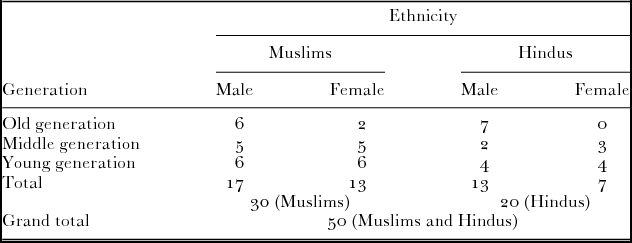
Although I observed and spoke to a larger number of people, I was able to record interviews with 50 people in total, both Muslims and Hindus, covering all three generations. Table 1 above gives information about the sample population.
Breakdown of sample population

In the interviews, my goal was two-fold: to examine the language-ideologies of Muslims and Hindus about Urdu and Hindi, and to study how their ideologies map onto their actual language use. In other words, I studied whether the language they spoke was Urdu or Hindi. Since my goal was to study speech, rather than writing, a methodological issue emerged: how would I determine whether a particular stretch of speech was Urdu or Hindi? This methodological problem was solved by studying the occurrence of the sounds /f/, /z/, /kh/, /gh/, and /q/. Since these sounds occur mostly in loanwords from Persian and Arabic, many scholars argue that they serve to distinguish Urdu from Hindi on the spoken level.Footnote 27 Although words borrowed from Persian and Arabic can also be used as indicators of whether the language in question is Urdu or Hindi, it is difficult to predict their occurrences in ordinary speech.
These sounds also emerged ethnographically as markers of Urdu. Many research participants, in response to my question about similarities and differences between Urdu and Hindi, pointed out that Hindi speakers do not pronounce these Urdu sounds correctly. Sumair Shahnawaz (SS),Footnote 28 a 22-year-old Muslim resident of Turkaman Gate, explained the difference between Urdu and Hindi:
Sumair also gave me examples of how Hindi speakers pronounced a place in Delhi called ‘Zakhira’ as ‘Jakhira’. Ideologies surrounding the pronunciation of the Urdu sounds are quite strong. Many Urdu speakers told me that their names were almost always mispronounced and misspelled by their Hindi-speaking friends. One Muslim participant said that Hindi-speakers couldn't even write Urdu/Muslim names in English correctly. He argued that Hindi-speakers misspelled names such as ‘Zamir’ as ‘Jamir’ and ‘Farhan’ as ‘Pharhan’, because Hindi does not have the sounds ‘z’ and ‘f’. Another participant said that when he was considering names for his bangle shop, he did not consider Urdu words with these sounds, because he knew that most Hindi speakers would mispronounce them. He decided to name his store ‘Kangni Bangles’ as ‘kangni’ does not have any of the five Urdu sounds.Footnote 29
The notion of using generations
My use of the notion of generations is anchored simultaneously in the sociolinguistic experiences of speakers as reflected in their reference to terms such as ‘parents’ and grandparents’ generations’ and in their language and the larger political developments that impacted on their life patterns, including the language behaviours of the Muslims and Hindus of Old Delhi. There are two important events that will serve as milestones for defining the flanking of the first and third generations; the second generation is the middle generation.
I argue that Partition marks a watershed in understanding the symbolic meanings of Urdu and Hindi. It is not my contention, however, that the symbolic meanings of Urdu and Hindi transformed overnight with Partition: I argue that the fluidity and multivalency of Urdu and Hindi that had existed before 1947 diminished, and the ideologies associated with language and identities became more polarized and crystallized after 1947. Aijaz Ahmad provides a good example of the polarization of language loyalties involving Urdu, Hindi, and Hindustani as result of Partition.Footnote 30
Ahmad compares the statistics of Urdu, Hindi, and Hindustani speakers from the census reports of 1951 and 1961. (Unfortunately the 1941 census figures cannot be compared with those of 1951, since mother tongue categories used in the two censuses were not the same.) Nevertheless the comparison between 1951 and 1961 is still very interesting. Ahmad shows that the number of people who returned Urdu and Hindi as their mother tongue in 1961 represents a dramatic increase from 1951—one that is out of proportion with the population growth of their speakers. Ahmad links the reason for the dramatic rise in the number of speakers of Urdu and Hindi to the decline of the number of speakers of Hindustani. He notes, ‘… the only way one can explain the stupendous increase in the number of rural Urdu-speakers is by surmising that two to three million among those who had previously returned Hindustani as their mother tongue now shifted to Urdu, while roughly an equal number shifted to Hindi’.Footnote 31
I refer to people born before 1947 as the first/old generation. The third generation refers to people born in the early 1980s, which marks the beginning of economic prosperity for Old Delhi Muslims and heralds a new type of language contact with Hindi speakers. Unlike previous generations, children born in the early 1980s were the first to receive a modern education which in turn brought third generation Muslims into close contact with Hindi and Punjabi speakers. The second generation is the middle generation born after Partition but before the 1980s.
Social transformation of Old Delhi
Three factors are important in understanding the transformation of the symbolic meanings of Urdu in India. First is the Partition of India and the creation of the Muslim state of Pakistan in 1947, which I argue contributed to the crystallization of the new meaning of Urdu as being emblematic of Muslim identity.Footnote 32 Urdu, before 1947, was not categorically symbolic of Muslim or Hindu identity; it represented an urban, educated, middle class identity. Second, the socioeconomic changes of the late 1970s and early 1980s heralded a new era when the Muslims of Old Delhi started to come into contact with Hindi speakers. Third, the non-availability of Urdu as a subject in many government schools deprived Muslims of the opportunity to learn the Urdu script.
The Independence of India, which was accompanied by Partition and followed by a massive migration of Muslims from India, not only changed the demographics of Muslims and Hindus in Delhi but also changed both Muslims’ perceptions of their own identity as well as the way they were perceived by other communities. Partition brought about two important changes related to the symbolic meanings of Urdu. First, on the national level, in post-colonial language discourse, Hindus began to see Urdu as the language of Muslims and, often, as the language of separatism associated with Pakistan. Purushottam Das Tandon, an important leader of the Congress Party, remarked in 1948:
The Muslims must stop talking about a culture and civilization foreign to our culture and genius. They should accept Indian culture. One culture and one language will pave the way for real unity. Urdu symbolizes a foreign culture. Hindi alone can be the unifying factor for all the diverse forces in the country.Footnote 33
Here one can see not only the beginnings of the identification of Urdu with Muslims and lack of patriotism but also of Hindi as the language of patriotism and nation-building. Barbara Metcalf makes a similar observation and notes the consequences of Partition for Urdu in India: ‘In any case, the fact that Urdu then became the national language of Pakistan, a country established on the grounds of the religion of the population, made the position of Urdu in its own homeland even more difficult.’Footnote 34
Secondly, the local impact of Partition on Old Delhi was that, due to the mass migration—both voluntary as well as forced—of middle class Muslims, the city was reduced to a ghetto community of poor and uneducated Muslims.Footnote 35 According to Gyanendra Pandey, by the end of October 1947, about 350,000 Muslims, which comprised 70 per cent of the Muslim population, had left Delhi.Footnote 36 As a result, the proportion of Muslims in the total population of Delhi dropped from 32 per cent in 1931 to 6 per cent in 1951.Footnote 37 Scholars believe that the majority of Muslims who migrated to Pakistan belonged to the middle class. Bhanu Pratap Singh notes, ‘Partition depleted the Muslim community of a major segment of the middle classes, elite, professionals, and enterprising population, and left the community impoverished in economic and social terms.’Footnote 38
Consequently, in the post-colonial imaginary of Hindus, Muslims in Old Delhi stood for poverty, backwardness, and lack of education. Although there have not been systematic sociological studies, some scholars have noted the change. Anvita Abbi et al. remark, ‘The past five decades of independence have seen, in popular perception, the descent of Urdu as a language of the dominant elite, to one associated with illiteracy, poverty, and backwardness.’Footnote 39 Many Muslim research participants shared with me the embarrassment they often felt telling outsiders that they were from Old Delhi. They said they would often lie to outsiders about their homes. However, with the economic prosperity of the late 1970s Muslims in Delhi began to open up. As Muslims began to benefit from the improved economic situation, they slowly started to invest in their children's education. Although there are several Urdu-medium schools in Old Delhi, they are in a shambles. As a result, Muslim parents sent their children to government and private Hindi- and English-medium schools, where opportunities to learn the Urdu language and script rarely existed.
These factors together created the conditions that led to the younger generation of Muslims feeling ashamed of their inherited identity, of which Urdu is an important linguistic component. They claim not to speak Urdu. When I asked the Muslim youth who in their neighbourhood spoke Urdu, they referred to the older generation. Many of them told me how people from outside of Old Delhi made fun of their language. This shame was often coupled with the lack of opportunity to learn the Urdu script in government schools. The easiest option for them was to write Urdu in Devanagari since they already learned it at school.
Changing times: changing meanings
Cross-generational ideologies about Urdu
In this section, I show that Urdu invokes different meanings for Muslims and Hindus of different generations. A cross-generational study of Muslims and Hindus makes it possible to trace the change in the perceptions of the meanings of Urdu. Based on a qualitative analysis of data collected through interviews with a range of Muslims and Hindus, I show that Urdu did not categorically become associated with Muslims until after the Partition of India in 1947. Then I show a shift in the ideologies of post-Partition Muslims and Hindus whereby they began to associate Urdu with Muslims.Footnote 40 I then demonstrate that this ideology again began to mutate among the Muslim youth of Delhi. They did not lay claim to Urdu as their language; instead, they argued that Urdu was the language of their parents, grandparents, and Islamic scholars.
Mr Chopra, a 74-year-old Hindu resident of Naiwara in Old Delhi, is a telling example of the generation that did not associate Urdu with Muslims. Mr Chopra represents the oldest generation of Dilliwalas, residents of Delhi born before Partition, who claimed that Urdu was their language as much it was the Muslims’. Until Mr Chopra became physically handicapped, he was actively involved as a trustee of a Hindu temple established by his forefathers in Naiwara. When I asked him about how he could differentiate Urdu from Hindi, he answered:
It is important to see how Mr Chopra distanced himself from Hindi by arguing that he never understood Hindi. Of course, he exaggerates the difference between Urdu and Hindi by stressing the incomprehensibility of the latter. His exaggeration, however, is crucial from the point of view of his stance towards Urdu and Hindi; I argue that by exaggerating, he made his negative stance towards Hindi even stronger. Note that he said that he did not or would not understand Hindi four times before making his final point that Urdu was his mother tongue. In conjunction with his negative stance towards Hindi, he showed a positive stance towards Urdu during another interview with my research assistant (SG):
Clearly, to Mr Chopra, his Hindu identity did not conflict with his language-ideology about Urdu. Similarly, other Hindus of Mr Chopra's generation did not see any contradictions between speaking Urdu and being Hindu. Shumbhunath Gupta, also 74-years-old, is another such Hindu resident of Delhi. When interviewing him, I saw a copy of the Gita, a Hindu religious book written in the Urdu script, and an Urdu newspaper on his desk. When I asked him about his literacy practices, he said that although he had learned the Devanagari script after 1947, he was always more comfortable in the Urdu script. He said that when he was growing up, Muslims and Hindus alike learned Urdu.
It is not only Hindus who do not associate Urdu with Muslims. Muslims of Delhi from the older generation did not view Urdu as the exclusive language of Muslims either. In response to my question about the difference between Urdu and Hindi, Mr Quraishi (NQ), a 70-year-old Muslim resident of Haveli Azam Khan, made the following claim about the meanings of Urdu:
Later on in the interview Mr Quraishi told me that in fact many Hindus from the older generation spoke better Urdu than many Muslims. When I asked for examples, he named several Urdu speakers among Hindus from Old Delhi and elsewhere to support his claim. He mentioned Gulzar Dehlvi, a Hindu resident of Delhi and a famous Urdu poet who, he said, spoke better Urdu than many Muslims. I met Gulzar sāhab at a mushāerā, a literary event where Urdu poets deliver their poetry in front of an audience, held on the occasion of the Republic Day of India. Subsequently I saw him at several other mushāerā and other literary events in Delhi.
At the mushāerā, I saw a lot of people jostling with each other to get closer to Gulzar sāhab. From a distance, it appeared to me that he was signing autographs for his admirers, but when I drew closer, I saw that he was doing much more than that. Before signing his name, he would write a slogan in Urdu: ‘Urdu zindābād, Urdu pāindābād’ (‘Long live Urdu! Long live Urdu!’). When he got up to give his presidential address at the mushāerā, he recited a rubāī (a four-line poem) about Urdu which received great applause from the audience. In his rubāī, Urdu is not only the language of the poem, but also its subject matter:
In sum, the above discussion shows that, on the ideological level, Hindus like Mr Gupta, Mr Chopra, and Gulzar sāhab identified themselves with the Urdu language and script; they did not see any conflict between their Hindu identity and their use of and support for Urdu. This suggests that Urdu was not categorically indexical of Muslim identity.
This ideology, however, began to change after 1947. Second generation Hindus, born after Partition, did not claim that Urdu was their language; instead they argued that Urdu was the language of Muslims. When I asked Hindus who in Delhi spoke Urdu, they pointed to Muslim neighbourhoods. Mr Ashok Nigam (AN) is representative of Hindus in post-Partition Old Delhi. He was born in 1956, in Pahari Dheeraj, to a Kayastha family. He spoke Hindi and some English. When I asked him what language he used at home, he replied categorically that it was Hindi. He, like many other Hindus, however, had older relatives who used Urdu, but he and his children did not.
This ideology associating Urdu with Muslim identity, which started to form around 1947, gradually became entrenched by the third generation of Muslims and Hindus. Kamal, a young man born in the early 1980s, who was a grandson of Mr Chopra, whom I discussed above, emphatically denied that Urdu was his language. It is worth noting how his ideologies about language were diametrically opposed to his grandfather’s, who claimed that Urdu was his mother tongue.
To sum up, Partition—not in a narrow temporal sense, but as a social and political event—marks a divide in the ideologies about the meaning of Urdu in such a way that Hindus born before Partition do not associate Urdu with Muslims, whereas those born after it clearly do. During my fieldwork, I did not find a single Hindu born after 1947 who spoke Urdu or claimed it as his/her language, although I found a number of Hindus who told me that their older relatives spoke Urdu.
As this transformation in the meaning of Urdu as symbolic of an exclusively Muslim identity developed and became entrenched among people born after 1947, a more radical transformation began soon afterwards. This new shift involves Muslims themselves disaffiliating from Urdu; these are third generation Muslims born in the early 1980s, who interact with Hindi and Punjabi speakers at their schools, colleges, and workplaces.Footnote 41 They do not claim Urdu as their own language. When I asked the Muslim youth in Delhi who spoke Urdu, they referred to their parents, grandparents, and scholars of Islam. This defection-from-within is quite startling in that it is happening among Muslims who are believed to be the sole claimants, preservers, and transmitters of the Urdu language and culture.
Rana Hashmi was born and raised in Churiwalan, a neighbourhood that lies south of the Jama Masjid. At the time of my research, she was a first year student at Zakir Husain College, majoring in psychology. She had attended an English-medium school. Most of her friends at College were Hindus. During an interview, when I asked her what language she spoke at home, she told me that she spoke a mixed language. After telling me about the old generation's language, she described the language that her own generation speaks.
Rana Hashmi forcefully stated that she did not speak Urdu at all, nor did other young men and women of her generation. Who, then I asked her, spoke Urdu in Old Delhi? She told me that only people belonging to older generations did. The association of Urdu with older generations is a dominant part of the ideology of the third generation Muslims.
Two things are important about Rana's generation of Muslims. First, their language is marked by heavy code-switching into English. Second, unlike their parents’ generation, they do not lay claims to Urdu as their language.
The change in the ideology and practice of third generation Muslims is being noticed by their parents. I met Mr Tabish Dard, father of three daughters, one of whom was majoring in Urdu at Zakir Husain College. Mr Dard lives in Churiwalan. During an interview, I asked him if he had trouble understanding Hindi, since he had received an Urdu medium education. He answered in the negative and explained that, although his daughters studied at Urdu medium institutions, they hardly spoke Urdu at home. Hindi was present in the home context, which helped him understand this language better.
Parents are noticing the change, and so are the Hindi-speaking friends of the third generation Muslims. They do not believe that their Muslim friends speak Urdu. They did, however, note that their friends’ parents and other old people did. Nikhil Gupta was born and raised in the Sitaram Bazar neighbourhood. His circle of friends consisted of a number of Muslims. When I asked him about who spoke Urdu in Old Delhi, he answered that only a few people do; his Muslim friends are not among them. Note in the transcript below that Nikhil said that, although he had seen his Muslim friends offer namaz—‘prayer’—he had not heard them speak Urdu. He had, however, heard Muslim religious priests speak Urdu.
Clearly, third generation Muslims did not claim to speak Urdu, nor did they identify themselves with the language of their parents. They maintained that they spoke a mixed language—one that had elements of English, Urdu, and Hindi, but crucially was a language that was liberated from the demeaning and stigmatizing image that their parents’ language carried. It is not Urdu; it is a language that is purged of elements that cannot but reveal the young generation's Old Delhi provenance—the Urdu sounds. In the section below I show frequency distribution of the Urdu sounds among the third generation Muslims.
Distribution of distinctive Urdu sounds across generations
Sociolinguistics research shows that speakers’ ideologies about their language may not always be in harmony with their actual linguistic practices. In this section, I study how the ideologies of Muslims and Hindus are reflected in their actual linguistic usage. I study recorded language samples of Muslims and Hindus from different generations. The language data for this analysis came from the same data-set involving interviews that I analysed in the last section. However, the goal of the analysis was to examine quantitatively the distribution of the distinctive Urdu sounds in their speech.
A quantitative study of these sounds, however, poses a methodological problem due to the unpredictability and low frequency of their occurrence. First, they are consonants and therefore they do not occur as frequently as vowels. Secondly, they occur mostly in words borrowed from Arabic. In order to get a comparative frequency of the distribution of these sounds, I kept the length of each conversation constant. I studied 30 minutes of recorded speech for each participant. The speech was transcribed by an Urdu-speaking research assistant, to whom I explained clearly that the goal was to transcribe the words as they were pronounced not as they should be pronounced. I listened for the words containing the sounds and double-checked the transcription to make sure that this was done correctly. I then counted the number of words containing the distinctive Urdu sounds and determined whether the speakers preserved the original pronunciations or replaced them with Hindi sounds. An example will make it clear. The word ‘bokhār’ (‘fever’) containing the Urdu sound /kh/ is pronounced as ‘bokhār’ in Urdu and as ‘bukhār’ in Hindi. Disregarding the vowel difference, the Hindi pronunciation involves the substitution of /kh/ with the Hindi sound /kh/. In Urdu, however, this sound is preserved. For the purposes of the symbolic meanings of Urdu, what is important is whether these Urdu sounds are preserved or replaced with their Hindi equivalents.
The results of the quantitative analysis complement the qualitative analysis presented earlier. In line with the ideologies about the Urdu of pre-Partition Muslims and Hindus, the analysis shows that the distribution of the Urdu sounds /f/, /z/, /kh/, /gh/, and /q/ in the speech of pre-Partition Muslims and Hindus was quite similar. However, the distribution changes significantly with post-1947 Hindus.
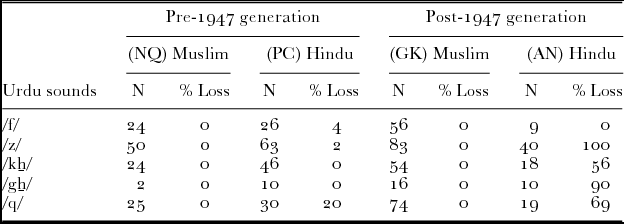
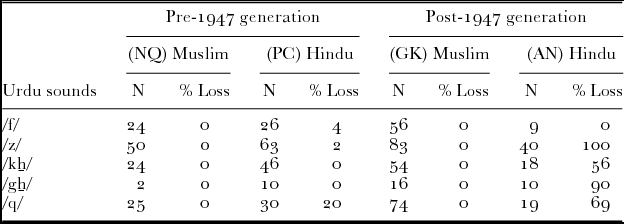
The data in Table 2 clearly show that the distribution of the Urdu sounds /f/, /z/, /kh/, /gh/, and /q/ among pre-Partition Muslims and Hindus is quite comparable. For /kh/ and /gh/, the distribution is categorical for both Nazir Quraishi (NQ), a Muslim, and P. K. Chopra (PC), a Hindu. Although Mr Chopra does show some variation, it is still a very small percentage. For /f/, /z/, and /q/, it is less than 5 per cent. (Note that N represents the total number of words containing the sound under study.) The distribution changes for post-Partition Hindus. An analysis of the language used by Anand Nigam (AN), who represents the middle generation, shows the change that has taken place in the use of Urdu among Hindus born after 1947. The percentage of loss of the Urdu sounds suggests that, except for /f/, he has lost them completely. The reason why /f/ has been retained is because this sound is also part of the English sound system and carries a positive meaning.
Distribution of Urdu sounds across generations.
Defection within: loss of Urdu among the Muslim youth
Addressing an election rally in the state of Uttar Pradesh on 15 April 2007, Manmohan Singh, the prime minister of India, promised that his government would ensure that Muslim children would receive an Urdu-medium education. He announced that this was part of his government's commitment to implementing the recommendations of the Sachar Committee as a means of ameliorating the socioeconomic conditions of Muslims. A week later, Khadija Arif of BBC Urdu interviewed some Muslim college students in Delhi and filed a report entitled ‘Muslims need progress, not Urdu’.Footnote 42 According to the report, most Muslim students did not want to receive education in Urdu because they believed that this would be an obstacle to success in their educational and professional careers.
Although these young Muslim students were responding to the issue of education in Urdu, their comments are indicative of the changing meanings of Urdu among Muslims themselves. Unlike their parents, third generation Muslims do not think that the Urdu language is crucial to their Muslim identity, nor do they think that it will further their educational and economic success. I argue that the negative orientation of third generation Muslims toward Urdu is the result of the construction of a stigmatized Muslim identity that emerged in post-Partition Delhi.
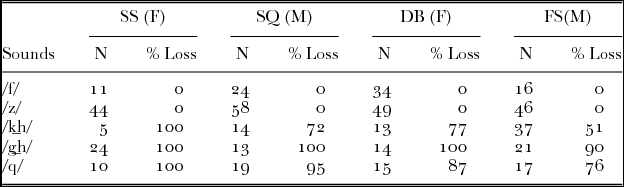
In order to construct a positive, modern identity—distinct from a stigmatized identity—third generation Muslims, who were born and raised after the beginning of the economic prosperity of the 1980s, try to disaffiliate themselves from the characteristic features of Old Delhi. To third generation Muslims, Urdu, which is an important linguistic component of the Old Delhi Muslim identity, constitutes a hurdle in the construction of a positive identity. The ideologies of disaffiliation are not only reflected in their views about Urdu but in the use of Urdu sounds in their speech as well. They are losing /kh/, /gh/, and /q/, three of the five sounds that are considered to be the shibboleth of Urdu. I argue that the loss of the Urdu sounds among third generation Muslims is part of the process of disaffiliation from a stigmatized Muslim identity. At the same time, for third generation Muslims, the disaffiliation from Urdu is also a means of aligning themselves with their Hindi-speaking Hindu friends. Table 3 above gives a frequency distribution of the distinctive Urdu sounds among third generation Muslims.
Distribution of Urdu sounds among third generation Muslims.

Table 3 shows that language change is under way in the third generation. All four Muslim participants are losing three of the five Urdu sounds, namely /kh/, /gh/, and /q/. Their frequency distributions are similar to those of Mr Nigam and Mrs Srivastava, both second generation Hindus. The first two columns show that Sukaina (SS) and Samad (SQ) do not preserve the three Urdu sounds /kh/, /gh/, and /q/, in a categorical fashion. Their rate of loss is 100 per cent. The other two Muslims have variation in the realization of these sounds, but the loss is above 50 per cent. The distribution is particularly striking since Muslims belonging to the first and second generations had a 100 per cent distribution of these sounds regardless of social factors such as gender and level of education (compare Table 3 with Table 2).
The loss of the Urdu sounds has been noticed and is discussed among Urdu-speaking Muslims. I mentioned above that many parents are noticing the loss of these sounds in the language of their children. This issue was also the theme of an article that appeared in the Sunday edition of the Urdu Rashtriya Sahara, published in New Delhi. The article is entitled ‘zab bigRī tō bigRī thī’, which seems to be part of an Urdu couplet meaning ‘How did it matter if the language was decaying?’ The article is written in the Urdu genre of tanz-ō-mazāh, which combines humour with sarcasm; the author discusses the ‘deplorable’ status of the Urdu language, especially among the younger generation. The writer Wakilur Rahman points out that most middle class Muslims want their children to learn English rather than Urdu. In addition to the ‘incorrect’ use of many Urdu words, the author also points out how the pronunciation of Urdu sounds is becoming corrupted among the younger generation. He noted, ‘shīn qāf kā bhī kōī
 yāl nah
 rakhā jā rahā hai. aksar lōg
 kō yē bōltē huē sunā gayā hai ke ‘fal kām m
 baRī dikkat (diqqat) hō rahī hai’ yā ‘ajī kyā batā
 , āmdanī kam hai aur kharchā (archā) zeyādah’ (‘Nobody cares about the shīn qāf. We often hear people say: “I have dikkat (diqqat) difficulty” in this job or “What shall I tell you, my income is low, but my archā (‘expenditure’) is more.”’)Footnote 43 The author used ‘shīn qāf’ as a metonymical device to refer to the whole—the Urdu language. Although he discusses many aspects of the Urdu language, he also mentions the substitution of the Urdu sounds such as /q/, /kh/, /gh/ with /k/, /kh/, and /g/.
It is important to note, however, that the other two Urdu sounds—/f/ and /z/—are categorically present in the speech of the Muslim youth. Even Sukaina (SS) and Samad (SQ), who have no retention of the other three Urdu sounds—/kh/, /gh/, and /q/—have 100 per cent retention of the sounds /f/ and /z/. The question is: why do some Urdu sounds show a different distribution from others? The explanation lies in the fact that /f/ and /z/ are also part of the English sound system. These sounds derive their symbolic meanings from English, which has quite a high social prestige among the youth. On a social level, middle class Indians consider English to be symbolic of education, cultural refinement, and prestige. R. S. Gupta and Kapil Kapoor (1991) note:
… educationally it [English] is recognized as an essential component of formal education and as the preferred medium of learning…; socially it is recognized and upheld as a mark of education, culture, and prestige. The polity and society confers great value on the learning of English, gives it enormous paying potential, thus creating a great demand for English-knowing Indian bi/multilinguals.Footnote 44
As a result of the high prestige of English among young people, third generation Muslims, like their Hindu friends, use English words extensively in their speech. I asked Samad, whom I quoted above, how he felt when he joined his new school. He said:
Notice Samad's use of English words and expressions in his speech (in bold in the transcript). Although Samad's pronunciation of many English words is different from native varieties of English, for example, his alveolar stops /t/, /d/ /n/, which are more retracted, close to being retroflex, his /f/ and /z/ are no different from Standard British/American English, nor are they different from the Urdu sounds.Footnote 45
The continued preservation of the Urdu sounds /f/ and /z/ can be attributed to the fact that they index an educated, modern, and culturally refined identity—an identity that these sounds derive from the prestigious status of English in India. In other words, the derogatory indexicality of the Urdu /f/ and /z/ has been overridden by the positive indexicality of the English /f/ and /z/.
Adopting Devanagari for writing Urdu
While the distinctive sounds discussed above have been the shibboleths of Urdu on the spoken level, Urdu script has been the most robust visual marker of the distinct identity of Urdu from Hindi. Urdu speakers have therefore resisted suggestions that Devanagari should be adopted for writing Urdu; they believe that this will result in Urdu losing its unique identity.Footnote 46 Shamsurrahman Faruqi in a recent article makes the most emphatic statement on the significance of the Urdu script for Urdu:
The situation today is that, in practical terms, it is only the script that separates Urdu from Hindi… If Urdu were to adopt the Nagari script, it would immediately lose its identity. Hindi would soon absorb Urdu into itself… The magnificent literary treasure of Urdu will have been reduced, through the conversion of these glorious classical treasures, into Hindi literature within no time, and its complete correction is practically impossible. Soon, this treasure will be beyond the reach of those Urdu people who are not familiar with the Nagari script (emphasis mine).Footnote 47
Despite such strong opposition, many Muslims have started to write Urdu in Devanagari. While doing my fieldwork in Delhi, one day I stopped at a bookshop in front of the Jama Masjid and asked for Pakiza Anchal (literally ‘chaste anchal’; ‘anchal’ refers to the end-piece of a sari, worn by women in South Asia), a general interest Urdu family magazine. The shopkeeper asked me if I wanted the Urdu or Hindi version. As I was not aware of the existence of the Hindi version, I asked him for both. At my request, he also showed me a number of other books, secular and religious, available in both the Urdu and Devanagari scripts.
The phenomenon of writing Urdu in Devanagari challenges and reconfigures the historical symbolic meanings of the Arabic and Devanagari scripts and, consequently, Urdu and Hindi. Muslims no longer believe that the Devanagari script is symbolic of Hindu identity and revivalism, nor do they think that the Urdu script is as crucial to the Urdu language. Many religious and secular books originally written in the Urdu script are being transliterated into Devanagari.Footnote 48 Below I discuss some Urdu texts that have been rendered in Devanagari recently.
Religious books
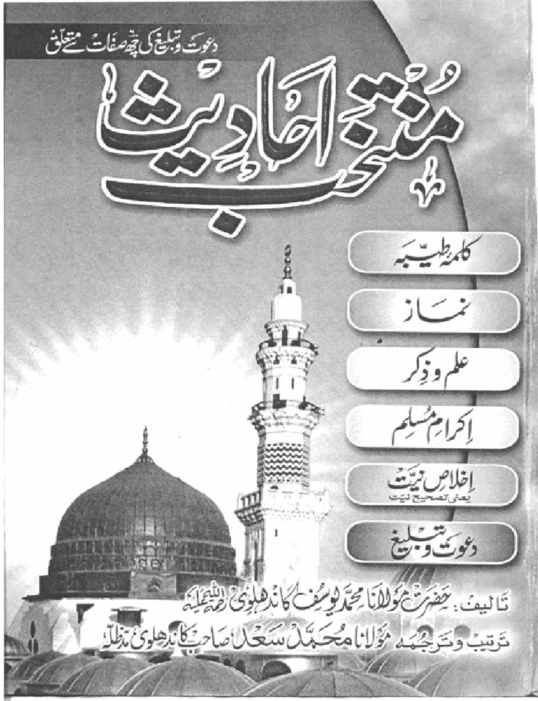
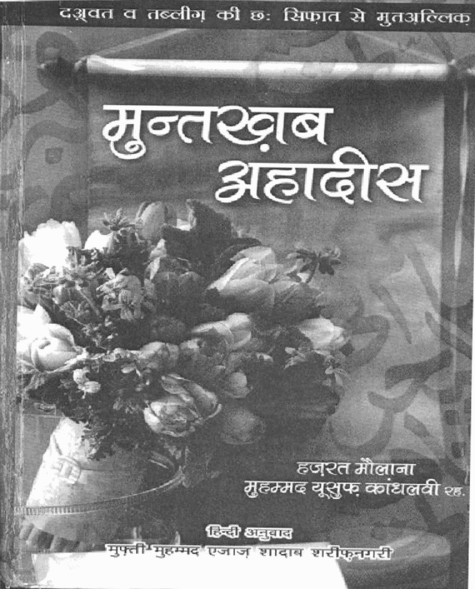
Fazael-e-Amal and Muntakhab Ahadis: Fazael-e-Amal is an Islamic book containing selected texts from the Quran and Hadith. This book is considered to be a vade mecum of the Islamic movement of spiritual renewal called Tablighi Jamat. Both the Arabic and Devanagari versions are available in the bookshops around Jama Masjid, and I found both versions in several mosques in Old Delhi. Sukaina, whom I discussed earlier, told me that they had both versions in the girls’ common room in Zakir Husain College. She told me that she used the Devanagari version because she couldn't read the Urdu version fluently. Muntakhab Ahadis (Selected prophetic traditions) is a religious book containing narrations of the Prophet Mohammad. As with Fazael-e-Amal, both Urdu and Devanagari versions were available in bookshops in Old Delhi as well as in many mosques. Opposite are the front pages of the two versions of Muntakhab Ahadis.
Muntakhab Ahadis in the Urdu script. Source: Reproduced with kind permission of Farid Book Depot (Pvt.) Ltd., New Delhi.

Muntakhab Ahadis in the Devanagari script. Source: Reproduced with kind permission of Farid Book Depot (Pvt.) Ltd., New Delhi.
Secular books
Some general interest Urdu magazines are now being published in Devanagari too. Mahakta Anchal is a popular, general-interest Urdu family magazine written in Devanagari, which was started in 1993 by  azalah Siddiqi under the patronage of Khalid Mustafa Siddiqi. Its format is modelled on the Pakiza Anchal in the Urdu script, which has been in print for a much longer time. The two magazines do not publish the same set of articles in the Urdu and the Devanagari scripts. However, much the same group of authors write for both, which suggests that they recycle some of their material in the Urdu and Devanagari versions of the magazine. Most issues of Anchal contain fiction, especially short stories and novels in instalments, which constitute the bulk of the magazine. It also contains Urdu poetry, especially ghazal, articles on health and beauty, matrimony, quotations from the Quran and Hadith, and well-known quotes by famous people. All writers of the articles are Muslim, except for occasional poems written by Hindu readers. It is worth mentioning here that these articles are not translations of the original Urdu texts.
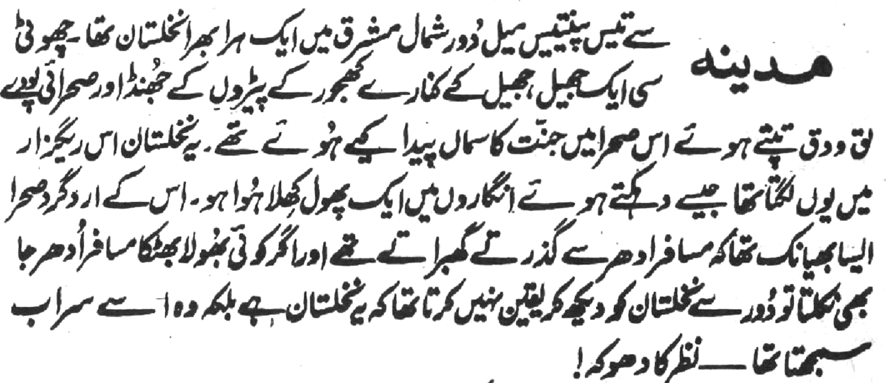
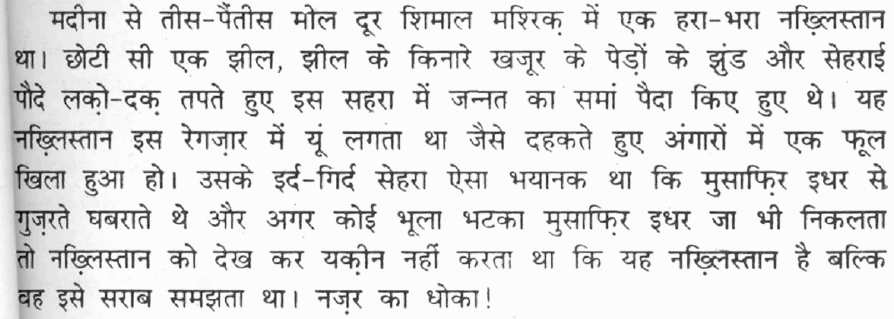
I give below a sample text from Hejaz ki Andhi (The storm of Hejaz), an Urdu novel originally written in the Urdu script, which was recently transliterated into Devanagari.
Page from Hejaz ki Andhi, an Urdu novel written in the Urdu script. Source: Altamash Enayatullah, hejāz kī dhī (Urdu) (The storm of Hejaz) (Delhi: Adabi Duniya, 2005) p. 3.
A Devanagari version of Hejaz ki Andhi. Source: Altamash Enayatullah, hejāz kī dhī (Devanagari) (The storm of Hejaz). (Delhi: Adabi Duniya, 2006) p. 1.
There was a (populated) oasis about 30–35 miles north east of Madina. A small pond, a row of palm trees and desert plants had created a heaven-like environment in this empty and scorching desert. This oasis in the desert looked like a flower in a raging flame. The desert surrounding it was so dreadful that people used to be scared of passing by it, and if [a] traveller ever happened to pass by it, he would not believe that it was desert; he would think that it was a mirage. A hallucination!
Below, I give a transliterated versions of the two texts to show that the only difference between the Arabic and Devanagari versions is the script—not a single word has been translated from Urdu into Hindi. In a typical translation into Hindi, the Urdu words, indicated in bold would be replaced with their Hindi equivalents.
madīna sē tīs pa tis mīl dūr shimāl mashriq m harā bharā nalistān thā. chhōTī sī ēk jhīl, jhīl kē kenārē khajūr kē peR kā jhunD aur sahrāī paudē laq-ō-daq taptē huē is sahrā mjannat kā sam paidā kiyē huē thē. yē nalistān is rēgzār m y lagtā thā jaisē dahaktē huē angār m ēk phūl khilā huā hō. us kē ird-gird sahrā aisā bhayānak thā ke mosāfir idhar sē guzartē ghabrātē thē aur agar kōī bhūlā bhaTkā mosāfir udhar jā bhī nikaltā tō dūr sē nalistān kō dēkh kar yaqīn nah kartā thā ke yē nalistān hai balkē wō usē sarāb samajhtā thā—nazar kā dhōka!
Urdu speakers recognize texts such as the one above as Urdu. When I asked Sukaina about the language of the Urdu-in-Devanagari texts, she said, ‘bōlnē m tō wō urdū hī hai, lekin paRhnē me hindī hai’ (‘It is Urdu when you speak it, but it is Hindi when you read it [on paper]’).
The use of Devanagari for writing Urdu, as discussed above, suggests that the symbolic meanings of Urdu as well as the Devanagari scripts are mutating. Muslims no longer see the Urdu script of Urdu as integral to the Urdu language, nor do they see Devanagari as completely antithetical to Urdu and their Muslim identity.
Summary and conclusion
Based on qualitative and quantitative data, I have demonstrated in this article that, contrary to the deeply entrenched views of scholars, politicians, and lay people, in post-colonial India Urdu does not symbolize an exclusive Muslim identity and culture. I have shown that Urdu invokes different symbolic meanings for different generations of Muslims and Hindus, and that Muslims and Hindus born before the Partition of India in 1947 do not associate Urdu with Muslims. In their language-ideologies, this generation does not view Urdu as symbolic of Muslim identity. A frequency distribution of the distinctive Urdu sounds, which is quite comparable among Muslims and Hindus, further demonstrates that the use of these sounds is not indexical of Muslim identity.
I have demonstrated that this ideology began to mutate among Hindus of the second generation born after Partition. First, on an ideological level, they do not identify themselves with the Urdu language. Secondly, a quantitative analysis of the Urdu sounds in their speech shows that, unlike the pre-Partition generation Hindus, they do not use the Urdu sounds in their speech. This reinforces the idea that Urdu is symbolic of Muslim identity.
My data further show that as this linking of Urdu with Muslims became established, another transformation in the meanings of Urdu began. The Muslim youth of Old Delhi began to disalign themselves from Urdu; they claimed not to speak Urdu, and an analysis of the distribution of the Urdu sounds shows that they were losing three of the five sounds that have been considered to be the shibboleth of the Urdu language. Consequently, their language was quite similar to Hindi.
I have further shown that these changes in the ideologies and practices of Urdu are concomitant with the adoption of the Devanagari script by a section of the Muslim population. The Urdu script, which has been the most robust marker of Urdu's identity as distinct from Hindi, was disappearing among the younger generation of Muslims. As they were losing their control of the traditional Urdu script, many religious and secular texts have begun to be transliterated or written in the Devanagari script. I argue that the adoption of Devanagari for writing Urdu further reinforces the shift in the symbolic meanings of Urdu.
I have argued that the transformation in the meanings of Urdu are reflective and, simultaneously, constitutive of the changes that the Muslims of Delhi have gone through in the twentieth century. I show that the Partition of India and the ensuing mass migration of educated middle class Muslims to Pakistan contributed to the stigmatization of Urdu in Old Delhi. I show that this stigmatization was a major driving force for the disaffiliation from Urdu among the younger generation of Old Delhi Muslims. In order to break free from the encumbering stigmatized Muslim identity and construct a positive identity, Muslim youth were moving away from the Urdu language.
Finally, it is important to mention that Muslims are making these sociolinguistic choices within the specific sociopolitical contexts of post-colonial India in which Muslims and their language and script have been subject to denigration and stigmatization. This article focuses on the micro sociolinguistic practices of residents of Old Delhi and does not dwell on the macro political processes of the state which crucially shape them. Addressing this theme raises the complex issue of the relationship between agency and structure. Many studies, including that of Anthony Giddens, questions the duality of agency and structure. Giddens argues that individual actions are informed by larger sociopolitical structures, which give form and shape to individual social actions.Footnote 49 The story of Urdu in India that I have told here suggests that minority languages and scripts can become stigmatized and marginalized in polities that de jure claim to support and sustain them.