Introduction
Theories of social construction have great relevance for understanding differential treatment of populations in the policy process. Social construction “refers to the cultural characterizations or popular images of the persons or groups whose behavior and well-being are affected by public policy” (Schneider and Ingram, 1990, p. 334). Stereotypes are not social constructions; social constructions “involve clusters of cognitive images about a target group – images or attitudes that tend to reinforce each other, thereby making the social construction more resistant to change” (Link and Oldendick, Reference Link and Oldendick1996, p. 152). Although individuals may have different perceptions about groups of people, the social construction of a target population is a pervasive view that is reinforced by social policies. Notably, policy is not the only way in which social constructions are created and reinforced, but “policy is the dynamic element through which governments anchor, legitimize, or change social constructions” (Schneider and Ingram, Reference Schneider and Ingram2005, p. 5). In a feedback loop, policies created for target populations in turn impact the ways in which individuals within the target populations engage in the political process (Béland, Reference Béland2010).
Constructions have implications for how policies are designed and lead to patterns that identify how some designs are more likely for certain target populations (Schneider and Sidney, Reference Schneider and Sidney2009). Understanding social constructions – their development, use, reinforcement, and adaptation – is useful to scholars, researchers, policymakers, and practitioners. Greater understanding may add clarity to explanations for the distribution of societal benefits and burdens. Furthermore, while policy scholars aim to produce research evidence to guide policymaking, it is also true that narratives drive policy as well, especially in the political arena. As stated by Brock: “language matters” (Reference Brock2017, p. 630). Describing the use of frames in political speech, Brock notes these “are a way of characterizing policies such that particular aspects of the policy will be highlighted, and others downplayed” (p.630). Effective frames reduce complexity, allowing ideas to resonate with individuals’ inherent beliefs regarding social problems, potential policy solutions, and target populations.
In this paper we apply the theoretical framework of social construction of target populations, developed by Schneider and Ingram (Reference Schneider and Ingram1993), to several child (under age 18) and youth (generally 14-24) populations. Child welfare, primary and secondary education, and juvenile justice, are some of the major policy areas with specific foci on children and youth. Additional policy sectors such as health care and public assistance, although not explicitly aimed at children and youth, also provide fundamental supports to families that consequently are important to the well-being of children and youth. Past applications of the framework have examined many different target populations (Pierce et al., Reference Pierce, Siddiki, Jones, Schumacher, Pattison and Peterson2014), but rarely has the framework been applied to children and youth. A more in-depth focus on this age-defined group (children and youth) may provide greater insight regarding various social constructions attributed to them and the common design of policies targeted toward them.
Our article is organized as follows: we (1) describe the original framework; (2) apply each of Schneider and Ingram’s four categories to examples relevant to children and youth; (3) identify adjustments to the model to guide further understanding of children and youth’s policy treatment; (4) discuss how these observations might inform policies targeted toward children and youth. By providing a more focused analysis of this theory’s application to the social construction of children and youth, we aim to contribute to the scholarly understanding of policymaking and inform potential policy design strategies that may result in positive outcomes for children and youth. The examples we provide are focused on the U.S. context. The implications are broader than a U.S. perspective, however, and we address them in the conclusion.
The Theory of Social Constructions of Target Populations
Schneider and Ingram (Reference Schneider and Ingram1993) argued that attention to the social construction of populations is particularly needed because of the relevance to “agenda setting, legislative behavior, and policy formulation and design, as well as studies of citizen orientation, conception of citizenship, and style of participation” (p.334). Fundamentally, the construction of target populations is related to the likelihood of receiving either beneficial or punitive policy action. Close examination of constructions aids in understanding the rationales embedded within policy designs and the various uses of policy tools to achieve outcomes (Schneider and Ingram, Reference Schneider and Ingram1997).
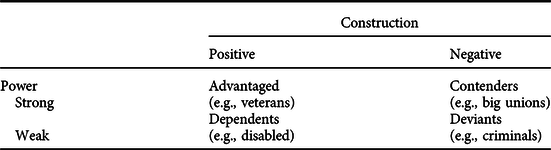
Two foundational dimensions were identified by Schneider and Ingram: the perceived power of the target group and their basic construction as either positive or negative. From this, four groups were identified. Table 1 provides the framework described in the original article, with example populations suggested by the original authors. We briefly describe each of the four quadrants including key characteristics of the groups and their experience of the policy process.
Social Constructions and Political Power: Types of Target Populations

Source: Schneider and Ingram, Reference Schneider and Ingram1993.
Advantaged groups have sufficient power to get their concerns on policy agenda and are able to control these agendas to result in favorable policy design. Moreover, they have the resources and capacity to shape their own construction as positive and to combat attempts to portray them otherwise. In the language of Schneider and Ingram (2012) they have policies with undersubscribed burdens and oversubscribed benefits. It is usually unnecessary to explain the need for programs for the advantaged because they are widely believed to be deserving of beneficial treatment.
In comparison, contenders have political power but a negative social construction, particularly when they assert power to receive benefits. Policies directed at contenders tend to be vague and complex according to Schneider and Ingram (Reference Schneider and Ingram1993) to make it difficult for others to determine who benefits and how. Their negative construction requires that policy rationales are explained. When contenders receive beneficial policies, rationales either minimize the benefit or focus on the benefits that all populations experience.
Dependents have a positive social construction, but lack power to have an influential role in policy making. Politicians want to be viewed as supportive of these populations; they often express concern, but do not want to direct resources to them since there is little political advantage to doing so. Policies are frequently symbolic and any actual programs are typically carried out within lower levels of government or by the private sector (Gainsborough, Reference Gainsborough2010). Policy beneficiaries usually lack options or voice and are expected to be satisfied with what they receive from a benevolent authority.
Finally, deviants have a negative social construction and lack power in the political arena. The result for the target population is minimal control over policies directed towards them. In comparison to advantaged populations who can influence the policy agenda to receive beneficial treatment, deviant populations receive excessive burdens and few benefits. Coercive policy tools (sanctions, punishment, and incarceration) are common and aim to both control the population and change their behavior. Other structural social conditions that may contribute to the behavior of the deviants are largely ignored. Moreover, coercive policies aimed toward deviants are explained as a protection of the rights of others whose interests are more deserving.
Numerous scholars have used this framework to examine various target populations and the types of policies they receive. In their review, Pierce et al. (Reference Pierce, Siddiki, Jones, Schumacher, Pattison and Peterson2014) found a wide range of applications, both empirical and theoretical scholarship, and use of the framework from multiple disciplines. They also noted that dependents and deviants have received the most attention from scholars followed by the advantaged and then contenders. Context is highly important in analyses of social construction; social constructions may or may not be broadly shared, they are frequently challenged by a range of groups, and they may vary in different geographic settings and across time. Pierce et al. (Reference Pierce, Siddiki, Jones, Schumacher, Pattison and Peterson2014) noted that certain populations have been viewed differently by various investigators depending on the context of their inquiry. This fluidity of interpretation fits with the nature of a social construction but also illustrates lessons (e.g., the manifestations of power) from those constructions that are relatively stable.
Minimal scholarly attention has used this framework in regard to children and youth. In the original conceptualization children were classified as dependent and youth were not addressed at all. Some of the few applications to children and youth have included a focus on service providers of childcare (Hynes and Hayes, Reference Hynes and Hayes2011), youth in child welfare (Collins and Clay Reference Collins and Clay2009; Collins, Reference Collins2018), and child nutrition programs (Brock, Reference Brock2017). In regard to child nutrition programs, for example, Brock notes that “children are a target population that lacks any political voice or agency in society; and second, children in particular are somewhat difficult for legislators to vilify, accuse of being lazy, or to criticize” (p. 631). Consequently, policymakers must find “creative” ways to be unsupportive of beneficial policy. Linking children with negative portrayals of their parents has been one strategy for doing so (Collins, Reference Collins2018).
Application to Child and Youth Populations
Having described the core components of the theory of social construction of target populations, we now apply this framework to various populations of children and youth who are targets of policies and who may engage in policy processes. To do so we utilized a deductive analytic strategy beginning with the defined categories of the framework. Utilizing discourse analysis we identified relevant examples in each category by the language cues reflective of key concepts (e.g., positive/negative constructions, power, policy feedback). These examples are described below along with our justification for their inclusion in the category. Using comparative analysis within and between categories, we identify common and distinctive features, to extend the theoretical work.
Advantaged
The greatest advantage accorded to children is to be born into well-functioning, well-resourced families and communities. The disadvantages associated with poverty and its related multiple stressors are firmly established (Brooks-Gunn and Duncan, Reference Brooks-Gunn and Duncan1997). Conversely, advantaged children and youth are often the recipients of intergenerational wealth transfers and other forms of family capital (Waithaka, Reference Waithaka2014). Systems of advantage and disadvantage exist within communities too. In the U.S., many communities remain segregated by characteristics of race, ethnicity, and social class (Massey and Tannen, Reference Massey, Tannen, Kirsch and Braun2016). Some children and youth, mostly white and middle to upper class, live in communities with good schools and other resources whereas other children and youth, disproportionately non-white and lower income, live in communities in which public schools are generally of lesser quality, other resources are limited (Massey and Tannen, Reference Massey, Tannen, Kirsch and Braun2016), and services such as police may be perceived as a threat rather than a protective force (Weitzer and Tuch, Reference Weitzer and Tuch2004).
A second mechanism that distinguishes advantaged youth from other youth is the system of occupational welfare, originally described by Titmuss (Reference Titmuss1965) and receiving more recent attention by Abramowitz (Reference Abramovitz2001). Occupational welfare focuses on benefits (e.g., health insurance, child care, family leave) provided to workers through their employers which are more likely to benefit the middle and upper classes. These benefits are important in the current U.S. context in which social risks are increasingly privatized (Hacker, Reference Hacker2006). Distribution of benefits through employment, however, results in increasing inequality between classes.
Third, there are enormous social and emotional benefits to having a “good” family. Poignantly, Seita (Reference Seita2001) has described “family privilege”, defining the term to mean “the benefits, mostly invisible, that come from membership in a stable family” (p.131). Bourdieu (Reference Bourdieu1996), in the context of discussing the social construction of family, also speaks of privilege. He states that in order for “this reality called ‘family’ to be possible, certain social conditions that are in no way universal have to be fulfilled” (p.22). Furthermore, “those who have the privilege of having a normal family are able to demand the same of everyone without having to raise the question of the conditions (e.g., a certain income, living space, etc.) of universal access to what they demand universally” (p.23). The privilege of family is “one of the major conditions for the accumulation and transmission of economic, cultural and symbolic privileges” (p.23).
These three examples (inequity in family/community resources, access to occupational welfare, and family privilege) are supported by a range of policies that receive limited public attention and debate (e.g., tax expenditures). When communities have adequate funding, individuals in those communities receive messages about who is deserving and undeserving of resources. Children and youth in those communities also receive messages about government that invite them to participate via opportunities for civic engagement available in their community (Augsberger et al., Reference Augsberger, Collins and Gecker2017). These opportunities, in turn, contribute to their development as citizens and offer exposure to learning how government can work in their interests.
Contenders
This category best fits children and youth who are organized to express voice to engage in policy processes to secure resources or policy change to benefit them. This often occurs at the local level for two reasons. In the U.S., children and youth lack a coordinated national constituency on many policy matters (Youniss and Levine, Reference Youniss, Levine, Youniss and Levine2009) and policy-making for children and youth has long occurred at lower levels of government (Gainsborough, Reference Gainsborough2010). Like other contending groups identified by Schneider and Ingram, children and youth can be viewed negatively when they assert power to get beneficial policy treatment.
A recent notable example of this category are the survivors of the school shooting at Marjory Stoneman Douglas High School in Parkland, Florida. In the aftermath of this incident several students have become highly visible activists particularly on issues of gun control and school safety, but addressing other issues as well (Cullen, Reference Cullen2019). Their visibility began with demonstrations and media interviews directly related to the shooting but expanded to include involvement in political campaigns and focused media strategies (e.g., op-eds, talk shows, books). Students and parents in Parkland, Florida created March for Our Lives, which began as a nationwide demonstration of youth advocating gun violence prevention. March for Our Lives has continued to encourage policy reform regarding gun violence, but has also expanded its focus to include increasing voter registration for young voters throughout the U.S.
Young victims of school shootings often elicit sympathy. Calls for action would normally put this population in the dependent category awaiting the beneficial action of other more powerful actors. In this instance, however, the students organized, spoke for themselves, and made demands of policymakers to address the problems they faced. They have been explicit that the symbolic “thoughts and prayers” of leaders were not only insufficient for the problem, but were offensive in their disregard for real actions (Cullen, Reference Cullen2019).
Given that they were students at the time and focused on mobilizing other students, their ability to influence policy was limited to outsider tactics typically used by populations who are negatively socially constructed. Without the ability to vote, they used marches, protests and interactions with the media and politicians that appears to have challenged adults’ existing social construction of youth. Rumors that the most vocal of the Parkland students were “crisis actors” (Arkin and Popkin, Reference Arkin and Popkin2018), highlight some of the backlash they received.
The Parkland youth are a high profile example of youth as contenders, but there are other less visible examples of young people engaging in political processes and endeavoring to exercise power. In countries other than the U.S., the United Nations Convention on the Rights of the Child (UNCRC) is a critical document used in several ways to secure rights for children and youth (Reynaert et al., Reference Reynaert, Bouverne-de-Bie and Vandevelde2009). Key provisions regarding children’s rights articulate mechanisms for participation in decisions that affect their lives. Without the UNCRC, efforts to secure children’s rights in the U.S. are less institutionalized. Efforts may still operate primarily from a dependency framework, such as an office of the child advocate or ombuds designed to monitor state actions in regard to children’s best interests (O’Neill, Reference O’Neill2011). But there are certainly youth-led efforts that have aimed to change policy. In child welfare, for example, youth coalitions (e.g., Augsberger et al., Reference Augsberger, Springwater, Hilliard-Koshinsky, Barber and Martinez2019) and policy forums (e.g., Day et al., Reference Day, Riebschleger, Dworsky, Damashek and Fogarty2012) have emerged as mechanisms for youth in foster care to express their voice to policymakers and achieve systems-level change. Efforts to organize, claim power, and influence policy (joining with other children and youth on some policy issues, exercising the youth voice) is an effort to change their own social construction from dependents to contenders.
Age is particularly relevant to this category. Young children are unlikely to be contenders due to their difficulty organizing collectively without significant support (e.g., transportation) from adults. There are debates in regard to children and youth’s ability to exercise their own agency without adults (Sinclair, Reference Sinclair2004). As children advance in age and move through adolescence, they are more likely to have the needed skills and resources to plan, organize, and communicate with some level of independence.
Dependents
Historically, the entire policy approach to child welfare (orphan, abused, neglected children) has categorized children as dependent. These children are mostly positively constructed and are often viewed as victims who are deserving of help. Phrases that are ubiquitous in child welfare such as “dependency petition”, “minors in need of supervision”, and “best interests of the child” illustrate this construction. Furthermore, there is a centuries-long scholarly and practice tradition that would indicate children are rightly situated in the dependent category. Children were identified within the Elizabethan Poor Laws as a group deserving of assistance. Based within the Poor Law tradition, in the U.S. the major welfare program to provide financial assistance to poor families with children was initially named Aid to Dependent Children and later Aid to Families with Dependent Children.
The overall message that dependents receive from policies is that they are in need of assistance from others and are unable to make their own decisions. Traditionally, as dependents, children have had minimal participation in solving their own problems when involved in the child welfare system and have often been marginalized in discussions related to their own case planning. A series of policy changes to enhance youth participation (e.g., the Fostering Connections to Success and Increasing Adoptions Act of 2008) have become law but full realization of these participation goals has not been achieved. More broadly, efforts to reform child welfare – to be more family-focused, culturally competent, trauma-informed, and inclusive of children and their parents in case planning – are critical goals, but remain challenging in many contexts (Berrick et al., Reference Berrick, Dickens, Pösö and Skivenes2015; Duffy et al., Reference Duffy, Collins and Kim2016). Children who have been involved in the child welfare system continue to receive messages about government not being something that is useful or helpful to them. Those in long term out-of-home care are often very eager to leave the system; in some cases they express this by running away from their care setting.
Age is also relevant in this category. As they become older children and adolescents, they typically receive less positive attention and may morph into a construction emphasizing deviancy rather than dependency. Additionally, problem behaviors in adolescents may be viewed less benevolently; they can trigger fear if these behaviors demonstrate aggression or blame if they demonstrate irresponsibility (Collins and Clay, Reference Collins and Clay2009).
Deviants
Juvenile delinquents are the classic population of deviant children. Young people involved in the juvenile justice system are those who have engaged in behavior that is determined by adults to be dangerous, illegal or unsafe due to the age of the youth. While the initial intention was to recognize children in need of support, whether due to their own behavior or parental neglect (Platt, Reference Platt2009), the structure of the juvenile court treats the target population somewhat like the criminal population. Despite attempts to provide treatment while youth are involved in juvenile justice programs, overall policies tend to focus on sanctions, offering burdens rather than benefits.
Other young deviant populations might include runaway youth, homeless youth, and school drop outs. Extensive research has documented the wide variety of circumstances that can lead to behaviors such as running away, homelessness, or school-leaving. These circumstances include abuse (Bender et al., Reference Bender, Brown, Thompson, Ferguson and Langenderfer2015), family conflict (Tyler et al., Reference Tyler, Hagewen and Melander2011), and youths’ sexual identity (Rosario et al., Reference Rosario, Schrimshaw and Hunter2011). In another example, only recently has “commercial sexual exploitation of children” been utilized as a linguistic frame rather than “child prostitution”, and, as a consequence, has put the focus on the vulnerability of the victim and de-criminalizing the behavior (Elliott, Reference Elliott2019). Advocacy efforts often have the aim of highlighting key causes of problematic youth behaviors and reframing youth circumstances to avoid strong deviancy labels.
Youth can be labelled as deviant even when they have not exhibited problematic behaviors. There are numerous examples of children and youth of color being hassled – and worse – for simply “hanging around” in public places (Boyd and Clampet-Lundquist, Reference Boyd and Clampet-Lundquist2019). Documented circumstances such as “playing” while black (Pinckney et al., Reference Pinckney, Outley, Brown and Theriault2019) call attention to the swift ease with which youth of color can be labelled as a problem based solely on their race. Gender also becomes prominent in several ways. First, although both male and female youth of color can be victimized by racist labels, boys are more likely to have legal interactions because of it (Rios, Reference Rios, Marable, Steinberg and Middlemass2007). Also, females face greater challenges than males related to the social construction of deviancy due to sexual behavior, pregnancy, and parenthood (Wilson and Huntington, Reference Wilson and Huntington2005).
In the contemporary environment immigrant children and youth in many countries are socially constructed to be deviants. This demonstrates the fluidity of social constructions and contrasts with the more positive, perhaps “contending” “Dreamers” (i.e., a political label given to children and youth brought to the U.S. illegally by their parents). Constructing young migrants as deviant allows for policies in the Southwest U.S. that has resulted in separation from parents, denial of human rights, confinement in institutional settings, and more egregious treatments that can be considered forms of child abuse (American Professional Society on the Abuse of Children, 2018). While competition for the social construction continues to evolve in politics, these children and youth currently have few protections and remain at risk of great harm.
Feedback Loops and Citizenship
The differential policy experience of groups has further implications for these groups’ overall view of government and consequent civic participation and engagement in the policy process (Schneider and Ingram, Reference Schneider and Ingram1993). Because the advantaged receive messages that their problems are worthy of attention and they receive beneficial policy treatment, they tend to view government positively, and participate in the political process through voting, engaging with policymakers, and self-advocacy. Contenders organize outside of formal systems and make demands, sometimes successfully, from government. As dependents’ voice has been repeatedly neglected, they frequently want nothing further to do with governmental systems. Deviants, subject to coercive controls, sanctions, and punishments would not be expected to have a positive view of government or typically want to participate in it.
Constructions – as either positive or negative – and resulting policy treatment frequently becomes entrenched (Pierson, Reference Pierson2000). When populations with limited power (e.g., dependents and deviants) continually receive policies that disenfranchise them, it becomes increasingly difficult for them to participate in government, which further perpetuates the cycle. There are exceptions to these patterns, however. Béland (Reference Béland2010) offers caution against an “overly deterministic vision of how existing policies influence politics and policy making” (p. 569). Important questions requiring attention include: overall, what are the conditions under which existing policy legacies can favor or hinder path-departing change? Thus, while social constructions are a strong factor to reinforce societal perceptions to trigger specific effects in policy development and political engagement of constituencies, these processes are not immutable. We discuss examples and possibilities of changing constructions later in the manuscript.
Recent scholarly attention has continued to examine policy feedback theory and research which includes attention to the impact on political behavior and citizen engagement (Béland and Schlager, Reference Béland and Schlager2019). Schneider and Ingram (Reference Schneider and Ingram2019), for example, discuss anticipatory feedback. Elected leaders, always planning for re-election, are aware that “the public likes for government to ‘do good things for good people,’ and to punish ‘bad people’ (p. 207).” In this way, feedback from the public has already shaped elected officials’ choices of policy design elements; the design “… was not simply crafted to solve a particular public problem, but also to address that problem in particular ways that will insure more positive and less negative reaction from those parts of the public that the elected official believes are important for his/her re-election” (p.207).
In comparison with other target populations, children and youth are unique because their social construction may not remain stable. They will exit the population of “children and youth” as they naturally age and become adults. Knowing this, many look forward to this change in status and the privileges of independence it can bring. Consequently, the concept of feedback loop is looser than with other populations and this has important implications. Children and youth have few built-in incentives to fight for their own target group in an intense way. Sustainability of effort is a constant challenge as children and youth “age out” of their target population.
Discussion
Our analysis identified several ways in which various child and youth populations fit within the Schneider and Ingram (Reference Schneider and Ingram1993) typology of social construction of target populations. The examples also identified areas of complexity and ambiguity. There are ready examples of children and youth in dependent and deviant categories; systems of child welfare and juvenile justice were designed to address children and youth in these categories. There are less obvious examples in the other categories of advantaged and contenders. These latter two groups require some element of power which, while less available to young people, can exist in some forms. We provided some examples by thinking more broadly about power. In advantaged groups sources of power stem from family relationships and characteristics related to the privileged categories of social class (upper), race (white), gender (male), and sexual orientation (heterosexual), for example. Among contenders, power emanates from the ability to organize and claim some influence through voice and action. These observations lead us to suggest adaptations to the theory when applied to child and youth populations.
We articulated several critical factors that influence social constructions of children and youth: (1) their ties to family and community; (2) relevance of age; (3) limitations and opportunities to exercise power and participate in government; and, (4) changes in social construction as they age into adolescence and young adulthood. We discuss these points in further detail below.
First, children and youths’ ties to their family are significant in the advantaged and dependent groups but less so in the contending and deviant groups. As we identified, advantaged children and youth receive their advantage by being a member of a family unit that is strong, cohesive, nurturing, well-functioning, and well-resourced. Lack of a family of any sort or a member of a family unit with excessive problems that requires state intervention puts a child in the dependent group. This status of child dependency on the state has been a core characteristic of social welfare systems across the globe.
It is difficult to isolate children and youth from the resources associated with their families and the ways that those resources allow some children and youth access to political participation. In the case of the Parkland students, their middle class status provided an education that taught them how to advocate for themselves and encouraged them to participate in government (Wong, Reference Wong2018). Cullen (Reference Cullen2019) documented the Parkland youths’ efforts to acknowledge race and social class disparities in the attention they received versus the lack of attention to more common gun violence devastating the lives of many youth in communities of color.
Second, age of children and youth adds critical nuance to the framework. Age seems largely irrelevant to the advantaged category. A trajectory of life advantage can begin with pre-natal care that leads to healthy infants as opposed to those with complex medical conditions at birth. Moreover, advantage can transcend the boundaries of age 18 well into adulthood. Advantaged parents can provide extensive resources to their children by supporting them in college, assisting with home ownership, and continuing with numerous transfers of wealth (Swartz, Reference Swartz2008). Disparities of wealth and race make the opposite also true (Addo et al., Reference Addo, Houle and Simon2016).
Whereas age has little importance in the advantaged category it manifests strongly in the others. As we have noted, contenders would typically be older children and adolescents. Younger children could be contenders, but their developmental stage makes it more challenging to organize, plan and exert some power. Some assistance from adults might be needed. This can raise questions as to whether children and youth are exerting power on their own or used as tokens in adults’ efforts. There is a robust literature on this (see for example Wong et al., Reference Wong, Zimmerman and Parker2010) that provides several typologies of youth power, particularly in relation to adults.
Age is also relevant in the relationship between dependent and deviant categories. Although on the surface there is nothing age-specific about these categories (dependents can be 17.5 years old and deviants can be quite young), in practice there are likely to be societal constructions of these populations that relegate younger children to the dependent category and older youth to the deviant category. One example from policy is the differential treatment of missing and absent children from child welfare systems. In the State of Massachusetts, for example, a missing persons’ report of a child missing from care is required when they are considered “high risk” (Massachusetts Department of Children and Families, 2019). The policy specifically states that any child under the age of 13 is considered high risk and needs to be reported as missing. Above age 13 the same attention is not required. More generally, as vulnerable children become troubled adolescents, the social construction likely changes from positive to more negative (Collins and Clay, Reference Collins and Clay2009).
Third, the key criterion of power requires adjustment in a way that is more relevant to children and youth. First, much of the power (or lack thereof) of their parents can accrue to the child. Again, this is most apparent in the advantaged category. Lack of parental power can compound the vulnerabilities of children and youth in the other three categories. Second, although they cannot vote, young people can participate civically in numerous other ways (Checkoway and Aldana, Reference Checkoway and Aldana2013). Contenders such as Parkland youth can be quite visible in their civic engagement. Third, although the U.S. is not a signatory to the UNCRC, all other countries in the world are signatories to this document, and many use it to shape child and youth policies in their countries. Particularly in Europe, the UNCRC has guided numerous efforts at national, regional, and community levels to institutionalize youth participation in governmental decision-making. Additional attention to formalized rights-based strategies may result in more examples of child and youth contenders.
Formal, institutionalized rights are particularly necessary for dependents and deviants who otherwise repeatedly receive messages that they are not important and therefore are discouraged from participating in civic activities altogether. This is consistent with the “third face” of power described by Gaventa (Reference Gaventa1980) in which large groups of people remain passive; they do not claim and use the power they potentially have. As a result, institutionalized processes prevent vulnerable populations from achieving successes in policy processes. Advantaged and contenders can exercise overt and preventive power; dependents and deviants are likely influenced by the third face in which they become passive based on their previous experience with governmental systems. These messages are similarly translated when applied to the child and youth population. Advantaged children and youth are those most likely to have access to civic engagement opportunities where they may learn and practice competency for civic life (Augsberger et al., Reference Augsberger, Collins and Gecker2017). Contending children and youth may more likely be those who engage in civic processes through mechanisms outside of traditional government channels.
A fourth key factor involves understanding the ways in which social constructions can change or do not. Some social constructions “seldom, if ever, change and are accepted as the natural order of things” (Schneider and Ingram, Reference Schneider and Ingram2005, p.5). In an illustration of changing social constructions, Hudson and Gonyea (Reference Hudson and Gonyea2012) document the movement of the elderly from dependents (prior to the enactment of old age insurance in the Social Security Act) to advantaged (particularly in the 1960s and 1970s) to contenders (most recently). A mostly positive construction has in recent years been tarnished somewhat by improvements in the economic and social status of the elderly, strong self-advocacy for beneficial policies, and rising concerns about intergenerational equity. Forces influencing changes in social constructions include target groups’ own efforts, external events, and the role of entrepreneurs to reframe populations (Pierce et al., Reference Pierce, Siddiki, Jones, Schumacher, Pattison and Peterson2014). One example of external events in regard to children and youth has been the role of increasing knowledge from neuroscience that has had some impact on societal understanding and subsequent policy treatment of juvenile delinquents which, though not fully transformative, has influenced decisions by the U.S. Supreme Court (Monahan et al., Reference Monahan, Steinberg and Piquero2015).
In the absence of major changes that lead to changing social construction, processes of division (rather than solidarity) can occur within target population groups to gain policy benefits for some at the expense of others. Donovan (Reference Donovan1997), for example, identified processes to gain early support for HIV/AIDS policies by focusing on children, women and people who had received blood transfusions, rather than gay men and intravenous drug users. In regard to children and adolescents, there are engrained practices that have frequently divided children and adolescents in need of assistance into “victims” of maltreatment and “perpetrators” of delinquent acts despite major overlap between the groups (Ryan and Testa, Reference Ryan and Testa2005). These populations have significantly different social constructions and therefore are subject to different policy interventions although their needs may be very similar. In contrast, target populations may aim to create solidarity with others to expand their size and potential power. Cullen (Reference Cullen2019), for example, identified efforts by the Parkland youth to create alliances with other youth groups affected by gun violence.
Advocates have played an important role in challenging social constructions and in allying with numerous groups to push for redefinition of constructions to gain greater benefit in the policy process. The concept of human dignity commits social workers, religious actors, humanitarians, and others to advocate for equal care and concern for those with less power. Deservedness has a long history that remains prominent in policy discussions. Deservedness is a massive social construction that is often central to policy debates. Social workers and other advocates often work to expand the boundaries of deservedness or to reject the idea outright. Ethics frames that emphasize compassion de-emphasize deservedness as a needed ingredient for addressing human suffering (Collins et al., Reference Collins, Cooney and Garlington2012). More generally, advocates act to reframe population constructions, serve as youth allies to lend support to youth-led organizing efforts, foster solidarity to prevent efforts to divide populations into favorable and unfavorable categories, and conduct research that can challenge prevailing negative constructions.
To recap, our proposed adjustments to the model calls for a re-framing of power to be more focused on resources, to recognize the fundamental linkage of children with their families as primary in securing advantage, to identify the prominent role of child age as an influence on construction, and to acknowledge the temporary nature of childhood and youth that limits the ability of feedback and feed-forward processes to enshrine beneficial policy treatments. Further research might hone more deeply on some of the examples provided in this paper, by conducting longitudinal research to trace the changing social constructions over time and their impacts on policy outcomes. Efforts to document either the static nature of these constructions or the factors that lead to changes in construction (both positive and negative) would be particularly fruitful for uncovering further important distinctions in these processes. Additionally, research might further explore the range of language used in policy and practice regarding children and youth. We recognize that the specific terms (advantaged, etc.) reflect concepts that may be labelled with other terms (e.g., “vulnerable”, “villains”) to connote common ideas. An in-depth linguistic analysis may offer further insight relevant to policymaking.
We also suggest that next steps in research incorporate explicit international comparisons. Questions might include the following: to what extent are the observations identified U.S.-centered? Other countries using the UNCRC may have developed sufficient mechanisms to allow young children to be contenders in policy environments. Other countries may have adopted more progressive juvenile justice policies that reduce conceptualization of troubled youth as deviants. Other countries attacking social inequality may have muted some of the advantages accumulated by those in the advantaged category. Other countries may have far more strict codes of social behavior that swells the category of deviants. Other countries may have more repressive political systems or hierarchical cultural frames that prohibit any expression of youth voice and thus offer little opportunity for contenders to arise. Explicit international comparisons would help identify these important factors influencing construction.
Conclusion
Children and youth in the United States, and throughout the world, receive attention from policymakers but their life circumstances remain challenging, and in many scenarios, precarious. The theoretical framework described in this article, with adaptations, may be useful in aiding policy efforts to obtain more beneficial policy treatment for children and youth. These might include continued efforts at framing and re-framing to solidify positive social constructions, practice of solidarity within groups to avoid splitting, intersection with civic engagement for all youth populations to reinforce identities as citizens, ongoing efforts to combat the persistent frame of deserving versus undeserving in all its forms, and application of explicit power in advocacy efforts. Additionally our analysis can inform further scholarship regarding the linkage between social construction, policy design, and outcomes for children and youth.