Introduction
Comprehending written or spoken sentences in a language learned at a later age is often different from sentence processing in one's native language. Several accounts have been proposed concerning the underlying difference between native and non-native sentence processing. According to the Shallow Structure Hypothesis (Clahsen & Felser, Reference Clahsen and Felser2006), late second-language (L2) learners cannot use detailed syntactic information, but use semantic information, and general heuristics to infer the meaning of the sentence. Under this account, differences between native and non-native speakers will be primarily attested in long-distance syntactic dependencies, in which the dependent elements are not adjacent and syntactic information is crucial to construct the correct meaning. Other proposals hypothesize that L2-learners can use syntactic information, but will experience difficulty when different kinds of information need to be combined (Sorace, Reference Sorace2011). An example of the latter is the licensing of a particular word order given a specific discourse context and information structure (Hopp, Reference Hopp2009).
A more recent proposal is that L2-speakers do not anticipate upcoming information to the same extent or manner as do native speakers (Grüter, Lew-Williams & Fernald, Reference Grüter, Lew-Williams and Fernald2012; Kaan, Reference Foucart, Martin, Moreno and Costa2014; Kaan, Dallas & Wijnen, Reference Kaan, Dallas, Wijnen, Zwart and de Vries2010; Martin, Thierry, Kuipers, Boutonnet, Foucart & Costa, Reference Martin, Thierry, Kuipers, Boutonnet, Foucart and Costa2013). A growing number of psycholinguistic studies suggests that native speakers make detailed predictions concerning upcoming information during listening and reading. These predictions include the gender (Van Berkum, Brown, Zwitserlood, Kooijman & Hagoort, Reference Van Berkum, Brown, Zwitserlood, Kooijman and Hagoort2005; Wicha, Moreno & Kutas, Reference Wicha, Moreno and Kutas2003, Reference Wicha, Moreno and Kutas2004), phonological form (DeLong, Urbach & Kutas, Reference DeLong, Urbach and Kutas2005; Martin et al., Reference Martin, Thierry, Kuipers, Boutonnet, Foucart and Costa2013), or visual form of the upcoming word (Dikker, Rabagliati, Farmer & Pylkkänen, Reference Dikker, Rabagliati, Farmer and Pylkkänen2010; Dikker, Rabagliati & Pylkkänen, Reference Dikker, Rabagliati and Pylkkänen2009). For instance, in a study using Event Related brain Potentials (ERPs), DeLong et al. (Reference DeLong, Urbach and Kutas2005) had participants read semantically highly constraining sentences such as The day was breezy so the boy went outside to fly. . .. The next word could be a determiner that either matched the expected noun ( a kite, in this case), or did not ( an airplane). The unexpected form of the determiner (an, in this case) elicited a larger N400 component compared with its expected counterpart (a). The N400 component is typically seen for words that are semantically unexpected (Kutas & Hillyard, Reference Kutas and Hillyard1980). The DeLong et al. (Reference DeLong, Urbach and Kutas2005) results suggest that native speakers predict upcoming words while they are reading, and even pre-activate the phonological form of these words, which, in turn generates expectations for the form of the determiner. This leads to a deflection in the ERP when the expectations are violated, even before the expected noun appears in the input.
Most studies on predictive processing in L2-learners, on the other hand, report that L2-learners do not anticipate upcoming words, at least, not to the same extent as do native speakers. This is in spite of the fact that the L2-learners in these experiments know the specific rules and words used when probed off-line (Dussias, Valdés Kroff, Guzzardo Tamargo & Gerfen, Reference Dussias, Valdés Kroff, Guzzardo Tamargo and Gerfen2013; Grüter et al., Reference Grüter, Lew-Williams and Fernald2012; Grüter & Rohde, Reference Grüter and Rohde2013; Hopp, Reference Hopp2013; Lew-Williams & Fernald, Reference Lew-Williams and Fernald2010; Martin et al., Reference Martin, Thierry, Kuipers, Boutonnet, Foucart and Costa2013). For instance, using an a/an paradigm similar to Delong et al. (Reference DeLong, Urbach and Kutas2005), Martin et al. (Reference Martin, Thierry, Kuipers, Boutonnet, Foucart and Costa2013) did not find anticipatory effects in the ERPs at the determiner (a, an) in Spanish L2-learners of English, even though the participants in this study were highly proficient in English, and had been English-immersed for at least two years. The L2-learners in this study did show incongruency effects in the ERPs at the noun when the preceding determiner did not match the noun (e.g. a airplane vs. an airplane ). This suggests that even though the L2-speakers knew the morpho-phonological rules of determiners in English, they lacked the ability to anticipate this phonological information on the basis of the semantic context during reading.
One account of L2-speakers’ reduced ability to predict is that this is the result of a processing deficit: Lexical access, and integration of the words into the context are slow and effortful in L2, with the result that fewer processing resources can be devoted to forming and maintaining predictions during listening or reading (Foucart, Martin, Moreno & Costa, Reference Foucart, Martin, Moreno and Costa2014; Grüter & Rohde, Reference Grüter and Rohde2013). Other factors that may affect predictive processing in L2 are the learner's L2 proficiency, native language, and the type of information to be predicted, among others (Dussias et al., Reference Dussias, Valdés Kroff, Guzzardo Tamargo and Gerfen2013; Foucart et al., Reference Foucart, Martin, Moreno and Costa2014; Hopp, Reference Hopp2013; Kaan, Reference Kaan2014).
Most studies on predictive processing in L2-learners have investigated the anticipation of specific discourse referents based on gender information encoded in the determiner preceding the noun, e.g. la fem/el masc in Spanish (Dussias et al., Reference Dussias, Valdés Kroff, Guzzardo Tamargo and Gerfen2013; Grüter et al., Reference Grüter, Lew-Williams and Fernald2012; Hopp, Reference Hopp2013; Lew-Williams & Fernald, Reference Lew-Williams and Fernald2010). To our knowledge, the few other studies that use on-line techniques have focused on the predictive use of contextual-lexical semantics (Chambers & Cooke, Reference Chambers and Cooke2009; Foucart et al., Reference Foucart, Martin, Moreno and Costa2014; Martin et al., Reference Martin, Thierry, Kuipers, Boutonnet, Foucart and Costa2013). It is therefore unclear to what extent the current findings on predictive processing in L2-speakers generalize to other phenomena, in particular the predictive use of syntactic information other than gender. This is especially important given the special role assigned to (non-adjacent) syntactic information in prevailing models of L2 processing (Clahsen & Felser, Reference Clahsen and Felser2006).
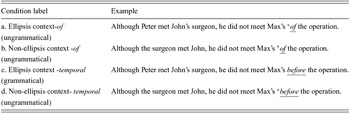
The aim of the present study is to investigate to what extent advanced L2-learners differ from native speakers in the anticipation and/or integration of syntactic information. To this purpose we adapted an ERP paradigm used by Lau, Stroud, Plesch and Philips (Reference Lau, Stroud, Plesch and Phillips2006). Lau et al. (Reference Lau, Stroud, Plesch and Phillips2006) manipulated the expectation of a particular word class by contrasting syntactic contexts that did and did not allow noun-ellipsis. Elliptical structures are structures in which a particular word or phrase is missing from the input, but can be inferred from the preceding linguistic or discourse context (for an overview of linguistic accounts of ellipsis, see Phillips & Parker, Reference Foucart, Martin, Moreno and Costa2014). Two of the conditions used by Lau et al. (Reference Lau, Stroud, Plesch and Phillips2006) are illustrated in (a) and (b) of Table 1. In (a), the fragment Although Peter met John's surgeon, he did not meet Max’s allows noun-ellipsis: Here the noun surgeon is missing from the second clause, yet it can be inferred from the preceding context. The second clause in (a) can therefore be syntactically complete at Max’s. There is no strong expectation for a particular type of continuation. In the example in (b), on the other hand, noun-ellipsis is not possible. The fragment Although the surgeon met John, he did not meet Max’s. . . is incomplete. This creates a strong expectation for an overt noun phrase to follow the possessive Max’s, since this is the only way to complete the sentence in a grammatical way. The conditions (a) and (b) therefore differ in the degree to which an overt noun can be anticipated: in (b) there is a strong expectation for an overt noun; in (a) this expectation is much weaker because of the possibility of noun-ellipsis. In both (a) and (b), the possessive is followed by of. This is an ungrammatical continuation in (a) and (b) for two reasons. First, of may introduce an expression that modifies a preceding noun (e.g., report of the operation), and would require an overt noun in contexts such as (a) and (b). However, no such noun is available in (a) and (b). Alternatively, of can introduce an argument of the verb (e.g., to remind somebody of something), but such a verb is missing in (a) and (b). In both (a) and (b), therefore, of constitutes an ungrammatical continuation. Crucially, the difference between (a) and (b) is that of violates a strong expectation for an overt noun in (b) but not in (a). Testing native English speakers, Lau et al. (Reference Lau, Stroud, Plesch and Phillips2006) reported a larger Left Anterior Negativity (LAN) effect at the word of in (b) versus (a). The LAN is a component elicited by syntactic-morphological violations (e.g., Coulson, King & Kutas, Reference Coulson, King and Kutas1998; Kaan & Swaab, Reference Kaan and Swaab2003), but has not been consistently observed. Although the LAN component and its meaning are rather controversial (Steinhauer & Drury, Reference Steinhauer and Drury2012), one interpretation proposed by Lau et al. (Reference Lau, Stroud, Plesch and Phillips2006) is that the LAN is modulated by the strength of syntactic predictions. Thus, the violation of a strong prediction, in particular, the prediction of an overt noun in (b), will lead to a larger LAN effect than violations of weaker predictions, as in (a).
Experimental conditions in the current study

Note: * indicates the onset of the ungrammaticality; the critical preposition is underscored and in italics for demonstration purposes only.
In the present study we used conditions (a) and (b) from Lau et al. (Reference Lau, Stroud, Plesch and Phillips2006) to test to what extent L2 and native speakers differed in their ability to predict an elided noun on the basis of the preceding syntactic context. If, in contrast to native speakers, L2-speakers cannot use the preceding syntactic context to generate predictions as to the possibility of noun-ellipsis, we expected the native, but not the L2-speakers to show an effect of the preceding context, that is, a difference between contexts in which ellipsis is possible (a) versus contexts in which ellipsis is not possible (b). In particular, we expected that in the native speakers, the context affects the LAN effect or other early components at the critical preposition of, or at the preceding possessive, but that the L2-speakers would not show such a modulation. Although Lau et al. did not find any significant differences at the possessive (Max’s) preceding the preposition, we do not exclude effects of context on that position, as the possessive is the first position at which noun-ellipsis can be inferred in (a) versus (b). Also, other ERP studies on ellipsis report effects at the position directly preceding the ellipsis site (Dimitrova, Reference Dimitrova2012). In our data analysis, we will therefore also analyze ERPs to the possessive preceding the critical preposition.
Second, we were interested in the extent to which native and non-native speakers differed in the integration of syntactic information across clauses and in the repair of syntactic errors. In order to interpret the elliptical constructions and to determine their grammaticality, information from the first clause needs to be combined with that in the second clause. If L2-learners have difficulties integrating structural information across clauses (Clahsen & Felser, Reference Clahsen and Felser2006), they will have difficulty distinguishing grammatical from ungrammatical ellipsis, and difficulty retrieving the antecedent of the elided element. To test this, the current study included two additional conditions, (c) and (d) in Table 1. These conditions were not part of the Lau et al. (Reference Lau, Stroud, Plesch and Phillips2006) study, but allowed us to tease apart the effects of processing ellipsis and the effects of processing a preposition (of) that is ungrammatical for reasons independent of ellipsis. Conditions (c) and (d) are the same as (a) and (b) except for the use of the preposition. In contrast to of in (a) and (b), the prepositions used in conditions (c) and (d) introduce expressions of time, and do not need a directly preceding noun or subcategorizing verb in order to be grammatical. As in (a) and (b), a noun is omitted after the possessive in (c) and (d). In (c) this kind of ellipsis is allowed because of parallelism with the preceding context, rendering (c) grammatical; in (d) omission of the noun is not allowed, which results in an ungrammaticality at the preposition.
Native speakers were expected to show a larger P600 effect at the preposition for the ungrammatical (d) versus grammatical condition (c). In addition, the P600 was expected to be larger in (b) than in (a), as the preposition in (b) may be perceived as a stronger violation than in (a) since noun-ellipsis is licensed in (a) but not in (b). The P600 effect is commonly observed for ungrammatical or syntactically difficult continuations and may reflect integration, repair and/or monitoring processes (Friederici, Hahne & Saddy, Reference Friederici, Hahne and Saddy2002; Kaan, Harris, Gibson & Holcomb, Reference Kaan, Harris, Gibson and Holcomb2000; Van de Meerendonk, Indefrey, Chwilla & Kolk, Reference Van de Meerendonk, Indefrey, Chwilla and Kolk2011). If L2-speakers have difficulty combining syntactic information across clauses, they may not experience the ungrammaticality in the way native speakers do, and/or may integrate or repair the ungrammatical continuation in a different way than native speakers. This would be reflected in differences in the latency, scalp distribution, or amplitude of the P600 effect at the preposition for (b) versus (a), and (d) versus (c).
In addition, differences between native speakers and L2-learners may be observed in a late anterior negativity following the P600. This effect has been observed in L2-learners (Gillon Dowens, Vergara, Barber & Carreiras, Reference Gillon Dowens, Vergara, Barber and Carreiras2010; Hahne & Friederici, Reference Hahne and Friederici2001; Isel, Reference Isel2007; Morgan-Short, Steinhauer, Sanz & Ullman, Reference Morgan-Short, Steinhauer, Sanz and Ullman2012; Sabourin & Stowe, Reference Sabourin and Stowe2008), as well as native speakers (Alemán Bañón, Fiorentino & Gabriele, Reference Alemán Bañón, Fiorentino and Gabriele2012; Gillon Dowens et al., Reference Gillon Dowens, Vergara, Barber and Carreiras2010; Sabourin & Stowe, Reference Sabourin and Stowe2004) and may reflect working memory load (Morgan-Short et al., Reference Morgan-Short, Steinhauer, Sanz and Ullman2012; Sabourin & Stowe, Reference Sabourin and Stowe2004; Sabourin & Stowe, Reference Sabourin and Stowe2008) or difficulty with semantic-conceptual integration (Hahne & Friederici, Reference Hahne and Friederici2001; Isel, Reference Isel2007).
In sum, the aim of the present study was to investigate to what extent advanced L2-learners of English differ from native English speakers in the use of syntactic information in the preceding clause: (a) to anticipate upcoming syntactic information (noun-ellipsis versus an overt noun in particular), leading to a modulation of the LAN effect at the ungrammatical preposition, or other early effects for the native speakers, but not for the L2-learners; (b) to integrate information and repair violations, possibly leading to differences between the native and L2-groups in P600 and late negativities following the ungrammatical preposition.
Methods
Participants
Two groups of participants were recruited. The Native English group consisted of 19 monolingually-raised, native speakers of American English, recruited and run at the University of Florida. An additional 7 participants were run in this group, but were omitted from analysis because of early bilingualism (5 participants); technical problems (1 participant); or close to chance performance on judging the grammaticality of the sentences in the ERP experiment (less than 55% correct, 1 participant). The L2-group consisted of 19 native speakers of Dutch who were advanced second language learners of English. This group was recruited and run at Utrecht University, The Netherlands. Participants in the L2-group were raised in a monolingual household, and started learning English in a school context around the age of 10, although many indicated they had been exposed to English through TV and other media at an earlier age (mean 8.1, range 3–10 years). Participants in the L2-group indicated that they had been actively using English for 13.3 years on average (range 9–23 years), which included at least 8 years of formal instruction. Eight of the 19 L2-speakers had spent 1–6 months in an English-speaking country; one had spent three years in an English-speaking country. The L2 participants indicated to have some knowledge of 1 to 5 other languages besides Dutch and English (mean 3.7), with French and German being the most frequently listed. The main criterion for inclusion in the L2-group was a score of at least 80 on the LexTALE English proficiency task (Lemhöfer & Broersma, Reference Lemhöfer and Broersma2012), which corresponds to an ‘advanced’ user. The LexTALE is a standardized lexical decision task. Scores on this task correlate strongly with more general English proficiency scores (Lemhöfer & Broersma, Reference Lemhöfer and Broersma2012). In this task, words and pseudo words are presented one at a time on a computer screen, and participants are asked to indicate with a button press whether or not the letter string is an actual word of English. An additional 13 Dutch speakers of English were run but not included in the analysis presented in this paper because of a LexTALE score lower than 80 (8 participants), early bilingualism (1 participant), or technical problems (4 participants). None of the participants reported any history of neurological or reading disorders; all had normal or corrected-to-normal vision, and were right-handed as determined by the Edinburgh Handedness Inventory (Oldfield, Reference Oldfield1971). Participants gave informed consent as per local Institutional Review Board procedures, and received course credit or small monetary compensation for participation.
Both native and L2 participants completed an augmented version of the LEAP-Q language questionnaire (Marian, Blumenfield & Kaushanskaya, Reference Marian, Blumenfield and Kaushanskaya2007) and an English cloze test in which they were asked to complete truncated words in short passages (passages number 1, 2, 4 and 5 from Keijzer, Reference Keijzer2007). To be able to control for potential differences in working memory and cognitive control between the groups, which may affect predictive language processing (e.g., Slevc & Novick, Reference Slevc and Novick2013), we had participants complete a forward and backward digit memory span task (Wechsler, Reference Wechsler1987) and a Stroop task in their native language (Stroop, Reference Stroop1935).
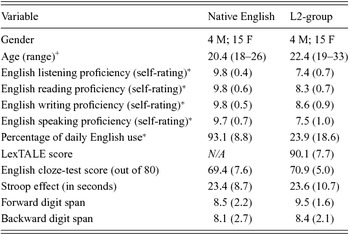
Language and other demographic data for the Native English and L2-groups are provided in Table 2. The L2-group was slightly older than the Native English group, rated themselves as less proficient in English, and used English less often on a daily basis compared with the Native English group. The groups did not differ on the English cloze-test, the Stroop task, or on the digit span tasks.
Participant demographics

Note: + significant difference between the groups, p < .05; * L2–group scored significantly lower than the Native English group, p < .0001. Numbers in parentheses indicate the range for Age, and standard deviation for other measures.
Materials
One hundred and sixty quadruplets were constructed of the type illustrated in Table 1. Most of the experimental stimuli were taken from Lau et al. (Reference Lau, Stroud, Plesch and Phillips2006). Some items were slightly modified, to make the scenarios more plausible and less culture-specific, and a few items were added. Conditions (a), “ellipsis of”, and (b), “non-ellipsis of”, were the same as in Lau et al. (Reference Lau, Stroud, Plesch and Phillips2006). In both conditions, the possessive in the second clause was followed by the preposition of, yielding an ungrammatical sentence. The ellipsis of a noun after the possessive was possible in (a), but not in (b). This means that the possessive can be a potential end of the clause in (a); in (b) an overt noun is required downstream in order for the sentence to be grammatical. In both (a) and (b), the preposition of either needs an overt noun, or a verb that takes an of-complement. The ungrammaticality in both constructions can therefore also be due to of missing an element it can modify, or due to the lack of an appropriate verb. In order to compare grammatical versus ungrammatical noun ellipsis, and to investigate effects of integration and repair, we added conditions (c), “ellipsis temporal”, and (d), “non-ellipsis temporal”. Up to and including the possessive, these conditions were the same as in (a) and (b): noun-ellipsis is possible in (c), but not in (d). In contrast to (a) and (b), the preposition following the possessive introduced a temporal modifier (before, during, after), and did not require a preceding noun. Condition (c) was therefore grammatical; Condition (d) was ungrammatical at the preposition, since ellipsis is not allowed, and an overt noun is expected rather than a preposition. Note that ellipsis after a possessive proper name is not possible in Dutch, the native language of the L2-learners in the study. In Dutch, a pronoun or other overt element must be used (Corver & van Koppen, Reference Corver and van Koppen2010). For instance, Ik zie Jans auto, maar niet *Piets “I see Jan's car, but not Piet’s,” is ungrammatical; a correct construction is Ik zie Jans auto, maar niet die van Piet, “I see Jan's car, but not that of Piet.”
A questionnaire study with 43 native English speakers (not participating in the ERP study) on 48 experimental items confirmed that the ellipsis temporal condition (c) was more acceptable than the other three conditions. On a scale from 1 (implausible) to 7 (plausible), the mean ratings were: (a) ellipsis of: 2.62 (SD 0.93); (b) non-ellipsis of : 2.04 (SD 0.86); (c) ellipsis temporal: 5.19 (SD 0.95); (d) non-ellipsis temporal: 2.37 (SD 1.03). The ellipsis temporal condition was rated as significantly more acceptable than the other three, with T-tests yielding ps < .001; in addition, the non-ellipsis of condition (b) was rated significantly worse than the other two ungrammatical conditions (ellipsis of (a) and non-ellipsis temporal (d), ps < .001).
In addition, 32 filler items for each of the following four filler conditions were constructed: (1) ellipsis context (possessive in first clause), with an overt noun in the second clause, e.g., Although Leigh emailed Kate's assistant, she did not email Amy's secretary before the class; (2) non-ellipsis context (i.e., no possessive in first clause), with a possessive and overt noun in the second clause, e.g., While Kimberly denied the criminal charges, she admitted that her lover's allegations were true; (3) non-ellipsis context in which of is used in a grammatical way, e.g., Although the nurse weighed Tristen, she forgot to take the temperature of the patient; (4) non-ellipsis context, other, e.g., Because Chloe had no other food in her house, she ate some chips for dinner. Fillers of type (1) and (2) were included to prevent participants from always expecting an elided noun in the second clause. Fillers of type (3) were included to bias participants away from noticing that all uses of the preposition of in the critical trials were ungrammatical. Fillers of type (4) introduced more variability into the sentence structures presented to participants. One fourth of all filler types contained an ungrammaticality (word order or agreement violation). The complete set of stimuli is given in the Supplementary Materials Online (Supplementary Material).
Experimental items were Latin-Squared and distributed across four lists. Fillers were the same across the lists. The order of fillers and experimental items was pseudo-randomized, such that conditions were equally distributed across the entire list and experimental trials of the same condition never occurred in immediate succession. Each participant saw only one list of 288 sentences: 160 experimental items (4 conditions of 40 trials each) and 128 fillers (4 types of 32 each). The 288 trials were broken into 8 blocks of 36 trials each, with 5 occurrences of each experimental condition, and 3–5 items of each filler type in each block.Footnote 1 The order of blocks was randomized per participant.
Procedure
During the ERP experiment, participants were seated at a distance of 100 cm from a computer monitor. The text was presented in 36-point Arial font, white against a black background. A trial started with a fixation cross presented for 700 ms in the center of the screen, followed by the words of the sentence. Each word was presented in the center of the screen for 300 ms followed by a 200 ms blank screen. The last word of each sentence was followed by a 700 ms blank screen, after which a prompt (“?”) appeared. Participants were instructed to silently read each sentence and to indicate at the prompt whether they judged the preceding sentence to be a grammatical sentence of English via a button press (left for ‘grammatical’; right for ‘ungrammatical’). They were asked to respond as quickly and accurately as possible, without sacrificing speed for accuracy. After responding, the words “Press for next” appeared on the screen; participants proceeded to the next trial at their own pace. Participants were familiarized with the procedure with a practice block of 8 items which were unrelated to the experimental manipulations. Each of the 8 blocks was followed by a short break.
Before the ERP experiment, the native English participants completed the cloze-test, the forward and backward digit span tasks, and the Stroop task. The L2 participants first completed the digit span and Stroop tasks in their native language, and then continued in their L2 (English) with the cloze-test and the LexTALE English proficiency task. During EEG setup and during the breaks in the ERP experiment, participants completed the Edinburgh Handedness Inventory and the LEAP-Q language questionnaires. These forms were all in English.
ERP Recording
EEG was recorded using Ag/AgCl electrodes mounted in a Waveguard 64 cap for the native English participants, and in a 64 channel Biosemi cap for the L2 participants. The following electrode locations were shared between the two systems: on the midline: Fpz, Fz, FCz, Cz, CPz, Pz, POz, and Oz, and at lateral sites: Fp1/2, AF3/4/7/8, F1/2/3/4/5/6/7/8, FC1/2/3/4/5/6, FT7/8, C1/2/3/4/5/6/, T7/8, CP1/2/3/4/5/6, TP7/8, P1/2/3/4/5/6/7/8, PO3/4/7/8, and O1/2. An additional 6 electrodes were placed at the following locations: both mastoids, the left and right outer canthi, above the left eye, and below the left eye. Impedance levels were generally kept below 5 kΩ, though in rare cases some electrodes could only be reduced to 10 kΩ. In the native English participants, signals were recorded using a sampling a rate of 256 Hz and referenced to the left mastoid. In the L2 participants, signals were acquired using a common reference and sampled at a rate of 2048 Hz, down-sampled to 256 Hz after recording.
EEG Analysis
In both participant groups, the signal was re-referenced off-line to the mean of both mastoids, and filtered between 0.01 and 30 Hz. Epochs were defined as -100 to 1500 ms from the onset of the possessive, that is, the word preceding the critical preposition. Averages were time-locked to the onset of the possessive, using the 100 ms window preceding the possessive as a baseline. We chose to time-lock to the onset of the possessive rather than to the critical preposition, to capture potential differences in ERPs due to the possessive signaling a potential ellipsis site in conditions (a) and (c), but not (b) and (d). Using the 100 ms time window before the onset of the possessive as a baseline, rather than the 100 ms preceding the preposition, allowed us to see to what extent early differences in the ERPs observed at the preposition were due to effects induced by the preceding possessive, and prevented confounding ERPs at the preposition with pre-existing differences between the conditions. Epochs containing blinks or other artifacts were rejected before averaging. For the Native English group, average artifact rejection rates were 11% for the ellipsis of condition; 16% for non-ellipsis of; 12% for ellipsis temporal; and 16% for non-ellipsis temporal; for the L2-group, the percentage of rejected trials were 10%, 9%, 9% and 13%, respectively. Mean amplitudes were analyzed in the following time windows, based on visual inspection and previous studies: 300–500 ms and 500–700 ms after onset of the possessive (early context effects); 900–1100 ms (that is, 400–600 ms after onset of the preposition, LAN effect); and 1200–1500 ms (that is, 700–1000 ms after onset of the preposition, P600 and late negative effects).
To avoid confounds due to the critical prepositions differing in length and frequency between conditions (a) and (b) on the one hand, and (c) and (d) on the other, we conducted two separate analyses: one comparing the two conditions containing of, (b) versus (a), and one comparing the two temporal preposition conditions, (d) versus (c). For each pair of conditions a 2 × 2 × 5 repeated measures Generalized Linear Model (GLM, Language Group x Ellipsis x Anteriority) was run on the midline electrodes, and a 2 × 2 × 2 × 5 repeated measures GLM (Language Group x Ellipsis x Hemisphere x Anteriority) was run on lateral electrodes, with Language Group (Native English, L2) as a between-subjects factor, and Ellipsis (ellipsis, non-ellipsis context), and scalp location factors as within-subject factors. Analyses on midline electrodes included Anteriority as within-subject factor (five levels: Fz, FCz, Cz, CPz and Pz). For the analyses of lateral sites, ten regions were defined: left (right) frontal: F1(2), F3(4), F5(6) and F7(8); frontal-central: FC1(2), FC3(4), FC5(6), FT7(8); central: C1(2), C3(4), C5(6), T7(8); central-parietal: CP1(2), CP3(4), CP5(6), TP7(8); and parietal: P1(2), P3(4), P5(6), P7(8). Analyses included the factor Hemisphere (two levels) and Anteriority (five levels). For effects involving factors with more than two levels, the p-value was corrected using the Greenhouse–Geisser correction for sphericity violations (Greenhouse & Geisser, Reference Greenhouse and Geisser1959). Since we were only interested in the difference in ERPs between the ellipsis and non-ellipsis conditions and between the language groups, we will only report effects involving the factor Ellipsis or Language group, that is, main effects of Anteriority, main effects of Hemisphere, and two-way interactions between Anteriority and Hemisphere are not reported because these do not convey any information as to the differences between the conditions or groups. Significant interactions of interest were followed up with separate GLMs. However, since the main focus of the study was on potential differences between L2 and native speakers in the processing of ellipsis vs. non-ellipsis conditions, separate analyses within the Language groups were conducted when differences were apparent in the means, even when the interaction between Language group and Ellipsis did not reach significance.
Results
Grammaticality judgments
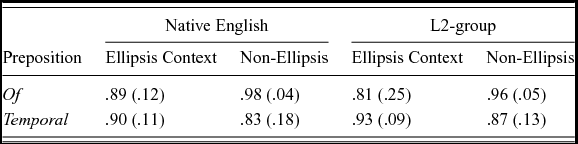
The proportions of accurate judgments in the four experimental conditions are given in Table 3. Accurate responses were the response “grammatical” for the ellipsis temporal condition (c), and “ungrammatical” for the other three conditions. In conditions with the preposition of, participants gave more accurate responses in the non-ellipsis (b) than in the ellipsis (a) contexts. With a temporal preposition, in contrast, participants gave fewer accurate responses in the non-ellipsis (d) than in the ellipsis context (c) (Ellipsis x Preposition, F(1, 36) = 17.59, p < .001; ellipsis versus non-ellipsis: of, F(1, 36) = 19.83, p < .001, temporal, F(1, 36) = 4.37, p < .05). The Native English group gave more accurate responses than the L2-group in the of conditions, and the L2-group gave more accurate responses than the Native English group in the conditions with the temporal preposition (Language group x Preposition, F(1, 36) = 4.80, p <.05). However, the effect of Language group was not significant when analyses were conducted separately for each preposition (of, F(1, 36) = 2.03, p = .16; temporal, F(1, 36) = 1.37, p = .25). No other differences between the Language groups were found (main effect of Language group, F < 1, N.S.; Language group x Ellipsis, F(1, 36) = 1.02, p = .32; Language group x Preposition x Ellipsis, F < 1, N.S.).Footnote 2
Mean (standard deviation) proportion of accurate grammaticality judgments.

ERPs: Comparing the ‘of’ conditions, (a) versus (b)
We first compared the processing of an ungrammatical preposition (of) in contexts that did allow ellipsis (a) versus contexts that did not (b). If L2-speakers differ from native speakers in terms of anticipating upcoming word categories on the basis of the preceding syntactic content, we expected the two groups to differ in the ERPs at the possessive (that is, the first position at which an elided noun can be predicted), and/or in early effects at the preposition, such as the LAN effect observed by Lau et al. (Reference Lau, Stroud, Plesch and Phillips2006). In particular, the native speakers were expected to show differences between the ellipsis and non-ellipsis contexts, whereas the L2-learners were expected not to do so.
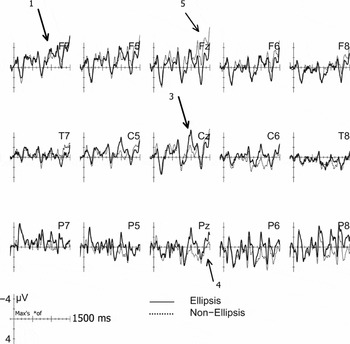
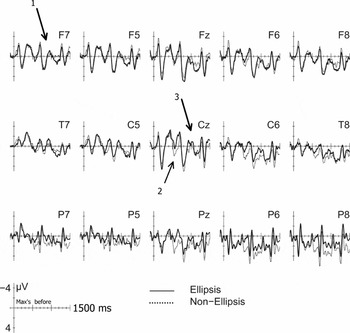
The ERPs for conditions (a) and (b), starting from the onset of the possessive, are displayed in Figure 1 for the Native English group and in Figure 2 for the L2-group.
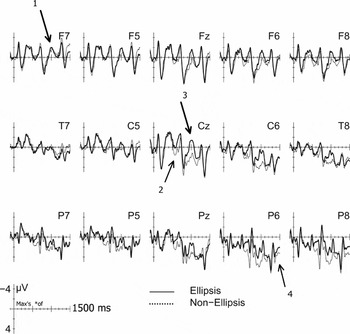
ERPs for the Native English group, ellipsis of condition (solid line) and non-ellipsis of condition (dotted line). ERPs are plotted from the onset of the possessive onwards. The preposition of starts at 500 ms. 1: absence of a LAN effect; 2: early positivity for non-ellipsis versus ellipsis condition; 3: positivity for non-ellipsis/negativity for ellipsis, 400–600 ms after onset of the preposition; 4: late positivity for the non-ellipsis condition at posterior sites.

ERPs for the L2-group, ellipsis of condition (solid line) and non-ellipsis of condition (dotted line). ERPs are plotted from the onset of the possessive onwards. The preposition of starts at 500 ms. 1: absence of a LAN effect; 3: positivity for non-ellipsis/negativity for ellipsis, 400–600 ms after onset of the preposition; 4: late positivity for the non-ellipsis condition at posterior sites; 5: late negativity for non-ellipsis condition at frontal sites.

Right after the onset of the preposition (that is, 500 ms after the onset of the possessive), we observed a posterior positivity for the non-ellipsis (b) versus ellipsis (a) conditions for the Native English group only (arrow 2 in Figure 1). In contrast to Lau et al. (Reference Lau, Stroud, Plesch and Phillips2006), however, we did not see a LAN effect at the preposition for the non-ellipsis versus ellipsis condition for either group (arrow 1 in Figures 1 and 2).
Our second set of predictions concerned effects of integration. We expected L2-speakers to differ from native speakers in the effect of context on the P600 at the preposition, and later effects reflecting integration and repair. As can be seen in Figures 1 and 2, both groups showed a difference for the non-ellipsis versus ellipsis condition at right central-posterior sites at 400–600 ms after the onset of the preposition (arrow 3 in Figures 1 and 2). This effect can either be seen as a positive shift for the non-ellipsis condition or an increased negativity for the ellipsis condition. At the end of the epoch, 700–1000 ms after the onset of the preposition, the L2-speakers’ ERPs for the non-ellipsis condition were more negative than for the ellipsis condition at anterior sites (arrows 4 and 5 in Figures 1 and 2). This difference was absent in the native speakers. Statistical evaluations of these observations are reported in the next paragraphs.
Context effects at the possessive
Early effects of context were assessed at the 300–500 ms and 500–700 ms time-windows after the onset of the possessive. No differences between the conditions or language groups were observed in the 300–500 ms interval after the onset of the possessive. Starting 500–700 ms after onset of the possessive (i.e., 0–200 ms after presentation of the critical preposition, arrow 2 in Figure 1), the non-ellipsis of (b) was more positive relative to the ellipsis of (a) condition. This positivity had a central-posterior maximum (Ellipsis x Anteriority, midline, F(4, 144) = 2.46, p = .08; lateral, F(4, 144) = 3.91, p < .05). Judging from Figures 1 and 2, the 500–700 ms positivity for the non-ellipsis condition was present only in the Native English group. Although the factor Language group did not significantly interact with Ellipsis effects (ps > .18), our research question justified a comparison within each group. Analyses for the groups separately yielded a main effect of Ellipsis for the Native English group only (midline, F(1, 18) = 4.79, p <.05; lateral, F(1, 18) = 3.78, p = .07; L2-group: Fs < 1, N.S.).
Context effects at the preposition
Context effects at the preposition were assessed 900–1100 ms after onset of the possessive, that is, 400–600 ms after onset of the preposition. In this time window, ERPs to the non-ellipsis condition were more positive going compared with the ellipsis condition (midline, F(1, 36) = 5.90, p <.05; lateral, F(1, 36) = 4.13, p < .05). This difference was largest over right central-posterior sites (Ellipsis x Anteriority: midline, F(4, 144) = 4.69, p < .01; lateral, F(4, 144) = 2.34, p = .13; Ellipsis x Hemisphere, F(1, 36) = 5.57, p < .05, Ellipsis x Hemisphere x Anteriority, F(4, 144) = 3.59, p < .05). The hemispheric asymmetry of the ellipsis effect was more pronounced in the Native English than the L2-group (Ellipsis x Hemisphere x Language Group, F(1, 36) = 3.99, p = .053; Ellipsis x Hemisphere: Native English, F(1,18) = 8.51, p <.01; L2, F(1,18) < 1, N.S.)
Later effects at the preposition
In the 1200–1500 ms interval after the onset of the possessive (700–1000 ms after onset of the preposition), the non-ellipsis condition (b) continued to elicit more positive ERPs at posterior sites than the ellipsis condition (a), especially over the right hemisphere (Ellipsis x Anteriority, midline, F(4, 144) = 5.95, p < .01; lateral, F(4, 144) = 4.69, p < .05; Ellipsis x Hemisphere: F(1, 36) = 7.98, p < .01, Ellipsis x Hemisphere x Anteriority: F(4, 144) = 3.32, p < .05). In addition, in the L2 participants, the ERPs for the non-ellipsis condition were more negative than for the ellipsis condition over frontal sites, leading to an interaction of Ellipsis x Anteriority x Language group (midline, F(4, 144) = 6.36, p < .001; lateral, F(4, 144) = 2.79, p = .09). Analyses for the language groups separately revealed an Ellipsis x Anteriority interaction for the L2-group only (L2, midline, F(4, 72) = 12.01, p < .001; lateral, F(4, 72) = 6.94, p < .01; Native English, midline and lateral: F(4, 72) < 1, N.S.).
Summary: (a) vs. (b)
To summarize these results, both language groups showed sensitivity to the contextual manipulation. Starting at 400 ms after onset of the preposition of, ERPs in both groups were more positive for the non-ellipsis than for the ellipsis condition. This effect tended to be more right-lateralized in the Native English group. This effect can be interpreted either as a P600 for the non-ellipsis conditions, and/or an N400 for the ellipsis condition. We will return to this in the Discussion section. The Native English group, but not the L2-group, showed an earlier positivity for the non-ellipsis versus ellipsis conditions, starting 500 ms after onset of the possessive, although the interaction with language group was not significant for this effect. Given its early onset, this effect suggests that the Native and L2-groups differed in the anticipation and early processing of the critical preposition.
Finally, the L2 and Native groups differed in the presence of a late frontal negativity, occurring 1200–1500 ms after the onset of the possessive, for the non-ellipsis versus ellipsis conditions in the L2-group, but not in the Native English. This suggests that the groups differed in the processing resources available, or in the processes involved in dealing with the ungrammaticality in ellipsis of contexts.
ERPs: Comparing the temporal conditions, (c) versus (d)
We also compared ERPs for ellipsis and non-ellipsis contexts containing a temporal preposition which did not require an overt noun or specific verb (conditions (c) and (d) in Table 1). This comparison allowed us to test the effect of a grammatical versus ungrammatical omission of a noun, independently of the ungrammaticality of the preposition. Also here, we had expected the L2 and Native groups to differ in early effects of context (ellipsis (c) vs. non-ellipsis (d)) at the possessive or preposition, and in the P600 and later effects for the ungrammatical (d) versus grammatical (c) condition.
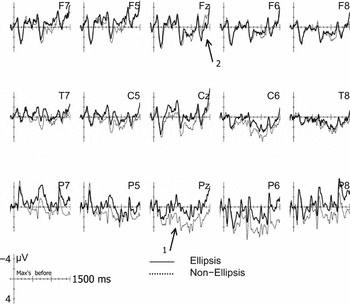
The ERPs for the ellipsis temporal (c) and non-ellipsis temporal (d) conditions are displayed in Figures 3 and 4 for the Native English and L2-groups, respectively.
ERPs for the Native English group, ellipsis temporal condition (solid line) and non-ellipsis temporal condition (dotted line). ERPs are plotted from the onset of the possessive onwards. The preposition starts at 500 ms. 1: absence of a LAN effect; 2: early positivity for non-ellipsis versus ellipsis condition. 3: absence of a 400–600 ms effect.

ERPs for the L2-group, ellipsis temporal condition (solid line) and non-ellipsis temporal condition (dotted line). ERPs are plotted from the onset of the possessive onwards. The preposition starts at 500 ms. Note the early spurious positivity (arrow 1), and the late frontal negativity for the non-ellipsis condition (arrow 2).

As in the (a) versus (b) contrast, the Native English group (Figure 3) showed a positivity for the non-ellipsis versus ellipsis conditions 500–700 ms after onset of the possessive (arrow 2 in Figure 3). Also, no LAN was observed (arrow 1 in Figure 3). In contrast to the (a) vs. (b) comparison, however, no differences were seen between 400–600 ms after onset of the preposition (arrow 3 in Figure 3).
The L2-group (Figure 4) showed a long-lasting posterior positivity for the non-ellipsis temporal condition (d), which started shortly after the onset of the possessive (arrow 1 in Figure 4). Towards the end of the epoch, 700–1000 ms after the onset of the preposition, this positivity turned into a negativity at frontal sites (arrow 2). Recall that the L2-group did not show an early-onset slow positivity in the comparison between the two of conditions, (b) and (a). Since the sentences in (c) and (d) were exactly the same as those in (a) and (b) before the preposition across the experiment, and no early differences were seen in the (a) vs. (b) contrast in the L2-group, we consider the slow positivity observed for the (d) vs. (c) condition a spurious effect caused by an unknown, task-irrelevant source. This spurious positivity makes it hard to interpret any differences between the Native and L2-group, especially those related to the early effects of context. We therefore assessed the early effects in the Native English group only. To assess the later effects of integration and repair, we used the 100 ms interval preceding the onset of the preposition as a baseline. This means that the differences between the conditions observed before the onset of the preposition are subtracted out from the ERPs observed at the preposition, allowing us to see whether the difference between the two conditions changed relative to that observed in the baseline period. Potential differences between the groups should still be interpreted with caution, however, due to differences during this baseline interval. Figures in which the ERPs are time-locked to the onset of the preposition are provided in the Supplementary Material Online (Supplementary Material).
Context effects at the possessive (Native English only)
Early context effects were assessed at the 300–500 ms and 500–700 ms time-windows after the onset of the possessive for the Native English only. No effects were significant for the 300–500 ms interval. Analysis on the 500–700 ms interval from the onset of the possessive showed a significant positive difference for the non-ellipsis (d) versus ellipsis condition (c) which was largest over posterior sites (midline, Ellipsis, F(1, 18) = 3.30, p = .09; Ellipsis x Anteriority F(4,72) = 7.44, p < .001; lateral, Ellipsis, F(1, 18) = 3.51, p = .08; Ellipsis x Anteriority F(4, 72) = 10.90, p < .001).
Late effects (pre-preposition baseline, both groups)
Using a pre-preposition baseline, the 400–600 ms time window (corresponding to 900–1100 ms from the onset of the possessive) yielded no significant effects. In the 700–1000 ms interval (1200–1500 ms from the onset of the possessive), the L2-group showed a frontal negativity for the ungrammatical versus the grammatical condition, as in the of conditions, leading to an interaction of Ellipsis x Anteriority (midline, F(4, 144) = 4.05, p < .05; lateral, F(4, 144) = 3.21, p = .07). Although the interaction with Language group was not significant (ps >.18), the Ellipsis x Anteriority interaction at the midline sites was only observed for the L2-group (F(4, 72) = 3.55, p < .05; Native English: F(4, 72) < 1, N.S).
Summary: (c) vs. (d)
Although the results for the (d) versus (c) comparison need to be interpreted with caution, the posterior positivity for the non-ellipsis versus ellipsis conditions, starting 500 ms after offset of the possessive, was again present for the Native English group. Due to the slow-positive artifact in the L2-group, it is hard to judge whether the L2-group showed a similar effect.
The main difference in results between the present comparisons and the of-conditions was the absence of the 400–600 ms effect for the ellipsis versus non-ellipsis conditions. This suggests that this effect was primarily driven by the use of the ungrammatical preposition of in an ellipsis context. As in the conditions containing the preposition of, we failed to find a LAN effect at the preposition, even though the critical preposition was a grammatical continuation in one condition, but not in the other. Similar to the of conditions, we saw a late frontal negativity at the preposition for the non-ellipsis versus ellipsis conditions which was more prominent in the L2-learners.
Direct comparison with Lau et al. (Reference Lau, Stroud, Plesch and Phillips2006)
In both comparisons (b) vs. (a), and (d) vs. (c), we failed to replicate the LAN effect reported by Lau et al. (Reference Lau, Stroud, Plesch and Phillips2006). One difference between our study and Lau et al.'s is that Lau et al. referenced their EEG to the average of all electrodes, and observed a LAN only using this reference. In addition, Lau et al. time-locked the ERPs to the onset of the preposition, using the 100 ms interval preceding the preposition as a baseline. To more closely compare our findings to those reported by Lau et al. (Reference Lau, Stroud, Plesch and Phillips2006), we re-referenced the EEG to the average of all scalp electrodes and used the same baseline as Lau et al. to investigate the ERPs at the preposition. The resulting figures are provided in the Supplementary Material Online (Supplementary Material). Using an average reference, and time-locking to the onset of the preposition, we did observe a negative deflection in the ERPs at left anterior sites for the non-ellipsis (b) versus ellipsis (a) conditions for the Native English speakers, but not for the L2-group. However, the negative deflection for the non-ellipsis condition started right at the onset of the preposition, which is too early to be a LAN effect elicited by the ungrammatical preposition. An analysis of the mean amplitude at left-frontal sites, restricted to the Native English speakers yielded no significant difference between the non-ellipsis and ellipsis conditions in the 400–600 ms interval for which Lau et al. reported a significant effect of Ellipsis (F(1, 18) = 1.11, p = .31). The effect was almost significant in the 0–200 ms window (F(1, 18) = 4.04, p = .06), however. Given the timing of the effect, we interpret this effect as the equivalent of the early positivity for the non-ellipsis condition that we reported above for the Native English group when referencing to the averaged mastoids.
Discussion
Summary of aim and results
The aim of this paper was to investigate to what extent advanced L2-learners differed from native speakers in the anticipation, integration and repair of syntactic information during reading. To this aim we used two-clause contexts in which the structure of the first clause either allowed or did not allow noun-ellipsis after a possessive in the second clause. We investigated whether native and L2-speakers differed in the processing of the possessive and the following grammatical or ungrammatical preposition (the preposition of, or a temporal preposition). Previous studies have reported a reduced ability for L2-speakers to actively anticipate information (Dussias et al., Reference Dussias, Valdés Kroff, Guzzardo Tamargo and Gerfen2013; Grüter et al., Reference Grüter, Lew-Williams and Fernald2012; Grüter & Rohde, Reference Grüter and Rohde2013; Hopp, Reference Hopp2013; Lew-Williams & Fernald, Reference Lew-Williams and Fernald2010; Martin et al., Reference Martin, Thierry, Kuipers, Boutonnet, Foucart and Costa2013). Our expectation was that if L2-speakers do not use syntactic information to anticipate the upcoming syntactic categories, that is, an overt noun or elided noun in this case, they would not show any differences between the ellipsis and non-ellipsis conditions at the possessive or shortly after the onset of the ungrammatical preposition, such as the LAN effect observed by Lau et al. (Reference Lau, Stroud, Plesch and Phillips2006). If the L2-speakers’ difficulty lies in the integration of syntactic information across clauses, as is implied by, e.g., the Shallow Structure Hypothesis (Clahsen & Felser, Reference Clahsen and Felser2006), L2-learners would differ from native speakers in the P600 at the critical preposition and in later effects indexing integration and repair.
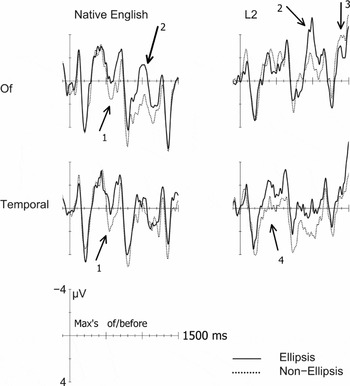
Across the board, the results for the L2 and native groups were remarkably similar. L2-learners did not differ from native speakers in judging the grammaticality of the sentences. Figure 5 summarizes the results for the ERPs. Both groups showed a larger posterior positivity/smaller negativity for the ungrammatical non-ellipsis relative to ellipsis conditions, starting at 400 ms after onset of the preposition of, suggesting that both groups employed overlapping integrative or repair processes at this point (arrow 2 in Figure 5). The two groups differed in two respects. First, the Native English group showed an early difference between the non-ellipsis and ellipsis conditions: the non-ellipsis condition elicited a central-parietal positivity in this group right at the onset of the preposition in both (b) versus (a), and (d) versus (c), (arrow 1 in Figure 5). Second, only the L2-group showed a late frontal negativity for the non-ellipsis condition in the of conditions (b) vs. (a) (arrow 3 in Figure 5). The effects for (d) vs. (c) were hard to evaluate for the L2-speakers because of the spurious slow positivity for this group (arrow 4 in Figure 5). A final finding is that, in contrast to the Lau et al. (Reference Lau, Stroud, Plesch and Phillips2006) study, no LAN effect was observed for the non-ellipsis vs. ellipsis of conditions. Below we will further discuss the effect starting at 400 ms that was shared between the groups, followed by a discussion of the effects that were different: the early ellipsis effect and the later effects. We will also address the absence of a LAN effect.
ERPs at the central midline electrode (Cz) for ellipsis (solid line) and non-ellipsis conditions (dotted line). Upper row: of conditions; bottom row: conditions with a temporal preposition; Left column: Native English group; right column L2-group. ERPs are plotted from the onset of the possessive onwards. The preposition starts at 500 ms. 1: early positivity for non-ellipsis versus ellipsis condition in the Native English group; 2: increased positivity/decreased negativity for the non-ellipsis of conditions in both groups, 400–600ms after onset of the preposition; 3: late fronto-central negativity for the non-ellipsis condition in the L2 group (700–1000 ms after onset of the preposition); 4: spurious slow positive wave for the L2-group in the conditions with a temporal preposition.

Shared effects of integration
If L2-learners have difficulty integrating information across clauses, the L2-group was expected to differ from native speakers in the later components reflecting integration and repair of the ellipsis, such as the P600 and later negativity.
Both the Native English and the L2-group showed a larger positivity/smaller negativity for the non-ellipsis versus ellipsis conditions starting at 400 ms after the onset of the preposition of (arrow 2 in Figure 5). This effect was not found for the non-ellipsis versus ellipsis conditions with temporal prepositions. There are two interpretations of this effect. The first is that the effect is a P600 effect, reflecting integration and revision processes, but with an earlier onset in the non-ellipsis of condition (b), and a later onset and smaller amplitude in the other ungrammatical conditions (ellipsis, of; non-ellipsis temporal). This would be in line with the pattern seen in the behavioral data. Participants were less likely to detect the ungrammaticality in the ellipsis of and non-ellipsis temporal condition than in the non-ellipsis of condition. In addition, when corrected for the pre-preposition differences, the native speakers did not show any significant differences in the ERPs between the grammatical and ungrammatical temporal conditions (d vs. c). This difference in the processing of the ungrammaticality between the conditions can be attributed to the number of cues available that indicate that the sentence is ungrammatical. In the non-ellipsis of condition, there are two cues: first, the absence of a required overt noun after the possessive, and, second, the absence of a noun or verb that of can modify. In contrast to the temporal prepositions, the preposition of needs either an overt noun it can modify, or a particular verb that takes an of- phrase as an argument (e.g., to remind somebody of something). In the non-ellipsis temporal condition the absence of an overt noun is the only cue that the sentence is ungrammatical; in the ellipsis of condition, the absence of noun or verb for of is the only cue. The difference in the timing and amplitude of the positivity may therefore reflect the ease with which the ungrammaticality is detected.
A second interpretation is that the effect observed in the of conditions is a combination of a P600 and an N400 effect. Under this interpretation, N400 reflects the difficulty with the semantic integration of the preposition of into the preceding context. The word of is hard to semantically integrate, since it does not have a verb or noun it modifies. N400 effects have been reported in similar situations, in which the clause contained an additional noun phrase which was not licensed by the verb (Friederici & Frisch, Reference Friederici and Frisch2000). The difference between the non-ellipsis and ellipsis of conditions can then be accounted for as follows. As suggested by the grammaticality judgment data, it may have been easier to spot the ungrammaticality of of in the non-ellipsis (b) than in the ellipsis context (a): the only possible continuation in the non-ellipsis context was an overt noun or an adjective; hence, the presence of of resulted in a phrase structure violation. This early detection of an ungrammaticality may have prevented readers from trying to integrate the preposition of in a semantic way, leading to the absence of an N400 effect or an early P600 in the non-ellipsis condition. This is similar to situations in which no N400 effects were reported for a semantically anomalous critical word when this word also formed a phrase structure violation (Frisch, Hahne & Friederici, Reference Frisch, Hahne and Friederici2004; Hahne & Friederici, Reference Hahne and Friederici2002).
Regardless of the interpretation of the 400–600 ms effect, the fact that the L2 as well as the Native English speakers showed the effect only for the ellipsis of condition suggests that both groups are similarly sensitive to the restrictions on the use of of, and that both groups used the structure of the preceding clause in detecting the ungrammaticality in the second clause. The only difference observed was a stronger right lateralization of the effect for the Native English group. One interpretation of this difference in scalp distribution is that the two groups made a slightly different trade-off between semantic integration, as indexed by an increased central N400-negativity, and syntactic integration/revision, as reflected by an increased parietal positivity. For differences among individuals in this respect see, e.g., Tanner, Inoue and Osterhout (Reference Tanner, Inoue and Osterhout2014), and Tanner and Van Hell (Reference Tanner and Hell2014).
Differences between L2 and Native speakers: Early context effect
The Native English, but not the L2-group, showed a posterior positivity for non-ellipsis versus ellipsis conditions (arrow 1 in Figure 5). We are cautious here, since we did not obtain a significant interaction with Language group. This ellipsis effect was present in the Native English group for conditions with of as well as a temporal preposition, and started 500 ms after onset of the possessive, that is, right at the onset of the preposition. This early onset makes it rather unlikely that this effect is a response to the preposition. Instead, the effect may reflect differences in the expectation of what is to follow the possessive. In contrast to the conditions allowing ellipsis, the non-ellipsis conditions required an overt noun to follow the possessive in order for the sentence to be complete; the ellipsis conditions could be interpreted as being complete at the possessive. A similar, though non-significant posterior positivity was reported by Osterhout, Holcomb and Swinney (Reference Osterhout, Holcomb and Swinney1994) for noun phrases following verbs that could take a sentential complement (e.g., The doctor hoped/believed/charged the patient ) compared with noun phrases following intransitive verbs (e.g., The doctor forced the patient ). In the latter case, the noun phrase can be the end of the clause, and no particular predictions can be made concerning the nature of the upcoming material; in the sentential complement conditions, in contrast, the noun phrase can be followed by a finite verb. The positivity may therefore reflect this difference in expectation. Native English speakers and advanced L2-learners in our study may thus have differed in the anticipation of syntactic information.
Alternatively, the effect starting at 500 ms after the onset of the possessive can be interpreted as a larger negativity for the ellipsis compared to the non-ellipsis conditions. This negativity may then reflect the anticipation and processing of the elided element. Previous studies on ellipsis often reported negativities associated with ellipsis starting at the word after the elided element (Kaan, Overfelt, Tromp & Wijnen, Reference Kaan, Overfelt, Tromp and Wijnen2013; Streb, Henninghausen & Rösler, Reference Streb, Henninghausen and Rösler2004), which were more anterior in distribution, however. The exception is Dimitrova (Reference Dimitrova2012), who reported a 400–700 ms, broadly distributed, negativity for prosodically stressed words directly preceding elided materials. In the Dimitrova (Reference Dimitrova2012) study, the prosody signaled the upcoming ellipsis. Similarly, in our experiment, the parallelism between the possessive in the first and second clause may have signaled an upcoming elided noun. Under this interpretation of the effect, L2-learners differed from the Native English group in the lack of anticipation of the ellipsis at the possessive. Further research is needed to tease these two interpretations apart.
A third, but somewhat problematic interpretation is that the effect is an early P600 and that the Native English participants may have been more sensitive to experimentally-induced manipulations. All non-ellipsis conditions in our experimental items were ungrammatical. Although we tried to counter the ungrammaticality bias by including 32 grammatical fillers with a possessive in the second clause, this may not have been enough to counterbalance the 80 ungrammatical non-ellipsis experimental items. The positivity observed for the non-ellipsis versus ellipsis conditions starting 500 ms after the onset of the possessive could then be interpreted as a P600 triggered by the possessive in the non-ellipsis condition, in anticipation of the upcoming ungrammaticality. The language groups, then, may have differed in the expectation of the ungrammaticality, induced by the experiment. We conducted a post-hoc analysis to test this interpretation. If the 500–700 ms positivity were indeed related to the experimentally-induced anticipation of the ungrammaticality, the positivity would have been stronger towards the end of the experiment. However, the effect in the Native English group was stronger in the first half of the experiment, instead (midline sites, F(1, 18) = 6.00, p < .05, mean 1.18 μV; second half, F(1, 18) = 1.00, p = .33, mean 0.40 μV). This is problematic for an interpretation of the early effect in terms of experiment-induced strategies.
Differences between L2 and Native speakers: Late effect (1200–1500 ms)
We found that the L2-group showed a frontal negativity (arrow 3 in Figure 5) and a late posterior positivity for the non-ellipsis versus ellipsis conditions, whereas the native speakers only showed the posterior effect. This suggests that, although the groups were similarly sensitive to the context in the initial stages of integration (as reflected in the 400–600 ms effect), the two groups differed in the later stages of integration and repair.
Late frontal negativities following the P600 in response to ungrammaticalities have been observed in native speakers (Alemán Bañón et al., Reference Alemán Bañón, Fiorentino and Gabriele2012; Gillon Dowens et al., Reference Gillon Dowens, Vergara, Barber and Carreiras2010; Sabourin & Stowe, Reference Sabourin and Stowe2004) as well as L2-learners (Gillon Dowens et al., Reference Gillon Dowens, Vergara, Barber and Carreiras2010; Hahne & Friederici, Reference Hahne and Friederici2001; Isel, Reference Isel2007; Morgan-Short et al., Reference Morgan-Short, Steinhauer, Sanz and Ullman2012; Sabourin & Stowe, Reference Sabourin and Stowe2008), with some studies reporting larger or earlier effects in L2-learners (Hahne & Friederici, Reference Hahne and Friederici2001; Isel, Reference Isel2007; Sabourin & Stowe, Reference Sabourin and Stowe2008). Two interpretations of this effect have been proposed. The first is that the slow anterior negativity reflects working memory load (Morgan-Short et al., Reference Morgan-Short, Steinhauer, Sanz and Ullman2012; Ruchkin, Grafman, Cameron & Berndt, Reference Ruchkin, Grafman, Cameron and Berndt2003), either due to the maintenance of the response that is due at the sentence end (Sabourin & Stowe, Reference Sabourin and Stowe2004), or due to keeping language material in working memory after attempts at repair fail (Sabourin & Stowe, Reference Sabourin and Stowe2008). Since second-language processing is often more effortful, repairing an ungrammaticality, maintaining uninterpreted material, or maintaining a response will put more burden on working memory in L2-speakers than in native speakers, leading to a larger negativity in the L2-group.
A second interpretation is that the frontal negativity reflects a semantic-conceptual way of repairing the ungrammaticality. This interpretation has been proposed by Hahne and Friederici (Reference Hahne and Friederici2001), who report a right anterior negativity in L2-speakers for semantic violation and violations that combined syntactic and semantic errors. Under this interpretation, our L2-speakers differ from the Native English speakers in the processes recruited in repairing the ungrammaticality caused by the lack of an overt noun in the non-ellipsis constructions: whereas the Native English speakers may not have attempted to semantically repair the missing noun in these conditions, the L2-speakers might have done so.
In an attempt to find support for one interpretation of the negativity over the other, we correlated the size of the late negativity over right-frontal sites (average of the F2/4/6/8 electrodes) for the non-ellipsis vs. ellipsis of condition in the L2-group, on the one hand, with the L2-learners’ performance on the backwards digit span task in their native language, on the other. A working memory interpretation of the late negativity predicts that L2-speakers with a smaller working memory span will show a larger frontal negativity. We did not find any relation between backward digit span and frontal negativity, however (Pearson's r = ‑.22; p = .36). We therefore do not have evidence directly favoring the working memory interpretation over the conceptual processing interpretation of the frontal negativity.
Absence of a LAN effect
Lau et al. (Reference Lau, Stroud, Plesch and Phillips2006) reported a larger LAN effect for the non-ellipsis versus ellipsis of conditions for native speakers, which they interpreted as the LAN being an index of prediction strength. The underlying reasoning is that the possessive in the non-ellipsis contexts needs a noun in order for the sentence to be grammatical; in the ellipsis contexts, the ellipsis could be a potential end of the clause; predictions regarding upcoming information are weaker in the latter than in the former case, leading to a weaker effect of the phrase structure violation (hence, smaller LAN effect) induced by the preposition of in the ellipsis versus non-ellipsis context. In contrast to Lau et al. (Reference Lau, Stroud, Plesch and Phillips2006), we did not observe a LAN effect in either language group. The failure to replicate the LAN effect is not very surprising given the inconsistency of the LAN effect across studies; see Steinhauer and Drury (Reference Steinhauer and Drury2012) for a critical review. Note that even in the Lau et al. (Reference Lau, Stroud, Plesch and Phillips2006) study, the LAN effect was not very robust, as it was no longer visible when the EEG was referenced to the averaged mastoids –which is a very commonly used reference in ERP research on sentence processing. In fact, after referencing to average mastoids, the Lau et al. results looked remarkably similar to the N400/P600 effects we observed (Lau et al., Figure 4). As discussed above and in the Supplementary Material Online (Supplementary Material), even after re-referencing our data using an average reference and using the same baseline as in Lau et al., we did not observe a significant LAN effect at the preposition of. We did observe an earlier left-frontal negativity, but given its early onset, we interpret this as the average-reference equivalent of the early positivity discussed above.
We should note that there were some other differences between the Lau et al. (Reference Lau, Stroud, Plesch and Phillips2006) study and ours. For instance, Lau et al. used three times as many grammatical as ungrammatical stimuli, whereas in our experiment, the number of grammatical and ungrammatical trials was about equal. In addition, our filler stimuli were different from those used by Lau et al. These and other differences in design could have affected the strategies used by participants in the two studies, and, hence, may have affected the presence of a LAN effect. The aim of our study, however, was not to directly replicate the Lau et al. study, but to use their ellipsis-paradigm as a means to test differences in anticipatory processing and integration between native and L2-speakers, regardless of whether these differences would emerge in the LAN effect, or in other components.
Conclusion
The present study aimed to identify differences between native and non-native speakers in the processing of ellipsis, especially concerning the combination of information across clauses, and the anticipation of syntactic categories during processing. Our advanced L2-speakers were very similar to native speakers: Grammaticality judgments were comparable between the groups, and both groups showed similar N400/P600 effects. This suggests that our advanced L2-learners had native-like knowledge of restrictions on ellipsis and the use of the preposition of, and were equally sensitive to whether the context allowed ellipsis or not. The groups differed in when and how this knowledge was used. First, the L2-speakers showed a late frontal negativity in the non-ellipsis conditions, suggesting either an increased working memory load or the use of different repair strategies compared with native speakers. Second, the native English speakers showed an early effect distinguishing ellipsis from non-ellipsis constructions, suggesting they anticipated upcoming information (either the ellipsis, or an upcoming noun phrase), whereas the L2-learners did not. The latter is in line with other studies suggesting that L2-speakers do not predict in the same way as native speakers do (Grüter et al., Reference Grüter, Lew-Williams and Fernald2012; Kaan, Reference Kaan2014; Kaan et al., Reference Kaan, Dallas, Wijnen, Zwart and de Vries2010; Martin et al., Reference Martin, Thierry, Kuipers, Boutonnet, Foucart and Costa2013), although this depends on proficiency (Dussias et al., Reference Dussias, Valdés Kroff, Guzzardo Tamargo and Gerfen2013; Hopp, Reference Hopp2013) and the typological relation between the first and second language (Dussias et al., Reference Dussias, Valdés Kroff, Guzzardo Tamargo and Gerfen2013).
Although the current data can be accounted for by the Shallow Structure Hypothesis (Clahsen & Felser, Reference Clahsen and Felser2006), for instance, by assuming that ellipsis involves the matching of stored phrase-structural templates, rather than the active computation of detailed syntactic structures, the present data are more directly compatible with a view according to which L2-speakers can attain the same syntactic knowledge as native speakers and use this information on-line, but differ from native speakers in the predictive use of information, and in either processing resources (Sorace, Reference Sorace2011) or strategies related to repair. Future research should explore the mechanisms that affect the anticipatory use of information and differences in repair strategy (e.g., speed and consistency of lexical access, Hopp, Reference Hopp2013; Kaan, Reference Kaan2014), and to what extent the differences observed between the L2-speakers and native speakers are a function of L2 proficiency.
Supplementary material
For supplementary material accompanying this paper, visit http://dx.doi.org/10.1017/S1366728914000844