Introduction
The eurypterids are an extinct group of Paleozoic (specifically from Middle Ordovician to late Permian) aquatic predatory chelicerates. Some forms attained giant size (2.5 m long; Lamsdell and Braddy, Reference Lamsdell and Braddy2010), but most were less than 50 cm long. Some 250 eurypterid species have been recovered from marine (often inshore) to freshwater settings. They are rarely preserved as fossils due to their unmineralized cuticle, but they do occur in large numbers in some Siluro-Devonian Konservat-Lagerstätten. Eurypterids attained their maximum diversity during the late Silurian and Early Devonian (Plotnick, Reference Plotnick, Boucot and Lawson1999).
Ordovician eurypterids are extremely rare, so any reported occurrence is of great significance to understanding their early evolutionary history. Many reported species from the Ordovician of New York State are particularly dubious (see Braddy et al., Reference Braddy, Tollerton, Racheboeuf, Schallreuter, Webby, Droser and Paris2004; Tollerton, Reference Tollerton2004), being either misidentified fossils or pseudofossils. Three equivocal specimens from the Upper Ordovician of Shanxi Province (S. Yanbin, personal communication, 2002) were referred to ?Eurypterida indet. (cf. Onychopterella) or possibly nautiloids (Braddy et al., Reference Braddy, Tollerton, Racheboeuf, Schallreuter, Webby, Droser and Paris2004). Unfortunately, these dubious fossils seem to have been lost, while the original report was not accompanied by figures and descriptions, so no restudy and further assignments are possible.
To date, only 12 species of Ordovician eurypterids are known in the world. Most of them are the large predatory forms of the Megalograptidae, including Pentecopterus decorahensis Lamsdell et al., Reference Lamsdell, Briggs, Liu, Witzke and McKay2015, Echinognathus clevelandi Walcott, Reference Walcott1882, Eocarcinosoma batrachophthalmus Caster and Kjellesvig-Waering, Reference Caster and Kjellesvig-Waering1964, Megalograptus alveolatus Shuler, Reference Shuler1915, M. welchi Miller, Reference Miller1874, M. ohioensis Caster and Kjellesvig-Waering, Reference Caster and Kjellesvig-Waering1955, M. shideleri Caster and Kjellesvig-Waering, Reference Caster and Kjellesvig-Waering1964, and M. williamsae Caster and Kjellesvig-Waering, Reference Caster and Kjellesvig-Waering1964. The others are smaller forms, including Orcanopterus manitoulinensis Stott et al., Reference Stott, Tetlie, Braddy, Nowlan, Glasser and Devereux2005, Brachyopterus stubblefieldi Størmer, Reference Størmer1951, Onychopterella augusti Braddy, Aldridge, and Theron, Reference Braddy, Aldridge and Theron1995, and Paraeurypterus anatoliensis Lamsdell, Hoşgör, and Selden, Reference Lamsdell, Hoşgör and Selden2013.
The earliest known eurypterid, Pentecopterus decorahensis Lamsdell et al., Reference Lamsdell, Briggs, Liu, Witzke and McKay2015 from the Darriwilian of Iowa, was described as a megalograptid, but it lacks cercal blades, so it is more likely to be an intermediate between the megalograptids and the other Eurypterina. Lamsdell et al. (Reference Lamsdell, Briggs, Liu, Witzke and McKay2015) resolved megalograptids in a more derived position than most workers (e.g., Tetlie, Reference Tetlie2007), dragging down the ghost range of all eurypterid lineages into the Early Ordovician. Lamsdell et al. (Reference Lamsdell, Hoşgör and Selden2013) described Paraeurypterus anatoliensis from the Upper Ordovician (Katian) of southeast Turkey and regarded it as an intermediate between the Dolichopteridae and Eurypteridae. They also inferred long ghost ranges, and a “missing” Ordovician fossil record for eurypterids, proposing that they actually originated in Gondwana and radiated to Laurentia and Baltica in the Late Ordovician and early Silurian, a hypothesis adopted to explain their sudden diverse appearance in Europe and North America.
Chinese eurypterids are known primarily from Silurian strata, with the mixopterid Terropterus xiushanensis from the Llandovery of Xiushan County, Chongqing Municipality, and Wuhan, Hubei Province (Wang et al., Reference Wang, Dunlop, Gai, Lei, Jarzembowski and Wang2021). Hughmilleria wangi was recorded by Tetlie et al. (Reference Tetlie, Selden and Ren2007) from the late Llandovery of Hunan Province, to which the specimens figured by Wang et al. (Reference Wang, Geng, Xiao and Zhu1988) from the same horizon in western Hunan Province may also be related. From the Wenlock of Xintan, Hubei Province, Eurypterus loi, E. styliformis, and E. yangi were described by Chang (Reference Chang1957) on the basis of four specimens. It seems likely that these species are at least partly synonymous, but this material seems to have been lost, and they must be considered dubious (Tetlie, Reference Tetlie2007). A pterygotid, Erettopterus qujingensis, and a slimoniid, Slimonia sp., were recently described by Ma et al. (Reference Ma, Selden, Lamsdell, Zhang, Chen and Zhang2022) from the upper Silurian Yulongsi Formation of Yunnan Province. Malongia mirabilis (Wang et al., Reference Wang, Liu, Xue, Lamsdell and Selden2022), Pterygotus wanggaii (Ma et al., Reference Ma, Zhang, Lamsdell, Chen, Selden and Chen2023), Parahughmilleria fuea (Ma et al., Reference Ma, Zhang, Lamsdell, Chen, Selden and Chen2023), and an indeterminate pterygotid (Wang and Gai, Reference Wang and Gai2014) were also reported from the Lower Devonian Xiaxishancun Formation of Yunnan Province. Adelophthalmus chinensis was reported by Grabau (Reference Grabau1920) from the Early Permian of Hebei Province.
In this paper, we describe a new eurypterid from the latest Ordovician (Hirnantian) Anji Biota of Zhejiang Province, South China (Fig. 1). Although some details are lacking in the single specimen available, there is sufficient information to support an assignment to the Adelophthalmidae, which extends their stratigraphic range back by some 10 million years.
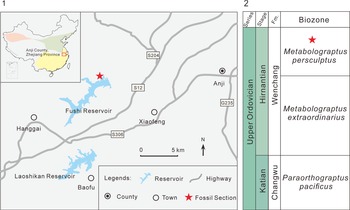
Regional map and stratigraphy. (1) Map of the Fushi Reservoir area (Anji County, Zhejiang Province, South China) showing location of the Tianfucun section where Archopterus anjiensis n. gen. n. sp. was recovered. (2) Lithostratigraphy and biozone showing the approximate position of Archopterus anjiensis n. gen. n. sp. in black mudstones of the Wenchang Formation.

Geological setting and preservation
The eurypterid was recovered from a 10 m thick sponge-bearing sequence of dark mudstone at locality Tianfucun in Anji County, Zhejiang Province, South China (Botting et al., Reference Botting, Muir, Zhang, Ma, Ma, Wang, Zhang, Song and Fang2017). This interval yielding the Anji Biota is dated by abundant graptolites to an age of the latest Ordovician Metabolograptus persculptus Biozone (Muir et al., Reference Muir, Zhang, Botting and Ma2020, Reference Muir, Zhang, Botting and Ma2021), i.e., right after the Hirnantian mass extinction (444 Ma). In the dark mudstone, sponges are exceptionally abundant and diverse, including remarkable early representatives of modern deep-sea lineages such as rossellids (Botting et al., Reference Botting, Janussen, Zhang and Muir2020) and euplectellid hexactinellids (Botting et al., Reference Botting, Janussen, Muir, Dohrmann, Ma and Zhang2022), associated with abundant graptolites, occasional nautiloids, and rare arthropods. Judging from evidence from previous paleogeographic reconstructions and the tectonic setting, the Anji area represented a localized deep-water basin with an estimated depth of several hundred meters (Botting et al., Reference Botting, Muir, Wang, Qie, Tan, Zhang and Zhang2018).
The preservation of sponges (and, potentially, the eurypterid) in the Anji Biota has been proposed to be through partial silicification of carbonaceous soft tissues, with early pyritization and subsequent pyrite dissolution (Wu et al., Reference Wu, Botting, Zhang, Muir and Ma2022). This was due to burial of the fossils by collapsing anoxic nepheloid layers (Botting et al., Reference Botting, Muir, Wang, Qie, Tan, Zhang and Zhang2018; Wu et al., Reference Wu, Botting, Zhang, Muir and Ma2022) followed by rapid reoxygenation of the surface sediment as the temporary benthic anoxia dispersed. The absence of any burrowing, or of typical benthic fossils such as brachiopods and trilobites, is consistent with a low-oxygen but survivable (for sponges) environment on the seafloor, where oxygenation was too low for animals with higher metabolic requirements. The eurypterid was therefore probably living within the water column and entrained within a collapsing nepheloid layer. This is the only eurypterid specimen recovered among thousands of complete sponges, implying that it was either a very rare member of the community or an accidental immigrant into this environment.
Materials and methods
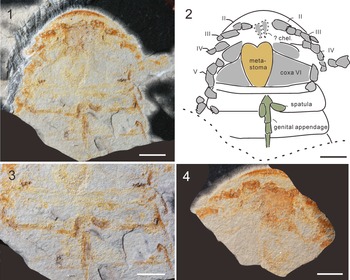
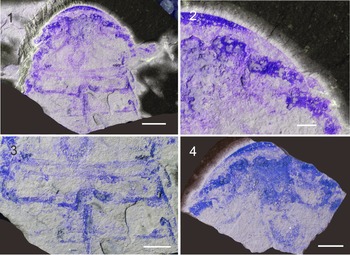
The eurypterid specimen is preserved in weathered (orange color) carbon in a dark gray, well-laminated mudstone matrix (Fig. 2). Eurypterid cuticle is preserved as orange films, but in places it has a shadowy appearance, and details are comparatively poor. Photographs were taken using a Nikon D810 camera under normal and polarized light, which helped resolve the appendages. Image processing was carried out with Adobe Photoshop CC2019 to adjust contrast and color, and plates and interpretive drawing (Figs. 2, 3) were prepared with CorelDRAW X7. Morphological terminology follows Wills (Reference Wills1964), for the genitalia, and Tollerton (Reference Tollerton1989), with modifications (i.e., carapace and metastoma shapes; see the following), illustrating the problem of “forcing” terminology into “boxes” on the basis of a limited number of geometric measurements.
Archopterus anjiensis n. gen. n. sp. (1) Entire specimen, holotype (NIGP 164906). (2) Line drawing of the entire specimen. (3) Close-up of type A genital appendage. (4) Counterpart. Scale bars = 10 mm.

Enhanced image of Archopterus anjiensis n. gen. n. sp., the original color of the fossil adjusted to blue to improve contrast. (1) Entire specimen, holotype (NIGP 164906). (2) Close-up of appendage. (3) Close-up of type A genital appendage. (4) Close-up of metastoma (counterpart). (1, 3, 4) Scale bars = 10 mm; (2) scale bar = 2 mm.

Repository and institutional abbreviation
The specimen used in this study is deposited in the Nanjing Institute of Geology and Palaeontology (NIGP), Nanjing, China, under the repository number NIGP 164906.
Systematic paleontology
Subphylum Chelicerata Heymons, Reference Heymons1901
Order Eurypterida Burmeister, Reference Burmeister1843
Suborder Eurypterina Burmeister, Reference Burmeister1843
Family Adelophthalmidae Tollerton, Reference Tollerton1989
Genus Archopterus new genus
Type and only species
Archopterus anjiensis n. gen. n. sp.
Diagnosis
As for the type species by monotype.
Etymology
Genus name from the Latin prefix arch-, meaning “ancient,” and -opterus, a common suffix for eurypterids, meaning “wing.”
Remarks
With a parabolic-shaped carapace and Hughmilleria-type prosomal appendages, Archopterus has an intermediate Adelophthalmid–hughmilleriid affinity. Most characters are consistent with the Adelophthalmidae Kjellesvig-Waering, Reference Kjellesvig-Waering1951, such as the carapace shape, spinosity of the appendages, and metastoma shape. Adelophthalmids were considered to have appeared in Baltica in the Silurian, with basal forms evolving in the Early Devonian of Euramerica (Tetlie, Reference Tetlie2007). The family includes Adelophthalmus Jordan in Jordan and von Mayer, Reference Jordan and Meyer1854, and the basal forms Bassipterus Kjellesvig-Waering and Leutze, Reference Kjellesvig-Waering and Leutze1966, Eysyslopterus Tetlie and Poschmann, Reference Tetlie and Poschmann2008, Nanahughmilleria Kjellesvig-Waering, Reference Kjellesvig-Waering1961, Parahughmilleria Kjellesvig-Waering, Reference Kjellesvig-Waering1961, Pittsfordipterus Kjellesvig-Waering and Leutze, Reference Kjellesvig-Waering and Leutze1966, and Unionopterus Chernyshev, Reference Chernyshev1948 (see Braddy et al., Reference Braddy, Lerner and Lucas2021 for review). Recently, Pruemopterus has also been added to the family (Poschmann, Reference Poschmann2020). With no spurs present on its abdominal segments, Archopterus is easily distinguished from Adelophthalmus (Størmer, Reference Størmer and Moore1955). Among basal forms, Archopterus is similar to Parahughmilleria in bearing a complex three-segmented type A genital appendage, large spatula, and vase-shaped metastoma with an anterior notch, but Parahughmilleria has reduced appendage spinosity, with isolated spines in places and crenulated distal podomeres, larger epimera and genital spatulae, and coarser ornament. Archopterus is distinguished from Nanahughmilleria by the fact that the former has larger spatula, less spinosity on its appendages, and relatively larger size. Bassipterus is a rare basal form, with appendages II–V of Hughmilleria type with paired ventral spines on each podomere and the paddle bearing a serrated outer edge; these features are also similar to Archopterus, but Bassipterus has a more-complex genital appendage, especially in the second and third joints. Bearing a parabolic carapace, Archopterus can also be easily distinguished from other basal forms, such as Eysyslopterus, Unionopterus, and Pruemopterus.
Archopterus anjiensis new species
Figures 2, 3
- Reference Botting, Muir, Zhang, Ma, Ma, Wang, Zhang, Song and Fang2017
unnamed hughmilleriid; Botting et al., fig. 2a.
Holotype
NIGP 164906, Nanjing Institute of Geology and Palaeontology, CAS, China.
Diagnosis
Adelophthalmid with a parabolic carapace, Hughmilleria-type prosomal appendages, vase-shaped metastoma, and three-segmented type A (female) genital appendage.
Occurrence
Hirnantian (Metabolograptus persculptus Biozone) of the Wenchang Formation of Tianfucun, Anji County, Zhejiang Province, South China.
Description
The carapace is 20 mm long and 28.8 mm wide (length/width ratio 0.69), with a lateral angle of 90° (i.e., “subquadrate” cf. Tollerton, Reference Tollerton1989). The anterior margin is more curved than a typical subquadrate carapace, showing more of a parabolic shape. A narrow (ventral) marginal rim, 1.4 mm wide anteriorly, narrowing to 0.6 mm laterally, surrounds the anterior carapace. The doublure is unknown, although large scales are apparent bordering the marginal rim. A possible robust chelicera, basis square, 1.3 mm wide, fingers 1.3 mm long, occurs near the anterior midline. Partial remains of prosomal appendages II–VI are preserved, mainly on the left side of the specimen. Appendages II and III, of Hughmilleria type, are folded inward on the left side, overlying the posterior appendages, obscuring details. Appendage II is 1.5 mm wide, with the following (*preserved) lengths: II-1 (coxa), 1.9 mm; II-2, 2.4 mm; II-3, 1.1* mm. Appendage III is best preserved (unfolded) on the right side: III-1 (coxa) and III-2 are obscured, III-3 length 2.9 mm, width 1.9 mm, paired distal spines, 1.3–1.6 mm long; III-4 length 2.6 mm, width 1.9 mm, with a tiny anterior spine 0.9 mm long preserved; III-5 length 1.2 mm, width 1.7 mm, with paired tiny spines 0.7 mm long; III-6 length 1.5 mm, width 1.3 mm. Appendage IV is obscured on the left side, but podomeres 3–6 are best preserved on the right side: IV-3 is 1.5 mm long and wide; IV-4 is 2.5 mm long and 1.4 mm wide; IV-5 is 2.5 mm long and 1.3 mm wide; IV-6 is 2.5 mm long and 1.8 mm wide, with a short spur or spine distally. Appendage V is long, projecting posteriorly on the left side: V-1 (coxa) is large, length 7 mm, distal width 4 mm, the anterior gnathobase curved anteriorly; V-2 is 2.7 mm long, 2.8 mm wide; V-3 is 2.8 mm long, width uncertain; V-4 is 2.5 mm long, 2.1 mm wide; V-5 to V-9 uncertain, as disarticulated. Appendage VI may curl over the genital operculum on the left side and projects laterally on the right side, with only disarticulated podomeres.
A slightly displaced metastoma is faintly preserved, its anterior margin with a notch. The shape is classed as “vase shaped” on the basis of Tollerton (Reference Tollerton1989, fig. 5), with a possible flatter posterior margin.
The genital operculum is 8 mm long, each opercular lobe 15 mm wide, preserving large anterior (3 mm long), median, and posterior (4.8 mm long) plates. The genital appendage is interpreted as being a type A (female; Braddy and Dunlop, Reference Braddy and Dunlop1997, but see Kamenz et al., Reference Kamenz, Staude and Dunlop2011); incompletely preserved part is 10 mm long, composed of three segments; deltoid plates are apparent anterior to the genital appendage; large spatulae can be seen. Two paired Blattfüsse are preserved, at least the second unfused, probably also the first (obscured by appendage). Large V-shaped scales are evident in places.
The first opisthosomal segment is reduced, approximately half the length of the others. The metasoma and telson are unknown. The eurypterid is estimated to have had a total body length of 15 cm.
Etymology
The species is named after Anji County, where the type specimen was discovered.
Remarks
Some obvious characters, such as the specific spatula size, can distinguish A. anjiensis from its most similar relatives, such as Parahughmilleria hefteri (Størmer, Reference Størmer1973) and Nanahughmilleria norvegica (Kiær, Reference Kiaer1911).
Discussion
A. anjiensis represents the oldest adelophthalmid and extends the stratigraphic range of this family to Late Ordovician (by about ten million years), making Adelophthalmidae the longest-living eurypterid family (Ordovician to Permian). The new fossil also represents the first unequivocal Ordovician and the oldest eurypterid recorded in China, adding new knowledge to early evolution of eurypterids in Gondwana.
Associated with diverse sponges, Archopterus anjiensis was found in a deep-water environment of several hundred meters deep. This occurrence, along with some Ordovician eurypterids—e.g., Megalograptus from a normal marine environment (Caster and Kjellesvig-Waering, Reference Caster and Kjellesvig-Waering1964)—may indicate that some early eurypterids favored a relatively deeper-water environment than their post-Ordovician relatives, although it is possible that this was a single vagrant individual washed out from more typical shallow-water environments. In addition, this occurrence indicates that adelophthalmids have been found in the widest range of habitats of all eurypterid groups.
Acknowledgments
We thank J. Dunlop and two anonymous reviewers for suggesting improvements to the manuscript. This work was supported by the Strategic Priority Research Program of Chinese Academy of Sciences (XDB26000000) and the National Natural Science Foundation of China (42125201).
Declaration of competing interests
The authors declare that they have no competing interests.