Implications
Transportation is a necessary component of cattle production that is of economic and welfare-related concern to producers and animal scientists because of its association with decreased performance and compromised health of cattle. Continued research in the area of transportation stress, neutrophil function and respiratory disease is crucial in the future improvement of cattle health and welfare. Discoveries presented in the current review offer opportunities for the development of therapeutics, detection of genetic variability with implications for genetic selection, and validation of potential biomarkers of transport stress and subsequent respiratory disease in cattle.
Introduction
The infrastructure of the beef cattle industry in today’s world dictates a need for the transportation of cattle, by road, including within the European Union, and internationally. Transportation of cattle is a stressor that causes a quantifiable biological response. The impact of transportation stress has generated great economic and welfare-related concerns because of its association with increased incidence and severity of bovine respiratory disease, commonly referred to as ‘shipping fever’ (Duff and Galyean, Reference Duff and Galyean2007). The bovine respiratory disease complex (BRDC), a disease of the lower respiratory tract of cattle, has a multifactorial aetiology of infectious agents, host factors, environmental stress factors and their interactions, resulting in bronchopneumonia (Caswell, Reference Caswell2014; Guzman and Taylor, Reference Guzman and Taylor2015). It has long been considered that the occurrence of the BRDC is linked to alterations in immune function caused by multiple stressors (including abrupt weaning, castration and adverse climatic conditions) experienced by newly received beef cattle (Lekeux, Reference Lekeux1995), particularly transport stress (Blecha et al., Reference Blecha, Boyles and Riley1984; Murata et al., Reference Murata and Hirose1987; Griebel et al., Reference Griebel, Hill and Stookey2014).
Infectious causes of BRDC include viral (bovine herpesvirus-1 (BoHV-1), bovine coronavirus, bovine respiratory syncytial virus (BRSV), bovine viral diarrhoea virus, parainfluenza-3 virus (PI-3V), bovine adenoviruses, bovine enterovirus-1, 2 and 3), bacteriological (Mannheimia haemolytica, Pasteurella multocida, Histophilus somni) and mycoplasmal agents (Mycoplasma bovis), many of which are normally present in the bovine respiratory tract (Timsit et al., Reference Timsit, Christensen, Bareille, Seegers, Bisgaard and Assié2013; Guzman and Taylor, Reference Guzman and Taylor2015). Viral shedding is greatest before animals become symptomatic (Guzman and Taylor, Reference Guzman and Taylor2015). Evidence exists that viruses may first alter the immune defence mechanisms of the host, making it possible for opportunistic bacteria to colonise and resulting in pulmonary lesions by toxin production, evidencing a possible synergism between viruses and bacteria (reviewed by Guzman and Taylor, Reference Guzman and Taylor2015). The predominant proposed mechanism is a multifaceted interference with the functions of phagocytic cells that defend the respiratory tract, mainly alveolar macrophages but also neutrophils. Probably the predominant emphasis on phagocytes reflects the long-standing recognition of phagocytes compared with more recently recognised aspects of respiratory immunity, and as a result the amount of research that has been done. However this does not mean that effects on phagocytes are the most important, just the most studied. Furthermore, evidence suggests that viral infection interferes with cilia function and mucociliary clearance, and the effects of stress hormones on tracheal antimicrobial peptides (Meyerholz and Ackermann, Reference Meyerholz and Ackermann2005; Taha-Abdelaziz et al., Reference Tarrant, Kenny, Harrington and Murphy2016). A more recent study suggests that tracheal antimicrobial peptides are among the innate respiratory defences that are dysregulated by the effects of stress and viral infection (Taha-Abdelaziz et al., Reference Tarrant, Kenny, Harrington and Murphy2016).
Due to the multifactorial and complex nature of BRDC, the effectiveness of prevention and treatment of the disease has been promising. Preconditioning programmes are highly effective in prevention, as is mass administration of long-acting antibiotics. For example, the effectiveness of metaphylaxis with tulathromycin for prevention of BRDC has been revolutionary (Hendrick et al., Reference Hendrick, Bateman and Rosengren2013).
Cattle are commonly vaccinated against BoHV-1, BRSV, PI-3V, M. haemolytica and H. somni with combinations of modified live virus, killed virus, bacterins or bacterial culture extracts. Although viral infection is usually primary in the pathogenesis of BRDC, vaccination against viruses alone is not effective in the prevention of the disease. Preconditioning is favoured as an effective method for the prevention of morbidity and mortality due to BRDC. During preconditioning, animals are weaned, vaccinated, castrated, dehorned and handled in advance of transportation as opposed to occurring simultaneously or after cattle are transported (Duff and Galyean, Reference Duff and Galyean2007). Swanson and Morrow-Tesch (Reference Swanson and Morrow-Tesch2001) reported that young cattle exhibit increased mortality and morbidity during transportation compared with older cattle due to a lack of exposure to the new environment and a naive immune system. In contrast, Knowles et al. (Reference Knowles1997) found a negative correlation between age at transport and mortality. Although the BRDC is a multifactorial condition, it is arguably of greatest importance to gain a better understanding of the mechanisms that drive the compromised immune function that first allows invasion of opportunistic pathogens (Caswell, Reference Caswell2014).
Physiological effects of transportation stress on cattle
Many physiological changes have been observed in association with transportation of cattle. Stress in animals occurs when an animal’s homoeostasis is disrupted, the stress response consists of a set of physiological mechanisms designed to return to homoeostasis. Indicators of the activation of the sympathetic adrenomedullary axis are seldom used, although increases in plasma epinephrine and norepinephrine have been observed in transported calves (Mitchell et al., Reference Mitchell, Hattingh and Ganhao1988; Agnes et al., Reference Agnes, Sartorelli, Abdi and Locatelli1990).
A decrease in glucocorticoid receptor (GR) and β-adrenergic receptor (a catecholamine receptor) expression in lymphocytes has been observed, and measurement of these receptors has been suggested as a more reliable indicator of stress than measurement of their corresponding stress hormones (Odore et al., Reference Odore, D’Angelo, Badino, Bellino, Pagliasso and Re2004). Circulating cortisol as an indicator of hypothalamic–pituitary–adrenal (HPA) axis activation is the most commonly utilised measurement, and increases have been observed in nearly all transportation studies of cattle as compared with pre-transportation concentrations or those obtained from non-transported counterparts (Simensen et al., Reference Simensen, Laksesvela, Blom and Sjaastad1980; Murata et al., Reference Murata and Hirose1987; Warriss et al., Reference Warriss, Brown, Knowles, Kestin, Edwards, Nolan and Phillips1995; Arthington et al., Reference Arthington, Eicher, Kunkle and Martin2003; Odore et al., Reference Odore, D’Angelo, Badino, Bellino, Pagliasso and Re2004; Buckham Sporer et al., Reference Buckham Sporer, Burton, Earley and Crowe2007; Gupta et al., Reference Gupta, Earley and Crowe2007; Schwartzkopf-Genswein et al., Reference Schwartzkopf-Genswein, Faucitano, Dadgar, Shand, González and Crowe2012). The magnitude of the cortisol response has been related to the pre-transport rearing conditions (farm facility and market), age of cattle transported, loading, duration of the journey, unloading and post-transport lairage conditions. Extensively raised animals exhibit more psychological or fear stress during loading and unloading compared with more intensively reared animals (Grandin, Reference Grandin1997). In young and older cattle, cortisol concentration is reported to increase following loading, during the first part of a journey and after unloading (Warriss et al., Reference Warriss, Brown, Knowles, Kestin, Edwards, Nolan and Phillips1995; Knowles, Reference Knowles, Warriss, Brown, Edwards, Watkins and Phillips1999). Furthermore, Warriss et al. (Reference Warriss, Brown, Knowles, Kestin, Edwards, Nolan and Phillips1995) reported that while plasma cortisol concentrations increased in cattle following loading, values returned to normal as the journey continued. In contrast, Tarrant et al. (Reference Taha-Abdelaziz, Wyer, Berghuis, Bassel, Clark and Caswell1992) and Dixit et al. (Reference Dixit, Marahrens and Parvizi2001) reported that for cattle, the actual journey was more stressful than loading and unloading. Overall loading, transportation itself and unloading has an important role in determining the increased cortisol response relative to the pre- and post-transport rearing conditions. In the lairage, animals may be exposed to the relatively greater psychological stress of mixing and noise and less physical stress such as fighting and mounting (Grandin, Reference Grandin1997).
Following transportation, decreased cortisol or cortisol concentration approaching that of pre-transportation levels was observed in a number of studies (Murata et al., Reference Murata and Hirose1987; Knowles, Reference Knowles, Warriss, Brown, Edwards, Watkins and Phillips1999; Odore et al., Reference Odore, D’Angelo, Badino, Bellino, Pagliasso and Re2004). After transporting cattle (4 to 6 months old) for 4 and 14 h, the plasma cortisol concentration recovered rapidly following 4 and 24 h, respectively (Odore et al., Reference Odore, D’Angelo, Badino, Bellino, Pagliasso and Re2004). However, given optimal husbandry management, it has been suggested that a 24 h period in a lairage is necessary for adequate physiological recovery of biological variables to pre-transport baseline levels in animals after transport (Knowles, Reference Knowles, Warriss, Brown, Edwards, Watkins and Phillips1999; Earley et al., Reference Earley and O’Riordan2013).
Haematological cell changes indicative of a stress response
Increased total white blood cell numbers, neutrophils, basophils, packed cell volume and haemoglobin and decreased lymphocytes, lymphocyte blastogenic responses (Blecha et al., Reference Blecha, Boyles and Riley1984; Murata et al., 1987), eosinophils and monocytes are the common changes observed following transportation of all age groups of cattle. Neutrophils have been implicated in the pathogenesis of numerous inflammatory diseases, particularly those in the respiratory tract. Neutrophils are phagocytic granulocytes responsible for rapid migration to infection foci and pathogen clearance there as well as important roles in cell–cell communication and tissue remodelling. In fact, neutrophils may be responsible for excessive inflammation and tissue damage observed in the BRDC associated with transportation-stressed cattle (Maheswaran et al., Reference Maheswaran, Weiss, Kannan, Townsend, Reddy, Whiteley and Srikumaran1992; Lekeux, Reference Lekeux1995; Wessely-Szponder et al., Reference Wessely-Szponder, Bobowiec, Martelli, Wojcik and Kosior-Korzecka2004). A profound leukocytosis, marked by neutrophilia may occur in conjunction with a decrease in the number of lymphocytes (Blecha et al., Reference Blecha, Boyles and Riley1984; Preisler et al., Reference Preisler, Weber, Tempelman, Erskine, Hunt and Burton2000), indicating a disruption of neutrophil homoeostasis in response to stress in cattle. There is also evidence that antibacterial functions may also be attenuated in neutrophils during a viral infection (Yates, Reference Yates1982). Ishizaki and Kariya (Reference Ishizaki and Kariya2010) have suggested that monitoring natural killer (NK) cell numbers in blood may provide a more specific measure of transportation stress responses than differential leucocyte counts.
Haematocrit levels are elevated with transportation in association with higher erythrocyte counts in the circulation (Tarrant et al., Reference Taha-Abdelaziz, Wyer, Berghuis, Bassel, Clark and Caswell1992). Increased haematocrit levels are indicative of dehydration during transport and values have been reported to return to normal after access to water and hay in the 24 h period post-transport (Earley et al., Reference Earley, Drennan and O’Riordan2006 and Reference Earley and O’Riordan2013).
The neutrophil paradox and bovine respiratory disease complex
The involvement of neutrophils in the pathogenesis of BRDC is a perfect example of the neutrophil paradox, as evidenced by a study that evaluated the effects of M. (Pasteurella) haemolytica infection in calves with sufficient and deficient neutrophil numbers. Extensive pulmonary lesions were found in both groups of calves, indicating severe tissue damage by both neutrophil-dependent and neutrophil-independent mechanisms (Breider et al., Reference Breider, Walker, Hopkins, Schultz and Bowersock1988). The major mechanism behind the neutrophil-mediated tissue damage in the respiratory tract is thought to be due to the massive infiltration of cells during an immune challenge; it has also been suggested that the state, in combination with simply the presence, of neutrophils in the tissue is important to their destructive potential (Haslett et al., Reference Haslett, Savill and Meagher1989). In fact, neutrophils may become sequestered in the pulmonary vasculature by several mechanisms (Doerschuk et al., Reference Doerschuk, Beyers, Coxson, Wiggs and Hogg1993; Burns et al., Reference Burns, Issekutz, Yagita and Issekutz2001), mainly because the size of the capillaries in the lungs is smaller than the diameter of neutrophils themselves. This may increase the length of time that the neutrophils are in contact with pulmonary tissue. Neutrophils are also capable of releasing inflammatory mediators, such as CXCL8, that recruit more neutrophils to sites of infection (Harada et al., Reference Harada, Sekido, Akahoshi, Wada, Mukaida and Matsushima1994). Furthermore, a delay in apoptosis and inability by macrophages to effectively clear great numbers of neutrophils could exacerbate this state. It follows that simply the number of these cells would not be enough to cause tissue damage unless they were releasing their toxic contents into the tissue. Several reports have found neutrophil-derived contents in the respiratory tract in concurrence with disease and injury. Elevated levels of myeloperoxidase, elastase, alkaline phosphatase and nitric oxide activity, which are all known to contribute to lung injury, were found in neutrophils of heifers with respiratory tract infections (Wessely-Szponder et al., Reference Wessely-Szponder, Bobowiec, Martelli, Wojcik and Kosior-Korzecka2004). Matrix metalloproteinases (MMPs), especially gelatinases, released from neutrophil tertiary granules have been implicated in tissue damage and have been found produced by neutrophils that were isolated from lung lesions and exposed to M. (Pasteurella) haemolytica products (Starr et al., Reference Starr, Dan, Minhas, Shewen and Coomber2004).
A proposed mechanism for the release of the above agents in association with lung injury during BRDC proceeds from the interaction of M. (Pasteurella) haemolytica leukotoxin and neutrophils (Lekeux, Reference Lekeux1995). This bacterial toxin stimulated respiratory burst and degranulation is reported to cause the cytolysis of neutrophils (Maheswaran et al., Reference Maheswaran, Weiss, Kannan, Townsend, Reddy, Whiteley and Srikumaran1992). It is possible that the proteolytic enzymes and reactive oxygen species released into surrounding lung tissue may cause more severe damage than the leukotoxin itself, exacerbating an already dangerous pathological state. It is also probable that other mechanisms such as a delay in apoptosis and an overwhelming of neutrophil-clearing macrophages play roles in neutrophil-mediated tissue damage associated with the BRDC. Although many reports have investigated neutrophil function during natural and experimental cases of the BRDC (Maheswaran et al., Reference Maheswaran, Weiss, Kannan, Townsend, Reddy, Whiteley and Srikumaran1992; Coomber et al., Reference Coomber, Nyarko, Noyes and Gentry2001; Wessely-Szponder et al., Reference Wessely-Szponder, Bobowiec, Martelli, Wojcik and Kosior-Korzecka2004), there are limited studies that have explored neutrophil function during transportation of cattle (Murata et al., 1987). Thus, decreased apoptosis of neutrophils in combination with increased migratory capacity in dairy cows after 4 h of transportation, support a potential enhancement of the pro-inflammatory response.
Immunological response to transport stress
Alterations in calf immunity are of great importance following transportation stress as these alterations are thought to be associated with increased incidence and severity of respiratory disease (Blecha et al., Reference Blecha, Boyles and Riley1984). Most of the immunological changes relate to immune cell numbers in the blood, in lung tissues and immune cell function.
The immune system is divided into innate and adaptive responses which work in an integrated manner to provide protection from pathogens and disease. The innate immune system is evolutionary conserved and non-specific, and therefore, effective immediately upon exposure against wide variety of potential pathogens (Sordillo, Reference Sordillo2016). The adaptive immune system provides specific responses to infectious pathogens, and therefore, can take several days to mount a response (Sordillo, Reference Sordillo2016). Transportation of cattle alters their susceptibility to diseases by disturbing their cellular (Simensen et al., Reference Simensen, Laksesvela, Blom and Sjaastad1980) and humoral (Murata et al., Reference Murata and Hirose1987) immune responses. A particular stressor may enhance the cell-mediated immune responses while suppressing humoral responses or vice versa, thus disrupting the balance between these components of the immune system (Salak-Johnson and McGlone, Reference Salak-Johnson and McGlone2007). A shift away from a Th1 cell-mediated response can result in increased susceptibility to viral infections. The bias for a Th2 response following stress may enhance protection against bacterial pathogens while dampening the response to viral antigens (Salak-Johnson and McGlone, Reference Salak-Johnson and McGlone2007). This has important implications for weaned beef calves as BRD is typically characterised by an initial viral infection followed by a secondary bacterial infection. Future work should address the complexity of the relationship between stress and Th1/Th2 balance in weaned beef calves and those likely to succumb to BRD following transportation and housing.
Riondato et al. (Reference Riondato, D’Angelo, Miniscalco, Bellino and Guglielmino2008) investigated effect of transport on peripheral blood lymphocyte subsets in calves by flow cytometry. A decrease in the percentages of all T lymphocyte subsets was evident immediately post-transport. The proportion of CD21+ cells did not change, indicating that the relative reduction of T lymphocyte subsets was not related to an increase in B lymphocytes. The authors suggested that these may be due to the increase of a NK cell subset and increasing major histocompatibility complex (BoLA) class II expression, indicating stress-induced stimulation of the immune system. In addition, BRSV infection is reported to induce MHC (BoLA) class II-restricted CD4+ and BoLA class I-restricted CD8+ T cells (Taylor et al., 1995). Thus, depletion of T cells in the respiratory tract could potentially lead to delayed BRSV clearance in calves suggesting that cell-mediated immunity must also be important for protection in cattle.
Murata et al. (Reference Murata and Hirose1987) reported a reduction in T lymphocyte numbers and no change in B lymphocyte numbers following transportation of cattle (4 to 6 months old). Decreased mitogen-driven lymphocyte stimulation, which is one of the fundamental parameters of immune reactivity, was reported during transportation stress in cattle. A decrease in lymphocyte blastogenesis or cytokine production in response to an antigen has been observed (Blecha et al., Reference Blecha, Boyles and Riley1984; Murata et al., Reference Murata and Hirose1987). Dixit et al. (Reference Dixit, Marahrens and Parvizi2001) observed that immunoglobulin G1 concentrations were elevated in transported calves as compared with non-transported controls, indicating a possible enhanced function of the B lymphocyte subsets. In contrast, several reports on increased lymphocyte blastogenesis in response to mitogen stimulation following transport in cattle have been published (Murata et al., Reference Murata and Hirose1987; Murata and Hirose, Reference Murata, Takahashi and Matsumoto1991; Swanson and Morrow-Tesch, Reference Swanson and Morrow-Tesch2001). The data by Murata et al. (Reference Murata and Hirose1987) represent the assays available at the time, but these parameters (i.e. minor changes in T cell number or mitogen-driven lymphocyte stimulation, etc.) may be of limited relevance to immunocompetence. Those data based on in vitro measurements are poor estimates of immune function and therefore are not highly informative, and have the potential to entrench erroneous dogma about the mechanisms of transport-associated immunosuppression. Therefore, more valid data based on more meaningful contemporary assays of immune function are warranted.
Acute phase response
Another marker of an inflammatory response is the release of a group of proteins known as acute phase proteins. These are secreted by hepatocytes in response to injury, trauma or infection and may be directly stimulated by glucocorticoids. Their presence in the circulation may be an excellent biomarker of inflammation as they are readily measurable in serum or plasma and may even discriminate between acute and chronic inflammation in cattle. Results in the literature concerning changes in acute phase protein concentrations during transportation stress are variable. Although stressors are considered to activate the acute phase response (Arthington et al., Reference Arthington, Eicher, Kunkle and Martin2003), there are conflicting reports, centred mainly on the management and breed of the animals, regarding this response in livestock (Qiu et al., Reference Qiu, Arthington, Riley, Chase, Phillips, Coleman and Olson2007). Following transportation, reduced concentrations of haptoglobin and fibrinogen were reported in bulls transported for 9 h in a truck (Buckham Sporer et al., Reference Buckham Sporer, Burton, Earley and Crowe2008). In contrast, Phillips et al. (Reference Phillips, Juniewicz, Zavy and Von Tungeln1989) reported increased concentration of fibrinogen following assembly and transport of beef calves. In a study transporting bulls at different stocking densities, plasma haptoglobin concentrations were unchanged, whereas plasma fibrinogen levels were reduced (Earley and O’Riordan, Reference Earley, Fisher and O’Riordan2006). Plasma fibrinogen was greatly increased in long distance transportation (Tarrant et al., Reference Taha-Abdelaziz, Wyer, Berghuis, Bassel, Clark and Caswell1992). However, further work is required before these proteins can be universally applied to all husbandry stressors, specifically co-mingling, weaning and transportation of calves.
Gene expression changes during transportation stress
Mechanistically, cortisol influences the expression of multiple genes and thus the phenotype of target tissues that co-ordinate the body’s response to stress. Gene expression regulation results from the binding of cortisol to its GR in the cytoplasm of target cells, with subsequent translocation of hormone-activated receptors into the nucleus and modulation of gene transcription by direct (receptor–DNA) and indirect (receptor–protein–DNA) interactions in regulatory regions of cortisol-sensitive genes (Preisler et al., Reference Preisler, Weber, Tempelman, Erskine, Hunt and Burton2000; Weber et al., Reference Weber, Madsen-Bouterse, Rosa, Sipkovsky, Ren, Almeida, Kruska, Halgren, Barrick and Burton2006). In addition, bovine neutrophils have been shown to exhibit differential expression of genes important to roles of immune function, apoptosis, tissue remodelling, and various metabolic and cellular functions in response to glucocorticoids in vitro and in vivo (Burton et al., Reference Burton, Madsen, Chang, Weber, Buckham, van Dorp, Hickey and Earley2005). Findings from these studies have implicated the downregulation of L-selectin as an important factor mediating neutrophilia (Burton et al., Reference Burton, Madsen, Chang, Weber, Buckham, van Dorp, Hickey and Earley2005). More recently, Lynch et al. (Reference Lynch, McGee, Doyle and Earley2012) reported that neutrophil surveillance and phagocytic activity were affected by weaning in beef calves; however, bactericidal activity was unaffected. In their study, post-weaning, peripheral neutrophil number increased which was related to decreased surface expression of L-selectin/CD62L as defined by its reduced mean fluorescent intensity on blood neutrophils. Reduction of this adhesion molecule from the surface of neutrophils, where it is constitutively expressed on resting cells before activation, suggests that weaning may have had a negative impact on the ability of these cells to roll along and adhere to the endothelium lining of vessels and thus, more cells remained in circulation as evidenced by neutrophilia (Lynch et al., Reference Lynch, McGee, Doyle and Earley2012). This phenomenon has been documented in stressed cattle, most notably coinciding with parturition (Burton et al., Reference Burton, Madsen, Chang, Weber, Buckham, van Dorp, Hickey and Earley2005) and following transportation (Yagi et al., Reference Yagi, Shiono, Chikayama, Ohnuma, Nakamura and Yayou2004).
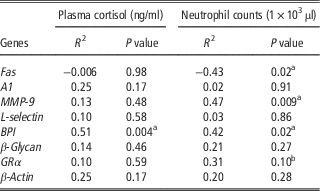
The expression changes of candidate neutrophil genes known to be altered in other stress models as well as novel genes on a transcriptome-wide scale in relation to transportation of young cattle was investigated by Sporer et al. (Reference Sporer, Xiao, Tempelman, Burton, Earley and Crowe2008). The genes selected for profiling were sensitive to glucocorticoids in other stress models (Burton et al., Reference Burton, Madsen, Chang, Weber, Buckham, van Dorp, Hickey and Earley2005; Weber et al., Reference Weber, Madsen-Bouterse, Rosa, Sipkovsky, Ren, Almeida, Kruska, Halgren, Barrick and Burton2006) and included Fas, A1, MMP-9, L-selectin, bactericidal/permeability-increasing protein (BPI), transforming growth factor-β receptor type III (subsequently referred to as β-glycan), and GRα. In all, 88 genes were found to be differentially expressed between −24 and 4.5, 9.75 or 14.25 h relative to transport, when cortisol and neutrophilia were at their peaks. Differentially expressed genes fell into three major functional groups: immune function, apoptosis and wound healing. These expression changes largely correlated with the neutrophil count profile (Table 1), which relates to blood cortisol concentration in numerous models of bovine stress (Burton et al., Reference Burton, Madsen, Chang, Weber, Buckham, van Dorp, Hickey and Earley2005; Weber et al., 2006; Buckham Sporer et al., Reference Buckham Sporer, Burton, Earley and Crowe2008). To our knowledge, this is the first study (Buckham Sporer et al., Reference Buckham Sporer, Burton, Earley and Crowe2008) that has reported transportation-induced changes in the expression of key neutrophil inflammatory and antibacterial genes in association with peak cortisol and neutrophilia stress responses. The observed gene expression changes for Fas, expression profiles for Fas, MMP-9, L-selectin and BPI were altered in these truck-transported bulls, suggesting that stress reprogrammes blood neutrophils for longer lifespan, increased proteolytic and tissue sterilising capabilities and preferential migration into the respiratory tract. While small, this subset of affected genes perfectly supports the notion of the ‘neutrophil paradox’, whereby crucial immune defence activities are counterbalanced by excessive inflammatory tissue destruction. Based on these findings, a broader investigation of the bovine neutrophil transcriptome during transportation stress seems warranted to gain a greater understanding of the neutrophil paradox, especially as it relates to severe respiratory disease in newly arrived feedlot cattle. Transportation stress could be part of this struggle, which may determine the outcome of opportunistic infections.
Pearson’s correlation coefficients (R 2) and associated P values for relationships between neutrophil gene expression, plasma cortisol concentrations and blood neutrophil counts

Buckham Sporer et al. (Reference Buckham Sporer, Burton, Earley and Crowe2008).
a Represents a significant relationship (P⩽0.05).
b Represents a tendency for relationship (P⩽0.10).
More importantly, because beef calves are typically weaned immediately before loading onto trucks for transport to feedlots, assessment of these dual stressors on neutrophil function, gene expression and hormonal stress profiles is warranted. Results from this work may yield a signature profile of potential genomic and phenotypic biomarkers for the detection of weanlings at risk of severe respiratory disease following arrival at the feedlot and might allow for early detection of morbid animals.
Conclusions
The ability to treat the BRDC especially in multiple sourced and co-mingled-transported animals, is increasing. With the emergence of antibiotic-resistant pneumonia in feedlot cattle, a more targeted and selective use of antimicrobials in the animal industries will be essential. It has long been observed that stress has a number of effects on respiratory immunity, response to infection, upregulation and downregulation of inflammatory responses, regulation of bacterial growth, repair of injured tissue, etc. Many researchers have implicated a suppression of the host’s immune system by stress that allows opportunistic infectious pathogens to invade. Furthermore, substantial evidence has suggested that this immunosuppression is mediated by glucocorticoids following HPA axis activation by a stressor. Neutrophils, as well as many other immune cells, are well-known targets of stress hormones, possessing receptors for catecholamines and glucocorticoids secreted during an acute stress response (Burton et al., Reference Burton, Madsen, Chang, Weber, Buckham, van Dorp, Hickey and Earley2005). Although many reports have investigated neutrophil function during natural and experimental cases of BRD (Maheswaran et al., Reference Maheswaran, Weiss, Kannan, Townsend, Reddy, Whiteley and Srikumaran1992; Coomber et al., Reference Coomber, Nyarko, Noyes and Gentry2001; Wessely-Szponder et al., Reference Wessely-Szponder, Bobowiec, Martelli, Wojcik and Kosior-Korzecka2004), none have investigated the effects of weaning alone or in combination with transportation on neutrophil gene expression, let alone on a transcriptome-wide scale. Tools developed in the past decade in the fields of functional genomics and proteomics have allowed for the identification of thousands of molecular changes at once in physiological or disease states. Use of these tools may discover potential targets for therapeutics and genetic selection and may present a pattern of genomic or proteomic changes as biomarkers of a stress response. In future studies, it may be beneficial to investigate neutrophil gene expression and phenotypic changes in actual diseased cattle in order to draw conclusions on how these changes in neutrophil function correspond to their ability to ward off infectious pathogens. The BRDC is the most common economically important disease affecting cattle. To develop accurate diagnostics that can predict disease susceptibility/resistance and stratification, it is essential to elucidate the molecular mechanisms that underlie BRDC in the host animal. To gain a greater understanding of the complex interactions between the bovine host and the multitude of viral and bacterial pathogens as well as the environmental factors associated with BRDC aetiology, genome-scale high-throughput functional genomics methods such as RNA-seq and complementary bioinformatics are essential and have the potential for identifying diagnostic markers or signatures that are indicative of the disease and its severity (Rai et al., Reference Rai, Epperson and Nanduri2015). In addition, the identification of genes and molecular networks which influence host biological response to bacterial and viral infections is a critical step towards identifying the specific genetic variants within the bovine genome, which enable the establishment of infection and reduce the efficacy of immune responses. These variants may be directly selected in cattle populations to reduce the prevalence of multi-agent diseases such as the BRDC.
Acknowledgements
This review is based on an invited presentation at the 65th Annual Meeting of the European Association for Animal Production held in Copenhagen, Denmark, August 2014.